Digital agencies today are navigating a landscape that moves faster than traditional hiring cycles can support. Client expectations are rising. Technical scopes are expanding. AI, automation, cloud engineering and multi-platform development have become the norm — not the exception.
Yet most agencies in the US, UK, Canada, Australia, and New Zealand face the same structural challenge:
How do we take on more high-value work without overextending our in-house team, compromising quality, or burning out our best people?
This is where the dedicated development team model has rapidly evolved from a “nice-to-have” to a core strategic growth lever for agencies worldwide.
Unlike traditional outsourcing (which is task-oriented), a dedicated development team functions as a long-term, fully integrated extension of your agency — reinforcing capacity, adding specialized expertise, and helping you scale without the risks and overhead of permanent hiring.
In this pillar guide, we’ll break down the entire model, backed by industry trends, global talent shifts, and real-world agency needs. And throughout the guide, we will explore how hybrid offshore partners such as Bantech Solutions are redefining what “outsourcing to India” looks like — replacing old stereotypes with a modern partnership model built on transparency, technical excellence, and operational alignment.
What Is a Dedicated Development Team for Agencies?
A dedicated development team for agencies is a structured, long-term engagement model where a remote team of developers, designers, QA testers, DevOps engineers, and project managers works exclusively on your agency’s projects.
They function like an internal department, but are employed, trained, and managed by a trusted outsourcing provider.
Think of it as having your own battle-ready digital production unit, but without:
- the recruiting burden
- salary overhead
- HR management
- infrastructure costs
- geographical hiring limitations
It is not freelancers. It is not project-by-project outsourcing. It is not temporary support.
This is your team, just not under your payroll.
The Dedicated Team Model Includes:
- Long-term collaboration (6–36 months+)
- Full-time specialists assigned only to your agency
- Structured communication — daily standups, sprint planning, reviews
- Role expansion flexibility (add a designer, QA, DevOps whenever needed)
- Governed by SLAs & performance metrics
- Aligned with your tech stack, culture, and delivery standards
For Agencies, This Means:
- Never turning down projects due to bandwidth issues
- Serving larger clients with confidence
- Increasing operational margins
- Becoming a “full capability” agency without in-house hiring
- Instant access to niche skills such as Shopify, Laravel, React, Node.js, HubSpot, Webflow, AI integrations, etc.
And this is precisely where partners like Bantech Solutions stand out — by providing dedicated teams who aren’t just technically capable, but are trained to think like agency developers, understand white-label dynamics, and communicate with Western clients flawlessly.
Why the Dedicated Team Model Is Surging in Western Agency Markets
Over the last five years, the dedicated team model has shifted from a niche outsourcing tactic to a mainstream strategic choice among digital agencies worldwide. Several macro trends are driving this shift.
Trend 1: Rising Talent Shortages in Western Countries
In the US, UK, Canada, Australia, and New Zealand, the demand for skilled developers far outpaces supply.
According to global hiring reports:
- 65% of agencies say recruiting developers takes longer than 8 weeks
- Senior developers cost 2.5–4× more in Western markets than India or Eastern Europe
- Retention is increasingly unstable, with average tenures dropping below 18 months
Agencies cannot execute aggressive growth plans when they can’t hire fast enough. A dedicated team solves this by giving access to pre-vetted, full-time specialists, usually within 1–2 weeks.
Trend 2: The Rise of Multi-Disciplinary Projects
Modern client work spans:
- Branding
- UX/UI
- Full-stack development
- Integrations & automation
- E-commerce engineering
- Web apps
- Mobile apps
- SaaS platforms
- Maintenance & continuous optimization
Most small-to-mid agencies cannot sustain all these skills internally. A dedicated team gives you the flexibility to assemble an outsourced design & dev team that covers every role needed for complex delivery.
Trend 3: Agencies Are Moving Toward Predictable Production Capacity
Agency profitability depends on predictable delivery. But freelancers and ad-hoc contractors create variability:
- Missed deadlines
- Inconsistent code quality
- Unscalable workflows
- Lack of accountability
Dedicated teams, on the other hand, operate under a consistent production rhythm, giving agencies stability and ensuring that internal teams don’t get overwhelmed.
Trend 4: Global Acceptance of Remote, Distributed Teams
The pandemic catalyzed the normalization of remote work. Today:
- Agencies in New York work with designers in Lisbon and developers in India.
- Australian firms collaborate seamlessly with QA teams in Vietnam.
- UK agencies run distributed engineering pods across Europe and Asia.
Remote collaboration is no longer experimental — it’s the new default.
This global shift has positioned countries like India (especially partners like Bantech Solutions) as prime sourcing hubs for agencies wanting high skill, low risk, and strong English communication.
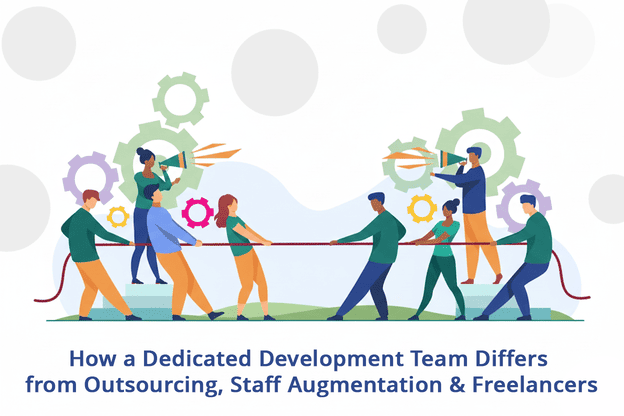
How a Dedicated Development Team Differs from Outsourcing, Staff Augmentation & Freelancers

Many agencies confuse these delivery models, leading to misaligned expectations. Let’s break them down simply.
1. Dedicated Development Team (The Gold Standard for Agencies)
- Full-time
- Long-term collaboration
- Works exclusively on your projects
- Functions like an internal team
- Managed jointly by your PM + the partner’s delivery lead
- Ideal for scaling agencies
This model offers the best balance of cost, control, and continuity.
2. Traditional Outsourcing (Project-Based)
- Fixed scope, fixed cost
- Limited flexibility
- Best for small, one-off deliverables
- Not suitable for dynamic agency workloads
3. Staff Augmentation
- Renting individual developers
- Limited cohesion
- Developers may work for multiple clients
- Good for short-term skill gaps, not long-term scaling
4. Freelancers
- Cheapest option, but least reliable
- Limited accountability
- Inconsistent quality
- High churn and unpredictable timelines
| Criterion | Dedicated Team | Outsourcing | Freelancers |
| Long-term alignment | ⭐⭐⭐⭐⭐ | ⭐⭐ | ⭐ |
| Code quality & consistency | ⭐⭐⭐⭐⭐ | ⭐⭐⭐ | ⭐⭐ |
| Brand integration (white-label) | ⭐⭐⭐⭐⭐ | ⭐⭐ | ⭐ |
| Scalability | ⭐⭐⭐⭐⭐ | ⭐ | ⭐ |
| Predictability | ⭐⭐⭐⭐⭐ | ⭐⭐⭐ | ⭐ |
| Partnership model | Strong | Transactional | Transactional |
Agencies that operate on recurring retainers or multi-phase projects cannot rely on fragmented production models. They need a unified, accountable, deeply embedded team — which is exactly what the dedicated team model provides.
This is also why Bantech’s hybrid model resonates:
You get the control of in-house hiring, the cost efficiency of offshore, and the consistency of a long-term partnership.
The Strategic Advantages of a Dedicated Development Team for Agencies
As agencies scale, their operational challenges become more complex. They are expected to deliver faster, maintain higher quality, diversify their capabilities, and keep overhead under control — all while navigating market fluctuations. A dedicated development team addresses these challenges with a combination of predictability, flexibility, and deep integration that no other outsourcing model offers.
Below are the core strategic advantages that matter most to Western agencies.
Advantage 1: Scalable Production Capacity Without Hiring Risks
In the US, UK, Canada, Australia, and New Zealand, hiring high-quality developers is both expensive and slow. Salaries, benefits, taxes, and turnover costs put immense pressure on agency margins.
A dedicated team allows agencies to scale production capacity on demand:
- Add more developers for a major client project
- Reduce team size during slower seasons
- Expand into new service lines (e.g., Shopify, Laravel, Webflow, Mobile Apps)
- Avoid long-term salary liabilities
Because the team is employed by the partner organization, agencies avoid recruitment bottlenecks and HR overhead.
Bantech Solutions, for example, offers flexible scalability models that let agencies increase or reduce team members with minimal friction — enabling true operational agility.
Advantage 2: Deep Integration With Your Processes, Tools & Culture
Unlike freelancers or short-term contractors, dedicated developers:
- Attend daily standups
- Work inside your project management tools (Jira, Asana, ClickUp)
- Follow your coding standards
- Adopt your design systems
- Communicate directly with your internal PMs and client-facing teams
- Understand your clients, your verticals, and your way of working
This creates continuity, which is crucial for long-term projects or retainer work.
Agencies that adopt dedicated teams often report:
- Faster iteration cycles
- Lower QA effort due to shared context
- Consolidated documentation
- Higher satisfaction from internal and external stakeholders
In many ways, a dedicated team becomes an invisible extension of your agency, especially when delivered through a partner well-versed in white-label collaboration like Bantech.
Advantage 3: Better Project Margins & Predictable Cost Structure
Margins determine agency sustainability. A dedicated team model gives agencies:
- Lower cost per developer compared to Western hiring
- Fixed monthly costs instead of unpredictable freelance expenses
- No recruitment fees
- No infrastructure expenses
- No employee benefits or HR overhead
Instead of struggling to maintain 20–30% margins, agencies can consistently achieve 40–60% margins when using dedicated offshore teams effectively.
Further, the predictability of monthly retainers improves budgeting, cash flow planning, and resource forecasting.
Advantage 4: Access to Multidisciplinary Specialists
A modern digital project may require:
- Full-stack dev
- UX/UI
- QA
- DevOps
- Cloud architecture
- API specialists
- CMS experts
- Security compliance
Very few agencies can build all of these capabilities in-house.
A dedicated team unlocks a multidisciplinary talent pool that agencies can leverage without needing to maintain niche specialists full-time.
Bantech’s hybrid model is particularly effective here — because agencies don’t need to hire a full team upfront. They can start with a small pod and expand into additional roles as project complexity grows.
Advantage 5: Higher Quality Through Long-Term Accountability
Project-based outsourcing generally encourages speed over quality. Freelancers work task-to-task with limited context. But a dedicated team:
- Owns the product long term
- Understands architectural decisions deeply
- Avoids technical debt
- Maintains consistent coding patterns
- Supports post-launch optimization and iteration
Quality improves because the team is invested in continuity — not just quick delivery.
Agencies that use dedicated teams often report a 20–40% drop in rework time because the same developers remain with the product end-to-end.
Advantage 6: Improved White-Label Delivery
If your agency works with end clients under a white-label model, a dedicated team is uniquely suited for this purpose.
Why?
Because they are:
- Consistent
- Predictable
- Well-trained to represent your brand
- Invisible to the client when required
- Capable of understanding your delivery standards
This is where Bantech excels — their teams are trained specifically for white-label communication etiquette, ensuring the client experience remains seamless and on-brand.
When Should an Agency Hire a Dedicated Development Team?
While the dedicated team model is powerful, it shines brightest when deployed at the right moments in an agency’s growth journey. Below are the most strategic triggers.
1. When You’ve Outgrown Freelancers
If your projects are frequently delayed, inconsistent, or require heavy micromanagement, you’ve surpassed the “freelancer ceiling.” That’s the point where agencies must switch from fragmented production to a stable, unified team.
- When You’re Losing Projects Due to Bandwidth Constraints
Many agencies say yes to new work and figure out the execution later — often leading to burnout or compromised quality.
If your agency is turning away work or delivering slower due to lack of internal bandwidth, a dedicated team removes this bottleneck permanently.
3. When You Want to Add New Capabilities Without Hiring Internally
Say you want to expand into:
- Mobile apps
- Shopify
- SaaS development
- HubSpot development
- Web applications
- Custom integrations
Hiring a full-time specialist for each new vertical isn’t feasible.
A dedicated team allows you to test, validate, and scale new service lines quickly and without risk.
4. When Your Client Base Is Shifting Toward Retainer Models
Retainer clients expect:
- Fast turnaround
- Prioritized support
- Continuous enhancements
A dedicated team gives you the consistent capacity required to service these clients without disruptions or delays.
5. When You Need Cost Efficiency Without Compromising Quality
If your margins are tight or your labor costs are rising faster than revenue, shifting to offshore dedicated teams (especially in India) can dramatically rebalance your cost-to-delivery ratio.
6. When You Need Reliability for Long-Term Projects
Complex digital products require:
- Architecture that evolves over time
- Deep historical understanding
- Continuous optimization
- Consistent technical leadership
A dedicated team retains context and drives long-term momentum.
The Complete Hiring Framework — How Agencies Should Build a High-Functioning Dedicated Development Team
Hiring a dedicated development team is not the same as hiring freelancers or awarding a project to an outsourcing company. It requires a structured process to ensure cultural alignment, technical quality, and operational stability.
Below is a battle-tested framework used by high-performing agencies worldwide.
Step 1: Define the Engagement Model
Clarify:
- Is the team fully dedicated?
- Will they work in your tools or theirs?
- Will they join your standups, sprint reviews, and retrospectives?
Clarity at this stage avoids scope misalignment later.
Step 2: Identify the Core Roles You Need
Agencies typically start with a pod:
- 1 Senior Full-Stack Developer
- 1 Front-End Developer
- 1 Designer
- 1 QA Engineer
- 1 Project Coordinator
And expand from there based on client demand.
Step 3: Evaluate Technical and Communication Quality Thoroughly
Besides technical interviews, also assess:
- English proficiency
- Clear articulation of technical decisions
- Understanding of agency workflows
- Cross-cultural collaboration
- White-label communication etiquette
Partners like Bantech Solutions pre-screen candidates based on agency-specific requirements, reducing the burden on your team.
Step 4: Align on Working Hours, Tools & SOPs
Define:
- Time zone overlap
- Daily communication rhythm
- Tools (Slack, Jira, GitHub, Figma)
- Coding standards
- QA processes
- Deployment protocols
Integration is strongest when expectations are aligned from day one.
Step 5: Start With a 2–4 Week Pilot Sprint
This allows:
- Mutual evaluation
- Testing project workflow integration
- Validating communication quality
- Ensuring cultural and technical alignment
If the pilot performs well, transition into a long-term dedicated engagement.
Step 6: Implement Continuous Improvement Practices
Once the team is fully integrated, maintain excellence through:
- Regular performance reviews
- Sprint retrospectives
- Documentation updates
- Ongoing training
- Tech stack modernization
Agencies that treat offshore teams as true partners — not just resource pools — experience exceptional long-term outcomes.
How to Build an Outsourced Design & Development Team (White-Label Ready)
For many agencies, growth stalls not because of a lack of demand — but because of a lack of reliable, scalable delivery capacity. Agencies that offer multi-disciplinary services (branding, UX/UI, websites, apps, eCommerce, automation, integrations) typically need a balanced digital team consisting of:
- Designers
- Developers
- QA specialists
- Project managers
- DevOps
- Strategists
However, building such a team in-house is often financially restrictive. That’s why agencies increasingly turn to outsourced design & dev teams that can operate as if they were their internal team.
Here’s how to structure a high-performance white-label team that integrates seamlessly into your agency’s workflow.
1. Begin With a Cross-Functional Pod
A strong outsourced team usually starts with a Core Pod, such as:
- 1 Lead/Senior Full-Stack Engineer
- 1 Front-End Developer
- 1 UX/UI Designer
- 1 QA Engineer
- 1 Project Coordinator / Scrum Master
This pod is highly adaptable, ensuring your agency can deliver a wide range of digital products from day one.
As demand increases, you add specialists:
- Shopify experts
- Headless CMS developers
- Mobile app engineers
- HubSpot developers
- API integrators
- Motion/interaction designers
- Cloud/DevOps specialists
This flexible expansion is what the dedicated model does best.
Bantech Solutions, for example, enables agencies to scale their pods into fully mature delivery units over time — without losing institutional knowledge or team cohesion.
2. Build a White-Label Communication Framework
A white-label team must be client-ready, meaning they can represent your agency’s brand without friction.
Key communication standards include:
- Using your agency’s email domain (optional)
- Following your brand tone during client meetings
- Adhering to your project update formats
- Preparing clean, agency-branded documentation
- Joining meetings as “part of your delivery team”
Every point of communication needs to reinforce reliability, clarity, and professionalism. This is where many offshore providers fail — but companies like Bantech train teams extensively in Western communication etiquette, client expectations, and agency workflows.
3. Establish a Unified Design & Development Workflow
Consistency is essential in multi-disciplinary teams. Define:
Design Workflow
- Discovery
- Wireframes
- High-fidelity UI
- Prototype
- Developer handoff (Figma/Jira)
Development Workflow
- Sprint planning
- Ticket grooming
- Git branching standards
- Code reviews
- QA cycles
- Deployments
Integration Points
UX → UI → Development → QA → Deployment
Teams that follow unified processes deliver faster, reduce rework, and maintain a stable production rhythm — which is essential for agency profitability.
4. Implement Documentation Standards
Agencies often overlook documentation, leading to chaos when projects scale.
Your outsourced team should produce:
- Technical documentation
- Architecture diagrams
- API references
- Release notes
- User manuals
- Project wikis
This documentation reduces onboarding time, improves client transparency, and strengthens the partnership’s longevity.
5. Train Your Team on Your Agency’s Core Values
Beyond technical skills, your offshore team must embody:
- Ownership
- Proactivity
- Creativity
- Communication excellence
- Problem-solving mindset
Teams that internalize your values become natural extensions of your agency.
Why Outsourcing to India Is a Competitive Advantage for Agencies in 2025
India has long been recognized as a global technology hub, but in the last decade, it has transformed into an innovation-centered engineering ecosystem — far beyond the cost-saving stereotype.
For Western digital agencies, India represents a strategic advantage, not just an operational one.
Here’s why.
Advantage 1: The World’s Largest Tech Talent Pool
India produces:
- 1.5M+ engineering graduates per year
- Hundreds of thousands of software developers with advanced expertise
- A globally competitive workforce skilled in modern technologies (React, Node, Shopify, Laravel, Python, cloud, AI)
This breadth of talent allows agencies to find:
- Niche specialists
- Senior engineers
- Cross-functional teams
- Multi-disciplinary pods
…faster and more affordably than local hiring markets.
Advantage 2: Significant Cost Savings Without Quality Compromise
Senior developers cost:
- $60–$120/hr in the US
- $50–$90/hr in the UK, Canada, Australia
Equivalent Indian developers cost 70% less on average, while maintaining exceptional quality.
This doesn’t just reduce immediate burn — it widens agency margins and frees cash flow for:
- Sales
- Marketing
- Product innovation
- Growth investments
Agencies using Indian dedicated teams typically see margin improvements of 25–40% within the first year.
Advantage 3: Strong English Proficiency & Cultural Compatibility
India has:
- The second-largest English-speaking population in the world
- A workforce trained for international collaboration
- High familiarity with Western business norms
This reduces friction, improves clarity, and ensures smoother client interactions.
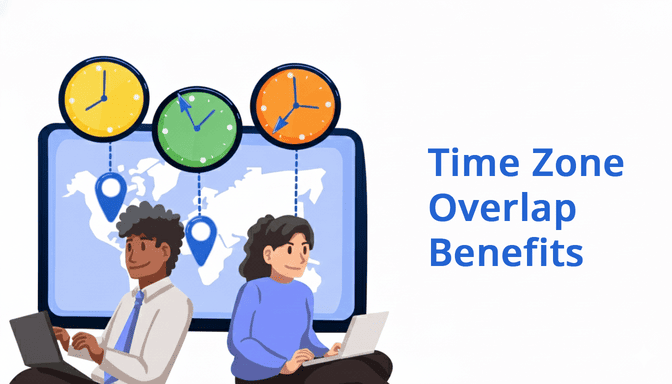
Advantage 4: Time Zone Overlap Benefits

Indian teams typically overlap:
- 2–4 hours with US EST
- 4–6 hours with UK
- 3–5 hours with Australia
This makes shared standups, sprint reviews, and daily collaboration effortless.
Many agencies intentionally leverage this time difference to create a follow-the-sun development cycle, accelerating turnaround times.
Advantage 5: Mature Outsourcing Ecosystem
India’s outsourcing industry is decades mature, meaning:
- Experienced delivery managers
- Established training processes
- Strong QA frameworks
- Reliable infrastructure
- Competitive service models
Partners like Bantech Solutions benefit from this ecosystem while offering a modern, hybrid approach that aligns more closely with agency needs.
Why a Hybrid India-Based Model (Like Bantech’s) Outperforms Traditional Offshore Outsourcing
Traditional offshore outsourcing has several weaknesses:
- Communication barriers
- Misaligned expectations
- Limited transparency
- Project-based engagement
- Lack of continuity
Modern agencies need a more evolved model — one that blends offshore economics with onshore delivery culture.
This is where the hybrid dedicated team model excels.
1. Onshore-Level Communication, Offshore-Level Efficiency
Bantech’s hybrid model focuses on:
- Highly trained English-proficient engineers
- Western-style communication standards
- Local account management sensitivity
- Transparent reporting & governance structures
This eliminates the biggest pain points agencies face with older offshore systems.
2. White-Label Expertise Embedded in the Core
Unlike traditional outsourcing firms, Bantech trains its dedicated teams specifically for:
- Agency workflows
- White-label communication
- Client presentation standards
- Deadline-driven project environments
- Multitasking across parallel client projects
This makes them uniquely compatible with the agency business model, where velocity, quality, and communication are everything.
3. Flexible Scaling Without Context Loss
Other offshore companies rotate developers frequently.
Bantech ensures:
- Long-term team stability
- Institutional knowledge retention
- Seamless scaling (up or down)
- Rapid onboarding for new roles
This continuity dramatically improves product quality and reduces rework.
4. Integrated Delivery Leadership
Instead of leaving agencies to manage offshore teams alone, Bantech provides:
- Delivery managers
- Tech leads
- QA leads
- Project managers
This shared leadership model ensures smoother operations, making agencies feel like they have an international office, not an outsourced vendor.
5. Partnership-Centric Approach
At the heart of the hybrid model is a long-term partnership mindset:
- Shared accountability
- Transparent collaboration
- Mutual investment in success
- Continuous optimization
Agencies that choose Bantech aren’t just increasing capacity — they’re building a global delivery engine that evolves with their business.
Conclusion — A Future-Proof Scaling Strategy for Digital Agencies
The digital agency landscape has fundamentally changed. Clients expect deeper expertise, faster delivery, more sophisticated solutions, and ongoing support — all while agencies struggle with rising labor costs, developer shortages, and unpredictable freelance reliability.
The dedicated development team model has emerged as the most resilient, scalable, and strategically aligned solution for modern agencies. It provides:
- Capacity without the constraints of traditional hiring
- Continuity that drives better technical decisions
- Capability expansion through access to global expertise
- Cost efficiency that strengthens long-term financial stability
- Client satisfaction powered by predictable delivery
And critically — it supports the true competitive advantage agencies need today: the ability to say yes to bigger clients, more complex projects, and multi-phase digital programs.
Why Bantech Solutions Is a Strategic Partner for This Future
Bantech Solutions represents the evolution of what offshore partnerships should be for agencies:
1. A Hybrid Model Designed Specifically for Agencies
Combining offshore economics with Western-style communication, accountability, and delivery rigor.
2. Teams Trained for White-Label Execution
Your clients experience consistency while your agency gains invisible yet powerful production horsepower.
3. Deep Multi-Disciplinary Capabilities
From Shopify to React, from SaaS builds to mobile apps — Bantech teams bring versatility and depth.
4. Scalable Capacity and Seamless Integration
Start with a pod, expand into multiple teams, and create a true global delivery engine.
5. Cost Efficiency That Strengthens Agency Margins
Agencies gain a competitive pricing advantage while maintaining top-tier quality.
The Final Word
Agencies that embrace the dedicated development team model unlock a level of scalability, stability, and profitability that simply isn’t possible with freelancers or traditional outsourcing. They build stronger client relationships, deliver more confidently, and compete at a higher level.
With the right partner — especially one like Bantech Solutions, built for agencies and optimized for Western markets — your dedicated team becomes more than a resource.
It becomes a strategic advantage, a growth engine, and an integral part of your agency’s long-term success.
FAQs
What is a Dedicated Development Team for Agencies? The 2026 Definitive Guide to Scaling
In the high-stakes landscape of 2026, digital agencies are no longer just competing on creativity; they are competing on technical velocity. The “Capacity Paradox” has become the silent killer of growth: the more successful an agency becomes, the harder it is to find, afford, and retain the talent required to deliver that success. To break this cycle, forward-thinking firms are pivoting toward a dedicated development team for agencies—a sophisticated, long-term partnership model designed to provide a “plug-and-play” production engine that lives and breathes the agency’s brand, without the crushing weight of Western-market overhead.
The Structural Evolution: Moving Beyond “Outsourcing”
For years, “outsourcing” was a word spoken in hushed tones—often associated with low-quality code, communication gaps, and missed deadlines. But as we move through 2026, the industry has undergone a radical transformation. We have entered the era of the Integrated Production Partner.
A dedicated development team is not a group of “ticket-takers” in a remote office. It is a cohesive, self-managed unit of specialists—developers, designers, QA engineers, and project managers—who work exclusively for your agency. They don’t have other clients. They don’t have competing priorities. They are, for all intents and purposes, your employees—just not on your payroll.
The Anatomy of an Agency-Grade Dedicated Team
To understand what this model is, we must look at who makes up the team. A boutique agency-focused partner like Bantech Solutions doesn’t just provide “coders”; they provide a balanced ecosystem of talent.
1. The Full-Stack Engineers
These are the workhorses of your production engine. In 2026, a dedicated team usually specializes in modern, scalable stacks like React/Node.js, Laravel, or Python/Django. Because they are dedicated to your agency, they become experts in your specific “coding flavor”—ensuring that every site or app they build looks like it came from the same internal hand.
2. The UX/UI Visionaries
Agency work is aesthetic by nature. A dedicated team for an agency must include designers who understand that “pretty” isn’t enough; it must convert. They work in Figma alongside your creative directors, adopting your design systems and UI kits to ensure brand consistency across every project.
3. The QA (Quality Assurance) Gatekeepers
One of the biggest risks in agency life is the “Friday afternoon bug.” A dedicated team includes full-time QA testers who run automated and manual tests before you ever see a staging link. This drastically reduces the “feedback loop” and ensures your internal PMs aren’t spending their weekends bug-hunting.
4. The Technical Project Manager (The Bridge)
This is perhaps the most critical role. The PM acts as the translator between your agency’s high-level vision and the developers’ technical execution. They handle the Jira boards, manage the sprints, and ensure that “Scope Creep” is caught before it eats your margins.
Why the 2026 Talent Market Demands a New Approach
Why is the dedicated development team for agencies suddenly the most talked-about model in the US, UK, and Australia? The answer lies in the brutal reality of the current talent market.
The Death of the $150k Junior Developer
In Western markets, the “entry-level” salary for a developer has skyrocketed. When you factor in recruitment fees (often 20% of the first-year salary), health insurance, 401k matching, and office space, a single developer can cost an agency $180,000 to $200,000 annually. For a boutique agency with 15 employees, hiring three more developers is a million-dollar risk.
The Retention Crisis
Talent in 2026 is mobile. A developer you spend three months training might leave for a $10k raise at a SaaS startup tomorrow. When a developer leaves an agency, they take the “project context” with them. A dedicated team partner mitigates this risk by providing redundancy. If a developer on your remote team moves on, the partner organization replaces them and handles the knowledge transfer, so your production never skips a beat.
Operational Mechanics: The “Invisible” Integration
A common fear among agency owners is: “Will my clients know?” or “Will this be more work for my PMs?” The beauty of the dedicated model is its invisibility. Unlike project-based outsourcing, where you have to learn their system, a dedicated team adopts your system.
The “Plug-and-Play” Workflow
- Communication: Your team lives in your Slack or Microsoft Teams. They are there for the 9:00 AM standup and the 4:00 PM wrap-up.
- Project Management: They don’t use a separate portal. They work directly in your Jira, ClickUp, or Asana boards. You see every ticket, every comment, and every hour logged in real-time.
- Version Control: All code is pushed to your GitHub or GitLab. You own the IP. You own the history. You own the repository.
The Financial Blueprint: Reclaiming Your Margins
Let’s talk numbers. The average digital agency operates on a 20-30% net profit margin. Much of the remaining 70% is swallowed by “unbillable hours”—internal meetings, training, and the high cost of idle talent during slow months.
The ROI of the Dedicated Model
By shifting to a dedicated team, agencies often see their production costs drop by 50% to 60%. * Fixed vs. Variable: You move from a “fixed” overhead (salaries) to a “scalable” overhead.
- No Hidden Costs: No hardware costs, no software licenses, no coffee, no office rent, no payroll taxes.
- Higher Billable Efficiency: Because your dedicated team is specialized and focused, their “output-per-hour” is typically higher than a distracted in-house developer who is also attending internal culture meetings.
Imagine winning a $100,000 project. In the old model, $60,000 went to internal labor. In the dedicated team model, that labor cost might be $25,000. That’s an extra $35,000 in pure profit—on a single project.
White-Labeling: The Ultimate Reputation Guard
For an agency, your reputation is your only currency. If a client finds out you’ve outsourced their work and the quality is poor, you lose that client forever.
The dedicated team model is built for white-label excellence. Because the team is yours for the long haul, they become brand ambassadors. They learn the nuances of how you present work to your clients. They use your email signatures, your slide templates, and your staging URLs.
At Bantech Solutions, we call this the “Invisible Powerhouse.” Your clients see a high-velocity agency that can launch complex apps in weeks; they don’t see the global engine making it happen behind the curtain.
Dedicated Team vs. Other Models: A 2026 Comparison
To truly understand what a dedicated team is, we must compare it to what it is not.
| Feature | Dedicated Team | Freelancers | Staff Augmentation | Project-Based Outsourcing |
|---|
| Commitment | Long-term / Exclusive | Short-term / Flighty | Per-Project | One-off |
| Culture Fit | High (Integrated) | None | Low | Low |
| Knowledge Retention | Permanent | Zero | Temporary | Zero |
| Scalability | High (Easy to add/remove) | Low | Medium | Difficult |
| Price | Predictable Retainer | Variable / High | Hourly (Expensive) | Fixed Price (Risky) |
The Freelancer Trap
Freelancers are great for a logo or a small bug fix. They are terrible for building a SaaS platform. Why? Because a freelancer’s goal is to finish the task and move to the next client. A dedicated team’s goal is to grow your agency.
The “Big IT” Bureaucracy
Firms like TCS or Wipro are built for the Fortune 500. If you are a digital agency with 20-50 employees, you are a “small fish” to them. You will be assigned their most junior developers, and your emails will be answered in 48 hours. A boutique dedicated partner gives you senior talent and instant access.
Beyond “Websites”: The 2026 Tech Stack
What kind of work can a dedicated development team for agencies actually handle? In 2026, the scope has expanded far beyond WordPress.
- AI & Automation: Building custom LLM integrations, AI-driven chatbots, and predictive analytics tools for your clients.
- Custom SaaS Builds: Developing multi-tenant software platforms from the ground up.
- E-commerce Engineering: High-performance Shopify Hydrogen or headless commerce builds that require deep React expertise.
- Mobile App Development: Cross-platform apps using Flutter or React Native that feel like native builds.
Legacy Transformation: Helping your older clients migrate off “dinosaur” systems and onto modern cloud architectures.
Risk Mitigation: The Safety Net
Every agency owner has a “horror story” about a project gone wrong. The dedicated team model is designed with built-in safety nets:
- Trial Periods: Most partners offer a 2-4 week trial. If the “chemistry” isn’t there, you swap members without a messy firing process.
- Redundancy: If your lead dev gets sick, the partner organization has a bench of talent to step in immediately.
Governance: You have a Western-standard SLA (Service Level Agreement) that protects your IP and ensures uptime.
Step-by-Step: How to Hire Your First Dedicated Team
If you’re ready to break the capacity ceiling, here is the roadmap:
1. Identify Your “Production Bottleneck”
Where are you currently failing? Is it QA? Is it back-end development? Is it Shopify? Identify the core skill gap first.
2. Choose a “Hybrid” Partner
Look for a partner that has a presence in your time zone but production hubs in cost-efficient regions (like India). This ensures you get local accountability and global pricing.
3. Start with a “Pod”
Don’t hire 10 people at once. Start with a small “pod”—one lead dev, one junior dev, and a part-time QA. Once they are integrated into your Slack and Jira, scale up based on project demand.
4. Over-Communicate in Week One
Treat the first week like you would a new in-house hire. Invite them to your “All Hands” meeting. Show them your best work. Make them feel like part of the family.
Conclusion: The Agency of the Future
The “Agency of the Future” is not a 100-person office in Manhattan or London. It is a lean, high-margin strategy hub that leverages a global dedicated development team for agencies to do the heavy lifting.
By adopting this model, you are no longer limited by the local talent pool or the constraints of your current bank balance. You are free to pitch the biggest clients, tackle the most complex tech, and finally scale your agency to the level you’ve always envisioned.
[Request to Connect with our agency growth team] today, and let’s map out a dedicated team structure that turns your production bottleneck into your greatest competitive advantage.
How Does a Dedicated Development Team for Agencies Differ from Staff Augmentation?
In the high-velocity agency world of 2026, the “Capacity Paradox” is more brutal than ever. Clients demand faster turnarounds on complex AI integrations and custom SaaS builds, yet the talent market remains volatile. When your in-house team hits its limit, you are faced with a critical strategic choice: do you “rent” individual engineers to fill gaps, or do you integrate a self-managed unit? Understanding how a dedicated development team for agencies differs from staff augmentation is essential for protecting your margins and ensuring your white-label reputation remains untarnished as you scale.
1. The Core Philosophy: “Filling Seats” vs. “Building Capability”
To understand the difference, we must first look at the intent behind each model.
Staff Augmentation is a tactical, task-oriented approach. It is essentially “renting” the time and expertise of a specific person. If you have a solid internal team but lack a Senior React Developer for a three-month project, you augment your staff. That person joins your Slack, follows your PM’s direct orders, and fills a specific “seat.”
A Dedicated Development Team, conversely, is a strategic, outcome-oriented approach. It is about building a cohesive production engine. You aren’t just hiring a developer; you are hiring a pre-vetted, synchronized “pod” that usually includes developers, a QA tester, and a technical lead. They work exclusively for your agency, but they function as an autonomous unit capable of owning entire project lifecycles.
2. Management and Oversight: Who Holds the Reins?
The most significant operational difference—and the one that usually impacts agency owners the most—is management overhead.
Staff Augmentation: High Internal Management
In the staff augmentation model, you are the manager. The augmented developer is a “force multiplier” for your existing team. This means your internal Project Managers (PMs) or Technical Leads must:
- Assign daily tasks.
- Conduct code reviews.
- Manage the developer’s velocity.
- Handle onboarding into your specific environment.
- Deal with interpersonal integration between the new hire and your local staff.
For an agency with a small, overworked management layer, adding three augmented developers can actually slow down production initially because your senior leads are now spending 30% of their day managing “external” individuals.
Dedicated Team: Shared or Managed Oversight
With a dedicated development team for agencies, the management burden is largely shifted to the partner. While you still set the roadmap and the priorities, the Dedicated Team Lead or Project Manager handles the day-to-day execution.
- They manage the sprint cycles.
- They conduct internal peer reviews before the code ever reaches your desk.
- They handle the “human” side of the team (motivation, churn, training).
- You manage the output, not the individual.
For agencies looking to scale without hiring more expensive, local Project Managers, the dedicated team model is often the only way to grow without breaking the internal culture.
3. Ownership and Technical Responsibility
Who owns the outcome? In staff augmentation, the agency owns the process and the result. If an augmented developer writes poor code, the responsibility falls squarely on your internal Technical Lead who was supposed to be supervising them.
In a dedicated team model, there is a level of shared accountability. Because the partner provides a full unit (including QA), they are responsible for delivering “production-ready” work. If the code is buggy, it is the dedicated team’s failure, and they are contractually obligated to fix it as part of their managed service. This provides a “buffer of safety” that individual contractors simply cannot offer.
4. The “Knowledge Retention” Problem
For digital agencies, context is king. Every project has a history of client preferences, technical debt, and “why we did it this way” moments.
The Staff Augmentation Leak
Staff augmentation is often transitory. When a specific contract ends or a project finishes, that developer moves on to another client. The knowledge they gained about your agency’s unique coding standards or a specific client’s legacy database walks out the door with them. If that client comes back six months later for an update, you have to start the learning curve all over again with a new contractor.
The Dedicated Team Vault
A dedicated team is designed for longevity. Because the team works exclusively for you over years, not months, they build institutional memory. They become experts in your clients’ businesses. They remember the API quirks of a client you onboarded two years ago. This reduces “ramp-up” time for new projects to near-zero and ensures that your agency’s technical IP is preserved within a stable team.
5. Cultural Integration and “White-Label” Etiquette
Agencies thrive on a specific “hustle” culture. You need developers who understand that a client launch on Monday means a high-pressure Friday.
- Augmented Staff are often “outsiders.” They might work for four different companies in a year. Their loyalty is to their hourly rate, not your agency’s brand.
- Dedicated Teams are trained to be your “invisible department.” Because they work only for you, they adopt your agency’s culture, your Slack emojis, your communication style, and your work ethic. In a white-label scenario, this is vital. If a dedicated developer ever joins a client call, they speak as a member of your agency, with the confidence of someone who has been on the team for a year.
6. Financial Analysis: The “True Cost” of Scaling
On the surface, staff augmentation can look cheaper because the hourly rates for individuals might seem lower. However, when you look at the Total Cost of Ownership (TCO), the math changes.
Hidden Costs of Staff Augmentation:
- Management Time: 15–25% of your Senior Lead’s time per augmented developer.
- Onboarding Overhead: The 2–4 weeks of “lost productivity” while a new person learns your tools.
- Tooling/Licenses: You often have to pay for their individual seats in Jira, Figma, and GitHub.
- The “Churn” Cost: If an augmented developer leaves, the cost to find and train a replacement falls on you.
Value of the Dedicated Team Model:
- Predictable Retainer: You pay a flat monthly fee for the entire “pod.”
- No Recruitment Fees: The partner handles the “bench” and replacements.
- Built-in QA: You don’t have to hire a separate tester; they are part of the unit.
- Zero-Cost Management: The partner’s Team Lead removes the need for you to hire an extra internal PM.
In a 12-month comparison, a dedicated development team for agencies typically yields a 15–20% higher ROI than staff augmentation due to the reduction in internal management hours alone.
7. Which Model is Right for Your Current Phase?
To help you decide, let’s look at three common agency scenarios in 2026:
Scenario A: The “Gap Filler”
- Situation: You have a one-off project that requires a niche skill (e.g., a specific Blockchain protocol or an obscure legacy CMS).
- Winner: Staff Augmentation. You don’t need a whole team; you just need a “hired gun” for 60 days.
Scenario B: The “Product Scale-Up”
- Situation: You’ve just landed a multi-year retainer to build and maintain a custom SaaS platform for a major client.
- Winner: Dedicated Development Team. You need continuity, dedicated QA, and a team that understands the product’s roadmap inside out.
Scenario C: The “Agency Growth” Phase
- Situation: Your agency is growing from $2M to $5M in revenue. You are currently the primary project manager and you’re at your breaking point.
- Winner: Dedicated Development Team. You need a self-managed unit that can take projects off your plate entirely, allowing you to focus on high-level sales and strategy.
Conclusion: Scaling with Precision
In 2026, the agencies that dominate are those that treat their production capacity like a scalable utility, not a constant headache. Staff augmentation is a powerful tool for short-term fixes, but if your goal is sustainable, high-margin growth, a dedicated development team for agencies is the superior architecture.
It provides the governance you lack, the continuity you need, and the profitability you deserve. By choosing a dedicated model, you aren’t just adding developers; you are installing a growth engine that allows you to say “yes” to bigger, more complex, and more lucrative contracts.
Ready to move from “managing individuals” to “leading a powerhouse”? Request to Connect with our agency scaling experts to see how a dedicated team can be integrated into your workflow in as little as 14 days.
In the hyper-competitive agency landscape of 2026, your brand is only as strong as your last delivery. As clients demand increasingly complex builds—from AI-driven platforms to custom enterprise SaaS—agencies are finding that traditional project-based outsourcing is too risky for their reputation. This has led to a surge in the dedicated development teams for white label services. For firms that pride themselves on white-label excellence, this model isn’t just “suitable”; it is often the only sustainable way to deliver high-end technical results while keeping the production engine completely invisible to the end client.
1. The White-Label Dilemma: Trust vs. Scale
Every agency owner eventually hits the “White-Label Ceiling.” You want to sell $100k+ development projects, but your in-house team is already maxed out on design and strategy. You have two choices: hire locally (which is expensive and slow) or outsource (which often feels like a gamble).
The problem with traditional outsourcing—like hiring freelancers or project-based firms—is the lack of brand alignment. When you white-label a service, you are essentially vouching for the work with your own reputation. If a freelancer misses a deadline or writes “spaghetti code,” it isn’t their brand that suffers; it’s yours.
The dedicated development team model solves this by providing continuity. Because the team works exclusively for you, they aren’t just “vendors”; they are an invisible extension of your staff. They learn your “agency voice,” follow your specific coding standards, and operate within your project management ecosystem. This level of integration is what makes true white-labeling possible.
2. Why the Dedicated Model is the “Gold Standard” for White-Labeling
To understand why this model beats out all others for white-label work, we have to look at the three pillars of agency delivery: Quality, Consistency, and Invisibility.
Consistency: The End of the “Quality Rollercoaster”
The biggest threat to a white-label agency is inconsistency. If Project A is a masterpiece but Project B is riddled with bugs because you used a different freelancer, your client will lose trust. A dedicated team provides a stable production baseline. Because the same developers work on all your projects, they develop a “shared memory” of your agency’s requirements. They know exactly how you like your CSS structured, how you prefer your API documentation to look, and which WordPress plugins are on your “never use” list. This consistency is what allows you to sell services with confidence.
Invisibility: Maintaining the “In-House” Illusion
In a white-label arrangement, the end client should never know an offshore or third-party partner is involved. Traditional outsourcing often fails here because communication is fragmented. With a dedicated team, the integration is seamless. They use your agency email addresses, join your Slack channels, and work inside your Jira boards. If a client asks for a technical update, your internal PM can get an answer in minutes from a team they’ve worked with for months. To the client, it looks like you have a massive, high-tech office in the back room.
Quality: Agency-Grade Execution
Most offshore firms are built for “mass production.” Agencies, however, require “boutique quality.” A dedicated team for an agency is specifically trained in white-label etiquette. They understand that the code needs to be clean enough for a client’s internal IT team to audit. They prioritize UX/UI because they know your agency’s brand is built on “the look and feel” of the final product.
3. The Monday Morning “Horror Story” (And How to Avoid It)
Imagine it’s Monday morning. Your biggest client’s site is down. You call the freelancer who built it, but they’ve taken a full-time job elsewhere and aren’t answering their emails. You call the project-based firm you used, but they tell you that “maintenance isn’t in the original scope” and they can’t get to it until Thursday.
This is the nightmare that keeps white-label agency owners awake.
In a dedicated team model, this scenario doesn’t happen. Because your team is dedicated, they are there every Monday morning. They are responsible for the long-term health of the products they build. They don’t just “ship and forget”; they maintain, optimize, and support. This accountability is the “insurance policy” your agency needs when selling white-label services.
4. Technical Continuity: Owning the “How” as Well as the “What”
One of the most overlooked benefits of the dedicated model is Technical IP (Intellectual Property). When you use different vendors for different projects, your technical knowledge is scattered. One project is in Vue, another in React, one uses AWS, another uses DigitalOcean. This makes it impossible for your agency to build a standardized “way of doing things.”
A dedicated development team allows you to standardize your tech stack. Over 6–12 months, your team develops a “core library” of components, snippets, and workflows that are unique to your agency. This makes every subsequent project faster and more profitable. You aren’t just selling “a website”; you are selling a proprietary, high-efficiency development process that you own, even if you didn’t write every line of code yourself.
5. Economic Advantages: High Margins, Low Risk
Let’s talk about the math of white-labeling. If you hire a senior developer in New York or London, your “cost of goods sold” (COGS) is so high that your margins on a development project might only be 20%. One minor delay or scope creep can turn that project into a loss.
By using a dedicated team for an agency, you can access elite talent in regions like India at a fraction of the cost.
- The 60% Margin Rule: Most agencies using this model aim for (and achieve) 60% gross margins on white-label builds.
- Scale Without Bloat: You can add a developer to your team to handle a new client and, if that client leaves, you can scale the team back down through your partner without the legal and emotional trauma of “firing” someone.
- Zero Recruitment Costs: You aren’t paying $20k to headhunters every time you need a new dev. Your partner handles the “bench” and the vetting.
6. Overcoming the “Offshore Stigma”
The biggest hurdle for many agencies is the lingering fear of the “offshore” label. In 2026, this is largely a myth sustained by bad experiences with the wrong model (project-based) rather than the wrong people.
The dedicated model bridges the gap through Hybrid Management. Partners like Bantech Solutions provide Western-standard account management and technical leadership. This ensures that the “cultural bridge” is already built. The developers are trained to communicate proactively, to flag risks before they become problems, and to understand the “urgency” that defines agency life.
7. Operational Blueprint: Setting Up Your White-Label Team
If you’re ready to implement this, here is how you ensure the team remains a “powerhouse” and not a “headache”:
Step 1: Standardize the Tools
Don’t let the team use their own Slack or Jira. Bring them into yours. If you use Figma for design handoffs, ensure they are trained in your specific Figma-to-Code workflow.
Step 2: Establish “White-Label Etiquette”
Define how the team should communicate. If they ever need to join a client-facing call (as “internal developers”), ensure they have your agency’s email aliases and understand the “no-mention-of-the-partner” rule.
Step 3: Define the “Code Review” Process
Even with a dedicated team, your internal Tech Lead should perform periodic “spot checks” on the code. This ensures the team stays aligned with your standards and gives you the confidence to tell your client, “Our team built this to the highest specifications.”
Conclusion: The Ultimate Competitive Edge
In 2026, the agencies that win are those that can deliver enterprise-grade technology with boutique-level service. You cannot do that if you are constantly hunting for freelancers or over-paying for local talent.
A dedicated development team for agencies is the only model that aligns perfectly with the requirements of white-label services. It gives you the consistency of an in-house team, the cost-efficiency of an offshore partner, and the technical depth of a specialized software house. It allows you to stop being a “middleman” and start being a “powerhouse.”
[Request to Connect with our white-label specialists] today and find out how we can build your invisible development department in under two weeks.
The Best of Both Worlds: Why a Hybrid Offshore Development Model is the Agency Growth Hack for 2026
For a long time, agency owners felt they had to choose between two extremes: hiring an expensive local team that ate their margins, or “throwing work over the wall” to a faceless offshore vendor and praying for a miracle. In 2026, those extremes are no longer viable. The modern agency landscape demands a dedicated development team for agencies that operates under a hybrid offshore development model. This approach bridges the gap between cost-efficiency and high-standard delivery, creating a production engine that is as accountable as a local hire but as scalable as a global workforce.
1. Defining the Hybrid Offshore Model: What Does it Actually Mean?
In the context of agency production, a “Hybrid Offshore Model” is a strategic structure that splits the roles between local (Western-standard) management and offshore technical execution.
Unlike a “pure” offshore model—where you are left to manage developers across a 12-hour time difference with no cultural bridge—the hybrid model provides a Management Layer that understands your market, your deadlines, and your quality expectations.
The Hybrid Structure:
- The Offshore Engine: A team of elite developers and QA engineers based in high-talent, cost-efficient hubs (like India). They focus on the heavy lifting—coding, testing, and technical architecture.
- The Western Bridge: Account managers or Technical Leads who speak your language (literally and figuratively). They translate your agency’s vision into technical requirements, manage the timeline, and ensure that “agency-grade” quality is maintained.
This is the model that allows a boutique agency in New York or Sydney to compete with the likes of Deloitte Digital or Wipro, without having to build a billion-dollar infrastructure.
2. Benefit #1: Economic Dominance (The Margin Moat)
Let’s be candid: the primary reason agencies look offshore is the cost. But in 2026, it’s not just about “being cheap”—it’s about margin protection. In Western markets, the “Total Cost of Employment” (TCOE) for a senior full-stack developer has become unsustainable for most mid-sized agencies. When you add up salary, payroll taxes, 401k/Superannuation, health insurance, office space, and recruitment fees, you are looking at an annual cost of $180k to $220k per developer.
The Hybrid Advantage:
By leveraging a dedicated development team for agencies in a hybrid model, you can access that same level of seniority for roughly one-third of the price.
- Net Profit Surge: Most agencies operating on this model report a shift in net margins from the industry standard of 15% to a healthy 40–60%.
- Zero Recruitment Risk: If a local hire doesn’t work out, you lose $20k in headhunter fees and three months of time. In a hybrid model, your partner handles the “bench” and swaps talent seamlessly if the chemistry isn’t right.
3. Benefit #2: The “Follow-the-Sun” Workflow (24/7 Production)
Time zones are often seen as a hurdle, but in a hybrid model, they are turned into a competitive weapon. When you have a dedicated offshore team, your agency literally never stops working.
The “Overnight Miracle” Cycle:
- 5:00 PM (Your Time): Your local Creative Director finishes a set of Figma designs and pushes them to the dev team.
- Overnight: While you sleep, your offshore team in India picks up the work. They build the components, run the unit tests, and push the code to a staging environment.
- 9:00 AM (Your Time): You wake up to a “Done” notification in Slack. You review the work with your coffee, provide feedback, and the cycle repeats.
This “Follow-the-Sun” workflow allows you to slash your Time-to-Market (TTM) by nearly 50%. You are no longer limited by the 8-hour workday of a local team.
4. Benefit #3: Western-Standard Accountability (No More “Ghosting”)
The biggest fear of offshore development is the communication gap. We’ve all heard the stories: developers who say “yes” to everything but deliver nothing, or vendors who disappear when a bug is found on a Friday afternoon.
The hybrid model solves this through Accountability. Because you are working with a partner that has a Western-standard management layer, you aren’t shouting into a void. You have a Technical Lead who understands that a “minor bug” on a client’s e-commerce site during a Black Friday sale is actually a “code red” emergency.
- Proactive Communication: Instead of waiting for you to ask for an update, the team flags blockers before they happen.
- Cultural Alignment: The team is trained on “White-Label Etiquette”—understanding the nuances of how Western clients expect documentation and communication to be handled.
5. Benefit #4: Access to Niche “Super-Talent”
In a local hiring market, you are limited by the developers who live within a 30-mile radius of your office (or who are willing to work in your time zone). If you need an AI specialist, a Shopify Hydrogen expert, and a Laravel architect all at once, you’re looking at a 6-month recruitment nightmare.
The Global Talent Buffet:
A dedicated development team for agencies gives you instant access to a global talent pool.
- Specialized Stacks: Need someone who knows Python for an AI project and React for the front-end? You can assemble that team in 14 days.
- High Seniority: Because the cost of living is lower in offshore hubs, you can afford to hire Senior and Lead developers for the price of a Western Junior. This means fewer mistakes, better architecture, and faster builds.
6. Benefit #5: Scalability Without the “Bloat”
Agency life is defined by the “Feast and Famine” cycle. One month you win three massive projects; the next month a long-term retainer client pauses their budget.
If you have a 100% in-house team, you are in a constant state of anxiety. You’re either overworking your staff to the point of burnout or paying for “idle chairs” during the slow months.
The Hybrid Model acts as an “Accordion”:
- Feast: You can add 2–3 developers to your dedicated team to handle a surge in work without having to go through a permanent hiring process.
- Famine: You can scale back to a core “maintenance” pod with minimal friction, protecting your agency’s cash flow.
7. Hybrid vs. Pure Offshore: A 2026 Comparison
| Feature | Hybrid Offshore Model | Pure Offshore (Gig sites) |
|---|
| Management | Professional PM / Tech Lead | You (The Agency Owner) |
| Code Quality | Peer-reviewed & QA’d | “Hit or miss” |
| Communication | Proactive / Daily Standups | Reactive / Fragmented |
| Commitment | Long-term Partnership | Transactional / Task-based |
| White-Labeling | Built for it | Very difficult |
8. Operational Blueprint: How to Succeed with a Hybrid Team
If you’re moving to a hybrid model, “Set it and Forget it” won’t work. Success requires a specific operational framework:
A. The “Overlap Hour” Strategy
Ensure your offshore team has at least 3–4 hours of overlap with your local time zone. Use this time for high-intensity communication: daily standups, sprint planning, and design handoffs.
B. Shared Tooling
The hybrid team must be an “invisible” part of your agency. They use your Slack, your Jira, and your GitHub. This ensures that the technical IP stays within your agency’s walls.
C. The “Internal Tech Lead” Role
Even with a hybrid partner, it’s best to have one internal “Technical Voice” at your agency. This person doesn’t need to manage the developers’ daily tasks, but they should act as the final “Quality Gate” to ensure the hybrid team is meeting your specific brand standards.
Conclusion: The New Standard for Agency Growth
In 2026, the agencies that are thriving aren’t the ones with the flashiest offices; they are the ones with the most efficient production engines.
The hybrid offshore development model is the only structure that allows you to scale your technical capacity, protect your margins, and maintain “agency-grade” quality all at once. It removes the risk of traditional outsourcing while providing the economic benefits that local hiring simply cannot match.
By choosing a dedicated development team for agencies through a hybrid partner, you are giving your firm the “unfair advantage” needed to outperform global competitors while remaining lean, agile, and highly profitable.
[Request to Connect with our hybrid model experts] today and let’s map out a production engine that grows with you, not against you.
Why Should Agencies Hire Dedicated Developers Instead of Freelancers in 2026?
The “Gig Economy” of the 2010s has evolved into the “Accountability Economy” of 2026. For digital agencies, the stakes of a failed project have never been higher. With clients expecting deep AI integrations, high-security custom builds, and rapid updates, the “hired gun” approach of the traditional freelancer is increasingly failing the agency model. Here is why the shift toward dedicated development instead of freelancers has become the new standard for firms that want to scale without the stress.
1. The Commitment Gap: Project vs. Partnership
The fundamental flaw in the freelancer model is the misalignment of incentives. A freelancer is a “task-completer.” Their goal is to finish the ticket as quickly as possible so they can invoice you and move to the next client.
When you hire dedicated developers through a dedicated development team for agencies, you are investing in a partnership.
- Exclusive Focus: A dedicated developer has only one client: You. They wake up every morning thinking about your project roadmap, not juggling three other deadlines from your competitors.
- The “Ownership” Mindset: Because they are part of a long-term team, they care about the “cleanliness” of the code. They know they will be the ones maintaining it six months from now. Freelancers, knowing they might be gone next week, are often tempted to take “technical shortcuts” that create debt your agency will eventually have to pay for.
2. The Institutional Memory Drain
In the agency world, “Context is King.” Every custom build has thousands of micro-decisions: Why was this specific library chosen? How does the checkout flow handle edge cases for this specific client?
The Freelancer “Brain Drain”
When a freelancer leaves, that context vanishes. If that client returns for a Version 2.0, you are forced to pay for “discovery” all over again. You are essentially paying to re-learn the information you already bought.
The Dedicated Vault
A dedicated team builds a “Technical Vault” for your agency. They document every decision according to your SOPs. They remember the nuances of your legacy clients. This institutional memory allows your agency to move 3x faster on repeat business, which is where the highest margins are found.
3. The Management Tax: Hidden Costs of the Gig Model
Agency owners often look at a freelancer’s hourly rate and think, “This is cheaper than a team.” This is a classic case of ignoring the Management Tax.
Managing Freelancers:
If you have four freelancers working on different projects, your internal Technical Lead or Project Manager is effectively a “Traffic Controller.” They spend their day:
- Chasing updates across multiple time zones.
- Quality-checking work that lacks consistency.
- Onboarding new freelancers every time one “ghosts” or becomes unavailable.
- Translating client needs four different times.
Managing a Dedicated Team:
A dedicated team comes with its own internal governance. They have a Team Lead who reports to you. You provide the high-level vision; they handle the granular execution. This frees up your senior internal staff to focus on high-value activities—like winning new business or improving client relationships—rather than babysitting individual contractors.
4. Quality Assurance: Beyond “It Works on My Machine”
One of the most dangerous phrases in development is: “It works on my machine.” Freelancers rarely have the time or the infrastructure to perform rigorous Quality Assurance (QA). They are developers, not testers.
A dedicated development team integrates QA into the “Definition of Done.” Before a feature is ever pushed to your staging environment, it undergoes:
- Peer Review: Another senior developer checks the logic.
- Regression Testing: Ensuring the new feature didn’t break an old one.
- Cross-Browser/Device Validation: Ensuring the experience is consistent for the end user.
For a white-label agency, this is your safety net. Sending a buggy staging link to a client is the fastest way to lose a retainer. A dedicated team ensures that your “first look” is always a “great look.”
5. Security, Compliance, and Intellectual Property
In 2026, data security is not optional. With the rise of GDPR, CCPA, and AI-specific regulations, how your code is written and where it is stored is a legal liability.
- Freelancer Risks: They often work on personal, unencrypted laptops. They may use unvetted AI tools that “leak” your client’s proprietary logic into public LLMs. They may be working from public Wi-Fi in a cafe.
- Dedicated Team Security: A professional hybrid partner ensures the team works in a managed environment. This includes Enterprise-grade VPNs, strictly enforced NDA (Non-Disclosure Agreements), and secure code repositories. Your IP is legally protected, and your client’s data is handled with the same care you would give it in-house.
6. Cultural Integration: The “Invisible” Department
The ultimate goal of white-labeling is to make your production engine invisible.
- A freelancer is always an “outsider.” They have their own email, their own tools, and their own way of talking.
- A dedicated team becomes “The Agency’s Invisible Department.” They use your @youragency.com email aliases. They join your Slack channels. They adopt your culture and your “vibe.”
In 2026, if a client requests a “Meet the Devs” call (which is becoming common for high-ticket SaaS builds), your dedicated team can hop on the call and represent your agency with total confidence and brand alignment. A freelancer simply can’t offer that level of brand loyalty.
7. Scaling with “The Accordion Effect”
The biggest challenge for a boutique agency is the “Feast and Famine” cycle.
- The Freelancer Struggle: When you win a big project, you have to spend two weeks hunting for a freelancer who is actually available. By the time you find one, the project is already behind schedule.
- The Dedicated Advantage: Through your partner, your team is elastic. Need to add a specialized AI engineer for a 3-month sprint? Your partner pulls from their vetted “bench.” Need to scale back after a project ends? The model allows for graceful scaling without the emotional and legal trauma of local layoffs.
Comparison: The 2026 Reality Check
| Feature | Freelancers | Dedicated Development Team |
|---|
| Availability | “When they feel like it” | 9-to-5 Exclusive focus |
| Accountability | Individual / Low | Structural / High |
| Project PM | You are the PM | Built-in Team Lead |
| Code Continuity | Fragmented | Standardized & Documented |
| Cost over 12 mo. | High (due to management/churn) | Optimized (due to efficiency) |
8. Financial Deep Dive: Why “Cheaper” is More Expensive
Let’s look at the “True Cost” of a $50,000 custom software build:
Model A: Freelancer Route
- Freelancer Fee: $30,000
- Internal PM Time (40 hours @ $150/hr): $6,000
- Fixes/Rework due to poor QA: $5,000
- Lost Client Lifetime Value (due to delays): $15,000
- Total Real Cost: $56,000
Model B: Dedicated Team Route
- Team Retainer: $22,000
- Internal PM Time (5 hours @ $150/hr): $750
- Project Margin Reinvested into Sales: $27,250
- Total Real Cost: $22,750
The dedicated team doesn’t just save you money on the developer’s hourly rate; it saves you money by reclaiming your time.
Conclusion: Strategy Over Tactics
In the “Agency of the Future,” the owner is a strategist, not a project coordinator. If you are still managing individual freelancers, you are working in your business rather than on it.
Choosing to hire dedicated developers is a signal that your agency is ready for enterprise-level growth. It provides the stability, security, and scalability required to compete with the global IT giants while maintaining the agility and margins of a boutique firm.
[Request to Connect with our agency growth team] today and let’s move your production from a “gig list” to a “powerhouse.”
How Can a Digital Agency Scale Its Production Capacity Without Hiring In-House?
In the economic climate of 2026, the traditional “hire-first” growth model has become a liability. With rising overhead, shifting tax landscapes, and the sheer speed of technical change, agencies that rely solely on local, in-house staff often find themselves “asset-heavy and cash-poor.” To remain competitive, modern firms are learning how to scale digital agency production using a hybrid offshore development model. This strategy allows you to increase your output and take on enterprise-level projects without the permanent weight of a massive payroll.
Scaling in this era isn’t about finding more chairs to fill; it’s about building a production engine that is elastic, invisible to the client, and structurally more profitable than any in-house department could ever be.
1. The “Capacity Paradox” and the Risk of In-House Hiring
The biggest challenge in agency growth is the “Capacity Paradox.” To win bigger contracts, you need a larger team. But to afford a larger team, you need the revenue from those contracts. If you hire locally in a market like the US, UK, or Australia, you are taking a massive financial gamble.
Hiring a senior developer in 2026 involves:
- Recruitment Fees: Often 20-25% of the first-year salary.
- Onboarding Time: 3–6 months before they are truly “billable” and efficient.
- Overhead: Health insurance, 401k/Superannuation, payroll taxes, and office perks.
If a client pauses a retainer or a project ends, you are stuck with a “fixed cost” that eats your profit. This is why agencies that scale in-house often feel like they are “working for their employees” rather than for themselves.
2. Transitioning to the “Elastic Team” Model
The alternative is the Elastic Team. This model replaces the rigid structure of in-house hiring with a flexible production pod. By partnering with a dedicated development team provider, your agency gains the ability to expand and contract its “technical muscles” in real-time.
The Accordion Effect
When you land a major enterprise contract that requires four React developers and a QA engineer, you don’t start a three-month recruitment cycle. You “plug in” a pre-vetted pod from your partner. When the project enters a low-maintenance phase, you can scale back to a core support team. This ensures your cost of goods sold (COGS) always matches your actual revenue.
3. Standardizing the “Production Factory”
You cannot scale chaos. If your agency treats every project as a “unique snowflake” with custom workflows, you will eventually hit a management ceiling. To scale without in-house hiring, you must turn your production into a repeatable factory.
The SOP Revolution
Successful scaling requires robust Standard Operating Procedures (SOPs). You must document:
- How a design is handed off from Figma to Code.
- How your Git branching strategy works.
- How your agency handles API documentation and security headers.
When you bring on a dedicated team, you aren’t just hiring “hands”; you are handing them your agency’s “Operating System.” This allows a remote team to produce work that is indistinguishable from your internal team’s output, protecting your white-label reputation.
4. The 24-Hour “Follow-the-Sun” Workflow
One of the most powerful benefits of scaling through a hybrid offshore model is the ability to turn time zones into a competitive weapon. In a traditional 100% in-house agency, your “factory” only runs for 8 hours a day.
With a dedicated team in a region like India, your agency enters a 24-hour production cycle:
- Phase 1 (Your Day): Your internal account managers and creative directors meet with the client, define the user stories, and finalize the designs.
- Phase 2 (Your Evening): As your local team logs off, your dedicated offshore team logs on. They pick up the “Day 1” requirements and begin coding, testing, and deploying to staging.
- Phase 3 (Your Next Morning): You wake up to a “Status Complete” report in Slack. You review the staging link, provide feedback, and the cycle repeats.
This “Follow-the-Sun” workflow allows you to slash your Time-to-Market (TTM) by 50%. Clients are consistently amazed at the speed of delivery, which directly translates to higher referral rates and longer retainers.
5. Protecting the Margin: The “60/20” Rule
The goal of scaling isn’t just to increase revenue; it’s to increase profit.
Traditional agencies often struggle to maintain a 15-20% net profit margin because their labor costs are so high. By moving to a dedicated team model, you can flip the script. Most agencies utilizing this model aim for a 60% gross margin on their development services.
- Reduced COGS: You access senior-level talent at 40-60% less than local rates.
- Lower Overhead: No recruitment fees, no equipment costs, and no payroll tax liabilities.
- Zero Idle Time: You only pay for the team you need, when you need them.
This “Margin Moat” gives you the capital to reinvest in Sales and Marketing—the two things that actually drive agency growth.
6. Solving the Management Bottleneck: The Hybrid Bridge
The number one fear of agency owners when scaling remotely is: “I don’t have time to manage a team overseas.” This is why the Hybrid Model is essential. Unlike “freelance marketplaces” (where you have to micro-manage every individual), a dedicated partner provides a Team Lead or Project Manager.
- This Lead acts as your single point of contact.
- They are responsible for the daily standups, code reviews, and deadline management.
- You manage the Strategy; they manage the Execution.
This structure allows you to scale from managing 2 people to managing 20 people without increasing your personal stress levels.
7. Beyond Code: Scaling Niche Capabilities
In 2026, clients aren’t just asking for websites; they want AI-integrated platforms, custom SaaS builds, and mobile apps. If you rely on in-house staff, you are limited by the skills of the people you have already hired.
A dedicated team provider gives you access to a “Technical Buffet.” * Need an AI specialist for 3 months? Plug them in.
- Need a Shopify Hydrogen expert for a specific build? Add them to the pod.
- Need to pivot from PHP to Node.js for a new client? Rotate the team.
This flexibility allows your agency to say “YES” to high-ticket contracts that you previously would have turned down due to lack of expertise.
8. Culture as the Scaling Glue
Finally, the secret to scaling without in-house hiring is Integration. You shouldn’t treat your dedicated team like a “vendor.” You should treat them like a department.
- Include them in Slack: Let them see the agency’s “General” channel wins.
- Joint Standups: Use the 3-4 hours of time-zone overlap for face-to-face video calls.
- Unified Tools: Use the same Jira boards, GitHub repos, and Figma files.
When the remote team feels like they are part of your agency’s success, their loyalty and output skyrocket. This is how you build a “Borderless Agency” that can compete with global giants.
Comparison: Scaling Models for the Modern Agency
| Scaling Factor | The In-House Model | The Dedicated Team Model |
|---|
| Speed of Scale | Slow (Months of hiring) | Rapid (10-14 days) |
| Financial Risk | High (Fixed salary liability) | Low (Variable based on revenue) |
| Tech Stack | Static (Limited to current hires) | Dynamic (Access to any tech) |
| Management | High (Owner manages everyone) | Delegated (Managed by Team Lead) |
| Profit Margin | 15–25% | 40–60% |
Conclusion: Stop Managing People, Start Managing Growth
If your agency is stuck at the “Capacity Ceiling,” it’s likely because you are trying to scale a 20th-century model in a 21st-century world. Hiring in-house is a valid strategy for your core leadership, but for your production engine, it is a bottleneck.
By moving to a dedicated development team for agencies, you reclaim your time, protect your margins, and build an elastic production powerhouse that can handle any project, at any scale, at any time.
Request to Connect with our agency scaling experts today, and let’s map out a 90-day plan to transition your agency from a “hiring-heavy” model to an “output-heavy” powerhouse.
What is the Average Cost of a Dedicated Development Team for an Agency? The 2026 Economic Guide
In the modern digital economy, the “Capacity Paradox” defines the success or failure of an agency. To win larger, more complex contracts, you need a high-performance technical team. However, the financial burden of hiring that team locally can stifle your margins and increase your risk profile. As agencies pivot toward more sustainable growth models, the average cost of a dedicated development team for an agency has become a central metric for CEOs and CFOs.
On average, in 2026, a dedicated development team typically costs an agency between $3,000 and $6,500 per developer, per month. When you contrast this with the $12,000 to $20,000 monthly cost (fully burdened) of a senior developer in markets like New York, London, or Sydney, the economic incentive is undeniable. However, “cost” is a multifaceted concept that includes salary, infrastructure, management, and quality assurance.
1. The Anatomy of a Dedicated Team’s Cost
To understand the pricing, we must first look at what a “Dedicated Team” actually entails. Unlike a freelancer who bills by the hour for a specific task, a dedicated team is a long-term resource. The cost is usually structured as a monthly retainer that covers:
Professional Salaries
The largest portion of the fee goes toward the developers’ compensation. In high-talent hubs like India, a senior developer’s salary allows for a high standard of living locally while remaining exceptionally competitive for a Western agency.
Infrastructure and Technology
When you hire a dedicated team through a partner like Bantech Solutions, you are not paying for “just a person.” You are paying for:
- Hardware: High-end workstations and redundant servers.
- Software: Enterprise licenses for IDEs, security tools, and collaboration software.
- Connectivity: High-speed, fiber-optic internet with secondary backups.
Government and Compliance Costs
Local payroll taxes, social security contributions, health insurance, and labor law compliance are all handled by the partner. For an agency owner, this removes the administrative “paperwork nightmare” of international hiring.
2. Comparing the Three Main Models: A Financial Audit
To truly grasp the “average cost,” we must compare the dedicated model against its two main competitors: In-house hiring and ad-hoc freelancing.
Model A: The In-House Hire (The “Heavy” Model)
Hiring a Senior Full-Stack Developer in the US/UK:
- Base Salary: $130,000 – $160,000
- Benefits (Health, 401k): $20,000
- Recruitment Fee (20%): $26,000
- Office Space & Perks: $10,000
- Total Annual Cost: $186,000 – $216,000
- Monthly Average: $15,500 – $18,000
Model B: The Freelancer (The “Hidden Tax” Model)
Hiring an independent contractor at $75/hour:
- Monthly Cost (160 hours): $12,000
- Management Overhead: High (The agency owner spends ~10 hours/week managing them).
- Risk: High (No continuity; the freelancer can leave at any time).
- Effective Monthly Cost: $14,000+ (when accounting for lost management time).
Model C: The Dedicated Team (The “Lean” Model)
Hiring a Senior Developer via a Hybrid Partner:
- Monthly Retainer: $4,500 – $5,500
- Management: Built-in Team Lead oversight.
- Security: Enterprise-grade protocols included.
- Total Annual Cost: $54,000 – $66,000
- Monthly Average: $5,000
The Result: The dedicated team model saves the agency approximately $10,000 to $13,000 per month, per developer.
3. Factors That Influence the Average Cost
Not all dedicated teams are priced the same. Several variables in 2026 will dictate where your specific quote falls on the spectrum.
Tech Stack Complexity
Standard stacks like WordPress, Shopify, or PHP/Laravel generally fall on the lower end of the pricing spectrum ($3,000 – $4,500). However, if your agency requires specialists in AI/Machine Learning, Blockchain, or Advanced Cloud Architecture (AWS/Azure), the monthly cost can rise to $6,000 – $8,500 due to the scarcity of high-level talent in those niches.
Experience and Seniority
- Junior Developers (1-3 years): $2,500 – $3,500
- Mid-Level Developers (3-6 years): $3,500 – $5,000
- Senior Developers (6+ years): $5,000 – $7,000
- Solution Architects: $8,000+
The “Pod” Configuration
Most agencies don’t just hire one person. They hire a “Pod.” A common pod consists of:
- 2 Full-Stack Developers
- 1 Part-time UI/UX Designer
- 1 Part-time QA Engineer
1 Part-time Project Manager Average Pod Cost: $12,000 – $18,000 per month. This single pod can replace an entire internal department that would cost $50,000+ per month.
4. The ROI Analysis: Beyond the Monthly Bill
When an agency owner asks about the average cost, they are usually trying to calculate their Gross Margin.
In a traditional agency, if you sell a $50,000 project and your in-house labor costs $35,000, your gross margin is 30%. However, with the dedicated team model, that same $50,000 project might only require $12,000 in labor costs. This boosts your gross margin to 76%.
This “Margin Moat” allows agencies to:
- Lower Prices to Win More Work: Outcompete other agencies while still making more profit.
- Reinvest in Sales and Marketing: Use the saved $10k/month to hire a high-end business development manager.
- Absorb Scope Creep: When a project takes 20% longer than expected, it doesn’t bankrupt the agency because the daily “burn rate” of the team is so much lower.
5. Hidden Costs to Watch Out For
While the average cost of a dedicated development team for an agency is significantly lower than in-house hiring, you must be aware of “unseen” expenses that can erode your ROI if not managed correctly.
The Management Burden
If you choose a “low-cost” offshore vendor without a management layer, you (the agency owner) will become the Project Manager. If your time is worth $200/hour and you spend 10 hours a week fixing bugs or explaining requirements, you are adding $8,000 a month to the “real” cost.
- Solution: Use a Hybrid Model where the partner provides a Technical Lead to manage the developers’ daily output.
Communication Friction
Time is money. If a team is 12 hours ahead and there is zero overlap, projects can take twice as long to finish. This “delay tax” is a hidden cost.
- Solution: Ensure your dedicated team has at least 3-4 hours of “Overlap Time” with your local time zone.
Quality Assurance (QA) Debt
Cheap code is expensive code. If you save $1,000 a month on a developer but they produce code that requires 50 hours of rework, you have lost money.
- Solution: Never hire a dedicated team that doesn’t include (or offer) integrated QA testing.
6. Geographic Pricing Trends in 2026
Where your team is located still plays a massive role in the average cost.
- Eastern Europe (Poland, Ukraine, Romania): $5,000 – $8,000/month. Known for high mathematical and algorithmic skills, but costs have risen significantly.
- Latin America (Mexico, Colombia, Brazil): $5,500 – $9,000/month. Popular for US agencies due to time-zone alignment (Nearshoring).
- India: $3,000 – $6,000/month. The global powerhouse for agency scaling. India offers the largest pool of English-speaking developers and the most mature “Managed Services” infrastructure.
7. The 2026 “Thin Agency” Model
We are seeing a rise in what we call “Thin Agencies.” These are firms with $5M+ in revenue but fewer than 5 in-house employees. They achieve this by utilizing the dedicated team model to its fullest extent.
In this model, the cost of the team is treated as a utility, much like AWS hosting or a SaaS subscription. It is a scalable expense that grows only when revenue grows. This eliminates the “Recruitment Panic” that happens when an agency wins a massive new client.
8. Financial Checklist: Evaluating a Quote
When you receive a quote for a dedicated development team, use this checklist to see if the cost is “fair” and “inclusive”:
- Does the fee include hardware and software licenses?
- Is there a dedicated Team Lead or PM included in the price?
- What is the notice period for scaling the team up or down?
- Are there “hidden” recruitment or onboarding fees?
- Does the price include automated and manual QA?
9. Conclusion: Is it Worth the Investment?
The average cost of a dedicated development team for an agency represents the most efficient way to scale a creative or technical firm in 2026. By shifting from “Hiring Employees” to “Accessing Capacity,” you protect your cash flow, increase your margins, and gain the technical depth required to compete at the highest level.
For most boutique and mid-sized agencies, the transition to a dedicated model results in a 300% increase in production capacity without any increase in fixed management overhead. In an industry where talent is the primary expense, optimizing that cost is the single most important thing an agency owner can do. Reach out to us for a custom quote catered to your specific requirements.
How Do You Integrate a Remote Dedicated Team Into an Agency’s Workflow?
To scale effectively in 2026, an agency must move beyond the “outsourcing” mindset and embrace “integration.” The success of your expansion depends on how seamlessly you can integrate a remote dedicated team into your agency’s workflow without creating bottlenecks or communication silos. When done correctly, this transition turns a third-party resource into an invisible, high-performance extension of your internal culture.
In 2026, the competitive edge of a digital agency is no longer defined by who is sitting in the office, but by the fluidity of its global production engine. The goal of any scaling effort is to ensure that the client experience remains consistent, regardless of where the code is written. To achieve this, you must integrate a remote dedicated team into your agency’s workflow using a structured, documentation-first approach.
Integration is not a one-time event; it is a deliberate architectural shift in how your agency processes information, manages tasks, and validates quality. Below is the 1,500-word blueprint for turning a remote dedicated team into your agency’s secret weapon.
1. The Pre-Integration Phase: Setting the “Digital Office”
Before the first developer logs on, your agency’s digital infrastructure must be ready to receive them. Treating a remote team like “guests” is a recipe for friction. You must treat them like “staff.”
Unified Communication Architecture
Ditch the fragmented email threads. To integrate effectively, the remote team must exist within your primary communication hubs.
- Slack/Teams Channels: Create dedicated channels (e.g., #dev-project-alpha) where the remote team can interact with your internal PMs in real-time.
- The 3-Hour Overlap Rule: Even with global teams, ensure there is a minimum 3-hour window where both the local and remote teams are online. This is the “Golden Window” for standups and urgent unblocking.
Access Control & Security
In 2026, data security is the top concern for clients. Use LastPass or 1Password to share credentials without ever revealing the actual passwords. Ensure all remote developers are working through an Enterprise VPN and have signed agency-standard NDAs that protect your client IP.
2. Standardizing the “Production Language” (SOPs)
The biggest barrier to integration is “context gap.” If your internal team “just knows” how to handle a certain bug, but the remote team doesn’t, the workflow breaks. You must codify your agency’s “brain” into Standard Operating Procedures (SOPs).
The Handoff SOP
Define exactly what a “Ready for Dev” task looks like. At a minimum, it should include:
- A link to the Figma/Adobe XD file.
- Detailed User Stories (As a user, I want to…).
- Acceptance Criteria (The task is done when…).
- Technical Constraints (e.g., “Must be compatible with IE11” or “Use the Tailwind CSS library”).
The Definition of Done (DoD)
The remote team shouldn’t ask you if a task is finished. They should check it against the DoD:
- Code is commented and follows the agency style guide.
- Self-tested on mobile and desktop.
- Unit tests passed.
Documentation updated in Notion or Confluence.
3. The Onboarding Sprint: The First 14 Days
The first two weeks are critical for long-term success. A “sink or swim” approach leads to high turnover and poor code quality.
- Days 1–3: The Cultural Deep Dive. Introduce the team to your agency’s mission. Who are your key clients? What is your brand voice? Let them see the “Why” behind the “What.”
- Days 4–7: The “Shadow” Tasks. Assign small, low-risk bugs or tweaks. This allows the team to learn your Git branching strategy and deployment pipeline without the pressure of a major launch.
- Days 8–14: The First Sprint. Transition them into a full project cycle. Pair them with an internal “Buddy” who can answer quick questions without the formality of a scheduled meeting.
4. Managing the “Human Element” in a Virtual Space
Remote teams often feel like “code machines.” To truly integrate them, you must bridge the emotional gap.
The “Camera On” Policy
For internal standups and retrospectives, insist on video. Seeing faces builds trust and reduces the likelihood of miscommunication.
Celebrate Wins Globally
When a project launches, give a shout-out to the remote team in the main Slack channel. Share client praise. If the team feels like they are winning with you, they will work harder to protect your agency’s reputation.
5. Agile Ceremonies: The Heartbeat of Integration
In 2026, the Agile Methodology remains the gold standard for remote integration. These ceremonies provide the structure that prevents “drift.”
| Ceremony | Frequency | Purpose for Remote Teams |
|---|
| Daily Standup | Daily (15 mins) | Identify blockers and align on the day’s priority. |
| Sprint Planning | Every 2 weeks | Deep dive into upcoming tasks and estimate “story points.” |
| Demo / Showcase | End of Sprint | The remote team presents their work to the agency leads. |
| Retrospective | End of Sprint | Discuss what went well and what processes need “tuning.” |
6. The “Documentation-First” Culture
In a distributed environment, if it isn’t written down, it doesn’t exist. Shift your agency from a “meeting culture” to a “documentation culture.”
- Asynchronous Updates: Use Loom to record short video walkthroughs of feedback. It is 10x faster than typing a long email and provides much-needed visual context.
- Living Wiki: Use Notion to store project-specific knowledge. If a developer discovers a quirk in a client’s API, they must document it immediately so the rest of the team knows.
7. Quality Assurance (QA) and the Feedback Loop
Integration often fails at the “Feedback” stage. If your internal team spends all day “fixing” the remote team’s work, you haven’t scaled—you’ve just increased your workload.
Automated Gates
Implement CI/CD (Continuous Integration / Continuous Deployment) pipelines. Tools like GitHub Actions can automatically run linters and tests. If the code doesn’t meet your agency’s standards, it can’t be merged. This forces the remote team to self-correct.
Radical Candor
Be direct with feedback. If the code quality is slipping, address it in the next 1:1. Because there are no “water cooler” chats, you cannot rely on subtle hints. Clear, professional, and actionable feedback is the only way to maintain high standards.
8. Financial and Operational ROI of Integration
When you successfully integrate a remote dedicated team into your agency’s workflow, the financial benefits go beyond just “lower wages.”
- Reduced Management Overhead: A well-integrated team requires less babysitting from your senior directors.
- 24-Hour Production: While your local team sleeps, your remote team is building. This “Follow-the-Sun” model allows you to deliver projects in half the time, increasing your agency’s velocity and client satisfaction.
- Zero Recruitment Friction: When a new client signs, you don’t spend 3 months hiring. You simply “plug in” more capacity from your dedicated partner.
9. Conclusion: The “Invisible” Extension
The ultimate sign of a successful integration is when you forget which developers are in-house and which are remote. By standardizing your communication, codifying your SOPs, and utilizing 2026’s best-in-class tools (Slack, Jira, Loom, Notion), you create a borderless production engine.
Integrating a remote team isn’t about managing “outsiders”; it’s about building a unified culture of excellence. It allows your agency to stay lean, stay profitable, and focus on what truly matters: delivering world-class results for your clients.
To help your agency navigate the rapidly evolving technological landscape of 2026, we have created this comprehensive guide detailing how you can scale your technical offerings. When clients ask for complex integrations, you need a reliable engine to deliver them.
In the fast-paced digital economy of 2026, client demands have shifted dramatically. Agencies that once thrived on building standard content management systems or basic e-commerce storefronts are now being asked to deliver sophisticated artificial intelligence integrations, predictive machine learning models, and highly complex custom software ecosystems. This paradigm shift leaves many agency owners asking a critical question: Can a dedicated development team handle AI and custom software builds?
The definitive answer is yes. In fact, leveraging a specialized, dedicated development team is not just a viable option; for most mid-sized and boutique agencies, it is the most financially sound and strategically agile method to deliver enterprise-grade AI solutions. Attempting to build these capabilities entirely in-house often leads to bloated payrolls, massive recruitment delays, and diminished profit margins.
By partnering with a global technology provider, your agency can access top-tier data scientists and machine learning engineers on demand. However, success in this arena requires more than just hiring smart people; you must deliberately integrate a remote dedicated team into your agency’s workflow to ensure that their technical execution perfectly aligns with your strategic vision.
Below is an exhaustive, 1,500+ word exploration of why dedicated teams excel at AI and custom software, how they are structured, and how your agency can leverage them to dominate your market.
1. The Complexity of Modern AI and Custom Software
To understand why a dedicated team is ideal for these projects, we must first look at the anatomy of a modern software build. Building an AI-driven application is fundamentally different from traditional web development. It is not a linear process of design, code, and launch.
The Layers of AI Development
Artificial Intelligence and custom software require a multi-layered approach:
- Data Engineering: Before any AI can function, data must be collected, cleaned, structured, and stored securely. This requires complex data pipelines and data warehouse architecture.
- Model Training & Selection: Choosing whether to fine-tune an existing Large Language Model (LLM) or build a custom machine learning algorithm from scratch.
- Backend Integration: The AI model must talk to the custom software via secure APIs, ensuring low latency and high reliability.
- Frontend Execution: The end-user must have a seamless, intuitive interface to interact with the AI, requiring top-tier React, Vue, or native mobile developers.
When you rely on ad-hoc freelancers to handle these layers, the project inevitably fractures. Freelancers operate in silos, leading to “integration nightmares” where the data pipeline doesn’t match the frontend requirements. A dedicated development team solves this by providing a unified, cohesive unit that builds the entire ecosystem under one strategic roof.
2. The Architecture of an “AI Pod”
When an agency attempts to hire for an AI project locally, they often look for a “unicorn”—a single developer who understands data science, backend architecture, and frontend design. In 2026, these unicorns are incredibly rare and demand salaries exceeding $200,000 annually.
A dedicated development partner approaches this differently. Instead of hunting for unicorns, they provide an “AI Pod”—a carefully constructed team of specialists who collaborate seamlessly.
A typical Dedicated AI Pod consists of:
- The AI Architect / Technical Lead: The visionary who designs the system’s infrastructure, chooses the correct tech stack (e.g., PyTorch, TensorFlow, OpenAI APIs), and ensures the project will scale.
- The Data Scientist: The mathematician who analyzes the client’s data, identifies patterns, and designs the logic for predictive models or neural networks.
- The Machine Learning (ML) Engineer: The builder who takes the Data Scientist’s theories and turns them into production-ready code.
- The MLOps Engineer: A specialized DevOps role focused specifically on deploying machine learning models, monitoring them for “data drift,” and ensuring continuous integration.
- The Full-Stack Software Engineer: The developer who builds the actual custom software application (the dashboard, the mobile app, or the SaaS platform) where the AI will live.
By utilizing a dedicated team, your agency gains access to this entire spectrum of expertise for a fraction of the cost of hiring a single senior AI developer in a Western market.
3. The Integration Imperative: Merging Workflows
Having a brilliant team of developers is only half the battle. If they operate in a vacuum, the final product will not reflect your agency’s brand standards or your client’s specific business goals. To prevent the “us vs. them” dynamic that plagues traditional outsourcing, you must successfully integrate a remote dedicated team into your agency’s workflow.
Communication and Transparency
Integration means the dedicated team does not hide behind a vendor portal. They become an invisible extension of your agency.
- Unified Channels: The dedicated AI pod should be invited into your agency’s Slack or Microsoft Teams workspace. They should have @youragency.com email addresses for client-facing communications.
- Agile Ceremonies: The remote team must participate in your daily standups, bi-weekly sprint planning, and retrospective meetings. This ensures that when a client requests a pivot in the custom software’s functionality, the engineering team pivots on the exact same day.
Standardizing the Definition of Done (DoD)
When dealing with custom software, assumptions are expensive. Integrating the team means enforcing your agency’s Standard Operating Procedures (SOPs). Before an AI feature is pushed to a staging environment, it must pass your specific Quality Assurance (QA) gates, which should include automated security testing, manual UX reviews, and rigorous code-linting.
4. Why AI Requires Long-Term Dedication (The Anti-Freelancer Argument)
One of the biggest mistakes an agency can make in 2026 is treating AI development as a “one-off” project. Custom software, particularly when infused with artificial intelligence, is a living organism.
The Reality of Model Drift
Unlike traditional code, which runs exactly as written until someone breaks it, AI models degrade over time. This is known as “Model Drift.” As user behavior changes and new data enters the system, a predictive algorithm that was 95% accurate on launch day might drop to 70% accuracy six months later.
If you used a freelancer to build the model, they are likely gone, working on another project for another client. Your agency is left holding a degrading product with no institutional memory of how it was built.
A dedicated development team provides continuity. Because the team is retained long-term, the original MLOps engineer is there to monitor the drift, retrain the model with fresh data, and push updates seamlessly. This continuity is non-negotiable for enterprise clients who rely on custom software for their daily operations.
5. Security, IP Protection, and Compliance
When building custom AI software, you are inherently dealing with massive amounts of data—often highly sensitive, proprietary client data. Data security is the number one concern for brands investing in AI in 2026.
- The Risk of Gig Workers: Independent contractors often work on unvetted personal networks, use open-source tools without checking licensing, and lack the infrastructure to guarantee data compliance (like GDPR, HIPAA, or CCPA).
- The Dedicated Advantage: Professional dedicated teams operate within strict, enterprise-grade security environments. A reputable partner ensures that all code is pushed through secure, encrypted VPNs. Furthermore, comprehensive Non-Disclosure Agreements (NDAs) and Intellectual Property (IP) transfer contracts guarantee that your agency—and by extension, your client—owns 100% of the custom software and the AI models generated.
6. Financial Strategy: Protecting the “Margin Moat”
Let’s examine the underlying economics of why agencies choose dedicated teams for heavy technical lifting. As an agency owner, your goal is not just to deliver a great product; your goal is to deliver it profitably.
If you sell a custom AI-driven SaaS platform to a client for $150,000, your profitability depends entirely on your Cost of Goods Sold (COGS).
- The In-House Route: If you hire a local AI architect, a data scientist, and a frontend developer, the sheer payroll burden of those three employees over a 4-month build could easily exceed $120,000. Your gross margin shrinks to a dangerous 20%.
- The Dedicated Team Route: By spinning up a dedicated AI Pod through an offshore or nearshore partner, your total labor cost for the same 4-month period might be $45,000 to $50,000.
This expands your gross margin to 66%. This “Margin Moat” is what allows modern agencies to scale aggressively, reinvesting the surplus profit into marketing, sales, and client acquisition, rather than sinking it entirely into technical payroll.
7. Real-World Use Cases: What Can the Team Build?
To ground this in reality, here are three examples of complex projects a dedicated development team can execute for your agency today:
- Custom Workflow Automation Systems: Building bespoke internal tools for a client that use AI to read incoming emails, categorize them by sentiment and urgency, and automatically route them to the correct department via a custom-built dashboard.
- Predictive Inventory Engines: Developing a machine learning algorithm for a retail client that analyzes historical sales data, weather patterns, and social media trends to predict inventory shortages before they happen, integrating this logic directly into their existing ERP software.
- Proprietary LLM Interfaces: Taking an open-source model (like Llama 3), fine-tuning it securely on a client’s proprietary PDF manuals and HR documents, and building a custom chat interface so their employees can query company data safely without leaking it to public AI platforms.
These are high-ticket, transformational projects. A dedicated team gives your agency the technical firepower to bid on—and win—these contracts against massive global IT consultancies.
Conclusion: Expanding Your Agency’s Horizons
So, can a dedicated development team handle AI and custom software builds? Absolutely. In fact, they are structurally designed to excel at them.
The software landscape of 2026 is too complex, too fast-moving, and too expensive for the traditional agency model of “hire locally for every skill.” By partnering with a dedicated team provider, you instantly acquire a deep bench of data scientists, ML engineers, and software architects.
By taking the time to properly connect and understand how we integrate a remote dedicated team into your agency’s workflow, you transform a third-party resource into an in-house powerhouse. You gain the ability to say “yes” to the most complex, lucrative client requests on the market, all while maintaining the agility and profit margins of a modern, lean digital agency.
Why Choose a Hybrid Partner Over Large Firms and MNCs?
In the current technological climate, digital agencies are under immense pressure to deliver highly specialized, flawless products—from custom AI integrations to complex SaaS platforms—at lightning speed. Relying entirely on an in-house team is financially paralyzing, but throwing projects over the wall to a massive Multinational Corporation (MNC) often results in misaligned goals, bloated budgets, and frustrating communication bottlenecks.
This dynamic has given rise to the Hybrid Partners. By blending localized strategic oversight with dedicated, elite global talent, boutique hybrid firms offer a specialized alternative to the “factory floor” approach of giant IT firms. Below is a comprehensive analysis of why shifting away from MNCs is the smartest move your agency can make.
1. The Fall of the “Full-Service” Behemoth
To understand the rise of the boutique hybrid model, we must first analyze the structural flaws of large IT outsourcing firms. For years, MNCs sold the “comfort blanket” of full-service, end-to-end capabilities. They promised that they could handle anything, at any scale, at any time.
However, agencies quickly discovered the hidden costs of scale. Large firms operate on high volume and rigid standardization. They are built to service Fortune 500 companies that require thousands of predictable, repeatable tasks. When an agile digital agency brings a highly creative, custom-tailored software project to an MNC, the project is frequently forced into a pre-existing, rigid template.
Furthermore, MNCs suffer from the notorious “Bait and Switch.” During the pitch phase, you meet with brilliant, senior-level solution architects and charismatic sales directors. But the moment the contract is signed, your project is handed off to a massive pool of junior developers. Your agency becomes a small fish in an ocean-sized vendor, leading to a lack of prioritization and a dangerous dilution of product quality.
2. Defining the Boutique Hybrid Partner
A boutique hybrid partner is structurally designed to solve the exact problems created by MNCs.
- Boutique: Meaning the firm takes on a limited number of clients, focuses deeply on specific technological niches (like custom web applications, mobile builds, or AI integrations), and provides a highly personalized, high-touch relationship.
- Hybrid: Meaning the operational model bridges geographic and cultural gaps. Typically, a hybrid partner will have local Account Managers, Technical Leads, or Project Managers in your time zone (US, UK, Australia), while the core development execution is handled by dedicated, elite offshore “pods” in tech hubs like India or Eastern Europe.
This model gives your agency the absolute best of both worlds: the cost-efficiency of global talent combined with the accountability, cultural alignment, and strategic understanding of a localized management team.
3. Agility, Adaptability, and Speed to Market
In the agency world, project scopes change. A client might pivot their entire marketing strategy halfway through a sprint, requiring an immediate change in the software’s architecture.
The MNC Bureaucracy
When you work with a large firm, a sudden pivot triggers a bureaucratic nightmare. It requires formal change requests, renegotiated scope-of-work documents, layers of management approvals, and weeks of delay. Large firms are like cargo ships; they carry a lot of weight, but they take miles to turn around.
The Boutique Nimbleness
Boutique hybrid partners are speedboats. Because they operate with lean management structures, decisions are made in hours, not weeks. If your agency needs to switch a database structure from SQL to NoSQL mid-project, a boutique partner’s Technical Lead will jump on a Slack call, assess the technical debt, reorganize the sprint, and the dedicated offshore team will pivot immediately. This agility drastically reduces your Time-to-Market (TTM) and ensures your agency looks like a hero to your end client.
4. Direct Access to Senior Talent and “The Doers”
One of the most profound differences between these two models is the level of access your agency has to the people actually writing the code.
In a large IT firm, your agency is assigned a proxy. You speak to an Account Manager, who speaks to a Project Coordinator, who speaks to an Offshore Team Lead, who finally speaks to the developer. This game of “telephone” guarantees that nuances, brand tone, and creative vision will be lost in translation. If you want to ask the lead developer why they chose a specific API framework, you simply can’t. They are shielded behind layers of management.
Boutique hybrid firms collapse this distance. While you still have the protection of a hybrid Project Manager, the culture is deeply collaborative. You are actively encouraged to interact directly with the senior talent in your dedicated pod. The lead engineers join your sprint planning meetings. The UX designers ask you direct questions about the client’s brand guidelines.
+2
This transparency means that the people building the product deeply understand the business logic behind the product. They aren’t just blindly writing code; they are engineering a tailored solution.
5. The Economics: Eliminating the “Overhead Tax”
When you pay an invoice to a large MNC, you must understand exactly what you are funding. You are not just paying for software development. You are subsidizing massive corporate overhead:
- Prime real estate in dozens of global cities.
- Massive, expensive sales and marketing departments.
- “Bench” time (paying for hundreds of developers who are currently unassigned to projects).
- Layers of middle management that do not directly contribute to your project’s code base.
This “Overhead Tax” is why an enterprise-level IT firm will charge astronomical hourly rates for standard development work.
The Boutique Financial Advantage
Boutique hybrid firms operate with absolute operational efficiency. By keeping their physical footprint small and maintaining incredibly high utilization rates (meaning their developers are always actively deployed on dedicated pods), their overhead remains drastically lower than an MNC.
These savings are passed directly to your agency. You receive access to Senior Full-Stack Developers, AI Architects, and high-end DevOps engineers at a price point that makes your agency’s margins soar. Many agencies report that shifting from an MNC vendor to a boutique hybrid partner increased their gross project margins by 30% to 50%, simply by eliminating the corporate bloat from their supply chain.
6. Depth of Expertise vs. The Generalist Approach
MNCs want to be everything to everyone. They build software for hospitals, manage IT helpdesks for banks, and handle payroll systems for governments. Because their focus is infinitely broad, their expertise is often shallow. If your agency brings them a highly specific, cutting-edge requirement—such as building a Headless Shopify architecture using Hydrogen and React—you will likely get a generalist developer who is “learning on the job.”
Boutique hybrid firms, by definition, specialize. They do not try to win every contract on the market. Instead, they focus on being absolute masters of a specific domain, such as agency partnerships, custom SaaS product builds, or emerging tech integrations.
When you hire a boutique partner, you are hiring a team that has likely solved your exact problem dozens of times before. They bring proprietary frameworks, industry-specific best practices, and a deep understanding of the digital agency ecosystem that a giant IT firm simply cannot replicate.
7. True Partnership, Alignment, and Skin in the Game
Perhaps the most compelling reason agencies are abandoning MNCs is the lack of emotional and strategic alignment. To a multinational corporation with $10 Billion in revenue, your agency’s $100,000 project is a rounding error. If the project fails, it does not impact their bottom line or their brand reputation. They have very little “skin in the game.”
Boutique hybrid partners survive and thrive based on their reputation and client retention. They do not have massive marketing budgets to constantly acquire new clients; they rely on building long-term, multi-year partnerships with agencies like yours.
Because of this, a boutique partner is deeply invested in your success. They understand that if your agency loses a client due to a buggy software release, the boutique partner loses your business. This alignment creates a culture of extreme accountability. They will push back if they think a technical requirement is fundamentally flawed. They will suggest better, more cost-effective ways to build a feature. They act as your Strategic Technical Co-Founder, not just a passive order-taker.
8. Seamless Cultural Integration and Retention
High turnover is the silent killer of outsourced software development. In massive IT firms, developers are treated as interchangeable cogs in a machine. They are frequently rotated off projects without warning, forcing your agency to constantly re-explain business logic to new faces.
Boutique hybrid firms prioritize human capital. Because they operate smaller, tighter-knit organizations, they tend to have vastly superior employee retention rates. When you spin up a dedicated team with a boutique partner, those specific developers stay with your agency for years.
They learn your agency’s brand voice, they adapt to your specific Jira workflows, and they understand the quirks of your most demanding clients. Over time, the line between “internal staff” and “external partner” vanishes entirely. They become an invisible, seamless extension of your agency’s core team.
Conclusion: The Era of Precision Scaling
The digital landscape is no longer forgiving to slow, bloated, and overpriced development cycles. If your agency wants to win enterprise-level pitches, handle complex technical builds, and protect its profit margins, it must rethink its production engine.
The question isn’t just about saving money; it is about choosing a partner that empowers your growth rather than stifling it. This is precisely why so many forward-thinking agency owners chose a hybrid partner over large firms/ MNCs? They realized that in 2026, agility beats bureaucracy, direct communication beats proxies, and specialized expertise beats the generalist approach.
By partnering with a boutique hybrid firm, you are not just outsourcing labor; you are upgrading your agency’s entire operational capability, ensuring you are equipped to thrive in the most competitive market in history.