
SEO Meta Description: Discover how agency website white-labelling enables digital agencies to scale efficiently through private label web development partnerships. Learn strategic outsourcing benefits, implementation best practices, and why partnering with India-based providers like Bantech Solutions delivers competitive advantages for agencies in the USA, UK, Canada, Australia, and New Zealand.
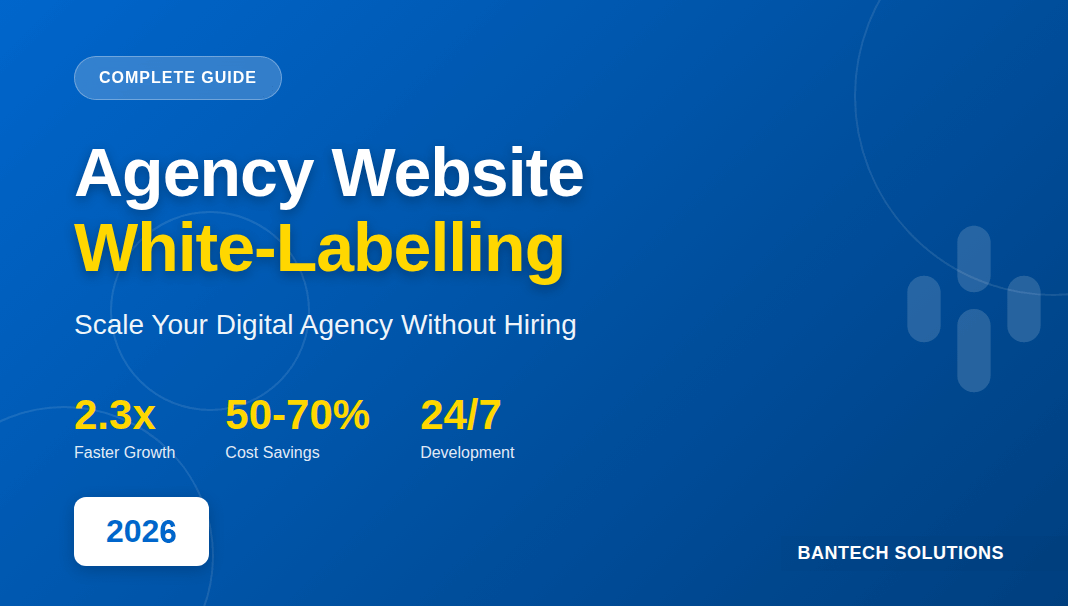
In today’s hyper-competitive digital landscape, agencies face an impossible choice: turn away profitable client work or overextend internal teams to the breaking point. The statistics paint a stark picture: 73% of agencies now incorporate white-label services into their operations, and those leveraging strategic outsourcing partnerships grow 2.3 times faster than competitors who don’t. For digital agencies across the USA, UK, Canada, Australia, and New Zealand, agency website white-labeling has emerged not as a stopgap measure, but as a fundamental strategic advantage.
The white-label market is projected to reach $99.19 billion by 2026, growing at 12.3% annually. This explosive growth isn’t happening by accident. Smart agencies have discovered that private label web development partnerships allow them to deliver enterprise-grade capabilities without enterprise-level overhead. They’re offering comprehensive agency-branded website services while their carefully selected partners handle technical execution behind the scenes.
This comprehensive guide reveals how strategic agency website white-labelling can transform your business model, why outsourcing to specialized partners in India creates sustainable competitive advantages, and how companies like Bantech Solutions are helping Western agencies scale profitably while maintaining the quality standards their clients demand.
Understanding Agency Website White-Labelling: More Than Just Outsourcing
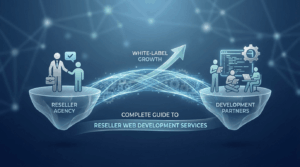
Agency website white-labelling represents a strategic business model where specialized development partners create fully functional websites, web applications, and digital solutions that agencies rebrand and present as their own work. Unlike traditional outsourcing arrangements where the external provider’s identity remains visible, white-label partnerships operate with complete invisibility to end clients.
The White-Label Business Model Explained
Think of agency website white-labelling as a behind-the-scenes partnership where each party focuses on their core strengths:
- Your agency maintains direct client relationships, handles strategy, manages communications, and owns the brand identity
- Your white-label partner handles technical execution, development workflows, quality assurance, and delivers finished products under your branding
- Your clients interact exclusively with your agency, never knowing specialized partners contributed to project delivery
This arrangement differs fundamentally from freelancing or standard outsourcing. Freelancers typically get credit for their contributions and may communicate directly with clients. Standard outsourcing agencies often maintain their own branding in deliverables. White-label partnerships, by contrast, deliver complete brand invisibility—a distinction that business research on strategic partnerships identifies as critical for maintaining competitive differentiation.
Private Label Web Development: Building Your Service Portfolio
Private label web development extends beyond simple website creation. Modern agencies offering agency-branded website services can leverage white-label partnerships across numerous specializations:
- Custom WordPress development including enterprise-level implementations with complex functionality, custom themes, advanced plugin integrations, and WooCommerce solutions
- E-commerce platforms built on Shopify Plus, WooCommerce, Magento, BigCommerce, and custom frameworks with payment gateway integrations
- Progressive web applications and custom software solutions using React, Angular, Vue.js, Node.js, Python, and modern tech stacks
- Mobile app development for iOS and Android platforms using native and cross-platform frameworks like React Native and Flutter
- API development and integrations, CRM synchronizations, payment processor integrations, and complex backend systems
- UI/UX design services including user research, wireframing, prototyping, and conversion-optimized interface design
The key advantage lies in offering these comprehensive services immediately, without spending months hiring developers, establishing infrastructure, or building internal capabilities from scratch.
The Strategic Business Case for Agency Website White-Labelling
Beyond operational convenience, agency website white-labelling creates profound strategic advantages that fundamentally reshape agency economics and competitive positioning.
Transforming Agency Economics Through Strategic Partnerships
The financial mathematics of agency website white-labelling reveal compelling advantages:
- Variable cost structure: Pay only for work delivered, eliminating fixed payroll expenses, benefits (typically adding 25-35% to base salary according to the U.S. Bureau of Labor Statistics), office space, equipment, and overhead associated with full-time employees
- Markup potential: Agencies typically achieve 35-55% margins on white-label services while remaining price-competitive in their markets
- Reduced recruitment costs: Eliminate expensive hiring processes averaging $4,129 per hire, onboarding periods lasting 3-6 months, and turnover risks
- Infrastructure savings: Avoid investments in development tools, software licenses, project management systems, and technical infrastructure
- Scalability advantages: Instantly scale development capacity up or down based on project pipeline without hiring friction
Consider this real-world comparison: Hiring a senior full-stack developer in the USA costs $120,000-$180,000 annually in salary alone, before benefits (adding $30,000-$45,000), payroll taxes, and equipment. That same budget invested in a strategic white-label partnership can deliver 3-5 times more development capacity while maintaining comparable or superior quality standards.
For a mid-sized agency managing 15-20 concurrent projects, the financial impact becomes transformative. Instead of maintaining a team of 5-7 in-house developers at $700,000-$1,000,000 in total employment costs, white-label partnerships can deliver equivalent or greater output at $350,000-$500,000, creating $350,000-$500,000 in annual savings that flow directly to profitability.
Accelerating Time-to-Market and Service Expansion
In competitive agency markets, speed determines who wins client relationships. Research demonstrates that agencies responding to client needs within 48 hours are 60% more likely to win new business. When a prospect requests website development services you don’t currently offer in-house, traditional responses create problems:
- Declining the work sends profitable business to competitors and damages your positioning as a full-service provider
- Scrambling to hire creates project delays averaging 3-6 months, quality risks during the learning curve, and uncertain delivery timelines
- Referring clients elsewhere establishes competitors as the go-to resource for those services, potentially losing the client relationship permanently
Agency website white-labelling eliminates these compromises. With established partnerships already in place, agencies can accept new service requests immediately, often beginning discovery work within 24-48 hours and commencing development within 5-7 business days.
Real-world case study: A Boston-based digital marketing agency partnered with Bantech Solutions (https://www.bantechsolutions.com) to expand into custom web development. Within 90 days, they had closed $280,000 in new project contracts they would have previously referred elsewhere. Within 12 months, white-label web development represented 35% of their total revenue.
Accessing Specialized Expertise Without Building Internal Teams
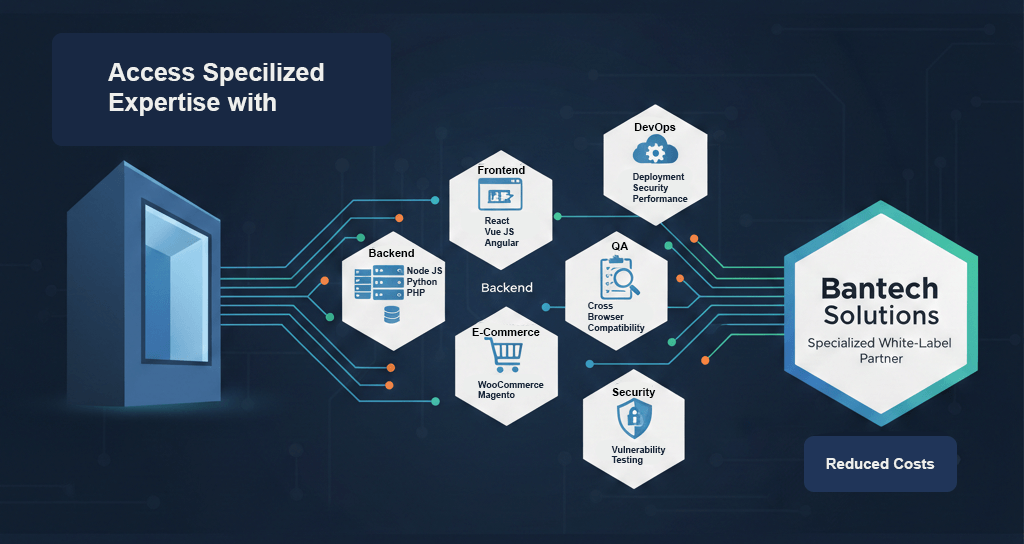
Modern web development demands expertise across constantly evolving technologies. The Stack Overflow Developer Survey reveals that effective full-stack development now spans 15-20 distinct technologies. Maintaining comprehensive capabilities in-house requires:
- Frontend specialists for React, Vue.js, Angular, and emerging frameworks • Backend developers proficient in Node.js, PHP, Python, and database technologies • E-commerce platform specialists for Shopify Plus, WooCommerce, and Magento • DevOps engineers managing deployment, hosting, security, and performance optimization • QA specialists ensuring cross-browser compatibility and accessibility compliance • Security experts conducting vulnerability assessments and penetration testing
Assembling this expertise internally would require a technical team of 8-12 specialized professionals, representing $800,000-$1,500,000 in annual salary costs alone before overhead expenses.
Specialized white-label partners like Bantech Solutions maintain these diverse capabilities across teams of dedicated professionals who work exclusively in their areas of expertise. Your agency benefits from this depth without the cost of building and maintaining such comprehensive internal capabilities.
Why India Represents the Optimal White-Label Partnership Destination
While white-label partnerships exist globally, India has emerged as the preferred destination for agency website white-labelling, particularly for agencies across the USA, UK, Canada, Australia, and New Zealand.
Technical Excellence and Educational Infrastructure
India produces over 1.5 million engineering graduates annually, creating an unparalleled talent pool for technology services. Indian technical education emphasizes practical problem-solving, advanced mathematics, and rigorous computer science fundamentals that translate directly into high-quality development work.
Major technology companies like Google, Microsoft, Amazon, Facebook, Apple, and Adobe maintain substantial research and development operations in India precisely because of this talent depth. Google’s largest engineering center outside the United States operates in Bangalore. When global tech giants trust India-based teams for critical product development and AI research, it validates capabilities that translate perfectly to private label web development partnerships.
India’s IT industry employs over 5.4 million professionals, with 65% holding advanced degrees in computer science or related technical disciplines. Indian developers regularly rank among the top performers in global coding competitions for problem-solving ability, algorithm implementation, and data structure mastery.
Strategic Cost Optimization Without Quality Compromise
The economic advantages of India-based agency website white-labelling create transformative opportunities:
- Development costs typically run 50-70% lower than comparable Western markets while maintaining equivalent quality standards
- Lower operating costs enable competitive project pricing that helps agencies win new business while maintaining healthy profit margins
- Improved profit margins allow reinvestment in sales, marketing, and client acquisition activities
- Predictable pricing structures simplify project estimation and reduce financial risk
- Flexible engagement models including dedicated teams, project-based pricing, and retainer arrangements
These cost advantages reflect economic realities where highly skilled professionals command different salary levels based on local cost-of-living considerations. A senior developer in Bangalore possessing equivalent skills to a San Francisco-based counterpart might earn $25,000-$40,000 annually versus $150,000-$200,000—not because of inferior capabilities, but due to dramatically different living costs.
Time Zone Advantages: The Follow-the-Sun Workflow
What initially appears as a time zone challenge actually creates powerful workflow advantages. When your agency’s workday ends in New York, London, or Sydney, development teams in India are just beginning theirs. This creates a follow-the-sun workflow where:
- Projects progress continuously across 24-hour cycles—what might take 10 business days with same-timezone developers compresses to 6-7 days
- Morning agency reviews of overnight development work enable rapid feedback and course corrections
- Critical bug fixes and urgent client requests can be addressed while your local team sleeps
- Planned overlap hours (typically 2-4 hours daily) facilitate real-time collaboration when necessary
- Extended coverage windows mean client emergencies occurring after hours can receive immediate technical attention
Research demonstrates that properly managed asynchronous workflows can accelerate project delivery by 30-40% compared to traditional same-location teams.
Process Maturity and Quality Frameworks
India’s IT services industry has matured over three decades, developing sophisticated process frameworks that ensure consistent delivery quality. Leading white-label partners like Bantech Solutions implement:
- ISO 9001:2015 quality management systems ensuring standardized processes and consistent service delivery
- CMMI Level 5 certification (the highest maturity level) demonstrating optimization of development processes
- Agile and DevOps methodologies aligned with Western development best practices
- Comprehensive quality assurance protocols including automated testing, code reviews, and security scanning
- Information security standards including ISO 27001 certification and data protection compliance
This process maturity means agencies partnering with established India-based providers benefit from enterprise-grade project management and quality control without building these capabilities internally.
Bantech Solutions: Your Strategic Partner for Agency Website White-Labelling
While understanding the strategic advantages of agency website white-labelling matters, implementation success depends entirely on partner selection. Bantech Solutions has established itself as a trusted white-label development partner specifically designed for agencies across the USA, UK, Canada, Australia, and New Zealand, with over 12 years of proven expertise serving Western agency partners.
Comprehensive Technical Capabilities
Bantech Solutions provides end-to-end private label web development across diverse technical requirements:
- Custom WordPress development: From simple business websites to complex enterprise implementations with custom plugins and WooCommerce integrations
- E-commerce solutions: Shopify Plus development, WooCommerce customization, Magento implementations, and headless commerce architectures
- Web application development: React, Angular, Vue.js frontends connected to Node.js, PHP, Python, and .NET backends
- Mobile app development: Native iOS and Android development, plus cross-platform solutions using React Native and Flutter
- UI/UX design services: User research, wireframing, prototyping, conversion optimization, and responsive design systems
- API development and integration: Connecting websites with CRM systems, marketing automation platforms, and payment gateways
- Website maintenance and support: Ongoing technical support, security updates, and performance monitoring with defined SLA commitments
Streamlined White-Label Workflow
Bantech Solutions has refined its agency partnership process over 12+ years to maximize efficiency while maintaining complete brand invisibility:
- Discovery and scoping: Your agency shares client requirements; Bantech provides detailed technical specifications and accurate project estimates within 24-48 hours
- Design approval: Wireframes, mockups, and designs delivered under your agency branding for seamless client presentation
- Development sprints: Regular updates, staging environment access, transparent progress tracking, and scheduled review meetings
- Quality assurance: Comprehensive testing including cross-browser verification, mobile device testing, accessibility audits, and performance optimization
- Launch and handoff: Final deployment with documentation and training materials branded for your agency, plus post-launch monitoring and warranty support
Throughout this process, all client communications flow exclusively through your agency. Bantech operates entirely behind the scenes, ensuring clients perceive your agency as the sole provider.
Rigorous Quality Standards
Quality control represents a non-negotiable priority in white-label partnerships. Bantech Solutions implements multi-layered quality assurance:
- Code review processes ensuring adherence to industry best practices and security standards
- Automated testing frameworks catching bugs before they reach staging environments
- Manual QA testing across multiple browsers and devices
- Performance optimization ensuring fast page loads and excellent Core Web Vitals scores
- Security audits including OWASP Top 10 verification and vulnerability prevention
- Accessibility compliance ensuring WCAG 2.1 Level AA conformance
- Comprehensive documentation enabling future development by any technical team
These quality frameworks protect your agency’s reputation by ensuring every delivered project meets or exceeds professional standards.
Implementation Best Practices for Agency Website White-Labelling Success
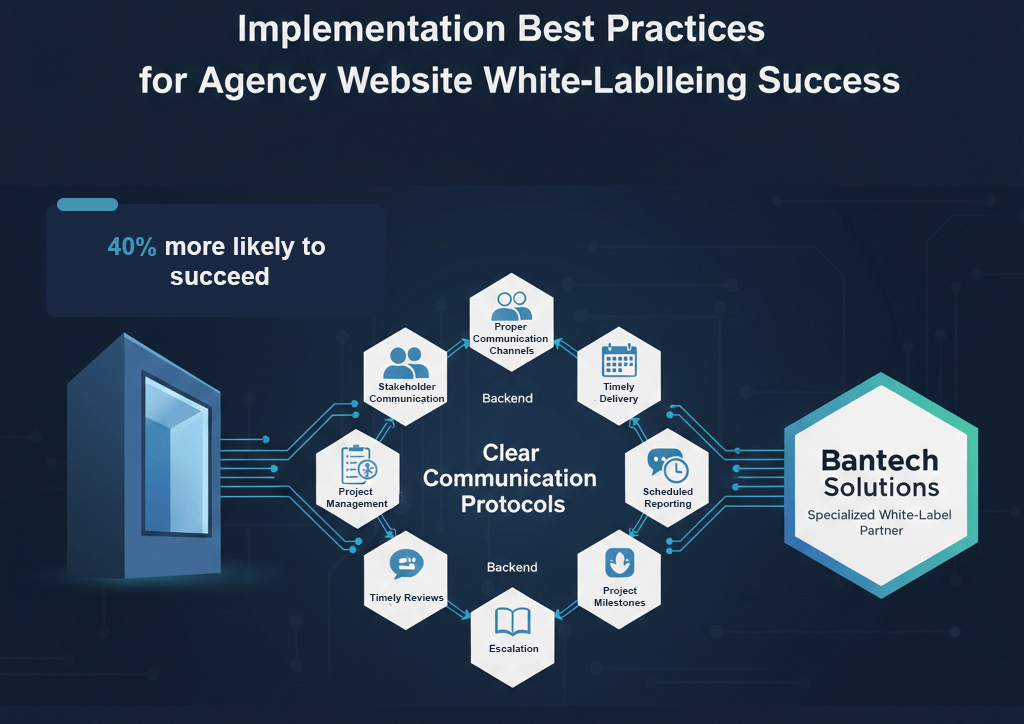
Successfully implementing agency website white-labelling requires strategic planning beyond simply selecting a development partner.
Establishing Clear Communication Protocols
Effective white-label partnerships depend on crystal-clear communication structures:
- Designated points of contact: Assign specific team members as primary contacts to prevent conflicting instructions
- Project management systems: Utilize shared platforms like Asana, Trello, or Jira for transparent task tracking
- Regular status updates: Schedule weekly or bi-weekly calls to review progress and maintain alignment
- Communication channels: Establish clear protocols for different communication types
- Escalation procedures: Define clear paths for addressing urgent issues or client emergencies
- Documentation standards: Maintain comprehensive records in shared knowledge bases
Research demonstrates that projects with clearly defined communication protocols are 40% more likely to succeed.
Setting Clear Client Expectations
Transparency with clients builds trust while protecting against unrealistic timeline pressures:
- Realistic timelines: Communicate accurate project schedules accounting for development complexity
- Scope documentation: Provide detailed specifications preventing scope creep
- Regular progress reports: Keep clients informed through staging environment access and milestone updates
- Change request processes: Establish procedures for mid-project modifications with transparent cost impacts
- Quality expectations: Educate clients about testing procedures and the importance of thorough UAT
Starting with Pilot Projects
Even with thorough vetting, new white-label partnerships carry risks. Minimize these through strategic pilot project selection:
- Choose lower-risk projects for initial engagements • Test critical capabilities that will be important for future projects • Evaluate communication effectiveness during real-world project pressure • Assess quality standards against your agency’s expectations • Measure timeline reliability
Maintaining Quality Oversight
Even with trusted white-label partners, your agency remains responsible for delivered quality:
• Code reviews: Periodically review delivered code for quality and security • Staging environment testing: Thoroughly test all deliverables before client review • Client feedback analysis: Track satisfaction to identify patterns • Performance monitoring: Use tools like Google PageSpeed Insights to verify performance standards • Security scanning: Utilize automated tools to verify absence of vulnerabilities
Common Questions About Agency Website White-Labelling
What exactly is agency website white-labelling and how does it differ from standard outsourcing?
Agency website white-labelling involves partnering with specialized development providers who build websites and digital solutions entirely under your agency’s brand. Unlike traditional outsourcing where the external provider maintains visibility, white-label partnerships operate with complete invisibility to your clients. You maintain all client relationships, own the brand identity, and present finished work as your own creation while your partner handles technical execution behind the scenes.
How can agencies ensure quality when using white-label development services?
Quality assurance starts with thorough partner vetting and continues through every project phase. Examine portfolios, request client references from other agency partners, conduct small test projects before committing to major engagements, and verify certifications (ISO, CMMI). Once partnered, implement regular quality checkpoints including staging environment testing, code reviews, comprehensive UAT protocols, and performance monitoring. Leading white-label providers maintain ISO 9001 and CMMI Level 5 certifications ensuring consistent delivery standards.
Why should agencies choose India-based white-label partners over domestic alternatives?
India-based partnerships offer compelling advantages: massive engineering talent pool (1.5+ million graduates annually) providing specialized expertise, development costs 50-70% below Western markets improving profitability, time zone differences enabling continuous 24-hour project progress, and process maturity (ISO 9001, CMMI Level 5) ensuring reliable quality. Over $200 billion in annual technology exports demonstrates sustained excellence serving demanding global clients.
What services can agencies offer through white-label web development partnerships?
Modern white-label partnerships enable comprehensive offerings: custom WordPress development, e-commerce platforms (Shopify Plus, WooCommerce, Magento), progressive web applications, mobile app development, API integrations, website maintenance, and specialized solutions for healthcare, financial services, e-learning, and real estate. This breadth positions agencies as full-service providers without building extensive internal teams.
How do time zone differences impact white-label development partnerships with India?
Time zone differences create strategic advantages when properly managed. As your agency’s workday ends, development teams in India begin theirs, enabling continuous progress across 24-hour cycles. Submit revision requests at day’s end; receive completed work by next morning. This creates “overnight miracle” turnarounds that delight clients. Planned overlap hours (2-4 hours daily) facilitate real-time collaboration when necessary.
The Future of Agency Website White-Labelling: 2025 and Beyond
Several emerging trends will reshape how agencies leverage white-label partnerships:
AI-Powered Development and Automation
Leading white-label partners now incorporate AI-powered tools for code generation, automated testing, performance optimization, and design assistance. Research suggests AI coding assistants improve developer productivity by 35-45% for certain task types. White-label partners embracing these technologies deliver faster, higher-quality results at better price points.
Increasing Specialization and Niche Expertise
The market is shifting toward specialized partners with deep expertise in specific industries or technologies. Agencies increasingly seek niche capabilities—healthcare portal development, financial services platforms, headless CMS expertise, accessibility compliance—that enable superior domain expertise rather than generic web development.
Advanced Integration and API Ecosystems
Modern websites exist as integrated components within larger technology ecosystems. White-label development increasingly focuses on seamless connections between CRM platforms, marketing automation, e-commerce systems, payment processors, and enterprise applications. Agencies partnering with providers offering robust integration capabilities better serve clients requiring sophisticated digital infrastructure.
Conclusion: Strategic Partnership as Competitive Advantage
Agency website white-labeling has evolved from an operational convenience into a fundamental strategic advantage:
- Growth acceleration: Agencies leveraging white-label partnerships grow 2.3 times faster than competitors • Client retention: White-label partnerships enable comprehensive service offerings achieving 42% higher retention rates • Profitability improvement: Variable cost structures deliver 30-40% higher profit margins • Market positioning: Full-service capabilities enable successful competition against larger agencies
For digital agencies across the USA, UK, Canada, Australia, and New Zealand, the question isn’t whether to adopt white-label partnerships but rather how quickly to implement them effectively.
India-based white-label providers like Bantech Solutions (https://www.bantechsolutions.com) offer the optimal combination of technical excellence, cost optimization (50-70% below Western markets), process maturity (ISO 9001, CMMI Level 5), follow-the-sun workflow advantages, and cultural alignment with Western business practices refined through decades serving international clients.
These partnerships enable agencies to scale rapidly without hiring friction, serve clients comprehensively across any technical requirement, compete effectively regardless of internal team size, maintain healthy profit margins while offering competitive pricing, and focus internal resources on high-value activities like client relationships and business development.
The future belongs to agencies that recognize white-label partnerships not as a compromise but as a competitive multiplier. By focusing internal resources on client relationships while leveraging specialized partners for technical execution, agencies create sustainable growth engines that compound competitive advantages over time.
Take the Next Step
Visit https://www.bantechsolutions.com/ to discover how strategic white-label partnership can transform your agency’s growth trajectory. Contact our team to discuss your specific requirements and explore how Bantech Solutions can become your trusted partner for agency website white-labelling excellence.