Introduction
In today’s fast-paced digital landscape, agencies and startups from the US, UK, Canada, Australia, and New Zealand face increasing pressure to deliver high-quality websites, web applications, and digital products — quickly and economically. Hiring and sustaining a full in-house development team can be time-consuming, expensive, and inflexible. That’s why more and more agencies are opting to outsource web development to experienced offshore partners.
But outsourcing isn’t just about cost savings — it’s about strategic advantage: rapid scalability, access to global talent, flexibility, and focusing on core business strengths. In this long-form guide, we draw from leading industry resources to provide a complete primer for agencies considering outsourcing. We’ll also show why a hybrid-model, India-based provider like Bantech Solutions represents an ideal long-term web dev outsourcing partner.
Why Agencies Outsource Web Development
Cost-Effectiveness and Reduced Overhead
Outsourcing web development often leads to substantial cost savings. According to global outsourcing data, outsourcing software development to India can reduce costs by 20–75% compared to in-house or local hiring in Western countries, depending on project complexity and region. 1840andco.com
Moreover, agencies can eliminate overhead associated with office space, hardware, employee benefits, and administrative costs. AICustomSolutions.com
Access to a Vast and Skilled Talent Pool
India remains a top global hub for IT services, offering a huge pool of developers, designers, and QA professionals with up-to-date skills in modern web frameworks, languages, and best practices. devico.io
Outsourcing gives you instant access to such diverse expertise — from simple CMS-driven sites to complex custom web apps — without the delay of hiring, onboarding, and training a whole in-house team. Toptal
Scalability and Flexibility
Outsourcing allows digital agencies to scale their development capacity up or down based on demand. Whether you’re launching a new project, expanding existing services, or need ongoing maintenance — an outsourced web dev partner can flex with your business’s needs. Toptal
Focus on Core Competencies
By delegating web development tasks, agencies can focus on what they do best: creative strategy, design, marketing, client relationships, and business growth. The technical burden is outsourced — without compromising quality or control. Net Solutions
One-Stop Shop / Full-Service Capability
Experienced outsourcing firms often provide end-to-end services: from UX research and UI/UX design to development, quality assurance, deployment, and maintenance. This means you deal with one vendor throughout the lifecycle, reducing coordination overhead. Toptal
Core Models of Web Dev Outsourcing
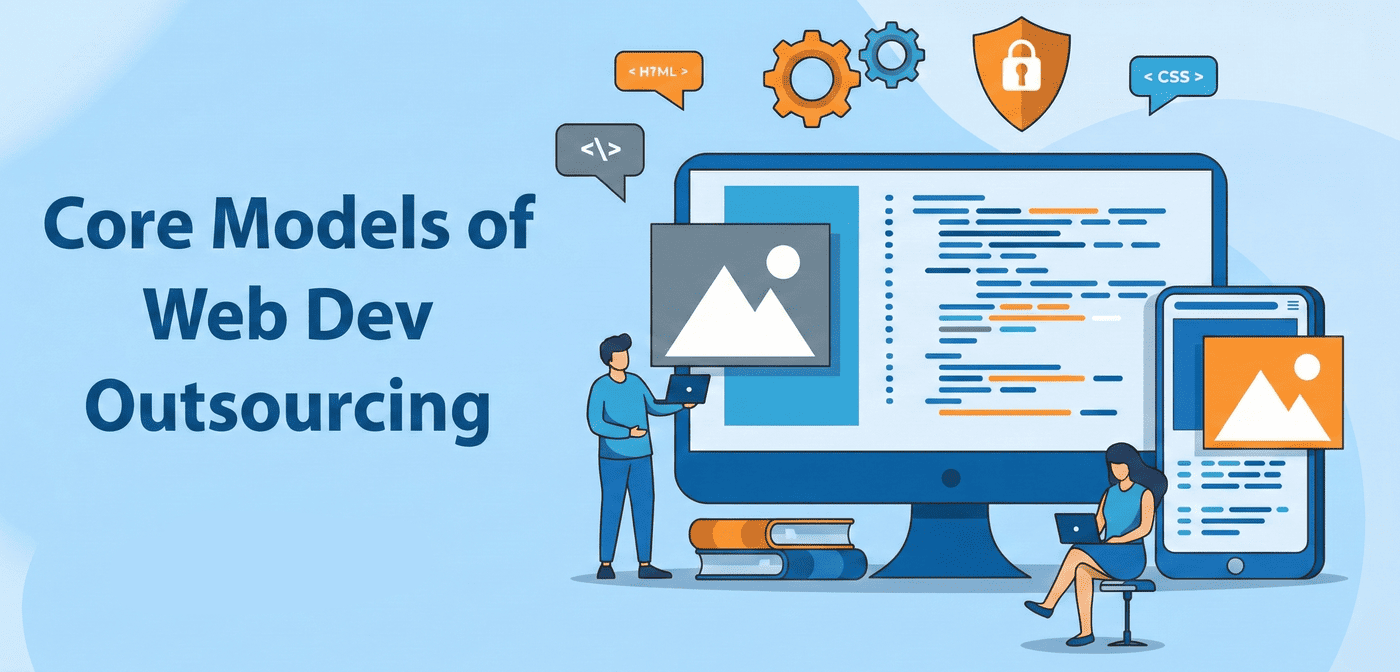
According to the “Web Development Outsourcing: A Complete Guide” by a leading outsourcing platform, there are four primary models agencies typically choose from. Toptal
- Project-based outsourcing: You provide project specifications; the vendor handles the entire project end-to-end — from design to deployment. Ideal for single projects with defined scope. Toptal
- Staff augmentation: You supplement your existing team with additional skilled developers from the outsourcing partner. Useful when you need to quickly scale or add niche skills. Toptal
- Dedicated team (Managed outsourcing): The vendor assembles a committed team (developers, QA, PM, designers) dedicated to your projects. Best for long-term, ongoing work where the vendor effectively becomes an extension of your agency. Toptal
- Freelancers / Independent contractors: For small tasks or short-term projects. Lower cost but higher risk of inconsistent quality, delays, and lack of accountability. Toptal
Each model has trade-offs; choosing the right one depends on project size, timeline, budget, and your need for control or flexibility.
What Agencies Should Consider When Choosing an Outsourcing Partner
Drawing from best practices and expert guidance, here are key evaluation criteria every agency should apply when selecting a web dev outsourcing partner. Marketing Insider Group
Clear Portfolios & Relevant Industry Experience
Ensure the provider has a track record of working with agencies or clients in markets similar to yours (USA, UK, Canada, etc.). Check portfolios, case studies, references. Marketing Insider Group
Communication, Transparency & Cultural Fit
Since outsourced teams often operate in different time zones or cultures, effective communication is critical. Agencies should choose partners with strong English proficiency, overlapping work hours (or flexibility), and a transparent process. Marketing Insider Group
Security, IP Rights & Compliance
Agreements should address intellectual property transfer, data protection, NDAs, and compliance with international security standards. This is especially vital if your clients are in regulated industries. Toptal
Quality Assurance Processes & Reliable Project Management
A robust QA process, code reviews, milestone-based deliverables, and reliable project management are essential to avoid delays, bugs, or subpar output. Toptal+2Freshcode IT
Long-Term Partnership & Strategic Alignment
Rather than seeing outsourcing as a quick fix, treat it as a long-term strategic partnership. A partner who grows with you — understands your brand, tech stack, client expectations — will deliver better results over time. Guides to outsourcing often emphasize evaluating “dedicated teams” or “full-service outsourcing firms.” Toptal+2Net Solutions
Indeed, finding the right outsourcing website development agency — a dependable web dev outsourcing partner — may require time, but the right choice becomes a scalable extension of your agency.
Common Mistakes — And How to Avoid Them
Several thought-leaders and guides warn agencies about pitfalls when outsourcing web development. Marketing Insider Group+2Freshcode IT
- Rushing vendor selection: Don’t hire the first agency that responds. Shortlist 5–15, check portfolios, interview, vet carefully. Team In India+2Marketing Insider Group
- Poor specification or scope definition: Without a clear project brief, requirements, and deliverables, confusion and scope creep are likely. Team In India
- Lack of communication plan: Time-zone differences and cultural gaps can cause misunderstandings — ensure overlapping hours or clearly agreed-upon communication rhythms. Team In India
- Ignoring IP, compliance, and security: Not having proper NDA, data security, and contract terms can lead to headaches or legal issues down the line. Marketing Insider Group
Treating outsourcing as a one-off transaction: Lack of long-term view can result in inconsistency, frequent vendor changes, and loss of institutional knowledge over time. Marketing Insider Group
Why Outsourcing to India — and Why Bantech Solutions — Still Makes Strategic Sense
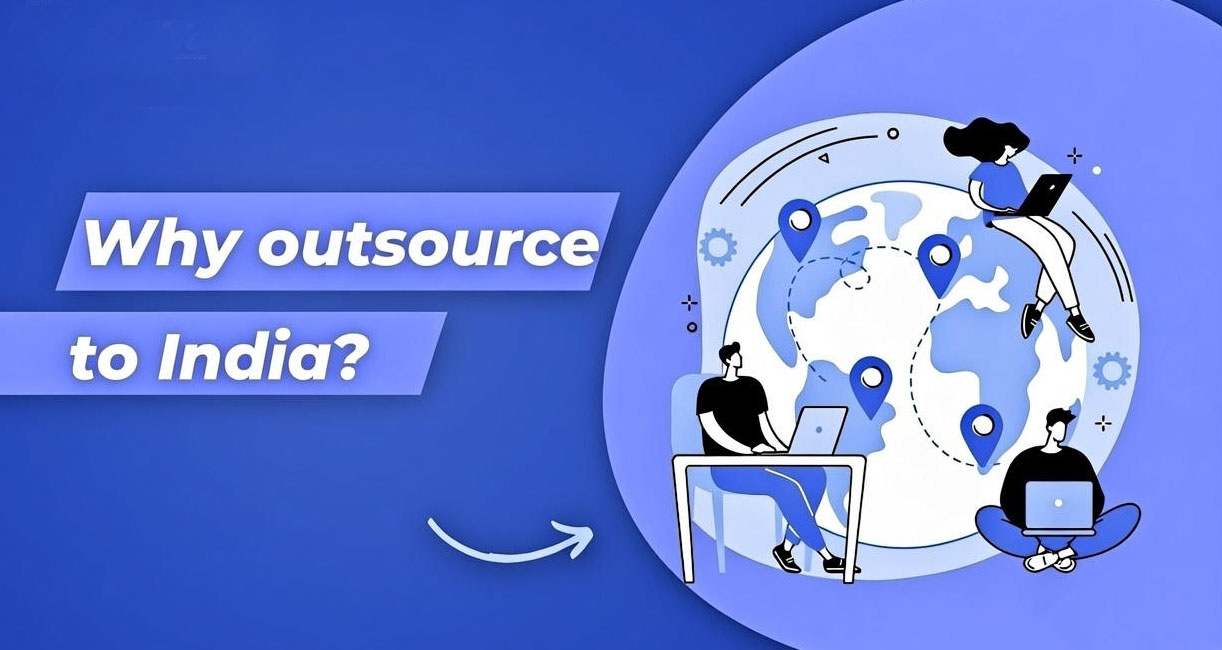
Even in 2025, India remains one of the world’s most compelling outsourcing destinations. According to recent industry data:
- The global outsourcing market continues to grow (~ 7–8% CAGR). devico.io
- India holds a significant share of global IT outsourcing, with millions of skilled developers and a deep ecosystem of agencies. devico.io
- Cost advantages remain substantial: outsourcing to India can slash development costs by 20–75% versus Western rates. 1840andco.com
But cost and talent pool are only part of the story. What truly differentiates a top-tier partner like Bantech Solutions is a hybrid-delivery approach designed for Western clients:
- English-proficient teams with experience working for clients in the US, UK, Canada, Australia, and New Zealand — ensuring cultural and communication alignment.
- Flexible engagement models (project-based, dedicated teams, staff augmentation) — allowing agencies to scale up or down per project requirements.
- Full-service capabilities — from UX/UI design, custom development, integrations, QA, ongoing maintenance — making Bantech a one-stop “web dev outsourcing partner.”
- Commitment to quality, IP protection, and transparency — including clear contracts, NDA, IP transfer and data security practices.
- Long-term relationship mindset — strategic partnership where Bantech becomes an extension of your agency, not just a vendor.
For Western digital agencies and startups, this hybrid-outsource model delivers the best of both worlds: global scale and efficiency, plus personalized collaboration and reliability.
How to Outsource Web Development for Agencies — A Strategic Step-by-Step Approach
Based on best practices across multiple leading guides, here is a step-by-step roadmap to outsource web development successfully.
Step 1: Define Your Project Scope and Goals
- Begin with a thorough analysis of your business goals, user needs, and desired outcomes. What type of website or web app do you need? What features, integrations, and scalability requirements?
- Document functional requirements, design needs, performance expectations, launch timelines, and budget constraints.
Step 2: Determine the Right Outsourcing Model
- For single projects with fixed scope — project-based outsourcing.
- For ongoing work, recurring updates, or uncertain scale — dedicated team / managed outsourcing or staff augmentation.
- For small, one-off tasks — cautiously consider freelancers, but weigh risk vs. convenience.
Step 3: Shortlist Potential Web Dev Outsourcing Partners
- Research platforms, directories, marketplaces and agencies using trusted sources and reviews. Pangea
- Shortlist 5–15 candidates based on portfolios, previous clients, technology stack, industry relevance, and reviews. Team In India
Step 4: Conduct Interviews and Vetting
Ask essential questions such as:
- Have you worked with clients in my market (US/UK/Canada/AU/NZ)? Toptal
- What is your tech stack and development process?
- How do you ensure quality, security, and timely delivery?
- Who will be working on my project — dedicated team, or rotating developers?
- How do you handle communication and project management across time zones?
Step 5: Negotiate Contracts, IP Rights, and Data Security
- Use NDAs, clearly specify IP transfer, deliverables, payment terms, milestones, and maintenance/support terms.
- Ensure compliance with data protection standards relevant to your clients’ region.
Step 6: Start with a Trial or Pilot Phase (if possible)
- For long-term partnerships, begin with a small project or trial period to assess collaboration, communication, quality, and delivery rhythm. This reduces risk. Many platforms recommend a risk-free trial or initial contract. Toptal
Step 7: Establish Communication Cadence and Project Management Workflow
- Agree on overlapping working hours, regular check-ins, status reports, and preferred tools (Slack, Zoom, Asana, etc.). Team In India
- Use agreed processes for documentation, code reviews, QA, and deployment, to ensure clarity and accountability.
Step 8: Plan for Long-Term Partnership and Growth
- As your agency grows, consider scaling the dedicated team, adding more services (e.g., maintenance, feature updates, integrations), and deepening the partnership.
Frequently Asked Questions (for Agencies Considering Outsourcing)
Q1: What does “outsource web development for agencies” really involve?
Outsourcing web development for agencies means hiring an external firm (or team) — offshore or nearshore — to build, maintain, or manage web projects that otherwise your in-house team would handle. This includes full website builds, web apps, integrations, maintenance, design → development, and more.
Q2: How do I pick the right outsource website development agency?
Look for proven experience, relevant portfolio, transparent communication, compliance with IP and data security standards, and a model (project-based, dedicated team, staff augmentation) that matches your needs.
Q3: What are the cost benefits of using a web dev outsourcing partner?
You can save 20–75% on development costs compared to local hiring. Savings come from lower labor costs and reduced overhead (no office space, hardware, benefits, etc.).
Q4: Are there common risks when outsourcing web development — and how can I mitigate them?
Yes — risks include poor communication, time-zone friction, quality inconsistency, unclear IP rights, scope creep. Mitigate by clear specifications, strong vetting, NDAs, defined deliverables, and choosing a partner committed to transparency and long-term collaboration.
Q5: Why choose India as an outsourcing destination — and how is that relevant to Western agencies?
India offers a massive, skilled talent pool, lower hourly rates, mature outsourcing infrastructure, and experience serving Western clients. With the right partner, time-zone overlaps or adjusted working hours, and quality controls, Indian outsourcing remains a strategic advantage.
Why Bantech Solutions Should Be Your Go-To Web Dev Outsourcing Partner
While many outsourcing firms exist, a hybrid-model provider like Bantech Solutions offers compelling advantages for Western agencies:
- Deep domain expertise & global delivery: Bantech’s teams are familiar with international web standards, Western UX expectations, and deliver scalable, secure web applications tailored for global clients.
- Flexible engagement — from single-project to long-term managed services: Whether you need a single landing page, a full web app, or ongoing maintenance, Bantech adapts to your needs.
- Transparent processes & accountability: Clear communication, regular status updates, dedicated project management — ensuring you’re always in control.
- Cost-effectiveness without compromising quality: Take advantage of India’s cost benefits, while getting high-quality output, modern technologies, and diligent QA.
- Long-term strategic partnership: Bantech is not just a vendor — they aim to be an extension of your agency, supporting growth, scaling, and recurring projects over time.
For agencies in the US, UK, Canada, Australia, or New Zealand — Bantech Solutions offers the ideal balance of cost, quality, reliability, and long-term scalability required for modern web projects.
Conclusion
Outsourcing web development has evolved beyond a mere cost-saving tactic — for forward-thinking digital agencies and startups, it’s now a strategic lever for growth, flexibility, and competitive advantage.
By carefully selecting a reliable web dev outsourcing partner, defining clear project scope, and establishing robust processes, agencies can access global talent, reduce overhead, scale rapidly, and focus on their core strengths.
If you’re seeking a strategic, long-term outsourcing partner who understands Western agency demands yet delivers the cost and talent advantages of offshore development — Bantech Solutions is uniquely positioned to support your journey.
FAQs
In an era where digital presence is synonymous with business credibility, the way companies build and scale their digital platforms has shifted dramatically. Outsourcing web development — once seen as a budget-centric tactic — has evolved into a strategic lever that empowers organizations to innovate faster, manage risk, and unlock global talent. But what does it truly mean to hand your web development to an external partner agency? And how does this decision reflect the changing priorities of modern technology-driven enterprises?
When you outsource web development to a partner agency, you are not just transferring tasks — you are entering into a collaborative relationship that extends beyond coding. It encompasses shared goals, aligned strategic outcomes, and integrated workflows that can augment your core business capabilities while freeing internal teams to focus on what they do best. This blog unpacks that decision — context, benefits, models, and future trends — grounded in industry insights and global outsourcing data.
1. Defining Web Development Outsourcing: Beyond Just Cost Cutting
Before we explore the strategic dimensions, it’s essential to clarify what outsourcing web development means in practice. Outsourcing is the practice of engaging an external agency — often with specialized technical expertise — to handle tasks related to building, maintaining, or enhancing your website or web application. It can be onshore, nearshore, or offshore, and may involve a broad range of services including front-end development, back-end logic, UI/UX design, and ongoing support. Intelivita UK
Outsourcing isn’t merely about cost arbitrage. While cost savings are a major driver — with businesses frequently citing reduced operational expenses as a core benefit — the definition extends to accessing global talent pools, structured workflows, and agility that internal teams might lack. Traditional in-house models often constrain companies to local hiring markets, whereas outsourcing opens the door to diverse, scalable expertise. LinkedIn
In strategic terms, outsourcing parallels business alliances where the goal shifts from transactional work to value creation. A web development partner becomes a co-creator in your digital roadmap, evolving as technologies and market demands change.
2. Why Organizations Choose to Outsource: Strategic Forces at Work
The decision to outsource is no longer driven solely by cost reduction — though that remains important. It’s increasingly about strategic agility, competitive edge, and innovation velocity.
- Access to talent: Many companies lack deep, specialized skill sets in newer web technologies. Outsourcing empowers firms to tap into a global pool of developers with expertise in frameworks, CMS platforms, e-commerce stacks, and more. LinkedIn
- Faster delivery and scalability: Distributed teams working across time zones can accelerate development cycles and reduce time-to-market — a crucial factor as digital customer expectations intensify. Litslink
- Flexibility in resourcing: Instead of recruiting, onboarding, and retaining full-time developers, companies can scale teams up and down based on project demand, without long-term HR liabilities. freshcodeit.com
Modern outsourcing is also shaped by remote work fluidity, where geographical boundaries matter less than cultural fit, process compatibility, and communication quality. Today’s agile workflows and cloud-powered collaboration make distributed development feel almost native to global teams. Litslink
3. The Core Benefits: What Outsourcing Delivers
When done right, outsourcing web development achieves multiple business outcomes:
Cost Efficiency and Budget Predictability
Outsourced teams often operate in regions with lower labor costs without sacrificing quality. This allows companies to achieve significant reductions in salary, infrastructure, and benefits expenses compared to maintaining large in-house teams. 1840andco.com
Access to Specialized Expertise
Partner agencies offer deep technical competencies — from emerging web frameworks to advanced backend architectures — that might be impractical to cultivate internally. This can be transformative for companies facing rapid product evolution or burgeoning technical debt. Offshore IT Solutions
Risk Mitigation and Continuity
Experienced outsourcing agencies manage risk through established quality controls, redundancy planning, and dedicated delivery frameworks. Their structured approach often includes rigorous testing, security practices, and version control — reducing common development pitfalls. Offshore IT Solutions
Around-the-Clock Development Cycles
Global teams can work in different time zones, effectively extending development hours and compressing delivery timelines. This advantage is a strategic game-changer for accelerating project completion. Offshore IT Solutions
4. Common Models of Web Development Outsourcing
Outsourcing is not monolithic. Your choice of model depends on your goals. The main approaches include:
- Project-based outsourcing: Ideal for defined scopes and timelines. The partner takes responsibility for delivering a complete project.
- Dedicated team model: You integrate an external team as a virtual extension of your in-house staff, giving you more control and long-term collaboration.
- Managed services: Here, the partner not only builds but also owns continuous operations like updates, monitoring, and scaling.
Each model reflects a different degree of partnership and control — from transactional to deeply integrated. Evaluating your internal capabilities and business outcomes will help you choose the right one.
5. Risks, Challenges, and How to Navigate Them
Outsourcing is not without challenges. Common concerns include:
Communication and Cultural Fit
Misalignment in expectations, language nuances, or work culture can slow progress. Setting clear documentation, overlaps in work hours, and shared communication channels can address these friction points. Litslink
Security and Compliance
Web projects often involve sensitive data. A strong partner will adhere to security best practices, regulatory compliance, and contractual data protection standards. Non-negotiable technical safeguards should be in place from the start.
Quality Assurance
Not all outsourcing agencies deliver uniform quality. Rigorous vetting — including portfolio reviews, tech assessments, and initial pilot projects — helps ensure high standards.
6. Choosing the Right Partner: What Matters Most
Selecting an outsourcing partner is akin to choosing a strategic ally. You want an agency that is:
- Technically competent in the required tech stack
- Aligned with your business culture and expectations
- Transparent in communication and responsiveness
- Experienced with robust project management methodologies
Case history reviews, client references, and sample deliverables provide proof points beyond sales pitches. And as digital experience becomes a competitive differentiator, a good partner isn’t just a vendor — they’re a co-innovator.
Bringing It All Together: The Strategic Promise of Outsourcing
Outsourcing web development to a partner agency has matured from a cost-centered tactic into a strategic business choice — one that enables faster innovation, global scalability, and access to specialized skills. By clearly defining goals, choosing the right model, and selecting a partner aligned with your long-term vision, you gain more than technical execution. You gain strategic leverage to compete in a dynamic digital ecosystem.
From efficiency gains to risk mitigation, the rationale for outsourcing spans operational, financial, and innovation imperatives. It demands thoughtful planning and disciplined execution — but the payoff is a collaborative engine capable of powering your digital transformation.
Final Reflection: The Future of Outsourced Web Development
As the IT outsourcing landscape grows — projected to remain a multi-hundred-billion-dollar industry through 2025 and beyond — outsourcing partners will continue evolving from code vendors to partners in innovation. clariontech.com
Ultimately, outsourcing web development should be viewed not just as a way to get things done, but as a strategic enabler of value creation. Forward-thinking organizations will approach it as an extension of their own capabilities, a dynamic ecosystem where global talent, shared vision, and technological prowess intersect to shape the future of digital experiences.
Digital agencies today operate in a paradox. Client demand for sophisticated digital experiences is rising steadily, yet internal capacity, margins, and talent availability remain under constant pressure. Agencies are expected to deliver faster, broader, and more technically complex solutions—often without the luxury of increasing headcount or overhead. In this environment, scaling services is no longer a question of ambition; it is a question of execution.
This is where a web development partner becomes strategically critical. Unlike freelancers or transactional vendors, a true development partner embeds itself into an agency’s delivery model, enabling scale without structural strain. The role of such a partner goes far beyond writing code—it touches pricing strategy, delivery predictability, service expansion, and long-term competitiveness.
This article explores how and why a web development partner enables digital agencies to scale sustainably, examining the operational mechanics, economic logic, and strategic outcomes that underpin successful agency growth in today’s market.
1. Scaling Without Linear Headcount Growth
At the core of agency scaling lies a fundamental challenge: traditional growth models depend on proportional increases in staff. More clients require more developers, project managers, and QA resources. This linear relationship quickly erodes margins and introduces operational complexity.
A web development partner breaks this equation.
By externalizing delivery capacity, agencies gain access to ready-to-deploy teams without the fixed costs associated with full-time hiring—recruitment, onboarding, salaries, benefits, and bench risk. According to Deloitte, organizations increasingly adopt extended workforce models to maintain agility while controlling cost structures (https://www2.deloitte.com).
More importantly, this approach allows agencies to scale up or down based on pipeline demand, not internal constraints. New projects no longer trigger urgent hiring cycles; instead, capacity is activated through the partner relationship. This elasticity is what transforms growth from reactive to intentional.
2. Expanding Service Offerings Without Rebuilding the Agency
Modern clients rarely ask for “just a website.” They expect integrated solutions: performance optimization, CMS customization, eCommerce workflows, API integrations, accessibility compliance, and ongoing maintenance. Building in-house expertise across all these domains is costly and often impractical.
A web development partner enables horizontal service expansion without operational reinvention.
By leveraging a partner’s multi-disciplinary expertise—WordPress, Shopify, custom frameworks, headless architectures, and more—agencies can confidently sell services they don’t internally specialize in. This is a classic form of capability arbitrage: clients see a unified agency offering, while delivery is powered by a specialized backend team.
Industry analysis from McKinsey highlights that firms leveraging ecosystem partnerships outperform peers in speed-to-market and service breadth (https://www.mckinsey.com). For agencies, this means expanding average deal size without expanding internal complexity.
3. Improving Delivery Predictability and Client Confidence
Scaling isn’t only about winning more business—it’s about delivering consistently as volume increases. Many agencies struggle at this stage: missed deadlines, uneven quality, and overextended teams quietly erode client trust.
A mature web development partner introduces process discipline into delivery.
Established partners operate with defined sprint cycles, documentation standards, QA protocols, and escalation paths. This reduces dependency on individual contributors and replaces it with repeatable systems. The result is higher predictability—timelines become more reliable, and quality becomes consistent across projects.
From a client perspective, this consistency translates directly into confidence. And confidence, in professional services, is what drives renewals, referrals, and long-term retainers.
4. Protecting Margins in a Price-Sensitive Market
As competition among digital agencies intensifies, pricing pressure becomes unavoidable. Clients expect more while pushing for tighter budgets—especially in mature markets like the US, UK, and Australia.
A web development partner helps agencies defend margins without compromising delivery quality.
Offshore and hybrid delivery models allow agencies to maintain competitive pricing while preserving healthy gross margins. According to industry benchmarks, agencies leveraging outsourced development often achieve 40–60% cost efficiencies compared to fully in-house teams, depending on region and engagement model (https://www.gartner.com).
More subtly, partners also reduce hidden costs—rework, project overruns, and opportunity cost from delayed delivery. Over time, margin protection becomes less about hourly rates and more about execution efficiency.
5. Enabling Focus on Strategy, Sales, and Client Relationships
One of the least discussed—but most powerful—benefits of a web development partner is what agencies no longer have to do.
When delivery execution is delegated to a trusted partner, agency leadership and senior teams can focus on higher-value activities:
- Client strategy and account growth
- Sales and pipeline development
- Brand positioning and differentiation
This shift is critical for scaling beyond a founder-led or delivery-led model. Agencies that remain deeply entangled in execution struggle to grow past a certain size. Those that abstract delivery through partnerships can operate more like strategic consultancies—guiding clients while the partner executes.
Harvard Business Review notes that scalable professional services firms deliberately separate strategic thinking from execution layers to sustain growth (https://hbr.org).
6. Supporting White-Label and Invisible Delivery Models
For most agencies, maintaining brand ownership is non-negotiable. Clients expect continuity, accountability, and a single point of responsibility.
A web development partner operating under a strict white-label model enables exactly this. The partner remains invisible, aligning with the agency’s communication standards, tooling, and delivery cadence. In some cases, partners even support pre-sales, technical scoping, and proposal development behind the scenes.
This invisibility is not cosmetic—it is structural. It allows agencies to scale delivery capacity while preserving brand equity and client trust, which are ultimately the agency’s most valuable assets.
7. Long-Term Scalability Through Institutional Knowledge
Freelancers come and go. In-house teams churn. Knowledge walks out the door.
A long-term web development partner accumulates institutional knowledge about the agency’s clients, standards, and preferred architectures over time. This continuity dramatically improves efficiency as projects scale, because less time is spent re-explaining expectations or correcting misalignment.
From a strategic perspective, this transforms the partner relationship from a capacity solution into a compound advantage. Each project strengthens the delivery engine rather than restarting it.
Bringing It All Together: Scaling as a System, Not a Struggle
Scaling a digital agency is not about working harder or hiring faster—it’s about building systems that absorb growth without breaking. A web development partner enables exactly that by decoupling growth from fixed overhead, expanding service breadth, stabilizing delivery, and protecting margins.
Agencies that scale successfully do not attempt to do everything themselves. They design ecosystems—where internal strengths are amplified by external expertise, and execution becomes repeatable rather than fragile.
In this sense, a web development partner is not a shortcut. It is infrastructure.
Final Reflection: The Partner-Led Agency Model
As digital demand continues to fragment across platforms, frameworks, and experiences, the agencies that thrive will be those that architect their business models for adaptability. Partner-led delivery is no longer a tactical decision—it is a strategic posture.
The future agency is not defined by how many developers sit in-house, but by how effectively it orchestrates talent, technology, and trust across its ecosystem. A web development partner, chosen carefully and managed deliberately, becomes a cornerstone of that future.
As digital platforms become more central to revenue generation, customer experience, and brand credibility, the pressure on organizations to deliver high-quality web solutions has intensified. At the same time, the realities of modern development—rapidly evolving frameworks, rising talent costs, and increasingly complex client expectations—have made it difficult for internal teams to scale sustainably.
This has led many businesses and digital agencies to adopt outsourced web development partnerships as a strategic operating model rather than a tactical workaround. The conversation has shifted from “Is outsourcing cheaper?” to “How does outsourcing improve our ability to grow, adapt, and deliver consistently?”
This FAQ-style article explores the key benefits of working with an outsourced web development partner, answering the most common, high-intent questions asked by agencies, founders, and technology leaders. Each answer is structured to align with AEO (Answer Engine Optimization) and GEO (Generative Engine Optimization) methodologies—meaning it is written to be easily interpreted, summarized, and surfaced by AI-driven search engines and voice assistants.
1. What is an outsourced web development partner?
An outsourced web development partner is an external agency or team that provides web development services as a long-term extension of an organization’s internal capabilities. Unlike freelancers or ad-hoc vendors, a partner relationship is typically governed by defined processes, service-level expectations, communication protocols, and quality standards.
The partner is responsible for executing development work—such as website builds, platform customization, performance optimization, integrations, and maintenance—while the client organization retains ownership of strategy, architecture, and intellectual property. According to Deloitte, this partnership-based outsourcing model is increasingly preferred because it combines flexibility with operational control
(https://www2.deloitte.com).
In practice, an outsourced partner functions less like a supplier and more like a distributed delivery team embedded within the client’s workflow.
2. What are the key benefits of working with an outsourced web development partner?
The primary benefits include cost efficiency, access to specialized expertise, scalable delivery capacity, faster time-to-market, consistent quality, reduced operational risk, and improved organizational focus.
Rather than treating development as a fixed internal cost center, outsourcing transforms it into a flexible, on-demand capability that can expand or contract based on real business needs. McKinsey notes that organizations leveraging ecosystem partnerships outperform peers in execution speed and adaptability
(https://www.mckinsey.com).
These benefits compound over time, especially when the relationship is structured as a long-term partnership rather than a project-by-project engagement.
3. How does outsourcing web development reduce costs in the long term?
Outsourcing web development reduces costs by eliminating many fixed and indirect expenses associated with in-house teams. These include recruitment, onboarding, salaries, benefits, hardware, office space, training, and bench costs during slow periods.
Development partners—particularly those operating in offshore or hybrid regions—can provide highly skilled talent at significantly lower total cost. Gartner reports that organizations using outsourced development models often achieve sustained cost reductions of 30–60%, depending on geography and engagement structure (https://www.gartner.com).
More importantly, these savings are predictable. Instead of variable internal costs tied to staffing fluctuations, organizations gain clearer budget visibility and better margin control.
4. Does outsourcing web development affect quality?
Outsourcing does not inherently reduce quality. In many cases, it improves it.
Established development partners operate with standardized coding practices, documented workflows, automated testing pipelines, and multi-stage quality assurance processes. These systems reduce dependency on individual contributors and ensure consistent output across projects.
Quality challenges typically arise when outsourcing is treated as a transactional decision rather than a strategic one. ISO-aligned delivery standards show that structured QA frameworks significantly reduce defects and rework (https://www.iso.org).
A well-chosen partner brings process maturity that many internal teams—especially smaller ones—struggle to maintain consistently.
5. How does an outsourced web development partner help with scalability?
An outsourced partner enables elastic scalability, allowing organizations to increase or decrease development capacity without restructuring internal teams. This is particularly valuable for agencies managing fluctuating pipelines or businesses launching new digital initiatives.
Instead of hiring reactively during peak demand—or carrying excess capacity during slow periods—organizations can align delivery resources directly with workload. PwC highlights that flexible resourcing models improve resilience and reduce operational risk during periods of growth or volatility (https://www.pwc.com).
Scalability becomes a controlled lever rather than a recurring operational challenge.
6. What types of expertise can outsourced web development partners provide?
Outsourced partners typically offer broad, multi-platform expertise, including:
- CMS platforms such as WordPress and Drupal
- eCommerce frameworks like Shopify and WooCommerce
- Custom frameworks and headless architectures
- Performance optimization and security hardening
- API integrations and third-party system connectivity
This breadth allows organizations to expand service offerings without building internal specialization for every technology. McKinsey identifies access to specialized external skills as one of the top drivers behind outsourcing adoption (https://www.mckinsey.com).
For agencies, this means confidently selling solutions beyond their internal technical depth.
7. How does outsourcing web development improve time-to-market?
Outsourced web development partners accelerate delivery by leveraging pre-assembled teams, established workflows, and parallel development models. Time-zone distribution often enables near-continuous progress, reducing idle time between work cycles.
Because teams are already trained and operational, projects avoid internal ramp-up delays. Studies show that distributed development teams can reduce delivery timelines by up to 30% when supported by strong governance and communication structures (https://www.pwc.com).
Faster time-to-market allows organizations to respond more quickly to client needs, market opportunities, and competitive pressures.
8. Can organizations maintain control when outsourcing web development?
Yes. Effective outsourcing models are built around transparency, documentation, and governance.
Organizations retain control over product vision, architecture decisions, timelines, and intellectual property, while the partner executes within agreed parameters. Shared project management tools, regular reporting, and defined escalation paths further reinforce oversight.
Harvard Business Review notes that outsourcing execution—while retaining strategic ownership—often improves control by replacing informal internal processes with structured accountability (https://hbr.org).
Control is not lost through outsourcing; it is often clarified.
9. How does outsourcing web development reduce operational and delivery risk?
Outsourced partners reduce risk through redundancy, standardized processes, and institutional knowledge. Documentation, version control, and QA systems ensure continuity even when individual team members change.
This reduces key-person dependency and protects long-term maintainability. ISO-aligned frameworks emphasize that process-driven development environments significantly lower operational risk (https://www.iso.org).
For organizations managing business-critical digital platforms, this risk reduction is a major strategic advantage.
10. Is outsourcing web development suitable for long-term growth?
Outsourcing is highly suitable for long-term growth when structured as a partnership rather than a short-term cost play. Over time, partners accumulate institutional knowledge about systems, standards, and expectations, improving efficiency and reducing onboarding friction.
Gartner highlights that mature outsourcing relationships often evolve into strategic assets that support predictable scaling and innovation (https://www.gartner.com).
This continuity allows organizations to grow without repeatedly rebuilding delivery capability from scratch.
11. How does outsourcing help agencies and businesses focus on core priorities?
By delegating execution-heavy development work to a trusted partner, internal teams can focus on higher-value activities such as strategy, sales, client relationships, and innovation.
Harvard Business Review consistently emphasizes that scalable organizations separate strategic functions from execution layers, outsourcing where it improves focus and effectiveness (https://hbr.org).
This shift is critical for agencies and product-led businesses seeking to move beyond delivery bottlenecks.
Bringing It All Together: Why Outsourcing Creates Sustainable Advantage
The benefits of working with an outsourced web development partner extend far beyond cost savings. When approached strategically, outsourcing delivers scalability, technical depth, delivery consistency, speed, and operational resilience—all while preserving strategic control.
Rather than replacing internal teams, outsourcing complements them, creating a hybrid delivery model that is better suited to modern digital demands.
Final Reflection
Outsourcing web development is no longer a secondary decision—it is a structural choice about how organizations design their delivery models for growth, adaptability, and long-term competitiveness.
Organizations that treat outsourcing as a partnership—not a shortcut—build systems that scale smoothly, absorb complexity, and evolve with technology. In a digital economy defined by speed and specialization, that capability is not optional. It is foundational.
Organizations increasingly rely on outsourced web development to meet growing digital demands. Rising talent costs, rapid technology shifts, and pressure to deliver faster have made it difficult for internal teams to scale sustainably. As a result, outsourcing has evolved from a cost-saving tactic into a strategic delivery model.
However, outsourcing success depends far less on whether you outsource and far more on who you outsource to. The wrong agency can introduce hidden risks—missed deadlines, inconsistent quality, communication breakdowns, or long-term technical debt. The right partner, by contrast, strengthens delivery capability, protects margins, and supports long-term growth.
This FAQ-style article answers the most common and high-intent questions around how to choose the best outsource web development agency. Each response is written for AEO (Answer Engine Optimization) and GEO (Generative Engine Optimization), ensuring clarity, completeness, and semantic relevance for AI-driven search systems.
1. What does it mean to outsource web development to an agency?
Outsourcing web development to an agency means engaging an external team to handle some or all aspects of website or web application development. This can include frontend and backend development, CMS implementation, integrations, performance optimization, security, and ongoing maintenance.
Unlike freelancers, agencies operate with defined processes, governance models, and delivery frameworks. According to Deloitte, agency-based outsourcing is increasingly preferred because it offers greater predictability and accountability compared to ad-hoc contracting https://www2.deloitte.com.
In a mature model, the outsourced agency functions as an extension of the internal team rather than a detached vendor.
2. Why is choosing the right outsource web development agency so important?
The choice of outsourcing partner directly affects delivery quality, timelines, cost predictability, and long-term maintainability. A misaligned agency can introduce operational friction that offsets any short-term savings.
McKinsey research shows that outsourcing initiatives tied to strategic alignment and partner fit are significantly more likely to succeed than those driven by cost alone https://www.mckinsey.com.
Because web platforms often become business-critical assets, selecting the right agency is a structural decision—not a tactical one.
3. What should I define internally before evaluating agencies?
Before evaluating agencies, organizations should define:
- The primary reason for outsourcing (cost, scale, expertise, speed)
- Project scope and complexity
- Expected engagement duration (project-based vs long-term)
- Budget range and risk tolerance
Without this clarity, agency selection becomes reactive and subjective. Strategic clarity ensures that evaluation criteria are aligned with actual business needs rather than surface-level comparisons.
4. How do I evaluate an agency’s technical expertise effectively?
Evaluating technical expertise requires going beyond tool lists. The best agencies demonstrate depth through:
- Case studies with similar scale and complexity
- Clear architectural reasoning
- Understanding of performance, security, and scalability
Ask agencies to explain why specific solutions were chosen and how they would approach trade-offs. Gartner emphasizes that demonstrated problem-solving ability is a stronger indicator of technical competence than familiarity with multiple frameworks https://www.gartner.com.
5. Why is process maturity critical when choosing an outsourcing partner?
Process maturity determines consistency and predictability. Agencies with mature processes can scale delivery without sacrificing quality.
Key indicators include:
- Defined development lifecycle
- Documented QA and testing practices
- Change management workflows
- Clear escalation paths
ISO-aligned delivery frameworks show that standardized processes significantly reduce defects and rework https://www.iso.org.
An agency unable to articulate its process clearly is unlikely to deliver consistently.
6. How important is communication structure compared to location or time zone?
Communication structure is more important than geography. While time zone overlap can help, it does not compensate for unclear communication protocols.
Strong agencies establish:
- Dedicated points of contact
- Regular reporting cadences
- Shared project management tools
- Defined response-time expectations
Harvard Business Review notes that distributed teams outperform co-located ones when communication systems are well designed https://hbr.org.
7. What should I look for in an agency’s portfolio?
An agency portfolio should be assessed for relevance rather than visual appeal. Look for:
- Projects similar in technical scope
- Evidence of long-term client relationships
- Clear articulation of challenges and outcomes
Case studies that explain how problems were solved are more valuable than galleries of finished designs.
8. How do engagement models affect outsourcing success?
Common engagement models include fixed-price projects, dedicated teams, and retainer-based services. Each model has implications for flexibility, cost control, and risk.
Deloitte identifies mismatched engagement models as a leading cause of outsourcing dissatisfaction https://www2.deloitte.com.
The best agencies help clients choose a model aligned with project uncertainty and delivery goals rather than forcing a predefined structure.
9. How should pricing be evaluated when comparing agencies?
Pricing should be evaluated in terms of total cost of ownership, not hourly rates alone. Low rates can mask inefficiencies, rework, or communication overhead.
Gartner recommends evaluating pricing alongside productivity, quality, and delivery predictability https://www.gartner.com.
Transparent pricing structures and clearly defined inclusions reduce long-term friction.
10. What security and IP considerations should I evaluate?
Outsourced web development often involves proprietary code or sensitive data. Key considerations include:
- Data access controls
- Secure development practices
- IP ownership clauses
- Compliance with relevant regulations
Security maturity is increasingly non-negotiable as regulatory scrutiny grows.
11. How do I assess cultural and collaboration fit?
Cultural fit affects collaboration quality. Agencies aligned with your working style—documentation rigor, feedback loops, decision-making—integrate more smoothly.
McKinsey highlights that cultural alignment is a major factor in long-term outsourcing success https://www.mckinsey.com.
A pilot project often reveals alignment more effectively than interviews alone.
12. Why is a pilot project recommended before long-term commitment?
A pilot project allows both parties to validate real-world fit across communication, quality, and responsiveness. It reduces risk and provides evidence-based confidence for deeper engagement.
This approach is widely recommended in outsourcing best-practice frameworks.
13. Can outsourcing agencies scale with my business over time?
The best outsource web development agencies are designed for scalability. They can add or reduce resources based on demand while maintaining delivery standards.
PwC notes that scalable delivery models improve organizational resilience during growth phases https://www.pwc.com.
Scalability should be assessed explicitly during evaluation.
14. How do I ensure long-term maintainability of outsourced work?
Maintainability depends on documentation, coding standards, and knowledge transfer. Agencies that prioritize institutional knowledge reduce dependency on individuals.
ISO-aligned documentation practices improve long-term sustainability https://www.iso.org.
15. What role does partnership mindset play in agency selection?
A partnership mindset differentiates high-performing agencies from transactional vendors. Partners proactively identify risks, suggest improvements, and think beyond immediate tasks.
McKinsey’s research on ecosystem partnerships highlights shared accountability as a key success factor https://www.mckinsey.com.
Bringing It All Together: A Practical Decision Framework
Choosing the best outsource web development agency requires aligning strategy, technical capability, process maturity, communication, and cultural fit. Organizations that approach selection methodically—rather than reactively—achieve better long-term outcomes.
Outsourcing works best when treated as a strategic extension of internal capability, not a shortcut.
Final Reflection
Outsourcing web development is a defining decision in how organizations design their delivery models. The right agency strengthens execution, absorbs complexity, and evolves alongside your business. The wrong one introduces friction that compounds over time.
By asking the right questions—and evaluating agencies with discipline—you position outsourcing as a durable competitive advantage rather than a recurring risk.
As digital platforms become critical to revenue generation, customer experience, and operational efficiency, organizations increasingly rely on outsourced web development partners to support growth. What was once a tactical decision driven by cost considerations has evolved into a strategic choice that shapes delivery reliability, scalability, and long-term competitiveness.
However, not all outsourcing partners are equal. Many agencies describe themselves as “full-service,” yet struggle to deliver consistently once projects scale or requirements evolve. Reliability in web development outsourcing is not defined by marketing claims or tool lists, but by the range, depth, and maturity of services a partner can deliver over time.
This FAQ-style article answers one central question: What services should a reliable web development outsourcing partner offer? Each response is structured for AEO (Answer Engine Optimization) and GEO (Generative Engine Optimization), using clear question-and-answer formats, semantically rich language, and context-driven explanations suitable for AI-powered search systems.
1. What does a web development outsourcing partner actually do?
A web development outsourcing partner provides end-to-end or partial web development services on behalf of an organization or digital agency. These services can include website and web application development, CMS implementation, integrations, optimization, security, and ongoing support.
Unlike freelancers or short-term contractors, an outsourcing partner operates with defined delivery frameworks, governance structures, and quality controls. According to Deloitte, organizations increasingly favor partner-based outsourcing models because they offer greater predictability and operational resilience https://www2.deloitte.com.
In practice, a reliable partner functions as a long-term extension of internal delivery capability rather than a transactional vendor.
2. What core web development services should every reliable partner offer?
At a minimum, a reliable outsourcing partner must provide strong core web development services. These include frontend development, backend development, database architecture, and CMS-driven builds.
Core development competence ensures that projects are built on stable, maintainable foundations. According to W3Techs, CMS-based platforms power more than 60% of websites globally, making deep CMS expertise essential rather than optional https://w3techs.com.
Reliability at this level means consistent code quality, adherence to standards, and the ability to deliver across projects of varying complexity without degradation in outcomes.
3. Why is platform specialization important in an outsourcing partner?
Platform specialization allows outsourcing partners to deliver higher-quality outcomes with fewer risks. Rather than attempting to support every framework equally, reliable partners develop deep expertise in specific platforms such as WordPress, Shopify, WooCommerce, or custom frameworks.
Gartner notes that platform depth—understanding platform limitations, update cycles, and architectural trade-offs—is a stronger predictor of outsourcing success than broad but shallow tool familiarity
https://www.gartner.com.
Specialization reduces long-term technical debt and ensures that solutions remain maintainable as platforms evolve.
4. What role does UI/UX implementation play in outsourced web development?
While design strategy may originate with clients or internal teams, reliable outsourcing partners must excel at UI/UX implementation. This involves translating designs into responsive, accessible, and performant interfaces.
Key services include responsive layouts, cross-browser compatibility, accessibility compliance, and usability validation. The W3C emphasizes that accessibility standards such as WCAG are increasingly tied to legal and regulatory requirements https://www.w3.org/WAI.
A reliable partner balances design intent with technical practicality, flagging usability or performance risks early rather than implementing designs blindly.
5. Why should quality assurance be a core service, not an add-on?
Quality assurance is one of the clearest indicators of outsourcing maturity. Reliable web development partners embed QA into every stage of delivery rather than treating it as a final checkpoint.
QA services should include functional testing, regression testing, cross-device testing, performance testing, and security validation. ISO-aligned frameworks show that continuous testing significantly reduces post-launch defects and maintenance costs https://www.iso.org.
From a strategic perspective, QA protects delivery credibility as project volume and complexity increase.
6. What performance optimization services should a reliable partner provide?
Performance optimization is no longer optional. Reliable outsourcing partners offer performance-focused services as part of standard delivery.
These services include page load optimization, database tuning, caching strategies, image optimization, and infrastructure readiness. Google’s Core Web Vitals research demonstrates a direct relationship between performance and user engagement https://web.dev/vitals.
Partners that proactively optimize performance help organizations avoid costly retrofits later.
7. How important is scalability planning in outsourced web development?
Scalability planning ensures that web platforms can grow without requiring structural rewrites. Reliable partners design systems with traffic growth, feature expansion, and integration complexity in mind.
This includes modular architectures, clean code practices, and future-proof integration strategies. According to McKinsey, scalability-focused design significantly reduces long-term digital transformation costs
https://www.mckinsey.com.
Scalability is not about overengineering; it is about thoughtful preparation.
8. What security services should a reliable web development partner offer?
Security is a foundational service, not a secondary concern. Reliable outsourcing partners provide secure coding practices, regular updates, vulnerability assessments, and access control management.
They also demonstrate awareness of regulatory requirements such as GDPR and regional data protection laws. IBM’s Cost of a Data Breach Report highlights web application vulnerabilities as a leading cause of breaches https://www.ibm.com/security/data-breach.
Security reliability is measured by prevention and process maturity, not just incident response.
9. How do compliance and data protection factor into outsourcing services?
Compliance and data protection are increasingly critical in web development outsourcing. Reliable partners understand applicable regulations and design systems accordingly.
This includes handling personal data responsibly, implementing consent mechanisms, and maintaining secure data storage practices. Regulatory compliance reduces legal risk and strengthens client trust.
Partners who treat compliance as a core service rather than a checkbox demonstrate long-term reliability.
10. Why are API development and integrations essential services?
Modern websites rarely operate in isolation. They integrate with CRMs, payment gateways, analytics tools, and internal systems.
Reliable outsourcing partners offer API development and integration services that enable seamless data flow across platforms. MuleSoft reports that organizations using API-led integration models experience faster innovation and improved scalability https://www.mulesoft.com.
Integration capability signals technical maturity and ecosystem thinking.
11. What ongoing maintenance and support services should be included?
Web development does not end at launch. Reliable partners offer structured maintenance and support services, including updates, bug fixes, monitoring, and performance tuning.
Harvard Business Review emphasizes that sustained digital performance depends on lifecycle ownership rather than one-time delivery https://hbr.org.
Maintenance services preserve institutional knowledge and protect long-term platform stability.
12. How important is documentation and knowledge continuity?
Documentation is often overlooked but critical for long-term reliability. Reliable partners produce clear technical documentation, code comments, and system diagrams.
ISO-aligned documentation practices reduce dependency on individual contributors and support smoother transitions over time https://www.iso.org.
13. What project management and governance services should a partner offer?
Reliable outsourcing partners provide strong project management services, including timelines, reporting, documentation, and escalation paths.
According to the Project Management Institute, organizations with mature project management practices complete projects more consistently and with fewer overruns https://www.pmi.org.
Governance services reduce uncertainty and allow internal stakeholders to focus on strategic decisions.
14. Why are flexible engagement models an essential service?
Reliable partners offer flexible engagement models such as fixed-scope projects, dedicated teams, and retainer-based services.
Deloitte notes that flexibility in engagement models is critical for managing growth without introducing structural risk https://www2.deloitte.com.
Flexibility allows organizations to adapt delivery capacity to changing business needs.
15. How do these services collectively indicate partner reliability?
Reliability emerges from how these services work together. A partner offering only development without QA, security, or support is not truly reliable.
A comprehensive service portfolio indicates process maturity, long-term thinking, and the ability to support evolving digital needs.
Bringing It All Together: A Practical Services Framework
A reliable web development outsourcing partner should offer:
- Core development foundations
- Platform-specific expertise
- Embedded QA and performance optimization
- Security and compliance awareness
- Integration and API capabilities
- Ongoing maintenance and governance
- Flexible engagement models
Together, these services form a resilient delivery ecosystem designed for long-term success.
Final Reflection
Reliability in web development outsourcing is not defined by promises or price points. It is defined by the services a partner is equipped to deliver consistently—across projects, platforms, and years.
Organizations that evaluate partners through this service-based lens are better positioned to build durable digital platforms that scale, adapt, and endure. In a digital economy where execution reliability directly affects business outcomes, choosing the right outsourcing partner is no longer optional—it is strategic.
Over the last two decades, India has evolved from a low-cost outsourcing destination into one of the most mature and strategically important technology delivery hubs in the world. Today, global enterprises, SaaS companies, and digital agencies rely on Indian development teams not simply to reduce costs, but to support scalability, delivery consistency, and long-term innovation.
For digital agencies in particular, the economics and operational realities of web development have changed dramatically. Client expectations continue to rise, margins are under pressure, and talent shortages in Western markets make in-house scaling increasingly difficult. At the same time, web projects are no longer isolated builds—they are complex, integrated systems requiring specialized expertise, quality assurance, and ongoing maintenance.
This FAQ-style article answers a central strategic question: Why should agencies consider outsourcing web development to India? Each answer is written for AEO (Answer Engine Optimization) and GEO (Generative Engine Optimization), ensuring clarity, depth, and semantic relevance for AI-powered search systems and decision-focused readers.
1. What does it mean for an agency to outsource web development to India?
Outsourcing web development to India means engaging Indian-based development teams or agencies to handle some or all aspects of website or web application development. This can include frontend and backend development, CMS customization, eCommerce builds, integrations, performance optimization, and ongoing support.
Unlike ad-hoc freelancing, agency-focused outsourcing typically involves structured delivery models, defined communication protocols, and long-term collaboration. According to Deloitte, India remains one of the most established global destinations for IT and digital outsourcing due to its scale, process maturity, and service reliability https://www2.deloitte.com.
For agencies, this model allows development execution to scale independently of internal headcount.
2. Why has India become a global hub for web development outsourcing?
India’s position as a global outsourcing hub is the result of long-term structural investment. The country has spent decades building technical education systems, IT infrastructure, and export-focused service organizations tailored to global markets.
Indian firms were early adopters of standardized delivery frameworks, quality certifications, and offshore collaboration models. Gartner consistently ranks India as a top destination for IT outsourcing due to its combination of talent availability, cost efficiency, and delivery maturity https://www.gartner.com.
This historical foundation gives Indian web development teams a level of outsourcing fluency that few regions can match.
3. Is cost still a primary reason agencies outsource web development to India?
Cost efficiency remains a factor, but it is no longer the sole or even primary driver for many agencies. The real advantage lies in cost structure optimization, not simply lower hourly rates.
According to Deloitte, agencies outsourcing to India can reduce development costs by 30–60% compared to onshore delivery, depending on scope and engagement model https://www2.deloitte.com.
More importantly, these savings are predictable and scalable, allowing agencies to protect margins while remaining competitive in price-sensitive client markets.
4. How does outsourcing to India help agencies manage margin pressure?
Agency margins are increasingly compressed by client demands for faster delivery and lower pricing. Outsourcing web development to India allows agencies to decouple revenue growth from fixed operational costs.
Instead of expanding in-house teams during peak demand—and carrying overhead during slow periods—agencies can scale delivery capacity elastically. PwC highlights flexible resourcing as a key mechanism for maintaining profitability during growth and volatility https://www.pwc.com.
This flexibility turns outsourcing into a margin-protection strategy rather than a short-term cost tactic.
5. Strong English Proficiency and Global Client Experience
One of the historical concerns around offshore outsourcing—communication—has diminished significantly in the Indian technology sector.
English is the primary language of business and higher education in India, and most web development teams have extensive experience working with clients in the US, UK, Canada, Australia, and Europe. This familiarity extends beyond language to working styles, documentation expectations, and business etiquette.
Harvard Business Review highlights that cultural and communication alignment is a key success factor in distributed teams, often outweighing geographic proximity https://hbr.org.
For agencies, this reduces friction and shortens the learning curve typically associated with offshore partnerships.
6. Time Zone Advantage and Faster Delivery Cycles
India’s time zone can be a strategic advantage rather than a limitation. When managed effectively, it enables near round-the-clock development cycles.
Agencies can hand off work at the end of their day and receive progress updates by the next morning. This asynchronous model accelerates development timelines and shortens feedback loops—particularly valuable for fast-moving projects.
Distributed development research shows that time zone leverage, when paired with structured communication, can reduce project timelines by up to 30% https://www.pwc.com.
Speed, in this context, becomes a competitive differentiator rather than a logistical challenge.
7. Strong Quality Assurance and Testing Discipline
Indian web development firms typically embed QA as a core part of their delivery model. Dedicated testing teams, structured test cases, and regression testing are common practice—even for mid-sized agencies.
This emphasis on QA reduces post-launch issues, rework, and long-term maintenance costs. ISO-aligned quality frameworks are widely adopted across Indian IT services organizations https://www.iso.org.
For agencies, strong QA discipline protects brand reputation and client trust, especially as project volume increases.
8. Security Awareness and Compliance Readiness
As global data protection standards have tightened, Indian outsourcing firms have adapted accordingly. Many operate under strict security protocols, NDA frameworks, and compliance practices aligned with GDPR and other international standards.
According to IBM’s Cost of a Data Breach Report, web application vulnerabilities remain a leading risk globally, making secure development practices non-negotiable
https://www.ibm.com/security/data-breach.
Agencies partnering with mature Indian firms benefit from this security awareness without building equivalent frameworks internally.
9. Long-Term Partnership Orientation
Indian outsourcing firms often operate with a long-term partnership mindset rather than a transactional approach. Many build multi-year relationships with agencies, accumulating institutional knowledge about clients, standards, and delivery preferences.
This continuity improves efficiency over time and reduces onboarding friction with each new project. McKinsey’s research on ecosystem partnerships emphasizes that shared accountability and longevity drive higher performance outcomes https://www.mckinsey.com.
For agencies, this transforms outsourcing from a capacity solution into a strategic delivery asset.
Bringing It All Together: A Strategic Rationale for Agencies
Outsourcing web development to India offers agencies a rare combination of advantages:
- Sustainable cost efficiency
- Deep and diverse technical talent
- Mature delivery processes
- Elastic scalability
- Strong communication and global experience
- QA and security discipline
- Long-term partnership potential
Together, these factors address the structural challenges agencies face as they scale in competitive markets.
Final Reflection
Outsourcing web development to India is no longer about labor arbitrage—it is about operating model design. Agencies that approach India as a strategic delivery hub, rather than a low-cost alternative, unlock resilience, scalability, and long-term competitiveness.
As digital complexity continues to rise and client expectations intensify, agencies must rethink how delivery capability is built and sustained. For many, India is not just an option—it is an advantage.
Hiring a web development partner is one of the most consequential decisions an organization can make in its digital journey. Websites and web platforms are no longer static marketing assets; they are operational systems that support revenue, customer engagement, internal workflows, and long-term brand credibility. As such, the partner responsible for building and maintaining them becomes deeply intertwined with business outcomes.
Despite this, many organizations still approach partner selection as a procurement exercise—comparing portfolios, pricing, and technology stacks without probing deeper into delivery maturity, risk management, or long-term alignment. The result is often frustration: missed timelines, inconsistent quality, unclear accountability, or systems that are difficult to maintain once the initial project is delivered.
This FAQ-style article addresses a critical question: What questions should you ask before hiring a web development partner? Each answer is structured for AEO (Answer Engine Optimization) and GEO (Generative Engine Optimization), ensuring clarity, depth, and semantic richness for AI-driven search engines while remaining practical and decision-focused for human readers.
1. Why is it important to ask the right questions before hiring a web development partner?
The questions you ask before hiring a web development partner shape the quality of the partnership long after contracts are signed. Superficial questions tend to surface surface-level answers, while strategic questions reveal how a partner thinks, plans, and responds under real-world conditions.
According to McKinsey, outsourcing and partnership initiatives anchored in structured evaluation criteria are significantly more likely to meet long-term objectives than those driven by speed or cost alone
https://www.mckinsey.com.
Asking the right questions early helps identify risks, align expectations, and avoid costly course corrections later in the project lifecycle.
2. What should I clarify internally before speaking with potential partners?
Before engaging external partners, organizations should establish internal clarity around goals, constraints, and expectations. This includes understanding why outsourcing is being considered and what success looks like.
Key internal questions include:
- Is this engagement project-based or long-term?
- Are we optimizing for cost, speed, quality, or scalability?
- What level of technical involvement do we expect internally?
Without this clarity, partner discussions become reactive and misaligned. McKinsey emphasizes that internal alignment is a prerequisite for successful external collaboration https://www.mckinsey.com.
3. What experience should I ask a web development partner about?
The most useful experience is contextual, not generic. Instead of asking how many projects a partner has completed, ask about projects similar in scope, complexity, and business goals to yours.
Encourage partners to explain challenges they encountered and how they resolved them. This reveals problem-solving ability rather than just execution capability. Gartner notes that relevant experience within similar constraints is a stronger success indicator than broad technical exposure https://www.gartner.com.
This approach separates seasoned partners from those relying on surface-level credentials.
4. How do I assess a partner’s technical decision-making approach?
Web development involves trade-offs that affect performance, scalability, and maintainability. Ask partners how they approach architectural decisions, framework selection, and future-proofing.
Strong partners explain why a solution was chosen, not just what was built. Harvard Business Review highlights that early technical decisions have disproportionate impact on long-term digital outcomes
https://hbr.org.
This question reveals whether a partner thinks strategically or defaults to familiar tools without context.
5. Why should I ask about development and QA processes?
Process maturity determines delivery consistency. Ask potential partners to walk you through their development lifecycle—from discovery and planning through development, testing, and deployment.
Look for structured workflows, defined QA checkpoints, and documentation practices. ISO-aligned frameworks show that continuous testing and standardized processes significantly reduce defects and rework
https://www.iso.org.
A partner who cannot clearly articulate their process is unlikely to deliver predictably.
6. How important is communication structure when hiring a web development partner?
Communication failures are among the most common causes of outsourcing dissatisfaction. Ask how communication is structured, not just how often it occurs.
Key aspects include:
- Dedicated points of contact
- Reporting cadence
- Documentation standards
- Escalation paths
Harvard Business Review research shows that distributed teams outperform co-located teams when communication protocols are clearly defined https://hbr.org.
Clear structure matters more than physical proximity.
7. What questions should I ask about handling changes and scope evolution?
Web projects evolve as requirements become clearer or business conditions change. Ask how the partner manages scope changes, feedback, and iteration.
Look for structured change management rather than ad-hoc adjustments. Deloitte identifies unmanaged scope changes as a leading cause of cost overruns in outsourced projects
https://www2.deloitte.com.
This question reveals whether a partner is adaptable without becoming chaotic.
8. How do I evaluate a partner’s approach to security and IP protection?
Web development often involves proprietary logic and sensitive data. Ask about secure coding practices, access controls, data handling, and IP ownership.
A reliable partner addresses security proactively. According to IBM’s Cost of a Data Breach Report, web application vulnerabilities remain a primary source of security incidents globally
https://www.ibm.com/security/data-breach.
Security awareness is an indicator of operational maturity, not over-caution.
9. What should I ask about long-term maintainability and continuity?
Ask how the partner ensures that systems remain maintainable beyond initial delivery. This includes documentation, coding standards, version control, and knowledge transfer practices.
ISO-aligned documentation standards emphasize that maintainability depends as much on clarity as on code quality https://www.iso.org.
This question distinguishes partners who build for longevity from those focused solely on launch.
10. Why should I discuss engagement models before hiring a partner?
Different projects require different engagement models. Ask what models the partner offers—fixed-scope, dedicated teams, retainers—and the trade-offs of each.
Deloitte notes that mismatched engagement models are a common cause of dissatisfaction in outsourcing relationships https://www2.deloitte.com.
A strong partner helps you choose the model that aligns with uncertainty, risk tolerance, and long-term goals.
11. How do I evaluate pricing beyond hourly rates?
Pricing should be assessed in terms of total cost of ownership, not just hourly rates. Low rates may hide inefficiencies, rework, or communication overhead.
Gartner recommends evaluating pricing alongside productivity, quality, and predictability https://www.gartner.com.
Transparent pricing structures reduce long-term friction and budget surprises.
12. What questions should I ask about accountability and performance measurement?
Ask how success is defined and measured. Is it based on timelines, quality metrics, business outcomes, or client satisfaction?
McKinsey’s research on ecosystem partnerships highlights shared accountability as a key driver of long-term success https://www.mckinsey.com.
This clarifies whether the partner views themselves as a vendor or a stakeholder in outcomes.
13. How do I assess cultural and collaboration fit?
Cultural fit influences collaboration quality more than technical alignment alone. Ask about working styles, documentation habits, feedback cycles, and decision-making processes.
Misalignment here often surfaces as friction later. McKinsey notes that cultural alignment is a major factor in sustained outsourcing success https://www.mckinsey.com.
A short pilot engagement can help validate fit before long-term commitment.
14. Why should I ask about scalability and future growth?
Ask whether the partner can scale with your business. This includes adding resources, supporting new technologies, and handling increased complexity.
PwC highlights scalable delivery models as essential for organizational resilience during growth phases https://www.pwc.com.
Scalability should be evaluated explicitly, not assumed.
15. What questions reveal a true partnership mindset?
Ask how the partner handles risk, challenges assumptions, and contributes ideas beyond execution. Partners with a long-term mindset proactively surface issues rather than reacting to them.
McKinsey’s research on partnerships shows that shared problem-solving drives higher performance outcomes https://www.mckinsey.com.
This mindset is often what differentiates durable partnerships from transactional relationships.
Bringing It All Together: A Practical Question Framework
The most effective way to evaluate a web development partner is not through a single question, but through a pattern of responses that reveal:
- Strategic alignment
- Relevant experience
- Process maturity
- Communication discipline
- Risk awareness
- Long-term thinking
Together, these factors determine whether a partnership will scale smoothly or introduce friction over time.
Final Reflection
Hiring a web development partner is an architectural decision about how your organization builds and sustains digital capability. The questions you ask before signing a contract determine whether that architecture is resilient or fragile.
Organizations that approach partner selection with curiosity, rigor, and strategic intent are far more likely to build relationships that endure. In an environment where digital execution directly impacts business performance, asking the right questions is not optional—it is foundational.
Digital agencies today operate in an environment defined by contradiction. On one hand, demand for digital experiences continues to rise—clients expect faster delivery, broader technical capabilities, and consistently high quality. On the other hand, agencies face mounting pressure on margins, limited access to specialized talent, and the operational complexity of scaling delivery without inflating overhead.
This tension has forced agencies to rethink how they build and deliver services. Traditional growth models—hiring in-house teams for every new capability—are increasingly difficult to sustain, particularly in competitive markets where pricing pressure is constant. As a result, many agencies are shifting toward white-label web development as a strategic operating model rather than a stopgap solution.
White-label development allows agencies to extend delivery capacity invisibly, enabling growth without structural strain. When implemented thoughtfully, it supports both sides of the agency equation: internal scalability and external client delivery. This article explores how white-label web development supports agency growth in practice, and why it has become a foundational component of modern agency models.
1. Enabling Scale Without Linear Headcount Growth
One of the most immediate ways white-label web development supports agency growth is by breaking the traditional link between revenue growth and headcount expansion.
In a purely in-house model, winning more work typically requires hiring more developers, onboarding them, and absorbing long-term employment costs. This linear relationship quickly erodes margins and introduces risk during slower periods. White-label development replaces this rigidity with elastic delivery capacity.
By partnering with a white-label provider, agencies can scale development resources up or down based on pipeline demand. According to Deloitte, flexible resourcing models significantly improve organizational agility while reducing fixed operational costs https://www2.deloitte.com.
This flexibility allows agencies to pursue growth opportunities confidently, without committing to permanent overhead before revenue is realized.
2. Expanding Service Offerings Without Rebuilding the Agency
Client expectations have evolved well beyond basic websites. Today’s projects often require CMS customization, performance optimization, eCommerce workflows, integrations, and ongoing support. Building in-house expertise across all these areas is costly and rarely efficient.
White-label web development enables agencies to expand their service portfolio without restructuring internal teams. Specialized delivery partners provide access to platform-specific expertise—WordPress, Shopify, WooCommerce, custom frameworks—allowing agencies to offer broader solutions under their own brand.
McKinsey notes that organizations leveraging ecosystem partnerships are able to expand offerings faster and with less internal friction than those relying solely on in-house capability
https://www.mckinsey.com.
For agencies, this means increased deal size and stronger client retention without diluting focus.
3. Improving Delivery Consistency and Predictability
As agencies scale, maintaining consistent quality across projects becomes increasingly difficult. Delivery often depends on individual contributors, creating variability in outcomes as volume grows.
White-label development partners typically operate with process-driven delivery models—defined workflows, QA checkpoints, documentation standards, and escalation paths. This process maturity introduces predictability into delivery, reducing the risk of missed deadlines or inconsistent quality.
ISO-aligned development frameworks emphasize that standardized processes significantly reduce defects and rework, particularly in distributed teams https://www.iso.org.
For clients, consistency builds trust. For agencies, it reduces firefighting and protects brand reputation as scale increases.
4. Protecting Margins in a Price-Sensitive Market
Margin pressure is a persistent challenge for agencies, particularly in mature markets where clients expect competitive pricing and rapid turnaround.
White-label web development helps agencies protect margins by optimizing delivery costs without compromising quality. Offshore and hybrid delivery models allow agencies to maintain healthy gross margins while remaining price-competitive.
Gartner highlights that agencies leveraging outsourced delivery models often achieve 40–60% cost efficiencies compared to fully in-house execution, depending on region and engagement structure
https://www.gartner.com.
Crucially, these savings are structural rather than temporary, supporting long-term financial sustainability.
5. Allowing Agencies to Focus on Strategy and Client Relationships
One of the most understated benefits of white-label web development is what it frees agencies not to do.
When delivery execution is handled by a trusted white-label partner, internal teams can focus on higher-value activities: strategy, creative direction, client communication, and account growth. This separation of concerns is critical for agencies seeking to move beyond founder-led or delivery-heavy models.
Harvard Business Review consistently emphasizes that scalable professional services firms distinguish between strategic functions and execution layers, outsourcing the latter where it improves focus and effectiveness https://hbr.org.
This shift enables agencies to behave more like consultative partners and less like production shops.
6. Supporting White-Label, Client-Facing Delivery Models
White-label development is designed to be invisible to clients. The delivery partner works behind the scenes, aligning with the agency’s brand, communication standards, and tooling.
This invisibility allows agencies to maintain full ownership of client relationships while benefiting from external delivery expertise. In many cases, white-label partners also support pre-sales scoping, technical documentation, and proposal input—without direct client exposure.
For agencies, this model preserves brand equity while expanding operational capability, a balance that is difficult to achieve through freelancers or ad-hoc outsourcing.
7. Reducing Delivery Risk Through Redundancy and Process Maturity
As agencies grow, delivery risk increases—not just from technical complexity, but from dependency on individuals. Illness, attrition, or competing priorities can disrupt timelines when delivery relies on a small internal team.
White-label partners mitigate this risk through team-based delivery models, redundancy, and documentation. Knowledge is shared across teams rather than concentrated in individuals, improving resilience.
According to PwC, organizations that diversify delivery responsibility across structured teams experience fewer project disruptions and greater operational stability https://www.pwc.com.
This risk reduction becomes increasingly valuable as agencies handle larger, more complex client portfolios.
8. Accelerating Time-to-Market Through Distributed Delivery
Speed is a competitive advantage in agency environments. Clients expect rapid turnaround, especially for campaigns, launches, and iterative improvements.
White-label development partners—particularly those operating across time zones—enable asynchronous delivery cycles. Work can progress while internal teams are offline, compressing timelines and accelerating feedback loops.
Research on distributed development shows that time-zone leverage, when paired with structured communication, can reduce delivery timelines by up to 30%
https://www.pwc.com.
For agencies, faster delivery directly impacts client satisfaction and retention.
9. Building Long-Term Delivery Capability, Not Just Capacity
The most effective white-label relationships are not transactional. Over time, delivery partners accumulate institutional knowledge about agency standards, client preferences, and workflows.
This continuity improves efficiency with each project and reduces onboarding friction. McKinsey’s research on ecosystem partnerships highlights that long-term collaboration drives higher performance outcomes than short-term vendor relationships https://www.mckinsey.com.
In this way, white-label development evolves from a capacity solution into a compound operational advantage.
Bringing It All Together: White-Label as a Growth Enabler
White-label web development supports agency growth by addressing structural challenges rather than surface symptoms. It enables agencies to:
- Scale delivery without linear headcount growth
- Expand services without internal complexity
- Improve delivery consistency and predictability
- Protect margins in competitive markets
- Focus internal teams on strategy and clients
- Reduce operational and delivery risk
Together, these benefits form a growth engine that is resilient, flexible, and aligned with modern agency economics.
Final Reflection
White-label web development is no longer a tactical outsourcing choice—it is a strategic design decision about how agencies build and sustain delivery capability.
Agencies that treat white-label partners as long-term collaborators rather than short-term vendors unlock a more scalable, predictable, and profitable operating model. In an environment where client expectations continue to rise and margins remain under pressure, this model is not just advantageous—it is increasingly essential.
As web development has evolved from isolated website builds into long-lived digital platforms, the way organizations engage external development partners has also matured. Today, outsourcing web development is less about whether to outsource and more about how to structure the relationship so that it supports speed, quality, scalability, and long-term sustainability.
Yet many organizations underestimate the importance of engagement models. They treat engagement structure as a contractual detail, when in reality it shapes delivery behavior, risk allocation, communication patterns, and ultimately project outcomes. Choosing the wrong model can create friction even with a capable development partner; choosing the right one can significantly amplify results.
This article explores the typical engagement models used when outsourcing web development services—especially in white-label and agency delivery contexts—explaining how each works, when it is most effective, and what trade-offs organizations should consider. The goal is not to prescribe a single “best” model, but to provide a decision framework aligned with modern digital delivery realities, similar to how mature providers like https://www.bantechsolutions.com/ approach outsourcing strategy.
1. Fixed-Price (Project-Based) Engagement Model
The fixed-price model is one of the most familiar approaches to outsourcing web development. In this model, scope, timelines, and costs are defined upfront, and the development partner commits to delivering the agreed output for a predetermined price.
This model works best when requirements are clearly defined and unlikely to change, such as marketing websites, brochure sites, or well-scoped platform migrations. Agencies often use this model for entry-level client projects before transitioning into more flexible delivery structures, including https://www.bantechsolutions.com/white-label-web-development/
for ongoing execution.
However, the rigidity of this model can become a limitation in dynamic environments. Any scope change typically requires renegotiation, which can slow progress or introduce friction. Deloitte notes that fixed-price models perform best in low-uncertainty scenarios but struggle when requirements evolve mid-project https://www2.deloitte.com.
2. Time and Material (T&M) Engagement Model
The time and material model is based on actual effort expended. Organizations pay for the time developers spend working on a project, usually at an agreed hourly or daily rate.
This model offers greater flexibility than fixed-price engagements, making it suitable for projects with evolving requirements, exploratory builds, or iterative development. It aligns well with agile methodologies, where scope is refined continuously based on feedback—particularly common in custom WordPress and WooCommerce builds delivered via https://www.bantechsolutions.com/white-label-wordpress-development/.
The trade-off is reduced cost predictability. Without strong governance, T&M engagements can drift in scope or duration. Gartner emphasizes that T&M models require disciplined backlog management and transparent reporting to remain effective https://www.gartner.com.
When paired with clear communication and accountability, T&M models support adaptability without sacrificing quality.
3. Dedicated Development Team Model
In the dedicated team model, the outsourcing partner provides a stable team—developers, QA engineers, and sometimes project managers—who work exclusively on the client’s projects over an extended period.
This model is particularly effective for organizations with ongoing development needs, such as SaaS companies, product-driven businesses, or digital agencies with recurring client pipelines. The team functions as an extension of the internal workforce, following the client’s tools, processes, and priorities—a model commonly used in https://www.bantechsolutions.com/dedicated-development-team/
engagements.
According to McKinsey, dedicated team models support long-term scalability by combining external talent with internal strategic control https://www.mckinsey.com.
While this model requires a longer-term commitment, it offers strong continuity, institutional knowledge retention, and predictable velocity over time.
4. Managed Services Engagement Model
The managed services model shifts responsibility for ongoing development, maintenance, and support to the outsourcing partner. Instead of paying for individual tasks or team members, organizations pay for outcomes or service levels.
This model is well-suited for post-launch support, platform maintenance, performance optimization, security updates, and incremental enhancements—particularly for agencies offering ongoing retainers to clients. Many white-label partners, including https://www.bantechsolutions.com/outsourced-web-development/ structure managed services as a long-term delivery layer.
Harvard Business Review highlights managed services as an effective way to reduce operational burden and improve focus on core business functions https://hbr.org.
The key to success lies in clearly defined service-level agreements (SLAs) and performance metrics.
5. Hybrid Engagement Models
In practice, many organizations adopt hybrid engagement models, combining elements of fixed-price, T&M, dedicated teams, or managed services depending on project phase.
For example, an initial discovery and build phase may use a fixed-price model, followed by a dedicated team for ongoing enhancements and a managed services layer for maintenance. This phased approach closely mirrors how mature agency-first providers like https://www.bantechsolutions.com/ structure long-term partnerships.
PwC notes that hybrid models are increasingly common as organizations seek to align engagement structures with changing delivery needs https://www.pwc.com.
Hybrid approaches require clear governance but often deliver the best overall outcomes.
6. Offshore, Nearshore, and Onshore Variants of Engagement Models
Engagement models are often discussed independently of geography, but location plays a significant role in how models perform.
Offshore models—particularly India-based delivery—are commonly paired with dedicated teams or managed services due to cost efficiency and scale. Providers operating from India, such as https://www.bantechsolutions.com/outsourcing-to-india/ offer agencies access to deep talent pools with mature delivery processes.
According to Deloitte, organizations increasingly select geography after choosing an engagement model, not before—prioritizing delivery fit over location https://www2.deloitte.com.
Understanding this interplay helps organizations avoid mismatches between expectations and execution.
7. Engagement Models and Risk Allocation
Each engagement model distributes risk differently between client and vendor:
- Fixed-price shifts delivery risk to the vendor but limits flexibility
- T&M shares risk but requires strong oversight
- Dedicated teams reduce delivery risk through continuity but require commitment
- Managed services transfer operational risk but depend heavily on governance
ISO-aligned risk management frameworks emphasize that clarity in responsibility and escalation paths is essential regardless of model https://www.iso.org.
Choosing a model should therefore reflect an organization’s risk tolerance as much as its budget constraints.
8. Engagement Models and Communication Dynamics
Engagement structure directly influences communication patterns. Fixed-price models often rely on milestone-based updates, while dedicated teams operate with daily stand-ups and continuous collaboration.
Harvard Business Review research shows that communication effectiveness—not frequency—is the strongest predictor of success in distributed development https://hbr.org.
Organizations should evaluate whether their internal teams are equipped to support the communication demands of the chosen model.
9. Cost Predictability vs. Long-Term Value
A common mistake is optimizing solely for cost predictability rather than long-term value. Fixed-price models may appear cheaper upfront but lack flexibility when requirements change. Dedicated teams may seem more expensive initially but often reduce rework and onboarding costs over time.
Gartner advises evaluating outsourcing models based on total cost of ownership, including rework, delays, and opportunity cost https://www.gartner.com.
This perspective aligns engagement decisions with business outcomes rather than short-term budgeting.
10. Choosing the Right Engagement Model for Your Organization
There is no universally “best” engagement model. The right choice depends on factors such as:
- Requirement stability
- Project duration
- Internal technical maturity
- Risk tolerance
- Budget structure
McKinsey emphasizes that successful outsourcing relationships are built on alignment between engagement model and organizational context https://www.mckinsey.com.
Organizations that revisit and adapt their engagement model as needs evolve tend to achieve better long-term results.
Bringing It All Together: A Practical Decision Framework
When outsourcing web development, engagement models should be viewed as strategic tools, not contractual formalities. Fixed-price, T&M, dedicated teams, managed services, and hybrid approaches each serve different purposes.
The most effective organizations choose models deliberately—matching structure to uncertainty, flexibility to risk tolerance, and governance to internal capability. In doing so, they create outsourcing relationships that scale with their digital ambitions, as seen in agency-first delivery frameworks like those at https://www.bantechsolutions.com/.
Final Reflection
Outsourcing web development is no longer about finding the cheapest or fastest execution. It is about designing a delivery relationship that supports adaptability, quality, and long-term growth.
Engagement models are the architecture of that relationship. When chosen thoughtfully, they enable collaboration rather than constrain it. And in a digital environment where change is constant, that architectural decision matters more than ever.
Outsourcing web development is no longer a peripheral or purely tactical decision. For many organizations and digital agencies, it has become a core operating model—one that directly affects delivery velocity, client satisfaction, and long-term competitiveness. As a result, choosing the right outsourcing approach is increasingly less about vendor selection and more about partnership design.
Despite this shift, many outsourced engagements still struggle. Rarely is the root cause a lack of technical skill alone. Instead, success or failure is typically driven by the interplay between cost, quality, and communication—three variables that shape expectations, behaviors, and outcomes throughout the engagement lifecycle.
This article explores how cost, quality, and communication influence the success of an outsourced web development partnership, particularly in agency and white-label delivery contexts similar to those supported by https://www.bantechsolutions.com/.
Rather than treating these factors in isolation, it presents a balanced framework for managing them together.
1. Why Cost Is Often Misunderstood in Outsourced Web Development
Cost is usually the first factor organizations evaluate when outsourcing web development. Hourly rates, offshore comparisons, and projected savings dominate early conversations. While cost efficiency matters, problems arise when cost is treated as a standalone metric rather than part of a broader value equation.
Low upfront rates can hide downstream costs: rework caused by unclear requirements, delays driven by weak communication, or long-term maintenance issues caused by poor architectural decisions. Gartner notes that organizations focusing narrowly on initial outsourcing costs often underestimate total cost of ownership by 20–30%
https://www.gartner.com.
Mature outsourcing partners—such as those operating under structured delivery models at https://www.bantechsolutions.com/outsourced-web-development/ —position cost optimization as a function of process maturity and quality discipline, not price compression alone.
2. How Cost Structures Influence Partner Behavior
The commercial structure of an outsourcing engagement directly influences delivery behavior. Fixed-price models incentivize efficiency and predictability but may discourage proactive improvement. Time-and-material models encourage flexibility but require strong governance to avoid scope drift.
Deloitte’s outsourcing research highlights that misaligned cost structures are among the leading causes of partnership dissatisfaction—not because the models are flawed, but because incentives are poorly matched to project realities https://www2.deloitte.com.
Well-designed outsourcing partnerships—especially white-label agency partnerships like those supported by https://www.bantechsolutions.com/white-label-web-development/
—align cost structures with collaboration, transparency, and shared accountability.
3. Quality as the Primary Determinant of Long-Term Success
While cost dominates early decisions, quality determines whether an outsourced partnership endures. In web development, quality extends far beyond visual polish or feature completion. It includes code maintainability, performance, security, documentation, and scalability.
Poor quality introduces compounding risk. Technical debt slows future development, inflates maintenance costs, and erodes trust between partners. McKinsey estimates that organizations prioritizing engineering quality early reduce long-term digital delivery costs by up to 40%
https://www.mckinsey.com.
This is why delivery partners with strong quality frameworks—such as https://www.bantechsolutions.com/dedicated-development-team/ models—tend to outperform purely transactional vendors over time.
4. Why Quality Breakdowns Are Usually Process Failures
When quality issues arise, they are often attributed to individual developers. In practice, quality failures are more commonly the result of process gaps: unclear requirements, inconsistent reviews, or insufficient QA integration.
ISO-aligned development frameworks emphasize that repeatable workflows, embedded testing, and documentation significantly reduce defect rates in distributed teams https://www.iso.org.
Partners that institutionalize these practices—rather than relying on individual heroics—create more reliable outcomes, particularly in multi-project agency environments.
5. Communication as the Invisible Infrastructure of Outsourcing
Communication is the least visible but most influential factor in outsourced web development. It is not just about meetings or status updates—it is how expectations are aligned, risks are surfaced, and trust is built.
Many outsourcing failures stem from assumptions left unspoken rather than explicit disagreement. Harvard Business Review research shows that communication clarity—not frequency—is the strongest predictor of success in distributed teams https://hbr.org.
This is why mature outsourcing providers—such as https://www.bantechsolutions.com/outsourcing-to-india/ —emphasize structured communication models alongside technical delivery.
6. How Communication Shapes Perceived Quality and Value
Perception matters. Transparent communication, early escalation of risks, and clear explanations of trade-offs often preserve trust even when challenges arise.
Conversely, poor communication magnifies small issues. A minor bug can feel catastrophic if discovered late or explained poorly. PMI research shows that projects with mature communication frameworks are significantly more likely to meet stakeholder expectations https://www.pmi.org.
In outsourced partnerships, communication quality often determines whether quality feels high—even when technical outcomes are comparable.
7. The Interdependence of Cost, Quality, and Communication
Cost, quality, and communication reinforce—or undermine—each other:
- Cost pressure without communication leads to corner-cutting
- Quality focus without cost discipline leads to inefficiency
- Communication without quality controls becomes performative
PwC notes that high-performing outsourcing relationships actively manage these trade-offs instead of optimizing a single dimension https://www.pwc.com.
This balanced approach is a hallmark of long-term agency-first outsourcing partnerships.
8. Geography, Delivery Maturity, and the Cost–Quality Balance
Geography often enters outsourcing discussions through the lens of cost, but its impact on quality and communication is equally important.
India-based delivery ecosystems, for example, combine cost efficiency with mature delivery processes and English-language fluency. According to NASSCOM, Indian IT services firms have decades of experience operating within Western quality and communication expectations https://nasscom.in.
Providers such as https://www.bantechsolutions.com/outsourcing-to-india/ demonstrate how ecosystem maturity—not geography alone—supports balanced outsourcing outcomes.
9. Governance as the Mechanism That Aligns All Three
Governance is what binds cost, quality, and communication into a coherent system. It includes reporting cadence, escalation paths, performance metrics, and role clarity.
Without governance, cost overruns go unnoticed, quality issues surface too late, and communication becomes reactive. ISO-aligned governance frameworks emphasize clarity of responsibility as a prerequisite for effective risk control https://www.iso.org.
Strong governance does not add bureaucracy—it reduces uncertainty.
10. Measuring Outsourcing Success Over Time
Outsourcing success should be measured longitudinally, not transactionally. Key indicators include:
- Reduced rework over time
- Stable delivery velocity
- Predictable cost patterns
- Continuity of delivery teams
- Fewer communication breakdowns
Gartner recommends evaluating outsourcing success across multiple delivery cycles rather than single projects https://www.gartner.com.
This long-term view reinforces the importance of balancing cost, quality, and communication consistently.
Bringing It All Together: A Practical Success Framework
Successful outsourced web development partnerships are not built by optimizing cost, quality, or communication in isolation. They are built by designing systems where all three reinforce each other.
Organizations that succeed:
- Treat cost as a structural variable, not a negotiation tactic
- Embed quality into delivery processes
- Invest in communication as a delivery discipline
This is the operating logic behind sustainable outsourcing partnerships like those supported by https://www.bantechsolutions.com/
Final Reflection
Outsourcing web development is ultimately a relationship decision disguised as a technical one. The code delivered matters—but cost structures, quality standards, and communication habits determine whether the relationship compounds value or accumulates risk.
In an environment defined by complexity and change, the most successful organizations approach outsourcing with balance, discipline, and long-term intent. Cost, quality, and communication are not competing priorities—they are the three pillars of durable outsourced partnerships.