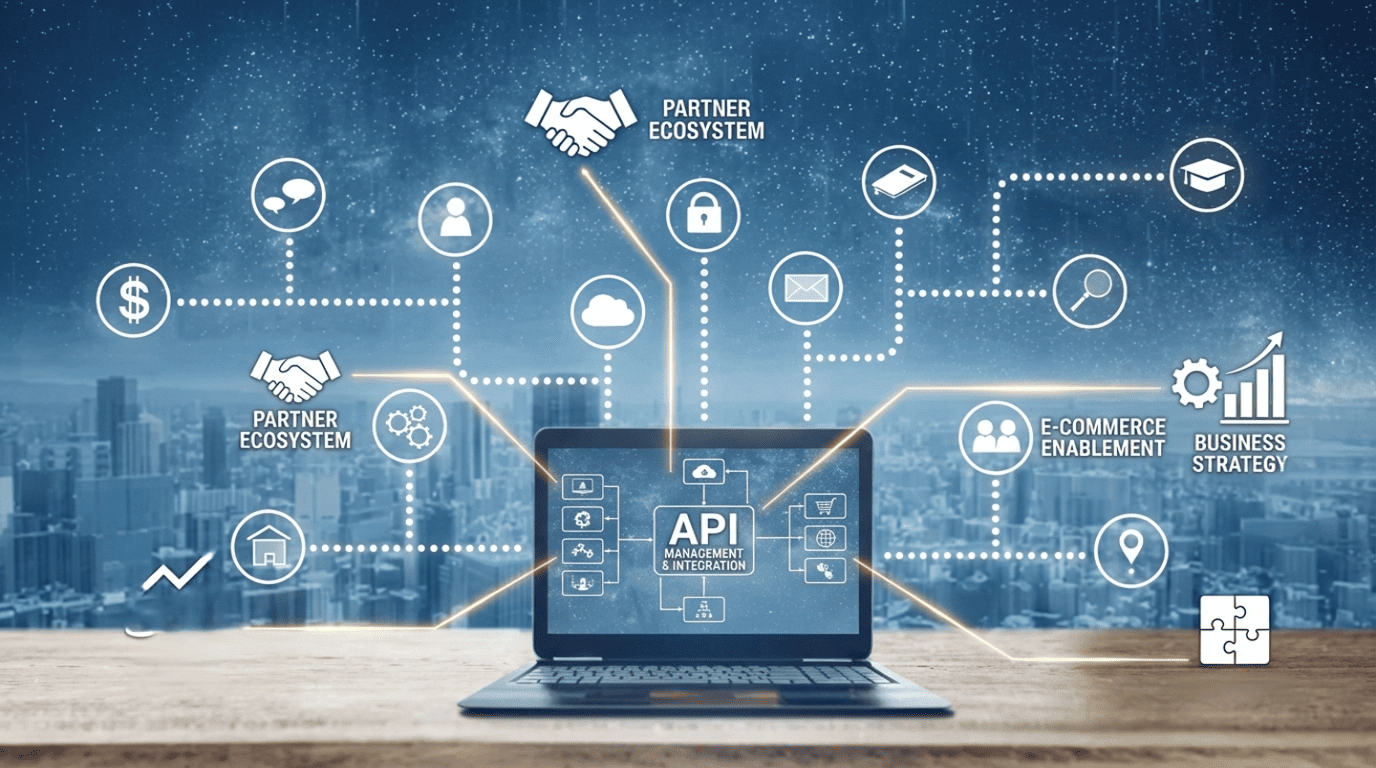
APIs Are Now a Business Capability, Not Just a Technical One
Digital agencies serving clients across the USA, UK, Canada, Australia, and New Zealand are operating in a market where technical execution is no longer evaluated in isolation. Integration has moved out of the engineering backlog and into the boardroom. APIs are now directly tied to business continuity, scalability, and competitive advantage.
This shift is clearly reflected in how leading platforms position their ecosystems. Salesforce, for example, treats APIs as a foundational layer of its platform strategy, enabling partners and businesses to build extensible, interconnected solutions at scale (developer.salesforce.com). Similarly, Stripe’s API-first business model demonstrates how deeply integrations influence revenue operations, billing workflows, and global scalability (stripe.com).
As a result, clients no longer ask whether systems can integrate — they assume that connectivity is built in by default.
CRMs are expected to synchronize seamlessly with marketing automation platforms. Payment systems must pass clean, real-time data into analytics and reporting tools. Internal dashboards increasingly rely on data aggregated from multiple external SaaS products. When these connections fail, or are implemented poorly, agencies don’t just face technical issues — they face a loss of credibility.
This reality fundamentally changes the role APIs play in agency engagements.
APIs now sit at the intersection of strategy, execution, and long-term value creation, enabling agencies to deliver outcomes rather than isolated features. Well-designed integration layers allow agencies to future-proof client platforms while supporting growth, automation, and system flexibility.
From a commercial and operational standpoint, strong API capabilities allow agencies to:
- Enable automation instead of manual, error-prone workflows
- Support real-time data synchronization across platforms
- Build scalable SaaS and subscription-based solutions
- Reduce operational friction for end clients
- Reuse integration frameworks across multiple accounts and industries
Industry research consistently reinforces this shift. McKinsey highlights that organizations leveraging integrated digital platforms outperform peers in both revenue growth and operational efficiency, largely due to better data flow and automation (mckinsey.com).
This is precisely why white label API & integrations development has become a critical capability for modern agencies. Instead of expanding in-house engineering teams or carrying long-term technical risk, agencies can adopt a white-label model that allows them to offer advanced, integration-driven solutions under their own brand—while maintaining focus on strategy, client relationships, and growth.
Agencies that recognize APIs as a business asset rather than a backend deliverable are far better positioned to win larger engagements, retain clients longer, and scale sustainably in an increasingly integration-driven digital landscape.
What Is White Label API & Integrations Development?
White label API & integrations development refers to the structured practice of designing, building, and maintaining backend APIs and third-party system integrations that are delivered entirely under an agency’s brand, while the technical execution is handled by a specialized external engineering partner.
From a client’s perspective, the agency appears to own and operate the full technology stack. The integrations feel native, the workflows are seamless, and the platform behaves as though it were built entirely in-house. This perception is critical, because clients increasingly associate integration quality with overall product maturity and business reliability.
Behind the scenes, however, these systems are powered by well-architected APIs that follow industry standards for scalability, security, and reuse. Leading cloud platforms such as AWS emphasize API-driven architectures as the foundation for building modular, scalable digital products (aws.amazon.com). This same principle applies directly to white label development for agencies.
In practical terms, white label API & integrations development creates a clear separation between brand ownership and technical execution.
To the client:
- The agency owns the solution end to end
- Integrations appear native to the platform
- The technology feels internally developed and controlled
Behind the scenes:
- APIs are architected for reuse across multiple clients and use cases
- Integrations are modular, making them easier to extend or replace
- Delivery, maintenance, and scaling are handled by a white-label engineering partner
This model is increasingly common among SaaS companies and platforms that need to move fast without sacrificing quality. Stripe, for example, has demonstrated how a clean, well-documented API layer can enable rapid product adoption and ecosystem growth without exposing internal complexity (stripe.com).
For agencies, the value lies in leverage.
White label APIs allow agencies to offer sophisticated technical capabilities—such as automation, data synchronization, and multi-platform connectivity—without carrying the cost, risk, or operational burden of building a full internal engineering organization.
From a commercial standpoint, this approach enables agencies to:
- Expand service offerings without increasing fixed overhead
- Standardize integrations across multiple client accounts
- Deliver enterprise-grade functionality to mid-market clients
- Reduce dependency on individual developers or freelancers
- Maintain full control of client relationships and brand perception
Industry leaders consistently advocate for this separation of concerns. Red Hat, for instance, positions APIs as products in their own right—designed, versioned, and maintained independently to support long-term scalability and business agility (redhat.com).
Ultimately, white label API & integrations development allows agencies to operate with the sophistication of a technology company—without becoming one. By combining brand ownership with outsourced execution, agencies gain the ability to deliver complex, integration-driven solutions while staying focused on strategy, growth, and client success.
Why White Label APIs Are Now Essential for Agencies
The expectations placed on digital agencies have changed fundamentally. Clients no longer evaluate agencies only on creativity, delivery speed, or surface-level functionality. Increasingly, they judge value based on how well systems communicate, automate, and scale together.
This shift is driven by the reality that most modern businesses operate across multiple interconnected platforms. Data fragmentation is no longer an inconvenience—it is a direct threat to productivity, decision-making, and customer experience. According to McKinsey, organizations that successfully integrate data and digital systems outperform peers in efficiency and revenue growth, largely due to improved automation and information flow (mckinsey.com).
For agencies, this means one thing: integration capability is now table stakes.
Clients Expect Connected Platforms by Default
Today’s clients assume that their tools will work together seamlessly. CRMs must pass data to marketing platforms. Payment systems must feed reporting dashboards. Internal tools must connect to external SaaS products without manual intervention.
When these connections are missing or unreliable:
- Teams revert to spreadsheets and manual processes
- Data inconsistencies increase
- Operational errors multiply
- Confidence in the agency erodes
Platforms like Zapier have built entire businesses around the demand for system connectivity, reinforcing how critical integrations have become for everyday operations (zapier.com). Agencies that can deliver API-driven integrations directly—rather than relying solely on third-party automation tools—position themselves as far more capable and strategic.
Integration Capability Directly Increases Deal Size
When agencies move beyond standalone deliverables and into integration-led solutions, the commercial impact is immediate.
Agencies that can confidently offer:
- Workflow automation across tools
- Real-time system synchronization
- Custom dashboards and reporting layers
naturally transition from one-off project fees to ongoing retainers, platform management contracts, and long-term engagements.
API-driven solutions also create stickiness. Once a client’s systems are deeply integrated, switching providers becomes costly and risky—dramatically improving retention.
From a sales perspective, integrations shift conversations away from price comparison and toward business outcomes, which supports premium positioning.
In-House API Teams Are Costly and Difficult to Scale
While the demand for integrations is rising, building and maintaining an internal API team remains a significant challenge for most agencies.
Senior backend engineers with API and integration expertise are:
- Expensive to hire in Western markets
- Highly competitive and difficult to retain
- Often underutilized between large projects
According to multiple industry hiring analyses, backend and integration engineers consistently rank among the hardest roles to fill due to skill scarcity and rising salary expectations.
White label API & integrations development removes this constraint.
By working with a specialized white-label partner, agencies gain access to:
- Experienced API engineers on demand
- Proven integration frameworks
- Scalable delivery capacity without long-term payroll risk
- Consistent quality without dependency on individual hires
This model allows agencies to grow integration capabilities in line with demand—without inflating internal teams or taking on unnecessary operational risk.
Ultimately, white label APIs are essential not because they are technically impressive, but because they align with how modern clients operate, buy, and scale. Agencies that recognize this early gain a structural advantage—delivering deeper value while maintaining flexibility, margins, and long-term growth potential.
Third-Party Integrations for Agencies: Where Real Value Is Created
Third-party integrations for agencies represent the point where technical execution translates directly into measurable business value. At a basic level, integrations connect client platforms with the tools they already depend on—CRMs, billing systems, analytics platforms, marketing software, and internal databases. At a strategic level, they determine how efficiently a business operates and how scalable its technology stack truly is.
Most modern SaaS and enterprise platforms are designed to be integration-first. HubSpot, for example, openly positions its APIs as a way for partners and agencies to extend functionality and embed workflows into broader business ecosystems (developers.hubspot.com). Similarly, accounting and billing platforms like Stripe and QuickBooks rely heavily on APIs to support automation, reconciliation, and reporting across systems (stripe.com, developer.intuit.com).
For agencies, the opportunity lies in owning this integration layer on behalf of clients.
When systems operate in isolation, businesses face duplicated data, manual reconciliation, delayed reporting, and higher error rates. Well-executed third-party integrations eliminate these friction points by creating a single, reliable flow of information across tools.
Each well-designed integration delivers tangible benefits:
- Improves operational efficiency by automating data exchange between systems
- Reduces manual work such as spreadsheet exports, re-entries, and reconciliations
- Increases data accuracy through real-time or scheduled synchronization
- Enhances platform stickiness by embedding critical workflows directly into the client’s core systems
Beyond efficiency, integrations change the nature of the agency–client relationship.
When an agency builds and manages the connective tissue between a client’s systems, it becomes deeply embedded in the client’s operations. Reporting dashboards pull from multiple sources. Automation workflows depend on custom logic. Business-critical processes rely on integrations that are tailored—not generic.
Platforms like Zapier highlight just how widespread the demand for connectivity has become, offering thousands of prebuilt app connections to address integration gaps (zapier.com). However, agencies that rely solely on no-code tools often hit limitations around customization, scalability, and control. This is where custom, API-driven integrations create a decisive advantage.
From a commercial standpoint, third-party integrations allow agencies to:
- Deliver higher-value solutions that go beyond surface-level features
- Transition from project-based pricing to ongoing retainers and platform management
- Differentiate themselves in competitive pitches with tangible technical depth
- Increase switching costs, improving long-term client retention
Well-designed integrations don’t just solve isolated problems. They become part of the client’s operating model. Over time, this transforms the agency from a service provider into a trusted technology partner—one whose value compounds as the client’s systems, data, and workflows continue to grow.
Why API Development Outsourcing Is the Smart Choice
API development outsourcing has evolved from a cost-saving tactic into a strategic operating model for high-performing digital agencies. As client expectations around speed, reliability, and integration depth continue to rise, agencies are under pressure to deliver enterprise-grade backend systems without overextending internal teams. Outsourcing API development—particularly to mature technology markets like India—has become one of the most effective ways to balance quality, scalability, and profitability.
Global consulting firms consistently highlight India’s position as a leading destination for high-value technology outsourcing due to its deep engineering talent pool and process maturity. McKinsey notes that India combines cost efficiency with increasingly sophisticated digital capabilities, making it a long-term partner rather than a short-term arbitrage play (mckinsey.com). Industry bodies such as NASSCOM further reinforce this, citing India’s strength in enterprise software, cloud engineering, and API-led integration work (nasscom.in).
From an agency perspective, the economics are compelling—but the advantages go well beyond cost.
Lower Cost Without Cutting Corners
Hiring and retaining senior backend engineers in the USA, UK, Canada, Australia, or New Zealand is both expensive and unpredictable. Salaries, benefits, recruitment overheads, and attrition risks add up quickly. API development outsourcing allows agencies to access experienced engineers at a fraction of the cost, without compromising on architectural rigor or security standards.
A well-structured outsourcing partner provides:
- Engineers experienced in RESTful and event-driven API architectures
- Familiarity with enterprise security, authentication, and compliance requirements
- Proven delivery processes aligned with Agile and DevOps practices
This cost efficiency enables agencies to protect margins while still delivering solutions that meet enterprise expectations.
Faster Delivery Cycles

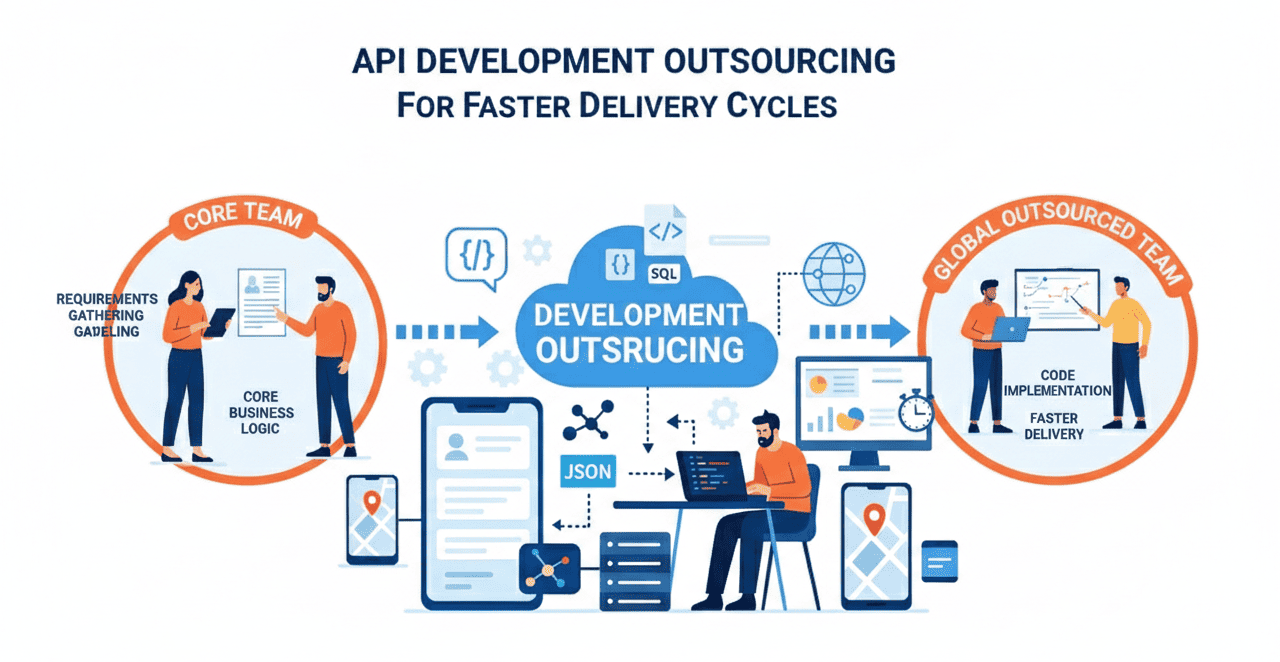
Speed is now a competitive differentiator. Clients expect rapid integration, shorter launch windows, and continuous iteration. Dedicated offshore API teams operate in parallel with onshore strategy, design, and client management functions, significantly compressing delivery timelines.
Time zone differences, when managed well, become an advantage rather than a challenge. Offshore teams progress development while onshore teams handle reviews, feedback, and stakeholder alignment. This “follow-the-sun” model accelerates iteration and reduces idle time across the project lifecycle.
The result:
- Faster proof-of-concepts and MVPs
- Shorter integration timelines
- Quicker go-to-market for client platforms
Focus on Growth, Not Infrastructure
Perhaps the most underestimated benefit of API development outsourcing is the operational clarity it creates. Agencies are not meant to function like software product companies. Their strength lies in understanding client needs, shaping strategy, and delivering outcomes—not in managing backend infrastructure, hiring cycles, or technical debt at scale.
By outsourcing API execution, agencies can concentrate on:
- Building and maintaining client relationships
- Expanding strategic and advisory services
- Driving sales, partnerships, and market positioning
- Innovating new service offerings without internal bottlenecks
Meanwhile, the outsourced engineering partner handles architecture, development, testing, documentation, and ongoing support behind the scenes.
When executed correctly, API development outsourcing doesn’t dilute control—it enhances it. Agencies gain predictable delivery capacity, scalable technical depth, and the freedom to grow without being constrained by internal hiring or infrastructure limitations.
Core Principles of High-Quality White Label API Development
High-quality white label API & integrations development is not defined by how quickly an API is delivered, but by how well it performs over time as client needs evolve. For agencies serving growth-oriented businesses, APIs are no longer disposable components—they become long-term digital infrastructure. The difference between an API that quietly supports scale and one that becomes a liability comes down to foundational design principles.
Industry leaders consistently emphasize that APIs should be treated as products, not one-off technical tasks. Organizations such as the OpenAPI Initiative and cloud providers like AWS advocate for standardized, well-documented, and secure API design as a prerequisite for sustainable digital ecosystems (openapis.org, aws.amazon.com).
Agencies that internalize these principles are better positioned to deliver solutions that endure client growth, platform changes, and evolving compliance requirements.
Scalable, Modular Architecture
Scalability begins with modularity. APIs should be designed as loosely coupled services that can evolve independently without breaking dependent systems. This approach allows agencies to add new integrations, endpoints, or workflows without refactoring entire platforms.
A modular API architecture enables:
- Easier onboarding of new third-party integrations
- Incremental feature expansion without disrupting existing clients
- Better performance tuning as usage grows
Cloud-native design patterns, such as stateless services and event-driven architectures, are now widely recognized as best practice for scalable APIs (aws.amazon.com, learn.microsoft.com).
Strong Authentication and Data Security
Security is non-negotiable in white label API development. Agencies often operate as trusted intermediaries between multiple systems, making APIs a prime target for misuse if not properly secured.
The Open Web Application Security Project (OWASP) publishes the widely referenced API Security Top 10, outlining the most common vulnerabilities in modern API implementations (owasp.org). High-quality APIs address these risks from day one through:
- Robust authentication mechanisms such as OAuth 2.0 and token-based access
- Role-based authorization and least-privilege access controls
- Encrypted data transmission and secure credential handling
- Rate limiting and monitoring to prevent abuse
For agencies, strong security practices are not just technical safeguards—they are trust signals that reassure enterprise clients.
Clear Versioning and Backward Compatibility
APIs are living systems. As business requirements change, APIs must evolve without breaking existing integrations. Clear versioning strategies ensure that clients can adopt new functionality on their own timelines while maintaining operational stability.
Leading API providers consistently emphasize backward compatibility as a cornerstone of developer trust (stripe.com). Effective versioning practices allow agencies to:
- Introduce improvements without disrupting production systems
- Support multiple client environments simultaneously
- Reduce emergency fixes caused by breaking changes
This discipline is especially critical in white label environments, where agencies are accountable for long-term reliability under their own brand.
Well-Structured Documentation
Documentation is often the most underestimated component of API quality. In white label delivery models, APIs must be usable not only by the original development team but also by future engineers, client-side teams, and integration partners.
Standards such as the OpenAPI Specification exist precisely to ensure consistency, clarity, and usability in API documentation (swagger.io). High-quality documentation typically includes:
- Clear endpoint descriptions and use cases
- Authentication and error-handling guidelines
- Sample requests and responses
- Version history and change logs
For agencies, strong documentation reduces dependency on specific individuals, accelerates onboarding, and reinforces professional credibility.
Short-term integrations may solve immediate problems, but they rarely survive scale, audits, or platform evolution. Agencies that think long-term invest in API foundations that are secure, extensible, and well-documented—because those foundations directly determine how confidently they can grow their service offerings and client portfolios over time.
Key Questions Agencies Ask
What is white label API & integrations development?
A delivery model where agencies offer branded APIs and integrations while outsourcing execution to a trusted backend partner.
How do third-party integrations help agencies grow?
They increase client retention, unlock recurring revenue, and position agencies as strategic technology partners.
Is API development outsourcing reliable?
Yes — when done with a structured, long-term partner that follows white-label and security best practices.
Why outsource instead of hiring in-house developers?
Outsourcing reduces cost, speeds delivery, and avoids long-term hiring risk.
Can white label APIs support SaaS platforms?
Yes. Properly designed APIs are ideal for SaaS and multi-tenant systems.
Why India Continues to Lead in API Development Outsourcing
India’s leadership in API development outsourcing is not the result of short-term cost arbitrage—it is the outcome of decades of investment in engineering talent, delivery maturity, and global collaboration. For digital agencies in the USA, UK, Canada, Australia, and New Zealand, India has become the default choice for complex backend and integration work that demands both technical depth and operational reliability.
Global research consistently validates this position. The World Economic Forum highlights India as one of the world’s largest and fastest-growing technology talent hubs, particularly strong in software engineering and digital services (weforum.org). Industry analysis from Deloitte further emphasizes India’s evolution from task-based outsourcing to high-value engineering and platform development (deloitte.com).
What sets India apart is not just scale, but specialization.
A Deep Pool of Backend and Integration Specialists
India produces a large number of engineers with hands-on experience in backend systems, API design, cloud-native architectures, and third-party integrations. Over time, exposure to global enterprise projects has created a workforce that is comfortable working with complex, distributed systems rather than isolated applications.
This talent depth enables agencies to:
- Access engineers skilled in REST, GraphQL, and event-driven APIs
- Scale teams quickly as client demand grows
- Retain institutional knowledge across long-term engagements
Unlike smaller outsourcing markets, India offers continuity—teams can evolve alongside agency portfolios without constant re-staffing.
Proven Delivery Models
India’s outsourcing ecosystem has matured well beyond ad-hoc staffing. Delivery models today are built around Agile methodologies, DevOps pipelines, and structured quality assurance processes. Many Indian technology firms align their workflows with global standards such as ITIL and ISO to ensure predictability and governance (iso.org).
For agencies, this maturity translates into:
- Predictable timelines and milestones
- Transparent communication and reporting
- Reduced delivery risk across multi-client engagements
These models are especially valuable in white label API & integrations development, where agencies remain accountable for outcomes under their own brand.
Cost Efficiencies of 40–70%
Cost efficiency remains a meaningful advantage, but it is best understood in terms of value rather than savings alone. Multiple industry analyses estimate that outsourcing software development to India can reduce costs by 40–70% compared to equivalent onshore teams, without sacrificing technical quality (deloitte.com).
This cost differential allows agencies to:
- Improve margins on fixed-price and retainer engagements
- Reinvest in sales, marketing, and service innovation
- Offer competitive pricing without eroding profitability
When managed correctly, cost efficiency becomes a growth enabler rather than a compromise.
Strong English Communication Skills
Effective API development outsourcing depends on clarity—requirements, documentation, reviews, and iteration cycles must all be communicated precisely. India’s long-standing emphasis on English-language technical education gives agencies a distinct advantage when collaborating across borders.
Clear communication supports:
- Faster onboarding and requirement alignment
- More accurate documentation and handovers
- Reduced friction in agile, iterative workflows
For Western agencies, this minimizes the cultural and operational gaps that often undermine offshore engagements.
India’s continued dominance in API development outsourcing is not accidental. It is the result of talent depth, delivery discipline, cost efficiency, and communication readiness. When paired with the right partner—one that understands agency workflows and white label accountability—this ecosystem becomes a strategic advantage rather than a tactical outsourcing decision.
Why Hybrid Partners Outperform Freelancers
As agencies scale their white label API & integrations development offerings, the limitations of freelancer-based delivery become increasingly visible. Freelancers can be effective for isolated tasks or short-term experimentation, but they rarely provide the consistency, accountability, and scalability required for long-term client engagements—especially when APIs become mission-critical infrastructure.
Industry research on distributed work models consistently shows that structured teams outperform individuals on complex, interdependent projects due to better knowledge retention, standardized processes, and risk mitigation. Harvard Business Review, for instance, has repeatedly emphasized the role of team-based delivery in sustaining quality and continuity as project complexity increases (hbr.org).
For agencies selling backend reliability under their own brand, these factors matter more than raw hourly cost.
The Hidden Risks of Freelancer-Driven Delivery
Freelancers often operate with limited context and minimal institutional support. While highly skilled individuals certainly exist, agencies remain exposed to structural risks that compound over time.
Common challenges include:
- Knowledge gaps, where critical architectural decisions reside with a single individual
- Inconsistent quality, driven by varying standards, availability, and tooling
- Scalability issues, as freelancers cannot easily expand capacity on demand
- Dependency risk, when timelines or support hinge on one person’s availability
These risks become especially pronounced in API-led systems, where long-term maintenance, versioning, and security updates are essential.
The Structural Advantage of Hybrid Outsourcing Partners
A hybrid outsourcing partner blends offshore engineering execution with agency-aligned delivery models. Instead of transactional staffing, agencies gain access to dedicated teams that operate as an extension of their own organization—while remaining invisible to end clients.
This model provides:
- Dedicated teams with shared context and architectural ownership
- Long-term continuity, ensuring knowledge persists beyond individual contributors
- Process maturity, including code reviews, testing, documentation, and governance
- White-label discipline, where all delivery aligns with the agency’s brand, standards, and client expectations
Frameworks such as Capability Maturity Model Integration (CMMI) highlight how process-driven organizations consistently outperform ad-hoc delivery models in software engineering outcomes (cmmiinstitute.com).
Alignment With Agency Growth Goals
Agencies are not optimizing for short-term task completion—they are building repeatable service offerings. Hybrid partners support this by enabling predictable delivery, reusable components, and standardized workflows across multiple clients.
With a hybrid model, agencies can:
- Scale delivery capacity without re-hiring or re-training
- Maintain consistent quality across accounts
- Support long-term retainers and managed services
- Reduce operational risk while increasing client lifetime value
Freelancers may solve immediate gaps, but hybrid partners solve structural problems. For agencies serious about building sustainable, high-margin API and integration practices, the hybrid outsourcing model aligns far more effectively with growth, reliability, and brand protection.
Why Bantech Solutions Fits the White Label Model
Bantech Solutions operates as a long-term, white-label technology partner for digital agencies and startups.
Rather than acting as a task-based vendor, Bantech integrates into agency workflows and supports ongoing delivery across API development, backend systems, and integrations.
Agencies working with Bantech benefit from:
- Dedicated offshore development teams
- White-label execution with no client exposure
- Strong experience in API-driven systems
- Long-term delivery continuity
Explore Bantech’s overall capabilities:
🔗 https://www.bantechsolutions.com/
Industry Trends Making White Label APIs a Long-Term Investment
The shift toward white label API & integrations development is not a passing trend—it reflects fundamental changes in how businesses design, deliver, and scale digital products. Agencies that adopt these capabilities now are not just meeting current client expectations; they are building compounding technical assets that pay dividends over years of client engagements. Understanding the broader industry trends highlights why this investment is both timely and strategic.
API-First Product Strategies
Modern SaaS companies increasingly adopt API-first approaches, designing software with integrations at the core rather than as an afterthought. This enables platforms to extend functionality seamlessly, interact with partner ecosystems, and respond rapidly to changing business needs. Leading examples include Shopify, Twilio, and Slack, whose API-first strategies allow them to scale partner and client integrations efficiently (twilio.com).
For agencies, aligning with API-first thinking means building platforms that are:
- Modular and scalable
- Easy to extend for future clients
- Capable of supporting complex workflows across multiple tools
Embedded Integrations in SaaS Platforms
Embedded integrations are no longer optional; they are expected. SaaS platforms now provide extensive API ecosystems, allowing agencies to embed features, automate workflows, and extend core functionality without reinventing the wheel. HubSpot, for instance, offers embedded integrations and a developer marketplace to empower partners and agencies (developers.hubspot.com).
Agencies leveraging embedded integrations can:
- Deliver rapid client value with minimal overhead
- Customize solutions while maintaining brand ownership
- Reduce the time and cost of repeated integrations
Automation Replacing Manual Workflows
Manual processes are increasingly seen as bottlenecks. APIs and integrations automate tasks such as data synchronization, reporting, billing, and customer communications. Automation reduces errors, accelerates workflows, and frees client teams to focus on strategic priorities. Gartner research underscores that process automation through APIs improves operational efficiency and scalability for businesses of all sizes (gartner.com).
Key benefits for agencies include:
- Increased client satisfaction through faster, more accurate results
- Enhanced platform value through integrated, automated processes
- Improved ability to scale services across multiple accounts
Integration-Led Differentiation
Integration capabilities have become a competitive differentiator for agencies. Platforms that integrate seamlessly with existing client ecosystems are more likely to be retained, expanded, and recommended. Offering robust API-driven integrations positions agencies as technical thought leaders rather than just service executors.
Benefits of integration-led differentiation include:
- Higher-value, recurring engagements
- Stronger client retention due to platform dependence
- Greater credibility in pitches for enterprise-level projects
Agencies that invest in white label API & integrations development today are effectively creating compounding technical assets. Each reusable integration, standardized API framework, and automated workflow not only delivers immediate client value but also lays the foundation for faster delivery, higher-quality solutions, and long-term client relationships in the future.
This approach transforms technical execution into a strategic advantage, allowing agencies to scale sustainably, protect margins, and solidify their reputation as trusted technology partners.
How Agencies Should Start
Building a robust white label API & integrations capability does not happen overnight. Agencies looking to scale offerings without inflating internal teams must follow a structured, repeatable approach. By prioritizing strategy alongside technical execution, agencies can deliver value faster while laying a foundation for long-term growth and operational efficiency.
Identify Integration-Heavy Client Needs
The first step is understanding where client workflows rely on multiple systems. Agencies should conduct a thorough audit of client tools, processes, and pain points. Identifying opportunities for automation and seamless data flow allows agencies to prioritize integrations that deliver the highest immediate impact.
Examples include:
- CRMs syncing automatically with marketing automation platforms
- Accounting software feeding real-time data to dashboards
- Project management tools integrating with time-tracking or billing systems
Research from Deloitte emphasizes that identifying business-critical integrations early is a major driver of digital transformation success (deloitte.com).
Standardize API Requirements
Once the integration needs are clear, agencies should define standard API requirements across clients. Standardization ensures that reusable modules can be built efficiently, reducing redundant work while improving quality and maintainability. Key elements include:
- Authentication and security protocols
- Data models and endpoints
- Error handling and logging conventions
- Versioning and backward compatibility
Clear, standardized API specifications also reduce the learning curve for offshore or white-label teams, accelerating delivery without compromising quality.
Choose a Long-Term White-Label Partner
Selecting the right white-label partner is critical. Agencies should look for partners that provide:
- Dedicated, experienced backend and integration teams
- Process maturity aligned with Agile and DevOps practices
- Proven track record in API-first, white-label delivery
- Transparent reporting and collaboration capabilities
A strong partner allows agencies to scale confidently while maintaining brand ownership and client trust. Bantech Solutions, for instance, offers dedicated offshore teams that integrate seamlessly with agency workflows, providing predictable, high-quality delivery (Bantech Hire a Team).
Build Reusable Integration Modules
Rather than treating each client engagement as a standalone project, agencies should focus on creating reusable integration modules. Modular APIs and integration patterns allow teams to:
- Accelerate onboarding for future clients
- Reduce maintenance overhead
- Standardize quality and security practices
- Quickly adapt to platform or client changes
Reusable modules act as compounding technical assets, enabling agencies to expand offerings without proportional increases in team size or cost.
Scale Responsibly Over Time
Finally, agencies should approach scaling deliberately. Rapid expansion without structure can lead to technical debt, inconsistent quality, and operational bottlenecks. Agencies that adopt a phased, metrics-driven approach ensure sustainable growth:
- Start with high-impact integrations for strategic clients
- Measure efficiency, reliability, and client satisfaction
- Expand the reusable module library based on demand
- Gradually increase team capacity and service offerings
By following these steps, agencies move from ad-hoc delivery to a strategic, repeatable, and scalable white label API & integrations practice, creating long-term value for both clients and the agency itself.
This structured approach ensures agencies can grow confidently, deliver enterprise-grade integrations, and maintain the operational flexibility necessary for future expansion.
Final Thoughts
White label API & integrations development is no longer optional for agencies that want to compete at the high end of the market.
By combining strong client relationships with a trusted outsourcing partner like Bantech Solutions, agencies can scale delivery, protect margins, and position themselves for long-term growth — without becoming bloated or brittle.
White label API integration lets agencies connect, rebrand, and resell third-party technology as their own — cutting development time without cutting corners on quality.
Key Takeaways
- White label API integration is the process of connecting a third-party service’s API into a client-facing product, then rebranding the experience so it looks like an agency’s own custom build.
- It lets agencies deliver features like payments, shipping, chat, or analytics in days instead of months.
- The client sees a seamlessly branded product; the underlying vendor and technical plumbing stay invisible.
- It’s different from plain API integration because the branding, support, and client relationship stay entirely with the agency.
- Done well, it’s a core growth lever for white label API integration for agencies that want to scale delivery without scaling headcount.
What Is White Label API Integration?
White label API integration is the practice of embedding a third-party application programming interface (API) into a client’s product or platform, then presenting that functionality under the agency’s or client’s own branding rather than the original vendor’s. The end user never sees the vendor’s name, logo, or interface — they just see a feature that appears to have been built in-house. For agencies, this is one of the fastest ways to expand a service menu without hiring an entire engineering team.
At its core, an API is simply a set of rules that lets two pieces of software talk to each other. When Bantech builds a project using our <a href=”https://bantechsolutions.com/services/api-integration”>API integration services</a>, we’re typically connecting a client’s website or app to an outside system — a payment processor, a logistics platform, a CRM, an AI model, or a marketing tool — through that system’s API. “White labeling” the integration means we strip away the third-party branding, apply the client’s visual identity, and manage the entire relationship so the client only ever deals with one point of contact: the agency.
This matters because most modern software products aren’t built entirely from scratch anymore. According to Fortune Business Insights, <cite index=”4-1″>the global API management market was valued at $6.89 billion in 2025 and is projected to grow from $8.77 billion in 2026 to $37.43 billion by 2034</cite> — a clear signal that connecting existing services, rather than reinventing them, has become the default way software gets built.
How Does White Label API Integration Work?
White label API integration works by connecting to a vendor’s API endpoints, then wrapping that connection in custom UI, authentication, and branding so it reads as a first-party feature. The technical steps are consistent across most projects, even though the underlying API might be for payments, shipping, or SaaS integration.
Here’s the typical workflow an agency follows:
- Vendor selection — Choose a reliable third-party API (payment gateway, mapping service, messaging platform, etc.) with solid documentation and uptime guarantees.
- Authentication setup — Configure secure API keys, OAuth tokens, or webhooks so the client’s system can talk to the vendor without exposing credentials.
- Middleware development — Build a layer of custom code between the client’s platform and the vendor’s API. This middleware handles data formatting, error handling, and business logic.
- UI rebranding — Replace any vendor-visible interface elements (checkout screens, dashboards, email templates) with the client’s own colors, fonts, and logo.
- Testing and monitoring — Run the integration through staging environments, then set up ongoing monitoring so the agency — not the client — catches issues first.
- Support ownership — The agency becomes the single point of contact for troubleshooting, even though a third-party vendor is doing some of the heavy lifting behind the scenes.
For a real-world reference point on how documentation-first APIs are typically structured, agencies often study platforms like <a href=”https://shopify.dev/docs/api”>Shopify’s developer documentation</a>, which is widely regarded as a model for clear, integration-friendly API design.
What’s the Difference Between White Label and Custom API Integration?
The difference is ownership and branding: custom API integration is built and presented as a bespoke solution from the ground up, while white label API integration reuses an existing vendor’s infrastructure but hides that fact from the end client. Both connect two systems technically — the difference is entirely in how the relationship and interface are presented.
| Factor | White Label API Integration | Fully Custom API Integration | Off-the-Shelf (No Rebrand) |
| Development time | Days to a few weeks | Weeks to months | Fastest, but least flexible |
| Branding control | Full — vendor is invisible | Full — built from scratch | None — vendor branding stays visible |
| Cost | Moderate | Higher (custom engineering) | Lowest |
| Client relationship | Owned entirely by the agency | Owned entirely by the agency | Often shared with the vendor |
| Best for | Agencies scaling service offerings quickly | Enterprises needing unique, proprietary systems | Startups testing an MVP on a budget |
| Maintenance burden | Shared with the vendor | Fully on the agency/client | Fully on the vendor |
This table is a useful gut-check when a client asks, “Why not just build this ourselves?” It’s often a faster conversation than a paragraph of explanation, and it’s the kind of comparison our team walks through during discovery calls — something we detail further in our post on <a href=”https://bantechsolutions.com/blog/choosing-a-white-label-development-partner”>choosing a white label development partner</a>.
What Are the Benefits of White Label API Integration for Agencies?
The core benefit of white label API integration for agencies is speed-to-market: agencies can offer sophisticated features like payments, chat, or analytics without building or maintaining the underlying infrastructure themselves. Beyond speed, there are several compounding advantages worth walking through.
- Faster delivery timelines. Instead of writing a payment processor or shipping calculator from scratch, developers connect to a proven, already-tested API — often cutting delivery time by weeks.
- Lower development risk. Vendors handling core infrastructure (like PCI-compliant payment processing) carry much of the security and compliance burden, reducing the agency’s exposure.
- Scalable service offerings. Agencies can add new capabilities — AI chat, SMS notifications, mapping — to their service menu without hiring specialized engineers for every niche.
- Stronger client retention. Because the agency owns the branding and support relationship, clients see one trusted partner instead of a patchwork of vendors.
- Recurring revenue potential. Many white label integrations are billed as ongoing managed services, creating a predictable revenue stream beyond the initial build.
Industry data backs up why this model has become common practice rather than a shortcut: research on enterprise integration platforms found that <cite index=”7-1″>45% of enterprises now lean on third-party integration platforms or API marketplaces</cite>, and standardizing on these approaches has been linked to noticeably faster deployment speeds. That’s a strong argument for why white label API integration has become standard practice rather than a shortcut.
For more on how this fits into a broader technology roadmap, see our related piece on <a href=”https://bantechsolutions.com/blog/custom-software-development-guide”>building a custom software development roadmap</a>.
What Should You Look for in a White Label API Integration Partner?
A strong white label API integration partner should offer transparent documentation practices, proven uptime with the specific APIs they integrate, and a clear support-escalation process that keeps the agency — not the end client — in the loop. A few practical checkpoints to evaluate before signing on:
- ✅ Do they have prior experience with the specific vendor API you need (payments, logistics, CRM, AI)?
- ✅ Can they provide a rebrand/whitelabeling checklist showing exactly what gets hidden vs. exposed?
- ✅ Is there a documented SLA for uptime and incident response?
- ✅ Do they offer ongoing monitoring, not just a one-time build?
- ✅ Can they show existing client integrations (with permission) as proof of past work?
If a prospective partner can’t answer these clearly, that’s usually a sign the integration will become a maintenance headache down the line rather than a growth lever.
Frequently Asked Questions
Is white label API integration the same as reselling software?
Not exactly. Reselling typically means passing along a vendor’s product mostly as-is, often with visible vendor branding. White label API integration goes a step further by embedding the API directly into a custom-branded product experience, so the vendor is never visible to the end user.
How much does white label API integration typically cost?
Cost varies by complexity, but it’s generally less expensive than fully custom development because the underlying infrastructure (payments, mapping, messaging, etc.) already exists. Agencies typically price it based on integration complexity, number of endpoints, and ongoing support needs.
Can white label API integrations be white labeled again by the client?
Yes. This is common in SaaS and platform businesses — an agency white labels a vendor’s API for a client, and that client may in turn offer the feature to their own customers under yet another layer of branding.
What industries use white label API integration most?
E-commerce, fintech, logistics, healthcare scheduling, and SaaS platforms are the heaviest users, largely because payments, shipping, and communication APIs are mature, well-documented, and easy to rebrand.
Does white label API integration affect SEO or site performance?
It can, if implemented poorly — for example, if the vendor’s scripts aren’t optimized or cached properly. A well-built integration should have minimal performance impact, which is why performance testing is a standard part of any responsible integration process.
Ready to Add White Label API Integration to Your Service Menu?
Whether you’re an agency looking to expand your offerings or a business that needs a branded feature built fast, Bantech’s team can scope, build, and support the integration end-to-end.
Talk to an API Integration Specialist →
For digital agencies, white label API integration means adding new, fully branded technical capabilities to a service menu — without hiring the specialists needed to build them from scratch.
Key Takeaways
- White label API integration for digital agencies is a delivery model where an agency embeds a third-party API into a client project and presents it entirely under its own brand.
- Agencies use it to expand into payments, logistics, chat, analytics, and AI features without hiring specialized engineers.
- It’s a recurring-revenue and retention play as much as a technical one — clients stay with a single trusted partner instead of juggling vendors.
- It differs from general white label API integration in one key way: the agency itself is both the technical integrator and the client-facing brand.
- Choosing the right integration partner is the single biggest factor in whether this model scales smoothly or creates support headaches.
What Is a White Label API Integration for Digital Agencies?
A white label API integration for digital agencies is a service model where the agency connects a third-party API into a client’s product, then delivers the result under its own name — so the client sees a custom feature, not an outsourced one. This is distinct from a one-off integration project because agencies typically repeat the same integration pattern across multiple clients, turning it into a packaged, sellable service rather than a single custom build.
For a digital agency, this usually shows up as a line item on a proposal: “payment processing,” “AI chatbot,” “shipping calculator,” or “CRM sync.” Behind the scenes, the agency’s developers are connecting to a vendor’s <a href=”https://bantechsolutions.com/services/api-integration”>API integration services</a> and layering the client’s branding, authentication, and support processes on top. The client never needs to know — or care — which vendor is doing the underlying work.
This model has grown alongside a broader shift in how digital agencies operate. Agencies now routinely resell specialized capabilities they don’t build in-house — SEO fulfillment, PPC management, and increasingly, technical integrations — because clients expect a growing list of capabilities that no single agency can staff for internally. As we covered in our earlier piece on <a href=”https://bantechsolutions.com/blog/what-is-white-label-api-integration”>what white label API integration actually is</a>, the technical mechanics stay the same; what changes here is that the agency is the one packaging and reselling the capability at scale.
How Do Digital Agencies Use White Label API Integration?
Digital agencies typically use white label API integration to add technical capabilities — payments, logistics, messaging, AI, or analytics — to client projects without building specialized in-house teams for each one. In practice, this shows up across a handful of common use cases:
- E-commerce agencies connect payment gateways, shipping calculators, and inventory APIs into client storefronts, branding the checkout and dashboard experience as their own.
- Marketing agencies integrate AI chat, email automation, or CRM APIs into client sites, so lead-capture tools look like custom-built features.
- Web development shops wire in scheduling, mapping, or SMS notification APIs for local business clients who need functionality but not a full custom build.
- SaaS-focused agencies embed analytics or reporting APIs into client dashboards, offloading data infrastructure to a specialized vendor while keeping the interface fully client-branded.
In each case, the pattern is the same: the agency picks a reliable API vendor, builds the connective middleware once, and reuses that integration pattern across future clients — which is what turns a single project into a repeatable service line.
What’s the Difference Between White Label API Integration and Building an In-House Dev Team?
The core difference is cost and speed: white label API integration lets an agency offer a capability immediately by connecting to existing infrastructure, while building an in-house dev team requires hiring, ramp-up time, and ongoing salary overhead for a skill the agency may only need occasionally.
| Factor | White Label API Integration | In-House Development Team |
| Time to offer new service | Days to a few weeks | Months of hiring and onboarding |
| Cost structure | Project or retainer-based, scales with usage | Fixed salary overhead, regardless of demand |
| Specialist expertise required | Handled largely by the API vendor | Must be recruited and retained internally |
| Flexibility to pivot services | High — swap vendors or APIs as needed | Low — sunk cost in trained staff |
| Best for | Agencies testing or scaling a new service line | Agencies with consistent, high-volume demand for one specialty |
Agencies generally start with white label API integration to validate demand for a new service, then evaluate whether it’s worth building a dedicated in-house team once volume justifies the investment — a decision path we walk through further in our post on <a href=”https://bantechsolutions.com/blog/choosing-a-white-label-development-partner”>choosing a white label development partner</a>.
What Are the Benefits of White Label API Integration for Digital Agencies?
The biggest benefit for digital agencies is being able to expand their service menu and revenue streams without the cost and risk of hiring specialized engineers for each new capability. A few specific advantages worth calling out:
- Higher client retention. Agencies offering a broader, more technically sophisticated service list are harder for clients to leave. Industry research on white label service adoption has found that agencies using white label models report meaningfully <cite index=”12-1″>higher client retention rates, with some reports citing figures as high as 42%</cite> compared to agencies offering a narrower service set.
- Lower operational overhead. Rather than carrying full-time specialist salaries, agencies pay for integration work as a project or retainer cost, which several industry analyses estimate can <cite index=”11-1″>reduce operational costs by as much as 70%</cite> compared to building the same capability internally.
- Faster proposal-to-delivery cycles. Since the underlying API is already built and tested, agencies can quote and deliver new capabilities in weeks rather than the months a custom build would take.
- Reduced hiring risk. Agencies avoid the sunk cost of hiring a specialist for a capability that may only be needed for a handful of clients.
- A single point of accountability. Clients deal with one agency contact, even though multiple vendor APIs may power the finished product — which simplifies the client relationship considerably.
How Should a Digital Agency Choose a White Label API Integration Partner?
A digital agency should choose a white label API integration partner based on documented uptime, clear support-escalation processes, and a track record with the specific type of API being integrated — not just price. Before committing, it’s worth confirming:
- ✅ Does the partner have direct experience with the API category you need (payments, logistics, CRM, AI)?
- ✅ Will the partner’s team be invisible to your client, with your agency as the sole point of contact?
- ✅ Is there a documented SLA for uptime, response time, and incident escalation?
- ✅ Can the partner scale the integration across multiple future clients, not just a single one-off build?
- ✅ Does the partner provide white-labeled documentation and reporting your agency can present as its own?
Skipping this evaluation is one of the most common reasons agencies end up with integration partners who create more support tickets than they save.
Frequently Asked Questions
Can a small digital agency use white label API integration, or is it only for larger firms?
Small agencies are often the best fit, since white label API integration lets them offer capabilities — like payment processing or AI chat — that would otherwise require a specialist hire they can’t yet justify.
Do clients ever find out a white label API integration isn’t fully custom-built?
It’s uncommon if the integration is implemented properly, since all vendor-facing branding, emails, and interfaces are replaced with the agency’s own. Problems typically only surface if the middleware layer is skipped and vendor branding leaks through.
How long does it take an agency to add a white label API integration to its service menu?
Timelines vary by API complexity, but most straightforward integrations (payments, scheduling, messaging) can go from scoping to launch in two to six weeks, compared to months for a fully custom build.
Is white label API integration only relevant for e-commerce agencies?
No. While e-commerce is a common use case, marketing agencies, web development shops, and SaaS-focused agencies all use white label API integration for capabilities like CRM sync, analytics, and AI-driven features.
What happens if the underlying API vendor changes its terms or pricing?
This is a real risk worth planning for, which is why agencies should choose integration partners who monitor vendor terms and can migrate a client to an alternative API with minimal disruption if needed.
Ready to Expand Your Agency’s Service Menu?
If you’re evaluating white label API integration as a new revenue line, Bantech’s team can help you scope which integrations make the most sense for your client base — and build them to be fully invisible to the end client.
Talk to an API Integration Specialist →
Third-party integrations turn an agency’s existing service offering into a broader, stickier, faster-selling one — often without adding a single new hire.
Key Takeaways
- Third-party integrations help agencies grow revenue by speeding up sales cycles, increasing deal size, and reducing client churn.
- Buyers consistently rank integration capability as one of the top factors in choosing a technology partner.
- Integrated clients renew at meaningfully higher rates than non-integrated ones.
- Integrations let agencies expand their service menu without hiring specialists for every new capability.
- The revenue impact compounds: faster sales, bigger deals, and longer retention all reinforce each other over time.
How Do Third-Party Integrations Help Agencies Grow Revenue?
Third-party integrations help agencies grow revenue primarily by shortening sales cycles, increasing average deal size, and improving client retention — three levers that compound into meaningfully higher lifetime value per client. Rather than treating integrations as a purely technical add-on, agencies that treat them as a sales and retention tool tend to see the clearest revenue gains.
The logic is straightforward. When an agency can connect a client’s platform to payment processors, CRMs, marketing tools, or AI services through <a href=”https://bantechsolutions.com/services/api-integration”>API integration services</a>, it removes a common objection during sales conversations: “Can this actually talk to the tools we already use?” Buyers care about this more than agencies often assume — integration capability is consistently cited as one of the top purchase criteria for technology and service providers, not a secondary feature.
This isn’t a new trend, but it has accelerated as businesses run more of their operations through interconnected software. Agencies that can speak fluently about integrations — and deliver them reliably — are increasingly winning deals that agencies without that capability lose outright.
Why Do Integrations Speed Up Agency Sales Cycles?
Integrations speed up agency sales cycles because they remove technical uncertainty early in the buying process, letting prospects move from “interested” to “signed” faster. When a prospective client already knows their CRM, payment processor, or marketing stack will connect cleanly, there’s one less reason to delay a decision or loop in additional technical stakeholders.
This shows up clearly in sales data from the broader software industry. According to an Okta report on technology partnerships, <cite index=”22-1″>tech partners helped sales reps close deals 40% faster and drove 50% better conversion rates from early stage to close/won</cite> — a pattern that holds just as true for agencies pitching integration-inclusive proposals as it does for software vendors.
For agencies, this means:
- Fewer stalled proposals waiting on “can you confirm this works with X system?”
- Shorter procurement and legal review cycles, since integration risk is addressed upfront
- A clearer, more specific pitch than a generic “we’ll build whatever you need” proposal
Do Integrations Actually Increase Deal Size?
Yes — integrations tend to increase deal size because they let agencies bundle additional capabilities into a single proposal rather than pitching a narrower, single-service engagement. Instead of quoting a client for a website rebuild alone, an agency that offers integrated payments, CRM sync, or AI-powered chat can quote a broader, higher-value engagement in the same sales conversation.
Data from partner-technology research backs this up: leads sourced through integrated tech partnerships have been shown to result in <cite index=”22-1″>20% to 50% larger deal sizes</cite> compared to deals without a partner-technology component. For agencies, the parallel is direct — a proposal that includes integration work is rarely priced the same as a stripped-down build, because it solves a bigger piece of the client’s operational puzzle.
How Do Third-Party Integrations Improve Client Retention?
Third-party integrations improve client retention because they make an agency’s work more deeply embedded in a client’s daily operations, which raises the cost and disruption of switching providers. A client whose payment processing, CRM data, and reporting all run through an agency-built integration has far more at stake in a vendor switch than one with a simple, standalone website.
This effect is well documented outside the agency world too. In one partner-ecosystem case study, <cite index=”22-1″>customers with at least one integration were 30% more likely to renew their contracts, and customers with four or more integrations were 135% more likely to renew</cite>. The more integrated a client’s systems become, the stickier the relationship — which is exactly why agencies increasingly treat integration depth as a retention strategy, not just a technical deliverable.
The retention math matters because client churn is one of the biggest silent revenue killers in agency businesses. Losing a client doesn’t just cost the retainer — it costs the cross-sell and referral revenue that client would have generated over years, not months.
What Are the Main Ways Agencies Turn Integrations Into Revenue?
Agencies typically generate revenue from third-party integrations in four main ways: one-time build fees, ongoing managed-service retainers, service-menu expansion into higher-margin work, and improved retention on existing accounts. Here’s a quick comparison of how each model plays out:
| Revenue Model | How It Works | Best For |
| One-time build fee | Client pays a flat or scoped fee to have the integration built and launched | Agencies wanting quick project revenue with minimal ongoing commitment |
| Managed retainer | Agency charges monthly for ongoing monitoring, updates, and support | Agencies wanting predictable, recurring revenue |
| Service-menu expansion | Integration capability becomes a new line item sold alongside existing services | Agencies looking to increase average deal size across the client base |
| Retention protection | No direct new fee, but deeper integration reduces churn on existing accounts | Agencies focused on protecting long-term account value |
Most agencies end up blending two or three of these models rather than relying on just one — a build fee upfront, followed by a smaller ongoing retainer for monitoring and support.
What Should Agencies Watch Out for When Selling Integration-Based Services?
Agencies should be careful not to oversell integration reliability, since vendor outages, API changes, or pricing shifts on the third-party side can directly affect the agency’s own client relationships. A few practical guardrails:
- Set clear expectations with clients about which parts of the system depend on outside vendors.
- Choose integration partners with a track record of stability and transparent change communication — a topic we cover in more depth in our post on <a href=”https://bantechsolutions.com/blog/what-is-white-label-api-integration”>what white label API integration actually is</a>.
- Build in monitoring so the agency catches vendor issues before the client does.
- Avoid stacking too many single-vendor dependencies into one client deliverable, which increases the blast radius if one integration breaks.
Agencies that treat this as an ongoing account-management responsibility — rather than a one-time technical task — tend to protect the retention gains integrations are supposed to create in the first place, a distinction we explore further in our piece on <a href=”https://bantechsolutions.com/blog/white-label-api-integration-for-digital-agencies”>white label API integration for digital agencies</a>.
Frequently Asked Questions
Do third-party integrations only make sense for larger agencies?
No. Smaller agencies often benefit the most, since even one or two well-chosen integrations can let them compete for deals that would otherwise require an in-house specialist team they can’t yet afford.
How quickly can an agency start generating revenue from integration work?
Timelines vary, but many agencies begin quoting and delivering straightforward integrations (payments, CRM sync, scheduling) within a matter of weeks once a reliable integration partner or process is in place.
Is it better to charge a one-time fee or a recurring retainer for integrations?
Many agencies use both — a build fee to cover initial development, plus a smaller recurring retainer for ongoing monitoring and support, which tends to produce more predictable long-term revenue than a one-time fee alone.
What’s the biggest mistake agencies make when pitching integration-based services?
Overpromising reliability for systems the agency doesn’t fully control. Being upfront about which components depend on third-party vendors protects trust — and the relationship — if something outside the agency’s control goes wrong.
Can integrations help win back churned clients?
Yes, in some cases. Offering deeper system integration as part of a renewed proposal can address the operational pain points that caused a client to consider leaving in the first place.
Ready to Build Integrations Into Your Revenue Strategy?
If your agency is looking to shorten sales cycles, grow deal size, or protect at-risk accounts, Bantech’s team can help you identify which integrations will move the needle fastest for your client base.
Talk to an API Integration Specialist →
API development outsourcing is safe and reliable when a vendor is vetted for security certifications, contract protections, and a documented delivery process — the risk lives in skipping that vetting, not in outsourcing itself.
Key Takeaways
- API development outsourcing is safe and reliable when the vendor holds recognized security certifications and follows a documented QA and code-review process.
- The real risk isn’t outsourcing itself — it’s outsourcing without proper vendor due diligence.
- Contracts should explicitly cover IP ownership, data handling, and breach notification timelines.
- API-specific security risks (broken authentication, shadow APIs) exist whether development happens in-house or outsourced — the mitigation is the same either way.
- A short due-diligence checklist can separate a safe outsourcing partner from a risky one before any code is written.
Is API Development Outsourcing Safe and Reliable for Client Projects?
API development outsourcing is safe and reliable for client projects when the vendor is evaluated against clear security, compliance, and delivery-process standards before the engagement begins — the safety comes from the vetting, not from the act of outsourcing itself. Agencies and businesses that skip this evaluation step are the ones who run into trouble, not because outsourcing is inherently risky, but because an unvetted partner introduces the same risks an unvetted in-house hire would.
This distinction matters because API security concerns are real and worth taking seriously regardless of who’s writing the code. Recent industry research found that <cite index=”29-1″>99% of organizations experienced an API security problem in the past 12 months, with 34% involving sensitive data exposure</cite>. That statistic isn’t an argument against outsourcing — it’s a reminder that API security discipline (authentication, access control, monitoring) has to be built into any project, whether it’s developed in-house or through a trusted <a href=”https://bantechsolutions.com/services/api-integration”>API integration services</a> partner.
The practical question isn’t “is outsourcing safe?” It’s “which vendor characteristics actually predict a safe, reliable outcome?”
What Makes an API Development Outsourcing Partner Reliable?
A reliable API development outsourcing partner demonstrates reliability through recognized security certifications, a documented QA process, and transparent communication — not just years in business or a polished portfolio. Specific signals worth checking before signing:
- Security certifications. ISO 27001 or SOC 2 Type II certification indicates the vendor’s information security practices meet independently audited standards, rather than relying on self-reported claims.
- Documented code review and QA processes. Reliable partners can explain their sprint cadence, testing gates, and code review workflow in specific terms, not vague reassurances.
- Clear communication cadence. Regular demos, sprint reviews, and a named point of contact reduce the risk of scope drift or silent delays.
- Reference-checkable delivery history. Case studies with measurable outcomes — not just client logos — and a willingness to connect you with past clients for a live reference call.
- Access control discipline. Role-based access, multi-factor authentication, and immediate access revocation when a team member leaves the project.
What Are the Biggest Risks of Outsourcing API Development?
The biggest risks of outsourcing API development are data exposure through weak access controls, intellectual property disputes from unclear contracts, and delivery delays from a vendor without a disciplined development process. None of these risks are unique to outsourcing — they’re the same risks any software project faces — but they become harder to catch early when a third party is holding the keys.
| Risk | What It Looks Like | How It’s Mitigated |
| Data exposure | Vendor has broad, unmonitored access to production systems or customer data | Role-based access, MFA, and access revoked immediately at project end |
| IP disputes | Contract doesn’t clearly assign code ownership to the client | IP assignment clauses reviewed before any development begins |
| Delivery delays | No visibility into sprint progress until a deadline is missed | Regular sprint reviews and demo checkpoints built into the engagement |
| Security gaps | Vendor lacks independently audited security practices | ISO 27001 / SOC 2 Type II certification requirements in vendor selection |
| Knowledge silos | Only one engineer understands the integration, creating a single point of failure | Documentation and code comments required as standard deliverables |
This table is a useful starting point for any internal risk conversation before signing an outsourcing agreement — it’s also the kind of framework we walk clients through directly, which we expand on further in our post on <a href=”https://bantechsolutions.com/blog/white-label-api-integration-for-digital-agencies”>white label API integration for digital agencies</a>.
How Do You Vet an API Development Outsourcing Partner Before Signing?
Vetting an API development outsourcing partner means verifying security certifications, requesting live reference calls, and confirming contract terms cover IP ownership and data handling before any development work starts. A practical checklist:
- ✅ Does the vendor hold ISO 27001 or SOC 2 Type II certification (not a self-assessment)?
- ✅ Can they provide case studies with specific scope, timeline, and measurable outcomes?
- ✅ Will they connect you directly with engineers, not just an account manager, during evaluation?
- ✅ Does the contract clearly assign IP ownership and define data handling and breach notification timelines?
- ✅ Do they conduct regular penetration testing and share the reports on request?
- ✅ Is development environment access separated from production systems?
Outsourcing surveys back up how much this vetting step matters to decision-makers: quality of work has been cited by more than half of technology leaders as their top concern when evaluating outsourcing partners, ahead of cost or speed — a signal that reliability is treated as the primary purchase criterion, not an afterthought.
Is Outsourced API Development as Reliable as an In-House Team?
Outsourced API development can be just as reliable as an in-house team — and in many cases more so, since a specialized vendor may bring deeper, narrower expertise in a specific API category than a generalist internal team. Reliability in either case comes down to process discipline, not who signs the paycheck.
That said, there are trade-offs worth naming honestly:
- In-house teams offer tighter day-to-day oversight but require the time and cost of hiring and retaining specialized talent for a capability that might only be needed occasionally.
- Outsourced partners offer faster access to specialized expertise but require more upfront due diligence to confirm the vendor’s process discipline matches what an internal team would provide.
Outsourcing has become a mainstream strategy specifically because of this trade-off calculation: a substantial majority of companies now outsource at least one IT function as part of normal operations, according to Deloitte’s Global Outsourcing Survey — not as a stopgap, but as a deliberate resourcing decision. For a broader look at how this plays out specifically in agency-delivered projects, see our piece on <a href=”https://bantechsolutions.com/blog/third-party-integrations-agency-revenue”>how third-party integrations help agencies grow revenue</a>.
Frequently Asked Questions
Is it safe to give an outsourced API developer access to production data?
It can be, but only with proper safeguards: role-based access controls, multi-factor authentication, and a policy of granting the narrowest access necessary for the task, ideally in a staging environment separated from production wherever possible.
What certifications should I look for in an API development outsourcing partner?
ISO 27001 and SOC 2 Type II are the most widely recognized, independently audited standards. Both indicate the vendor’s security practices have been externally verified rather than self-reported.
Who owns the code after an outsourced API project is finished?
This should be explicitly defined in the contract through an IP assignment clause before development begins. Without one, ownership can become a point of dispute even if the vendor never intended to withhold it.
How do I know if an outsourcing partner’s QA process is actually reliable?
Ask for specifics — sprint cadence, code review workflow, and testing gates — rather than accepting a general assurance of “quality work.” Reliable partners can describe their process in concrete, repeatable terms.
Does outsourcing API development increase the risk of a security breach?
Not inherently. The API security risks that lead to breaches — broken authentication, shadow APIs, weak access control — apply equally to in-house and outsourced development. The determining factor is whether proper security discipline is followed, not who wrote the code.
Ready to Outsource API Development With Confidence?
If you’re evaluating whether to outsource your next API project, Bantech can walk you through our security practices, delivery process, and past client references before you commit to anything.
Talk to an API Integration Specialist →
Agencies outsource API and backend development mainly because it’s faster and cheaper than hiring specialized full-time engineers for work that isn’t needed every week of the year.
Key Takeaways
- Agencies outsource API and backend development primarily to avoid the cost and time of hiring specialized full-time engineers for intermittent project needs.
- Hiring a single in-house backend developer can cost far more than the base salary once benefits, recruiting, and overhead are factored in.
- Filling a specialized engineering role typically takes over a month — sometimes two — while an outsourcing engagement can often start within weeks.
- Outsourcing gives agencies elastic capacity: scale up for a big project, scale down when it’s done, without carrying fixed payroll in between.
- The trade-off isn’t outsourcing vs. quality — it’s fixed overhead vs. flexible capacity, and most agencies land somewhere in between.
Why Do Agencies Outsource API and Backend Development Instead of Hiring In-House?
Agencies outsource API and backend development instead of hiring in-house primarily because it’s faster to start, cheaper on a total-cost basis, and more flexible than committing to a full-time salary for work that may only be needed for a handful of projects each year. Backend and API work is often specialized and project-shaped — a payment integration here, a CRM sync there — which makes it a poor fit for a permanent hire unless an agency has near-constant demand for that exact skill set.
This is fundamentally a staffing math problem, not a quality problem. When an agency needs <a href=”https://bantechsolutions.com/services/api-integration”>API integration services</a> for a client project, the real choice isn’t “outsourced work vs. better in-house work” — it’s “pay for a full-time specialist year-round” vs. “pay for specialized expertise only when a project calls for it.”
How Much Does It Actually Cost to Hire an In-House Backend Developer?
Hiring an in-house backend developer costs significantly more than the advertised salary once benefits, recruiting, tools, and overhead are factored in — often 1.4 to 2.5 times the base salary in total annual cost. With average U.S. software developer salaries running <cite index=”47-1″>around $122,000 per year before benefits</cite>, that puts the fully loaded cost of a single backend hire well into the $170,000–$300,000 range for many agencies.
This gap is exactly why agency owners often underestimate the true cost of building an in-house backend team. A useful comparison: <cite index=”46-1″>in-house developers in the U.S. can cost $200,000 to $240,000 per year in total compensation, while outsourcing equivalent output typically costs $55,000 to $115,000</cite>. For an agency without year-round demand for backend specialization, that gap represents real margin — not a corner cut on quality.
How Much Longer Does It Take to Hire In-House Compared to Outsourcing?
Hiring an in-house backend developer typically takes over a month from job posting to signed offer, while an outsourcing engagement can often begin within a few weeks of vendor selection — a meaningful difference for agencies working against client deadlines. According to hiring-time research, <cite index=”45-1″>it takes an average of 43 days to fill a technical position in the U.S., with engineering roles specifically averaging closer to 59 days</cite> once qualified-candidate sourcing and interview cycles are accounted for.
For an agency that’s already won a client project and needs to deliver, waiting two months to hire a specialist simply isn’t realistic. Outsourcing partners with existing, vetted engineering teams can typically start scoped work within a few weeks — sometimes days — because the hiring and ramp-up work has already been done on the vendor’s side.
What’s the Real Trade-Off Between Outsourcing and Hiring In-House?
The real trade-off isn’t outsourcing versus quality — it’s fixed, ongoing payroll overhead versus flexible, project-based capacity that scales up and down with actual client demand. Here’s how the two models compare on the factors that matter most to agencies making this decision:
| Factor | In-House Hire | Outsourced API/Backend Team |
| Time to start delivering | 6–8+ weeks (hiring, onboarding, ramp-up) | 2–4 weeks typical |
| Total annual cost | Base salary × 1.4–2.5 (benefits, overhead, tools) | Project or retainer-based, scales with actual usage |
| Flexibility to scale down | Low — layoffs are costly and disruptive | High — scale down between projects |
| Access to specialized skills | Limited to what you’ve hired for | Broad — swap specialists based on project need |
| Institutional knowledge | Strong — full-time staff retain context | Requires documentation and knowledge transfer |
| Best for | Agencies with constant, high-volume backend demand | Agencies with variable or project-based backend needs |
Most agencies don’t pick one model exclusively — a common pattern is keeping architecture and client strategy in-house while outsourcing the specialized execution work, a hybrid approach we cover in more depth in our post on <a href=”https://bantechsolutions.com/blog/is-api-development-outsourcing-safe-reliable”>whether API development outsourcing is safe and reliable</a>.
When Does It Make More Sense to Hire In-House Instead of Outsourcing?
Hiring in-house makes more sense when an agency has consistent, high-volume demand for a specific backend skill set and wants tighter day-to-day oversight over that work. A few signals that point toward hiring rather than outsourcing:
- Backend or API work is a core, constant part of nearly every client engagement — not an occasional need.
- The agency has the budget to absorb the fixed cost of a specialist even during slower project months.
- Deep institutional knowledge of the agency’s codebase and client history is a priority that’s hard to maintain with rotating outsourced teams.
- The agency is scaling toward a size where a dedicated internal team pays for itself through volume.
For agencies without those conditions in place, outsourcing tends to be the more capital-efficient choice — a decision framework we explore further in our piece on <a href=”https://bantechsolutions.com/blog/white-label-api-integration-for-digital-agencies”>white label API integration for digital agencies</a>.
A practical way to test which category an agency falls into is to look back at the last twelve months of client work and count how many projects required backend or API-level engineering. If the answer is “nearly every project, every month,” a dedicated in-house hire likely pays for itself over time. If the answer is “a handful of projects, spread unevenly across the year,” that’s a strong signal the demand doesn’t justify a full-time salary — and outsourcing captures the same capability without the idle-time cost.
Frequently Asked Questions
Do agencies lose quality control by outsourcing backend development?
Not necessarily. Quality control depends on the vendor’s process discipline — documented QA, code review, and communication cadence — rather than whether the team is in-house or outsourced.
Can an agency outsource just part of its backend work and keep the rest in-house?
Yes, this is a common hybrid model. Many agencies keep architecture decisions and client strategy in-house while outsourcing specialized execution work like specific API integrations.
How quickly can an agency start an outsourced backend project once it decides to move forward?
Timelines vary by vendor, but many outsourcing partners with existing teams can begin scoped work within two to four weeks of finalizing an agreement, compared to over a month just to fill an in-house role.
Is outsourcing backend development only a short-term cost-saving move?
Not necessarily. While cost savings are a major driver, agencies also outsource for faster access to specialized skills and the flexibility to scale capacity up or down with project volume, which can be a long-term operating strategy rather than a stopgap.
What happens if an agency outsources backend work and later wants to bring it in-house?
This transition is manageable with proper documentation. Agencies that require clear code comments, architecture documentation, and knowledge transfer as standard deliverables from their outsourcing partner make this shift much smoother if their needs change later.
Ready to Decide Between Hiring and Outsourcing?
If your agency is weighing whether to build an in-house backend team or bring in specialized outside help, Bantech can walk you through the real cost and timeline trade-offs for your specific situation.
Talk to an API Integration Specialist →
Yes — white label APIs are built to support SaaS and multi-tenant platforms, provided the underlying architecture handles tenant isolation, scaling, and branding correctly from day one.
Key Takeaways
- White label APIs can absolutely support SaaS and multi-tenant platforms when they’re designed with proper tenant isolation, not just a shared codebase.
- The real question isn’t “can it work” — it’s whether the API architecture separates tenant data, configuration, and branding cleanly enough to avoid cross-tenant risk.
- Multi-tenant SaaS is growing fast: one market analysis projects the global multi-tenant SaaS architecture market to expand at a 14.7% CAGR through 2033.
- Most production multi-tenant platforms use a hybrid model — shared infrastructure with logical data separation — rather than fully isolated environments per customer.
- Getting white label API support for multi-tenancy wrong is usually an architecture and process problem, not a fundamental limitation of white labeling itself.
Can White Label APIs Support SaaS and Multi-Tenant Platforms?
White label APIs can support SaaS and multi-tenant platforms, and in practice this is one of the most common uses of white label API architecture today. The API sits behind each tenant’s own branding, subdomain, and configuration while running on shared backend infrastructure — which is exactly the model that lets SaaS companies onboard new customers without provisioning a separate stack for each one.
This is the same architectural pattern behind platforms like Slack, Salesforce, and Zendesk, where every customer gets what feels like a dedicated environment while the provider runs one underlying system. When an agency or SaaS company needs white label API integration services built specifically for a multi-tenant environment, the engineering challenge isn’t whether it’s possible — it’s designing tenant isolation, authentication, and data segregation correctly so that one customer’s data, traffic, or configuration never bleeds into another’s.
What Makes an API “White Label” in a Multi-Tenant SaaS Context?
A white label API in a multi-tenant SaaS context is one where the underlying functionality is shared across all customers, but each tenant experiences it as fully their own — their branding, their domain, their configuration, with no visible trace of the shared backend. The API itself doesn’t change per tenant; what changes is the layer of presentation and configuration wrapped around it.
In practice, this usually means a few specific technical pieces working together:
- Tenant-aware authentication — every API request carries a tenant identifier, so the system knows whose data it’s serving before it processes anything else.
- Subdomain or custom-domain routing — each customer accesses the platform through their own branded URL, even though requests route to the same API layer underneath.
- Per-tenant configuration — feature flags, pricing tiers, and UI settings are stored per tenant rather than hardcoded, so one API can serve very different customer experiences.
- Data segregation at the storage layer — whether through separate schemas, row-level security, or fully isolated databases, tenant data is kept apart even when it lives on shared infrastructure.
None of this is exotic engineering — it’s a well-understood pattern. But it does mean a white label API built for a single client can’t simply be duplicated for multi-tenant use without rework on these four points specifically.
How Does Tenant Isolation Work in a White Label API Architecture?
Tenant isolation in a white label API architecture works by separating tenant data and access at one or more layers of the stack — application, database, or infrastructure — so a request from one tenant can never reach another tenant’s data, even under failure conditions. The right layer to isolate at depends on compliance requirements, customer size, and growth stage.
Most SaaS companies blend isolation models by tenant size and risk profile rather than picking one for every customer:
| Isolation Model | How It Works | Best For |
| Shared database, shared schema | All tenants share tables; a tenant ID column filters every query | High-volume, low-complexity SaaS with many small tenants |
| Shared database, separate schema | Each tenant gets its own schema within one database | Mid-size platforms needing more separation without full infrastructure cost |
| Fully isolated database per tenant | Each tenant has a dedicated database instance | Enterprise or regulated customers (healthcare, finance) requiring strict data segregation |
| Hybrid (tiered by customer size) | Small tenants share infrastructure; large or regulated tenants get dedicated environments | Most mature multi-tenant SaaS platforms in production today |
This hybrid pattern is increasingly the default rather than the exception — one recent architecture guide notes that most modern SaaS platforms now lean toward a blended multi-tenant approach specifically to balance scalability against security needs, a pattern also reflected in broader SaaS infrastructure research from GitNexa’s SaaS architecture guide.
What Technical Challenges Come With White Label APIs on Multi-Tenant Platforms?
The main technical challenges with white label APIs on multi-tenant platforms are noisy-neighbor performance issues, tenant-specific customization creep, and the complexity of deploying updates across every tenant without downtime. None of these are reasons to avoid multi-tenancy — they’re problems a well-built architecture plans for:
- Noisy neighbor effects — one tenant running heavy queries or high traffic can degrade performance for every other tenant sharing that infrastructure, if resource quotas aren’t enforced per tenant.
- Customization bloat — as more tenants request specific features or workflow tweaks, it’s tempting to hardcode exceptions into the API, which quickly turns a clean codebase into an unmaintainable one.
- Coordinated rollouts — because multi-tenant platforms deploy once for everyone, shipping a breaking change means breaking it for every customer simultaneously unless canary releases and feature flags are used carefully.
- Cost attribution — without tenant-scoped monitoring, it becomes difficult to know which customers are actually driving infrastructure spend, which matters once usage-based pricing enters the picture.
The market pressure to solve these problems well isn’t slowing down — the global multi-tenant SaaS architecture market is projected to reach roughly $13.4 billion by 2033, growing at a 14.7% CAGR, according to market research covered in Rishabh Software’s multi-tenant SaaS architecture analysis. That growth is a direct reflection of how many SaaS companies are actively investing in getting this architecture right rather than treating it as a one-time setup task.
When Should a SaaS Company Invest in White-Label, Multi-Tenant API Architecture?
A SaaS company should invest in white-label, multi-tenant API architecture as soon as it plans to onboard more than a handful of branded, self-contained customers — waiting until after rapid growth hits usually means an expensive re-architecture later. A few signals make the timing clearer:
- The product roadmap includes reseller, agency, or enterprise customers who want their own branding on top of the platform.
- Customer onboarding currently requires manual configuration work that doesn’t scale past a few accounts per month.
- Some prospective customers are asking about data isolation, compliance, or “will my data ever touch another customer’s environment” — a sign enterprise deals are on the table.
- Engineering is already fielding one-off customization requests that are getting harder to maintain inside a single, shared codebase.
For SaaS companies weighing whether to build this internally or bring in outside engineering support, the same in-house-versus-outsourcing math applies here as it does to any specialized backend work — a trade-off we break down in more depth in our post on why agencies outsource API and backend development. The short version: multi-tenant API architecture is a narrow, high-stakes specialty, which is exactly the kind of work that benefits from experienced hands rather than a first attempt in-house.
Frequently Asked Questions
Can white label APIs support SaaS and multi-tenant platforms?
Yes. White label APIs are commonly used to power multi-tenant SaaS platforms, as long as the architecture includes proper tenant isolation, tenant-aware authentication, and per-tenant configuration rather than relying on a single shared codebase with no separation.
Do all tenants on a multi-tenant platform share the same database?
Not necessarily. Some platforms use a fully shared database with tenant ID filtering, others use separate schemas per tenant, and many mature platforms use a hybrid model — sharing infrastructure for smaller customers while isolating larger or regulated tenants in dedicated databases.
Is multi-tenant architecture less secure than single-tenant?
Not inherently. Security in a multi-tenant environment depends on how well tenant isolation is implemented at the authentication, application, and data layers — a well-built multi-tenant system with strict isolation can be just as secure as separate single-tenant deployments.
Can a white label API be customized differently for each tenant?
Yes, through per-tenant configuration rather than per-tenant code. Feature flags, branding settings, and pricing tiers are typically stored as tenant-specific data that the shared API reads at request time, avoiding the need to maintain separate codebases per customer.
How long does it typically take to add multi-tenant support to an existing API?
It varies by how the API was originally built, but retrofitting proper tenant isolation into an API that wasn’t designed for it is usually a multi-month engineering effort, which is why planning for multi-tenancy early tends to be far cheaper than adding it later.
Ready to Build Multi-Tenant API Architecture the Right Way?
If your SaaS platform needs white label API architecture that actually holds up under real tenant load and compliance scrutiny, Bantech’s engineering team can assess your current setup and map out what tenant isolation looks like for your specific product.
Talk to an API Integration Specialist →
India remains the most-used destination for API development outsourcing because it combines the world’s largest technical talent pool with mature delivery processes and a substantial cost advantage over US and UK hiring.
Key Takeaways
- India is the top destination for API development outsourcing due to talent depth, cost savings of roughly 60–80%, and two decades of mature delivery infrastructure.
- India produces over 1.5 million engineering graduates a year and has more than 5 million active IT professionals, per NASSCOM-sourced industry research.
- English fluency and multi-hour daily overlap with US and European business hours reduce the communication friction that undermines many offshore engagements.
- Cost savings aren’t just about cheaper labor — lower cost of living lets Indian firms price specialized API and backend talent well below US or UK rates at comparable skill levels.
- The trade-offs are real (attrition, vendor quality variance) and manageable with the right partner — they’re a vendor-selection problem, not a reason to avoid India as a destination.
Why Is India a Popular Destination for API Development Outsourcing?
India is a popular destination for API development outsourcing because it offers a rare combination of scale, specialization, and cost efficiency that few other regions can match at the same time. A country with millions of active software professionals and decades of experience delivering to global clients has built the infrastructure — recruiting pipelines, delivery frameworks, English-language business fluency — that makes outsourcing complex backend and API work practical rather than risky.
For agencies and SaaS companies evaluating API integration and backend development services, the calculation usually comes down to three factors that India happens to satisfy simultaneously: enough specialized engineers to actually staff a project quickly, cost savings large enough to matter, and delivery processes mature enough that “outsourced” doesn’t mean “unpredictable.”
How Big Is India’s API and Backend Development Talent Pool?
India’s technology talent pool is large enough that staffing a specialized API or backend role rarely comes down to availability — it comes down to vetting the right engineer out of a deep bench. The scale here isn’t a marketing claim; it shows up consistently across independent industry research.
A few figures make the scale concrete:
- India produces <a href=”https://www.classicinformatics.com/blog/outsourcing-to-india”>over 1.5 million engineering graduates annually</a>, and NASSCOM-sourced data puts the country’s active tech workforce above 5 million professionals.
- India’s IT and software exports crossed <a href=”https://www.infozion.in/outsource-software-development-india/”>$194 billion in the 2023–24 fiscal year, serving clients in more than 80 countries</a>, according to NASSCOM figures.
- That talent spans the specific stacks API and backend work typically requires — Java, .NET, Python, Node.js, and cloud-native development across AWS, Azure, and GCP — rather than being concentrated in a single narrow specialty.
For agencies used to competing for a handful of qualified backend engineers in a tight domestic market, this depth is the difference between a six-week hiring search and a shortlist that’s ready in days.
How Much Cheaper Is Outsourcing API Development to India?
Outsourcing API development to India typically costs 60–80% less than hiring equivalent talent in the US or UK, and the gap holds up across most experience levels and specializations. This isn’t a discount on quality — it reflects a genuinely lower cost of living, which lets Indian firms price senior, specialized engineers well below what the same skill set commands in a US or European market.
| Role | Typical US Annual Cost | Typical India Annual Cost | Approx. Savings |
| Senior backend / API engineer | $120,000–$180,000 | $25,000–$80,000 | ~55–75% |
| Cloud architect / DevOps lead | $150,000–$220,000 | $40,000–$90,000 | ~55–70% |
| Project manager / delivery lead | $100,000–$140,000 | $18,000–$35,000 | ~65–80% |
These aren’t isolated figures — one industry guide notes that <a href=”https://www.classicinformatics.com/blog/outsourcing-to-india”>a senior software engineer in a major US city typically carries $180,000–$220,000 in total annual compensation, compared to $40,000–$80,000 for equivalent talent through a quality-focused Indian partner</a>. For an agency staffing a single specialized API project rather than a full-time role, that gap often means the difference between shipping one project this year and shipping three.
📌 Weighing Where to Source Your Next API or Backend Build? Bantech provides senior API and backend engineering delivered from India-based teams — combining specialized talent with the cost efficiency that makes project-based engagements work. Request a Free Integration Assessment →
What Makes India’s Delivery Model Work for API Projects Specifically?
India’s delivery model works well for API development specifically because API work tends to be well-scoped, documentation-friendly, and testable against a clear contract — exactly the kind of engagement that benefits from agile, sprint-based delivery rather than constant in-person oversight. This is different from work that requires heavy day-to-day creative judgment, which is part of why API and backend engineering has become one of the most commonly outsourced categories of technical work.
A few structural factors make this fit particularly strong:
- English-medium technical education — India is the world’s second-largest English-speaking population, and most IT professionals are trained and work daily in English, which reduces the communication friction that derails many offshore engagements.
- Time zone overlap — India’s working hours overlap enough with both US evening hours and full European business hours to support daily standups and same-day turnaround on questions, rather than a full 24-hour delay on every exchange.
- Two decades of agile maturity — sprint-based delivery, CI/CD pipelines, and structured QA processes are standard practice at established Indian engineering firms, not a new adaptation to remote work.
- API work is inherently spec-driven — a well-defined API contract, endpoint documentation, and test suite travel well across time zones and teams in a way that more ambiguous product work doesn’t.
This is also why the question of quality control comes up less as a location issue and more as a vendor-selection issue, a distinction we cover in more depth in our post on <a href=”https://bantechsolutions.com/blog/is-api-development-outsourcing-safe-reliable”>whether API development outsourcing is safe and reliable</a>.
What Are the Real Risks of Outsourcing API Development to India?
The real risks of outsourcing API development to India are vendor quality variance and IT industry attrition — not a fundamental gap in technical capability. Both are manageable with the right partner selection and project structure, but they’re worth planning for rather than ignoring.
- Attrition — annual attrition in the Indian IT industry commonly runs 20–25%, meaning a long engagement has a real chance of losing a team member mid-project if the vendor doesn’t manage retention and knowledge transfer deliberately.
- Vendor quality spread — the market includes both world-class engineering firms and vendors that overpromise, so the difference between a lower-cost and a mid-market rate is often the difference between someone who writes code and someone who architects a solution.
- Communication structure — engagements work best with a single point of contact on each side rather than multiple client stakeholders messaging individual offshore developers directly, which creates conflicting instructions and accountability gaps.
None of these risks are unique to India, and none of them argue against outsourcing API development there — they argue for the same due diligence any specialized engineering engagement deserves, regardless of where the team sits. Agencies weighing this decision against building an in-house team can find a fuller breakdown of that trade-off in our post on <a href=”https://bantechsolutions.com/blog/why-agencies-outsource-api-backend-development”>why agencies outsource API and backend development</a>.
Frequently Asked Questions
Why is India a popular destination for API development outsourcing?
India combines a large, specialized technical talent pool, 60–80% cost savings compared to US or UK hiring, strong English-language business fluency, and two decades of mature agile delivery processes — a combination few other outsourcing destinations offer at the same scale.
How much does it cost to outsource API development to India compared to the USA?
Outsourcing API development to India typically costs 60–80% less than equivalent US hiring, with a senior backend or API engineer running roughly $25,000–$80,000 annually in India versus $120,000–$220,000 for comparable US talent.
Is outsourcing API development to India as reliable as hiring locally?
Reliability depends primarily on vendor selection rather than location — established Indian engineering firms with documented QA processes, clear communication structures, and low attrition management can deliver output comparable to local hiring at a fraction of the cost.
What technical skills are strongest among Indian API and backend developers?
Indian development talent spans the full range of mainstream backend stacks, including Java, .NET, Python, Node.js, and cloud-native development on AWS, Azure, and GCP, along with growing depth in AI and machine learning integration.
Does time zone difference make outsourcing to India difficult for API projects?
Time zone difference is manageable rather than prohibitive for most API projects, since India’s working hours overlap with both late US business hours and full European business hours, supporting daily standups and same-day communication turnaround.
Ready to Explore India-Based API Development for Your Next Project?
If your agency or SaaS company is evaluating where to source specialized API and backend engineering, Bantech can walk through the specific cost, timeline, and delivery model that fits your project.
Talk to an API Integration Specialist →
India remains the most-used destination for API development outsourcing because it combines the world’s largest technical talent pool with mature delivery processes and a substantial cost advantage over US and UK hiring.
Key Takeaways
- India is the top destination for API development outsourcing due to talent depth, cost savings of roughly 60–80%, and two decades of mature delivery infrastructure.
- India produces over 1.5 million engineering graduates a year and has more than 5 million active IT professionals, per NASSCOM-sourced industry research.
- English fluency and multi-hour daily overlap with US and European business hours reduce the communication friction that undermines many offshore engagements.
- Cost savings aren’t just about cheaper labor — lower cost of living lets Indian firms price specialized API and backend talent well below US or UK rates at comparable skill levels.
- The trade-offs are real (attrition, vendor quality variance) and manageable with the right partner — they’re a vendor-selection problem, not a reason to avoid India as a destination.
Why Is India a Popular Destination for API Development Outsourcing?
India is a popular destination for API development outsourcing because it offers a rare combination of scale, specialization, and cost efficiency that few other regions can match at the same time. A country with millions of active software professionals and decades of experience delivering to global clients has built the infrastructure — recruiting pipelines, delivery frameworks, English-language business fluency — that makes outsourcing complex backend and API work practical rather than risky.
For agencies and SaaS companies evaluating API integration and backend development services, the calculation usually comes down to three factors that India happens to satisfy simultaneously: enough specialized engineers to actually staff a project quickly, cost savings large enough to matter, and delivery processes mature enough that “outsourced” doesn’t mean “unpredictable.”
How Big Is India’s API and Backend Development Talent Pool?
India’s technology talent pool is large enough that staffing a specialized API or backend role rarely comes down to availability — it comes down to vetting the right engineer out of a deep bench. The scale here isn’t a marketing claim; it shows up consistently across independent industry research.
A few figures make the scale concrete:
- India produces <a href=”https://www.classicinformatics.com/blog/outsourcing-to-india”>over 1.5 million engineering graduates annually</a>, and NASSCOM-sourced data puts the country’s active tech workforce above 5 million professionals.
- India’s IT and software exports crossed <a href=”https://www.infozion.in/outsource-software-development-india/”>$194 billion in the 2023–24 fiscal year, serving clients in more than 80 countries</a>, according to NASSCOM figures.
- That talent spans the specific stacks API and backend work typically requires — Java, .NET, Python, Node.js, and cloud-native development across AWS, Azure, and GCP — rather than being concentrated in a single narrow specialty.
For agencies used to competing for a handful of qualified backend engineers in a tight domestic market, this depth is the difference between a six-week hiring search and a shortlist that’s ready in days.
How Much Cheaper Is Outsourcing API Development to India?
Outsourcing API development to India typically costs 60–80% less than hiring equivalent talent in the US or UK, and the gap holds up across most experience levels and specializations. This isn’t a discount on quality — it reflects a genuinely lower cost of living, which lets Indian firms price senior, specialized engineers well below what the same skill set commands in a US or European market.
| Role | Typical US Annual Cost | Typical India Annual Cost | Approx. Savings |
| Senior backend / API engineer | $120,000–$180,000 | $25,000–$80,000 | ~55–75% |
| Cloud architect / DevOps lead | $150,000–$220,000 | $40,000–$90,000 | ~55–70% |
| Project manager / delivery lead | $100,000–$140,000 | $18,000–$35,000 | ~65–80% |
These aren’t isolated figures — one industry guide notes that <a href=”https://www.classicinformatics.com/blog/outsourcing-to-india”>a senior software engineer in a major US city typically carries $180,000–$220,000 in total annual compensation, compared to $40,000–$80,000 for equivalent talent through a quality-focused Indian partner</a>. For an agency staffing a single specialized API project rather than a full-time role, that gap often means the difference between shipping one project this year and shipping three.
What Makes India’s Delivery Model Work for API Projects Specifically?
India’s delivery model works well for API development specifically because API work tends to be well-scoped, documentation-friendly, and testable against a clear contract — exactly the kind of engagement that benefits from agile, sprint-based delivery rather than constant in-person oversight. This is different from work that requires heavy day-to-day creative judgment, which is part of why API and backend engineering has become one of the most commonly outsourced categories of technical work.
A few structural factors make this fit particularly strong:
- English-medium technical education — India is the world’s second-largest English-speaking population, and most IT professionals are trained and work daily in English, which reduces the communication friction that derails many offshore engagements.
- Time zone overlap — India’s working hours overlap enough with both US evening hours and full European business hours to support daily standups and same-day turnaround on questions, rather than a full 24-hour delay on every exchange.
- Two decades of agile maturity — sprint-based delivery, CI/CD pipelines, and structured QA processes are standard practice at established Indian engineering firms, not a new adaptation to remote work.
- API work is inherently spec-driven — a well-defined API contract, endpoint documentation, and test suite travel well across time zones and teams in a way that more ambiguous product work doesn’t.
This is also why the question of quality control comes up less as a location issue and more as a vendor-selection issue, a distinction we cover in more depth in our post on <a href=”https://bantechsolutions.com/blog/is-api-development-outsourcing-safe-reliable”>whether API development outsourcing is safe and reliable</a>.
What Are the Real Risks of Outsourcing API Development to India?
The real risks of outsourcing API development to India are vendor quality variance and IT industry attrition — not a fundamental gap in technical capability. Both are manageable with the right partner selection and project structure, but they’re worth planning for rather than ignoring.
- Attrition — annual attrition in the Indian IT industry commonly runs 20–25%, meaning a long engagement has a real chance of losing a team member mid-project if the vendor doesn’t manage retention and knowledge transfer deliberately.
- Vendor quality spread — the market includes both world-class engineering firms and vendors that overpromise, so the difference between a lower-cost and a mid-market rate is often the difference between someone who writes code and someone who architects a solution.
- Communication structure — engagements work best with a single point of contact on each side rather than multiple client stakeholders messaging individual offshore developers directly, which creates conflicting instructions and accountability gaps.
None of these risks are unique to India, and none of them argue against outsourcing API development there — they argue for the same due diligence any specialized engineering engagement deserves, regardless of where the team sits. Agencies weighing this decision against building an in-house team can find a fuller breakdown of that trade-off in our post on <a href=”https://bantechsolutions.com/blog/why-agencies-outsource-api-backend-development”>why agencies outsource API and backend development</a>.
Frequently Asked Questions
Why is India a popular destination for API development outsourcing?
India combines a large, specialized technical talent pool, 60–80% cost savings compared to US or UK hiring, strong English-language business fluency, and two decades of mature agile delivery processes — a combination few other outsourcing destinations offer at the same scale.
How much does it cost to outsource API development to India compared to the USA?
Outsourcing API development to India typically costs 60–80% less than equivalent US hiring, with a senior backend or API engineer running roughly $25,000–$80,000 annually in India versus $120,000–$220,000 for comparable US talent.
Is outsourcing API development to India as reliable as hiring locally?
Reliability depends primarily on vendor selection rather than location — established Indian engineering firms with documented QA processes, clear communication structures, and low attrition management can deliver output comparable to local hiring at a fraction of the cost.
What technical skills are strongest among Indian API and backend developers?
Indian development talent spans the full range of mainstream backend stacks, including Java, .NET, Python, Node.js, and cloud-native development on AWS, Azure, and GCP, along with growing depth in AI and machine learning integration.
Does time zone difference make outsourcing to India difficult for API projects?
Time zone difference is manageable rather than prohibitive for most API projects, since India’s working hours overlap with both late US business hours and full European business hours, supporting daily standups and same-day communication turnaround.
Ready to Explore India-Based API Development for Your Next Project?
If your agency or SaaS company is evaluating where to source specialized API and backend engineering, Bantech can walk through the specific cost, timeline, and delivery model that fits your project.
Talk to an API Integration Specialist →
The main risks of using freelancers for API and backend development are project abandonment, undocumented code, no independent QA or code review, and unclear IP ownership — risks an agency partner is structured specifically to avoid.
Key Takeaways
- The biggest freelancer-specific risk for API and backend work is continuity: a single point of failure with no backup if the freelancer disappears, gets sick, or takes another contract.
- Freelancer-built API code often lacks independent code review and QA, since the same person writes, reviews, and ships the code with no second set of eyes.
- Roughly a third of complex technical projects fail outright, according to PMI’s 2026 Pulse of the Profession research — and backend/API work carries above-average complexity.
- IP ownership and handover documentation are frequently left ambiguous in freelancer engagements, which becomes expensive if the relationship ends and someone else has to pick up the code.
- These risks aren’t reasons to avoid freelancers universally — they’re reasons to match the engagement model to how much the API sits at the center of the business.
What Are the Risks of Using Freelancers for API/Backend Development vs an Agency Partner?
Using freelancers for API and backend development carries real risks — project abandonment, missing documentation, no independent code review, and unclear IP ownership — that an agency partner’s structure is specifically designed to prevent through redundancy, process, and accountability. None of this means freelancers can’t write good API code; it means the risk sits differently depending on who’s writing it.
For businesses evaluating API integration and backend development services, this is fundamentally a risk decision, not just a cost decision. A freelancer can absolutely deliver a well-scoped, narrow API integration. The risk profile changes sharply once the API in question sits at the center of the product — handling payments, authentication, or data that the rest of the business depends on.
What Is the Single Point of Failure Risk with Freelancers?
The single point of failure risk means that if a freelancer gets sick, takes a better contract, or simply stops responding, the API or backend work they were building stops with them — there’s no backup engineer who already understands the codebase. This is arguably the most consequential risk specific to freelancer engagements, because backend and API systems are rarely something a new person can pick up in an afternoon.
This risk shows up in a few concrete ways:
- Project abandonment mid-build — a freelancer disappearing partway through leaves an incomplete, sometimes undocumented codebase that someone else has to reverse-engineer before continuing.
- Multiple concurrent clients — many freelancers work several contracts simultaneously, so a project isn’t always their top priority when problems arise, and a majority of freelancers report juggling more than one client at a time.
- No coverage during absence — if a freelancer takes vacation, gets sick, or is simply unavailable, a critical bug in a production API can sit unresolved with no one else authorized or familiar enough to fix it.
- Knowledge concentration — everything about the API’s design decisions, edge cases, and undocumented quirks lives in one person’s head rather than being distributed across a team.
An agency partner absorbs this risk structurally: when one engineer is unavailable, another engineer who already has context on the project can step in, which is a fundamentally different risk profile than a solo freelancer working alone.
Why Does API/Backend Code Need Independent Review, and Why Do Freelancers Often Skip It?
API and backend code needs independent review because a second engineer catches security gaps, architectural mistakes, and edge cases that the original author — reviewing their own work — is structurally unlikely to catch. Freelancers often skip this step entirely, not out of negligence, but because a solo practitioner has no one else on the engagement to do it.
This matters more for API and backend work than for many other kinds of development, because the failure modes are less visible upfront:
- A poorly designed authentication flow might work fine in testing and fail under real traffic or a specific attack pattern.
- An API that doesn’t handle rate limiting or error states gracefully can degrade an entire product’s reliability, not just one feature.
- Security vulnerabilities in backend code — missing input validation, weak session handling — often aren’t obvious until they’re exploited, which is exactly the kind of issue a second reviewer is trained to look for.
An agency partner typically builds code review, QA, and testing into the delivery process by default, because the team includes more than one person with a stake in the outcome. That structural difference is a big part of why we cover this exact risk trade-off in our post on <a href=”https://bantechsolutions.com/blog/is-api-development-outsourcing-safe-reliable”>whether API development outsourcing is safe and reliable</a>.
How Do Freelancer and Agency Risk Profiles Compare on API/Backend Projects?
Freelancer and agency engagements trade risk in opposite directions — freelancers concentrate risk in a single person, while agencies distribute it across a team at a higher cost. Here’s how the two models compare on the risk factors that matter most for API and backend work specifically:
| Risk Factor | Freelancer | Agency Partner |
| Continuity if one person is unavailable | High risk — single point of failure | Low risk — team can reassign work |
| Independent code review / QA | Often none — same person writes and ships | Standard practice — built into delivery process |
| Documentation and handover | Inconsistent, depends on individual habits | Typically standardized as a deliverable |
| IP ownership clarity | Often ambiguous unless explicitly contracted | Usually defined clearly in the engagement contract |
| Security and architecture oversight | Limited to one person’s judgment | Senior technical oversight built into the team |
| Scalability mid-project | Difficult — requires onboarding a new person | Easier — team can add capacity within days |
Independent research on complex technical projects backs up why this distinction matters: roughly <a href=”https://kavara.dev/resources/agency-vs-freelancer-vs-inhouse”>a third of complex projects fail outright, compared with a 13% failure rate for projects overall</a>, according to PMI’s 2026 Pulse of the Profession research — and API/backend work, with its dependencies on security, data integrity, and system-wide reliability, tends to land on the more complex end of that spectrum.
When Is a Freelancer an Acceptable Risk for API/Backend Work?
A freelancer is an acceptable risk for API and backend work when the project is narrowly scoped, non-critical to core business operations, and the client has enough technical judgment in-house to review the output themselves. A few signals suggest the risk is manageable:
- The API integration is small, well-defined, and isolated — not connected to payments, authentication, or customer data at the center of the product.
- The business has internal technical leadership capable of reviewing the freelancer’s work and catching issues the freelancer might miss.
- The engagement is short-term, and a gap in continuity wouldn’t meaningfully disrupt operations if the freelancer became unavailable.
- Budget constraints make an agency engagement impractical, and the business accepts the added coordination work as its own responsibility.
Outside those conditions — for anything that sits at the center of revenue, compliance, or customer data — the risk math shifts toward an agency partner, a decision we explore in more depth in our post on <a href=”https://bantechsolutions.com/blog/why-agencies-outsource-api-backend-development”>why agencies outsource API and backend development</a>. The freelance market itself has grown into a roughly <a href=”https://www.jhavtech.com.au/blog/freelancer-vs-agency-app-development-2026″>$1.8 trillion global economy in 2026</a>, which means the talent is genuinely out there — the risk isn’t about talent quality, it’s about how much redundancy and process the engagement actually needs.
Frequently Asked Questions
What are the risks of using freelancers for API/backend development vs an agency partner?
The main risks are project abandonment (a single point of failure with no backup), lack of independent code review or QA, inconsistent documentation and handover, and ambiguous IP ownership — all risks an agency partner mitigates through team redundancy and standardized process.
Is it riskier to use a freelancer for backend development than for frontend work?
Generally yes, because backend and API failures tend to be less visible upfront — security gaps, poor error handling, or architectural issues can go unnoticed until they cause a production problem, whereas frontend issues are often caught through simple visual testing.
Can a freelancer provide the same code quality as an agency?
An individual freelancer can write high-quality code, but without a second reviewer, some issues that a peer review process would catch are more likely to reach production — the risk is less about skill and more about the absence of independent review.
What happens if a freelancer building API/backend work becomes unavailable mid-project?
The project typically stalls, since backend systems usually require reading and understanding existing code before continuing it, and there’s no other team member who already has that context, unlike an agency engagement where a team member can step in.
Who owns the code if a freelancer engagement ends without a written agreement?
Ownership can be genuinely ambiguous without an explicit contract, which is a common and costly gap in freelancer engagements — agencies typically define IP ownership, source code rights, and handover deliverables clearly in the engagement contract from the start.
Ready to De-Risk Your Next API or Backend Build?
If you’re weighing a freelancer against an agency partner for API or backend development, Bantech can walk through the specific risk trade-offs for your project’s scope and stakes.
Talk to an API Integration Specialist →
Outsourcing API development to India typically costs $30–$80 per hour depending on developer experience, with a simple API running $5,000–$20,000 and a complex, enterprise-grade integration running well into six figures.
Key Takeaways
- API developer hourly rates in India range from roughly $15–$25/hour for junior talent to $45–$80/hour for senior architects, compared to $100–$250/hour for equivalent US talent.
- Total project cost depends more on complexity tier than on hourly rate alone — a simple CRUD API and a multi-service enterprise integration can differ by 10x or more.
- The three common pricing models — fixed price, time and materials, and dedicated team — each fit a different project shape, and picking the wrong one is a common source of budget overruns.
- Hidden costs like ongoing maintenance (typically 20–25% of build cost annually) and third-party integration work are often left out of initial quotes and should be budgeted separately.
- A lower hourly rate doesn’t automatically mean lower total cost — a less experienced team can take significantly more hours to deliver the same result.
How Much Does It Cost to Outsource API Development to India?
Outsourcing API development to India costs roughly $30–$80 per hour for agency-employed developers, translating to $5,000–$20,000 for a simple API and considerably more for complex, multi-endpoint systems with heavy integration requirements. The exact figure depends far more on project complexity and engagement model than on the country alone.
For businesses evaluating API integration and backend development services, the hourly rate is really just the starting input — the total cost is a function of how many hours the project actually takes, which pricing model is used, and how much ongoing maintenance gets factored in from the start rather than discovered later.
How Much Do API Developers in India Charge Per Hour?
API developers in India typically charge between $15 and $80 per hour, with the rate scaling directly with experience level and the complexity of work they’re trusted to own. Rates vary by city, agency versus freelancer sourcing, and specialization, but experience level is the single biggest driver.
| Experience Level | Typical Hourly Rate (India) | What They Typically Handle |
| Junior (0–2 years) | $15–$25/hour | Bug fixes, well-defined endpoints, documentation, supporting tasks |
| Mid-level (2–5 years) | $25–$45/hour | Independent feature ownership, API integrations, contributing to architecture |
| Senior (5+ years) | $45–$65/hour | Architecture decisions, complex integrations, security and performance |
| Solution Architect | $65–$80+/hour | System design, technology strategy, oversight of multi-developer builds |
For comparison, a senior API developer in the US typically charges <a href=”https://www.spaceotechnologies.com/blog/api-development-cost/”>$100–$250 per hour, compared to $30–$80 per hour for a developer with comparable skills in India</a>. That gap holds up consistently across most specializations, though rates for developers agencies employ (versus open-marketplace freelancers) tend to sit at the higher end of these ranges, reflecting the added project management, QA, and infrastructure support bundled in.
How Much Does a Full API Project Cost Based on Complexity?
The total cost of an API development project depends primarily on how many endpoints, integrations, and authentication requirements it involves — not on the hourly rate alone, since a more complex project simply requires more hours regardless of who’s building it. Most API projects fall into one of three broad complexity tiers.
| Complexity Tier | Typical Scope | Timeline | Estimated Cost (India) |
| Simple | 5–15 endpoints, basic CRUD operations, standard authentication | 2–4 weeks | $5,000–$20,000 |
| Medium | 15–40 endpoints, third-party integrations, custom business logic | 6–12 weeks | $20,000–$60,000 |
| Complex / Enterprise | Multi-service architecture, high-security compliance, heavy integration load | 3–6+ months | $60,000–$150,000+ |
These figures track closely with broader Indian software development pricing patterns, where a mid-market project typically falls in a similarly wide range depending on scope, team composition, and technology stack, according to <a href=”https://www.akoode.com/blog/software-development-cost-in-india”>detailed 2026 pricing research on Indian software development costs</a>. The takeaway is the same for API-specific work: the complexity tier, not the region, is what moves the number most.
Which Pricing Model Should You Use to Outsource API Development to India?
The right pricing model for outsourcing API development to India depends on how well-defined the project scope is and how long the engagement is expected to run — fixed price, time and materials, and dedicated team each fit a different situation, and choosing the wrong one is a common source of budget surprises.
- Fixed price — best for a well-scoped, standalone API build with a locked spec. You get one number for one deliverable, though most vendors add a 15–20% risk premium to account for scope uncertainty.
- Time and materials (T&M) — best when requirements are likely to evolve, such as an API built alongside a product that’s still finding its shape. You pay for actual hours worked, which offers flexibility but requires active scope management on your end.
- Dedicated team — best for ongoing API development tied to a long-term product roadmap. You get a consistent team working exclusively on your product, typically billed monthly, which delivers the best continuity for projects running more than a few months.
For a single, clearly-scoped API integration, fixed price is usually the simpler and more predictable choice. For a backend that will keep evolving with a growing product, a dedicated team or T&M engagement tends to deliver better value over time, a distinction we explore further in our post on <a href=”https://bantechsolutions.com/blog/why-agencies-outsource-api-backend-development”>why agencies outsource API and backend development</a>.
📌 Ready for a Real Number Instead of a Rate Range? Bantech provides a transparent, complexity-based cost breakdown for your specific API project — not just a blended hourly rate. Request a Free Integration Assessment →
What Hidden Costs Should You Budget for Beyond the Initial Build?
The most commonly overlooked costs in an API outsourcing budget are ongoing maintenance, third-party integration work, and scope-creep buffer — all of which show up after the initial quote rather than in it. Skipping these in the budgeting stage is one of the most common reasons an API project ends up costing more than expected.
A realistic budget accounts for:
- Ongoing maintenance — security patches, dependency updates, and bug fixes typically run 20–25% of the original build cost annually, and an API left unmaintained accumulates security and compatibility risk quickly.
- Third-party integrations — connecting to payment gateways, CRMs, or external data sources isn’t plug-and-play; each integration needs its own scoping, building, and testing time, which is easy to underestimate upfront.
- Contingency buffer — most software projects run 15–25% over their initial estimate, so budgeting a buffer from the start is more realistic than treating an on-budget delivery as the default expectation.
- Deployment and go-live support — infrastructure setup, monitoring, and launch support are sometimes billed separately from core development and worth confirming before signing.
This is exactly why India’s cost advantage isn’t just about hourly rates — a country with the talent depth and process maturity to plan for these costs upfront, rather than discovering them mid-project, delivers a more predictable total cost of ownership. We cover the broader talent and delivery-model reasons behind that maturity in our post on <a href=”https://bantechsolutions.com/blog/why-india-popular-destination-api-development-outsourcing”>why India is a popular destination for API development outsourcing</a>.
Frequently Asked Questions
How much does it cost to outsource API development to India?
Outsourcing API development to India typically costs $30–$80 per hour depending on developer experience, translating to roughly $5,000–$20,000 for a simple API and $60,000 or more for a complex, enterprise-grade integration.
Is a lower hourly rate always cheaper overall?
Not necessarily. A less experienced team charging a lower hourly rate can take significantly more hours to deliver the same result, so total project cost — hours multiplied by rate, plus rework — often matters more than the rate itself.
What’s the difference between fixed price and time-and-materials pricing for API development?
Fixed price sets one cost for a locked, well-defined scope, while time and materials bills for actual hours worked, offering more flexibility for projects where requirements are likely to change as development progresses.
Does the cost of outsourcing API development to India include ongoing maintenance?
Usually not automatically — ongoing maintenance is typically a separate cost running 20–25% of the original build cost annually, and it’s worth confirming whether a quote includes it or only covers the initial build.
How much cheaper is outsourcing API development to India compared to the US?
API development in India typically costs 60–80% less than equivalent US rates, with senior developers charging roughly $45–$80 per hour in India compared to $100–$250 per hour for comparable talent in the US.
Ready to Get a Real Cost Estimate for Your API Project?
If you’re planning to outsource API development to India, Bantech can provide a complexity-based cost breakdown specific to your project’s scope, integrations, and timeline.
Talk to an API Integration Specialist →