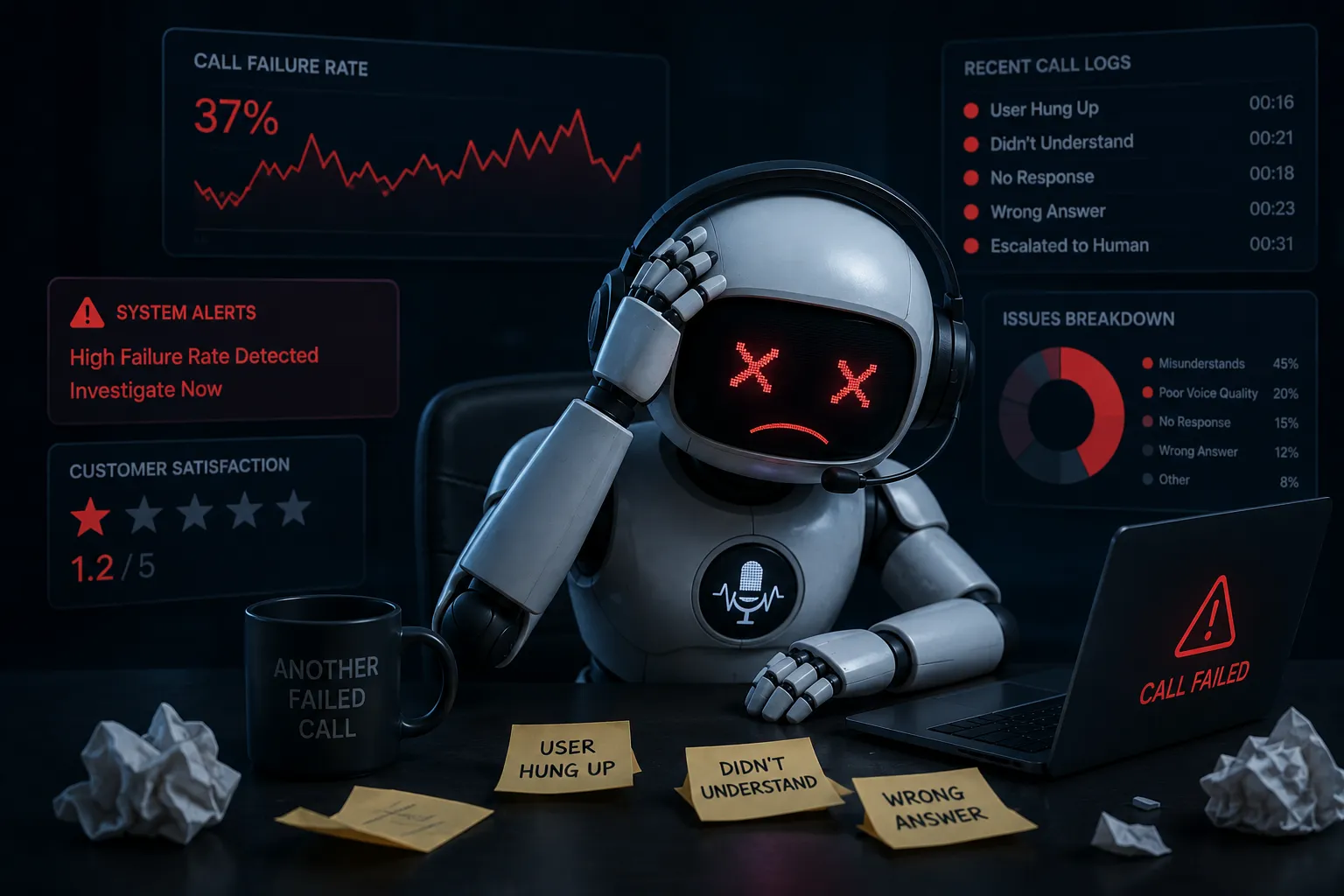
You ran the demo. The board applauded. Your voice agent handled billing inquiries flawlessly, escalated the edge cases gracefully, and even pulled off a warm handoff to a human agent. Then you pushed it to 10% of live traffic — and everything fell apart.
Containment rates dropped to the floor. Customers started demanding humans within two sentences. Your contact center manager was quietly pulling up the old IVR menus “just in case.” The engineering team is blaming the LLM. The vendor is blaming your CRM. And leadership wants to know why you spent six figures on something that can’t handle a customer saying “actually, wait.”
Here’s the truth: AI voice agents don’t fail because the underlying AI is bad. They fail because production is nothing like a demo environment — and most teams build for the demo.
This article breaks down the 10 most common reasons enterprise AI voice agents collapse in production, what is actually happening at a technical and architectural level, and what the fix looks like. If you are planning, building, or rescuing a voice AI deployment, this is the map you need.
The Core Misunderstanding That Causes Most Voice AI Failures
Before getting to the specific failure modes, it helps to understand the one assumption that causes almost all of them: teams treat voice AI as a smarter IVR, then get surprised when it behaves like one.
A traditional IVR is a decision tree. It cannot go off-script because it has no concept of “script” — it only has branches. A voice AI agent, by contrast, operates on language understanding, probabilistic intent resolution, multi-turn memory, and real-time integration with live systems. Its failure modes are completely different from an IVR’s — and far less predictable.
When something goes wrong with a decision tree, you can trace it to a branch. When something goes wrong with a voice AI agent, the cause could be a latency spike in your TTS layer, a confidence threshold that’s too aggressive, a CRM schema change that broke your entity extractor, or an LLM hallucinating a refund policy that doesn’t exist. The diagnostic work is harder, and the surface area is enormous.
That is the real challenge. Not the AI. The architecture, the integration, and the operational discipline around the system.
10 Reasons AI Voice Agents Fail in Production
1. Latency That Breaks the Illusion of a Conversation
Human conversation operates on a rhythm. A pause longer than 800 milliseconds reads as a problem. Beyond 1.5 seconds, most callers assume the line has gone dead or the system has crashed. This is not a preference — it is a deeply wired expectation from decades of phone interaction.
Most voice AI pipelines leak latency at every stage: the ASR (automatic speech recognition) layer converts audio to text, the NLU and LLM layers interpret intent and generate a response, the TTS (text-to-speech) layer converts that response back to audio, and the telephony layer delivers it. Each of these steps adds time, and if any of them are running sequentially instead of streaming, the numbers compound fast.
The fix is not a faster model. It is end-to-end streaming, regional deployment close to the telephony edge, parallelized tool calls, cached TTS for predictable responses, and tuned end-of-speech detection so the agent does not wait an extra half-second to be sure you have finished talking. Teams that monitor average latency instead of P95 latency will always miss the tail events that destroy customer experience.
2. Speech Recognition That Fails the Actual User Base

ASR quality is the ceiling for everything downstream. If the transcription is wrong, the intent resolution is wrong, the action is wrong, and the customer is angry — regardless of how sophisticated your LLM is.
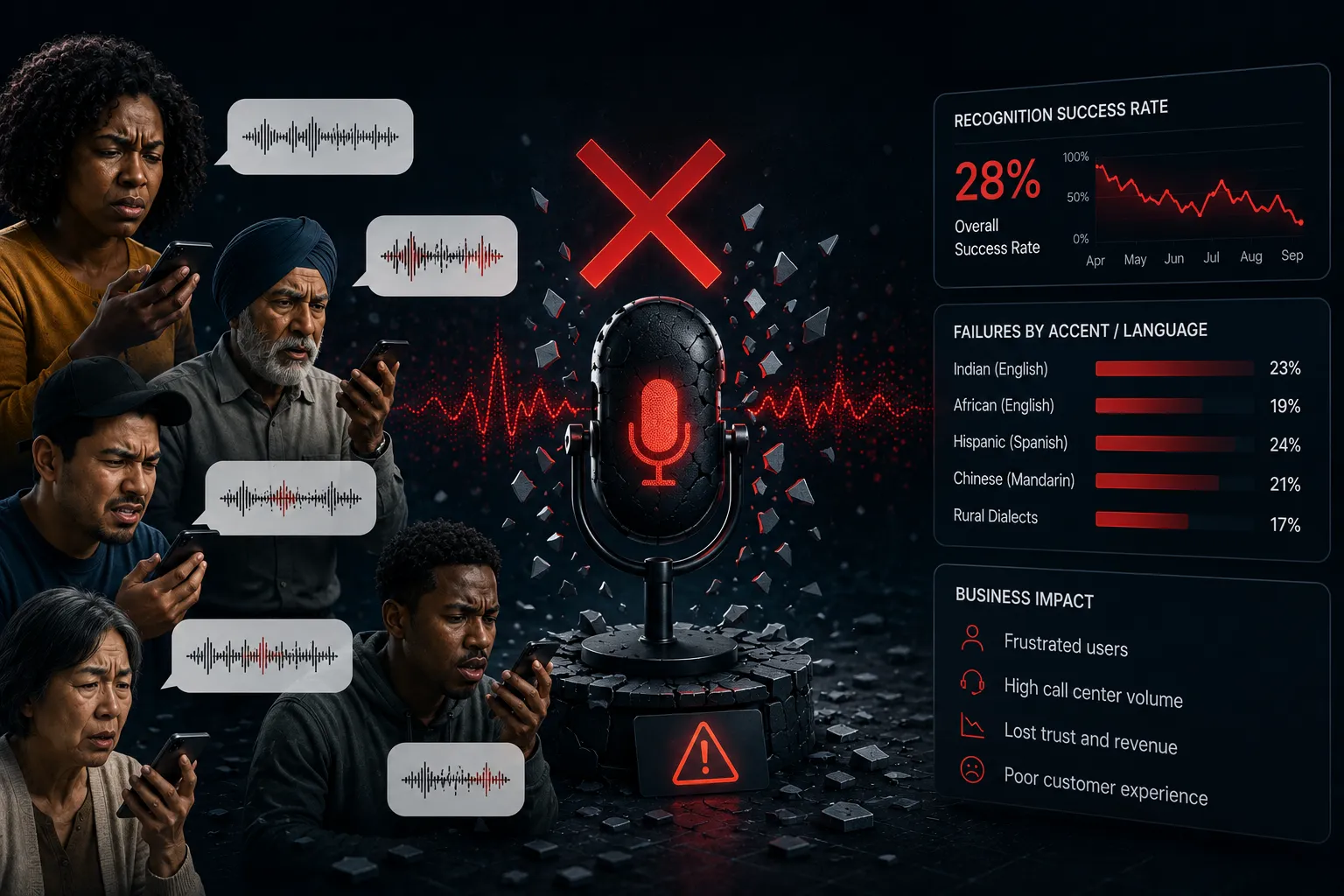
The specific failure modes are predictable: accents that were not in the training data, domain-specific vocabulary (drug names, product SKUs, account codes, medical terminology), elderly speech patterns with longer pauses and softer articulation, background noise from call center floors or customer environments, and code-switching where a bilingual customer flips between languages mid-sentence.
Most teams discover these problems after go-live because they tested with the same demographic, acoustic environment, and vocabulary used during development — which rarely match real-world conditions. The fix requires representative training data, phonetic lexicons for domain vocabulary, confidence-based fallbacks that gracefully ask for clarification instead of passing a bad transcript downstream, and ongoing evaluation using sampled production calls.
3. Context That Evaporates Mid-Conversation
Ask a human agent to help you with a problem and they remember what you said three minutes ago. Ask a poorly architected voice AI the same thing and by turn five it has forgotten turn one. This is not an LLM limitation — it is a dialogue management failure.
Context collapse happens when the system has no session memory architecture, when entity extraction is too shallow to track what was established earlier in the conversation, or when the prompt construction for each LLM call does not include the relevant conversational history. The result is an agent that makes customers repeat themselves constantly, misidentifies what “that one” refers to, or loses track of a multi-step transaction partway through.
Solid context management requires a structured dialogue state that persists across turns, entity resolution that tracks names, dates, account numbers, and product references throughout the session, goal-based flow design that evaluates every response against the stated objective, and intent resolution with confidence scoring that triggers clarification instead of guessing when the signal is ambiguous.
4. Enterprise Integrations That Break Under Real Load
A voice agent that understands a customer but cannot update the CRM, trigger a refund, pull an order status, or confirm a reservation is worse than no agent at all — because it creates the expectation of resolution and then fails to deliver it.
Integration failures in production voice AI almost always trace to one of four root causes: brittle connections to legacy systems that were never designed for real-time API calls, missing idempotency on write operations (leading to duplicate records when a call retries), total failure cascades when a downstream service is temporarily unavailable, and race conditions between parallel tool calls.
The architectural patterns that prevent these failures are event-driven integrations, contract-first API design so schema changes do not silently break the system, idempotency keys on every write, graceful degradation paths that let the agent continue the conversation even when a downstream service is unavailable, and circuit breakers that fail fast rather than hanging.
5. No Control Layer Between the LLM and Production Systems
This is the failure mode that creates the most spectacular postmortems. Teams build a sophisticated LLM-powered voice agent, wire it directly to their production database and CRM, and discover — sometimes at scale — that the LLM occasionally invents refund policies, quotes incorrect pricing, or generates tool calls with malformed parameters that cause downstream errors.
An LLM is a probabilistic system. It does not know with certainty what it does not know. Without a control layer between the model’s reasoning and your systems of record, every model inference is an unguarded write to your business-critical data.
The control layer is the architectural component that enforces business rules, validates tool calls before they execute, grounds the agent’s responses in verified data sources, maintains tamper-evident audit logs, and routes borderline cases to human review. It is not glamorous, and it does not show up in demos. It is also the only thing standing between your voice agent and a lawsuit or a compliance incident.
6. Compliance and Privacy Treated as Afterthoughts
Voice data is uniquely sensitive. In most jurisdictions it is biometric data. In US healthcare it is protected health information. In the EU it is subject to GDPR. In several US states it is governed by biometric privacy laws with statutory damages. None of this can be retrofitted cleanly after deployment.
The compliance failure pattern is predictable: a team builds a capable voice agent, ships it, and then gets a legal or procurement question about data handling six months later. The answer reveals that raw audio is being retained indefinitely, that a third-party LLM vendor has prompt retention enabled, that there is no consent capture at call open, and that audit logs are incomplete or mutable.
Building compliance correctly from the start means capturing consent before the conversation begins, implementing tiered retention policies where raw audio expires fastest, encrypting biometric templates separately from audio files, maintaining tamper-evident audit logs with role-based access, and selecting vendors whose data processing agreements match your regulatory obligations.
7. Turn-Taking Logic That Makes Conversations Feel Broken
End-of-speech detection is one of the most underappreciated components in voice AI design, and one of the most frequently misconfigured. Get it wrong and the agent either cuts customers off mid-thought or sits silently for an awkward beat after they finish talking.
The challenge is that human speech does not come with clean delimiters. People pause mid-sentence while thinking. They trail off and then continue. They say “um” and “uh” in ways that look like silence but are not. And sometimes they want to interrupt — to correct the agent, add information, or redirect the conversation entirely.
Barge-in support (the ability for a customer to interrupt agent speech and have the system respond to the interruption, not finish speaking first) is technically complex but essential for natural-feeling interactions. Without it, the experience feels like leaving a voicemail rather than having a conversation. The fix requires adaptive end-of-speech models tuned to the specific use case and caller population, with different sensitivity settings for elderly callers, high-noise environments, and complex multi-step queries.
8. Multilingual and Multicultural Deployment Without Locale-Specific Design
Global enterprises assume that localizing a voice agent means translating the English script and swapping the TTS voice. This assumption is wrong in almost every dimension.
Accents within the same language create different acoustic profiles that a model trained on North American English will not handle reliably. Code-switching — where a bilingual speaker flips between two languages within a single utterance — breaks monolingual ASR pipelines entirely. Cultural norms around conversational formality differ significantly: the warm, casual tone that tests well with US callers reads as unprofessional or even rude in some German, Japanese, and Korean contexts. Entity formats differ — addresses, dates, phone numbers, and identity numbers are all structured differently by locale and require locale-specific extraction models.
And then there is data residency. GDPR prevents EU caller audio from being routed to US inference infrastructure. India’s DPDP Act has equivalent restrictions. A voice agent architecture that does not account for regional data sovereignty cannot legally operate in many markets it needs to serve. The solution is locale-specific conversation flows built from scratch — not translated from a master version — with regionally co-located inference infrastructure.
9. Human Escalation Designed as an Afterthought
Every AI voice agent will encounter situations it cannot handle: genuinely novel edge cases, emotionally distressed callers, complex multi-part problems, or situations that require human judgment and accountability. How the agent handles these moments determines whether the customer experience is recoverable or catastrophic.
The most common failure is the dead-end escalation: the agent recognizes it cannot help, says so, and then either loops back to the beginning of the menu or drops the caller with a hold time. The second most common failure is the context-free handoff: the human agent picks up with no record of what was said, what was tried, or what the customer’s current state is.
Effective escalation design means the agent detects escalation signals early — rising sentiment frustration, repeated reformulation of the same request, explicit requests for a human — and routes before the experience deteriorates further. The handoff should include a real-time summary of the conversation, the customer’s emotional state as detected by sentiment analysis, the intent that could not be resolved, and the entities extracted during the conversation. A human picking up that context can resolve most issues in under two minutes.
10. No Operational Feedback Loop After Deployment
Voice AI agents degrade silently. Customer language evolves. Product names change. Pricing updates. Policy exceptions accumulate. A well-tuned agent at launch becomes a poorly performing one six months later if nobody is systematically measuring quality and feeding improvements back into the system.
The failure mode here is not dramatic — it is slow. Containment rates drift down a few percentage points per quarter. CSAT scores slip. The contact center starts handling more calls that should have been resolved by the bot, but nobody has connected the dots. By the time leadership notices, the agent has been quietly underperforming for months.
Operational excellence in voice AI requires sampling real production calls and evaluating them against defined quality criteria, tracking call outcome metrics rather than just completion metrics, maintaining versioned prompt and dialogue flow configurations so changes can be tested and rolled back, running automated evaluation suites on every release, and building a feedback channel from human agents back into the training data pipeline.
What Separates a Voice AI That Works From One That Does Not
Looking across these ten failure modes, a pattern emerges. The teams that build voice AI agents that survive production share a few characteristics that distinguish them from teams whose deployments stall or get shut down.
They treat the control layer as non-negotiable infrastructure, not an optional add-on. They design for their actual user population — including accents, languages, emotional states, and environments — rather than the test population. They build compliance and data governance in from the architecture stage, not the legal review stage. They instrument everything so problems surface before customers notice them. And they design escalation paths that preserve dignity for both the customer and the human agent receiving the handoff.
Most importantly, they do not confuse model quality with system quality. The LLM is one component of a pipeline that spans telephony, ASR, dialogue management, enterprise integration, TTS, and observability. Upgrading the model without addressing the pipeline is like replacing the engine in a car with broken steering. The speed potential goes up; the likelihood of crashing goes up with it.
The Difference Between a Demo and a Deployment
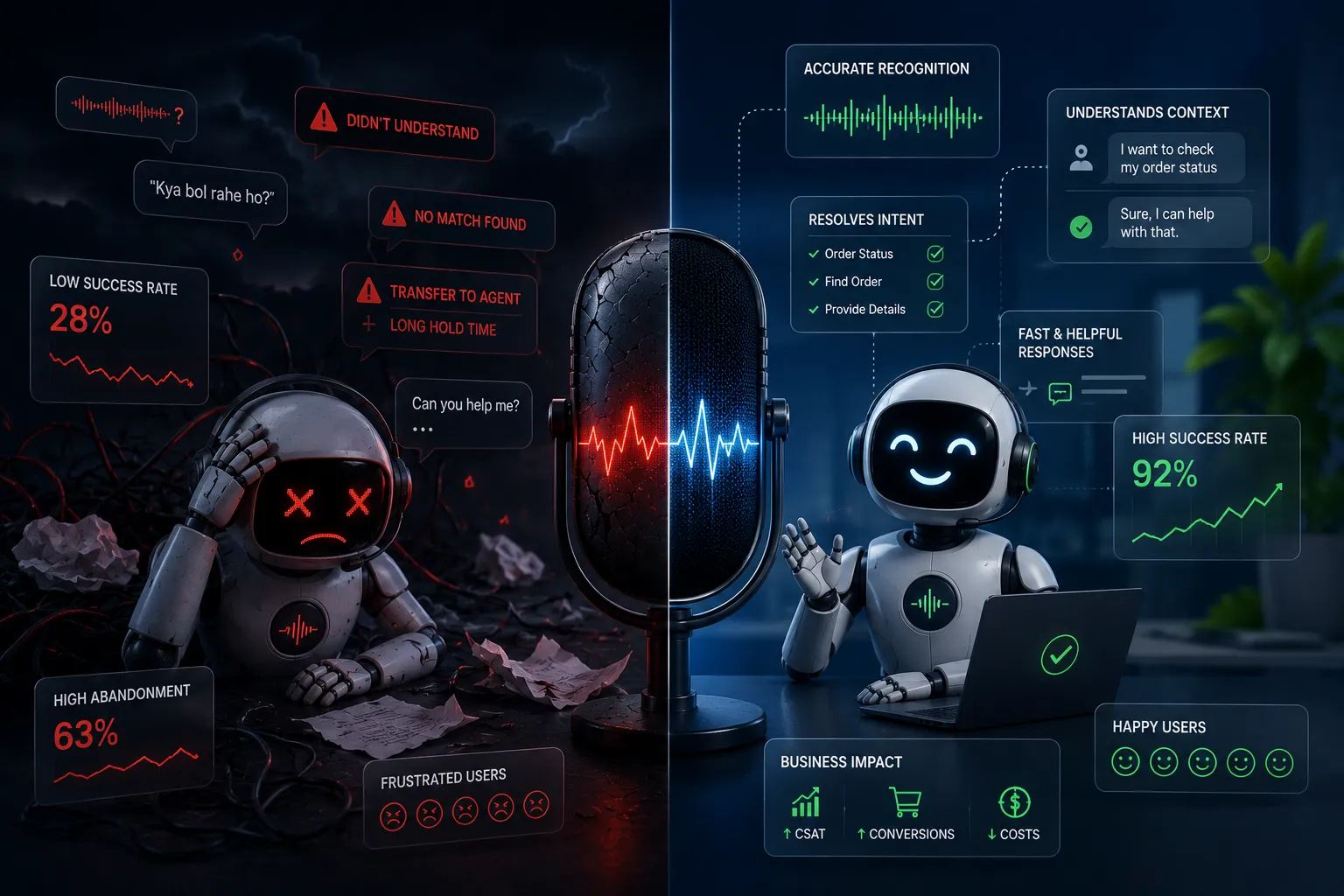
Every AI voice agent looks good in a controlled environment. The vendor script is clean, the test callers speak clearly, the CRM is freshly seeded, and nobody interrupts. Production is none of those things.
Real callers are distracted, frustrated, bilingual, elderly, in loud environments, asking questions that were never anticipated, and calling about problems that sit at the intersection of three different backend systems. The gap between what a voice agent handles in a demo and what it encounters in production is not a gap in AI capability — it is a gap in engineering discipline.
The ten failure modes covered in this article are not exotic edge cases. They are the standard failure pattern for enterprise voice AI deployments that were built to impress rather than built to last. Latency that kills the conversational rhythm. Context that evaporates mid-call. Integrations that crack under real load. A missing control layer that lets a probabilistic model make unguarded writes to production data. Compliance architecture that was never designed, only described.
None of these are unfixable. Every one of them has a known solution — but the window to apply those solutions is before go-live, not after the first wave of customer complaints arrives.
The teams that build voice AI that actually works in production share one habit above all others: they treat the demo as a hypothesis, not a proof. They assume the real world will break their system, and they design accordingly. They instrument before they ship. They plan the escalation path before they need it. They build the control layer before they regret not having it.
The AI in your voice agent is probably not the problem. The question is whether everything around it is.
AI voice agents fail in production primarily because teams design for clean demos rather than the messy realities of live traffic, integrations, latency, and operational feedback. Most failures stem from architecture and process gaps, not the underlying models.
TL;DR / Key Takeaways
- Production exposes latency, ASR mismatches, context loss, and integration fragility that demos hide.
- A missing control layer between the LLM and live systems creates compliance and hallucination risks.
- Turn-taking, escalation design, and post-launch feedback loops determine whether the agent recovers or collapses.
- Successful deployments treat voice AI as an operational system with streaming architecture, guardrails, and continuous measurement.
- Focus on the full pipeline (ASR, dialogue state, tools, TTS, and human handoff) rather than model size alone.
AI voice agents fail in production far more often than demos suggest because real callers introduce variability that controlled tests never replicate. Teams that treat voice AI as a smarter IVR or a prompt-only solution quickly discover the gap. Production environments demand end-to-end streaming, robust dialogue state, reliable enterprise integrations, and continuous operational discipline. Partners offering specialized artificial intelligence development services help close that gap by designing systems built for live traffic rather than boardroom presentations.
The core misunderstanding is simple: a traditional IVR follows fixed branches and cannot go off-script. A voice AI agent relies on probabilistic language understanding, multi-turn memory, real-time tool calls, and live system connections. When something breaks, the cause may be a latency spike in the TTS layer, an aggressive confidence threshold, a CRM schema change, or an LLM inventing a policy. Diagnostic work becomes harder and the surface area grows large.
Latency That Breaks Conversational Rhythm
Human conversation expects responses within roughly 800 milliseconds. Beyond 1.5 seconds most callers assume the system has stalled. Voice AI pipelines accumulate delay across ASR, NLU or LLM reasoning, TTS, and telephony. Sequential rather than streaming processing makes the problem worse. Teams that track only average latency miss the P95 tail events that destroy caller experience.
The practical fix is end-to-end streaming, regional placement close to the telephony edge, parallel tool calls, cached TTS for common replies, and carefully tuned end-of-speech detection. Monitoring must focus on the worst-case experiences that actually reach customers.
Speech Recognition That Fails Real Users
ASR quality sets the ceiling for everything that follows. Accents outside the training data, domain-specific vocabulary, elderly speech patterns, background noise, and mid-sentence code-switching all degrade transcription. Most teams only discover these issues after launch because test data matched the development environment rather than production callers.
Representative training data, phonetic lexicons for specialized terms, confidence-based clarification prompts, and ongoing evaluation of sampled production calls form the minimum viable defense. Without them, even a strong LLM receives corrupted input and produces incorrect actions.
Context Collapse Mid-Conversation
Callers expect the agent to remember what was said three turns earlier. Poorly designed systems lose entity state, fail to track multi-step goals, or reconstruct prompts without sufficient history. The result is repeated questions, broken references such as “that one,” and abandoned multi-step transactions.
Solid dialogue management requires a persistent structured state, entity resolution that carries names, dates, account numbers, and product references across turns, goal-oriented flow design, and confidence scoring that triggers clarification instead of guessing.
Enterprise Integrations That Break Under Load
An agent that understands intent but cannot update a CRM, trigger a refund, or pull order status creates false expectations. Common failure patterns include brittle connections to legacy systems, missing idempotency on writes, cascade failures when a downstream service is unavailable, and race conditions between parallel tool calls.
Event-driven integrations, contract-first API design, idempotency keys, graceful degradation paths, and circuit breakers keep the conversation moving even when individual services falter.
Missing Control Layer Between LLM and Production Systems
LLMs are probabilistic. Without a deterministic control layer, the model can invent refund policies, quote incorrect prices, or generate malformed tool calls that hit live systems. This is the failure mode that produces the most serious compliance and customer-trust incidents.
The control layer enforces business rules, validates tool calls before execution, grounds responses in verified data, maintains tamper-evident audit logs, and routes borderline cases to human review. It rarely appears in demos yet is essential for safe production use.
Compliance and Privacy Treated as Afterthoughts
Voice data often qualifies as biometric information and may fall under GDPR, HIPAA, or state biometric privacy laws. Retaining raw audio indefinitely, allowing third-party prompt retention, skipping consent capture, or maintaining incomplete audit logs creates legal exposure that cannot be fixed cleanly after launch.
Consent must be captured at call open, retention policies must tier audio and derived data appropriately, biometric templates require separate encryption, and vendor data-processing agreements must match regulatory obligations.
Turn-Taking and Barge-In Failures
End-of-speech detection that is too aggressive cuts callers off. Detection that is too passive creates awkward silence. Callers also need the ability to interrupt the agent mid-response. Without adaptive models tuned to the specific caller population and environment, the interaction feels like leaving a voicemail rather than holding a conversation.
Multilingual and Locale-Specific Gaps
Simply translating an English script and swapping a TTS voice fails in production. Accents within the same language, code-switching, cultural norms around formality, locale-specific entity formats, and data-residency rules all require purpose-built conversation flows and regionally co-located inference.
Human Escalation Designed Too Late
Every agent will encounter novel edge cases, emotionally charged callers, or situations that demand human judgment. Dead-end escalations or context-free handoffs destroy the recovery opportunity. Effective design detects frustration signals early, packages a real-time summary of conversation state, extracted entities, and sentiment, and routes cleanly to a prepared human agent.
Absence of Operational Feedback Loops
Voice agents degrade silently as language, products, pricing, and policies evolve. Without systematic sampling of production calls, containment and CSAT metrics drift downward for months before leadership notices. Continuous evaluation and closed-loop improvement keep performance stable.
Comparison of Demo vs Production Conditions
| Factor | Demo Environment | Production Reality |
| Audio conditions | Clean studio recordings | Noise, accents, code-switching, telephony codecs |
| Conversation flow | Scripted linear paths | Interruptions, topic shifts, multi-intent utterances |
| System load | Low concurrency | Bursty traffic and concurrent tool calls |
| Integration behavior | Happy-path mocks | Latency spikes, schema changes, partial outages |
| Measurement focus | Average accuracy | P95 latency, containment drift, escalation quality |
According to Gartner research, 57 percent of infrastructure and operations leaders report at least one AI initiative failure, often driven by unrealistic expectations and inadequate operational foundations. A second high-authority analysis from McKinsey highlights that many voice AI deployments struggle when strategy, conversation design, and post-launch ownership are misaligned.
Mid-article CTA
Ready to move from fragile demos to production-ready voice AI? Explore how Bantech’s custom software development approach builds the architecture, guardrails, and feedback loops that keep agents reliable under real load. Request a quote to discuss your use case.
Teams that succeed treat voice AI as an operational system rather than a model experiment. They invest in streaming pipelines, persistent dialogue state, validated tool calls, locale-aware design, clean escalation, and continuous measurement. The underlying LLMs are rarely the limiting factor. Architecture, integration discipline, and operational ownership determine whether the agent scales or collapses.
For deeper technical patterns on related enterprise challenges, see Bantech’s discussion of why AI voice agents fail in production and practical guidance on IT outsourcing and long-term system reliability.
Related Questions
What is the single most common technical cause of AI voice agent failure after launch?
Latency that exceeds conversational expectations is the most frequent immediate cause of caller frustration and early hang-ups. When end-to-end response time regularly exceeds one second, containment rates drop and human escalations rise even if intent recognition is accurate. Streaming architecture and P95 monitoring address the root issue more effectively than simply upgrading the language model.
How can teams test AI voice agents more realistically before production?
Pull a representative sample of real historical calls, including noisy audio, accented speakers, multi-intent requests, and interruption patterns. Replay those recordings against the agent in shadow mode and measure not only accuracy but also latency distribution, escalation quality, and context retention across five or more turns. Clean scripted tests systematically understate production risk.
Why do integrations cause so many production outages for voice AI?
Voice agents make real-time write and read calls under concurrent load. Legacy systems rarely offer the low-latency, idempotent APIs required. Without circuit breakers, retries with backoff, and graceful degradation paths, a single downstream timeout cascades into silent agent failures or duplicate records. Contract-first design and event-driven patterns reduce this exposure.
What role does a control or guardrail layer play in preventing hallucinations?
The control layer sits between model output and production systems. It validates tool-call parameters against business rules, grounds factual claims in approved data sources, logs every action for audit, and forces human review when confidence is low or the request falls outside allowed policy. Without it, probabilistic model behavior reaches customers and systems of record unchecked.
How should organizations measure ongoing health of a deployed voice agent?
Track containment rate, P95 latency, escalation quality (including whether context is preserved), CSAT on AI-handled calls, and silent degradation signals such as rising repeat-contact rates. Sample production transcripts weekly for new failure patterns and feed improvements back into prompts, state management, and tool definitions. Static post-launch agents inevitably drift.
End-of-article CTA
Stop losing callers to production failures that demos never revealed. Partner with Bantech to design, build, and operate voice AI systems that hold up under real traffic, real accents, and real enterprise systems. Request a Quote today and move from fragile pilots to reliable containment.
AI voice agents fail after deployment because production environments introduce acoustic variability, concurrent load, integration fragility, and operational drift that controlled tests never fully simulate. The underlying models rarely change; the surrounding architecture and processes prove insufficient for live traffic.
TL;DR / Key Takeaways
- Real callers bring noise, accents, interruptions, and multi-intent requests that clean test data misses.
- Latency spikes, brittle integrations, and missing state management surface only under concurrent load.
- Absent guardrails and weak escalation paths turn edge cases into customer-facing incidents.
- Without continuous monitoring and feedback loops, performance drifts silently after launch.
- Success requires treating voice AI as an operational system, not a one-time model deployment.
AI voice agents that perform well in staged demos frequently collapse once exposed to real callers and live systems. The shift from controlled conditions to production reveals gaps in audio handling, dialogue continuity, system connectivity, and ongoing governance. Organizations that invest in robust enterprise software development from the outset build the supporting architecture needed to withstand these pressures rather than discovering them after go-live.
The root pattern is consistent across industries. Teams optimize for the happy path, measure average-case metrics, and assume that strong model performance in the lab will transfer. Real-world use introduces simultaneous stressors: imperfect audio, unpredictable speaking styles, partial system outages, policy changes, and the need for safe human recovery. Each of these can independently degrade the experience; together they compound.
Acoustic and Recognition Mismatches in Live Environments
Production audio differs sharply from laboratory recordings. Callers speak from cars, noisy homes, shared workspaces, or through low-quality handsets and compressed telephony codecs. Accents, dialects, elderly speech patterns, and mid-utterance language switching further reduce automatic speech recognition accuracy. When transcription quality drops, every downstream step (intent detection, entity extraction, response generation) inherits the error.
Teams that only tested clean audio discover these failures only after launch. The practical response combines noise-robust models, confidence thresholds that trigger clarification rather than silent errors, and ongoing sampling of production transcripts to identify new acoustic failure modes.
Latency and Conversational Timing Failures
Callers expect near-human response timing. Delays that feel minor in a written chat become glaring silences on a phone call. Production traffic often reveals queuing at the ASR, LLM, tool-call, or TTS stages that never appeared under light test load. Bursty concurrency at peak hours amplifies the problem.
Streaming pipelines, regional inference placement, parallel tool execution, and careful end-of-speech detection keep total response time inside the conversational window. Measuring only average latency hides the tail events that drive hang-ups and escalations.
Loss of Context Across Multi-Turn Conversations
Real conversations are rarely linear. Callers correct themselves, refer back to earlier statements, introduce new constraints, or change goals mid-call. Systems that reconstruct prompts without durable dialogue state forget established entities or prior commitments. The result is repeated questions and broken multi-step processes.
Persistent structured state, entity tracking, and goal-oriented dialogue management prevent context collapse. Without them, even accurate single-turn responses fail to deliver complete resolutions.
Fragile Enterprise Integrations Under Concurrent Load
A voice agent that understands intent but cannot reliably read or write to CRM, billing, inventory, or reservation systems creates false expectations. Legacy platforms frequently lack the low-latency, idempotent interfaces required for real-time voice traffic. Schema changes, rate limits, and partial outages that were invisible in demos surface immediately in production.
Contract-first API design, circuit breakers, graceful degradation, and idempotency keys allow the agent to continue the conversation even when individual downstream services degrade. Event-driven patterns further reduce tight coupling.
Missing Guardrails Between Model Output and Live Systems
Large language models generate probabilistic outputs. When those outputs flow directly into production systems of record, the agent can invent policies, quote incorrect figures, or issue malformed tool calls. Real-world volume multiplies the exposure.
A deterministic control layer validates parameters against business rules, grounds factual claims in approved sources, maintains audit logs, and routes uncertain cases to human review. This layer is rarely visible in demos yet essential once the agent touches customer data or financial actions.
Inadequate Escalation and Recovery Paths
Every agent will encounter situations beyond its current capability: novel edge cases, emotional intensity, or requests requiring human accountability. Production failures often occur at the handoff. Dead-end responses or context-free transfers force callers to restart their story, destroying trust.
Early detection of frustration signals, packaging of conversation summary and extracted entities, and prepared human agent queues convert potential failures into recoverable experiences.
Operational Drift After Launch
Language, products, pricing, and policies evolve. An agent that performed well at launch degrades if no one systematically reviews production samples, measures containment and CSAT trends, and feeds improvements back into prompts, state logic, and tool definitions. Drift is quiet until containment rates and customer satisfaction have already declined.
Closed-loop evaluation, regular transcript review, and clear ownership of post-launch tuning keep the system current.
Demo Conditions Versus Real-World Stressors
| Condition | Typical Demo | Real-World Production |
| Audio quality | Clean, high-SNR recordings | Noise, codecs, accents, overlapping speech |
| Conversation style | Linear, single-intent scripts | Interruptions, corrections, multi-intent turns |
| System load | Low concurrency | Peak-hour bursts and concurrent tool calls |
| Downstream systems | Mocked or always-available | Latency, partial outages, schema changes |
| Measurement | Average accuracy | P95 latency, containment drift, escalation quality |
| Post-launch ownership | Often undefined | Required for continuous adaptation |
Industry analysis consistently shows that many AI initiatives struggle once they leave the pilot stage. Research from Deloitte highlights that operational readiness, data quality, and clear ownership frequently determine whether AI systems deliver sustained value after deployment. Complementary findings from the National Institute of Standards and Technology emphasize the need for robust testing under realistic conditions and continuous risk management for AI systems that interact with the public.
Mid-article CTA
Avoid discovering production failures the hard way. Bantech’s approach to security and compliance and enterprise-grade system design embeds the guardrails, monitoring, and recovery paths that keep voice agents stable under real load. Request a quote to review your current architecture.
Organizations that succeed after deployment treat the voice agent as a living operational system. They invest in representative testing, streaming architecture, durable state, validated integrations, explicit guardrails, clean escalation, and continuous measurement. Model capability matters, yet the surrounding engineering and process discipline determine whether the agent continues to resolve calls months after launch or quietly erodes customer experience.
For related guidance on building resilient systems, explore Bantech’s insights on white label partnership models for scalable delivery and practical considerations around IT outsourcing for long-term operational support.
Related Questions
Why do AI voice agents that succeed in pilots often fail months later?
Performance drifts because customer language, product details, and policies change while the agent remains static. Without regular sampling of live calls, updated training signals, and clear ownership of continuous improvement, containment and satisfaction metrics decline gradually until the gap becomes obvious.
What role does concurrent load play in post-deployment failures?
Peak traffic reveals latency accumulation, rate-limit collisions, and race conditions that light test loads never trigger. Streaming design, parallel tool handling, and circuit breakers become essential once the agent must serve many simultaneous callers.
How important is human escalation design after the agent is live?
Critical. Callers who reach a dead end or must repeat their entire story after transfer lose trust quickly. Early detection of difficulty, complete context transfer, and prepared human queues convert potential failures into resolved experiences and protect brand reputation.
Can better speech recognition alone solve real-world failure rates?
No. Improved ASR raises the ceiling, yet context management, integration reliability, guardrails, and operational feedback remain necessary. A more accurate transcript still fails if the agent forgets prior turns or cannot safely act on the request.
What measurement practices prevent silent degradation after launch?
Track P95 latency, containment rate trends, escalation quality, and CSAT on AI-handled calls. Combine quantitative dashboards with weekly review of sampled transcripts to surface new failure patterns before they affect large volumes of callers.
End-of-article CTA
Protect your investment by designing for real-world conditions from day one. Work with Bantech to build voice AI systems that maintain performance under live traffic, acoustic variability, and evolving business rules. Request a Quote and move from fragile post-launch surprises to reliable, measurable containment.
The biggest reason voice AI agents fail in production is latency that breaks the natural rhythm of conversation. When end-to-end response times regularly exceed one second, callers perceive the system as broken, hang up, or demand a human, regardless of how accurate the underlying language model may be.
TL;DR / Key Takeaways
- Human conversation expects responses inside roughly 800 milliseconds; longer delays destroy the illusion of dialogue.
- Latency accumulates across ASR, reasoning, tool calls, TTS, and network hops under real load.
- Average-latency metrics hide the P95 and P99 events that actually reach customers.
- Streaming architecture, regional placement, and parallel processing address the root cause more effectively than larger models.
- Fixing latency first improves containment and reduces escalations even before other issues are solved.
Voice AI agents fail in production most often because of latency that violates deeply wired expectations of conversational timing. Callers tolerate far less silence on a phone call than they do in text chat. Once the gap between the end of a caller’s utterance and the start of the agent’s reply stretches beyond a second, the interaction feels broken. This single factor drives more early hang-ups and forced escalations than almost any other technical shortcoming. Teams that prioritize model sophistication while under-investing in end-to-end pipeline speed discover the problem only after live traffic begins. Partners experienced in support and maintenance services help organizations instrument, diagnose, and continuously tune these timing-critical systems after launch.
The expectation is biological as much as cultural. Decades of telephone interaction have trained people to interpret pauses longer than about 800 milliseconds as a problem and pauses beyond 1.5 seconds as a likely system failure. Voice AI pipelines introduce multiple sequential stages: audio capture and voice-activity detection, automatic speech recognition, intent and entity processing or large-language-model reasoning, tool or API calls, text-to-speech synthesis, and final delivery over the telephony network. Each stage adds time. Under concurrent production load the delays compound, and the tail of the latency distribution becomes the experience most callers actually receive.
How Latency Accumulates in Real Pipelines
In a typical non-streaming architecture the agent waits for a complete transcript before beginning reasoning, waits for a complete model response before beginning synthesis, and waits for synthesis to finish before playing audio. Tool calls that query CRM or inventory systems introduce additional round-trips. Network distance between the telephony edge and the inference region adds further milliseconds. Peak-hour concurrency creates queuing that never appeared in light load tests.
The result is a distribution in which the average may look acceptable while the 95th or 99th percentile regularly exceeds two seconds. Callers who experience those tail events hang up or demand a human. Containment rates fall and the contact-center team begins to lose confidence in the automation.
Why Average Latency Metrics Mislead
Many teams monitor mean response time and declare the system healthy. Mean values are pulled downward by the large number of simple, cacheable interactions. The difficult calls (multi-intent, tool-heavy, noisy audio) generate the long tail. Those are precisely the calls that most need reliable automation and most damage customer experience when they fail. Production monitoring must therefore track percentile latency, correlate it with hang-up and escalation rates, and alert on sustained degradation of the tail.
Architectural Patterns That Keep Latency Inside the Conversational Window
End-to-end streaming is the foundational fix. Partial transcripts flow into the reasoning layer as soon as they are available. Model tokens begin streaming to the TTS engine before the full response is complete. TTS audio chunks are delivered to the caller as soon as they are synthesized. Tool calls that can run in parallel are launched concurrently rather than sequentially. Predictable replies (greetings, confirmations, hold messages) are served from a low-latency cache.
Geographic placement of inference and synthesis capacity close to the telephony points of presence reduces network contribution. Adaptive end-of-speech detection that is tuned to the specific caller population avoids unnecessary waiting for silence. Circuit breakers and timeouts prevent a single slow downstream service from blocking the entire response path.
These patterns require deliberate engineering. They are rarely present in prototype or vendor demo environments, which is why latency problems surface so consistently after deployment.
Interaction With Other Failure Modes
Latency rarely acts in isolation. Noisy audio lengthens ASR processing. Complex multi-turn state increases reasoning time. Slow or unreliable integrations add tool-call delay. When several of these factors coincide, the conversational window is exceeded even more dramatically. Addressing latency first often reduces the visible impact of secondary issues because callers remain engaged long enough for the agent to recover.
Measurement and Continuous Improvement
After the initial architecture is corrected, ongoing discipline is required. Production dashboards should surface P95 and P99 latency by call type, time of day, and downstream dependency. Sampled call recordings that experienced high latency should be reviewed to identify new sources of delay. Capacity planning must account for expected concurrency growth so that queuing does not reappear as volume increases.
Organizations that treat latency as a first-class product metric rather than a secondary infrastructure concern maintain higher containment and lower escalation rates over time.
Latency Impact Thresholds
| Response Delay | Typical Caller Perception | Business Consequence |
| Under 800 ms | Natural conversation | High engagement, strong containment |
| 800 ms – 1.5 s | Noticeable hesitation | Rising frustration, some early exits |
| 1.5 s – 3 s | System feels slow or stuck | Sharp increase in hang-ups and escalations |
| Over 3 s | Assumed failure | Near-total loss of trust for that call |
Industry observers repeatedly identify conversational timing as the dominant production failure mode. Analysis published by SignalWire notes that response times beyond two seconds cause callers to assume the system has broken. Complementary research from Hamming AI underscores that operational reliability under real load, including latency budgets, determines whether voice agents scale successfully.
Mid-article CTA
Latency problems rarely fix themselves after launch. Bantech’s transform legacy systems and modern architecture practices help organizations rebuild the streaming pipelines and monitoring required for production-grade voice AI. Request a quote to assess your current end-to-end timing.
While other factors such as acoustic robustness, context management, and integration reliability matter, latency is the failure mode that most consistently and immediately destroys the caller experience. Teams that solve it first create the headroom needed to address secondary issues. Those that ignore it discover that even sophisticated language understanding cannot overcome the perception that the system is unresponsive.
For additional practical patterns on maintaining production systems, review Bantech’s guidance on post-deployment support and continuous optimization and broader considerations for enterprise-scale software reliability.
Related Questions
Is latency still the top failure mode when using the latest large language models?
Yes. Newer models can reduce reasoning time, yet the full pipeline (audio capture, recognition, tool calls, synthesis, and network delivery) still determines total delay. Without streaming and careful orchestration, even fast models produce responses that feel slow to callers.
How should teams measure latency so that production problems are visible?
Track end-to-end response time at the 95th and 99th percentiles, broken down by call type and time of day. Correlate those percentiles with hang-up rates and escalation frequency. Average latency alone systematically understates the problem callers actually experience.
Can better hardware or simply more compute solve the latency issue?
Additional compute helps, but architecture matters more. Sequential processing, distant inference regions, and blocking tool calls will still produce unacceptable delays. Streaming design, regional placement, and parallel execution deliver larger improvements than raw hardware alone.
How does latency interact with barge-in and turn-taking?
Poor end-of-speech detection either cuts callers off or adds unnecessary silence before the agent begins speaking. Both problems inflate perceived latency. Adaptive detection tuned to real caller behavior is therefore part of the latency solution.
What is a realistic target for production voice AI latency?
Most successful deployments aim to keep the large majority of responses under one second end-to-end, with P95 comfortably below 1.5 seconds. Targets should be validated against actual caller tolerance in the specific domain and population.
End-of-article CTA
Make conversational timing a non-negotiable requirement rather than an afterthought. Partner with Bantech to design, instrument, and continuously optimize voice AI systems that respond inside the window callers expect. Request a Quote and turn the number-one production failure mode into a competitive advantage.
AI voice agents work in demos because controlled conditions hide the variability of real speech, concurrent load, messy conversation patterns, and live system behavior. They fail with real callers when those hidden gaps in architecture, testing, and operational design are exposed under production traffic.
TL;DR / Key Takeaways
- Demos use clean audio, linear scripts, low concurrency, and mocked integrations that do not exist in live calls.
- Real callers introduce noise, accents, interruptions, multi-intent requests, and emotional variability.
- Production load reveals latency tails, integration fragility, and state-management weaknesses.
- Success requires representative testing, streaming pipelines, durable dialogue state, and continuous feedback.
- Closing the gap is an engineering and process problem, not simply a model upgrade.
AI voice agents frequently impress stakeholders in polished demonstrations yet collapse once real callers begin using them. The difference is not mysterious. Demos are carefully staged environments. Real calls are noisy, unpredictable, concurrent, and connected to live enterprise systems. Teams that design only for the demonstration environment discover the gap after launch, when containment rates drop and escalations rise. Organizations that engage experienced partners for product design and ideation build conversation flows and interaction models that account for real human behavior from the start rather than discovering limitations in production.
The core issue is mismatch. A demo typically features high-quality audio, cooperative speakers following a prepared script, light system load, and happy-path integrations. Real callers speak over background noise, interrupt, correct themselves, combine multiple requests, express frustration, and interact with systems that experience latency, partial outages, and schema changes. Each of these factors can independently degrade performance. Together they compound.
Clean Audio Versus Real-World Acoustics
Demonstrations almost always use studio-quality or carefully selected recordings. Production traffic arrives through compressed telephony codecs, mobile handsets, speakerphones, and environments filled with television audio, traffic, or overlapping voices. Accents, dialects, elderly speech patterns, and mid-sentence language switching further reduce recognition accuracy. When the transcript is wrong, every subsequent step inherits the error.
Teams that never tested against representative production audio learn this only after go-live. The remedy is deliberate inclusion of noisy, accented, and domain-specific samples during development and ongoing evaluation of live call transcripts.
Scripted Paths Versus Messy Human Conversation
Demo scripts are linear. The caller asks a clear question, the agent responds, the caller confirms, and the interaction ends. Real conversations rarely follow that pattern. Callers ramble, backtrack, pack multiple intents into one utterance, pause mid-thought, or change goals partway through. Systems built only on happy-path flows lack recovery strategies for ambiguity and repair sequences.
Conversation design must therefore incorporate real call recordings, multi-intent handling, clarification strategies, and graceful recovery when the agent is uncertain. Rigid trees that look efficient in a demo become brittle under live variability.
Low Concurrency Versus Production Load
Demonstrations run with one or a few simultaneous sessions. Production environments experience traffic spikes, concurrent tool calls, and shared resource contention. Latency that was acceptable under light load becomes visible as queuing delays. Downstream services that responded instantly in testing begin to time out or rate-limit.
Streaming architecture, parallel tool execution, regional capacity, and circuit breakers become essential once real volume arrives. Average-case testing systematically underestimates these effects.
Mocked Integrations Versus Live Systems of Record
In a demo the agent can appear to update a CRM, check inventory, or process a refund because the responses are simulated. In production those same actions hit real systems that may be slow, inconsistent, or temporarily unavailable. Missing idempotency, absent error handling, and tight coupling turn transient issues into caller-facing failures.
Contract-first interfaces, graceful degradation, and validated tool-call guardrails allow the agent to continue the conversation even when individual services degrade.
Absence of Edge Cases and Emotional Variability
Demos avoid the long tail: unusual names, complex account situations, frustrated or distressed callers, and requests that fall between defined categories. Real traffic surfaces these cases daily. Without early detection of difficulty, complete context transfer on escalation, and prepared human recovery paths, the agent creates dead ends that damage trust.
Measurement and Ownership Gaps
Demonstrations are judged by impression. Production systems are judged by sustained containment, customer satisfaction, and operational cost. Without clear post-launch ownership, percentile latency monitoring, transcript sampling, and closed-loop improvement, performance drifts as language, products, and policies evolve.
Demo Environment Versus Real Caller Conditions
| Aspect | Typical Demo | Real Caller Production |
| Audio | Clean, high quality | Noise, codecs, accents, overlapping speech |
| Conversation style | Linear, single intent, cooperative | Interruptions, corrections, multi-intent, emotion |
| System load | Low concurrency | Peak bursts and concurrent tool calls |
| Integrations | Mocked or always available | Latency, partial outages, schema changes |
| Edge cases | Avoided | Encountered daily |
| Success metric | Stakeholder impression | Containment, CSAT, escalation quality |
| Post-demo ownership | Often undefined | Required for continuous adaptation |
Research consistently shows that the transition from controlled testing to live use is where many AI systems struggle. A Gartner analysis of generative AI projects found that a substantial share of initiatives are abandoned after proof of concept because of data quality, risk controls, and unclear business value once real conditions appear. Complementary observations from McKinsey on AI voice agents emphasize that conversation design debt and organizational misalignment frequently surface only after deployment with actual customers.
Mid-article CTA
Stop discovering the demo-to-production gap the hard way. Bantech’s mobile application development and full-stack engineering practices help teams design interaction models and pipelines that hold up under real caller behavior and live system conditions. Request a quote to review your current approach.
Closing the gap requires deliberate changes in how systems are designed, tested, and operated. Representative audio and conversation samples must be part of development from the beginning. Architecture must favor streaming, durable state, validated tool calls, and clean escalation. Measurement must focus on the experiences callers actually have, including the tail of the latency and quality distributions. Ownership of continuous improvement must be explicit.
Organizations that treat the demonstration as a sales artifact rather than a production prototype consistently outperform those that equate demo success with production readiness. The models themselves are rarely the limiting factor. The surrounding engineering, testing discipline, and operational processes determine whether the agent continues to resolve real calls or quietly erodes customer experience after launch.
For related practical guidance, see Bantech’s discussion of why AI voice agents fail in production and considerations for white label partnership models that support scalable, reliable delivery.
Related Questions
What is the most effective way to test voice AI against real caller behavior before launch?
Collect a representative sample of historical production calls that include noise, accents, interruptions, multi-intent requests, and emotional variability. Replay those recordings against the agent in shadow mode and measure not only accuracy but also latency distribution, context retention, and escalation quality. Clean scripted tests systematically understate risk.
How much of the demo-to-production gap is caused by the language model itself?
Relatively little. The same model that performs well in a demo usually performs poorly in production because of upstream audio quality, missing dialogue state, integration latency, and absent recovery paths. Improving the surrounding system yields larger gains than simply swapping models.
Why do stakeholders often remain confident after a successful demo?
Demos are optimized for impression. They avoid the conditions that cause failure and present average-case or best-case interactions. Without explicit discussion of the differences between staged and live environments, decision makers reasonably assume the demonstrated performance will transfer.
Can better prompts alone close the gap between demo and real callers?
No. Prompts influence model behavior but cannot compensate for poor audio, missing state management, slow tool calls, or the absence of escalation design. Architecture and operational processes remain necessary.
What ownership model helps prevent post-demo surprises?
Clear post-launch accountability for monitoring, transcript review, and continuous improvement. Teams that treat the agent as a living operational system rather than a completed project detect drift early and maintain performance as conditions change.
End-of-article CTA
Design for real callers from the first prototype rather than discovering limitations after launch. Work with Bantech to build voice AI systems that maintain performance under the acoustic, conversational, and system conditions of live traffic. Request a Quote and turn demo success into sustained production results.
Latency directly determines whether an AI voice agent feels like a natural conversation or a broken system. When end-to-end response times regularly exceed one second, callers experience hesitation, lose trust, hang up, or demand a human, regardless of recognition accuracy or language quality.
TL;DR / Key Takeaways
- Human conversation expects replies inside roughly 800 milliseconds. Longer delays feel unnatural.
- Latency compounds across ASR, reasoning, tool calls, TTS, and network stages under real load.
- Average latency metrics hide the tail events that drive most hang-ups and escalations.
- Streaming design, regional placement, and parallel processing keep responses inside the conversational window.
- Measuring and managing latency is one of the highest-leverage improvements for containment and customer experience.
Latency is one of the most decisive factors in AI voice agent performance. Callers bring expectations shaped by decades of telephone interaction. A brief pause feels normal. A longer silence feels like a problem. Once the gap between the end of a caller’s speech and the start of the agent’s reply stretches beyond a second, the interaction begins to feel mechanical or broken. This perception drives hang-ups, forced escalations, and lower containment even when the agent ultimately understands the request correctly. Teams that focus only on model accuracy while under-investing in end-to-end timing discover the cost after launch. Partners with deep experience in cloud computing strategy and migration help place inference and synthesis capacity where it minimizes network contribution and supports low-latency operation at scale.
The effect is not subtle. Research into conversational timing shows that delays beyond approximately 800 milliseconds begin to register as hesitation. Delays beyond 1.5 seconds frequently cause callers to assume the system has stalled. In a voice channel there is no visual progress indicator and no ability to multi-task the way users do with text. Silence is interpreted as failure.
How Latency Accumulates Across the Pipeline
A typical voice AI pipeline includes several stages: audio capture and voice activity detection, automatic speech recognition, natural language understanding or large language model reasoning, optional tool or API calls, text-to-speech synthesis, and delivery over the telephony network. In non-streaming designs each stage waits for the previous one to complete. Under concurrent production load these sequential waits compound. Tool calls that query live systems introduce additional variable delay. Geographic distance between the caller, the telephony edge, and the inference region adds further milliseconds.
The result is a latency distribution in which the average may appear acceptable while the 95th and 99th percentiles regularly exceed the conversational threshold. Those tail events are the ones callers actually experience on difficult or high-value interactions.
Impact on Caller Behavior and Business Metrics
Elevated latency produces measurable downstream effects. Hang-up rates rise. Escalation rates increase as callers lose patience and request a human. Containment falls. Customer satisfaction scores on AI-handled calls decline. Contact center agents receive more transfers that begin with the phrase “the system was not responding.” Over time leadership loses confidence in the automation investment.
The damage is asymmetric. Simple, cacheable interactions may still feel fast. Complex, tool-heavy, or noisy calls generate the longest delays and the greatest frustration. These are often the interactions that most need reliable automation.
Why Average Latency Metrics Are Insufficient
Many teams monitor mean response time and conclude the system is healthy. Means are pulled downward by the large volume of quick interactions. The difficult calls that generate long tails remain invisible. Effective monitoring therefore tracks percentile latency, correlates it with hang-up and escalation rates, and alerts on sustained degradation of the tail. Breakdowns by call type, time of day, and downstream dependency further isolate sources of delay.
Architectural Approaches That Keep Latency Acceptable
End-to-end streaming is the foundational pattern. Partial transcripts flow into reasoning as soon as they are available. Model tokens begin streaming to the synthesis engine before the full response is complete. Audio chunks are delivered to the caller as soon as they are generated. Tool calls that can execute concurrently are launched in parallel rather than sequentially. Predictable responses are served from low-latency caches.
Placement of inference and synthesis capacity close to telephony points of presence reduces network contribution. Adaptive end-of-speech detection tuned to the actual caller population avoids unnecessary waiting. Circuit breakers and aggressive timeouts prevent a single slow dependency from blocking the entire response path.
These patterns require deliberate design. They are rarely present in early prototypes or vendor demonstrations optimized for average-case impression.
Interaction With Other Performance Factors
Latency rarely acts alone. Noisy audio lengthens recognition time. Complex multi-turn state increases reasoning duration. Slow or unreliable integrations add tool-call delay. When several factors coincide, the conversational window is exceeded more dramatically. Addressing latency first often improves the visible impact of secondary issues because callers remain engaged long enough for the agent to recover.
Measurement Discipline After Launch
Once the architecture is corrected, ongoing attention is required. Dashboards should surface P95 and P99 latency by relevant dimensions. Sampled recordings of high-latency calls should be reviewed to identify new sources of delay. Capacity planning must account for expected concurrency growth so that queuing does not reappear as volume increases. Latency targets should be treated as product requirements rather than secondary infrastructure concerns.
Latency Thresholds and Caller Impact
| End-to-End Delay | Typical Caller Perception | Observed Business Effect |
| Under 800 ms | Natural, conversational | Strong engagement and containment |
| 800 ms – 1.5 s | Noticeable hesitation | Rising frustration, some early exits |
| 1.5 s – 3 s | System feels slow or unresponsive | Sharp increase in hang-ups and escalations |
| Over 3 s | Assumed failure | Near-total loss of trust for that interaction |
Industry analyses repeatedly identify conversational timing as a dominant production constraint. Observations from SignalWire on voice AI architecture note that response times beyond two seconds cause many callers to assume the system has broken. Complementary findings discussed in Hamming AI research on scaling voice agents emphasize that operational reliability under real load, including disciplined latency budgets, separates systems that scale from those that degrade.
Mid-article CTA
Latency problems become expensive once live traffic begins. Bantech’s expertise in network infrastructure design and implementation and modern cloud architectures helps organizations build the low-latency pipelines required for natural voice interactions. Request a quote to evaluate your current end-to-end timing.
Organizations that treat latency as a first-class performance requirement rather than an afterthought achieve higher containment, lower escalation rates, and more stable customer experience. Model capability matters, yet the speed with which the full pipeline can produce and deliver a response often determines whether callers stay engaged long enough to benefit from that capability.
For additional guidance on production reliability, review Bantech’s analysis of why AI voice agents fail in production and practical approaches to long-term support and continuous optimization.
Related Questions
What is a realistic latency target for production voice AI?
Most successful deployments aim to keep the majority of responses under one second end-to-end, with the 95th percentile comfortably below 1.5 seconds. Targets should be validated against actual caller tolerance in the specific domain and population rather than assumed from laboratory conditions.
How should teams measure latency so that problems remain visible?
Track end-to-end response time at the 95th and 99th percentiles, broken down by call type, time of day, and major dependencies. Correlate those percentiles with hang-up rates and escalation frequency. Average latency alone systematically understates the experience of callers who encounter the tail.
Can simply using a faster language model solve latency issues?
A faster model reduces one component of delay but does not address recognition time, tool-call latency, synthesis, or network contribution. Without streaming orchestration and careful pipeline design, overall response time can still exceed conversational thresholds.
How does latency interact with barge-in and turn-taking quality?
Poor end-of-speech detection either cuts callers off or inserts unnecessary silence before the agent begins speaking. Both problems inflate perceived latency. Adaptive detection tuned to real caller behavior is therefore part of any comprehensive latency solution.
What is the business cost of ignoring latency after launch?
Elevated hang-up and escalation rates increase contact center load, reduce the return on the automation investment, and erode caller trust. Over time leadership may lose confidence in voice AI even when recognition and language quality are strong.
End-of-article CTA
Make conversational timing a non-negotiable product requirement. Partner with Bantech to design, instrument, and continuously optimize the full voice AI pipeline so that responses stay inside the window callers expect. Request a Quote and turn latency from a hidden failure mode into a measurable competitive advantage.
Speech recognition fails for AI voice agents in production primarily because real-world audio differs sharply from the clean data used in development. Accents, background noise, domain vocabulary, elderly speech patterns, code-switching, and telephony codecs all degrade transcription quality, and every downstream error begins with a flawed transcript.
TL;DR / Key Takeaways
- Production audio includes noise, accents, overlapping speech, and low-quality codecs that laboratory recordings omit.
- Domain-specific terms, product names, and account codes are frequently missing from general training data.
- Confidence scores and graceful clarification prevent bad transcripts from cascading into incorrect actions.
- Representative production samples and ongoing evaluation are essential for sustained accuracy.
- ASR quality sets the ceiling for intent detection, entity extraction, and overall containment.
Automatic speech recognition is the foundation of every AI voice agent interaction. When the transcript is wrong, intent classification, entity extraction, dialogue state, and response generation all inherit the error. In controlled demonstrations ASR often appears highly accurate. In production it encounters the full variability of human speech and real acoustic environments. Teams that treat recognition as a solved problem discover the gap only after live traffic begins. Organizations that partner for specialized artificial intelligence development build recognition pipelines that account for the conditions callers actually create rather than the conditions of the test set.
The failure pattern is consistent. Development and vendor evaluations rely on high-signal recordings of cooperative speakers using common vocabulary. Production traffic arrives through compressed telephony channels, mobile handsets, speakerphones, and environments filled with television audio, traffic, or competing voices. Speakers bring regional accents, non-native patterns, age-related changes in articulation, and the habit of mixing languages mid-sentence. Specialized terms such as drug names, product SKUs, account codes, or medical terminology further increase error rates.
Acoustic Mismatch Between Training and Production
Most general-purpose ASR models are trained on relatively clean data. Production audio is not clean. Background noise at typical contact-center or consumer levels reduces word accuracy. Side speech and overlapping voices create false voice-activity triggers or dropped content. Telephony codecs strip acoustic detail that helps distinguish similar-sounding consonants. The result is systematic degradation that laboratory benchmarks do not reveal.
Teams that never inject realistic noise, codec effects, or competing speech into their test sets overestimate production accuracy. The practical response includes noise-robust models, front-end enhancement where appropriate, and deliberate evaluation against production-like audio.
Accent, Dialect, and Speaker Variation
English alone contains more than 160 documented regional accents and dialects. Training data typically over-represents a narrow subset of standard varieties and under-represents many others. Non-native speakers, elderly callers with softer articulation or longer pauses, and speakers with speech differences further widen the gap. When recognition accuracy drops for specific populations, the agent appears less capable precisely for those callers.
Tracking error rates by accent group or speaker demographic makes the equity and reliability issues visible. Region-specific models, custom phonetic adaptations, and targeted data collection reduce the disparity.
Domain Vocabulary and Entity Errors
General ASR models handle everyday language reasonably well. They struggle with the specialized vocabulary of a particular business: medication names, technical product codes, internal account identifiers, or industry jargon. These terms are often the most important words in the call. When they are misrecognized, the agent cannot complete the task even if the rest of the utterance is correct.
Phonetic lexicons, custom language models, and entity-focused evaluation help close the gap. Confidence thresholds that trigger clarification for low-certainty domain terms prevent silent errors from cascading.
Code-Switching and Multilingual Patterns
Bilingual callers frequently switch languages within a single utterance. Monolingual ASR pipelines break on these turns. Even within one language, rapid shifts in formality or register can degrade performance. Global deployments that treat localization as simple translation of the English script inherit these recognition failures.
Language identification, multilingual models, and locale-specific tuning are required when the caller base includes code-switching or multiple primary languages.
Confidence Handling and Error Cascades
Not every recognition error is equally harmful. High-confidence errors on critical entities cause the most damage. Systems that pass every transcript downstream without regard to confidence allow flawed input to drive incorrect tool calls or responses. Confidence-based fallbacks that ask for clarification or confirmation on uncertain spans limit the blast radius.
Graceful recovery is preferable to silent failure. An agent that says “I want to make sure I have the account number correct” preserves trust better than one that acts on a misheard digit string.
The Need for Continuous Evaluation
Language and acoustic conditions evolve. New product names appear. Caller demographics shift. Telephony infrastructure changes. An ASR configuration that performed well at launch degrades if no one systematically samples production transcripts and measures error rates on the terms and conditions that matter. Closed-loop evaluation keeps recognition aligned with reality.
Common ASR Failure Modes in Production
| Failure Mode | Typical Cause | Impact on Agent Performance |
| Background noise and side speech | Consumer environments, contact-center floors | Dropped words, false end-of-speech triggers |
| Accent and dialect variation | Under-represented training data | Higher error rates for specific populations |
| Domain vocabulary gaps | Missing specialized terms in general models | Critical entities misrecognized |
| Telephony codec degradation | Compressed audio channels | Loss of consonant detail |
| Code-switching | Monolingual pipelines | Complete transcript failure on mixed turns |
| Elderly or atypical speech | Longer pauses, softer articulation | Premature cut-offs or missed content |
Industry benchmarks illustrate the scale of the problem. Published evaluations from leading speech platforms show that background noise at typical real-world levels can reduce transcription accuracy by 15 to 30 percent depending on the model and conditions. Complementary analyses from organizations focused on trustworthy AI, including guidance associated with the National Institute of Standards and Technology, emphasize the importance of testing under realistic conditions and monitoring performance across diverse speaker groups.
Mid-article CTA
Recognition quality sets the ceiling for everything that follows. Bantech’s work in enterprise software development helps teams design the full voice pipeline, including robust ASR adaptation and confidence handling, so that production audio does not become the limiting factor. Request a quote to assess your current recognition performance.
Improving ASR for production voice agents is not a one-time model selection exercise. It requires representative data, domain adaptation, confidence-aware design, demographic monitoring, and continuous evaluation. Teams that invest in these disciplines raise the ceiling for every subsequent stage of the conversation. Those that treat recognition as a black box discover that even sophisticated language models cannot recover from systematically flawed input.
For broader context on production failure modes, see Bantech’s analysis of why AI voice agents fail in production and practical guidance on maintaining systems through post-deployment support services.
Related Questions
What is the single largest contributor to ASR degradation in live voice AI?
The mismatch between clean training or evaluation audio and the noisy, codec-compressed, multi-speaker conditions of real calls is the dominant factor. Laboratory benchmarks systematically overstate the accuracy callers will experience.
How can teams improve recognition of domain-specific terms?
Build phonetic lexicons for critical vocabulary, adapt language models with in-domain data, and evaluate entity-level accuracy separately from overall word error rate. Confidence thresholds that trigger clarification on low-certainty domain terms prevent silent failures.
Should accuracy be measured the same way for all caller groups?
No. Aggregate word error rate can mask large disparities across accents, age groups, or languages. Tracking performance by relevant demographic or acoustic segments reveals equity and reliability gaps that overall metrics hide.
Can a better large language model compensate for poor ASR?
Only partially. A strong language model may recover from some recognition errors through context, yet critical entity mistakes (account numbers, medication names, product codes) often cannot be repaired downstream. Raising ASR quality remains higher leverage.
How often should production ASR performance be re-evaluated?
Regularly. Sample live transcripts on a weekly or bi-weekly cadence, measure error rates on high-value terms, and monitor for drift as products, policies, and caller demographics change. Static configurations degrade over time.
End-of-article CTA
Raise the recognition ceiling so that every downstream component can perform at its best. Partner with Bantech to design ASR adaptation, confidence handling, and continuous evaluation into your voice AI systems. Request a Quote and turn production audio from a liability into a managed strength.
Handling interruptions, barge-in, and turn-taking in AI voice agents requires full-duplex audio, adaptive end-of-speech detection, instant TTS cancellation, and logic that distinguishes true interruptions from backchannels or mid-thought pauses. Without these capabilities the agent either cuts callers off or talks over them, destroying the sense of natural conversation.
TL;DR / Key Takeaways
- Barge-in occurs in roughly one in five calls and is a primary signal of engaged, high-intent callers.
- Acoustic VAD alone is insufficient; semantic and prosodic cues are needed to avoid cutting speakers off mid-thought.
- True barge-in demands sub-200 ms TTS suppression, echo cancellation, and cancellation of in-flight responses.
- Backchannels such as “uh-huh” or “yeah” must not yield the floor.
- Adaptive thresholds tuned to caller population and use case produce the most natural experience.
Natural conversation is full of overlapping speech, mid-sentence pauses, backchannels, and interruptions. AI voice agents that cannot handle these behaviors feel like rigid IVRs rather than conversational partners. Callers who try to interrupt and are ignored, or who are cut off while still thinking, quickly lose patience and request a human. Teams that treat turn-taking as a simple silence threshold discover the limitation only after real traffic begins. Organizations that invest in robust custom software development design the full-duplex pipelines and dialogue logic required for fluid, human-like interaction.
Turn-taking quality is one of the highest-leverage determinants of whether a voice agent feels polished or broken. Getting it right involves several coordinated components working under tight timing constraints.
The Two Core Problems: Knowing When to Speak and When to Stop
End-of-turn detection decides when the caller has finished speaking so the agent can respond. Barge-in handling decides when the caller has started speaking while the agent is talking so the agent can stop. Both problems look simple and both are deceptively hard in production.
Human speakers pause mid-thought, trail off, insert fillers, and produce short acknowledgments that do not yield the floor. Pure energy-based voice activity detection cannot distinguish a thinking pause from a completed turn. The result is either the agent interrupting the caller or the agent waiting awkwardly after the caller has finished.
Barge-in adds further complexity. The system must continue listening while it is speaking, cancel its own audio output within a few hundred milliseconds, discard or revise the in-flight response, and begin processing the new caller input. Anything slower feels unresponsive.
Why Simple Silence Thresholds Fail
Many early implementations wait for a fixed period of silence (often 500–1000 ms) before considering the turn complete. This approach produces two common failure modes. Aggressive thresholds cut callers off while they are still formulating a thought, especially older speakers or those providing complex information. Conservative thresholds insert long, unnatural gaps that make the agent feel slow.
Production systems therefore move beyond pure silence detection. Modern end-of-turn models combine acoustic features, prosody, and partial lexical information to estimate the probability that the speaker has finished. These models can achieve median delays closer to human turn gaps (roughly 200–300 ms) while remaining robust to mid-utterance pauses.
Implementing Reliable Barge-In
Effective barge-in requires several technical capabilities working together:
- Full-duplex audio with echo cancellation so the ASR can hear the caller while TTS audio is playing.
- Continuous voice activity detection on the caller channel even during agent speech.
- Immediate kill signal to the TTS engine and any audio buffers (target under 50–200 ms).
- Dialogue manager logic that discards or marks as interrupted the partially spoken response and routes the new input to a fresh reasoning cycle.
- Cancellation of any in-flight tool calls that are no longer relevant.
Without these pieces the agent either talks over the caller or continues speaking after the interruption has been detected, both of which feel broken.
Industry observations indicate that barge-in occurs in approximately one in five calls. Callers who interrupt are often the most engaged and highest-intent participants. How the agent handles those moments disproportionately shapes overall perception of quality.
Distinguishing Backchannels from True Interruptions
Not every short utterance is an interruption. Backchannels such as “uh-huh,” “yeah,” “right,” or “okay” signal that the listener is following and that the speaker should continue. Treating these as barge-in events causes the agent to stop unnecessarily and disrupts conversational flow.
A practical approach combines duration, word content, and dialogue context. Very short, low-information acknowledgments are classified as backchannels and ignored for turn-taking purposes. Longer or content-bearing speech is treated as a true interruption. Tuning these distinctions requires review of real production audio.
Adaptive Behavior Across Populations and Use Cases
Ideal thresholds are not universal. Elderly callers or those providing detailed information often produce longer mid-turn pauses. High-noise environments increase false voice activity triggers. Fast-paced transactional flows benefit from tighter barge-in sensitivity, while complex troubleshooting may require more patience.
Successful deployments therefore maintain configurable or adaptive parameters and validate them against the actual caller population rather than laboratory speakers.
Measurement and Continuous Tuning
Turn-taking quality should be measured with specific metrics:
- Mid-turn cut-off rate (agent interrupts caller)
- Barge-in success rate and latency (time from caller speech onset to TTS suppression)
- False barge-in rate (agent stops when caller did not intend to interrupt)
- Backchannel false-yield rate
- Caller-rated naturalness on sampled calls
Regular review of calls that experienced turn-taking friction supplies the data needed for ongoing refinement.
Common Turn-Taking Failures and Mitigations
| Failure Mode | Root Cause | Practical Mitigation |
| Agent cuts caller off mid-thought | Over-aggressive end-of-speech threshold | Semantic + prosodic end-of-turn model |
| Long awkward silence after caller finishes | Over-conservative silence wait | Lower threshold with lexical completeness cues |
| Agent talks over caller | Missing or slow barge-in | Full-duplex + sub-200 ms TTS kill |
| Agent stops on “uh-huh” | No backchannel filter | Short-utterance and content-based classification |
| In-flight response continues after interrupt | No cancellation of partial output | Dialogue manager discards interrupted response |
| Tool call completes after redirect | No cancellation of pending actions | Cooperative cancellation on barge-in event |
Research on incremental dialogue systems has long shown that flexible turn-taking improves robustness and user success rates. Complementary industry measurements confirm that barge-in handling is among the strongest differentiators between agents that feel conversational and those that feel mechanical. Analysis from providers focused on production voice AI notes that barge-in occurs in about one in five calls and that inadequate handling sharply reduces call quality scores for the most engaged callers.
Mid-article CTA
Natural turn-taking is an engineering discipline, not a model setting. Bantech’s enterprise software development practice helps teams implement the full-duplex pipelines, adaptive detection, and cancellation logic required for production-grade conversation. Request a quote to review your current interruption handling.
Agents that master interruptions and turn-taking create a fundamentally different experience. Callers can correct the agent, redirect the conversation, or provide additional information without fighting the system. The interaction feels collaborative rather than adversarial. Achieving this level of fluidity requires deliberate architecture, representative testing, and continuous measurement. Teams that invest in these capabilities raise containment, improve satisfaction, and reduce the volume of frustrated escalations.
For additional production failure patterns and architectural guidance, see Bantech’s detailed examination of why AI voice agents fail in production and real-world outcomes in the case studies portfolio.
Related Questions
What is the difference between barge-in and end-of-turn detection?
End-of-turn detection decides when the caller has finished speaking so the agent can begin its response. Barge-in handling decides when the caller has started speaking while the agent is already talking so the agent can stop. Both are required for natural conversation; solving only one leaves the experience feeling either slow or unresponsive.
How fast does TTS need to stop for barge-in to feel natural?
Most production targets aim for suppression within 50–200 milliseconds of detecting caller speech. Delays much beyond that cause the agent to talk over the caller, forcing repetition and eroding trust. Achieving this speed requires streaming TTS with an immediate kill path and minimal audio buffering.
Should every short utterance be treated as an interruption?
No. Backchannels such as “yeah,” “uh-huh,” or “okay” are signals that the listener is following and that the current speaker should continue. Classifying them as barge-in events causes unnecessary stops and disrupts flow. Duration, content, and dialogue context help separate acknowledgments from true interruptions.
How do you prevent the agent from cutting off callers who pause while thinking?
Pure silence thresholds are insufficient. Combine acoustic voice activity detection with prosodic features and partial lexical completeness estimates. Adaptive models tuned to the specific caller population (for example, longer patience for older speakers or complex information capture) further reduce mid-turn cut-offs.
What metrics best indicate turn-taking quality in production?
Track mid-turn cut-off rate, barge-in success rate and latency, false barge-in rate, backchannel false-yield rate, and qualitative naturalness scores from sampled calls. These metrics surface problems that overall containment or CSAT numbers may obscure until frustration has already accumulated.
End-of-article CTA
Give callers the ability to interrupt, correct, and redirect without friction. Partner with Bantech to design and tune the full-duplex audio, adaptive detection, and dialogue cancellation required for natural turn-taking. Request a Quote and make interruptions a strength rather than a failure mode.
AI voice agents lose context mid-conversation because most implementations rely on replaying raw transcripts into a stateless model rather than maintaining a structured, persistent dialogue state. As turns accumulate, critical details fade, constraints are dropped, and the agent begins re-asking for information the caller has already provided.
TL;DR / Key Takeaways
- Large language models are stateless by design; they do not automatically carry forward structured memory.
- Simply stuffing longer chat history into the context window still produces drift and “lost in the middle” failures.
- Voice removes the recovery mechanisms (scrolling, re-reading) that text channels provide.
- Structured session state, entity tracking, and goal management outperform raw transcript replay.
- Multi-turn performance can drop substantially compared with single-turn benchmarks when state is poorly managed.
Callers expect an AI voice agent to remember what was said three or four turns earlier. When the agent asks again for an account number, product preference, or constraint that was already established, trust erodes quickly. In a voice channel there is no scroll-back buffer and no ability to pause and re-orient. Context loss is immediately audible and immediately frustrating. Teams that treat conversation history as a simple list of messages discover the limitation once real multi-turn calls begin. Organizations that invest in disciplined enterprise software development design explicit state layers that keep the agent aligned with the caller’s actual experience across the full interaction.
The root cause is architectural rather than a pure model limitation. Transformers process a fixed context window on every inference and then discard internal state. Without an external, structured memory that is updated turn by turn, the system must re-derive everything that matters from the growing transcript. That reconstruction is noisy. Details near the beginning and end of the window receive more attention; information in the middle is progressively ignored. Constraints stated early can be contradicted or forgotten later. Entities such as names, dates, account identifiers, and preferences drift or disappear.
Why Voice Makes Context Loss Especially Costly
In text chat a user can scroll up, copy a previous statement, or rephrase without much friction. On a phone call none of those recovery mechanisms exist. Every forgotten detail must be restated out loud. Research on customer experience consistently shows that repetition is one of the most common complaints. One widely cited industry survey found that 56 percent of customers report having to repeat information, a direct symptom of weak context retention.
Because the conversation moves at speaking speed, the cost of each failure is higher. The caller cannot stop the clock to gather what has already been said. The emotional impact compounds quickly when the agent appears not to be listening.
The Limits of Raw Transcript Replay
A common implementation pattern is to append every user and agent turn to a messages array and send the entire history on each new inference. This approach works for short interactions. As the conversation lengthens, several problems appear.
First, token cost and latency rise with every turn. Second, attention is uneven; models exhibit a well-documented tendency to under-weight information in the middle of long contexts. Third, the model must perform forensic reconstruction of state on every turn instead of reading a clean, up-to-date summary of what has been established. Small reconstruction errors accumulate. By the middle of a moderately long call the agent may re-ask for details, contradict an earlier constraint, or lose track of the original goal.
Benchmarks that compare single-turn versus multi-turn performance routinely show substantial degradation. One large-scale evaluation across more than 200,000 simulated conversations found an average 39 percent drop in performance when the same information was delivered across multiple turns rather than in a single fully specified prompt. The degradation is not explained solely by context length; the conversational format itself increases the cognitive load of tracking evolving state.
Interruptions and Partial Delivery Corrupt Shared Reality
Voice agents face an additional complication that text systems largely avoid. When a caller interrupts, the agent may stop speaking, yet the full generated response has often already been written into the conversation history. The system’s internal record now contains content the caller never heard. Subsequent turns are conditioned on a shared context that does not match the caller’s actual experience. Clarifications can be misread as confirmations, and the divergence grows.
Proper handling requires that interrupted or partially delivered responses be marked as such in the state layer so that the agent does not treat undelivered content as established fact.
Structured Dialogue State as the Remedy
High-performing systems maintain an explicit, structured representation of the conversation that is updated after every turn. Typical elements include:
- Extracted entities (names, account numbers, dates, product references, preferences)
- Current goal or intent stack
- Constraints and qualifiers the caller has stated
- Slots that remain unfilled
- Sentiment or escalation signals
- Summary of key decisions or commitments made so far
This structured state is injected into the prompt (or retrieved by the reasoning layer) instead of relying solely on the raw transcript. The transcript may still be available for reference, but the model is no longer forced to re-derive everything that matters on every turn.
Entity resolution must be robust across references such as “that one,” “the earlier date,” or “my other account.” Goal tracking allows the agent to evaluate whether the current exchange is advancing the original objective or has drifted into a side path that should be resolved or parked.
Multi-Agent and Handoff Risks
When conversations are routed across specialized sub-agents (authentication, billing, scheduling, escalation), state loss at the handoff boundary is common. The receiving agent starts without the entities, constraints, or goal context collected so far. From the caller’s perspective the system has amnesia. Explicit session-state propagation, or a shared state broker, is required to keep continuity across agent boundaries and when escalating to a human.
Measurement and Continuous Improvement
Context health should be monitored directly rather than inferred only from overall containment. Useful signals include:
- Rate of re-asking for previously provided information
- Contradiction rate against earlier constraints
- Entity consistency across turns
- Caller corrections that indicate forgotten details
- Performance on multi-turn evaluation suites that stress state tracking
Regular sampling of longer calls surfaces drift before it becomes widespread.
Context Management Approaches Compared
| Approach | Strengths | Weaknesses in Production | Best Used For |
| Raw full transcript replay | Simple to implement | Drift, lost-in-middle, rising cost/latency | Very short interactions |
| Sliding window or summarization | Controls token growth | Summaries can drop critical details | Medium-length calls with light state |
| Structured dialogue state | Precise, low-noise, goal-aware | Requires entity extraction and update logic | Most enterprise multi-turn use cases |
| Hybrid (state + selective history) | Combines precision with fallback detail | Slightly higher implementation complexity | Complex or long-running conversations |
Industry analyses of conversational systems repeatedly identify context retention as a primary source of caller frustration. The multi-turn performance drop observed in large-scale benchmarks and the high rate of reported repetition in customer surveys both point to the same underlying gap: the absence of reliable, structured memory that survives the full length of a real conversation.
Mid-article CTA
Context loss is an architecture problem, not a model-size problem. Bantech’s custom software development practice helps teams design the persistent state layers, entity tracking, and handoff protocols that keep agents aligned with callers across multi-turn interactions. Request a quote to evaluate your current dialogue management approach.
Agents that maintain accurate context feel attentive and competent. Agents that lose the thread feel inattentive and force callers to do extra work. The difference is rarely the underlying language model. It is the presence or absence of an explicit, well-engineered state management layer that is updated on every turn, protected across interruptions and handoffs, and continuously measured for drift.
For related production failure patterns, see Bantech’s analysis of why AI voice agents fail in production and examples of reliable system delivery in the case studies portfolio.
Related Questions
Is a longer context window enough to solve mid-conversation memory loss?
No. Longer windows reduce the chance of hard truncation but do not eliminate uneven attention or the need to re-derive state from raw text on every turn. Structured state that is explicitly maintained and injected remains more reliable and more efficient than simply enlarging the transcript window.
How does context loss differ between voice and text channels?
In text the user can scroll, copy, or re-read previous messages. In voice those recovery options do not exist. Every forgotten detail must be restated aloud, making the same underlying state failure more noticeable and more costly to the caller experience.
What should be stored in a structured dialogue state?
At minimum: key entities and their values, the current goal or intent stack, caller-stated constraints, unfilled slots, relevant decisions or commitments, and signals related to sentiment or escalation. The exact schema should match the domain and the actions the agent is allowed to take.
How do interruptions make context problems worse?
When a response is interrupted, the full generated text may still be written into history even though the caller heard only a prefix. The system’s internal record then diverges from the caller’s actual experience, and later turns can misinterpret partial information as established fact. Interrupted outputs must be marked accordingly in the state layer.
How can teams detect context drift in production?
Monitor the rate at which the agent re-asks for information already provided, the frequency of caller corrections, entity consistency across turns, and performance on multi-turn test suites. Sample longer calls regularly rather than relying solely on aggregate containment metrics.
End-of-article CTA
Stop forcing callers to repeat themselves. Partner with Bantech to implement structured dialogue state, robust entity tracking, and reliable handoff protocols so your voice agents stay aligned from the first turn to the last. Request a Quote and turn context retention into a competitive strength.
AI voice agents should escalate to human agents through a warm handoff that transfers full conversational context, detected intent, extracted entities, sentiment signals, and a clear reason for escalation so the human can continue without forcing the caller to repeat information. Escalation must be triggered early by explicit requests, rising frustration, low confidence, or policy rules rather than after the experience has already collapsed.
TL;DR / Key Takeaways
- Always honor an explicit request for a human.
- Trigger escalation on sentiment, confidence thresholds, repeated failure, and policy-defined topics.
- Deliver a structured context package (summary, entities, attempts, sentiment) before the human speaks.
- Aim for warm handoffs that keep total transfer time short.
- Measure success by CSAT on escalated calls and caller-repeat rate, not just containment.
Every AI voice agent will encounter situations it cannot or should not resolve alone. Novel edge cases, emotionally charged callers, high-stakes decisions, regulatory requirements, and simple human preference all create legitimate needs for escalation. The difference between a recoverable experience and a damaging one is how the handoff is designed and executed. Poorly designed escalations force callers to restart their story, destroy trust, and turn what could have been a contained interaction into a longer, more expensive, lower-satisfaction contact. Teams that treat escalation as an afterthought discover the cost in rising repeat contacts and declining CSAT. Organizations that build deliberate escalation paths as part of post-deployment support and maintenance keep the overall system effective even when the AI reaches its limits.
The goal of escalation is not merely to move the call. It is to preserve the work already done, protect the caller’s time and emotional energy, and give the human agent everything needed to resolve the issue efficiently.
When Escalation Should Occur
Effective systems define clear, early triggers rather than waiting until the caller is already frustrated.
The most important trigger is an explicit request. When a caller says they want a human, the agent should comply promptly. Gating or arguing with that request almost always damages the relationship.
Sentiment and behavioral signals provide the next layer. Rising frustration, repeated reformulation of the same request, elevated volume or negative language, and signs of distress should all raise the probability of escalation. Waiting until the caller is openly angry is too late.
Confidence thresholds matter. When the agent’s own assessment of its ability to resolve the issue falls below a defined floor, or when the same clarification loop has failed multiple times, escalation should be preferred over continued guessing.
Finally, policy and intent rules should force escalation for categories that require human judgment or accountability: fraud, hardship, certain complaints, regulated decisions, or any topic the organization has decided must stay with people.
What a Proper Handoff Must Include
A cold transfer that simply parks the caller in a queue with no context is the most common failure mode. The human agent answers with no knowledge of what has already been said, what has been tried, or why the transfer occurred. The caller is forced to repeat everything.
A warm handoff solves this by delivering a structured context package to the human agent’s interface before or at the moment of connection. At minimum the package should contain:
- Verified caller identity and relevant account details
- Primary and secondary intents
- Extracted entities (order numbers, dates, amounts, names)
- Summary of the conversation so far
- Actions the AI already attempted and their outcomes
- Current sentiment or emotional state
- Explicit reason for escalation
- Suggested next action or open questions
Many implementations also include a short “whisper” or screen-pop summary that the human can absorb in a few seconds before greeting the caller. The caller should be told that the human will have the full context so expectations are set correctly.
Timing and Experience Design
Speed matters. Long waits after the escalation decision destroy much of the value the AI created. Targets that keep the majority of transfers under 30 seconds from decision to human on the line help preserve CSAT. The AI should explain the transfer clearly, set a realistic expectation, and avoid empty hold music or repeated “please wait” loops that feel like abandonment.
The language used at the moment of escalation also shapes perception. Vague statements such as “let me transfer you” prepare the caller to repeat everything. Specific language that names the reason and promises context continuity reduces anxiety and sets a collaborative tone.
Measuring Escalation Quality
Containment rate alone is a misleading success metric. An agent that refuses to escalate can post high containment while damaging customer relationships and creating repeat contacts. Better measures include:
- CSAT specifically on escalated calls (compared with human-only baselines)
- Caller-repeat rate after transfer (how often the human asks for information already provided)
- Time from escalation decision to human connection
- Re-escalation or re-transfer rate
- Distribution of escalation triggers (to detect over- or under-triggering)
These metrics reveal whether the handoff is adding value or simply moving unresolved friction downstream.
Escalation Design Comparison
| Aspect | Poor Design (Cold / Late) | Strong Design (Warm / Early) |
| Trigger timing | After repeated failure or open anger | Explicit request, sentiment, confidence, policy |
| Context transferred | Little or none | Full summary, entities, attempts, sentiment |
| Caller experience | Forced to restart story | Continuity and reduced effort |
| Human agent readiness | Starts from zero | Pre-briefed and ready to act |
| Primary success metric | Containment rate | CSAT on escalated calls + low repeat rate |
| Business outcome | Higher handle time, lower trust | Faster resolution, protected brand perception |
Industry research underscores the importance of deliberate handoff design. McKinsey notes that the absence of a clear process for handing off to human agents is a common organizational failure mode when voice AI is treated as a layer rather than part of the operating system. Broader contact-center observations show that mature voice AI programs can bring escalation rates down significantly, yet the quality of those remaining escalations determines whether overall customer experience improves or degrades.
Mid-article CTA
Escalation is not a failure of the AI. It is a designed capability. Bantech’s enterprise software development and ongoing support practices help teams implement reliable triggers, structured context packages, and measurable warm handoffs. Request a quote to strengthen your escalation paths.
Well-designed escalation turns the moments the AI cannot handle into opportunities to demonstrate care and competence. Callers who are transferred with full context and minimal delay often leave with higher satisfaction than if they had fought through a rigid system. Human agents who receive a clear brief resolve issues faster and with less frustration. The overall operation improves because containment is no longer pursued at the expense of resolution and experience.
Organizations that invest in escalation design treat the boundary between AI and human as a first-class product surface rather than an afterthought. That investment protects the return on the voice AI program and preserves the trust that makes automation sustainable.
For additional patterns that affect production reliability, see Bantech’s examination of why AI voice agents fail in production and real delivery examples in the case studies section.
Related Questions
What is the difference between a warm handoff and a cold transfer?
A warm handoff delivers conversational context, entities, intent, and escalation reason to the human agent before or as the caller is connected, so the human can continue without forcing repetition. A cold transfer simply moves the caller into a queue or to an agent with little or no prior context, requiring the caller to restart.
Should every explicit request for a human be honored immediately?
Yes. Attempting to retain callers who have clearly asked for a person almost always increases frustration and damages trust. The better approach is to comply promptly, transfer full context, and use the resulting data to improve the AI’s coverage over time.
What information is most important to include in the handoff package?
Caller identity, primary intent, key entities already collected, a concise summary of the conversation, actions the AI already attempted, current sentiment, the specific reason for escalation, and any open questions or suggested next steps. The package should be readable by a human agent in a few seconds.
How do you prevent escalated calls from increasing overall handle time?
By transferring rich context so the human does not re-collect information, by triggering escalation before the caller becomes highly emotional, and by routing to appropriately skilled agents. When these elements are present, escalated calls can often be resolved faster than if the caller had reached a human with no preparation.
What metrics best indicate whether escalation is working well?
CSAT on escalated calls, the rate at which human agents re-ask for information already provided to the AI, time from escalation decision to human connection, and re-transfer rate. High containment paired with low CSAT on the calls that do escalate is a warning sign.
End-of-article CTA
Design escalation as a strength rather than a last resort. Partner with Bantech to implement early triggers, structured context packages, and warm handoffs that protect both customer experience and operational efficiency. Request a Quote and make the boundary between AI and human a seamless part of your service.
The main challenges of deploying AI voice agents at scale in enterprise environments are organizational readiness, legacy integration complexity, compliance and data governance, performance under concurrent load, multi-vendor reliability, and the absence of continuous operational ownership. Most pilots succeed in controlled conditions; scaling exposes gaps in process, infrastructure, and governance that technology alone cannot close.
TL;DR / Key Takeaways
- Enterprise scale turns small pilot weaknesses into systemic failures around latency, integration, and ownership.
- Only a small minority of organizations report high process readiness for agentic systems.
- Legacy systems, compliance requirements, and multi-vendor chains create fragility that volume amplifies.
- Success requires treating voice AI as an operational capability with clear ownership, not a one-time technology project.
- Measurement must shift from pilot impression to production reliability, containment quality, and escalated-call experience.
Deploying an AI voice agent that works for a few dozen concurrent test calls is fundamentally different from running one that serves thousands of real enterprise customers under peak load, regulatory scrutiny, and constant change. The technology that impresses in a pilot frequently stalls when organizations attempt to scale. The limiting factors are rarely the underlying language models. They are the surrounding architecture, integration surface, governance model, and operational discipline. Enterprises that approach voice AI as a full operating-system change rather than a contact-center feature achieve durable results. Those that do not remain stuck in perpetual pilot mode. Partners experienced in enterprise software development help organizations design for scale from the outset rather than discovering structural limits after go-live.
Organizational and Strategic Misalignment
Many programs begin with the wrong questions. Leadership focuses on deflection volume or cost reduction without first defining the specific interaction types the agent can reliably resolve and the ones it should never attempt. When containment becomes the primary incentive, the system persists on calls that should escalate, creating repeat contacts and eroding satisfaction.
Clear ownership is frequently missing. Responsibility for model performance, conversation design, integration health, compliance, and continuous improvement is split across teams or left undefined. Errors repeat because no single group is accountable for the end-to-end outcome. Scaling succeeds only when voice AI is embedded into operating processes with explicit post-launch ownership and incentives aligned to resolution quality rather than raw containment.
Legacy Integration and Data Foundations
Enterprise environments are full of systems never designed for real-time, high-concurrency conversational access. CRM platforms, billing engines, inventory systems, and authentication services often present brittle APIs, inconsistent data quality, or high latency. At pilot volumes these issues remain hidden. At scale they produce cascading failures, duplicate records, or long silences while the agent waits on downstream systems.
Data readiness is equally critical. Incomplete, siloed, or poorly governed data limits personalization, accurate entity resolution, and reliable tool use. Surveys of enterprise leaders consistently identify the lack of a unified, accessible data foundation and the cost and complexity of integration among the top barriers to scaling agentic systems.
Performance and Reliability Under Concurrent Load
Latency that is acceptable for ten simultaneous sessions becomes unacceptable at hundreds or thousands. Speech recognition, reasoning, tool calls, and synthesis all compete for resources. Telephony infrastructure, regional capacity, and orchestration layers each have ceilings. Volume finds every bottleneck.
High availability and geographic redundancy shift from optional to mandatory. A single-region or single-provider dependency that never surfaced in testing becomes a production outage risk. Carrier-grade expectations for uptime and graceful degradation must be designed in rather than added later.
Compliance, Security, and Trust
Voice data is sensitive. In many jurisdictions it qualifies as biometric information. Healthcare, financial, and public-sector deployments add further regulatory layers. Consent capture, retention policies, auditability, access controls, and vendor data-processing agreements cannot be retrofitted cleanly after the system is live at volume.
Trust and governance challenges compound the issue. Leaders frequently report difficulty trusting and governing agents at scale. Without clear guardrails, action validation, and human oversight for high-risk paths, organizations either over-restrict the agent into limited usefulness or accept unacceptable risk.
Multi-Vendor Complexity and Observability
A production voice agent is rarely a single system. It is typically a chain of specialized components for telephony, speech recognition, language understanding, synthesis, orchestration, and enterprise connectors. Each vendor introduces its own latency profile, failure modes, versioning, and support model. Drift in any link affects the whole experience.
Observability that works for a pilot is insufficient at scale. Teams need end-to-end tracing, percentile latency by dependency, transcript sampling, escalation quality metrics, and rapid incident response. Without these capabilities, problems remain invisible until customer complaints or containment collapse force attention.
Process and Change Management Readiness
Technology can be ready while the organization is not. Only a small fraction of enterprises report that their business processes are highly prepared for agentic adoption. Even among those that have scaled multi-agent systems, process readiness remains limited. Workflows, agent roles, escalation protocols, and knowledge management must evolve alongside the technology. Ignoring this dimension produces systems that technically function yet fail to deliver sustained operational value.
Pilot Versus Enterprise-Scale Challenges
| Dimension | Pilot / Limited Deployment | Enterprise Scale |
| Concurrent load | Low, controlled | Peak bursts, thousands of sessions |
| Integration surface | Mocked or limited systems | Full legacy estate with variable quality |
| Compliance exposure | Minimal real data | Full regulatory and biometric obligations |
| Ownership model | Project team | Cross-functional, ongoing operational ownership |
| Failure visibility | Immediate in small tests | Silent drift until metrics or complaints surface |
| Success metric | Demo impression or limited containment | Resolution quality, CSAT, cost-to-serve, reliability |
| Change impact | Isolated | Affects contact center, IT, compliance, and processes |
Research from leading advisory firms underscores the scale of the gap. McKinsey analysis of voice AI implementations highlights that enterprise-scale deployment remains rare and difficult, with failures frequently rooted in strategy misframing, weak integration, insufficient context capabilities, and missing handoff processes. Deloitte research on agentic AI readiness shows that only a small percentage of organizations have achieved scaled, orchestrated adoption and that process preparedness lags even among more mature adopters, with data foundations, trust and governance, and integration complexity cited as primary obstacles.
Mid-article CTA
Scaling voice AI is an enterprise architecture and operating-model problem. Bantech’s experience with complex system integration and legacy transformation helps organizations build the foundations required for reliable volume rather than perpetual pilots. Request a quote to assess your readiness for scale.
Organizations that succeed at scale treat the voice agent as a long-lived operational capability. They invest early in structured dialogue state, validated tool use, warm escalation paths, end-to-end observability, and clear ownership. They align incentives to customer outcomes rather than pure deflection. They design for the long tail of accents, noise, multi-intent requests, and edge cases that volume inevitably surfaces. And they accept that continuous measurement and improvement are not optional extras but core requirements.
The technology continues to improve rapidly. The differentiator is no longer access to capable models. It is the discipline with which enterprises surround those models with the architecture, governance, integration, and operational practices that allow them to perform reliably when thousands of real customers are on the line.
For deeper examination of specific failure modes that appear at volume, see Bantech’s analysis of why AI voice agents fail in production and practical delivery examples in the case studies portfolio.
Related Questions
Why do so many voice AI pilots fail to reach full enterprise production?
Pilots succeed under controlled conditions with limited concurrency, clean audio, narrow intents, and high oversight. Production introduces peak load, legacy integration friction, compliance constraints, organizational ownership gaps, and the long tail of real caller behavior. Most programs underestimate the gap between these two environments.
What is the single most common organizational barrier to scaling?
Lack of clear, ongoing ownership and misaligned incentives. When no team is accountable for end-to-end performance after launch, and when success is measured primarily by containment rather than resolution quality and customer experience, problems accumulate quietly until confidence in the program erodes.
How important is legacy system modernization for voice AI scale?
Critical. Real-time conversational agents place demands on CRM, billing, and authentication systems that many legacy platforms were never designed to meet. Without contract-first interfaces, idempotency, circuit breakers, and acceptable latency, scale simply multiplies integration failures.
Can enterprises scale voice AI without major process redesign?
Rarely. Technology deployment without corresponding changes to workflows, escalation protocols, agent roles, and knowledge management produces systems that function technically but fail to deliver sustained operational value. Process readiness consistently lags technology readiness in enterprise surveys.
What metrics matter most when moving from pilot to scale?
Percentile latency under load, containment quality (not just rate), CSAT on both AI-handled and escalated calls, escalation context completeness, incident response time, and drift in recognition or task success over time. Pilot impression metrics are insufficient once real volume and real consequences appear.
End-of-article CTA
Move beyond perpetual pilots. Partner with Bantech to design the architecture, integrations, governance, and operational model required for reliable enterprise-scale voice AI. Request a Quote and build a system that performs when it matters most: under real load with real customers.