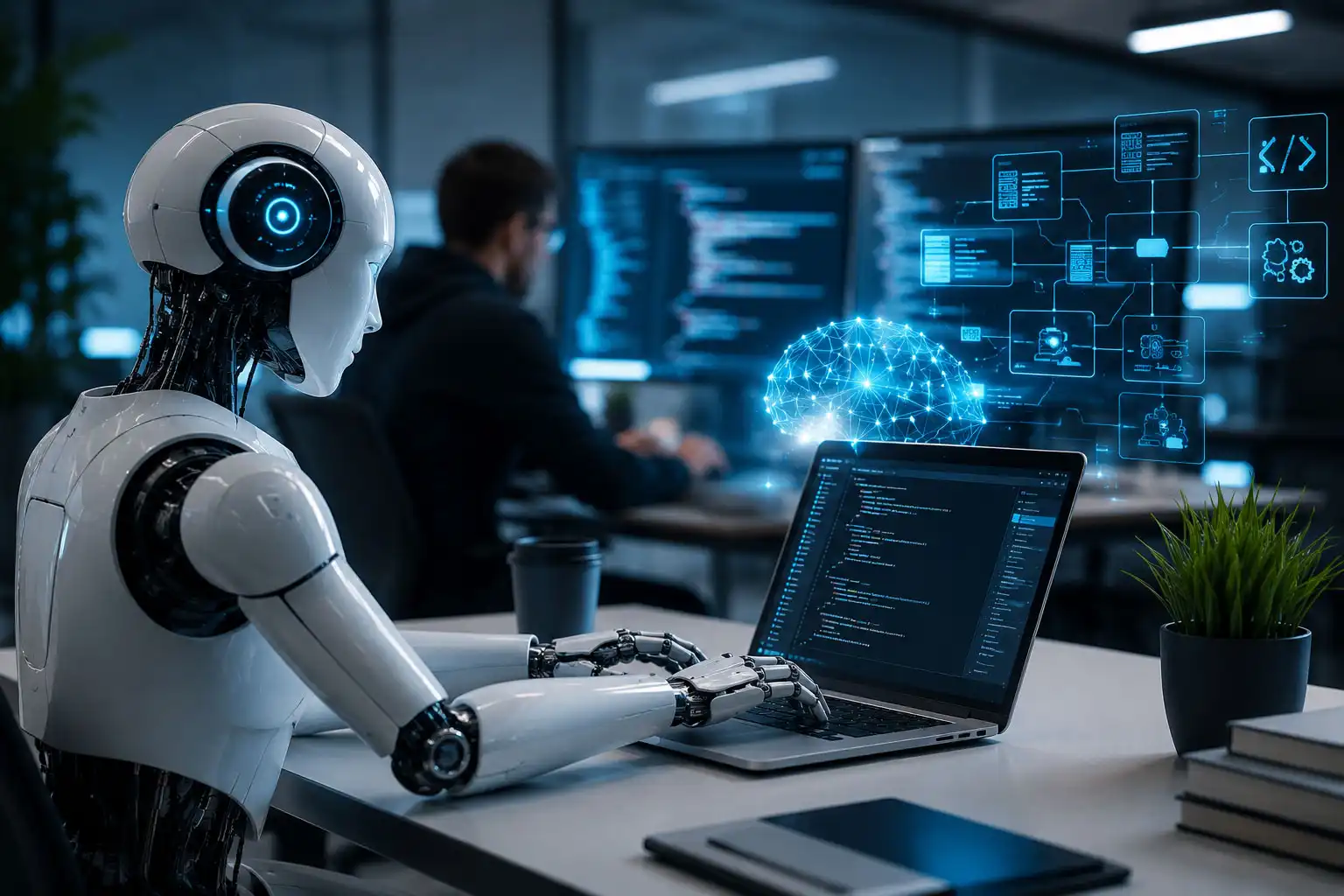
Artificial intelligence is rapidly transforming the software development industry. What once required months of manual coding, repetitive testing, and resource-intensive debugging can now be accelerated through intelligent automation, predictive analytics, and AI-assisted engineering tools. In 2026, businesses are no longer asking whether AI should be part of their software strategy — they are asking how quickly they can implement it effectively.
The rise of AI-powered software development represents a major shift in how organizations approach digital transformation. Companies are under constant pressure to release products faster, improve software quality, reduce operational costs, and deliver better customer experiences. Traditional development methods alone are no longer sufficient to meet these demands at scale.
AI is helping businesses solve these challenges by enhancing nearly every stage of the software development lifecycle. From intelligent code generation and automated testing to predictive maintenance and advanced cybersecurity, AI-driven technologies are enabling development teams to work smarter, faster, and more strategically.
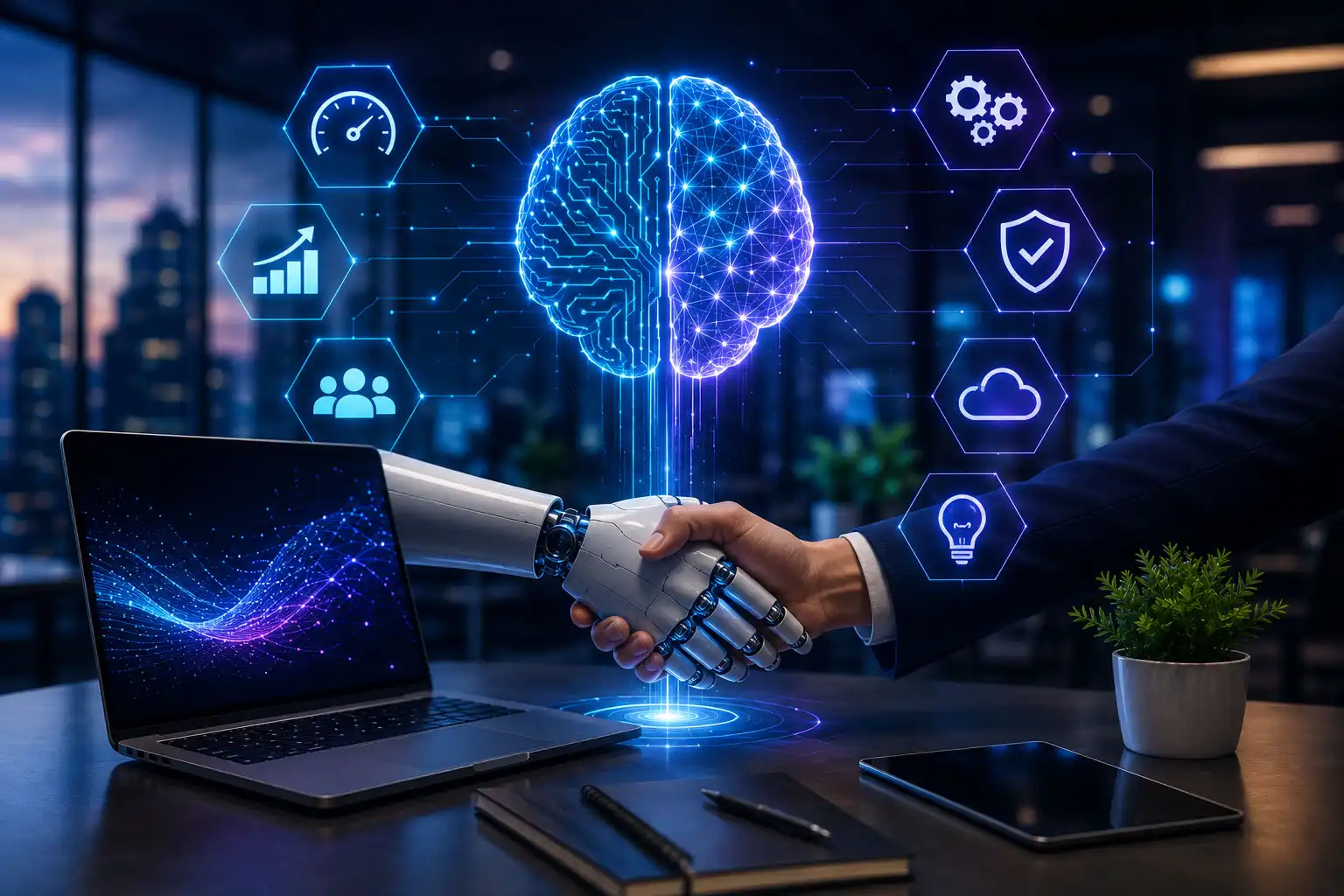
However, AI-powered development is not simply about replacing human developers with automation. The real value lies in combining artificial intelligence with human expertise to create more scalable, secure, and innovative digital solutions.
In this article, we explore how AI-powered software development is reshaping the technology landscape in 2026, the benefits and risks organizations should understand, and why businesses that embrace AI strategically are gaining a significant competitive advantage.
Understanding AI-Powered Software Development
AI-powered software development refers to the integration of artificial intelligence technologies into software engineering processes to improve efficiency, accuracy, scalability, and decision-making. These technologies include machine learning, natural language processing, predictive analytics, generative AI, and intelligent automation systems.
Rather than relying entirely on manual workflows, development teams now use AI to automate repetitive tasks, analyze code quality, predict system failures, optimize performance, and accelerate software delivery. AI acts as a powerful assistant that helps developers focus more on innovation and strategic problem-solving instead of spending excessive time on repetitive engineering tasks.
Modern AI development tools are capable of understanding development patterns, learning from historical data, and continuously improving over time. This makes software development more adaptive, intelligent, and responsive to changing business requirements.
Some of the most common applications of AI in software development include:
- AI-assisted code generation
- Automated testing and debugging
- Intelligent cybersecurity monitoring
- Predictive software maintenance
- DevOps automation
- Performance optimization
- Natural language-based programming
- AI-driven project management
The growing adoption of these technologies reflects a broader shift toward intelligent software ecosystems where automation and human expertise work together to drive digital innovation.
Ultimately, AI-powered development is not just improving software engineering workflows — it is redefining how modern businesses build technology solutions.
Why Businesses Are Rapidly Adopting AI in Software Development
The increasing demand for AI-powered software development is being driven by several major business and technological factors. Organizations across industries are facing intense competition, rising customer expectations, and growing pressure to innovate more quickly than ever before.
AI offers businesses a way to overcome many of the limitations associated with traditional software development methods.
Faster Time-to-Market
Modern businesses operate in fast-moving digital environments where delays in software delivery can lead to lost opportunities and reduced competitiveness. Traditional development processes often involve lengthy coding cycles, repetitive testing procedures, and time-consuming debugging efforts.
AI significantly accelerates these processes by automating large portions of development workflows. Developers can now generate code suggestions instantly, automate testing scenarios, and identify software vulnerabilities earlier in the development cycle.
This speed allows organizations to:
- Launch products faster
- Release updates more frequently
- Respond quickly to customer demands
- Reduce development bottlenecks
As markets become increasingly competitive, faster software delivery is becoming a critical business advantage rather than a technical convenience.
Businesses that can innovate faster are better positioned to adapt to changing market conditions, customer expectations, and emerging technologies. AI is helping organizations achieve that agility at scale.
Managing Increasing Software Complexity
Modern software systems are far more complex than those developed a decade ago. Today’s applications often involve cloud-native infrastructure, APIs, microservices, real-time analytics, IoT integrations, and AI-powered functionality.
Managing these interconnected systems manually can become overwhelming for development teams.
AI-powered tools help simplify complexity by analyzing system dependencies, monitoring infrastructure performance, and identifying architectural inefficiencies before they become critical issues.
AI can assist teams in managing:
- Distributed cloud environments
- Scalable microservices architectures
- Complex application integrations
- Performance optimization
- Infrastructure monitoring
By improving visibility across software ecosystems, AI enables organizations to maintain stability while scaling their digital operations more effectively.
As software environments continue to grow more sophisticated, AI is becoming essential for maintaining operational efficiency, scalability, and long-term reliability.
Rising Cybersecurity Concerns
Cybersecurity has become one of the most significant challenges facing modern organizations. As businesses expand their digital operations, cyber threats are becoming more sophisticated, automated, and difficult to detect.
Traditional security approaches are often reactive, meaning vulnerabilities are discovered only after an attack occurs.
AI is transforming cybersecurity by enabling proactive threat detection and intelligent risk analysis during software development itself.
AI-driven security systems can:
- Detect suspicious coding patterns
- Identify software vulnerabilities
- Monitor abnormal system behavior
- Scan dependencies for known threats
- Automate security testing
This integration of security directly into development workflows is commonly referred to as DevSecOps.
By embedding AI-powered security measures into the software lifecycle, organizations can significantly reduce their exposure to cyber threats while improving compliance and operational resilience.
In 2026, secure software development is no longer optional. Businesses that fail to prioritize AI-driven cybersecurity risk falling behind both technologically and operationally.
How AI Is Transforming the Software Development Lifecycle

Artificial intelligence is influencing nearly every phase of software engineering. Rather than serving as a standalone tool, AI now functions as an integrated development partner that enhances efficiency across planning, coding, testing, deployment, and maintenance.
AI-Assisted Planning and Project Management
Project planning has traditionally relied heavily on manual estimation and human judgment. This often leads to inaccurate timelines, resource allocation challenges, and budget overruns.
AI-powered analytics tools improve project planning by analyzing historical development data, identifying risk patterns, and generating predictive insights.
AI can help organizations:
- Forecast development timelines
- Estimate project costs
- Prioritize features intelligently
- Identify potential delays early
- Improve resource allocation
These insights help businesses make more informed decisions while reducing operational uncertainty.
AI-assisted planning creates more predictable development cycles, enabling organizations to improve project outcomes while minimizing costly delays.
AI-Assisted Coding and Code Generation
One of the most visible applications of AI in software development is intelligent code generation. Modern AI coding assistants can analyze developer intent and generate code suggestions in real time.
Developers can now use natural language prompts to create functions, automate repetitive tasks, and accelerate software creation.
AI coding tools assist with:
- Boilerplate code generation
- Syntax suggestions
- Error detection
- Algorithm recommendations
- Documentation generation
While AI-generated code still requires human oversight, these tools dramatically improve developer productivity and reduce repetitive manual work.
Importantly, AI does not eliminate the need for experienced engineers. Instead, it allows developers to focus more on architecture, innovation, and strategic engineering challenges.
AI-assisted coding is helping development teams work more efficiently without sacrificing software quality or creativity.
Intelligent Testing and Quality Assurance
Software testing has historically been one of the most resource-intensive aspects of development. Manual testing processes can slow down deployment timelines and increase operational costs.
AI-powered testing systems are transforming quality assurance by automating repetitive testing tasks and continuously learning from software behavior.
AI-driven testing platforms can:
- Generate automated test cases
- Simulate user interactions
- Detect performance issues
- Identify edge cases
- Improve test coverage
Machine learning algorithms also help prioritize high-risk areas that require deeper testing.
This proactive approach significantly reduces production bugs and improves overall software reliability.
Organizations that implement AI-driven testing can release software more confidently while reducing costly errors and maintenance issues.
The Business Benefits of AI-Powered Software Development

AI-powered software development offers substantial advantages for organizations seeking to improve operational efficiency, innovation, and long-term scalability.
Improved Development Efficiency
AI automates repetitive engineering tasks that traditionally consume valuable developer time.
This includes:
- Code generation
- Testing automation
- Infrastructure monitoring
- Debugging support
- Documentation assistance
By reducing manual workloads, development teams can focus on solving higher-value business problems and creating more innovative digital solutions.
Improved efficiency not only accelerates development but also enhances team productivity and business agility.
Lower Operational Costs
Software development can be expensive, especially for complex enterprise systems. AI helps reduce costs by minimizing manual labor, optimizing infrastructure usage, and improving resource allocation.
Organizations can lower expenses associated with:
- Testing cycles
- Maintenance
- Bug fixes
- Cloud resource management
- Operational downtime
AI-powered automation creates long-term cost savings while improving software performance and reliability.
Businesses that strategically implement AI often achieve stronger ROI from their technology investments.
Better User Experiences
AI enables businesses to create more intelligent and personalized digital experiences.
AI-powered applications can analyze user behavior and adapt dynamically to customer needs. This leads to:
- Faster response times
- Personalized recommendations
- Smarter automation
- Improved usability
- Enhanced customer engagement
As customer expectations continue to evolve, personalized software experiences are becoming increasingly important for competitive differentiation.
Organizations that combine AI with customer-centric development strategies are better positioned to build long-term customer loyalty.
Challenges Businesses Must Consider
Despite its advantages, AI-powered software development also introduces several important challenges that organizations must manage carefully.
AI-Generated Security Risks
AI-generated code may contain vulnerabilities or insecure patterns if not properly reviewed.
Potential risks include:
- Weak authentication mechanisms
- Vulnerable dependencies
- Poor encryption practices
- Logic flaws
Human oversight remains critical for ensuring software quality and cybersecurity compliance.
AI should enhance secure development practices — not replace responsible engineering standards.
Overdependence on Automation
While automation improves efficiency, excessive reliance on AI can create operational risks.
Developers must continue applying:
- Critical thinking
- System design expertise
- Security judgment
- Architectural decision-making
AI is a tool, not a replacement for engineering leadership.
The most successful organizations use AI to empower developers rather than eliminate human involvement.
The Future of AI-Powered Software Development
The future of software development will be increasingly shaped by intelligent automation, predictive systems, and AI-native architectures.
Over the coming years, businesses can expect advancements in:
- Autonomous development agents
- Predictive cybersecurity
- AI-native cloud applications
- Intelligent DevOps automation
- Personalized digital experiences
- Real-time infrastructure optimization
Organizations that adopt AI strategically today will be better prepared for the next wave of digital transformation.
However, success will depend on balancing innovation with security, governance, scalability, and human expertise.
AI-powered software development is not simply a technology trend — it represents a long-term transformation in how businesses create, deploy, and manage digital solutions.
Final Thoughts
AI-powered software development is redefining the future of software engineering in 2026. Businesses are using AI to accelerate development cycles, improve software quality, strengthen cybersecurity, reduce operational costs, and deliver smarter digital experiences.
The companies achieving the greatest success are not replacing developers with AI. Instead, they are combining human expertise with intelligent automation to build scalable, secure, and future-ready software systems.
As digital competition continues to intensify, organizations that embrace AI strategically will gain significant advantages in innovation, operational efficiency, and customer engagement.
Businesses that delay AI adoption may struggle to keep pace with rapidly evolving market expectations and technological advancements.
The future of software development belongs to organizations that can effectively integrate AI into their long-term digital strategy while maintaining strong engineering, security, and business foundations.
AI enhances cybersecurity in software development by continuously scanning code for vulnerabilities, detecting insecure patterns in both human-written and AI-generated code, supporting shift-left security practices, improving dependency and supply-chain analysis, and enabling faster remediation, all while human experts retain responsibility for policy, risk decisions, and final approval.
TL;DR / Key Takeaways253242
- AI enables continuous, automated security scanning throughout the development lifecycle instead of periodic reviews.
- It helps identify insecure coding patterns, vulnerable dependencies, and configuration issues earlier.
- AI supports true shift-left security by embedding checks directly into coding and CI/CD workflows.
- Supply-chain and dependency risk analysis becomes more scalable and timely.
- Human oversight, clear policies, and strong review processes remain essential for effective protection.
Cybersecurity can no longer be treated as a final checkpoint in software development. As code volume grows and delivery speed increases, traditional periodic security reviews struggle to keep pace. AI strengthens cybersecurity by making security analysis continuous, scalable, and more tightly integrated into everyday development work. When applied correctly, it helps teams find and fix issues earlier while reducing the burden of manual review.
Organizations that want to strengthen security without slowing delivery often partner with teams that already embed AI-supported practices inside custom software development engagements. This accelerates the adoption of effective guardrails and tooling.
Continuous Vulnerability Detection
AI-powered static and dynamic analysis tools scan code in real time or as part of every commit and pull request. They identify common vulnerability patterns, insecure API usage, injection risks, authentication weaknesses, and other issues that traditional tools or manual review might miss under time pressure.
Because the analysis runs continuously, problems surface while the code is still fresh in the developer’s mind, making remediation faster and less expensive.
Securing AI-Generated Code
As more code is produced with the help of generative AI, new security challenges appear. AI models can reproduce insecure patterns learned from training data or introduce subtle weaknesses. Specialized AI security tools and multi-agent approaches are increasingly used to review AI-generated code, flag risky constructs, and recommend safer alternatives before the code is merged.
Research from CrowdStrike highlights the growing importance of dedicated systems that can analyze and harden code produced by AI agents.
Improved Dependency and Supply-Chain Security
Modern applications rely heavily on open-source components and third-party libraries. AI helps analyze large dependency graphs, prioritize high-risk components, detect known vulnerabilities, and recommend safer alternatives or upgrades. This scales far better than purely manual review as the volume and complexity of dependencies continue to grow.
Data from Sonatype research shows that the speed of software creation in the AI era has increased the volume of risk that organizations must manage, making automated, intelligent analysis increasingly necessary.
Supporting Shift-Left and DevSecOps Practices
AI makes it practical to embed security checks earlier in the lifecycle. Developers receive immediate feedback inside their IDE or during pull-request reviews. Security becomes part of the normal development flow rather than a separate, late-stage gate. This reduces friction between development and security teams and improves overall compliance with secure coding standards.
Faster Remediation and Prioritization
Beyond detection, AI can help prioritize findings by potential impact, exploitability, and business context. Some tools also suggest concrete remediation steps or generate secure code alternatives. This shortens the time between discovery and fix and helps teams focus limited security capacity on the issues that matter most.
Traditional Security Approach vs. AI-Enhanced Approach
| Aspect | Traditional Approach | AI-Enhanced Approach |
| Scanning frequency | Periodic or pre-release | Continuous (commit, PR, and pipeline) |
| Handling of AI-generated code | Often treated the same as human code | Specialized analysis and hardening |
| Dependency analysis | Manual or limited automated checks | Scalable, prioritized, and continuous |
| Feedback timing | Late in the cycle | Immediate, inside the development workflow |
| Remediation support | Manual research and fixes | Prioritized findings + suggested secure alternatives |
| Primary human focus | Finding issues through review | Policy, risk decisions, complex threats, oversight |
Important Limitations
AI security tools are powerful but not perfect. They can produce false positives, miss novel or highly contextual vulnerabilities, and require proper configuration and tuning. Over-reliance without skilled human review can create a false sense of security. The strongest outcomes occur when AI handles scale and repetition while experienced security and engineering professionals set policy, evaluate residual risk, and make final decisions.
For a broader perspective on how security fits into modern AI-supported delivery, see our overview of AI-powered software development in 2026.
Ready to strengthen cybersecurity in your software development process with AI?
Request a quote to discuss practical ways to embed AI-supported security practices into your teams and pipelines.
Practical Steps to Get Started
Begin by integrating AI-powered scanning into existing CI/CD pipelines and IDE workflows. Establish clear policies for reviewing both human-written and AI-generated code. Prioritize findings based on real risk rather than raw volume. Train developers on secure coding practices and on how to interpret AI security feedback. Measure outcomes using metrics such as time-to-remediate, vulnerability escape rate, and coverage of critical paths. Expand capabilities gradually as the team builds confidence and process maturity.
When implemented with discipline, AI meaningfully enhances cybersecurity in software development. It makes continuous protection practical, supports earlier detection and remediation, and helps teams manage the growing volume and complexity of modern software risk.
Related Questions
Can AI fully replace traditional security scanning tools?
No. AI enhances and accelerates detection, but it works best alongside established static analysis, dynamic testing, software composition analysis, and human expertise. A layered approach remains the most effective strategy.
Does AI help secure code that was itself generated by AI?
Yes. Specialized tools and multi-agent systems are increasingly used to review AI-generated code for insecure patterns, suggest safer alternatives, and reduce the risk of introducing known vulnerability classes. Human review of critical findings is still required.
How does AI support shift-left security?
By providing immediate feedback inside the IDE and during pull requests, AI makes it practical for developers to address security issues while they are still writing or reviewing code. This moves security earlier in the lifecycle and reduces reliance on late-stage gates.
What is the biggest risk when using AI for cybersecurity in development?
Treating AI findings as complete or automatically correct. False positives, missed contextual issues, and over-confidence in automated results can create gaps. Skilled human oversight and clear escalation paths remain essential.
How should teams measure the impact of AI on application security?
Useful metrics include reduction in time-to-remediate, decrease in vulnerabilities reaching production, coverage of critical application paths, volume of high-severity findings caught early, and developer feedback on the usefulness of security tooling.
Final Thoughts
If you want to enhance cybersecurity in your software development process with practical AI capabilities, the Bantech team is ready to help. Request a quote today for guidance matched to your technology stack, risk profile, and development workflow.
Businesses are adopting AI in software development primarily to accelerate delivery speed, increase developer productivity, reduce costs, improve software quality, and maintain competitive advantage in a market where faster, more efficient software creation has become a strategic necessity.
TL;DR / Key Takeaways
- Faster time-to-market and higher release frequency are among the strongest drivers.
- AI multiplies the output of existing development teams without proportional headcount growth.
- Cost efficiency comes from reduced rework, faster cycles, and better use of engineering talent.
- Quality improvements and earlier defect detection support more reliable releases.
- Competitive pressure and the need to modernize legacy systems further accelerate adoption.
Businesses face growing pressure to deliver software faster, at higher quality, and with constrained resources. AI has moved from experimental pilots into mainstream development practice because it directly addresses these pressures. Organizations that successfully integrate AI into their software development processes gain measurable advantages in speed, efficiency, and capacity. Those that delay risk falling behind competitors who can iterate and release more rapidly.
Many companies accelerate their adoption by working with partners that already apply AI effectively inside custom software development projects. This reduces trial-and-error costs and helps establish productive patterns early.
Faster Delivery and Shorter Time-to-Market
One of the most compelling reasons businesses adopt AI is the ability to compress development cycles. AI assists with code generation, test creation, documentation, and routine implementation tasks, allowing teams to move from idea to working software more quickly. Shorter cycle times enable faster response to customer feedback, market changes, and new opportunities.
In competitive markets, the ability to release features and fixes ahead of rivals has become a clear strategic advantage.
Higher Developer Productivity and Capacity
AI multiplies the effective output of development teams. By handling boilerplate, repetitive coding, and initial test scaffolding, it frees skilled engineers to focus on architecture, complex problem-solving, and high-value features. Businesses can deliver more with existing headcount or scale output without linear increases in team size.
This productivity lift is especially valuable in tight talent markets where hiring and retaining experienced developers remains challenging and expensive.
Cost Efficiency and Better Resource Utilization
Faster delivery and reduced rework translate into lower development and operational costs. Organizations spend less time on manual coding of routine components, debugging preventable issues, and maintaining brittle test suites. AI-supported processes also improve the efficiency of cloud and infrastructure usage in many cases.
Over time these efficiencies improve the return on technology investment and free budget for innovation rather than pure maintenance.
Improved Quality and Reduced Risk
When used with proper review practices, AI contributes to higher software quality. Expanded test coverage, earlier detection of common defects, and continuous scanning help reduce the number of issues that reach production. Businesses adopt AI in part because more reliable releases lower support costs, protect reputation, and improve customer satisfaction.
Competitive Pressure and Modernization Needs
Many organizations adopt AI simply because their competitors are doing so. The companies that move first often gain lasting advantages in speed and cost structure. At the same time, AI tools help accelerate modernization of legacy systems, a persistent and expensive challenge for established businesses. The combination of competitive necessity and practical modernization support drives broader adoption.
Key Business Drivers for AI Adoption
| Driver | How AI Helps | Business Impact |
| Speed to market | Faster coding, testing, and iteration | Quicker response to customers and markets |
| Developer productivity | Automation of routine tasks | More output from existing teams |
| Cost control | Less rework, faster cycles, efficient resource use | Improved ROI on development spend |
| Software quality | Broader testing and earlier defect detection | Fewer production issues and support costs |
| Competitive positioning | Ability to iterate and release faster | Reduced risk of being outpaced |
| Legacy modernization | Accelerated analysis, refactoring, and migration | Faster reduction of technical debt |
Evidence Behind the Adoption Trend
Industry research consistently shows that productivity, speed, and quality improvements are the primary motivators for AI adoption in software development. Studies indicate that a large majority of development leaders report meaningful productivity gains and faster delivery when AI is embedded across multiple stages of the lifecycle. Organizations that scale AI beyond isolated use cases tend to see the strongest results in release frequency and defect reduction.
For a wider view of how these business drivers translate into modern delivery practices, see our analysis of AI-powered software development in 2026.
Important Considerations for Successful Adoption
The benefits are real but not automatic. Businesses that treat AI as a simple plug-in tool often see limited returns. The strongest outcomes appear when organizations also invest in process changes, developer training, review standards, and clear measurement of both speed and quality. Security, intellectual property, and governance considerations must be addressed from the start.
Ready to explore how AI can support your business goals in software development?
Request a quote to discuss practical adoption approaches matched to your priorities, technology stack, and team structure.
How Businesses Typically Begin
Most organizations start with high-impact, lower-risk use cases such as code generation and test automation. They establish success metrics focused on cycle time, defect rates, and developer experience. Training and clear guidelines help teams use the tools effectively. Expansion into more stages of the lifecycle follows once early results and process maturity are proven. External experience can shorten the learning period and help avoid common pitfalls.
Businesses are adopting AI in software development because it delivers tangible advantages in speed, productivity, cost, quality, and competitiveness. When implemented with discipline and clear business alignment, AI becomes a powerful lever for building better software faster and more efficiently.
Related Questions
What is the single strongest reason most businesses adopt AI in development?
Faster delivery and higher productivity are consistently the top drivers. Organizations want to release software more quickly and get more value from their existing engineering teams without proportional increases in headcount or cost.
Does AI adoption primarily help large enterprises or smaller companies as well?
Both. Large enterprises often focus on scale, consistency, and modernization of complex systems. Smaller companies and startups frequently gain even more relative benefit because AI multiplies limited engineering capacity and helps them compete with better-resourced rivals.
How quickly do businesses typically see results after adopting AI?
Many teams notice improvements in coding speed and routine task completion within weeks. Broader gains in cycle time, quality, and cost efficiency usually become clearer over a few months once processes, review standards, and measurement are in place.
Is cost reduction a major driver of AI adoption in software development?
Yes. While speed and productivity often rank highest, cost efficiency is a close and related motivator. Reduced rework, faster delivery, and better utilization of expensive engineering talent all contribute to lower overall development costs.
What holds some businesses back from adopting AI more quickly?
Common barriers include concerns about code quality and security, uncertainty about how to measure ROI, skills gaps, integration challenges with existing tools, and lack of clear governance. Organizations that address these issues deliberately tend to move faster and achieve better results.
Final Thoughts
If you want to understand how AI can support your specific business goals in software development, the Bantech team is ready to help. Request a quote today for a practical assessment of opportunities matched to your priorities, processes, and technology environment.
AI helps with software testing and quality assurance by automatically generating test cases, maintaining and self-healing test suites as applications change, prioritizing high-risk areas, expanding coverage, detecting visual and functional issues, and supporting earlier defect prediction, all while human testers retain ownership of strategy, edge cases, and final validation.
TL;DR / Key Takeaways
- AI significantly accelerates test case creation and reduces the manual effort required to keep tests up to date.
- Self-healing and intelligent maintenance lower the cost of test automation over time.
- Risk-based prioritization and broader coverage help teams find important defects earlier.
- Visual testing and exploratory support improve detection of issues that traditional scripts often miss.
- The best results come when AI handles volume and repetition while skilled QA professionals focus on strategy, risk, and complex scenarios.
Software testing has long been one of the most time-consuming and resource-intensive parts of the development lifecycle. AI is changing that equation by automating large portions of test creation, execution analysis, and maintenance. The result is faster feedback, higher coverage, and more efficient use of QA capacity when the technology is applied with clear process and human oversight.
Organizations that want to modernize testing often partner with teams that already embed AI practices inside custom software development work. This helps establish effective patterns for generation, review, and governance from the start.
Automated Test Case Generation
One of the highest-impact uses of AI is generating test cases from requirements, user stories, code changes, or existing application behavior. AI can produce unit, integration, API, and end-to-end tests far faster than manual authoring. This expands coverage and frees testers to focus on higher-value activities such as exploratory testing, risk analysis, and usability evaluation.
Generation quality improves when the AI is given clear context and when generated tests are reviewed before they become part of the permanent suite.
Intelligent Test Maintenance and Self-Healing
Traditional automated tests frequently break when the user interface or underlying code changes. AI-powered tools can detect these changes, update selectors or assertions, and keep tests running with far less manual intervention. Self-healing capabilities reduce the ongoing maintenance burden that has historically limited the return on test automation investments.
This is especially valuable in fast-moving applications where frequent UI or API changes would otherwise create constant test debt.
Risk-Based Prioritization and Smarter Execution
AI can analyze code changes, historical defect data, and usage patterns to prioritize which tests should run first or which areas deserve deeper attention. Instead of executing every test on every change, teams can focus computational and human effort on the highest-risk paths. This shortens feedback cycles while still protecting critical functionality.
Visual and Exploratory Testing Support
AI-powered visual testing compares screenshots or rendered pages against baselines and flags meaningful differences while ignoring insignificant noise. Some tools also assist with exploratory testing by suggesting paths, generating test data, or highlighting unusual application behavior. These capabilities catch classes of defects that pure functional scripts often miss.
Defect Prediction and Earlier Feedback
Machine learning models trained on historical project data can help predict which modules or changes are more likely to contain defects. Combined with continuous integration, this supports shift-left testing and earlier intervention. Faster feedback loops reduce the cost of fixing issues and improve overall release confidence.
Traditional Testing vs. AI-Augmented Testing
| Aspect | Traditional Approach | AI-Augmented Approach |
| Test case creation | Mostly manual | Automated generation from requirements or code |
| Test maintenance | High manual effort when UI/code changes | Self-healing and intelligent updates |
| Coverage | Limited by available time | Broader coverage with less incremental effort |
| Prioritization | Often based on experience or fixed suites | Risk- and change-based prioritization |
| Visual validation | Limited or manual | Automated visual comparison and anomaly detection |
| Primary human focus | Writing and maintaining scripts | Strategy, risk analysis, exploratory testing, review |
Evidence of the Impact
Industry research shows that generating test cases is one of the areas where teams experience some of the largest time savings from AI. Adoption of AI in testing has become widespread, with many organizations reporting improved speed and coverage when the tools are integrated into existing pipelines. At the same time, studies emphasize that human oversight, clear governance, and measurement of quality outcomes remain essential for sustainable results.
For a broader view of how AI-supported testing fits into modern delivery practices, see our overview of AI-powered software development in 2026.
Important Limitations and Best Practices
AI-generated tests are not automatically correct or complete. They can miss business-critical edge cases, introduce flaky assertions, or create redundant coverage. Over-reliance without review can produce large suites that are difficult to trust. The most effective teams treat AI as a powerful accelerator for volume and maintenance while keeping skilled QA professionals responsible for test strategy, risk prioritization, and final validation.
Ready to strengthen testing and quality assurance with AI?
Request a quote to explore practical ways to introduce or scale AI-assisted testing inside your development process.
How Teams Get Started Successfully
Begin with high-volume opportunities such as unit and API test generation or maintenance of existing UI tests. Establish clear review standards for any AI-created tests before they enter the main suite. Measure impact using metrics that matter (defect escape rate, test maintenance effort, cycle time, and coverage of critical paths). Expand into more advanced capabilities only after the foundational practices prove reliable. External experience can help teams avoid common pitfalls and accelerate meaningful results.
When applied with discipline, AI meaningfully improves software testing and quality assurance. It reduces repetitive work, expands coverage, shortens feedback loops, and allows skilled testers to focus on the judgment and exploration that still require human insight.
Related Questions
What types of tests benefit most from AI generation today?
Unit tests, API tests, and standard end-to-end flows currently see the strongest and most reliable gains. Complex business-logic scenarios, accessibility edge cases, and highly exploratory testing still benefit heavily from human design and oversight.
Does AI eliminate the need for manual or exploratory testing?
No. AI handles volume and repetition effectively, but exploratory testing, usability evaluation, and assessment of complex or novel scenarios continue to require skilled human testers. The combination of AI scale and human insight produces the best quality outcomes.
How does AI reduce the cost of maintaining automated tests?
Self-healing and intelligent maintenance capabilities detect application changes and update tests automatically or with minimal human input. This significantly lowers the ongoing effort that has traditionally made large automated suites expensive to keep reliable.
Can AI help with visual and UI testing?
Yes. AI-powered visual testing tools compare rendered pages against baselines, ignore insignificant differences, and flag meaningful visual regressions. This catches layout, styling, and rendering issues that functional scripts often miss.
What is the biggest risk when adopting AI for testing?
Accepting generated tests without sufficient review. Low-quality or redundant tests can create false confidence and increase maintenance burden. Strong review gates and clear ownership of the test suite remain essential.
Final Thoughts
If you want to improve software testing and quality assurance with practical AI capabilities, the Bantech team is ready to help. Request a quote today for guidance matched to your current processes, technology stack, and quality goals.
The best AI tools for software development in 2026 are Claude Code for deep agentic and multi-file work, Cursor for AI-native IDE experience and daily coding, and GitHub Copilot for broad IDE support and enterprise integration, with the right choice depending on workflow, team size, and whether you prioritize terminal agents, visual editing, or seamless existing-tool compatibility.
TL;DR / Key Takeaways
- Claude Code leads for complex, autonomous, multi-file reasoning and terminal-based agentic workflows.
- Cursor is the strongest AI-native editor for developers who want deep IDE integration and fast daily coding.
- GitHub Copilot remains the most widely adopted option for teams already invested in the GitHub ecosystem.
- Most productive developers in 2026 combine tools rather than relying on a single one.
- The best results come from matching the tool to the specific stage of work and enforcing strong review standards.
The landscape of AI tools for software development has matured significantly. In 2026 the market has moved beyond simple autocomplete into full agentic systems that can plan, edit across files, run tests, and prepare changes for review. Choosing the right tools depends on whether your priority is raw agent capability, editor experience, enterprise controls, or seamless integration with existing workflows.
Teams evaluating these options often benefit from working with partners that already use a modern AI tool stack inside custom software development projects. This provides practical insight into what works at scale.
Leading AI Coding Tools in 2026
Claude Code
Claude Code has emerged as a top choice for developers handling complex, long-lived codebases. It operates primarily in the terminal, offers strong multi-file reasoning, supports parallel sub-agents, and performs well on demanding benchmarks. It is particularly effective for large refactors, autonomous task execution, and workflows that benefit from deep codebase understanding.
Cursor
Cursor is an AI-native code editor built on a VS Code foundation. It provides excellent inline assistance, multi-file editing through its Composer agent, and flexible model support. Many developers prefer it for daily hands-on coding because the AI feels tightly integrated into the editing experience rather than bolted on.
GitHub Copilot
GitHub Copilot continues to dominate in breadth of adoption and IDE coverage. It works across a wide range of editors, offers solid agent capabilities, and integrates deeply with GitHub workflows, pull requests, and enterprise controls. It remains the default choice for many organizations that want minimal disruption to existing toolchains.
Other notable tools include Windsurf (strong free tier and agentic features), Amazon Q Developer (especially for AWS-centric teams), and specialized options for code review or privacy-focused environments.
How to Choose the Right Tool
The best tool depends on context:
- Complex multi-file reasoning and autonomous tasks → Claude Code
- Daily IDE-based development with strong visual feedback → Cursor
- Broad IDE support and GitHub-centric teams → GitHub Copilot
- Cost-sensitive or free-tier exploration → Options like Windsurf or free tiers of the major tools
- Strict compliance or on-premises needs → Tools with strong privacy and deployment controls
Many experienced developers now run a small stack (for example, Copilot or Cursor for daily work plus Claude Code for heavier agentic tasks) rather than relying on a single solution.
Comparison of Leading AI Coding Tools
| Tool | Best For | Interface | Strengths | Typical Starting Price |
| Claude Code | Complex agentic & multi-file work | Terminal / CLI | Deep reasoning, autonomy, codebase understanding | ~$20/mo |
| Cursor | Daily AI-native coding | AI-first IDE | Multi-file editing, polished experience, model flexibility | ~$20/mo |
| GitHub Copilot | Enterprise & broad IDE support | IDE extension | Wide compatibility, GitHub integration, maturity | Free / ~$10–19/mo |
| Windsurf | Free-tier & agentic editing | AI-first IDE | Strong free offering, agent features | Free / paid tiers |
| Amazon Q | AWS-heavy environments | IDE + AWS | Native cloud integration | Free / paid |
Evidence from the Current Landscape
Developer surveys and independent rankings in 2026 consistently place Claude Code, Cursor, and GitHub Copilot at the top for different use cases. Adoption data shows high usage of these tools in professional settings, with many teams reporting meaningful productivity gains when the tools are paired with clear review processes. The market has also seen rapid improvement in agentic capabilities, moving beyond simple suggestions into multi-step execution.
For a broader view of how these tools fit into modern delivery practices, see our overview of AI-powered software development in 2026.
Practical Recommendations
Start by identifying the biggest friction points in your current workflow (inline coding speed, large refactors, test generation, or review volume). Pilot one or two tools with a small group, measure both speed and quality impact, and establish non-negotiable review and security standards before wider rollout. Most teams get the best results by combining a strong daily coding assistant with a more powerful agentic tool for heavier tasks.
Need help selecting and implementing the right AI tools for your team?
Request a quote to discuss practical tool recommendations and integration approaches matched to your stack and goals.
Getting Started Successfully
Define success metrics in advance (cycle time, defect rates, developer satisfaction). Provide training on effective prompting and critical evaluation of output. Keep human review and security scanning as mandatory gates. Expand usage only after the team demonstrates consistent quality. External experience can shorten the learning curve and help avoid common adoption pitfalls.
The best AI tools for software development in 2026 are powerful, but they deliver the greatest value when matched to real workflows and supported by strong engineering discipline.
Related Questions
Which AI coding tool is best for most individual developers in 2026?
For many individual developers, Cursor offers the best balance of daily usability and agentic power inside a familiar editor experience. Developers who prefer terminal workflows or need maximum reasoning depth often prefer Claude Code. The optimal choice depends on personal workflow and the complexity of the work.
Is GitHub Copilot still worth using in 2026?
Yes. GitHub Copilot remains one of the strongest options for teams that value broad IDE support, mature enterprise features, and deep GitHub integration. While other tools may lead in pure agentic capability or editor experience, Copilot’s reach and ecosystem continue to make it a practical default for many organizations.
Should teams use more than one AI coding tool?
In practice, yes. Many high-performing developers and teams combine tools—for example, using one for fast inline assistance and another for complex multi-file or autonomous tasks. The key is avoiding tool sprawl while covering the main friction points in the workflow.
How important is model choice versus the tool interface?
Both matter. The underlying model affects reasoning quality and code accuracy, while the tool interface determines how smoothly the AI fits into daily work. The strongest results usually come from pairing a high-performing model with an interface that matches the developer’s preferred way of working.
What should teams prioritize when evaluating AI coding tools?
Focus on real workflow fit, quality of generated output on your actual codebase, review and security capabilities, pricing transparency, and ease of governance. Pilot with real tasks rather than relying solely on marketing benchmarks.
Final Thoughts
If you want expert guidance on selecting and rolling out the best AI tools for your software development process, the Bantech team is ready to help. Request a quote today for practical recommendations matched to your technology stack, team structure, and goals.
AI improves coding and code generation by producing functional code from natural-language descriptions, completing functions in real time, automating boilerplate and repetitive patterns, assisting with refactoring, and accelerating prototyping, all while developers retain control through review, architecture decisions, and final accountability.
TL;DR / Key Takeaways
- AI dramatically reduces time spent on boilerplate, repetitive patterns, and routine implementation.
- Developers can generate working code from natural-language prompts and iterate much faster.
- Real-time suggestions and multi-file assistance improve flow and consistency.
- The biggest gains appear when AI output is treated as a strong first draft that still requires human review.
- Teams that combine AI generation with solid engineering practices ship higher-quality code more quickly.
AI has changed the mechanics of writing software. Instead of typing every line by hand, developers now work with tools that understand context, generate substantial portions of code, and handle many repetitive tasks. The result is faster implementation, reduced friction on routine work, and more capacity for the complex decisions that still require human judgment.
Organizations that want to capture these improvements often partner with teams that already apply AI-assisted practices inside custom software development projects. This helps establish effective workflows and review standards from the start.
Real-Time Code Completion and Suggestions
Modern AI coding tools sit inside the editor and offer context-aware suggestions as developers type. They predict the next lines, complete functions, and propose entire blocks based on the surrounding code, comments, and project patterns. This reduces keystrokes, lowers cognitive load, and helps maintain consistency across a codebase.
The improvement is especially noticeable on familiar patterns, standard library usage, and common architectural approaches.
Natural Language to Working Code
One of the most powerful advances is the ability to generate functional code from natural-language descriptions. A developer can describe a feature, a utility function, or a data transformation in plain language and receive a working implementation that can be refined. This shortens the path from idea to prototype and makes it easier to explore alternatives quickly.
The quality of the output depends heavily on the clarity of the prompt and the context provided to the model. Clear intent produces better results.
Automation of Boilerplate and Repetitive Work
Large portions of software development involve boilerplate: configuration, data models, API endpoints, standard CRUD operations, test scaffolding, and similar patterns. AI handles these tasks efficiently, freeing developers to focus on business logic, edge cases, performance, and design decisions that create real differentiation.
This shift is one of the most consistently reported productivity benefits of AI-assisted coding.
Support for Refactoring and Code Improvement
AI tools can suggest refactorings, help modernize older code, identify potential improvements, and even assist with language or framework migrations. When guided properly, they accelerate cleanup and technical-debt reduction that many teams otherwise postpone.
Human oversight remains essential to ensure that suggested changes preserve behavior and fit the broader architecture.
Multi-File and Larger-Scope Generation
More advanced agentic tools can now plan and execute changes across multiple files, update related tests, and prepare changes for review. This moves AI assistance beyond single-function suggestions into more substantial implementation support. Developers still define the goals, review the results, and own the final quality.
For a wider perspective on how these coding improvements fit into the full development process, see our analysis of AI-powered software development in 2026.
Traditional Coding vs. AI-Assisted Coding
| Aspect | Traditional Approach | AI-Assisted Approach |
| Starting a new function | Write from scratch or copy patterns | Generate from natural-language description or context |
| Boilerplate and scaffolding | Manual and time-consuming | Largely automated |
| Code completion | Basic IDE suggestions | Context-aware, multi-line, project-aware |
| Refactoring | Manual and careful | AI-suggested with human validation |
| Prototyping speed | Limited by typing and lookup time | Significantly faster iteration |
| Primary developer focus | Writing most of the code | Directing, reviewing, and refining AI output |
Evidence of the Improvement
Industry research consistently shows meaningful gains in coding speed and developer flow when AI tools are used effectively. Studies and real-world reporting highlight reductions in time spent on routine implementation and increases in the volume of useful code that teams can produce. At the same time, the research underscores that the quality of results depends on human review, clear prompting, and strong engineering practices. AI improves the generation step; humans remain responsible for correctness, security, and fit.
Important Limitations to Keep in Mind
AI-generated code is not guaranteed to be correct, secure, or optimal. It can contain subtle bugs, insecure patterns, or solutions that do not fit the larger system. Over-reliance without review can introduce technical debt or security issues. The most successful teams treat AI output as a high-quality starting point that still requires the same rigor applied to any other contribution.
Ready to improve coding speed and quality with AI?
Request a quote to explore practical ways to introduce or scale AI-assisted coding inside your teams.
How Teams Get the Best Results
Start with clear use cases such as boilerplate generation, test scaffolding, and well-defined utility functions. Invest in training so developers learn to write effective prompts and critically evaluate output. Keep strong review and security standards in place. Measure both speed and quality so that gains in generation do not come at the expense of reliability. Expand into larger-scope assistance only after the foundational practices are working well.
When used with discipline, AI significantly improves coding and code generation. It reduces friction on routine work, accelerates iteration, and allows skilled developers to spend more time on the decisions that truly matter.
Related Questions
What types of coding tasks benefit most from AI today?
Boilerplate, standard patterns, utility functions, test generation, simple CRUD operations, and initial prototyping currently see the largest and most reliable gains. Complex architectural decisions, novel algorithms, and highly context-specific logic still require substantial human direction and review.
Does AI-generated code require less testing?
No. In many cases it requires the same or even more careful testing, especially when the generated code touches critical paths or security-sensitive areas. AI can help create tests, but human judgment is still needed to ensure coverage and correctness.
How much faster can developers work with AI coding tools?
Reported gains vary widely depending on the task, the developer’s experience, and how well the team has integrated the tools. Many developers experience noticeable reductions in time spent on routine implementation, which compounds into faster feature delivery when review processes keep pace.
Can AI help with legacy code and refactoring?
Yes. AI tools are increasingly useful for explaining unfamiliar code, suggesting refactorings, and assisting with modernization efforts. The suggestions still need careful validation to ensure behavior is preserved and the changes fit the overall system design.
What is the biggest mistake teams make with AI code generation?
Accepting generated code with insufficient review. Treating AI output as production-ready without the same scrutiny applied to human-written code is the most common source of quality and security problems.
Final Thoughts
If you want to improve coding speed and quality with well-governed AI assistance, the Bantech team is ready to help. Request a quote today for practical guidance matched to your technology stack and development process.
The main challenges and risks of AI-powered software development include security vulnerabilities in generated code, inconsistent output quality, over-reliance that can weaken human skills, intellectual property and licensing concerns, and the extra review overhead required to keep AI contributions safe and reliable.
TL;DR / Key Takeaways
- AI-generated code frequently introduces security weaknesses that require rigorous human and automated review.
- Output quality can vary, leading to subtle bugs, hallucinations, or maintainability problems.
- Over-reliance on AI risks eroding foundational engineering skills, especially among junior developers.
- Intellectual property, licensing, and data privacy issues can arise when using third-party models.
- Strong governance, review standards, and continuous security scanning are essential to manage these risks.
AI offers clear productivity and quality advantages, but it also introduces real challenges that organizations must address deliberately. The risks of AI-powered software development are not reasons to avoid the technology. They are reasons to adopt it with clear processes, strong oversight, and realistic expectations. Teams that ignore these issues often find that faster output simply creates more problems downstream.
Organizations that want to move forward safely frequently work with experienced partners who already apply disciplined AI practices inside custom software development projects. This helps establish the right guardrails from the beginning.
Security Vulnerabilities in AI-Generated Code
One of the most significant risks is security. AI models can reproduce insecure coding patterns, suggest vulnerable dependencies, or overlook context-specific threats. Studies and industry testing have repeatedly shown that a substantial portion of AI-generated code contains weaknesses that would fail standard security reviews.
Without continuous scanning and mandatory human review, these issues can reach production and create serious exposure. Security must be treated as a non-negotiable gate rather than an afterthought.
Inconsistent Quality and Reliability
AI output is probabilistic. The same prompt can produce different results, and generated code may look correct while containing subtle logic errors, edge-case failures, or poor architectural choices. Hallucinations (confident but incorrect suggestions) remain a persistent problem.
This variability increases the importance of thorough code review, comprehensive testing, and clear definition of what “acceptable” output looks like before it is merged.
Over-Reliance and Skill Erosion
When teams lean too heavily on AI for routine implementation, junior and mid-level engineers may get fewer opportunities to practice core skills. Over time this can weaken the organization’s depth of expertise in debugging, system design, and secure coding.
The most effective teams use AI to handle repetitive work while deliberately protecting time for learning, mentoring, and hands-on problem solving.
Intellectual Property, Licensing, and Data Privacy Concerns
Using third-party AI models raises questions about ownership of generated code, potential exposure of proprietary information in prompts, and compliance with open-source licensing terms that the model may have learned from. Organizations must understand the terms of the tools they use and establish clear policies about what data can be shared with external models.
Increased Review and Governance Overhead
Faster generation of code and tests often means a higher volume of changes that must be reviewed, tested, and secured. Without updated processes, the review bottleneck simply moves downstream. Governance frameworks, automated quality gates, and clear ownership are required to keep the system sustainable.
Summary of Key Risks and Mitigations
| Risk Area | Description | Recommended Mitigation |
| Security vulnerabilities | Insecure patterns or dependencies in AI code | Mandatory scanning + human security review |
| Output quality & reliability | Subtle bugs, hallucinations, inconsistent results | Strong code review standards and expanded testing |
| Skill erosion | Reduced practice of core engineering skills | Structured learning paths and mentoring |
| IP and licensing | Ownership and compliance uncertainty | Clear tool policies and legal review |
| Review overload | Higher volume of changes to validate | Automated gates + risk-based human review |
| Data privacy | Sensitive information sent to external models | Strict data-handling rules and approved tools only |
Evidence of the Risks
Industry analysis continues to highlight these issues. Research on generative AI for developers from IBM emphasizes that while productivity gains are real, organizations must actively manage accuracy limitations, security exposure, and the need for human oversight. Complementary findings in the broader technology landscape, including perspectives on AI-assisted engineering risks, reinforce that ungoverned adoption can amplify existing weaknesses rather than resolve them.
For a wider view of how these challenges fit into modern delivery approaches, see our overview of AI-powered software development in 2026.
How Teams Can Manage the Risks Effectively
Successful organizations treat AI output as a high-quality first draft, never as finished work. They enforce consistent review standards, embed security scanning in the pipeline, invest in training on effective prompting and critical evaluation, and track both delivery speed and quality metrics. Clear policies on approved tools, data handling, and ownership reduce legal and compliance exposure.
When these practices are in place, the risks become manageable and the benefits remain attainable.
Want help putting the right guardrails around AI in your development process?
Request a quote to discuss practical risk-management approaches tailored to your teams and technology stack.
Practical Starting Points
Begin by establishing non-negotiable review and security gates before expanding AI usage. Choose a limited set of approved tools and define clear data-handling rules. Measure not only velocity but also defect rates, security findings, and developer skill development. Expand AI application only after the surrounding controls prove effective. External experience can help teams avoid common pitfalls and implement proven safeguards faster.
AI-powered software development delivers real advantages, but only for organizations that respect its limitations and invest in the discipline required to use it safely.
Related Questions
What is the biggest security risk with AI-generated code?
The most common issue is the introduction of insecure coding patterns, vulnerable dependencies, or missing security controls that the model has seen in its training data. These problems are often subtle and require both automated scanning and experienced human review to catch reliably.
Can over-reliance on AI hurt long-term team capability?
Yes. If junior and mid-level engineers rarely practice core skills such as debugging, system design, and secure coding, the organization’s overall engineering depth can decline over time. Balanced use of AI combined with deliberate skill-building is essential.
How should companies handle intellectual property concerns?
Organizations need clear policies on which AI tools are approved, what data may be shared with them, and how ownership of generated code is treated. Legal review of tool terms and regular training for developers help reduce exposure.
Does AI increase or decrease the need for code review?
It usually increases the need for disciplined review. Because AI can generate larger volumes of code quickly, review processes must become more efficient and risk-based while remaining rigorous on security and correctness.
What is a practical first step to reduce AI-related risks?
Start by requiring that all AI-generated code and tests pass through the same security scanning and peer-review standards applied to human-written work. This single practice prevents many of the most common problems from reaching production.
Final Thoughts
If you want to adopt AI in software development while keeping risks under control, the Bantech team is ready to help. Request a quote today for a practical assessment of opportunities and safeguards matched to your current processes and goals.
No, AI will not replace software developers in 2026. Instead, it is transforming the role by automating routine coding tasks while increasing demand for engineers who can define problems clearly, design robust systems, review AI output critically, and take ownership of quality, security, and business outcomes.
TL;DR / Key Takeaways
- AI is automating significant portions of routine implementation work, but it is not eliminating the need for skilled developers.
- The developers who thrive are those who treat AI as a powerful collaborator and focus on higher-value activities.
- Demand continues for people who can handle architecture, complex problem-solving, system integration, and accountability.
- Organizations that combine AI tools with strong human expertise outperform those that try to remove developers from the process.
- The real risk is not replacement by AI, but being outpaced by developers and teams that use AI effectively.
The question of whether AI will replace software developers has been asked repeatedly as generative tools and coding agents have advanced. The evidence in 2026 points clearly to transformation rather than elimination. AI handles a growing share of boilerplate code, test generation, documentation, and even multi-step implementation tasks. At the same time, the need for human judgment, system-level thinking, and accountability has not disappeared. In many cases it has become more important.
Teams that want to adapt successfully often partner with experienced providers that already integrate AI into custom software development work. This helps organizations evolve roles and processes without losing engineering depth.
Why AI Is Not Replacing Developers
Software development has never been only about writing lines of code. It involves understanding ambiguous requirements, making architectural trade-offs, ensuring security and compliance, integrating systems, debugging complex interactions, and aligning technical decisions with business goals. Current AI systems excel at pattern-based generation and acceleration of well-defined tasks. They still struggle with deep context, novel problem-solving, long-term maintainability, and owning the consequences of decisions.
As a result, the most effective teams use AI to multiply the output of skilled engineers rather than attempting to remove them. The developers who remain essential are those who can direct AI tools, evaluate their output rigorously, and take responsibility for the final system.
How the Developer Role Is Changing
The day-to-day work of software developers is shifting. Less time is spent on repetitive implementation. More time is spent on:
- Defining clear intent and acceptance criteria
- Designing system architecture and boundaries
- Reviewing and refining AI-generated code and tests
- Ensuring security, performance, and maintainability
- Integrating components and handling edge cases
- Mentoring others and improving team processes
This evolution rewards engineers who develop strong systems-thinking skills, clear communication, and the ability to work effectively with intelligent tools. For a broader view of how these changes fit into modern delivery practices, see our overview of AI-powered software development in 2026.
Evidence from Industry Research
Multiple sources confirm that AI is augmenting rather than eliminating developer roles. Analysis from IBM on AI in the software development lifecycle describes AI as an intelligent layer that enhances productivity and decision-making while keeping human developers central to the process. Complementary research on the future of software engineering roles emphasizes that demand remains strong for professionals who can orchestrate AI, maintain quality, and align technical work with business outcomes. The consistent message is that organizations still need skilled people to direct, review, and own the systems being built.
Role Evolution: Traditional vs. AI-Augmented Developer
| Aspect | Traditional Focus | AI-Augmented Focus |
| Primary activity | Writing most of the code manually | Directing AI, reviewing output, system design |
| Time spent on boilerplate | High | Significantly reduced |
| Key skills | Syntax mastery and implementation speed | Architecture, critical evaluation, problem framing |
| Accountability | Individual code ownership | Ownership of overall system quality and outcomes |
| Collaboration with tools | Limited | Continuous partnership with AI agents and assistants |
| Career trajectory | Progression through coding complexity | Faster path to tech-lead and orchestration skills |
What This Means for Developers and Organizations
For individual developers, the practical advice is clear: learn to work effectively with AI tools, strengthen system design and review skills, and focus on the work that still requires human judgment. Those who adapt tend to become more productive and more valuable.
For organizations, the opportunity is to redesign workflows, training, and career paths so that AI multiplies human capability instead of creating skill gaps. Companies that simply reduce headcount without investing in higher-value engineering often lose quality, speed, and resilience.
Practical Guidance for 2026
Developers should treat AI as a powerful assistant that still requires supervision. Organizations should invest in training, update review standards, and measure both delivery speed and system quality. The teams that combine strong human expertise with well-governed AI consistently outperform those that treat AI as a full replacement.
Want to evolve your development team for the AI era?
Request a quote to discuss how to integrate AI while strengthening your engineering capability.
Looking Ahead
AI will continue to automate more of the routine work in software development. That trend does not remove the need for skilled developers. It raises the value of those who can define problems well, design resilient systems, evaluate AI contributions critically, and deliver reliable outcomes. In 2026 and beyond, the developers and organizations that thrive will be those that treat AI as a collaborator rather than a replacement.
Related Questions
Is AI reducing the total number of software developer jobs?
Current evidence points more to a shift in the type of work than to a broad reduction in demand. Routine implementation tasks are being automated, while demand remains strong for engineers who can handle architecture, integration, quality ownership, and AI orchestration. The net effect varies by organization and by how effectively teams adapt.
What skills should developers focus on to stay relevant?
High-value skills include system design and architecture, precise problem framing, critical evaluation of AI output, security awareness, performance optimization, and the ability to integrate complex systems. Communication and collaboration skills also become more important as developers spend more time directing tools and aligning with stakeholders.
Will junior developer roles disappear?
Junior roles are changing rather than vanishing. Entry-level work that consists mainly of straightforward coding is shrinking. Organizations that still want to grow talent need to redesign onboarding and mentoring so that juniors gain experience in review, testing, system understanding, and working effectively with AI tools.
How should companies adjust their hiring and team structure?
Many organizations are moving toward smaller, more senior-heavy teams that leverage AI for higher output, or they are creating hybrid roles that combine product, design, and engineering responsibilities. The most successful approaches focus on capability rather than simply reducing headcount.
What is the biggest risk for developers who ignore AI?
The largest risk is falling behind peers and teams that use AI effectively. Developers who refuse to engage with the tools may find their relative productivity and value declining even if absolute demand for software engineering remains strong.
Final Thoughts
If you want to prepare your development team for the realities of AI in 2026 and beyond, the Bantech team is ready to help. Request a quote today for practical guidance on integrating AI while building stronger engineering capability.
The main benefits of AI in software development include faster delivery cycles, higher code quality through expanded testing and earlier defect detection, lower operational costs, improved developer productivity, and the ability to build more personalized and adaptive user experiences while keeping human expertise in control of architecture and critical decisions.
TL;DR / Key Takeaways
- AI accelerates routine coding, testing, and documentation so teams ship features and fixes faster.
- Expanded automated testing and continuous scanning often reduce defects that reach production.
- Developers gain capacity for higher-value work such as architecture, complex problem-solving, and innovation.
- Organizations see measurable cost savings from less rework, more efficient infrastructure use, and shorter cycle times.
- The strongest results appear when AI is paired with solid review practices, security standards, and clear measurement.
Artificial intelligence is delivering tangible advantages across the software development process. The benefits of AI in software development go well beyond faster code generation. When applied thoughtfully, AI improves speed, quality, cost efficiency, developer experience, and the ability to respond to changing business needs. These gains become most reliable when teams combine the technology with strong human oversight and disciplined engineering practices.
Many organizations realize these benefits faster by working with partners that already embed AI capabilities into custom software development engagements. This reduces experimentation overhead and helps teams adopt proven patterns from the start.
Faster Time-to-Market and Higher Delivery Velocity
One of the most visible benefits is accelerated delivery. AI assists with boilerplate code, function completion, refactoring, and test creation, which shortens the time required to move from idea to working software. Updates and bug fixes can also be produced and validated more quickly.
Shorter cycle times give businesses a competitive edge. They can respond to customer feedback, market shifts, and new opportunities with greater agility. The speed advantage compounds when AI is used consistently across planning, implementation, and testing rather than in isolated pockets.
Improved Code Quality and Fewer Production Defects
AI expands test coverage by generating unit, integration, and end-to-end tests that human teams might not have time to write manually. It can also prioritize high-risk areas and help maintain test suites as the application evolves. Continuous security scanning detects common vulnerability patterns earlier in the process.
The result is often a reduction in defects that reach production and lower costs associated with late-stage fixes. Quality improvements are most consistent when AI-generated tests and code are still subject to human review and established quality gates.
Greater Developer Productivity and Focus on High-Value Work
By handling repetitive tasks, AI frees developers to concentrate on architecture, complex logic, system design, and creative problem-solving. This shift improves both individual effectiveness and overall team output.
Developers spend less time on routine implementation and more time on the work that differentiates products and creates lasting business value. The productivity lift is largest in teams that invest in training people to prompt effectively, evaluate output critically, and integrate AI smoothly into existing workflows. For additional context on how these productivity gains fit into broader delivery practices, see our analysis of AI-powered software development in 2026.
Lower Operational and Development Costs
Faster delivery and fewer production issues translate directly into cost savings. Organizations reduce the effort spent on rework, manual testing, and emergency fixes. More efficient use of cloud resources and infrastructure, guided by AI-driven insights, can further lower running costs.
Over time these efficiencies improve the return on technology investment and free budget for innovation rather than maintenance.
Better User Experiences and Product Adaptability
AI enables more personalized and responsive applications. Features such as intelligent recommendations, adaptive interfaces, and real-time optimization become easier to implement and maintain. Teams can also iterate on user-facing functionality more rapidly because the underlying development and testing cycles are shorter.
This combination helps products stay aligned with evolving customer expectations and creates stronger competitive differentiation.
Summary of Key Benefits
| Benefit Area | How AI Contributes | Typical Business Impact |
| Delivery speed | Faster code generation, testing, and iteration | Shorter time-to-market and quicker response |
| Software quality | Expanded test coverage and earlier defect detection | Fewer production issues and lower fix costs |
| Developer productivity | Automation of repetitive tasks | More capacity for architecture and innovation |
| Cost efficiency | Reduced rework and optimized resource use | Lower development and operational expenses |
| User experience | Support for personalization and rapid feature iteration | Higher engagement and customer satisfaction |
| Risk management | Continuous security and quality scanning | Earlier visibility into potential issues |
Evidence Supporting the Benefits
Leading research confirms these advantages when AI is adopted with the right supporting practices. McKinsey’s analysis of rewiring software delivery for the agentic era shows that organizations redesigning workflows around AI can achieve substantial productivity improvements, in some cases reaching three- to five-fold gains, along with more efficient team structures. Deloitte’s 2026 Software Industry Outlook further notes that companies applying AI across the full development lifecycle can unlock productivity gains in the range of 30% to 35% when processes and roles are properly redesigned.
Important Considerations for Realizing the Benefits
The benefits are not automatic. AI-generated code and tests still require review. Weak processes can turn higher output into higher volumes of low-quality work. Security and compliance risks must be actively managed. Teams also need to invest in skills so that people can direct AI effectively rather than simply accept its suggestions.
Organizations that treat AI as a force multiplier for solid engineering practices consistently outperform those that treat it as a shortcut.
Ready to capture the benefits of AI in your software development process?
Request a quote to explore practical ways to introduce or scale AI capabilities inside your teams.
How to Start Capturing These Benefits
Begin with high-volume, lower-risk use cases such as code completion and automated test generation. Establish clear review and security standards from the outset. Measure impact using a balanced set of metrics that include cycle time, defect rates, and developer experience. Expand gradually as confidence and process maturity grow. Partnering with teams that already operate AI-augmented delivery can accelerate results and reduce common pitfalls.
When implemented with discipline, the benefits of AI in software development compound over time, enabling organizations to deliver better software faster, at lower cost, and with greater ability to adapt to change.
Related Questions
What is the most immediate benefit teams usually notice?
Most teams first notice faster completion of routine coding and testing tasks. This quickly translates into shorter feature cycle times and the ability to respond to feedback more rapidly, provided review processes keep pace with the increased output.
Do the quality benefits depend on how AI is used?
Yes. Quality improvements are strongest when AI-generated tests and code pass through the same rigorous review, security scanning, and quality gates applied to human-written work. Without those controls, higher volume can sometimes increase the number of issues that need later correction.
How do cost savings typically appear?
Savings usually show up as reduced rework, fewer production incidents, more efficient use of cloud and infrastructure resources, and the ability to deliver more value with existing team capacity. Over longer periods these efficiencies improve overall return on technology investment.
Can smaller teams achieve the same benefits as large organizations?
Yes. Smaller teams often gain proportionally more because AI multiplies limited capacity. The key is starting with focused use cases, maintaining strong review discipline, and measuring outcomes so that the technology supports rather than overwhelms the team.
What should leaders measure to confirm the benefits are real?
Useful metrics include lead time for changes, deployment frequency, change failure rate, defect density in production, mean time to recovery, and developer-reported productivity or friction. Tracking only output volume can create a misleading picture.
Final Thoughts
If you want to realize the practical benefits of AI in software development inside your organization, the Bantech team is ready to help. Request a quote today for a clear assessment of opportunities matched to your current processes, technology stack, and business goals.
AI is transforming the software development lifecycle by embedding intelligent automation, generative models, and predictive analytics into every phase, from requirements and design through coding, testing, deployment, and maintenance, so teams deliver software faster and with higher consistency while human engineers retain strategic control.
Key Takeaways
- AI compresses timelines and reduces repetitive work across the entire SDLC rather than improving only the coding stage.
- The biggest shifts appear in requirements refinement, code generation, automated testing, continuous security scanning, and predictive maintenance.
- Human roles are moving toward intent definition, architecture, critical review, and accountability.
- Organizations that redesign workflows around AI (instead of simply adding tools) capture the largest gains in speed and quality.
- Strong review gates, security practices, and measurement remain essential to turn AI acceleration into reliable outcomes.
Artificial intelligence is no longer limited to isolated coding assistants. It is reshaping how software moves from idea to production and ongoing support. AI is transforming the software development lifecycle by injecting intelligence into planning, design, implementation, quality assurance, release, and operations. The result is shorter cycles, broader test coverage, earlier risk detection, and more predictable delivery when the technology is applied with clear process and human oversight.
Teams looking to capture these advantages often partner with experienced providers that already embed AI practices into custom software development work. This approach accelerates learning and reduces the risk of fragmented tool adoption.
From Linear Phases to Continuous Intelligence
Traditional SDLC models treated phases as largely sequential hand-offs. Requirements were frozen, design documents were written, code was produced, tests followed, and operations began only after release. AI changes the rhythm. Insights flow earlier and more frequently. Generated artifacts can be reviewed and refined in tighter loops. Feedback from production can influence the next iteration within hours rather than weeks.
The transformation is most visible when organizations stop treating AI as a coding add-on and start redesigning the surrounding workflows, review standards, and role definitions. Research from the 2025 DORA Report on AI-assisted software development shows that AI acts as an amplifier: it magnifies the strengths of high-performing teams and the weaknesses of struggling ones.
AI Impact Across Each Stage of the SDLC
Requirements and planning
AI can synthesize stakeholder interviews, meeting notes, and existing documentation into draft user stories, acceptance criteria, and initial prioritization. It surfaces ambiguities and edge cases earlier, improving the quality of what enters the design phase. Predictive models also refine effort estimates by learning from historical delivery data.
Design and architecture
Models propose component structures, data flows, and integration patterns. They can highlight potential scalability or maintainability issues and generate visual representations that help teams align quickly. Human architects still make the final trade-off decisions, but they start from a richer set of options.
Implementation and coding
Generative AI produces boilerplate, completes functions, refactors modules, and assists with language translation or framework migration. Developers shift effort toward system-level reasoning, novel logic, and ensuring the generated code fits the broader architecture and non-functional requirements.
Testing and quality assurance
AI generates unit, integration, and end-to-end tests from code changes or acceptance criteria. It prioritizes high-risk paths, helps maintain test suites as the application evolves, and supports visual or exploratory testing. Coverage expands while the manual burden on QA teams declines.
Security and compliance
Continuous AI-assisted scanning detects insecure patterns, vulnerable dependencies, and configuration issues in both human-written and AI-generated code. This supports genuine shift-left security and reduces the volume of late-stage findings.
Deployment, monitoring, and maintenance
Predictive analytics flag anomalies, suggest performance optimizations, and automate routine operational tasks. AI can also assist with root-cause analysis and recommend targeted fixes, shortening mean time to recovery.
These changes do not eliminate any phase. They compress cycle times inside each phase and improve the quality of hand-offs between them. For a broader view of how these capabilities fit into modern delivery practices, see our overview of AI-powered software development in 2026.
Evidence of the Transformation
Adoption data confirms the shift is already widespread. According to Deloitte’s perspective on agentic AI in software engineering, the move from traditional SDLC practices toward agent-orchestrated development is already reshaping roles, with engineers increasingly acting as orchestrators rather than pure code writers. When AI is applied across the full lifecycle and supported by proper governance, organizations can realize meaningful productivity improvements while maintaining quality and control.
Traditional SDLC vs. AI-Augmented SDLC
| Stage | Traditional Approach | AI-Augmented Approach |
| Requirements | Manual elicitation and documentation | AI-assisted synthesis, ambiguity detection, draft stories |
| Design | Human-created diagrams and specs | AI-proposed structures with human architectural decisions |
| Coding | Fully manual implementation | Generative assistance + mandatory human review |
| Testing | Largely manual test creation and execution | Automated generation, prioritization, and maintenance |
| Security | Periodic reviews and scans | Continuous scanning embedded in the pipeline |
| Deployment & Ops | Reactive monitoring and manual updates | Predictive insights and automated routine actions |
| Primary human focus | Writing and verifying every artifact | Intent, architecture, critical evaluation, accountability |
Challenges That Accompany the Transformation
Faster code generation can increase the volume of changes that must be reviewed, tested, and secured. AI output can contain subtle defects or insecure patterns if review standards are weak. Over-reliance risks eroding foundational skills among less experienced engineers. Measurement can also become distorted if teams track only velocity and ignore quality or stability metrics.
Successful organizations respond by strengthening review gates, embedding security scanning, investing in training on effective AI use and evaluation, and tracking a balanced set of delivery and quality indicators. Clear ownership and governance prevent the speed gains from turning into unmanaged risk.
Ready to apply AI across your software development lifecycle?
Request a quote to discuss practical ways to introduce or scale AI practices inside your existing SDLC.
Practical Steps to Capture the Benefits
Begin with high-volume, lower-risk activities such as code suggestions and test generation so the team builds confidence and process maturity. Establish review and security standards before expanding into more autonomous agent workflows. Measure cycle time, defect rates, and developer experience rather than relying on anecdotal impressions. Expand stage by stage only after the surrounding practices prove stable. Partnering with teams that already operate AI-augmented delivery can shorten the learning period and reduce trial-and-error costs.
When AI is treated as a lifecycle capability rather than a coding convenience, the software development process becomes faster, more consistent, and better aligned with business needs. Human expertise remains the decisive factor that turns raw acceleration into dependable, high-quality outcomes.
Related Questions
Which SDLC stages benefit most from AI today?
Coding, testing, and security scanning currently show the most immediate and measurable gains because they contain large volumes of pattern-based work. Requirements refinement and predictive operations are advancing quickly as well. The highest overall impact appears when AI support is applied consistently across multiple stages rather than concentrated in one.
Does AI eliminate the need for traditional SDLC discipline?
No. AI amplifies both good and weak practices. Organizations with clear requirements, solid architecture, strong review culture, and reliable measurement gain the most. Those that lack these foundations often see increased volume of work without corresponding improvements in quality or predictability.
How should teams change their review and approval processes?
Review standards must become more rigorous, not less. Because AI can generate larger volumes of code and tests, teams need clear criteria for what constitutes acceptable output, mandatory human sign-off on critical paths, and automated checks for security and quality. Treating AI contributions with the same scrutiny applied to any external code is a sound default.
What metrics best show whether AI is improving the SDLC?
Useful indicators include lead time for changes, deployment frequency, change failure rate, mean time to recovery, defect density in production, and developer-reported friction or satisfaction. Tracking only story points or lines of code can create misleading signals when AI increases output volume.
How can a mid-sized engineering team begin transforming its SDLC with AI?
Start with a focused pilot in one or two stages (for example, AI-assisted coding plus automated unit-test generation). Define success metrics in advance. Put review and security gates in place immediately. Gather feedback from the team, refine the process, and only then expand to additional stages. External experience can help avoid common pitfalls and accelerate results.
Final Thoughts
If you want to modernize your software development lifecycle with practical AI capabilities, the Bantech team is ready to help. Request a quote today for a clear assessment of opportunities matched to your current processes, technology stack, and business goals.
AI-powered software development integrates artificial intelligence tools and techniques into every stage of building software, from planning and coding to testing, deployment, and maintenance, so teams deliver higher-quality applications faster while keeping skilled engineers firmly in control.
Key Takeaways
- AI-powered software development combines generative AI, machine learning, and automation with human expertise across the entire software development lifecycle.
- It speeds up code generation, testing, security analysis, and planning while reducing repetitive work and improving consistency.
- According to the 2025 Stack Overflow Developer Survey, 84% of developers now use or plan to use AI tools in their workflows.
- Real value comes from pairing AI productivity with strong review processes, architecture oversight, and governance rather than treating AI as a complete replacement for people.
- Organizations that approach adoption strategically gain measurable improvements in delivery speed, cost efficiency, and software quality.
Artificial intelligence has moved from experimental side projects into the everyday reality of how software is designed, built, and maintained. AI-powered software development is the deliberate integration of AI technologies (generative models, machine learning, natural language processing, and intelligent automation) into the full set of practices teams use to create applications. The purpose is not to eliminate developers. It is to multiply their effectiveness by handling routine and pattern-based work so that human engineers can concentrate on architecture, complex logic, stakeholder alignment, security, and business outcomes.
Many organizations begin this transition by working with partners that already apply these methods inside custom software development engagements. This lets teams gain practical experience and measurable results without having to invent every process from zero.
How AI-Powered Software Development Differs from Traditional Approaches
In traditional development, nearly every activity depends on manual effort. Requirements are refined through meetings and documents, code is written line by line, tests are created and executed largely by hand, and security reviews occur in scheduled phases. AI-powered software development redistributes that effort.
AI systems can turn natural-language descriptions into working code, generate relevant test cases from recent changes, flag common vulnerability patterns, produce more accurate effort forecasts from historical data, and automate many maintenance tasks. The human contribution shifts toward clear problem definition, critical evaluation of AI output, architectural decision-making, and final accountability for quality and compliance.
The result is shorter feedback loops and greater consistency on well-understood work, provided experienced engineers remain responsible for review and direction. As detailed in McKinsey’s examination of how technology is rewriting the rules of software creation, the organizations capturing the largest gains treat AI as part of a broader redesign of workflows and roles rather than as a simple productivity add-on.
Core Technologies That Make AI-Powered Development Practical
Several complementary technologies underpin effective implementations in 2026:
- Generative AI and large language models that produce code, documentation, tests, and design suggestions from natural-language prompts or repository context.
- Machine learning models that learn from past projects to improve estimates, prioritize testing effort, and surface potential failure points.
- Intelligent agents capable of executing multi-step sequences such as implementing a feature, writing tests, running them, and preparing a reviewable change.
- AI-enhanced static and dynamic analysis tools that continuously scan for security issues, performance problems, and maintainability concerns.
When these capabilities are embedded directly into the development environment and continuous integration pipeline, they become a natural part of daily work instead of occasional experiments.
AI Across the Full Software Development Lifecycle
The greatest returns appear when AI supports every phase rather than only the coding stage.
In planning and requirements, AI can synthesize stakeholder input, draft user stories, highlight ambiguities, and generate preliminary estimates grounded in similar historical work.
In design and architecture, models propose component structures, call out scalability risks, and help visualize system interactions.
During implementation, coding assistants generate boilerplate, complete functions, refactor existing modules, and assist with language translation while developers retain full ownership of the final design.
For testing and quality assurance, AI expands coverage by creating unit, integration, and end-to-end tests, ranking high-risk paths, and helping stabilize flaky tests.
Security and compliance benefit from continuous scanning that detects insecure patterns in both human-written and AI-generated code, supporting genuine DevSecOps practices.
In deployment, monitoring, and maintenance, predictive analytics identify anomalies, recommend optimizations, and automate routine updates.
This lifecycle-wide presence separates mature AI-powered software development from isolated use of coding assistants. For a practical view of how these capabilities are already changing delivery outcomes, review our analysis of AI-powered software development in 2026.
Measurable Business Benefits
Thoughtful adoption produces concrete advantages. Developers spend less time on repetitive coding and debugging, freeing capacity for higher-value work. Delivery cycles shorten as generation, testing, and review accelerate. Expanded test coverage and earlier detection of common issues often lower defect rates. Operational costs decline through reduced rework and more efficient infrastructure use.
Customer-facing applications improve as well, because AI supports more personalized experiences and faster adaptation to changing needs. The net effect is higher output without a matching increase in headcount, as long as organizations invest in review standards, governance, and skill development. The 2025 Stack Overflow Developer Survey confirms that 84% of respondents are already using or planning to use AI tools, showing how widely these benefits are becoming available.
Comparison of Traditional vs. AI-Powered Approaches
| Aspect | Traditional Development | AI-Powered Software Development |
| Code generation | Fully manual | AI-assisted with mandatory human review |
| Test creation | Mostly manual | Automated generation plus risk-based prioritization |
| Security scanning | Periodic | Continuous and proactive |
| Project estimation | Primarily experience-based | Data-driven with historical pattern analysis |
| Focus of senior talent | Writing and debugging code | Architecture, intent definition, oversight, innovation |
| Typical velocity impact | Baseline | Faster iteration on routine and medium-complexity work |
Important Challenges and Practical Responses
AI-powered software development introduces real risks. Generated code can contain subtle security flaws or incorrect logic if accepted without rigorous scrutiny. Trust in AI output often lags behind usage rates, which is healthy because it encourages verification. Over-reliance can also hinder the development of foundational skills among junior engineers.
High-performing teams treat AI output as a strong first draft rather than finished work. They enforce consistent code-review standards, keep security scanning inside the pipeline, train people in effective prompting and critical evaluation, and track delivery metrics instead of assuming automatic gains. Clear ownership, governance policies, and human accountability remain essential. McKinsey’s analysis of AI-powered software development underscores that lasting value comes from redesigning workflows and roles, not from tool adoption alone.
Ready to explore how AI can accelerate your next software project?
Request a quote or speak with our team about options tailored to your technology stack and business goals.
Getting Started with AI-Powered Software Development
Begin with focused, low-risk use cases that provide fast feedback, such as code completion, unit-test generation, or documentation assistance. Put review gates and security checks in place before expanding into more autonomous agent workflows. Measure effects on cycle time, defect rates, and developer experience. Engage experienced partners when scaling beyond pilots or modernizing larger systems.
The organizations that extract the most value treat AI as a strategic amplifier of strong engineering culture rather than a shortcut that replaces it. When human judgment and intelligent tooling operate together, the outcome is software that ships faster, runs more reliably, and aligns more closely with business objectives.
Related Questions
How does AI improve developer productivity in practice?
AI reduces the time spent on boilerplate code, routine debugging, test creation, and documentation. Developers can therefore devote more attention to system design, novel algorithms, cross-team coordination, and the nuanced judgment calls that still require human insight. The productivity lift is largest when teams also improve their review processes and measurement practices so that the extra output translates into higher-quality releases rather than simply more volume.
Is AI-generated code secure enough for production use?
Not by default. AI models can reproduce insecure patterns, introduce vulnerable dependencies, or overlook context-specific threats. Every organization that uses AI coding tools must keep human review, automated security scanning, dependency checking, and secure-coding standards firmly in place. Treating AI output with the same caution applied to any external contribution is the safest default.
Will AI replace software developers in the coming years?
Current evidence points to transformation rather than replacement. AI automates significant portions of routine implementation work, yet demand remains strong for engineers who can define problems clearly, design robust architectures, evaluate AI suggestions critically, own system quality, and align technical decisions with business goals. The developers who thrive are those who learn to direct and oversee AI effectively.
What skills become most important in an AI-powered development environment?
The ability to express intent precisely, strong systems-thinking and architectural judgment, disciplined critical evaluation of generated output, solid security awareness, and the capacity to orchestrate tools and agents all grow in importance. Soft skills such as collaboration, prioritization, and clear communication also become more valuable because they help teams convert AI acceleration into reliable business outcomes.
How should a company begin adopting AI in its software development process?
Start with high-volume, lower-risk activities such as code suggestions and automated test generation. Establish clear review and security gates from day one. Track concrete metrics (cycle time, defect density, developer satisfaction) rather than relying on anecdotal impressions. Provide training on effective use and evaluation of AI tools. Expand gradually into more autonomous workflows only after the foundational practices prove stable. Partnering with teams that already operate these practices can shorten the learning curve.
Final Thoughts
If you are evaluating how AI-powered software development can support your product roadmap or modernization efforts, the Bantech team is ready to help. Request a quote today for a practical assessment of opportunities matched to your technology stack and business goals.