
Over the last two articles, we covered what agentic AI is and how it works at an architectural level. We broke down the four core capabilities — persistent memory, tool use, planning, and self-correction — that define a real agentic system and separate it from the chatbots and workflow tools most organizations already have running.
Now comes the question every executive, finance lead, and technology decision-maker is actually waiting to ask: what does it return?
The evidence on that question has become remarkably clear over the past 18 months. Not in the form of projections or analyst forecasts, but in verified enterprise deployments with documented, auditable outcomes. The numbers are significant enough to be changing capital allocation conversations at the highest levels of business leadership. And yet, most companies still are not talking about them with the urgency the opportunity deserves.
That changes here.
The Headline Numbers
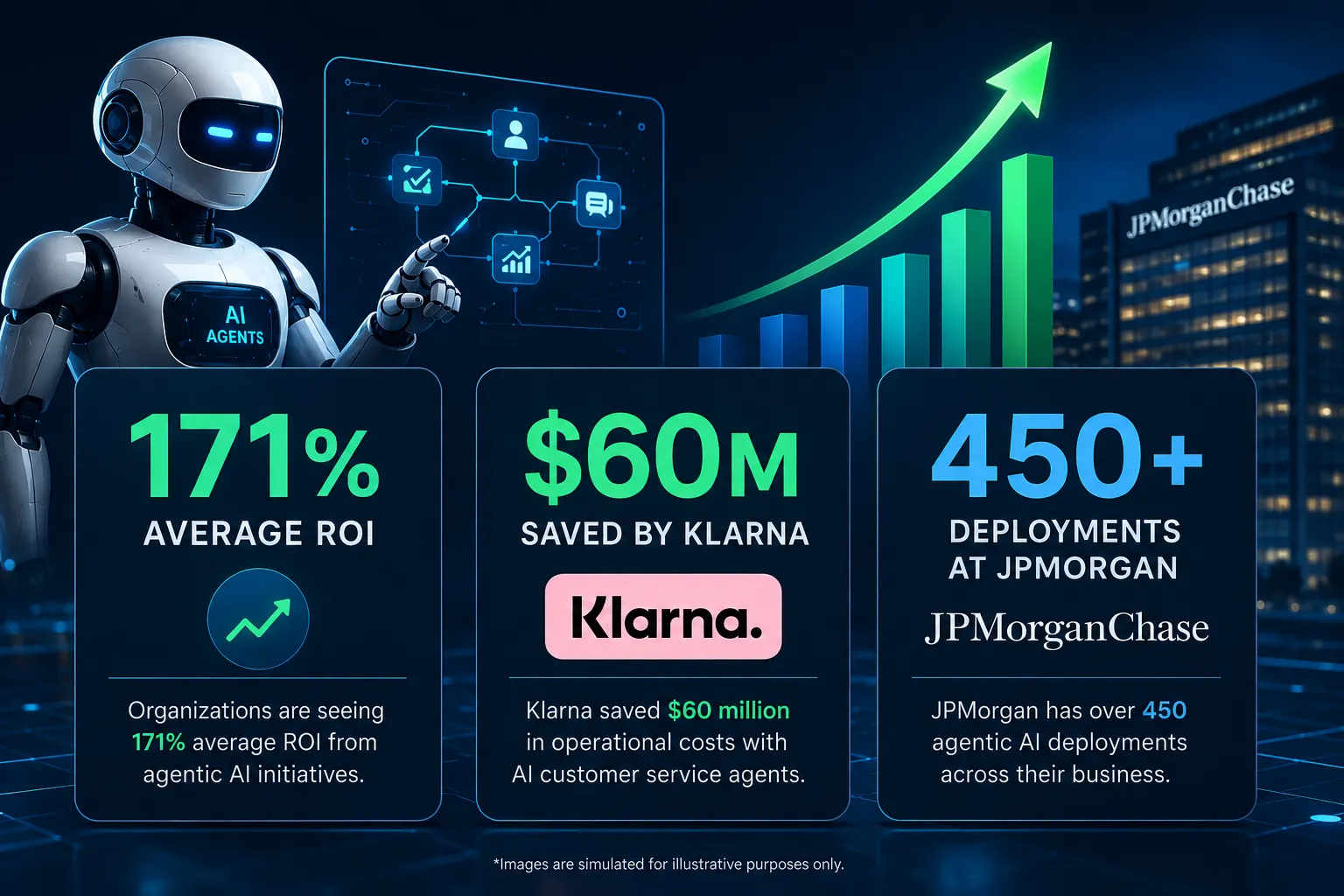
Start with the figure that anchors every serious conversation about agentic AI economics. Companies deploying agentic AI systems report an average return on investment of 171%. U.S. enterprises specifically report average returns of approximately 192%. For context, traditional automation — robotic process automation, rule-based workflow tools, scripted integrations — typically generates ROI in the range of 50 to 70%. Agentic AI is not a marginal improvement on that baseline. It is roughly three times better.
That gap is not a coincidence. It flows directly from the architectural differences covered in the previous article. Traditional automation delivers returns by executing predefined steps faster and more reliably than humans. It captures value at the task level. Agentic AI delivers returns by owning entire workflows end-to-end, including the coordination, exception handling, and decision-making that happen between steps. It captures value at the process level. That is a categorically larger unit of value.
The macro picture is equally striking. According to KPMG’s research on the agentic AI opportunity, agentic AI will be key to unlocking $3 trillion in corporate productivity annually, with the average Fortune 1000 company projected to see a 5.4% EBITDA improvement driven by agentic deployments alone. For a company generating $500 million in EBITDA, that is $27 million in annual earnings improvement. Not from a single use case, but from the cumulative effect of agentic systems operating across business functions.
Research from McKinsey’s Seizing the Agentic AI Advantage report identifies a defining paradox at the heart of current enterprise AI deployments. Nearly eight in ten companies report using generative AI, yet just as many report no significant bottom-line impact. The culprit, in McKinsey’s analysis, is an imbalance between broad-based copilots and chatbots that scale quickly but deliver diffuse, hard-to-measure gains, and function-specific use cases where 90% remain stuck in pilot mode. Agentic AI is precisely the technology that breaks this stalemate by making those vertical, high-impact use cases deployable at scale.
The Case Studies That Change the Conversation
Abstract statistics are useful for framing conversations. What actually moves investment decisions is specific, verified evidence from named organizations doing real work. The agentic AI case study record has grown substantially in the past year, and the outcomes documented in it are far from incremental.
Klarna is the most widely cited example and the one that most dramatically illustrates what agentic AI can do at scale. The company deployed an AI agent for customer service operations that handled the workload of 853 full-time employees, resolved customer issues in an average of two minutes compared to an industry average of eleven minutes, and generated $60 million in savings within a single year. This was not a narrow automation of scripted FAQ responses. It was an agent capable of managing complex, multi-step customer interactions including billing disputes, refund requests, and account issues, with the kind of contextual reasoning that previously required experienced human agents.
JPMorgan Chase has deployed agentic AI at a scale few organizations have matched. The bank runs more than 450 active AI use cases in production every day, spanning investment banking, fraud detection, trade settlement, and compliance monitoring. One of the most notable applications generates investment banking presentations and merger and acquisition memos in 30 seconds, tasks that previously required hours of junior analyst time. The cumulative impact of this deployment sits inside an $18 billion annual technology investment that the bank treats as a direct driver of competitive advantage.
Salesforce deployed agentic AI across its legal and contract operations function, reducing legal processing costs by $5 million annually through autonomous contract review, risk flagging, and document management. What makes this case instructive is that it tackles a domain many organizations assume is too nuanced or judgment-intensive for autonomous AI. The Salesforce deployment demonstrated that with the right architecture and appropriate human escalation protocols, agentic AI can handle high-volume, well-defined legal work with reliability and accuracy that meets enterprise standards.
Unilever, operating one of the world’s most complex supply chains, deployed agentic AI to autonomously assess more than 5,000 daily shipments. The system evaluates routing options, timing windows, and vendor performance in real time and flags exceptions for human review rather than pausing for approval on every decision. The result has been more than $20 million in supply chain savings, achieved through faster decision cycles and the elimination of coordination overhead that previously required human teams working around the clock.
These are not startups with clean, greenfield technology stacks. These are large, complex enterprises with legacy systems, regulatory requirements, and operational dependencies that create exactly the challenges that make technology deployment hard. The fact that they are achieving these outcomes is evidence that agentic AI has moved well beyond controlled pilots into genuine operational reliability.
Why the Returns Are Three Times Higher Than Traditional Automation

Understanding why agentic AI generates returns at this level matters for making realistic projections about your own organization’s opportunity.
The answer comes back to what agentic AI replaces versus what automation replaces.
Traditional automation tools are designed to eliminate specific, repeatable, rule-based tasks. They are excellent at what they do: data entry, format conversion, scheduled report generation, defined-condition alerts. The savings are real. But they are bounded by the fact that most of the cost in any complex workflow is not in the individual tasks. It is in the coordination, the exception handling, the context-switching, and the decision-making that happens between and around those tasks.
Think about a procurement workflow. The individual tasks — submitting a request, generating a purchase order, sending it to a vendor, logging the receipt — can all be automated with relatively straightforward tools. But the decisions that surround those tasks — which vendor to choose, how to handle a supplier who misses a delivery commitment, whether an unusual purchase requires additional approval, how to respond when a price has changed since the last order — require contextual judgment and multi-step reasoning. These are the tasks that have historically required human involvement, and they represent the majority of the labor cost in the workflow.
Agentic AI addresses exactly this layer. It does not just execute the predefined steps faster. It handles the decisions, adapts to exceptions, manages the coordination between steps, and delivers the completed outcome without requiring human intervention at each judgment point. That is why the return is not 50% better than traditional automation. It is 300% better.
IDC data reinforces this picture. Organizations achieve an average 2.3x return on agentic AI investments within 13 months, with ROI expected to grow as adoption scales. The gap between early movers and laggards is already measurable. Frontier firms leading in AI adoption achieve returns of 2.84x on their investments, compared to just 0.84x for laggards. Companies at the back of the adoption curve are currently generating returns below their cost of capital on AI investments, not because the technology does not work, but because they are deploying it at the wrong scope.
The Time-to-ROI Picture
One of the most practical questions for any organization evaluating agentic AI is not just how much it returns, but how quickly. Capital has a time value, and the faster an investment generates measurable returns, the stronger the internal business case becomes.
The evidence on time-to-ROI varies significantly by use case, and understanding that variation is important for sequencing your investments correctly.
Customer service automation has the shortest time-to-ROI of any agentic use case category. The combination of high interaction volume, well-defined resolution criteria, and direct connection to measurable satisfaction metrics means results are visible within two to four weeks of deployment. The infrastructure required is relatively contained, the success criteria are clear, and the feedback loop between agent performance and business outcomes is fast.
Sales and revenue operations applications, including lead qualification, account research, outreach sequencing, and pipeline management, typically generate measurable ROI within one to three months. The outputs connect directly to revenue metrics organizations already track, which makes attribution straightforward.
Finance and back-office operations, including invoice processing, reconciliation, compliance monitoring, and reporting automation, typically deliver measurable returns within three to six months. The workflows are often more complex and more deeply integrated with existing systems, which means implementation takes longer, but the cost savings once deployed are typically large and highly predictable.
Supply chain and operations, where agents need to integrate with logistics systems, inventory platforms, supplier networks, and multiple internal data sources simultaneously, have the longest time-to-ROI at six to twelve months. But they also produce some of the largest absolute return figures, as the Unilever example demonstrates.
This sequence has a practical implication for how organizations should approach deployment. The conventional wisdom in enterprise technology is to start with the most strategic use case. With agentic AI, the more effective approach is to start with the use case that generates the fastest visible results, build the organizational confidence and infrastructure lessons that come from a successful deployment, and then expand to higher-complexity workflows where the returns are larger but the implementation timeline is longer.
The Business Case Framework
With the evidence this strong, why are so many organizations still in the evaluation or pilot phase rather than scaling? Part of the answer lies in a persistent mismatch between how agentic AI creates value and how most organizations measure and approve technology investments.
Traditional IT investment models are built around cost displacement: how much does this tool save versus the current approach? That framing undervalues agentic AI in two important ways. First, much of what agentic AI displaces is coordination work that does not appear as a direct line item in any budget. This includes the hours managers spend handling exceptions, the delay costs in workflows that wait for human approvals, and the quality failures that come from context being lost between handoffs. Second, agentic AI also creates value by enabling things the organization could not do before, such as operating at a scale or speed that was economically impossible with human labor, and providing levels of monitoring and responsiveness that no team can sustain continuously.
A business case that only counts direct labor displacement is systematically undercounting the return. The most rigorous approaches include four value categories: direct cost reduction from labor and process efficiency gains, revenue impact from faster cycles and better conversion rates, risk reduction from compliance monitoring and lower error rates, and strategic optionality from the ability to scale operations without proportional headcount growth.
The Futurum Group’s 2026 enterprise software survey found that direct financial impact combining top-line revenue growth and bottom-line profitability nearly doubled as the primary ROI measurement enterprises report, while productivity gains alone fell as the leading success metric. The enterprise buyer has matured. The business case that lands in 2026 is the one tied directly to P&L outcomes, not hours saved per employee.
The Cost of Getting This Wrong
One more set of numbers deserves careful attention, because they matter just as much as the ROI figures for organizations planning their approach.
Research shows that 88% of AI agents fail to reach production. But the agents that successfully reach production are the ones delivering that average 171% ROI. The 12% who succeed share four consistent attributes: they invested in infrastructure before deployment, they documented governance frameworks before agents went live, they captured baseline metrics before pilots began, and they established dedicated business ownership with clear accountability for post-deployment performance.
The high failure rate is not evidence that agentic AI does not work. It is evidence that deploying agentic AI without the right infrastructure, governance, and expertise is expensive and unreliable. The gap between the 12% who succeed and the 88% who do not is not a technology gap. It is an implementation gap. It is the difference between organizations that treat agentic deployment as a technology purchase and organizations that treat it as an operational transformation.
This is precisely why the choice of implementation partner matters as much as the choice of platform. Getting the architecture right, the integrations stable, the governance frameworks documented, and the deployment sequenced correctly is not a commodity capability. It requires experience across the specific technical and organizational challenges that agentic deployments encounter in real enterprise environments.
At Bantech Solutions, our Artificial Intelligence services are built around exactly this implementation discipline, ensuring that clients approach agentic deployment with the infrastructure, governance, and integration foundations that separate the 12% who achieve strong returns from the 88% who never reach production. And because agentic AI’s ROI is inseparable from the quality of the underlying data and systems infrastructure, our Enterprise Software Development practice makes sure those foundations are solid before the first agent goes live.
Where This Series Goes Next
In the first three articles, we have moved from concept to mechanics to economics. You now have a clear picture of what agentic AI is, how it works at an architectural level, and what the evidence says about the returns it generates.
The next question every organization reaches at this stage is the one that most directly affects whether a deployment succeeds or fails: if the returns are this strong, why do so many deployments struggle? And more importantly, how do you make sure yours does not?
The answer lies in understanding multi-agent systems, the orchestration layer that allows individual agents to coordinate with each other on complex workflows, and how to build them in a way that is reliable, governed, and scalable. The companies achieving the ROI figures documented in this article are not running single agents on isolated tasks. They are running coordinated systems where multiple specialized agents work in parallel, each doing what it does best, under the oversight of an orchestration layer that makes the whole greater than the sum of its parts. That is the subject of the next article in this series.
Continue reading the Complete Agentic AI Series
This post is a part of the Agentic AI Content Series — the complete 10 article series to understanding, implementing, and scaling Agentic AI in your organization.