
In the first article of this series, we established the most important distinction in enterprise AI right now: the difference between AI that answers questions and AI that gets things done. We introduced agentic AI as the category of technology that acts on goals rather than waiting for prompts — and explained why the companies deploying it are pulling ahead of those that haven’t started yet.
But we left a critical question open: what exactly makes an AI system genuinely agentic? What separates a real autonomous agent from a chatbot with a fancier name, or a workflow tool with an AI label bolted on?
That distinction matters enormously — not just conceptually, but commercially. The enterprise software market is currently flooded with products describing themselves as “agentic.” Some of them are. Many of them are not. Organizations that can’t tell the difference end up deploying systems that underperform, erode internal trust in AI, and consume budget without delivering the autonomous capability that justifies the investment.
This article gives you the framework to tell the difference. There are four core capabilities that define a genuine agentic AI system. Not every deployment will implement all four at maximum depth — but the presence or absence of each capability has direct, measurable consequences for what the system can and cannot do inside a real business environment.
Why the Architecture Matters Before the Vendor Does
Most technology buying conversations start with vendors and platforms. What tools are available? What do they integrate with? What does the demo look like? These are reasonable questions, but they are the wrong first questions for agentic AI.
The right first question is: what architecture does this system actually implement? Underneath every agentic AI product is a set of design decisions about how the system handles memory, how it accesses and uses tools, how it plans multi-step tasks, and how it responds when things don’t go as expected. Those design decisions determine the ceiling on what the system can accomplish — far more than the quality of the underlying language model or the polish of the interface.
As IBM’s research on agentic AI notes, a genuine agentic system is defined by its ability to perceive, reason, act, and learn — not simply to generate text or follow a predefined script. Each of those four verbs maps to one of the four capabilities we will examine here. Understanding them turns a vendor evaluation from a feature comparison into a substantive architectural assessment.
Let’s go through each one.
Capability One: Persistent Memory
Every large language model has a context window — the amount of information it can hold in active consideration at any given moment. For most general-purpose AI models, that window resets with every new conversation. Yesterday’s exchange is gone. Last week’s completed task is gone. The user’s preferences, the state of a long-running project, the history of decisions made along the way — all of it vanishes unless explicitly re-entered.
For a productivity tool, this is an inconvenience. For a business agent responsible for managing ongoing workflows, it is a fundamental disqualification.
Persistent memory is the capability that allows an agent to maintain context not just within a single session but across sessions, across days, and across the lifespan of a project or relationship. It is what transforms an AI that can help with a task into an AI that can own a workflow.
In practice, persistent memory is not stored inside the language model itself — current models don’t work that way. Instead, it is implemented through external memory systems: vector databases that store semantic representations of past interactions and can retrieve relevant context when needed, structured logs that record the state of ongoing tasks, and knowledge bases that capture organizational information the agent needs to act intelligently on behalf of the business.
The distinction matters for how you evaluate any system claiming to be agentic. Ask: where does this agent store context between sessions? How does it retrieve relevant history when starting a new task? How does it manage the difference between information that should persist indefinitely — like a client’s preferences or the current state of a project — and information that is task-specific and should expire?
In a well-implemented agentic system, persistent memory is what allows an agent managing customer accounts to remember that a particular client prefers email over phone, that their contract renewal is 60 days away, and that the last interaction flagged a technical issue that was never fully resolved — and to factor all of that context into its next action without being reminded. That level of operational continuity is what moves agents from being useful to being genuinely reliable.
Capability Two: Tool Use
A language model, by itself, can only do one thing: generate text. It can generate very sophisticated, contextually rich, and operationally useful text — but it cannot look up a customer’s order history, send an email, update a record in a CRM, run a query against a database, check a calendar, trigger an API call, or execute code. All of those actions require the model to reach outside itself and interact with external systems.
Tool use is the capability that makes this possible. In an agentic system, the agent has access to a defined set of tools — integrations with external services, APIs, databases, communication platforms, file systems, and other software — and can invoke them as needed to gather information and take real-world actions.
This is what gives agents operational power. An agent with robust tool use isn’t just reasoning about your business — it is actually inside your business systems, interacting with the same data and platforms your employees use. It can read and write. It can query and execute. It can send and receive. It can trigger workflows that produce outcomes in the real world, not just recommendations in a conversation window.
The breadth and quality of tool use is one of the most important differentiators between agentic platforms. A narrow set of tools limits what the agent can accomplish. Poor tool design — where tools don’t return useful error messages, or where the agent can’t gracefully handle a tool returning unexpected data — creates fragility that shows up as failures in production.
There is also a governance dimension to tool use that is frequently underweighted in early deployment. When an agent has access to tools, it has access to real systems — and that access needs to be governed with the same rigor applied to human access. Which tools can the agent use autonomously? Which require a human confirmation step before execution? What is the audit trail for every tool action the agent takes? How is sensitive data handled when the agent interacts with systems that contain it?
These are not edge cases. They are routine operational requirements for any agentic deployment in a real enterprise environment, and the answers to them should be established before an agent is deployed, not after the first incident.
Capability Three: Planning and Goal Decomposition
The third capability is what most people think of when they imagine a truly autonomous AI: the ability to receive a high-level goal and figure out, independently, how to achieve it.
Planning — sometimes called goal decomposition or task decomposition — is the process by which an agent translates an objective into a sequence of steps, determines what needs to happen in what order, identifies which tools and information sources are needed for each step, and allocates its efforts accordingly.
This is harder than it sounds, and it is where a great deal of the gap between genuine agentic systems and sophisticated automation tools becomes visible. Traditional automation requires humans to specify every step in advance. If the process changes, or if an unexpected condition arises, the automation breaks and waits for human intervention. Planning-capable agents don’t require pre-specified workflows — they construct the workflow in response to the goal and the conditions they encounter.
In practice, planning in agentic systems typically involves what researchers call chain-of-thought reasoning — the model explicitly working through the logic of a problem before taking action — and tree-of-thoughts approaches that allow the agent to evaluate multiple possible paths and select the most promising one. The most advanced systems can parallelize certain sub-tasks, farming them out simultaneously when they don’t depend on each other, and then synthesizing the results.
The business implication is significant. A planning-capable agent can handle tasks that haven’t been seen before. It can adapt when a step produces unexpected results. It can pursue a goal even when the specific path to that goal isn’t known in advance. This is the capability that allows agents to operate in the genuinely dynamic, unpredictable conditions of real business environments — rather than only in the controlled, well-documented workflows that traditional automation requires.
Where planning capability varies across systems is in the depth and reliability of reasoning. Some systems can plan reliably for two or three steps but become unreliable at longer horizons. Others handle simple linear tasks well but struggle when tasks branch or require conditional logic. Part of evaluating any agentic platform is stress-testing its planning capability against the specific complexity of the workflows you intend to automate.
Capability Four: Self-Correction
The fourth capability is arguably the most underappreciated — and the most critical to reliable real-world performance.
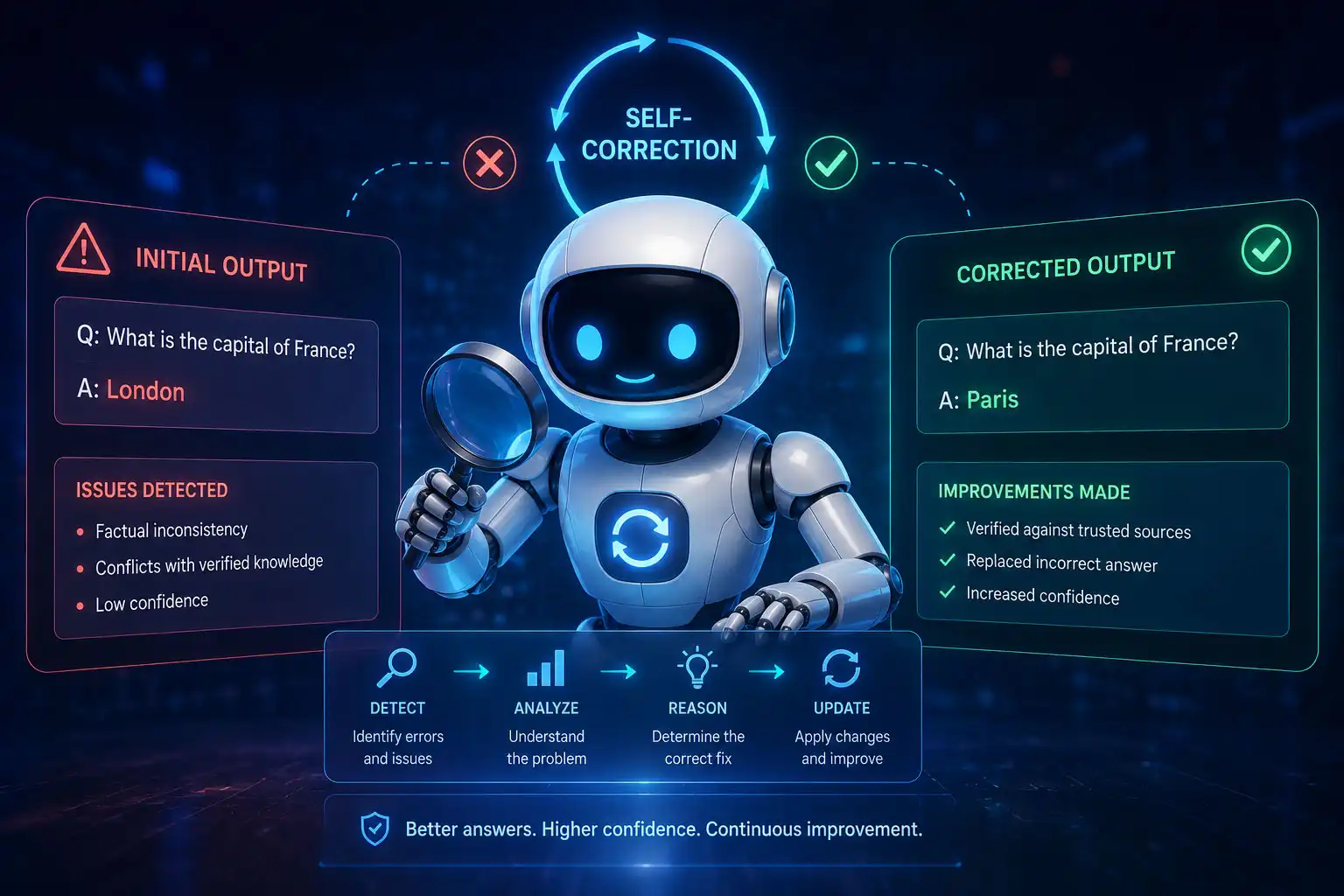
Self-correction is the ability of an agent to recognize when a step has gone wrong, diagnose why, and adjust its approach without requiring human intervention to restart the process. It is the difference between a system that fails gracefully and one that fails catastrophically.
In any multi-step automated workflow, things will go wrong. A data source will return an unexpected format. A tool call will fail with an ambiguous error. An intermediate result will be outside the range the agent expected. A step will produce a logically valid but operationally incorrect outcome that doesn’t satisfy the goal. These are not rare edge cases — they are the normal operating conditions of complex, real-world systems.
A system without self-correction handles these situations by stopping and surfacing an error for human review. Sometimes that is the right outcome — particularly for high-stakes decisions where human judgment is appropriate. But for the vast majority of operational tasks, requiring human intervention every time something unexpected happens defeats the purpose of autonomous operation. It transforms the agent from an independent executor into a very complicated form of step-by-step automation, with all the overhead that implies.
Self-correction changes this dynamic. When a step fails, the agent evaluates what went wrong, identifies whether it can resolve the issue independently — by trying a different tool, reformulating a query, using an alternative data source, or decomposing the problem differently — and continues toward the goal without surfacing every minor failure to a human. Only genuine decision points, escalation-worthy failures, or outcomes requiring human judgment trigger a handoff.
As MIT Technology Review has documented in its reporting on enterprise agentic AI adoption, the organizations seeing the strongest returns from agentic deployments are those whose agents can handle novel situations outside their predefined parameters — not just the clean, expected paths. Self-correction is the architectural capability that makes this possible.
How the Four Capabilities Work Together
These four capabilities are not independent features that can be evaluated in isolation. They form an integrated architecture, and the value each one delivers depends on the presence and quality of the others.
Persistent memory without planning means an agent that remembers everything but can’t figure out what to do with that context in service of a complex goal. Planning without tool use means an agent that can design a perfect strategy for a task but has no way to execute it in the real world. Tool use without self-correction means an agent that can take real actions but becomes unreliable the moment anything unexpected happens. Self-correction without persistent memory means an agent that can recover from failures within a single session but can’t apply what it learned to future encounters with similar problems.
When all four are implemented well, the result is a system that can genuinely own an end-to-end workflow — not just assist with individual steps. It remembers the relevant context, designs the path to the goal, executes each step using the appropriate systems, handles the inevitable complications along the way, and delivers a complete outcome with a full audit trail of what it did and why.
This is the architecture that underpins the enterprise deployments producing the ROI numbers we cited in the previous article — the 171% average returns, the 60 million dollars in operational savings at Klarna, the 800+ agents running autonomously at Zapier. Those outcomes aren’t produced by any one capability in isolation. They come from all four working together in production.
What This Means When You’re Evaluating Solutions
Armed with this framework, the evaluation questions for any agentic AI solution become much more specific and useful:
On persistent memory: What external memory systems does this platform support? How does the agent retrieve relevant context at the start of a new session? What controls exist over what is retained, for how long, and who can access it?
On tool use: What tools and integrations are available out of the box? How extensible is the tool layer for custom integrations with internal systems? What governance controls exist over tool permissions and actions? What is the audit trail for every tool call the agent makes?
On planning: How does the agent handle goals that span more than five steps? Can it operate with conditional logic? Can it parallelize sub-tasks? How does it perform when intermediate steps produce unexpected results?
On self-correction: What happens when a tool call fails? When an intermediate result is outside expected parameters? When the agent’s initial plan turns out to be unworkable? Does the system surface every failure, or only genuine escalation points?
These are not trick questions. They are baseline capability checks. Any platform that cannot answer them clearly — or whose answers reveal shallow implementation in one or more areas — is not production-ready for serious enterprise deployment.
The Role of Implementation Partners in Getting This Right

Understanding the four capabilities is one thing. Implementing them in a way that’s reliable, governed, secure, and actually connected to your business systems is another.
Most organizations don’t have the in-house expertise to architect and deploy production-grade agentic systems from scratch. The configuration of memory systems, the design of tool integrations with existing enterprise software, the governance frameworks that determine what agents can and cannot do autonomously — all of these require both deep technical expertise and a thorough understanding of the business processes being automated.
This is precisely where Bantech Solutions operates. Our Artificial Intelligence services are built around the architecture we’ve described in this article — designing agentic systems that implement all four capabilities in ways that are reliable, secure, and integrated with the enterprise environments our clients already operate in.
And because agentic AI doesn’t exist in isolation from the broader technology infrastructure of a business, we approach it as part of a complete digital transformation strategy. If your existing systems — legacy platforms, data architecture, integration layers — aren’t ready to support agents, deploying them anyway produces fragile results. Our Enterprise Software Development practice ensures the foundations are in place before the agents are deployed.
Conclusion
Understanding the four capabilities answers the “what is it” and the “how does it work” questions about agentic AI. The next question — the one that drives most executive conversations about this technology — is the “is it worth it” question.
In the next article in this series, we move from architecture to economics. We examine the ROI evidence for agentic AI deployments across industries, break down why the returns are so dramatically higher than traditional automation, and introduce a framework for identifying which use cases in your specific business are likely to generate the fastest and most measurable returns. The numbers are significant — and understanding where they come from is essential for building the internal case for investment.
Continue reading the Complete Agentic AI Series
This post is a part of the Agentic AI Content Series — the complete 10 article series to understanding, implementing, and scaling Agentic AI in your organization.