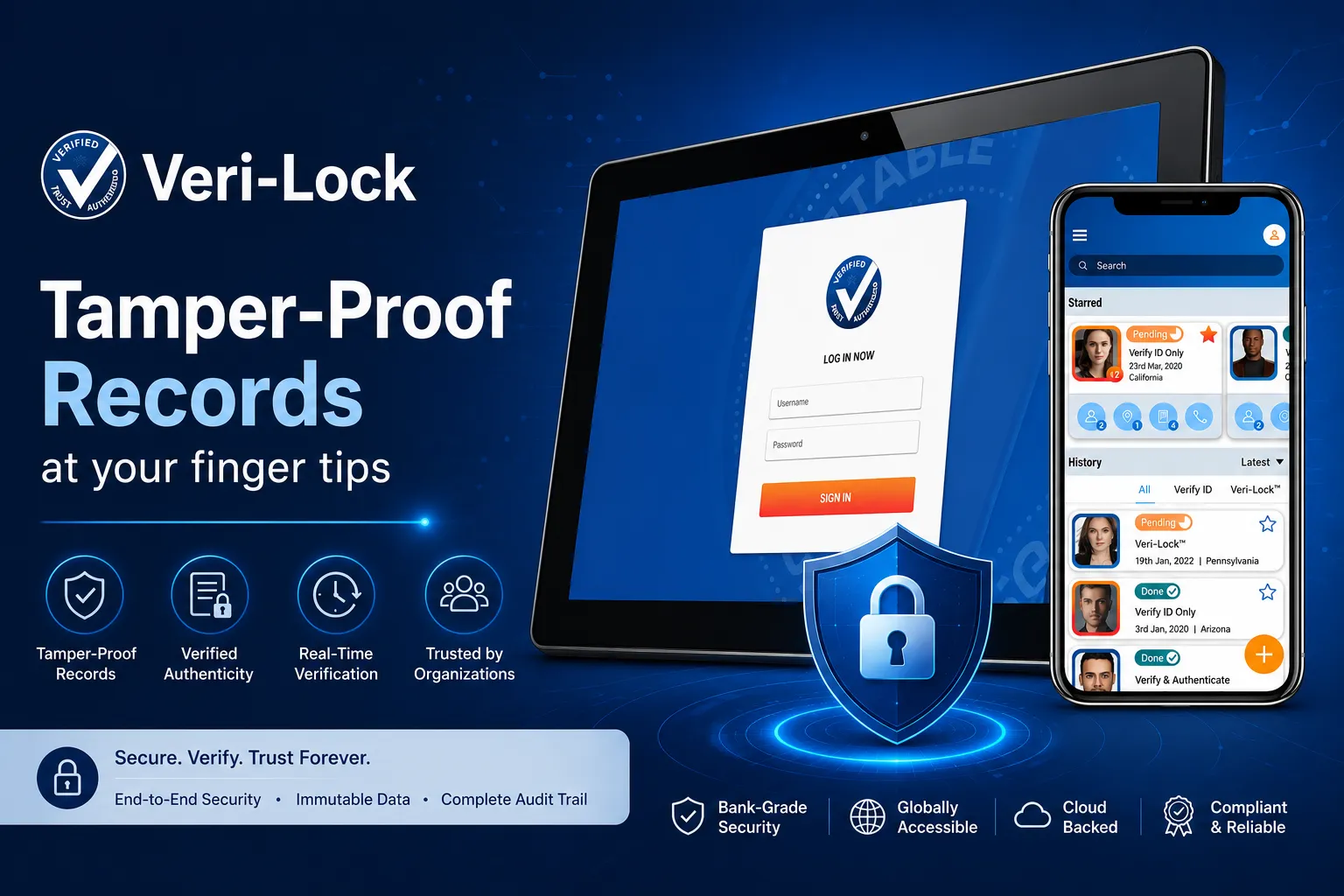

Veri-Lock is a blockchain-powered mobile notarization app that lets notaries verify identities and store signed documents as immutable, tamper-proof records. By combining real-time ID verification with blockchain storage, it gives notaries and clients a way to complete legally sound notarizations from anywhere, without sacrificing security or compliance.
Every industry that depends on trust, whether it’s real estate, healthcare, or law, eventually runs into the same problem: how do you prove that a record hasn’t been altered after the fact? For centuries, the answer was a wet signature, a notary stamp, and a filing cabinet. That system worked reasonably well until documents went digital and the internet made it trivially easy to copy, edit, and redistribute files without leaving a trace. The team at Bantech ran headfirst into this exact challenge while building Veri-Lock, a mobile notarization platform that has since become one of the more interesting examples of blockchain solving a genuinely old-world problem.
This is the second entry in our case study series looking at how practical blockchain applications move from concept to production. If you read the first piece, you already know we’re not interested in blockchain as a buzzword. We’re interested in what happens when a development team sits down with notaries, compliance officers, and everyday clients and asks a simple question: what would actually make this process better? Veri-Lock is the answer that came out of that question, and it’s worth unpacking in detail.
The Problem With Traditional Notarization
Notarization exists to solve a trust problem. When you sign a mortgage, a power of attorney, or an affidavit, someone independent needs to confirm that you are who you say you are, that you signed willingly, and that the document wasn’t swapped out after the fact. Traditionally, that meant showing up in person, presenting a physical ID, signing in front of a notary, and trusting that the paper trail would hold up if anyone ever challenged it.
The friction in that process is obvious to anyone who has ever had to schedule a notary appointment around a work day, drive across town, or wait for a signing agent to become available for a real estate closing. It’s slow, it’s location-dependent, and it puts a disproportionate burden on people with mobility issues, unpredictable schedules, or jobs that don’t allow for a lunchtime trip to a UPS Store.
There’s a second, quieter problem too. Even after a document is notarized, the record of that notarization typically lives in a paper journal or a basic digital file. Both are vulnerable to loss, damage, and tampering. If a dispute arises years later, and property and estate disputes often do, proving that a notarization happened exactly as recorded can become a genuine legal headache.
Digitizing notarization sounds like an obvious fix, and several states have moved toward remote online notarization laws in recent years. But digitizing the process without addressing the underlying trust problem just moves the vulnerability from a filing cabinet to a database that a system administrator could, in theory, edit. That’s the gap Veri-Lock was built to close.
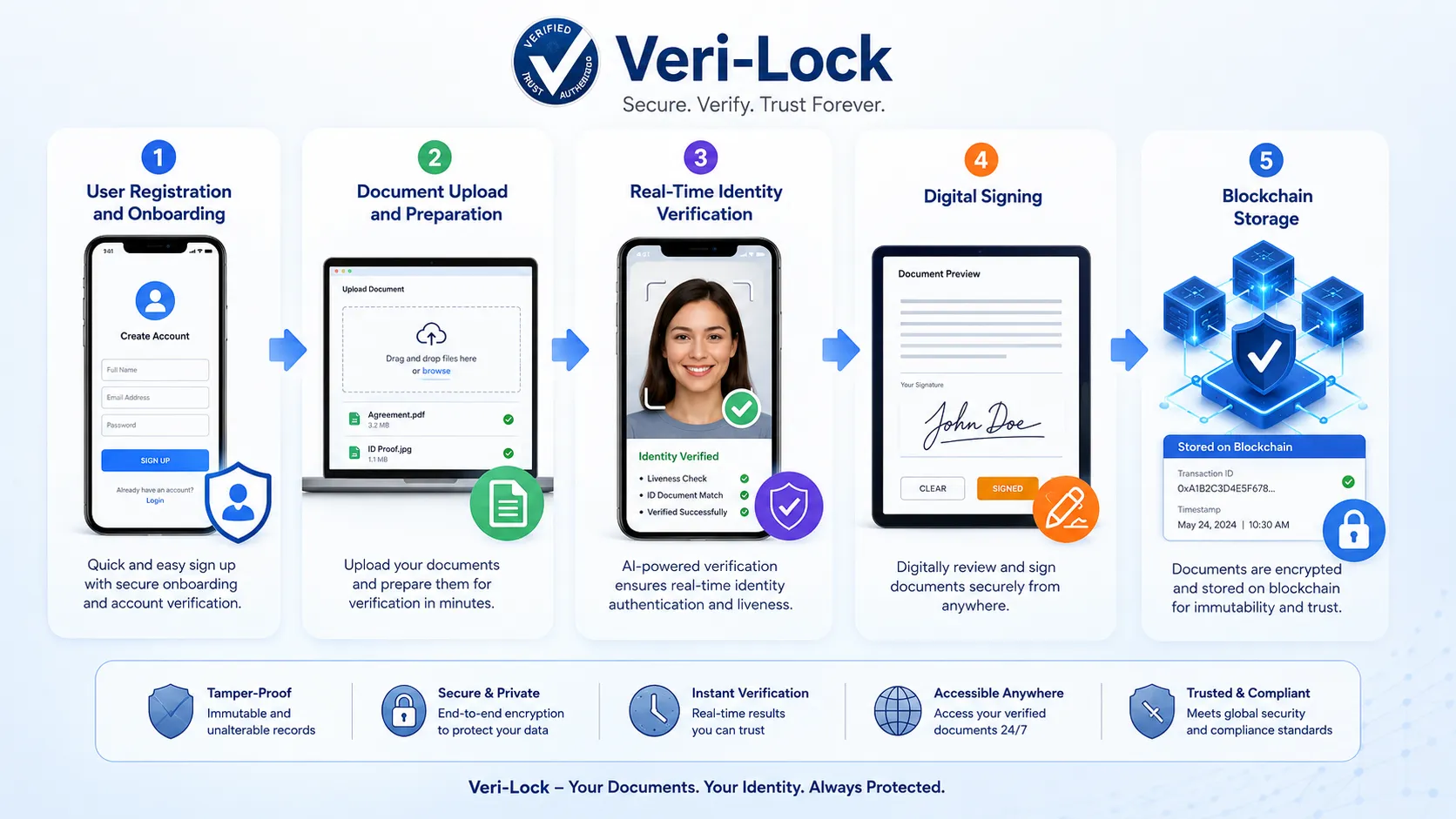
Veri-Lock is a native mobile application, built for both Android and iOS, that lets notaries and their clients complete the entire notarization workflow from a phone. Under the hood, it combines four things that don’t normally get built together: user account management for notaries and clients, real-time identity verification through a third-party vendor, digital signature capture, and custom blockchain storage for the finished record.
The practical effect is that a notary no longer needs to be sitting behind a desk to do their job. A client can upload their identification, get verified in real time, sign the document digitally, and have the entire transaction sealed and stored in a way that can’t quietly be edited later. Notaries described this shift as “on-the-go notarization” becoming a reality rather than a marketing phrase, and that framing matters because it reflects an actual change in how their days work, not just a new app icon on their home screen.
User Registration and Onboarding
The first building block was a registration flow that worked for two very different audiences at once: professional notaries who needed credentialing and compliance checks, and one-time clients who just wanted to get a document signed without creating unnecessary friction. Getting both groups through onboarding quickly, without cutting corners on identity assurance, took real design work. A notarization app that’s annoying to sign up for doesn’t get used, no matter how secure the backend is.
Document Upload and Preparation
Once registered, users could upload the documents that needed notarizing along with supporting identification. This step sounds simple, but it’s where a lot of the compliance weight sits. Every document type, a power of attorney, a real estate deed, an affidavit, carries different legal requirements, and the upload process had to accommodate that variability without turning into a maze of dropdowns and disclaimers.
Real-Time Identity Verification
This is the piece that makes remote notarization defensible. Veri-Lock integrates with Jumio, a third-party identity verification vendor, to run live checks on government-issued IDs. The camera captures the ID, computer vision algorithms scan for security features like holograms and microprint, and facial recognition compares the live image of the person to their ID photo. All of it happens in seconds rather than minutes.
This step exists because remote notarization only works if fraud detection is at least as strong, and ideally stronger, than what a notary can catch by eyeballing a physical ID across a desk. A forged license that might pass a distracted human glance has a much harder time getting past algorithmic document analysis paired with live facial matching.
Digital Signing
After identity verification clears, the signer completes the document digitally. This removes the need for a wet signature while preserving the legal weight that a signature is supposed to carry. The signature, along with metadata about when and how it was captured, becomes part of the record that eventually gets sealed on the blockchain.
Blockchain Storage
Here’s the part that ties everything together. Once a notary approves the finished document, the record isn’t just saved to a database, it’s written to a custom blockchain built specifically for notarial and verification data. That distinction matters. A standard database can be edited by anyone with the right access credentials, and even audit logs can be altered if someone with sufficient privileges wants to cover their tracks. A blockchain record, by contrast, generates a unique cryptographic hash for each transaction. If anyone tries to alter the underlying data later, the hash no longer matches, and the discrepancy is immediately detectable.
The National Institute of Standards and Technology describes this property well in its foundational overview of the technology: blockchains function as tamper-evident and tamper-resistant digital ledgers precisely because each block is cryptographically linked to the one before it, so altering an earlier record breaks the chain in a way that later blocks will reveal. That’s the mechanism Veri-Lock leans on, applied specifically to notarial records rather than financial transactions, which is a less common but arguably more consequential use case.
Why This Matters Beyond Convenience
It would be easy to describe Veri-Lock purely as a convenience play, an app that saves people a trip to the notary. That undersells what’s actually happening. The real shift is in how disputes get resolved after the fact.
Consider a scenario that plays out constantly in real estate and estate law: a document surfaces years after it was signed, and someone challenges whether it’s authentic. Was it really signed by the person listed? Was it altered after signing? Under the traditional model, resolving that dispute often comes down to whichever party has the more convincing paper trail, which isn’t the same thing as an accurate one.
With a blockchain-backed record, the question becomes much easier to answer. The hash either matches the original transaction or it doesn’t. There’s no ambiguity, no reliance on a filing cabinet that may or may not have been tampered with, and no need to take anyone’s word for it. That’s a meaningfully different standard of proof, and it’s the kind of improvement that legal professionals notice even if end users never think about it.
This also has implications for regulatory compliance. Industries that handle notarized documents, including title insurance, mortgage lending, and estate planning, operate under audit requirements that assume records can be trusted over long periods of time. A tamper-evident ledger gives those industries a stronger foundation to build compliance processes on top of, rather than hoping a legacy document management system holds up under scrutiny.
The Legal Landscape Veri-Lock Had to Navigate
None of this works if the underlying notarization isn’t legally recognized. The team building Veri-Lock had to design around a patchwork of state laws governing remote and electronic notarization, which vary meaningfully depending on where a notary is commissioned and where a signer is located.
According to the National Association of Secretaries of State, a large majority of states now have laws permitting remote electronic notarization in some form, building on model standards that require independent verification of a notary’s electronic signature and seal, along with evidence of any changes made after the fact. That model closely mirrors what blockchain storage provides at a technical level, which made it a natural fit rather than a forced one. Still, building an application that could flex to meet varying state requirements, rather than assuming a single national standard, was one of the more time-consuming parts of the project.
This is worth calling out because it’s easy to assume blockchain and legal compliance sit in tension with each other, one being cutting-edge and the other being conservative by design. In practice, they reinforced each other here. The compliance requirements around identity verification and tamper-evidence gave the blockchain architecture a clear job to do, rather than being technology bolted on for its own sake.
Results and Adoption
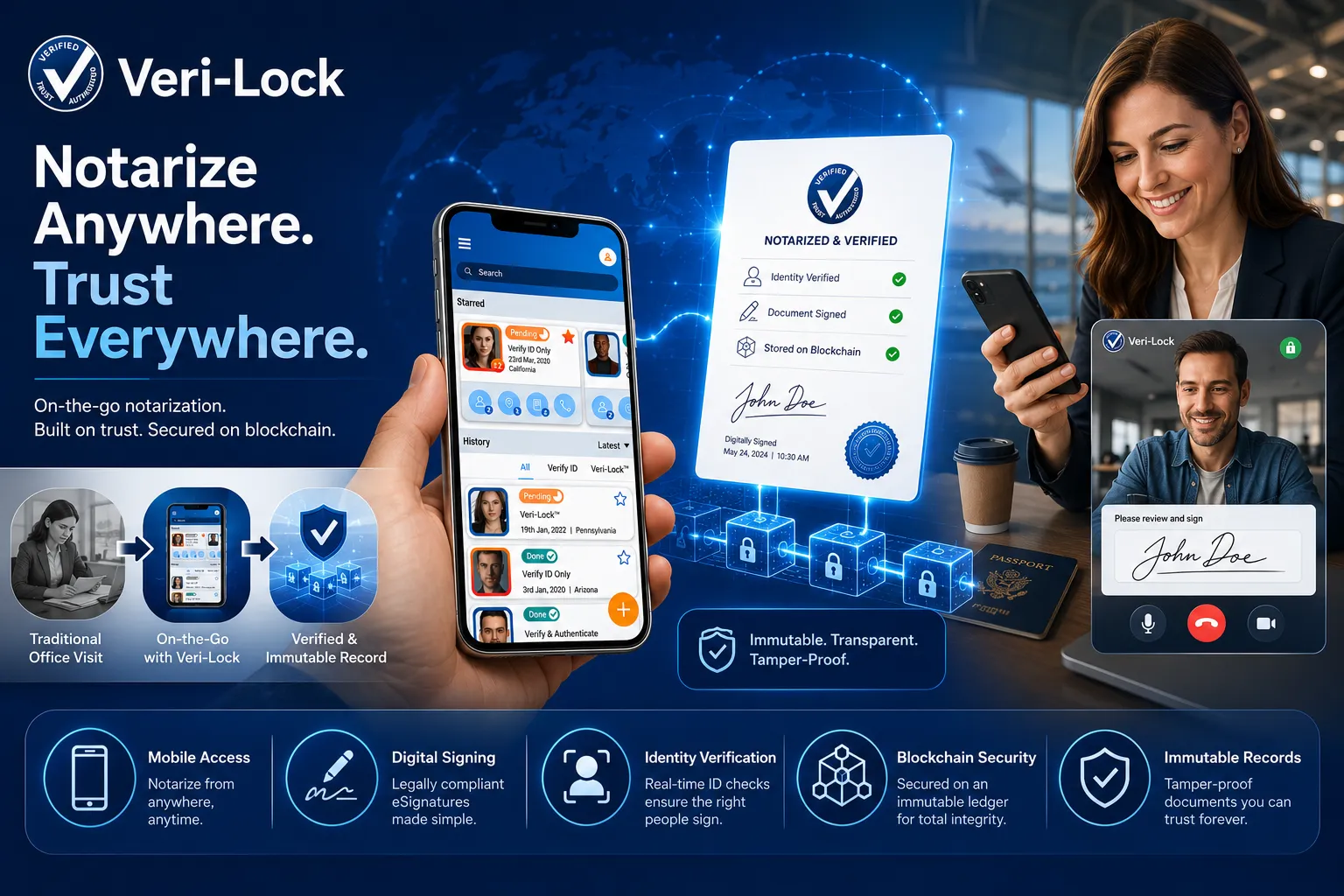
Veri-Lock launched after months of development that touched mobile engineering, blockchain architecture, and third-party integration work simultaneously. The response from notaries across the United States was, by most accounts, faster and more enthusiastic than the team expected going in. Notaries who had spent years tied to physical office hours suddenly had a way to serve clients on evenings, weekends, and while traveling, without giving up the compliance safeguards their commission depends on.
Clients benefited just as directly. The old model assumed people could take time off work, drive to an office, and sign in person during business hours. That assumption never worked well for shift workers, people with disabilities, rural clients living far from notary offices, or anyone dealing with a time-sensitive legal matter outside of a nine-to-five window. On-the-go notarization removed that constraint entirely.
There’s also a trust dividend that’s harder to quantify but shows up consistently in user feedback. Knowing that a document is stored on an immutable ledger, rather than a database an administrator could theoretically edit, changes how people feel about the whole transaction. That confidence matters especially for high-stakes documents like powers of attorney or real estate transfers, where the cost of a dispute later on is measured in real money and real stress.
What Veri-Lock Reveals About Building Blockchain Products That Work
There’s a pattern worth pulling out of this case study for anyone evaluating whether blockchain makes sense for their own product. Veri-Lock didn’t start with “let’s use blockchain” as the goal. It started with a specific trust problem, provable, tamper-evident records, that happened to map cleanly onto what blockchain does well.
That ordering matters. A lot of blockchain projects fail not because the technology doesn’t work, but because it gets applied to problems that didn’t actually need a distributed ledger in the first place. Notarization is a case where the fit is genuine. You need an append-only, cryptographically verifiable record that multiple parties can trust without relying on a single central authority to vouch for its integrity. That’s close to a textbook use case, which is part of why the result held up in production rather than staying a proof of concept.
The other lesson is about integration discipline. Veri-Lock’s blockchain layer isn’t the whole product, it’s one component among several, sitting alongside identity verification, digital signature capture, and mobile app development. None of those pieces exist in isolation. The blockchain record is only as trustworthy as the identity verification step that fed it, which is why so much engineering effort went into the real-time ID check rather than treating it as a checkbox feature. A tamper-proof record of a fraudulent signature is still a fraudulent signature. The whole chain of custody, from first ID scan to final hash, has to hold up.
Where Tamper-Proof Records Go From Here
Notarization is one application, but the underlying architecture behind Veri-Lock, identity verification linked to an immutable ledger entry, extends naturally into other industries facing similar trust problems. Healthcare systems need tamper-proof audit trails for who accessed patient records and when. Supply chain operators need verifiable proof that a product wasn’t swapped or altered between origin and destination. Government agencies issuing licenses, permits, or certifications face the same fundamental question notaries do: how do you prove a record is authentic years after it was created, without relying on trust in a single institution’s internal record-keeping.
Bantech’s broader work in this space extends beyond Veri-Lock itself. The team’s blockchain and NFT development services apply the same core principles, custom architecture, smart contract development, and industry-specific compliance, to sectors ranging from finance to healthcare to real estate. Veri-Lock is a proof point for what that approach looks like when it’s built around a genuinely difficult trust problem rather than a speculative use case.
How the Hash-Based Verification Actually Works
It helps to walk through the mechanics of what happens the moment a document is notarized, because the phrase “tamper-proof” gets thrown around a lot without much explanation of what’s actually happening underneath it. When a notary approves a document inside Veri-Lock, the system generates a cryptographic hash, essentially a unique digital fingerprint, of that document and its associated metadata: the signer’s verified identity, the timestamp, and the notary’s credentials. That hash gets written into the blockchain as its own entry, linked to the block before it.
If anyone later tries to alter even a single character in the underlying document or metadata, running the same hashing function on the altered version produces a completely different fingerprint. That mismatch is immediately obvious to anyone checking the record against the chain, which means tampering isn’t just difficult, it’s detectable the moment someone looks. This is a meaningfully different security model than password-protecting a PDF or locking a database table behind admin credentials, both of which can be quietly bypassed by someone with the right access level and no one the wiser. A blockchain entry doesn’t rely on trusting that no one with access misused it. It relies on math that either checks out or doesn’t.
This same mechanism is what links Veri-Lock’s identity verification step to the final notarized record in a way that can’t be pulled apart after the fact. When a notary verifies someone’s ID through Veri-lock, that verification event is cryptographically tied to whatever document gets notarized in that session. The result is a full chain of custody, covering who was verified, what was signed, when it happened, and which notary approved it, all bound together in a way that can be checked independently rather than taken on faith.
Final Thoughts
Veri-Lock didn’t set out to reinvent blockchain. It set out to fix a slow, paper-bound process that hadn’t meaningfully changed in decades, and it happened to find, in blockchain, the right tool for making records that actually hold up under scrutiny. That’s a more modest story than some of the grander claims made about distributed ledger technology over the years, but it’s also a more convincing one, because it’s already shipped, already in use by notaries across the country, and already solving the exact problem it was built for.
For businesses weighing whether blockchain fits their own record-keeping challenges, Veri-Lock offers a useful test: does your problem actually require an immutable, independently verifiable record that multiple parties need to trust without a central gatekeeper? If the answer is yes, the technology stops being a buzzword and starts being infrastructure. That’s the shift Veri-Lock represents, and it’s a template worth studying for any organization sitting on records that absolutely cannot afford to be altered quietly.
Continue reading the Complete Blockchain Series
This post is a part of the Blockchain Content Series — the complete 5 article series to understanding, implementing, and scaling enterprise blockchain and tokenization in your organization.