Most hyperautomation initiatives do not fail because the technology does not work. They fail because the strategy behind the technology was never clearly defined.
Organizations rush to deploy RPA bots, layer in AI tools, and announce digital transformation milestones — only to find themselves, twelve months later, sitting on a fragmented collection of point automations that require growing maintenance investment, deliver unclear ROI, and cannot scale beyond the department where they were first built. Gartner has noted that fewer than 20% of large enterprises have genuinely mastered the measurement and governance of their hyperautomation initiatives — which means the majority are investing heavily in technology without the strategic foundation needed to realize its full potential.
The difference between organizations that transform and those that stall is almost never the quality of their automation tools. It is the quality of their strategy.
This guide provides a practical, step-by-step framework for building a hyperautomation strategy from scratch — one that delivers fast early wins, scales sustainably across the enterprise, and is governed rigorously enough to earn continued investment from leadership. Whether your organization is just beginning to explore automation or is looking to evolve an existing RPA program into something more ambitious, this framework gives you the structure to do it right.
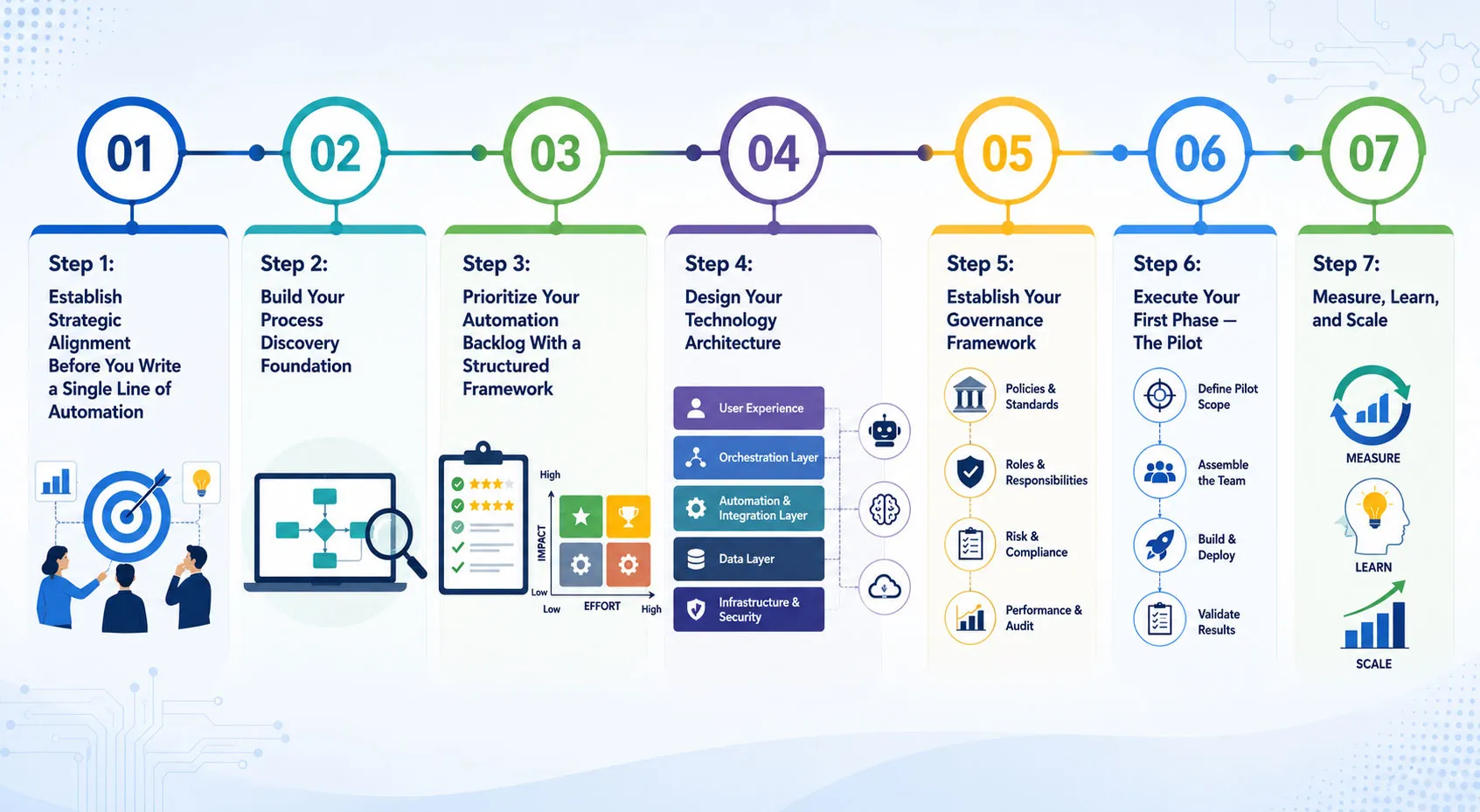
Step 1: Establish Strategic Alignment Before You Write a Single Line of Automation
The most common mistake organizations make when starting a hyperautomation initiative is beginning with technology selection. They evaluate platforms, run vendor demos, and build proof-of-concept bots — all before answering the fundamental question: what are we actually trying to achieve, and how will we know if we have achieved it?
Strategic alignment means anchoring your hyperautomation program to specific, measurable business objectives that matter to leadership. Not “we want to be more efficient” — but “we want to reduce our accounts payable processing cost by 40% within 18 months” or “we want to cut customer onboarding time from 10 days to 24 hours.” These are outcomes that executives will fund, defend, and champion through the inevitable friction of a large-scale technology change.
Start by mapping your hyperautomation goals to the organization’s broader strategic priorities. If the business is focused on cost reduction, lead with ROI and cost-per-transaction metrics. If the focus is growth and customer experience, lead with speed, accuracy, and service quality. If the priority is compliance and risk management, lead with error rates, audit trail completeness, and regulatory adherence.
This alignment work also defines your governance structure from day one. Identify an executive sponsor — ideally a C-suite leader with both the authority to allocate budget across departments and the credibility to drive organizational change. Without executive sponsorship, hyperautomation initiatives tend to remain departmental experiments rather than enterprise-wide programs, and they rarely survive the inevitable resistance that change management demands.
Step 2: Build Your Process Discovery Foundation
You cannot automate what you do not understand. And in most organizations, the way processes actually operate in practice is significantly different from how they are documented — or how leadership believes they work.
Process discovery is the discipline of mapping real-world workflows with data-driven precision. It has two primary tools: process mining and task mining.
Process mining analyzes event logs from existing business systems — ERPs, CRMs, ticketing platforms, finance systems — to reconstruct accurate, end-to-end maps of how processes flow across systems and people. It reveals the actual number of process variants your organization is running, where bottlenecks accumulate, which steps are most error-prone, and where handoffs between people and systems introduce the most delay.
Task mining complements process mining by capturing how individual employees interact with their screens and applications at the task level — the specific clicks, keystrokes, and copy-paste actions that make up the manual steps within a larger process. This granular view identifies exactly which tasks are most repetitive, most time-consuming, and most suitable for bot automation.
Together, these tools give you something invaluable before you spend a single dollar on automation development: an objective, data-driven picture of where automation will deliver the highest return. Organizations that skip this step and rely instead on stakeholder interviews and anecdote-based process maps consistently encounter surprises in production — discovering that the process they automated handles only 30% of real-world cases because the remaining 70% involve variants that nobody mentioned.
During this phase, document every candidate process with the following attributes: current processing volume, current processing time, error rate, number of systems involved, degree of variability in inputs, and estimated cost per transaction. This data forms the basis of your automation backlog and prioritization model.
Step 3: Prioritize Your Automation Backlog With a Structured Framework
Not every process is equally suitable for hyperautomation, and not every suitable process delivers the same return. A structured prioritization framework prevents you from spending significant resources automating low-value processes while higher-impact opportunities wait.
A practical prioritization model evaluates each candidate process across four dimensions.
Business impact measures the financial and operational significance of improving the process. High-volume processes where small improvements in cost, speed, or accuracy compound across thousands or millions of transactions score highest here.
Automation suitability measures how ready the process is for automation. Processes with structured, consistent inputs; clear, rule-based logic; stable underlying systems; and low exception rates are the most suitable candidates for initial deployment. Processes with high variability, frequent exceptions, or significant unstructured data require more sophisticated AI capabilities and carry higher implementation risk — they are better candidates for later phases.
Implementation complexity measures the technical and organizational effort required. Processes that run within a single system, involve a small number of stakeholders, and are well-documented are faster and cheaper to automate than those that span many systems, require deep integration work, or involve significant process redesign before automation is viable.
Strategic value measures alignment with organizational priorities. A process that directly supports a key strategic objective — reducing customer onboarding time when customer acquisition is a top priority, for example — ranks higher than one with equivalent ROI that sits in a less strategically visible function.
Plot your candidate processes against these dimensions and use the output to sequence your automation roadmap into phases. Your first phase should prioritize processes that score high on impact and suitability and low on complexity — the “quick wins” that deliver visible results fast, build organizational confidence, and generate the internal funding and momentum needed to tackle more complex initiatives in subsequent phases.
Step 4: Design Your Technology Architecture
With a clear prioritized backlog in hand, you are ready to make technology decisions — and the order matters. Too many organizations choose their automation platform first and then try to fit their processes into its capabilities. The right approach is the reverse: understand your process requirements first, then select the technology stack that best serves them.
A mature hyperautomation architecture typically consists of several layers, each addressing a different set of capabilities.
The execution layer handles rule-based, structured task automation. This is where RPA lives. Your RPA platform needs to support attended and unattended bot operation, integrate with your core business systems via APIs and UI automation, and provide a robust development environment for building and maintaining bot workflows.
The intelligence layer handles unstructured data, decision-making, and learning. This includes AI and machine learning models for classification and prediction, NLP for language understanding, optical character recognition (OCR) and intelligent document processing (IDP) for extracting data from documents, and computer vision for image-based tasks. Many modern hyperautomation platforms have begun incorporating these capabilities natively; in other cases, they are sourced from specialist providers and integrated via APIs.
The orchestration layer coordinates the execution of complex, multi-step workflows that involve bots, AI components, human tasks, and external system calls in a defined sequence. This is the layer that transforms a collection of individual automations into genuinely end-to-end process automation.
The integration layer connects your automation platform to the underlying business systems it needs to interact with — ERPs, CRMs, databases, cloud services, and legacy applications. The maturity of your integration layer determines how widely automation can reach across your technology stack.
The discovery and monitoring layer continuously surfaces new automation opportunities using process mining, measures the performance of deployed automations in real time, and flags issues before they impact operations.
When evaluating platforms, most enterprises in 2026 are adopting a hybrid architecture: one or two anchor platforms that provide the core execution, orchestration, and governance capabilities, supplemented by specialist tools for specific capabilities where the anchor platform is not best-in-class. For a detailed analysis of how leading organizations are structuring these decisions, Smartbridge’s guide to hyperautomation strategy beyond RPA in 2026 provides a practical breakdown of the technology selection considerations that matter most at each phase of maturity.
Step 5: Establish Your Governance Framework
Governance is the element of hyperautomation strategy that most organizations either underinvest in or defer until problems force the issue. This is a mistake that compounds over time — and it is the primary reason why so many organizations have large automation portfolios that they cannot clearly measure, govern, or scale.
A hyperautomation governance framework addresses five core requirements.
Standards and policies define how automations are built, tested, documented, and deployed. Without standards, every team builds in a different way, using different tools and conventions, creating a portfolio that is impossible to maintain consistently as it grows. Standards should cover naming conventions, documentation requirements, testing protocols, security controls, and change management procedures.
A Centre of Excellence (CoE) is the organizational structure that owns the hyperautomation program, maintains the platform, develops reusable components, sets standards, supports business teams in developing their own automations, and governs the overall portfolio. The CoE model is the most widely adopted governance structure for mature hyperautomation programs, and for good reason — it balances centralized control with distributed delivery, enabling both consistency and speed.
Measurement and reporting establishes the KPIs and dashboards that track the performance of deployed automations and the overall program. At the process level, key metrics include straight-through processing rate, exception rate, bot utilization, processing time, and cost per transaction. At the program level, key metrics include total automations deployed, cumulative hours saved, cost reduction delivered, and ROI against investment. Without rigorous measurement, the program cannot prove its value to leadership — and programs that cannot prove their value do not get funded to grow.
Risk and compliance controls address the operational, security, and regulatory risks that hyperautomation introduces. Automated systems that access sensitive data, execute financial transactions, or make decisions affecting customers or employees require clear accountability, comprehensive audit trails, and defined escalation procedures when exceptions or failures occur. In regulated industries, these requirements are not optional — and in 2026, with the EU AI Act fully applicable and regulatory scrutiny of automated decision-making increasing globally, governance frameworks must be designed with compliance as a first-order concern.
Change management addresses the human dimension of hyperautomation — arguably the most underestimated challenge in the entire program. Automation changes how people work. It eliminates some tasks, transforms others, and creates new responsibilities around monitoring, exception handling, and continuous improvement. Without deliberate change management — communication, training, involvement of affected teams in process design, and visible leadership support — even technically successful automation deployments can fail to achieve their potential because the people who need to operate within the new model resist or undermine it.
Step 6: Execute Your First Phase — The Pilot
With strategy aligned, processes prioritized, architecture designed, and governance established, you are ready to build. Your first phase should be a focused pilot: select two or three high-impact, high-suitability processes from the top of your prioritized backlog and automate them end to end.
The purpose of the pilot is not just to deliver automation value — though it should do that. It is to prove the model: that your team can deliver working automation against a defined process, using the chosen technology stack, within budget and on schedule, and produce measurable results that justify expanding the program.
Choose processes for your pilot carefully. They should be significant enough that the results are visible and credible to leadership, but bounded enough that the implementation risk is manageable. Accounts payable automation, employee onboarding, and customer query routing are among the most common first-phase choices for exactly these reasons — they are high-volume, well-understood, and deliver clear, quantifiable results.
Run the pilot with the same rigor you intend to apply to the full program: full documentation, testing protocols, measurement framework, and governance compliance. The shortcuts taken in a pilot become the technical debt of the production program — and they are far more expensive to fix after the fact than to prevent from the beginning.
Step 7: Measure, Learn, and Scale
Once your pilot automations are live, measurement takes center stage. Track every KPI you defined in your governance framework from day one. Understand not just the headline numbers — hours saved, cost reduced — but the quality of the automation: how often does it run without exception? What percentage of cases does it handle end to end? Where are the failure points, and what do they tell you about process variants you did not anticipate?
This analysis feeds directly into your next phase of development. Use process mining to identify the exception patterns that are routing the most cases to human review, and build additional automation logic to handle them. Use task mining to identify manual steps that the current automation does not cover. Use performance data to prioritize the next tranche of processes from your automation backlog.
Scaling hyperautomation is not simply a matter of replicating what worked in the pilot across more processes. It requires investing in the platform capabilities that enable distributed development — low-code tools that allow business teams to build their own automations within governed guardrails, reusable component libraries that prevent teams from rebuilding the same solutions independently, and a CoE that provides the support, standards, and oversight needed to maintain quality as the portfolio grows.
IBM’s foundational overview of what hyperautomation is and how it works remains one of the most useful reference points for leadership teams framing the business case for scaling — particularly for organizations presenting the case for increased investment after a successful first phase.
The organizations that scale successfully treat hyperautomation not as a project with a defined end date but as an ongoing operational discipline — a program that continuously discovers new automation opportunities, deploys against them, measures the results, and feeds those results back into strategy. This cycle of continuous improvement is what separates organizations that realize the full transformational potential of hyperautomation from those that plateau at incremental efficiency gains.
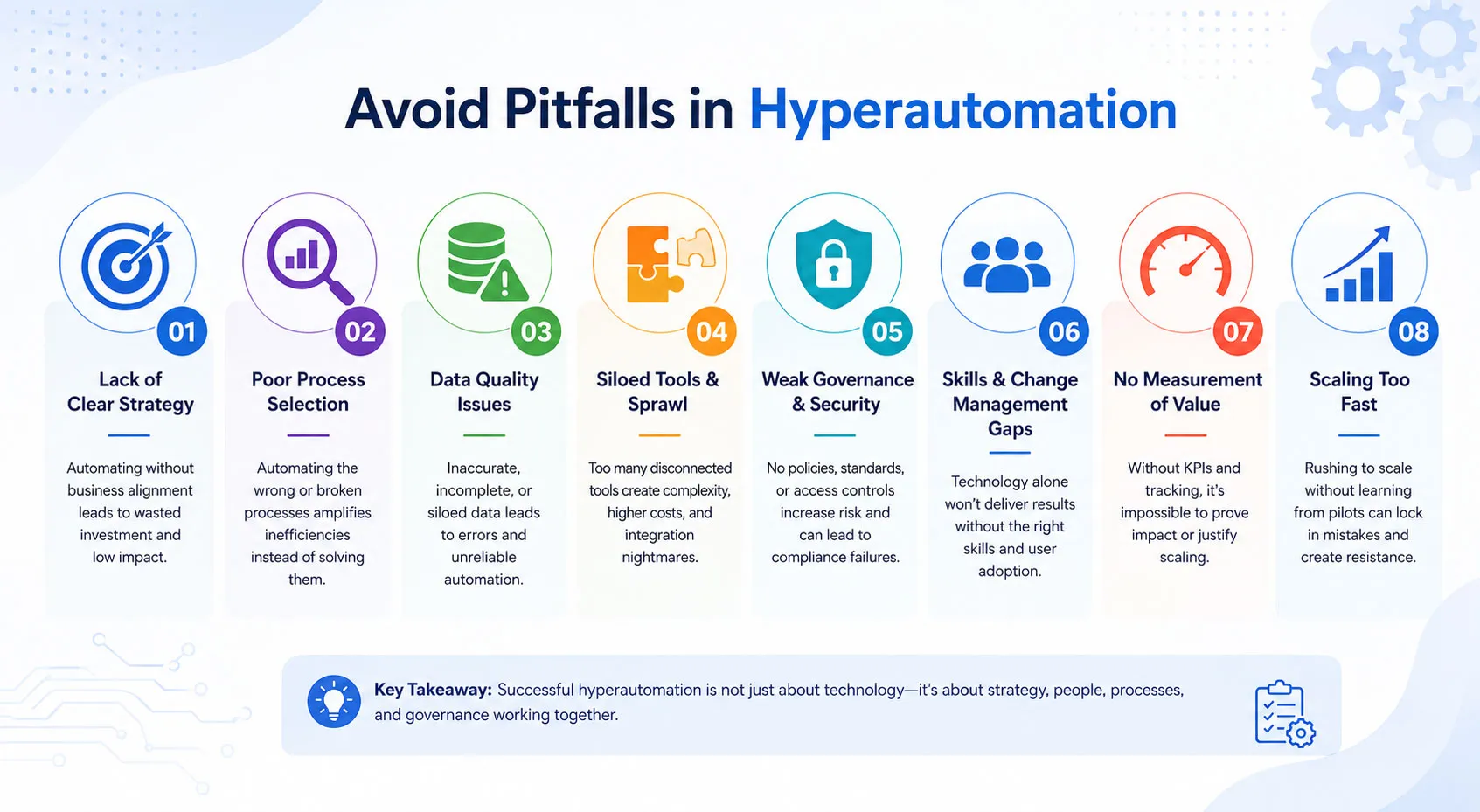
Common Pitfalls to Avoid

Even well-designed hyperautomation strategies encounter predictable obstacles. Understanding them in advance significantly improves your chances of navigating them successfully.
Automating broken processes. Automation amplifies whatever is already happening in a process — including its inefficiencies. Automating a process that is poorly designed does not fix the design; it executes the bad design faster and at higher volume. Before automating any process, invest time in simplifying and standardizing it. The rule is: optimize first, automate second.
Underestimating data quality requirements. Automation is only as reliable as the data it processes. Poor data quality — inconsistent formats, missing fields, duplicate records — is one of the most common sources of bot exceptions and automation failures. Assess data quality as part of your process discovery phase and address issues before they become production problems.
Building without reuse in mind. Each automation built in isolation from the rest of the portfolio is a missed opportunity to create reusable components that accelerate future development. From the beginning, design automations with modularity in mind — separating data extraction logic, business rules, and system interactions into components that can be recombined for different use cases.
Neglecting the exception path. The happy path — the standard, uninterrupted version of a process — is typically straightforward to automate. The exception paths are where the real complexity lives. Organizations that automate only the happy path and send all exceptions to human queues often find that exception volume is high enough to erode a significant portion of their efficiency gains. Exception handling logic deserves as much design investment as the core automation.
Moving too fast on change management. Technology deployments can be completed quickly; organizational change cannot. The pace of your automation rollout should be matched to the pace at which your people can genuinely adapt to new ways of working. Organizations that deploy automation faster than their teams can absorb the change create confusion, resistance, and — in worst cases — active sabotage of the tools they have invested in building.
What a Mature Hyperautomation Strategy Looks Like
After 18 to 24 months of disciplined execution against this framework, a mature hyperautomation strategy looks meaningfully different from where most organizations start.
There is a functioning Centre of Excellence with clear ownership, standards, and a growing library of reusable components. There is a live automation portfolio across multiple business functions, governed by a measurement framework that reports ROI in real time. There is a pipeline of prioritized automation candidates derived from continuous process mining, ensuring that the program never runs out of high-value targets. There are citizen developers across the business — finance analysts, HR partners, operations managers — who are building and deploying their own automations within governed guardrails, expanding the reach of the program far beyond what a central IT team could achieve alone.
And there is organizational confidence: leadership understands the value of the program because the data is clear and consistent, and the business is visibly operating faster, more accurately, and at lower cost than it was before.
That is the destination that a well-built hyperautomation strategy is designed to reach. The path there is neither short nor without challenge — but every step of this framework is designed to make the journey measurable, defensible, and sustainable.
Conclusion
Building a hyperautomation strategy from scratch is one of the most consequential technology investments an organization can make — and, when done right, one of the most rewarding. The organizations that approach it with strategic clarity, process discipline, governance rigor, and genuine change management capability are consistently the ones that achieve transformational outcomes.
The framework outlined in this guide does not promise a shortcut. What it provides is a sequence: align strategy before selecting technology; discover and map processes before building automations; establish governance before scaling; measure rigorously from day one; and treat automation as an ongoing organizational capability rather than a project with a defined endpoint.
In 2026, with hyperautomation platforms more capable, more accessible, and more competitively priced than at any point in the technology’s history, the barrier to entry has never been lower. The organizations that build the strategic foundation to take full advantage of that opportunity are the ones that will define their industries in the decade ahead.
The time to start is now. And the first step — more valuable than any technology decision you will make — is getting the strategy right.
Hyperautomation Content Series
Continue the Complete Hyperautomation Guide
This post is a part of the Hyperautomation Content Series — the complete 8 article guide to understanding, implementing, and scaling hyperautomation in your organization.
FAQs
Align hyperautomation with business goals by first defining specific, measurable outcomes that leadership already prioritizes, then securing an executive sponsor and mapping every automation effort directly to those outcomes before any tools are chosen.
Key Takeaways
- Start with measurable business outcomes, not technology selection.
- Map hyperautomation goals to existing strategic priorities such as cost, growth, or compliance.
- Secure a C-suite sponsor early to protect funding and drive cross-department change.
- Document success metrics at both process and program levels from day one.
- Treat alignment as the foundation that prevents fragmented, low-ROI automation portfolios.
Hyperautomation programs succeed or stall based on one early decision: whether the work begins with technology or with business outcomes. Most organizations reverse this order. They evaluate platforms, run proof-of-concept bots, and only later try to justify the investment. The result is a collection of disconnected automations that consume budget without clear impact. Enterprise software development teams that treat alignment as the first step avoid this pattern and build programs leadership continues to fund.
According to Gartner, fewer than 20% of large enterprises have mastered the measurement and governance of their hyperautomation initiatives. That statistic points to a deeper problem: without strategic alignment, measurement becomes impossible because no one agreed on what success should look like.
Begin with outcomes leadership already cares about
Strategic alignment means translating high-level business priorities into concrete automation targets. Vague statements such as “we want to be more efficient” do not secure budget or executive attention. Specific targets do.
Examples of effective outcome statements include:
- Reduce accounts payable processing cost by 40% within 18 months.
- Cut customer onboarding cycle time from 10 days to 24 hours.
- Lower compliance error rates in claims handling by 60%.
These statements work because they connect directly to financial results, customer experience, or risk reduction. When the business is focused on cost control, lead with cost-per-transaction and hours saved. When growth and customer experience sit at the top of the agenda, emphasize speed and accuracy. When regulatory pressure dominates, prioritize audit trails and error reduction.
This mapping also reveals which departments and processes deserve early attention. A process that supports a top strategic priority ranks higher than one with equal technical suitability but lower visibility to leadership.
Secure executive sponsorship before technology decisions
Alignment without sponsorship remains theoretical. An executive sponsor, ideally a C-suite leader with authority to allocate budget across functions, turns strategy into organizational reality. Without this role, hyperautomation tends to stay trapped inside individual departments. Resistance from middle management, competing priorities, and funding cuts then stop progress.
The sponsor’s responsibilities include:
- Protecting the program budget through quarterly reviews.
- Resolving cross-department conflicts over process ownership.
- Communicating the strategic rationale to the wider organization.
- Holding the program accountable to the agreed outcome metrics.
Organizations that skip this step often discover, twelve months later, that their automation portfolio delivers unclear ROI and cannot scale. The difference between programs that transform and those that stall is almost never the quality of the tools. It is the quality of the strategy and the sponsorship behind it.
Connect every candidate process to the strategic map
Once outcomes and sponsorship are in place, evaluate candidate processes against the strategic map. A structured view helps teams avoid the common trap of automating the easiest or most visible tasks first.
| Strategic Priority | Preferred Metrics | Example Process Focus |
|---|
| Cost reduction | Cost per transaction, hours saved | Invoice processing, order entry |
| Growth & experience | Cycle time, accuracy, NPS | Customer onboarding, support ticket resolution |
| Compliance & risk | Error rate, audit completeness | KYC/AML checks, claims adjudication |
This comparison table forces clarity. A high-volume process that scores well on technical suitability but sits far from any strategic priority should wait. Early wins should combine high business impact with clear alignment so results are visible to the people who control future funding.
Ready to map your first set of high-impact automation outcomes?
Speak with a Bantech strategist to review your current priorities and identify the processes that will deliver the fastest, most visible results.
Define success metrics at two levels
Process-level metrics track individual automations: straight-through processing rate, exception rate, bot utilization, processing time, and cost per transaction. Program-level metrics track the overall initiative: total automations deployed, cumulative hours saved, cost reduction delivered, and ROI against investment.
Both sets must be established before development begins. Without them, the program cannot prove value when leadership reviews progress. Programs that cannot prove value rarely receive continued investment. This is why the complete guide to hyperautomation stresses measurement as a core design requirement rather than an afterthought.
Avoid the most common alignment failures
Three patterns repeatedly undermine hyperautomation strategy:
- Starting with platform selection. Teams evaluate RPA, AI, and orchestration tools before defining outcomes. The technology then shapes the strategy instead of the reverse.
- Relying on departmental anecdotes. Process owners describe ideal workflows rather than the real variants that occur in production. Alignment work that skips objective discovery later discovers that the automated process covers only a fraction of actual cases.
- Treating governance as optional. Without agreed standards, documentation rules, and escalation paths, the portfolio grows in ways that become unmanageable.
Each of these failures traces back to missing or weak strategic alignment. When outcomes, sponsorship, and metrics are clear from the start, the remaining steps of process discovery, prioritization, architecture design, and governance become far more effective. Real-world deployments across industries, detailed in the hyperautomation examples by industry, show the same pattern: the programs that deliver measurable results began with business goals rather than technology shopping lists.
Practical next steps for leadership teams
- Convene a short alignment workshop with the proposed executive sponsor and key process owners.
- List the organization’s top three strategic priorities for the next 18–24 months.
- Draft three to five outcome statements that could be advanced through automation.
- Identify one or two candidate processes that map cleanly to those outcomes and score well on volume, rule-based logic, and low exception rates.
- Agree on the process-level and program-level metrics that will be reported monthly.
These steps require no software licenses and can be completed in days rather than months. They create the foundation that later phases of process mining, backlog prioritization, technology architecture, and Centre of Excellence design all depend on.
Alignment is not a one-time exercise. As business priorities shift, the hyperautomation roadmap must be reviewed and adjusted. Regular quarterly reviews with the executive sponsor keep the program tethered to current strategy and prevent drift into low-value automation.
Organizations that treat strategic alignment as the non-negotiable first step of their hyperautomation strategy position themselves to deliver early wins, scale with confidence, and maintain leadership support through the inevitable friction of large-scale change. Those that skip it usually spend the next year explaining why the bots they deployed never produced the results that were promised.
Stop the cycle of fragmented automations and unclear ROI. Contact Bantech to diagnose the strategy and governance gaps in your current program and build a foundation that scales. Most hyperautomation programs fail because the strategy, governance, and measurement foundations were never defined, leaving organizations with fragmented bots that deliver unclear ROI and cannot scale beyond the original department.
Key Takeaways
- Technology is rarely the root cause of failure; missing strategy is.
- Fragmented point automations create growing maintenance costs and low visibility.
- Fewer than 20% of large enterprises have mastered measurement and governance of hyperautomation.
- Executive sponsorship, clear outcomes, and a Centre of Excellence prevent the most common collapse patterns.
- Early process discovery and prioritization protect the program from scaling the wrong work.
Hyperautomation programs almost never collapse because the RPA bots or AI models stop functioning. The technology itself usually works as designed. The failure occurs higher up: the strategy that was supposed to guide selection, prioritization, architecture, and ongoing management was never clearly defined. Organizations that hire a software development team experienced in enterprise automation see this pattern repeatedly. Teams rush to deploy bots, layer in AI tools, and announce digital transformation milestones, only to find themselves twelve months later sitting on a fragmented collection of point automations that require rising maintenance investment, deliver unclear ROI, and cannot scale beyond the department where they were first built.
Gartner has noted that fewer than 20% of large enterprises have genuinely mastered the measurement and governance of their hyperautomation initiatives. That figure reveals the core problem. The majority are investing heavily in technology without the strategic foundation required to realize its full potential.
The strategy vacuum is the primary cause
When leadership treats hyperautomation as a technology purchase rather than a business transformation program, several predictable outcomes follow. Process owners select the easiest or most visible tasks instead of the highest-impact ones. Multiple teams adopt different tools without shared standards. Documentation is incomplete or inconsistent. Exception handling is left to individual developers. Over time the portfolio becomes a collection of brittle, single-purpose bots that break when systems change and that no one fully understands.
The difference between organizations that transform and those that stall is almost never the quality of their automation tools. It is the quality of their strategy. A clear strategy answers four questions before any bot is built:
- What specific business outcomes must the program deliver?
- Which processes will produce those outcomes fastest and with the least risk?
- How will success be measured at both process and portfolio levels?
- Who owns governance, standards, and ongoing funding?
Without answers to these questions, technology decisions are made in isolation and the program drifts.
Fragmentation and maintenance debt compound quickly
Once the first wave of bots is live, the absence of architecture and governance becomes expensive. Each new automation is built differently. Naming conventions differ. Error handling is inconsistent. Integration points are poorly documented. When an underlying system is upgraded, multiple bots fail at once and the team that built them has moved on.
This creates a growing maintenance burden that eventually exceeds the original efficiency gains. Leadership begins to question the value of the entire program. Funding is reduced or frozen. New automation requests are blocked. The portfolio stalls at a departmental scale even though the underlying technology remains perfectly capable of handling enterprise workloads.
Organizations that avoid this outcome treat the technology stack as a layered architecture from the start: an execution layer for RPA, an intelligence layer for AI and document processing, an orchestration layer for end-to-end workflows, and a discovery and monitoring layer for continuous improvement. The core technologies powering hyperautomation must be selected and integrated with this architecture in mind rather than purchased one tool at a time.
Missing measurement makes value invisible
Even when individual automations produce local efficiency, the program cannot prove aggregate value without rigorous measurement. Process-level metrics such as straight-through processing rate, exception rate, processing time, and cost per transaction must sit alongside program-level metrics such as total hours saved, cost reduction delivered, and ROI against investment.
When these metrics are absent or inconsistently reported, leadership has no reliable way to decide whether to expand the program. The initiative is then judged by anecdote rather than data. Positive stories from one department are outweighed by complaints from another. Momentum dies.
A Centre of Excellence (CoE) is the organizational structure that prevents this. The CoE owns standards, reusable components, platform support, and the measurement dashboards that keep the program visible and accountable. Without it, hyperautomation remains a collection of departmental experiments rather than an enterprise capability.
Is your current automation portfolio showing early signs of fragmentation or unclear ROI?
Schedule a short diagnostic call with Bantech to identify the strategy and governance gaps before they become expensive.
Process discovery is frequently skipped
Many programs begin with stakeholder interviews and process maps drawn from institutional memory. These maps almost always understate the real number of process variants, the frequency of exceptions, and the true handoff delays. When the automation goes live it handles only a portion of actual cases. The remaining volume continues to require manual work, eroding the projected savings and damaging credibility.
Process mining and task mining solve this by reconstructing actual workflows from system logs and desktop activity. Organizations that invest in discovery before prioritization build an objective backlog ranked by business impact, automation suitability, implementation complexity, and strategic value. Those that skip discovery consistently encounter production surprises that undermine confidence in the entire approach.
The practical framework for avoiding these failures is laid out in detail in the guide on how to build a hyperautomation strategy from scratch. It begins with strategic alignment and moves through discovery, prioritization, architecture, and governance in a deliberate sequence.
Governance and risk controls arrive too late
Automated systems that access sensitive data, execute financial transactions, or make decisions affecting customers introduce new operational, security, and regulatory risks. When risk and compliance controls are added only after incidents occur, the program faces sudden restrictions or shutdowns.
Effective governance frameworks define standards for development, testing, documentation, security, and change management from the first pilot. They also establish clear accountability and escalation paths for exceptions. In regulated industries these requirements are non-negotiable. Even in less regulated environments they protect the program from the reputational and financial damage that follows uncontrolled automation failures.
How successful programs reverse the pattern
Organizations that sustain and scale hyperautomation share a common sequence:
- They define measurable business outcomes and secure executive sponsorship before selecting any technology.
- They invest in process and task mining to create an objective, data-driven backlog.
- They prioritize for early wins that combine high impact with low complexity.
- They design a layered technology architecture rather than accumulating point tools.
- They establish a CoE and measurement system early so value remains visible.
- They treat governance as a first-order design concern rather than a later remediation.
When these elements are present, the technology is free to deliver the results it is capable of producing. When they are absent, even the best platforms eventually look like expensive failures.
The technology works. The strategy, or the lack of it, determines whether the program succeeds.
Stop the cycle of fragmented automations and unclear ROI. Contact Bantech to diagnose the strategy and governance gaps in your current program and build a foundation that scales. Process mining and task mining form the data-driven foundation of a hyperautomation strategy by reconstructing how work actually happens, revealing true process variants, bottlenecks, and the highest-value automation opportunities before any bots are built.
Key Takeaways
- You cannot automate what you do not accurately understand.
- Process mining maps end-to-end flows from system event logs.
- Task mining captures the detailed desktop actions that make up manual steps.
- Together they produce an objective automation backlog ranked by real impact and suitability.
- Skipping discovery leads to production surprises and lower-than-expected ROI.
You cannot automate what you do not understand. In most organizations the way processes actually operate differs significantly from how they are documented or how leadership believes they work. Process discovery is the discipline that closes this gap with data rather than interviews and anecdotes. Teams that begin hyperautomation with business process analysis services grounded in mining tools avoid the costly surprises that later undermine confidence in the entire program.
Gartner and other analysts consistently show that organizations investing in objective process discovery before prioritization achieve higher automation success rates and clearer ROI. The reason is simple: discovery supplies the factual picture that strategy, prioritization, and architecture all depend on.
Process mining reconstructs the real end-to-end flow
Process mining analyzes event logs from existing business systems such as ERPs, CRMs, ticketing platforms, and finance applications. It reconstructs accurate maps of how processes flow across systems and people. The output reveals:
- The actual number of process variants running in production
- Where bottlenecks accumulate
- Which steps are most error-prone
- Where handoffs between people and systems introduce the greatest delay
Unlike traditional process mapping workshops that rely on memory and ideal-state descriptions, process mining works from the digital footprints already present in the systems of record. This produces an objective baseline that can be measured, compared, and improved over time.
Task mining captures the granular human work
Task mining complements process mining by focusing on the individual employee level. It records how people interact with their screens and applications: the specific clicks, keystrokes, copy-paste sequences, and application switches that make up the manual steps inside a larger process.
This granular view identifies exactly which tasks are most repetitive, most time-consuming, and most suitable for bot automation. It also surfaces the informal workarounds and shadow processes that never appear in official documentation.
When process mining and task mining are used together, the organization gains a complete picture: the high-level flow across systems plus the detailed human effort inside each step. This combined view is invaluable before any automation development begins.
Discovery creates the objective automation backlog
During the discovery phase, every candidate process should be documented with a consistent set of attributes:
- Current processing volume
- Current processing time
- Error rate
- Number of systems involved
- Degree of variability in inputs
- Estimated cost per transaction
These attributes form the basis of the automation backlog and the prioritization model that follows. Processes that score high on volume, cost, and error rate while showing low variability become the natural candidates for early, high-confidence automation.
Organizations that skip this step and rely instead on stakeholder interviews consistently encounter production surprises. They discover that the process they automated handles only a fraction of real-world cases because the remaining volume involves variants that nobody mentioned in the workshops.
Want an objective view of your highest-impact processes before you invest in bots?
Request a discovery assessment with Bantech to apply process and task mining to your key workflows.
How discovery feeds the rest of the strategy
A strong discovery foundation directly improves every later stage of the hyperautomation strategy:
- Prioritization becomes evidence-based rather than opinion-based. The four dimensions of business impact, automation suitability, implementation complexity, and strategic value can be scored with real data.
- Technology architecture decisions are guided by actual requirements. Teams know whether they need advanced document processing, complex orchestration, or primarily rule-based RPA.
- Governance and measurement start with accurate baselines. Cycle times, error rates, and cost-per-transaction figures recorded during discovery become the benchmarks against which automation success is judged.
- Change management is more effective because the real process variants and exception paths are already understood.
The practical sequence is covered in depth in the guide on how to build a hyperautomation strategy from scratch. Discovery is Step 2 precisely because everything that follows depends on its accuracy.
Common discovery mistakes to avoid
Three patterns reduce the value of process and task mining:
- Treating mining as a one-time project rather than an ongoing capability. Processes evolve. Continuous or periodic mining keeps the backlog current.
- Focusing only on the happy path. The highest automation risk often sits in the exception paths and low-frequency variants. These must be quantified.
- Stopping at visualization. The maps and dashboards are useful, but the real output is the scored, attribute-rich backlog that drives prioritization and roadmap decisions.
When discovery is performed rigorously, the organization enters the prioritization and architecture phases with a clear, shared understanding of where automation will deliver the highest return and where human judgment must remain in the loop.
Real-world results across industries, illustrated in the hyperautomation examples by industry, consistently show that programs built on objective process discovery scale farther and sustain value longer than those built on anecdotal process maps.
Process mining and task mining are not optional add-ons. They are the mechanism that turns hyperautomation from a collection of hopeful technology projects into a disciplined, data-driven strategy capable of delivering measurable enterprise outcomes.
Build your hyperautomation strategy on facts rather than assumptions. Contact Bantech to design a process and task mining engagement that identifies your highest-ROI automation opportunities with precision. Prioritize processes for a hyperautomation backlog by scoring each candidate across four dimensions: business impact, automation suitability, implementation complexity, and strategic value, then sequence the highest-scoring low-complexity items as quick wins.
Key Takeaways
- Not every process is equally suitable or valuable for hyperautomation.
- Score candidates on business impact, suitability, complexity, and strategic value.
- Sequence early work toward high-impact, high-suitability, low-complexity processes.
- An objective scoring model prevents teams from automating the loudest or easiest tasks first.
- The resulting phased roadmap builds momentum and funds later, more complex initiatives.
Not every process is equally suitable for hyperautomation, and not every suitable process delivers the same return. A structured prioritization framework prevents organizations from spending significant resources on low-value work while higher-impact opportunities wait. Teams that apply a clear scoring model early, often with support from an experienced IT strategy and planning partner, create roadmaps that deliver visible results fast and sustain leadership support.
The practical model evaluates each candidate process across four dimensions. These dimensions turn a long list of ideas into a sequenced backlog that balances speed, risk, and strategic contribution.
Business impact measures financial and operational significance
Business impact scores the financial and operational importance of improving the process. High-volume processes where small gains in cost, speed, or accuracy compound across thousands or millions of transactions score highest.
Examples of strong impact signals include:
- High transaction volume
- Significant current cost per transaction
- Material effect on customer experience or revenue
- Clear link to risk reduction or compliance exposure
A process that touches every customer invoice or every new employee onboarding request will almost always outrank a low-volume internal reporting task, even if the latter looks easier to automate.
Automation suitability assesses readiness for bots and AI
Automation suitability measures how ready the process is for reliable automation. Processes with structured, consistent inputs, clear rule-based logic, stable underlying systems, and low exception rates are the strongest candidates for initial deployment.
Processes with high variability, frequent exceptions, or large volumes of unstructured data require more sophisticated AI capabilities and carry higher implementation risk. These are better candidates for later phases once the program has proven value and built internal capability.
Suitability scoring protects the program from early failures that erode confidence. Automating a highly variable process before the supporting intelligence layer is mature produces high exception rates and heavy human oversight, which defeats the purpose of the investment.
Implementation complexity estimates effort and risk
Implementation complexity measures the technical and organizational effort required. Processes that run inside a single system, involve a small number of stakeholders, and are already well documented are faster and cheaper to automate than those that span many systems, require deep integration work, or need significant process redesign before automation is viable.
Complexity scoring keeps early phases realistic. A high-impact process that also carries extreme technical complexity is rarely the right first project. The combination of high impact and low-to-medium complexity produces the quick wins that generate internal funding and momentum.
Strategic value ties the process to organizational priorities
Strategic value measures alignment with the organization’s current priorities. A process that directly supports a key objective, such as reducing customer onboarding time when customer acquisition is a top priority, ranks higher than one with equivalent ROI that sits in a less visible function.
This dimension ensures the backlog remains connected to the strategic alignment work completed at the start of the program. Without it, teams can accumulate a portfolio of locally efficient automations that leadership does not recognize as strategically important.
| Dimension | High Score Indicators | Low Score Indicators |
|---|
| Business impact | High volume, high cost, customer or revenue effect | Low volume, internal only, limited cost |
| Automation suitability | Structured inputs, rule-based, low exceptions | High variability, unstructured data, frequent exceptions |
| Implementation complexity | Single system, few stakeholders, well documented | Multi-system, many handoffs, redesign required |
| Strategic value | Directly supports top business priorities | Peripheral to current strategic goals |
This comparison table makes scoring transparent and reduces debate. Each candidate process receives a score on every dimension. The resulting matrix guides sequencing.
Need help scoring your current process list against these four dimensions?
Book a prioritization workshop with Bantech to turn your backlog into a clear, phased roadmap.
Sequence the backlog into practical phases
Plot the scored processes and group them into phases. The first phase should prioritize processes that score high on impact and suitability and low on complexity. These are the quick wins that deliver visible results fast, build organizational confidence, and generate the internal funding and momentum needed to tackle more complex initiatives later.
Subsequent phases can absorb higher-complexity or lower-suitability processes once the program has a proven track record, a functioning Centre of Excellence, and reusable components.
This phased approach is a core part of the practical framework described in the guide on how to build a hyperautomation strategy from scratch. Prioritization is the step that converts discovery data into an executable roadmap.
Common prioritization mistakes to avoid
Three patterns consistently produce weak backlogs:
- Starting with the loudest stakeholder request rather than the highest-scoring process.
- Over-weighting technical ease and under-weighting business impact and strategic value.
- Treating the backlog as static. New discovery data, changing business priorities, and completed automations should trigger regular re-scoring.
When prioritization is performed with a consistent four-dimension model, the organization avoids both analysis paralysis and the opposite problem of automating the wrong work first. The result is a living backlog that continuously directs effort toward the highest return.
Real-world programs that follow this approach, as illustrated across industries in the hyperautomation examples by industry, consistently show faster time to value and higher sustained ROI than programs that prioritize by intuition or political pressure.
A disciplined prioritization framework is what turns a long list of automation ideas into a strategy that leadership can fund, track, and expand with confidence.
Turn your process list into a prioritized hyperautomation backlog that delivers early wins and scales. Contact Bantech to apply the four-dimension scoring model to your candidates and build a roadmap leadership will support. The four key dimensions for evaluating automation candidates are business impact, automation suitability, implementation complexity, and strategic value. Scoring every process against these dimensions produces an objective backlog that delivers quick wins and scales sustainably.
Key Takeaways
- Business impact quantifies financial and operational significance.
- Automation suitability measures how ready a process is for reliable bots and AI.
- Implementation complexity estimates technical and organizational effort.
- Strategic value ensures alignment with current enterprise priorities.
- A balanced score across all four dimensions prevents low-value or high-risk automation.
A structured evaluation model is essential once process discovery has produced a list of candidate processes. Without clear dimensions, teams tend to automate the easiest, loudest, or most familiar work rather than the work that will move the business forward. Organizations that apply a consistent four-dimension framework, often with support from data analytics and business intelligence capabilities, convert raw discovery data into a prioritized, defensible backlog.
These four dimensions, drawn from practical hyperautomation strategy work, give every candidate a transparent score that can be compared, debated, and sequenced.
1. Business impact: financial and operational significance
Business impact measures how much improving the process will matter to the organization. High-volume processes where even modest gains in cost, speed, or accuracy compound across thousands or millions of transactions receive the highest scores.
Key signals of strong business impact include:
- High transaction or case volume
- Elevated current cost per transaction or per case
- Direct effect on revenue, customer experience, or employee productivity
- Material exposure to risk, penalties, or compliance findings
A process that handles every supplier invoice or every customer onboarding request will almost always outrank a low-volume internal reporting task, even if the latter appears simpler. Impact scoring keeps the program focused on outcomes that leadership already tracks and values.
2. Automation suitability: readiness for reliable automation
Automation suitability assesses how well the process lends itself to current automation technologies. Processes with structured and consistent inputs, clear rule-based logic, stable underlying systems, and low exception rates are the strongest early candidates.
Processes that involve high input variability, frequent exceptions, significant unstructured data (emails, scanned documents, free-text notes), or frequent system changes score lower on suitability. These processes usually require more advanced AI, intelligent document processing, or process redesign before automation becomes reliable.
Suitability scoring protects the program from early credibility damage. Automating a highly variable process before the supporting intelligence layer is mature produces high exception rates and heavy human intervention, which undermines the projected savings and erodes trust in the broader initiative.
3. Implementation complexity: technical and organizational effort
Implementation complexity estimates the real effort and risk required to automate the process. Processes that operate inside a single system, involve a limited number of stakeholders, and are already well documented score low on complexity and are therefore attractive for early phases.
Processes that span many systems, require deep custom integrations, involve significant process redesign, or depend on unstable legacy interfaces score high on complexity. These should generally be deferred until the program has proven value, built reusable components, and established stronger integration capabilities.
Complexity scoring keeps early roadmaps realistic. Combining high business impact with low-to-medium complexity produces the quick wins that generate internal funding and organizational momentum for later, more ambitious work.
4. Strategic value: alignment with enterprise priorities
Strategic value measures how closely the process supports the organization’s current top priorities. A process that directly advances a key objective, such as reducing customer onboarding time when acquisition is a strategic focus, receives a higher score than a process with similar ROI that sits in a less visible function.
This dimension ensures the automation portfolio remains connected to the strategic alignment work completed at the start of the program. Without it, teams can accumulate a set of locally efficient bots that leadership does not recognize as contributing to the outcomes they care about most.
| Dimension | High Score Characteristics | Low Score Characteristics |
|---|
| Business impact | High volume, high cost, customer or revenue effect | Low volume, internal only, limited financial effect |
| Automation suitability | Structured inputs, rule-based, low exceptions | High variability, unstructured data, frequent exceptions |
| Implementation complexity | Single system, few stakeholders, well documented | Multi-system, many handoffs, redesign required |
| Strategic value | Directly supports top business priorities | Peripheral to current strategic goals |
This comparison table makes scoring transparent and reduces subjective debate. Each candidate receives a numerical or categorical score on every dimension. The combined view then drives sequencing decisions.
Ready to score your current process list against these four dimensions?
Request a prioritization session with Bantech to turn discovery findings into a clear, sequenced backlog.
How the four dimensions work together
No single dimension should dominate. A process with exceptional business impact but very low suitability and high complexity is usually a poor first project. Conversely, an easy, highly suitable process with negligible business impact wastes limited automation capacity.
The strongest early candidates score high on business impact and automation suitability, low on implementation complexity, and at least moderate on strategic value. These combinations produce visible results quickly, build confidence, and create the internal case for expanding the program into more complex territory.
Later phases can absorb higher-complexity or lower-suitability processes once the organization has a functioning Centre of Excellence, reusable assets, and proven measurement practices.
The full prioritization approach that uses these dimensions sits inside the broader framework described in the guide on how to build a hyperautomation strategy from scratch. Evaluating candidates is the step that converts discovery data into an executable, phased roadmap.
Practical application tips
- Score consistently. Use the same scale and the same evaluators across the backlog so results remain comparable.
- Re-score periodically. New discovery data, completed automations, and shifting business priorities should trigger updates.
- Document the rationale. Record why a process received each score so future reviewers understand the original reasoning.
- Separate the scoring from the sequencing discussion. First create objective scores, then decide the phase order.
When these four dimensions are applied rigorously, the organization avoids both analysis paralysis and the opposite problem of automating the wrong work first. The result is a living backlog that continuously directs limited resources toward the highest-return opportunities.
Real-world programs that evaluate candidates this way, as shown across industries in the hyperautomation examples by industry, consistently achieve faster time to value and higher sustained returns than programs that prioritize by intuition, politics, or technical ease alone.
A clear, four-dimension evaluation model is what turns a long list of automation ideas into a strategy that leadership can understand, fund, and expand with confidence.
Evaluate your automation candidates with a proven four-dimension framework. Contact Bantech to score your processes and build a prioritized backlog that delivers early wins and scales. Design a hyperautomation technology architecture by defining clear layers for execution, intelligence, orchestration, integration, and discovery/monitoring, then selecting platforms that serve process requirements rather than forcing processes into a pre-chosen tool.
Key Takeaways
- Architecture decisions must follow process requirements, not the reverse.
- The execution layer handles rule-based RPA work.
- The intelligence layer adds AI, ML, NLP, and document processing for unstructured data and decisions.
- The orchestration layer coordinates bots, AI, humans, and systems into end-to-end flows.
- A hybrid model with strong governance outperforms a single-vendor or pure point-tool approach.
With a prioritized backlog in hand, technology decisions become possible. The order of those decisions matters. Too many organizations choose an automation platform first and then try to fit their processes into its capabilities. The correct sequence is the reverse: understand process requirements thoroughly, then select the technology stack that best serves them. Teams that follow this sequence, often with guidance from experienced software development consulting partners, avoid expensive lock-in and architectural dead ends.
A mature hyperautomation architecture typically consists of several distinct layers. Each layer addresses a different set of capabilities and can be fulfilled by one or more specialized tools.
Execution layer: rule-based task automation
The execution layer handles structured, rule-based task automation. This is where robotic process automation lives. The RPA platform must support both attended and unattended bots, integrate with core business systems through APIs and user-interface automation, and provide a robust environment for building, testing, and maintaining bot workflows.
Key requirements for this layer include:
- Reliable UI and API automation
- Centralized bot scheduling and monitoring
- Version control and change management for bot logic
- Credential and security management
The execution layer is the operational muscle of the architecture. It performs the repetitive digital work at scale once the higher layers have prepared the data and decisions.
Intelligence layer: unstructured data and decision-making
The intelligence layer handles unstructured data, judgment, and learning. It includes artificial intelligence and machine learning models for classification and prediction, natural language processing for language understanding, optical character recognition and intelligent document processing for extracting data from documents, and computer vision for image-based tasks.
Many modern platforms have begun incorporating these capabilities natively. In other cases they are sourced from specialist providers and integrated through APIs. The intelligence layer is what allows automation to move beyond pure rules and handle the variability and ambiguity that pure RPA cannot address.
Without a capable intelligence layer, organizations are limited to highly structured processes and must leave large volumes of work in human hands.
Orchestration layer: end-to-end process coordination
The orchestration layer coordinates the execution of complex, multi-step workflows that involve bots, AI components, human tasks, and external system calls in a defined sequence. This is the layer that transforms a collection of individual automations into genuine end-to-end process automation.
Orchestration provides:
- Conditional routing and branching logic
- Escalation paths when exceptions occur
- Service-level tracking and visibility
- Human-in-the-loop checkpoints designed deliberately rather than as afterthoughts
Strong orchestration is what prevents the architecture from becoming a set of isolated bots that still require heavy manual coordination between steps.
Integration and discovery/monitoring layers
Two additional layers complete the architecture.
The integration layer connects the automation platform to the underlying business systems it must interact with: ERPs, CRMs, databases, cloud services, and legacy applications. The maturity of the integration layer determines how widely automation can reach across the technology landscape. Preference should be given to APIs where they exist; UI automation is reserved for systems that offer no better interface.
The discovery and monitoring layer continuously surfaces new automation opportunities through process mining, measures the performance of deployed automations in real time, and flags issues before they impact operations. This layer closes the loop so the architecture improves over time rather than remaining static.
| Layer | Primary Role | Typical Technologies |
|---|
| Execution | Rule-based structured task automation | RPA platforms |
| Intelligence | Unstructured data, decisions, learning | AI/ML, NLP, OCR/IDP, computer vision |
| Orchestration | End-to-end workflow coordination | BPM/orchestration engines, workflow platforms |
| Integration | Connectivity to business systems | APIs, iPaaS, connectors |
| Discovery & Monitoring | Opportunity identification and performance tracking | Process mining, task mining, analytics dashboards |
This layered view makes capability gaps visible and prevents the common mistake of expecting a single tool to perform every function well.
Need help mapping your process requirements to the right architecture layers?
Schedule an architecture review with Bantech to design a stack that fits your backlog and existing systems.
Hybrid architecture is the practical reality in 2026
Most enterprises adopt a hybrid model: one or two anchor platforms that provide core execution, orchestration, and governance capabilities, supplemented by specialist tools for capabilities where the anchor platform is not best-in-class. This approach balances consistency with best-of-breed performance.
The alternative extremes both create problems. A pure single-vendor strategy can force compromises in areas where the vendor is weak. A pure best-of-breed collection of point tools quickly becomes unmanageable without strong integration and governance.
When evaluating platforms, the decisive questions are therefore:
- Which layers does this platform cover well?
- Where will specialist tools still be required?
- How will governance, security, and monitoring work across the combined stack?
- Does the architecture support the prioritized processes identified earlier?
These decisions are explored in greater technical depth in the analysis of core technologies powering hyperautomation. Architecture design is also a central step in the overall approach outlined in the guide on how to build a hyperautomation strategy from scratch.
Common architecture mistakes to avoid
Three patterns repeatedly produce fragile or expensive architectures:
- Selecting the platform before understanding process requirements.
- Treating every capability as an RPA problem and under-investing in intelligence and orchestration.
- Neglecting the discovery and monitoring layer, so the architecture cannot improve itself over time.
When the layers are defined clearly and the selection sequence is correct, the technology stack becomes an enabler of the strategy rather than a constraint on it. The result is an architecture that can start with high-suitability, low-complexity processes and later expand into more sophisticated end-to-end automation without requiring a complete rebuild.
A well-designed technology architecture is what allows hyperautomation to scale from departmental experiments into an enterprise capability that continues to deliver measurable value.
Design a hyperautomation architecture that matches your processes instead of forcing processes into a pre-chosen tool. Contact Bantech to map your requirements to the right combination of execution, intelligence, and orchestration layers. A hyperautomation governance framework should include clear standards and policies, a Centre of Excellence, rigorous measurement and reporting, and robust risk and compliance controls so the program can scale without becoming fragmented or unmeasurable.
Key Takeaways
- Governance is the element most organizations underinvest in until problems force the issue.
- Standards prevent every team from building differently and creating an unmaintainable portfolio.
- A Centre of Excellence balances centralized control with distributed delivery.
- Measurement at process and program levels is required to prove value and secure continued funding.
- Risk and compliance controls must be designed in from the start, especially in regulated environments.
Governance is the element of hyperautomation strategy that most organizations either underinvest in or defer until problems force the issue. This is a mistake that compounds over time and is the primary reason so many organizations end up with large automation portfolios they cannot clearly measure, govern, or scale. Teams that establish governance early, often with support from audit and compliance services, protect the program from the fragmentation and credibility loss that later become expensive to reverse.
A practical hyperautomation governance framework addresses five core requirements.
Standards and policies define how work is done
Standards and policies define how automations are built, tested, documented, and deployed. Without them, every team builds in a different way, using different tools and conventions. The resulting portfolio becomes impossible to maintain consistently as it grows.
Effective standards cover:
- Naming conventions for bots, processes, and components
- Documentation requirements for logic, exceptions, and dependencies
- Testing protocols before promotion to production
- Security controls and credential management
- Change management procedures for updates and system changes
These standards create consistency without eliminating the speed that distributed delivery can provide. They are the foundation that allows a Centre of Excellence to support rather than bottleneck the organization.
A Centre of Excellence owns the program
A Centre of Excellence (CoE) is the organizational structure that owns the hyperautomation program. It maintains the platform, develops reusable components, sets and enforces standards, supports business teams in building their own automations, and governs the overall portfolio.
The CoE model is the most widely adopted governance structure for mature hyperautomation programs because it balances centralized control with distributed delivery. Centralization ensures consistency, security, and architectural coherence. Distribution enables speed and business ownership of process knowledge.
Without a CoE, hyperautomation tends to remain a collection of departmental experiments. With a well-run CoE, it becomes an enterprise capability that can be measured, improved, and expanded.
Measurement and reporting prove value continuously
Measurement and reporting establish the KPIs and dashboards that track the performance of deployed automations and the overall program.
At the process level, key metrics include:
- Straight-through processing rate
- Exception rate
- Bot utilization
- Processing time
- Cost per transaction
At the program level, key metrics include:
- Total automations deployed
- Cumulative hours saved
- Cost reduction delivered
- ROI against investment
Without rigorous measurement, the program cannot prove its value to leadership. Programs that cannot prove their value do not get funded to grow. Measurement must therefore be designed into the governance framework from the first pilot rather than added later as an afterthought.
Risk and compliance controls manage new exposures
Automated systems that access sensitive data, execute financial transactions, or make decisions affecting customers or employees introduce operational, security, and regulatory risks. Clear accountability, comprehensive audit trails, and defined escalation procedures are required when exceptions or failures occur.
In regulated industries these requirements are not optional. Even in less regulated environments they protect the organization from the reputational and financial damage that follows uncontrolled automation failures. Governance frameworks must treat compliance as a first-order design concern, especially as regulatory scrutiny of automated decision-making continues to increase.
| Governance Element | Primary Purpose | Key Outputs |
|---|
| Standards and policies | Consistency in how automations are built and changed | Naming, documentation, testing, security rules |
| Centre of Excellence | Ownership, platform support, reusable assets | CoE charter, support model, component library |
| Measurement and reporting | Visibility of value at process and program levels | KPI dashboards, ROI tracking |
| Risk and compliance | Control of operational, security, and regulatory risk | Audit trails, escalation paths, accountability |
This table summarizes the core components that together prevent the most common failure modes of hyperautomation programs.
Is your current automation portfolio growing faster than your ability to govern it?
Request a governance diagnostic with Bantech to identify the gaps before they become costly.
How governance enables the rest of the strategy
Strong governance does not slow delivery. It makes sustainable delivery possible. Standards reduce rework. The CoE accelerates new projects by supplying reusable components and expert support. Measurement keeps leadership engaged. Risk controls prevent sudden stops caused by compliance or security incidents.
When these elements are missing, even well-designed process discovery, prioritization, and technology architecture eventually produce a portfolio that cannot be managed or defended. The full sequence that places governance as a deliberate early step is described in the guide on how to build a hyperautomation strategy from scratch.
Organizations that treat governance as optional or deferrable consistently join the majority that, according to Gartner, have not mastered the measurement and governance of their hyperautomation initiatives. Those that treat it as a core design requirement build programs that continue to deliver and expand.
Real-world deployments that scale successfully, as illustrated in the hyperautomation examples by industry, share a common pattern: governance was established early enough to shape behavior rather than merely react to problems.
A complete hyperautomation governance framework turns a collection of promising automations into a managed enterprise capability that leadership can trust, fund, and grow.
Build a hyperautomation governance framework that scales with your program instead of constraining it. Contact Bantech to design the standards, CoE model, measurement system, and risk controls your organization needs. A Centre of Excellence is critical for scaling hyperautomation because it provides the centralized ownership, standards, reusable assets, and measurement that turn scattered departmental bots into a sustainable enterprise capability.
Key Takeaways
- Without a CoE, hyperautomation remains a collection of departmental experiments that rarely survive contact with enterprise complexity.
- The CoE balances centralized control (consistency, security, architecture) with distributed delivery (speed and business ownership).
- It owns the platform, develops reusable components, enforces standards, and maintains the measurement system that proves value.
- Organizations that scale successfully almost always establish the CoE early rather than as a later remediation.
- The CoE is the organizational mechanism that converts strategy into repeatable execution.
Hyperautomation that stays trapped inside individual departments almost never becomes an enterprise capability. The bots may work locally, but they do not scale. Different teams use different tools and conventions. Documentation is incomplete. Reusable components are rare. Measurement is inconsistent. When leadership asks for the aggregate ROI or when a core system changes, the portfolio reveals itself as fragile and expensive to maintain. A Centre of Excellence is the structure that prevents this outcome. Teams that establish one early, often with support from project management and implementation services, create the conditions for controlled, measurable growth.
Gartner’s observation that fewer than 20% of large enterprises have mastered measurement and governance of hyperautomation points directly to the absence of an effective CoE in most organizations. The CoE is the practical answer to that gap.
The CoE owns the program so no one else has to
A Centre of Excellence is the organizational unit that owns the hyperautomation program as a whole. Its core responsibilities typically include:
- Maintaining the automation platform and related tooling
- Developing and curating a library of reusable components
- Setting and enforcing development, testing, documentation, and security standards
- Supporting business teams that want to build or request automations
- Governing the overall portfolio and reporting value to leadership
Without a single accountable owner, these responsibilities fragment across departments. Platform decisions are made inconsistently. Standards drift. Measurement becomes optional. The program loses coherence and eventually loses funding.
Centralized control plus distributed delivery
The CoE model succeeds because it balances two opposing needs. Centralization ensures consistency, architectural integrity, security, and reliable measurement. Distribution enables speed and keeps process knowledge close to the business users who understand the work best.
In practice this means the CoE does not attempt to build every automation itself. Instead it provides the platform, the standards, the reusable assets, and the expert support that allow business teams to deliver faster and more safely than they could alone. The result is higher throughput without the chaos of completely decentralized automation.
Organizations that try pure centralization create bottlenecks. Organizations that try pure decentralization create unmaintainable portfolios. The CoE is the hybrid structure that avoids both extremes.
Reusable components and standards multiply capacity
One of the highest-leverage activities of a mature CoE is the creation of reusable components: common connectors, exception-handling patterns, logging frameworks, and document-processing modules. Each new automation can then start from a higher baseline rather than from scratch.
Standards reinforce this advantage. When every team follows the same naming conventions, documentation requirements, testing protocols, and security controls, the portfolio remains understandable and maintainable as it grows. New team members can contribute faster. System changes can be assessed and updated more systematically. Technical debt grows more slowly.
Without these assets and standards, every new automation is essentially a one-off project. Capacity does not compound. Scaling becomes linear and expensive.
Is your automation work still happening in departmental silos?
Request a CoE readiness assessment with Bantech to define the structure, roles, and operating model that will support scale.
Measurement lives inside the CoE
The CoE is also the natural home for the measurement system that tracks both process-level and program-level results. Straight-through processing rates, exception rates, hours saved, cost reduction, and overall ROI are collected, validated, and reported through the CoE.
This visibility is what keeps leadership engaged and funding flowing. When value is reported consistently and credibly, the program earns the right to expand into more complex processes and additional business units. When value is invisible or contested, expansion stalls.
What happens when organizations scale without a CoE
The failure pattern is consistent and well documented. Early bots deliver local wins. Multiple departments launch their own initiatives. Tools proliferate. Standards diverge. Maintenance costs rise. A system upgrade breaks a cluster of bots whose original developers have moved on. Leadership asks for a consolidated view of ROI and receives incomplete or conflicting answers. Funding is frozen or reduced. The program plateaus or shrinks even though the underlying technology remains capable.
This sequence is avoidable. The full strategic context for establishing the CoE at the right moment is set out in the guide on how to build a hyperautomation strategy from scratch. The CoE is not an optional later addition. It is the organizational mechanism that allows the earlier work of alignment, discovery, prioritization, and architecture to scale.
Real-world programs that reach enterprise scale, as illustrated across industries in the hyperautomation examples by industry, share a common feature: a functioning CoE was in place early enough to shape behavior and capture value before fragmentation set in.
A Centre of Excellence is critical because scaling hyperautomation is not primarily a technology problem. It is an operating-model problem. The CoE is the operating model that turns promising individual automations into a durable enterprise capability.
Establish the Centre of Excellence that will let your hyperautomation program scale with control and measurable value. Contact Bantech to design the CoE structure, roles, and operating model suited to your organization. Measure the success of a hyperautomation program with process-level metrics such as straight-through processing rate, exception rate, processing time, and cost per transaction, plus portfolio-level metrics such as total automations deployed, cumulative hours saved, cost reduction, and overall ROI.
Key Takeaways
- Process-level metrics track the performance of individual automations.
- Portfolio-level metrics track the aggregate value of the entire program.
- Both sets of metrics must be defined before development begins.
- Without rigorous measurement, programs cannot prove value and lose funding.
- Consistent reporting through a Centre of Excellence keeps leadership engaged.
Without rigorous measurement, a hyperautomation program cannot prove its value to leadership. Programs that cannot prove their value do not get funded to grow. Measurement must therefore be designed into the strategy from the first pilot rather than added later when questions about ROI already threaten the initiative. Organizations that establish clear metrics early, often with support from data analytics and business intelligence capabilities, create the visibility required for sustained investment and controlled expansion.
Gartner has noted that fewer than 20% of large enterprises have mastered the measurement and governance of their hyperautomation initiatives. The practical consequence is that most programs operate without a shared, credible view of what they are delivering. The solution is a two-level measurement system that operates at both the individual process and the overall portfolio.
Process-level metrics track individual automations
Process-level metrics focus on the performance of each deployed automation. They answer the question: is this specific bot or workflow delivering the results that were projected?
Core process-level metrics include:
- Straight-through processing rate: the percentage of cases that complete without human intervention
- Exception rate: the percentage of cases that require human review or correction
- Bot utilization: how fully the available bot capacity is being used
- Processing time: the end-to-end time from trigger to completion compared with the manual baseline
- Cost per transaction: the fully loaded cost of handling each case after automation
These metrics are most powerful when they are compared against the baseline figures captured during process discovery. A reduction in processing time or cost per transaction only becomes meaningful when the pre-automation numbers are known and trusted.
Additional useful process metrics can include error rates after automation, volume handled, and the percentage of process variants successfully covered. The exact set should be tailored to the outcomes defined during strategic alignment, but the five core metrics above form a solid starting foundation for most programs.
Portfolio-level metrics track the overall program
Portfolio-level metrics answer a different question: is the hyperautomation program as a whole delivering enterprise value that justifies continued investment?
Core portfolio-level metrics include:
- Total automations deployed: the cumulative number of production automations
- Cumulative hours saved: the aggregate time freed by all automations
- Cost reduction delivered: the total financial savings realized
- ROI against investment: the return calculated against the full cost of platforms, development, CoE, and ongoing operations
These metrics give leadership a consolidated view that individual process reports cannot provide. They also support decisions about whether to expand into new business units, invest in additional platform capabilities, or adjust the prioritization of the backlog.
| Level | Primary Question | Example Metrics |
|---|
| Process | Is this automation performing as expected? | Straight-through rate, exception rate, processing time, cost per transaction, bot utilization |
| Portfolio | Is the overall program delivering enterprise value? | Total automations, cumulative hours saved, cost reduction, ROI against investment |
This comparison makes the complementary roles of the two levels clear. Process metrics diagnose the health of individual assets. Portfolio metrics diagnose the health of the strategy itself.
Do you have clear baseline and ongoing metrics for both individual automations and the overall program?
Request a measurement framework review with Bantech to define the KPIs that will keep your initiative visible and fundable.
Measurement must start before the first bot is built
The most common measurement failure is trying to invent metrics after automations are already live. Baselines are then reconstructed from incomplete data or contested estimates, and credibility suffers.
The correct sequence is:
- Capture baseline metrics during process discovery.
- Define target improvements as part of prioritization and business-case work.
- Instrument the automations so the same metrics can be collected automatically in production.
- Report both process and portfolio views on a regular cadence through the Centre of Excellence.
When this sequence is followed, every automation has a clear success definition before development begins, and the program as a whole has a transparent value story that leadership can track over time.
Common measurement pitfalls to avoid
Three patterns repeatedly undermine measurement effectiveness:
- Tracking only activity metrics (number of bots, number of runs) instead of outcome metrics (hours saved, cost reduced, quality improved).
- Allowing each team to define its own metrics, so portfolio consolidation becomes impossible.
- Reporting savings without accounting for the full cost of platforms, development, maintenance, and the CoE itself. True ROI requires the complete cost picture.
When measurement is inconsistent or incomplete, even successful automations fail to protect the program. Leadership sees local anecdotes rather than a coherent enterprise result and eventually questions the entire investment.
The full context for embedding measurement inside strategy, discovery, prioritization, architecture, and governance is set out in the guide on how to build a hyperautomation strategy from scratch. Measurement is not a reporting exercise added at the end. It is a design requirement that shapes every earlier decision.
Real-world programs that sustain and expand, as shown across industries in the hyperautomation examples by industry, treat process-level and portfolio-level metrics as non-negotiable. They know that what cannot be measured consistently cannot be managed or defended at scale.
A clear two-level measurement system is what turns hyperautomation from a collection of hopeful projects into a managed capability that continues to earn its place in the enterprise portfolio.
Define the process-level and portfolio-level metrics that will prove the value of your hyperautomation program. Contact Bantech to design a measurement framework that baselines performance, tracks results, and keeps leadership support strong. The first practical steps to build a hyperautomation strategy from scratch are to establish strategic alignment with measurable business goals, conduct process and task mining discovery, prioritize the backlog with a four-dimension model, design a layered technology architecture, and put governance and measurement in place before scaling.
Key Takeaways
- Begin with business outcomes and executive sponsorship, not technology selection.
- Use process mining and task mining to create an objective view of real work.
- Score and sequence candidates for early high-impact, low-complexity wins.
- Design architecture around process requirements rather than a pre-chosen platform.
- Install governance, a Centre of Excellence, and measurement from the start so the program can scale.
Most hyperautomation initiatives do not fail because the technology does not work. They fail because the strategy behind the technology was never clearly defined. Organizations that start with a deliberate sequence of practical steps, often with support from an experienced enterprise software development partner, avoid the fragmented, low-ROI portfolios that consume budget without delivering enterprise results.
The difference between organizations that transform and those that stall is almost never the quality of their automation tools. It is the quality of their strategy. The following steps form a practical, end-to-end framework for building that strategy from scratch.
Step 1: Establish strategic alignment and executive sponsorship
Before any process is mapped or any tool is evaluated, define specific, measurable business outcomes that leadership already prioritizes. Vague goals such as “become more efficient” do not secure funding or sustained attention. Concrete targets do: reduce accounts payable processing cost by 40% within 18 months, cut customer onboarding from 10 days to 24 hours, or lower compliance error rates by 60%.
Map these outcomes to the organization’s current strategic priorities (cost, growth, customer experience, or risk). Then secure an executive sponsor, ideally a C-suite leader with authority to allocate budget across departments. Without sponsorship, the initiative remains a departmental experiment and rarely survives organizational resistance.
Step 2: Build a process discovery foundation
You cannot automate what you do not accurately understand. Use process mining to reconstruct end-to-end flows from system event logs and task mining to capture the detailed desktop actions that make up manual work. Together they reveal the real number of process variants, true bottlenecks, error-prone steps, and the highest-value automation opportunities.
Document every candidate with consistent attributes: volume, processing time, error rate, systems involved, input variability, and estimated cost per transaction. This data becomes the factual foundation for prioritization and later measurement. Organizations that skip discovery and rely on interviews consistently discover in production that their automated process covers only a fraction of actual cases.
Step 3: Prioritize the automation backlog
Score every candidate process across four dimensions:
- Business impact (financial and operational significance)
- Automation suitability (structured inputs, rule-based logic, low exceptions)
- Implementation complexity (systems, stakeholders, documentation)
- Strategic value (alignment with current enterprise priorities)
Sequence the backlog so the first phase focuses on processes that score high on impact and suitability and low on complexity. These quick wins deliver visible results fast, build confidence, and generate the internal funding needed for more complex work later.
Ready to turn these first steps into a concrete roadmap for your organization?
Request a strategy workshop with Bantech to apply the framework to your priorities and processes.
Step 4: Design the technology architecture
Only after the prioritized backlog exists should technology decisions be made. Design a layered architecture that matches process requirements:
- Execution layer for rule-based RPA
- Intelligence layer for AI, machine learning, NLP, and intelligent document processing
- Orchestration layer for end-to-end coordination of bots, AI, humans, and systems
- Integration layer for connectivity to business systems
- Discovery and monitoring layer for continuous improvement
Most enterprises succeed with a hybrid model: one or two anchor platforms supplemented by specialist tools where needed. Selecting platforms before understanding process needs is the most common architectural mistake.
Step 5: Establish governance, CoE, and measurement
Governance must be designed in from the start rather than added after problems appear. Core elements include:
- Standards and policies for development, testing, documentation, security, and change management
- A Centre of Excellence that owns the platform, reusable components, standards, support, and portfolio governance
- Process-level metrics (straight-through rate, exception rate, processing time, cost per transaction) and portfolio-level metrics (total automations, hours saved, cost reduction, ROI)
- Risk and compliance controls with clear accountability and audit trails
Without these elements the program cannot prove value, maintain consistency, or scale safely. Gartner’s finding that fewer than 20% of large enterprises have mastered measurement and governance of hyperautomation is largely a story of missing or late governance.
Putting the steps into an actionable sequence
The practical first actions for a leadership team are therefore:
- Convene an alignment workshop with the proposed executive sponsor and key process owners to define three to five measurable outcomes.
- Launch process and task mining on a focused set of high-potential processes to create an objective baseline and candidate list.
- Score the candidates on the four dimensions and select the first wave of quick-win processes.
- Map the required architecture layers against those processes and evaluate platforms accordingly.
- Stand up the initial CoE structure, standards, and measurement dashboards before the first production deployment.
These steps require discipline more than large budgets. They can be completed in weeks rather than months and create the foundation that later phases of development and scaling depend on.
The complete framework that expands each of these steps is detailed in the guide on how to build a hyperautomation strategy from scratch. Real-world results across industries, shown in the hyperautomation examples by industry, confirm that programs following this sequence deliver faster time to value and far higher sustained ROI than those that begin with technology selection.
Building a hyperautomation strategy from scratch is not primarily a technology exercise. It is a sequence of practical decisions about outcomes, discovery, prioritization, architecture, and governance. Organizations that follow the sequence position themselves to deliver early wins, scale with control, and maintain the leadership support required for long-term transformation.
Start your hyperautomation strategy with the practical steps that produce measurable results. Contact Bantech to design an alignment, discovery, and prioritization engagement tailored to your business goals and begin building a program that scales.