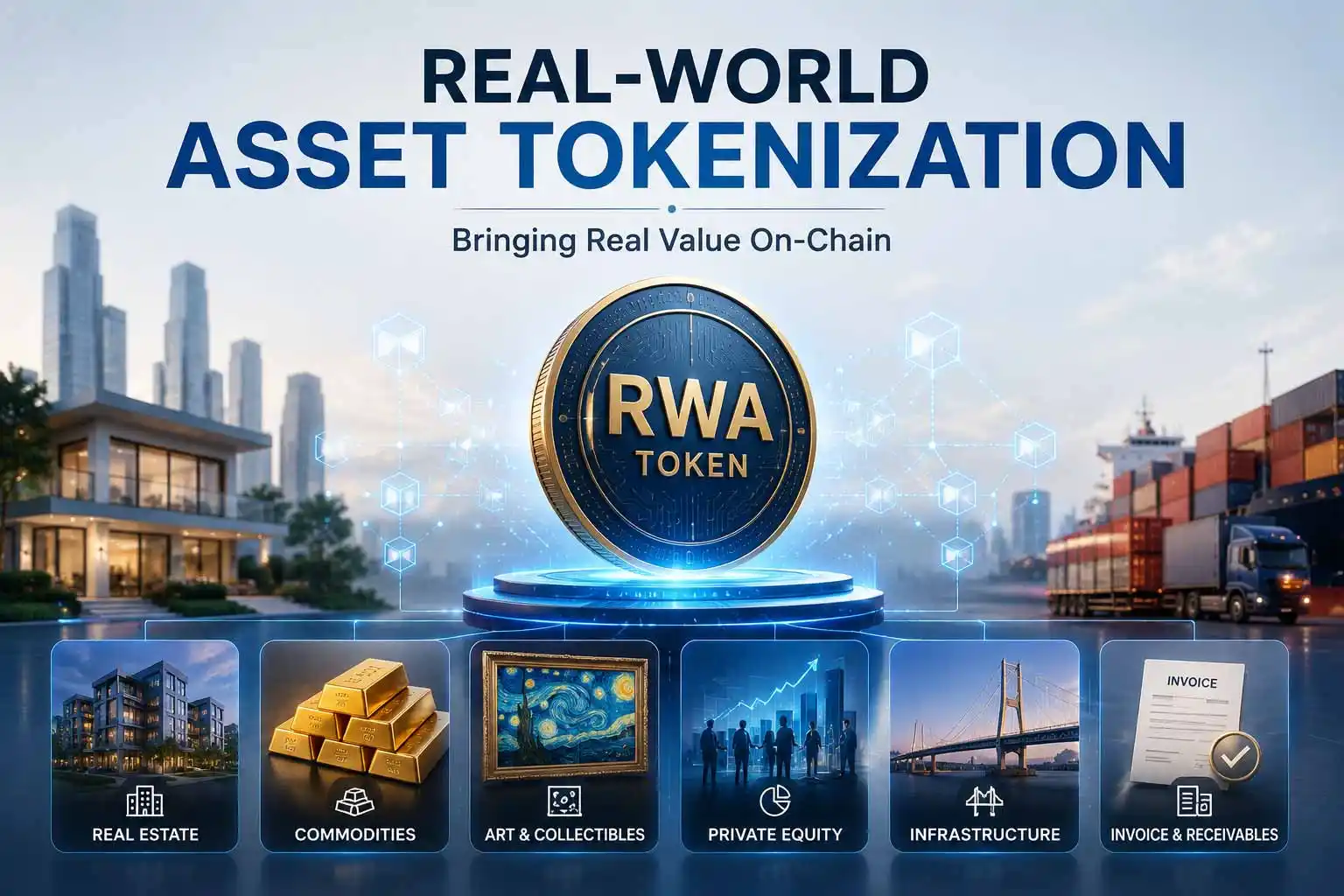

Real-world asset tokenization is the process of converting ownership rights in a physical or financial asset, such as real estate, bonds, private credit, or commodities, into a digital token recorded on a blockchain. It gives traditionally illiquid assets fractional ownership, faster settlement, and broader investor access, while keeping every transaction transparent, traceable, and verifiable.
If you’ve been following this series, you already know how blockchain infrastructure is reshaping the way we verify identity, credentials, and ownership. In the earlier installments, we walked through how decentralized verification systems cut down on fraud and how notarization moved from a physical office to a phone screen. Real-world asset tokenization is the natural next chapter in that story. It takes the same trust architecture, verifiable, tamper-resistant, and instantly auditable, and applies it to something even bigger: the ownership of the assets that make up the global economy. Businesses exploring this space often start by working with a technology partner that already understands both the blockchain layer and the compliance layer, which is exactly the kind of work covered under Bantech’s blockchain and NFT development services.
This isn’t a hypothetical trend piece riding a hot search wave. The numbers behind it are moving fast enough that even skeptics are paying attention.
What Real-World Asset Tokenization Actually Means
Let’s strip away the jargon for a second. Tokenization, at its core, means taking something that exists in the physical or traditional financial world, a building, a bond, a bar of gold, a slice of private credit, and creating a digital representation of it on a blockchain. That digital representation, or token, carries the legal and economic rights tied to the underlying asset. Own the token, and depending on how it’s structured, you own a claim on the asset, a share of its cash flows, or both.
This is different from cryptocurrencies like Bitcoin, which aren’t backed by any external asset. A tokenized Treasury bond, by contrast, is backed one-to-one by an actual bond sitting in custody somewhere. The blockchain doesn’t replace the legal structure of ownership, it sits on top of it, acting as a faster, more transparent settlement and record-keeping layer.
Why does this matter? Because traditional asset ownership is clunky. Buying a fraction of a commercial building, transferring bond ownership across borders, or verifying who owns what in a private credit deal usually involves paperwork, intermediaries, and days or weeks of settlement time. Tokenization compresses that timeline to minutes, removes several layers of intermediaries, and creates a single, auditable source of truth that every party can check independently.
Why 2026 Is Being Called the Tipping Point
For years, tokenization was treated as a proof-of-concept exercise, interesting in theory, thin on real adoption. That has changed dramatically. According to a market report covering Q1 2026, the total value of tokenized real-world assets on-chain grew from around $21 billion at the start of the year to approximately $27.5 billion by the end of the first quarter alone, a 30% jump in three months. By early July 2026, on-chain distributed value tracked by industry aggregator rwa.xyz had climbed to roughly $33.5 billion, with a representative underlying asset value near $388.5 billion.
That kind of quarter-over-quarter growth doesn’t happen because of hype. It happens because the institutions that run global capital markets have started building the infrastructure themselves. Nasdaq, the New York Stock Exchange, and the Depository Trust and Clearing Corporation have all moved toward integrating tokenized securities directly into the existing architecture of regulated markets rather than treating tokenization as a side experiment. The DTCC launched a pilot for tokenized securities trading in mid-2026, and the SEC approved Nasdaq’s proposal allowing certain stocks to be traded and settled through tokens, a meaningful signal that regulators are no longer just watching from the sidelines.
Tokenized U.S. Treasuries have become the anchor product of the entire category, surpassing $10 billion by late February 2026 and continuing to climb from there, driven in large part by asset managers building on-chain money market products. Tokenized commodities, largely gold-backed, reached roughly $7.3 billion in the same period. Meanwhile, in Europe, the European Central Bank confirmed that distributed ledger technology assets are now eligible collateral for Eurosystem credit operations as of March 30, 2026, formally recognizing tokenized instruments within the plumbing of the eurozone’s monetary system.
Put simply, 2026 is the year tokenization stopped being a blockchain conference talking point and started showing up in the actual settlement rails of the financial system.
The Regulatory Shift That Made This Possible
None of this growth would matter without regulatory clarity, and that’s the piece that finally started falling into place this year. On January 28, 2026, the SEC’s Division of Corporation Finance, Division of Investment Management, and Division of Trading and Markets issued a joint statement on tokenized securities. The core message was straightforward: tokenization doesn’t change the legal nature of the underlying asset. If it’s a security before tokenization, it remains a security after tokenization, and existing federal securities laws apply.
That clarification mattered enormously because it removed years of ambiguity that had kept larger institutions on the sidelines. As the World Economic Forum noted in its outlook on digital assets for 2026, regulatory clarity is one of the central forces enabling increased adoption and scalability of tokenized assets, alongside blockchain’s shift from experimental technology to enterprise-grade infrastructure. The Forum’s assessment lines up closely with what’s actually happening on the ground: asset managers, custodians, and market infrastructure providers are treating 2026 as the year to move from pilot programs to production deployments.
On the legislative side, the GENIUS Act established the first federal regulatory framework for dollar-pegged stablecoins, requiring issuers to back tokens with full reserves and provide mandated monthly disclosures. A companion bill working through Congress, often referred to as the Clarity Act, aims to formally distinguish digital commodities from securities and codify registration requirements for brokers and dealers handling digital assets. Together, these developments have given institutional players the “rules of the road” they’d been waiting for before committing serious capital to tokenized products.
Where the Growth Is Actually Happening
Not every asset class is tokenizing at the same pace, and that’s an important nuance often lost in headline numbers. A recent industry report tracking roughly $60 billion in tokenized real-world assets across more than 7,000 products and 12 asset classes found that the market, while growing quickly, remains uneven and heavily concentrated. US Treasuries stand out as the only asset class to reach what analysts describe as production-grade maturity, with tokenized Treasury debt reaching around $15 billion across roughly 100 distinct assets, and a meaningful share of those tokens moving freely on public blockchain rails rather than sitting locked inside closed, permissioned ledgers.
Other categories tell a more complicated story. A Forbes analysis published in July 2026 highlighted what it called an “activity paradox” in the broader tokenized asset market: over $32.9 billion worth of tokens across more than 900 assets show zero weekly transfer activity. Much of that inactivity isn’t necessarily a red flag, it often reflects tokens designed for permissioned institutional use rather than public trading, such as tokenized commodity contracts that are minted when a deal is signed and burned when the underlying goods are delivered. Still, the report pointed to a genuine access gap, describing a “waiting room” effect where a small number of products account for the overwhelming majority of active trading, while the rest of the market waits for broader distribution, clearer secondary market infrastructure, and mainstream investor access.
This is a useful reminder that tokenization isn’t a single monolithic trend. Tokenized Treasuries are maturing into everyday financial infrastructure. Tokenized real estate, private credit, and equities are earlier in their adoption curve, growing fast in percentage terms but still building the ecosystem, custody arrangements, and secondary liquidity needed to reach the same level of maturity.
Why Businesses Should Care Right Now
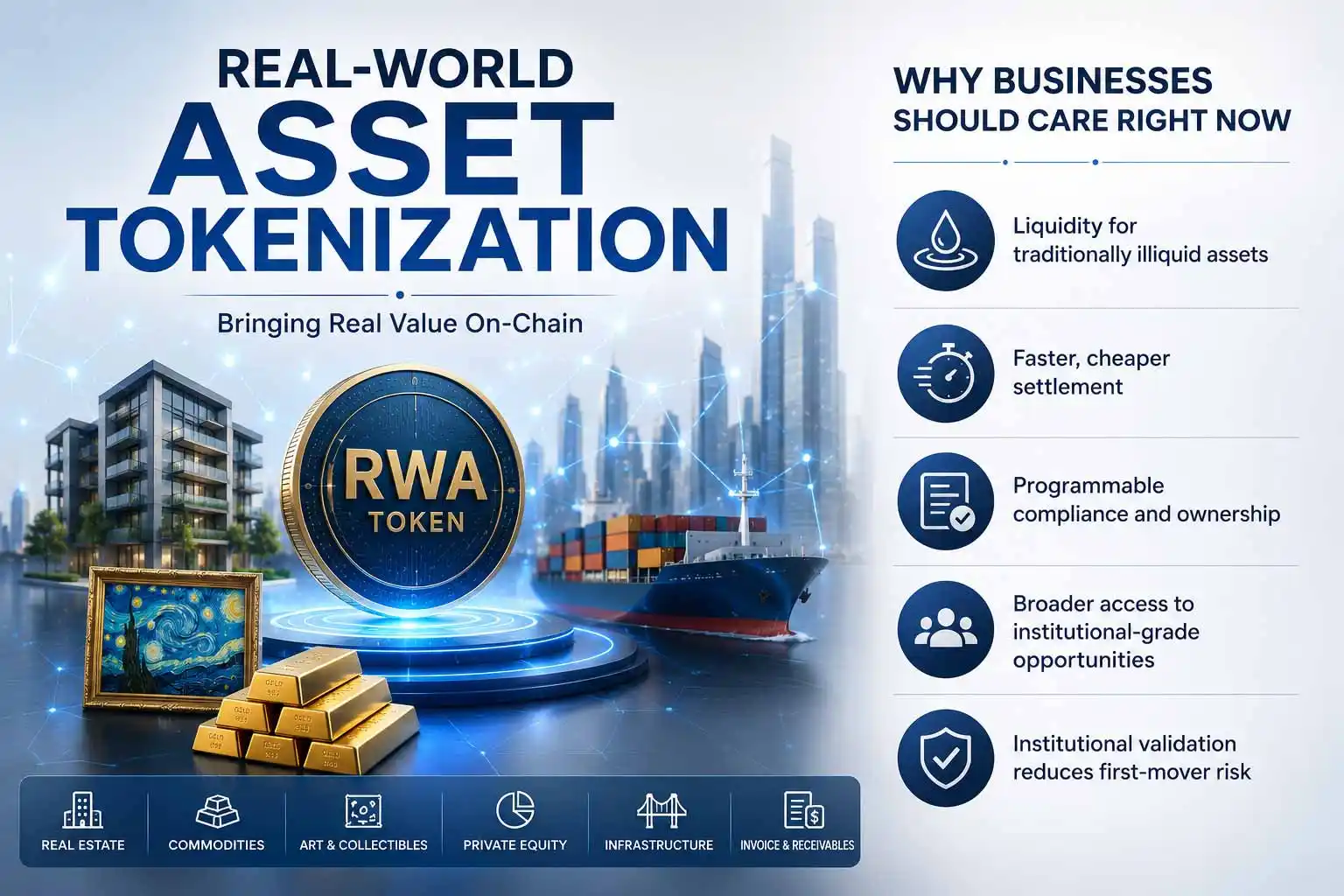
If you run a business that touches real estate, private credit, commodities, supply chain finance, or any asset class where ownership records and liquidity have historically been a bottleneck, 2026 is the moment to start paying close attention. A handful of practical reasons stand out.
Liquidity for traditionally illiquid assets. Commercial real estate, fine art, private equity stakes, and infrastructure projects have always suffered from a liquidity problem: it’s hard to sell a fraction of a building or a slice of a private credit deal without a lengthy, expensive process. Tokenization allows these assets to be broken into smaller, tradable units, opening them up to a much wider pool of potential buyers and creating secondary markets that didn’t exist before.
Faster, cheaper settlement. Traditional asset transfers, especially across borders, often take days and involve multiple intermediaries, each adding cost and friction. Blockchain-based settlement can compress that timeline dramatically, sometimes to near-instant finality, while cutting out layers of custodial and administrative overhead.
Programmable compliance and ownership. Smart contracts can encode compliance rules directly into the token itself, automatically restricting transfers to verified, accredited, or jurisdictionally eligible investors. This reduces the manual compliance burden that traditionally made fractional ownership structures expensive to administer. Because these systems handle sensitive ownership and financial data, they also need to meet the same rigorous data protection and regulatory standards that govern any financial platform, which is where dedicated security and compliance frameworks become essential rather than optional.
Broader access to institutional-grade opportunities. Historically, many of the best-performing private market opportunities, real estate developments, private credit funds, infrastructure projects, were reserved for institutional investors or high-net-worth individuals who could meet high minimum investment thresholds. Tokenization, paired with fractional ownership, has the potential to lower those thresholds meaningfully, though regulatory frameworks around investor accreditation still apply and are evolving alongside the technology.
Institutional validation reduces first-mover risk. When Nasdaq, the NYSE, the DTCC, and the ECB all move in the same direction within a matter of months, it changes the risk calculus for mid-sized businesses considering their own tokenization strategy. You’re no longer betting on unproven technology, you’re adopting infrastructure that the largest players in global finance are actively building around.
The Practical Path: What Building a Tokenization Strategy Actually Involves
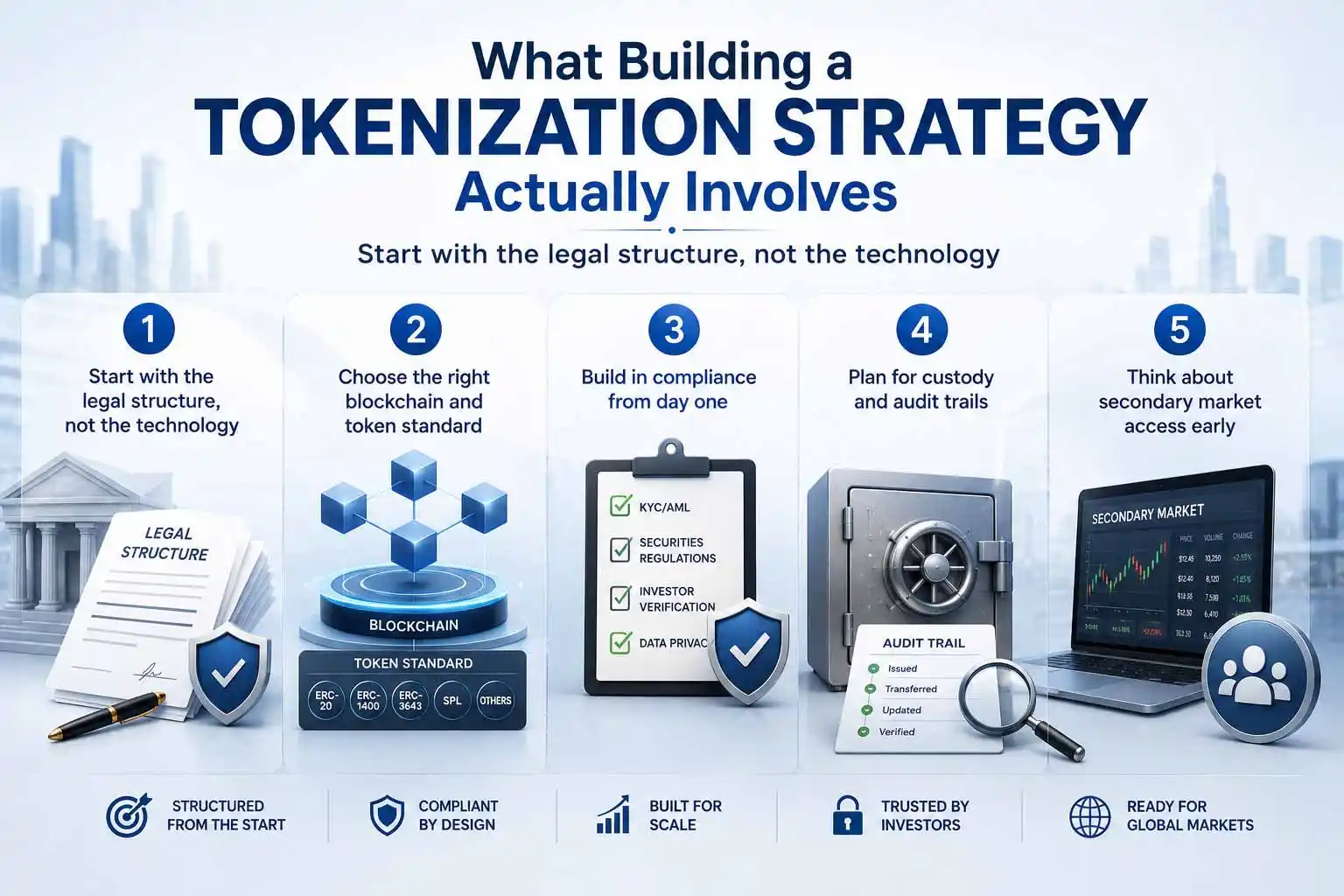
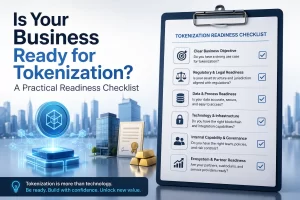
For a business exploring tokenization for the first time, the process generally follows a few key stages, and skipping any of them tends to create problems down the road.
Start with the legal structure, not the technology. The blockchain layer is often the easiest part. What determines whether a tokenization project succeeds or collapses under regulatory scrutiny is how the underlying legal wrapper is structured, whether that’s a special purpose vehicle, a trust, or a direct securities offering. Getting this wrong means the token has no enforceable legal claim behind it, no matter how well the smart contract is written.
Choose the right blockchain and token standard. Different assets, and different regulatory jurisdictions, call for different technical approaches. A private, permissioned blockchain might make sense for an institutional private credit fund that needs to restrict participation to accredited investors, while a public chain with built-in compliance controls might suit a tokenized real estate offering aimed at a broader retail base. This decision affects everything from transaction costs to how easily the token can eventually plug into public secondary markets.
Build in compliance from day one. Know-your-customer and anti-money-laundering checks, investor accreditation verification, and transfer restrictions all need to be embedded into the smart contract logic itself, not bolted on afterward. This is one of the areas where the line between “interesting blockchain project” and “investable financial product” gets drawn.
Plan for custody and audit trails. Institutional investors, and increasingly regulators, expect clear answers about who is holding the underlying asset, how it’s insured, and how ownership records reconcile between the on-chain token and the off-chain legal reality. Skipping this step is one of the most common reasons early tokenization projects lose institutional trust.
Think about secondary market access early. As the Forbes reporting on market activity illustrated, a token with no path to a liquid secondary market risks becoming exactly the kind of inactive, “waiting room” asset that undermines the whole value proposition of tokenization in the first place. Businesses that plan for exchange listings, over-the-counter desks, or dedicated marketplace integrations from the outset tend to see meaningfully better liquidity outcomes than those that treat distribution as an afterthought.
The Risks Nobody Should Gloss Over
It’s tempting, especially in a piece about a fast-growing trend, to skip past the downside. That would be a disservice, so let’s be direct about the real risks involved.
Tokenization does not eliminate credit risk. A tokenized bond backed by a shaky issuer is still a shaky investment, the blockchain layer just makes the ownership record faster and more transparent, it doesn’t improve the underlying fundamentals of the asset. Investors who treat “tokenized” as a synonym for “safer” are making a category error that could prove costly.
Regulatory frameworks, while clearer than they were a year ago, are still evolving and vary significantly by jurisdiction. A tokenization structure that’s fully compliant in one country may run into licensing or securities-law obstacles in another, which matters enormously for any business planning to offer tokenized products to a global investor base. Cross-border tokenization projects in particular need ongoing legal review as rules continue to shift.
Liquidity, as the Forbes data on inactive tokens makes clear, is not guaranteed simply by putting an asset on a blockchain. A token with no active secondary market is arguably less useful than a traditional illiquid asset, because it creates the illusion of tradability without the substance. Businesses need a genuine distribution and market-making strategy, not just a smart contract.
Finally, smart contract risk is real. Bugs, poorly audited code, or oracle failures (the systems that feed real-world data into blockchain applications) have caused significant losses across the broader digital asset industry. Any tokenization project handling meaningful capital should budget for independent security audits as a non-negotiable line item, not an afterthought squeezed in at the end of development.
None of this is a reason to avoid tokenization. It’s a reason to approach it the way any serious financial infrastructure decision deserves to be approached: with realistic expectations, experienced legal counsel, and a technology partner who understands both the blockchain mechanics and the regulatory terrain surrounding them.
What This Means Looking Beyond 2026
Analysts differ on exact projections, which is normal for a market moving this fast, but the directional consensus is consistent. Some industry researchers point to a market that could reach the low single-digit billions by 2030 if growth continues along its current trajectory in specific asset classes, while others, including digital assets researchers at major banks, have floated far more ambitious multi-trillion-dollar projections for the broader decentralized finance ecosystem by the end of the decade. What matters more than any single number is the pattern underneath it: institutional infrastructure providers, regulators, and asset managers are all moving in the same direction at the same time, and that kind of alignment rarely reverses once it takes hold.
For businesses that have already invested in verifiable digital identity and credential systems, which we covered earlier in this series, tokenization represents a logical extension rather than a separate technology bet. The same principles, verifiable ownership, tamper-resistant records, and programmable trust, apply just as naturally to a Treasury bond or a commercial property as they do to a professional credential or a notarized document.
Getting Started the Right Way
Real-world asset tokenization sits at the intersection of financial engineering, legal structuring, and blockchain development, and getting any one of those three wrong can undermine the entire project. Businesses that succeed tend to work with partners who understand all three dimensions simultaneously rather than treating tokenization as a purely technical exercise.
If your business is evaluating whether tokenization fits your asset base, the smartest first step isn’t picking a blockchain, it’s mapping out the legal structure, compliance requirements, and custody arrangements your specific asset class demands, and only then choosing the technical architecture that supports it. That sequencing is what separates tokenization projects that attract real institutional capital from those that remain interesting experiments with no path to liquidity.
2026 has given the market something it never had before: regulatory clarity, institutional infrastructure, and genuine trading volume in at least one mature asset class. Whether your business is exploring tokenized real estate, private credit, or a completely different asset category, the tools, legal precedent, and market appetite now exist to build something real, not just something experimental.
Continue reading the Complete Blockchain Series
This post is a part of the Blockchain Content Series — the complete 5 article series to understanding, implementing, and scaling enterprise blockchain and tokenization in your organization.