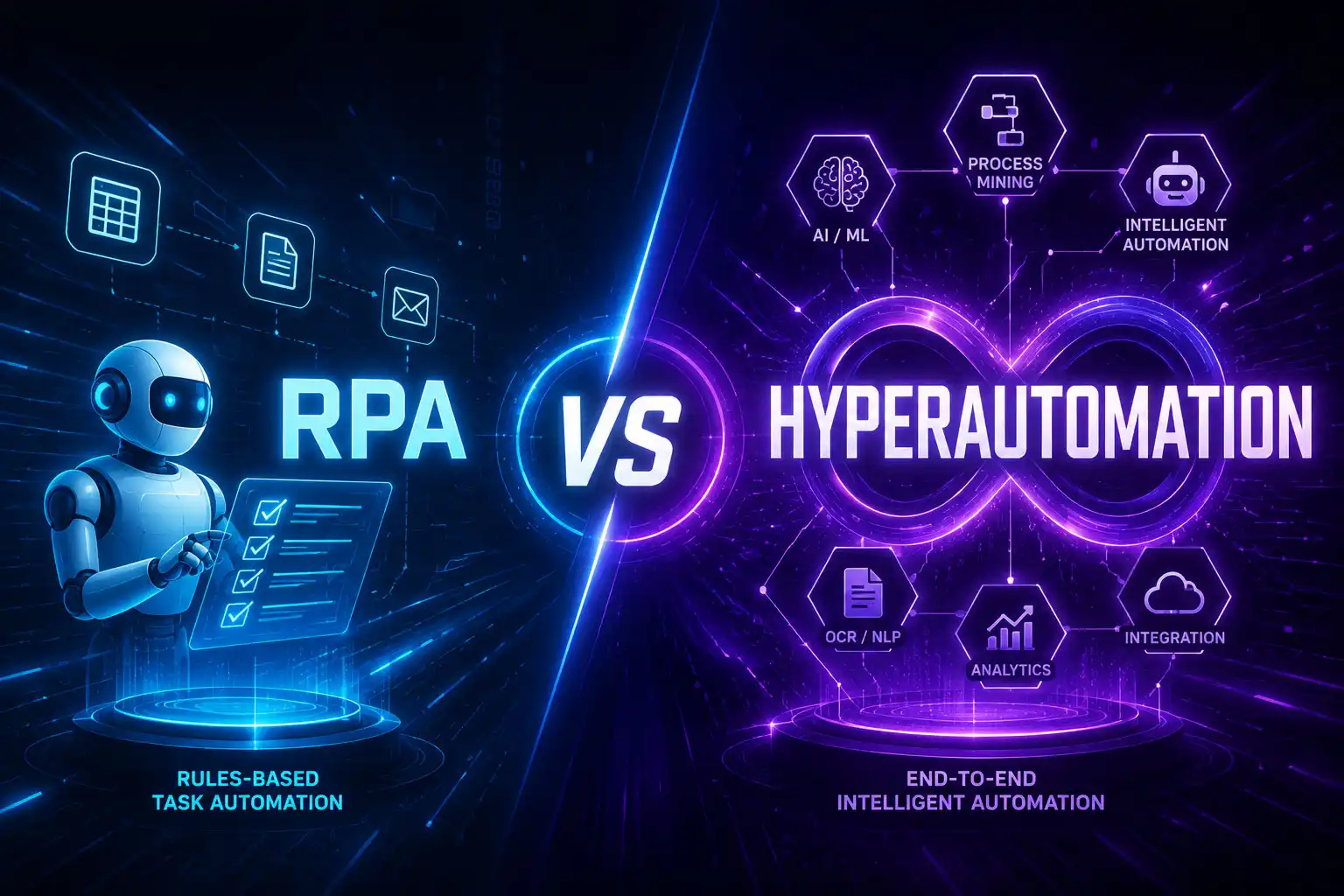
If you have spent any time researching automation for your organization, you have almost certainly encountered both of these terms — robotic process automation (RPA) and hyperautomation — sometimes used interchangeably, sometimes as if one is simply a newer version of the other. Neither assumption is quite right, and the confusion matters more than it might seem.
Choosing the wrong automation approach is not just a technical misstep. It can mean investing significant time and budget into a solution that delivers short-term efficiency gains but hits a hard ceiling, leaving your organization stuck when the next wave of complexity arrives. Or it can mean overengineering a solution for a problem that a simpler, faster, and cheaper tool would have handled perfectly.
The global hyperautomation market reached USD 68.2 billion in 2026 and is projected to grow to USD 278.3 billion by 2035. At the same time, the RPA market — far from disappearing — is projected to grow from USD 27.22 billion in 2026 to USD 110.06 billion by 2034. Both markets are expanding rapidly because both technologies are genuinely valuable, just in different contexts and at different levels of organizational maturity.
This article draws a clear, practical line between the two. By the end, you will know exactly what each approach does, where it excels, where it falls short, and — most importantly — how to decide which one is the right starting point for your organization right now.
What Is RPA? A Focused Recap
Robotic Process Automation is a technology that uses software bots to mimic human interactions with digital systems. An RPA bot can log into an application, navigate its interface, copy data from one system and paste it into another, fill out forms, generate reports, and trigger actions — all at a speed and consistency that no human team can match on repetitive, high-volume work.
The defining characteristics of RPA are its rule-based logic and its reliance on structured inputs. A well-configured RPA bot follows an explicit script: if this condition is met, take this action; if that condition is met, take that action. There is no ambiguity, no interpretation, and no learning. The bot does exactly what it was told, every time, with no variation.
This is both RPA’s greatest strength and its most fundamental limitation.
The strength is reliability and speed on predictable work. RPA bots do not get tired, do not make transcription errors, and can operate around the clock without breaks. For high-volume, rule-based tasks — processing invoices from a standardized template, migrating data between two systems with consistent formats, generating end-of-day compliance reports — RPA delivers fast, measurable ROI with relatively low implementation complexity.
The limitation becomes visible the moment the real world intrudes. RPA bots follow rigid scripts and break when screen layouts change, data formats deviate from the expected structure, or an exception arises that the original script did not anticipate. In production environments, as one analysis of enterprise automation deployments put it, RPA handles the “happy path” brilliantly — but introduce an unexpected data format or a system timeout, and the bot fails. Human workers then spend time managing bot exceptions rather than doing strategic work, which erodes a significant portion of the efficiency gains RPA was deployed to deliver.
What Is Hyperautomation? A Strategic Reframe
Hyperautomation is not a single technology. It is a strategy — specifically, an enterprise-wide approach to automating as many business and IT processes as possible by orchestrating a coordinated combination of technologies, of which RPA is just one component.
Where RPA asks “how do we automate this task?”, hyperautomation asks a fundamentally different question: “across this entire organization, which processes are slowing us down, costing us money, or creating errors — and how do we systematically eliminate those friction points end to end?”
The technologies that hyperautomation brings together include RPA for rule-based task execution; artificial intelligence and machine learning for decision-making on unstructured or ambiguous inputs; natural language processing for understanding documents, emails, and voice interactions; process mining for discovering and mapping how workflows actually operate in practice; low-code platforms that enable non-technical employees to build and modify automations; and integration middleware that connects disparate enterprise systems so data can flow seamlessly between them.
Each of these technologies addresses a different layer of complexity. Together, they form what practitioners describe as an automation fabric — a coherent, governed, continuously improving system that spans the entire enterprise rather than sitting in a single department or addressing a single workflow step.
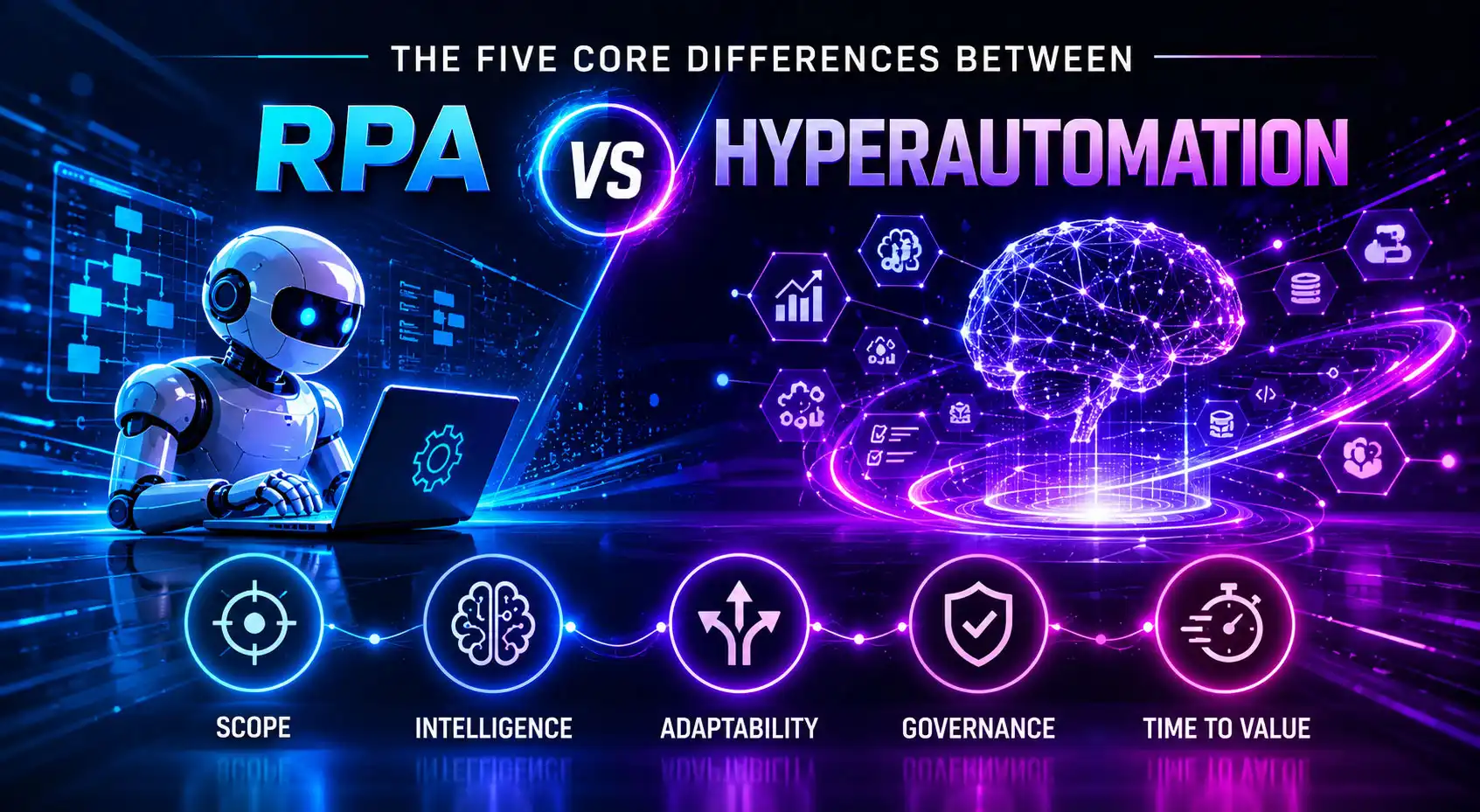
The Five Core Differences Between RPA and Hyperautomation

Understanding the distinction between RPA and hyperautomation is easier when you look at five specific dimensions: scope, intelligence, adaptability, governance, and time to value.
1. Scope: Tasks versus End-to-End Processes
RPA operates at the task level. It automates individual, discrete steps within a larger workflow — entering data, generating a document, sending a notification. The workflow itself remains largely unchanged; RPA simply makes one part of it faster and more accurate.
Hyperautomation operates at the process level. Its goal is the end-to-end automation of entire workflows — from the moment a business event triggers an action to the moment that action is fully resolved, with every step in between handled intelligently and automatically. This means crossing departmental boundaries, spanning multiple systems, and handling both structured and unstructured data within a single orchestrated flow.
An accounts payable workflow illustrates the difference clearly. RPA can automate the data entry step — extracting fields from a standardized invoice and populating an ERP system. Hyperautomation automates the entire workflow: ingesting invoices in any format via intelligent document processing, cross-referencing them against purchase orders, applying AI-driven exception handling when something does not match, routing approvals based on organizational rules, and updating financial records — all without human involvement unless a genuinely unusual situation requires judgment.
2. Intelligence: Rules versus Decision-Making
RPA follows explicit, predefined rules. It cannot handle ambiguity, interpret unstructured content, or make probabilistic decisions. Its logic is essentially binary: if the input matches the expected pattern, proceed; if it does not, escalate to a human.
Hyperautomation incorporates AI and machine learning, which means it can process unstructured inputs — a handwritten note, a customer email, a scanned document — and make intelligent decisions based on context, patterns, and learned experience. Over time, machine learning components improve their accuracy as they process more data, making the system smarter rather than merely faster.
This distinction is not academic. In the real world, a large proportion of business inputs are unstructured or semi-structured — emails, PDFs, forms in non-standard layouts, voice messages, images. RPA cannot touch these inputs without significant pre-processing. Hyperautomation can handle them natively.
3. Adaptability: Fragility versus Resilience
One of the most frequently cited limitations of RPA in enterprise deployments is fragility. RPA bots are tightly coupled to the specific interfaces and data formats they were trained on. When an application updates its UI, when a supplier sends an invoice in a slightly different layout, or when a system introduces a new field, bots break. Maintenance burden is one of the top challenges reported by organizations with large RPA deployments.
Hyperautomation’s AI components are fundamentally more resilient. Machine learning models generalize from experience rather than following a fixed script, which means they can handle variation and exceptions without breaking. Process mining continuously monitors how workflows are actually executing and flags deviations. The system as a whole is designed to adapt rather than fail.
4. Governance: Siloed versus Enterprise-Wide
RPA deployments are frequently siloed. A finance team implements a bot for invoice processing. An HR team implements a bot for onboarding paperwork. An IT team implements a bot for routine ticketing. Each deployment is managed independently, with its own logic, its own maintenance requirements, and no shared visibility into how automation is performing across the organization.
Hyperautomation requires — and enforces — enterprise-wide governance. It introduces centralized logging, auditing, version control, and policy enforcement across all automation initiatives. It treats automation as a portfolio rather than a collection of isolated projects, which enables organizations to measure ROI holistically, identify redundancies, manage risk consistently, and make strategic decisions about where to invest next.
Forrester has noted that over 60% of automation projects fail due to integration and governance gaps — a problem that hyperautomation’s architectural approach is specifically designed to prevent.
5. Time to Value: Fast Tactical Gains versus Long-Term Transformation
RPA is quick to deploy. An experienced team can configure a bot for a well-defined task in days or weeks. The ROI is visible quickly and is easy to measure. This makes RPA an excellent entry point for organizations new to automation — it delivers fast wins that build organizational confidence and demonstrate the value of investing further.
Hyperautomation takes longer to implement and requires a more substantial organizational commitment. It involves technology procurement and integration, process discovery and redesign, governance framework development, and change management. The payoff is correspondingly larger — not incremental efficiency gains on individual tasks, but transformational improvements across entire business functions.
The Relationship Between RPA and Hyperautomation
It is important to understand that RPA and hyperautomation are not competing alternatives. RPA is a component of hyperautomation. Every mature hyperautomation deployment uses RPA bots as part of its execution layer — they remain the most efficient tool for handling the rule-based, structured steps within a larger automated workflow.
The relationship is better understood as a maturity journey. Most organizations begin with RPA: they identify a high-volume, repetitive task, configure a bot to handle it, and measure the results. This is a legitimate and valuable starting point. It builds the internal capability, process documentation, and stakeholder confidence needed to tackle more ambitious automation initiatives.
As automation maturity grows, the limitations of task-level RPA become apparent. Processes that involve unstructured data, complex decision-making, or cross-departmental handoffs cannot be fully automated with RPA alone. This is the natural inflection point at which organizations begin adding AI, process mining, and integration layers — transitioning from a collection of RPA deployments to a coherent hyperautomation strategy.
For a practical framework on how to assess your organization’s current automation maturity and chart a path toward hyperautomation, Business Automation Projects is a widely used reference that maps the progression from basic task automation through to enterprise-wide hyperautomation.
Where RPA Still Wins
Given the narrative above, it would be easy to conclude that RPA is simply a less sophisticated predecessor to hyperautomation and that any serious organization should bypass it entirely. That conclusion would be wrong.
RPA remains the right tool for a wide range of use cases — specifically, those characterized by structured inputs, well-defined rules, high volume, and low variability. Data migration between legacy systems, report generation from existing databases, scheduled file transfers, form population from standardized templates — all of these are tasks where RPA delivers exceptional ROI with minimal implementation complexity.
There are also organizational contexts where hyperautomation is premature. If a business has not yet developed the internal process documentation, data infrastructure, and cross-functional alignment needed to support enterprise-wide automation governance, starting with hyperautomation will produce a costly and fragmented result. RPA’s lower barrier to entry makes it the appropriate first step for organizations that are early in their automation journey.
The key question is not “is RPA good enough?” but rather “what is the right tool for this specific problem at this specific stage of our automation maturity?”
Where Hyperautomation Is the Right Choice
Hyperautomation becomes the appropriate choice when the problem you are solving has characteristics that RPA cannot handle: unstructured inputs, multi-step cross-system processes, intelligent exception handling, or the need for continuous improvement based on real-world performance data.
Specific triggers that signal it is time to move beyond RPA include a growing backlog of bot maintenance work as underlying systems change; automation initiatives that keep stalling at process boundaries where data is unstructured or decision-making is required; difficulty measuring the aggregate ROI of a growing portfolio of isolated bot deployments; regulatory requirements for comprehensive audit trails and centralized governance; and strategic ambitions that require automating not just tasks but entire business functions.
IDC forecasts that by 2026, 70% of large enterprises will have deployed hyperautomation to optimize their production and operating models — a number that reflects how rapidly the technology has moved from early-adopter territory into mainstream enterprise strategy.
A Practical Decision Framework
When evaluating whether to use RPA or hyperautomation for a given initiative, consider the following questions:
Is the input always structured and predictable? If yes, RPA may be sufficient. If inputs vary in format, content, or language, you need AI-enhanced processing.
Does the process involve decision-making beyond binary if-then logic? If decisions require context, probability, or learning from historical data, RPA alone will not suffice.
Does the process cross multiple systems or departments? Single-system, single-department tasks are good candidates for RPA. Multi-system, cross-functional processes need the orchestration layer that hyperautomation provides.
How important is resilience? If the underlying systems change frequently or the process must handle exceptions gracefully without human intervention, hyperautomation’s adaptive capabilities are essential.
What is your current automation maturity? If you are new to automation, start with RPA on a clearly defined, high-volume task. If you have existing RPA deployments and are hitting their limits, the evidence is telling you it is time to scale to hyperautomation.
For a vendor-neutral perspective on how to evaluate these tradeoffs in the context of your specific industry and technology stack, the 2026 Guide of Best RPA Tools provides an annually updated assessment of the leading platforms and their relative strengths across both RPA and hyperautomation capabilities.
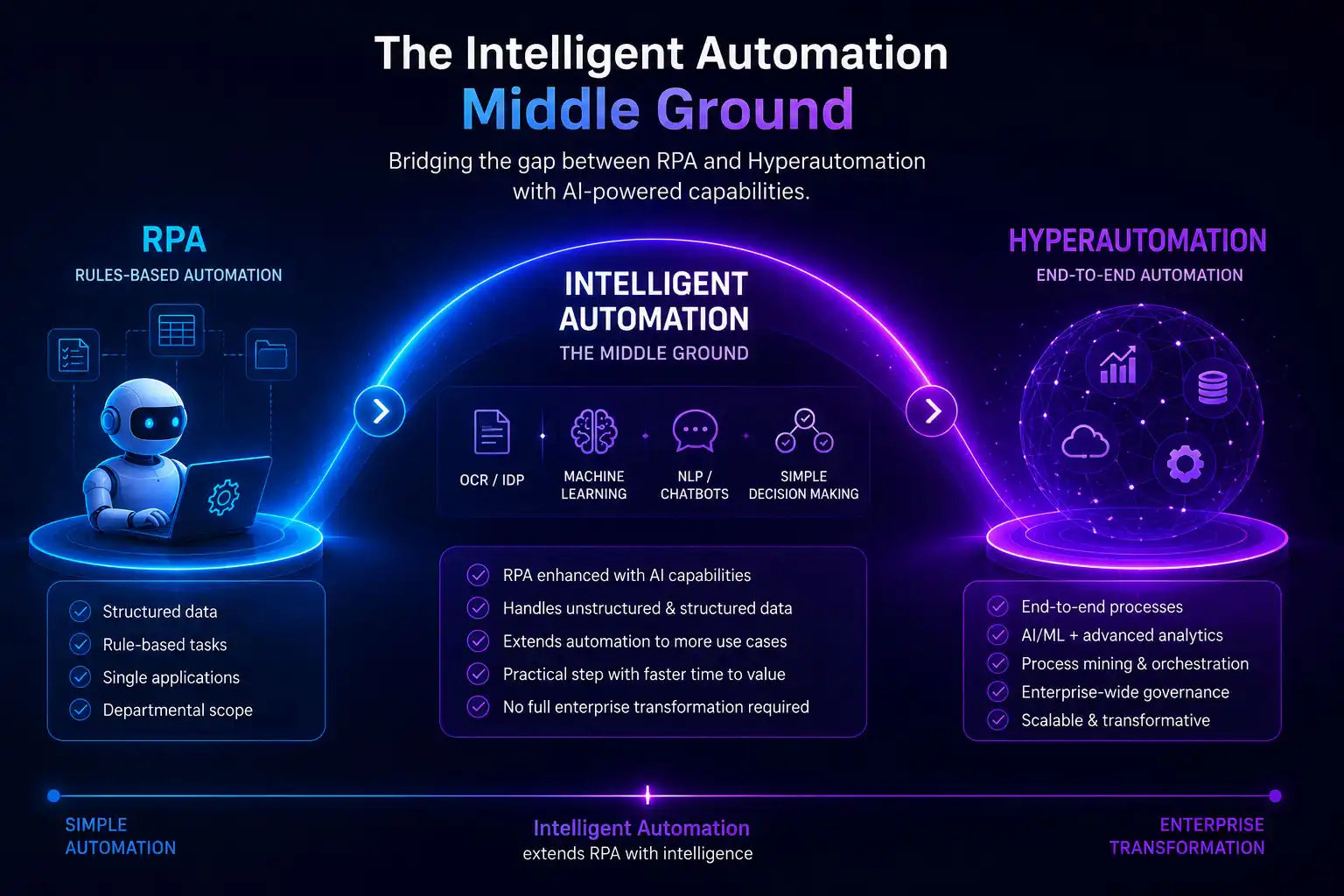
The Intelligent Automation Middle Ground

One term that appears with increasing frequency in this discussion is intelligent automation — a category that sits between pure RPA and full hyperautomation. Intelligent automation typically refers to RPA enhanced with AI capabilities, such as machine learning-based document processing or NLP-driven chatbot integration, without the full enterprise governance and process mining framework that characterizes mature hyperautomation.
For many organizations, intelligent automation represents a practical intermediate step: it extends the reach of RPA into unstructured data and simple decision-making while stopping short of the organizational and architectural transformation that hyperautomation requires. It is worth understanding this category because many platforms market their offerings as intelligent automation, and the capabilities it delivers may be sufficient for a significant portion of your automation roadmap without requiring the full investment that enterprise hyperautomation demands.
What This Means for Your Organization in 2026
The conversation in enterprise technology circles has shifted noticeably in the past two years. RPA is no longer positioned as a destination — it is widely understood as a foundational capability, a step on the journey rather than the journey itself. The organizations that invested early in RPA deployments are now sitting on a large portfolio of bots that require growing maintenance investment and are bumping up against process boundaries they cannot cross.
The strategic question for most enterprises in 2026 is not whether to adopt hyperautomation, but how fast to move and how to sequence the transition without disrupting the RPA investments that are already delivering value.
The answer, in most cases, is to treat existing RPA deployments as assets rather than liabilities. A well-governed hyperautomation platform can incorporate existing bots into larger orchestrated workflows, extending their value rather than replacing them. The transition is additive, not subtractive — and that is a message worth communicating clearly to the stakeholders who championed the initial RPA investments.
Conclusion
RPA and hyperautomation are not rivals. They are complementary technologies operating at different levels of scale and sophistication, serving different needs at different stages of organizational maturity.
RPA is fast to deploy, easy to justify, and excellent at automating the structured, rule-based, high-volume tasks that every organization has in abundance. It is the right starting point for most automation journeys and remains a core component of every mature hyperautomation deployment.
Hyperautomation is the strategic evolution of RPA — an enterprise-wide orchestration of multiple technologies that extends automation into complex, end-to-end processes involving unstructured data, intelligent decision-making, and cross-functional coordination. It is the approach that delivers transformational outcomes rather than incremental efficiency gains.
Understanding the difference is not an academic exercise. It is the foundation of an automation strategy that actually scales — one that starts delivering value quickly with RPA, builds organizational capability over time, and ultimately positions your business to operate at a level of efficiency and agility that was simply not possible a decade ago.
The organizations investing in that strategic clarity today are the ones that will look back on 2026 as the year they got serious about automation — not just as a cost-cutting measure, but as a genuine competitive advantage.
Hyperautomation Content Series
Continue the Complete Hyperautomation Guide
This post is a part of the Hyperautomation Content Series — the complete 8 article guide to understanding, implementing, and scaling hyperautomation in your organization.
What is hyperautomation?
Hyperautomation is a business-driven, disciplined approach that organizations use to rapidly identify, vet, and automate as many business and IT processes as possible by orchestrating multiple technologies including RPA, AI, machine learning, process mining, and low-code platforms.
Key Takeaways
- Hyperautomation is a strategy, not a single tool; it orchestrates RPA, AI, ML, NLP, process mining, and integration platforms.
- It targets end-to-end processes rather than isolated tasks and handles both structured and unstructured data.
- Organizations adopt it to achieve scalable efficiency, better governance, continuous improvement, and transformative ROI.
- RPA remains a core execution layer within hyperautomation rather than a competing technology.
- Success requires process discovery, strong governance, and a clear maturity roadmap.
Hyperautomation is a business-driven strategy that enables organizations to systematically identify and automate as many processes as possible across the enterprise. According to the official Gartner definition of hyperautomation, it involves the orchestrated use of multiple technologies, tools, or platforms to rapidly identify, vet, and automate business and IT processes. Teams looking to build these capabilities often partner with specialists in artificial intelligence solutions to ensure the AI and ML layers deliver real decision-making power rather than simple rule execution.
Unlike earlier automation approaches that focused on discrete, repetitive steps, hyperautomation asks a broader question: which processes across the entire organization create friction, cost, or risk, and how can technology eliminate those friction points end to end? The result is an adaptive system that improves over time rather than a collection of fragile bots.
Core Technologies That Power Hyperautomation
Hyperautomation works because it deliberately layers complementary technologies, each addressing a different part of the automation challenge.
Robotic process automation provides the reliable execution layer for structured, rule-based work. Bots interact with existing applications exactly as a human would, logging in, navigating screens, moving data, and completing high-volume tasks without changing the underlying systems.
Artificial intelligence and machine learning add the decision-making capability. These components process unstructured inputs such as emails, scanned documents, images, and free-text notes, then make probabilistic judgments based on patterns and context. Machine learning models improve accuracy as they process more data.
Natural language processing enables systems to understand and generate human language, powering intelligent document processing, chat interfaces, and voice-driven workflows.
Process mining analyzes event logs from existing systems to create accurate maps of how work actually flows. This reveals bottlenecks, variations, and automation opportunities that process documentation alone often misses.
Low-code and no-code platforms allow business users to build and modify workflows quickly, expanding the pace of automation beyond the capacity of specialized development teams.
Integration platforms and middleware connect disparate systems so data flows seamlessly between ERPs, CRMs, legacy applications, and cloud services. Without reliable integration, automation initiatives stall at system boundaries.
Together these technologies form what practitioners call an automation fabric: a governed, continuously improving system that spans the enterprise rather than sitting in isolated departmental silos.
How Hyperautomation Differs from Traditional Automation and RPA
Traditional automation targets individual tasks with fixed rules. It works well when inputs are structured and processes never change, but it breaks when exceptions appear or systems update. RPA improved on this model by making task automation faster and less invasive, yet pure RPA remains limited to the happy path of predictable work.
Hyperautomation operates at a different scale and intelligence level. It aims for end-to-end process automation that crosses departmental boundaries and systems. It incorporates AI so the system can interpret unstructured data and handle exceptions intelligently. It includes process mining so opportunities are discovered continuously rather than through one-time workshops. And it enforces enterprise-wide governance so automation becomes a managed portfolio instead of a collection of independent projects.
The relationship is complementary. As explained in the detailed comparison of RPA vs hyperautomation, RPA remains the most efficient tool for the structured execution steps inside a larger hyperautomated workflow. Most mature hyperautomation deployments still rely heavily on RPA bots for the rule-based portions of the process.
Primary Focus and Business Benefits
The primary focus of hyperautomation is the systematic elimination of unnecessary human involvement in routine, data-intensive processes while simultaneously augmenting the work that benefits from human judgment. It is not simply about replacing people. It is about redesigning how work gets done so teams can concentrate on higher-value activities.
Organizations that implement hyperautomation typically see several measurable benefits. Efficiency gains appear first as end-to-end cycle times compress from days to hours. Cost per transaction drops because software handles the volume. Accuracy and compliance improve because bots follow rules consistently and create automatic audit trails. Customer experience improves through faster resolution and 24/7 availability. Scalability becomes possible without proportional headcount growth. Decision quality rises as AI surfaces patterns from larger data sets than any manual team could process.
Research from McKinsey on the economic potential of generative AI and automation indicates that current technologies have the potential to automate activities that absorb 60 to 70 percent of employees’ time, supporting substantial productivity improvements when applied systematically across processes.
When Hyperautomation Makes Sense
Hyperautomation becomes the right choice when processes involve unstructured data, multiple systems, frequent exceptions, or cross-functional handoffs that pure RPA cannot handle cleanly. It also fits organizations that already have some RPA experience and are ready to move from tactical task automation to enterprise-wide process transformation.
Organizations early in their automation journey often begin with focused RPA projects to deliver quick wins and build internal capability. As maturity grows, they add process mining, AI, and governance layers, evolving naturally into a hyperautomation strategy. The complete guide to hyperautomation for 2026 outlines this maturity progression in practical detail.
Practical Implementation Considerations
Successful hyperautomation requires more than technology selection. Process discovery must precede automation so teams automate the right work rather than the work that is easiest to script. Governance frameworks covering logging, version control, policy enforcement, and ROI measurement prevent the siloed deployments that cause many automation programs to stall. Change management ensures employees understand how their roles evolve and how the new tools support better outcomes.
A mid-program assessment of data quality, system integration readiness, and organizational alignment usually reveals the highest-value next steps. Starting with a well-scoped pilot that spans multiple systems and includes both structured and unstructured inputs provides proof of concept while building the skills needed for broader rollout.
Mid-article CTA
Ready to move beyond isolated bots? Explore how a structured hyperautomation approach can transform your operations. Talk with our team about assessing your current automation maturity and identifying high-impact process opportunities.
Comparison: Traditional Automation vs RPA vs Hyperautomation
| Dimension | Traditional Automation | RPA | Hyperautomation |
| Scope | Single tasks | Discrete tasks | End-to-end processes |
| Intelligence | Fixed rules | Rule-based | AI + ML decision-making |
| Data types | Structured only | Mostly structured | Structured and unstructured |
| Adaptability | Low | Low (fragile to changes) | High (learns and adapts) |
| Governance | Minimal | Often siloed | Enterprise-wide |
| Time to value | Fast for simple tasks | Fast for focused tasks | Longer initial, larger long-term impact |
| Primary role | Task efficiency | Tactical automation | Strategic transformation |
Related Questions
What technologies are essential for hyperautomation?
The core stack includes RPA for execution, AI and machine learning for decisions, process mining for discovery, NLP for language understanding, low-code platforms for rapid development, and integration tools for system connectivity. Governance and analytics layers complete the fabric.
How does hyperautomation differ from intelligent automation?
Intelligent automation typically refers to RPA enhanced with AI for more complex tasks. Hyperautomation is broader: it is the enterprise-wide strategy of identifying and automating as many processes as possible using the full range of technologies, with strong emphasis on orchestration and continuous improvement.
Can small or mid-sized organizations benefit from hyperautomation?
Yes, provided they start with clear process prioritization and realistic scope. Many begin with RPA and selective AI components, then expand as capability and ROI justify further investment. The key is matching the approach to organizational maturity rather than attempting a full enterprise program immediately.
What is the biggest risk when adopting hyperautomation?
The most common risk is treating it as a pure technology project rather than a business transformation effort. Without process redesign, governance, and change management, organizations end up with expensive tools that deliver only incremental gains.
How long does it take to see results from hyperautomation?
Focused pilots can deliver measurable results in weeks to a few months. Enterprise-wide impact typically requires 12 to 24 months of sustained effort as process discovery, technology integration, and cultural adoption mature.
Final Thoughts
If your organization is ready to move from fragmented automation projects to a coherent hyperautomation strategy, our team can help assess current maturity, prioritize high-value processes, and design a practical roadmap. Contact Bantech Solutions to start the conversation and turn automation into lasting competitive advantage.
Is RPA part of hyperautomation?
Yes, RPA is a foundational component of hyperautomation. Hyperautomation uses robotic process automation as its primary execution layer for structured, rule-based tasks while layering AI, process mining, and orchestration to automate entire end-to-end processes.
Key Takeaways
- RPA is not replaced by hyperautomation; it is one of its essential building blocks.
- Hyperautomation orchestrates RPA bots together with AI, machine learning, process mining, and integration tools.
- Organizations typically start with RPA for quick wins and expand into full hyperautomation as maturity grows.
- Pure RPA handles predictable tasks; hyperautomation adds intelligence for unstructured data and cross-system workflows.
- Treating RPA as a standalone solution limits long-term scale and resilience.
Yes, RPA is part of hyperautomation. In fact, nearly every mature hyperautomation deployment relies on robotic process automation as the reliable execution engine for high-volume, rule-based work. Hyperautomation is the broader strategy that combines RPA with artificial intelligence, machine learning, process mining, low-code platforms, and integration middleware to automate complete processes rather than isolated tasks. Organizations seeking to scale this capability often engage specialists to hire a software development team experienced in both RPA implementation and the surrounding intelligent layers.
The relationship is complementary rather than competitive. RPA delivers speed and consistency on structured work. Hyperautomation supplies the intelligence, discovery, governance, and orchestration that allow automation to span departments and systems without constant human intervention.
Understanding the Relationship Between RPA and Hyperautomation
RPA uses software bots that mimic human interactions with digital systems. These bots log into applications, navigate interfaces, extract or enter data, and complete repetitive sequences with high accuracy and speed. Because RPA requires no changes to underlying systems, it became the fastest path to automation for many enterprises.
Hyperautomation takes a wider view. It is a business-driven approach that systematically identifies every process that can be automated and then applies the right combination of technologies to do so end to end. RPA remains the preferred tool for the deterministic steps inside those processes. AI and machine learning handle interpretation of unstructured inputs and decision-making. Process mining discovers the actual workflows. Integration platforms connect the systems. Governance frameworks keep everything measured and controlled.
As detailed in the comparison of RPA vs hyperautomation, the two operate at different levels: RPA at the task level and hyperautomation at the process and enterprise level. One does not eliminate the other.
Why RPA Remains Essential Inside Hyperautomation
Several practical reasons keep RPA central to hyperautomation programs.
First, RPA excels at structured, high-volume work. Invoice data entry from standardized templates, report generation from databases, and routine system-to-system transfers remain ideal RPA use cases even inside a larger hyperautomated flow.
Second, RPA provides a non-invasive integration method. Many enterprises still run critical processes on legacy systems that lack modern APIs. RPA bots interact with the user interface exactly as a person would, enabling automation without costly system rewrites.
Third, RPA delivers rapid time to value. An experienced team can configure a well-scoped bot in days or weeks. These early wins build organizational confidence and generate the process documentation needed for broader hyperautomation initiatives.
Fourth, RPA bots serve as the reliable “hands” of the system. When AI determines the next best action or process mining flags a variation, RPA executes the concrete steps across applications consistently and at scale.
Industry analyses consistently describe RPA as the foundational execution layer within broader automation strategies. For example, research from Deloitte on AI agents and collaborative automation emphasizes that organizations should maintain RPA for structured tasks while integrating more advanced capabilities for dynamic work.
How Organizations Progress from RPA to Hyperautomation
Most successful programs follow a clear maturity path.
They begin with focused RPA projects that target high-volume, low-variability tasks. These deliver measurable ROI quickly and surface process knowledge that was previously tribal.
Next comes process mining and discovery. Event logs reveal how work actually flows, including exceptions and variations that pure RPA scripts cannot handle gracefully.
AI and intelligent document processing layers are then added so the system can process emails, varied document formats, and other unstructured inputs without constant human pre-processing.
Orchestration and governance follow. Centralized monitoring, version control, policy enforcement, and portfolio-level ROI tracking turn a collection of bots into a managed automation fabric.
Finally, low-code platforms and citizen development expand the capacity to build and maintain automations beyond the core development team.
This progression is outlined in practical detail in the complete guide to hyperautomation. Organizations that skip the foundational RPA stage often struggle with data quality, process clarity, and stakeholder buy-in.
Common Misconceptions
One frequent misconception is that hyperautomation makes RPA obsolete. In reality, RPA volumes often increase inside successful hyperautomation programs because more processes become candidates for automation once intelligence and orchestration are available.
Another misconception is that RPA alone can scale indefinitely. Without AI for exceptions, process mining for discovery, and enterprise governance, large RPA estates become fragile and expensive to maintain. Screen changes, data format variations, and system updates break bots, shifting effort from productive work to exception handling.
A third misconception treats hyperautomation as a single product purchase. It is a strategy and an operating model. Technology selection matters, yet process redesign, change management, and continuous improvement determine long-term results.
Practical Implications for Decision Makers
When evaluating automation investments, leaders should ask whether the current need is best served by task-level RPA or by a broader hyperautomation approach. Stable, high-volume, structured processes remain excellent candidates for pure RPA. Processes that cross systems, involve unstructured data, or require ongoing adaptation benefit from the full hyperautomation stack that includes RPA.
Organizations already running RPA should assess how many of their bots operate in isolation versus how many participate in orchestrated, AI-enhanced workflows. Expanding the surrounding layers usually yields higher returns than simply adding more bots.
Mid-article CTA
If your RPA deployments are delivering solid but limited results, the next step is often to embed them inside a hyperautomation framework. Speak with our team to map your current automation footprint and identify the highest-value expansion opportunities.
Comparison: RPA Alone vs RPA Inside Hyperautomation
| Aspect | RPA Alone | RPA Inside Hyperautomation |
| Scope | Individual tasks | Tasks within end-to-end processes |
| Handling of exceptions | Escalates to humans | AI-driven handling and continuous learning |
| Data types supported | Primarily structured | Structured plus unstructured |
| Discovery of opportunities | Manual workshops | Continuous via process mining |
| Governance | Often departmental | Enterprise-wide portfolio management |
| Long-term scalability | Limited by maintenance burden | Designed for expansion and resilience |
| Primary outcome | Efficiency on specific tasks | Transformational process improvement |
Related Questions
Does every hyperautomation project use RPA?
Most do, because RPA remains the most efficient and least invasive way to execute structured digital tasks. Some highly modern environments may rely more on APIs and low-code orchestration, yet RPA is still widely used for legacy and UI-heavy systems.
Can RPA exist without hyperautomation?
Yes. Many organizations run successful RPA programs focused on discrete high-volume tasks. The limitation appears when they try to scale beyond those tasks or when processes become more complex and variable.
What other technologies sit alongside RPA in hyperautomation?
AI and machine learning for decisions, natural language processing for documents and conversation, process mining for discovery, low-code platforms for rapid development, integration platforms for connectivity, and governance tools for control and measurement.
Is hyperautomation just RPA plus AI?
No. While AI is a critical addition, hyperautomation also requires process mining, orchestration, enterprise governance, and a disciplined approach to identifying and prioritizing automation opportunities across the organization.
How should we measure success when RPA is part of hyperautomation?
Move beyond bot count or hours saved on individual tasks. Track end-to-end cycle time, exception rates, process compliance, overall cost per transaction, and the percentage of processes that run with minimal human intervention.
Final Thoughts
Ready to position your existing RPA investments inside a stronger hyperautomation strategy? Our team can assess your current automation landscape, prioritize high-impact processes, and design a practical roadmap that builds on what already works. Contact Bantech Solutions to begin the conversation.
Yes, RPA is a foundational and essential component of hyperautomation. Hyperautomation treats robotic process automation as the primary execution layer for structured, rule-based tasks and then surrounds it with AI, machine learning, process mining, orchestration, and governance to automate complete end-to-end business processes.
Key Takeaways
- RPA is not replaced by hyperautomation; it serves as the reliable “hands” that execute concrete digital actions.
- Hyperautomation orchestrates RPA bots together with AI for decisions, process mining for discovery, and integration tools for connectivity.
- Most organizations begin with focused RPA projects and expand into hyperautomation as process maturity and data quality improve.
- Pure RPA delivers fast wins on predictable work; hyperautomation adds the intelligence and scale needed for complex, cross-system processes.
- Successful programs measure success at the process level rather than simply counting bots or hours saved on individual tasks.
Yes, RPA is part of hyperautomation. In practice, the majority of mature hyperautomation initiatives rely heavily on robotic process automation to perform the high-volume, deterministic steps inside larger workflows. Hyperautomation is the overarching business strategy that identifies automation opportunities across the enterprise and then applies the right mix of technologies to capture them. RPA supplies the consistent, non-invasive execution capability that makes those opportunities real. Organizations that want to build this capability often look for experienced partners who can transform legacy systems while introducing modern automation layers that work with existing infrastructure rather than requiring wholesale replacement.
The relationship is one of inclusion rather than replacement. RPA handles the structured, rule-based work that still forms a large percentage of enterprise activity. Hyperautomation adds the surrounding intelligence, discovery mechanisms, and governance that allow automation to move beyond isolated tasks and into complete processes that cross departmental and system boundaries.
Clarifying the Core Relationship
Robotic process automation uses software bots that interact with applications exactly as a human user would. A bot can log into a system, navigate menus, copy data from one screen to another, populate forms, generate reports, and trigger downstream actions. Because it operates at the user-interface level, RPA requires no changes to the underlying applications. This non-invasive nature made it the fastest route to measurable automation value for thousands of organizations.
Hyperautomation, by contrast, is not a single technology. It is a disciplined, business-driven approach that seeks to automate as many processes as possible, end to end. It draws on a coordinated set of capabilities: RPA for execution, artificial intelligence and machine learning for interpretation and decision-making, process mining for accurate discovery of real workflows, low-code platforms for rapid development, and integration platforms for seamless data movement. Governance frameworks ensure the entire portfolio remains auditable, secure, and aligned with business outcomes.
Within this architecture, RPA remains the preferred method for any step that is repetitive, high-volume, and governed by clear rules. When a process involves unstructured documents, ambiguous decisions, or frequent exceptions, the AI and process-mining layers step in. The two layers work together rather than compete.
Why RPA Continues to Matter Inside Hyperautomation Programs
Several practical realities keep RPA central to hyperautomation success.
Structured work still dominates many operational processes. Invoice processing from standardized templates, month-end report generation, employee onboarding data entry, and routine system reconciliations remain ideal candidates for pure RPA even when the surrounding process is hyperautomated. These tasks deliver consistent, measurable returns and free human capacity for higher-value work.
Legacy systems remain widespread. A large share of critical enterprise processes still run on applications that lack modern APIs or cannot be easily modified. RPA bots interact with the existing interface, enabling automation without the cost, risk, and timeline of system replacement or custom integration projects. This capability is especially valuable in regulated industries where changing core systems carries significant compliance overhead.
Speed of deployment remains a decisive advantage. A well-scoped RPA bot can often be designed, tested, and placed into production in a matter of weeks. These early successes generate both financial returns and the process documentation that later hyperautomation phases require. Organizations that attempt to jump directly to full hyperautomation without this foundation frequently encounter gaps in process knowledge and stakeholder alignment.
RPA provides reliable execution once higher-level intelligence has decided what should happen. An AI model may classify a document or recommend an exception path; a process-mining insight may flag a variation that needs handling. In both cases, RPA bots carry out the concrete actions across the relevant applications with speed and consistency that humans cannot match at scale.
Industry observers consistently describe RPA as the execution foundation within broader automation strategies. Research from IBM on the evolution of intelligent automation highlights how RPA continues to serve as the “doing” layer while AI supplies the “thinking” layer, reinforcing that the technologies are designed to operate together.
The Typical Maturity Path from RPA to Hyperautomation
Organizations rarely implement full hyperautomation in a single step. Most follow a progressive path that builds capability and confidence over time.
They start with focused RPA projects that target high-volume, low-variability tasks. These pilots prove value quickly, surface previously undocumented process steps, and create internal champions.
Process mining and task mining are introduced next. These tools analyze system event logs to produce accurate maps of how work actually flows, including the exceptions and workarounds that formal documentation often omits. The resulting visibility reveals which processes are ready for broader automation and where redesign is needed before automation begins.
AI and intelligent document processing capabilities are then layered on. Unstructured inputs such as emails, varied invoice layouts, scanned forms, and free-text notes become usable without constant human preparation. Exception handling shifts from pure escalation to intelligent triage and, in many cases, automated resolution.
Orchestration and enterprise governance follow. Centralized monitoring, version control, policy enforcement, security controls, and portfolio-level ROI tracking convert a collection of independent bots into a managed automation fabric. Redundant automations are identified and retired. Risk is managed consistently. Investment decisions become data-driven.
Low-code and citizen-development platforms expand capacity. Business users who understand the processes best can participate in building and maintaining automations under appropriate guardrails, accelerating the pace of value delivery.
This progression is explored in greater depth in the complete guide to hyperautomation for 2026. Organizations that treat the journey as a sequence of capability-building stages rather than a single technology purchase achieve more durable results.
Addressing Common Misconceptions
A persistent misconception is that hyperautomation renders RPA obsolete. In reality, successful hyperautomation programs often increase the volume of RPA activity because more processes become viable candidates once intelligence and orchestration are available. RPA bots continue to handle the structured portions of those newly automated processes.
Another misconception is that RPA alone can scale indefinitely. Large estates of ungoverned bots become fragile. Application updates, data format changes, and unexpected exceptions create maintenance burdens that erode the original efficiency gains. Hyperautomation addresses this limitation by adding resilience through AI, continuous discovery through process mining, and control through enterprise governance.
A third misconception frames hyperautomation as a product that can simply be purchased and installed. It is an operating model and a strategic discipline. Technology choices matter, yet the quality of process redesign, the strength of change management, and the rigor of ongoing measurement determine whether the investment produces lasting transformation.
Decision Framework for Leaders
When evaluating automation opportunities, decision makers should distinguish between pure task automation and process-level transformation. Stable, high-volume, structured work remains an excellent fit for focused RPA. Processes that span multiple systems, incorporate unstructured data, or require ongoing adaptation benefit from the fuller hyperautomation stack that includes RPA as one component.
Organizations that already operate RPA programs should examine the degree of isolation versus integration. Bots that operate as standalone solutions deliver limited strategic value. Bots that participate in orchestrated, AI-enhanced, governed workflows contribute to broader operational improvement. Expanding the surrounding layers usually produces higher returns than simply deploying additional bots.
Measurement should also evolve. Early RPA success is often tracked by hours saved or bots deployed. Mature hyperautomation success is tracked by end-to-end cycle time reduction, exception rates, process compliance, cost per transaction, and the percentage of processes that run with minimal human intervention.
Mid-article CTA
If your current RPA deployments are delivering solid operational gains but feel limited in scope, the logical next step is to embed them inside a coherent hyperautomation framework. Our team can help map your existing automation footprint and identify the highest-leverage opportunities for expansion.
Comparison: Standalone RPA versus RPA within Hyperautomation
| Dimension | Standalone RPA | RPA within Hyperautomation |
| Primary focus | Individual repetitive tasks | Tasks that form part of end-to-end processes |
| Handling of exceptions | Escalation to human workers | Intelligent triage and often automated resolution |
| Supported data types | Primarily structured | Structured plus unstructured |
| Opportunity discovery | Manual process workshops | Continuous discovery via process and task mining |
| Governance model | Frequently departmental or project-based | Enterprise-wide portfolio management |
| Resilience to change | Fragile when interfaces or data formats shift | Higher resilience through AI generalization and monitoring |
| Scalability trajectory | Constrained by maintenance burden | Designed for progressive expansion |
| Typical business outcome | Efficiency gains on specific activities | Transformational improvement across processes |
Related Questions
Does every hyperautomation initiative rely on RPA?
The large majority do, because RPA remains the most practical and cost-effective way to execute structured digital tasks, especially when legacy systems are involved. Fully modern, API-centric environments may lean more heavily on native integrations and low-code orchestration, yet RPA continues to play a significant role in most real-world deployments.
Can an organization run RPA successfully without ever adopting hyperautomation?
Yes. Many companies achieve strong returns from focused RPA programs that target discrete, high-volume processes. The limitations appear when leaders attempt to scale beyond those processes or when the work becomes more variable and exception-heavy. At that point the absence of intelligence, discovery, and governance begins to constrain further progress.
Which additional technologies typically accompany RPA in a hyperautomation architecture?
Artificial intelligence and machine learning supply decision-making and pattern recognition. Natural language processing enables understanding of documents and conversations. Process mining reveals actual workflows. Low-code platforms accelerate development. Integration platforms connect systems. Governance and analytics tools provide control and visibility.
Is hyperautomation simply RPA combined with artificial intelligence?
No. While AI is a critical addition, hyperautomation also requires systematic process discovery, enterprise orchestration, rigorous governance, and a deliberate approach to prioritizing automation opportunities across the organization. The strategy is broader than any single technology combination.
How should success be measured when RPA operates as part of hyperautomation?
Shift the focus from bot counts and individual task hours saved toward process-level metrics: reduction in end-to-end cycle time, decrease in exception rates, improvement in compliance and audit readiness, lower cost per completed transaction, and growth in the percentage of processes that operate with minimal human intervention.
Final Thoughts
If you are ready to position existing RPA investments inside a stronger, more scalable hyperautomation strategy, our team can assess your current automation landscape, prioritize high-impact processes, and design a practical roadmap that builds on what already works. Contact Bantech Solutions today to begin the conversation and turn automation into sustained operational advantage.
Use RPA when the work is high-volume, rule-based, structured, and stable with clear inputs and low variability. Choose hyperautomation when processes span multiple systems, involve unstructured data, require intelligent exception handling, or demand enterprise-wide governance and continuous improvement.
Key Takeaways
- RPA is the right starting point for focused, predictable tasks that need fast ROI and minimal change to existing systems.
- Hyperautomation becomes necessary when processes cross departments, handle mixed data types, or require ongoing adaptation and measurement.
- Most organizations begin with RPA to build capability and confidence, then expand into hyperautomation as maturity grows.
- The decision rests on process characteristics, data quality, organizational readiness, and desired time horizon for value.
- Treating the choice as binary is a mistake; RPA remains a core component inside successful hyperautomation programs.
Use RPA when the work is high-volume, rule-based, structured, and stable. Choose hyperautomation when the goal is end-to-end process transformation that includes unstructured data, cross-system coordination, and continuous optimization. Organizations evaluating this choice often benefit from partners experienced in enterprise software development who can assess both tactical automation needs and longer-term architectural fit.
The decision is rarely absolute. RPA and hyperautomation address different levels of complexity and maturity. Selecting the wrong approach can lead to either underpowered solutions that hit a ceiling quickly or over-engineered initiatives that consume budget without delivering early wins. Understanding the precise conditions for each path protects investment and accelerates results.
Core Decision Criteria
Several practical factors determine whether RPA alone is sufficient or whether a broader hyperautomation approach is required.
Process scope and boundaries
RPA works best on discrete tasks that sit inside a larger workflow. Data entry from a standardized form, generation of a daily compliance report, or scheduled file movement between two systems are classic examples. The surrounding process can remain largely unchanged. Hyperautomation is designed for complete workflows that begin with a triggering event and end only when the business outcome is fully resolved. These workflows frequently cross departmental lines and multiple applications.
Nature of the data
RPA expects structured, predictable inputs. When every invoice arrives in the same layout or every customer record follows a fixed template, bots perform reliably. The moment documents vary in format, emails contain free-text instructions, or scanned images require interpretation, pure RPA breaks or requires heavy human pre-processing. Hyperautomation incorporates intelligent document processing, natural language understanding, and machine learning so the system can handle mixed and unstructured inputs natively.
Frequency of exceptions and change
Stable processes with few deviations favor RPA. When screen layouts, data formats, or business rules change only rarely, bots remain robust and maintenance stays low. Processes that experience frequent exceptions, supplier variations, or system updates quickly generate a high volume of bot failures. Hyperautomation addresses this through AI generalization, continuous process monitoring, and adaptive decision logic.
Organizational maturity and governance needs
Teams new to automation usually gain the most from focused RPA projects. These deliver visible results in weeks, create internal process documentation, and build stakeholder confidence. Once multiple bots exist across departments, the absence of centralized visibility, version control, and portfolio-level ROI tracking becomes a liability. Hyperautomation introduces the governance layer that turns isolated automations into a managed enterprise capability.
Desired time horizon and scale of impact
RPA prioritizes speed to value. A well-chosen bot can produce measurable efficiency gains inside a single quarter. Hyperautomation requires greater upfront investment in discovery, integration, and change management. The payoff arrives later but is larger, often transforming cycle times, error rates, and scalability across entire functions rather than individual steps.
When RPA Is the Clear Choice
RPA remains the stronger option in several common situations.
High-volume, repetitive tasks with stable rules deliver the fastest returns. Examples include extracting data from standardized invoices and entering it into an ERP, generating and distributing end-of-day reports from existing databases, performing routine data migrations between systems with consistent formats, and completing scheduled compliance checks. In these cases the inputs are structured, the decision logic is explicit, and the volume justifies automation without the overhead of a broader program.
Organizations early in their automation journey also benefit from starting with RPA. The lower barrier to entry allows teams to demonstrate value, document processes, and develop internal skills before committing to enterprise-wide architecture and governance. Attempting full hyperautomation without this foundation frequently results in fragmented tools and unclear ownership.
Legacy-heavy environments favor RPA when modern APIs are unavailable or prohibitively expensive to build. Bots interact with the existing user interface, enabling automation without modifying core systems. This is particularly relevant in regulated industries where system changes carry heavy compliance and testing costs.
Finally, when the primary objective is rapid cost reduction or capacity relief on a specific bottleneck, pure RPA is usually the most efficient path. The complete comparison of approaches appears in the detailed RPA versus hyperautomation analysis.
When Hyperautomation Becomes Necessary
Hyperautomation is the appropriate choice once processes exhibit characteristics that pure RPA cannot address cleanly.
End-to-end workflows that span multiple systems and departments require orchestration beyond individual bots. An accounts payable process that must ingest invoices in any format, match them against purchase orders, apply intelligent exception handling, route approvals according to policy, and update financial records is a classic hyperautomation candidate. RPA can handle the data-entry portion; the surrounding intelligence, routing, and monitoring require the fuller stack.
Unstructured or semi-structured inputs appear frequently in real operations. Customer emails, varied PDF layouts, handwritten notes, images, and free-text fields cannot be processed reliably by rule-based bots alone. Hyperautomation incorporates AI and machine learning so these inputs become usable without constant human intervention.
Processes that demand continuous improvement and adaptation also favor hyperautomation. Process mining continuously maps how work actually occurs and flags deviations. Machine learning components improve accuracy over time. Governance frameworks allow the organization to measure ROI across the entire automation portfolio and reallocate effort toward the highest-value opportunities.
Organizations that have already deployed multiple RPA bots and now face rising maintenance costs, siloed ownership, or limited visibility into overall impact are typically ready for the next stage. Expanding into hyperautomation converts a collection of tactical tools into a strategic capability. Practical guidance on making this transition is covered in the complete hyperautomation guide.
Research from McKinsey on automation and productivity shows that technologies capable of handling broader ranges of work activities can unlock significantly larger productivity gains when applied systematically rather than in isolated fashion. This supports the shift from task-level to process-level automation once foundational capability exists.
A Practical Decision Framework
Leaders can apply a simple sequence of questions to guide the choice.
First, map the process boundaries. If the work is a discrete step with clear start and end points and stable inputs, RPA is likely sufficient. If the work is a multi-step workflow that crosses systems or teams, hyperautomation warrants serious consideration.
Second, examine the data. Structured and consistent data favors RPA. Mixed or unstructured data points toward hyperautomation.
Third, assess exception volume and rate of change. Low exception rates and stable interfaces support pure RPA. High variability or frequent changes favor the resilience of a hyperautomation approach.
Fourth, evaluate organizational readiness. Limited process documentation, weak cross-functional alignment, or early-stage automation experience usually indicate that RPA is the safer and faster starting point. Strong process knowledge, existing bot estates, and executive sponsorship for broader transformation support a move into hyperautomation.
Fifth, clarify the time horizon and scale of ambition. Immediate, measurable relief on specific bottlenecks favors RPA. Multi-year transformation of entire functions favors hyperautomation.
In many cases the optimal path is sequential. Begin with RPA on the highest-volume, most stable tasks. Use the resulting process knowledge and demonstrated value to fund and de-risk the expansion into intelligent, governed, end-to-end automation.
Industry analysts at Gartner emphasize that hyperautomation is a business-driven discipline rather than a pure technology purchase. This reinforces the need to match the approach to both process characteristics and organizational readiness rather than defaulting to the most advanced available tools.
Risks of Choosing Incorrectly
Selecting pure RPA for a process that requires intelligence and cross-system coordination produces fragile bots that break frequently and generate high exception-handling costs. Teams spend more time maintaining the automation than they save.
Selecting full hyperautomation for simple, stable tasks produces unnecessary complexity, longer implementation timelines, and higher cost without proportional benefit. Early credibility can be damaged when stakeholders expect rapid wins that do not materialize.
The most common failure pattern is treating the two approaches as mutually exclusive. RPA remains valuable inside hyperautomation. The goal is to apply each technology where it performs best rather than forcing one approach to cover every scenario.
Mid-article CTA
Unsure which path fits your current processes and maturity level? Our team can conduct a focused assessment of high-volume workflows, data characteristics, and existing automation assets to recommend the right mix of RPA and hyperautomation capabilities.
Comparison Table: Decision Guide
| Factor | Favor RPA | Favor Hyperautomation |
| Process scope | Discrete tasks | End-to-end workflows |
| Data characteristics | Structured and consistent | Mixed or unstructured |
| Exception volume | Low and predictable | High or variable |
| System landscape | Stable interfaces, possible legacy | Multiple systems requiring orchestration |
| Organizational readiness | Early-stage automation experience | Existing bots, process knowledge, sponsorship |
| Time to value priority | Fast tactical gains | Longer-term transformational impact |
| Governance needs | Departmental or project-level | Enterprise-wide portfolio management |
| Primary success metric | Hours saved on specific tasks | Cycle time, cost per transaction, scalability |
Related Questions
Can an organization use both RPA and hyperautomation at the same time?
Yes. In fact, this is the most common and effective pattern. RPA handles the structured execution steps inside processes that are otherwise orchestrated and enhanced by AI, process mining, and governance layers. The two approaches reinforce each other rather than compete.
How do I know if my current RPA program is ready to expand into hyperautomation?
Look for rising maintenance effort, growing numbers of exceptions that require human intervention, limited visibility into overall automation ROI, and processes that stop at departmental boundaries. These signals indicate that additional intelligence, discovery, and governance layers will produce higher returns than simply adding more bots.
What is the typical timeline difference between an RPA project and a hyperautomation initiative?
Focused RPA bots can often move from design to production in a few weeks. Hyperautomation pilots that include process mining, AI components, and multi-system orchestration typically require several months for the first measurable outcomes, with broader enterprise impact unfolding over 12 to 24 months.
Is hyperautomation always more expensive than RPA?
Upfront costs are higher because of the additional technologies, discovery work, and governance requirements. Over a multi-year horizon the total cost of ownership can be lower when the alternative is a large, fragile RPA estate that demands continuous manual exception handling and maintenance. The correct comparison is lifecycle value rather than initial license or implementation cost.
What happens if we start with hyperautomation before we have any RPA experience?
Organizations that lack basic process documentation, data quality standards, and cross-functional alignment often struggle. The more complex technology stack amplifies existing weaknesses. Starting with focused RPA projects usually builds the foundation that later hyperautomation efforts require.
Final Thoughts
If you need a clear recommendation on where RPA ends and hyperautomation begins for your specific processes, our team can help. We assess current workflows, data readiness, and automation maturity, then design a practical roadmap that delivers early wins while building toward scalable, intelligent automation. Contact Bantech Solutions to start the evaluation.
Hyperautomation offers broader scope, intelligent decision-making, higher resilience to change, enterprise-wide governance, and continuous improvement that pure RPA cannot provide. It turns isolated task automation into scalable, adaptive process transformation.
Key Takeaways
- Hyperautomation automates complete end-to-end processes rather than isolated tasks.
- AI and machine learning enable handling of unstructured data and intelligent exception management.
- The approach is more resilient to interface changes and process variations than rule-based bots.
- Enterprise governance and process mining deliver portfolio-level visibility and continuous optimization.
- Long-term scalability and transformational impact exceed the tactical efficiency gains of standalone RPA.
Hyperautomation offers broader scope, intelligent decision-making, higher resilience to change, enterprise-wide governance, and continuous improvement that pure RPA cannot provide. Organizations seeking these gains often partner with specialists in custom software development to design the integration, orchestration, and AI layers that sit around core RPA capabilities.
RPA remains highly effective for structured, high-volume tasks. Its limitations become clear once processes grow more complex, data becomes less predictable, or the organization needs consistent measurement and control across many automations. Hyperautomation addresses those limitations by design.
Expanded Scope: From Tasks to End-to-End Processes
The most fundamental advantage is scope. RPA automates individual steps such as data entry, form completion, or report generation. The larger workflow stays largely manual or only partially automated. Hand-offs between systems and departments continue to create delays, errors, and visibility gaps.
Hyperautomation targets the complete process. From the moment a business event occurs until the final outcome is recorded, every step that can be automated is addressed. An accounts payable workflow, for example, can ingest invoices in multiple formats, extract and validate data, match against purchase orders, apply exception logic, route approvals according to policy, and update financial systems without repeated human intervention. The result is shorter cycle times, fewer touchpoints, and clearer accountability.
This end-to-end orientation produces larger operational impact. Efficiency gains compound across the full process rather than appearing only at isolated points. Customer and employee experience also improve because work moves continuously instead of stopping at each departmental boundary.
Intelligence and Handling of Unstructured Data
RPA follows explicit rules. It performs well when inputs match expected patterns and fails or escalates when they do not. A large share of real business inputs are unstructured or semi-structured: emails, varied PDF layouts, scanned images, free-text notes, and voice recordings. Pure RPA cannot process these without extensive human preparation.
Hyperautomation incorporates artificial intelligence, machine learning, and natural language processing. These components interpret context, extract meaning from unstructured content, classify documents, and make probabilistic decisions. Over time the models improve as they process more examples. Exception rates drop and the proportion of straight-through processing rises.
The practical effect is that processes previously considered too variable for automation become viable. Organizations no longer need to force every input into rigid templates before automation can begin. This expands the addressable opportunity set significantly beyond what RPA alone can reach.
Greater Resilience and Lower Maintenance Burden
One of the most frequently reported challenges with large RPA deployments is fragility. Bots are tightly coupled to specific screen layouts, field locations, and data formats. When an application is updated, a supplier changes an invoice template, or a new field appears, bots break. Maintenance effort rises and the original efficiency gains erode as teams spend time repairing automations instead of improving operations.
Hyperautomation is designed for greater resilience. Machine learning models generalize from patterns rather than relying solely on fixed scripts. Process mining continuously monitors actual execution and surfaces deviations before they become widespread failures. Orchestration layers can route work around temporary issues or apply alternative paths. The overall system adapts rather than failing outright.
The result is lower long-term maintenance cost and higher reliability. Organizations spend less time firefighting broken bots and more time refining processes and expanding coverage.
Enterprise Governance and Portfolio Visibility
RPA projects frequently begin in individual departments. Finance builds bots for invoice processing. Human resources builds bots for onboarding paperwork. IT builds bots for routine ticket handling. Each deployment uses its own logic, naming conventions, and monitoring approach. Over time the organization accumulates a collection of automations with little shared visibility into overall performance, risk, or return on investment.
Hyperautomation requires and enables enterprise-wide governance. Centralized logging, auditing, version control, policy enforcement, and ROI tracking become standard. Automation is treated as a managed portfolio rather than a set of independent projects. Leaders can identify redundant efforts, prioritize the highest-value opportunities, manage risk consistently, and demonstrate cumulative impact to the business.
Research from IBM on hyperautomation underscores that organizations adopting this broader approach gain the ability to scale automation initiatives while maintaining control and alignment with strategic objectives. Without such governance, many automation programs plateau or create new operational risks.
Continuous Improvement and Process Discovery
RPA typically begins with workshops or process documentation exercises that capture how work is supposed to occur. Once bots are deployed, further improvement depends on manual review and new project requests. Hidden variations and inefficiencies often remain invisible.
Hyperautomation includes process mining and task mining as core capabilities. These tools analyze system event logs to produce accurate, data-driven maps of how processes actually run. Bottlenecks, rework loops, and unofficial workarounds become visible. Automation opportunities can be prioritized on evidence rather than opinion. After deployment, the same tools monitor performance and flag opportunities for further optimization.
This creates a continuous improvement loop. The system does not merely execute faster versions of existing processes. It surfaces insights that allow the organization to redesign work itself. Over time the combination of discovery, automation, and measurement produces compounding gains that pure RPA rarely achieves.
Scalability Without Proportional Complexity
Standalone RPA scales by adding more bots. Each new bot brings its own maintenance, exception handling, and monitoring requirements. Beyond a certain point the operational overhead grows faster than the benefits.
Hyperautomation is architected for scale. Shared orchestration, reusable components, centralized governance, and AI-driven exception handling allow the organization to expand coverage without a linear increase in management effort. Volume can grow while cost per transaction continues to decline. New processes can be automated more quickly because foundational platforms, data connections, and governance frameworks already exist.
McKinsey analysis of automation potential indicates that applying advanced technologies across a wider range of activities can produce substantially larger productivity improvements than limiting automation to the most structured tasks. This supports the shift from tactical RPA to broader hyperautomation once the foundational capability is in place.
Strategic Alignment and Transformational Impact
RPA is primarily a tactical efficiency tool. It reduces cost and effort on specific activities and can free capacity for higher-value work. Its impact is real but usually incremental.
Hyperautomation is a strategic approach. It aligns automation with broader business objectives such as faster customer response, improved compliance, greater operational agility, and the ability to scale without proportional headcount growth. Because it addresses complete processes and incorporates continuous learning, the organizational changes it enables are deeper and more durable.
Leaders who treat automation solely as a cost-reduction exercise often under-invest in the discovery, governance, and change-management elements that turn efficiency into lasting competitive advantage. Hyperautomation makes those elements explicit requirements rather than optional extras.
The detailed relationship between the two approaches is examined in the RPA versus hyperautomation comparison. Practical implementation guidance appears in the complete hyperautomation guide for 2026.
Practical Implications for Decision Makers
Organizations already running RPA should examine where bots operate in isolation versus where they participate in broader workflows. Expanding the surrounding layers of intelligence, discovery, and governance typically yields higher returns than simply deploying additional bots.
New automation initiatives should begin with a clear assessment of process scope, data characteristics, and exception volume. When these factors indicate that pure RPA will hit a ceiling quickly, investing in the fuller hyperautomation stack from the outset avoids later rework.
Measurement frameworks should evolve in parallel. Early RPA success is often tracked by hours saved or bots deployed. Mature hyperautomation success is tracked by end-to-end cycle time, exception rates, cost per completed transaction, process compliance, and the percentage of work that runs with minimal human intervention.
Mid-article CTA
If your current RPA deployments are delivering solid but limited results, the next step is often to add the intelligence, discovery, and governance layers that define hyperautomation. Our team can assess your existing automation footprint and identify the highest-value opportunities for expansion.
Comparison of Key Advantages
| Advantage Area | Pure RPA | Hyperautomation |
| Scope | Individual tasks | End-to-end processes |
| Data handling | Structured only | Structured and unstructured |
| Exception management | Human escalation | Intelligent, often automated |
| Resilience to change | Low (fragile bots) | Higher (AI generalization and monitoring) |
| Governance | Often siloed | Enterprise-wide portfolio management |
| Discovery and improvement | Manual and periodic | Continuous via process mining |
| Scalability model | Linear increase in bots and overhead | Designed for expansion with shared platforms |
| Primary impact | Tactical efficiency | Strategic process transformation |
Related Questions
Does adopting hyperautomation mean discarding existing RPA bots?
No. Existing RPA bots typically become the execution layer inside the new architecture. The investment already made continues to deliver value while the surrounding capabilities expand what those bots can achieve.
Are the advantages of hyperautomation worth the additional complexity?
For processes that are stable, structured, and contained, pure RPA remains the more efficient choice. For processes that cross systems, involve variable data, or require ongoing adaptation, the additional capabilities produce substantially higher returns and lower long-term risk. The decision should be driven by process characteristics rather than technology preference.
How quickly do the advantages of hyperautomation appear?
Focused pilots that combine RPA with intelligent document processing or process mining can show measurable improvement in exception rates and cycle times within a few months. Enterprise-wide impact on governance, scalability, and continuous improvement typically emerges over 12 to 24 months as more processes are brought under the common framework.
What is the biggest single advantage over pure RPA?
The ability to automate complete processes that include unstructured data and intelligent decision points. This expands the addressable opportunity set and produces compounding efficiency gains that isolated task automation cannot match.
Can smaller organizations realize these advantages?
Yes, provided they start with clear prioritization and realistic scope. Many begin by adding intelligent document processing and basic orchestration to existing RPA deployments, then expand governance and discovery capabilities as value is demonstrated. Matching ambition to organizational readiness remains essential.
Final Thoughts
If you want to move beyond the limits of standalone RPA and capture the broader advantages of hyperautomation, our team can help. We assess current automation assets, process characteristics, and organizational readiness, then design a practical roadmap that builds on what already works. Contact Bantech Solutions to begin the evaluation and unlock greater operational impact.
No, pure RPA cannot reliably handle unstructured data. It is designed for structured, predictable inputs that follow fixed rules and formats. Unstructured content such as free-text emails, varied document layouts, images, and handwritten notes requires additional intelligent technologies.
Key Takeaways
- RPA excels at structured data that appears in consistent fields and formats.
- Unstructured data lacks predefined structure, so rule-based bots cannot interpret it without heavy human preparation or failure.
- Combining RPA with intelligent document processing, OCR, NLP, and machine learning enables effective handling of mixed data types.
- Most real-world processes contain significant unstructured elements, which is why pure RPA often hits a ceiling.
- Hyperautomation architectures deliberately address this limitation by design.
No, pure RPA cannot reliably handle unstructured data. It is designed for structured, predictable inputs that follow fixed rules and formats. Organizations that need to process mixed or unstructured content typically combine RPA with intelligent layers and often engage specialists in artificial intelligence solutions to add the necessary interpretation and decision capabilities.
RPA bots follow explicit scripts. They locate fields by position or label, copy values that match expected patterns, and execute predefined actions. When the input deviates from those expectations, the bot either fails or escalates the case to a human. This design makes RPA fast and accurate on structured work and fragile on everything else.
Understanding Structured versus Unstructured Data
Structured data resides in fixed fields with consistent formats. Examples include database records, spreadsheet columns with uniform data types, form fields that always appear in the same location, and standardized templates where every invoice or application looks essentially identical. RPA bots navigate these inputs with high reliability because the rules remain valid across thousands of transactions.
Unstructured data has no predefined model. Free-text emails, customer comments, scanned paper documents with varying layouts, photographs, audio recordings, and handwritten notes fall into this category. Semi-structured data sits in between: PDFs or forms that contain some consistent elements mixed with free-text sections or variable arrangements. Both unstructured and semi-structured inputs dominate many operational processes.
The distinction matters because the majority of business information arrives in unstructured or semi-structured form. Customer service tickets, supplier invoices from multiple vendors, insurance claims, medical records, and contract documents rarely conform to a single rigid template. Relying solely on RPA forces organizations either to constrain inputs artificially or to accept high exception rates.
Why Pure RPA Fails on Unstructured Inputs
RPA operates through deterministic logic. A bot is instructed to open a specific application, locate a field at a particular screen coordinate or with a particular label, extract the value, and paste it elsewhere. If the field moves, the label changes, or the value appears in free text instead of a dedicated field, the instruction set no longer works.
Consider an invoice processing example. When every supplier uses the identical template, an RPA bot can extract invoice number, date, amount, and line items with near-perfect accuracy. When suppliers send invoices in dozens of different layouts, some as scanned images, some as emails with embedded tables, and some as free-text descriptions, the same bot fails on a large percentage of cases. Human workers must then intervene to interpret the content and complete the process, eroding the efficiency gains that justified the automation investment.
Similar problems appear in customer onboarding, claims handling, email triage, and compliance document review. The more variable the input, the higher the exception volume and the greater the ongoing maintenance burden.
Even basic optical character recognition added to RPA has limits. Traditional OCR can convert images of text into machine-readable characters, yet it still requires the resulting text to follow expected patterns and locations. It does not understand context, resolve ambiguity, or make probabilistic judgments about what a document means.
How Intelligent Technologies Close the Gap
The practical solution is not to abandon RPA but to surround it with capabilities designed for unstructured content. Intelligent document processing combines OCR, machine learning, and natural language processing to classify documents, extract relevant information regardless of layout, and validate results against business rules or historical patterns.
Natural language processing interprets free-text emails and notes, identifying intent, entities, and required actions. Computer vision handles images and handwritten content. Machine learning models improve extraction accuracy over time as they process more examples and receive feedback on corrections.
Once the intelligent layer has converted unstructured input into structured data, RPA bots can execute the downstream actions with their usual speed and consistency. The combination produces straight-through processing rates that pure RPA cannot achieve on variable inputs.
This layered approach is a core reason organizations move from standalone RPA toward hyperautomation. Process mining can further reveal where unstructured data creates bottlenecks, allowing teams to prioritize the highest-impact intelligent enhancements. The relationship between the technologies is examined in the RPA versus hyperautomation comparison.
Real-World Implications and Common Patterns
Organizations that deploy pure RPA against processes rich in unstructured data typically experience three outcomes. Exception queues grow rapidly. Maintenance effort rises as bots are constantly adjusted for new variations. And the percentage of fully automated transactions remains disappointingly low.
By contrast, programs that deliberately introduce intelligent document processing and related AI capabilities report higher straight-through rates, lower exception volumes, and reduced need for human pre-processing. The same RPA bots continue to perform the structured execution steps, but they now receive cleaner, more complete data from the upstream intelligent layer.
A frequent pattern is to begin with RPA on the most structured portions of a process while manually handling the unstructured portions. Once volume and pain points are clear, intelligent technologies are added to the front end. This sequenced approach delivers early wins while building the foundation for broader automation. Guidance on managing this progression appears in the complete hyperautomation guide.
Industry research consistently shows that the volume of unstructured data continues to grow. Analyses from McKinsey on the potential of advanced automation technologies highlight that tools capable of interpreting unstructured content expand the share of work activities that can be automated far beyond what rule-based systems alone can address. This reinforces the practical necessity of moving beyond pure RPA for many core processes.
Decision Guidance for Leaders
When evaluating a process for automation, the first question should be whether the inputs are predominantly structured. If yes, pure RPA is often the fastest and most cost-effective path. If a material portion of the inputs is unstructured or highly variable, plan from the outset to include intelligent document processing or equivalent AI capabilities.
Existing RPA programs should be audited for exception rates and the root causes of those exceptions. High volumes of exceptions driven by document variation or free-text content signal a clear opportunity to add an intelligent layer rather than simply deploying more bots or hiring more exception handlers.
Data quality and document standards can be improved in parallel. Encouraging suppliers or internal teams to adopt more consistent formats reduces variability and improves both RPA and intelligent processing performance. However, complete standardization is rarely achievable, so the technology stack must still be capable of handling residual variation.
Measurement should track not only hours saved but also straight-through processing rate, exception volume, and the percentage of cases that require human interpretation of unstructured content. These metrics reveal whether the current approach is sustainable or whether additional intelligence is required.
Mid-article CTA
If your RPA bots are generating high exception volumes because of varied documents or free-text inputs, the solution is rarely more bots. Our team can assess the data characteristics of your key processes and design the intelligent layers needed to raise straight-through rates significantly.
Comparison: RPA Alone versus RPA Plus Intelligent Processing
| Aspect | Pure RPA | RPA Combined with Intelligent Technologies |
| Structured data | Excellent | Excellent |
| Semi-structured documents | Limited, high exceptions | Strong extraction and validation |
| Free-text emails and notes | Cannot interpret | Intent and entity extraction via NLP |
| Varied layouts and scans | Fails or requires templates | Layout-agnostic extraction via ML and OCR |
| Exception volume | High when inputs vary | Significantly reduced |
| Straight-through processing | High only on perfect structured inputs | High across mixed data types |
| Ongoing maintenance | Rises with every new variation | Models improve with feedback; lower script changes |
| Typical use case fit | Stable, templated processes | Real-world processes with mixed inputs |
Related Questions
Can OCR make RPA work with unstructured documents?
Basic OCR converts images of text into characters but does not understand context or variable layouts. Intelligent document processing that combines OCR with machine learning and validation rules is required for reliable results on diverse documents.
Is there any scenario where pure RPA can process unstructured data?
Only if the unstructured content is first converted into structured form by humans or another system. In that case the RPA bot is still operating on structured data. The conversion step itself remains manual or requires separate intelligent technology.
How much unstructured data is typical in enterprise processes?
Many operational processes contain a substantial percentage of unstructured or semi-structured inputs. Email-driven workflows, multi-vendor document processing, and customer correspondence are common examples where pure RPA coverage remains partial without additional capabilities.
Does adding AI for unstructured data eliminate the need for RPA?
No. Once unstructured content has been interpreted and converted into structured data or decisions, RPA remains the most efficient way to execute the subsequent system interactions and updates. The technologies are complementary.
What is the practical first step for organizations struggling with unstructured data in their RPA programs?
Measure the current exception rate and categorize the root causes. If document variation or free-text content dominates, pilot an intelligent document processing capability on the highest-volume process and measure the improvement in straight-through rate before expanding.
Final Thoughts
If unstructured data is limiting the reach and reliability of your current RPA deployments, our team can help. We analyze the data characteristics of your key processes, design the appropriate intelligent processing layers, and integrate them with existing bots to raise automation rates. Contact Bantech Solutions to evaluate the opportunity and close the unstructured data gap.
RPA automates structured, rule-based tasks with software bots. Intelligent automation adds AI and machine learning so bots can handle unstructured data and make decisions. Hyperautomation is the enterprise strategy that orchestrates RPA, IA, process mining, and other tools to automate as many processes as possible end to end.
Key Takeaways
- RPA is task-level automation limited to structured data and fixed rules.
- Intelligent automation (IA) enhances RPA with AI for unstructured inputs and decision-making.
- Hyperautomation is a broader business strategy that combines multiple technologies, including RPA and IA, under enterprise governance.
- The three represent increasing levels of scope, intelligence, and organizational impact.
- Most organizations progress from RPA to IA and then to hyperautomation as maturity grows.
RPA automates structured, rule-based tasks with software bots. Intelligent automation adds AI and machine learning so bots can handle unstructured data and make decisions. Hyperautomation is the enterprise strategy that orchestrates RPA, IA, process mining, and other tools to automate as many processes as possible end to end. Teams building these capabilities frequently work with partners who provide enterprise software development services that span the full spectrum from basic bots to governed, intelligent platforms.
The terms are often used interchangeably, yet they describe distinct layers of capability and ambition. Understanding the differences prevents both under-investment in the wrong tool and over-engineering of simple needs.
Defining Robotic Process Automation (RPA)
Robotic process automation uses software robots to mimic human interactions with digital systems. A bot logs into applications, navigates screens, copies data between fields, fills forms, generates reports, and triggers actions according to predefined rules. It requires no changes to the underlying systems and works best when inputs are structured and processes follow consistent paths.
RPA delivers speed, accuracy, and consistency on high-volume repetitive work. It is relatively fast to implement and produces measurable returns in weeks or months. Its limitations are equally clear. It cannot interpret unstructured content, handle ambiguity, or adapt when interfaces or data formats change. Exceptions are escalated to humans, and large estates of bots can become fragile and costly to maintain without strong governance.
RPA remains the foundational execution layer for the more advanced approaches that follow.
Defining Intelligent Automation (IA)
Intelligent automation builds directly on RPA by incorporating artificial intelligence and machine learning. The goal is to move beyond pure rule following so that automation can process unstructured or semi-structured inputs and make context-aware decisions.
Typical IA capabilities include intelligent document processing that extracts data from varied layouts and scanned images, natural language processing that understands emails and free-text notes, machine learning models that classify cases or predict outcomes, and decision engines that apply probabilistic logic rather than binary rules. Once the intelligent layer has interpreted the input or chosen a path, RPA bots often execute the resulting structured actions.
IA therefore expands the range of processes that can be automated. Exception rates drop because many previously manual interventions are now handled by models that improve with feedback. Maintenance can also decrease as systems become less dependent on brittle screen coordinates and more dependent on learned patterns.
IA is sometimes called cognitive automation or enhanced RPA. It is still primarily focused on improving individual processes or process segments rather than transforming the entire enterprise automation landscape.
Defining Hyperautomation
Hyperautomation is not a single technology. It is a business-driven, disciplined approach that organizations use to identify, prioritize, and automate as many business and IT processes as possible. It orchestrates a coordinated set of technologies that typically includes RPA, the AI capabilities found in intelligent automation, process mining, task mining, low-code platforms, integration tools, and enterprise governance frameworks.
Where RPA asks how to automate a specific task and IA asks how to make that automation more intelligent, hyperautomation asks a larger question: across the whole organization, which processes create friction, cost, or risk, and how can technology systematically eliminate those friction points end to end?
Process mining supplies the discovery layer by analyzing real system event logs to map how work actually flows. Low-code platforms accelerate development and enable broader participation. Integration middleware connects disparate systems. Governance provides centralized monitoring, policy enforcement, version control, and portfolio-level ROI measurement. The result is an automation fabric that spans departments and continuously improves rather than a collection of isolated bots or intelligent processes.
Side-by-Side Comparison
The clearest way to distinguish the three approaches is to examine them across consistent dimensions.
| Dimension | RPA | Intelligent Automation (IA) | Hyperautomation |
| Primary focus | Individual rule-based tasks | Processes requiring interpretation or decisions | Enterprise-wide process automation |
| Intelligence level | None (deterministic rules) | Medium to high (AI/ML, NLP, decision engines) | Variable and coordinated across multiple technologies |
| Data types supported | Structured | Structured and unstructured | Structured and unstructured across systems |
| Scope | Task level | Process or process-segment level | End-to-end and cross-enterprise |
| Discovery method | Manual workshops and documentation | Often still manual or limited | Continuous via process and task mining |
| Governance | Frequently departmental or project-based | Improving but often still localized | Enterprise-wide portfolio management |
| Typical starting point | High-volume stable tasks | Processes with mixed data or exceptions | Strategic automation programs |
| Time to initial value | Fast (weeks) | Moderate | Longer for full impact, faster for focused pilots |
| Long-term role | Execution layer | Capability layer that enhances automation | Strategic operating model |
This progression is not strictly linear for every organization, yet it reflects the most common maturity path. Detailed exploration of the RPA-to-hyperautomation journey appears in the RPA versus hyperautomation analysis.
How the Three Approaches Relate in Practice
RPA is the foundational technology. Both IA and hyperautomation rely on it for reliable execution of structured steps. Intelligent automation enhances RPA with cognitive capabilities so that more of the process can be automated without constant human intervention. Hyperautomation then embeds both RPA and IA inside a larger framework of discovery, orchestration, integration, and governance.
An organization may run pure RPA on some processes, apply intelligent automation to others that involve documents or decisions, and pursue hyperautomation as the overarching strategy that prioritizes opportunities, manages risk, and measures cumulative impact. The technologies are complementary rather than mutually exclusive.
Research from Gartner on hyperautomation defines it as a business-driven approach that orchestrates multiple technologies, including those used in RPA and intelligent automation. This reinforces that hyperautomation is the strategic layer rather than simply a more advanced form of IA.
When to Apply Each Approach
Choose pure RPA when the process is high-volume, stable, fully structured, and contained within clear boundaries. The priority is rapid efficiency gains with minimal complexity.
Move to intelligent automation when the same process includes unstructured documents, free-text inputs, or decision points that pure rules cannot handle cleanly. The addition of AI expands coverage and reduces exceptions while still focusing on defined processes.
Adopt hyperautomation when the organization needs to scale automation across many processes, require consistent governance, continuously discover new opportunities, and align automation with broader operational transformation goals. At this stage the question shifts from “how do we automate this process” to “how do we systematically automate everything that should be automated.”
Most successful programs begin with RPA, add intelligent capabilities where data and exception profiles demand them, and gradually introduce the discovery and governance practices that characterize hyperautomation. Practical roadmaps for this evolution are outlined in the complete hyperautomation guide.
Analyses from McKinsey on automation technologies show that expanding beyond basic rule-based automation to include advanced interpretation and decision capabilities significantly increases the share of work activities that can be automated. This data supports progressive investment in IA and hyperautomation once foundational RPA capability exists.
Common Points of Confusion
One frequent confusion is treating intelligent automation and hyperautomation as synonyms. IA is primarily a technology enhancement to RPA. Hyperautomation is a strategic and organizational approach that may include IA among many other elements.
Another confusion is assuming that hyperautomation eliminates the need for RPA. In practice RPA volumes often increase inside hyperautomation programs because more processes become candidates once discovery and intelligence are available.
A third confusion is viewing the three as competing products that must be chosen exclusively. In mature environments all three coexist, each applied where it creates the most value.
Practical Implications for Decision Makers
Leaders should assess current processes against the dimensions of structure, exception volume, cross-system complexity, and strategic importance. This assessment reveals whether pure RPA, intelligent enhancement, or a full hyperautomation approach is the appropriate next step.
Existing RPA estates should be reviewed for exception rates and root causes. High volumes of exceptions driven by unstructured data or complex decisions indicate readiness for intelligent automation capabilities. Limited visibility into overall automation performance and rising maintenance costs indicate readiness for the governance and discovery layers of hyperautomation.
Measurement frameworks should evolve with the approach. RPA success is often tracked by hours saved or bots deployed. IA success adds straight-through processing rates and exception reduction. Hyperautomation success is measured by end-to-end cycle times, portfolio-level ROI, process compliance, and the percentage of work that runs with minimal human intervention.
Mid-article CTA
Unsure whether your next investment should deepen RPA, add intelligent capabilities, or move toward full hyperautomation? Our team can map your current processes and automation assets against these three levels and recommend a practical sequence that balances speed and long-term impact.
Related Questions
Is intelligent automation the same as hyperautomation?
No. Intelligent automation primarily enhances RPA with AI for better handling of unstructured data and decisions within defined processes. Hyperautomation is the broader enterprise strategy that includes IA, process mining, orchestration, low-code tools, and governance to automate as many processes as possible.
Does every organization need to reach hyperautomation?
Not necessarily. Organizations with limited process complexity and strong results from focused RPA or IA may not require the full hyperautomation framework. The decision should be driven by the scale of opportunity, the need for governance, and strategic priorities rather than by technology fashion.
Can RPA, IA, and hyperautomation coexist?
Yes. This is the normal state in mature automation programs. RPA executes structured tasks, IA handles interpretation and decisions where needed, and hyperautomation provides the discovery, prioritization, and governance that keep the overall effort aligned and scalable.
What is the typical progression from RPA to hyperautomation?
Organizations usually begin with pure RPA on high-volume structured tasks, add intelligent document processing and decision capabilities to address exceptions and unstructured inputs, then introduce process mining and enterprise governance to scale systematically across the organization.
Which approach delivers the fastest ROI?
Pure RPA on well-chosen structured tasks typically produces the fastest initial returns. Intelligent automation and hyperautomation require more upfront investment in technology and change management but generate larger and more durable impact once established.
Final Thoughts
If you need clarity on where your organization sits on the RPA–IA–hyperautomation spectrum and what the highest-value next step should be, our team can help. We assess process characteristics, existing automation assets, and organizational readiness, then design a roadmap that delivers early wins while building toward scalable intelligent automation. Contact Bantech Solutions to start the conversation.
No, hyperautomation is not universally better than RPA. RPA is often the superior choice for high-volume, structured, stable tasks that need fast results. Hyperautomation is better when processes require end-to-end automation, unstructured data handling, resilience, and enterprise governance.
Key Takeaways
- Hyperautomation is not a replacement for RPA; it is a broader strategy that includes RPA as a core component.
- RPA delivers faster time to value and lower complexity for well-defined structured work.
- Hyperautomation provides greater scope, intelligence, resilience, and scalability for complex or variable processes.
- The better choice depends on process characteristics, data types, organizational maturity, and strategic goals.
- Most successful programs use both, starting with RPA and expanding into hyperautomation as needs evolve.
No, hyperautomation is not universally better than RPA. RPA is often the superior choice for high-volume, structured, stable tasks that need fast results. Hyperautomation is better when processes require end-to-end automation, unstructured data handling, resilience, and enterprise governance. Organizations weighing the two approaches frequently consult partners experienced in custom software development to match technology choices to actual process needs rather than defaulting to the most advanced option available.
Treating one as inherently superior leads to poor decisions. RPA remains highly effective in the right contexts and continues to serve as the execution foundation inside most hyperautomation programs. The real question is which approach fits the specific problem, the current maturity of the organization, and the desired timeline for impact.
Why the “Better” Framing Is Misleading
RPA and hyperautomation operate at different levels. RPA is a technology focused on automating individual rule-based tasks. Hyperautomation is a business strategy that orchestrates multiple technologies, including RPA, to automate complete processes across the enterprise.
Comparing them as direct competitors is like asking whether a screwdriver is better than a full workshop. The screwdriver is better for driving screws. The workshop is better when the job requires many tools working together. In the same way, RPA is better for certain jobs and hyperautomation is better for others. In mature environments the two coexist, with RPA handling the structured execution steps inside larger hyperautomated workflows.
This complementary relationship is explored in detail in the RPA versus hyperautomation analysis.
Where RPA Is the Stronger Choice
RPA outperforms a full hyperautomation approach in several common scenarios.
When the process is high-volume, fully structured, and stable, pure RPA delivers the fastest and most cost-effective results. Data entry from standardized templates, routine report generation, scheduled file transfers, and system-to-system data movement are classic examples. The inputs follow predictable patterns, the rules are explicit, and the volume justifies automation without additional layers of intelligence or governance.
Organizations early in their automation journey also benefit more from focused RPA. Implementation is faster, the learning curve is lower, and visible wins build internal support and process knowledge. Jumping directly to hyperautomation before these foundations exist often produces complexity without corresponding early returns.
Legacy environments without modern APIs favor RPA because bots can interact with existing user interfaces. Building the integration and orchestration layers required for hyperautomation may be unnecessary or prohibitively expensive when the immediate need is simply to automate a few high-effort tasks.
Finally, when the primary objective is rapid cost reduction or capacity relief on a specific bottleneck, RPA is usually the more efficient path. The additional discovery, AI, and governance components of hyperautomation add time and cost that may not be justified for narrowly scoped work.
Where Hyperautomation Delivers Superior Results
Hyperautomation becomes the better choice once process characteristics exceed the practical limits of pure RPA.
End-to-end workflows that cross multiple systems and departments require orchestration and visibility that individual bots cannot provide. Hyperautomation supplies the coordination layer so work flows continuously from trigger to resolution with minimal human hand-offs.
Processes that include unstructured or semi-structured data benefit from the AI and intelligent document processing capabilities that hyperautomation incorporates. Pure RPA cannot interpret free-text emails, varied document layouts, or images without high exception rates. The intelligent layers convert those inputs into structured data or decisions that RPA bots can then execute reliably.
Environments with frequent exceptions or changing interfaces favor the resilience of hyperautomation. Machine learning models generalize better than fixed scripts. Process mining continuously surfaces variations. The overall system adapts rather than breaking.
Organizations that already operate multiple RPA bots and face rising maintenance costs, limited visibility into overall performance, or inconsistent standards gain clear advantages from the enterprise governance that hyperautomation enforces. Automation becomes a managed portfolio instead of a collection of independent projects.
When the strategic goal is operational transformation rather than incremental efficiency, hyperautomation aligns better with that ambition. It supports continuous discovery of new opportunities, portfolio-level measurement, and the ability to scale without linear growth in management overhead. Practical guidance on making this transition appears in the complete hyperautomation guide.
Research from McKinsey on the economic potential of advanced automation indicates that expanding automation beyond basic rule-based tasks to include interpretation and decision capabilities significantly increases the share of work that can be automated. This supports the value of hyperautomation for processes that pure RPA cannot fully address.
The Most Effective Pattern: Sequential and Combined Use
The highest-performing organizations do not choose one approach exclusively. They apply RPA where it fits best and expand into hyperautomation where additional capabilities are required.
A typical sequence begins with focused RPA projects on the highest-volume, most stable tasks. These deliver quick returns, document processes, and develop internal skills. As exception rates, cross-system complexity, or the desire for broader impact increase, intelligent document processing, process mining, orchestration, and governance are added. Existing RPA bots continue to operate as the execution layer inside the expanded architecture.
This pattern avoids both the under-powered results of stopping at pure RPA and the over-engineered complexity of launching full hyperautomation before the organization is ready. It also protects prior investment. Bots already in production keep delivering value while the surrounding capabilities grow.
Industry analyses, including those from Gartner defining hyperautomation, consistently describe it as an orchestrated approach that includes RPA rather than a technology that replaces it. This reinforces that the question is not which is better in absolute terms but which combination produces the best outcome for the specific context.
Decision Framework for Leaders
Leaders can evaluate the choice by examining five practical factors.
Process scope: Discrete tasks favor RPA. Multi-step, cross-system workflows favor hyperautomation.
Data characteristics: Fully structured data favors RPA. Mixed or unstructured data favors hyperautomation.
Exception volume and rate of change: Low and stable favors RPA. High or variable favors hyperautomation.
Organizational readiness: Limited process documentation or early-stage experience favors RPA as the starting point. Existing bots, cross-functional alignment, and executive sponsorship support hyperautomation.
Strategic time horizon: Immediate tactical gains favor RPA. Multi-year transformational impact favors hyperautomation.
In many cases the answer is both, applied in sequence or in combination according to the needs of each process.
Risks of Treating One as Universally Superior
Declaring hyperautomation always better leads to unnecessary complexity, longer timelines, and higher costs on processes that pure RPA could have handled efficiently. Early credibility can suffer when stakeholders expect rapid results that do not appear.
Declaring RPA always sufficient leads to fragile estates, high exception volumes, and limited strategic impact once processes grow more complex or the organization needs consistent governance. Maintenance costs rise and the percentage of fully automated work plateaus.
The balanced view avoids both extremes. Match the approach to the work and to the organization’s current capability, then expand deliberately as conditions change.
Mid-article CTA
If you are evaluating whether to stay with pure RPA or expand into hyperautomation, our team can assess your key processes, data profiles, and existing automation assets to recommend the right mix and sequence.
Comparison Summary
| Factor | RPA Stronger | Hyperautomation Stronger |
| Time to initial value | Faster for structured tasks | Longer for full impact |
| Complexity of implementation | Lower | Higher |
| Handling unstructured data | Limited | Strong via AI and intelligent processing |
| End-to-end process coverage | Partial | Comprehensive |
| Resilience to change | Lower | Higher |
| Enterprise governance | Often limited | Built-in |
| Scalability model | Linear with rising overhead | Designed for expansion |
| Best fit | Stable, high-volume structured work | Complex, variable, or cross-system processes |
Related Questions
Does choosing hyperautomation mean discarding RPA?
No. RPA remains the primary execution technology inside hyperautomation programs. Existing bots typically continue to operate while new layers of intelligence, discovery, and governance are added around them.
Is hyperautomation more expensive than RPA?
Upfront investment is higher because of additional technologies and the work required for discovery and governance. Over a multi-year horizon the total cost of ownership can be lower when the alternative is a large, high-maintenance RPA estate with elevated exception handling costs. Lifecycle value, not initial cost, is the correct comparison.
Can small or mid-sized organizations benefit from hyperautomation?
Yes, when process complexity or data variability justifies the additional capabilities. Many begin by adding intelligent document processing and basic orchestration to existing RPA deployments and expand governance later as value is proven. Matching scope to organizational capacity remains essential.
What is the biggest risk of assuming hyperautomation is always better?
Over-engineering simple processes, delaying early wins, and creating unnecessary complexity that reduces rather than increases the return on automation investment.
How should success be measured when both approaches are in use?
Track process-level outcomes such as end-to-end cycle time, exception rates, cost per transaction, and the percentage of work completed with minimal human intervention, rather than focusing solely on bot counts or hours saved on individual tasks.
Final Thoughts
If you need a clear recommendation on where RPA is sufficient and where hyperautomation will deliver superior results for your processes, our team can help. We evaluate process characteristics, data readiness, and current automation maturity, then design a practical roadmap that captures quick wins while building toward scalable intelligent automation. Contact Bantech Solutions to begin the assessment.
Hyperautomation uses a coordinated set of technologies that typically includes robotic process automation, artificial intelligence, machine learning, natural language processing, process mining, low-code platforms, and integration tools. These components work together to discover, automate, and continuously improve end-to-end business processes.
Key Takeaways
- RPA provides the reliable execution layer for structured digital tasks.
- AI, machine learning, and NLP add interpretation and decision-making for unstructured data.
- Process mining discovers real workflows and prioritizes automation opportunities.
- Low-code platforms and integration tools accelerate development and connect systems.
- Governance and analytics layers keep the overall program measured, secure, and aligned with business goals.
Hyperautomation uses a coordinated set of technologies that typically includes robotic process automation, artificial intelligence, machine learning, natural language processing, process mining, low-code platforms, and integration tools. These components work together to discover, automate, and continuously improve end-to-end business processes. Organizations assembling this stack often partner with teams skilled in enterprise software development to ensure the individual technologies interoperate cleanly and support long-term scalability.
No single tool constitutes hyperautomation. The power comes from orchestration. Each technology addresses a different layer of complexity, and the combination produces results that isolated tools cannot achieve.
Robotic Process Automation (RPA)
RPA forms the foundational execution layer. Software bots interact with applications through the user interface exactly as a human would. They log in, navigate screens, extract or enter data, complete forms, generate reports, and trigger downstream actions according to predefined rules.
RPA is non-invasive. It requires no changes to underlying systems and can therefore automate processes that run on legacy applications lacking modern APIs. It excels at high-volume, structured, rule-based work and delivers rapid time to value. In a hyperautomation architecture RPA bots continue to perform these structured steps while other technologies handle discovery, interpretation, and orchestration.
Most mature hyperautomation programs still rely heavily on RPA for the deterministic portions of automated workflows. The relationship is detailed in the RPA versus hyperautomation comparison.
Artificial Intelligence and Machine Learning
Artificial intelligence and machine learning supply the cognitive layer that pure RPA lacks. These technologies enable systems to process unstructured or semi-structured inputs, recognize patterns, make probabilistic decisions, and improve performance over time.
Machine learning models classify documents, predict outcomes, detect anomalies, and recommend next actions based on historical data. They generalize from examples rather than relying solely on fixed rules, which increases resilience when inputs vary. Over time, feedback from human corrections or process outcomes allows the models to become more accurate.
AI capabilities turn processes that were previously considered too variable for automation into viable candidates. Exception rates drop and the percentage of straight-through processing rises. In practice, AI often sits upstream of RPA: it interprets the input or decides the path, then RPA executes the resulting structured actions across systems.
Natural Language Processing (NLP)
Natural language processing enables machines to understand and generate human language. In hyperautomation it powers the interpretation of emails, free-text notes, chat messages, and voice interactions.
NLP extracts intent, entities, and key information from unstructured text. It can route customer inquiries, summarize documents, generate responses, or convert free-text instructions into structured data that downstream systems can use. When combined with machine learning, NLP models improve as they process more examples and receive feedback.
This capability is essential for any process that begins with or includes human language. Customer service workflows, contract review, email-driven approvals, and compliance document analysis all benefit from NLP as part of the hyperautomation stack.
Process Mining and Task Mining
Process mining analyzes event logs from existing business systems to create accurate, data-driven maps of how processes actually run. It reveals the real sequence of steps, the frequency of variations, bottlenecks, rework loops, and unofficial workarounds that formal documentation often misses.
Task mining complements process mining by capturing how users interact with applications at the desktop level. Together they provide objective visibility into automation opportunities and process inefficiencies.
In a hyperautomation program, process mining serves both as a discovery engine before automation begins and as a continuous monitoring layer after deployment. It prioritizes the highest-value opportunities, quantifies potential impact, and later tracks whether automated processes are performing as expected or drifting. This evidence-based approach replaces reliance on workshops and tribal knowledge.
Low-Code and No-Code Platforms
Low-code and no-code platforms allow both professional developers and business users to build and modify automated workflows with minimal traditional coding. Visual designers, pre-built connectors, and reusable components accelerate development and reduce the backlog that pure IT-led automation often creates.
In hyperautomation these platforms expand capacity. Citizen developers who understand the business process can participate in building automations under appropriate governance and security controls. Professional developers focus on more complex integrations and reusable components. The result is faster coverage of automation opportunities and greater organizational ownership of the outcomes.
Low-code capabilities also support rapid iteration. When process mining or performance data indicates a need for adjustment, changes can be made and deployed more quickly than with traditional development approaches.
Integration Platforms and Middleware
Hyperautomation requires data and actions to flow across multiple systems. Integration platform as a service (iPaaS) solutions and other middleware provide the connectivity layer that makes this possible.
These tools offer pre-built connectors to common enterprise applications, support for APIs, data transformation capabilities, and orchestration of multi-step flows. Without reliable integration, automation initiatives stall at system boundaries. Bots may complete their local tasks, yet the overall process remains fragmented.
In a hyperautomation architecture the integration layer ensures that information moves seamlessly between ERPs, CRMs, legacy systems, cloud services, and the automation platform itself. It also supports event-driven triggers so that processes can start automatically when specific conditions occur.
Business Process Management and Orchestration
Business process management (BPM) and orchestration tools provide the coordination layer that sequences tasks, manages hand-offs, applies business rules, and maintains process state across long-running workflows.
While RPA handles individual system interactions, orchestration ensures that the full end-to-end process executes correctly, including human-in-the-loop steps when judgment is still required. It manages escalations, timeouts, parallel paths, and compensations when something goes wrong.
Orchestration is what elevates a collection of bots and AI models into a coherent automated process. It also supplies the visibility and control points needed for effective governance.
Governance, Analytics, and Security Layers
Although not always listed as core technologies, governance, analytics, and security capabilities are essential to sustainable hyperautomation.
Centralized logging, auditing, version control, access management, and policy enforcement keep the automation portfolio secure and compliant. Analytics dashboards track performance, ROI, exception rates, and utilization across the entire estate. These layers prevent the siloed, high-maintenance deployments that limit many pure RPA programs.
Security considerations include credential management for bots, data protection during processing, and controls that prevent unauthorized changes to automated workflows. As automation scales, these capabilities become non-negotiable.
How the Technologies Work Together
In a well-designed hyperautomation architecture the technologies form a continuous loop.
Process mining identifies and prioritizes opportunities. Intelligent document processing and NLP interpret unstructured inputs. AI and machine learning make decisions or classify cases. Orchestration sequences the steps and manages state. RPA executes the structured digital actions. Integration platforms move data between systems. Low-code tools accelerate development of new or adjusted workflows. Governance and analytics monitor everything and feed insights back into the discovery layer.
This coordinated operation is what distinguishes hyperautomation from simply deploying multiple automation tools in isolation. The complete picture of how these elements combine is covered in the complete hyperautomation guide for 2026.
Industry definitions, including those from Gartner on hyperautomation, emphasize the orchestrated use of multiple technologies rather than reliance on any single one. Research from McKinsey on advanced automation potential further shows that combining interpretation, decision, and execution capabilities expands the range of work that can be automated far beyond what rule-based tools alone can achieve.
Practical Considerations When Selecting Technologies
Not every organization needs the full stack on day one. Many begin with RPA and basic integration, then add intelligent document processing for unstructured data, followed by process mining and stronger governance as the estate grows.
Selection criteria should include interoperability with existing systems, security and compliance features, scalability, total cost of ownership, and the vendor’s roadmap for AI and orchestration capabilities. Proof-of-concept projects on high-volume processes provide the best evidence of fit before larger commitments are made.
Vendor consolidation is also a consideration. Platforms that combine RPA, intelligent document processing, process mining, and orchestration under a single governance model can reduce integration effort and simplify operations compared with best-of-breed point solutions.
Mid-article CTA
Building a hyperautomation technology stack requires careful matching of capabilities to process needs and organizational readiness. Our team can help assess your current tools, identify gaps, and design an architecture that delivers early value while supporting long-term scale.
Technology Stack Overview
| Technology Layer | Primary Role | Key Contribution to Hyperautomation |
| Robotic Process Automation | Structured task execution | Reliable, non-invasive digital actions |
| AI and Machine Learning | Pattern recognition and decision-making | Handles variation and improves over time |
| Natural Language Processing | Understanding human language | Processes emails, notes, and conversational inputs |
| Process and Task Mining | Discovery and monitoring | Evidence-based prioritization and continuous insight |
| Low-Code / No-Code Platforms | Rapid development and citizen participation | Faster coverage and broader ownership |
| Integration / iPaaS | System connectivity | Seamless data and process flow across applications |
| BPM and Orchestration | Process coordination and state management | End-to-end execution and human-in-the-loop support |
| Governance and Analytics | Control, measurement, and security | Portfolio visibility, compliance, and ROI tracking |
Related Questions
Is RPA still necessary if AI is available?
Yes. AI interprets and decides; RPA remains the most efficient way to execute structured interactions with applications, especially legacy systems. The two layers are complementary.
Do organizations need to buy every technology at once?
No. Most successful programs adopt technologies progressively, starting with RPA and integration, then adding intelligence, discovery, and governance as process complexity and scale demand them.
What is the most important technology in the hyperautomation stack?
There is no single most important technology. The value comes from orchestration. Process mining often provides the highest leverage early because it reveals where to focus effort. RPA remains essential for execution. AI becomes critical once unstructured data or complex decisions appear.
How does process mining differ from traditional process mapping?
Traditional mapping relies on workshops and documentation of how work is supposed to occur. Process mining uses actual system event logs to show how work really occurs, including variations and inefficiencies that participants may not recall or report.
Can low-code platforms replace professional development in hyperautomation?
Low-code platforms expand capacity and speed for many workflows, yet complex integrations, reusable components, security controls, and advanced AI models still require professional development expertise. The most effective model combines both.
Final Thoughts
If you are evaluating or expanding the technologies that support your automation program, our team can help. We assess current capabilities, process requirements, and organizational readiness, then recommend a practical technology roadmap that balances speed, intelligence, and governance. Contact Bantech Solutions to design a hyperautomation stack that delivers measurable results.
Implement hyperautomation after RPA by treating existing bots as the execution foundation, then adding process mining for discovery, AI for unstructured data and decisions, orchestration for end-to-end flows, and enterprise governance for scale and control. Progress in deliberate phases rather than attempting a complete overhaul at once.
Key Takeaways
- Begin with an honest assessment of current RPA performance, exception rates, and process documentation.
- Introduce process mining to reveal real workflows and prioritize the highest-value expansion opportunities.
- Layer intelligent document processing and AI where unstructured data or complex decisions limit pure RPA.
- Add orchestration and centralized governance so isolated bots become part of managed end-to-end processes.
- Measure success at the process level and expand iteratively while protecting prior RPA investment.
Implement hyperautomation after RPA by treating existing bots as the execution foundation, then adding process mining for discovery, AI for unstructured data and decisions, orchestration for end-to-end flows, and enterprise governance for scale and control. Progress in deliberate phases rather than attempting a complete overhaul at once. Organizations making this transition often work with partners who specialize in custom software development to design the additional layers without disrupting production bots.
RPA delivers fast, tangible wins on structured tasks. Those wins create the process knowledge, stakeholder confidence, and internal skills that later hyperautomation efforts require. The transition succeeds when leaders build on what already works instead of discarding it.
Phase 1: Assess the Current RPA Estate
The first step is a clear-eyed inventory and performance review of existing automations.
Catalog every bot in production: the process it supports, the systems it touches, the volume it handles, the exception rate, the maintenance effort required, and the business owner. Identify which bots deliver consistent value and which generate frequent failures or high human intervention.
Examine the root causes of exceptions. High volumes of failures driven by document variation, free-text inputs, or system changes signal clear opportunities for intelligent layers. Bots that operate in complete isolation with no visibility into upstream or downstream steps indicate the need for orchestration.
Assess process documentation quality. RPA projects often force teams to capture steps that were previously tribal knowledge. That documentation becomes the starting point for process mining and redesign. Gaps in documentation should be closed before broader expansion begins.
Evaluate organizational readiness. Cross-functional alignment, data quality standards, executive sponsorship, and basic change-management capability determine how quickly additional technologies can be absorbed. Weaknesses in these areas should be addressed in parallel with technology expansion.
This assessment produces a prioritized list of processes that are ready for intelligent enhancement and those that still need foundational cleanup.
Phase 2: Introduce Process Mining and Discovery
Process mining converts the assessment into evidence-based prioritization.
Connect process mining tools to the event logs of the systems that support the highest-volume or highest-pain processes. The resulting maps show the actual paths work takes, including variations, rework, and bottlenecks that formal documentation missed. These insights often reveal that the original RPA bots automated only a portion of the real process.
Use the mining results to quantify potential impact. Processes with high volume, long cycle times, significant rework, or frequent exceptions rise to the top of the expansion backlog. Processes that are already highly standardized and fully covered by stable bots may remain pure RPA for the foreseeable future.
Task mining can supplement process mining by capturing desktop-level user behavior. Together they provide an objective foundation for deciding where to add intelligence, where to redesign the process before further automation, and where to leave well enough alone.
The detailed comparison of approaches in the RPA versus hyperautomation analysis shows why discovery becomes essential once an organization moves beyond isolated tasks.
Phase 3: Add Intelligence for Unstructured Data and Decisions
Many RPA programs plateau because unstructured or semi-structured inputs generate constant exceptions. The next phase addresses that limitation directly.
Introduce intelligent document processing on the highest-volume document-driven processes. These capabilities combine optical character recognition, machine learning, and validation rules to extract data from varied layouts, scanned images, and mixed formats. Once the content is converted into structured data, existing RPA bots can execute the downstream steps with far higher straight-through rates.
Add natural language processing where free-text emails, notes, or chat messages initiate or influence the process. Intent detection and entity extraction turn unstructured language into actionable structured inputs or routing decisions.
Apply machine learning models for classification, risk scoring, or next-best-action recommendations where pure rules are insufficient. Start with supervised models that learn from historical outcomes and human corrections. Keep humans in the loop for low-confidence cases until the models demonstrate reliable performance.
The goal is not to replace RPA but to feed it cleaner inputs and clearer decisions so that the bots already in production deliver greater coverage and lower exception volumes.
Phase 4: Implement Orchestration and End-to-End Flows
With discovery and intelligence in place, the next step is to connect individual automated steps into coherent end-to-end processes.
Introduce orchestration capabilities that sequence RPA bots, AI decisions, human approval steps, and system updates. The orchestration layer maintains process state, manages timeouts and escalations, handles parallel paths, and provides a single view of work in progress.
Redesign selected processes so that automation is not simply layered onto the existing sequence of tasks. Remove unnecessary steps, eliminate redundant approvals, and redesign hand-offs that previously existed only because of manual constraints. Process mining insights guide these redesign decisions.
Ensure integration between the systems that participate in the end-to-end flow. Integration platforms or middleware move data reliably and support event-driven triggers so that processes start automatically when conditions are met.
At this stage the organization begins to experience the compounding benefits of hyperautomation: shorter cycle times, fewer human touchpoints, and clearer accountability across departmental boundaries.
Phase 5: Establish Enterprise Governance and Measurement
Isolated RPA projects can succeed with lightweight oversight. Scaled hyperautomation cannot.
Create a centralized automation governance structure that covers intake and prioritization of new opportunities, design standards, security and credential management, version control, testing requirements, deployment processes, and ongoing monitoring. Define clear roles for business process owners, automation developers, citizen developers, and the governance team.
Implement portfolio-level dashboards that track not only bot performance but end-to-end process metrics: cycle time, exception rate, cost per completed transaction, straight-through processing percentage, and cumulative ROI. These metrics shift the conversation from “how many bots do we have” to “how much operational improvement have we achieved.”
Establish feedback loops so that process mining, performance data, and human corrections continuously improve both the automated processes and the underlying models. Governance turns a collection of tools into a managed capability that can scale without proportional growth in risk or overhead.
Practical roadmaps for building this governance layer are outlined in the complete hyperautomation guide.
Common Pitfalls and How to Avoid Them
Several patterns frequently undermine the transition.
Attempting to implement every hyperautomation technology simultaneously creates complexity and delays early value. Sequence the additions according to the assessment and process-mining results.
Neglecting process redesign and simply adding AI or orchestration on top of inefficient workflows produces automated inefficiency. Use discovery insights to simplify before further automation.
Under-investing in change management and skills leaves business teams disengaged and IT teams overloaded. Involve process owners early, train citizen developers under clear guardrails, and communicate how roles will evolve.
Failing to protect and integrate existing RPA bots wastes prior investment and creates parallel, conflicting automation streams. Treat current bots as the execution foundation and expand around them.
Measuring only tactical metrics such as bot count or hours saved on individual tasks obscures the larger process-level gains that justify hyperautomation. Shift measurement frameworks in parallel with the technology expansion.
Industry research, including analyses from McKinsey on expanding automation potential, shows that organizations that systematically address unstructured work and process complexity achieve substantially larger productivity gains than those that remain limited to basic rule-based automation. This supports deliberate expansion once foundational RPA capability exists.
Definitions from Gartner on hyperautomation further emphasize that the approach is business-driven and orchestrated rather than a pure technology upgrade, reinforcing the need for discovery, governance, and staged implementation.
Success Factors for the Transition
Several practices consistently improve outcomes.
Maintain executive sponsorship that understands the difference between tactical RPA wins and strategic process transformation. Sponsorship secures the resources and cross-functional cooperation that later phases require.
Keep business process owners accountable for outcomes rather than treating automation as an IT project. Ownership drives better prioritization and faster adoption of redesigned workflows.
Invest in data quality and basic process standardization in parallel with technology expansion. Cleaner inputs improve both RPA reliability and AI model performance.
Run focused pilots that combine existing bots with one or two new capabilities (for example, intelligent document processing plus light orchestration) before attempting enterprise-wide rollout. Pilots generate proof points and refine the operating model.
Document reusable components, design patterns, and lessons learned so that each subsequent process benefits from prior work. Reuse accelerates coverage and reduces cost per automated process.
Mid-article CTA
If your RPA program is delivering solid results but you are ready to expand into intelligent, end-to-end automation, our team can help assess your current estate and design a practical phased roadmap.
Implementation Roadmap Overview
| Phase | Primary Focus | Key Activities | Typical Outcomes |
| 1. Assess | Current RPA performance and readiness | Inventory, exception analysis, documentation review | Prioritized expansion backlog |
| 2. Discover | Real process visibility | Process and task mining | Evidence-based prioritization and redesign opportunities |
| 3. Add Intelligence | Unstructured data and decisions | Intelligent document processing, NLP, ML models | Higher straight-through rates, fewer exceptions |
| 4. Orchestrate | End-to-end flows | Process orchestration, integration, redesign | Shorter cycle times, fewer hand-offs |
| 5. Govern and Scale | Enterprise control and continuous improvement | Centralized governance, portfolio metrics, feedback loops | Sustainable scale and measurable transformation |
Related Questions
How long does the transition from RPA to hyperautomation typically take?
Focused pilots that add intelligence or light orchestration to existing bots can show results in a few months. Broader enterprise impact with process mining, full orchestration, and mature governance usually unfolds over 12 to 24 months of sustained effort.
Do we need to replace our existing RPA platform?
Not necessarily. Many organizations extend their current RPA platform with intelligent document processing, process mining, and orchestration capabilities from the same or complementary vendors. The decision depends on interoperability, governance features, and total cost of ownership.
What skills are required beyond traditional RPA development?
Process mining analysis, data science or machine learning model management, integration expertise, process redesign facilitation, and governance or center-of-excellence operating skills become increasingly important. Many organizations upskill existing automation teams and add specialist roles as the program matures.
How should we prioritize which processes to expand first?
Use process mining and exception data to identify high-volume processes with significant unstructured content, long cycle times, or frequent human intervention. These typically deliver the clearest early returns from intelligent and orchestrated automation.
What is the biggest risk in the transition?
The biggest risk is treating hyperautomation as a pure technology project rather than a process and operating-model transformation. Without redesign, ownership, and governance, additional tools simply automate existing inefficiency at larger scale.
Final Thoughts
If you are ready to move from isolated RPA wins to a coherent hyperautomation capability, our team can help. We assess your current automation estate, identify the highest-leverage next steps, and design a phased implementation roadmap that protects existing investment while delivering expanded impact. Contact Bantech Solutions to begin the transition.