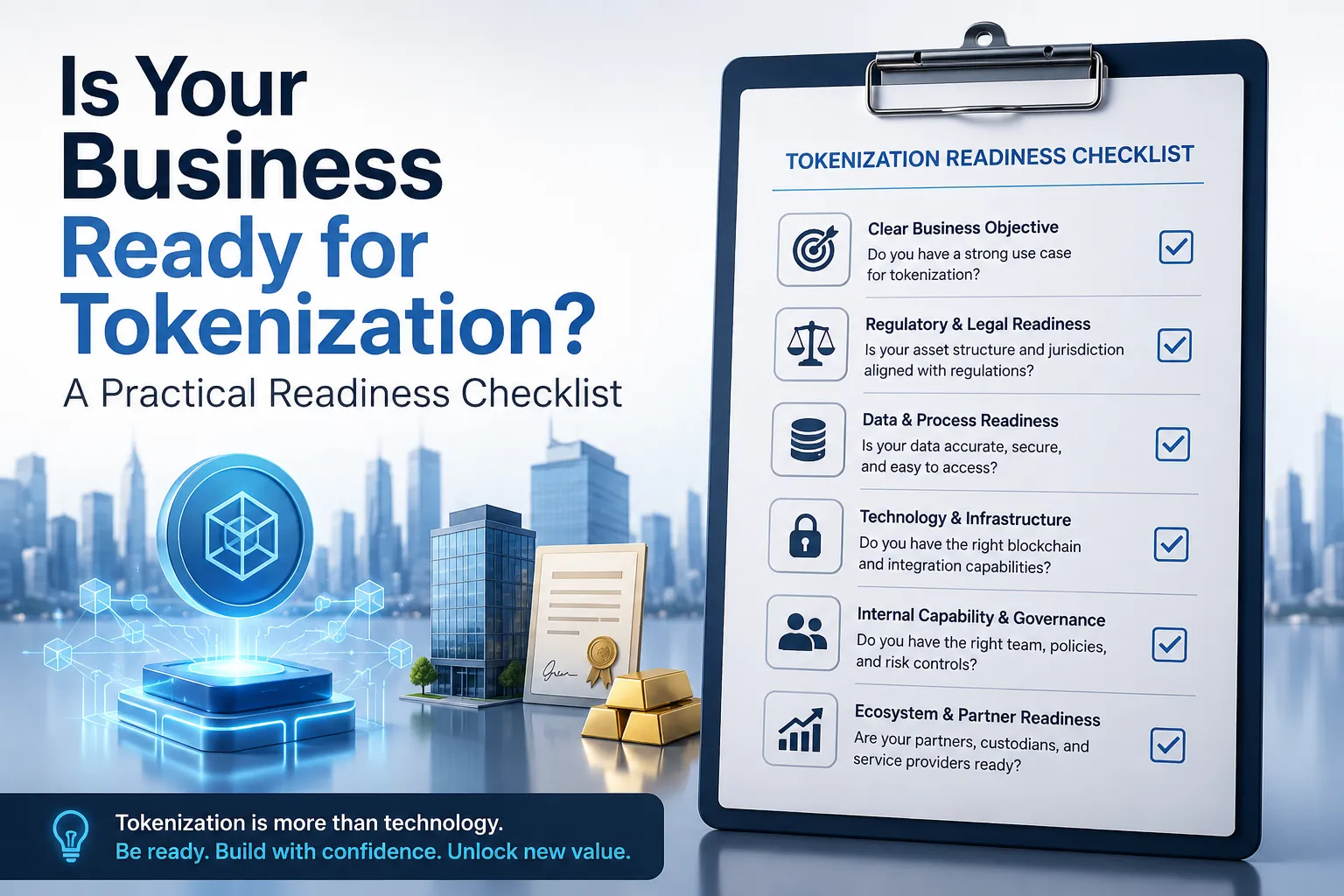

A business is ready for tokenization when it has a clear use case, assets with a verifiable title, a compliance plan for securities and KYC/AML rules, and the technical infrastructure to issue and manage tokens. Without these four pieces in place, tokenization projects tend to stall before they ever reach investors.
Tokenization has moved out of the whitepaper stage and into boardrooms, and a lot of business owners are asking a version of the same question: are we actually ready for this, or are we chasing a trend? It’s a fair question. Turning real estate, equity, invoices, or intellectual property into blockchain-based tokens sounds simple in a pitch deck, but the businesses that pull it off successfully tend to have done a lot of unglamorous groundwork first. Firms like Bantech Solutions work with companies at exactly this stage, helping them figure out whether tokenization solves a real problem before a single line of smart contract code gets written. If you’re trying to make that same call for your own business, this checklist walks through the areas that matter most, in the order most consultants would actually check them.
Why Tokenization Readiness Is Suddenly a Real Question
Five years ago, tokenization was mostly a conversation for crypto-native startups. That’s no longer true. Asset managers, real estate developers, private equity firms, and even mid-sized manufacturers are looking at tokenized structures to raise capital, unlock liquidity, or simplify ownership records. Regulators have taken notice too. During a 2025 roundtable, a U.S. Securities and Exchange Commission official pushed for proactive policymaking around tokenization, making the point that market participants shouldn’t be left guessing about how to stay compliant, a stance laid out in full on the SEC’s official website. That kind of statement from a federal regulator tells you something important: tokenization is no longer a gray-area experiment. It’s becoming a recognized part of financial infrastructure, which means the bar for “doing it right” is rising along with the interest.
That’s good news in one sense. It means there’s a growing body of precedent, tooling, and regulatory guidance to lean on. But it also means the businesses that jump in without preparation are more exposed than they would have been a few years ago, when nobody was watching that closely. Readiness isn’t optional anymore. It’s the difference between a tokenization project that attracts serious capital and one that quietly dies in legal review.
The Business Tokenization Readiness Checklist
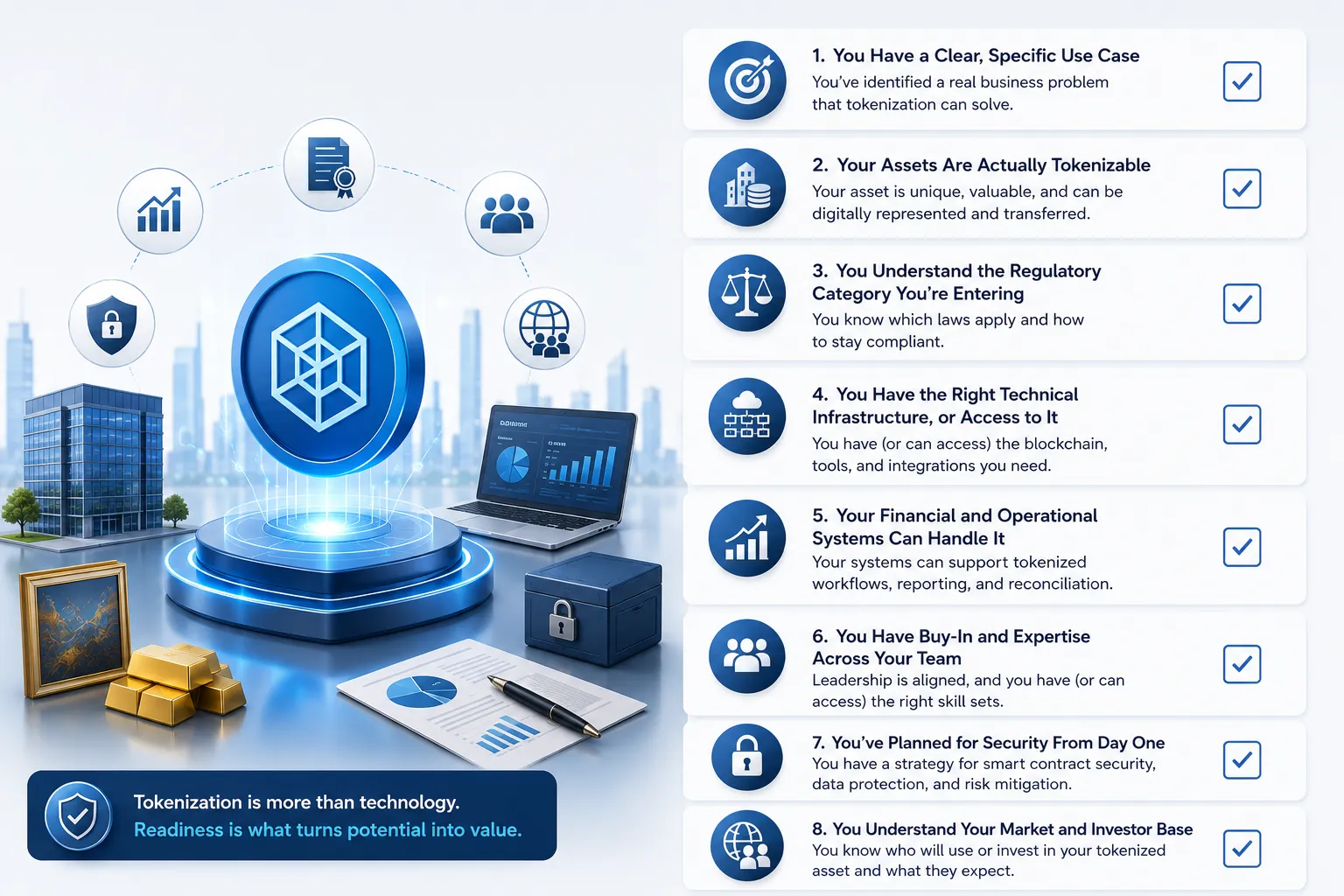
Below is the checklist broken into the categories that tend to make or break a tokenization initiative. Work through each one honestly. If you find yourself unsure about more than two or three items, that’s not a disqualifier, it’s just a sign you need outside expertise before moving forward.
1. You Have a Clear, Specific Use Case
This is the single biggest predictor of success or failure. “We want to tokenize our company” is not a use case. “We want to fractionalize ownership of a $12 million commercial property to open it up to accredited investors at a $25,000 minimum” is a use case. Ask yourself:
- What problem does tokenization solve that traditional structures don’t?
- Who is the buyer or investor for these tokens, and why would they prefer a token over a conventional share, bond, or fund interest?
- Is liquidity actually the goal, or is it capital formation, transparency, automation, or something else entirely?
If you can’t answer these questions in a sentence or two, you’re not ready to move forward yet, and that’s fine. Plenty of businesses spend months refining the use case before touching any technology, and that time is well spent.
2. Your Assets Are Actually Tokenizable
Not every asset benefits from tokenization, and not every asset can legally be tokenized without significant restructuring. Real estate, private equity, revenue-sharing agreements, fine art, commodities, and debt instruments are common candidates because they already have clear title, valuation methods, and transfer mechanisms. Ask:
- Is ownership of the underlying asset clearly documented and legally transferable?
- Can the asset be independently valued, or is valuation subjective and disputed?
- Does the asset generate cash flow, appreciation, or utility that gives the token intrinsic value?
An asset with murky title history or contested ownership will cause problems no smart contract can fix. Tokenization doesn’t clean up bad paperwork, it just puts a shinier wrapper around whatever exists underneath.
3. You Understand the Regulatory Category You’re Entering
This is where a lot of otherwise well-run businesses stumble. A token backed by a real asset, offering profit-sharing or appreciation, is very likely to be treated as a security in most jurisdictions, which means securities law applies in full: registration or exemption requirements, disclosure obligations, investor accreditation checks, and ongoing reporting. The World Economic Forum’s 2025 report on tokenized markets noted that adoption is often slowed by regulatory fragmentation and the need for institutions to coordinate closely with regulators and technology providers, a point worth reading directly in the WEF’s published research if you want the fuller institutional perspective.
Practical questions to answer here:
- Will your token likely be classified as a security, utility token, or something else in your target jurisdiction?
- Do you have a securities attorney (not just a generalist) reviewing the structure?
- Have you mapped out KYC (know your customer) and AML (anti-money laundering) obligations for anyone buying your tokens?
- Are you prepared for ongoing compliance, not just the initial offering?
Skipping this step, or treating it as an afterthought, is the number one reason tokenization projects get shut down after launch instead of before.
4. You Have the Right Technical Infrastructure, or Access to It
You don’t need an in-house blockchain engineering team to tokenize an asset, but you do need a technology partner who understands the tradeoffs between blockchain networks, custody models, and smart contract architecture. Check whether you have clarity on:
- Which blockchain (public, private, or consortium) fits your compliance and performance needs
- How tokens will be custodied, whether through self-custody wallets, institutional custodians, or a hybrid model
- Whether smart contracts will be independently audited before deployment
- How you’ll handle upgrades, bug fixes, or emergency pauses if something goes wrong post-launch
Smart contract bugs have cost projects millions of dollars in the past, and a poorly chosen custody model can create the exact liquidity and security problems tokenization was supposed to solve. This is usually the point where businesses bring in a specialized development partner rather than trying to build in-house, and it’s a reasonable decision given how much technical nuance is involved in getting the architecture right the first time.
5. Your Financial and Operational Systems Can Handle It
Tokenization changes how ownership, cap tables, and financial reporting work, sometimes significantly. Before moving forward, confirm:
- Your accounting team understands how tokenized ownership will be reflected in financial statements
- You have a plan for reconciling on-chain token ownership with off-chain legal ownership records
- Dividend, interest, or profit distributions can be automated or manually processed without errors
- You’ve budgeted realistically for legal, technical, and ongoing compliance costs, which are usually higher than founders initially expect
A surprising number of tokenization projects underestimate the operational lift required to keep on-chain and off-chain records in sync. This isn’t a one-time setup cost, it’s an ongoing operational responsibility.
6. You Have Buy-In and Expertise Across Your Team
Tokenization touches legal, finance, technology, and investor relations all at once, which means it rarely succeeds as a side project owned by a single enthusiastic executive. Ask:
- Does leadership understand the basics well enough to make informed decisions, rather than deferring entirely to outside consultants?
- Is there a single accountable owner for the project internally, even if execution is outsourced?
- Have you identified which functions need external expertise, whether that’s a securities attorney, a blockchain development firm, or a compliance consultant?
Internal alignment sounds like a soft factor compared to legal and technical readiness, but it’s often what determines whether a project actually gets finished. Tokenization initiatives that lack a clear internal champion tend to stall in committee.
7. You’ve Planned for Security From Day One
Security in tokenization isn’t just about smart contract audits, though those matter enormously. It also includes:
- Multi-signature or institutional-grade custody for any treasury funds raised
- Clear incident response plans if a smart contract vulnerability or exchange hack occurs
- Investor-facing security education, since many retail token buyers are new to self-custody and phishing risks
- Penetration testing on any web or app interfaces used to interact with the tokens
Security failures in this space tend to be catastrophic and public. A single exploited vulnerability can wipe out investor trust permanently, which is a much harder thing to rebuild than a smart contract.
8. You Understand Your Market and Investor Base
Finally, tokenization only works if there’s real demand on the other side. Ask honestly:
- Who is actually going to buy these tokens, and have you validated that interest before building anything?
- Are you targeting accredited investors, retail investors, or institutions, and does your regulatory structure match that audience?
- What secondary market, if any, will these tokens trade on, and is that venue compliant and operational?
- Have comparable tokenized offerings in your asset class succeeded or struggled, and what can you learn from them?
A recent industry analysis noted that institutional forecasts for the tokenized asset market vary wildly, from roughly $2 trillion to $16 trillion by 2030 depending on the source, which tells you the market is still forming rather than fully mature. That’s an opportunity for early movers, but it also means demand isn’t guaranteed just because the technology exists.
Common Pitfalls That Delay or Kill Tokenization Projects
Even businesses that check most of the boxes above run into predictable problems. A few worth flagging specifically:
Treating tokenization as a marketing move rather than a financial structure. Tokens announced primarily for press attention, without the legal and operational scaffolding behind them, tend to unravel quickly once regulators or investors start asking detailed questions.
Underestimating jurisdictional complexity. A token offering that’s compliant in one country can be a securities violation in another. Businesses that plan to sell tokens internationally need jurisdiction-specific legal review, not a single blanket compliance opinion.
Choosing blockchain infrastructure before defining the use case. Some businesses fall in love with a specific chain or protocol first, then try to force their asset and investor base to fit it. That order should be reversed every time.
Skipping the smart contract audit to save time or money. This is consistently one of the most expensive mistakes to correct after the fact, since fixing a live, exploited contract is far costlier than auditing it before launch.
No plan for secondary liquidity. Tokenizing an asset without a compliant venue for it to trade afterward defeats one of the main reasons businesses pursue tokenization in the first place, which is liquidity.
Assuming tokenization replaces legal ownership structures entirely. A token is a representation of ownership, not a substitute for the underlying legal agreement. Businesses sometimes assume that once an asset is tokenized, the traditional deed, share certificate, or partnership agreement becomes irrelevant. In most jurisdictions, the opposite is true: the legal document still governs, and the token is layered on top as a transfer and record-keeping mechanism. Skipping this distinction creates confusion for investors and, in some cases, disputes over who actually owns what when the on-chain and off-chain records disagree.
Underpricing the ongoing cost of compliance. The upfront legal and technical costs of a tokenization launch get most of the attention, but the recurring costs, annual audits, regulatory filings, custody fees, and investor reporting, often add up to more over a three-year period than the initial launch did. Businesses that budget only for the launch phase frequently find themselves scrambling for funds a year in, right when investor confidence matters most.
What Readiness Actually Looks Like in Practice
Businesses that are genuinely ready for tokenization usually share a few traits that aren’t on any formal checklist but show up consistently. They’ve already had at least one serious conversation with a securities attorney, even if the project is still months away from launch. They can describe their target investor in specific terms, not vague ones like “crypto-native investors” or “family offices.” They’ve budgeted for the unglamorous costs, legal review, audits, custody infrastructure, ongoing compliance, rather than assuming the technology itself is the expensive part. And critically, they’ve been willing to hear “not yet” from an advisor without treating it as a dealbreaker.
That last point matters more than it might seem. Readiness is a moving target, not a fixed gate. A business that isn’t ready today can often get there in three to six months of focused preparation: tightening asset documentation, securing the right legal opinions, and scoping the technical architecture with a development partner who has done this before. Rushing past that preparation phase is almost always more expensive in the long run than taking the extra time upfront.
It also helps to look at readiness in stages rather than as a single milestone. Early-stage readiness usually means the leadership team has agreed internally that tokenization is worth pursuing and has assigned an owner to the project. Mid-stage readiness typically involves an initial legal opinion on token classification, a rough architecture plan, and a first pass at identifying the target investor base. Late-stage readiness is when the legal structure, technical build, and compliance workflows are all mapped out well enough that a launch date becomes realistic rather than aspirational. Mapping your own business against these three stages, rather than treating readiness as binary, tends to produce a much more honest picture of where the real gaps are and how long it will take to close them.
It’s also worth acknowledging that readiness looks different depending on the asset class. A real estate tokenization project usually has to solve for title transfer law and property-specific investor protections, while a revenue-share tokenization for a private company leans more heavily on securities exemptions and cash flow verification. A commodities-backed token has to address custody and proof-of-reserve questions that don’t apply to the other two. There’s no universal readiness formula, which is exactly why generic advice tends to fall short and why a tailored assessment, done with someone who has worked across multiple asset classes, is usually worth the investment before you commit real budget to development.
How a Consulting Partner Fits Into This Process

Most businesses evaluating tokenization for the first time don’t have in-house blockchain legal or engineering expertise, and that’s completely normal. This is exactly the kind of project where an experienced consulting partner earns their fee many times over, by catching the compliance gaps, architecture mistakes, and market misreads before they become expensive problems. Bantech Solutions has worked with businesses across finance, real estate, and healthcare on custom blockchain and NFT development, smart contract auditing, and tokenization strategy, and if you’re at the stage of trying to figure out whether your business is genuinely ready, that’s a conversation worth having before you commit budget to development. You can reach out to the Bantech team directly to walk through your specific use case and get a realistic read on where you stand.
Final Readiness Recap
Before moving forward with a tokenization project, you should be able to say yes, or have a credible plan to get to yes, on each of these:
- A specific, well-defined use case with a clear target investor
- Assets with verifiable title and reliable valuation
- A securities law opinion on how your token will be classified
- A KYC/AML plan for onboarding token holders
- A technology partner or team capable of building and auditing smart contracts
- Financial systems ready to reconcile on-chain and off-chain records
- Internal leadership alignment and a clear project owner
- A security and incident response plan
- A realistic understanding of investor demand and secondary market options
If you’re confidently checking most of these boxes, you’re in a strong position to move forward. If you’re not, that’s not a failure, it’s useful information. The businesses that succeed with tokenization are rarely the fastest movers. They’re the ones who took readiness seriously before they started.
Continue reading the Complete Blockchain Series
This post is a part of the Blockchain Content Series — the complete 5 article series to understanding, implementing, and scaling enterprise blockchain and tokenization in your organization.