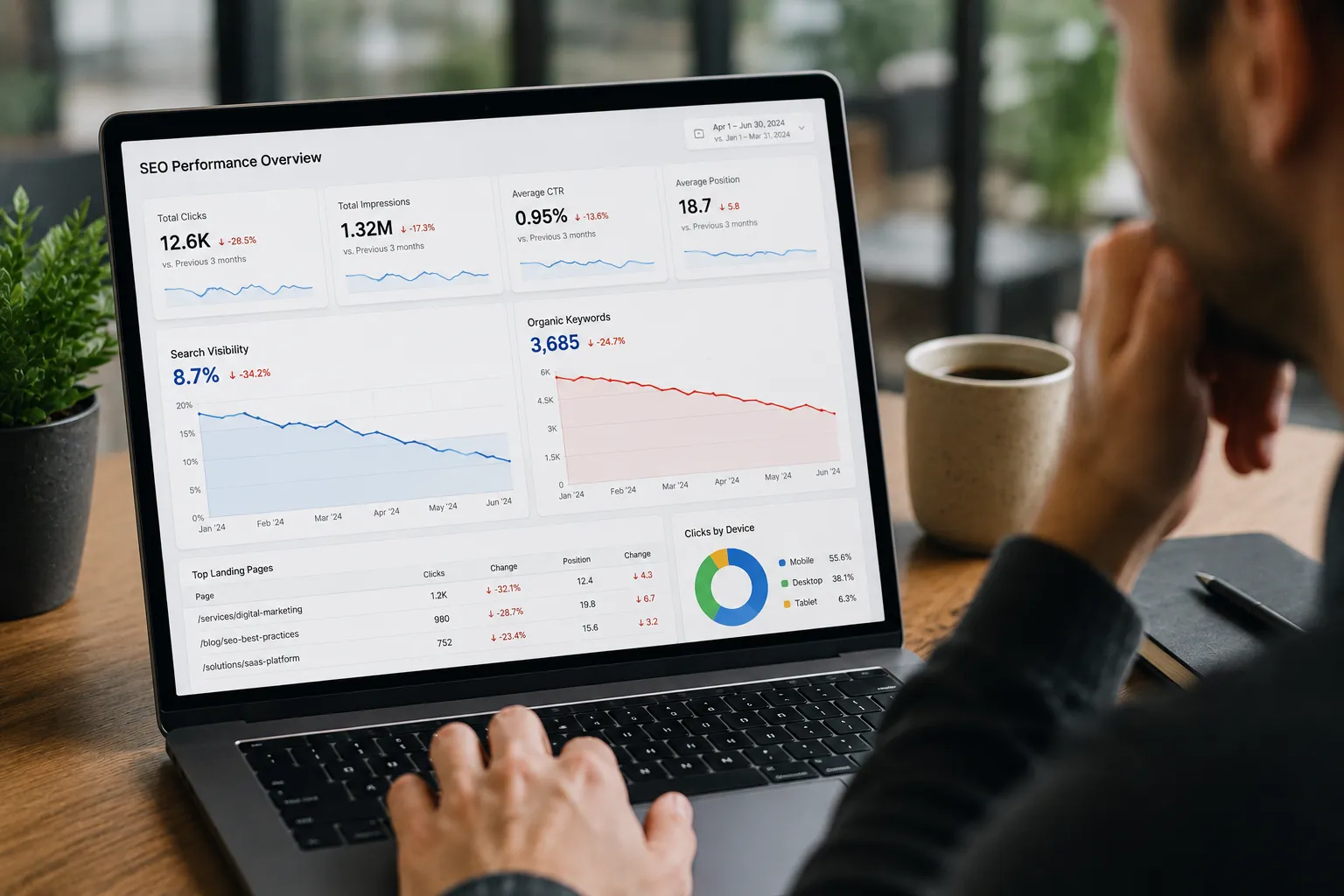

Why doesn’t ranking #1 on Google guarantee traffic anymore? Because Google now answers most questions directly on the results page through AI Overviews, featured snippets, and People Also Ask boxes. Over two-thirds of searches now end without a click, so the top spot delivers visibility and brand exposure, but not the flood of visitors it once did.
If you have spent any real time in the search marketing world, you already know the old story. Get to position one, and the traffic follows. Rank on page one, and your business grows. For close to two decades, that formula was more or less true, and an entire industry built itself around chasing that blue link at the top of the page.
That story is no longer accurate, and pretending otherwise is costing businesses real money. Ranking first is still worth pursuing, but what it delivers has quietly changed shape. Teams that measure success purely by rank position are increasingly confused about why their traffic charts have gone flat, or worse, why they’re sliding, even as their rankings hold steady or improve. This is the first article in a series that unpacks what’s actually happening in search right now, and it starts with the single biggest shift: the rise of the zero-click search. Businesses working with a partner like <a href=”https://www.bantechsolutions.com/keyword-ranking-tool/”>Bantech’s SEO and keyword ranking team</a> are already adjusting their strategy around this shift, and understanding why matters before we get into the how.
The Old Definition of “Winning” Search
For most of Google’s history, the relationship between rank and reward was fairly linear. If you ranked first for a valuable keyword, you captured somewhere between a quarter and a third of all clicks for that query. Rank tenth, and you were lucky to see low single digits. This is the logic behind nearly every SEO pitch of the last fifteen years: get to the top, and the visitors will come.
That logic assumed something specific about how people used search engines. It assumed a search results page was a menu of options, and the searcher’s job was to pick the best one and click through. Google’s job, in that model, was purely to sort and rank those options in the right order. The click was the transaction. It was the moment value got delivered, first to the user, who found their answer, and then to the business, who earned a visitor.
Search engines have been chipping away at that model since well before generative AI entered the picture. Featured snippets, knowledge panels, local packs, and instant answers for things like weather, sports scores, and unit conversions all predate the current wave of AI search products. But those earlier features nibbled at the edges. What’s happening now is closer to a full rewrite.
Zero-Click Search Is No Longer the Exception
A zero-click search is exactly what it sounds like: a query where the user gets what they need directly on the results page and never clicks through to any website. For years this was treated as a curiosity, a small and slowly growing slice of total search volume. That framing doesn’t hold anymore.
Recent research from SparkToro, built on Similarweb clickstream data and covering the first four months of 2026, found that <a href=”https://searchengineland.com/google-zero-click-searches-2026-study-479717″>68 percent of U.S. Google searches ended without a click to any website</a>, up from roughly 60 percent just two years earlier. That’s not a rounding error. That’s a shift of nearly ten percentage points in the fraction of searches that ever leave Google’s own properties, and it represents the fastest two-year acceleration the firm has measured. Put another way, out of every thousand searches performed today, roughly six hundred and eighty resolve entirely inside Google, with no visit to an outside site at all.
Zero-click behavior isn’t new; it has been climbing steadily since at least 2019, when it hovered around the 50 percent mark. What’s changed is the slope of the curve. The line used to creep upward a few points a year. Now it’s accelerating, and the reason for that acceleration has a name: generative AI answers baked directly into the search results page.
It’s worth being precise about what zero-click search actually includes, because it’s broader than most people assume. It covers the obvious cases, like typing “15 USD to GBP” and getting an instant currency conversion, or asking when the next leap year falls and getting the answer without a single blue link in sight. But it also covers a huge volume of informational queries where an AI-generated summary, a featured snippet, or a People Also Ask answer fully satisfies the person’s intent. The user got what they came for. Google delivered the value. And the website that originally created that answer, the one that did the research, wrote the explanation, and built the authority to be cited, got nothing but an impression.
AI Overviews Are Reshaping the Click Economy
If zero-click search is the trend, AI Overviews are the accelerant. These AI-generated summaries now appear on more than one in five Google searches, synthesizing information pulled from multiple sources into a single answer box sitting above the traditional organic results. And when an AI Overview shows up on a search results page, the data is stark: click-through rates to the organic listings below it drop by close to 60 percent.
Think about what that means for a business that has spent years and real budget earning the top organic position for a competitive keyword. The ranking is still there. The work still paid off in terms of authority and relevance signals. But the AI Overview sitting above that ranking is now absorbing the majority of the attention that used to flow down to the first organic result. The searcher reads the summary, gets an answer that feels complete, and moves on to their next query, often without scrolling far enough to even register that your website was the top-ranked page.
This isn’t uniform across every type of search either. Informational queries, the “how does this work” and “what is the difference between” kind of searches, are far more likely to trigger an AI Overview and end in zero clicks. Transactional queries, where someone is actively trying to buy something or complete a specific task, are more resistant, because AI summaries are generally worse at closing a purchase than they are at answering a factual question. That distinction matters a lot for how different businesses should react. A publisher whose traffic depends on broad informational content is exposed in a very different way than an ecommerce brand whose keywords are dominated by high-intent, transactional searches.
There’s also a second-order effect worth naming. Google reported at its 2026 developer event that AI Mode, its more conversational and interactive search experience, had already surpassed one billion monthly users, with query volume more than doubling every quarter. That growth curve suggests the current zero-click numbers, as dramatic as they already are, may just be an early chapter rather than the final state of things.
Position Zero and the Snippet Economy
Featured snippets deserve their own mention here, because they’re the mechanism that makes it possible for a page to be listed as an answer without receiving a visit, and because they set the template that AI Overviews later scaled up. According to <a href=”https://developers.google.com/search/docs/appearance/featured-snippets”>Google’s own documentation on featured snippets</a>, these boxes reverse the usual order of a search result, showing the descriptive answer first and the link second, and they can also surface inside a related questions group, more commonly known as the People Also Ask section.
Featured snippets have existed since 2014, long before anyone was talking about generative AI search. What they proved, well before AI Overviews arrived, was that Google was comfortable answering a question directly on its own page if it could extract a clean, confident answer from an existing web page. AI Overviews took that same underlying idea, being able to answer instead of merely rank, and applied it at a much larger scale, pulling from multiple sources instead of just one and generating a fresh synthesis rather than lifting an exact passage.
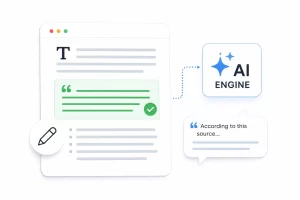
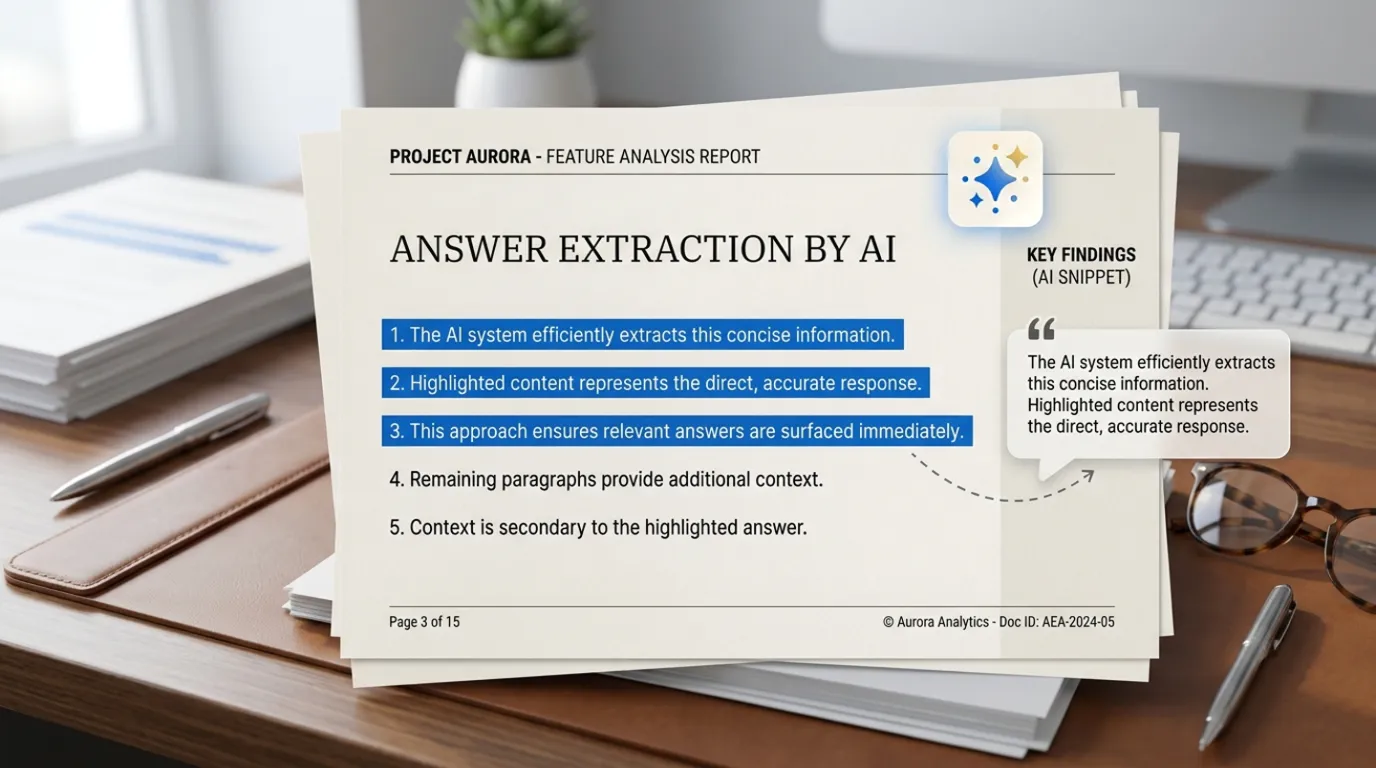
This is also exactly why the opening of this article, and of most well-optimized content today, is written as a short, direct answer. A concise 50 to 60 word response to a specific question, placed near the top of a page, gives Google’s systems a clean block of text to lift into a snippet or a People Also Ask answer. You can’t manually request a featured snippet placement, Google is explicit about that, its systems decide automatically whether a page is a good fit. But you can absolutely structure your content to make that decision easy for the algorithm to make in your favor.
Reframing “Visibility” vs. “Ranking”
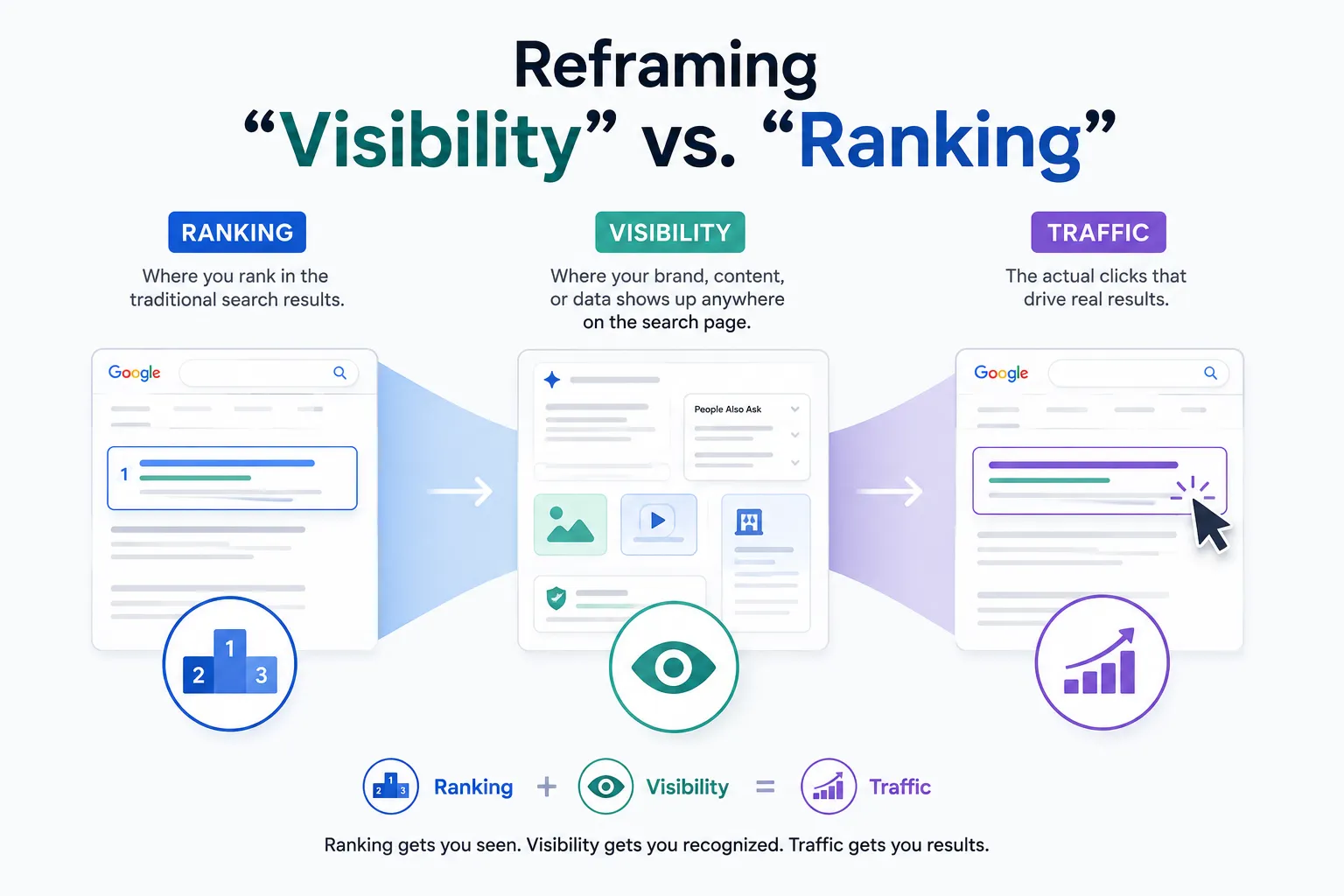
Here’s the uncomfortable part for anyone who built their entire SEO strategy around the old model: ranking and visibility have started to come apart from each other. You can rank exactly where you always did, in the same position, for the same keyword, and still see your organic traffic decline, because the definition of what happens above your listing on the page has changed.
It helps to think about three separate layers that used to be treated as one thing.
Ranking is your position in the traditional organic results, the blue links stacked below everything else. This is what most rank tracking tools still measure, and it’s still meaningful, but it’s no longer the whole picture.
Visibility is broader. It includes whether your brand, your data, or your content appears anywhere on the page, whether that’s an organic listing, a citation inside an AI Overview, a People Also Ask answer, an image pack, or a knowledge panel entry. Visibility can be strong even when clicks are weak, because being the source an AI answer cites still builds brand recognition and trust, even without a visit.
Traffic is the actual clicks that make it to your website, the metric that ties most directly to leads, sales, and revenue.
The old model assumed these three moved in lockstep. Rank well, and visibility and traffic would follow automatically. That assumption is breaking down. It’s entirely possible now to have excellent visibility, showing up prominently across snippets, AI Overviews, and organic results, while traffic quietly erodes because so much of that visibility never converts into a click. Data from recent industry research backs this up directly: brands that get cited inside AI Overviews are seeing measurably higher trust and conversion rates among the visitors who do click through, even while the raw volume of those visitors shrinks. Fewer people arrive, but the ones who do are often further along and more likely to act.
This is the reframe businesses need to make. Success in search can no longer be judged by a single rank position on a single keyword. It has to be judged across all three layers, and the balance between them will look different depending on your industry, your audience, and the type of queries your business depends on.
What This Means for How You Should Be Measuring Success
If rank position alone no longer tells the full story, the next obvious question is what should replace it. This is where a lot of businesses get stuck, because most of the reporting dashboards and tracking tools built over the last decade were designed around the old assumptions. They tell you where you rank. They tell you how much organic traffic arrived. They rarely tell you how often your brand was the answer inside an AI Overview, or how many People Also Ask boxes you’re quietly winning without anyone clicking through to check.
Getting a fuller picture usually means combining a few different signals rather than leaning on any single number. Impressions and average position data from Google Search Console still matter, even on queries where the click-through rate has fallen, because they tell you whether your content is still being surfaced and considered. Brand search volume is another useful proxy; if people are searching for your company by name more often after encountering it inside an AI-generated answer, that’s a real business outcome even if it never shows up as a referral in your analytics. And for businesses that work with an outside partner, this is exactly the kind of shift that a team like the one at <a href=”https://www.bantechsolutions.com/digital-marketing/”>Bantech’s digital marketing division</a> factors into campaign planning now, building strategy around impressions, citations, and qualified conversions rather than just chasing raw click volume.
None of this means abandoning the fundamentals of good SEO. Technical health, relevant content, and earning legitimate authority through links and mentions still matter enormously, arguably more than ever, because those are exactly the signals that determine whether an AI system trusts your page enough to cite it in the first place. What’s changing is the scorecard, not the underlying discipline.
Practical Adjustments Worth Making Now
A few concrete shifts are worth prioritizing while the rest of this series digs into the details.
Structure your most important pages so the first 50 to 60 words directly answer the primary question a searcher is likely to have. This gives both featured snippet systems and AI Overview summarizers a clean, quotable answer, which increases your odds of being the cited source rather than being paraphrased anonymously.
Build a genuine FAQ section into long-form content, addressing the specific questions that show up in the People Also Ask box for your target keywords. Each answer should be short, direct, and stand on its own.
Stop treating rank position as your only KPI. Pull impression data alongside click data, and start tracking whether your brand name is appearing more often in AI Overview citations for your core topics, even on searches where you don’t own the traditional top organic spot.
Reassess which of your keywords are informational versus transactional. Informational terms are far more exposed to zero-click erosion, and content strategy built purely around top-of-funnel informational queries may need rebalancing toward terms closer to a purchase decision, where zero-click impact is measurably smaller.
Accept that some content will do its job without ever generating a visit. A well-structured, accurate answer that gets pulled into an AI Overview is still doing work for your brand, building recognition and trust with people who may search for you by name later, even if it never shows up in your traffic reports.
A Quick Look at Who Feels This the Most
Not every business feels this shift equally, and that’s worth spelling out before wrapping up, because the right response really does depend on where you sit.
Publishers and content sites built around broad informational topics tend to be hit hardest. If your business model relies on ad revenue or affiliate clicks driven by people searching “what is,” “how does,” or “why does” style questions, you’re squarely in the zero-click blast radius. These are exactly the queries AI Overviews handle most confidently, because they tend to have a single, well-defined correct answer that can be summarized cleanly without much nuance lost.
Local service businesses tend to fare better, at least for now. Searches like “plumber near me” or “emergency dentist open now” carry an implicit need for a real-world action, a phone call, a booking, a visit, and AI-generated summaries are considerably less useful for satisfying that kind of intent. Local pack results, reviews, and map listings still drive real clicks and real calls, and that part of search has been comparatively insulated from the zero-click trend so far.
Ecommerce and other highly transactional businesses sit somewhere in the middle. Broad, top-of-funnel product research queries are increasingly answered by AI summaries comparing options, which can reduce clicks during the research phase. But once a shopper has narrowed down to a specific product or brand, the query becomes far more transactional, and transactional searches remain considerably more resistant to zero-click behavior than informational ones. The practical implication is that ecommerce content strategy may need to lean harder into the bottom of the funnel, where intent is clearer and AI summaries are less likely to fully satisfy the searcher on their own.
B2B and service-based businesses face a more complicated picture. Buyers in these categories often research extensively before ever reaching out, and a lot of that early research now happens through AI-generated summaries rather than a string of website visits. That means the earlier stages of the buyer’s journey may generate far fewer trackable website sessions than they used to, even while your brand is quietly building familiarity and trust through repeated AI citations. The businesses that adapt well here tend to be the ones investing in becoming the kind of source that AI systems reach for in the first place, through original data, clear expertise, and content that’s genuinely difficult to summarize away without losing something important.
The Historical Pattern Behind This Shift
It’s worth zooming out for a moment, because none of this happened overnight, and understanding the pattern helps make sense of where things are likely headed next. Zero-click behavior has been climbing in a fairly consistent direction for close to a decade now. Estimates from clickstream data put the figure at roughly 45 percent back in 2016, creeping up to around 49 or 50 percent by 2019, based on the now-retired Jumpshot panel. By 2020, that number had jumped to nearly 65 percent according to Similarweb’s own tracking, and by 2024 independent research from Datos put it at 58.5 percent in the U.S. and close to 60 percent across the EU.
Every one of those studies used slightly different data sources and methodologies, so treating the exact percentages as perfectly comparable year over year would be a mistake. But the direction of travel across nearly every independent dataset tells the same story: the share of searches ending without a click has been rising steadily for years, well before generative AI entered the picture. Featured snippets, knowledge panels, and instant answer boxes were already doing this work quietly in the background. What’s different about the last two years is the speed. The move from roughly 60 percent to 68 percent in just two years represents the steepest acceleration measured yet, and it lines up almost exactly with the rollout of AI Overviews at scale.
That acceleration is the real headline here, more than any single percentage figure. A slow, decade-long drift is something a business can plan around gradually. A sudden jump of this size, concentrated in a two-year window, is the kind of change that catches a lot of otherwise well-run marketing teams off guard, simply because the tools and habits built for the old, slower pace of change haven’t caught up yet.
What Comes Next in This Series
This piece is meant to set the stage rather than cover every angle. Zero-click search and AI Overviews raise a lot of follow-up questions that deserve their own dedicated treatment: how to actually optimize content to get cited inside AI-generated answers, how to build a measurement framework that captures visibility rather than just clicks, which industries and query types remain the most resistant to zero-click erosion, and how paid search fits into a world where organic clicks are harder to earn.
The throughline across all of it is the same idea introduced here. Ranking #1 hasn’t stopped mattering, but it has stopped being the whole story. The businesses that adapt fastest will be the ones that stop asking only “where do we rank” and start asking “where do we show up, and does that presence actually move the business forward.” That’s the mindset shift this entire series is built around, and it’s the one worth making before your competitors get there first.
Other Articles in the AI Search & GEO Series
This post is part of the AI Search & GEO Content Series — a practical guide to improving visibility across traditional search engines and AI-powered search experiences.