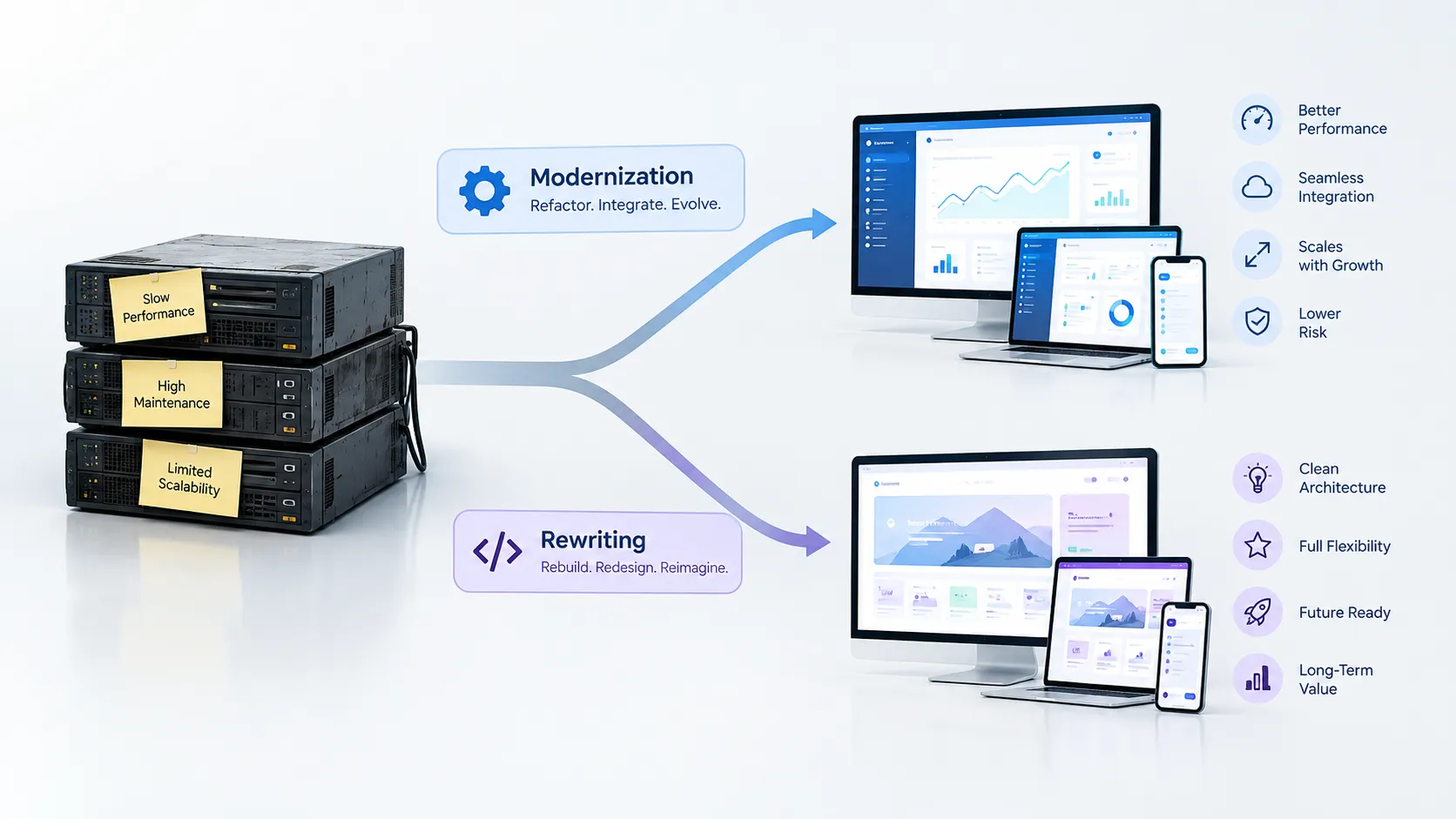

Legacy system modernization is usually the better choice for most businesses because it preserves working functionality while upgrading the technology underneath it, cutting risk and cost. A full rewrite only makes sense when the codebase is unworkable, the architecture cannot scale, or compliance demands force a clean break from the old platform.
Why This Decision Keeps IT Leaders Up at Night
Every CTO eventually hits the same wall. The core system that has run the business for the last decade, the one nobody wants to touch because it “just works,” starts showing cracks. Maybe it can’t talk to the new CRM. Maybe the one developer who understands the COBOL routines is retiring next year. Maybe a security audit just flagged seventeen vulnerabilities that the vendor stopped patching in 2019.
At this point, two words start getting thrown around in every leadership meeting: modernize or rewrite. They sound similar, but they represent two fundamentally different philosophies, two different budgets, and two very different risk profiles. Choosing wrong doesn’t just waste money, it can stall an entire digital transformation initiative for years. That’s exactly the kind of decision the team at Bantech’s legacy system transformation services helps businesses work through every day, because getting this call right the first time saves far more than it costs to get advice upfront.
This guide breaks down both paths in plain language: what they actually involve, what they cost, how long they take, and which one fits your situation. No jargon for the sake of sounding smart, just a straight comparison so you can walk into your next budget meeting with a clear answer.
What Legacy System Modernization Actually Means
Modernization is the practice of upgrading an existing system’s technology stack, architecture, or infrastructure while keeping its core logic and business value intact. Think of it less like demolition and more like a full home renovation. You’re not tearing the house down to the foundation; you’re rewiring it, replacing the plumbing, opening up the layout, and installing modern systems, all while the family keeps living there.
In software terms, this usually involves one or more of the following:
- Moving an on-premises application to the cloud (rehosting)
- Swapping outdated components for modern equivalents without changing the underlying code structure (replatforming)
- Restructuring the code itself to improve performance and maintainability without changing external behavior (refactoring)
- Redesigning parts of the application’s architecture to take advantage of microservices, containers, or serverless computing (rearchitecting)
- Wrapping legacy functionality behind modern APIs so new applications can talk to old systems without touching their internals
The defining trait of modernization is continuity. Users barely notice the transition because the system keeps functioning throughout the process. Data isn’t lost. Business rules that took fifteen years to get right don’t have to be rediscovered and rebuilt from scratch.
What a Full Rewrite Actually Means
A rewrite, sometimes called a “rip and replace” or “big bang” rewrite, means building an entirely new system from the ground up to replace the old one. The existing codebase is treated as reference material at best and gets retired once the new system goes live.
This path appeals to teams who feel burned by years of patchwork fixes. There’s something psychologically satisfying about starting clean, no more workarounds, no more code nobody understands, no more “don’t touch that function, we don’t know what it breaks.” A rewrite promises a fresh architecture built with current best practices, modern frameworks, and none of the accumulated technical debt.
But that promise comes with real risk. Rewrites are notorious for running over budget and over schedule. Joel Spolsky, the co-founder of Stack Overflow, famously called a full rewrite “the single worst strategic mistake that any software company can make,” largely because teams underestimate just how much undocumented business logic is buried in “ugly” old code. That logic exists because someone, at some point, hit a real-world edge case and fixed it. Rewriting from scratch means relearning every one of those lessons the hard way.
Head-to-Head Comparison
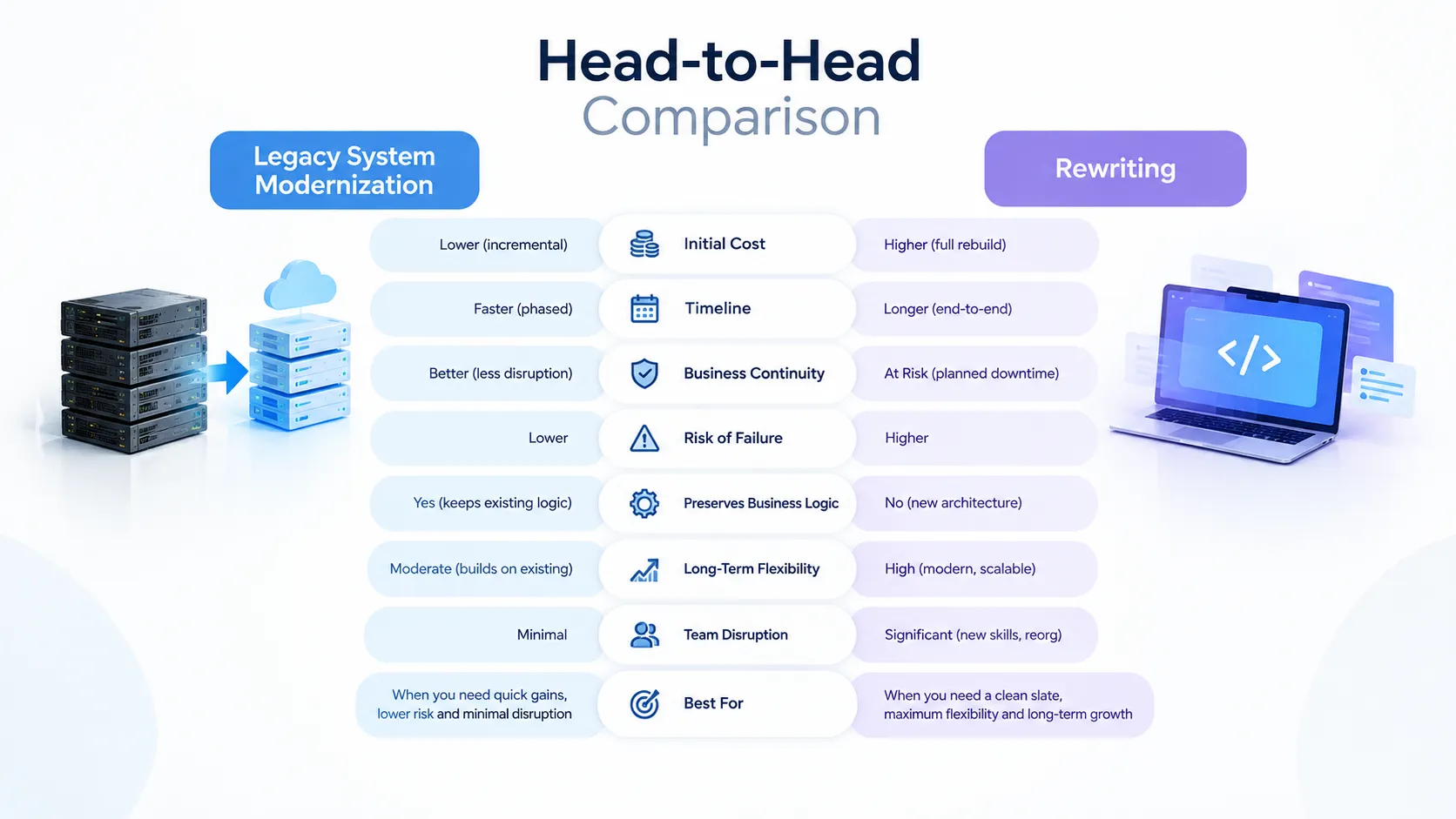
| Factor | Modernization | Full Rewrite |
|---|---|---|
| Initial Cost | Lower to moderate | High, often 2 to 4x higher |
| Timeline | Weeks to a few months for most projects | 6 months to 2+ years |
| Business Continuity | System stays operational throughout | Requires parallel operation or a hard cutover |
| Risk of Failure | Lower, incremental changes are easier to test and roll back | Higher, big-bang cutovers carry more exposure |
| Preserves Business Logic | Yes, largely intact | No, must be rediscovered and rebuilt |
| Long-Term Flexibility | Good, especially with rearchitecting | Excellent, if scoped and executed well |
| Team Disruption | Minimal | Significant, new skills and workflows required |
| Best For | Systems with sound logic but outdated infrastructure | Systems with fundamentally broken architecture or unsupported languages |
The Real Cost of Rewriting from Scratch
Cost is usually the first question every stakeholder asks, and it’s where rewrite projects tend to surprise people the most. Building a new enterprise application from zero means paying for design, development, quality assurance, data migration, integration testing, and user retraining, all before the new system delivers a single dollar of value.
Industry estimates for full rearchitecting or rebuilding projects commonly run from $100,000 to well over $500,000, depending on complexity, compliance requirements, and the number of integrations involved. Modernization projects that use rehosting or replatforming strategies, by contrast, frequently land in the $10,000 to $100,000 range because they reuse existing logic instead of reinventing it. That’s not a small gap. For a mid-sized company, that difference can be the entire annual IT innovation budget.
There’s also the “invisible” cost of a rewrite: the opportunity cost of tying up your best engineers on a project that, for a year or more, produces zero new revenue-generating features. While your team rebuilds what already existed, competitors using a modernization strategy are shipping new capabilities on top of their existing systems.
Where Modernization Falls Short
Modernization isn’t a silver bullet either, and it’s worth being honest about its limits. If your legacy application is built on a language with no available developers, running on hardware the vendor no longer supports, or structured in a way that makes even simple changes dangerous, modernization can feel like renovating a house with a cracked foundation. You can patch it, but you’re fighting the structure the whole time.
There’s also a ceiling effect. Modernization extends the life of a system and improves specific pain points, but it rarely delivers the kind of clean-slate architecture a rewrite can, especially for companies planning to scale dramatically or pivot their business model entirely. If your five-year roadmap includes doubling transaction volume, entering new markets, or building an entirely new product line on top of the existing platform, a partial rewrite of the most critical components might actually serve you better than stretching an aging system past its natural limits.
The Middle Path: Strangler Fig Modernization
There’s a third option that often gets overlooked in the “modernize versus rewrite” debate, and it tends to be the most pragmatic choice for complex, business-critical systems: the strangler fig pattern. The approach, first described by software architect Martin Fowler, takes its name from a type of vine that gradually grows around a host tree, eventually replacing it entirely while the tree continues supporting life throughout the process.
Applied to software, this means building new functionality as independent services around the edges of the legacy system, gradually routing traffic away from the old code path and toward the new one, feature by feature. AWS documents this same approach in its cloud design pattern guidance for breaking apart monolithic applications, precisely because it lets teams replace risky, high-value components first without a single catastrophic cutover event. Over months or years, the legacy system gets progressively “strangled” until it can be safely retired, all while the business keeps running without disruption.
This hybrid strategy captures much of the architectural cleanliness of a rewrite while avoiding the all-or-nothing risk that sinks so many big-bang projects. It does take longer than a straightforward lift-and-shift modernization, but for mission-critical systems where downtime simply isn’t an option, it’s often the safest route to a modern architecture.
Questions to Ask Before You Decide
Rather than defaulting to whichever option sounds more exciting in a boardroom, walk through these questions with your technical and business stakeholders together.
Is the core business logic still valid? If the rules embedded in your system still reflect how the business actually operates, that logic has value worth preserving. Rebuilding it from scratch means re-deriving years of accumulated decisions, often without the people who made them still around to explain why.
What’s driving the urgency? A security vulnerability, a vendor sunset date, or a compliance deadline usually calls for a faster, more contained solution, which favors modernization. A strategic pivot toward an entirely new business model might justify a rewrite.
Can the team support a multi-year project? Rewrites demand sustained focus and budget over long timelines. If your organization has a track record of losing momentum on multi-year initiatives, a phased modernization approach with visible wins every few months is far more likely to survive internal politics and leadership changes.
How tightly coupled is the system? Systems where every module depends heavily on every other module are harder to modernize incrementally and may genuinely need a more aggressive rearchitecting effort, even if that stops short of a full rewrite.
What does downtime actually cost? For an e-commerce platform processing orders around the clock, even a few hours of downtime during a cutover can mean real revenue loss. For an internal reporting tool used twice a month, that risk tolerance looks completely different.
Do you have institutional knowledge documented anywhere? If your legacy system’s logic lives only in the heads of two senior developers, that’s actually a strong argument for modernizing sooner rather than later, before that knowledge walks out the door for good.
Answering these honestly usually points toward a clear direction faster than most teams expect. It’s rarely a coin flip once the specifics are on the table.
A Practical Decision Framework
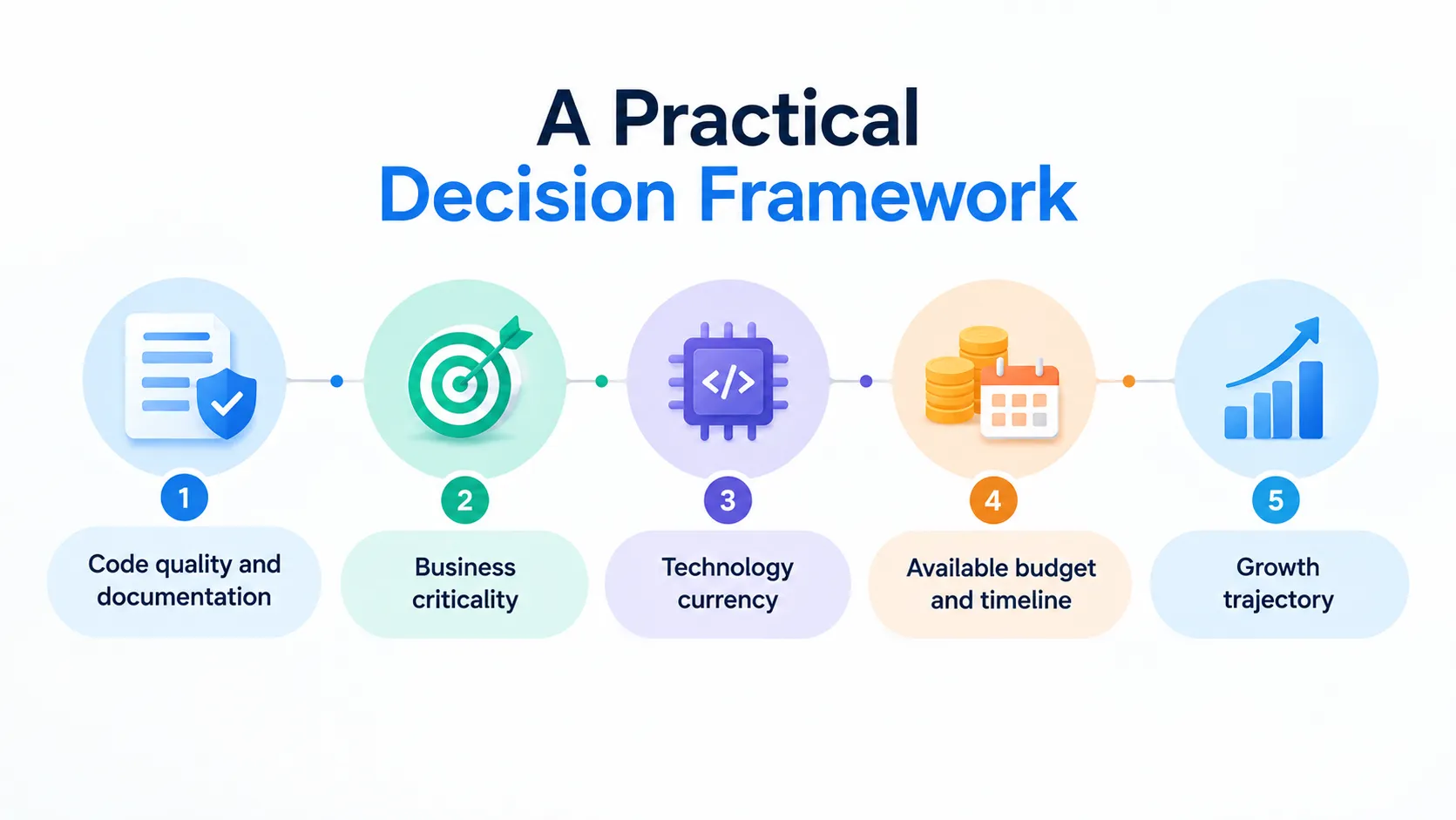
To simplify the choice, it helps to score your system across a few dimensions:
- Code quality and documentation. Well-documented, logically structured code favors modernization. Sparse or missing documentation combined with tangled logic tilts toward a rewrite or a phased strangler fig approach.
- Business criticality. Systems that generate revenue directly or touch customer-facing operations should almost always favor lower-risk, incremental modernization over a risky big-bang rewrite.
- Technology currency. If the platform runs on a language or framework still actively maintained, modernization is usually sufficient. If it depends on technology that vendors have officially discontinued, a rewrite becomes harder to avoid.
- Available budget and timeline. Modernization fits tighter budgets and shorter timelines. Rewrites require patience and a war chest, and that’s before accounting for inevitable scope creep.
- Growth trajectory. A company planning aggressive scaling or a pivot in its core offering may find that a rewrite, done carefully, pays for itself faster than continuously patching an architecture that was never designed for that scale.
Most organizations score somewhere in the middle, which is exactly why hybrid strategies like the strangler fig pattern have become so popular over the last decade. It’s rarely a binary choice in practice.
How to Minimize Risk Whichever Path You Choose
Whether you land on modernization or a full rewrite, a handful of practices consistently separate successful projects from expensive failures.
Start with a comprehensive audit before committing to either path. You can’t make a sound architectural decision without first understanding exactly what the current system does, including the undocumented edge cases that only surface once a year during tax season or year-end reconciliation. A thorough IT strategy and planning engagement that maps out current infrastructure, dependencies, and business goals before any code gets touched consistently produces better outcomes than teams that jump straight into development.
Run systems in parallel wherever feasible. Whether modernizing or rewriting, keeping the old system live alongside the new one, even temporarily, gives you a safety net if something doesn’t behave as expected. Sudden full cutovers are where most catastrophic project failures happen.
Prioritize based on business impact, not developer preference. It’s tempting to rebuild the “fun” parts of a system first, but the components that generate revenue or carry the highest risk should get attention first, precisely because that’s where failure would hurt most.
Invest in automated testing before making any changes. Legacy systems rarely come with adequate test coverage, and without it, you’re modifying critical logic blind. Building a regression test suite before touching production code is tedious, but it catches the failures that would otherwise reach customers.
Train your team continuously, not just at the end. Whether you modernize incrementally or rewrite entirely, your staff needs to understand the new system as it evolves, not scramble to learn it the week before go-live.
Real-World Scenarios: Which Approach Fits
Scenario one: A regional bank running a 20-year-old core banking system. Regulatory compliance requirements, sensitive financial data, and zero tolerance for downtime make a big-bang rewrite extremely risky. This is a textbook case for phased modernization, likely using a strangler fig approach that migrates high-risk modules like fraud detection first while leaving stable transaction processing logic largely untouched until later phases.
Scenario two: A ten-person SaaS startup whose MVP was built in a weekend hackathon three years ago. The codebase has no tests, no documentation, and the two original developers have left the company. Here, a targeted rewrite of the core application, informed by three years of real customer usage data, often makes more sense than trying to modernize code nobody fully understands anymore.
Scenario three: A manufacturing company with a custom inventory system built on a now-unsupported database platform. The business logic works fine; the underlying technology is the problem. This is close to an ideal modernization case: replatform the database, keep the application logic intact, and avoid the cost and risk of rebuilding functionality that already works well.
These examples aren’t universal rules, but they illustrate how the right answer depends far more on context than on a generic best practice.
Making the Final Call
There’s no universal winner in the modernization versus rewrite debate, and anyone who tells you otherwise is probably trying to sell you one specific service regardless of whether it fits your situation. Modernization wins for most businesses because it reduces risk, controls cost, and keeps operations running while improvements happen in the background. A rewrite earns its place only when the existing system’s architecture or technology stack has become a genuine barrier that incremental changes cannot fix.
The smartest move before committing either way is a proper technical assessment, one that honestly evaluates your code, your team’s capacity, your budget, and your actual business risk tolerance. That assessment, done well, usually makes the decision obvious. Guessing, or following whatever approach is currently trending in tech blogs, is how organizations end up with half-finished rewrites and abandoned modernization efforts sitting in the same graveyard.
Ready to figure out which path makes sense for your systems? A proper technical assessment removes the guesswork, whether that leads to modernization, a targeted rewrite, or something in between. Contact Us Today!