
If you have ever asked an IT vendor for a modernization quote and gotten back a shrug and a “it depends,” you are not alone. It is one of the most common questions business leaders ask, and one of the hardest to answer honestly without a real conversation about your systems. This guide breaks down what legacy application modernization actually costs in 2026, walks through the approaches that shape your final bill, and shows where the legacy system transformation services offered by teams like Bantech typically land on price. By the end, you should have a realistic number to bring to your next budget meeting.
Legacy application modernization typically costs between 10,000 dollars for a simple rehosting project and 500,000 dollars or more for a full rebuild of a complex enterprise system. The final price depends on your chosen approach, application size, data volume, number of integrations, and compliance requirements.
That quick answer is useful for a Google snippet, but it is nowhere near the full picture. Let’s dig into the numbers that actually matter for your project.
Why “It Depends” Is Actually a Fair Answer
Every legacy modernization project is shaped by a handful of variables, and none of them are optional to consider. Skip any one of them and your budget estimate will be wrong, sometimes by a factor of five or more.
The three biggest cost drivers are:
- Application complexity. A departmental scheduling tool with 20,000 lines of code is a different animal than a core banking platform with three decades of accumulated business logic.
- Data volume and quality. Clean, well-documented data migrates quickly. Data scattered across flat files, duplicated tables, and undocumented workarounds takes far longer to untangle.
- Number of integration points. Every connected system, whether it is a payment gateway, a CRM, or a supplier API, adds testing time, mapping work, and risk.
Hold those three factors in mind as you read the ranges below, because they explain why two companies modernizing what looks like a “similar” system can end up with wildly different invoices.
The Six Modernization Approaches and What Each One Costs
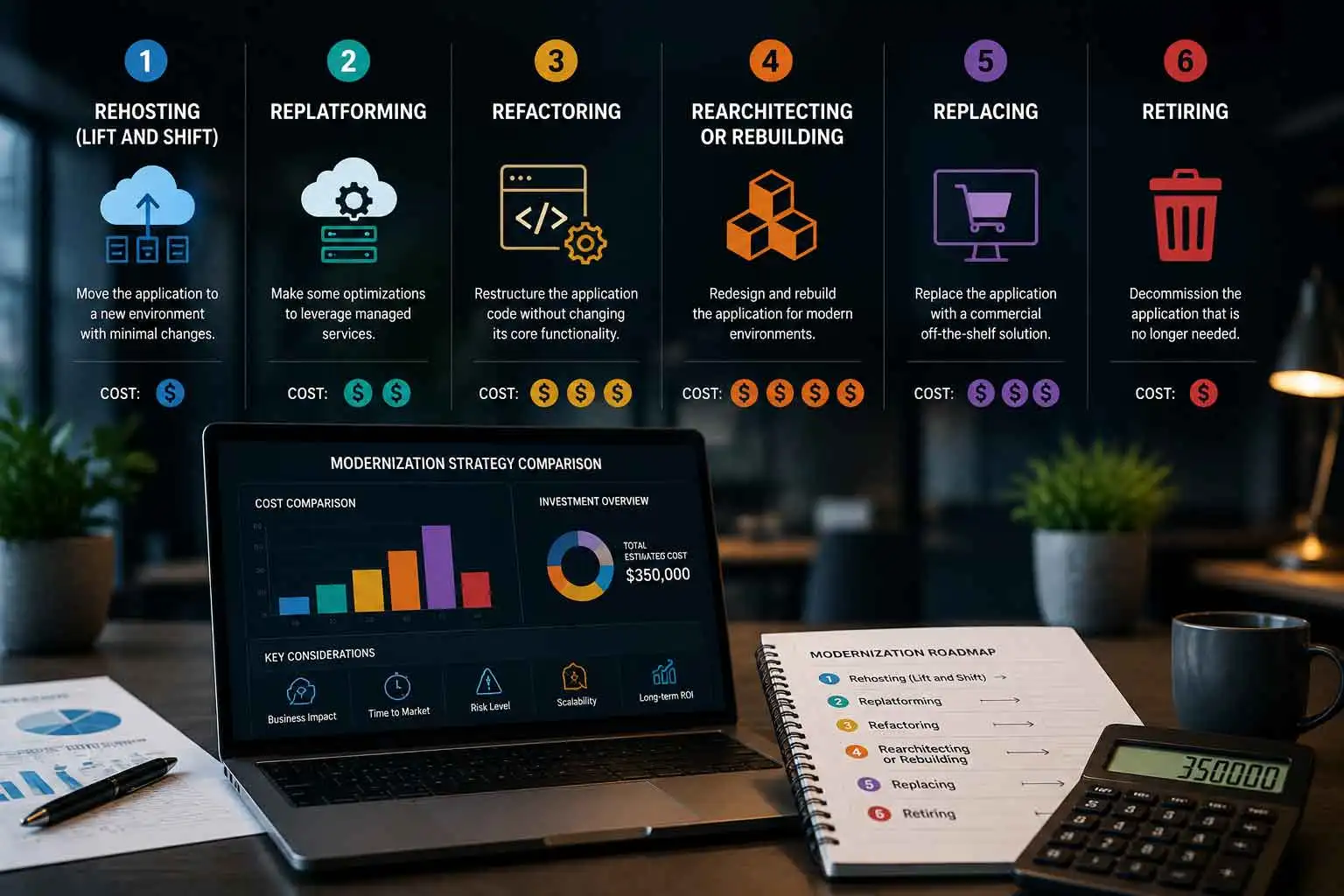
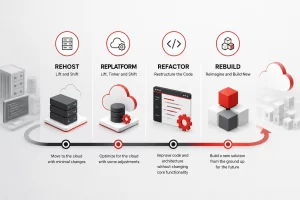
Not every legacy system needs to be torn down and rebuilt from scratch. In fact, most shouldn’t be. Modernization specialists typically work from a menu of approaches, often summarized as the “6 Rs,” and each one comes with its own cost profile.
1. Rehosting (Lift and Shift)
This is the fastest and cheapest path. You move the application, largely unchanged, onto new infrastructure, usually the cloud. No code is rewritten, so the risk and cost stay low.
Typical cost: 10,000 to 50,000 dollars for a small to mid-sized application.
Rehosting makes sense when the application’s logic still works fine but the hardware or hosting environment it sits on has become unreliable, expensive, or unsupported.
2. Replatforming
Replatforming goes a step further than rehosting. You make small, targeted changes, maybe swapping an on-premises database for a managed cloud database, without altering the application’s core architecture.
Typical cost: 30,000 to 100,000 dollars.
This is often the sweet spot for organizations that want meaningful gains in performance and scalability without committing to a full rewrite.
3. Refactoring
Refactoring means restructuring the existing code to improve performance, reduce technical debt, and make the system easier to maintain, all while preserving its external behavior. It is more involved than replatforming because developers are working directly inside the codebase.
Typical cost: 50,000 to 150,000 dollars.
Refactoring pays off when the application’s core functionality is sound but the underlying code has become fragile, poorly documented, or difficult to extend.
4. Rearchitecting or Rebuilding
This is where costs climb sharply. Rearchitecting involves changing how the application is built, often moving from a monolith to microservices, while rebuilding means starting largely from scratch with modern frameworks and design patterns.
Typical cost: 100,000 to 500,000 dollars or more, depending on scope.
Large enterprise systems, such as core insurance platforms or multi-region ERP deployments, can push well past the half-million mark once you factor in data migration, compliance testing, and parallel-run periods.
5. Replacing
Sometimes it is cheaper to buy than to build. Replacing a legacy system with an existing SaaS or COTS (commercial off-the-shelf) product can range from a few thousand dollars a month in subscription fees to well into six figures for enterprise licensing, implementation, and data migration combined.
6. Retiring
Not every legacy application needs to survive the transition. Retiring redundant systems, ones whose functionality has already been absorbed elsewhere, costs comparatively little but still requires careful data archiving and decommissioning to avoid compliance headaches down the line.
Real 2026 Cost Ranges by Application Size
Beyond the approach you choose, the sheer size and criticality of the system plays a major role. Here is a rough breakdown based on current industry benchmarks for 2026:
- Small departmental applications: 25,000 to 200,000 dollars
- Mid-sized business applications: 200,000 to 1,000,000 dollars
- Large enterprise systems (ERP, CRM, core banking): 1,000,000 to 10,000,000 dollars
- Mainframe-scale core platforms: 10,000,000 dollars and up, in extreme cases reaching into the tens of millions for the most complex financial and government systems
These figures might look intimidating at the top end, but the vast majority of businesses reading this are working with applications in the small to mid-sized range, where a well-scoped project can realistically land under 300,000 dollars.
How Your Industry Changes the Price Tag
The same modernization approach can carry very different price tags depending on which industry you operate in, mostly because of compliance overhead and data sensitivity.
Financial services. Banks and insurers often carry the heaviest compliance burden of any industry, since core platforms typically need to satisfy PCI-DSS, SOX, and regional banking regulations simultaneously. Expect compliance testing and audit trails to add a meaningful premium on top of the base development cost, and expect the timeline to stretch accordingly.
Healthcare. HIPAA compliance, protected health information handling, and integration with electronic health record systems make healthcare modernization projects unusually data-intensive. Migration and cleansing work tends to sit at the higher end of the 15 to 35 percent range mentioned earlier, since patient records rarely arrive in clean, standardized formats.
Retail and e-commerce. These projects are often less compliance-heavy but more integration-heavy, since a modern retail platform typically needs to talk to payment processors, inventory systems, shipping providers, and marketing tools all at once. The cost driver here is less about regulation and more about the sheer number of moving parts that need to stay synchronized.
Manufacturing and logistics. Legacy modernization in these sectors increasingly involves connecting older operational technology, think warehouse systems or production line software, with modern IoT sensors and analytics platforms. This blending of old and new infrastructure tends to add both cost and complexity beyond a typical software-only project.
Government and public sector. Procurement rules, security clearances, and long approval cycles mean government modernization projects often take longer and cost more than a comparable private-sector project of the same technical scope, even before a single line of code gets written.
Knowing where your industry sits on this spectrum before you request quotes will help you sanity-check whether a proposal is realistic or whether a vendor is either underselling the complexity or padding the number unnecessarily.
The Hidden Costs Nobody Puts in the Initial Quote
This is where most modernization budgets go sideways. A vendor quotes you a number for “development,” and then the actual invoice comes in 30 to 45 percent higher once everything else is accounted for. Here are the line items that catch people off guard.
Data migration and cleansing. Moving data from an old system to a new one rarely goes smoothly. Duplicate records, inconsistent formatting, and orphaned entries all need to be resolved before migration, and this work alone can consume 15 to 35 percent of a project’s budget, especially for document-heavy industries like insurance or healthcare.
Integration rework. If your legacy system talks to five other tools, all five of those connections need to be rebuilt, tested, and validated against the new system.
Parallel run and testing. Most organizations do not flip a switch overnight. Running old and new systems side by side for a transition period adds infrastructure and labor costs that are easy to underestimate.
Change management and training. New interfaces mean retraining staff, updating documentation, and absorbing a temporary dip in productivity while people adjust.
Post-launch support. Bugs surface after go-live no matter how thorough your testing was. Budgeting for a stabilization period, typically 60 to 90 days of dedicated support, prevents nasty surprises.
A useful rule of thumb: whatever the base development quote is, add 30 to 45 percent on top to get a realistic total project cost.
The Cost of Doing Nothing
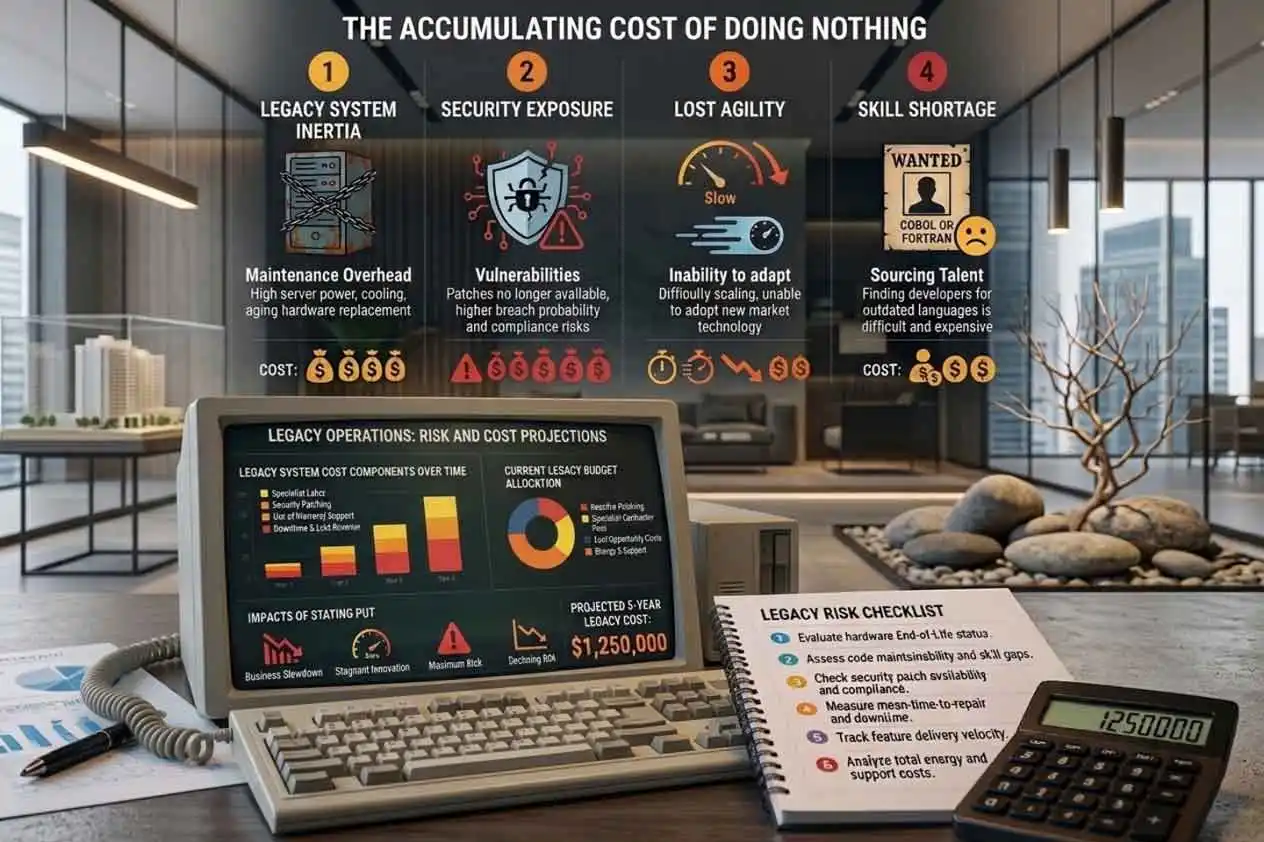
Every conversation about modernization cost needs a counterweight: what happens if you don’t. Organizations that keep patching legacy systems instead of modernizing them tend to underestimate just how much money is quietly leaking out of the business.
Industry benchmarks from Gartner, Forrester, and Deloitte consistently show that enterprises spend somewhere between 60 and 80 percent of their total IT budget simply keeping aging systems alive, leaving a shrinking slice for the innovation work that actually grows the business. That ratio tends to get worse over time too, since legacy maintenance costs typically climb another 10 to 15 percent a year once a system moves past its vendor-supported life.
There is also a security dimension that is easy to overlook until it becomes a crisis. According to IBM’s 2026 Cost of a Data Breach Report, the global average cost of a data breach reached a record high this year, and organizations running outdated, poorly patched systems are disproportionately represented among the worst breach outcomes. Legacy applications are frequently the weakest link precisely because they cannot be patched, monitored, or isolated as easily as modern, cloud-native systems.
Put simply, the “cost” of legacy application modernization is only one side of the ledger. The other side is what your business continues to pay, in maintenance overhead, security exposure, and lost agility, by staying put.
What Drives ROI and How Fast You’ll See It
Modernization spending is not just a cost center, it is an investment with a measurable payback window. Most well-executed projects reach positive ROI somewhere between 12 and 30 months, depending on the scope and the approach chosen.
A few patterns show up consistently across real-world projects:
- Organizations that modernize report infrastructure cost reductions of 25 to 45 percent within the first year.
- Release cycles for new features tend to speed up by 40 to 60 percent once teams move away from monolithic architectures.
- Companies migrating to cloud infrastructure have reported up to 66 percent lower infrastructure costs compared to running the same workloads on-premises.
None of these numbers are guaranteed, of course. They depend heavily on choosing the right modernization path for your specific system rather than defaulting to the most expensive option out of caution, or the cheapest one out of budget pressure.
How to Build a Realistic Modernization Budget
If you are the one who has to walk into a boardroom and defend a number, here is a practical sequence that tends to produce estimates people can actually trust.
Start with a technical assessment. Before anyone commits to a dollar figure, a code audit, infrastructure review, and dependency mapping exercise should happen first. Skipping this step is the single biggest reason modernization projects blow past their original budgets, since a huge share of them fail to meet their original estimate simply because the system wasn’t properly understood at the outset.
Match the approach to the actual problem. Not every legacy system needs a full rebuild. If the core logic still holds up and the pain is really about aging infrastructure, rehosting or replatforming will get you most of the benefit at a fraction of the cost of rearchitecting.
Ask for a phased payment structure. Reputable modernization partners will break the project into gated phases, typically assessment, design, build, testing, and deployment, so you are never writing a single enormous check based on assumptions made before the work started.
Budget the hidden costs upfront. Build that 30 to 45 percent buffer into your initial number rather than discovering it halfway through the project.
Get more than one estimate. Costs can vary significantly between vendors depending on team seniority, geographic location, and whether they are using modern AI-assisted development tooling, which has meaningfully compressed both timelines and costs for discovery and code translation work over the past year.
Where Bantech Fits Into This Picture
At Bantech, legacy modernization work usually starts the same way regardless of the client’s industry: with an honest assessment of what the system actually needs, not what sounds impressive in a sales pitch. Some clients need nothing more than a replatforming project to get off unsupported hardware. Others are sitting on a decade of technical debt that genuinely calls for a full rearchitecture.
Rather than pushing every client toward the most expensive option, the team maps out the modernization roadmap first, prioritizes the changes that deliver the most business impact with the least operational disruption, and builds a cost structure around that plan instead of a generic package. If you want a second opinion on a quote you already received, or you are starting from scratch and need a realistic number before you go to your finance team, you can get in touch with the Bantech team for a project assessment.
Frequently Asked Questions
Is legacy modernization cheaper than building a new system from scratch?
Usually, yes. Even a full rearchitecture typically costs less than building an equivalent system from zero, since a significant amount of business logic, data, and institutional knowledge already exists inside the legacy application and can be carried forward rather than reinvented.
Can I modernize a legacy system in phases instead of all at once?
Absolutely, and in most cases this is the recommended approach. Phased modernization spreads out the cost, reduces the risk of a disruptive all-at-once cutover, and lets you validate each stage before committing budget to the next one.
How long does a typical modernization project take?
Simple rehosting projects can wrap up in two to four weeks. Replatforming or refactoring work usually takes two to four months. Full rearchitecting or rebuilding projects for complex enterprise systems can span six months to well over a year.
Does modernization always mean moving to the cloud?
Not necessarily, though cloud migration is a common component of many modernization projects because of the cost and scalability benefits it delivers. Some organizations modernize their application architecture while keeping infrastructure on-premises for regulatory or data sovereignty reasons.
What is the biggest mistake companies make when budgeting for modernization?
Treating the initial development quote as the final number. Data migration, integration rework, testing, training, and post-launch support routinely add 30 to 45 percent on top of the base estimate, and companies that don’t plan for this end up scrambling for additional funding mid-project.
Bringing It All Together
Legacy application modernization cost is not a single number you can look up and copy into a budget spreadsheet. It is a range shaped by the approach you choose, the size and complexity of your system, and how much hidden work is lurking underneath the surface. A small departmental tool might see a clean rehosting project wrap up for well under 50,000 dollars, while a core enterprise platform could easily run into seven figures once every integration and compliance requirement is accounted for.
What matters most is starting with an honest technical assessment rather than a guess, choosing the modernization approach that matches your actual problem instead of the one that sounds the most impressive, and budgeting for the hidden costs before they become a surprise. Do that, and the number you bring to your leadership team will hold up under scrutiny, and more importantly, it will hold up once the project actually gets underway.