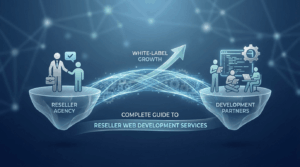
Introduction: The Strategic Imperative of Offshore Development for Modern Agencies
Digital agencies across the United States, United Kingdom, Canada, Australia, and New Zealand face an increasingly complex challenge: delivering exceptional client work while managing escalating operational costs and talent shortages. According to recent McKinsey research, 60% of companies identify the scarcity of tech talent as a key inhibitor of digital transformation, with 74% of employers reporting difficulty finding skilled professionals.
Enter the offshore web development partner—no longer simply a cost-cutting measure, but a strategic enabler that transforms how agencies scale, innovate, and compete. The global offshore development market, valued at approximately $160.9 billion in 2024, is projected to more than double to $413 billion by 2033, growing at a compound annual growth rate of 11.04%. This explosive growth reflects a fundamental shift: agencies aren’t just offshoring to save money; they’re doing it to access specialized expertise, accelerate time-to-market, and build sustainable competitive advantages.
For Western agencies, particularly those serving high-value clients in sectors like fintech, healthcare, e-commerce, and SaaS, the decision to partner with an offshore dev partner represents more than operational efficiency—it’s about survival and growth in an increasingly competitive marketplace.
Why Digital Agencies Are Embracing Offshore Development Partnerships
The Economic Reality: Cost Efficiency Without Quality Compromise
The financial advantages of partnering with an offshore web development partner for agencies are substantial and well-documented. Organizations implementing strategic offshore models achieve annual cost savings between 40-60%, with optimized partnerships reaching savings as high as 68% according to Deloitte’s 2025 Global Outsourcing Survey.
Consider the stark cost comparisons:
- United States: Senior developers command $120,000-$180,000 annually ($60-$90/hour)
- Western Europe: Development costs range from $80,000-$140,000 annually ($40-$70/hour)
- India: Comparable talent available at $30,000-$60,000 annually ($15-$30/hour)
- Eastern Europe: Mid-range at $50,000-$90,000 annually ($25-$45/hour)
For a typical agency maintaining a team of 10-15 developers, these differences translate to $800,000-$1.8 million in annual savings—capital that can be reinvested in business development, marketing, or expanding service offerings.
But the conversation has evolved beyond simple arbitrage. As Glassdoor reports indicate, in-house web developers in the United States cost agencies approximately $90,000 per year in salary alone, before accounting for benefits, office space, equipment, and administrative overhead. An offshore white label agency partnership eliminates these ancillary costs entirely, with the provider handling recruitment, HR, payroll, infrastructure, and compliance.
Access to Specialized Global Talent
The technical talent landscape has become increasingly specialized. Modern client projects demand expertise in AI/ML integration, blockchain development, cloud-native architectures, progressive web applications, and complex API ecosystems. Finding developers who possess these niche skills locally—particularly in smaller markets—has become nearly impossible.
India alone produces over 5.8 million developers, with hundreds of thousands entering the workforce annually from premier institutions like IITs, NITs, and specialized technology universities. This vast talent pool ensures agencies can access developers proficient in:
- Advanced frameworks: React, Angular, Vue.js, Next.js, Node.js, Laravel, Django
- Emerging technologies: AI/ML, blockchain, IoT, cloud computing (AWS, Azure, GCP)
- Enterprise solutions: Custom ERP, CRM integration, legacy system modernization
- E-commerce platforms: Magento, Shopify, WooCommerce, custom builds
According to industry data, 75% of Indian offshore development firms have integrated AI capabilities by the end of 2025, with 55% of new technology contracts involving AI-driven projects. This positions offshore partners not as commodity providers, but as innovation accelerators.
24/7 Development Cycles and Faster Time-to-Market
Time zone differences—often perceived as challenges—actually create strategic advantages when properly managed. An agency headquartered in New York can hand off work to their offshore team in India at the end of their business day, effectively creating a “follow-the-sun” development model where progress continues around the clock.
Real-world results demonstrate the impact:
- Healthcare SaaS company: Increased project velocity by 40% using 24/7 development cycles across time zones
- FinTech startup: Scaled from 5 to 25 developers in 3 months while maintaining code quality standards
- E-commerce platform: Reduced feature development costs from $250,000 to $95,000 per quarter while launching 3x more features
Scalability and Operational Flexibility
Traditional hiring models lock agencies into long-term commitments. The offshore development model offers unprecedented flexibility to scale teams up or down based on project demands, seasonal variations, or strategic pivots.
Need to add five React developers for a three-month sprint? An offshore web development partner for agencies can provision talent within 7-14 days. Project complete and team requirements reduced? Scale down without severance costs, HR complications, or morale impacts on core staff.
This elasticity proves particularly valuable for:
- Growing agencies: Handling project overflow without permanent headcount increases
- Specialized projects: Accessing niche expertise (blockchain developers, AI specialists) for specific client engagements
- Seasonal variations: Accommodating peak periods without maintaining excess capacity year-round
Testing new services: Experimenting with new offering areas before committing to full-time hires
Understanding Different Offshore Partnership Models
Not all offshore arrangements are created equal. Understanding the various engagement models helps agencies select the structure that best aligns with their operational needs and client service approach.
White Label Development Services
The offshore white label agency model has become the preferred choice for digital agencies looking to expand service capabilities while maintaining brand consistency. In this arrangement, the offshore partner operates completely behind the scenes, executing work that’s delivered under your agency’s brand.
Key characteristics:
- Complete brand invisibility: All deliverables, communications, and reports carry your agency branding
- Client relationship preservation: Your agency maintains direct client relationships; offshore team remains anonymous
- Service expansion: Offer comprehensive development services without building internal capacity
- Flexible engagement: Scale services based on client demand without long-term commitments
White label partnerships work particularly well for agencies that:
- Focus on strategy, design, and client relationship management
- Need development capacity without internal technical management
- Want to offer full-stack services across diverse technology stacks
- Serve clients who prefer working with domestic agencies
Bantech Solutions exemplifies this model, providing white-label web development services that allow Western agencies to deliver PHP, Node.js, React, and custom application development under their own brand while maintaining complete control over client relationships.
Dedicated Development Team Model
This model provides agencies with a team of developers who work exclusively on their projects, functioning as a remote extension of the in-house team. Unlike white label arrangements, the agency has direct interaction with individual developers.
Advantages:
- Team continuity: Same developers work on your projects long-term, building deep product knowledge
- Direct management: Agency retains control over daily workflows, priorities, and methodologies
- Cultural integration: Developers adopt your agency’s processes, communication styles, and quality standards
- Knowledge retention: Institutional knowledge remains with your extended team
This model suits agencies that:
- Maintain multiple ongoing client projects requiring dedicated capacity
- Have strong internal technical leadership and project management
- Value deep integration between offshore and onshore teams
- Need consistent availability of specific skill sets
Staff Augmentation

The most flexible model, staff augmentation allows agencies to temporarily add specific developers to their team for defined periods or projects. Think of it as flexible capacity-on-demand.
When staff augmentation makes sense:
- Short-term projects requiring specialized skills (3-6 month engagements)
- Seasonal demand fluctuations requiring temporary capacity
- Specific skill gaps in current team composition
- Testing offshore collaboration before committing to larger partnerships
Project-Based Outsourcing
Traditional project outsourcing involves handing off complete projects to an offshore partner who manages the entire development lifecycle from requirements to deployment.
Best for:
- Well-defined projects with clear specifications
- Agencies without internal technical management capacity
- One-off client projects outside core service areas
- Situations where agencies can provide comprehensive documentation upfront
Why India Remains the Premier Destination for Offshore Development Partnerships
The Indian IT Advantage: Beyond Cost Arbitrage
While cost efficiency initially attracted global businesses to India, the country has evolved into a comprehensive technology ecosystem that offers strategic value far beyond labor cost advantages. According to Nasscom projections, India’s IT services sector is forecasted to reach $254 billion in 2025, with IT exports surpassing $224 billion—a 4.6% year-over-year increase reflecting sustained global reliance on Indian development capabilities.
Unmatched Talent Density and Technical Excellence
India’s higher education system produces approximately 1.5 million engineering graduates annually, with specialized technology programs at institutions like the Indian Institutes of Technology (IITs), National Institutes of Technology (NITs), and thousands of engineering colleges nationwide.
This creates several compounding advantages:
Deep Technical Expertise: Indian developers routinely work with Fortune 500 companies, gaining exposure to enterprise-grade architecture, security practices, and scalability challenges. Many offshore development firms in India employ engineers who previously worked for global tech giants (Microsoft, Google, Amazon, IBM) and bring that institutional knowledge to client projects.
English Language Proficiency: As one of India’s official languages, English proficiency among technical professionals is exceptionally high. This eliminates communication barriers that plague offshore partnerships in other regions, ensuring clear requirements gathering, status updates, and collaborative problem-solving.
Global Standards Adherence: Indian development firms follow international standards including Agile, Scrum, ISO 9001, ISO 27001, CMMI, SOC 2, and industry-specific compliance frameworks (HIPAA for healthcare, PCI DSS for payments, GDPR for European projects).
Mature IT Infrastructure and Supportive Ecosystem
India’s technology infrastructure has matured significantly over the past two decades. Major cities like Bangalore, Hyderabad, Pune, Chennai, and Mumbai feature:
- Reliable connectivity: High-speed internet infrastructure with redundancy
- Software Technology Parks: Government-supported IT hubs with tax incentives and infrastructure
- Collaborative ecosystems: Dense networks of technology companies fostering innovation and knowledge sharing
- Time-tested operations: Decades of experience managing complex global client relationships
Specialization in Emerging Technologies
Indian offshore development companies lead in emerging technology adoption:
- AI/ML Integration: 75% of Indian firms integrated AI capabilities by the end of 2025, with expertise in natural language processing, computer vision, and predictive analytics
- Cloud-Native Development: 62% adoption of hybrid cloud strategies, with deep expertise in AWS, Azure, and Google Cloud Platform
- Blockchain and DeFi: Growing specialization in smart contract development, NFT platforms, and decentralized applications
- DevOps and CI/CD: Advanced implementation of containerization (Docker, Kubernetes), automated testing, and continuous deployment pipelines
The Bantech Solutions Advantage
While India offers abundant options, not all offshore partners deliver equal value. Bantech Solutions stands out by combining India’s cost advantages with hybrid operational excellence tailored specifically for Western agencies.
Proven Track Record: With 300+ solutions designed and delivered across 20+ business domains and 100+ legacy systems re-engineered, Bantech brings battle-tested experience to every engagement.
Comprehensive Service Portfolio:
- Enterprise Software Development: Custom web applications using PHP, Laravel, Node.js, React, and modern JavaScript frameworks
- AI and Machine Learning Solutions: Custom AI development, NLP, computer vision, and intelligent automation
- Blockchain and NFT Development: Smart contracts, DeFi platforms, and tokenization services
- Post-Deployment Support: 24/7 maintenance, bug fixes, security updates, and ongoing optimization
Client-Centric Approach: Testimonials consistently highlight Bantech’s professionalism, reliability, and ability to function as a “white-labeled back-office” that makes agency operations possible. This partnership mentality—rather than vendor mentality—creates the foundation for long-term success.
How to Evaluate and Select the Right Offshore Web Development Partner for Agencies
Essential Evaluation Criteria
Selecting an offshore dev partner requires methodical evaluation across multiple dimensions. Agencies should never rely solely on cost comparisons or marketing claims. Instead, implement a comprehensive vetting framework:
1. Technical Expertise and Specialization
Assess specific technology competencies:
- Request detailed portfolios demonstrating work in your required technology stack
- Ask for case studies from similar industries or project types
- Verify certifications and training programs for their development teams
- Review their adoption of modern development practices (test-driven development, code reviews, CI/CD)
Red flag: Agencies claiming expertise across every technology stack and framework often lack deep specialization. Look for focused competence rather than shallow breadth.
2. Communication Infrastructure and Cultural Alignment
Communication quality determines offshore partnership success more than any other single factor. Studies show that offshore development teams excelling in communication, cultural fit, and technical expertise achieve 30% higher project success rates.
Evaluation tactics:
- Conduct multiple discovery calls: Assess English proficiency, responsiveness, and question quality
- Request dedicated points of contact: Ensure assigned project managers have appropriate technical backgrounds
- Test collaboration tools: Confirm compatibility with your existing project management platforms (Jira, Asana, ClickUp, Slack)
- Evaluate time zone management: Determine overlap hours and responsiveness protocols for urgent issues
Look for partners who:
- Ask clarifying questions about your business context and client needs
- Proactively suggest alternative approaches or identify potential issues
- Demonstrate understanding of your agency’s brand positioning and service model
- Propose structured communication cadences (daily standups, sprint planning, retrospectives)
3. Quality Assurance and Security Protocols
Quality assurance must be built into workflows, not retrofitted after problems emerge.
Critical questions:
- What code review processes do you implement?
- How do you handle testing (unit tests, integration tests, user acceptance testing)?
- What security practices govern code development?
- Which compliance frameworks do you follow? (ISO 27001, SOC 2, GDPR, HIPAA)
- How do you handle intellectual property protection and NDA enforcement?
Best practices partners implement:
- Automated testing integrated into CI/CD pipelines
- Mandatory peer code reviews before merging
- Regular security audits and penetration testing
- Documented coding standards and style guides
- Comprehensive data protection policies
Bantech Solutions prioritizes security and compliance across all engagements, with encryption protocols, permission systems, and adherence to global data protection standards ensuring client data remains secure throughout development and deployment.
4. Scalability and Resource Management
Evaluation factors:
- Team size and availability: Can the partner scale to your requirements? (Small teams may lack capacity; very large firms may provide inconsistent quality)
- Recruitment capabilities: How quickly can they add specialized skills when projects demand them?
- Resource continuity: What’s their developer retention rate? (High turnover disrupts projects)
- Onboarding processes: How do they integrate new developers mid-project without knowledge loss?
Industry data indicates developer retention rates significantly impact project continuity. Partners with turnover below 15% annually provide much more stable engagements than those with 30-40% churn.
5. Client References and Proven Track Record
Due diligence steps:
- Request references from agencies (not just direct product companies) who can speak to white-label partnership experiences
- Review platforms like Clutch, GoodFirms, and Google Reviews for unfiltered feedback
- Ask for specific examples of handling project challenges or scope changes
- Inquire about their longest-running client relationships (longevity indicates satisfaction)
Warning signs:
- Reluctance to provide references
- No verifiable case studies or portfolio work
- Inconsistent reviews across multiple platforms
- Vague responses about processes and methodologies
6. Pricing Models and Contract Structure
Transparent, flexible pricing builds trust and enables effective budgeting.
Common pricing models:
Fixed Price: Suitable for well-defined projects with clear specifications and deliverables. Provides budget certainty but requires comprehensive upfront documentation.
Time and Materials: Pay for actual hours worked. Offers flexibility for evolving requirements but requires careful management to control costs.
Dedicated Team: Monthly retainer for exclusive access to defined team members. Provides consistency and predictable budgeting for ongoing work.
Hourly Rates: Most flexible model for staff augmentation or variable-scope projects. Typical ranges:
- Junior Developers (1-3 years): $15-$25/hour
- Mid-Level Developers (3-5 years): $25-$40/hour
- Senior Developers (5-10 years): $40-$60/hour
- Technical Leads/Architects (10+ years): $60-$80/hour
Contract essentials:
- Clear IP ownership clauses (all code belongs to your agency)
- Comprehensive NDA covering proprietary information and client data
- Service level agreements (SLAs) defining response times and availability
- Termination clauses protecting both parties
- Payment terms aligned with milestone deliveries
The Pilot Project Strategy
Never commit to large-scale partnerships without validation. Implement a phased approach:
Phase 1: Initial Assessment (Weeks 1-2)
- Detailed discovery calls and technical discussions
- Review portfolios, case studies, and references
- Assess cultural fit and communication quality
- Define pilot project scope and success criteria
Phase 2: Pilot Project Execution (Weeks 3-8)
- Assign a small, well-scoped project (2-4 week sprint)
- Monitor code quality, communication responsiveness, and problem-solving
- Evaluate adherence to deadlines and handling of unexpected issues
- Assess integration with your existing workflows
Phase 3: Evaluation and Decision (Weeks 9-10)
- Review deliverables against acceptance criteria
- Collect feedback from internal team members who interfaced with offshore developers
- Compare technical quality to your standards
- Assess business aspects (pricing accuracy, contract clarity, responsiveness to concerns)
Only after successful pilot completion should agencies commit to larger engagements or long-term contracts.
Maximizing Success: Best Practices for Managing Offshore Development Partnerships
Establishing Clear Communication Frameworks
Structured communication cadences:
- Daily standups: 15-minute video calls to review progress, identify blockers, and align on priorities
- Sprint planning: Collaborative sessions defining work scope for upcoming iterations (typically bi-weekly)
- Sprint retrospectives: Team discussions about what worked, what didn’t, and process improvements
- Weekly stakeholder updates: Summary reports for agency leadership and clients (when appropriate)
Tool stack optimization:
- Project management: Jira, Asana, Monday.com, ClickUp for task tracking and workflow visibility
- Communication: Slack or Microsoft Teams for real-time collaboration
- Documentation: Confluence, Notion, or Google Docs for requirements and technical specifications
- Code repository: GitHub, GitLab, or Bitbucket with protected main branches and PR-based workflows
- Design handoff: Figma, Zeplin, or Adobe XD for design-to-development collaboration
Documentation and Knowledge Management
Comprehensive documentation prevents miscommunication and enables smooth team transitions.
Critical documentation:
- Technical specifications: Detailed requirements, architecture decisions, and data models
- API documentation: Clear endpoint definitions, authentication methods, and response formats
- Coding standards: Style guides, naming conventions, and architectural patterns
- Deployment procedures: Step-by-step processes for pushing code to various environments
- Troubleshooting guides: Common issues and resolution procedures
Setting Clear Expectations and Acceptance Criteria
Ambiguity kills offshore projects. Define success explicitly:
For every development task:
- Functional requirements: What the feature must do
- Non-functional requirements: Performance benchmarks, security requirements, accessibility standards
- Acceptance criteria: Specific, testable conditions that determine task completion
- Definition of done: Quality gates that must be passed (code review, testing, documentation)
Managing Cultural Differences and Building Team Cohesion
Geographic distance need not create team fragmentation. Intentional practices build cohesion:
Team integration strategies:
- Virtual team-building: Occasional informal video calls for personal connection
- Recognition practices: Celebrate milestones, excellent work, and project completions
- Inclusive decision-making: Involve offshore developers in technical decisions and architecture discussions
- Cultural awareness training: Help onshore teams understand Indian holidays, work customs, and communication styles
Continuous Improvement and Feedback Loops
High-performing offshore partnerships never plateau—they continuously improve.
Implementation:
- Sprint retrospectives: Regular forums for team feedback and process refinement
- Quarterly business reviews: Strategic discussions about partnership performance and improvements
- Developer feedback collection: Understanding offshore team experience and addressing concerns
- Metrics tracking: Monitor velocity, defect rates, and deployment frequency to identify trends
Bantech Solutions exemplifies this commitment to continuous improvement through their structured IT Strategy & Planning services, which help agencies optimize their technology roadmaps and offshore collaboration models for maximum efficiency.
Common Pitfalls and How to Avoid Them
Pitfall 1: Inadequate Onboarding and Context Sharing
The problem: Offshore teams can’t deliver effectively without understanding your agency’s clients, brand positioning, quality standards, and business objectives.
The solution: Invest 2-3 weeks in comprehensive onboarding covering:
- Agency history, values, and service philosophy
- Client portfolio and industry contexts
- Quality standards and deliverable expectations
- Technical stack preferences and architectural patterns
- Communication protocols and escalation procedures
Pitfall 2: Micromanagement or Insufficient Oversight
The problem: Agencies struggle to find the balance between autonomy and oversight. Too much micromanagement breeds resentment and slows productivity. Too little oversight creates drift and misalignment.
The solution: Establish clear autonomy boundaries:
- Offshore teams own implementation decisions within defined architectural frameworks
- Agencies provide clear requirements but defer to technical expertise on methodology
- Regular checkpoints provide visibility without constant intervention
- Empower offshore leads to make daily decisions while escalating strategic questions
Pitfall 3: Unclear IP Ownership and Legal Protections
The problem: Ambiguous contracts create disputes about code ownership, particularly when partnerships end.
The solution: Ensure contracts explicitly state:
- All developed code becomes agency IP immediately upon creation
- Comprehensive NDAs cover proprietary information, client data, and business methods
- Developers sign IP assignment agreements
- Source code repositories reside in agency-controlled accounts
Pitfall 4: Ignoring Time Zone Challenges
The problem: The 10-12 hour time difference between Western countries and India creates coordination challenges when ignored.
The solution: Strategic approaches include:
- Overlap hours mandate: Require 3-4 hours of guaranteed overlap with agency working hours
- Asynchronous workflows: Structure projects to minimize dependencies requiring real-time collaboration
- Clear handoff protocols: End-of-day summaries enabling smooth transitions between shifts
- Flexibility on both sides: Occasional early/late meetings demonstrating mutual accommodation
Pitfall 5: Selecting Partners Based Solely on Cost
The problem: Choosing the lowest-cost provider often results in subpar quality, poor communication, and ultimate project failure—making it the most expensive choice long-term.
The solution: Evaluate total value, not just hourly rates:
- Factor in communication quality and responsiveness
- Consider developer experience and expertise depth
- Assess quality assurance processes and defect rates
- Calculate hidden costs (rework, scope management, coordination overhead)
A mid-tier partner charging $10-15 more per hour but delivering higher quality and requiring less oversight typically costs significantly less overall than a bargain-basement provider requiring constant supervision and generating technical debt.
Frequently Asked Questions About Offshore Web Development Partners for Agencies
How Do I Ensure Quality When Working With an Offshore Dev Partner?
Quality assurance begins with partner selection and continues through structured processes:
Partner selection: Choose firms with documented QA practices, relevant certifications (ISO 9001, CMMI), and strong client references specifically from agencies.
Process implementation: Establish mandatory code reviews, automated testing requirements, and clear acceptance criteria for every deliverable.
Continuous monitoring: Track metrics including defect rates, code coverage, deployment success rates, and client satisfaction scores.
Feedback loops: Implement sprint retrospectives and regular technical reviews to identify and address quality issues proactively.
Bantech Solutions maintains rigorous quality assurance protocols including multiple testing stages, security audits, and performance optimization—ensuring every delivery meets enterprise-grade standards.
What’s the Ideal Team Size for Starting an Offshore Partnership?
Start small and scale based on results. The optimal initial engagement:
Pilot phase: 2-3 developers for 1-2 months allows meaningful evaluation without excessive risk.
Initial production phase: 3-5 developers provides sufficient capacity to handle real client work while maintaining manageable coordination overhead.
Scale-up phase: Add developers incrementally (2-3 at a time) as offshore processes mature and trust builds.
Agencies serving 5-10 concurrent client projects typically maintain offshore teams of 8-15 developers once partnerships mature. High-growth agencies may scale to 20-50+ developers over 12-24 months.
How Do I Handle Client Concerns About Offshore Development?
Transparency and positioning determine client acceptance:
White label approach: Most agencies never disclose offshore partnerships. From the client perspective, all work is “your team.”
When disclosure is necessary:
- Focus on expertise access: Position as accessing specialized global talent unavailable locally
- Emphasize quality controls: Describe rigorous oversight, testing protocols, and your direct involvement
- Highlight cost efficiency: Frame as enabling more services within client budgets
- Share success stories: Reference other clients benefiting from the model (with permission)
- Maintain accountability: Make clear you remain fully responsible for all deliverables
Most client concerns evaporate when deliverables consistently meet or exceed expectations.
What Technologies and Services Should I Offshore First?
Begin with lower-risk, well-defined work before transitioning strategic projects:
Ideal initial projects:
- Front-end development: UI implementation from approved designs
- CMS customization: WordPress, Drupal, or proprietary CMS enhancements
- Maintenance and support: Bug fixes, minor enhancements, technical debt reduction
- QA and testing: Test case development and execution
- API integration: Connecting third-party services following clear specifications
Later-stage offshoring:
- Custom application development: Bespoke solutions requiring significant architectural decisions
- Discovery and strategy: Requirements gathering and technical planning
- Direct client interaction: Technical consulting and project management
How Quickly Can I Scale My Offshore Team?
Timelines depend on partner capacity and specialization requirements:
General developers (React, Node.js, PHP, Python): 7-14 days with established partners maintaining talent benches
Specialized skills (AI/ML, blockchain, specific enterprise platforms): 3-4 weeks to recruit and vet appropriate expertise
Large team scaling (10+ developers simultaneously): 4-8 weeks to maintain quality standards during rapid growth
Bantech Solutions maintains a curated talent pool enabling rapid provisioning while ensuring every developer meets cultural and technical requirements before assignment.
What Should My Offshore Development Budget Include?
Comprehensive budgeting prevents surprises:
Direct costs:
- Developer hourly rates or monthly retainers
- Project management overhead (typically 10-15% of development costs)
- Communication and collaboration tools
Indirect costs:
- Internal coordination time (agency PM/technical lead oversight)
- Knowledge transfer and documentation
- Travel for quarterly in-person meetings (optional but valuable)
One-time setup costs:
- Detailed onboarding and knowledge transfer
- Process documentation and workflow establishment
- Tool setup and integration
Typical total costs: For a 5-developer offshore team, expect $12,000-$20,000 monthly all-in costs (versus $35,000-$50,000 for equivalent local hiring).
The Future of Agency-Offshore Partnerships: Trends Shaping 2025 and Beyond
AI-Augmented Development

Artificial intelligence is transforming software development workflows. Progressive offshore partners integrate AI tools for:
- Code generation: AI assistants (GitHub Copilot, Tabnine) accelerating initial development by 30-55%
- Automated testing: AI-powered test case generation and predictive bug detection
- Code review assistance: Automated identification of security vulnerabilities, performance issues, and code smells
- Documentation generation: AI-created technical documentation from code comments and structure
Bantech Solutions’ AI and ML capabilities position partner agencies at the forefront of these innovations, enabling delivery of intelligent, data-driven applications that provide competitive differentiation.
Low-Code/No-Code Platform Integration
The rise of low-code platforms (Webflow, Bubble, OutSystems) is creating new opportunities for agency-offshore collaboration:
- Offshore teams rapidly prototype and build MVPs using low-code tools
- Agencies focus on strategy, design, and client management
- Custom functionality added through traditional development where low-code falls short
- Faster time-to-market for standard business applications
Specialized Vertical Expertise
Generic development capabilities are being commoditized. Leading offshore partners differentiate through deep vertical expertise:
- FinTech: PCI compliance, payment gateway integration, blockchain applications
- HealthTech: HIPAA compliance, EHR integration, telemedicine platforms
- E-commerce: Platform-specific expertise (Shopify Plus, Magento, WooCommerce), headless commerce
- SaaS: Multi-tenancy architecture, subscription billing, usage analytics
Hybrid and Distributed Team Models
The future isn’t purely offshore or onshore—it’s intelligently distributed:
- Strategic onshore resources: Client-facing roles, business strategy, complex problem-solving
- Offshore development capacity: Implementation, testing, maintenance, support
- Nearshore coordination: Regional presence (Mexico, Colombia for US agencies) providing timezone alignment
Follow-the-sun workflows: Continuous development across global locations
Conclusion: Transforming Your Agency Through Strategic Offshore Partnerships
The decision to partner with an offshore web development partner for agencies represents far more than a tactical cost-reduction measure. It’s a strategic transformation enabling agencies to:
- Expand service offerings without proportional overhead increases
- Access specialized expertise unavailable in local markets
- Increase profitability by optimizing cost structures while maintaining or improving quality
- Scale elastically to accommodate growth and project variability
- Accelerate delivery through 24/7 development cycles
- Focus internal resources on high-value strategy, client relationships, and business development
Success requires methodical partner selection, structured processes, clear communication, and commitment to continuous improvement. Agencies that approach offshore partnerships strategically—viewing them as extensions of their core team rather than vendor relationships—unlock transformative competitive advantages.
India, with its unmatched combination of technical talent, cost efficiency, English proficiency, and mature IT infrastructure, remains the premier destination for offshore development. Within this landscape, Bantech Solutions distinguishes itself through a proven track record of agency partnerships, comprehensive technical capabilities spanning web development, AI/ML, blockchain, and enterprise solutions, and an unwavering commitment to functioning as a reliable, strategic, long-term partner for Western agencies.
The future belongs to agencies that leverage global talent strategically while maintaining the client relationships, creative vision, and strategic insight that define their brand. An offshore partnership doesn’t dilute your agency—it amplifies it.
Are you ready to transform your agency’s capabilities and competitive positioning? The offshore opportunity isn’t coming—it’s here. The only question is whether you’ll lead or follow.
Take the Next Step: Partner With Bantech Solutions
Discover how Bantech Solutions can serve as your strategic offshore web development partner, providing:
- 300+ Proven Solutions across 20+ industries
- White-Label Services that protect your client relationships and brand
- Full-Stack Expertise in PHP, Node.js, React, AI/ML, blockchain, and more
- 24/7 Support ensuring your projects never stall
- Transparent Pricing with no hidden costs or surprises
- Rapid Scaling from pilot projects to dedicated teams
Schedule a consultation to discuss how an offshore partnership can transform your agency’s growth trajectory, profitability, and competitive position in 2025 and beyond.
FAQs
Digital agencies today operate in a fast-moving, high-pressure environment. Clients expect fast turnaround, cutting-edge technology, and flawless execution — all while budgets remain tight and local developer talent grows harder to find. In response, thousands of agencies across the United States, United Kingdom, Canada, Australia, and New Zealand have turned to a powerful solution: the offshore web development partner.
But what exactly is an offshore web development partner for agencies? How does it differ from simply outsourcing a project to a freelancer or a local vendor? And why is this model reshaping how modern agencies scale, compete, and deliver?
This article answers all of those questions in full. Whether you’re a digital agency owner exploring offshore options for the first time, or an operations lead looking to understand the model more deeply before committing, this guide will give you a complete, clear picture.
What Is an Offshore Web Development Partner?
An offshore web development partner is a professional development company located in another country — typically in a lower-cost region such as India, Eastern Europe, or Southeast Asia — that works exclusively or primarily with digital agencies to deliver web development services on their behalf.
The word “partner” is deliberate and important. Unlike a one-off freelancer or a transactional outsourcing vendor, an offshore development partner operates as a true extension of your agency. They understand your workflows, your quality standards, your clients’ expectations, and your brand voice. Their goal isn’t just to write code — it’s to make your agency more capable, more profitable, and more competitive.
From a practical standpoint, an offshore web development partner for agencies typically provides:
- Full-stack web development (front-end, back-end, and database)
- Custom web application development (SaaS, portals, dashboards)
- CMS development (WordPress, Drupal, Joomla)
- E-commerce development (Shopify, Magento, WooCommerce)
- API development and third-party integrations
- QA testing and quality assurance
- Post-launch maintenance and support
In most agency partnerships, this work is delivered on a white-label basis — meaning the offshore team works silently behind the scenes, and all deliverables are presented to your clients under your agency’s name and branding.
How Is It Different from Regular Outsourcing?
This is a question many agency owners ask, and the distinction matters significantly.
Traditional outsourcing is typically transactional: you hand off a project, the vendor delivers it, and the relationship ends. There’s limited investment in understanding your agency’s unique needs, and the vendor may be juggling dozens of unrelated clients simultaneously.
An offshore web development partnership, by contrast, is strategic and ongoing. The offshore team invests time in learning how your agency operates — your project management tools, your communication style, your technical preferences, your client base. Over time, they become genuinely integrated with your internal team, capable of acting on initiative rather than waiting for every instruction.
Think of it this way: an outsourcing vendor completes tasks. An offshore development partner helps build your agency.
This distinction shows up in several practical ways:
- Dedicated resources: Offshore partners assign specific developers to your agency long-term, rather than rotating generic staff from project to project.
- Cultural alignment: A true partner adapts to your communication cadence, uses your preferred tools, and aligns with your work culture.
- Proactive involvement: Rather than waiting for a spec document, a good offshore partner asks the right questions, flags potential issues early, and suggests improvements.
- Shared accountability: Offshore partners care about outcomes, not just deliverables. If a project isn’t working, they collaborate with you to fix it.
Why Agencies Choose Offshore Development Partners
The rise of the offshore web development partner model is not accidental. Several converging forces make it particularly attractive for agencies right now.
1. The Developer Talent Shortage
The global shortage of skilled developers is well-documented. In the United States alone, demand for software developers is expected to grow far faster than supply well into the next decade. For agencies based in smaller cities or towns, finding qualified local developers is even harder. Partnering offshore opens access to a vast, skilled, and English-proficient talent pool — most notably in India, which produces over 1.5 million engineering graduates annually.
2. Cost Efficiency Without Quality Trade-offs
Hiring in-house developers in the US or UK comes with significant overhead: salaries, benefits, office space, equipment, HR administration, and more. Senior developers in the US typically command $120,000 to $180,000 per year. Comparable talent in India can be engaged at $30,000 to $60,000 annually — a saving of 40% to 68% depending on seniority and engagement model.
Critically, this cost difference no longer implies a quality trade-off. Leading offshore development firms in India operate at global standards, follow international compliance frameworks (ISO 27001, SOC 2, CMMI), and routinely serve Fortune 500 clients. For agencies, this means the ability to increase margins, offer more competitive pricing to clients, or reinvest savings into growth.
3. Scalability and Flexibility
Traditional hiring locks agencies into fixed overhead. If a large project ends or client demands shift, downsizing a full-time team is slow, expensive, and damaging to morale. An offshore development partner lets agencies scale up or down quickly — adding five developers for a three-month sprint or reducing capacity after a project wraps, all without the friction of conventional employment.
4. 24/7 Development Cycles
The time zone difference between Western countries and India (typically 9 to 13 hours) is often perceived as a challenge. In reality, well-managed partnerships turn it into an advantage. Your agency’s team finishes work for the day and hands off to the offshore team, who continue development through the night. By the next morning, progress has been made while you slept. This “follow-the-sun” model compresses timelines dramatically on deadline-sensitive projects.
The Main Offshore Partnership Models for Agencies
Not every offshore arrangement works the same way. Agencies typically choose from four primary engagement models depending on their needs:
White-Label Development Partnership
The most popular model for agencies. The offshore team works entirely under your brand — all code, documentation, reports, and communications carry your agency’s identity. Your clients never know a third party is involved. This is ideal for agencies that want to expand service capabilities without building internal capacity or disclosing their supply chain.
Dedicated Development Team
In this model, the agency is assigned a fixed team of developers who work exclusively on their projects. The agency may interact directly with individual developers, manage daily standups, and direct priorities. The offshore team functions like a remote department of your agency, with deep familiarity with your systems and clients.
Staff Augmentation
A more flexible arrangement where one or several developers are added temporarily to supplement your existing team. Useful for projects that require specific skills your team lacks, or for handling peak demand periods without a long-term commitment.
Project-Based Outsourcing
The closest to traditional outsourcing. The agency hands over a well-defined project — with specs, timelines, and deliverables — and the offshore partner manages the entire development lifecycle. Best suited for clearly scoped projects with minimal room for ambiguity.
What Makes India the Leading Offshore Destination for Agencies?
While offshore development partners can be found in many regions, India remains the world’s premier destination for this model, and for good reason.
India’s IT sector is forecasted to reach $254 billion in 2025, with IT exports surpassing $224 billion. The country’s higher education system produces an enormous volume of technical graduates each year from prestigious institutions including the IITs (Indian Institutes of Technology) and NITs (National Institutes of Technology).
Beyond volume, India offers several advantages that directly benefit agencies:
- English as an official language, enabling clear communication without translation barriers
- Deep familiarity with Western business culture through decades of serving US, UK, and Australian clients
- Mature IT infrastructure in major tech hubs including Bangalore, Hyderabad, Pune, and Mumbai
- Broad technology expertise, from legacy PHP and WordPress to modern React, Node.js, AI/ML, and blockchain
- Rigorous compliance adherence, including GDPR, HIPAA, PCI DSS, and other frameworks relevant to agency clients
Key Qualities to Look For in an Offshore Web Development Partner
Choosing the right partner is as important as deciding to work offshore at all. When evaluating potential offshore web development partners, agencies should assess:
Technical Depth: Does the partner have genuine expertise in the technologies your clients require? Ask for portfolios, case studies, and references from similar agency clients.
Communication Quality: Is the team responsive, proactive, and clear? Communication is cited as the single most important factor in offshore partnership success.
Quality Assurance Processes: Does the partner have structured QA workflows, code review practices, and automated testing pipelines — or do they wing it?
Security and IP Protection: Does the partner use NDAs, IP assignment agreements, and data security protocols to protect your client work?
Scalability: Can the partner grow with you? Do they have a talent pipeline ready to onboard additional developers when your projects expand?
Cultural Fit: Does the team understand agency work — deadlines, client expectations, brand standards — or do they treat every project like generic software development?
Common Misconceptions About Offshore Web Development Partners
Several myths continue to discourage agencies from exploring this model:
“Quality will suffer.” This was a legitimate concern 15 years ago. Today, leading offshore partners deliver enterprise-grade work and routinely serve global brands. Quality depends on partner selection, not geography.
“It’s too complicated to manage.” With modern tools — Slack, Jira, GitHub, Figma — managing an offshore team is no more complex than managing a remote in-house team. Many agencies find it easier, because offshore partners bring their own project management experience.
“My clients will find out and be upset.” Most clients don’t ask. And when they do, the conversation is easily reframed around access to specialized expertise and cost efficiency — both of which ultimately benefit the client.
“It only works for simple projects.” Offshore partners today handle everything from complex SaaS platforms and AI-powered applications to enterprise ERP integrations and blockchain development. Complexity is not a barrier.
How to Get Started with an Offshore Web Development Partner
If you’re ready to explore an offshore partnership, the recommended approach is to start small and validate before committing at scale.
Begin with a clearly scoped pilot project — something real but not mission-critical. Use it to evaluate the partner’s technical quality, communication responsiveness, and ability to work within your workflows. After a successful pilot, expand the engagement incrementally, adding developers and complexity as trust builds.
Before any engagement begins, ensure the legal foundations are solid: a comprehensive NDA, IP assignment clauses confirming all code belongs to your agency, and a service level agreement (SLA) defining response times and availability.
Conclusion
An offshore web development partner for agencies is more than a cost-saving measure — it is a strategic lever that allows agencies to scale intelligently, access world-class technical talent, and compete at a higher level without proportional increases in overhead.
When chosen carefully and managed well, an offshore partner becomes a genuine extension of your agency: aligned with your values, fluent in your processes, and committed to your clients’ success. The best offshore development partnerships don’t look like outsourcing at all — they look like an exceptionally capable remote team that happens to be based in another country.
For agencies navigating a competitive market with limited local talent and growing client expectations, an offshore web development partner is no longer just an option. For many, it has become an essential part of how they operate, grow, and win.
One of the first questions any agency asks when considering an offshore web development partner is simple and entirely reasonable: how much is this going to cost?
The honest answer is: it depends — but far less than most agencies assume, and far less than the alternative of hiring locally. Offshore web development costs for agencies vary based on region, developer seniority, engagement model, and project complexity. But across all those variables, one truth remains consistent: agencies that partner with offshore development teams almost universally spend significantly less than they would building equivalent in-house capacity, often saving between 40% and 68% on development costs.
This guide breaks down offshore web development pricing in full — by region, by seniority level, by engagement model, and by total cost of ownership — so you can plan your budget accurately and make a confident decision.
Why Cost Is Only Part of the Picture
Before diving into numbers, it’s worth framing how to think about offshore development costs correctly. The temptation for many agencies is to evaluate offshore partners purely on hourly rate — to find the lowest number and treat it as a win. This approach consistently leads to poor outcomes.
The right question isn’t “how much per hour?” It’s “what is the total cost of delivering this outcome, and what is the value returned against that cost?”
An offshore developer charging $12 per hour who requires constant supervision, produces frequent rework, and communicates poorly may cost your agency more in the long run than a developer charging $28 per hour who delivers clean, well-documented code with minimal oversight. True cost includes time spent on corrections, project management overhead, missed deadlines, and client dissatisfaction.
With that framing in mind, here is a complete picture of what offshore web development actually costs for agencies.
Offshore Developer Hourly Rates by Region (2026)
The global map of offshore development has several key hubs, each offering a different balance of cost, talent quality, and time zone alignment.
India
India remains the world’s leading offshore development destination for agencies, combining the most competitive pricing with a vast, English-proficient talent pool and mature IT infrastructure.
- Junior Developers (0–2 years experience): $12–$20/hour
- Mid-Level Developers (3–5 years experience): $20–$35/hour
- Senior Developers (5–10 years experience): $35–$55/hour
- Technical Leads / Architects (10+ years): $55–$80/hour
For most agency work — WordPress builds, custom web applications, React front-ends, Laravel backends — mid-level developers in this range represent the best value proposition: experienced enough to work independently, affordable enough to deploy at scale.
Eastern Europe (Ukraine, Poland, Romania)
Eastern European developers offer a nearshore option for Western European agencies, with rates that are higher than India but lower than Western Europe. Time zone overlap with the UK and EU is a key advantage.
- Junior Developers: $25–$40/hour
- Mid-Level Developers: $40–$65/hour
- Senior Developers: $65–$90/hour
- Technical Leads / Architects: $90–$120/hour
Southeast Asia (Philippines, Vietnam, Indonesia)
Southeast Asia offers competitive rates, though the talent pool is smaller and less specialised than India for certain technology stacks.
- Junior Developers: $10–$18/hour
- Mid-Level Developers: $18–$30/hour
- Senior Developers: $30–$50/hour
- Technical Leads / Architects: $50–$70/hour
Latin America (Mexico, Colombia, Brazil)
Latin America has grown in popularity among US agencies specifically for its time zone alignment with North America. Rates are higher than Southeast Asia or India but timezone compatibility is often worth the premium.
- Junior Developers: $25–$40/hour
- Mid-Level Developers: $40–$65/hour
- Senior Developers: $65–$95/hour
- Technical Leads / Architects: $95–$130/hour
Comparison: Offshore vs. In-House vs. Freelance
To understand the true financial impact of offshore development, it helps to compare directly against the alternatives most agencies consider.
In-House Developers (United States)
- Junior Developer salary: $65,000–$85,000/year
- Mid-Level Developer salary: $90,000–$120,000/year
- Senior Developer salary: $130,000–$180,000/year
But salary is just the starting point. Add employer taxes (7.65% FICA), health insurance ($6,000–$15,000/year), equipment ($2,000–$4,000), office space ($5,000–$12,000/year), paid leave, onboarding costs, and HR overhead — and the true cost of a mid-level in-house developer in the US rises to $120,000–$160,000 per year, or roughly $58–$77 per hour.
Compare that to a mid-level offshore developer in India at $20–$35/hour — the annual equivalent of $40,000–$70,000, with no benefits, no equipment costs, no office overhead, and no HR burden. The offshore partner handles all of that.
Freelancers
Freelancers sit between in-house and offshore in terms of cost structure. US-based freelancers typically charge $60–$120/hour for mid-to-senior web development work, while international freelancers on platforms like Upwork can be found at lower rates. However, freelancers carry significant risks: no continuity, no quality oversight, availability gaps, no accountability structure, and no scalability. For agencies delivering ongoing client work, a freelancer pool is not a reliable supply chain.
Summary Cost Comparison Table
| Model |
Equivalent Hourly Cost |
Scalability |
Oversight Required |
| US In-House (Mid-Level) |
$58–$77/hour |
Low |
Low |
| US Freelancer (Mid-Level) |
$60–$120/hour |
Very Low |
High |
| Eastern Europe Offshore |
$40–$65/hour |
Medium |
Medium |
| India Offshore (Mid-Level) |
$20–$35/hour |
High |
Low–Medium |
| Southeast Asia Offshore |
$18–$30/hour |
Medium |
Medium |
Offshore Development Cost by Engagement Model
Beyond hourly rates, the engagement model you choose significantly affects your total cost structure. Different models suit different agency needs and project types.
White-Label Monthly Retainer
The most common model for agencies, a white-label retainer gives you access to a defined team on an ongoing basis. You pay a fixed monthly fee regardless of whether you fill every hour — the trade-off being consistency, dedicated availability, and deep integration with your workflows.
Typical cost range:
- 2–3 developer team (India-based): $8,000–$15,000/month
- 5 developer team (India-based): $15,000–$25,000/month
- 10 developer team (India-based): $28,000–$50,000/month
For reference, a single mid-level in-house developer in the US costs $10,000–$13,000/month fully loaded. At $15,000–$25,000/month for an offshore team of five, the value difference is immediate.
Dedicated Development Team
Similar to the retainer model but with even tighter integration — the offshore team functions as a true remote department of your agency, often attending your standups, working within your tools, and reporting to your project managers.
Typical cost range (India-based, per developer per month):
- Junior Developer: $2,000–$3,500/month
- Mid-Level Developer: $3,500–$5,500/month
- Senior Developer: $5,500–$8,500/month
- Tech Lead / Architect: $8,500–$12,000/month
Time and Materials (T&M)
You pay for actual hours worked, tracked and billed weekly or monthly. This offers the most flexibility for projects with evolving scope, but requires careful management to control costs.
Best for: Agile projects, discovery phases, or ongoing maintenance where scope changes frequently.
Typical billing increments: Weekly or bi-weekly, based on tracked hours.
Fixed Price Project
You agree on a scope and the offshore partner quotes a fixed price for delivery. This gives budget certainty but requires thorough upfront documentation. Change requests typically incur additional fees.
Best for: Well-defined projects — landing pages, CMS builds, e-commerce implementations with clear specifications.
Example fixed-price ranges (India-based partner):
- WordPress website (standard): $2,500–$6,000
- Custom web application (mid-complexity): $15,000–$40,000
- E-commerce platform (Shopify/WooCommerce): $5,000–$20,000
- SaaS MVP: $25,000–$80,000
Staff Augmentation
You bring in one or several specific developers to supplement your team for a defined period. This is the most targeted model — you’re solving a specific skill gap or capacity shortfall without building a full offshore team.
Typical cost: Same as individual hourly or monthly rates above, with a short-term premium of 10–15% for arrangements under three months.
What Hidden Costs Should Agencies Budget For?
Beyond the headline developer rates, a realistic offshore budget includes several additional cost categories that agencies should plan for from the outset.
Project Management Overhead
Offshore partnerships don’t run themselves. Whether you use an internal project manager or the offshore partner provides one, coordination has a cost. Budget approximately 10–15% of your development spend for project management — less if the offshore partner provides a dedicated PM, more if your internal team carries that load.
Onboarding and Knowledge Transfer
When starting a new offshore partnership, expect to invest 2–4 weeks of time getting the team up to speed on your agency’s workflows, clients, tools, and standards. This has a real cost in both offshore hours (while the team is learning, not producing) and internal staff time spent teaching.
Most offshore partners absorb a portion of onboarding costs, but agencies should budget $1,500–$4,000 for this phase to be realistic.
Communication and Collaboration Tools
If your agency doesn’t already use tools like Jira, Slack, GitHub, or Figma, you may need to add subscriptions. These costs are typically modest — $50–$300/month depending on team size — but worth including in your total cost calculation.
Quality Assurance
Some agencies handle QA internally; others rely on the offshore partner. If you’re using the offshore partner for QA, budget separately — typically 15–20% of development hours.
Legal and Contract Setup
For new offshore partnerships, budget a one-time cost of $500–$2,000 for legal review of contracts, NDAs, and IP assignment agreements. This is non-negotiable and should never be skipped to save money.
Real-World Cost Examples for Agencies
To make these numbers concrete, here are three realistic scenarios for agencies at different scales.
Scenario 1: Small Agency — Handling Project Overflow
A boutique agency with four full-time staff brings on two mid-level offshore developers from India on a white-label retainer to handle client project overflow.
- 2 developers × $4,500/month each: $9,000/month
- Project management overhead (10%): $900/month
- Tools: $100/month
- Total monthly cost: ~$10,000/month
Equivalent in-house cost for two mid-level developers in the US: ~$22,000–$28,000/month fully loaded. Annual saving: $144,000–$216,000.
Scenario 2: Mid-Size Agency — Dedicated Offshore Team
A 20-person agency builds a dedicated offshore team of five developers (two senior, two mid-level, one junior) to support ongoing client delivery.
- 2 Senior Developers × $7,000/month: $14,000
- 2 Mid-Level Developers × $4,500/month: $9,000
- 1 Junior Developer × $3,000/month: $3,000
- Project management (included by offshore partner): $0
- Tools and administration: $200/month
- Total monthly cost: ~$26,200/month
Equivalent in-house cost for five developers in the US: ~$55,000–$70,000/month. Annual saving: $345,000–$525,000.
Scenario 3: Growing Agency — Scaling with a New Service Line
An agency wants to offer AI-powered web development to clients without hiring expensive AI specialists locally. They bring on two senior AI/ML developers from India on a dedicated basis.
- 2 Senior AI/ML Developers × $9,000/month: $18,000/month
- Project management overhead: $1,800/month
- Total monthly cost: ~$19,800/month
US-based senior AI/ML developers would cost $180,000–$220,000/year each, or roughly $30,000–$37,000/month for two. Annual saving: $122,000–$206,000.
How to Get the Most Value from Your Offshore Development Budget
Spending less doesn’t automatically mean getting more. Agencies that extract the highest value from offshore partnerships follow consistent practices:
Start with a pilot project. Before committing to a large retainer, run a 4–6 week paid pilot with a realistic project. This validates quality, communication, and process fit before you scale.
Don’t default to the lowest rate. A $12/hour developer who requires constant hand-holding and produces code requiring significant rework is more expensive than a $28/hour developer who delivers clean, well-documented work and asks the right questions.
Invest in onboarding. Agencies that rush through onboarding spend months correcting misalignment. Spending two to three weeks properly integrating an offshore team into your workflows pays dividends for years.
Use fixed-price for well-defined work, T&M for evolving scope. Mismatching the billing model to the project type is a common source of budget overruns.
Negotiate long-term rate locks. Most offshore partners will lock rates for 12–24 months in exchange for commitment. This protects your budget from inflation and currency fluctuations.
Conclusion
Offshore web development costs for agencies vary by region, seniority, engagement model, and project type — but across every variable, the financial case is compelling. Agencies partnering with India-based offshore development teams typically spend 40%–68% less than they would on equivalent local hiring, without sacrificing quality when the right partner is chosen.
More importantly, the savings aren’t an end in themselves. The capital freed up by an offshore development model can be reinvested in business development, marketing, or expanding service offerings — compounding competitive advantages over time.
For agencies willing to approach the model strategically — choosing partners on value rather than rate, investing in proper onboarding, and building genuine long-term relationships — offshore web development doesn’t just reduce costs. It transforms the economics of running an agency entirely.
Choosing the right offshore web development partner is one of the most consequential decisions an agency can make. Get it right, and you unlock a scalable, cost-effective development engine that grows with your agency, elevates your service offering, and frees your internal team to focus on strategy and client relationships. Get it wrong, and you face missed deadlines, subpar code, frustrated clients, and the painful cost of starting the search all over again.
The global offshore development market is enormous. Thousands of companies across India, Eastern Europe, Southeast Asia, and Latin America position themselves as ideal partners for Western agencies. Many of them are capable. Some are exceptional. Others will cost you far more than they save. The challenge — and the skill — lies in telling them apart before you commit.
This guide gives you a comprehensive, step-by-step framework for evaluating and selecting the right offshore web development partner for your agency. Every criterion covered here is grounded in what actually determines partnership success, not just what looks good on a vendor’s sales page.
Step 1: Get Clear on What You Actually Need
Before you evaluate a single offshore partner, you need to be clear on your own requirements. Agencies that enter the search without defined criteria end up selecting partners based on whoever presents most persuasively — which is rarely the same as whoever is most capable.
Start by answering these questions internally:
What technology stacks do your clients require? If most of your client work involves WordPress, Shopify, and React, you need a partner with deep expertise in those specific technologies — not a generalist who lists every framework on their website. If you’re expanding into AI-powered applications or headless commerce, look for demonstrated experience in those areas specifically.
What engagement model fits your workflow? Do you want a dedicated team that works exclusively on your projects long-term? Or do you need flexible staff augmentation for project overflow? Or white-label delivery for specific client builds? Your answer shapes the type of partner you should prioritise.
What is your communication style? Some agencies prefer daily standups and direct developer access. Others want a single project manager as their point of contact and don’t want to manage individual developers. Know your preference before you start evaluating.
What volume of work are you offshoring? A partner suited to managing three concurrent small projects is different from one capable of handling a 15-developer dedicated team. Match the partner’s scale to yours.
What are your quality standards? This sounds obvious, but agencies often fail to define this precisely. Document your coding standards, testing expectations, documentation requirements, and delivery benchmarks before the first conversation with any offshore partner.
Only once you have clear answers to these questions can you evaluate offshore partners accurately — because now you know exactly what you’re evaluating against.
Step 2: Assess Technical Expertise Rigorously
Technical capability is the foundation of every offshore partnership. No amount of good communication, cultural alignment, or competitive pricing compensates for a team that cannot deliver technically sound work.
Review Their Portfolio — Critically
Every offshore development company will show you a portfolio. The question is not whether they have one, but how critically you examine it. Look for:
- Work in your required technology stack. A portfolio full of PHP and WordPress builds is not evidence of React or Node.js expertise. Ask for specific examples in the technologies your clients actually use.
- Complexity and scope. Are the portfolio pieces simple brochure websites, or do they include custom web applications, API integrations, database architecture, and scalable platforms? The complexity of their past work signals what they can handle for you.
- Recency. Technology evolves quickly. Projects from five years ago may not reflect the team’s current capabilities or practices.
- Verifiability. Can you find the live websites? Do they match the screenshots? Are there named clients you could contact? Unverifiable portfolio work is a red flag.
Request a Technical Assessment
For any shortlisted partner, request a structured technical assessment. This can take several forms:
- A paid, scoped test project (the gold standard — a small, real piece of work that lets you evaluate quality directly)
- A technical interview with the developers who would actually work on your projects
- A code review of an existing sample project they provide
- A live whiteboard or walk-through session where their team explains an architecture decision
What you’re looking for is not just whether they can produce correct code, but whether they think well — whether they ask clarifying questions, identify edge cases, suggest improvements, and demonstrate architectural awareness.
Verify Their Development Practices
Beyond raw technical skill, the best offshore partners follow structured development practices that ensure consistent quality:
- Version control: Do they use Git with proper branching strategies and pull request workflows?
- Code reviews: Is peer review mandatory before any code is merged?
- Testing: Do they write unit tests, integration tests, and end-to-end tests? Is testing automated within CI/CD pipelines?
- Documentation: Do they document their code and maintain technical specifications throughout the project?
- Deployment: Do they use staging environments, automated deployments, and rollback procedures?
Partners who can answer these questions clearly and in detail are operating at a professional level. Partners who are vague or who treat these as optional extras are likely to create technical debt on your clients’ projects.
Step 3: Evaluate Communication Quality Thoroughly
Communication is consistently cited as the single most important factor in offshore partnership success and failure. Technical skill without clear, responsive communication creates projects that drift, miss requirements, and deliver the wrong thing on time rather than the right thing.
Assess English Proficiency from the First Call
From your very first discovery call, pay attention to how clearly the team communicates. You’re not looking for perfect formal grammar — you’re looking for whether they can understand nuanced requirements, ask intelligent clarifying questions, and articulate technical concepts clearly to a non-developer audience when needed.
Ask a complex, multi-part question on the first call and watch how they respond. Do they address every component? Do they ask for clarification where appropriate? Or do they give a vague, generic answer that seems designed to avoid saying anything definitive?
Test Responsiveness Before You Commit
Send a detailed email query before signing any contract and measure the response time and quality. A partner who takes three days to respond to a pre-sales enquiry will not suddenly become highly responsive once you’re a client. Expect what you experience during the sales process to reflect how communication will work on live projects.
Assess how they handle different scenarios:
- Routine updates: Are their status reports clear, specific, and timely? Or vague and generic?
- Problem escalation: When something goes wrong on a test project, do they tell you immediately and with a proposed solution? Or do they go quiet and hope you don’t notice?
- Requirement clarification: When requirements are ambiguous, do they flag this proactively? Or do they make assumptions that derail the project later?
Evaluate Their Communication Infrastructure
Ask specifically about the tools and cadences the team uses. The best offshore partners for agencies will be comfortable with — or already using — standard agency tools:
- Project management: Jira, Asana, ClickUp, Monday.com
- Real-time communication: Slack or Microsoft Teams
- Code management: GitHub or GitLab
- Design handoff: Figma or Adobe XD
- Documentation: Notion, Confluence, or Google Workspace
A partner who insists on communicating only via email or who uses unfamiliar proprietary tools will add friction to your workflow from day one.
Step 4: Check References — From Agencies Specifically
References are one of the most underused tools in the offshore partner selection process. Most agencies either skip them entirely or accept a curated list of references the vendor has pre-selected to give glowing reviews. Neither approach is useful.
Ask for Agency-Specific References
The experience of a software product company working directly with an offshore team is fundamentally different from the experience of a digital agency using the same partner for white-label delivery. Ask specifically for references from agencies — ideally in your region and similar in size.
When speaking with references, ask specific questions:
- “How did the team handle a situation where a project wasn’t going to plan?”
- “What was the quality of their communication during difficult moments?”
- “Were there any deliverables that required significant rework? How did the partner handle that?”
- “If you were starting fresh, would you choose this partner again, and why?”
These questions surface the real experience of working with the partner — not the sanitised highlight reel.
Go Beyond Provided References
Search independently for reviews on platforms like Clutch, GoodFirms, and Google Business. Look at the full review history, not just the headline rating. Pay attention to reviews that mention specific scenarios — timeline adherence, communication during challenges, responsiveness to feedback — rather than generic praise.
Be cautious of partners with very few reviews, or whose reviews all appear within a short time window and use similar language. These patterns may indicate managed or manufactured feedback.
Step 5: Scrutinise Security, Compliance, and IP Protection
For agencies delivering work to clients — especially in sectors like healthcare, fintech, legal, or e-commerce — data security and intellectual property protection are non-negotiable requirements, not optional extras.
Verify Security Credentials
Ask specifically about the certifications and frameworks the offshore partner adheres to. Reputable partners will have documented processes around:
- ISO 27001 (information security management)
- SOC 2 Type II (security, availability, and confidentiality controls)
- GDPR compliance (for any projects involving EU user data)
- HIPAA compliance (for healthcare-related projects)
- PCI DSS (for projects handling payment card data)
Don’t accept generic assurances like “we take security seriously.” Ask to see their security policies, their incident response procedures, and their data handling agreements.
Ensure Watertight IP Protection
All code written by an offshore team should become your agency’s intellectual property the moment it is created. Ensure your contract explicitly states:
- All developed code, designs, and documentation belong entirely to your agency upon creation
- Developers working on your projects sign individual IP assignment agreements
- The offshore partner has no ongoing right or licence to use, repurpose, or reference your clients’ work
- Source code repositories are hosted in accounts controlled by your agency, not the offshore partner
A reputable partner will have no objection to any of these requirements. Resistance to standard IP clauses is a serious warning sign.
Review the NDA Thoroughly
A comprehensive NDA should cover not just the code itself but also client identities, project details, business strategies shared during the engagement, and proprietary methodologies your agency uses. Have your legal counsel review any NDA before signing, particularly if the offshore partner provides the template.
Step 6: Evaluate Scalability and Team Stability
A partner who is perfect for your current needs but unable to scale with you will become a constraint on your agency’s growth within 12 to 18 months.
Assess Their Talent Pipeline
Ask directly: if you needed to add four mid-level React developers to your team within three weeks, how would they do it? A partner with a strong talent pipeline and an active bench of vetted developers can answer this concretely. A partner who would need to start recruiting from scratch cannot.
Ask About Developer Retention
High developer turnover is one of the most disruptive forces in offshore partnerships. When developers change frequently, your projects lose institutional knowledge, onboarding cycles repeat, and quality consistency suffers. Ask for the partner’s developer retention rate and average developer tenure.
Partners with annual turnover below 15% offer significantly more stability than those with 30–40% churn. Offshore development firms that invest in developer career development, competitive compensation, and positive working culture consistently outperform those focused purely on headcount.
Understand Continuity Planning
Ask what happens if a developer on your project becomes unavailable — through illness, resignation, or other circumstances. A professional offshore partner will have a clear answer: backup developers who shadow active projects, overlap periods during transitions, and knowledge documentation practices that minimise disruption.
Step 7: Validate Pricing Structure and Contract Terms
Once you’ve verified technical capability, communication quality, references, security practices, and scalability, you’re in a strong position to evaluate pricing and contract terms — with full context rather than in isolation.
Compare Total Cost, Not Just Headline Rates
When comparing offshore partners, build a total cost model that includes developer rates, project management costs, tooling, onboarding investment, and any retainer minimums. Two partners may quote similar hourly rates but have very different total cost profiles depending on what’s included.
Look for Transparent, Flexible Billing
The best offshore partners offer clear billing practices: documented hours (for T&M engagements), detailed invoices, and no hidden fees. Ask specifically about:
- How hours are tracked and reported
- Whether there are minimum commitments or exit penalties
- How scope changes are priced in fixed-price arrangements
- Whether rates are locked for the contract period
Negotiate Contract Protections
Before signing, ensure your contract includes:
- SLAs defining minimum response times, availability guarantees, and escalation procedures
- Milestone-based payment terms for project-based work (never pay in full upfront)
- Performance review clauses allowing regular assessment with defined remediation steps
- Exit provisions that are fair to both parties and include knowledge transfer obligations
Step 8: Run a Paid Pilot Before Full Commitment
No matter how thorough your evaluation process, the only true test of an offshore development partner is actual work on a real project. Before committing to a long-term retainer or large engagement, run a paid pilot project.
The ideal pilot has several characteristics:
- Real work, not hypothetical scenarios. Use an actual client project or an internal project that mirrors the complexity of client work.
- Defined scope and success criteria. Know in advance what “good” looks like so you can assess the outcome objectively.
- Short enough to be low-risk, long enough to be meaningful. Four to six weeks is typically the right window.
- Involves the people who will actually work on your projects. Make sure the pilot team is the team you’re evaluating — not the partner’s best developers brought in to impress during the trial.
After the pilot, evaluate not just the deliverable itself but the entire experience: communication quality, adherence to your workflow, handling of ambiguity or problems, and the overall feel of working with the team.
Red Flags to Watch For During the Selection Process
Even a thorough evaluation process can be undermined if you’re not watching for warning signs. These are the most common red flags agencies encounter:
- Claiming expertise in every technology. Genuine specialists know their strengths and acknowledge their limits.
- Reluctance to provide verifiable references. If they can’t connect you with real clients, ask why.
- Vague or evasive answers about processes and methodologies. Professional firms can describe their workflows in detail.
- Pressure to sign long-term contracts before a pilot. Confidence in their quality means welcoming a trial period.
- Resistance to standard IP and NDA terms. Any reputable partner accepts these without negotiation.
- Communication delays during the sales process. If they’re slow before you’ve signed, expect worse after.
- Portfolio work that can’t be verified or located online. Fabricated case studies are more common than agencies realise.
Conclusion
Choosing the right offshore web development partner for your agency is not a decision to rush, and it’s not a decision to make on price alone. The agencies that succeed with offshore partnerships are those that invest time in rigorous evaluation — assessing technical depth, communication quality, security practices, scalability, and cultural alignment before committing to any long-term relationship.
The eight-step framework in this guide won’t guarantee a perfect partnership on the first attempt. But it will dramatically improve your odds of selecting a partner that delivers real value — one that grows with your agency, supports your clients’ success, and becomes a genuine competitive advantage rather than a source of operational stress.
The offshore development landscape is full of capable, professional, dedicated partners. The goal of this process is simply to find the one that is right for your agency specifically — aligned with your technology needs, your communication culture, your quality standards, and your growth ambitions.
Take the time to do this properly. The partner you choose will shape how your agency operates for years to come.
When agencies begin exploring development outsourcing, they quickly encounter three terms that are often used interchangeably but mean very different things in practice: offshore, nearshore, and onshore web development. Choosing between these three models is one of the most important strategic decisions an agency will make — and making it without a clear understanding of the differences can lead to mismatched expectations, budget overruns, and partnerships that never quite work the way they should.
Each model has its own cost structure, communication dynamics, talent profile, and ideal use case. None of them is universally better than the others. The right choice depends on your agency’s specific priorities — whether that’s minimising cost, maximising time zone overlap, accessing niche technical skills, or maintaining tight creative control.
This article defines each model clearly, compares them across every dimension that matters to agencies, and gives you a practical framework for deciding which approach — or which combination — is right for your situation.
What Is Onshore Web Development?
Onshore web development means working with developers or a development company located in the same country as your agency. A US-based agency hiring US-based developers is onshore. A UK agency working with a UK development firm is onshore. The work stays entirely within your own national borders.
How Onshore Works in Practice
Onshore development can take several forms: hiring full-time in-house developers, contracting with a domestic development agency, or bringing in local freelancers. In all cases, the defining characteristic is geographic co-location within the same country — and often within the same time zone or a very similar one.
For agencies, onshore development is most commonly associated with in-house hiring or working with local partner studios. The appeal is straightforward: same language, same culture, same working hours, easy access to face-to-face meetings, and a shared understanding of the business and regulatory environment.
The Cost Reality of Onshore Development
Onshore development commands the highest price point of the three models, often dramatically so. In the United States, fully loaded developer costs — salary, benefits, taxes, equipment, and office overhead — typically land between $90,000 and $200,000 per developer per year, depending on seniority and location. In the UK, equivalent costs range from £55,000 to £130,000 per year.
For agencies with 10 to 15 developers, these figures translate to $1.2 million to $3 million in annual staffing costs — before a single line of client revenue is generated. The financial weight of this model is why so many agencies explore the alternatives.
When Onshore Makes Sense
Despite its cost, onshore development has genuine advantages in specific circumstances:
- Highly regulated industries: Projects in defence, government, or sensitive financial sectors may legally require data to remain within national borders and personnel to hold specific clearances.
- Complex, high-touch discovery work: When requirements are genuinely ambiguous and the discovery process requires intensive in-person collaboration, having developers in the room is valuable.
- Extremely tight deadlines with real-time collaboration: When projects require same-timezone real-time problem-solving at scale, onshore teams eliminate communication lag.
For most standard agency work, however, the cost premium of onshore development is difficult to justify when nearshore and offshore alternatives can deliver comparable quality at a fraction of the price.
What Is Nearshore Web Development?
Nearshore web development means working with developers or a development company in a neighbouring country or a country within a similar or adjacent time zone to your own. For US agencies, nearshore typically means Latin American countries — Mexico, Colombia, Brazil, Argentina, or Costa Rica. For UK and Western European agencies, nearshore usually means Eastern Europe — Poland, Romania, Ukraine, the Czech Republic, or Bulgaria.
How Nearshore Works in Practice
The defining feature of nearshore development is time zone proximity. A New York agency working with a team in Bogotá has only a one-hour time difference. A London agency working with a Warsaw-based team operates in the same time zone for much of the year. This overlap enables a much more synchronous working relationship than offshore development typically allows — live standups, real-time code reviews, and immediate problem-solving during shared working hours.
Nearshore teams also tend to share greater cultural similarities with their Western clients than offshore teams in Asia or India, which can ease communication and alignment on creative and user experience decisions.
The Cost Reality of Nearshore Development
Nearshore development costs fall between onshore and offshore — meaningfully cheaper than domestic hiring, but more expensive than India or Southeast Asia.
Latin America (for US agencies):
- Junior Developers: $25–$40/hour
- Mid-Level Developers: $40–$65/hour
- Senior Developers: $65–$95/hour
Eastern Europe (for UK/EU agencies):
- Junior Developers: $25–$45/hour
- Mid-Level Developers: $45–$70/hour
- Senior Developers: $70–$100/hour
For a five-developer dedicated team, nearshore engagement typically costs $25,000–$45,000/month — significantly less than onshore but roughly 50–80% more expensive than a comparable India-based offshore team.
When Nearshore Makes Sense
Nearshore development is an excellent fit for agencies whose primary concern is time zone alignment rather than maximum cost savings:
- Agencies requiring high real-time collaboration: When your internal team needs daily live interaction with developers — immediate Slack responses, same-hour turnaround on questions, live pair programming — nearshore eliminates the synchronisation challenges of offshore.
- Projects with frequently changing requirements: Agile projects where scope evolves rapidly benefit from teams who can participate in multiple daily touchpoints without scheduling contortions.
- Agencies serving time-sensitive clients: If your clients expect same-day responses to development queries and your account managers need to pull developers into calls on short notice, nearshore makes this far easier.
Cultural alignment priorities: For agencies whose work is deeply culturally specific — particularly in the US and Western Europe — nearshore teams may naturally understand cultural nuances relevant to design, UX, and content decisions.
What Is Offshore Web Development?
Offshore web development means working with developers or a development company in a distant country — typically one with a significantly lower cost of living and, correspondingly, lower developer rates. For agencies in the US, UK, Canada, and Australia, offshore development most commonly means India, though the Philippines, Vietnam, Indonesia, and other Asian countries also feature in the landscape.
How Offshore Works in Practice
The defining characteristic of offshore development is geographic and temporal distance. The time difference between a US agency and an India-based team is typically 9 to 13 hours — essentially the opposite end of the working day. Between the UK and India, the gap is 4.5 to 5.5 hours.
This time difference, while often cited as a challenge, can be turned into an operational advantage through proper workflow design. Agencies that structure their offshore partnerships around asynchronous handoffs — clear end-of-day briefings passed to the offshore team who work through the night, with progress ready by the next morning — effectively create a 24-hour development cycle that compresses timelines on delivery-heavy projects.
Offshore development has matured dramatically over the past two decades. India, in particular, has developed a sophisticated, globally competitive IT sector — now valued at over $254 billion — staffed by English-proficient, technically excellent engineers who routinely work to international standards including ISO 27001, SOC 2, GDPR, HIPAA, and CMMI.
The Cost Reality of Offshore Development
Offshore development — particularly from India — offers the most significant cost reduction of any model, typically 40%–68% compared to equivalent onshore hiring.
India:
- Junior Developers: $12–$20/hour
- Mid-Level Developers: $20–$35/hour
- Senior Developers: $35–$55/hour
- Technical Leads / Architects: $55–$80/hour
For a five-developer dedicated team in India, monthly costs typically fall in the range of $15,000–$28,000 — compared to $50,000–$70,000 for an equivalent onshore team in the US, and $25,000–$45,000 for a nearshore team in Latin America.
When Offshore Makes Sense
Offshore development is the most appropriate model for the majority of agency use cases:
- Cost-efficiency is a priority: When margin optimisation is central to your agency’s growth strategy, offshore delivers the most dramatic impact.
- Access to specialised technical talent: India’s vast developer talent pool includes deep expertise in emerging technologies — AI/ML, blockchain, cloud-native development — that are simply unavailable or prohibitively expensive locally.
- Large or ongoing development capacity needs: Building and maintaining a team of five to twenty developers is far more financially viable through an offshore model than any alternative.
- White-label delivery at scale: Agencies running white-label development operations — where the offshore team delivers under the agency’s brand — benefit most from offshore, where cost efficiency enables healthy margins on resold development services.
- 24/7 development requirements: The time zone gap that creates synchronisation challenges also enables round-the-clock development when workflows are designed to use it.
Side-by-Side Comparison: Offshore vs Nearshore vs Onshore
| Criterion |
Onshore |
Nearshore |
Offshore (India) |
| Typical Cost |
$60–$120/hour |
$35–$100/hour |
$12–$55/hour |
| Time Zone Overlap |
Full |
Partial (3–8 hrs) |
Minimal (0–4 hrs) |
| Communication Ease |
Highest |
High |
Moderate–High* |
| Talent Pool Size |
Limited |
Moderate |
Very Large |
| Specialised Skill Access |
Limited locally |
Moderate |
Extensive |
| Cultural Alignment |
Highest |
High |
Moderate–High* |
| Scalability |
Low |
Moderate |
Very High |
| Best For |
Regulated/sensitive projects |
High-collaboration teams |
Cost-efficiency and scale |
*India-based offshore teams with English-proficient, agency-experienced developers routinely achieve high communication and cultural alignment scores — the “moderate” rating applies to inexperienced partners, not the best of the market.
The Hidden Dimensions: What the Simple Comparison Misses
The offshore/nearshore/onshore comparison is often presented as a simple trade-off between cost and communication convenience. In reality, there are several dimensions that don’t fit neatly into a comparison table but matter enormously in practice.
Talent Depth and Specialisation
The local developer talent markets in the US, UK, Canada, and Australia are deep in some technologies and genuinely shallow in others. Finding senior AI/ML engineers, experienced blockchain developers, or specialists in legacy system modernisation is difficult and expensive in most Western markets.
India’s offshore talent pool — built on a foundation of over 1.5 million annual engineering graduates — includes depth in virtually every technology stack, including advanced emerging technologies. For agencies that need to build or expand services in specialised areas, offshore development doesn’t just save money; it provides access to capability that simply isn’t available locally at any price.
Quality Trajectory
The quality gap between onshore and offshore development that existed a decade ago has largely closed. Leading offshore development firms in India today follow international coding standards, implement rigorous QA processes, hold ISO and CMMI certifications, and deliver work for the world’s largest companies. The assumption that offshore equals lower quality is an outdated heuristic that misleads agencies into paying onshore premiums they don’t need to pay.
Communication in a Remote-First World
The COVID-19 pandemic normalised remote work globally and, in doing so, eliminated much of the practical communication advantage of onshore and nearshore development. Most agencies — and most clients — are now comfortable with asynchronous communication, video calls, and digital collaboration tools. The workflows that make offshore development work smoothly are now standard operating procedure for distributed teams everywhere.
This shift has reduced one of the most significant traditional advantages of nearshore and onshore models. An agency in London that already manages a remote team across the UK has the same communication infrastructure and culture needed to manage an offshore team in India effectively.
The Compliance and Data Residency Question
One area where onshore and nearshore development retain a real advantage is data residency and regulatory compliance. Some industries — government contracting, certain financial services, defence — legally require that data remain within specific geographic boundaries and that personnel hold specific security clearances. In these cases, offshore development may not be an option regardless of cost or capability.
For the majority of agency work — websites, web applications, e-commerce platforms, SaaS products — these requirements don’t apply. But agencies serving clients in highly regulated sectors should verify data residency requirements before defaulting to offshore.
Can Agencies Use More Than One Model?
Absolutely — and many of the most sophisticated agencies do. Rather than treating offshore, nearshore, and onshore as mutually exclusive choices, leading agencies design hybrid models that leverage the strengths of each.
A common and effective hybrid structure looks like this:
- Onshore (in-house): Senior account managers, creative directors, strategy leads, and client-facing project managers. These roles require deep client relationships, cultural nuance, and real-time availability.
- Nearshore: Mid-level project coordinators or technical leads who bridge the communication gap between the agency’s in-house team and the offshore developers. Useful for agencies managing large offshore teams who want a timezone-proximate technical liaison.
- Offshore: The core development team — front-end developers, back-end engineers, QA specialists, DevOps engineers — where the volume of work and the cost-efficiency argument is strongest.
This structure is sometimes called a “follow-the-sun” model and is increasingly common among ambitious digital agencies that want to compete on both quality and price without the overhead of a large onshore team.
Which Model Is Right for Your Agency?
Here is a practical decision framework for agencies evaluating these three models:
Choose onshore if: Your projects involve classified data or legally mandated domestic data residency, or you have specific clients who contractually require it.
Choose nearshore if: Real-time synchronous collaboration is genuinely critical to your workflow, time zone overlap is more valuable than maximum cost savings, or you serve a market where cultural proximity matters significantly.
Choose offshore if: Cost efficiency and access to a large, skilled talent pool are your primary drivers, you’re comfortable with asynchronous communication workflows, you want to scale a development team significantly, or you need specialised technical capabilities not available locally.
Choose a hybrid model if: You need different things from different parts of your operation — client-facing roles onshore or nearshore, production development offshore — and you have the project management capability to coordinate across locations.
For most independent and mid-size digital agencies, offshore development — particularly with an India-based partner — represents the best balance of cost, talent access, quality, and scalability. The time zone challenge is real but manageable, and the financial advantages are substantial enough to reshape how an agency competes and grows.
Conclusion
Offshore, nearshore, and onshore web development are not simply points on a cost spectrum. They represent fundamentally different operating models, each with its own strengths, trade-offs, and ideal application contexts.
Onshore offers maximum communication convenience and regulatory simplicity at maximum cost. Nearshore offers a middle ground — better time zone alignment than offshore at a lower cost than onshore. Offshore offers the most significant financial advantage, the largest talent pool, and the greatest scalability — at the cost of a larger time zone gap that well-designed workflows can largely overcome.
The agencies that thrive are those that choose deliberately — matching their outsourcing model to their operational reality, their growth ambitions, and their clients’ actual requirements — rather than defaulting to the most familiar option or the cheapest one without considering the full picture.
Understanding these three models clearly is the foundation of that deliberate choice.
Of all the challenges agencies anticipate when working with offshore development teams, communication is the one that keeps coming up — in planning conversations, in post-mortems, and in the honest reflections of agency owners who have tried and struggled with offshore partnerships before finding their footing.
And the concern is legitimate. When your development team is operating 9 to 12 time zones away, speaks English as a second language, and is embedded in a different working culture, the communication dynamics are genuinely different from managing a local team down the corridor. Misunderstandings that a quick desk conversation would resolve in seconds can fester for days when they fall into the gap between working hours. Requirements that seem obvious to a Western agency can be interpreted differently by developers working in a different cultural context. Status updates that feel informative from the sender can feel vague and insufficient to the receiver.
But here is what the most successful agency-offshore partnerships demonstrate clearly: communication challenges in offshore development are not fundamental obstacles — they are operational problems with well-established solutions. Agencies that manage offshore teams effectively don’t do so by accident. They build deliberate communication frameworks, use the right tools, set clear expectations from the outset, and invest in the relationship infrastructure that makes distributed collaboration work smoothly.
This article gives you a complete, practical guide to how agencies manage communication with offshore development teams — from the tools and cadences they use to the cultural practices and time zone strategies that make the difference between a partnership that hums and one that constantly struggles.
Why Communication in Offshore Partnerships Is Different
Before looking at solutions, it’s worth understanding precisely what makes offshore team communication distinct from managing a local or even a remote domestic team.
The Time Zone Gap
The most obvious difference is time zone separation. A US-based agency working with an India-based team navigates a 9.5 to 13.5 hour difference depending on location within each country. The UK-India gap is 4.5 to 5.5 hours. Australia-India is roughly 4 to 7 hours depending on the Australian state.
This means that for much of the working day, both teams are not simultaneously online. Questions asked in the morning may not be answered until the following day. Problems that surface mid-afternoon may not reach the offshore team until they begin their working day hours later. Without deliberate planning, this asynchronous reality creates delays that compound across a project’s lifetime.
Language and Cultural Context
English is widely spoken by Indian developers — it is one of India’s official languages and the standard language of the IT industry there. However, communication nuances still exist. Concepts that feel obvious in a Western cultural context may require more explicit articulation. Indirect communication styles, assumptions about hierarchy and escalation, and different professional norms around raising concerns or disagreeing with a client all vary between cultures and need to be navigated thoughtfully.
The Written Communication Dependency
When a team shares a physical office, enormous amounts of context are transmitted informally — overheard conversations, visual cues, hallway questions, whiteboard sessions. Offshore teams operate on written communication far more heavily than co-located ones. This places a premium on writing clearly, precisely, and completely — a skill that many agency professionals, accustomed to informal verbal communication, have to consciously develop.
Trust Building at Distance
Trust between onshore and offshore team members develops differently when face-to-face interaction is limited. It takes longer to build, relies more heavily on consistent behaviour over time, and requires intentional effort from both sides. Agencies that treat their offshore team purely as a delivery mechanism — rather than investing in genuine working relationships — consistently report more communication friction than those that invest in team cohesion.
The Foundation: Setting Communication Expectations Before Work Begins
The most effective offshore communication frameworks are built before a single line of code is written. Agencies that establish clear expectations during the onboarding phase spend dramatically less time resolving communication problems during live projects.
Define Your Communication Standards Explicitly
Don’t assume your offshore team understands your agency’s communication norms. Document them explicitly and share them during onboarding. This should cover:
- Response time expectations: What is the expected turnaround for routine messages? For urgent issues? For end-of-day handoff summaries?
- Escalation procedures: What constitutes an issue that should be escalated immediately versus handled independently? Who is the escalation contact on the agency side?
- Status update format: What should a daily or weekly status update include? Provide a template so the format is consistent from day one.
- Decision-making authority: Which decisions can the offshore team make independently? Which require agency sign-off before proceeding?
- Definition of “done”: What does task completion mean in your agency’s context — just code written, or code written, reviewed, tested, and deployed to staging?
Writing these expectations down and reviewing them with the offshore team during onboarding is the single most effective step agencies can take to prevent communication breakdowns later.
Create a Communication Charter
Some agencies formalise this into a brief communication charter — a one or two page document that both the agency team and the offshore team agree to at the start of the engagement. It covers tools, cadences, escalation paths, response time standards, and cultural protocols. Having both teams agree to it in writing creates shared accountability and a reference point when expectations are not being met.
The Tool Stack: Building a Communication Infrastructure That Works
The right tool stack does not solve communication problems by itself, but the wrong tool stack reliably creates them. Agencies managing offshore teams successfully operate with a defined, streamlined set of tools that their teams use consistently.
Project Management: The Single Source of Truth
Every task, requirement, deadline, and status update should live in a shared project management platform. This eliminates ambiguity about what has been agreed, what is in progress, and what is complete — and creates an audit trail that is invaluable when questions arise about scope or requirements.
The most commonly used platforms for offshore team management are:
- Jira: The industry standard for software development project management, particularly well-suited to Agile and Scrum workflows. Highly configurable and integrates with most development tools.
- Asana: More visual and flexible than Jira, often preferred by agencies managing a mix of development and creative work.
- ClickUp: A versatile option that combines task management, docs, and time tracking in a single platform, reducing tool sprawl.
- Monday.com: Well-suited for agencies that want high-level visibility into project status across multiple client engagements simultaneously.
Whichever platform you choose, the key principle is consistency: every task is created, assigned, updated, and closed in the project management tool. Tasks managed via email or Slack messages outside the tool inevitably fall through cracks.
Real-Time Communication: Structured but Accessible
Real-time messaging platforms are essential for the conversations that don’t need a formal task — quick questions, clarifications, informal check-ins, and immediate notifications when something needs attention.
- Slack: The dominant choice for agency-offshore communication. Structured around channels (one per project, per client, per topic), it keeps conversations organised and searchable, and integrates with virtually every other tool in the stack.
- Microsoft Teams: Preferred by agencies operating within the Microsoft 365 ecosystem. Offers similar functionality to Slack with tighter integration with Office applications and SharePoint.
For offshore teams, establish clear Slack channel conventions from day one. At minimum: a channel per active project, a general team channel, an urgent escalations channel, and a social/informal channel that helps build team cohesion across distance.
Video Communication: Synchronous Touchpoints
Despite the asynchronous nature of much offshore communication, regular video calls are essential. They maintain human connection, resolve complex issues far faster than text threads, and create the mutual visibility that builds trust over time.
- Google Meet and Zoom are the most widely used platforms and work reliably across the connectivity conditions common in India and other offshore locations.
- Loom is increasingly used for asynchronous video — recording short screen-share explanations rather than scheduling a call for every piece of feedback. This is particularly useful for design feedback, bug reports, and code walk-throughs where visual context matters but a synchronous meeting is not essential.
Code and Version Control
The code repository is a communication tool as much as a technical one. Pull requests, code review comments, commit messages, and branch naming conventions all communicate intent, context, and progress.
- GitHub and GitLab are the standard platforms. Both offer robust code review workflows, issue tracking, and CI/CD integration.
- Establish conventions for commit messages (clear, descriptive, referencing the relevant task ID), branch naming (feature/task-name, bugfix/issue-number), and pull request descriptions (what was built, why, and how to test it).
Design Handoff and Documentation
For agencies with design and development split between onshore and offshore teams, a clean design handoff process is essential.
- Figma is the current standard for design-to-development handoff, with built-in developer mode that gives offshore developers direct access to specifications, assets, and design tokens without needing to ask the designer.
- Notion or Confluence for maintaining living technical documentation — architecture decisions, API references, environment setup guides, and project-specific conventions.
Communication Cadences: The Rhythms That Keep Offshore Teams Aligned
Tools provide the infrastructure; cadences provide the rhythm. The most effective offshore partnerships operate on a structured meeting and reporting schedule that creates predictable touchpoints without overwhelming either team with meetings.
Daily Asynchronous Standups
Rather than requiring a live daily standup — which is often impractical across large time zone gaps — many agencies use asynchronous standups. The offshore team posts a brief written update at the end of their working day (which falls during or before the agency’s working day) covering:
- What was completed yesterday
- What is planned for today
- Any blockers or questions requiring agency input
This gives the agency team a morning briefing without either team needing to adjust their working hours. Tools like Geekbot (a Slack bot that automates standup prompts) can systematise this practice with minimal effort.
Weekly Synchronous Check-In
Once per week, schedule a live video call between the agency project lead and the offshore team lead. This is the opportunity to review sprint progress, address anything that async communication has left unresolved, align on priorities for the coming week, and maintain the human connection that prevents the partnership from becoming purely transactional.
Keep this call focused and time-bounded — 30 to 45 minutes is typically sufficient. A standing agenda (sprint review, blockers, upcoming priorities, any concerns from either side) prevents it from expanding into an unproductive all-hands discussion.
Sprint Planning and Retrospectives
For agencies running Agile development workflows, bi-weekly sprint planning and sprint retrospective sessions are essential. Sprint planning aligns both teams on exactly what will be built in the next two weeks, with clear acceptance criteria for every task. Sprint retrospectives create a forum for honest feedback about what is working and what needs to improve — in the workflow, the communication, and the quality of the work.
These sessions are best run live, via video call, with both the agency team and key offshore team members present.
Quarterly Business Reviews
Every three months, hold a broader strategic review with the offshore partner’s leadership team. This is not a sprint retrospective — it is a strategic conversation about the partnership itself: what is working, what is not, whether the team composition is right, whether the engagement model still fits the agency’s evolving needs, and how the relationship can deepen over the next quarter.
Agencies that skip quarterly reviews often find small misalignments compounding into significant problems over time. Regular strategic reviews prevent this by surfacing issues while they are still manageable.
Time Zone Management: Turning a Challenge into an Advantage
The time zone gap between Western agencies and offshore teams in India or Southeast Asia is the communication challenge that most agencies worry about most — and the one that well-structured partnerships manage most effectively.
Establish Mandatory Overlap Hours
Even when teams are working in very different time zones, negotiate a defined window of daily overlap — typically two to four hours — when both teams are simultaneously online and responsive. For a US East Coast agency working with an India-based team, this might mean the offshore team’s late afternoon overlaps with the US morning. For UK-India partnerships, there is a natural four to five hour overlap in the early part of both teams’ working days.
During overlap hours, prioritise the communication that genuinely requires synchronous interaction: live problem-solving, requirement clarification, demo reviews, and urgent issue resolution. Reserve asynchronous time for focused development work.
Design for Asynchronous Handoffs
The most mature agency-offshore partnerships design their workflows explicitly around the time zone difference rather than fighting it. The key mechanism is the end-of-day handoff: each team produces a clear summary of what was completed, what is in progress, and what the next team needs to do when they begin their working day.
This “follow-the-sun” model, when well-executed, means that development progress continues around the clock. The offshore team builds on what the agency team prepared; the agency team wakes to progress made overnight. Projects that would take six weeks with a single-timezone team can often be completed in four weeks with a well-managed follow-the-sun workflow.
Overlap Scheduling Best Practices
- Book recurring calls in advance: Regular overlap-hour meetings should be in both teams’ calendars weeks ahead, not scheduled day-by-day.
- Respect offshore working hours for non-urgent requests: Don’t message the offshore team outside their working hours for non-urgent matters. This builds mutual respect and prevents communication fatigue.
- Be aware of Indian holidays: India has a significant calendar of national and regional holidays that differ from Western calendars. Build awareness of these into your project planning to avoid unpleasant surprises.
- Rotate call times occasionally: If overlap scheduling consistently requires the offshore team to be available at the edges of their working day, rotate the schedule periodically so the inconvenience is shared equitably.
Cultural Communication Practices That Build Better Partnerships
Beyond tools and cadences, the agencies that manage offshore communication most effectively invest in understanding and navigating cultural differences thoughtfully.
Directness and Feedback Culture
Western agencies — particularly US and Australian ones — typically operate with a high-directness communication culture. Feedback is given plainly, disagreement is expressed openly, and problems are raised quickly. Indian professional culture, while increasingly aligned with global norms in the IT sector, historically has a somewhat more indirect communication style, particularly around expressing disagreement or raising concerns with clients.
This can manifest in offshore partnerships as developers who are reluctant to push back on requirements they believe are problematic, or who may say “yes” to a deadline they know is unrealistic rather than risk appearing difficult. Agencies can address this by explicitly creating psychological safety: making clear that raising concerns early is valued and that unrealistic commitments are far more damaging than honest pushback.
Clarity Over Assumption
Written communication requires a level of clarity that verbal communication does not. A requirement that feels obvious in a face-to-face conversation can be interpreted in multiple ways when read without tone, gesture, or context. The discipline of writing requirements precisely — with specific acceptance criteria, examples, and visual references wherever possible — is one of the highest-leverage communication habits an agency can develop.
When reviewing offshore-produced work that doesn’t meet expectations, always ask first whether the requirement was communicated clearly enough — often the “quality problem” is actually a “clarity problem” in disguise.
Celebrate Achievements, Not Just Deadlines
Offshore teams that feel like interchangeable delivery units disengage faster than those who feel genuinely valued as contributors. Simple practices — acknowledging excellent work publicly in a team Slack channel, celebrating project completions, sharing client feedback directly with the offshore team, and including offshore developers in discussions about technical decisions — build the team cohesion that makes communication more fluid over time.
Common Communication Mistakes Agencies Make With Offshore Teams
Understanding what not to do is as valuable as knowing what to do. These are the communication mistakes that most consistently derail offshore partnerships:
Communicating primarily via email. Email is too slow, too easy to misinterpret, and too hard to search for active project communication. Move real-time conversation to Slack and formal documentation to your project management tool.
Assuming silence means agreement. If the offshore team doesn’t raise a concern, many agencies assume everything is on track. A developer who is struggling or confused may not volunteer that information without being asked. Regular check-ins that explicitly invite concerns prevent small problems from becoming large ones.
Skipping documentation because it feels bureaucratic. The agencies that struggle most with offshore communication are those that rely on verbal or chat-based communication for requirements, then wonder why the delivered work doesn’t match expectations. Requirements in a project management ticket with acceptance criteria and linked design files are far more reliable than a Slack message.
Over-scheduling synchronous meetings. Requiring the offshore team to attend multiple daily live meetings disrupts their focused development time, adds fatigue, and often adds less value than well-written async updates. Reserve synchronous time for what genuinely requires it.
Failing to invest in relationship-building. Agencies that treat offshore teams purely as a production resource, with no informal interaction or genuine relationship investment, consistently report more communication problems than those that treat their offshore team as colleagues. The human dimension of communication cannot be optimised away.
Conclusion
Managing communication with offshore development teams is not about eliminating the challenges of distance and time zones — it is about building systems, habits, and relationships that make those challenges manageable and, in many cases, invisible to the agencies and clients involved.
The agencies that do this well share a common set of practices: they set explicit expectations before work begins, use a streamlined and consistent tool stack, establish regular cadences that create predictable touchpoints, design workflows that leverage the time zone difference rather than fighting it, and invest in the cultural and relational dimensions of offshore partnership alongside the operational ones.
Communication in a well-run offshore partnership doesn’t feel like a compromise compared to managing a local team. It feels like the new normal of distributed, professional collaboration — which, increasingly, is exactly what it is.
Quality is the make-or-break variable in every offshore development partnership. It is the concern that sits behind almost every question agencies ask when considering offshore — not just “will the code work?” but “will it work reliably, securely, and at the standard my clients expect?” It is the concern that, when poorly managed, turns a cost-saving measure into an expensive problem. And it is the area where the gap between agencies that succeed with offshore development and those that struggle is most clearly visible.
The reassuring truth is this: quality in offshore development partnerships is not a matter of luck, geography, or hope. It is the product of deliberate systems — the right partner selection criteria, the right quality assurance processes, the right communication standards, and the right accountability structures built into the engagement from day one. Agencies that build these systems consistently get excellent work from their offshore partners. Agencies that skip them consistently don’t.
This guide gives you a comprehensive, practical framework for ensuring quality across every dimension of your offshore development partnership — from how you choose a quality-focused partner, to how you define and communicate your standards, to the QA processes and code review practices that catch problems before they reach your clients.
Why Quality in Offshore Development Requires Active Management
The first thing to understand about quality in offshore partnerships is that it does not happen passively. Handing off a project brief to an offshore team and hoping the output meets your standards is a strategy that reliably produces disappointment. Quality requires active management — not micromanagement, but structured oversight built into the workflow at defined checkpoints.
This is true of in-house teams too, of course. No serious agency ships client work without internal review processes. The difference with offshore development is that the distance, time zone gap, and cultural dynamics amplify the cost of poor quality at each stage. A misunderstood requirement that a quick desk conversation would resolve with an in-house developer can turn into two weeks of misdirected development effort with an offshore team. A code quality standard that goes undocumented for an in-house team can be communicated implicitly over time; with an offshore team, implicit standards don’t travel across time zones.
The solution is not to distrust offshore teams — it is to build the same quality systems you would want for any high-performing team, then make them explicit enough to work effectively across distance.
Stage One: Choose a Partner Who Takes Quality Seriously
Quality management in an offshore partnership begins before the partnership starts. The single highest-leverage decision you make is the partner you choose — because a quality-focused partner brings their own robust QA culture, processes, and standards that work alongside yours rather than depending entirely on your oversight.
Look for Documented QA Processes
When evaluating offshore partners, ask specifically about their quality assurance processes. A serious partner can describe them in detail without hesitation:
- What code review process do they follow before any code is merged?
- What types of testing do they implement — unit testing, integration testing, end-to-end testing?
- Is testing automated within their CI/CD pipeline, or done manually?
- How do they handle bug tracking and resolution?
- What is their process for performance testing and security auditing?
Partners who give vague answers like “we follow best practices” or “our developers are very experienced” are telling you something important: they do not have structured QA processes. Partners who can walk you through their QA workflow in specific, concrete detail are demonstrating the operational maturity that produces consistent quality.
Verify Relevant Certifications and Standards
Reputable offshore development partners hold certifications that demonstrate their commitment to quality and security standards. Look for:
- ISO 9001: The international standard for quality management systems. Indicates the organisation has documented, audited quality processes.
- ISO 27001: Information security management. Particularly important for agencies handling client data.
- CMMI (Capability Maturity Model Integration): A framework for measuring the maturity of an organisation’s development processes. CMMI Level 3 and above indicates well-defined, consistently followed processes.
- SOC 2 Type II: Demonstrates controls around security, availability, and confidentiality — critical for agencies serving clients in regulated industries.
These certifications are not guarantees of quality, but they are meaningful indicators of a partner who invests in formal quality systems rather than relying on individual developer skill alone.
Review Their Track Record with Similar Agencies
Ask for case studies and references specifically from digital agencies of similar size and service profile to your own. Talk to those references not just about outcomes but about the quality experience: how the partner handled bugs, how they responded to quality feedback, whether their first-pass work typically met standards or required significant rework, and how their QA processes evolved over the course of the engagement.
Developer retention rate is also a relevant quality indicator. Partners with low turnover — below 15% annually — maintain institutional knowledge and consistent standards more reliably than those with high churn, where quality can vary significantly as team composition shifts.
Stage Two: Define Quality Before Work Begins
One of the most common sources of offshore quality problems is not developer incompetence — it is undefined expectations. When quality standards exist only in the heads of the agency team rather than in written documentation accessible to the offshore team, inconsistency is inevitable.
Document Your Quality Standards Explicitly
Before your offshore team writes a single line of code, create a quality standards document that covers:
Coding Standards:
- Language-specific style guides (PSR-12 for PHP, Airbnb or Standard for JavaScript, PEP 8 for Python)
- Naming conventions for files, functions, variables, and database tables
- Comment and documentation requirements within the code itself
- Maximum function and file length guidelines
- Acceptable complexity thresholds
Architecture Standards:
- Preferred architectural patterns (MVC, microservices, component-based architecture)
- Database design conventions
- API design standards (RESTful conventions, versioning, error handling)
- Security practices (input validation, parameterised queries, authentication standards)
Performance Standards:
- Page load time benchmarks
- Core Web Vitals targets (LCP, FID, CLS)
- Database query performance thresholds
- API response time expectations
Accessibility Standards:
- WCAG compliance level required (typically WCAG 2.1 AA for most agency clients)
- Screen reader compatibility requirements
- Keyboard navigation standards
Browser and Device Compatibility:
- Which browsers must be supported and to what version
- Which device categories and screen sizes must be tested
This document becomes the reference point for every quality review throughout the engagement. It removes subjectivity — “this doesn’t feel right” — and replaces it with objective, auditable criteria: “this does not meet the standard defined in section 3.2 of our quality standards document.”
Write Acceptance Criteria for Every Task
Every development task — whether it is a new feature, a bug fix, or a design implementation — should have explicit acceptance criteria written before work begins. Acceptance criteria define exactly what conditions must be met for the task to be considered complete.
Good acceptance criteria follow the Given-When-Then format commonly used in behaviour-driven development:
- Given [a specific context or precondition]
- When [a specific action or event occurs]
- Then [a specific, measurable outcome results]
For example: “Given a user is on the checkout page, when they enter an invalid email address and click Submit, then an inline error message appears beneath the email field within 200ms and the form is not submitted.”
Acceptance criteria eliminate the single most common source of offshore quality disputes: the gap between what the agency thought they asked for and what the developer thought they were building.
Establish a Clear Definition of Done
Beyond acceptance criteria for individual tasks, define what “done” means at the project level. A strong Definition of Done for offshore development typically includes:
- All acceptance criteria met and verified
- Unit tests written and passing for all new functions
- Code reviewed and approved by at least one other developer
- No new linting errors or warnings introduced
- Tested across all required browsers and devices
- Deployed to staging environment and verified functional
- Technical documentation updated where relevant
- No open bugs rated medium severity or above
When both the agency and the offshore team are working to the same Definition of Done, the conversation about whether something is complete becomes factual rather than subjective.
Stage Three: Build Quality Into the Development Workflow
Quality assurance is most effective when it is woven into the development process at every stage rather than applied as a retrospective check at the end. This is the principle behind modern QA practices — catching problems early, when they are cheap to fix, rather than late, when they are expensive.
Implement Mandatory Code Reviews
Code review is the single most effective quality control mechanism in software development. Before any code written by the offshore team is merged into the main codebase, it should be reviewed by at least one other developer — ideally a senior developer who can assess not just whether the code works but whether it is well-structured, secure, performant, and maintainable.
Establish clear code review standards:
- All pull requests must include a description of what was built and why, with a link to the relevant task
- Reviewers check for correctness, security vulnerabilities, performance issues, code clarity, and adherence to your documented coding standards
- No pull request is merged without at least one approval
- Reviewers leave specific, constructive comments — not vague rejections
- The developer addresses all comments before merging, or documents why a comment was not acted on
Code review also has a quality benefit beyond catching specific bugs. It creates a culture of accountability — developers write better code when they know it will be read and critiqued by a colleague before it goes anywhere near production.
Require Automated Testing
Manual testing catches many bugs but cannot reliably catch regressions — new code breaking existing functionality. Automated testing addresses this by running a defined suite of tests every time new code is committed, immediately flagging anything that breaks.
Require your offshore partner to implement automated testing at multiple levels:
Unit Tests: Test individual functions and components in isolation, verifying that each piece of code does what it is supposed to do regardless of the rest of the system. Target a minimum code coverage of 70–80% for critical business logic.
Integration Tests: Test how different parts of the system work together — verifying that API endpoints return the expected data, that database interactions produce the right results, and that third-party integrations behave correctly.
End-to-End Tests: Simulate real user journeys through the application — logging in, completing a form, processing a payment — using tools like Cypress or Playwright. These tests catch the category of bugs that only emerge when all the pieces are working together.
Regression Tests: A suite that runs against every deployment to verify that previously working functionality has not been broken by new changes. This is the safety net that makes confident, frequent deployments possible.
Integrate Quality Checks Into the CI/CD Pipeline
A CI/CD (Continuous Integration / Continuous Deployment) pipeline automates the process of testing and deploying code, running quality checks at every step. A well-configured pipeline for an offshore team should include:
- Linting: Automated checking of code against your style guide, catching formatting and syntax issues before human review
- Automated test suite: Running all unit, integration, and regression tests on every commit
- Static code analysis: Tools like SonarQube or CodeClimate that analyse code for complexity, duplication, security vulnerabilities, and maintainability issues
- Dependency scanning: Checking third-party libraries for known security vulnerabilities
- Build verification: Confirming the application builds successfully before any review or deployment
A pull request that fails any of these automated checks should not proceed to human code review until the issues are resolved. This keeps the human review process focused on substantive quality rather than mechanical formatting issues.
Use Staging Environments Religiously
Every significant piece of work should be deployed to a staging environment — an environment that mirrors production as closely as possible — and verified there before any deployment to production. Staging deployments should be the norm, not the exception.
On the agency side, assign responsibility for staging review. Either a senior developer on the agency team reviews the staging deployment, or a defined QA process within the offshore team completes a structured testing checklist before marking the staging release as approved. Either way, production deployments should never happen without staging verification.
Stage Four: Monitor and Maintain Quality Over Time
Quality in an offshore partnership is not a problem to solve once at the beginning — it is an ongoing discipline that requires regular attention, measurement, and refinement.
Track Quality Metrics Consistently
What gets measured gets managed. Define a set of quality metrics that you track throughout the engagement and review regularly:
- Defect rate: The number of bugs found post-deployment per unit of development work. A consistently declining defect rate indicates improving quality processes.
- Code coverage: The percentage of codebase covered by automated tests. Should trend upward over time.
- Rework rate: The percentage of completed tasks that require significant revision after review. High rework rates indicate problems with requirement clarity, code review rigour, or both.
- First-pass acceptance rate: The percentage of deliverables that meet acceptance criteria on first review without requiring changes. A strong offshore partner should achieve 80%+ over time.
- Critical bug frequency: The number of high-severity bugs found in production. Should trend toward zero as automated testing and QA processes mature.
Review these metrics in your monthly or quarterly partnership reviews, not just when a problem surfaces. Trends in quality metrics give you advance warning of developing problems — before they become client-facing crises.
Conduct Periodic Code Audits
Every three to six months, arrange a structured review of the codebase by a senior developer — either from your agency’s technical team or an independent technical consultant. The audit should assess:
- Overall code quality and adherence to your defined standards
- Test coverage and the quality of the test suite itself
- Security vulnerabilities and outdated dependencies
- Technical debt accumulation — areas where shortcuts have been taken that will create problems later
- Architecture alignment — whether the codebase is evolving in line with your original technical direction
Code audits serve two functions: they catch quality issues before they compound into larger problems, and they provide a regular, objective external perspective on the offshore team’s technical output that complements the day-to-day oversight of the project management process.
Run Regular Retrospectives Focused on Quality
Include quality as a standing agenda item in your sprint retrospectives and quarterly reviews. Ask specific questions:
- What quality issues emerged in this sprint, and what caused them?
- Which QA processes worked well, and which created unnecessary friction?
- Are there patterns in the types of bugs being found that suggest a systemic gap in the testing approach?
- Are there requirements or handoff processes on the agency side that are contributing to quality problems?
Quality retrospectives are only valuable if they produce actionable process changes. For every quality problem identified, assign a specific improvement, an owner, and a timeframe. Then verify in the next retrospective whether the improvement was implemented and whether it had the intended effect.
Stage Five: Handle Quality Issues Constructively When They Arise
Even in the best-managed offshore partnerships, quality problems will occur. The measure of a partnership’s maturity is not whether problems arise but how they are handled when they do.
Create a Clear Bug Resolution Process
Define and document your bug resolution process at the start of the engagement:
- Severity classification: Define what constitutes a critical, high, medium, and low severity bug with specific examples
- Response time SLAs: Critical bugs addressed within 4 hours, high within 24 hours, medium within the next sprint, low in the backlog
- Resolution accountability: Who owns the bug until it is resolved? How is resolution verified?
- Root cause analysis: For critical bugs, require a brief post-mortem identifying the root cause and the process change that will prevent recurrence
Give Quality Feedback Specifically and Constructively
When offshore work does not meet your quality standards, how you communicate that matters enormously for the ongoing health of the partnership. Vague feedback — “this isn’t quite right” or “the quality needs to be better” — is demoralising and unhelpful. Specific feedback — “this function does not handle null input values, which will cause a runtime error in this specific scenario — please add input validation following the pattern in the quality standards document, section 4.3” — gives the developer exactly what they need to improve.
Document all quality feedback in the project management system rather than in ephemeral Slack messages, so patterns can be analysed over time and recurring issues addressed at the process level rather than just the individual task level.
Conclusion
Ensuring quality when working with an offshore development partner is not about lowering your expectations or accepting “good enough.” It is about building the systems, standards, and processes that make excellent quality the natural output of the partnership rather than a happy accident.
The framework in this guide — choosing a quality-focused partner, defining explicit standards, embedding QA into every stage of the development workflow, monitoring quality metrics over time, and handling quality issues constructively — gives you everything you need to make quality a consistent, reliable feature of your offshore development operation.
Agencies that implement these practices find that their offshore teams regularly produce work that meets or exceeds the standards of their best local developers. The geography of the team becomes irrelevant. What matters is the system — and when the system is right, the quality follows.
When agencies begin researching offshore web development partners, one country comes up more consistently than any other: India. It dominates global rankings of offshore development destinations, accounts for the largest share of IT outsourcing contracts worldwide, and is home to some of the most technically accomplished development firms serving Western agencies today.
But is India genuinely the best country for offshore web development — or is that reputation a legacy of an era when fewer options existed, perpetuated by inertia and marketing rather than ongoing merit?
The honest answer is nuanced. India is, for most agencies and most use cases, the strongest overall offshore development destination available today. But “best” is always relative to specific needs, and there are scenarios where Eastern Europe, Southeast Asia, or Latin America offer advantages that India does not. Understanding why India leads — and where its alternatives are genuinely competitive — gives agencies the full picture they need to make a deliberate, well-informed decision rather than simply defaulting to the most familiar option.
This article examines India’s offshore development landscape in depth, compares it directly against the major alternative destinations, and gives you a clear framework for deciding whether India is the right choice for your agency specifically.
The Scale and Maturity of India’s IT Sector
To understand why India is so consistently cited as the world’s leading offshore development destination, it helps to start with the sheer scale of what has been built there over the past three decades.
India’s IT services sector is now forecasted to reach $254 billion in 2025, with IT exports surpassing $224 billion — representing 4.6% year-over-year growth that reflects sustained global demand rather than a one-cycle boom. This is not a developing industry finding its footing; it is a mature, globally integrated technology ecosystem that has been serving Western enterprises at scale since the early 1990s.
The numbers behind this sector are staggering. India produces approximately 1.5 million engineering graduates annually from thousands of institutions, including the globally respected Indian Institutes of Technology (IITs) and National Institutes of Technology (NITs). The country has a developer community of over 5.8 million professionals — the second largest in the world after the United States — with hundreds of thousands entering the workforce each year.
Major technology hubs in Bangalore, Hyderabad, Pune, Chennai, and Mumbai host the Indian operations of virtually every major global technology company: Microsoft, Google, Amazon, IBM, Oracle, Accenture, and hundreds more. Indian developers working for these firms gain exposure to enterprise-grade architecture, security practices, and scalability challenges that translate directly into the quality of work they deliver to offshore clients.
This ecosystem — the scale of the talent pool, the depth of institutional experience, and the density of technical knowledge — is what makes India structurally different from other offshore destinations, not merely cheaper.
The Six Core Advantages India Offers Agencies
1. Unmatched Cost Efficiency
India’s cost advantage over Western markets remains the most significant in the offshore development landscape. Senior developers in the US command $130,000–$180,000 annually. Equivalent talent in India is available at $35,000–$65,000 per year — a saving of 50%–75% before accounting for the additional overhead costs eliminated by the offshore model.
For agencies, these savings translate directly into margin improvement, competitive pricing for clients, or capital freed for reinvestment in growth. A five-developer India-based team typically costs $15,000–$28,000 per month all-in — compared to $55,000–$75,000 for an equivalent onshore team in the US or UK.
Critically, India’s cost advantage is not narrowing significantly against Western markets. While Indian developer salaries have increased steadily over the past decade, the underlying wage differential remains large enough to sustain meaningful cost savings for the foreseeable future.
2. English Proficiency at Scale
English is one of India’s official languages and the standard medium of instruction in its technical universities. India has the world’s second-largest English-speaking population, with an estimated 125 million English speakers — many of them highly proficient.
For agency work, this matters enormously. Communication clarity is the most cited factor in offshore partnership success and failure. When both the agency team and the offshore development team are working in the same language with genuine proficiency on both sides, the requirements get understood correctly, the questions get asked precisely, and the feedback gets implemented accurately.
This English-language advantage is one area where India is structurally stronger than Southeast Asian alternatives like Vietnam, Indonesia, or the Philippines — where English proficiency exists but is less uniformly high in the technical workforce — and broadly comparable to Eastern Europe, where English proficiency among IT professionals is also generally strong.
3. Time Zone Coverage and Follow-the-Sun Development
India’s time zone (IST, UTC+5:30) sits in a position that enables effective collaboration with agencies across multiple major Western markets, albeit with different dynamics for each.
For US agencies (EST, UTC-5), the 10.5-hour difference means the Indian team’s working day begins well before the US agency’s day ends, and the Indian team finishes their day before the US morning begins. With a defined overlap window — typically managed through an adjusted end-of-day shift for the offshore team — effective daily communication is achievable, and the time difference enables genuine follow-the-sun development that extends the productive hours available on any given project.
For UK agencies (GMT, UTC+0), the 5.5-hour gap creates a more natural overlap. The Indian team’s afternoon coincides with the UK morning, enabling real-time collaboration for the first half of the UK working day without either team needing significant schedule adjustment.
For Australian agencies (AEST, UTC+10), the 4.5-hour gap (5 hours behind most Indian time zones) creates a comfortable overlap that many Australia-based agencies find even more workable than the US-India dynamic.
4. Technical Depth Across Modern and Emerging Technologies
India’s developer talent pool is not merely large — it is deep in precisely the technologies that agencies need most for client delivery in 2026 and beyond.
Web development frameworks: React, Angular, Vue.js, Next.js, Node.js, Laravel, Django, Ruby on Rails — India has hundreds of thousands of developers with production experience in each of these technologies.
E-commerce platforms: Shopify, Magento, WooCommerce, Salesforce Commerce Cloud — India has deep specialist communities in all major platforms.
Cloud and DevOps: AWS, Azure, Google Cloud, Docker, Kubernetes, CI/CD implementation — India’s cloud expertise has grown dramatically alongside global cloud adoption.
Emerging technologies: 75% of Indian offshore development firms had integrated AI/ML capabilities by the end of 2025, according to industry data. Expertise in natural language processing, computer vision, large language model integration, and intelligent automation is available at scale in India in a way that is simply not replicable in smaller talent markets.
Blockchain and Web3: Smart contract development, DeFi platforms, NFT marketplaces, and decentralised application development have strong specialist communities in India’s major tech hubs.
For agencies looking to expand their service offerings into emerging technology areas, India’s breadth and depth of specialist talent is a significant strategic advantage.
5. Mature Quality and Compliance Infrastructure
India’s IT sector has had three decades to develop the quality management systems, compliance frameworks, and institutional processes that Western enterprises require. This maturity shows up in several concrete ways:
- Indian development firms routinely hold ISO 9001, ISO 27001, SOC 2, and CMMI certifications — the international standards that agencies serving regulated industries must verify in their partners.
- India has a well-developed legal framework for intellectual property protection, NDAs, and data security agreements that aligns with the standards Western agencies require.
- Indian IT companies have extensive experience with compliance requirements relevant to Western markets: GDPR for European projects, HIPAA for healthcare clients, PCI DSS for e-commerce and fintech work.
This compliance maturity is particularly important for agencies serving enterprise clients or operating in regulated sectors. It is not a given across all offshore destinations — particularly in some Southeast Asian markets where the compliance infrastructure is less developed.
6. Cultural Alignment with Western Business Practices
India’s long history of serving Western clients has produced a business culture within its IT sector that is well-calibrated to the expectations of US, UK, Canadian, and Australian agencies. Indian development professionals are generally familiar with Western business communication norms, Agile and Scrum methodologies, client service expectations, and the pace and responsiveness that Western agencies expect from their partners.
This cultural alignment is not perfect — there are still differences in communication directness, hierarchy norms, and feedback culture that require conscious navigation, as discussed in the communication section. But the baseline alignment is significantly higher than in markets with less history of Western engagement, and it continues to improve as the Indian IT sector matures.
Where India’s Alternatives Are Genuinely Competitive
Intellectual honesty requires acknowledging that India is not the best choice in every scenario. There are specific circumstances where alternative offshore destinations offer genuine advantages.
Eastern Europe: When Time Zone Overlap Matters Most
Poland, Romania, Ukraine, the Czech Republic, and Bulgaria host strong, technically excellent development communities that are particularly well-suited for Western European agencies.
The primary advantage is time zone alignment. Eastern European teams operate within one to three hours of Western European time zones, enabling a much higher degree of real-time collaboration than India allows. For UK or German agencies whose workflow requires multiple daily synchronous touchpoints, Eastern Europe’s time zone proximity can outweigh India’s cost advantage.
Eastern European developers also tend to have strong mathematics and computer science foundations from Soviet-era educational traditions, producing excellent engineers in complex algorithm-heavy domains — though India’s IIT graduates are equally strong in this regard.
The trade-off is cost. Eastern European rates — $40–$100/hour for mid-to-senior developers — are significantly higher than India’s $20–$55/hour range, and the talent pool is considerably smaller. For agencies prioritising cost efficiency or needing to scale teams rapidly, these constraints are significant.
Best fit for: UK and Western European agencies whose primary need is time zone overlap and who are willing to pay a premium for it.
Southeast Asia: Emerging Strength at Competitive Rates
Vietnam, the Philippines, and Indonesia have growing offshore development communities that offer competitive rates comparable to or slightly below India in some cases.
Vietnam in particular has developed a strong reputation for front-end development and has a growing pool of React and Node.js developers. The Philippines offers good English proficiency — comparable to India — and a time zone that suits Australian agencies well (UTC+8, roughly 2 hours behind AEST).
The limitations are real, however. The talent pools are significantly smaller than India’s, making rapid team scaling difficult. Depth in specialised or emerging technologies is more limited. Compliance infrastructure and quality management maturity are less developed. And for most agencies, the cost difference compared to India is not dramatic enough to compensate for these trade-offs.
Best fit for: Agencies with modest scale requirements, specific front-end technology needs, or Australian agencies seeking time zone proximity at competitive rates.
Latin America: The US Time Zone Solution
Mexico, Colombia, Brazil, and Argentina have grown significantly as offshore destinations for US agencies specifically because of their time zone alignment. A US agency working with a Colombian team may have only a one-hour time difference — enabling fully synchronous working relationships that are impossible with India.
The trade-off is cost. Latin American developers typically command $40–$95/hour — closer to Eastern European rates than Indian rates — making the financial case considerably less compelling than India for agencies whose primary driver is cost efficiency.
Best fit for: US agencies whose workflow genuinely requires real-time collaboration throughout the working day and who are willing to pay a premium for time zone alignment comparable to nearshore.
A Direct Comparison: India vs Key Alternatives
| Criterion |
India |
Eastern Europe |
Southeast Asia |
Latin America |
| Developer Hourly Rate |
$12–$55 |
$35–$100 |
$10–$50 |
$25–$95 |
| Talent Pool Size |
Very Large |
Moderate |
Small–Moderate |
Moderate |
| English Proficiency |
Very High |
High |
Moderate–High |
Moderate |
| Time Zone (vs US EST) |
+10.5 hrs |
+6–8 hrs |
+11–13 hrs |
0–3 hrs |
| Time Zone (vs UK GMT) |
+5.5 hrs |
+1–3 hrs |
+6–8 hrs |
−4–5 hrs |
| Tech Specialisation Depth |
Very High |
High |
Moderate |
Moderate |
| Compliance Maturity |
High |
High |
Moderate |
Moderate |
| Scalability |
Very High |
Moderate |
Low–Moderate |
Moderate |
| AI/ML Expertise |
Very High |
Moderate–High |
Low–Moderate |
Low–Moderate |
| Cultural Alignment (Western) |
High |
High |
Moderate |
High (US) |
Common Misconceptions About India as an Offshore Destination
Despite India’s dominant position in the offshore development market, several persistent misconceptions continue to influence agency decisions — often inaccurately.
“Indian developers produce lower quality work”
This was a legitimate concern in the 1990s and early 2000s, when the offshore model was newer and quality management systems were less developed. It is not an accurate characterisation of India’s leading development firms today. Indian engineers work on the most complex, high-stakes technology projects in the world — for companies like Google, Microsoft, and Amazon — and bring that experience to their offshore client work. Quality in any offshore partnership is a function of partner selection and process design, not geography.
“Communication is too difficult due to the time zone gap”
The time zone difference is real and requires deliberate management — but it is manageable, and well-structured partnerships routinely turn it into a competitive advantage through follow-the-sun workflows. Agencies that cite communication as a reason to avoid India are often describing the failure of a specific past partnership rather than an inherent limitation of the model.
“India only works for low-complexity, commodity development”
India’s developer talent pool includes some of the world’s leading experts in AI/ML, cloud architecture, blockchain, and complex enterprise systems. The assumption that India is suited only for simple or repetitive development tasks is decades out of date. Indian firms regularly deliver the most technically demanding projects in the global software industry.
“Cheaper automatically means lower quality”
The cost advantage India offers is a function of labour market economics, not of developer capability or output quality. A mid-level developer in India earns less than their US counterpart not because they are less skilled but because the cost of living and local market rates are different. Many Indian developers who work for offshore clients are simultaneously working on projects for global enterprises at the same technical standards.
How to Choose the Right India-Based Partner
Accepting that India is the right offshore destination for your agency is the beginning of the decision, not the end. The Indian development market is large and varied — the quality difference between the best and worst partners is substantial, and partner selection requires the same rigour in India as it would anywhere else.
When evaluating India-based offshore development partners, prioritise:
Demonstrated agency experience: Look for partners who work specifically with digital agencies, understand white-label delivery, and have references from agency clients in your region.
Specific technology portfolio: Verify that the partner has genuine, demonstrable expertise in the technology stacks your clients require — not just a list of every framework on their website.
Communication infrastructure: Assess English proficiency, responsiveness, and communication clarity in early interactions. The best Indian partners communicate as naturally and effectively as any local team.
Quality credentials: ISO certifications, documented QA processes, and a track record of low defect rates are indicators of a partner who takes quality as seriously as you do.
Cultural fit with agency work: The best India-based partners for agencies understand the agency model — deadlines, client-facing deliverables, brand standards, and the white-label dynamic — and operate accordingly.
Conclusion
Is India the best country for offshore web development? For the majority of digital agencies, the answer is yes — and the reasons are structural rather than circumstantial. The scale of the talent pool, the depth of technical expertise, the strength of English proficiency, the maturity of the compliance infrastructure, the cost efficiency, and the breadth of technology specialisation collectively make India the most capable and comprehensive offshore development destination available.
There are specific scenarios where Eastern Europe’s time zone proximity, Latin America’s synchronous collaboration benefits, or Southeast Asia’s emerging capabilities represent genuine alternatives worth evaluating. These trade-offs are real and should be considered honestly.
But for agencies whose primary objectives are cost-efficient access to deep technical talent, scalable team capacity, quality-assured delivery, and a partner with proven experience serving Western clients — India’s combination of advantages is unmatched by any single alternative destination.
The quality of your offshore partnership will ultimately be determined not by the country you choose but by the specific partner you select, the systems you build together, and the investment you make in the relationship over time. India gives you the strongest starting point from which to build that partnership.
There is a version of offshore web development that most agency clients never know is happening — and that is precisely the point. It is called white-label offshore web development, and for thousands of digital agencies across the United States, United Kingdom, Canada, Australia, and New Zealand, it is the engine quietly powering their ability to deliver more services, serve more clients, and grow more profitably than their staffing levels would otherwise allow.
White-label offshore web development is one of the most strategically powerful models available to agencies today. It allows an agency to offer full-stack web development services under its own brand without employing a single in-house developer — or to dramatically extend the capacity of an existing development team without the overhead of additional full-time hires. The offshore partner works silently in the background, producing code, building applications, and delivering projects that the agency presents to its clients as its own work.
But what exactly is white-label offshore web development? How does it work in practice? What does it cost, and how does an agency structure a white-label partnership effectively? And how is it different from other forms of offshore development?
This article answers all of those questions comprehensively — giving agencies a complete understanding of the white-label offshore model, its advantages and limitations, and how to evaluate whether it is the right approach for their specific situation.
Defining White-Label Offshore Web Development
White-label offshore web development is an arrangement in which an offshore development company builds digital products and services on behalf of a digital agency, with all deliverables presented under the agency’s brand rather than the developer’s.
The term “white-label” comes from the manufacturing world, where products are produced by one company and sold by another under the retailer’s own branding. The same principle applies in web development: the offshore partner produces the work, the agency presents it to clients as its own, and the offshore partner’s identity remains entirely invisible throughout the client relationship.
In a white-label arrangement:
- All code, documentation, and deliverables carry the agency’s branding or no branding at all — never the offshore partner’s
- The offshore team operates under a strict NDA that prevents them from disclosing the relationship to anyone outside the engagement
- Client communications, project presentations, and deliverable handovers are handled by the agency, not the offshore team
- The agency maintains full ownership of all intellectual property created during the engagement
- From the client’s perspective, they are working with the agency’s team — because, in every meaningful sense, they are
This is fundamentally different from a referral arrangement or a disclosed subcontracting relationship. In white-label offshore development, the offshore partner’s role is structural rather than visible. They are part of the agency’s delivery infrastructure, not a named third party.
How White-Label Offshore Web Development Works in Practice
Understanding the mechanics of a white-label offshore partnership helps agencies appreciate both its power and its operational requirements.
The Typical White-Label Workflow
A standard white-label offshore engagement follows a consistent workflow pattern:
Step 1 — Client Acquisition and Scoping (Agency) The agency wins a client project through its normal sales process. The client has no knowledge of — and no reason to think about — how the agency will staff the project internally. The agency scopes the project, defines requirements, and agrees on deliverables and timelines with the client.
Step 2 — Internal Briefing and Task Definition (Agency) The agency translates the client brief into a structured technical brief for the offshore team. This includes wireframes or design files, functional specifications, acceptance criteria, technical requirements, and any brand guidelines relevant to the build. The quality and completeness of this brief is one of the most important factors in white-label delivery success.
Step 3 — Development (Offshore Partner) The offshore team builds the project according to the brief, using the agreed technology stack, following the agency’s quality standards and coding conventions. Progress is tracked in shared project management tools, with regular status updates passed to the agency team. All communication between the offshore team and the agency happens within the agency’s own tools — the client never has visibility into this layer.
Step 4 — Internal Review (Agency) Before any deliverable reaches the client, the agency reviews it against the agreed acceptance criteria and its own quality standards. Feedback is passed back to the offshore team for revisions if needed. This internal review layer is what ensures the agency maintains full quality control over everything presented to the client.
Step 5 — Client Delivery (Agency) The agency presents the completed work to the client under its own brand, handles client feedback, and manages any revisions. If revisions require development work, the brief returns to the offshore team and the cycle repeats.
Step 6 — Ongoing Support (Offshore Partner, Invisible) After project delivery, ongoing maintenance, support, and enhancement requests are handled through the same structure — the agency manages the client relationship, the offshore team handles the technical work, and the client experiences seamless continuity.
The Invisible Integration
What makes white-label offshore development work so smoothly in practice is that the offshore team is genuinely integrated into the agency’s operational infrastructure — not bolted on as an external vendor. They use the agency’s project management tools, follow the agency’s coding standards and processes, communicate in the agency’s preferred style, and produce work that is indistinguishable in quality and presentation from what an in-house team would deliver.
The best white-label offshore partners invest significant effort in understanding the agency’s clients, service philosophy, quality standards, and brand positioning during the onboarding phase — precisely because this understanding is what makes seamless invisible delivery possible.
Who Uses White-Label Offshore Web Development?
White-label offshore development is used by agencies across a wide spectrum of sizes, service models, and market positions — but it is particularly valuable in several specific situations.
Design and Creative Agencies Expanding into Development
Many design and creative agencies have deep expertise in strategy, branding, UX, and visual design but lack in-house development capability. White-label offshore development allows these agencies to offer end-to-end digital delivery — from discovery and design through to development and launch — without building a development team internally.
This is one of the most natural fits for the white-label model. The agency handles everything the client sees — the strategy, the creative, the relationship — while the offshore partner handles the technical execution that turns designs into functioning websites and applications. To the client, it is a seamless full-service experience. To the agency, it is a scalable delivery model that keeps margins strong without the overhead of an in-house technical team.
Marketing Agencies Adding Web Development Services
Marketing agencies frequently encounter clients who need websites, landing pages, e-commerce stores, or web applications as part of their broader marketing strategy. Without development capability, these agencies either decline the work, refer it to a third party, or attempt to manage an unconsolidated collection of freelancers.
White-label offshore development solves all three problems simultaneously: the agency retains the client relationship and the revenue, the work is delivered to a consistent standard under the agency’s brand, and the operational complexity of managing individual freelancers is replaced by a single professional offshore partnership.
Development Agencies Managing Overflow and Scale
Even agencies with in-house development teams frequently face situations where demand outstrips capacity — a large project comes in while existing projects are fully staffed, a specialised technology requirement falls outside the team’s current skill set, or seasonal demand creates short-term capacity peaks that don’t justify permanent hires.
White-label offshore development gives these agencies a scalable overflow solution. When capacity is tight, the offshore team absorbs additional work. When demand normalises, the engagement scales back. The client experience is consistent throughout — seamlessly delivered work under the agency’s brand — without the agency needing to turn away business or compromise on delivery quality.
Boutique Agencies Competing Against Larger Firms
One of the most strategically powerful applications of white-label offshore development is the way it allows small and boutique agencies to compete against much larger firms for clients who need comprehensive development capabilities.
A five-person agency with a strong creative and strategy offering can, through a white-label offshore partnership, present clients with the full-stack development capability of a twenty-person firm. Pitches that would previously have been out of reach — complex web applications, e-commerce platforms, SaaS products — become entirely achievable. The boutique agency retains its agility and personal service advantage while acquiring the delivery scale it needs to win larger engagements.
The Financial Case for White-Label Offshore Development
The business model logic of white-label offshore development is straightforward and compelling. Agencies charge clients for development services at market rates — typically $80–$150/hour in the US and UK markets — while delivering those services through an offshore partner at $20–$55/hour. The margin between these two rates represents the agency’s gross profit on development, which is available to cover account management costs, agency overhead, and profit.
A Concrete Example
A UK-based agency charges its clients £75/hour for WordPress development. Through its white-label offshore partner in India, it delivers that work at £25/hour (approximately $32/hour). On a 100-hour WordPress build:
- Client invoice: £7,500
- Offshore development cost: £2,500
- Gross margin on development: £5,000 (67%)
From that £5,000, the agency covers its project management time (perhaps 10 hours at the account manager’s internal cost), tools, and a portion of its overhead — and retains a healthy net margin on the engagement.
Now scale this to ten concurrent projects. The white-label offshore model transforms development from a cost centre that requires heavy internal investment into a margin-generative service line that funds the agency’s growth.
Eliminating the Hidden Costs of In-House Development
Beyond the margin arithmetic, white-label offshore development eliminates the substantial hidden costs of in-house development staffing:
- Employer taxes, benefits, and HR administration
- Recruitment costs (typically 15–25% of first-year salary per hire)
- Training and professional development
- Equipment and software licences
- Office space allocation
- Paid leave, sick leave, and coverage gaps
- Severance and redundancy costs when capacity needs to reduce
An offshore white-label partner covers all of these costs within their engagement fee. The agency’s cost is a single line item — development delivery — with no hidden additions.
What to Look for in a White-Label Offshore Development Partner
Not every offshore development company is suited to white-label agency work. The requirements of the white-label model are specific enough that agencies should evaluate potential partners against criteria particular to this engagement type.
Proven Agency Partnership Experience
A white-label partner needs to understand the agency business model deeply — not just technically, but operationally. They need to understand that their output will be presented to a third party, that brand consistency matters, that client-facing documentation must be polished, that timelines are non-negotiable because they affect client relationships they have no direct visibility into, and that discretion about the partnership itself is absolute.
Ask specifically for references from agency clients — not just direct end-client relationships. The experience of a product company working directly with an offshore team is structurally different from an agency using an offshore partner for white-label delivery.
Complete Brand Invisibility
Verify that the partner has robust processes for complete brand invisibility. This means:
- All deliverables, documentation, and reports are branded with the agency’s identity or left unbranded — never with the offshore partner’s name or logo
- Developer email signatures, Slack profiles, and any client-visible communications are configured to represent the agency
- The partner has never and will never disclose the relationship to clients without explicit agency consent
- NDAs covering client identities, project details, and the partnership itself are comprehensive and professionally drafted
Seamless Tool Integration
A white-label partner should integrate into the agency’s existing tool stack — not require the agency to adopt new tools to accommodate them. They should be comfortable working within the agency’s project management platform, communicating via the agency’s messaging tools, and using the agency’s code repositories and design handoff tools as if they were an in-house team.
Communication Style That Reflects the Agency
In a white-label arrangement, there is always a risk that offshore team communication bleeds through into client-facing contexts — a developer copying a client on a technical email, or a project manager update that uses phrasing inconsistent with the agency’s voice. The best white-label partners train their teams explicitly on client-facing communication standards and have clear processes for ensuring all client-visible communication is routed through the agency.
Quality That Requires Minimal Agency Rework
In a white-label arrangement, the agency’s reputation is directly on the line with every deliverable. There is no buffer — if the offshore team produces poor quality work, it is the agency’s name that is attached to it when the client receives it. This makes first-pass quality — the quality of deliverables before the agency’s internal review — particularly important.
Ask potential white-label partners about their internal QA processes, their first-pass acceptance rates with existing agency clients, and their defect rates on delivered projects. Partners who invest heavily in internal QA before deliverables reach the agency review stage are structurally better suited to white-label work than those who treat the agency review as the primary QA gate.
Structuring a White-Label Offshore Partnership for Success
Beyond choosing the right partner, the structure of the engagement itself determines how smoothly white-label delivery operates in practice.
Invest Thoroughly in Onboarding
The onboarding phase of a white-label partnership is more important than in other offshore models because the offshore team needs to internalise not just the agency’s technical standards but its brand, its client service philosophy, and its delivery culture. Dedicate two to three weeks to comprehensive onboarding covering:
- The agency’s history, positioning, and service philosophy
- The client portfolio and the industries served
- Brand guidelines and communication tone
- Technical standards, coding conventions, and quality benchmarks
- Project management workflows and tool usage conventions
- Client-facing documentation templates and reporting formats
This investment pays dividends for the lifetime of the partnership. An offshore team that deeply understands how the agency operates produces work that requires far less revision and oversight than one operating from a generic brief.
Define the Internal Review Process Clearly
The agency’s internal review of offshore deliverables is the quality gate that protects client relationships. Define this process precisely:
- Who reviews what, and at which stage?
- What is the turnaround time for internal review?
- How is feedback communicated to the offshore team?
- What happens when deliverables fail to meet the agency’s standards?
A clear, consistent internal review process protects both the agency and the offshore partner — the agency’s clients get quality-controlled work, and the offshore team gets precise, actionable feedback that improves the quality of subsequent deliverables.
Build Margin Into Your Pricing Deliberately
White-label offshore development only generates its full financial benefit when agencies price their services to reflect the value they deliver to clients rather than the cost of offshore delivery. Agencies that price development services at a thin margin over offshore costs are leaving money on the table and creating a fragile business model that leaves no buffer for project overruns, account management costs, or quality iterations.
Price at market rate for your agency’s positioning and client base, then use the offshore cost advantage to build strong margins rather than to undercut competitors on price. The competitive advantage of white-label offshore development is not that it lets you be cheaper — it is that it lets you be more profitable at the same price points as your competitors.
Common Concerns About White-Label Offshore Development
“What if a client asks directly if we use offshore developers?”
This is a question agencies worry about far more than clients actually ask it. Most clients do not ask, and those who do are typically satisfied by a direct, confident response: “We work with a global network of development professionals to ensure we can always bring the best technical expertise to your project.” This is honest, positions the model as a strategic asset rather than a cost-cutting measure, and redirects the conversation to the value the agency delivers.
Agencies should never lie directly to a client who asks a direct question. But there is a significant difference between proactively disclosing the offshore partnership and being evasive when directly asked.
“Will the quality be consistent enough to present to clients?”
Quality consistency in white-label offshore development is a function of three things: the calibre of the partner you choose, the clarity of the briefs you provide, and the robustness of your internal review process. Agencies that invest seriously in all three consistently present work to clients that meets or exceeds the standard of their best in-house development.
“What happens to client data security?”
Client data security in a white-label offshore arrangement requires the same protections as in any offshore engagement — comprehensive NDAs, data processing agreements compliant with relevant regulations (GDPR, HIPAA, etc.), clear data handling policies, and a partner with documented security credentials. The white-label structure does not introduce unique security risks beyond those present in any offshore development engagement — and a quality partner manages these risks with robust, auditable processes.
Conclusion
White-label offshore web development is one of the most strategically valuable tools available to digital agencies in 2026. It allows agencies to deliver comprehensive development services under their own brand, at margin levels that in-house delivery cannot match, with the flexibility to scale capacity up or down as client demand requires.
For design and creative agencies without development teams, it unlocks full-service delivery. For marketing agencies, it transforms development from a referred-out service into a margin-generative capability. For development agencies, it provides scalable overflow capacity without permanent overhead. For boutique agencies, it enables competition against firms many times their size.
The model works when the partner is right, the brief is clear, the onboarding is thorough, and the internal review process is robust. When those conditions are met, white-label offshore development becomes invisible in the best possible way — seamlessly integrated into the agency’s delivery operation, invisible to clients, and quietly powering the agency’s growth.
Protect IP When Working With Offshore Developers
Working with offshore developers can significantly reduce costs and give you access to world-class talent. But for many business owners and startup founders, one question looms large: what happens to my ideas, my code, and my competitive advantage? Intellectual property (IP) protection when engaging offshore teams is not just a legal formality — it is a business-critical practice that requires deliberate planning, airtight contracts, and the right operational habits from day one.
This guide walks you through everything you need to know to protect your intellectual property when working with offshore developers, from pre-engagement legal groundwork to day-to-day security practices.
Why IP Protection Matters More With Offshore Teams
When you hire a local developer or agency, you operate within a shared legal jurisdiction. Disputes can be resolved through domestic courts, and local employment law often automatically assigns IP created on the job to the employer. Offshore arrangements are far more complex.
Cross-border IP disputes involve multiple legal systems, varying enforcement standards, and international treaties that may or may not apply depending on which countries are involved. A contract that holds up perfectly in the United Kingdom may be difficult to enforce in certain Southeast Asian or Eastern European jurisdictions, and vice versa.
Beyond legal complexity, offshore arrangements introduce additional risks: developers working across time zones with minimal supervision, code repositories hosted on external servers, and proprietary business logic being shared with third parties who have limited accountability to your organisation. Without a structured protection strategy, you could inadvertently hand over your most valuable assets.
Start With a Robust Non-Disclosure Agreement (NDA)
The first line of defence is a well-drafted Non-Disclosure Agreement. Before sharing any details about your product, codebase, business model, or customer data with an offshore developer or agency, ensure they have signed an NDA.
A strong NDA for offshore developers should include a clear definition of what constitutes confidential information, covering source code, algorithms, business processes, customer data, financial information, and any other proprietary material. It should specify the duration of the confidentiality obligation — both during the engagement and for a defined period after it ends, typically two to five years. It must include explicit restrictions on how information may be used, ensuring it cannot be shared with third parties, used for competing projects, or retained after the engagement concludes. Jurisdiction and governing law clauses are essential, specifying which country’s courts will handle disputes and which country’s law governs the agreement. Finally, remedies for breach should be clearly outlined, including injunctive relief and the right to seek damages.
It is worth investing in a lawyer who specialises in international technology contracts to draft your NDA. A generic template found online may not hold up in the developer’s home jurisdiction.
Assign IP Ownership in Your Contract — Explicitly
One of the most common and costly mistakes clients make is assuming that paying for development work automatically transfers ownership of the resulting code and assets. This is not true in most jurisdictions. In many countries, the default legal position is that the developer or agency retains copyright ownership of work they create, unless there is a written agreement to the contrary.
Your development contract must include an IP assignment clause that explicitly and irrevocably transfers all intellectual property rights — including copyright, patents, trade secrets, and moral rights where applicable — from the developer to your company. This clause should cover all code, scripts, documentation, databases, and related materials created during the engagement, as well as any derivative works or modifications to existing materials. It should also extend to work created by subcontractors or employees of the offshore agency, with a requirement that the agency obtain written assignments from its own staff. Where the governing law permits, a waiver of moral rights ensures you have full freedom to modify and distribute the work without restriction.
Do not rely on vague language such as “work for hire” — this concept applies automatically only under US law and only in limited circumstances. Be explicit in every clause.
Choose the Right Legal Jurisdiction and Governing Law
Jurisdiction is one of the most underestimated aspects of offshore IP protection. Even with a perfect contract, enforcement depends heavily on where the dispute is heard and which law applies.
When negotiating with offshore developers, try to specify that disputes will be governed by the laws of your home country, or a neutral jurisdiction with strong IP enforcement such as England and Wales, Singapore, or Delaware in the US. Additionally, consider including an arbitration clause — international arbitration through bodies like the ICC (International Chamber of Commerce) or SIAC (Singapore International Arbitration Centre) is often more practical and enforceable across borders than litigation.
Research whether your country and the developer’s country are signatories to key international IP treaties, including the Berne Convention for copyright, the Paris Convention for patents and trademarks, and the TRIPS Agreement. These treaties provide a baseline level of protection and mutual recognition, though enforcement still varies significantly in practice.
Vet Your Offshore Partner Thoroughly
Legal protections are only as effective as the counterparty’s willingness to comply. Before engaging any offshore developer or agency, conduct thorough due diligence. Check references from previous clients, particularly those who have worked with them on proprietary or sensitive projects. Research whether the agency or individual has been involved in IP disputes or has a history of misappropriating client work. Evaluate the agency’s internal security practices — do their developers work on personal devices? Do they use VPNs? Are their systems audited regularly?
Assess the legal standing of the company — is it a registered entity with a verifiable address, or a loose network of freelancers with no formal accountability? Consider working with agencies in countries that have strong IP enforcement cultures and robust legal infrastructure, such as Poland, the Czech Republic, or the Philippines, depending on your requirements.
A reputable offshore partner will welcome your due diligence and be transparent about their processes. Reluctance to share information at this stage is a warning sign.
Implement Technical and Operational Security Measures
While contracts provide legal protection, technical safeguards provide practical protection. Do not share more than what is necessary for the developer to complete their specific task — this principle of least privilege limits the exposure of your IP even if a breach occurs.
Use private, access-controlled code repositories such as GitHub, GitLab, or Bitbucket where you control permissions and can revoke access immediately upon contract termination. Avoid sharing proprietary business logic, encryption keys, API credentials, or production database access unless absolutely necessary. Watermark sensitive documents or embed unique identifiers in shared code so that unauthorised distribution can be traced back to its source. Where possible, require developers to work within managed environments or virtual machines that your team controls, rather than on their personal devices. Use secure communication tools and encrypted channels for all project-related discussions.
From an operational standpoint, conduct regular code reviews, maintain version control logs, and document all contributions. This creates an audit trail that can be invaluable in the event of a dispute over ownership or breach of confidentiality.
Register Your IP Where Possible
Registration is not always required to establish IP rights — copyright in source code arises automatically upon creation in most jurisdictions. However, registration strengthens your position considerably, particularly in enforcement scenarios.
Register copyrights in your home country for key software assets. In the US, this is done through the US Copyright Office and provides access to statutory damages in infringement cases. File patents for novel and inventive aspects of your technology where feasible — while expensive and time-consuming, patent protection provides the strongest legal monopoly over your inventions. Register trademarks for your product name, logo, and branding elements in all markets where you operate. Consider trade secret protection for confidential algorithms or business processes that cannot or should not be patented — this requires demonstrating that you take reasonable steps to keep them secret, which is precisely where your NDAs and operational measures come in.
Plan for Offboarding and Contract Termination
IP risks do not end when the engagement does. Offboarding an offshore developer or team requires just as much attention as onboarding. Your contract should require the developer to return or destroy all copies of confidential information, source code, and proprietary materials, and to confirm in writing that no copies have been retained on personal devices, cloud storage, or third-party systems. All access credentials, accounts, and repository permissions must be revoked or transferred. A final handover of all work in progress, documentation, and related assets should be delivered before the engagement formally closes.
Immediately upon termination, revoke all access to your repositories, communication tools, project management platforms, and any other systems the developer had access to. Do not delay this step — it is one of the most effective safeguards against post-engagement IP misappropriation.
Conclusion: Protect Your IP as a Business Asset
Your intellectual property is often your most valuable business asset — and working with offshore developers does not have to put it at risk. By combining robust legal agreements, careful partner vetting, technical access controls, and a disciplined offboarding process, you can work with global talent confidently and securely.
The upfront investment in proper IP protection — a well-drafted NDA, a comprehensive development contract, and appropriate technical safeguards — is minimal compared to the cost of losing control of your core technology or business processes. Treat IP protection not as a legal afterthought, but as a foundational element of every offshore engagement you undertake.
Risks of Hiring an Offshore Web Development Agency
Offshore web development has become one of the most popular strategies for businesses looking to build digital products quickly and cost-effectively. Access to a global talent pool, lower hourly rates, and the ability to scale teams rapidly make offshore agencies an attractive proposition for startups and established businesses alike. But the decision to hire offshore is not without its pitfalls.
Understanding the risks before you commit to an offshore agency is not pessimism — it is due diligence. Many businesses have experienced significant setbacks, cost overruns, and product failures as a direct result of underestimating the challenges that come with cross-border development partnerships. This article covers the most significant risks in detail, along with practical guidance on how to identify and mitigate each one.
1. Communication Barriers and Language Gaps
The most frequently cited risk in offshore development is communication — and for good reason. Even when an offshore agency advertises fluent English-speaking developers, the reality of day-to-day communication can be very different. Subtle misunderstandings in requirements, unclear feedback, and differences in how technical concepts are expressed across languages can compound over time into serious project problems.
Communication barriers go beyond vocabulary. Business culture plays a significant role in how feedback is given and received. In some cultures, saying “no” to a client — or flagging that a deadline is unrealistic — is considered impolite. This can result in offshore teams agreeing to timelines or requirements they cannot realistically deliver, without raising concerns until the problem becomes unavoidable.
Written communication in asynchronous formats like email or project management tools can also strip out important context, leading to developers building features that technically match the written specification but miss the actual intent entirely. The further away an agency is from your communication style, working culture, and business context, the greater the risk of this happening.
2. Time Zone Differences and Availability Gaps
Hiring an offshore agency in a significantly different time zone introduces a structural challenge to collaboration. If your business operates in the US and your development team is based in India or the Philippines, you may share only a few hours of overlap per day — or none at all. In practice, this means that a question raised at the end of your working day may not be answered until the following morning, and a critical bug discovered on a Friday afternoon may not be addressed until Monday.
For fast-moving projects with tight deadlines, these delays compound quickly. Each day of miscommunication or waiting for a response can push timelines back, increase costs, and create frustration on both sides. Some offshore agencies mitigate this by offering extended working hours or dedicated points of contact who overlap with client time zones, but this is not universal and should be verified before signing any agreement.
3. Quality and Standards Inconsistency
Not all offshore agencies deliver the same quality of work, and the gap between the best and worst providers is enormous. One of the most significant risks is receiving code that works functionally but is poorly structured, inadequately documented, difficult to maintain, and riddled with technical debt that will cost significantly more to fix than it saved to build cheaply in the first place.
Quality issues often manifest in specific ways: inconsistent coding standards across a team, insufficient testing coverage, poor performance optimisation, lack of accessibility compliance, and security vulnerabilities that go unnoticed because no one on the offshore team has been asked to look for them. These problems may not surface immediately — they tend to emerge months later when you are trying to scale the product, onboard a new development team, or pass a security audit.
Many offshore agencies also rely heavily on junior developers supervised by a small number of senior engineers. The senior developers may be excellent, but if they are stretched across multiple client projects, the quality of oversight on your work may be inconsistent.
4. Hidden Costs and Budget Overruns
The promise of offshore development is cost savings. The reality is often more complicated. Many businesses find that the initial low hourly rate is offset by a range of hidden costs that were not factored into the original budget.
These hidden costs can include additional hours spent on rework due to misunderstood requirements, the cost of your own staff’s time spent managing the offshore relationship, travel costs if in-person visits become necessary, legal fees for contract drafting and dispute resolution, and the cost of bringing in a local developer or agency to fix problems after the fact. There are also softer costs — the time lost to delayed launches, the opportunity cost of a product that is not performing as expected, and the management burden of coordinating across time zones and cultures.
Scope creep is another common source of budget overruns in offshore engagements. Without tight change management processes and a clearly defined scope of work, offshore agencies may interpret ambiguous requirements liberally, adding features or approaches that were not requested and billing for the additional time accordingly.
5. Intellectual Property and Data Security Risks
As covered extensively in other resources, IP protection is a significant concern with offshore development. When your source code, business logic, customer data, and proprietary processes are being handled by a team in another country, you are exposed to risks that simply do not exist in the same way with local partners.
Data security is an equally serious concern. Offshore developers may be working from personal devices on unsecured networks, without the enterprise-grade security protocols that your own organisation maintains. Sensitive customer data, financial records, and proprietary algorithms may be accessed, stored, or transmitted in ways that violate your data protection obligations — including GDPR if you operate in or serve customers in Europe.
Some offshore markets have weaker legal frameworks around data protection and cybersecurity, meaning that even a well-intentioned agency may not meet the security standards you require. Without clear contractual obligations and technical safeguards, you may not know about a data breach until significant damage has already been done.
6. Project Management and Accountability Challenges
Effective project management is hard enough within a single office. Across borders, time zones, and organisational boundaries, it becomes significantly more complex. Many offshore agencies lack robust project management practices, relying instead on informal communication channels and reactive problem-solving rather than structured planning, sprint reviews, and proactive risk management.
Without clear accountability mechanisms, it can be difficult to track progress, identify bottlenecks, and ensure that milestones are being met. Offshore agencies may present optimistic status updates while problems are quietly accumulating beneath the surface. By the time the true state of the project becomes visible, you may have already missed a critical deadline or exhausted a significant portion of your budget.
The lack of a physical presence also makes it harder to build the kind of working relationship that drives performance. With a local agency or in-house team, a conversation in the office can resolve a misunderstanding in minutes. With an offshore team, the same issue may require a chain of messages, a scheduled video call, and follow-up documentation — all of which take time and introduce additional opportunity for misinterpretation.
7. High Staff Turnover and Knowledge Loss
Staff turnover is significantly higher in many offshore development markets than in Western Europe or North America. In competitive technology hubs like India, Ukraine, or Vietnam, experienced developers frequently move between employers in pursuit of better salaries, more interesting projects, or improved working conditions. This turnover can have a direct impact on your project.
When a developer who has been working on your codebase for several months leaves the agency, the institutional knowledge they carried — the context behind certain design decisions, the quirks of your specific integration setup, the unwritten rules of how your system behaves — leaves with them. Their replacement will need time to get up to speed, and the transition period introduces risk. If turnover is high across a team, this problem multiplies.
Good offshore agencies mitigate this through thorough documentation requirements and knowledge transfer processes, but not all agencies maintain these standards consistently. It is worth asking prospective partners directly about their turnover rates and how they manage knowledge continuity.
8. Cultural and Work Ethic Differences
Beyond language, cultural differences can affect how work is approached, how deadlines are respected, how initiative is taken, and how problems are escalated. These differences are not a reflection of capability — offshore developers are often technically excellent — but they can create friction in a working relationship if they are not acknowledged and managed proactively.
For example, some offshore teams may wait to be told exactly what to do rather than proactively identifying problems or suggesting improvements. Others may have different expectations around working hours, public holidays, or the pace of response to urgent requests. Understanding the cultural context of your offshore partner and establishing clear expectations from the outset is essential to avoiding disappointment on both sides.
9. Dependency and Lock-In Risk
Finally, there is the risk of becoming overly dependent on a single offshore agency. If your entire codebase is managed by one external partner, and that partner suddenly increases their rates, changes ownership, loses key staff, or simply becomes unresponsive, you may find yourself in a very difficult position. Transitioning a complex codebase to a new team is expensive, time-consuming, and disruptive.
To mitigate lock-in risk, ensure that all code and documentation is stored in repositories you own and control, that you maintain internal familiarity with the architecture of your own product, and that your contracts include clear provisions for handover in the event that the relationship ends.
Conclusion: Offshore Development Works — When You Go in With Eyes Open
The risks outlined above are real, but they are not insurmountable. Thousands of businesses successfully leverage offshore development agencies every year. The ones that do so effectively are those that invest time upfront in vetting partners thoroughly, establishing clear contracts and expectations, building robust communication processes, and maintaining active oversight throughout the engagement.
Going offshore to save costs while cutting corners on due diligence is a false economy. Approach it as a strategic partnership rather than a transaction, and the rewards can be substantial. Go in without preparation, and the risks will find you.