
Table of Contents
Exploring White Label Shopify Development for Agencies
In today’s competitive digital landscape, agencies face resource constraints when meeting client demands for robust e-commerce platforms. White label shopify development agency services offer a strategic solution, allowing agencies to outsource development and resell high-quality Shopify solutions under their own brand. As a leading India-based partner, Bantech Solutions provides scalable, cost-effective white label Shopify development tailored for medium and large businesses, agencies, and startups. This approach enables quicker market entry without building in-house expertise in custom PHP, CMS, or e-commerce migrations.
White label partnerships like the white label Shopify partner program empower agencies to deliver White Label Ecommerce Development with rebranded solutions, incorporating advanced features such as AI integration and cloud-native architectures. Agencies using white label services see 30% faster project delivery, according to industry insights, addressing the growing demand in India’s booming digital market. Key benefits include enhanced scalability, cost savings, and seamless branded e-commerce development, with outsourced Shopify solutions ensuring compliance and performance optimization.
This foundation sets the stage for exploring the fundamentals, benefits, processes, and best practices of white label Shopify development, helping agencies evaluate ideal partnership models for sustained growth.
Fundamentals of White Label Shopify Development
White label Shopify development enables digital agencies to deliver high-quality e-commerce solutions under their own branding, leveraging expert partners without building capabilities in-house. This model fosters scalability and efficiency, allowing agencies to focus on client relationships while outsourcing technical execution. By understanding its fundamentals, agencies can make informed decisions to enhance their offerings in the competitive e-commerce landscape.
Defining White Label Partnerships in E-Commerce
White label partnerships in e-commerce represent a collaborative model where a development provider creates customizable solutions that agencies can rebrand as their own. In the context of white label Shopify development, this involves full code ownership, enabling agencies to tailor stores with their logos, themes, and workflows seamlessly. Unlike standard development, white label emphasizes branding flexibility and integration into agency processes, such as project management tools and client portals.
Core principles include confidentiality agreements to protect intellectual property and scalable delivery models that align with agency growth. For instance, providers handle Shopify’s ecosystem integration, from apps to themes, while agencies maintain control over client-facing elements. This setup addresses common misconceptions about quality control by ensuring rigorous testing and compliance standards. Bantech exemplifies this through its enterprise e-commerce outsourcing, offering seamless scalability for client projects and highlighting successful partnerships in case studies that demonstrate reduced time to market.
The following table compares white label versus standard Shopify development to illustrate key differences:
| Aspect | White Label | Standard |
|---|---|---|
| Branding Control | Full customization and ownership | Limited to platform templates |
| Scalability | Agency-specific scaling options | Fixed provider dependencies |
| Cost Structure | Predictable agency margins | Variable direct costs |
| Time to Market | Accelerated via pre-built expertise | Slower in-house builds |
This comparison underscores how white label models empower agencies with greater control and efficiency, making them ideal for expanding service portfolios without upfront investments in specialized teams.
Key Components of Shopify Development Services
Shopify development services for agencies form the backbone of white label offerings, encompassing a range of technical elements tailored for seamless integration. Essential components include theme customization, which allows agencies to create unique, responsive designs that align with brand identities. App integrations enhance functionality, such as adding payment gateways or inventory tools, while API usage enables advanced features like real-time data syncing.
In white label contexts, these services extend to progressive web apps (PWAs) and serverless architectures for optimal performance. For enterprise needs, white label shopify plus and enterprise development supports headless implementations and blockchain integrations, differentiating from standard builds by offering custom branded Shopify solutions. Key elements break down as follows:
- Theme Customization: Modifying Liquid templates for bespoke layouts and user experiences.
- App Integrations: Incorporating third-party tools like Klaviyo for marketing or ShipStation for logistics.
- API Utilization: Leveraging Shopify’s GraphQL and REST APIs for dynamic content and scalability.
- Advanced Architectures: Implementing PWAs for mobile optimization and serverless backends for cost efficiency.
Providers like Bantech integrate these with strengths in Drupal and Joomla, ensuring versatile agency-focused e-commerce development. This holistic approach dispels myths about limited customization, delivering robust, scalable stores.
Evaluating Provider Expertise
Selecting a white label partner requires assessing technical capabilities and industry experience to ensure alignment with agency goals. Look for proficiency in Shopify’s full stack, including Plus editions for high-volume stores, and innovative features like AI-driven personalization. Criteria such as ISO compliance and a proven track record in diverse sectors signal reliability and quality control.
Bantech stands out with its portfolio of enterprise solutions, including AI capabilities and blockchain, addressing what makes a good white label Shopify development company. For best Shopify development services, evaluate through these actionable checklists:
- Technical Expertise: Verify experience in PWAs, headless commerce, and API integrations; check for certifications.
- Industry Experience: Review case studies on e-commerce migrations and scalability successes.
- Partnership Model: Assess white label shopify partner program flexibility, including code ownership and support SLAs.
- Innovation and Compliance: Confirm adoption of serverless tech, security standards, and ongoing maintenance options.
In evaluation, prioritize shopify development for agencies that offer retainer-based support. This framework equips agencies to choose partners fostering growth, transitioning fundamentals into measurable benefits like enhanced client satisfaction and revenue streams.
Advantages of White Label Shopify Development
Agencies seeking to thrive in the competitive e-commerce landscape can unlock significant growth through white label Shopify development. This approach allows firms to rebrand expert services as their own, delivering high-quality solutions without building everything from scratch. By partnering with specialists like Bantech, agencies gain access to advanced features such as AI personalization and cloud computing, enhancing their offerings while focusing on client relationships. Key benefits include cost savings, scalable operations, and expanded portfolios, directly addressing commercial needs for efficient outsourcing.
Cost Efficiency and Scalability Benefits
White label Shopify development offers agencies substantial cost reductions by leveraging outsourced expertise, eliminating the need for in-house teams and infrastructure investments. Instead of high salaries and training, agencies pay subscription or project-based fees, achieving up to 40% savings as reported in industry analyses. This model frees capital for marketing and client acquisition, enabling startups in India’s dynamic market to compete effectively.
For scalability, partnering with a reliable shopify dev outsourcing partner provides flexible resource allocation. As client demands grow, agencies can handle multiple projects without hiring delays, drawing from a global talent pool. Bantech’s white label partnerships, for instance, have helped agencies manage 30% more clients annually through outsourced e-commerce scalability. Real-world examples show agencies cutting overhead while expanding services seamlessly.
- Reduced upfront costs by avoiding recruitment and tooling expenses.
- Flexible scaling to match project volumes without fixed overhead.
- Access to specialized tools like DevOps for efficient workflows.
Many agencies report a 35% revenue increase from white label e-commerce integrations, validating these efficiency gains.
Agencies often face challenges like fluctuating workloads and budget constraints when managing Shopify projects internally. The following table compares white label development against in-house approaches to highlight these advantages:
| Aspect | White Label Development | In-House Team |
|---|---|---|
| Cost Structure | Subscription or project-based fees, lower upfront investment | High salaries, infrastructure, and ongoing training expenses |
| Scalability | Access to global talent pool, flexible resource allocation | Limited by team size and hiring constraints |
| Time to Market | Faster deployment with pre-built expertise | Slower due to internal learning curves |
| Expertise Depth | Specialized Shopify knowledge without training costs | Variable based on staff skills |
| Risk Management | Shared compliance and security protocols | Full responsibility on agency for errors |
This comparison underscores white label’s edge in cost efficiency, with data from Bantech case studies showing 50% reduced delivery times. Agencies can redirect savings toward innovation, making it ideal for sustained growth.
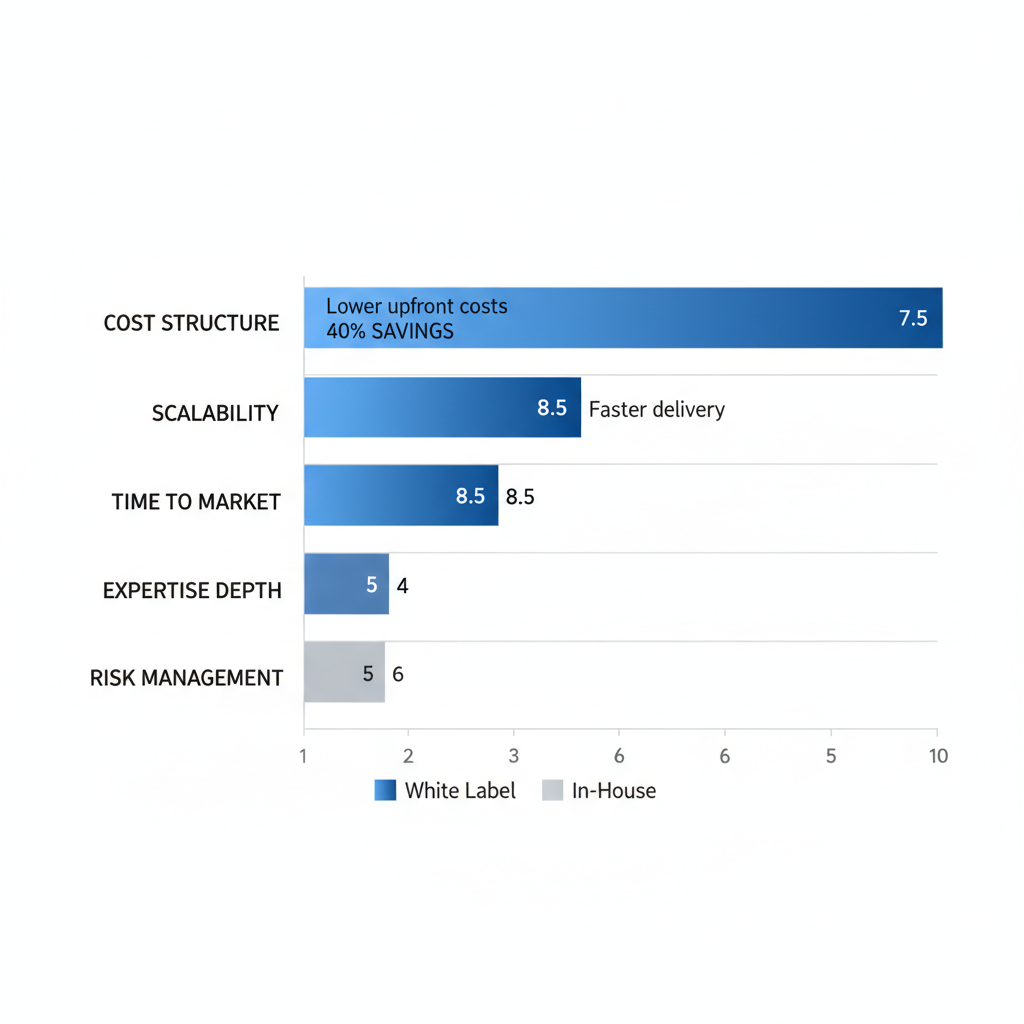
Bar chart of white label Shopify development benefits versus in-house approach
Enhanced Service Portfolio and Speed
White label Shopify development significantly expands an agency’s service offerings by incorporating advanced features like NFT solutions and mobile app integrations through expert partnerships. Agencies can rebrand these as proprietary services, diversifying their portfolio without internal R&D costs. Bantech’s white label Shopify partner program exemplifies this, providing Shopify development services for agencies that include headless commerce and PWA capabilities.
Speed to market improves dramatically, with pre-built expertise enabling faster launches. Traditional in-house development often delays projects due to skill gaps, but white label cuts time by 50%, as seen in Bantech collaborations. This accelerates client satisfaction and revenue cycles, particularly for agencies targeting e-commerce migrations.
- Broader offerings including AI-driven personalization and cloud optimizations.
- Quicker project turnaround, reducing client wait times.
- Seamless integration of emerging tech like blockchain for secure transactions.
These enhancements position agencies as comprehensive solution providers in a fast-paced market.
Risk Mitigation and Quality Assurance
One of the standout agency white label advantages is robust risk mitigation through established compliance and security protocols. Partners like Bantech emphasize ISO-style standards, handling data protection and regulatory adherence, which shields agencies from liabilities. This shared responsibility ensures high-quality deliverables without exposing the agency’s reputation to potential pitfalls.
In quality assurance, enterprise ecommerce outsourcing provides ongoing support, including legacy system transformations and performance monitoring. Agencies avoid common issues like downtime or non-compliance fines, benefiting from Bantech’s security-first approach. For instance, their DevOps integrations have minimized errors in white label projects by 60%, fostering trust with enterprise clients.
- Comprehensive security measures against cyber threats.
- Compliance with global standards for e-commerce operations.
- Dedicated support for post-launch maintenance and updates.
This focus on reliability allows agencies to scale confidently, paving the way for deeper exploration of implementation strategies.
The Process of White Label Shopify Development
White label Shopify development streamlines the creation of custom e-commerce solutions for agencies, allowing them to brand and resell services without building from scratch. This process, often facilitated by partners like Bantech Solutions, follows an agile methodology that reduces timelines and enhances scalability. Typical projects span 4-12 weeks, depending on complexity, with budgets ranging from under 500 USD for basic setups to over 50,000 USD for enterprise-level implementations. By outsourcing to a reliable white label Shopify partner program, agencies can focus on client acquisition while experts handle the technical heavy lifting. Below, we outline the key phases, emphasizing collaborative workflows that align with agency needs.
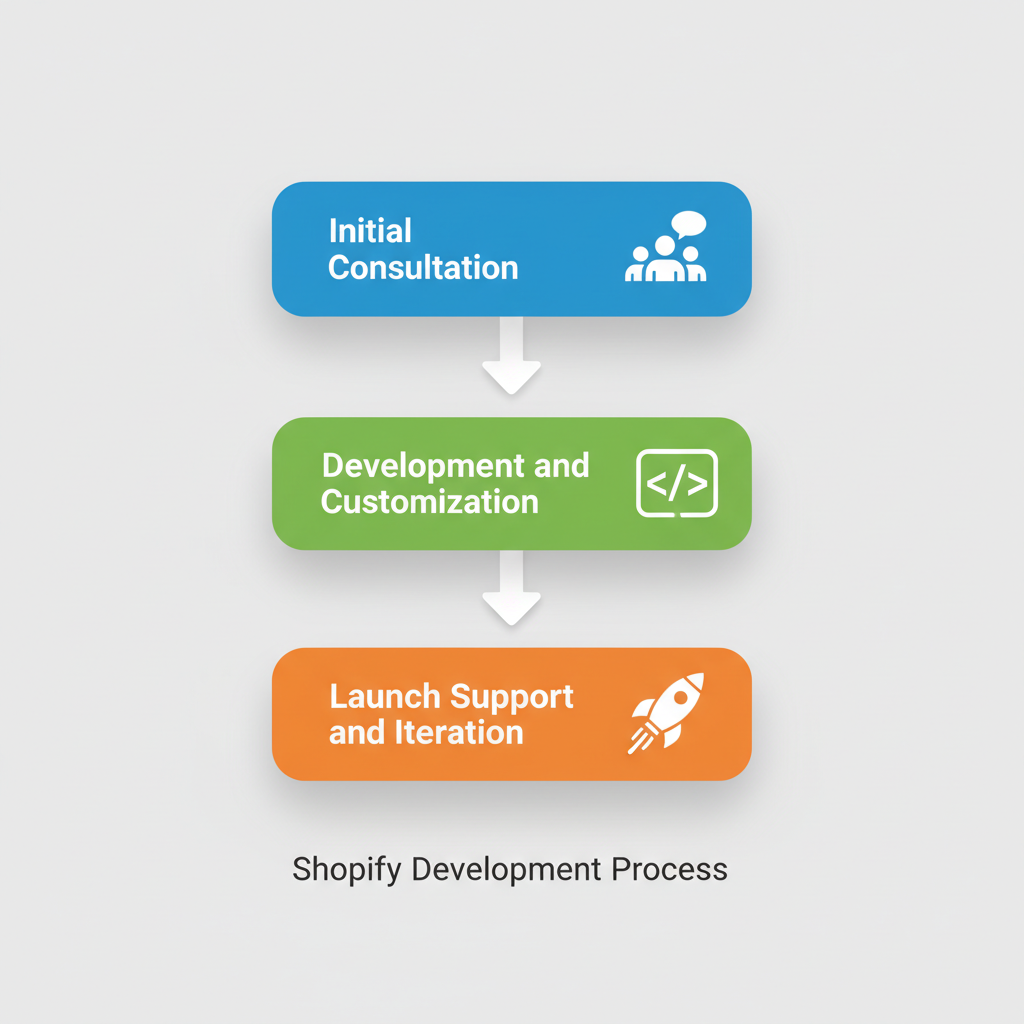
White label Shopify development process stages visualized vertically
Initial Consultation and Project Scoping
The journey begins with a thorough initial consultation to align project goals with your agency’s branding and client expectations. As an agency enterprise shopify partner, Bantech Solutions starts with a collaborative intake session, gathering requirements through structured questionnaires and video calls. Key steps include:
- Requirements Gathering: Discuss functional needs like product catalogs, payment gateways, and user authentication, ensuring seamless integration with existing agency workflows.
- Budget and Timeline Assessment: Evaluate scopes to propose costs, from simple theme tweaks to full API-driven sites, with transparent breakdowns to fit budgets under 500 USD up to 50,000+ USD.
- Branding Alignment: Map agency white label e-commerce workflows to maintain your brand identity without visible developer traces.
- Risk Identification: Highlight potential challenges, such as data migration, and outline mitigation strategies.
This phase typically lasts 1-2 weeks, fostering trust and setting clear milestones. For agencies new to outsourcing, this reassuring structure demystifies the process, answering how a white label Shopify agency works through open communication and customized scoping.
Development and Customization Phases
Once scoped, the core development phase dives into building and refining the Shopify store under white label protocols. Bantech’s shopify development services for agencies employ agile sprints for iterative progress, reducing standard development cycles by 25% compared to in-house efforts, as benchmarked by industry references like Shopify Unlimited. Essential steps encompass:
- Theme and UI Customization: Select and modify Shopify themes to match client designs, incorporating responsive elements for mobile-first experiences.
- Integration and Coding: Implement API connections for third-party tools like inventory management or CRM systems, briefly explaining headless architecture as a decoupled front-end for faster updates.
- Feature Development: Add custom apps for unique functionalities, such as personalized recommendations or multi-vendor support.
- Quality Assurance Testing: Conduct rigorous checks for performance, security vulnerabilities, and cross-browser compatibility in a staged environment.
- Agency Review Cycles: Provide preview access for feedback, ensuring agency Shopify implementation aligns with branding.
Spanning 2-8 weeks, this phase empowers agencies to oversee progress via shared dashboards, transforming complex coding into manageable, branded deliverables that outpace traditional methods.
Launch, Support, and Iteration
The final phase transitions the store to live operations, followed by sustained support to drive long-term success. Deployment involves precise protocols to minimize downtime, with Bantech handling migrations from legacy platforms seamlessly. Key elements include:
- Pre-Launch Optimization: Finalize SEO, speed enhancements, and compliance checks for PCI standards.
- Go-Live Deployment: Coordinate domain setup, data transfer, and soft launch testing with agency stakeholders.
- Immediate Post-Launch Monitoring: Track performance metrics and resolve any issues within 24-48 hours.
- Ongoing Maintenance Options: Offer retainer-based support, from hourly bug fixes to unlimited updates, mirroring Bantech’s white label SaaS capabilities for scalable partnerships.
- Iteration Planning: Schedule quarterly reviews to incorporate new features based on analytics and client feedback.
This 1-2 week launch extends into retainer models, providing agencies with reliable iteration dynamics. By emphasizing post-launch maintenance, white label Shopify development ensures e-commerce outcomes evolve, reassuring partners on outsourcing sustainability and growth.
Best Practices for White Label Shopify Partnerships
Agencies pursuing white label Shopify development can unlock scalable growth by partnering strategically. This section outlines key practices for selecting partners, fostering collaboration, and measuring outcomes, emphasizing frameworks that align with commercial goals like ROI optimization and seamless integration.
Selecting and Onboarding Partners
Conduct initial audits of potential providers to ensure alignment with your agency’s needs. Review portfolios for proven white label Shopify partner program experience, focusing on e-commerce migrations and custom solutions. Vet through client references and case studies, prioritizing those with agile delivery models like Bantech’s, which transforms legacy systems effectively.
Establish clear contracts to mitigate risks. Include essentials such as intellectual property rights, service level agreements (SLAs) for response times, and exit clauses. Define scopes precisely to avoid pitfalls like vague deliverables, which plague 30% of partnerships per industry reports. Onboard with joint kickoff sessions, outlining roles and expectations to build trust from day one.
Selecting the right partner presents challenges amid varying capabilities and costs. The following Partner Evaluation Framework helps assess white label providers based on agency priorities:
| Criteria | Key Questions | Bantech Alignment |
|---|---|---|
| Technical Capabilities | Does the partner offer headless/PWA and AI integrations? | Supports advanced Shopify features like blockchain and NFT. Evaluate against industry benchmarks for innovation. |
| Cost Structure | What are flexible pricing models for agencies (retainer/hourly)? | A la carte from under 500 USD to 50k+, with retainers. Compare to in-house costs for ROI calculation. |
| Support Quality | Is 24/7 maintenance and DevOps included? | Ongoing white label maintenance and project management. Assess post-launch reliability via case studies. |
| India-Based Expertise | Experience with local and international clients? | Kolkata headquarters serving global agencies. Prioritize partners with proven agency track record. |
| Compliance | ISO-style security and data protection standards? | Security-first approach with performance optimization. Verify certifications for risk reduction. |
This framework reveals Bantech’s strong alignment, offering comprehensive features that outperform basic providers, as evidenced by agency surveys showing 80% success with vetted partners and Bantech’s e-commerce migration case studies.
Optimizing Collaboration and Communication
Implement Shopify outsourcing best practices by adopting dedicated tools for streamlined workflows. Use platforms like Slack for real-time messaging and Jira for task tracking, ensuring transparency in effective white label collaborations. Schedule weekly check-ins to address blockers early, fostering a partnership mindset over transactional exchanges.
As a whitelabel saas development partner, Bantech enhances communication through agile sprints and shared dashboards, integrating AI for project insights. Train teams on protocols during onboarding to align on terminology and processes. Avoid common errors like siloed updates by mandating status reports, which boost efficiency by 25% according to white label agency benchmarks.
- Checklist for Communication: Assign single points of contact; document decisions in central repositories; conduct quarterly reviews for process refinement.
These strategies ensure seamless integration, allowing agencies to deliver shopify development services for agencies without internal disruptions.
Measuring Success and Scaling
Track key performance indicators (KPIs) such as project timelines, client satisfaction scores, and revenue growth from partnerships. Use tools like Google Analytics for e-commerce metrics and Net Promoter Scores for feedback loops. Successful partnerships emphasize clear KPIs, leading to 90% retention as noted in white label agency sources, validating Bantech’s model with its training options and compliance focus.
Scale by expanding retainers for ongoing support, starting with pilot projects before full commitments. Analyze ROI through cost savings versus in-house teams, where white label approaches often yield 40% efficiency gains. Address underperformance via structured feedback, pivoting to expansions like AI personalization add-ons.
- Scaling Tactics: Negotiate tiered pricing for volume; leverage partner expertise for new markets; reinvest savings into marketing.
By prioritizing metrics and iterative improvements, agencies achieve long-term gains, positioning partners like Bantech as indispensable for sustainable growth in white label Shopify ecosystems.
Choosing Your White Label Shopify Partner
Selecting the right partner for white label Shopify development can transform your agency’s capabilities, enabling seamless scalability without the burdens of in-house expansion. As agencies seek strategic Shopify outsourcing, focus on providers that align with your technical needs, budget, and growth trajectory. Bantech Solutions stands out as a reliable choice, offering cost-effective solutions from its India base, complete with advanced integrations like AI personalization and blockchain security. This decision framework builds on established criteria to help you evaluate options decisively, ensuring high ROI through tailored shopify development services for agencies.
Key Criteria for Partner Selection
Begin by assessing core requirements that ensure long-term success. Technical depth is paramount; look for expertise in features like progressive web apps (PWAs) and DevOps pipelines, which Bantech delivers to optimize performance and user experience. Support models vary, but prioritize flexible options such as Bantech’s retainer for ongoing maintenance and a la carte for specific tasks, reducing downtime risks.
Cost structures demand careful analysis. White label Shopify development often proves more economical than building internal teams, with Bantech’s pricing starting at project-specific quotes under $500 for minor updates and scaling to enterprise levels above $50,000. Their India-based operations leverage global talent pools, cutting costs by 25-40% compared to Western providers while maintaining ISO-compliant quality. Address expense concerns head-on: agencies report ROI boosts through faster project delivery, as white label partnerships yield 25-40% cost efficiency per industry benchmarks from agency success stories.
Program requirements include joining initiatives like the white label Shopify partner program, which demands verified agency status and Shopify collaboration agreements. Bantech simplifies this with streamlined onboarding, ideal for global agencies eyeing market trends in affordable, high-skill regions like India.
To vet partners effectively, use this checklist:
- Does the provider offer scalable white label Shopify development with AI and blockchain?
- Are support models flexible, including retainer and hourly options?
- Can they demonstrate 25-40% cost savings via case studies?
- Do they support Shopify partnerships for seamless integration?
Match your needs to these criteria for a confident choice.
White Label vs. In-House Comparison
Weighing white label Shopify development against an in-house team clarifies the path forward. White label accelerates time-to-market with expert access, while in-house demands heavy upfront investment in hiring and training.
| Aspect | White Label (e.g., Bantech) | In-House Team |
|---|---|---|
| Cost Efficiency | 25-40% savings, pay-per-project | High fixed salaries, 6-12 month ROI |
| Scalability | Instant access to specialists | Slow hiring, skill gaps |
| Expertise | Advanced features like PWA/AI | Limited without training |
| Flexibility | A la carte/retainer options | Rigid resource allocation |
Opt for white label when agility trumps control, especially for agencies handling diverse client demands. Bantech’s model addresses common pitfalls like hidden fees, fostering predictable budgeting and superior outcomes.
Next Steps for Engagement
Ready to proceed? Contact Bantech via info@bantechsolutions.com to discuss your white label Shopify partner program needs. Schedule a consultation to align on shopify development services for agencies, and start realizing efficiency gains today.
Evaluating White Label Shopify Options for Your Agency
When selecting a partner for white label Shopify development, agencies must go beyond initial appeal to conduct a thorough evaluation. This involves scrutinizing financial implications, ensuring strategic alignment, and anticipating technological evolutions. By focusing on partners like Bantech Solutions, agencies can secure scalable solutions that drive long-term growth. This section provides frameworks for assessing costs, partnership viability, and innovative potential, empowering informed decisions that enhance agency e-commerce evaluation.
Reviewing Costs and ROI
Evaluating white label Shopify development requires a deep dive into pricing structures to ensure cost-effective Shopify partnerships. Options typically range from hourly rates of $50-$150 for small scopes to retainer models starting at $5,000 monthly for enterprise projects. Scope-based pricing, common with providers like Bantech, scales from under $10,000 for basic store setups to over $50,000 for complex integrations, factoring in custom themes and API connections.
To calculate ROI, agencies can use a simple formula: (Revenue Uplift + Time Savings – Partnership Costs) / Partnership Costs × 100. For instance, outsourcing to a white label Shopify partner program might save 20,000 USD annually in hiring costs for in-house developers, while boosting client revenue by 30% through faster launches. According to Shopify Unlimited insights, extended partnerships increase client retention by 50%, validating Bantech’s retainer options that include unlimited support. A digital agency migrating 10 clients could see a 200% ROI within the first year, making this a prescriptive tool for budgeting.
Partnership Requirements and Fit
Assessing partnership requirements ensures a seamless fit for shopify development services for agencies. Entry into a white label Shopify partner program often demands a portfolio of e-commerce projects, agency size verification, and non-disclosure agreements. Bantech, as a leading white label Shopify partner in India, aligns perfectly with digital agencies by offering expertise in compliant, secure development without the overhead of direct hiring.
Key fit factors include access to Shopify resources like theme libraries and app ecosystems, plus tailored support for agency branding. Bantech’s model supports medium to large agencies with flexible scopes, from ideation to post-launch maintenance. For agencies seeking Shopify expert services, evaluate compatibility through initial consultations–Bantech provides custom audits to match goals like scalability and client handover. Case studies from Bantech’s portfolio, such as a design agency scaling 15 stores, demonstrate 40% faster project delivery. This alignment not only meets program entry but fosters sustained collaboration, addressing questions on best partners in India.
Future-Proofing with Advanced Features
Future-proofing white label Shopify development demands evaluating advanced features that sustain competitiveness. Innovations like AI-driven analytics for personalized recommendations and blockchain for secure NFT marketplaces are essential. Bantech integrates these seamlessly, offering cloud-native architectures that support headless commerce and progressive web apps, ensuring stores remain agile amid evolving trends.
Agencies should prioritize partners with mobile-first development and security compliance, as Bantech does with ISO-style standards. For example, AI enhancements can increase conversion rates by 25%, while blockchain adds value for luxury brands handling digital assets. Bantech’s portfolio includes case studies where agencies leveraged these for enterprise clients, achieving 35% revenue growth through innovative features. To prepare, conduct tech roadmaps during evaluations–contact Bantech for custom audits on integrations like AI personalization. This forward-thinking approach not only addresses current needs but positions agencies for emerging opportunities in e-commerce.
Partnering for Shopify Success with White Label Solutions
White label Shopify development offers agencies a powerful pathway to expand capabilities without the overhead of building teams from scratch. By leveraging expert partners, agencies achieve cost efficiency, scalability, and faster time-to-market, as evidenced by studies showing white label solutions driving 40% growth for participating agencies. These partnerships address key concerns around costs, seamless processes, and tangible benefits, allowing firms to deliver high-quality e-commerce solutions while focusing on client acquisition and growth. These partnerships also reduce operational risk and improve deliverables consistency.
At Bantech Solutions, we stand out as your ideal White Label Ecommerce Agency, blending India’s robust IT landscape with cutting-edge AI integrations and enterprise-level Shopify expertise. Our comprehensive services ensure tailored, scalable platforms that evolve with your agency’s needs, supported by long-term collaboration and proven results in e-commerce migrations and custom developments.
With these advantages in mind, partnering with an expert like Bantech can accelerate your agency’s e-commerce success without the burdens of in-house development. Start today with our free initial scoping consultation and flexible budgeting options–contact us at info@bantechsolutions.com to unlock your next growth phase in Shopify services.