SEO Meta Description: Discover how agency website white-labelling enables digital agencies to scale efficiently through private label web development partnerships. Learn strategic outsourcing benefits, implementation best practices, and why partnering with India-based providers like Bantech Solutions delivers competitive advantages for agencies in the USA, UK, Canada, Australia, and New Zealand.
In today’s hyper-competitive digital landscape, agencies face an impossible choice: turn away profitable client work or overextend internal teams to the breaking point. The statistics paint a stark picture: 73% of agencies now incorporate white-label services into their operations, and those leveraging strategic outsourcing partnerships grow 2.3 times faster than competitors who don’t. For digital agencies across the USA, UK, Canada, Australia, and New Zealand, agency website white-labeling has emerged not as a stopgap measure, but as a fundamental strategic advantage.
The white-label market is projected to reach $99.19 billion by 2026, growing at 12.3% annually. This explosive growth isn’t happening by accident. Smart agencies have discovered that private label web development partnerships allow them to deliver enterprise-grade capabilities without enterprise-level overhead. They’re offering comprehensive agency-branded website services while their carefully selected partners handle technical execution behind the scenes.
This comprehensive guide reveals how strategic agency website white-labelling can transform your business model, why outsourcing to specialized partners in India creates sustainable competitive advantages, and how companies like Bantech Solutions are helping Western agencies scale profitably while maintaining the quality standards their clients demand.
Understanding Agency Website White-Labelling: More Than Just Outsourcing
Agency website white-labelling represents a strategic business model where specialized development partners create fully functional websites, web applications, and digital solutions that agencies rebrand and present as their own work. Unlike traditional outsourcing arrangements where the external provider’s identity remains visible, white-label partnerships operate with complete invisibility to end clients.
The White-Label Business Model Explained
Think of agency website white-labelling as a behind-the-scenes partnership where each party focuses on their core strengths:
- Your agency maintains direct client relationships, handles strategy, manages communications, and owns the brand identity
- Your white-label partner handles technical execution, development workflows, quality assurance, and delivers finished products under your branding
- Your clients interact exclusively with your agency, never knowing specialized partners contributed to project delivery
This arrangement differs fundamentally from freelancing or standard outsourcing. Freelancers typically get credit for their contributions and may communicate directly with clients. Standard outsourcing agencies often maintain their own branding in deliverables. White-label partnerships, by contrast, deliver complete brand invisibility—a distinction that business research on strategic partnerships identifies as critical for maintaining competitive differentiation.
Private Label Web Development: Building Your Service Portfolio
Private label web development extends beyond simple website creation. Modern agencies offering agency-branded website services can leverage white-label partnerships across numerous specializations:
- Custom WordPress development including enterprise-level implementations with complex functionality, custom themes, advanced plugin integrations, and WooCommerce solutions
- E-commerce platforms built on Shopify Plus, WooCommerce, Magento, BigCommerce, and custom frameworks with payment gateway integrations
- Progressive web applications and custom software solutions using React, Angular, Vue.js, Node.js, Python, and modern tech stacks
- Mobile app development for iOS and Android platforms using native and cross-platform frameworks like React Native and Flutter
- API development and integrations, CRM synchronizations, payment processor integrations, and complex backend systems
- UI/UX design services including user research, wireframing, prototyping, and conversion-optimized interface design
The key advantage lies in offering these comprehensive services immediately, without spending months hiring developers, establishing infrastructure, or building internal capabilities from scratch.
The Strategic Business Case for Agency Website White-Labelling
Beyond operational convenience, agency website white-labelling creates profound strategic advantages that fundamentally reshape agency economics and competitive positioning.
Transforming Agency Economics Through Strategic Partnerships
The financial mathematics of agency website white-labelling reveal compelling advantages:
- Variable cost structure: Pay only for work delivered, eliminating fixed payroll expenses, benefits (typically adding 25-35% to base salary according to the U.S. Bureau of Labor Statistics), office space, equipment, and overhead associated with full-time employees
- Markup potential: Agencies typically achieve 35-55% margins on white-label services while remaining price-competitive in their markets
- Reduced recruitment costs: Eliminate expensive hiring processes averaging $4,129 per hire, onboarding periods lasting 3-6 months, and turnover risks
- Infrastructure savings: Avoid investments in development tools, software licenses, project management systems, and technical infrastructure
- Scalability advantages: Instantly scale development capacity up or down based on project pipeline without hiring friction
Consider this real-world comparison: Hiring a senior full-stack developer in the USA costs $120,000-$180,000 annually in salary alone, before benefits (adding $30,000-$45,000), payroll taxes, and equipment. That same budget invested in a strategic white-label partnership can deliver 3-5 times more development capacity while maintaining comparable or superior quality standards.
For a mid-sized agency managing 15-20 concurrent projects, the financial impact becomes transformative. Instead of maintaining a team of 5-7 in-house developers at $700,000-$1,000,000 in total employment costs, white-label partnerships can deliver equivalent or greater output at $350,000-$500,000, creating $350,000-$500,000 in annual savings that flow directly to profitability.
Accelerating Time-to-Market and Service Expansion
In competitive agency markets, speed determines who wins client relationships. Research demonstrates that agencies responding to client needs within 48 hours are 60% more likely to win new business. When a prospect requests website development services you don’t currently offer in-house, traditional responses create problems:
- Declining the work sends profitable business to competitors and damages your positioning as a full-service provider
- Scrambling to hire creates project delays averaging 3-6 months, quality risks during the learning curve, and uncertain delivery timelines
- Referring clients elsewhere establishes competitors as the go-to resource for those services, potentially losing the client relationship permanently
Agency website white-labelling eliminates these compromises. With established partnerships already in place, agencies can accept new service requests immediately, often beginning discovery work within 24-48 hours and commencing development within 5-7 business days.
Real-world case study: A Boston-based digital marketing agency partnered with Bantech Solutions (https://www.bantechsolutions.com) to expand into custom web development. Within 90 days, they had closed $280,000 in new project contracts they would have previously referred elsewhere. Within 12 months, white-label web development represented 35% of their total revenue.
Accessing Specialized Expertise Without Building Internal Teams

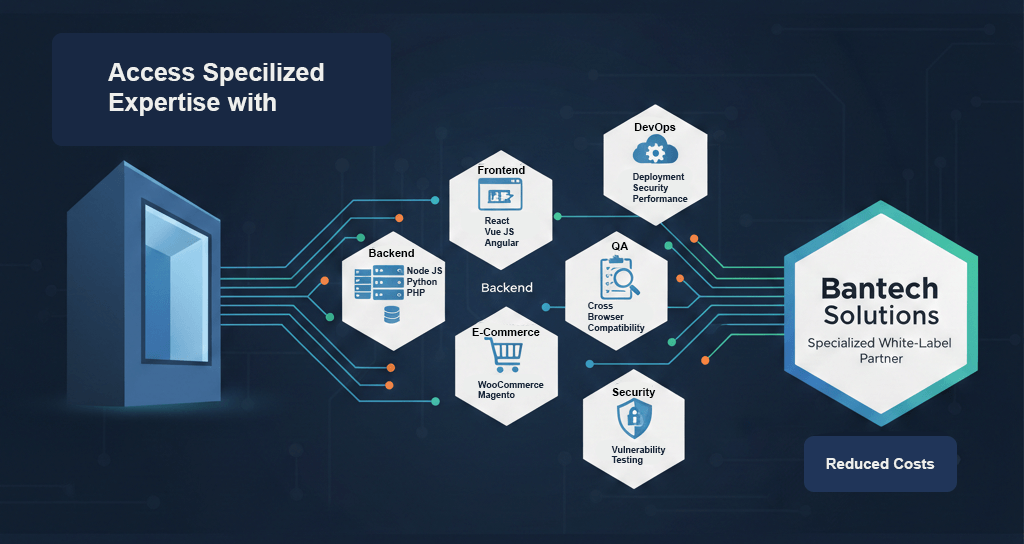
Modern web development demands expertise across constantly evolving technologies. The Stack Overflow Developer Survey reveals that effective full-stack development now spans 15-20 distinct technologies. Maintaining comprehensive capabilities in-house requires:
- Frontend specialists for React, Vue.js, Angular, and emerging frameworks • Backend developers proficient in Node.js, PHP, Python, and database technologies • E-commerce platform specialists for Shopify Plus, WooCommerce, and Magento • DevOps engineers managing deployment, hosting, security, and performance optimization • QA specialists ensuring cross-browser compatibility and accessibility compliance • Security experts conducting vulnerability assessments and penetration testing
Assembling this expertise internally would require a technical team of 8-12 specialized professionals, representing $800,000-$1,500,000 in annual salary costs alone before overhead expenses.
Specialized white-label partners like Bantech Solutions maintain these diverse capabilities across teams of dedicated professionals who work exclusively in their areas of expertise. Your agency benefits from this depth without the cost of building and maintaining such comprehensive internal capabilities.
Why India Represents the Optimal White-Label Partnership Destination
While white-label partnerships exist globally, India has emerged as the preferred destination for agency website white-labelling, particularly for agencies across the USA, UK, Canada, Australia, and New Zealand.
Technical Excellence and Educational Infrastructure
India produces over 1.5 million engineering graduates annually, creating an unparalleled talent pool for technology services. Indian technical education emphasizes practical problem-solving, advanced mathematics, and rigorous computer science fundamentals that translate directly into high-quality development work.
Major technology companies like Google, Microsoft, Amazon, Facebook, Apple, and Adobe maintain substantial research and development operations in India precisely because of this talent depth. Google’s largest engineering center outside the United States operates in Bangalore. When global tech giants trust India-based teams for critical product development and AI research, it validates capabilities that translate perfectly to private label web development partnerships.
India’s IT industry employs over 5.4 million professionals, with 65% holding advanced degrees in computer science or related technical disciplines. Indian developers regularly rank among the top performers in global coding competitions for problem-solving ability, algorithm implementation, and data structure mastery.
Strategic Cost Optimization Without Quality Compromise
The economic advantages of India-based agency website white-labelling create transformative opportunities:
- Development costs typically run 50-70% lower than comparable Western markets while maintaining equivalent quality standards
- Lower operating costs enable competitive project pricing that helps agencies win new business while maintaining healthy profit margins
- Improved profit margins allow reinvestment in sales, marketing, and client acquisition activities
- Predictable pricing structures simplify project estimation and reduce financial risk
- Flexible engagement models including dedicated teams, project-based pricing, and retainer arrangements
These cost advantages reflect economic realities where highly skilled professionals command different salary levels based on local cost-of-living considerations. A senior developer in Bangalore possessing equivalent skills to a San Francisco-based counterpart might earn $25,000-$40,000 annually versus $150,000-$200,000—not because of inferior capabilities, but due to dramatically different living costs.
Time Zone Advantages: The Follow-the-Sun Workflow
What initially appears as a time zone challenge actually creates powerful workflow advantages. When your agency’s workday ends in New York, London, or Sydney, development teams in India are just beginning theirs. This creates a follow-the-sun workflow where:
- Projects progress continuously across 24-hour cycles—what might take 10 business days with same-timezone developers compresses to 6-7 days
- Morning agency reviews of overnight development work enable rapid feedback and course corrections
- Critical bug fixes and urgent client requests can be addressed while your local team sleeps
- Planned overlap hours (typically 2-4 hours daily) facilitate real-time collaboration when necessary
- Extended coverage windows mean client emergencies occurring after hours can receive immediate technical attention
Research demonstrates that properly managed asynchronous workflows can accelerate project delivery by 30-40% compared to traditional same-location teams.
Process Maturity and Quality Frameworks
India’s IT services industry has matured over three decades, developing sophisticated process frameworks that ensure consistent delivery quality. Leading white-label partners like Bantech Solutions implement:
- ISO 9001:2015 quality management systems ensuring standardized processes and consistent service delivery
- CMMI Level 5 certification (the highest maturity level) demonstrating optimization of development processes
- Agile and DevOps methodologies aligned with Western development best practices
- Comprehensive quality assurance protocols including automated testing, code reviews, and security scanning
- Information security standards including ISO 27001 certification and data protection compliance
This process maturity means agencies partnering with established India-based providers benefit from enterprise-grade project management and quality control without building these capabilities internally.
Bantech Solutions: Your Strategic Partner for Agency Website White-Labelling
While understanding the strategic advantages of agency website white-labelling matters, implementation success depends entirely on partner selection. Bantech Solutions has established itself as a trusted white-label development partner specifically designed for agencies across the USA, UK, Canada, Australia, and New Zealand, with over 12 years of proven expertise serving Western agency partners.
Comprehensive Technical Capabilities
Bantech Solutions provides end-to-end private label web development across diverse technical requirements:
- Custom WordPress development: From simple business websites to complex enterprise implementations with custom plugins and WooCommerce integrations
- E-commerce solutions: Shopify Plus development, WooCommerce customization, Magento implementations, and headless commerce architectures
- Web application development: React, Angular, Vue.js frontends connected to Node.js, PHP, Python, and .NET backends
- Mobile app development: Native iOS and Android development, plus cross-platform solutions using React Native and Flutter
- UI/UX design services: User research, wireframing, prototyping, conversion optimization, and responsive design systems
- API development and integration: Connecting websites with CRM systems, marketing automation platforms, and payment gateways
- Website maintenance and support: Ongoing technical support, security updates, and performance monitoring with defined SLA commitments
Streamlined White-Label Workflow
Bantech Solutions has refined its agency partnership process over 12+ years to maximize efficiency while maintaining complete brand invisibility:
- Discovery and scoping: Your agency shares client requirements; Bantech provides detailed technical specifications and accurate project estimates within 24-48 hours
- Design approval: Wireframes, mockups, and designs delivered under your agency branding for seamless client presentation
- Development sprints: Regular updates, staging environment access, transparent progress tracking, and scheduled review meetings
- Quality assurance: Comprehensive testing including cross-browser verification, mobile device testing, accessibility audits, and performance optimization
- Launch and handoff: Final deployment with documentation and training materials branded for your agency, plus post-launch monitoring and warranty support
Throughout this process, all client communications flow exclusively through your agency. Bantech operates entirely behind the scenes, ensuring clients perceive your agency as the sole provider.
Rigorous Quality Standards
Quality control represents a non-negotiable priority in white-label partnerships. Bantech Solutions implements multi-layered quality assurance:
- Code review processes ensuring adherence to industry best practices and security standards
- Automated testing frameworks catching bugs before they reach staging environments
- Manual QA testing across multiple browsers and devices
- Performance optimization ensuring fast page loads and excellent Core Web Vitals scores
- Security audits including OWASP Top 10 verification and vulnerability prevention
- Accessibility compliance ensuring WCAG 2.1 Level AA conformance
- Comprehensive documentation enabling future development by any technical team
These quality frameworks protect your agency’s reputation by ensuring every delivered project meets or exceeds professional standards.
Implementation Best Practices for Agency Website White-Labelling Success

Successfully implementing agency website white-labelling requires strategic planning beyond simply selecting a development partner.
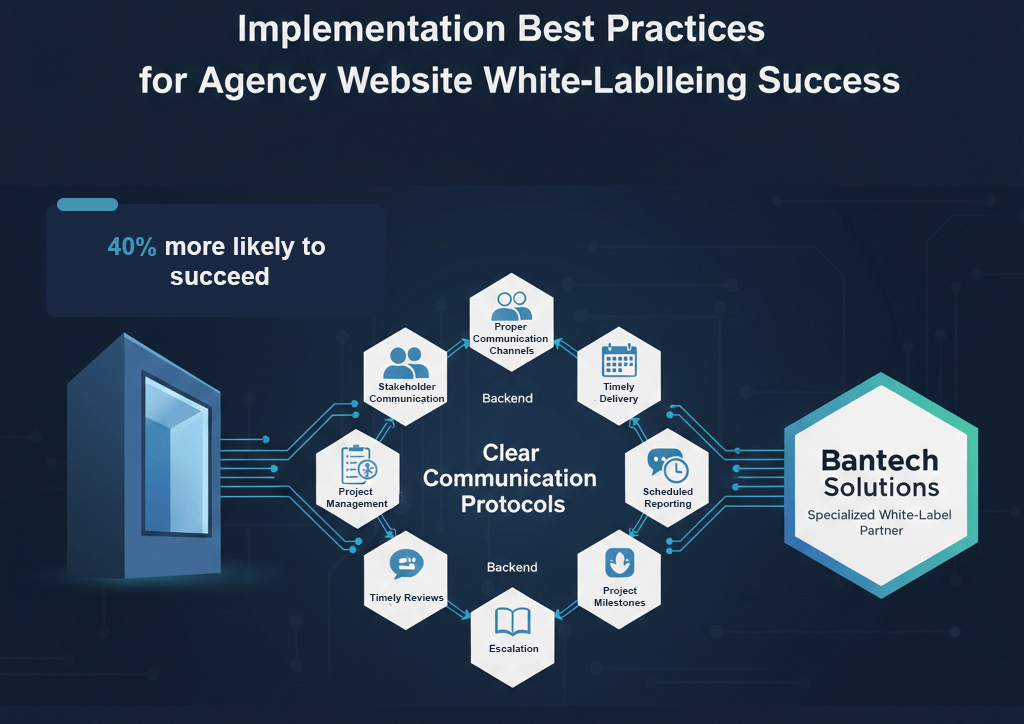
Establishing Clear Communication Protocols
Effective white-label partnerships depend on crystal-clear communication structures:
- Designated points of contact: Assign specific team members as primary contacts to prevent conflicting instructions
- Project management systems: Utilize shared platforms like Asana, Trello, or Jira for transparent task tracking
- Regular status updates: Schedule weekly or bi-weekly calls to review progress and maintain alignment
- Communication channels: Establish clear protocols for different communication types
- Escalation procedures: Define clear paths for addressing urgent issues or client emergencies
- Documentation standards: Maintain comprehensive records in shared knowledge bases
Research demonstrates that projects with clearly defined communication protocols are 40% more likely to succeed.
Setting Clear Client Expectations
Transparency with clients builds trust while protecting against unrealistic timeline pressures:
- Realistic timelines: Communicate accurate project schedules accounting for development complexity
- Scope documentation: Provide detailed specifications preventing scope creep
- Regular progress reports: Keep clients informed through staging environment access and milestone updates
- Change request processes: Establish procedures for mid-project modifications with transparent cost impacts
- Quality expectations: Educate clients about testing procedures and the importance of thorough UAT
Starting with Pilot Projects
Even with thorough vetting, new white-label partnerships carry risks. Minimize these through strategic pilot project selection:
- Choose lower-risk projects for initial engagements • Test critical capabilities that will be important for future projects • Evaluate communication effectiveness during real-world project pressure • Assess quality standards against your agency’s expectations • Measure timeline reliability
Maintaining Quality Oversight
Even with trusted white-label partners, your agency remains responsible for delivered quality:
• Code reviews: Periodically review delivered code for quality and security • Staging environment testing: Thoroughly test all deliverables before client review • Client feedback analysis: Track satisfaction to identify patterns • Performance monitoring: Use tools like Google PageSpeed Insights to verify performance standards • Security scanning: Utilize automated tools to verify absence of vulnerabilities
Common Questions About Agency Website White-Labelling
What exactly is agency website white-labelling and how does it differ from standard outsourcing?
Agency website white-labelling involves partnering with specialized development providers who build websites and digital solutions entirely under your agency’s brand. Unlike traditional outsourcing where the external provider maintains visibility, white-label partnerships operate with complete invisibility to your clients. You maintain all client relationships, own the brand identity, and present finished work as your own creation while your partner handles technical execution behind the scenes.
How can agencies ensure quality when using white-label development services?
Quality assurance starts with thorough partner vetting and continues through every project phase. Examine portfolios, request client references from other agency partners, conduct small test projects before committing to major engagements, and verify certifications (ISO, CMMI). Once partnered, implement regular quality checkpoints including staging environment testing, code reviews, comprehensive UAT protocols, and performance monitoring. Leading white-label providers maintain ISO 9001 and CMMI Level 5 certifications ensuring consistent delivery standards.
Why should agencies choose India-based white-label partners over domestic alternatives?
India-based partnerships offer compelling advantages: massive engineering talent pool (1.5+ million graduates annually) providing specialized expertise, development costs 50-70% below Western markets improving profitability, time zone differences enabling continuous 24-hour project progress, and process maturity (ISO 9001, CMMI Level 5) ensuring reliable quality. Over $200 billion in annual technology exports demonstrates sustained excellence serving demanding global clients.
What services can agencies offer through white-label web development partnerships?
Modern white-label partnerships enable comprehensive offerings: custom WordPress development, e-commerce platforms (Shopify Plus, WooCommerce, Magento), progressive web applications, mobile app development, API integrations, website maintenance, and specialized solutions for healthcare, financial services, e-learning, and real estate. This breadth positions agencies as full-service providers without building extensive internal teams.
How do time zone differences impact white-label development partnerships with India?
Time zone differences create strategic advantages when properly managed. As your agency’s workday ends, development teams in India begin theirs, enabling continuous progress across 24-hour cycles. Submit revision requests at day’s end; receive completed work by next morning. This creates “overnight miracle” turnarounds that delight clients. Planned overlap hours (2-4 hours daily) facilitate real-time collaboration when necessary.
The Future of Agency Website White-Labelling: 2025 and Beyond
Several emerging trends will reshape how agencies leverage white-label partnerships:
AI-Powered Development and Automation
Leading white-label partners now incorporate AI-powered tools for code generation, automated testing, performance optimization, and design assistance. Research suggests AI coding assistants improve developer productivity by 35-45% for certain task types. White-label partners embracing these technologies deliver faster, higher-quality results at better price points.
Increasing Specialization and Niche Expertise
The market is shifting toward specialized partners with deep expertise in specific industries or technologies. Agencies increasingly seek niche capabilities—healthcare portal development, financial services platforms, headless CMS expertise, accessibility compliance—that enable superior domain expertise rather than generic web development.
Advanced Integration and API Ecosystems
Modern websites exist as integrated components within larger technology ecosystems. White-label development increasingly focuses on seamless connections between CRM platforms, marketing automation, e-commerce systems, payment processors, and enterprise applications. Agencies partnering with providers offering robust integration capabilities better serve clients requiring sophisticated digital infrastructure.
Conclusion: Strategic Partnership as Competitive Advantage
Agency website white-labeling has evolved from an operational convenience into a fundamental strategic advantage:
- Growth acceleration: Agencies leveraging white-label partnerships grow 2.3 times faster than competitors • Client retention: White-label partnerships enable comprehensive service offerings achieving 42% higher retention rates • Profitability improvement: Variable cost structures deliver 30-40% higher profit margins • Market positioning: Full-service capabilities enable successful competition against larger agencies
For digital agencies across the USA, UK, Canada, Australia, and New Zealand, the question isn’t whether to adopt white-label partnerships but rather how quickly to implement them effectively.
India-based white-label providers like Bantech Solutions (https://www.bantechsolutions.com) offer the optimal combination of technical excellence, cost optimization (50-70% below Western markets), process maturity (ISO 9001, CMMI Level 5), follow-the-sun workflow advantages, and cultural alignment with Western business practices refined through decades serving international clients.
These partnerships enable agencies to scale rapidly without hiring friction, serve clients comprehensively across any technical requirement, compete effectively regardless of internal team size, maintain healthy profit margins while offering competitive pricing, and focus internal resources on high-value activities like client relationships and business development.
The future belongs to agencies that recognize white-label partnerships not as a compromise but as a competitive multiplier. By focusing internal resources on client relationships while leveraging specialized partners for technical execution, agencies create sustainable growth engines that compound competitive advantages over time.
Take the Next Step
Visit https://www.bantechsolutions.com/ to discover how strategic white-label partnership can transform your agency’s growth trajectory. Contact our team to discuss your specific requirements and explore how Bantech Solutions can become your trusted partner for agency website white-labelling excellence.
FAQs
White label web development is when one company builds a website on behalf of another, and the finished product is delivered under the client-facing agency’s own brand, with no trace of who actually built it.
Key Takeaways
- White label web development lets agencies offer web design and build services without hiring an in-house dev team.
- The white label partner works entirely behind the scenes: no logos, no credits, no client contact unless you want it.
- It’s commonly used by marketing agencies, PR firms, business consultants, and freelancers who want to sell websites without building them.
- Pricing is typically wholesale, so the agency marks the project up and keeps the margin.
- Choosing the right partner comes down to communication, code ownership, and how well they match your existing client experience.
If you run an agency and a client just asked, “can you build us a website too,” you’ve probably run into this term already. White label web development is one of the fastest ways agencies expand their service list without touching a single line of code themselves.
At its core, it’s a wholesale relationship. A development studio, like the one behind our own white label web development services, builds the site, handles the technical heavy lifting, and hands it back ready to present as if it came from your shop. The client never knows a third party was involved. You keep the relationship, the invoice, and the credit.
This model has grown alongside a broader shift toward outsourcing in general. Small businesses are already almost evenly split on how they get a website built: 45% now outsource to web design agencies while 46% build in-house, according to Clutch’s 2025 research on small business websites. That near 50/50 split is exactly the gap white label partnerships were built to fill, since it means half the market is actively looking for someone else to do the technical work while a brand they trust handles the relationship.
How White Label Web Development Actually Works
The direct answer: your agency sells and manages the client relationship, while a white label development partner designs, builds, and often maintains the site under a non-disclosure agreement, delivering it fully branded as your work.
Here’s the typical flow, step by step:
- You scope and sell the project, gathering requirements and quoting using your own pricing.
- You brief the white label partner with the client’s requirements, brand guidelines, and content or design direction.
- The partner builds the site: design, front end and back end development, CMS setup, and QA, all under your agency’s name.
- You review and give feedback, using the revision round most white label shops build into the process.
- You deliver the finished site to the client. Some agencies handle the handoff themselves; others loop in the partner under an “in-house developer” identity.
- Ongoing support and hosting stay white labeled too, so tickets route through you, not the development team.
Not sure if white labeling fits your agency’s workflow?
If you’re weighing whether to build an in-house dev team or partner with a white label studio, we can walk you through both models and what they cost over a year.
Talk to Our Team About Your Options → Who Actually Uses White Label Web Development?
The direct answer: marketing agencies, branding studios, PR firms, business consultants, and freelance designers are the most common users, since they already have client relationships but not necessarily an in-house engineering team.
A few real-world scenarios where this model shows up constantly:
- Marketing agencies selling SEO, paid ads, and content who want to bundle in a website rebuild without hiring developers.
- Branding and design studios that create the visual identity but lack coders to turn a Figma file into a working site.
- Management consultants whose clients ask for a functional website mid-engagement.
- Freelance designers offering full-service packages without learning to code themselves.
- Overbooked web agencies that need overflow capacity during busy seasons.
This isn’t a fringe strategy either. Execution capacity is one of the top reasons companies bring in outside technical partners in the first place. Recent industry research found that limited internal technical expertise is a leading barrier businesses face when trying to execute on technology priorities, which is a large part of why agencies without a dev bench turn to white label partners rather than losing the deal entirely, as detailed in Clutch’s 2026 small business technology adoption report.
If you’re weighing whether this model makes sense for your own agency, our post on why the best white label development partners for Western agencies are based in India walks through the economics and talent factors behind that shift.
White Label vs. Private Label vs. In-House: What’s the Difference?
The direct answer: white label means the client never sees the development partner at all, private label means the partner is disclosed but still operates under your brand’s direction, and in-house means you hire and manage developers directly on payroll.
| Model | Client Sees Dev Partner? | Cost Structure | Best For |
|---|
| White label | No, fully hidden | Wholesale, agency marks up | Agencies wanting full brand control |
| Private label | Sometimes, partially disclosed | Wholesale or hybrid | Agencies open to some co-branding |
| In-house team | Yes, they’re your employees | Salaries, benefits, overhead | High, steady project volume |
| Freelance contractor | Often yes, direct contact | Hourly or project rate | One-off or small projects |
Most agencies land on white label because it protects the two things that matter most in client relationships: consistency of brand and control of the narrative. The client’s experience with “your team” stays seamless from strategy through launch.
What Should You Look for in a White Label Web Development Partner?
The direct answer: look for confirmed NDA and non-compete terms, clear code ownership, responsive project communication, and a portfolio that matches the complexity of work you plan to sell.
A few specifics worth confirming before you sign anything:
- Code and IP ownership. The contract should clearly state that your agency, or your client, owns the final code outright.
- NDA and non-solicitation terms. The partner should be barred from contacting your client directly or poaching them later.
- Communication style and turnaround time. Ask how they handle revisions and what response times look like mid-project.
- Technical range. Confirm they can handle the CMS platforms you’re likely to sell: WordPress, Webflow, Shopify, or custom builds.
- Scalability. A partner who can only take one project at a time won’t help during a busy quarter.
This kind of due diligence matters more than it might seem. Outsourcing relationships that lack clear structure tend to break down quickly. In Deloitte’s 2024 Global Outsourcing Survey, 83% of surveyed executives said they were leveraging AI as part of their outsourced services, while only a smaller share had formal strategies in place to manage that shift. The gap between adopting a tool and having a real process around it is exactly where partnerships tend to go sideways, whether the issue is AI or basic project management.
If your agency is being asked for more than a marketing site, our guide on white label product development for agencies (MVPs) covers how the same white label model extends to building full software products for clients.
What Does White Label Web Development Cost?
The direct answer: pricing is usually wholesale, meaning you pay a flat or hourly rate to the development partner and then mark the project up when you quote it to your client, with typical wholesale rates ranging from a few thousand dollars for a small site to tens of thousands for complex builds.
Cost depends heavily on scope:
- Small brochure sites: Simple, few-page builds on platforms like WordPress or Webflow.
- Mid-size business sites: Custom design, CMS integration, moderate functionality like booking or forms.
- E-commerce builds: Product catalogs, payment integration, inventory sync, and more complex QA.
- Custom web applications: Bespoke functionality, database architecture, and ongoing development sprints.
Your markup is where the agency margin lives. Many agencies mark up wholesale pricing by 30 to 60 percent, depending on how much project management and client-facing work they’re layering on top.
Frequently Asked Related Questions
Does the client ever find out a white label partner was involved?
Not if the agreement is structured properly. NDAs and clear communication protocols keep the development partner invisible to the end client unless the agency chooses otherwise.
Can white label developers join client calls directly?
Yes, some partnerships allow this under an alias or as a “member of your team,” though many agencies prefer to keep all client contact in-house.
Is white label web development only for small agencies?
No. Larger agencies use it too, often to handle overflow capacity or to offer development services in markets where they don’t have local technical staff.
What happens if the client wants ongoing site updates after launch?
Most white label agreements include an option for ongoing maintenance, still delivered under the agency’s brand, so support requests never reveal the development partner.
How is white label web development different from reselling a website builder?
Reselling a builder like Squarespace or Wix means the client gets a templated tool. White label development means a real team custom builds the site, giving you far more control over functionality and design.
Ready to Add Web Development to Your Service List?
If you’re ready to start offering websites without hiring a single developer, request a quote for white label web development and we’ll scope your first project within 48 hours.
White labeling works by having a specialized partner deliver a product or service behind the scenes, while your agency handles the client relationship, sales, and branding, so the client only ever sees your name on the work.
Key Takeaways
- White labeling separates production from client management: your partner builds it, you sell and brand it.
- The process runs on clear briefs, NDAs, and a defined handoff, not just a one-time handshake.
- It’s used across web development, SEO, PPC, content, and design, not just one service line.
- Agencies typically mark up wholesale pricing to create their margin.
- The model only works long term if the partner protects your brand and never contacts your client directly.
If you’ve ever wondered how a five-person agency somehow offers SEO, web development, PPC, and content all under one roof, the answer is usually white labeling. It’s less about doing everything in-house and more about knowing which parts of the work to hand off, and to whom.
The mechanics are simpler than most agency owners expect. You already have the client relationship and the sales process. What you’re missing is production capacity for a specific service, so you plug in a partner like our agency white label partner program to fill that gap. The client interacts with your brand from the first call to the final invoice. The partner stays entirely out of view.
This isn’t a niche workaround either. Outsourcing has become a default growth lever for small businesses generally. Clutch found that most small businesses planning to outsource in 2023 intended to maintain or grow that spending rather than cut back, a pattern that has only accelerated since as agencies lean harder on outside partners to fill capability gaps, according to Clutch’s research on the surge in small business outsourcing.
The Step-by-Step White Label Process
The direct answer: white labeling runs on five core stages, sales and scoping, briefing, production, review, and branded delivery, with the agency owning every client-facing touchpoint throughout.
- Sales and scoping. Your team pitches and closes the deal using your own pricing, contracts, and branding.
- Briefing the partner. You share the client’s goals, brand assets, and technical requirements with your white label provider.
- Production. The partner does the actual work, whether that’s writing code, building campaigns, or designing assets, entirely under NDA.
- Internal review. You check the output against the brief before anything reaches the client, catching issues while they’re still cheap to fix.
- Branded delivery. The finished work goes to the client under your agency’s name, with your team handling any explanation or walkthrough.
Curious what a white label workflow would look like at your agency?
We can map out exactly how briefing, review, and delivery would run for your specific service mix before you commit to anything.
Get a Free Workflow Walkthrough → What Makes a White Label Partnership Different From a Regular Vendor?
The direct answer: a regular vendor is visible to the client and often bills them directly, while a true white label partner operates under strict confidentiality, has no direct client contact, and lets the agency control 100% of the brand experience.
| Factor | White Label Partner | Regular Vendor/Subcontractor |
|---|
| Client visibility | Invisible, works under your brand | Often visible or named in contracts |
| Billing | You bill the client, partner bills you | May bill the client directly |
| Client contact | None, unless you allow it | Frequently direct |
| Contract structure | NDA and non-solicitation required | Varies, often looser |
| Brand experience | Fully consistent with your agency | Can feel disjointed or mixed |
That distinction matters more than it looks on paper. A subcontractor who emails your client directly, even once, can unravel months of relationship-building. A properly structured white label partner never gets the chance to.
How Communication Actually Flows in a White Label Setup
The direct answer: communication runs in two separate tracks, one between you and the client, and one between you and the production partner, with the two rarely if ever overlapping.
In practice, that means:
- Client-facing updates come from your account manager, using language and reporting formats that match your agency’s usual style.
- Technical questions get routed to the partner internally, then translated back into client-friendly language before anything goes out.
- Status meetings with the partner happen on your schedule, often weekly or biweekly, separate from any client touchpoints.
- Escalations stay internal too. If something goes wrong, you manage the client conversation while working the fix with your partner behind the scenes.
Getting this translation layer right matters just as much after launch as it does during a build. Our guide on white label website maintenance for agencies covers how that same communication structure carries over into ongoing support, once a project moves from delivery into ongoing retainer work.
Which Services Commonly Get White Labeled?
The direct answer: web development, SEO, PPC management, content writing, and reporting dashboards are the most commonly white labeled services, since they require specialized, ongoing technical skill that’s expensive to build in-house.
A quick breakdown of where this shows up most:
- Web development and design, for agencies that sell branding or marketing but don’t code.
- SEO and link building, where technical expertise and time investment are both high.
- Paid media management, since platform certifications and daily optimization take dedicated staff.
- Content writing and editing, particularly at volume, for agencies managing multiple client blogs.
- Analytics and reporting, where white labeled dashboards let agencies present polished, branded data without building the tooling themselves.
Once you know which service you’re white labeling, the next decision is how to structure the engagement itself. Our breakdown of typical engagement models for outsourced web development covers fixed-price, dedicated team, and managed service structures, and how to match one to your workload.
What Are the Risks, and How Do Agencies Manage Them?
The direct answer: the main risks are quality inconsistency, communication breakdowns, and client discovery of the partner, and agencies manage them through strict vetting, clear contracts, and a defined internal review step before any deliverable reaches the client.
Common risk areas worth planning for:
- Quality control. Build a review step into every workflow, not just for the first project but for every one after it.
- Turnaround time mismatches. Confirm your partner’s standard timelines match what you’re promising clients, with buffer room built in.
- Client discovery. Strong NDAs and non-solicitation clauses prevent partners from reaching out to your clients directly, intentionally or otherwise.
- Over-reliance on one partner. Some agencies work with two or three vetted partners per service line, so a single relationship ending doesn’t stall active projects.
Execution capacity, not budget, tends to be the real bottleneck agencies are solving for when they bring in a partner in the first place. Recent research on small business technology spending found that limited internal expertise ranks among the top barriers to execution, ahead of cost concerns for many organizations, per Deloitte’s Global Business Services survey research. White labeling exists largely to solve exactly that gap: it lets an agency say yes to work it couldn’t otherwise deliver, without carrying the payroll cost or hiring risk of building that expertise internally.
None of this works without documentation, though. Agencies that treat white labeling casually, with verbal agreements and no written process, tend to run into trouble the first time a project goes sideways. A simple shared document covering brief templates, review checkpoints, and escalation contacts solves most of the friction before it starts.
Frequently Asked Related Questions
Does the client ever sign anything with the white label partner directly?
No. In a properly structured arrangement, the client only ever signs contracts with your agency. The partner operates entirely under a separate agreement with you.
Can an agency white label more than one service at once?
Yes, many agencies run several white label partnerships in parallel, one for web development, another for SEO, and another for paid media, for example.
What happens if the white label partner makes a mistake?
Your agency handles the client conversation and resolution, since the client relationship is yours. Internally, you’d work with the partner on the fix and any process changes needed.
How long does it take to onboard a new white label partner?
Most agencies can fully onboard a vetted partner within one to two weeks, covering brand guidelines, communication preferences, and a trial project.
Is white labeling the same as dropshipping or reselling software?
Not quite. Reselling software means the client uses someone else’s platform under your name. White labeling for services means a real team custom produces the work itself.
Ready to Build Your Own White Label Workflow?
If you want a partner that fits quietly into your existing process, request a quote and workflow walkthrough and we’ll show you exactly how it would run.
White label means a third party builds a product or service that you brand entirely as your own, with the client never knowing anyone else was involved, while outsourcing is the broader practice of paying an external provider to do work, whether or not that work is rebranded.
Key Takeaways
- White label is a type of outsourcing, but not all outsourcing is white label.
- The defining difference is brand visibility: white label hides the provider completely, while outsourcing sometimes discloses them.
- Outsourcing can mean a single freelance task, a subcontractor, or a long-term offshore team, branded or not.
- White label always implies you resell the finished work as your own, with your pricing and your client relationship intact.
- Choosing between the two comes down to how much client-facing control your agency wants to keep.
If you run an agency, you’ve probably used both words in the same sentence without thinking too hard about whether they mean the same thing. They don’t, though the overlap is large enough to cause real confusion when you’re negotiating a contract or explaining a delivery model to a client.
Here’s the short version. Outsourcing is the umbrella term. It covers any situation where you hire an external party, freelancer, agency, or offshore team, to do work you’d otherwise do in-house. White label is one specific flavor of outsourcing, defined by a strict rule: the end client never learns who actually did the work. Every white label arrangement is outsourcing. Not every outsourcing arrangement is white label.
This distinction matters most when you’re structuring a service offering. If you’re weighing whether to outsource web development for your agency, the branding question, whether your client sees the vendor’s name anywhere, changes the contract, the pricing, and the risk you’re taking on.
What Does Outsourcing Actually Mean?
The direct answer: outsourcing means hiring an external company or individual to perform a task or function that could otherwise be done internally, regardless of whether the client knows a third party is involved.
Outsourcing is a broad umbrella. It includes:
- Hiring a freelance developer for a single feature build
- Bringing on an offshore team that works as an extension of your staff
- Contracting a specialist firm for a defined project, with or without disclosure to the end client
- Using a subcontractor whose name might appear in a contract or on an invoice the client sees
The one thing outsourcing does not require is secrecy. A subcontractor can outsource openly, appearing in project documentation, joining client calls, or even branding their own portion of the deliverable. As one plain-language definition puts it, outsourcing is a strategic decision to hire another company or individual to perform tasks or handle operations that would otherwise be done by internal staff, according to the Corporate Finance Institute’s overview of outsourcing. Nothing in that definition mentions branding at all, which is exactly the point.
For a deeper look at what this looks like in a web development context specifically, our guide on what it means to outsource web development to a partner agency walks through the models, from project-based work to dedicated teams, in more detail.
What Makes White Label Different?
The direct answer: white label is outsourcing with one non-negotiable condition attached, the client only ever sees your brand, meaning the provider’s name, logo, and involvement stay completely invisible from start to finish.
White label adds three requirements on top of standard outsourcing:
- Complete brand invisibility. No provider logos, no provider contact information, no mention of the provider anywhere the client can see.
- You control the client relationship entirely. Sales, pricing, communication, and support all run through your agency.
- The deliverable is presented as though your team built it. Documentation, source files, and support all carry your branding, not the provider’s.
Our own explainer on what white label development actually involves covers this from the provider’s side: a company builds a product or service that another company then brands and sells entirely as its own.
That third requirement is where a lot of agencies get tripped up. It’s not enough for the provider to simply stay quiet. The deliverable itself, code comments, README files, admin dashboards, invoices, needs to be scrubbed of any reference to who actually built it. A single stray logo in a footer can undo months of careful client management.
Not sure which model fits your next project?
If you’re deciding between a disclosed outsourcing arrangement and a fully white labeled build, we can walk you through what each looks like in practice for your specific client base.
Talk to Our Team About Your Options → White Label vs. Outsourcing: Side-by-Side Comparison
The direct answer: the two models differ most in client visibility, contract structure, and who owns the relationship, while overlapping heavily on cost savings and access to specialized talent.
| Factor | White Label | General Outsourcing |
|---|
| Client sees the provider? | Never | Sometimes |
| Who owns the client relationship? | Always the agency | Varies by arrangement |
| Branding on deliverables | 100% agency branded | May carry provider branding |
| Contract typically includes | Strict NDA, non-solicitation | NDA optional, less strict |
| Common use case | Reselling services under your name | Extending internal capacity |
| Billing | Agency bills client, provider bills agency | Provider may bill client directly |
Looking at this table, the pattern is clear. White label is the more restrictive, more controlled version of outsourcing. General outsourcing gives you more flexibility in how visible the relationship is, which can work fine for internal tools, backend infrastructure, or projects where the client doesn’t care who’s behind the keyboard.
When Does the Difference Actually Matter?
The direct answer: the distinction matters most when client trust, brand equity, or long-term positioning are at stake, and matters far less for internal or backend work the client never directly interacts with.
A few scenarios where the difference becomes practically important:
- Client-facing deliverables, like a website, an app, or a marketing report, where any hint of outside involvement could undercut the agency’s credibility.
- Competitive markets, where a client might shop around if they learned your agency doesn’t build everything in-house.
- Long-term retainers, where repeated contact with an unbranded outsourcing partner is harder to keep invisible over time.
- Internal tooling or infrastructure, where the client never sees the work directly and disclosure risk is low.
In the first three cases, agencies generally default to a white label structure specifically to protect the relationship. In the last case, standard outsourcing, even openly disclosed, usually works fine without the added contractual overhead.
This distinction is becoming more relevant as outsourcing itself keeps growing as an industry. India’s technology sector alone is projected to cross $315 billion in revenue for fiscal year 2026, driven in large part by outsourced IT services, engineering, and business process work, according to Nasscom’s Strategic Review 2026. As more of that work flows through agencies rather than directly to end clients, knowing exactly which model you’re operating under stops being a semantic question and starts being a contractual one.
Can You Mix the Two Models?
The direct answer: yes, many agencies run a hybrid where some services are white labeled and others are openly outsourced, depending on how client-facing each piece of work is.
A common hybrid setup looks like this:
- Front-end client deliverables (the website, the app, the campaign) stay fully white labeled.
- Backend infrastructure or tooling (hosting, DevOps, internal dashboards) gets outsourced openly, since the client never touches it directly.
- Specialist one-off work (a security audit, a niche integration) might be disclosed to the client as a named subcontractor, particularly when the client wants direct assurance about who’s handling something sensitive.
This flexibility is one reason outsourcing and white labeling get confused in the first place. A single agency might run both models simultaneously across different parts of the same project, which makes the terminology feel interchangeable even though the underlying agreements are structured very differently.
How Do Contracts Differ Between the Two?
The direct answer: white label contracts require stricter NDAs, non-solicitation clauses, and IP assignment terms than typical outsourcing agreements, because the entire arrangement depends on the provider staying invisible.
Key contract differences worth checking for:
- Non-solicitation clauses. White label agreements almost always bar the provider from contacting your client directly, ever. Standard outsourcing contracts may not include this at all.
- IP and code ownership. Both models should transfer ownership to you, but white label agreements tend to spell this out more explicitly, since the deliverable needs to appear entirely yours.
- Branding restrictions. White label contracts often specify exactly what can and can’t appear in deliverables, down to file metadata and admin panel footers.
- Confidentiality scope. White label NDAs typically cover the mere existence of the relationship, not just project details, since even acknowledging the partnership publicly would break the model.
If you’re drafting or reviewing a contract for either model, it’s worth having a lawyer confirm these clauses match the actual working arrangement, since a mismatch between what the contract says and what the team actually does is where most disputes start.
Frequently Asked Related Questions
Is white label always cheaper than regular outsourcing?
Not necessarily. Pricing depends more on the scope and complexity of the work than on whether it’s branded. White label sometimes costs slightly more due to the added contractual protections involved.
Can a freelancer offer white label services?
Yes, individual freelancers can absolutely work under a white label arrangement, as long as they agree to the same branding and confidentiality terms a larger provider would.
Does white label only apply to software and web development?
No. White label is common in marketing, manufacturing, financial products, and many other industries, wherever one company builds something another company sells under its own name.
If I outsource openly, can I switch to white label later?
Usually yes, though it requires renegotiating the contract to add the stricter confidentiality and branding terms, and may involve retroactively removing any existing provider branding from past deliverables.
Who takes legal responsibility if something goes wrong in a white label deal?
The agency remains legally responsible to the client in almost all white label structures, since the agency is the only party the client has a direct contract with.
Ready to Decide Which Model Fits Your Agency?
If you want help figuring out whether white label or standard outsourcing makes more sense for your next project, request a quote and we’ll walk through both options based on your client base and goals.
White label web development is legal in virtually every jurisdiction and is standard practice across manufacturing, finance, and professional services, and it’s ethical as long as the agency doesn’t misrepresent its own capabilities or breach the specific terms of its client contract.
Key Takeaways
- There’s no law that requires an agency to disclose its development partners to clients, unless the contract itself says otherwise.
- Delegating contracted work to a third party is a well established, legal practice in contract law, as long as the agency remains accountable for the result.
- The ethical line isn’t about using a partner, it’s about honesty regarding what the agency can deliver and who’s ultimately responsible.
- Some client contracts do require disclosure of subcontractors, so it’s worth checking the specific agreement, not just industry norms.
- Reputable white label partners build confidentiality into the relationship from day one, which protects both the agency and the client.
If you’ve ever hesitated before signing a white label agreement, wondering whether you’re doing something shady by not mentioning your development partner to a client, you’re not alone. It’s one of the most common anxieties agency owners bring up, and it’s worth answering directly instead of dancing around it.
Is White Label Web Development Actually Legal?
The direct answer: yes, white label web development is legal in essentially every jurisdiction, because contract law generally allows a party to delegate performance of its obligations to a third party, as long as the delegating party remains responsible for the outcome.
This isn’t a gray area or a loophole. It’s a foundational principle of how contracts work. A party may perform its duty through a delegate unless the contract says otherwise or the other party has a specific interest in having the original party perform the work personally, and delegating the work never relieves the original party of liability for how it turns out, according to Cornell Law School’s overview of delegation in contract law. In plain terms, your agency can hand off the build to a partner like our own agency white label partnership program, and your agency still carries full responsibility for the finished product either way.
The one exception worth flagging: if your specific client contract explicitly requires you to perform the work personally, or explicitly requires disclosure of subcontractors, that clause overrides the general rule. Read your contracts. Most standard web development agreements don’t include this language, but some enterprise or government-adjacent contracts do.
So Why Does It Feel Ethically Murky?
The direct answer: it feels murky because agencies conflate two separate questions, whether they’re allowed to use a partner, and whether they’re being honest about what they can deliver, and the second question is where actual ethical risk lives.
Using a white label partner isn’t dishonest by itself. Plenty of legitimate industries run on exactly this model:
- Private label manufacturing, where store-brand products are made by the same factories as name brands
- Financial services, where wealth managers often use third-party fund administrators behind the scenes
- Consulting, where large firms staff projects with specialized subcontractors under the firm’s name
- Law, where firms regularly bring in outside counsel or contract attorneys without naming them to the client at every turn
The ethical question isn’t “did a third party touch this,” it’s “did the agency misrepresent what it can do, who’s accountable, or what the client is actually paying for.” Those are very different questions, and only the second one should keep you up at night.
Not sure your current white label setup is on solid ground?
We can walk through your existing client contracts and partnership agreements to flag anything that might need tightening up.
Talk to Our Team About Your Contracts → What Does “Disclosure” Actually Mean Here?
The direct answer: disclosure means being truthful about what your agency is contractually promising and who’s accountable for it, not necessarily naming your specific vendor or subcontractor by name.
There’s a useful distinction professional standards bodies draw here. The PMI Code of Ethics builds its honesty standard around truthful communication and protecting confidential information, not around naming every party involved in a project’s execution. Those two obligations, being honest and protecting confidentiality, aren’t in conflict. You can be fully honest about your agency’s deliverables, timelines, and accountability while still keeping your partner relationship confidential.
Here’s what disclosure typically does not require:
- Naming your specific development partner or vendor
- Explaining your internal staffing or subcontracting structure
- Revealing pricing arrangements with your partner
Here’s what it typically does require:
- Not claiming capabilities your agency doesn’t actually have if directly asked
- Being accurate about timelines and what’s realistically achievable
- Honoring whatever specific disclosure terms exist in the signed contract
When Disclosure Actually Becomes Required
The direct answer: disclosure becomes a legal requirement, not just a courtesy, when the contract explicitly demands it, when a regulator requires it for the industry involved, or when a client directly and specifically asks who’s doing the work.
A few concrete situations where you can’t rely on the general “no disclosure needed” rule:
- The contract has a subcontracting clause. Some enterprise, government, or highly regulated client agreements explicitly require prior written approval before subcontracting any portion of the work.
- The client directly asks. If a client asks point blank, “is anyone else working on this besides your team,” lying is a different problem entirely from simply not volunteering the information. Evasive non-answers here carry real reputational risk.
- Regulated industries with compliance obligations. Healthcare, finance, and government-adjacent projects sometimes carry data handling rules that require documented visibility into every party touching client data, regardless of branding.
- Data protection and privacy law. If the white label partner will handle personal data covered by frameworks like GDPR or similar regional privacy laws, the agency may have separate legal obligations to document and disclose data processors, which is a distinct requirement from general business disclosure.
What Makes a White Label Arrangement Ethically Sound?
The direct answer: an arrangement is ethically sound when the agency maintains real accountability for the outcome, protects client confidentiality on both ends, and never actively deceives a client who asks a direct question.
A practical checklist for keeping things clean:
>
| Practice | Why It Matters |
|---|
| Read every client contract for subcontracting clauses | Avoids breaching terms you didn’t realize existed |
| Maintain a signed NDA with your white label partner | Protects the client’s confidential information on both sides |
| Never claim in-house capabilities you don’t have, if asked directly | Keeps you honest without requiring unprompted disclosure |
| Retain accountability for quality and delivery | Ensures the client has real recourse if something goes wrong |
| Document data handling if regulated data is involved | Meets separate legal obligations beyond general contract law |
Our explainer on what white-label web design actually involves covers this same territory from the operational side, including how NDAs and IP assignment clauses are typically structured to keep everyone protected.
Does the Partner’s Location Change the Ethics?
The direct answer: no, the ethics of white labeling don’t change based on where the development partner is located, though offshore arrangements do carry additional practical considerations around data protection compliance and communication that deserve their own attention.
There’s sometimes an unspoken assumption that using an offshore partner is somehow less legitimate than using a domestic one. It isn’t. What actually matters is whether the partner operates under proper confidentiality agreements, delivers consistent quality, and helps the agency meet its obligations to the client, regardless of geography. Our guide on white label UX/UI design services for digital agencies walks through exactly how confidentiality, IP ownership, and quality governance get structured in a hybrid delivery model, and the same principles apply directly to development work.
Frequently Asked Related Questions
Can a client sue an agency for not disclosing a white label partner?
Generally no, unless the specific contract required disclosure and the agency violated that term. Absent a specific clause, using an undisclosed partner isn’t itself a breach.
Is it illegal to rebrand someone else’s code as your own?
No, as long as the IP has been properly transferred through the partnership agreement. The agency needs clear ownership rights, but rebranding legally owned work is standard practice.
Do freelance platforms count as white label arrangements?
Not automatically. A freelance hire only becomes a white label arrangement if the confidentiality and branding terms specifically require it, since many freelance engagements are openly disclosed by default.
What happens if a client finds out about an undisclosed partner and gets upset?
This is a relationship and trust issue more than a legal one in most cases. Handling it with transparency about your accountability, rather than defensiveness, tends to preserve the relationship.
Should agencies mention white labeling in their standard service agreements?
Many agencies include a general clause reserving the right to use subcontractors or partners, without naming them specifically. This covers the bases without oversharing operational details.
Ready to Structure a White Label Partnership the Right Way?
If you want to review how your contracts and partnership agreements should be structured to stay both legal and ethically sound, request a quote and we’ll walk through the details with you.
White label web development typically costs an agency anywhere from $500 for a simple landing page to $50,000 or more for a complex custom build, with most standard business websites landing between $2,000 and $15,000 in wholesale cost before the agency’s markup.
Key Takeaways
- Wholesale white label pricing usually runs 40 to 70 percent below what an equivalent in-house hire would cost an agency annually.
- Most agencies mark up wholesale white label pricing by 30 to 60 percent, sometimes higher, to set their client-facing rate.
- Pricing models come in three flavors: hourly, fixed-price per project, and monthly retainers.
- Simple sites start under $1,000, while custom applications and e-commerce builds regularly exceed $25,000.
- The real savings come from avoiding the fixed cost of a full-time hire, not just from a lower hourly rate.
If you’re trying to figure out whether white label web development actually saves your agency money, or you’re just trying to build a client-facing rate card, the honest answer is that the range is wide. But the ranges aren’t random. They follow a predictable logic once you understand how wholesale pricing, markup, and project scope interact.
What’s the Typical Price Range for White Label Web Development?
The direct answer: wholesale white label web development typically ranges from $500 for a basic single-page site to $50,000 or more for complex custom applications, with the bulk of standard agency projects falling between $2,000 and $15,000.
Here’s how that breaks down by project type:
| Project Type | Typical Wholesale Cost | Typical Timeline |
|---|
| Basic landing page or brochure site | $500 to $2,000 | 1 to 2 weeks |
| Standard business website (5 to 10 pages) | $2,000 to $8,000 | 3 to 5 weeks |
| CMS-driven site (WordPress, Drupal, custom) | $5,000 to $15,000 | 4 to 6 weeks |
| E-commerce platform | $10,000 to $30,000 | 6 to 10 weeks |
| Custom web application | $15,000 to $50,000+ | 8 to 16 weeks |
| Ongoing maintenance retainer | $500 to $5,000 per month | Ongoing |
These figures reflect wholesale pricing from a white label partner, not what an agency charges its own client. That distinction matters, because the wholesale number is only half the picture. Our own reseller web development services page breaks down how these wholesale tiers typically scale with project volume, since agencies running higher volume usually unlock better per-project rates.
How Does Pricing Actually Get Structured?
The direct answer: white label web development is priced through one of three models, hourly billing, fixed-price per project, or a monthly retainer, and which one makes sense depends on how predictable and ongoing the work is.
- Hourly billing. Common for smaller tasks, ongoing tweaks, or projects where scope isn’t fully defined yet. Rates typically range from $25 to $80 per hour depending on the partner’s location and specialization.
- Fixed-price per project. The most common model for a defined website build. The partner scopes the project upfront and quotes a flat rate, which makes budgeting predictable for the agency.
- Monthly retainer. Used for ongoing maintenance, recurring feature work, or agencies that need consistent capacity every month rather than one-off projects.
Most agencies end up using a mix of all three, fixed-price for new builds, retainers for maintenance, and hourly for anything that falls outside a clean scope.
How Does This Compare to Hiring an In-House Developer?
The direct answer: hiring a full-time in-house web developer in the US typically costs an agency $100,000 or more per year once salary and benefits are combined, compared to a white label partnership where the agency only pays for active project work.
The average salary for a web developer in the United States runs around $100,813 per year, based on current Glassdoor salary data. That figure is base salary only. Layer on benefits, and the real cost climbs further. Benefit costs account for roughly 29.9 percent of total private industry employer compensation costs on top of wages, according to the U.S. Bureau of Labor Statistics’ most recent Employer Costs for Employee Compensation report. Applied to a developer’s salary, that pushes all-in annual cost well past $120,000 once benefits, payroll taxes, and basic overhead like equipment are factored in, before the developer has touched a single client project.
Compare that to a white label arrangement, where the agency pays only for the hours or projects actually delivered. A developer sitting idle between projects costs an agency nothing under a white label model, while that same idle time is a sunk cost with a full-time hire.
Want a real quote instead of a range?
Every project is different, and the fastest way to get an accurate number is a short scoping call.
Request a Quote for Your Project → How Should Agencies Mark Up White Label Pricing?
The direct answer: most agencies mark up wholesale white label pricing by 30 to 60 percent to set their client-facing rate, though markups of 100 percent or more are common for smaller projects where the agency is also handling significant strategy and account management.
A simple example: if a wholesale website build costs the agency $6,000, a 40 percent markup puts the client-facing price at $8,400, while a 60 percent markup lands closer to $9,600. Higher markups tend to show up on smaller projects, since the agency’s fixed cost of managing the client relationship stays roughly the same regardless of project size, which eats a bigger percentage of a small project’s margin.
A few factors that typically push markup higher or lower:
- Higher markup: Complex client management, custom design work layered on top, ongoing strategic consulting bundled in
- Lower markup: High project volume, long-term retainer clients, projects where the agency is mostly reselling with minimal added service
Our guide to reseller web development services for agencies walks through specific markup tiers in more detail, including how volume discounts from the wholesale side can widen an agency’s margin further.
What Drives Cost Up or Down Within a Project Type?
The direct answer: the biggest cost drivers are custom functionality versus template-based design, the number of integrations required, content volume, and how many rounds of revision are built into the scope.
Specific factors worth watching for:
- Custom design versus templates. A fully custom design costs meaningfully more than adapting an existing theme or template.
- Third-party integrations. Payment gateways, CRMs, marketing automation tools, and custom APIs all add development time and cost.
- Content volume and migration. Moving large amounts of existing content, or requiring extensive new copywriting, adds to project scope.
- Revision rounds. Most fixed-price quotes include a set number of revision cycles. Extra rounds beyond that typically incur additional cost.
- Compliance requirements. Accessibility standards, healthcare or financial data handling, and security audits all add specialized work on top of standard development.
Are There Hidden Costs Agencies Should Watch For?
The direct answer: the most common hidden costs are scope creep from undocumented revisions, third-party licensing or hosting fees not included in the base quote, and post-launch support that wasn’t clearly scoped upfront.
Before signing off on a project, it’s worth confirming:
- Whether hosting, domain, and SSL costs are included or billed separately
- How many revision rounds are built into the fixed price, and what happens beyond that limit
- Whether post-launch bug fixes are covered for a defined warranty period
- Whether third-party plugin or platform licensing fees are passed through separately
Our guide on agency website white labeling covers the fuller financial picture of what a white label partnership actually saves an agency once these variables are accounted for, including how the math shifts for agencies running higher project volumes.
Frequently Asked Related Questions
Is white label web development always cheaper than freelancers?
Not necessarily on a per-hour basis, but white label partnerships typically offer more consistency, established quality processes, and scalability that freelancers often can’t match at the same price point.
Do white label partners charge setup fees?
Some do, but many reputable partners offer no-setup-fee models with flexible month-to-month arrangements, so it’s worth asking directly before assuming one applies.
How much should an agency charge a client for a basic website?
This depends on the agency’s markup strategy, but a wholesale cost of $2,000 to $5,000 for a standard business site commonly translates to a $3,500 to $9,000 client-facing quote after markup.
Does project cost change based on the partner’s location?
Yes, significantly. Partners based in regions with lower operating costs, such as India, typically offer rates 50 to 70 percent below Western market rates for comparable work.
Can agencies negotiate wholesale pricing with a white label partner?
Often, yes, particularly for agencies committing to ongoing volume or longer retainer agreements, since most partners offer tiered discounts as project volume increases.
Ready to Get an Accurate Quote?
If you want real pricing based on your specific project scope rather than general ranges, request a quote and we’ll get back to you with a detailed breakdown.
Nearly any specialized service can be white labeled, including web development, web design, SEO, PPC management, content creation, mobile app development, SaaS products, e-commerce builds, and ongoing website maintenance, as long as the work can be delivered without the end client ever seeing who actually performed it.
Key Takeaways
- Web development, design, and marketing services (SEO, PPC, content, social) are the most commonly white labeled service categories for agencies.
- Software-heavy services like SaaS products, mobile apps, and custom integrations can also be fully white labeled with the right partner.
- Ongoing services like website maintenance and reporting dashboards work particularly well under a retainer model.
- Not every service is equally suited to white labeling. Anything requiring deep, ongoing personal trust with the client is harder to fully hide.
- The best white label categories are ones with clear deliverables, established quality benchmarks, and minimal need for the provider to speak directly with the client.
If you’re running an agency and wondering what you could realistically hand off to a white label partner, the honest answer is: more than most agency owners assume. The real question isn’t whether a service can be white labeled. It’s whether it should be, given how it’s delivered and how much direct client trust it depends on.
What Are the Most Commonly White Labeled Services?
The direct answer: web development, web design, SEO, PPC management, content creation, and social media management are the services agencies most frequently white label, since they combine high client demand with specialized skill sets that are expensive to build in-house.
Here’s a breakdown of the major categories:
| Service Category | Common White Label Examples | Typical Delivery Model |
|---|
| Web development | Custom sites, CMS builds, web apps | Fixed-price or retainer |
| Web design | UX/UI design, wireframes, prototypes | Fixed-price project |
| SEO | Technical audits, link building, on-page optimization | Monthly retainer |
| PPC management | Google Ads, Microsoft Ads, campaign optimization | Monthly retainer |
| Content creation | Blog posts, whitepapers, social copy | Per-piece or retainer |
| E-commerce development | Shopify, WooCommerce, Magento builds | Fixed-price project |
| Mobile app development | iOS/Android native or cross-platform apps | Fixed-price project |
| SaaS product development | Multi-tenant software products | Fixed-price plus retainer |
| Website maintenance | Updates, security patches, backups | Monthly retainer |
| API and integrations | CRM connections, payment gateways | Fixed-price project |
Our own whitelabel digital marketing services for agencies page breaks down how several of these marketing-side categories, SEO, PPC, content, and social, typically get bundled together for agencies that want a single partner covering the full marketing stack rather than juggling several.
Can Web Development and Design Both Be White Labeled?
The direct answer: yes, both are among the easiest services to white label cleanly, since the deliverables are tangible files and finished products that carry no inherent trace of who built them once properly rebranded.
Web development covers a wide range under one label:
- Custom website builds on WordPress, Drupal, or fully custom code
- E-commerce platforms like Shopify, WooCommerce, or Magento
- Web application development with custom backend logic
- API integrations connecting a site to CRMs, payment processors, or marketing tools
Web design typically runs alongside development and includes:
- UX research and wireframing
- UI design systems and style guides
- Prototyping and usability testing
- Conversion-focused landing page design
Because the final product is a website, an app, or a design file, white labeling this category is largely a matter of stripping out provider branding, using the agency’s file naming conventions, and making sure no code comments reference the development partner.
Not sure which of your services are ready to white label?
We can walk through your current service list and flag which ones are the easiest wins for outsourcing first.
Talk to Our Team About Your Services → What About Marketing Services Like SEO, PPC, and Content?
The direct answer: SEO, PPC, and content creation are all commonly white labeled, though they require closer ongoing coordination than a one-time web build, since these services involve continuous optimization rather than a single delivery.
A few specifics on each:
- SEO. Technical audits, keyword research, link building, and on-page optimization can all be handled by a white label partner, with the agency presenting monthly reports as its own work.
- PPC management. Daily campaign optimization, bid management, and conversion tracking are frequently outsourced, since these tasks require constant attention that’s hard to staff consistently in-house.
- Content creation. Blog posts, whitepapers, email campaigns, and social copy are among the most straightforward to white label, since the finished product is simply text delivered under the agency’s byline.
The tradeoff with marketing services is that they’re rarely one-off. A website gets built once and maintained occasionally. SEO and PPC require ongoing, active management, which means the white label relationship needs to function well over months or years, not just for a single project sprint.
Can Software Products Like SaaS and Mobile Apps Be White Labeled?
The direct answer: yes, though these are more complex to white label successfully than a marketing service, since they require the partner to maintain lifecycle ownership rather than just delivering a finished asset once.
A few things that make software-based white labeling different:
- SaaS products need ongoing architecture decisions, security maintenance, and feature iteration long after launch, so the relationship has to extend past the initial build.
- Mobile apps require App Store and Play Store compliance and ongoing updates as devices and operating systems change.
- Custom integrations between platforms need monitoring, since third-party APIs change over time and can break connections without warning.
For agencies exploring this category specifically, our guide on choosing a whitelabel SaaS development partner covers what separates a partner capable of true lifecycle ownership from one that only handles a single build and then disappears, which matters more here than in most other white label categories.
What Services Are Harder to White Label Successfully?
The direct answer: services that depend heavily on direct, ongoing personal trust between the client and an individual, like executive coaching, high-touch account strategy, or bespoke legal and financial advice, are much harder to white label cleanly than production-based work.
A few reasons certain services resist white labeling:
- High personal trust requirements. Clients often want to know exactly who is advising them on sensitive strategic decisions.
- Real-time, client-facing interaction. Services requiring live calls or direct negotiation are difficult to keep fully invisible.
- Regulatory or licensing requirements. Some professional services legally require the credentialed individual to be named or directly involved.
- Highly bespoke, judgment-heavy work. Anything requiring deep contextual knowledge built over years doesn’t transfer cleanly to a new, invisible partner.
None of this means these services can never involve outside support. It just means full invisibility is harder to maintain, so agencies typically keep strategic and relationship work in-house while white labeling the execution work underneath it.
How Do Agencies Decide Which Services to White Label First?
The direct answer: agencies typically start with whichever service has the clearest deliverables, the most consistent client demand, and the least need for the provider to interact directly with the client.
A simple way to prioritize:
- Start with production-heavy services. Web development, design, and content creation are usually the easiest first step, since the output is a tangible deliverable.
- Add ongoing services next. SEO and PPC retainers come after the agency trusts the partner’s reliability, since these require sustained quality over time.
- Move into software last. SaaS and app development typically come once the agency has an established partnership and trusts the provider with longer-term ownership.
Growth in outsourced service categories overall reflects this same pattern. The global business process outsourcing market, spanning IT services, customer support, finance, and marketing functions, is projected to reach $695.77 billion by 2033, with IT and telecommunications-related services holding the largest revenue share, according to Grand View Research’s business process outsourcing market report. That IT-heavy skew tracks closely with what agencies white label first: technical, production-based work before anything more relationship-dependent.
Software specifically continues driving this shift. Worldwide IT spending is projected to reach $6.31 trillion in 2026, with software spending growing faster than nearly every other IT category, according to Gartner’s worldwide IT spending forecast. For agencies, that growth is exactly why SaaS and software-based white labeling has become a bigger part of the conversation, not just a niche add-on.
Frequently Asked Related Questions
Can accounting or bookkeeping services be white labeled?
Yes, finance and accounting business process outsourcing is a well established white label category, though it typically requires stricter compliance and data handling agreements than creative or technical services.
Is customer support a common white label service?
Yes, many companies white label customer support and help desk functions, with support agents trained to represent the client-facing brand rather than the outsourcing provider.
Can white labeling work for one-off projects, or does it require ongoing retainers?
Both work. One-off projects like a website build fit a fixed-price model, while services like SEO or maintenance are better suited to a retainer.
Do white label partners typically specialize, or offer everything?
Most partners specialize in a cluster of related services, such as web development plus design, rather than offering every category equally well, so it’s worth checking a partner’s depth in the specific service you need.
Should an agency use one white label partner for everything, or different partners per service?
Many agencies use different partners for different service categories, since a partner strong in web development isn’t necessarily the best fit for SEO or SaaS work.
Ready to Find Out Which Services Fit Your Agency?
If you want a clearer picture of which services make sense to white label for your specific client base, request a quote and we’ll walk through your options.
Quality with a white label partner comes down to three things: vetting the partner thoroughly before signing anything, building verification steps like code review and testing into every project, and running a paid pilot before committing to a long-term relationship.
Key Takeaways
- Quality starts at selection. A rigorous vetting process before signing catches most problems before they become your problem.
- Structured processes, mandatory code review, automated testing, documented standards, matter more than any single developer’s individual skill.
- A paid pilot project is the single best predictor of how a partnership will actually perform.
- Ongoing quality depends on continuous monitoring: defect rates, client satisfaction, and regular check-ins, not a one-time evaluation.
- Certifications like ISO 9001 and CMMI are useful signals, but they work best alongside references and a real test project, not instead of them.
If you’re about to hand client work to a white label partner, the quality question is really the only one that matters. Cost savings and speed mean nothing if the work coming back needs to be redone. The good news is that quality with a white label partner isn’t left to chance. It’s something you can build in from the first conversation, not something you hope for after the fact.
What Should You Check Before Signing With a Partner?
The direct answer: before signing, verify the partner’s portfolio in your specific technology stack, request a paid technical assessment, and check references specifically from other agencies rather than only direct product companies.
A few things worth confirming upfront:
- Portfolio relevance. A portfolio full of unrelated work doesn’t prove capability in the technologies your clients actually need. Ask for examples in your specific stack, not a generalist showcase.
- Verifiable work. Can you find the live sites? Do they match what’s shown in the portfolio? Unverifiable case studies are a real warning sign.
- Technical assessment. Request a small, paid, scoped project rather than relying on a sales conversation alone. This is the closest thing to a real test before you commit.
- Agency-specific references. A reference from a direct product company describes a different experience than one from an agency doing white label resale. Ask specifically for the latter.
Our dedicated development team model is built around this exact idea: the same developers stay on your projects long-term, which makes vetting a one-time investment rather than something you repeat every time a new person rotates in.
Want a second opinion on a partner you’re already vetting?
We’re happy to walk through your evaluation criteria and flag anything that might be worth pushing harder on before you sign.
Talk to Our Team About Vetting a Partner → What Processes Actually Prevent Quality Problems?
The direct answer: mandatory code review, automated testing built into deployment pipelines, documented coding standards, and staged environments before anything goes live are the core processes that separate reliable partners from unreliable ones.
Here’s what to look for in each area:
| Process | What Good Looks Like |
|---|
| Version control | Git with proper branching and pull request workflows |
| Code review | Mandatory peer review before any code is merged |
| Testing | Unit, integration, and end-to-end tests, automated in CI/CD |
| Documentation | Code comments, technical specs, and API documentation maintained throughout |
| Deployment | Staging environments, automated deployments, rollback procedures available |
A partner that can describe these processes in specific detail is operating professionally. A partner who gives vague answers, or treats these as optional extras, is telling you something important about how they’ll handle your client’s project when things get busy.
How Do Certifications Like ISO 9001 Fit In?
The direct answer: certifications like ISO 9001 signal that a partner has a documented, auditable quality management system in place, though they work best as one input alongside references and a real test project, not as a substitute for either.
ISO 9001 is the internationally recognized standard for a quality management system, and it provides a framework that helps organizations deliver consistent products and services while meeting customer and regulatory expectations, according to the International Organization for Standardization. For software specifically, a related framework, the Capability Maturity Model Integration, provides a proven set of practices originally developed for evaluating software contractors, now used globally to build and benchmark organizational capability, according to the CMMI Institute.
What these certifications actually tell you:
- The partner has documented processes rather than ad hoc ones
- Those processes are subject to some form of external or internal audit
- There’s a stated commitment to continuous improvement, not a static one-time setup
What they don’t tell you:
- Whether the specific team assigned to your project follows those processes consistently
- Whether communication and responsiveness will meet your standards
- Whether the partner is the right cultural and technical fit for your specific agency
Treat certifications as a filter, not a finish line. A certified partner with poor communication can still create real problems for your clients.
What Should the Contract Require to Protect Quality?
The direct answer: the contract should require documented acceptance criteria for every deliverable, defined revision rounds, service level agreements for response times, and a warranty period for post-launch fixes.
Specific terms worth negotiating:
- Acceptance criteria. Every deliverable should have specific, testable conditions that determine whether a task is actually complete, not a vague sense of “done.”
- Defined revision rounds. Fixed-price quotes should specify how many rounds of feedback are included, so scope doesn’t quietly expand.
- Service level agreements. Response time guarantees for both routine questions and urgent issues, with an escalation path if those times aren’t met.
- Warranty period. A defined window after launch during which bug fixes are covered without additional cost.
- Performance review clauses. The right to a regular, structured review of the partnership, with a defined process for addressing problems if quality slips.
Our guide on how to choose the right offshore web development partner walks through a full evaluation framework covering exactly these contract protections in more depth, alongside the technical and communication criteria that should shape your decision before you sign.
Why Is a Paid Pilot the Best Quality Test?
The direct answer: a paid pilot project is the only true test of quality, because it evaluates real work under real conditions rather than a sales presentation or a curated portfolio.
An effective pilot has a few defining features:
- Real work, not a hypothetical exercise. Use an actual client project or an internal project that mirrors real complexity.
- Defined success criteria set in advance. Know what “good” looks like before the work starts, so the evaluation isn’t subjective after the fact.
- A meaningful but limited window. Four to six weeks is typically enough to be informative without excessive risk.
- The actual team you’ll be working with. Make sure the pilot uses the real assigned developers, not a partner’s top talent brought in just to impress during evaluation.
After the pilot, evaluate more than just the finished deliverable. Communication quality, adherence to your workflow, and how the team handled ambiguity or unexpected problems all matter as much as the code itself.
How Do You Maintain Quality Over the Life of a Partnership?
The direct answer: ongoing quality depends on continuous monitoring through defect rates, client satisfaction tracking, and regular structured check-ins, rather than a one-time evaluation at the start of the relationship.
A few practices that keep quality consistent over time:
- Sprint retrospectives. Regular, recurring sessions where both sides discuss what’s working and what needs to change.
- Quarterly business reviews. A step back from day-to-day delivery to assess the overall health of the partnership.
- Metrics tracking. Defect rates, on-time delivery rates, and client satisfaction scores tracked over time, not just anecdotally.
- Developer retention monitoring. High turnover on the partner’s side disrupts institutional knowledge and quality consistency. Ask about retention rates and continuity planning directly.
Our guide covering offshore development partnerships for agencies includes a dedicated breakdown of exactly how quality assurance should work on an ongoing basis, not just during initial partner selection, which is worth reviewing if you’re managing an active partnership rather than starting a new one.
Frequently Asked Related Questions
How quickly should quality issues become apparent in a new partnership?
Most quality issues surface within the first one to two projects. If problems appear repeatedly after that point despite feedback, it’s a signal the partnership may not be the right fit.
Should agencies handle QA internally or rely on the white label partner?
Both models work, but the contract and pricing should reflect the choice clearly. If the partner handles QA, budget separately for it, typically 15 to 20 percent of development hours.
What’s a reasonable defect rate to expect from a quality partner?
There’s no universal number, but a reliable partner should be able to share their own defect tracking data and show consistent improvement over time rather than treating the question as unanswerable.
Does a lower price always mean lower quality?
Not directly, but the cheapest available option often requires more oversight and rework, which can make it more expensive overall once total cost is accounted for.
Can quality problems be fixed mid-partnership, or is starting over usually necessary?
Many quality issues are fixable through clearer documentation, tighter acceptance criteria, and more structured check-ins. Persistent problems despite those changes usually signal it’s time to look elsewhere.
Ready to Vet Your Next White Label Partner Properly?
If you want help building a quality evaluation process for your next partnership, request a quote and we’ll talk through what to look for.
Yes, clients can technically find out you’re using a white label service, but in practice it’s rare, and when it happens it’s almost always due to a preventable mistake, like a stray logo in a footer, a metadata leak, or a support email sent from the wrong address, rather than clients actively investigating who built their site.
Key Takeaways
- Most discovery risk comes from small technical oversights, not clients hunting for evidence of outsourcing.
- Common leak points include code comments, admin panel branding, email headers, and file metadata.
- A solid NDA and clear confidentiality terms protect you legally, even if something is discovered.
- If a client does ask directly, honesty about accountability matters more than the existence of a partner.
- The risk is manageable with a documented checklist most agencies can run through before every delivery.
If you’re using a white label partner, this is probably the question that keeps you up at night more than any other. The honest answer is that discovery is possible, but it’s far less common than agency owners tend to assume, and almost every real case traces back to something specific and fixable.
What Are the Most Common Ways Clients Actually Find Out?
The direct answer: the most common leak points are visible branding left in deliverables, metadata embedded in files, support emails sent from the wrong domain, and direct questions from a client that get answered evasively instead of confidently.
Here’s where discovery actually tends to happen:
- Code comments and file metadata. Developer names, company names, or timestamps left in source files or document properties.
- Admin panel or CMS footers. A “powered by” credit or developer login left visible in a backend interface.
- Email headers and reply-to addresses. Support tickets or project emails that accidentally reveal a different domain or company name.
- Invoice or contract mismatches. Paperwork that doesn’t match the agency’s branding, sent by accident during a handoff.
- Direct, pointed questions. A client asking plainly whether anyone else is working on the project, met with a vague or defensive non-answer instead of a confident one.
Our white label website maintenance service is built specifically around closing these gaps: all client interaction flows through the agency, and reporting, tickets, and communications are structured to carry the agency’s branding at every step, not just at the final handoff.
Is This Risk Actually as High as It Feels?
The direct answer: no, the practical risk is lower than it feels, because most clients aren’t looking for evidence of outsourcing in the first place, and the handful of leak points that do exist are well understood and straightforward to close with a documented process.
A few reasons the fear tends to outweigh the reality:
- Clients hire outcomes, not org charts. Most clients care whether the website works, loads fast, and meets their goals. Who specifically wrote the code rarely factors into that evaluation.
- The tools involved are standard. Modern white label workflows use the same project management, communication, and delivery tools a fully in-house team would use, which makes the experience feel identical from the client’s side.
- Leak points are known and checklistable. Unlike a genuinely unpredictable risk, every common discovery point on the earlier list has a specific, repeatable fix.
That said, “lower than it feels” isn’t the same as zero. It’s still worth treating this as a real operational discipline rather than something to hope works out.
Want a second set of eyes on your delivery checklist?
We can walk through your current handoff process and flag any spots where branding or metadata might be slipping through.
Talk to Our Team About Delivery Checklists → What Legal Protection Exists if Something Does Get Discovered?
The direct answer: a properly drafted NDA and confidentiality agreement gives you real legal recourse if a white label partner breaches confidentiality, since courts generally enforce these agreements as long as they’re reasonably scoped and the information genuinely qualifies as confidential.
Confidentiality agreements are considered a reasonable precaution for maintaining secrecy of business information, and they create a binding obligation for the receiving party to protect that confidentiality, according to established trade secret law principles outlined by Justia’s overview of trade secret law. This isn’t unique to white label web development. Even in tightly regulated professions, delegating work to unnamed assistants is standard and permitted practice, as long as confidentiality is protected and the supervising party remains accountable for the outcome, a principle reflected in the American Bar Association’s guidance on responsibilities regarding nonlawyer assistants. If a well-established profession built on strict confidentiality obligations permits this structure, a marketing or development agency operating the same way isn’t doing anything unusual or legally exposed.
What this means practically:
- Your contract with the white label partner should explicitly prohibit direct client contact and require confidentiality of the partnership’s existence, not just project details.
- If a partner breaches that agreement, you generally have grounds for damages or injunctive relief, not just a difficult conversation.
- This legal backing exists regardless of whether a client ever actually discovers the arrangement. It’s protection you have from day one, not something you only benefit from after a leak.
What Should You Do if a Client Actually Asks Directly?
The direct answer: if a client asks directly whether anyone else is working on their project, the safest response focuses on your agency’s accountability and quality standards rather than an evasive denial, since honesty about responsibility matters more to most clients than the org chart itself.
A few ways this typically plays out well:
- Acknowledge accountability, not the org chart. You can truthfully say your agency stands fully behind the work and manages every aspect of quality and delivery, without needing to name a specific vendor.
- Reframe around expertise, not secrecy. Many agencies find success framing any outside collaboration as access to specialized expertise, which is simply true, rather than something to hide defensively.
- Avoid outright denial if pressed further. If a client asks a very specific, pointed question, an evasive lie carries more reputational risk than a general answer focused on accountability.
Most of these conversations end without incident, because the client’s real concern is usually about quality and reliability, not organizational structure.
Which Services Beyond Web Development Face This Same Question?
The direct answer: any white labeled service, not just web development, faces this same discovery risk, and the same principles of confidentiality, careful branding, and structured communication apply whether you’re white labeling SEO, design, content, or software development.
As agencies expand into white labeling multiple service categories, from UX strategy to SEO to automation, the same invisible infrastructure principle applies across all of them: careful branding, agency-only client communication, and airtight confidentiality terms, according to our breakdown of white label services beyond web design. The specific leak points differ slightly by service (a design file’s metadata versus an SEO report’s export settings, for instance), but the underlying discipline is identical.
The same holds true in e-commerce specifically, where client agreements are signed directly with the agency, and the development partner remains anonymous throughout the entire build and support lifecycle, according to our guide on white label e-commerce development for agencies. The structure that protects confidentiality in a web build translates directly to any other service category you choose to white label.
Frequently Asked Related Questions
Do white label partners ever accidentally reveal themselves through analytics or hosting settings?
It’s possible if hosting accounts, analytics properties, or domain registrations aren’t set up under the agency’s ownership from the start. This is a common and entirely preventable oversight.
Should agencies use a checklist before every project delivery?
Yes. A short, standardized pre-delivery checklist covering metadata, admin credentials, email domains, and file properties catches the vast majority of potential leaks before they reach a client.
Is it riskier to use an offshore white label partner versus a domestic one?
Not inherently. Discovery risk comes down to process discipline, not geography. A well-run offshore partnership is no more likely to leak than a poorly run domestic one.
What happens to the client relationship if a leak does occur?
Most relationships survive a leak if handled transparently and calmly, with a clear explanation of accountability. Reactions tend to be worse when agencies are caught being evasive rather than the outsourcing itself.
Can a client legally demand to know who’s doing the work?
Generally no, unless the contract specifically grants that right. Absent such a clause, an agency isn’t obligated to disclose its internal staffing or subcontracting structure.
Ready to Tighten Up Your White Label Delivery Process?
If you want a second opinion on your current confidentiality and delivery practices, request a quote and we’ll talk through what to check.
White labeling means multiple companies sell the exact same product, made by the same manufacturer, each under their own separate brand, while private labeling means a retailer commissions a product built specifically for them, often with some exclusivity or customization the manufacturer won’t offer to competitors.
Key Takeaways
- White label products are identical across every brand that sells them; private label products are usually tailored, at least somewhat, to one retailer.
- Exclusivity is the real dividing line: white label products can be resold by anyone, private label products typically can’t.
- Both terms originated in physical retail and manufacturing, long before software adopted the language.
- In software and web development specifically, the two terms get used loosely and often interchangeably, which causes real confusion.
- Understanding the distinction matters most when negotiating exclusivity, customization scope, and pricing with a development partner.
If you’ve heard both terms thrown around in the same conversation about outsourcing web development, you’re not imagining the overlap. White labeling and private labeling are close cousins, and in casual usage people often swap them without much thought. But there’s a real, meaningful distinction underneath, and it traces back to industries far older than web development.
Where Do These Terms Actually Come From?
The direct answer: both terms originated in physical product manufacturing and retail, where “white label” described a generic product multiple brands could resell identically, and “private label” described a product a retailer commissioned specifically for its own store brand.
The classic examples make the distinction concrete:
- White label: A single factory produces one identical bottle of hand soap. Ten different brands buy that exact same bottle, slap their own label on it, and sell it as their own. The product inside never changes.
- Private label: A grocery chain works with a manufacturer to create a store-brand cereal, with a recipe, packaging, and sometimes even a formulation, requested specifically for that chain and often not sold to any competing retailer.
Store brands are a massive, well-documented industry built on exactly this distinction. Store brand product sales reached a record $228.6 billion in 2022, spanning hundreds of food and non-food categories sold across supermarkets, drug chains, and mass merchandisers, according to the Private Label Manufacturers Association. That scale exists specifically because retailers wanted products built or customized for them, not simply relabeled generic goods, which is the private label model in its purest, original form.
So What Does This Mean in a Software or Web Development Context?
The direct answer: in web development, white labeling generally means an agency resells a development partner’s standard process and output under its own brand with no special exclusivity, while private labeling implies a more customized, sometimes exclusive arrangement built specifically for that agency.
Our own white label product development service for agencies draws exactly this line: white label product development involves rebranding ready-made software for client-facing use, while private label development implies fully customized ownership built around a specific agency’s requirements rather than a repeatable, resold process.
A few ways this plays out practically:
- White label web development: A partner builds websites using a standard, repeatable process and tech stack. Multiple agencies use the same partner, the same workflow, and often similar underlying components, each simply presenting the output under their own brand.
- Private label development: An agency negotiates something more exclusive, perhaps a dedicated team that works only for them, custom-built internal tools, or a development process tailored specifically to that agency’s workflow and never offered to competitors.
Not sure whether you need white label or private label terms in your next contract?
We can walk through what level of exclusivity and customization actually makes sense for your agency’s situation.
Talk to Our Team About Your Options → What’s the Real Difference in Practice?
The direct answer: the practical difference comes down to three factors, exclusivity, customization depth, and who else has access to the same underlying product or process.
| Factor | White Label | Private Label |
|---|
| Exclusivity | None, multiple resellers use the same base product | Often exclusive to one client or retailer |
| Customization | Minimal, mostly branding and presentation | Deeper, sometimes built specifically for the client |
| Underlying product | Identical across all resellers | May differ meaningfully between clients |
| Typical relationship | Transactional, resold as-is | Closer to a bespoke partnership |
| Common industries | Consumer electronics, generic software tools | Grocery store brands, custom manufacturing, dedicated dev teams |
This table oversimplifies a little, since real-world arrangements often sit somewhere in between. A white label web development partner might offer moderate customization without exclusivity, while a private label arrangement might not always be fully exclusive either. But as a framework for understanding what you’re actually negotiating, the distinction holds up well.
Is the Distinction Just About Branding Rights?
The direct answer: no, branding rights are involved in both models, but the deeper distinction is about intellectual property and licensing structure, specifically whether the client is simply relabeling something generic or gaining rights to something built or customized specifically for them.
This is where trademark and IP licensing concepts actually apply. Licensing allows one party to use intellectual property owned by another without infringing on the owner’s rights, typically in exchange for a fee, while the underlying property itself stays owned by the original party, according to Cornell Law School’s overview of intellectual property licensing. White label arrangements function similarly to a straightforward license: you get to present the product as yours, but the underlying process and IP generally remain the provider’s, unchanged across every client. Private label arrangements often go further, sometimes involving genuine IP assignment or exclusive customization that the provider contractually can’t extend to anyone else.
Our guide on private label API solutions for agencies illustrates this well. Several of the integration platforms covered offer white label branding to any customer who signs up, while a genuinely private label API arrangement would typically involve a provider building or restricting a specific integration exclusively for one agency’s use.
Which Model Should Your Agency Actually Look For?
The direct answer: choose white label if you want a repeatable, cost-efficient way to resell a standard service, and choose private label if you need exclusivity, deep customization, or a competitive advantage your competitors can’t simply purchase from the same provider.
A few questions worth asking yourself:
- Do you need exclusivity? If a competing agency using the exact same underlying product wouldn’t hurt you, white label is usually more cost-effective.
- How much customization do you actually need? Standard white label arrangements rarely include deep, ongoing customization. If your needs go beyond branding and light configuration, you’re really asking for a private label relationship.
- What’s your budget tolerance? Private label arrangements, given their exclusivity and customization, typically cost more than a standard white label resale relationship.
- How important is differentiation from competitors? Agencies competing heavily on unique capability often lean toward private label arrangements specifically to avoid competitors accessing the identical underlying product.
Our explainer on white label SaaS development and private label solutions covers this decision in more depth for software specifically, including how the choice between licensing an existing platform versus commissioning a custom-built one maps directly onto the white label versus private label distinction.
Frequently Asked Related Questions
Can a single provider offer both white label and private label arrangements?
Yes, many development partners offer both, typically pricing private label arrangements higher given the added exclusivity and customization involved.
Is private label always more expensive than white label?
Usually, yes, since it typically requires dedicated resources, custom development work, or contractual exclusivity that a standard white label resale relationship doesn’t need.
Does private label always mean full IP ownership?
Not necessarily. Some private label arrangements grant exclusivity without full IP transfer, while others include complete ownership. The specific contract terms determine this, not the label itself.
Can an agency switch from a white label to a private label relationship with the same partner?
Often, yes. This typically involves renegotiating for exclusivity or deeper customization, sometimes at a higher price point reflecting the added commitment from the provider.
Is the white label versus private label distinction as strict in software as it is in retail?
Not always. The software industry uses both terms more loosely than traditional retail, so it’s worth clarifying specific terms in any contract rather than assuming either label implies a fixed set of rights.
Ready to Figure Out Which Model Fits Your Agency?
If you want help deciding between a white label or private label arrangement for your next project, request a quote and we’ll walk through the tradeoffs with you.
Yes, white label web development is generally profitable for agencies, with most reporting gross margins between 30 and 75 percent on resold development work, well above the roughly 13 percent average net margin agencies see across their business overall, since wholesale development costs stay low while client-facing pricing is set entirely by the agency.
Key Takeaways
- Agencies typically mark up wholesale white label development by 30 to 60 percent, with some pushing markups of 100 percent or more on smaller projects.
- Gross margins on white label web development commonly land between 30 and 75 percent, compared to a roughly 13 percent average net margin across the broader agency industry.
- Profitability comes from converting a fixed cost (an in-house hire) into a variable one (project-based development spend).
- Smaller, more specialized agencies tend to post higher margins than larger, more generalized ones, and white label partnerships tend to widen that gap further.
- The real profit driver isn’t the wholesale rate itself, it’s how much of the savings an agency keeps versus passes on to compete on price.
If you’re an agency owner weighing whether white label web development is actually worth it financially, the short answer is yes, for most agencies, in most situations. But “profitable” isn’t automatic. It depends on how the math is structured, and getting that structure right is what separates agencies that treat white label as a real profit center from ones that just barely break even on it.
What Kind of Margins Can Agencies Actually Expect?
The direct answer: agencies typically see gross margins of 30 to 75 percent on white label web development, depending on project type, markup strategy, and how much project management the agency layers on top of the base development cost.
Here’s how that plays out across common structures:
| Markup Strategy | Wholesale Cost | Client-Facing Price | Gross Margin |
|---|
| Standard resale markup | $6,000 | $8,400 (40% markup) | 29% |
| Higher-touch markup | $6,000 | $9,600 (60% markup) | 38% |
| Small project, high markup | $1,500 | $3,000 (100% markup) | 50% |
| Volume retainer pricing | $4,000/mo | $6,500/mo | 38% |
These numbers matter because they compare favorably to the agency industry’s broader profitability picture. The average digital agency earned roughly a 13 percent after-tax net margin in 2025, though agencies with fewer than 10 employees averaged closer to 19 percent, while agencies with 50 or more employees averaged only about 8 percent, according to Promethean Research’s analysis of digital agency profitability. White label development margins, sitting well above that broader average, function as a genuine profit lever rather than a marginal add-on.
Why Does White Label Development Tend to Outperform an Agency’s Overall Margin?
The direct answer: white label development converts what would otherwise be a large fixed cost, a full-time developer’s salary and benefits, into a variable cost tied directly to active project work, which structurally protects margin in a way in-house hiring can’t.
A useful way to see this: the same research found that the average project margin agencies report, across all service types, sits around 35 percent, but that number often shrinks dramatically by the time it reaches the bottom line as net margin, due to overhead, underutilized staff, and fixed costs. That gap between project margin and net margin is exactly where white label development has an advantage. There’s no idle developer costing money between projects. There’s no benefits load, no equipment budget, no ramp-up period. The agency pays for development capacity only when it’s actively generating revenue.
Our white label Shopify development agency partnership illustrates this concretely. Agencies reselling Shopify builds at standard markups typically see the wholesale-to-retail spread do most of the profitability work, without the agency ever carrying a Shopify specialist on payroll during slow months.
Want to see what your specific margin picture could look like?
Send us your typical project type and current pricing, and we’ll walk through what a white label markup structure would actually net you.
Talk to Our Team About Your Margins → What Actually Determines Whether an Agency Turns a Healthy Profit?
The direct answer: the biggest profitability factors are markup discipline, project scoping accuracy, and how much of the cost savings an agency passes on to clients versus keeps as margin, not the wholesale rate itself.
A few specific levers worth watching:
- Markup consistency. Agencies that apply a clear, repeatable markup formula across projects tend to protect margin better than those negotiating pricing case by case.
- Scope discipline. Undercharging for scope creep, extra revision rounds, or last-minute changes quietly erodes what looked like a healthy margin on paper.
- Competing on price too aggressively. Some agencies pass along most of the wholesale savings to win deals, which grows revenue but caps actual profit.
- Project management overhead. Managing the client relationship and the development partner both take real time. Agencies that don’t account for this in their pricing often underprice their own labor.
How Does This Compare to Hiring In-House Developers?
The direct answer: an in-house developer typically costs an agency well over $100,000 per year once salary and benefits are combined, a fixed cost the agency carries whether or not there’s active project work, while white label development is billed only against real, revenue-generating projects.
Benefit costs alone account for roughly 29.9 percent of total private industry employer compensation costs on top of wages, according to the U.S. Bureau of Labor Statistics’ Employer Costs for Employee Compensation report. Applied to a developer’s salary, that pushes all-in annual cost well past $120,000 before the developer has generated a single dollar of billable client revenue during a slow month.
Compare that to a white label arrangement, where a quiet month simply means lower development spend, not a fixed salary obligation sitting on the books regardless of workload. This difference is exactly why smaller, leaner agencies tend to post higher net margins than larger ones carrying more fixed headcount, a pattern that shows up consistently across industry benchmarking.
Does Agency Size Change the Profitability Picture?
The direct answer: yes, smaller agencies tend to extract more profit from white label development relative to their revenue than larger ones, primarily because they carry less fixed overhead to absorb before profit shows up on the bottom line.
A few patterns worth understanding:
- Smaller agencies (under 10 employees) tend to post higher overall net margins, since white label development lets them avoid adding headcount entirely while still taking on larger, more technical projects.
- Mid-size agencies often see white label margins used to fund growth, reinvesting the spread into sales, marketing, or expanding into new service categories.
- Larger agencies still benefit from white label development, particularly for overflow capacity or specialized skill gaps, but the margin impact is proportionally smaller against a larger cost base.
Our guide on what agencies should look for in a white label e-commerce partner touches on this directly, noting that a strong partnership protects margins while expanding service offerings, while a poorly vetted one creates operational chaos that erodes exactly the profitability the model is supposed to deliver.
Is There a Risk of White Label Development Actually Hurting Profitability?
The direct answer: yes, poor partner selection, weak markup discipline, or excessive project management overhead can turn what should be a profitable arrangement into a break-even or even loss-making one, which is why the model isn’t automatically profitable just because wholesale costs are low.
The clearest profitability killers include:
- Underpricing to win deals. Passing along too much of the wholesale savings leaves little margin once overhead is accounted for.
- Choosing an unreliable partner. Rework, missed deadlines, and quality issues quietly consume the time savings the model is supposed to provide.
- Ignoring project management costs. Coordinating between client and partner takes real hours. Not pricing for that labor understates true cost.
- Scope creep without change orders. Extra revisions or expanded requirements that go unbilled erode margin project by project.
Our broader explainer on white label web development as an agency growth model covers exactly how agencies protect margins through fixed-scope pricing, clear change management, and disciplined markup structures, which is really the operational half of the profitability equation that the wholesale rate alone doesn’t capture.
Frequently Asked Related Questions
What’s a reasonable markup to start with if I’m new to white label reselling?
Many agencies start around a 40 percent markup on standard projects, adjusting up or down based on how much account management and strategic input the agency layers on top of pure execution.
Does profitability improve over time with the same white label partner?
Often, yes. Volume discounts from the partner combined with more efficient internal scoping tend to widen margins as the relationship matures.
Is white label development more profitable for web design or web development specifically?
Both can be profitable, though development projects often carry higher wholesale costs and correspondingly higher absolute margin dollars, even if the percentage markup is similar.
Can white label development support a full agency business model, or just supplement one?
Both are common. Some agencies build their entire technical delivery around white label partnerships, while others use it selectively for overflow or specialized project types.
How do I know if my current markup is actually profitable after overhead?
Track project margin separately from net margin. If the gap between the two is large, overhead or project management costs are likely eating into what looks like healthy markup on paper.
Ready to See What Your Margins Could Look Like?
If you want a realistic look at what white label web development could add to your agency’s bottom line, request a quote and we’ll walk through the numbers with you.