
Introduction: The New Face of Digital Defense
The cybersecurity landscape is no longer a chess match — it’s a live battlefield evolving faster than any human team can track. Ransomware, zero-day exploits, supply chain attacks, and AI-generated phishing campaigns are breaching enterprise perimeters at unprecedented speed. In this environment, AI agents for cybersecurity are no longer a futuristic concept — they are the operational backbone that modern security teams are building their defenses around. Unlike traditional security software that waits for rules to be triggered, AI agents reason, learn, and act. They detect threats before they detonate, investigate anomalies without waiting for a human to open a ticket, and respond to incidents in milliseconds. As adversaries grow more sophisticated, organizations that fail to adopt agentic AI in their security stack risk falling dangerously behind.
What Capabilities and Functions Define a Modern Cybersecurity AI Agent
A modern AI security agent is far more than an automated script. It is an autonomous system capable of perception, reasoning, decision-making, and action — all within a defined security context. Here is what sets it apart:
Continuous Threat Monitoring AI agents operate 24/7, ingesting telemetry from endpoints, networks, cloud environments, and SaaS platforms simultaneously. Unlike dashboards that require human eyes, agents surface and prioritize threats in real time.
Behavioral Anomaly Detection Rather than relying solely on known signatures, AI agents build behavioral baselines for users, devices, and network flows. Any deviation — a user logging in from two countries within an hour, or a service account suddenly accessing sensitive directories — triggers automated investigation.
Autonomous Incident Response When a threat is confirmed, an AI agent can isolate the affected endpoint, revoke compromised credentials, block a malicious IP, or quarantine a file — all without waiting for a human to log in. This compresses response time from hours to seconds.
Threat Intelligence Correlation Cybersecurity AI agents continuously cross-reference internal events against global threat intelligence feeds, mapping observed behavior to known attack tactics, techniques, and procedures (TTPs) from frameworks like MITRE ATT&CK.
Natural Language Interaction Advanced agents are capable of conversational interaction, allowing analysts to query security data in plain English — “Show me all lateral movement activity in the last 72 hours from unmanaged devices” — and receive actionable, contextual answers.
Adaptive Learning Each incident teaches the agent. Over time, AI agents reduce false positives, refine detection logic, and develop increasingly accurate threat models specific to your environment.
Architecting an AI Agent for Enterprise-Grade Security
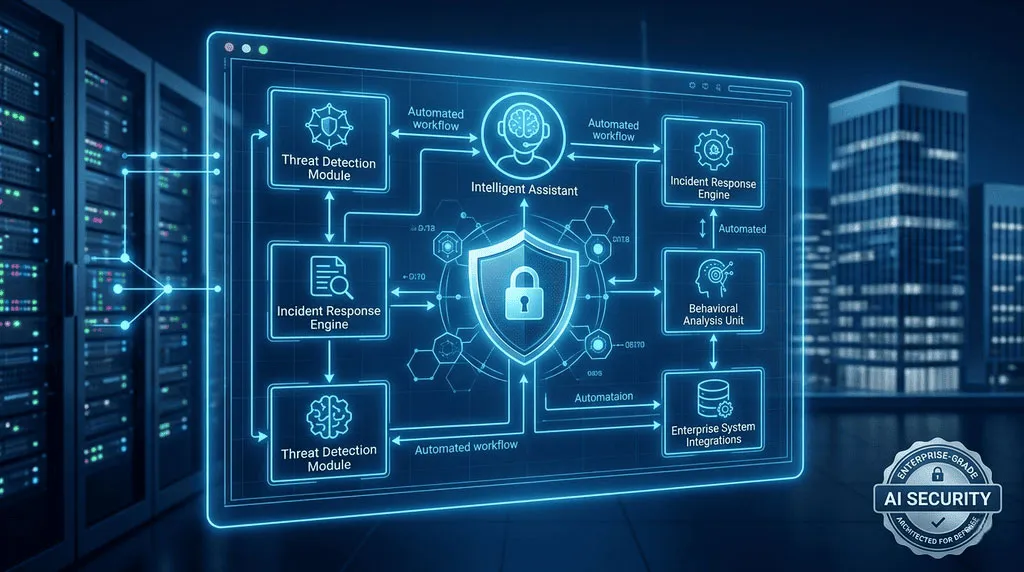
Deploying cybersecurity AI agents inside an enterprise is not a plug-and-play exercise. Architecture decisions made at the outset determine whether the agent becomes a force multiplier or a liability.
- Define the Agent’s Scope and Authority Before deployment, clearly establish what the agent can do autonomously versus what requires human approval. A tiered action model works best: low-risk actions (logging, alerting, tagging) are fully autonomous; medium-risk actions (blocking traffic, quarantining endpoints) require confirmation; high-risk actions (wiping systems, revoking access at scale) always route to a human.
- Build on a Zero-Trust Foundation The agent itself must operate within a Zero Trust architecture. It should authenticate continuously, carry only the minimum permissions required for each task, and never be granted standing admin privileges.
- Integrate Across the Security Stack An isolated agent is a limited agent. Enterprise AI security platforms must integrate with SIEM, SOAR, EDR, identity providers, cloud security posture tools, and ticketing systems. APIs and standardized data formats (like STIX/TAXII for threat intelligence) are essential connective tissue.
- Design for Explainability Every action the agent takes must be logged with reasoning. Security teams and auditors need to understand why a decision was made — not just what was done. Opaque AI in security creates compliance risk and erodes analyst trust.
- Plan for Failover and Human Override Always architect a human-in-the-loop override mechanism. If the agent malfunctions or encounters an edge case beyond its training, human operators must be able to pause, override, or roll back agent actions immediately.
- Use Modular, Role-Specific Agents Rather than a single monolithic agent, enterprise deployments benefit from an orchestrated multi-agent architecture — one agent specializing in identity threats, another in network traffic analysis, another in cloud misconfigurations — all coordinated by an orchestration layer that synthesizes their findings.
Securing the Agents Themselves: Protecting Your AI Defense Layer
A critical and often overlooked reality: AI agents are attack targets. If adversaries can manipulate, poison, or compromise your security agent, they gain a privileged insider position within your defense system.
Protect the Training Pipeline AI agents trained on poisoned data will develop blind spots or misclassify threats. Validate training datasets rigorously, monitor for data drift, and retrain models in controlled, auditable environments.
Guard Against Prompt Injection Agents that process external text — emails, web content, logs — are vulnerable to prompt injection attacks, where malicious actors embed instructions designed to hijack the agent’s behavior. Input sanitization and strict context boundaries are non-negotiable.
Enforce Least-Privilege Access The agent should never hold credentials or API keys beyond what its current task requires. Use ephemeral, short-lived tokens and vault-based secret management.
Monitor Agent Behavior Continuously Run a meta-monitoring layer that watches the agent’s own actions for anomalies. If an agent suddenly begins escalating its own privileges or exfiltrating logs, that is a signal of compromise.
Conduct Regular Red Team Exercises Test your AI agents the same way you test the rest of your infrastructure — through adversarial simulation. Red teams should specifically probe for ways to manipulate, confuse, or bypass the agent’s decision logic.
Challenges and Risks of Deploying AI Agents in Cybersecurity
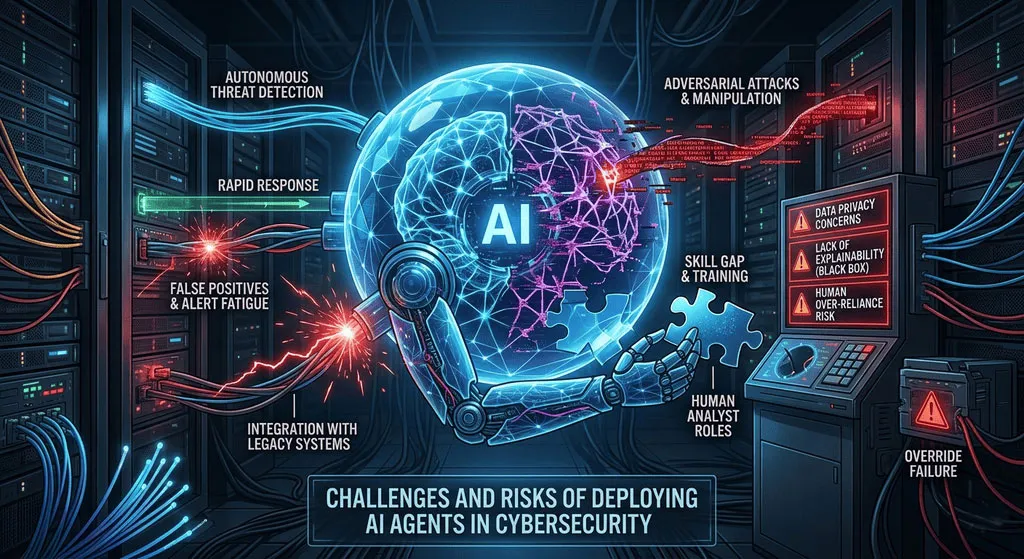
Adopting autonomous cybersecurity solutions is not without friction. Understanding the risks upfront leads to more responsible and effective deployment.
False Positives and Alert Fatigue Poorly tuned agents can generate an avalanche of alerts, overwhelming analysts and causing critical signals to be missed. Calibration during the early deployment phase is essential.
Adversarial AI Threat actors are developing AI-powered attack tools specifically designed to evade AI-based detection. The arms race between offensive and defensive AI is already underway.
Regulatory and Compliance Risk Autonomous actions — like blocking network segments or deleting files — can have legal implications, especially in regulated industries. Compliance frameworks may require documented human authorization for certain security actions.
Data Privacy Concerns AI agents ingest enormous volumes of user and system data. Organizations must ensure that data handling by the agent complies with GDPR, CCPA, HIPAA, and other applicable regulations.
Over-Reliance and Skill Erosion When AI handles the heavy lifting, human analysts may lose the hands-on experience needed to manage edge cases or outages. Maintaining analyst proficiency alongside AI-assisted operations is a cultural and training challenge.
Integration Complexity Legacy infrastructure rarely plays nicely with modern AI platforms. Bridging old systems with new agentic capabilities requires substantial investment in APIs, data normalization, and orchestration.
Building Trust and Ensuring Responsible AI Actions in Cybersecurity
Trust is the currency of effective AI-powered security. If analysts don’t trust the agent, they override it. If leadership doesn’t trust it, they defund it. Here is how to build that trust systematically:
Implement Full Auditability Every action taken by the agent — and the reasoning behind it — must be logged in an immutable, queryable audit trail. This satisfies both internal governance and external regulators.
Use Confidence Scoring Agents should communicate uncertainty. A decision made with 95% confidence should be treated differently from one made at 60%. Displaying confidence scores allows analysts to intervene where it matters most.
Establish Clear Escalation Protocols Define precisely when and how the agent escalates to a human. Ambiguity in escalation logic leads to critical threats being handled incorrectly or not at all.
Adopt an AI Ethics Framework Apply principles of fairness, accountability, and transparency to your security AI. Avoid deploying agents that make consequential decisions — like blocking a user’s access — based on biased or unvalidated signals.
Involve Analysts in Continuous Feedback Loops Analyst feedback on agent decisions should directly inform model retraining. When an analyst overrides an agent’s recommendation, that override should be captured, reviewed, and used to improve future behavior.
Traditional Cybersecurity Tools vs. AI Agents: Understanding the Divide
| Dimension | Traditional Tools | AI Agents |
|---|---|---|
| Detection Method | Signature and rule-based | Behavioral and contextual |
| Response Speed | Minutes to hours | Milliseconds to seconds |
| Adaptability | Manual updates required | Learns and adapts continuously |
| Scope | Single domain (e.g., endpoint) | Cross-domain correlation |
| Human Dependency | High — requires constant oversight | Low — operates autonomously with defined guardrails |
| Threat Coverage | Known threats | Known and unknown (zero-day) threats |
| Scalability | Limited by human bandwidth | Scales linearly with infrastructure |
| Explainability | Rule logic is transparent | Requires explainability design |
Traditional tools remain valuable as data sources and foundational controls. But they are reactive by nature. AI agents shift the security posture from reactive to predictive and proactive — the difference between finding a fire and preventing one from igniting.
Partner With Bantech Solutions to Deploy AI-Driven Security That Works
Cybersecurity transformation at the enterprise level demands more than technology — it demands expertise, strategy, and a trusted implementation partner. Bantech Solutions brings deep experience in architecting, deploying, and managing AI-powered security systems tailored to your industry, infrastructure, and risk profile. Whether you are beginning your AI security journey or scaling an existing agentic framework, Bantech Solutions delivers the technical rigor and strategic guidance to ensure your AI agents perform reliably, securely, and responsibly. Don’t wait for a breach to accelerate your evolution. Reach out to Bantech Solutions today and let’s build a security posture that’s as intelligent as the threats you face.
Conclusion: The Future of Security Is Agentic
The question is no longer whether AI agents belong in cybersecurity — it’s how quickly organizations can deploy them responsibly. Threats are faster, smarter, and more coordinated than ever before. Human teams alone cannot scale to meet that challenge. AI agents — when properly architected, secured, and governed — dramatically extend what a security organization can detect, prevent, and remediate. They don’t replace human judgment; they amplify it, freeing analysts to focus on the decisions that truly require human insight. Organizations that embrace this shift today will not only survive the evolving threat landscape — they will lead it.
FAQs
AI Agents in Cybersecurity: Uses & Benefits
Cyber threats are evolving faster than any human team can track. Every day, organizations face millions of attack attempts, phishing campaigns, zero-day exploits, and sophisticated nation-state intrusions. Against this backdrop, artificial intelligence—and specifically AI agents—have emerged as one of the most powerful forces reshaping how the security industry operates.
But what exactly are AI agents, and how are they being put to work in cybersecurity today? This article answers both questions in depth, walking through the real-world applications, the benefits they deliver, and the challenges that still remain.
What Is an AI Agent in the Context of Cybersecurity?
An AI agent is a software system that perceives its environment, processes information, makes decisions, and takes actions—often with little or no human intervention. Unlike traditional security tools that follow rigid, pre-written rules, AI agents can learn from data, adapt to new patterns, and act autonomously on what they discover.
In cybersecurity, this distinction matters enormously. A rule-based firewall blocks traffic that matches a known signature. An AI agent, by contrast, can analyze network behavior over time, recognize that something unusual is happening even if it has never seen that exact pattern before, and take steps to investigate or contain it—all within seconds.
AI agents in security typically combine several underlying technologies: machine learning models that classify threats, natural language processing that parses logs and alerts, large language models that reason about attacker intent, and automation frameworks that execute responses across tools and systems. Together, these capabilities allow an AI agent to function as something approaching an always-on, tireless member of the security team.
Threat Detection and Monitoring
The most widespread use of AI agents in cybersecurity is continuous threat detection. Security operations centers (SOCs) are inundated with alerts—most large organizations generate hundreds of thousands of security events every day. Human analysts simply cannot review them all. AI agents address this problem by ingesting and analyzing event data at machine speed.
Modern AI-powered detection systems work across multiple data streams simultaneously: network traffic, endpoint logs, identity and access management records, cloud infrastructure telemetry, and email flows. Rather than checking individual events against a static rulebook, they build behavioral models of what “normal” looks like for a given organization and flag meaningful deviations.
This behavioral approach is particularly effective against insider threats and advanced persistent threats (APTs)—attack types that are deliberately designed to blend in with legitimate activity. An AI agent monitoring user behavior might notice that an employee who normally accesses a handful of internal systems is suddenly querying databases in three different countries at 3 a.m. That kind of contextual, time-aware analysis is difficult for rules-based tools and impractical for human reviewers at scale.
Automated Incident Response
Detecting a threat is only half the battle. The speed at which a security team responds to an incident is directly tied to how much damage the attacker can do. Historically, incident response has been a slow, manual process: an analyst gets an alert, reviews logs, escalates to a senior engineer, convenes a call, decides on a containment strategy, and eventually executes it. That process can take hours—or days.
AI agents dramatically compress this timeline. When an agent detects an active threat, it can immediately begin executing a response playbook: isolating a compromised endpoint from the network, revoking a user’s access tokens, blocking a malicious IP address at the firewall, or quarantining a suspicious file before it executes. These actions happen in seconds, not hours.
More sophisticated AI agents can also coordinate responses across multiple security tools simultaneously—something human responders struggle to do. They can open a ticket in the organization’s ITSM system, notify the affected user’s manager, gather forensic evidence from the impacted machine, and update the threat intelligence platform, all as part of a single automated workflow. Security teams are increasingly using these systems to handle high-volume, lower-complexity incidents autonomously, freeing human analysts to focus on the cases that genuinely require expert judgment.
Vulnerability Management and Prioritization
Organizations typically have thousands of known vulnerabilities across their infrastructure at any given time. Patch management is one of the most thankless jobs in IT security—there are always more vulnerabilities than resources to fix them, and prioritization is rarely straightforward. A vulnerability with a high CVE score might be technically severe but unexploitable in a particular environment, while a medium-severity flaw in a public-facing system might represent a critical real-world risk.
AI agents are being applied to this problem in several ways. They can scan infrastructure continuously to maintain an up-to-date picture of exposed assets and their vulnerabilities. More importantly, they can cross-reference vulnerability data with threat intelligence feeds to assess which flaws are actively being exploited in the wild, and correlate that against an organization’s specific environment to produce a risk-adjusted priority list.
Some AI-powered systems go further, using knowledge of network topology and attacker techniques to model attack paths—essentially asking, “If an adversary were to exploit this vulnerability, where could they go from there?” This graph-based reasoning helps security teams understand not just which vulnerabilities exist, but which ones represent the most dangerous footholds for an attacker.
Phishing Detection and Email Security
Phishing remains one of the most effective attack vectors in cybercriminals’ arsenal, and it is also one of the areas where AI agents have demonstrated remarkable effectiveness. Traditional email security filters rely on blacklists, keyword matching, and domain reputation scores. AI agents take a fundamentally different approach.
By analyzing the linguistic patterns, sender behavior, URL structures, and metadata of billions of emails, AI systems can identify phishing attempts that evade conventional filters. They can recognize that an email purporting to be from a CEO uses subtly different phrasing than that executive’s actual communication history, or that a link in a message redirects through a series of domains consistent with a known credential-harvesting campaign.
AI agents can also adapt in near real-time. When a new phishing campaign emerges—a technique that has never been seen before—an AI system trained on the underlying patterns of deceptive communication can often still catch it, without waiting for a human analyst to write a new detection rule.
Malware Analysis and Zero-Day Defense
Analyzing malware is time-consuming, highly specialized work. A human reverse engineer might spend days dissecting a complex piece of malware to understand how it works, what it targets, and how to neutralize it. AI agents can accelerate this process significantly.
Using static analysis (examining the code itself) and dynamic analysis (observing the malware’s behavior in a sandboxed environment), AI systems can classify new malware samples in seconds, identify which known malware families they resemble, and flag the specific capabilities they exhibit—persistence mechanisms, lateral movement techniques, command-and-control communication patterns, and so on. This gives defenders a rapid initial assessment that informs the response, even while deeper human analysis continues.
Against zero-day exploits—attacks that target previously unknown vulnerabilities—AI agents offer a form of behavioral defense. Because they monitor what systems are doing rather than just matching against signatures, they can often detect that something anomalous is happening even when the attack method is entirely new. A process that suddenly attempts to write to system directories, spawn unexpected child processes, and reach out to an external IP may trigger an AI agent’s defenses regardless of whether that specific exploit has ever been seen before.
Security Information and Event Management (SIEM) Enhancement
AI agents are increasingly being embedded within or layered on top of Security Information and Event Management platforms. Traditional SIEMs aggregate log data from across an organization’s environment and generate alerts based on rules. The problem is that they generate enormous volumes of false positives—alerts that turn out to be benign—which leads to alert fatigue among security teams who begin to tune out or deprioritize notifications.
AI-enhanced SIEM systems address this through correlation and contextual reasoning. Instead of generating an alert for each individual suspicious event, an AI agent can connect events across time and systems to determine whether they form a coherent attack pattern. A failed login here, a privilege escalation there, an unusual outbound connection elsewhere—separately, none of these might warrant immediate action. Together, analyzed in context, they may indicate an active intrusion. The AI agent surfaces the pattern as a single high-fidelity alert, along with a narrative explanation of what it believes is happening and why.
Challenges and Limitations
Despite their power, AI agents in cybersecurity are not without limitations. Adversarial machine learning is an emerging threat: attackers who understand how AI detection systems work can deliberately craft attacks designed to evade them—feeding the model data designed to make it classify malicious activity as benign.
AI agents also require high-quality training data. A model trained on data that is not representative of an organization’s environment will produce poor results. And because AI systems can be opaque in their reasoning, security teams sometimes struggle to explain why an agent took a particular action—a challenge in regulated industries where audit trails and explainability are required.
Finally, AI agents operate best as force multipliers for human security teams, not replacements for them. The most effective security operations combine the speed and scale of AI with the contextual judgment, creativity, and ethical reasoning of human analysts.
The Road Ahead
AI agents are not a future possibility in cybersecurity—they are a present reality. Organizations of every size are deploying them for threat detection, incident response, vulnerability management, email security, and malware analysis. The technology continues to advance rapidly, with agentic systems becoming increasingly capable of reasoning through complex, multi-step problems and coordinating across an entire security stack with minimal human input.
For security professionals, the practical implication is clear: understanding how to work alongside AI agents, configure them effectively, and interpret their outputs is becoming as fundamental a skill as knowing how to read a packet capture or write a detection rule. The organizations that learn to combine human expertise with AI capability will be best positioned to defend against the threats of tomorrow.
The 4 Pillars of AI Agents Explained
Artificial intelligence agents are moving from research curiosity to mainstream technology at a remarkable pace. They book travel, write code, manage customer service queues, monitor security systems, and coordinate complex multi-step business workflows—often with little or no human involvement. Yet despite this diversity of applications, virtually every AI agent in existence is built on the same foundational architecture. That architecture rests on four pillars: Perception, Reasoning, Action, and Learning.
Understanding these four pillars is not just an academic exercise. For business leaders evaluating AI investments, developers building agent-powered applications, or anyone trying to make sense of where this technology is headed, grasping what makes an AI agent tick is essential context. This article walks through each pillar in depth, explains how they interact, and shows why all four must work together for an AI agent to be genuinely useful.
What Is an AI Agent?
Before examining the pillars, it helps to be precise about what an AI agent actually is. The term “agent” comes from the Latin agere—to act. In artificial intelligence, an agent is any system that perceives its environment, processes what it perceives, and takes actions in response to achieve one or more goals.
This definition encompasses a wide spectrum. A simple thermostat could technically be called an agent—it perceives temperature, compares it to a target, and acts by switching heating or cooling on or off. Modern AI agents are vastly more sophisticated: they perceive complex, unstructured information (text, images, sensor data, API responses), reason about it using large language models or other AI systems, act across digital and sometimes physical environments, and continuously improve from experience.
What distinguishes a true AI agent from a simple automation script is the combination of all four pillars. A script executes fixed instructions. An agent perceives, reasons, acts, and learns—adapting its behavior based on context and feedback rather than following a predetermined path.
Pillar 1: Perception
Perception is how an AI agent takes in information about the world around it. Without perception, an agent is blind—it has no basis on which to reason or act. This pillar encompasses everything related to data ingestion, input processing, and situational awareness.
What Agents Perceive
Modern AI agents can perceive an extraordinarily broad range of inputs. These include:
- Text: Emails, documents, chat messages, web pages, code, and structured data like spreadsheets or JSON files.
- Images and video: Photographs, screenshots, diagrams, video feeds from cameras or surveillance systems.
- Audio: Spoken language, environmental sounds, phone call recordings.
- Sensor data: Readings from IoT devices, industrial equipment, environmental monitors, or GPS systems.
- System signals: API responses, database query results, software logs, network telemetry, and UI state from applications.
The breadth of what an agent can perceive largely determines the breadth of tasks it can engage with. An agent that can only read text is constrained to text-based tasks. An agent that can process text, images, and live system data can engage with a far richer set of real-world problems.
Perception and Context Windows
For AI agents built on large language models (LLMs), perception is closely tied to the concept of a context window—the body of information the model can actively “hold in mind” at any given moment. The agent perceives not just the immediate input but a structured context that might include the conversation history, relevant documents, tool outputs from previous steps, and memory retrieved from past interactions.
Effective perception is therefore not just about raw data ingestion—it is about assembling the right information, in the right form, at the right time, so that the reasoning layer has what it needs to make good decisions.
Why Perception Quality Matters
Garbage in, garbage out is a principle that applies with full force to AI agents. An agent that misreads a document, fails to notice a critical data point, or receives poorly formatted inputs will reason from a flawed foundation—no matter how capable its reasoning engine. Investing in high-quality data pipelines, robust input processing, and clear context construction is not optional; it is a prerequisite for agent reliability.
Pillar 2: Reasoning
If perception is the agent’s senses, reasoning is its mind. This is where the agent processes what it has perceived, interprets its meaning, evaluates options, and determines what to do. Reasoning is the cognitive core of an AI agent—and it is where large language models have made the most dramatic recent advances.
Types of Reasoning in AI Agents
AI agents engage in several distinct types of reasoning, often in combination:
Analytical reasoning involves breaking a problem down into its components, understanding relationships between them, and drawing conclusions from the available evidence. When a security agent analyzes a pattern of network events to determine whether they constitute an attack, it is engaging in analytical reasoning.
Planning and sequential reasoning involves thinking through a multi-step task: what needs to happen first, what depends on what, and how to reach a goal through a sequence of actions. An agent asked to research a topic, summarize findings, draft a report, and email it to a stakeholder must plan and execute these steps in order.
Counterfactual and hypothetical reasoning involves thinking about what might happen under different conditions. An agent managing infrastructure might reason: “If I apply this patch, this service will need to restart. If the service restarts during peak hours, response times will spike. Therefore, I should schedule this for the maintenance window.”
Ethical and constraint-based reasoning involves recognizing boundaries. A well-designed AI agent does not simply optimize for its immediate goal—it reasons about what it is and is not permitted to do, escalating to human oversight when it encounters ambiguity or potential harm.
Chain-of-Thought and Agentic Reasoning
One of the most significant advances in AI reasoning has been the development of chain-of-thought techniques, in which a model is prompted or trained to reason step by step before producing an answer. This internal deliberation dramatically improves performance on complex tasks—the model effectively “thinks out loud,” catching errors and considering multiple angles before committing to a conclusion.
In agentic settings, this reasoning is often interleaved with action. The agent reasons about what to do, takes an action (calling an API, running code, retrieving information), observes the result, and then reasons again about what to do next. This perceive-reason-act loop, repeated across many cycles, allows agents to tackle tasks that would be impossible to address in a single reasoning step.
Pillar 3: Action
Reasoning without action is contemplation. The action pillar is what makes an AI agent genuinely useful—it is the mechanism by which the agent affects the world in pursuit of its goals. Actions are the outputs of the agent: the things it does rather than the things it thinks.
The Range of Possible Actions
AI agents can act across a remarkable range of domains, depending on what tools and integrations they have access to. Common action categories include:
Communication actions: Sending emails, posting messages in Slack, generating reports, drafting documents, responding to customer inquiries, or updating stakeholders.
Data actions: Querying databases, writing records, updating spreadsheets, processing files, generating visualizations, or running analytics.
System and API actions: Calling external services, triggering webhooks, provisioning cloud resources, deploying software, managing user accounts, or interacting with third-party platforms.
UI and browser actions: Navigating web pages, filling forms, clicking buttons, extracting information from websites, or automating interactions with desktop applications.
Physical actions (in robotics and IoT contexts): Controlling motors, adjusting physical systems, responding to sensor readings, or operating machinery.
Tools as the Bridge to Action
In most modern AI agent architectures, actions are mediated through tools—discrete capabilities the agent can invoke when needed. A tool might be a web search function, a code execution environment, a database connector, or an API client. The agent’s reasoning layer decides which tool to use and with what inputs; the tool executes the action and returns a result; the agent perceives that result and continues its reasoning.
This tool-use pattern is powerful because it is modular. New capabilities can be added to an agent simply by providing access to new tools, without retraining the underlying model. It also provides a natural control point: by carefully defining which tools an agent has access to and what they can do, developers can constrain the agent’s behavior and limit the potential for unintended consequences.
The Importance of Safe, Bounded Action
The action pillar carries the highest stakes of the four. An agent that reasons incorrectly might produce a bad recommendation. An agent that acts incorrectly might delete data, send an ill-considered message to a client, or make a costly change to a live system. Responsible AI agent design therefore places considerable emphasis on action boundaries: what can the agent do unilaterally, what requires human confirmation, and what is strictly off-limits?
Effective agents are designed with graduated autonomy—handling routine, low-risk actions automatically while escalating high-impact or irreversible decisions to human oversight. This balance between capability and caution is one of the defining challenges of production AI agent deployment.
Pillar 4: Learning
The fourth pillar is what separates a static automation from a truly intelligent agent. Learning is the ability of an AI agent to improve over time—to become more accurate, more efficient, and better aligned with user needs as a result of experience.
Forms of Learning in AI Agents
Learning in AI agents takes several forms, operating at different timescales:
In-context learning happens within a single session. The agent observes feedback, corrections, or new information during an interaction and adjusts its behavior accordingly—without any changes to its underlying model weights. If a user tells an agent it misunderstood a task, a capable agent will incorporate that correction and produce a better result on the next attempt.
Memory-augmented learning involves the agent retaining information across sessions in an external memory store. The agent might remember user preferences, past decisions, the results of previous actions, or facts it has discovered in the course of completing tasks. When a similar situation arises in the future, the agent retrieves and applies what it previously learned.
Fine-tuning and reinforcement learning operate at a deeper level—modifying the model itself based on feedback signals. In reinforcement learning from human feedback (RLHF), for example, human evaluators rate model outputs, and those ratings are used to adjust the model toward responses that better match human preferences. This kind of learning happens during training and evaluation cycles, not in real-time deployment.
Behavioral adaptation refers to the agent learning which strategies, phrasings, or approaches tend to produce good outcomes in a given context, and gradually gravitating toward them. Over time, an agent that receives consistent feedback about what works and what does not will develop increasingly effective heuristics.
Learning and Trust
The learning pillar also has an important relationship with trust. An AI agent that cannot learn from mistakes will repeat them indefinitely. One that learns effectively—updating its behavior in response to feedback, improving its accuracy over time, and becoming better calibrated about its own uncertainty—earns increasing trust from the humans who work with it. Building robust feedback loops into an agent’s deployment is therefore not just a technical consideration; it is a trust-building strategy.
How the Four Pillars Work Together
The four pillars are not independent modules—they form an integrated cycle. At any moment, an operating AI agent is simultaneously perceiving its environment, reasoning about what it has perceived, acting on the conclusions it has reached, and learning from the results of its actions.
Consider an AI agent deployed to handle customer support tickets. It perceives an incoming message from a frustrated customer describing a billing error. It reasons about the situation: What is the nature of the error? What policies apply? What resolution options are available? Has this customer had similar issues before? It acts by retrieving the customer’s account data, identifying the discrepancy, issuing a correction, and sending a personalized response. It learns from the interaction: if the customer rates the resolution positively, that feedback reinforces the approach the agent took; if not, the agent’s future behavior is adjusted accordingly.
This cycle—perceive, reason, act, learn—repeats continuously, across every interaction, at speeds and scales no human team could match. That is the fundamental promise of AI agents, and the four pillars are what make it possible.
Why the Four Pillars Framework Matters
For anyone building, buying, or working alongside AI agents, the four pillars framework provides a useful diagnostic lens. When an agent underperforms, the cause can usually be traced to a weakness in one or more pillars:
- If the agent consistently misunderstands tasks, the perception layer may be receiving poor-quality inputs or insufficient context.
- If the agent makes logical errors or fails to plan effectively, the reasoning layer may need a more capable model or better prompting.
- If the agent cannot get things done, it may lack access to the right tools or have overly restrictive action boundaries.
- If the agent keeps making the same mistakes, the learning mechanisms may be absent or ineffective.
Understanding which pillar is the weak link points directly toward the right solution—and helps organizations avoid the common mistake of treating AI agent failures as monolithic problems requiring wholesale replacement rather than targeted improvement.
Conclusion
The four pillars of AI agents—Perception, Reasoning, Action, and Learning—represent the complete architecture of intelligent, autonomous behavior. Each pillar is necessary; none is sufficient on its own. Together, they define what it means for a system to genuinely act as an agent in the world rather than simply execute fixed instructions.
As AI agents become more deeply embedded in business operations, professional workflows, and everyday life, understanding these foundations becomes increasingly important for everyone who interacts with them. The organizations and individuals who develop a clear mental model of how agents work will be far better equipped to deploy them effectively, troubleshoot them when they fall short, and shape their development in directions that are genuinely beneficial.
Why AI Is Important in Cybersecurity Today
Cybersecurity has always been a contest between attackers and defenders. For most of the internet’s history, defenders had one significant structural advantage: most attackers were opportunistic, and a reasonable level of vigilance was enough to keep the majority of threats at bay. That advantage has largely evaporated. Today’s threat landscape is defined by automation, scale, and sophistication that far outpaces the capacity of traditional security approaches—and increasingly, of human teams working without technological support.
Artificial intelligence has emerged as the most consequential response to this shift. It is not simply a useful add-on to existing security tooling; it is becoming a foundational requirement for any organization that wants to defend itself effectively in the modern threat environment. This article examines why in detail—covering the specific problems AI solves, the capabilities it unlocks, and the broader strategic reasons it has moved from “emerging technology” to essential infrastructure in the space of just a few years.
The Scale Problem That Made AI Necessary
To understand why AI matters in cybersecurity, you first need to appreciate the scale at which the problem now operates.
A large enterprise might generate hundreds of millions of security events every single day—log entries, network connections, authentication attempts, file system changes, API calls, and dozens of other data points flowing in from endpoints, servers, cloud environments, identity systems, and application layers. Even a modestly sized organization typically generates millions. No team of human analysts, however skilled and however large, can review that volume of data meaningfully. The math simply does not work.
Traditional security tools addressed this by applying rules and thresholds—only alerting when specific patterns matched known signatures or when metrics crossed predefined limits. This approach worked adequately when the threat landscape was simpler and slower-moving. Today, it produces two simultaneous failure modes: it misses novel threats that do not match existing signatures, and it generates so many alerts on everything else that security teams are buried under false positives. Alert fatigue—the phenomenon in which analysts become desensitized to alerts because so many turn out to be benign—is one of the most documented and persistent problems in the field. Studies consistently find that a substantial portion of security alerts go uninvestigated simply because there are too many of them.
AI solves the scale problem in a way that no other approach can. Machine learning models can ingest and analyze millions of events per second, apply sophisticated pattern recognition across all of them simultaneously, and surface only the findings that genuinely warrant human attention—with context, explanation, and recommended next steps attached. This is not an incremental improvement on what human analysts do. It is a qualitatively different capability that makes comprehensive security monitoring possible for the first time.
Speed: The Window Between Detection and Damage
Beyond scale, speed is perhaps the single most critical reason AI has become indispensable in cybersecurity. The interval between when an attacker gains initial access to a network and when they achieve their objective—whether that is exfiltrating data, deploying ransomware, or establishing persistent backdoors—has been shrinking for years. In many modern attacks, particularly ransomware campaigns, the entire chain from initial compromise to full encryption of an organization’s systems can play out in hours.
The traditional incident response process was simply not designed for this tempo. An alert fires, an analyst investigates, escalates if warranted, convenes the appropriate team, and eventually reaches a decision about how to respond. Each handoff takes time. By the time a human-driven response is coordinated and executed, the damage may already be done.
AI systems operate on an entirely different timescale. An AI-powered detection and response platform can identify an anomalous behavior, correlate it with related events across the environment, classify it as a high-confidence threat, and execute a containment action—isolating an endpoint, blocking a network connection, revoking a compromised credential—within seconds of the first suspicious signal. The attacker’s window of opportunity collapses.
This speed advantage is not just about reacting faster to known attacks. It also changes the economics of targeted attacks. When adversaries know that any unusual behavior will trigger an automated, immediate response, many attacks that would otherwise be viable become impractical. The combination of fast detection and fast response effectively raises the cost of attacking a well-defended organization.
Detecting What Rule-Based Systems Miss
One of the most important technical contributions AI makes to cybersecurity is the ability to detect threats that signature-based and rule-based tools simply cannot catch. This matters enormously because the most dangerous attacks are specifically designed to evade conventional detection.
Advanced persistent threats (APTs)—the kind of sophisticated, patient campaigns typically associated with nation-state actors and organized criminal groups—are crafted to look like normal activity for as long as possible. The attacker moves slowly, uses legitimate tools already present in the environment (a technique known as “living off the land”), and avoids triggering the specific signatures that security teams have written rules to catch. Against a purely signature-based defense, this approach is highly effective.
AI-based behavioral detection takes a fundamentally different approach. Instead of asking “does this event match a known bad pattern?”, it asks “does this activity fit the established baseline of normal behavior for this user, system, or environment?” An account that suddenly begins accessing sensitive data stores it has never touched, at an unusual time of day, from an unfamiliar location, will stand out against its behavioral baseline even if every individual action it takes is technically legitimate and matches no existing rule.
This behavioral approach is also effective against zero-day exploits—attacks that leverage previously unknown vulnerabilities for which no signature exists. Because AI systems monitor what is happening rather than matching against a catalog of what has happened before, they can often detect the behavioral artifacts of a zero-day attack even before the vulnerability itself has been publicly disclosed. The anomaly in system behavior—a process attempting to escalate privileges in an unusual way, a service making unexpected outbound connections—is visible regardless of whether the underlying exploit technique is new or old.
Managing the Cybersecurity Talent Shortage
AI’s importance in cybersecurity is not solely a technical story. It is also a workforce story. The global cybersecurity industry faces a significant and well-documented talent shortage—there are more open positions than there are qualified candidates to fill them, and the gap has persisted for years despite substantial investment in training and recruitment. Estimates of the shortfall vary, but all point in the same direction: there are not enough skilled security professionals to meet demand.
This shortage has direct security consequences. Organizations that cannot hire and retain sufficient talent are forced to make difficult choices about what to monitor, what to investigate, and what to let slide. Coverage gaps are inevitable, and attackers are adept at finding and exploiting them.
AI does not replace security professionals—the best outcomes come from combining human expertise with machine capability—but it dramatically extends what a given team can accomplish. An AI-powered platform can handle the high-volume, repetitive work that consumes most of an analyst’s day: triaging alerts, correlating events, enriching indicators of compromise with threat intelligence, and executing routine response playbooks. This frees human analysts to focus on the work that genuinely requires their judgment: investigating complex incidents, hunting for novel threats, refining the organization’s security posture, and making the contextual decisions that AI systems cannot reliably make on their own.
In practical terms, AI allows a security team of ten people to operate with the coverage and throughput of a team many times that size. For the vast majority of organizations—particularly those without the budget or brand profile to compete for top security talent—this multiplier effect is not a luxury. It is what makes adequate security coverage achievable at all.
AI in Threat Intelligence and Predictive Defense
Reactive security—detecting and responding to attacks after they begin—is necessary but not sufficient. The most sophisticated security programs also invest in understanding the threat landscape proactively, identifying likely attack vectors before they are exploited, and taking preventive action to close gaps.
AI plays a central role in this kind of threat intelligence work. The volume of threat intelligence data available to security teams—from government agencies, commercial vendors, open-source communities, industry sharing groups, and dark web monitoring services—is immense and growing. Making sense of it, connecting the dots between different data points, and translating raw intelligence into actionable defensive measures is a task that benefits enormously from machine assistance.
AI systems can continuously monitor threat intelligence feeds, identify emerging attack campaigns, correlate indicators of compromise with an organization’s own environment, and automatically update detection rules and blocklists to reflect the current threat picture. They can also analyze historical attack data to identify patterns in how adversaries select and approach targets—information that can inform where to focus defensive investment.
More ambitiously, AI is beginning to enable genuinely predictive security: using historical patterns to anticipate likely attack vectors and prioritize defensive action before an attack materializes. If a particular class of vulnerability is being actively exploited across the industry, an AI system can identify which assets in an organization’s environment are exposed and prioritize their remediation before the organization itself becomes a target.
Securing Complex, Distributed Environments
The environments that security teams must protect have grown dramatically more complex over the past decade. The transition to cloud infrastructure, the proliferation of remote work, the explosion of connected devices through the Internet of Things, and the adoption of microservices and containerized applications have all expanded the attack surface in ways that traditional perimeter-based security models were never designed to handle.
Protecting a modern organization means monitoring activity across on-premises data centers, multiple cloud providers, mobile devices, remote endpoints, third-party SaaS applications, operational technology systems, and an interconnected web of APIs and integrations. The number of distinct assets and data flows involved is orders of magnitude larger than what security teams were managing even ten years ago.
AI is uniquely suited to this complexity. It can simultaneously monitor activity across all of these environments, maintain a unified picture of what normal looks like across a heterogeneous infrastructure, and detect anomalies regardless of where in the environment they occur. It can correlate events that originate in completely different parts of the stack—a suspicious authentication event in an identity provider, an unusual API call in a cloud service, and anomalous data movement in a storage bucket—and recognize them as connected steps in a single attack campaign.
Without AI, this kind of holistic, cross-environment visibility is simply not achievable at the speed and scale required. The dots exist; only AI can connect them quickly enough to matter.
Reducing the Cost of Security Breaches
There is a compelling financial case for AI in cybersecurity that goes beyond capability. Security breaches are expensive—extraordinarily so. The costs include direct incident response expenses, legal fees, regulatory fines, customer notification, credit monitoring services, reputational damage, lost business, and the long-term effect on customer trust. Industry research consistently finds that the average total cost of a data breach runs into the millions of dollars, with major incidents at large organizations running into the tens or hundreds of millions.
The economics of AI in security need to be understood against this backdrop. AI-powered security tools have real costs: licensing, implementation, integration, tuning, and ongoing management. But those costs are measured against the cost of the breaches they prevent or limit. An AI system that detects a ransomware infection thirty minutes earlier than a conventional tool—before the encryption spreads to backup systems and the damage becomes catastrophic—may deliver return on investment that dwarfs its entire annual cost in a single incident.
Beyond preventing individual breaches, AI also reduces the ongoing operational cost of security by automating labor-intensive processes and enabling smaller teams to cover more ground. Organizations that use AI effectively can achieve better security outcomes with fewer resources—a meaningful advantage in an environment where security budgets are always competing with other organizational priorities.
The Arms Race Dimension
A final and often underappreciated reason AI is important in cybersecurity is simply that attackers are using it too. AI tools lower the barrier to conducting sophisticated attacks. They make it easier to generate convincing phishing emails at scale, identify vulnerabilities in target systems, craft malware that evades detection, and automate the reconnaissance and exploitation phases of an attack. Cybercriminal groups and nation-state actors are actively investing in AI-enabled offensive capabilities.
This creates an arms race dynamic in which defenders who do not adopt AI face adversaries who are increasingly AI-enabled. The asymmetry is stark: an attacker using AI to automate and accelerate their operations against a defender relying on manual processes and legacy tools has a significant structural advantage. Adopting AI in defense is therefore not simply about getting better—it is about not falling further behind.
Conclusion
AI is important in cybersecurity for reasons that are simultaneously technical, operational, economic, and strategic. It solves the scale problem that makes comprehensive human monitoring impossible. It provides the speed necessary to contain fast-moving threats before they cause catastrophic damage. It detects the novel and sophisticated attacks that traditional tools miss. It extends the capacity of security teams facing a structural talent shortage. It enables proactive, intelligence-driven defense in environments of ever-growing complexity. And it is necessary simply because the adversaries on the other side of the equation are using it.
For organizations of every size and in every industry, AI in cybersecurity has moved from an aspirational capability to a practical necessity. The question is no longer whether to adopt it—but how to do so effectively, responsibly, and in ways that genuinely strengthen security rather than simply adding complexity.
The 7 Types of AI Agents Explained
Artificial intelligence agents are not a single, uniform technology. The term “AI agent” describes a broad family of systems that range from simple, reactive programs following fixed rules to sophisticated autonomous entities capable of planning, reasoning, and learning across complex environments. Understanding the distinctions between them is essential for anyone building, deploying, or evaluating AI systems—because the right type of agent for a given problem depends entirely on what that problem actually requires.
The classification of AI agents into distinct types comes primarily from the foundational AI research framework established by Stuart Russell and Peter Norvig in their landmark textbook Artificial Intelligence: A Modern Approach. Their taxonomy has become the standard reference point in the field, and while real-world agents often blend characteristics from multiple categories, the seven types provide a clear and useful conceptual map.
This article examines each of the seven types in depth: what they are, how they work, where they excel, where they fall short, and what real-world applications they power.
What Makes Something an AI Agent?
Before diving into the types, it is worth anchoring the definition. An AI agent is any system that perceives its environment through sensors or inputs, processes that information, and produces actions or outputs in response—with the goal of achieving some objective. The key word is agent: something that acts, rather than simply computes.
Agents exist on a spectrum of capability. At the simple end, an agent might respond to a single input with a single fixed output. At the sophisticated end, an agent might maintain a rich internal model of the world, plan sequences of actions across extended time horizons, learn from experience, and coordinate with other agents to achieve shared goals. The seven types map this spectrum systematically.
Type 1: Simple Reflex Agents
Simple reflex agents are the most fundamental type. They operate entirely on the present moment: they perceive the current state of their environment and respond according to a pre-defined set of condition-action rules. There is no memory, no model of the world, no planning, and no learning. The agent sees a condition and executes the corresponding action—nothing more.
How They Work
The architecture is essentially: if condition X, then do action Y. The agent checks its rules against the current input and fires the matching response. The rules are written in advance by the agent’s designers and do not change during operation.
Strengths and Limitations
Simple reflex agents are fast, predictable, and easy to understand. Because their logic is fully explicit in their rule set, there is no ambiguity about why they behave as they do. They are also computationally inexpensive and reliable within their defined scope.
Their fundamental limitation is that they have no memory and no awareness of anything outside the current moment. If the environment is not fully observable—if the agent cannot perceive everything it needs in a single snapshot—simple reflex agents quickly fail. They also cannot handle situations their rules do not explicitly cover, and they cannot improve through experience.
Real-World Examples
Spam filters based on keyword rules, basic thermostat controls, simple customer service chatbots that match queries to canned responses, and automatic door sensors that open when motion is detected are all examples of simple reflex agents in everyday use. Industrial control systems that respond to sensor readings with fixed actuator commands follow the same pattern.
Type 2: Model-Based Reflex Agents
Model-based reflex agents address the most significant limitation of their simpler cousins: the inability to handle partially observable environments. These agents maintain an internal model—a representation of the state of the world—that they update as new information arrives. Rather than acting only on what they can perceive right now, they act on what they know about the world based on everything they have perceived so far.
How They Work
The agent maintains a state variable that represents its best current understanding of the world. With each new perception, it updates this internal model using two pieces of knowledge: how actions affect the world, and how the world changes on its own. It then applies condition-action rules to this updated state rather than to raw perception alone.
Strengths and Limitations
By maintaining state, model-based reflex agents can handle environments where not everything is visible at any given moment. They can track objects that temporarily leave the field of view, remember what happened earlier in an interaction, and respond appropriately to situations that unfold over time.
Their limitation is that they are still fundamentally reactive. They do not plan sequences of future actions, evaluate options, or optimize toward long-term goals. Their behavior is still governed by condition-action rules; it is just that those rules operate on a richer representation of the world.
Real-World Examples
A robot vacuum cleaner that builds a map of the rooms it has navigated and tracks which areas it has already cleaned is a model-based reflex agent. Navigation systems that maintain a model of the car’s position even when GPS signal is temporarily lost, and adaptive cruise control systems that track the position and velocity of vehicles ahead over time, follow the same architecture.
Type 3: Goal-Based Agents
Goal-based agents represent a significant step up in capability. Rather than simply reacting to the current state of the world—however richly they model it—goal-based agents act in pursuit of explicit objectives. They evaluate potential actions not just by whether they match a rule, but by whether they contribute to achieving a defined goal.
How They Work
A goal-based agent has, in addition to its world model, a representation of one or more goals it is trying to achieve. When deciding what to do, it considers which actions will move it closer to its goal state. This requires search and planning: the agent reasons forward through possible sequences of actions to find a path that leads to the goal.
Strengths and Limitations
Goal-based agents are far more flexible than reflex agents. Because their behavior is driven by goals rather than fixed rules, they can adapt their actions to circumstances their designers never explicitly anticipated—as long as the new circumstances still allow some path to the goal. They can also handle complex, multi-step tasks that require planning rather than immediate reaction.
The limitation is that goals are binary: achieved or not achieved. Goal-based agents do not have a way to compare two situations in which the goal is partially met, or to trade off between competing considerations. They also require that goals be clearly and completely specified in advance—a harder problem than it sounds in real-world deployments.
Real-World Examples
Chess-playing programs that search for move sequences leading to checkmate, route-planning algorithms that find a path from A to B, and automated scheduling systems that arrange tasks to meet a set of constraints are all goal-based agents. Early autonomous vehicle systems that navigated toward a destination waypoint followed this architecture.
Type 4: Utility-Based Agents
Utility-based agents extend the goal-based model by replacing binary goal achievement with a continuous measure of desirability. Rather than simply asking “does this action lead to the goal?”, a utility-based agent asks “how good is this outcome, and how can I achieve the best possible outcome given the constraints I face?”
How They Work
The agent has a utility function—a mathematical representation of how desirable any given state of the world is, typically producing a numerical score. When choosing between actions, the agent evaluates which action leads to the highest expected utility, taking into account both the outcomes of actions and the probabilities of reaching those outcomes in an uncertain environment.
Strengths and Limitations
Utility functions allow agents to handle nuance, trade-offs, and uncertainty in ways that binary goal achievement cannot. An agent choosing between two routes might prefer the one that is slightly longer but much more reliable, because the utility function captures this trade-off explicitly. Utility-based agents can also gracefully handle situations where the ideal outcome is not achievable and the best available option must be selected.
The challenge is designing utility functions that accurately capture what humans actually value—a problem that turns out to be subtle and consequential. A poorly specified utility function can produce agents that technically maximize their score while producing outcomes their designers never intended.
Real-World Examples
Recommendation systems that optimize for user engagement, financial trading algorithms that balance expected return against risk, ride-sharing dispatch systems that allocate drivers to maximize overall efficiency, and modern autonomous vehicle systems that weigh safety, passenger comfort, travel time, and energy efficiency simultaneously are all utility-based agents.
Type 5: Learning Agents
Learning agents are distinguished by their ability to improve their own performance over time. Rather than operating with a fixed set of rules, models, or utility functions defined entirely at design time, learning agents adapt based on experience—becoming more effective as they encounter more situations and receive more feedback.
How They Work
A learning agent has four key components. The learning element is responsible for improving the agent’s performance based on feedback—this is where machine learning, reinforcement learning, or other adaptive mechanisms operate. The performance element is the part of the agent that actually decides what to do and acts—it is what the learning element is trying to improve. The critic evaluates the agent’s actions against a performance standard and provides feedback to the learning element. The problem generator suggests exploratory actions that might yield new information, enabling the agent to discover better strategies it would not find by sticking to what it already knows.
Strengths and Limitations
Learning agents are the most powerful type in terms of adaptability. They can operate effectively in environments that are too complex to specify rules for in advance, they improve over time without requiring manual updates from designers, and they can discover strategies that human designers would not have thought of. Modern large language models, reinforcement learning systems, and neural network-based agents all fall broadly within this category.
The limitations are also significant: learning agents require substantial amounts of training data or experience, their reasoning can be opaque and difficult to audit, they can learn unintended behaviors if their feedback signals are poorly designed, and they can be brittle outside the distribution of situations they have been trained on.
Real-World Examples
Virtual assistants that improve their understanding of a user’s preferences over time, fraud detection systems that continuously update their models as new fraud patterns emerge, personalized content feeds that learn individual tastes, game-playing AI systems like AlphaGo and AlphaZero, and modern LLM-powered agents that are fine-tuned on human feedback are all learning agents.
Type 6: Multi-Agent Systems
Multi-agent systems (MAS) consist of multiple individual agents operating within a shared environment, interacting with each other to achieve individual or collective goals. Rather than a single agent handling all aspects of a task, multi-agent systems distribute responsibility across specialized agents that cooperate, coordinate, compete, or some combination of all three.
How They Work
Each agent in a multi-agent system has its own perception, decision-making logic, and action capabilities. Agents interact through a shared environment, direct communication, or both. The system’s overall behavior emerges from these interactions. Designing multi-agent systems involves defining not just the capabilities of individual agents but the protocols and norms that govern how they interact—how they share information, negotiate priorities, divide labor, and resolve conflicts.
Strengths and Limitations
Multi-agent systems are highly scalable and inherently parallel—different agents can work on different aspects of a problem simultaneously. They are also robust: if one agent fails, others can compensate. And they can tackle problems that are too large or complex for any single agent to handle, by decomposing them into manageable sub-tasks distributed across specialized agents.
The complexity of designing and debugging multi-agent systems is the primary limitation. Emergent behavior—outcomes that arise from agent interactions that were not explicitly designed—can be surprising and sometimes undesirable. Coordination overhead, communication bottlenecks, and conflicting incentives between agents all require careful design.
Real-World Examples
Autonomous robot swarms used in warehouse logistics, air traffic control systems, distributed sensor networks, financial market simulations, online multiplayer game AI, complex supply chain optimization platforms, and the emerging category of “agentic AI” systems in enterprise software—where multiple specialized AI agents collaborate on complex workflows—are all multi-agent systems.
Type 7: Hierarchical Agents
Hierarchical agents organize their decision-making across multiple layers of abstraction, with higher-level agents decomposing complex goals into sub-goals and delegating them to lower-level agents. Rather than a flat architecture where a single agent handles all levels of a task, hierarchical systems separate strategic planning from tactical execution.
How They Work
At the top of the hierarchy sits an orchestrator or planning agent that understands the overall goal and breaks it into component tasks. These tasks are passed down to specialized sub-agents, each responsible for a specific domain or capability. Sub-agents may themselves be complex, coordinating their own sub-processes. Results flow back up the hierarchy, with the orchestrating agent synthesizing outputs and managing the overall workflow.
Strengths and Limitations
Hierarchical architecture mirrors the way large human organizations operate—with strategic leadership, middle management, and execution-level workers—and for similar reasons: it allows complex, long-horizon problems to be tackled systematically, with each level of the hierarchy operating at the right level of abstraction. Specialization at lower levels means each agent can be optimized for its specific function. The top-level agent does not need to know how to write code or query a database; it simply needs to know when those capabilities are needed and which agent to delegate to.
The limitation is that hierarchical systems depend heavily on clear, well-defined interfaces between levels. Misunderstandings at the boundary between orchestrator and sub-agent—where a high-level goal is translated into a specific task—can cascade into significant failures. Managing the flow of context and information up and down the hierarchy also adds complexity.
Real-World Examples
Enterprise AI platforms that use a central orchestrating LLM to coordinate specialized agents for research, writing, coding, data analysis, and communication; autonomous software development systems; complex AI research assistants; and military command-and-control AI systems that separate strategic planning from tactical execution all employ hierarchical architectures. The emerging category of “agentic workflows” in enterprise AI—where a planning layer directs execution-layer agents through multi-step tasks—is rapidly becoming one of the most commercially significant applications of this type.
How the Seven Types Relate to Each Other
These seven types are not mutually exclusive categories—they are more like layers of an onion, with each successive type adding capability on top of what came before.
Simple reflex agents are the foundation. Model-based reflex agents add internal state. Goal-based agents add purposeful planning. Utility-based agents add nuanced optimization. Learning agents add adaptability over time. Multi-agent systems add coordination between multiple agents. Hierarchical agents add structured decomposition of complex goals.
Most sophisticated real-world AI systems combine characteristics from several types. A modern enterprise AI agent might be learning-based at its core, operate within a multi-agent system, be organized hierarchically, and optimize a utility function—all simultaneously. Understanding the seven types individually helps clarify which aspects of a system’s design are doing which jobs.
Choosing the Right Type for the Right Problem
The practical value of this taxonomy is that it helps match agent architecture to problem requirements:
When the environment is simple and fully observable, and the task is repetitive and well-defined, simple or model-based reflex agents deliver reliable performance with minimal complexity. When the task requires reaching a specific, clearly defined goal through multi-step planning, goal-based agents are the natural fit. When trade-offs between competing considerations matter—or when the environment is uncertain—utility-based agents provide the necessary nuance. When the problem is complex enough that pre-specified rules cannot cover it, or when performance needs to improve over time, learning agents are essential. When the problem is too large, complex, or multifaceted for a single agent, multi-agent or hierarchical systems provide the architecture to scale.
Conclusion
The seven types of AI agents—simple reflex, model-based reflex, goal-based, utility-based, learning, multi-agent, and hierarchical—represent the full spectrum of how artificial intelligence systems can be designed to perceive, reason, and act in the world. Each type reflects a different balance of simplicity, capability, flexibility, and complexity.
As AI agents move deeper into enterprise operations, scientific research, cybersecurity, creative work, and everyday life, the ability to recognize which type of agent is appropriate for which situation—and to understand the strengths and limitations of each—becomes an increasingly valuable skill. The landscape of AI is advancing rapidly, but these foundational types remain the conceptual vocabulary that makes sense of it.
The 7 Types of Cybersecurity Explained
Cybersecurity is not a single discipline. It is an umbrella term covering a wide and interconnected set of practices, technologies, and strategies, each designed to protect a different part of an organization’s digital environment. Treating cybersecurity as one monolithic thing—something you either have or you do not—is one of the most common and costly mistakes organizations make. A company can have world-class network security and still suffer a devastating breach because its application security is neglected. It can invest heavily in endpoint protection while leaving its cloud infrastructure virtually unguarded.
Understanding cybersecurity properly means understanding its component domains: the distinct areas of risk that must each be addressed in their own right. While taxonomies vary across the industry, seven types of cybersecurity capture the full scope of what a comprehensive security program needs to cover. Each represents a different attack surface, a different set of threats, and a different body of specialized knowledge and tooling.
This article examines all seven in depth—what each protects, why it matters, what the key threats are, and what effective defense looks like in practice.
Why the Seven-Domain Framework Matters
Before examining the individual types, it is worth understanding why this kind of structured thinking about cybersecurity is useful. Organizations face an enormous range of potential threats, and security resources—budget, personnel, time—are always finite. Without a clear framework for thinking about what needs to be protected and why, organizations inevitably end up with uneven defenses: over-investing in areas that receive attention and under-investing in areas that go unexamined simply because nobody thought to ask the right questions.
The seven-domain framework provides a systematic checklist. It ensures that every major attack surface is at least considered, that gaps are identified rather than discovered by attackers, and that investment decisions are made with full awareness of the threat landscape rather than driven purely by whatever security risk happened to make the news most recently. It also provides a shared vocabulary that allows technical and non-technical stakeholders to discuss security risks and investments in concrete, organized terms.
Type 1: Network Security
Network security is the protection of the infrastructure that carries data between systems—routers, switches, firewalls, wireless access points, and the communication channels that connect them. It is one of the oldest and most established domains of cybersecurity, and for good reason: the network is the primary pathway through which most attacks travel.
What Network Security Protects Against
Network threats include unauthorized access to network resources, interception of data in transit (man-in-the-middle attacks), distributed denial-of-service (DDoS) attacks that flood networks with traffic until they become unavailable, lateral movement by attackers who have gained an initial foothold and are trying to reach more valuable systems, and traffic-based malware delivery.
Core Network Security Practices
Firewalls remain the foundational tool of network security—inspecting traffic and enforcing rules about what is allowed to pass. Modern next-generation firewalls go far beyond simple port and protocol filtering, performing deep packet inspection, application-layer analysis, and integration with threat intelligence feeds.
Network segmentation divides the network into isolated zones, limiting the damage an attacker can do if they breach one area. Zero-trust network architecture takes this further, eliminating the concept of a trusted internal network entirely and requiring authentication and authorization for every connection regardless of where it originates.
Intrusion detection and prevention systems (IDS/IPS) monitor network traffic for signs of attack and can automatically block malicious traffic in real time. Virtual private networks (VPNs) encrypt traffic for remote users. Network traffic analysis tools powered by AI build behavioral baselines and detect anomalies that signature-based tools miss.
Why It Still Matters
Despite the shift toward cloud computing and the dissolution of the traditional network perimeter, network security remains critical. Every organization has network infrastructure, and attackers who gain network access can reach an enormous range of assets. The domain has evolved to accommodate distributed, cloud-native environments, but its core importance has not diminished.
Type 2: Cloud Security
Cloud security encompasses the technologies, policies, and practices that protect data, applications, and infrastructure hosted in cloud environments. As organizations have migrated workloads to platforms like Amazon Web Services, Microsoft Azure, and Google Cloud, the cloud has become one of the most important and, in many organizations, most vulnerable parts of the attack surface.
What Cloud Security Protects Against
Cloud-specific threats include misconfigured storage buckets that expose sensitive data publicly, insecure APIs that provide unauthorized access to cloud services, compromised cloud credentials that allow attackers to provision resources or access data, insufficient access controls that allow over-permissioned users or services to reach sensitive assets, and shared-environment attacks that attempt to exploit the multi-tenant nature of cloud infrastructure.
Core Cloud Security Practices
Cloud security begins with a shared responsibility model: cloud providers secure the underlying infrastructure, but customers are responsible for securing what they run on top of it. Misunderstanding this boundary—assuming the cloud provider handles security comprehensively—is one of the most common sources of cloud-related breaches.
Cloud Security Posture Management (CSPM) tools continuously scan cloud environments for misconfigurations and compliance violations, flagging problems before attackers find them. Cloud Access Security Brokers (CASBs) provide visibility and control over data moving between users and cloud services. Identity and access management (IAM) in cloud environments requires careful attention to who and what has permission to do what—the principle of least privilege applied rigorously across every service account, role, and user.
Encryption of data at rest and in transit, comprehensive logging and monitoring of cloud activity, and automated remediation of detected misconfigurations round out a mature cloud security program.
Why It Still Matters
Cloud adoption is accelerating, not slowing. The majority of enterprise workloads now run in cloud environments, and the volume of sensitive data stored there grows every year. The speed and flexibility that make cloud computing attractive also make it easy to introduce security gaps quickly. Cloud security is no longer a specialized concern—it is a central pillar of any serious security program.
Type 3: Application Security
Application security (AppSec) focuses on securing the software that organizations build and use. Every application—web app, mobile app, internal tool, or API—is a potential entry point for attackers, and vulnerabilities introduced during development can persist in production for years, quietly exposing sensitive data or providing footholds for attackers.
What Application Security Protects Against
Application threats include SQL injection attacks that manipulate database queries, cross-site scripting (XSS) that injects malicious code into web pages, authentication weaknesses that allow attackers to bypass login controls, insecure direct object references that expose data records without proper authorization checks, and API vulnerabilities that expose backend functionality to unauthorized parties. The OWASP Top 10—a regularly updated list of the most critical web application security risks—provides a comprehensive picture of the threat landscape.
Core Application Security Practices
Effective application security begins in the development process itself, not after an application is deployed. Secure coding practices, developer security training, and threat modeling during the design phase all reduce the number of vulnerabilities introduced in the first place.
Static Application Security Testing (SAST) analyzes source code for security flaws during development. Dynamic Application Security Testing (DAST) tests running applications by simulating attacks. Software Composition Analysis (SCA) identifies known vulnerabilities in open-source libraries and third-party components—an increasingly important concern given how heavily modern applications depend on external packages.
Web Application Firewalls (WAFs) provide a runtime defense layer, inspecting HTTP traffic and blocking requests that match known attack patterns. Penetration testing—engaging skilled security professionals to attempt to break into applications—uncovers vulnerabilities that automated tools miss. Bug bounty programs extend this by inviting the broader security research community to find and responsibly disclose flaws.
Why It Still Matters
Applications are the interface through which users, customers, and partners interact with an organization’s data and systems. They are also, historically, the source of some of the most damaging breaches on record. As organizations build more software, rely on more third-party applications, and expose more functionality through APIs, application security becomes a larger and more critical domain, not a smaller one.
Type 4: Endpoint Security
Endpoint security protects the individual devices that connect to an organization’s network and systems: laptops, desktops, smartphones, tablets, servers, and the growing universe of Internet of Things devices. Each endpoint is a potential point of compromise—and in the era of remote work and bring-your-own-device (BYOD) policies, the number of endpoints organizations must protect has expanded dramatically.
What Endpoint Security Protects Against
Endpoint threats include malware infections delivered through phishing emails, malicious downloads, or compromised websites; ransomware that encrypts device contents and demands payment; credential theft through keyloggers or credential-harvesting tools; unauthorized access to sensitive data stored on devices; and exploitation of unpatched vulnerabilities in operating systems and applications.
Core Endpoint Security Practices
Traditional antivirus software—matching files against a database of known malware signatures—has given way to Endpoint Detection and Response (EDR) platforms that monitor endpoint activity continuously, detect behavioral anomalies, and provide security teams with the visibility and tools to investigate and respond to incidents. EDR has in turn been extended into Extended Detection and Response (XDR), which integrates endpoint data with telemetry from networks, cloud environments, and identity systems for a unified view.
Mobile Device Management (MDM) and Unified Endpoint Management (UEM) platforms provide centralized control over device configurations, enforce security policies, and enable remote wipe of lost or compromised devices. Patch management—ensuring that operating systems and applications are kept up to date with security patches—addresses one of the most consistently exploited categories of vulnerability. Disk encryption protects data on devices that are lost or stolen.
Why It Still Matters
Every person in an organization uses endpoints every day, making them both ubiquitous and high-value targets. Attackers know that the most direct path to an organization’s data often runs through a compromised employee device. With the explosion of remote work normalizing access to corporate systems from personal and home networks, endpoint security has become more complex and more important simultaneously.
Type 5: Identity and Access Management Security
Identity and access management (IAM) security focuses on ensuring that only the right people and systems have access to the right resources—and that their identities can be reliably verified. In an era when most attacks involve compromised credentials at some stage, identity has become what many security professionals now describe as the new perimeter.
What IAM Security Protects Against
Identity-related threats include credential theft through phishing, brute force attacks, or data breaches; account takeover, in which an attacker uses stolen credentials to impersonate a legitimate user; privilege escalation, where an attacker with limited access finds ways to gain broader permissions; and insider threats, where legitimate users access resources they should not.
Core IAM Security Practices
Multi-factor authentication (MFA) is the single most impactful control in the IAM domain. By requiring users to provide a second form of verification beyond a password—a one-time code, a biometric, a hardware token—MFA dramatically reduces the risk that a stolen password alone is sufficient for account takeover.
Single sign-on (SSO) simplifies identity management by allowing users to authenticate once and access multiple systems, reducing password fatigue and the security risks that come with it. The principle of least privilege—granting users and systems only the permissions they need to perform their specific functions—limits the damage that can be done with a compromised account.
Privileged Access Management (PAM) applies special controls to accounts with elevated permissions, which represent the highest-value targets for attackers. Zero-trust architecture, which continuously verifies identity and context rather than trusting any user or device by default, is increasingly being adopted as the overarching framework for IAM-driven security.
Why It Still Matters
Credential compromise is involved in a majority of security breaches. Attackers who obtain valid credentials can often operate inside an environment for extended periods without triggering detection, because they appear to be legitimate users. Strong identity security closes the gap between “attacker has credentials” and “attacker can do damage” in ways that no other control can match.
Type 6: Data Security
Data security focuses on protecting the information itself—wherever it lives, wherever it travels, and throughout its entire lifecycle. While other cybersecurity domains protect the infrastructure, applications, and identities that surround data, data security is concerned directly with the confidentiality, integrity, and availability of the data that organizations depend on.
What Data Security Protects Against
Data threats include unauthorized access to sensitive records, data exfiltration by external attackers or malicious insiders, ransomware that renders data inaccessible, accidental data exposure through misconfiguration or human error, and regulatory non-compliance that results from inadequate data protection practices.
Core Data Security Practices
Data classification is the foundation of effective data security—understanding what data an organization holds, where it is stored, how sensitive it is, and who should have access to it. Without this visibility, protecting data systematically is impossible.
Encryption is the primary technical control: data encrypted at rest and in transit is unreadable to anyone who obtains it without the corresponding decryption keys. Data Loss Prevention (DLP) tools monitor data flows and prevent sensitive information from being transmitted outside authorized channels—whether intentionally or accidentally.
Access controls restrict who can read, modify, or delete sensitive data. Database activity monitoring tracks how data is accessed and flags anomalous patterns. Backup and recovery procedures ensure that data can be restored following ransomware attacks or other incidents. Privacy regulations—GDPR, CCPA, HIPAA, and their counterparts around the world—add a compliance dimension to data security, with significant financial penalties for organizations that fail to protect personal data adequately.
Why It Still Matters
Data is the ultimate target of most attacks. Attackers compromise networks, endpoints, and identities because those are the pathways to the data they actually want. Data security ensures that even when other defenses are breached, the information itself remains protected. In a regulatory environment where data breaches carry escalating legal and financial consequences, data security has also become a significant governance and compliance concern at the board level.
Type 7: Operational Security (OpSec)
Operational security—often abbreviated as OpSec—is perhaps the least technical of the seven types, but it is no less important. OpSec focuses on the processes, procedures, and human behaviors that determine how securely an organization operates day to day. It addresses the reality that technical controls, however sophisticated, can be undermined by process failures, poor habits, inadequate training, and cultural indifference to security.
What Operational Security Protects Against
Operational threats include social engineering attacks that manipulate employees into disclosing sensitive information or taking dangerous actions, insider threats both malicious and accidental, security incidents caused by failure to follow established procedures, gaps created by inadequate security policies, and the organizational blind spots that arise when security is treated as a purely technical problem rather than a human one.
Core Operational Security Practices
Security awareness training ensures that every employee understands the threats they face, recognizes phishing and social engineering attempts, and knows how to respond to suspicious activity. This is not a one-time exercise—effective awareness programs are continuous, updated to reflect the current threat landscape, and reinforced through regular simulated phishing tests and other exercises.
Incident response planning establishes clear procedures for what to do when a security event occurs: who is notified, what steps are taken, how communications are managed, and how recovery is prioritized. Organizations with mature incident response plans contain and recover from breaches significantly faster and at significantly lower cost than those that improvise their response.
Change management processes ensure that modifications to systems, configurations, and infrastructure go through appropriate review and approval, reducing the risk that well-intentioned changes inadvertently introduce vulnerabilities. Third-party and supply chain risk management extends security scrutiny beyond the organization’s own environment to the vendors, partners, and service providers whose access and vulnerabilities can become the organization’s problem.
Regular security audits, penetration tests, and red team exercises provide independent validation of whether controls are working as intended—rather than simply assuming they are.
Why It Still Matters
The most sophisticated technical security program in the world can be defeated by an employee who clicks a phishing link, a vendor with poor security practices that provides an entry point, or a change management process that fails to review a configuration update that opens a critical port. Humans are consistently the most exploited element in the attack chain—not because they are careless, but because well-designed social engineering is extraordinarily effective. Operational security is what ensures the human layer of the organization reinforces rather than undermines the technical controls surrounding it.
How the Seven Types Work Together
The seven types of cybersecurity are not alternatives to choose between—they are complementary layers of a defense-in-depth strategy. Each domain addresses a different attack surface, and weaknesses in any one of them create openings that attackers are well equipped to find and exploit.
An attacker who finds network defenses impenetrable may pivot to targeting an unpatched web application. If application security is strong, they may try to compromise employee credentials through phishing. If MFA blocks credential compromise, they may look for misconfigured cloud storage. If cloud security is well managed, they may approach through a third-party vendor with weaker controls. Defense-in-depth means that each of these pivots encounters another layer of security rather than an open path to sensitive data.
This layered approach is also why understanding all seven domains matters, not just the ones that receive the most organizational attention or happen to have been tested by a recent incident. Security is only as strong as its weakest domain.
Conclusion
The seven types of cybersecurity—network security, cloud security, application security, endpoint security, identity and access management security, data security, and operational security—represent the full map of what a comprehensive security program must address. Each domain carries its own threat landscape, its own specialized tools and practices, and its own body of expertise.
For organizations building or maturing their security programs, this framework provides a structured starting point: assess the current state of each domain, identify gaps, prioritize investment based on risk, and develop a roadmap toward genuinely comprehensive protection. For individuals seeking to understand cybersecurity at a meaningful level, these seven types provide the vocabulary and the conceptual architecture to make sense of a field that can otherwise seem overwhelming in its breadth and complexity.
The threat landscape will continue to evolve. The seven domains will evolve with it. But the fundamental insight—that comprehensive security requires addressing all of these areas, in combination, as parts of an integrated whole—will remain as relevant tomorrow as it is today.
The 7 Main Types of AI Explained
Artificial intelligence has become one of the most used—and most misused—terms in modern technology. It appears in product marketing, government policy debates, academic research, and everyday conversation, often referring to vastly different things depending on context. A spam filter and a system capable of writing novels, generating code, and holding nuanced conversations are both called “AI,” yet they operate on fundamentally different principles and occupy entirely different positions on the spectrum of machine intelligence.
To make sense of this landscape, it helps to understand how AI is classified. There are two primary frameworks for categorizing artificial intelligence: one based on capability—how broadly and deeply an AI system can perform—and one based on the underlying technology and learning approach. Together, these frameworks give us seven distinct types of AI that map the full range of what exists today, what is being actively developed, and what remains in the realm of theoretical future possibility.
This article examines all seven in depth: what each type is, how it works, where it currently stands, and why it matters.
Framework One: Classifying AI by Capability
The capability-based framework asks a simple but profound question: how broadly can this AI system think and act? It produces three categories that form a spectrum from narrow, task-specific intelligence to intelligence that matches or exceeds the full range of human cognitive capability.
Type 1: Narrow AI (Artificial Narrow Intelligence)
Narrow AI—also called Artificial Narrow Intelligence (ANI) or weak AI—is the only type of AI that actually exists in widespread deployment today. Every AI system you interact with in the real world, from the algorithm that recommends your next streaming show to the voice assistant on your phone to the model that detects fraud on your credit card, is a form of narrow AI.
What It Is
Narrow AI systems are designed and trained to perform one specific task, or a closely related cluster of tasks, extremely well. They cannot generalize beyond their training domain. A chess engine that plays at superhuman level cannot play checkers. An image recognition model that identifies tumors in medical scans cannot read an X-ray. A large language model that writes fluent prose cannot drive a car. Each system is a specialist, not a generalist.
How It Works
Narrow AI is typically powered by one or more machine learning techniques—the same techniques described in the technology-based framework below. The system is trained on large datasets relevant to its specific task, learns to recognize patterns in that data, and applies those patterns to new inputs. The training process is supervised, unsupervised, or reinforcement-based depending on the application.
Where It Stands Today
Narrow AI has achieved extraordinary performance within its domains. In specific benchmarks—image recognition, protein structure prediction, game playing, language generation—narrow AI systems have matched or exceeded human performance. This has produced enormous real-world value: AI-powered medical diagnostics, language translation, autonomous driving assistance, scientific research acceleration, and productivity tools of many kinds are all narrow AI in action.
The limitation is precisely the narrowness. No matter how superhuman a narrow AI is at its specific task, it has no understanding of the broader world, no ability to transfer what it knows to a new domain, and no general problem-solving capability. When the task changes, the system must be retrained or replaced.
Real-World Examples
Recommendation algorithms on Netflix and Spotify, facial recognition systems, spam filters, virtual assistants like Siri and Alexa, AlphaFold’s protein structure predictions, self-driving vehicle perception systems, and large language models like GPT and Claude are all narrow AI—however impressive their capabilities within their domains.
Type 2: General AI (Artificial General Intelligence)
Artificial General Intelligence (AGI) is the type of AI that researchers have been working toward since the field’s founding in the 1950s, and which remains, as of today, unrealized. AGI refers to a system with the ability to understand, learn, and apply intelligence across any intellectual task that a human being can perform—not just the specific task it was trained for.
What It Is
An AGI system would be able to reason across domains, transfer knowledge from one context to another, understand language in its full depth and ambiguity, solve novel problems it has never encountered, and adapt to entirely new environments without requiring retraining. It would, in short, exhibit the kind of flexible, general-purpose intelligence that humans deploy naturally in navigating a complex and unpredictable world.
How It Works
No one knows exactly how AGI will be achieved, because it has not been achieved yet. Current theories and research programs involve scaling up and extending existing deep learning architectures, developing new approaches to reasoning and world modeling, integrating different AI modalities (language, vision, motor control) into unified systems, and exploring insights from neuroscience and cognitive science about how human intelligence actually works.
There is significant debate in the research community about whether current large language models represent early steps toward AGI, whether they are fundamentally different in kind from what AGI would require, and how close or far AGI actually is. Timelines proposed by serious researchers range from years to decades to indefinitely far away.
Where It Stands Today
AGI does not yet exist. What does exist are increasingly capable narrow AI systems that, in some specific respects, resemble what AGI might look like—systems that can handle a wide range of language tasks, that can reason across domains to a limited degree, that can use tools and plan sequences of actions. Whether these represent genuine progress toward AGI or a fundamentally different kind of capability is one of the most contested questions in AI research today.
Why It Matters
AGI, if achieved, would represent one of the most transformative events in human history. A system with general intelligence—and the ability to operate and improve itself—would be capable of accelerating scientific discovery, solving complex global problems, and redefining the relationship between human and machine capability in ways that are genuinely difficult to predict. It is also the reason AI safety research exists: the stakes of getting AGI wrong are high enough to warrant serious, proactive attention.
Type 3: Super AI (Artificial Superintelligence)
Artificial Superintelligence (ASI) sits at the far end of the capability spectrum: an AI system that surpasses human intelligence not just in specific domains, but across every dimension of cognitive performance. It would be smarter than the smartest humans in science, creativity, social understanding, strategic reasoning, and every other intellectual domain—by a margin potentially so large as to be difficult to comprehend.
What It Is
ASI is a theoretical construct—it does not exist, and its development is contingent on first achieving AGI. The concept describes a system that, having reached human-level general intelligence, continues to improve—either through self-modification, recursive self-improvement, or simply through scaling and optimization—until it operates at a level of intelligence that dwarfs anything humans can achieve.
How It Works
The most commonly discussed path to ASI runs through AGI: once a system reaches human-level general intelligence, it might be capable of improving its own design, leading to rapid recursive self-improvement—an “intelligence explosion” first described by mathematician I.J. Good in 1965 and later popularized by futurists including Ray Kurzweil and Nick Bostrom.
Where It Stands Today
ASI is entirely hypothetical. It is taken seriously as a long-term concern by a significant portion of the AI research community—including many of the leading figures in the field—but it remains a future possibility rather than a present reality or near-term development.
Why It Matters
ASI is the primary focus of AI existential risk research. A superintelligent system that is not aligned with human values—that pursues goals that are indifferent or harmful to human welfare—could pose risks of a magnitude unlike any technology humanity has previously developed. This is the core concern animating the field of AI safety research, and it is why organizations like Anthropic, the Machine Intelligence Research Institute, and the Center for Human-Compatible AI exist.
Framework Two: Classifying AI by Technology and Learning Approach
The second framework categorizes AI not by how broadly it can think, but by how it learns and processes information. This produces four additional types that describe the dominant technical paradigms underlying modern AI systems.
Type 4: Machine Learning
Machine learning (ML) is the foundation of virtually all modern AI. Rather than being explicitly programmed with rules for every situation, a machine learning system learns patterns from data and uses those patterns to make predictions or decisions about new inputs. It is the technology that transformed AI from a field of carefully hand-crafted rule systems into one of the most powerful and versatile technologies in history.
What It Is
Machine learning is a method of building AI systems by training them on large datasets rather than writing explicit rules. The system adjusts its internal parameters—millions or billions of numerical values—during training until it can accurately map inputs to outputs for the examples it has seen, and generalize this mapping to new examples it has not seen.
Core Approaches Within Machine Learning
Supervised learning trains models on labeled data—input-output pairs where the correct answer is known. The model learns to predict the output for new inputs. Classification (is this email spam or not?) and regression (what will this house sell for?) are the classic supervised learning tasks.
Unsupervised learning finds patterns in data without labels. Clustering algorithms group similar data points together; dimensionality reduction techniques find compact representations of complex data. These approaches are used for customer segmentation, anomaly detection, and data exploration.
Reinforcement learning trains agents through trial and error in an environment, rewarding behaviors that lead to good outcomes and penalizing those that do not. This approach underlies many of the most dramatic AI achievements in game playing and robotics.
Real-World Examples
Credit scoring models, recommendation systems, medical diagnostic tools, predictive maintenance systems, spam filters, and the vast majority of the AI applications organizations deploy today are built on machine learning foundations.
Type 5: Deep Learning
Deep learning is a subset of machine learning that uses artificial neural networks with many layers—hence “deep”—to learn representations of data at increasing levels of abstraction. It is the technology most directly responsible for the dramatic AI advances of the past decade, from image recognition and speech processing to the large language models that power modern AI assistants.
What It Is
A deep learning model consists of many layers of interconnected nodes—loosely inspired by the structure of neurons in the human brain, though the analogy should not be taken too literally. Each layer transforms its input and passes the result to the next layer, with the model learning, during training, what transformation each layer should perform to best solve the task at hand.
The “depth” of deep learning—the many layers of processing—is what allows these models to learn complex, hierarchical representations: from raw pixels to edges to shapes to objects in computer vision; from individual characters to words to phrases to meaning in natural language processing.
Why It Matters
Deep learning is the technology behind virtually every high-profile AI breakthrough of the past decade. Convolutional neural networks transformed computer vision. Recurrent neural networks and later transformer architectures transformed natural language processing. Generative adversarial networks and diffusion models transformed image generation. The transformer architecture in particular—introduced in a 2017 paper and now the basis for GPT, Claude, Gemini, and essentially every leading large language model—is a deep learning architecture.
Real-World Examples
Image and speech recognition, machine translation, drug discovery, natural language generation, protein structure prediction, autonomous vehicle perception systems, and the large language models powering modern AI assistants are all deep learning applications.
Type 6: Generative AI
Generative AI refers to AI systems designed not just to classify, predict, or make decisions about existing data, but to create new content—text, images, audio, video, code, and other outputs—that did not exist before. It is the type of AI that has most dramatically entered public consciousness in recent years, through tools like ChatGPT, DALL-E, Midjourney, Stable Diffusion, and Claude.
What It Is
Generative AI models learn the underlying structure and patterns of their training data deeply enough that they can produce new examples that share those patterns. A generative AI trained on text learns the statistical structure of language well enough to produce coherent, contextually appropriate new text. One trained on images learns the visual patterns of photographs, illustrations, or paintings well enough to generate new images that are visually plausible and stylistically consistent.
Key Generative AI Architectures
Large Language Models (LLMs) are trained on vast quantities of text and can generate, summarize, translate, answer questions about, and reason over language at a level of sophistication that was not achievable even a few years ago. They are the foundation of modern AI assistants and copilot tools.
Diffusion models underlie the leading image generation systems. They learn to reverse a process of gradually adding noise to images, and generate new images by starting from pure noise and iteratively denoising it toward a coherent picture guided by a text prompt.
Generative Adversarial Networks (GANs) train two neural networks in competition—one generating content and one trying to distinguish generated content from real content—producing outputs of remarkable realism.
Real-World Examples
AI writing assistants, code generation tools like GitHub Copilot, image generators like DALL-E and Midjourney, AI voice synthesis, video generation systems, drug molecule design tools, and synthetic data generation for training other AI systems are all generative AI applications.
Why It Matters
Generative AI has fundamentally expanded what AI can do. Previous AI could analyze, classify, and predict. Generative AI creates—and in doing so, it is becoming a direct participant in knowledge work, creative work, and scientific research in ways that narrow analytical AI never could be. Its impact on productivity, creativity, and the nature of work is only beginning to be understood.
Type 7: Reactive AI
Reactive AI is the simplest and oldest type of AI defined by its learning approach—or more precisely, by its lack of one. Reactive AI systems respond to current inputs based on fixed rules or patterns established at design or training time. They have no memory of past interactions, no ability to learn from experience, and no model of the world beyond the immediate stimulus they are responding to.
What It Is
A reactive AI system takes in a current input and produces an output based on predetermined logic. It does not store information about previous interactions, cannot update its behavior based on feedback, and does not reason about the future. Every interaction is treated as if it were the first.
This might sound like a significant limitation—and in many contexts it is—but reactivity is also a feature in applications where consistency, speed, and predictability matter more than adaptability. A reactive system always behaves the same way given the same input, which makes it easy to test, audit, and trust in constrained environments.
Historical Significance
IBM’s Deep Blue, the chess computer that defeated world champion Garry Kasparov in 1997, is the canonical example of reactive AI. Deep Blue evaluated chess positions and selected moves based on a vast search through possible futures, but it had no memory of previous games, no model of Kasparov as an opponent, and no ability to learn from the matches it played. It was purely reactive—and within its domain, extraordinarily effective.
Real-World Examples
Rules-based chatbots that match user inputs to scripted responses, simple recommendation filters based on predefined criteria, spam filters based on keyword matching, and automated customer service systems that follow decision trees are all reactive AI in everyday use. Game AI that responds to player actions with scripted behaviors, and industrial control systems that respond to sensor readings with fixed actuator commands, follow the same architecture.
Why It Still Matters
Reactive AI remains relevant precisely because many tasks do not require learning or memory. For applications where behavior must be predictable and auditable, where computational resources are limited, or where the task is genuinely simple enough that fixed rules handle it well, reactive AI is often the right tool. It also provides a useful conceptual baseline against which the additional capabilities of more sophisticated AI types can be understood.
How the Seven Types Relate to Each Other
These seven types are not entirely separate categories—they overlap, nest within each other, and combine in real-world systems in complex ways.
Narrow AI, General AI, and Super AI describe levels of capability—a spectrum from today’s task-specific systems to hypothetical future systems of unbounded intelligence. Machine learning, deep learning, generative AI, and reactive AI describe the technical approaches and architectures used to build AI systems. Most modern narrow AI systems are built using machine learning or deep learning. The most capable of them—the large language models and generative AI systems attracting the most attention today—are narrow AI built on deep learning foundations.
A complete picture of any specific AI system therefore typically involves both frameworks: what is this system capable of (narrow, general, or super), and how does it work (reactive, machine learning, deep learning, or generative)?
The Evolving Landscape
The classification of AI is not static. As capabilities advance, systems that would once have been considered firmly in the narrow AI category push against the boundaries of that definition. Large language models that can write code, solve math problems, reason about science, analyze images, and hold extended conversations across dozens of domains blur the line between narrow and general—not because they have achieved AGI, but because the concept of “narrow” has become harder to apply cleanly.
Similarly, the boundaries between machine learning, deep learning, and generative AI are porous. Generative AI models are deep learning models; deep learning is a form of machine learning. The distinctions are real and useful, but they describe a continuum rather than a set of hermetically sealed boxes.
What remains constant is the value of understanding the landscape—knowing what each type can and cannot do, where current systems sit, and where the field is heading. In a world where AI touches nearly every domain of professional and personal life, that understanding is no longer the exclusive province of researchers and engineers. It belongs to everyone.
Conclusion
The seven main types of AI—Narrow AI, General AI, Super AI, Machine Learning, Deep Learning, Generative AI, and Reactive AI—together describe the full scope of artificial intelligence as a technology: from the simple reactive systems that predate the modern AI era to the generative and reasoning systems transforming knowledge work today, to the general and superintelligent systems that remain future possibilities but command serious attention from researchers and policymakers alike.
For anyone seeking to understand, work with, invest in, or simply make sense of AI in its current moment, these seven types provide the essential map. The technology will continue to evolve—new architectures will emerge, capabilities will expand, and the boundaries between categories will shift. But the conceptual framework these seven types provide will remain a reliable guide to navigating whatever comes next.
The 5 D’s of Cybersecurity Explained
Every organization that takes security seriously eventually arrives at the same uncomfortable truth: no single control, tool, or policy is enough. Firewalls can be bypassed. Passwords can be stolen. Even the most vigilant employees can be deceived by a well-crafted phishing email. The attackers only have to succeed once; the defenders have to succeed every time. Against that asymmetry, the only rational response is a layered approach—multiple overlapping lines of defense, each designed to catch what the others miss.
The 5 D’s of cybersecurity provide exactly that kind of layered framework. Originally derived from physical security doctrine—where it has been used to protect military installations, critical infrastructure, and high-value facilities for decades—the 5 D’s translate powerfully into the digital world. The five principles are Deter, Detect, Defend, Delay, and Document. Together, they form a complete cycle of proactive and reactive security that addresses threats before they materialize, catches them as they unfold, limits the damage they can cause, buys time for response, and captures the intelligence needed to improve defenses going forward.
This article examines each of the 5 D’s in depth: what it means in the context of cybersecurity, why it matters, what it looks like in practice, and how it connects to the other four principles in a coherent defensive strategy.
Why a Framework Matters
Before examining each principle individually, it is worth understanding why a structured framework for thinking about cybersecurity is valuable in the first place.
Organizations face an enormous and constantly evolving range of threats. Without a structured approach, security investment tends to be reactive—driven by whatever incident just happened, whatever vendor is most aggressively marketing, or whatever regulation is currently attracting scrutiny. The result is typically uneven coverage: some areas over-protected, others barely addressed, and no clear picture of whether the organization’s defenses as a whole are adequate.
The 5 D’s framework imposes discipline on this process. By asking whether each principle is adequately addressed—are we deterring attackers, detecting threats, defending our assets, delaying breaches, and documenting what happens—security teams and organizational leaders can conduct a structured assessment of their security posture, identify genuine gaps, and prioritize investment in ways that strengthen the overall system rather than just adding more of what is already there.
The framework is also useful as a communication tool. Not everyone involved in security decisions has a deep technical background. The 5 D’s provide a clear, memorable, and intuitively understandable structure that enables meaningful conversations between technical security teams, business leaders, legal counsel, and board members about where the organization stands and what it needs.
The First D: Deter
Deterrence in cybersecurity means making an attack less likely to be attempted in the first place. It operates on the attacker’s decision-making process—raising the perceived cost, difficulty, or risk of targeting a specific organization to the point where they choose a different, easier target instead.
The Logic of Deterrence
Most cyberattacks—particularly opportunistic ones—follow a logic of least resistance. Attackers, especially financially motivated criminal groups, are rational actors who weigh effort against reward. An organization that visibly invests in security, that responds rapidly and effectively to probes and intrusions, and that presents no obvious easy entry points is a less attractive target than one that clearly has weak defenses. Deterrence does not make an organization immune—determined, well-resourced adversaries will pursue their targets regardless—but it significantly reduces exposure to the large volume of opportunistic attacks that affect the majority of organizations.
Deterrence in Practice
Visible security posture is a foundational deterrence measure. When attackers conduct reconnaissance on a potential target—scanning for open ports, probing for unpatched vulnerabilities, testing email systems for phishing susceptibility—what they find shapes their decision about whether to proceed. An organization that presents a hardened, well-maintained attack surface sends a signal that the effort required will be high.
Strong authentication requirements deter credential-based attacks. When attackers know that stolen passwords alone are insufficient because multi-factor authentication is enforced universally, the value of credential theft decreases and the effort required for account compromise increases.
Legal and regulatory deterrence plays a role too. Clear public commitments to prosecuting cybercriminals, participation in threat intelligence sharing communities that help law enforcement track attackers, and reputation for rapid and effective incident response all contribute to making an organization a less attractive target.
Employee awareness has a deterrent dimension as well. Organizations whose employees consistently recognize and report phishing attempts, refuse suspicious requests, and follow security protocols present a harder human target than those where social engineering succeeds routinely.
The Limits of Deterrence
Deterrence works best against opportunistic attackers and least well against determined, targeted adversaries—particularly nation-state actors pursuing specific intelligence objectives or activist groups motivated by ideology rather than financial gain. For these threat actors, the calculation is different, and deterrence alone is insufficient. This is why deterrence must be the first D, not the only one.
The Second D: Detect
Detection is the capability to identify when an attack is occurring or has occurred—to see through the noise of normal activity and recognize the signals that indicate something malicious is happening. It is arguably the most technically sophisticated of the 5 D’s, and the one where the gap between well-resourced and under-resourced organizations is most stark.
Why Detection Is Critical
No defense is perfect. Regardless of how strong deterrence measures are, some attacks will be attempted, and some will penetrate initial defenses. The question then becomes: how quickly is the intrusion identified? The longer an attacker operates undetected inside an environment, the more damage they can do—exfiltrating data, escalating privileges, establishing persistence, and spreading laterally to additional systems. The average dwell time—the period between initial compromise and detection—has historically been measured in weeks or months for sophisticated attacks. Reducing this window is one of the highest-impact investments an organization can make.
Detection in Practice
Security monitoring and SIEM platforms aggregate log and event data from across the environment—endpoints, networks, cloud infrastructure, identity systems, applications—and apply detection rules, behavioral analytics, and correlation logic to identify suspicious patterns. Modern platforms incorporate machine learning to build behavioral baselines and detect anomalies that would never match a signature-based rule.
Endpoint Detection and Response (EDR) tools provide continuous visibility into what is happening on individual devices—what processes are running, what files are being accessed, what network connections are being made—and flag behavior that deviates from established norms.
Network traffic analysis monitors communication patterns across the organization’s network, identifying unusual flows, unexpected connections to external destinations, and signs of lateral movement or data exfiltration.
Threat hunting goes beyond passive monitoring by deploying skilled analysts to proactively search for evidence of compromise that automated tools may have missed. It operates on the assumption that sophisticated attackers are already present and attempts to find them before they cause damage.
User and Entity Behavior Analytics (UEBA) focuses specifically on detecting anomalous behavior by users and systems—the kind of subtle, contextual signals that indicate an insider threat or a compromised account being used by an external attacker.
The Role of AI in Detection
Artificial intelligence has become central to modern detection capability. The volume of security data generated by large organizations is simply too large for human analysts to review manually, and the patterns that distinguish malicious activity from normal noise are often too subtle and complex for rule-based systems to reliably catch. AI-powered detection platforms analyze data at machine speed, build sophisticated behavioral models, correlate events across multiple systems and time periods, and surface high-fidelity alerts that give analysts what they need to respond effectively. Detection without AI assistance is increasingly inadequate against sophisticated threats.
The Third D: Defend
Defense encompasses the active technical controls that protect systems, data, and people from attack—the measures that make it harder for an attacker who has decided to strike and evaded initial detection to actually succeed in achieving their objective. If deterrence operates before the attack and detection operates during it, defense operates at every stage: it makes attacks harder to launch, harder to sustain, and less likely to produce the outcome the attacker is seeking.
Defense in Depth
The foundational concept of the defense D is defense in depth—the deliberate layering of multiple, independent security controls such that the failure of any single control does not result in a successful breach. A single wall, however strong, can be breached. Multiple walls, each with different characteristics, each requiring the attacker to use different techniques to overcome, dramatically increase the cost and complexity of a successful attack.
Defense in Practice
Firewalls and network segmentation control traffic flows between network zones, limiting an attacker’s ability to move from an initial foothold to high-value targets. Next-generation firewalls perform deep packet inspection and application-layer filtering that goes far beyond simple port and protocol rules.
Endpoint protection platforms combine antivirus, behavioral detection, exploit prevention, and application control to block malicious activity on individual devices. Modern platforms respond automatically to detected threats—isolating infected devices, terminating malicious processes, rolling back unauthorized changes.
Identity and access controls enforce least privilege—ensuring that users and systems have only the permissions they need for their specific functions—and apply additional controls to privileged accounts that represent the highest-value targets for attackers.
Patch management closes the known vulnerabilities that attackers exploit most routinely. Keeping operating systems, applications, and firmware up to date eliminates the footholds that unpatched systems provide.
Email and web security controls filter malicious content before it reaches users—blocking phishing emails, malicious attachments, and dangerous links, and preventing access to known malicious websites.
Data encryption ensures that even data that is accessed or exfiltrated by an attacker is unreadable without the appropriate keys, limiting the value of a successful breach.
Backup and recovery systems provide resilience against ransomware and destructive attacks—ensuring that even if data is encrypted or destroyed, it can be restored from clean, recent backups without paying a ransom.
Defense as a Living System
Effective defense is not static. Threat actors constantly develop new techniques designed to bypass existing controls, and defensive measures must evolve in response. Regular security assessments, penetration testing, and red team exercises identify gaps in existing defenses before attackers find them. Threat intelligence integration ensures that defensive tools are updated with the latest indicators of compromise and attack techniques as they emerge.
The Fourth D: Delay
Delay is the principle that even when an attack cannot be entirely prevented, it can be slowed down—buying time for detection and response to occur before the attacker achieves their objective. It is one of the most underappreciated of the 5 D’s, yet in the context of fast-moving attacks like ransomware, it can be the difference between a contained incident and a catastrophic one.
The Strategic Value of Delay
Modern attacks move fast. Ransomware operators, in particular, have refined their techniques to compress the time between initial access and full encryption of a target environment. In some cases, this window has shrunk to hours. If detection and response are not faster than the attack, the outcome is determined before the defender even knows a fight has begun.
Delay measures are specifically designed to slow the attacker down—to introduce friction at every stage of the attack chain that extends the time between initial compromise and mission completion. Every additional minute the attacker needs to achieve their objective is another minute in which detection tools might fire, response teams might mobilize, and containment might be executed.
Delay in Practice
Network segmentation and micro-segmentation force attackers to overcome additional barriers to move laterally from their initial entry point to higher-value targets. Each segment boundary is an obstacle that requires additional effort to cross—effort that takes time and creates additional opportunities for detection.
Just-in-time access and time-limited credentials reduce the window during which compromised accounts can be actively exploited. If elevated permissions are only granted for the duration of a specific task and automatically revoked afterward, a stolen credential has a much shorter useful life.
Progressive security controls in critical systems—requiring additional authentication factors, approval workflows, or time delays before high-impact actions like bulk data exports or administrative changes can be executed—introduce friction that slows attackers while adding minimal burden to legitimate operations.
Honeypots and deception technology create false targets—fake systems, data, and credentials that appear attractive to attackers but trigger alerts when accessed. An attacker who pursues a honeypot has spent time on a dead end while simultaneously revealing their presence. Deception technology does not stop attackers, but it slows them, misdirects them, and provides early warning.
Canary tokens—fake files, credentials, or data records that generate alerts when accessed—serve a similar function at lower cost and complexity, embedded throughout the environment as tripwires that signal unauthorized access while also consuming the attacker’s time.
Delay and Incident Response
The delay principle connects directly to incident response readiness. Delay measures are most valuable when response capabilities are already in place to capitalize on the time they buy. An organization that delays an attacker for thirty minutes but has no incident response plan, no on-call security team, and no pre-positioned containment tools gains little from that delay. Delay and response must be designed together to produce the intended outcome.
The Fifth D: Document
Documentation is the principle that every security event—successful or not—should be recorded, analyzed, and used to improve the organization’s security posture. It closes the loop of the 5 D’s framework: what is learned from incidents, near-misses, and routine security operations becomes the intelligence that strengthens deterrence, sharpens detection, improves defense, and refines delay measures for the next cycle.
Why Documentation Is Often Undervalued
Documentation is frequently the most neglected of the 5 D’s, partly because it produces no immediate, visible security benefit and partly because it requires discipline and investment to do well. In the aftermath of a security incident, organizations are understandably focused on recovery—getting systems back online, notifying affected parties, managing communications. The less urgent work of capturing what happened, why it happened, and what it means for future security tends to get deprioritized.
This is a mistake. The intelligence value of well-documented security events is enormous. Organizations that systematically capture and analyze what happens to them build a compounding advantage over time—their defenses become increasingly well-calibrated to their actual threat environment rather than generic best practices.
Documentation in Practice
Comprehensive logging is the technical foundation of documentation—ensuring that meaningful activity across the environment is captured in logs that are retained for sufficient periods, protected against tampering, and accessible for analysis. Logs from endpoints, networks, identity systems, applications, and cloud environments collectively tell the story of what happened during an incident.
Incident post-mortems are structured retrospective analyses conducted after significant security events—whether actual breaches or near-misses. They examine the timeline of the incident, the controls that failed or succeeded, the response actions taken, and the lessons that should be applied to improve future preparedness.
Threat intelligence capture turns the artifacts of security incidents—indicators of compromise, attacker techniques and tools, infrastructure used, and behavioral patterns—into reusable intelligence that can be fed back into detection tools, shared with industry peers, and used to anticipate similar attacks in the future.
Metrics and reporting provide the organizational visibility needed to assess whether the security program as a whole is improving over time. Tracking metrics like mean time to detect (MTTD), mean time to respond (MTTR), number of incidents by category, and security control effectiveness enables evidence-based decisions about where to invest and what to change.
Compliance and legal documentation captures the evidence needed to demonstrate regulatory compliance, support legal proceedings against attackers, and manage the legal and reputational consequences of significant incidents. In many industries, the ability to demonstrate that appropriate security measures were in place and that incidents were handled responsibly is a legal and regulatory requirement.
Documentation as a Learning System
At its deepest level, the documentation principle reflects a commitment to continuous improvement. Organizations that treat each security event as a learning opportunity—extracting lessons, updating processes, refining controls, and sharing what they know with peers—build security programs that improve compounding over time. Those that simply respond, recover, and move on without capturing what happened remain perpetually reactive, vulnerable to the same attacks in new forms.
How the 5 D’s Work Together
The 5 D’s are most powerful not as individual principles but as an integrated system, with each D reinforcing and enabling the others.
Deterrence reduces the volume of attacks the organization must deal with, allowing detection and defense resources to focus on the most serious threats. Detection identifies attacks that deterrence failed to prevent, triggering the response that makes defense and delay measures effective. Defense limits the damage attackers can do, while delay buys the time needed for detection and response to succeed. Documentation captures what happened and why, feeding intelligence back into deterrence, detection, defense, and delay to make each more effective in the next cycle.
An organization that excels at four of the five but neglects the fifth will have meaningful gaps. Strong deterrence, detection, defense, and delay without documentation means the organization learns nothing from its experiences and remains perpetually reactive. Excellent documentation of incidents that were never detected until after significant damage had occurred means the learning comes too late. All five D’s must be addressed, and all five must be connected.
Applying the 5 D’s Framework
For organizations looking to apply the 5 D’s framework practically, the most useful starting point is an honest assessment of current capability across each dimension:
Are deterrence measures—visible security posture, strong authentication, awareness programs—sufficient to discourage opportunistic attackers? Is detection capability—monitoring coverage, detection tools, alert quality, threat hunting—adequate to identify threats quickly? Are defensive controls—firewalls, endpoint protection, access controls, patching—comprehensive and current? Are delay measures—segmentation, deception technology, progressive controls—in place to slow attackers who breach initial defenses? And is documentation—logging, post-mortems, metrics, threat intelligence capture—systematic and consistently applied?
The answers to these questions reveal where the gaps are and point toward the investments that will most improve the organization’s overall security posture. The 5 D’s framework does not prescribe specific tools or vendors—it prescribes the outcomes that any effective security program must achieve, leaving the specific implementation to be tailored to each organization’s size, risk profile, industry, and resources.
Conclusion
The 5 D’s of cybersecurity—Deter, Detect, Defend, Delay, and Document—provide a comprehensive, memorable, and practically actionable framework for building layered security that addresses threats at every stage of the attack lifecycle. Each principle captures something essential that the others cannot replace: deterrence prevents attacks, detection finds them, defense limits their impact, delay buys time for response, and documentation turns experience into intelligence.
For organizations at any level of security maturity, the 5 D’s offer a reliable map for assessing where they stand and charting a path toward more comprehensive, more resilient, and more continuously improving cybersecurity. In a threat landscape that grows more sophisticated and more relentless every year, that kind of structured, principled approach is not optional—it is the foundation on which effective security is built.
The 3 A’s of Cybersecurity: AAA Explained
Access is at the heart of almost every cybersecurity problem. The vast majority of breaches—whether carried out by external attackers, malicious insiders, or negligent employees—involve someone or something gaining access they should not have, to resources they should not be able to reach, in ways that go unrecorded and unexamined. The question of who can get in, what they can do once they are in, and whether a reliable record exists of what they did is not a peripheral concern in cybersecurity. It is the central one.
The 3 A’s of cybersecurity—Authentication, Authorization, and Accounting—provide the foundational framework for answering those three questions systematically. Collectively known as the AAA framework (pronounced “triple-A”), these three principles form the backbone of access control in virtually every serious security architecture, from enterprise networks and cloud platforms to government systems and critical infrastructure.
Understanding the 3 A’s is not simply an academic exercise. It is essential knowledge for anyone building security programs, evaluating security tools, designing systems that handle sensitive data, or trying to make sense of why identity-based attacks are so prevalent and so damaging. This article examines each of the three A’s in depth—what it is, why it matters, how it works in practice, and how it connects to the others in a unified, coherent framework.
The Origin and Importance of the AAA Framework
The AAA framework has its roots in network security, where it was developed to solve the problem of controlling access to network resources in a consistent, auditable, and scalable way. Early implementations were built around protocols like RADIUS (Remote Authentication Dial-In User Service) and TACACS+ (Terminal Access Controller Access-Control System Plus), which provided centralized AAA services for network devices and remote access systems.
Over time, the framework expanded far beyond its networking origins. Today, AAA principles apply to cloud identity platforms, enterprise applications, database systems, API security, physical access control systems, and virtually every other context in which a decision must be made about who can access what. The specific technologies have evolved enormously—from hardware tokens to biometrics, from RADIUS servers to modern identity providers like Azure Active Directory and Okta—but the three underlying principles have remained constant.
The reason for their durability is straightforward: Authentication, Authorization, and Accounting together answer the three fundamental questions that any access control system must address. Without all three, the system is incomplete, and the gaps each missing component creates are consistently and predictably exploited by attackers.
The First A: Authentication
Authentication is the process of verifying that someone or something is who or what they claim to be. Before any access decision can be made, the system must establish identity. Authentication is the gate—the mechanism by which the system distinguishes between legitimate users and imposters, between authorized devices and malicious ones, between valid service accounts and compromised credentials.
Why Authentication Matters
Compromised credentials are involved in the majority of security breaches. When an attacker obtains a valid username and password—through phishing, credential stuffing, data breaches, brute force attacks, or social engineering—they can often bypass network perimeter defenses entirely, because they appear to be a legitimate user. The authentication layer is what stands between a stolen credential and full access to an organization’s systems and data. When authentication is weak, everything downstream of it is exposed.
The Three Factors of Authentication
Authentication mechanisms are typically categorized by the type of evidence they require a user or system to provide. There are three fundamental categories, commonly described as the three factors of authentication:
Something you know encompasses knowledge-based credentials: passwords, PINs, passphrases, and answers to security questions. This is the oldest and most widely used authentication factor, and also the most vulnerable. Passwords can be guessed, stolen, phished, or obtained from data breaches. Reuse of passwords across multiple services—an almost universal human behavior despite years of security awareness training—means that a single breach can expose credentials that work across dozens of systems. Knowledge-based authentication alone is no longer considered adequate for protecting anything of significant value.
Something you have encompasses possession-based factors: physical tokens that generate one-time codes, smart cards, hardware security keys like YubiKeys, and mobile devices used to receive authentication codes or approve login requests. Because these factors require physical possession of a device, they are significantly harder for remote attackers to compromise than passwords alone. Even if a password is stolen, an attacker without the associated physical token cannot complete authentication.
Something you are encompasses biometric factors: fingerprints, facial recognition, iris scans, voice patterns, and behavioral biometrics like typing rhythm and mouse movement patterns. Biometrics are convenient—they require no device to carry and no password to remember—but they introduce their own considerations around privacy, accuracy, and the permanent nature of biometric data. Unlike a compromised password, a compromised biometric cannot be changed.
Multi-Factor Authentication
Multi-factor authentication (MFA) combines two or more of these factors, requiring an attacker to compromise multiple independent elements to gain unauthorized access. MFA is one of the single most impactful security controls available to organizations—widely cited research consistently shows that accounts protected by MFA are dramatically less likely to be compromised than those relying on passwords alone. Even basic MFA implementations—such as a time-based one-time password sent to a mobile device—stop the vast majority of automated credential-based attacks.
More advanced implementations use phishing-resistant MFA factors such as hardware security keys and passkeys, which bind authentication to the specific website or service being accessed and cannot be intercepted by phishing sites that capture one-time codes.
Modern Authentication Approaches
Beyond traditional username-and-password plus MFA, modern authentication encompasses several additional paradigms.
Single Sign-On (SSO) allows users to authenticate once to a central identity provider and then access multiple applications and services without re-authenticating for each one. SSO reduces password fatigue, improves the user experience, and centralizes authentication in a place where strong controls can be consistently applied. It also makes it easier to enforce MFA uniformly across all connected systems.
Certificate-based authentication uses cryptographic certificates to verify identity—widely used for machine-to-machine authentication, VPN access, and code signing. Certificates offer strong, phishing-resistant authentication that does not depend on shared secrets like passwords.
Passwordless authentication eliminates passwords entirely, replacing them with cryptographic mechanisms—passkeys, biometrics tied to device-bound keys, or magic links sent to verified email addresses. Passwordless approaches address the root cause of most credential-based attacks by removing the credential that attackers most commonly target.
Adaptive and risk-based authentication adjusts the strength of authentication requirements dynamically based on contextual risk signals. A user logging in from their usual device, at their usual time, from their usual location might complete authentication with a single factor. The same user logging in from an unfamiliar country at an unusual hour might be required to complete additional verification steps. This approach balances security with usability, applying friction proportionate to the assessed risk of each authentication attempt.
Authentication for Non-Human Identities
Authentication applies not only to human users but to machines, applications, and services that access resources programmatically. Service accounts, API keys, OAuth tokens, and certificates are all mechanisms for authenticating non-human identities. As organizations deploy more microservices, automation, and AI-driven systems, the number of non-human identities that require careful authentication management has grown to dwarf the number of human ones—making machine identity authentication an increasingly critical security concern.
The Second A: Authorization
Authorization is the process of determining what an authenticated identity is permitted to do. Where authentication answers the question “who are you?”, authorization answers the question “what are you allowed to do?” Authentication establishes identity; authorization enforces what that identity can access, what actions it can take, and under what conditions.
Why Authorization Matters
Authentication and authorization are frequently confused, but they are distinct and equally essential. An attacker who has successfully authenticated—either legitimately or through credential compromise—still faces the authorization layer. If authorization controls are strong, a compromised account with limited permissions can do limited damage. If authorization controls are weak—if accounts are over-permissioned, if privilege escalation is easy, if controls are inconsistently applied—even a low-privilege compromise can quickly become a catastrophic breach.
Many of the most damaging attacks in cybersecurity history succeeded not because the attacker obtained highly privileged credentials at the outset, but because they obtained any credentials and then exploited weak authorization controls to escalate privileges and reach the data or systems they actually wanted.
Core Authorization Principles
Least privilege is the foundational principle of authorization: every user, service, and system should have the minimum level of access required to perform its legitimate functions—no more. Least privilege limits the blast radius of any individual compromise. A user account that can only read specific documents cannot exfiltrate the entire database, even if it is compromised. A service account that can only query specific tables cannot modify or delete data, even if an attacker gains control of it.
In practice, implementing least privilege requires ongoing effort. Access needs evolve over time as roles change, projects begin and end, and systems are added or retired. Without active management, permissions accumulate—users gain access they once needed but no longer do, service accounts acquire permissions added for specific purposes that were never removed, and over time the organization drifts toward a state of over-permissioning that significantly increases its risk exposure.
Role-Based Access Control (RBAC) is the most widely used authorization model. Rather than assigning permissions to individual users directly, RBAC assigns permissions to roles, and then assigns users to roles. A “finance analyst” role might grant access to financial reporting systems; a “system administrator” role might grant broader system management permissions. When a user’s function changes, their role assignment changes, and their permissions change with it—automatically and consistently.
Attribute-Based Access Control (ABAC) extends RBAC by making access decisions based on a richer set of attributes: the user’s role, department, and clearance level; the sensitivity classification of the resource being accessed; the context of the access request, including time, location, and device; and the nature of the action being requested. ABAC enables more granular, context-aware authorization decisions than RBAC alone, and is particularly well-suited to complex, data-centric environments where different users need different access to different parts of the same dataset depending on context.
Zero Trust Authorization rejects the concept of implicit trust—the assumption that because a user or device is inside the network perimeter, it should be trusted to access internal resources. Zero trust requires continuous verification of identity and authorization for every access request, regardless of where it originates. Rather than granting broad access to internal resources upon authentication, zero trust evaluates each request individually: who is asking, what they are asking for, from where, on what device, at what time, and whether the requested access is consistent with their established behavioral patterns.
Privileged Access Management
Privileged accounts—those with elevated permissions to administer systems, access sensitive data, or modify security controls—represent the highest-value targets for attackers and require special authorization controls. Privileged Access Management (PAM) platforms provide a range of controls specifically designed for these accounts: just-in-time access that grants elevated permissions only for the duration of a specific task, session recording that captures everything done during a privileged session, approval workflows that require human sign-off before high-impact actions can be taken, and credential vaulting that protects privileged passwords behind strong controls and rotates them automatically.
Authorization in APIs and Microservices
As organizations move toward microservices architectures and API-driven integrations, authorization at the API level has become a critical concern. API authorization typically uses standards like OAuth 2.0 and OpenID Connect to define scopes—the specific actions a client application is permitted to take on behalf of a user—and enforce them consistently across services. Misconfigured API authorization is one of the most commonly exploited vulnerability categories in modern web applications, making it an area that warrants particular attention.
The Third A: Accounting
Accounting—sometimes called Auditing—is the systematic recording, monitoring, and analysis of what authenticated and authorized users and systems actually do. Where authentication establishes who is accessing a system and authorization determines what they are permitted to do, accounting captures what they actually did: every login, every resource access, every action taken, every configuration change made, and every error encountered.
Why Accounting Matters
Accounting serves multiple critical functions that are distinct from the access control functions of authentication and authorization. It provides the forensic trail needed to investigate incidents, the compliance evidence needed to satisfy regulatory requirements, the behavioral baseline needed to detect anomalies, and the operational intelligence needed to continuously improve the security program.
Without accounting, security teams are flying blind. They can know that access was controlled, but they cannot know how it was used. They can respond to a breach, but they cannot reconstruct what the attacker did. They can assert compliance with security policies, but they cannot demonstrate it. Accounting is what transforms a security program from a set of controls into a system of record—one that can learn from what happens and continuously improve.
What Accounting Captures
Comprehensive accounting covers multiple categories of activity across the environment.
Authentication events capture every login attempt—successful and failed—including the user, the system accessed, the time, the source IP address, the authentication method used, and the outcome. Authentication logs are often the first place security teams look when investigating a suspected compromise, providing the timeline of how and when access was gained.
Authorization decisions record what access was granted or denied, and under what conditions. These logs help identify misconfigured permissions, unusual access patterns, and policy violations—both by external attackers and by legitimate users exceeding their authorized scope.
User and system activity captures what authenticated and authorized identities actually did: files accessed, queries executed, configurations changed, data transmitted, commands run, and actions taken within applications. This is the richest and most granular layer of accounting data, and the most valuable for both forensic investigation and behavioral anomaly detection.
Security events record the operation of security controls themselves: firewall rules triggered, intrusion detection alerts generated, DLP policies applied, and security tool updates applied. These logs enable security teams to verify that controls are operating as intended and to identify gaps in coverage.
Accounting in Practice
Centralized log management aggregates logs from across the environment into a centralized platform where they can be stored securely, searched efficiently, and retained for the periods required by policy and regulation. Security Information and Event Management (SIEM) platforms typically serve this function, combining log aggregation with real-time analysis and alerting.
Log integrity protection ensures that logs cannot be modified or deleted by attackers seeking to cover their tracks. Write-once storage, cryptographic signing of log records, and transmission of logs to systems that are isolated from the environments they monitor all contribute to maintaining the integrity and reliability of the accounting record.
Retention policies define how long different categories of logs are retained, balancing the value of historical data for forensic investigation and compliance against the storage costs and privacy considerations of retaining large volumes of activity data. Regulatory requirements in many industries mandate minimum retention periods—often one to three years for security logs.
Real-time monitoring and alerting applies detection logic to accounting data as it is generated, identifying anomalous patterns that warrant immediate investigation. An unusual volume of failed authentication attempts, a user accessing a large number of sensitive files in rapid succession, a service account making unexpected external network connections—these patterns, surfaced in real time from accounting data, enable the fast detection that limits the impact of security incidents.
Compliance reporting uses accounting data to demonstrate adherence to regulatory requirements and security policies. The ability to produce clear, auditable records of who accessed what, when, and what they did is a requirement in industries including healthcare (HIPAA), financial services (PCI DSS, SOX), and government (FedRAMP, FISMA), and increasingly expected by enterprise customers evaluating vendors and partners.
Accounting and the Insider Threat
Accounting is particularly important as a control against insider threats—both malicious insiders who intentionally abuse their access, and negligent insiders who inadvertently cause harm through careless behavior. Because insiders operate with legitimate credentials and authorized access, they often evade perimeter-focused security controls entirely. Accounting provides visibility into what legitimate users are actually doing with their access, enabling the detection of behavioral patterns that suggest abuse, exfiltration, policy violation, or compromise of a legitimate account by an external attacker.
User and Entity Behavior Analytics (UEBA) systems apply machine learning to accounting data to build behavioral baselines for individual users and systems, and flag deviations that may indicate insider threats or compromised accounts. A user who suddenly begins accessing sensitive data at unusual hours, in unusual volumes, or in unusual categories is surfaced for investigation—not because they violated an explicit rule, but because their behavior has deviated from their own established pattern.
How the 3 A’s Work Together
Authentication, Authorization, and Accounting are not independent controls—they are three interconnected components of a unified access control framework, and their value is multiplicative rather than additive. Each A depends on the others to be effective.
Authentication without authorization establishes identity but applies no constraints on what that identity can do. Every authenticated user would have access to everything, making the system as exposed to insiders and compromised accounts as to unauthenticated external attackers.
Authorization without authentication defines access policies but has no reliable way to enforce them, because there is no verified identity to which the policies can be applied. Access decisions would be made based on unverified claims of identity that could trivially be falsified.
Authentication and authorization without accounting establish and enforce access controls but leave no record of what actually happened. Incidents cannot be investigated, compliance cannot be demonstrated, anomalies cannot be detected, and the system cannot learn from experience. The controls are present, but they operate in the dark.
Full AAA means that every access to a system is associated with a verified identity, constrained by enforced policies, and recorded in a tamper-evident log. The authentication layer ensures that identity claims can be trusted. The authorization layer ensures that verified identities can only do what they are permitted to do. And the accounting layer ensures that what actually happened is captured, available for analysis, and usable for improvement.
AAA in the Zero Trust Era
The 3 A’s have taken on renewed importance in the context of zero trust architecture, which has emerged as the dominant security paradigm for modern organizations. Zero trust rejects the traditional model of a trusted internal network and an untrusted external one—a model that was already outdated before the widespread adoption of cloud computing and remote work made it untenable.
In a zero trust model, the AAA framework is applied continuously and contextually, not just at the network perimeter. Every access request—regardless of where it originates, whether inside or outside the traditional network boundary—must be authenticated, authorized based on the current context, and recorded in the accounting layer. Trust is never assumed; it is continuously evaluated and re-evaluated based on ongoing signals about identity, device health, behavior, and context.
This means that AAA is no longer a perimeter function but a pervasive one—applied at every layer of the stack, for every type of identity, for every resource access request. The technical infrastructure required to implement AAA at this scale and with this level of contextual intelligence is significantly more sophisticated than traditional AAA implementations, leveraging modern identity platforms, behavioral analytics, and AI-powered risk assessment. But the underlying principles remain exactly the same three A’s that have governed access control since the beginning of networked computing.
Common AAA Implementation Challenges
Understanding the 3 A’s as principles is one thing; implementing them effectively in complex, real-world environments is another. Several common challenges deserve specific attention.
Legacy systems often have limited authentication capabilities—supporting only passwords, lacking API integration with modern identity providers, or being unable to enforce MFA. Organizations with significant legacy infrastructure must often deploy compensating controls—privileged access management platforms, network-level authentication enforcement, or behavioral monitoring—to achieve adequate AAA coverage across their full environment.
Shadow IT—the use of applications and services that employees adopt without formal IT approval—creates blind spots in the AAA framework. Systems that are not managed by IT are unlikely to be integrated with the organization’s centralized identity provider, making authentication and authorization controls inconsistent and accounting data incomplete.
Over-permissioning accumulates over time as the path of least resistance in granting access. When access reviews are infrequent or poorly conducted, permissions granted for specific purposes that were never revoked, and role definitions that are not kept current with actual job functions, the authorization layer drifts toward a state where least privilege is violated at scale.
Log volume and quality present challenges for effective accounting. The sheer volume of log data generated by large organizations can be overwhelming, and not all log sources produce data that is consistently formatted, complete, or meaningful. Building an accounting capability that reliably captures what matters—without drowning analysts in noise—requires deliberate design and ongoing tuning.
Conclusion
The 3 A’s of cybersecurity—Authentication, Authorization, and Accounting—form the essential foundation of access control in every serious security architecture. They answer the three questions that every security program must be able to answer: who is accessing our systems, what are they permitted to do, and what did they actually do?
Authentication establishes verified identity, shutting the door to imposters and making credential-based attacks significantly harder. Authorization enforces the principle of least privilege, limiting the damage any single compromised identity can cause. Accounting creates the record of truth—the tamper-evident log that enables incident investigation, compliance demonstration, anomaly detection, and continuous improvement.
Together, they form a framework that is simultaneously foundational and future-proof. The specific technologies that implement the 3 A’s continue to evolve—from passwords to passkeys, from RBAC to zero trust, from manual log review to AI-powered behavioral analytics—but the principles themselves remain as relevant and as essential as they have ever been. In a threat landscape where identity is the new perimeter and access control is the central battleground, mastering the 3 A’s is not optional. It is the starting point of every effective security program.
AI in Cybersecurity: Real-World Examples Explained
Artificial intelligence is transforming cybersecurity at a pace few industries have experienced before. As cyber threats become more sophisticated, businesses, governments, and organizations are increasingly relying on AI-driven security systems to detect, prevent, and respond to attacks faster than human teams alone ever could.
If you have ever wondered, “What is an example of AI in cybersecurity?” the answer is broader than many people realize. AI is now used in everything from spam filtering and fraud detection to ransomware prevention and automated threat hunting. Some of the most advanced cybersecurity systems in the world depend heavily on machine learning and artificial intelligence to identify suspicious activity in real time.
This article explains practical examples of AI in cybersecurity, how these systems work, and why AI has become one of the most important technologies in modern digital security.
Understanding AI in Cybersecurity
AI in cybersecurity refers to the use of artificial intelligence technologies such as machine learning, behavioral analytics, neural networks, and automation to identify and stop cyber threats.
Traditional cybersecurity systems often rely on predefined rules and known threat signatures. While effective against familiar attacks, these systems can struggle to identify new or evolving threats. AI changes this by enabling security platforms to learn from data, recognize unusual patterns, and adapt to emerging attack techniques.
For example, instead of simply checking whether a file matches a known virus signature, an AI-powered security tool can analyze how the file behaves. If the behavior resembles ransomware activity, the system can block it even if the malware has never been seen before.
This ability to learn and evolve makes AI extremely valuable in modern cybersecurity environments.
Example of AI in Cybersecurity: Threat Detection
One of the most common and important examples of AI in cybersecurity is threat detection.
Cybersecurity teams manage enormous amounts of network traffic, login activity, emails, applications, and endpoint data every day. Human analysts cannot realistically review every event manually. AI systems help by continuously monitoring this data and identifying suspicious patterns automatically.
For instance, imagine an employee account that normally logs in from Kochi during business hours. Suddenly, the account attempts to log in from another country at 3:00 AM and starts downloading large amounts of sensitive data.
An AI-driven security platform can recognize this unusual behavior immediately and flag it as a potential account compromise.
Unlike traditional systems that depend entirely on preset rules, AI can detect anomalies even when attackers use previously unknown methods.
Key benefits of AI-based threat detection include:
- Faster identification of cyber threats
- Reduced response times
- Continuous monitoring 24/7
- Improved accuracy through behavioral analysis
- Early detection of suspicious activities
This is one of the clearest examples of how artificial intelligence improves cybersecurity operations.
AI-Powered Phishing Detection
Phishing attacks remain one of the biggest cybersecurity threats worldwide. Attackers constantly create convincing fake emails designed to steal passwords, financial data, or confidential information.
AI plays a major role in detecting and blocking phishing attempts before they reach users.
Traditional email filters typically rely on blacklists or keyword-based rules. However, attackers frequently change domains, wording, and formats to bypass these defenses.
AI-powered phishing detection systems analyze multiple factors simultaneously, including:
- Writing patterns
- Email structure
- Sender behavior
- Link destinations
- Attachment behavior
- Language anomalies
- User interaction history
For example, an AI system may notice that an email claiming to be from a bank uses unusual sentence structures or originates from a domain that slightly differs from the legitimate company website.
The AI can then classify the email as suspicious and either quarantine it or warn the user.
Modern phishing detection systems continuously improve because machine learning models learn from newly identified phishing campaigns.
This allows organizations to defend against rapidly evolving email threats more effectively than traditional filtering methods alone.
AI in Endpoint Security
Endpoint security refers to protecting devices such as laptops, desktops, mobile phones, and servers from cyber threats.
AI has become a major component of endpoint protection platforms because cybercriminals increasingly target individual devices with ransomware, spyware, trojans, and zero-day exploits.
A strong example of AI in endpoint security is behavioral malware detection.
Instead of relying solely on malware databases, AI-powered endpoint security software analyzes how applications behave on a device.
For example, ransomware often attempts to:
- Encrypt files rapidly
- Modify large amounts of data
- Disable backups
- Terminate security services
An AI system can identify these suspicious behaviors immediately and stop the process before widespread damage occurs.
This is especially valuable for detecting zero-day attacks, which are previously unknown vulnerabilities or malware variants that traditional antivirus tools may not recognize.
AI-based endpoint security can also automate threat containment by:
- Isolating infected devices
- Blocking malicious processes
- Preventing lateral movement across networks
- Alerting security teams instantly
This automation significantly reduces the time required to respond to cyber incidents.
Fraud Detection Using AI
Financial institutions heavily depend on AI-driven cybersecurity systems to prevent fraud.
Banks, payment processors, and e-commerce platforms analyze millions of transactions every day. AI systems help identify unusual spending patterns that may indicate fraudulent activity.
For example, if a customer typically shops locally but suddenly makes multiple expensive international purchases within minutes, an AI model may flag the transactions as suspicious.
The system can then:
- Request additional authentication
- Temporarily freeze the transaction
- Alert the customer
- Escalate the issue for investigation
Machine learning models become increasingly accurate over time because they continuously analyze transaction behavior and adapt to new fraud techniques.
AI fraud detection helps reduce:
- Credit card fraud
- Account takeovers
- Identity theft
- Payment fraud
- Financial scams
Without AI, detecting fraud at this scale would be nearly impossible.
AI for Network Security Monitoring
Modern networks generate massive amounts of data every second. Monitoring this data manually is unrealistic, especially for large enterprises.
AI-powered network security systems analyze traffic patterns continuously to identify anomalies that could indicate cyberattacks.
Examples of suspicious behavior include:
- Sudden spikes in outbound traffic
- Unauthorized access attempts
- Data exfiltration activity
- Communication with malicious servers
- Unusual internal network movement
AI systems can recognize these patterns much faster than traditional monitoring tools.
For example, if malware begins communicating with a command-and-control server, AI-driven network monitoring software may identify the abnormal traffic pattern instantly and block the connection.
This real-time analysis is critical because cyberattacks often spread rapidly once attackers gain access.
AI also helps reduce false positives, which is a major challenge in cybersecurity. Security teams often receive thousands of alerts daily, many of which are harmless. AI systems prioritize the most dangerous threats, allowing analysts to focus on genuine risks.
AI in Automated Incident Response
Another important example of AI in cybersecurity is automated incident response.
When cyberattacks occur, speed matters. The longer attackers remain undetected, the more damage they can cause.
AI-powered incident response systems can take immediate action when threats are identified.
These automated responses may include:
- Blocking malicious IP addresses
- Disabling compromised accounts
- Isolating infected systems
- Stopping suspicious processes
- Preventing unauthorized access
For instance, if AI detects that an employee account has been compromised, the system can automatically lock the account before attackers access sensitive data.
This reduces response times dramatically compared to traditional manual investigations.
Security Operations Centers (SOCs) increasingly use AI to automate repetitive tasks, helping cybersecurity teams manage growing workloads more efficiently.
AI and Behavioral Analytics
Behavioral analytics is one of the most powerful uses of AI in cybersecurity.
Instead of focusing only on known threats, behavioral AI systems establish a baseline for normal user and system behavior.
The AI learns patterns such as:
- Typical login times
- Device usage habits
- Application access behavior
- Network activity levels
- Geographic access locations
When activity deviates significantly from normal patterns, the system flags it as suspicious.
For example:
- An employee suddenly downloading thousands of confidential files
- A user logging in from multiple countries within minutes
- An administrator account accessing systems it never previously used
These anomalies may indicate insider threats, stolen credentials, or active cyberattacks.
Behavioral analytics is especially valuable because many modern attacks bypass traditional signature-based detection systems.
Machine Learning vs Traditional Cybersecurity
Traditional cybersecurity tools mainly rely on static rules and predefined threat signatures.
AI and machine learning differ because they adapt and learn over time.
Here are some key differences:
| Traditional Security | AI-Powered Security |
| Uses predefined rules | Learns from data |
| Detects known threats | Detects unknown threats |
| Requires manual updates | Continuously improves |
| Limited behavioral analysis | Advanced anomaly detection |
| Slower response times | Real-time threat detection |
This does not mean AI completely replaces traditional cybersecurity. Instead, modern security strategies combine both approaches for stronger protection.
Challenges of AI in Cybersecurity
Although AI offers major advantages, it also comes with challenges.
False Positives
AI systems may sometimes incorrectly classify normal behavior as malicious. Excessive false alerts can overwhelm security teams.
Adversarial Attacks
Cybercriminals are also using AI to develop smarter attacks. Some attackers attempt to manipulate machine learning systems to evade detection.
Data Quality Issues
AI models depend heavily on data quality. Poor or biased data can reduce detection accuracy.
High Implementation Costs
Advanced AI cybersecurity systems may require significant investment, especially for large organizations.
Despite these challenges, AI remains one of the most effective tools for modern cybersecurity defense.
The Future of AI in Cybersecurity
AI will continue playing a larger role in cybersecurity as threats become more advanced.
Future developments may include:
- Predictive threat intelligence
- Fully autonomous security operations
- AI-driven vulnerability management
- Advanced biometric authentication
- Real-time adaptive defense systems
Organizations increasingly recognize that traditional cybersecurity alone is no longer sufficient against modern cyber threats.
AI enables faster detection, smarter analysis, and automated responses that significantly improve overall security posture.
As machine learning technology evolves, AI-powered cybersecurity solutions will likely become even more accurate, proactive, and essential.
Final Thoughts
A strong example of AI in cybersecurity is AI-powered threat detection systems that monitor network activity, identify suspicious behavior, and automatically respond to cyber threats in real time.
However, AI’s role in cybersecurity extends far beyond a single application. It now supports phishing detection, endpoint security, fraud prevention, network monitoring, behavioral analytics, and automated incident response.
The growing complexity of cyber threats has made AI one of the most valuable technologies in digital security. By analyzing enormous amounts of data rapidly and identifying anomalies humans may miss, AI helps organizations defend themselves more effectively against modern attacks.
As cybercrime continues evolving, artificial intelligence will remain a critical component of cybersecurity strategies across industries worldwide.
The Big 4 in Cyber Security Explained
Cybersecurity has become one of the most critical priorities for businesses, governments, and individuals worldwide. As cyber threats continue to evolve, organizations are investing heavily in protecting their digital infrastructure, sensitive data, networks, and systems from malicious attacks.
When people ask, “What are the Big 4 in cyber security?” they are typically referring to the four major pillars or domains that form the foundation of a strong cybersecurity strategy. These four areas work together to protect organizations against modern cyber threats ranging from malware and phishing attacks to ransomware and data breaches.
The Big 4 in cybersecurity are generally considered to be:
- Network Security
- Endpoint Security
- Application Security
- Cloud Security
Each of these cybersecurity domains plays a unique role in protecting digital environments. Understanding how they work helps organizations build layered defenses capable of resisting increasingly sophisticated attacks.
This article explains each of the Big 4 cybersecurity domains in detail, including their importance, key technologies, common threats, and best practices.
Why the Big 4 in Cyber Security Matter
Modern organizations operate in highly connected digital environments. Employees work remotely, applications run in the cloud, devices connect from multiple locations, and sensitive information travels across global networks every second.
This digital transformation has created enormous opportunities, but it has also expanded the attack surface for cybercriminals.
Hackers now target:
- Corporate networks
- Employee devices
- Cloud platforms
- Web applications
- Customer databases
- Mobile devices
- IoT systems
No single cybersecurity solution can protect every part of an organization. That is why cybersecurity is divided into specialized domains, with the Big 4 serving as the core foundation of enterprise security strategies.
Together, these four areas help organizations:
- Prevent unauthorized access
- Detect cyber threats quickly
- Protect sensitive data
- Minimize downtime
- Reduce financial losses
- Maintain regulatory compliance
- Improve overall cyber resilience
A weakness in any one of these domains can expose an organization to serious cybersecurity risks.
1. Network Security
Network security is one of the oldest and most essential areas of cybersecurity.
It focuses on protecting an organization’s internal networks, internet connections, and communication systems from unauthorized access, attacks, and malicious activity.
Since most cyberattacks involve network communication at some stage, network security acts as a frontline defense.
What Does Network Security Protect?
Network security protects:
- Internal business networks
- Routers and switches
- Wireless networks
- Internet gateways
- Remote access connections
- Data transfers
- Network traffic
The goal is to ensure that only authorized users and devices can access network resources.
Common Network Security Threats
Organizations face many network-related cyber threats, including:
- Distributed Denial-of-Service (DDoS) attacks
- Man-in-the-middle attacks
- Unauthorized access attempts
- Malware propagation
- Network scanning
- Packet sniffing
- DNS attacks
Without strong network security, attackers may gain access to sensitive systems or disrupt business operations.
Network Security Technologies
Modern network security relies on multiple technologies, such as:
Firewalls
Firewalls monitor and control incoming and outgoing network traffic based on predefined security rules.
Intrusion Detection Systems (IDS)
IDS tools monitor network activity for suspicious behavior and potential attacks.
Intrusion Prevention Systems (IPS)
IPS solutions actively block malicious traffic before it reaches internal systems.
Virtual Private Networks (VPNs)
VPNs encrypt internet connections to protect remote users and sensitive communications.
Network Segmentation
Segmentation divides networks into isolated sections to limit the spread of attacks.
Importance of Network Security
Strong network security helps organizations:
- Prevent unauthorized access
- Protect sensitive information
- Monitor network activity
- Detect cyberattacks early
- Reduce malware spread
- Maintain secure communications
As businesses become increasingly connected, network security remains one of the most important pillars of cybersecurity.
2. Endpoint Security
Endpoint security focuses on protecting individual devices connected to a network.
These devices, known as endpoints, include:
- Laptops
- Desktop computers
- Smartphones
- Tablets
- Servers
- Point-of-sale systems
- IoT devices
Because employees frequently access company systems remotely, endpoints have become major targets for cybercriminals.
Why Endpoint Security Is Critical
Attackers often target endpoints because they provide direct access to organizational systems and data.
For example:
- A phishing email may install malware on an employee’s laptop
- A ransomware attack may begin on a single infected device
- A stolen smartphone may expose sensitive business information
Endpoint security helps detect and stop these threats before they spread.
Common Endpoint Security Threats
Endpoint-related threats include:
- Malware infections
- Ransomware attacks
- Spyware
- Trojans
- Credential theft
- Unauthorized device access
- Zero-day exploits
As remote work grows, endpoint attacks continue increasing globally.
Endpoint Security Solutions
Organizations use various endpoint protection technologies, including:
Antivirus Software
Traditional antivirus tools detect known malware signatures.
Endpoint Detection and Response (EDR)
EDR platforms monitor device activity continuously and detect suspicious behavior.
AI-Powered Endpoint Protection
Artificial intelligence helps identify unknown threats based on behavior rather than signatures alone.
Device Encryption
Encryption protects data stored on devices from unauthorized access.
Mobile Device Management (MDM)
MDM solutions help organizations secure employee smartphones and tablets.
Benefits of Endpoint Security
Strong endpoint security helps organizations:
- Prevent malware infections
- Protect remote employees
- Detect ransomware early
- Reduce insider threats
- Secure company devices
- Improve incident response times
Because every connected device can become an attack entry point, endpoint security is a major component of modern cybersecurity strategies.
3. Application Security
Application security focuses on protecting software applications from vulnerabilities, attacks, and unauthorized access.
Applications are among the most frequently targeted assets because they often store sensitive data and interact directly with users.
This includes:
- Websites
- Mobile apps
- Enterprise software
- APIs
- Cloud applications
- E-commerce platforms
Poorly secured applications can expose organizations to major cybersecurity risks.
Common Application Security Threats
Cybercriminals commonly target applications using attacks such as:
- SQL injection
- Cross-site scripting (XSS)
- Cross-site request forgery (CSRF)
- API attacks
- Authentication bypass
- Session hijacking
- Remote code execution
Many high-profile data breaches occur because of vulnerable applications.
Application Security Practices
Modern application security includes several protective measures.
Secure Coding
Developers follow secure programming practices to reduce vulnerabilities.
Penetration Testing
Security professionals test applications for weaknesses before attackers can exploit them.
Web Application Firewalls (WAFs)
WAFs filter and block malicious web traffic.
Vulnerability Scanning
Automated tools scan applications for security flaws regularly.
Multi-Factor Authentication (MFA)
MFA adds additional layers of login protection.
DevSecOps and Modern Application Security
Today, many organizations adopt DevSecOps, which integrates security directly into software development workflows.
This approach helps identify security issues earlier during development rather than after deployment.
Benefits include:
- Faster vulnerability detection
- Reduced security risks
- Improved compliance
- More secure software releases
Application security is increasingly important because businesses now rely heavily on digital platforms and online services.
4. Cloud Security
Cloud security protects cloud-based infrastructure, applications, data, and services from cyber threats.
As organizations move operations to the cloud, cloud security has become one of the fastest-growing areas in cybersecurity.
Major cloud environments include:
- Public clouds
- Private clouds
- Hybrid clouds
- Multi-cloud systems
Businesses now store enormous amounts of sensitive data in cloud platforms.
Why Cloud Security Matters
Cloud computing offers flexibility, scalability, and cost savings, but it also introduces new security challenges.
Cloud-related risks include:
- Misconfigured cloud storage
- Unauthorized access
- Data breaches
- Insecure APIs
- Insider threats
- Account hijacking
A single cloud misconfiguration can expose millions of records publicly.
Cloud Security Technologies
Organizations use multiple security controls to protect cloud environments.
Identity and Access Management (IAM)
IAM systems control who can access cloud resources.
Cloud Encryption
Encryption protects sensitive cloud data both in transit and at rest.
Cloud Security Posture Management (CSPM)
CSPM tools identify cloud configuration weaknesses automatically.
Zero Trust Security
Zero Trust assumes no user or device should be trusted automatically.
Security Information and Event Management (SIEM)
SIEM systems collect and analyze cloud security logs for suspicious activity.
Shared Responsibility Model
One important aspect of cloud security is the shared responsibility model.
In most cloud environments:
- Cloud providers secure the infrastructure
- Customers secure their own data, applications, and configurations
Misunderstanding this responsibility often leads to security gaps.
Importance of Cloud Security
Cloud security helps organizations:
- Protect sensitive cloud data
- Prevent unauthorized access
- Maintain regulatory compliance
- Secure remote work environments
- Detect cloud-based threats
- Reduce misconfiguration risks
As cloud adoption continues growing, cloud security will remain one of the most critical cybersecurity domains.
How the Big 4 Work Together
The Big 4 cybersecurity domains are interconnected.
For example:
- Network security protects communication channels
- Endpoint security protects user devices
- Application security protects software systems
- Cloud security protects cloud environments
An organization with strong network security but weak application security can still suffer a major data breach.
Similarly, secure cloud infrastructure means little if compromised endpoints allow attackers inside the network.
Modern cybersecurity strategies rely on layered defense models where all four areas work together to provide comprehensive protection.
Emerging Trends in Cybersecurity
The Big 4 continue evolving as technology changes.
Key cybersecurity trends include:
Artificial Intelligence
AI helps automate threat detection and incident response.
Zero Trust Architecture
Organizations increasingly adopt Zero Trust models to strengthen access control.
Extended Detection and Response (XDR)
XDR combines network, endpoint, cloud, and application security into unified threat detection systems.
Cybersecurity Automation
Automation helps security teams respond to threats faster.
Threat Intelligence
Organizations now use real-time threat intelligence feeds to improve defense strategies.
These advancements are shaping the future of cybersecurity worldwide.
Final Thoughts
The Big 4 in cyber security are Network Security, Endpoint Security, Application Security, and Cloud Security.
Together, these four cybersecurity domains form the core foundation of modern digital protection strategies. Each area addresses different types of cyber threats while working together to secure networks, devices, applications, and cloud environments.
As cyberattacks become more advanced, organizations must strengthen all four areas rather than relying on a single security solution. Businesses that invest in comprehensive cybersecurity strategies are better equipped to prevent breaches, reduce operational risks, and protect sensitive information in today’s increasingly connected world.
Understanding the Big 4 in cybersecurity is essential for anyone interested in digital security, whether you are a business owner, IT professional, student, or everyday internet user.






White Label eCommerce Development: The Complete 2025 Agency Guide
White Label eCommerce Development: The Complete 2025 Agency Guide to...
-
Outsource Web Development | Bantech-Strategic Agency Partner
Introduction In today’s fast-paced digital landscape, agencies and startups from...

Whitelabel SaaS Development Partner: A Strategic Guide for Agencies
The Partner Decision That Now Shapes Agency Futures For digital...
-
The Complete Guide to Choosing an Offshore Web Development Partner for Agencies in 2026
Introduction: The Strategic Imperative of Offshore Development for Modern Agencies...
-
White Label Mobile App Development: A Strategic Growth Framework for Digital Agencies
Executive Introduction: From Capability Gap to Competitive Advantage Digital agencies...