
Is your enterprise infrastructure ready for agentic AI? Most enterprises are not. Agentic AI requires real-time data pipelines, low-latency compute, API-accessible legacy systems, and robust governance frameworks. Without these foundations, autonomous AI agents cannot operate reliably at scale. Organizations must assess their current architecture, close infrastructure gaps, and establish oversight controls before deploying agentic systems in production environments.
Is Your Enterprise Infrastructure Ready for Agentic AI?
There is a quiet shift happening inside enterprise technology teams right now. The conversation has moved on from chatbots and copilots. The question on every CTO’s agenda is no longer whether AI can help knowledge workers draft emails faster. The real question is whether your organization is structurally prepared to run AI agents that think, plan, and take action autonomously across your core business systems. That is a very different problem, and the answer for most companies is more honest than comfortable.
Agentic AI refers to systems that do more than respond to a prompt. They pursue goals, break tasks into steps, use tools, call APIs, query databases, and make decisions with minimal human input along the way. For enterprises wanting to understand the depth of this transformation and the technology required to support it, the Bantech Solutions AI services page offers a useful starting point for what modern AI integration actually looks like at the infrastructure level. The difference between a generative AI tool and a deployed AI agent is the difference between having a smart assistant and deploying an autonomous employee with access to your entire technology stack.
That gap makes infrastructure the central challenge. You can pick the best AI model in the world, but if your data pipelines are fragmented, your legacy systems lack accessible APIs, and your governance controls are underdeveloped, the agent will fail or worse, it will behave in ways that expose your organization to serious risk.
Why Agentic AI Demands More Than Traditional AI
Most enterprise AI deployments over the past two years have been additive. Companies layered generative AI tools on top of existing workflows. Employees got a writing assistant, a code helper, a summarization tool. The underlying infrastructure remained largely unchanged because the AI was not taking actions independently. It was helping humans do what they were already doing.
Agentic AI breaks that model entirely. An autonomous agent does not just suggest. It executes. It can write and run code, send communications, update records, trigger workflows, request approvals, interact with external APIs, and iterate on its own outputs based on the results it observes. That level of autonomous action means every weak point in your infrastructure becomes a potential failure point for the agent.
According to McKinsey’s analysis of enterprise infrastructure transformation, IT infrastructure costs are projected to increase two to three times by 2030 as AI workloads expand, while budgets are expected to remain relatively flat. The pressure on technology leaders is therefore twofold. They need to upgrade infrastructure fast enough to support agentic AI, and they need to use agentic AI itself to help manage and contain the cost of doing so. Very few organizations have resolved this tension thoughtfully.
The companies that do get it right tend to share a few common characteristics. They have treated data quality as a first-class concern for years. They have invested in API modernization before the agentic AI wave hit. And they have built compliance and governance thinking into their technology architecture rather than bolting it on after the fact.
The Four Infrastructure Pillars You Cannot Skip
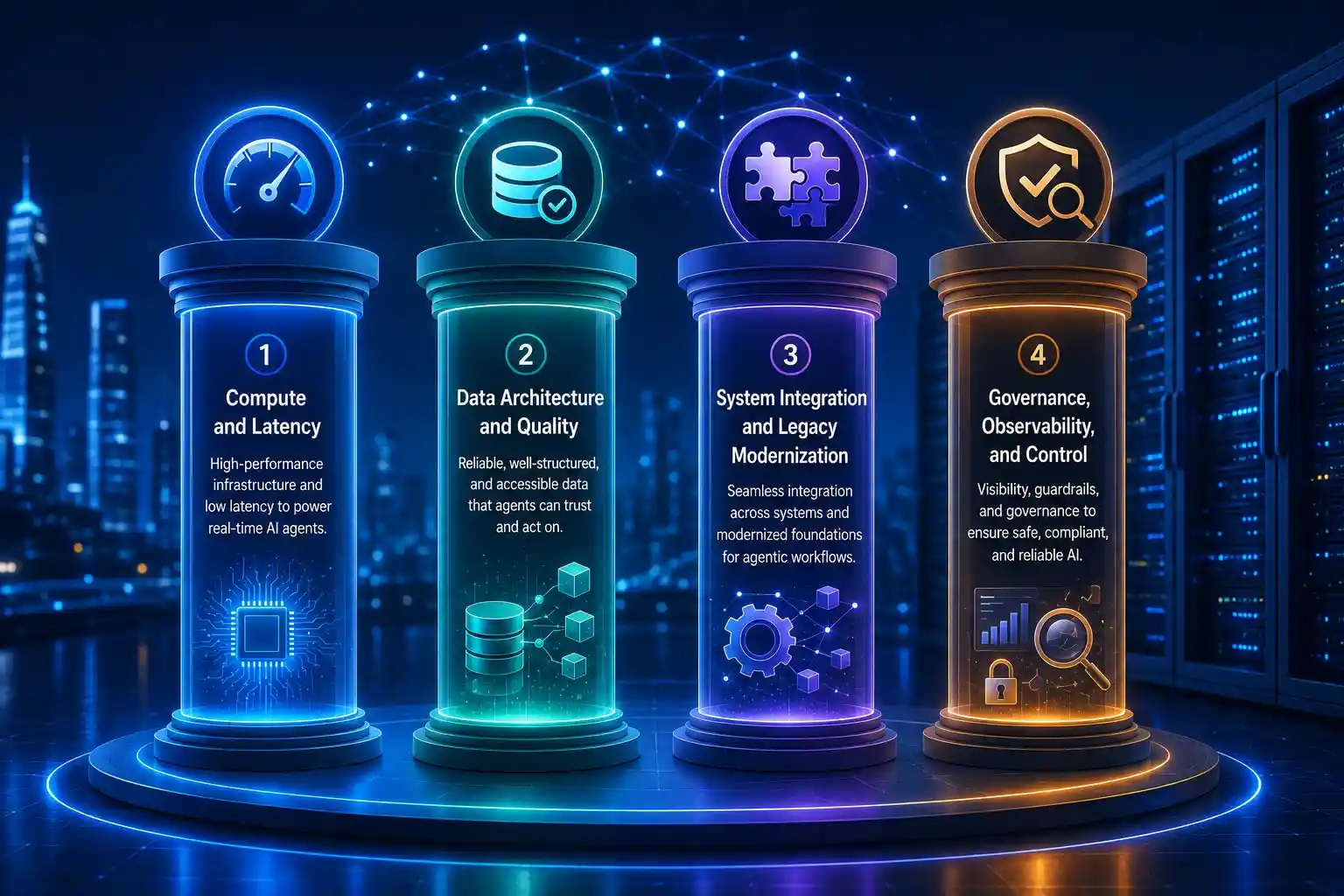
If you are trying to assess whether your enterprise is ready for agentic AI, it helps to think in terms of four foundational pillars. Each one is necessary. None is sufficient on its own.
Compute and Latency
Agentic AI systems make decisions in real time. Unlike batch processing or periodic model inference, agents loop continuously, taking input, reasoning, acting, observing results, and reasoning again. That tight feedback cycle requires low-latency compute that most legacy enterprise infrastructure was not designed to provide. Organizations need to evaluate whether their on-premises hardware, cloud deployment strategy, or hybrid configuration can sustain agent workloads at scale without introducing unacceptable delays that break the reasoning chain.
The 2026 picture on compute is complicated by supply chain constraints. Enterprises are competing directly with research labs and hyperscalers for GPU and TPU capacity. The organizations that secured dedicated inference hardware in 2024 and 2025 now hold a meaningful competitive advantage. For others, cloud APIs can fill the gap for experimental workloads, but production-grade agentic systems will eventually require more predictable capacity guarantees.
Data Architecture and Quality
Agents are only as effective as the data they can access and trust. Disconnected data lakes, inconsistent schemas, outdated records, and siloed systems are not just inefficiencies in a world of agentic AI. They are reliability killers. An agent tasked with managing customer escalations across your organization needs to pull from CRM records, support tickets, billing history, product usage data, and communication logs in real time. If any of those sources are stale, inaccessible, or inconsistent, the agent’s actions will reflect those gaps in ways that can damage customer relationships at speed and scale.
Research from enterprise AI deployments in 2025 found that 70% of organizations discover their data infrastructure is fundamentally inadequate only after launching ambitious AI initiatives. That is an expensive time to learn. The right approach is to conduct a thorough data readiness audit before committing to agentic AI deployment, not during it.
System Integration and Legacy Modernization
Most enterprise systems were designed for human operators working through user interfaces. Agentic AI needs programmatic access. It needs APIs, not screens. In a 2025 Deloitte study, 60% of organizational leaders identified legacy system integration as their primary challenge in scaling AI efforts, and 35% considered it the single biggest barrier. That finding is consistent with what technology teams encounter in practice. The systems holding your most valuable business data, your ERP, your CRM, your core banking platform, your manufacturing execution system, are often the hardest to connect to modern AI architectures.
The good news is that API modernization does not always require ripping out legacy systems. Middleware layers, event-driven architectures, and well-designed abstraction APIs can give AI agents the access they need without wholesale replacement of platforms that have been running reliably for years. What matters is having a clear integration roadmap and the engineering capacity to execute it.
Governance, Observability, and Control
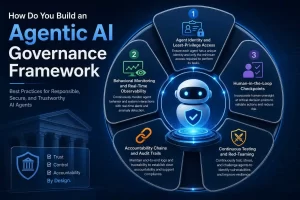
This is the pillar that surprises organizations the most. They invest in compute. They clean their data. They build integrations. And then they release an agent into production and realize they have no reliable way to understand what it is doing or why. No audit trail. No mechanism to intervene when the agent’s behavior drifts. No policy enforcement layer. No escalation workflow for decisions that exceed the agent’s defined authority.
Governance is not a bureaucratic afterthought in agentic AI. It is a technical requirement. IDC predicted that by 2026, 60% of AI failures would stem from governance gaps rather than model performance issues. That prediction is bearing out in enterprise deployments. The organizations hitting walls are not being stopped by the capability of the models. They are being stopped by the absence of a control plane that can be trusted.
What the Numbers Are Telling Enterprise Leaders
The statistical picture of where enterprises actually stand is instructive. According to Gartner, 40% of enterprise applications will include task-specific AI agents by 2026, up from less than 5% in 2025. By 2029, 70% of enterprises are projected to deploy agentic AI as part of IT infrastructure operations. Those numbers represent a massive wave of deployment activity that is already beginning.
At the same time, Gartner has also predicted that 40% of agentic AI projects will be cancelled by 2027, with the primary reasons being escalating costs from infrastructure complexity, failure to demonstrate ROI due to incomplete integration, and inadequate risk controls. The model works. The infrastructure does not. That is the dominant failure pattern in enterprise agentic AI right now.
McKinsey’s research adds another dimension to this picture. It found that more than one-third of high performers are committing more than 20% of their digital budgets to AI. Those organizations are not just experimenting. They are rebuilding their infrastructure with agentic AI as a design constraint, not an add-on. That shift in mindset, from layering AI on top of existing architecture to designing architecture around AI’s requirements, is the clearest differentiator between organizations that will scale successfully and those that will generate expensive pilot reports.
Legacy Systems: The Honest Conversation
There is a tendency in enterprise technology planning to treat legacy system modernization as an optional upgrade. The hope is that a capable AI model can work around whatever friction the legacy environment creates. That hope is generally misplaced. Legacy systems impose real constraints on agentic AI performance.
Consider what an AI agent actually needs from your systems. It needs data that is current, not data that was refreshed in a nightly batch job. It needs to trigger actions in real time, not submit requests that sit in a queue for manual processing. It needs a consistent data model it can reason across, not dozens of different schemas in different systems that were never designed to talk to each other. These are not preferences. They are prerequisites for reliable agentic behavior.
The practical path forward for most enterprises involves a phased approach. Identify the two or three high-value agentic use cases that offer clear ROI and begin by modernizing the systems those agents need to interact with first. Do not try to modernize everything at once. Use the early deployments to build organizational experience with agentic infrastructure requirements, and let that experience inform the broader modernization roadmap.
Bantech Solutions has been working with enterprises on exactly this kind of structured AI integration, as detailed in their AI development and deployment methodology, which outlines how organizations can bridge legacy infrastructure with modern AI capabilities without disrupting existing operations.
Security and Compliance in an Agentic World

Every new capability an AI agent gains represents a new attack surface. An agent that can send emails can be manipulated into sending malicious communications. An agent that can query databases can be turned into a data exfiltration tool if prompt injection attacks are not properly defended against. An agent that can trigger financial workflows can be exploited to initiate unauthorized transactions. These are not theoretical risks. They are documented vulnerabilities that security researchers have already demonstrated in production-grade agentic systems.
Enterprise security architecture needs to evolve alongside agentic AI deployment. That means implementing strict permission boundaries for each agent, using least-privilege access controls so agents can only interact with the systems their task requires, deploying anomaly detection that flags unusual agent behavior in real time, and establishing human review workflows for high-consequence actions that exceed defined risk thresholds.
Regulatory compliance adds another layer of complexity, particularly for enterprises in heavily regulated industries. Financial services firms, healthcare organizations, and insurance companies face sector-specific requirements around data handling, decision-making transparency, and audit trails that agentic AI systems must be designed to satisfy from the ground up. In Europe, the EU AI Act creates enforceable obligations around high-risk AI deployments, with penalties reaching up to 6% of annual revenue for violations. Building compliance architecture before deployment is not just good governance. It is a financial necessity.
The Human Side of the Infrastructure Question
Technology infrastructure is only half of the readiness picture. The human side matters just as much, and it tends to get less attention in planning conversations.
Workforce readiness for agentic AI involves more than teaching employees to prompt an AI chatbot. It means reshaping job responsibilities so that human workers are supervising and governing agent systems rather than performing the tasks those agents now handle. That shift requires new skills, new mental models, and in many cases, new organizational structures.
Teams need to understand how to define agent scope clearly, how to recognize when an agent is behaving unexpectedly, how to intervene when agent outputs require human judgment, and how to continuously improve agent performance based on observed results. These are genuinely new capabilities for most enterprise workforces, and building them takes time.
The organizations navigating this transition most effectively are investing in workforce upskilling programs that run parallel to their infrastructure upgrades. They are not waiting until the technology is deployed to figure out who will manage it. They are building human governance capacity alongside technical capability so that both are ready when agentic systems go live.
Building Your Readiness Assessment
The practical question for most enterprise technology leaders is not whether to prepare for agentic AI. The evidence that it is coming, and coming fast, is overwhelming. The question is how to systematically assess where your organization stands today and what gaps need to close before you deploy.
A structured readiness assessment should cover five areas. First, compute infrastructure: do you have the capacity, latency profile, and cost model to support agentic workloads at the scale you envision? Second, data quality and accessibility: can your agents reach the data they need, when they need it, with sufficient accuracy and freshness to make reliable decisions? Third, system integration: have you mapped the API access requirements for your priority use cases and assessed which legacy systems require modernization to support them? Fourth, governance and observability: do you have the tooling to monitor agent behavior, enforce policy constraints, maintain audit trails, and intervene when necessary? Fifth, organizational readiness: do your teams have the skills and structures needed to oversee agentic systems responsibly?
Organizations that conduct this assessment honestly will find gaps. That is expected and healthy. The purpose of the assessment is not to confirm readiness but to produce a clear, actionable roadmap for achieving it. The companies that will win in the agentic AI era are not necessarily the ones that move fastest. They are the ones that move with the right foundations in place.
Looking at What Is Actually Working Right Now
There are early production deployments of agentic AI that offer useful lessons for enterprises still in the planning phase.
Morgan Stanley deployed an internal AI agent called DevGen.AI, built on large language models, to tackle the challenge of modernizing legacy code. Since its launch in early 2025, the system reviewed over 9 million lines of code, saving developers approximately 280,000 hours. That success was enabled by clear scoping, clean integration architecture, and a use case where the agent’s actions could be reviewed and validated by human engineers before being applied to production systems.
Deutsche Telekom deployed what it called its RAN Guardian agent, an agentic system that actively monitors mobile network performance, assists in troubleshooting, and optimizes solutions in real time. That deployment required significant infrastructure preparation, including real-time data feeds from network sensors, a well-defined action boundary for the agent, and observability tooling that gave network engineers visibility into what the agent was doing.
Both examples share a common thread. Neither organization tried to deploy a broadly capable autonomous agent across their entire enterprise on day one. Both identified a constrained, high-value use case, prepared the specific infrastructure that use case required, and built human oversight into the deployment model from the start. That pattern, narrow scope, strong foundations, tight governance, is the one that consistently converts agentic AI potential into actual production value.
The Competitive Stakes Are Genuine
It would be easy to dismiss agentic AI readiness as a future concern. The models are still maturing. Deployment complexity is real. Many organizations are reasonably cautious. But the competitive dimension of this technology shift is already playing out in ways that are hard to ignore.
Enterprises that began building agentic-ready infrastructure in 2024 and 2025 now hold advantages that will compound over the next several years. They have teams that understand how to design and operate agentic systems. They have data architectures that support autonomous decision-making. They have governance frameworks that allow them to deploy confidently without fearing regulatory or security exposure. And they have early deployments generating real performance data that they are using to improve their systems continuously.
Organizations that are waiting for the technology to mature further before investing in infrastructure are not avoiding risk. They are accumulating technical debt. The gap between agentic-ready enterprises and those that have not yet started the infrastructure journey will be materially harder to close two years from now than it is today.
The question is not whether your enterprise will eventually need infrastructure ready for agentic AI. It will. The question is whether you are building that readiness proactively or whether you will be rebuilding under competitive pressure. For enterprise technology leaders thinking through this challenge, the time to start that honest infrastructure conversation is now.
Continue reading the Complete Agentic AI Series
This post is a part of the Agentic AI Content Series — the complete 10 article series to understanding, implementing, and scaling Agentic AI in your organization.