

There is a quiet but consequential race playing out inside businesses right now — and most executives don’t yet realize they’re in it.
On one side, companies are using AI the way most people think about it: as a sophisticated assistant. You ask it a question, it gives you an answer. You prompt it to write something, it writes it. You need a summary, a draft, a translation, an analysis — done. It’s fast, it’s impressive, and compared to what we had five years ago, it feels transformative.
On the other side, a smaller but fast-growing number of companies are deploying AI that doesn’t wait to be asked. Their AI sets goals. It breaks those goals into steps, executes them across multiple systems, checks its own work, corrects course when something goes wrong, and delivers a finished outcome — without a human having to manage the process in between. Their AI doesn’t answer questions. It gets things done.
That second category has a name: agentic AI. And if you’re not already thinking seriously about what it means for your business, the gap between you and the companies that are is widening every single day.
The Brilliant Intern vs. The Experienced Executive
Here’s the clearest way to understand the difference between what most businesses are using today and what agentic AI represents.
Generative AI — the AI that powers most chatbots, writing tools, and Q&A assistants — is like a brilliant intern. Highly knowledgeable, fast, capable of producing impressive work. But fundamentally reactive. It sits at its desk and waits. You come to it with a task, it delivers, and then it waits again. It has no memory of what you asked yesterday, no awareness of what needs to happen next, and no ability to take independent action inside your business systems. Every result requires a human to notice a need, formulate a request, review the output, and decide what to do with it.
Agentic AI is more like a seasoned executive or a highly capable operations manager. You give it a goal — not step-by-step instructions, just the outcome you want — and it figures out the path. It pulls information from the tools and systems it has access to. It makes decisions along the way. It handles unexpected complications. It loops back when something doesn’t work. And when it’s done, it hands you a result, not a draft waiting for your next prompt.
This is not a subtle upgrade. It is a fundamentally different relationship between a business and its technology. And in 2026, that difference is showing up directly in competitive performance.
Why This Year Is the Turning Point
For the past few years, agentic AI has existed mostly in research labs, startup demos, and carefully controlled enterprise pilots. The technology was promising but fragile — agents would hallucinate steps, lose context mid-task, or fail when connected to real-world data systems. The infrastructure to deploy them reliably at scale simply wasn’t mature enough.
That has changed rapidly and decisively.
According to Gartner’s Top Strategic Technology Trends for 2026, multiagent systems — networks of AI agents collaborating on complex tasks — are now among the most critical technology investments for enterprise leaders. Gartner projects that by the end of 2026, 40% of enterprise applications will include task-specific AI agents, up from less than 5% in 2025. That is an eightfold increase in a single year.
The reason this is happening now is because the supporting infrastructure has caught up. Orchestration frameworks that allow agents to coordinate with each other are mature. Governance models that allow companies to deploy autonomous AI without losing control have been developed. The connection layers between AI agents and enterprise systems — CRMs, ERPs, databases, communication tools, workflow platforms — are standardized and reliable. The technology is no longer experimental. It is operational.
As a result, companies that were running cautious pilots in 2024 are deploying at scale in 2026. And companies that are still evaluating the idea are not standing still — they are falling behind.
What Makes AI Truly “Agentic”
Before going further, it’s worth being precise about what actually defines an agentic AI system, because the term is being used loosely in the market in ways that muddy the picture.
Not every AI that feels automated is actually agentic. A chatbot that responds to customer queries is not agentic. An AI that suggests email replies is not agentic. Even a workflow that uses AI to process data through a predefined pipeline is, strictly speaking, not agentic — it’s automation with an AI component.
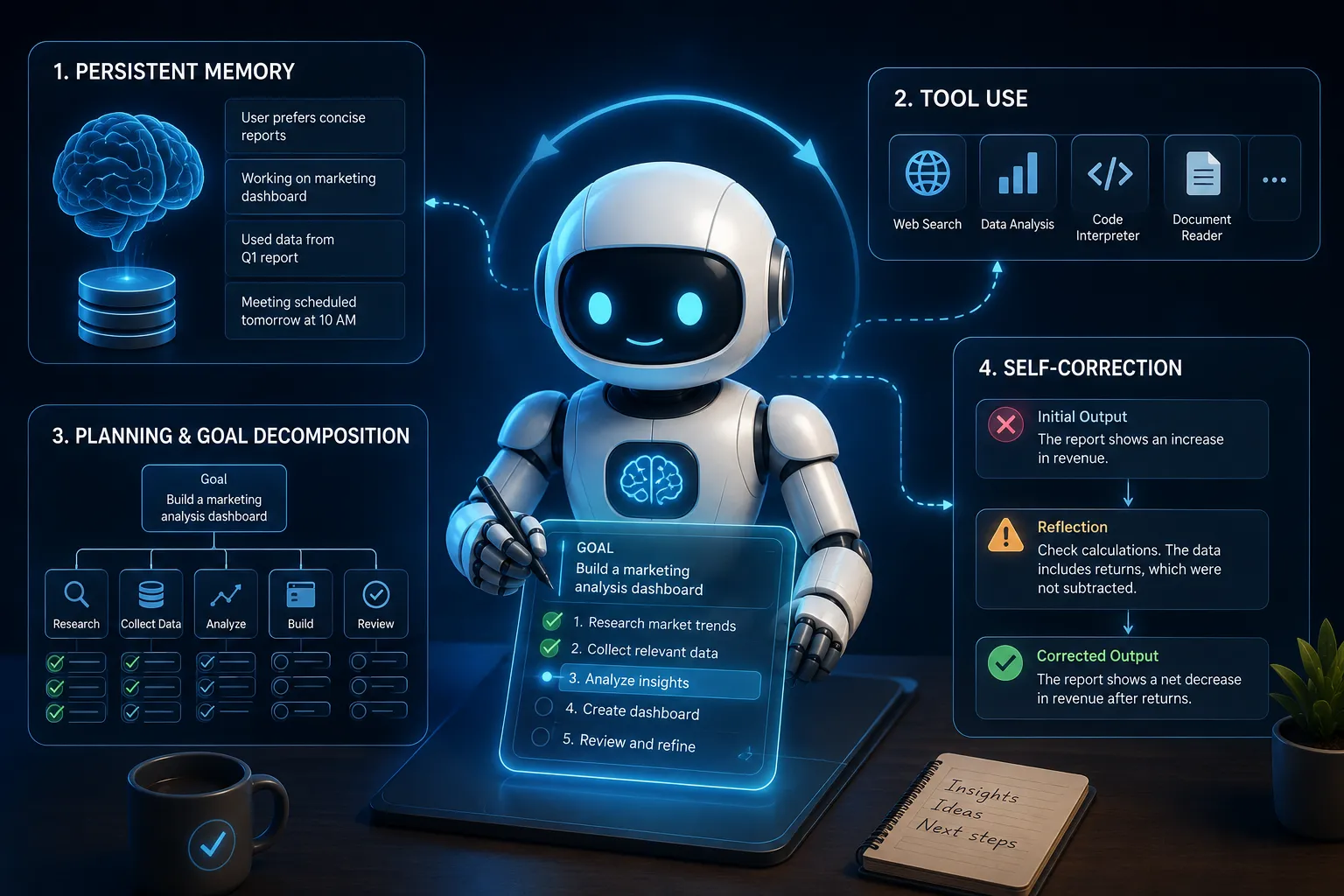
Genuine agentic AI is defined by four core capabilities working together:
Persistent memory. The agent retains context across interactions and over time. It knows what it has already done, what the current state of a task is, and what has changed since it last acted. It doesn’t start from scratch with every prompt.
Tool use. The agent can interact with external systems — search engines, databases, APIs, calendars, email, code environments, file systems — and use them to gather information, take actions, and produce outputs in the real world. It isn’t trapped inside a conversation window.
Planning and goal decomposition. When given an objective, the agent can break it down into a sequence of steps, determine what needs to happen first, and adapt that plan when circumstances change. It doesn’t need a human to specify every sub-task.
Self-correction. When something goes wrong — a data source returns an unexpected result, a step fails, an approach doesn’t work — the agent recognizes the issue, diagnoses it, and tries a different path. It doesn’t just stop and report an error.
When all four of these properties are present in a system, you have something qualitatively different from any previous generation of business software. You have a system capable of owning a workflow end-to-end, not just assisting with a step.
What This Looks Like in Practice
The best way to make this concrete is through a real operational scenario. Consider a business development team.
In the generative AI model, a sales rep might use an AI assistant to draft a prospecting email, summarize a company’s recent news, or prepare talking points for a call. Each of these is genuinely useful. Each still requires the human to notice the need, formulate the request, review the output, and carry the task forward.
In the agentic AI model, the agent is given a goal: identify and qualify the top 20 accounts in a target segment for outreach this week. The agent proceeds to research each account across multiple sources, cross-reference them against the company’s CRM to eliminate existing relationships, score them according to predefined qualification criteria, draft personalized outreach messages based on each company’s recent activity, schedule them for delivery at optimal times, and report back with a summary of what it did and why each account was prioritized.
The human didn’t orchestrate each step. They defined the goal and reviewed the outcome. Everything in between was handled autonomously.
This is not a hypothetical. This is the model that companies like Zapier have already deployed internally — 800 or more AI agents running across the organization — with 89% AI adoption across their workforce. Companies that have deployed agentic systems report average returns on investment of 171%, with U.S. enterprises hitting closer to 192%, roughly three times the return of traditional automation approaches.
The Industries Already Being Reshaped
While agentic AI has cross-industry applications, certain sectors are seeing the transformation most acutely right now.
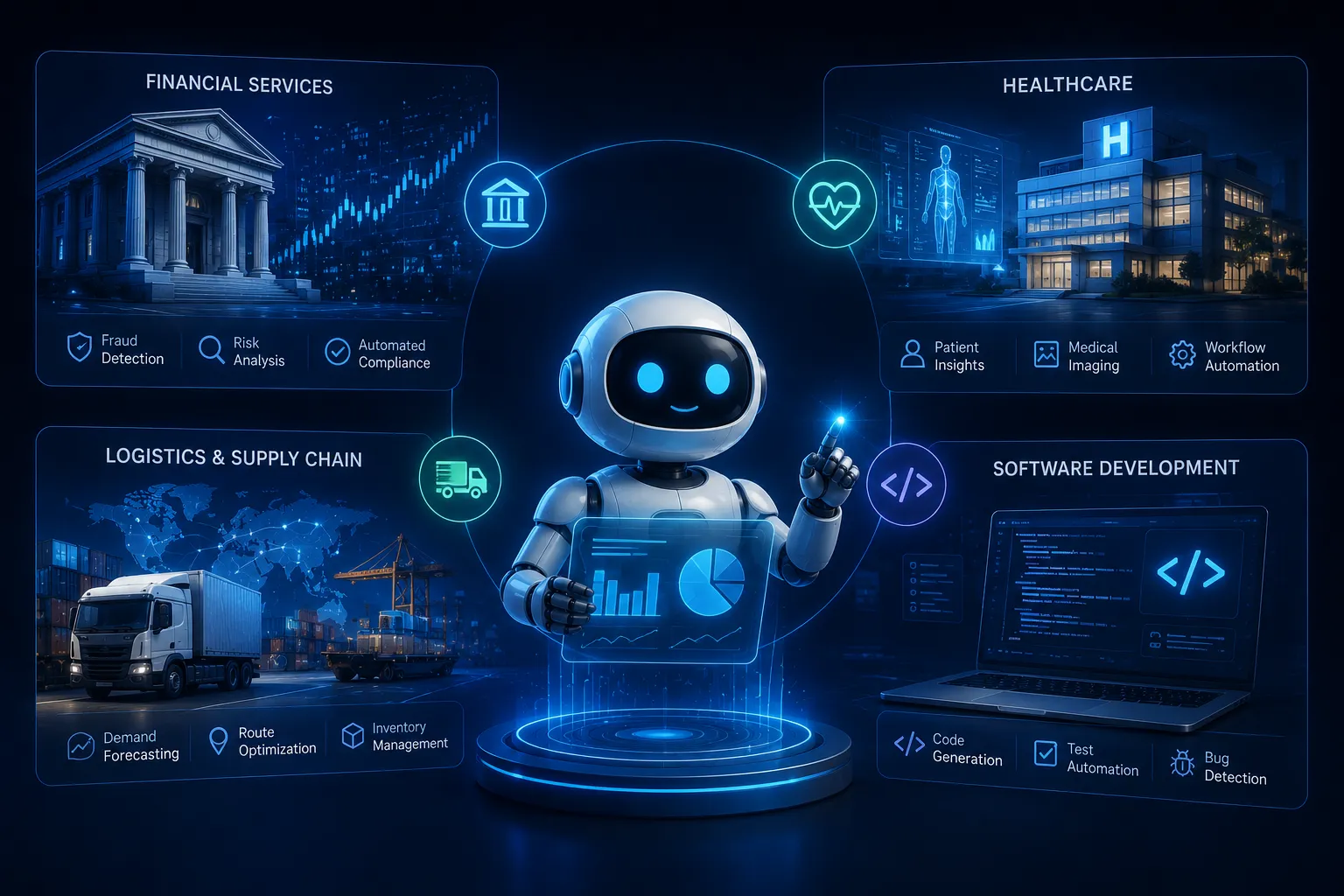
Financial services is deploying agents for fraud detection, risk assessment, customer onboarding, and compliance monitoring — tasks that previously required teams of analysts running manual processes across multiple systems. Agents that can autonomously monitor transactions, flag anomalies, cross-reference regulatory requirements, and generate compliance reports are compressing days-long workflows into minutes.
Healthcare is using agentic systems to automate patient data analysis, prior authorization processing, scheduling coordination, and clinical documentation — freeing clinicians from administrative burden and reducing error rates that stem from manual data entry across disconnected systems.
Logistics and supply chain operations are deploying agents that monitor real-time shipment data, predict disruptions, reroute automatically when delays occur, coordinate with suppliers, and update customer communications — all without human intervention at each decision point.
Software development teams are using agentic coding assistants that don’t just suggest lines of code but architect features, write tests, identify bugs, and iterate based on test results — compressing development cycles in ways that redefine what a small engineering team can accomplish.
The pattern is consistent across industries: agentic AI is not replacing the humans in these workflows. It is absorbing the coordination overhead that previously consumed enormous amounts of human time and attention, allowing the humans to focus on the judgment, creativity, and relationship work that genuinely requires them.
Why Most Businesses Haven’t Made the Move Yet
Despite the scale of the opportunity, most businesses are still in the early stages of engagement with agentic AI. According to McKinsey’s State of AI survey, while 88% of organizations report using AI in at least one business function, nearly two-thirds have not yet begun scaling AI across the enterprise. Fewer than 10% have deployed agents at a level that delivers measurable bottom-line impact.
The reasons are understandable and worth naming honestly.
Many organizations conflate agentic AI with the generative AI tools they already have. They see AI as a productivity add-on rather than an operational redesign opportunity, and so they benchmark agentic AI against the productivity gains from Copilot or ChatGPT rather than against the cost of maintaining current manual workflows. The comparison undervalues the technology.
Others are held back by infrastructure readiness concerns. Their data is fragmented across systems. Their workflows aren’t documented well enough to delegate to an autonomous agent. Their security and governance frameworks haven’t been updated to account for AI systems that take real-world actions. These are real constraints — but they are solvable, and organizations that begin the infrastructure work now will compound that advantage over the next 18 months.
There is also, frankly, a hesitation rooted in unfamiliarity. Handing a goal to an AI and trusting it to pursue that goal across multiple systems without step-by-step oversight requires a different kind of organizational trust than anything businesses have extended to technology before. That trust is earned through well-designed guardrails, clear escalation paths, and governance frameworks — not by treating agents like unconstrained autonomous actors.
The Cost of Waiting
Here is the uncomfortable reality that this series of articles will return to repeatedly: the competitive gap created by agentic AI is not linear. It compounds.
A company that deploys agents across its sales, finance, operations, and customer service functions this year doesn’t just get faster at those functions. It accumulates institutional knowledge in those agents, refines their performance through iteration, and builds an operational flywheel that runs continuously — including nights, weekends, and across time zones — without proportional increases in headcount. Every month that system runs, it gets better and more embedded in how the business operates.
A company that waits 18 months to start that journey doesn’t enter 18 months behind. It enters behind a competitor whose systems have been compounding advantages for 18 months. In a market where competitors are operating with 171% ROI on AI deployments, waiting is not a neutral choice. It is a strategic concession.
The question for every business leader reading this is not whether agentic AI is real or whether it works. The evidence on both counts is now overwhelming. The question is whether your organization is going to be among the companies that deploy it early and build compounding advantages, or among the companies that scramble to catch up after the gap has already opened.
Where to Start
For businesses at the beginning of this journey, the most important first step is not picking a technology platform. It is identifying the right use cases — the workflows in your business that are high-volume, well-defined, involve multiple steps and multiple data sources, and currently require significant human coordination time to manage.
Those are the workflows where agentic AI delivers the fastest and most measurable returns. They are also the workflows that build organizational confidence in the technology, which is what makes broader deployment possible.
At Bantech Solutions, we work with businesses at exactly this stage — helping organizations move from AI curiosity to AI advantage by designing and deploying solutions that are purpose-built for their specific operational needs. If you are looking to understand where agentic AI fits into your business and how to build the infrastructure to support it, our Artificial Intelligence Services are a practical starting point.
And if you are looking at the bigger picture — at how AI fits into a broader strategy for digital transformation that includes your enterprise systems, your data infrastructure, and your long-term competitive positioning — Bantech’s full technology solutions are designed to support that end-to-end journey.
The Organizational Mindset Shift That Matters Most
Beyond the technology itself, there is a cultural and organizational shift that separates companies that succeed with agentic AI from those that stall.
Most businesses are accustomed to thinking about software as a tool that does what you tell it to do. The human is always the decision-maker, the initiator, the one who defines each step. Software executes. This mental model is deeply embedded in how organizations design processes, assign accountability, and measure performance.
Agentic AI asks businesses to extend a different kind of trust — not to a tool, but to a system that pursues goals. That shift requires organizations to get clear on something they often haven’t needed to articulate before: what the goal actually is, as distinct from the steps they currently use to reach it.
This turns out to be harder than it sounds. Many processes that feel well-defined are actually collections of habits — sequences of steps that made sense when they were established but that have never been interrogated as a whole. When you hand a workflow to an agent, the agent doesn’t inherit your habits. It pursues the stated goal by the most effective path available to it, which sometimes exposes the fact that several of the steps humans perform were redundant, or that the process was designed around a bottleneck that no longer exists.
This is uncomfortable for some teams and genuinely valuable for organizations willing to lean into it. The discipline of defining clear goals for AI agents forces a quality of thinking about operational design that most businesses haven’t applied to their processes in years. The companies that embrace this as an opportunity — rather than resisting it as a threat to established ways of working — are the ones extracting the most value from agentic deployment.
Building that mindset doesn’t happen by decree. It happens through visible leadership commitment, through early wins that demonstrate what agents can accomplish, and through deliberate investment in helping employees understand the technology as a collaborator rather than a replacement. We will explore this dimension of the agentic transition in depth later in this series.
What Comes Next
This article is the first in a ten-part series: The Agentic Enterprise. Each piece builds on the last, moving from foundational understanding through the mechanics of how agentic systems work, the ROI evidence, the governance requirements, the security considerations, and the practical roadmap from pilot to production.
In the next article, we break down the four core capabilities that define a genuine agentic AI system — persistent memory, tool use, planning, and self-correction — and show exactly how they combine to create the kind of end-to-end autonomous workflows that are reshaping enterprise operations. We will also look at real examples of what these capabilities look like inside actual business systems, and why understanding them matters before you evaluate any agentic platform or solution.
The race is already underway. The companies pulling ahead are not waiting for a clearer picture. They are building that picture by doing. The rest of this series will give you the map.
Continue reading the Complete Agentic AI Series
This post is a part of the Agentic AI Content Series — the complete 10 article series to understanding, implementing, and scaling Agentic AI in your organization.