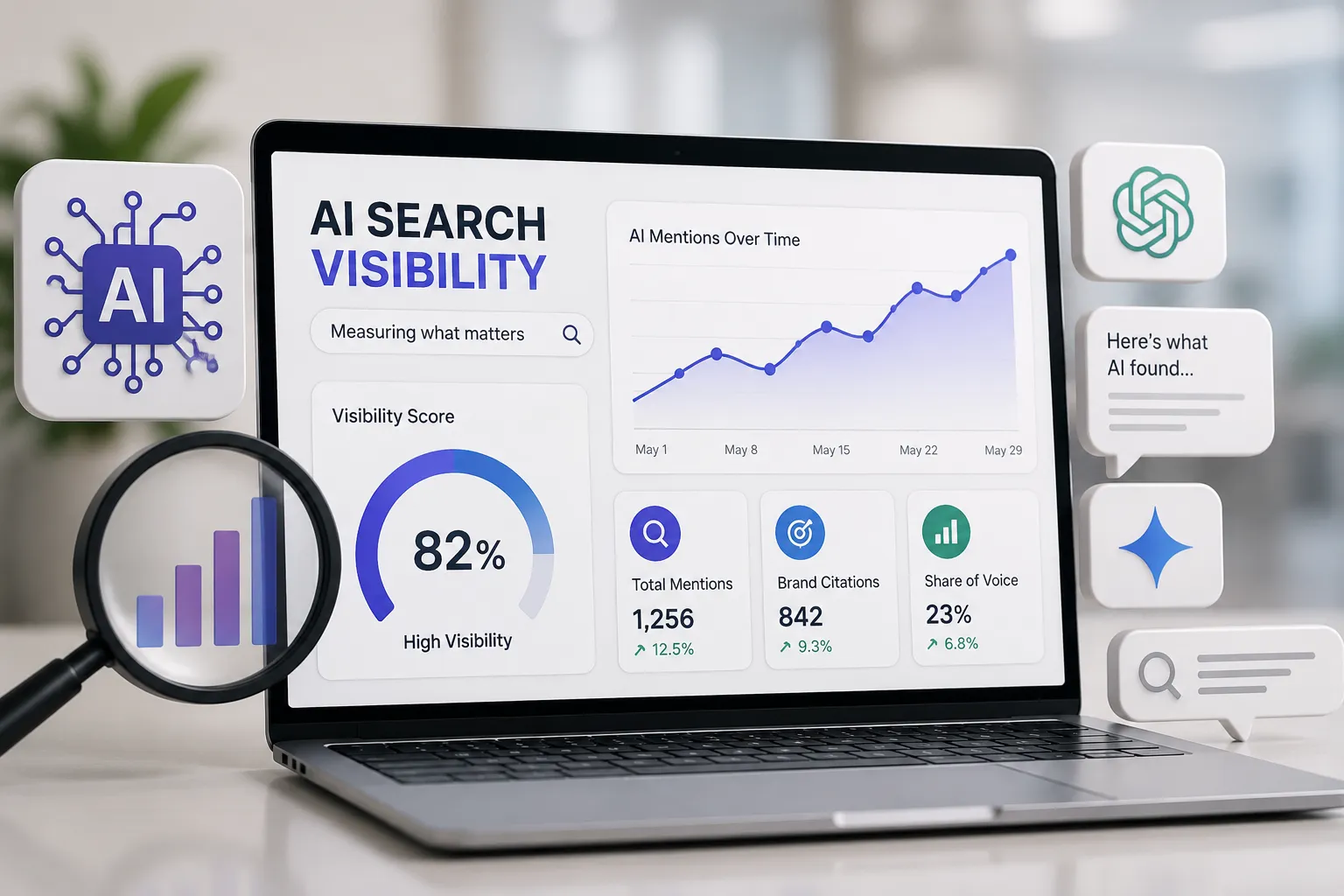

You measure AI search visibility by tracking three things: how often AI platforms cite your pages as sources, how often they mention your brand by name, and your share of voice against competitors across tools like ChatGPT, Perplexity, and Google AI Overviews. Rank trackers can’t see any of this, since there’s no traditional SERP position to track.
For twenty years, “how is my SEO doing” had a simple answer: check your rank tracker, see where you sit for your target keywords, and adjust from there. That model is starting to break down. A growing share of searches now end inside an AI generated answer, whether that’s a Google AI Overview, a ChatGPT response, or a Perplexity summary, and none of those surfaces hand out a tidy position 1 through 10 the way a classic SERP does. Teams that are still relying on legacy tools to understand how brands approach AI driven SEO are flying blind on a huge and growing chunk of their visibility.
This guide walks through what to measure instead, how to actually collect that data without an enterprise budget, and how to turn the numbers into a report that a marketing lead or a client will actually understand. No fluff about why AI search “matters,” just the mechanics of tracking it.
Why Rank Trackers Don’t Cut It Anymore
A rank tracker was built for a world with a fixed, ordered list of ten blue links. It pings Google, scrapes the results page, and logs where your URL landed. That worked well because the output was deterministic enough, and mostly stable, at least across a day or a week.
AI answers don’t behave that way. A few things break the old model completely.
There’s no fixed position to track. An AI Overview or a ChatGPT answer might cite three sources, or eight, or none at all. It might mention your brand by name without linking to you, or link to you without naming your brand. There isn’t a “rank 4” to log.
The same query gets different answers for different people. Location, chat history, and even the time of day can change what an AI system serves up. Two people typing the identical prompt can see two different sets of cited sources.
Answers are rewritten constantly. Ahrefs has found that citations inside AI Overviews change roughly 46% of the time on repeat queries, and the visible content changes even more often than that. A single snapshot tells you almost nothing about your standing over time.
Clicks aren’t the metric anymore. A huge share of AI search sessions end without a visit to any website at all, because the answer already satisfied the person’s question. If you’re only watching Google Analytics for referral traffic, you’re missing the much larger story of whether AI systems are describing your brand accurately, favorably, or at all.
Put simply, rank trackers were built to answer “where do I appear,” and AI search requires answering “do I appear, how often, in what context, and who else is showing up instead of me.” That’s a different measurement problem, and it needs different tools and a different vocabulary.
The Three Metrics That Actually Matter
Before you pick a tool or build a spreadsheet, it helps to get precise about what you’re counting. Most confusion in this space comes from people using “mentions” and “citations” interchangeably when they measure two different things.
Citations
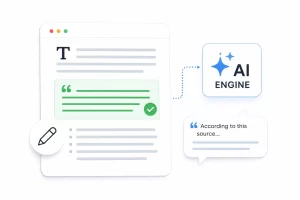
A citation is when an AI platform lists your URL as a source it pulled information from. In Google AI Overviews, these show up as the small linked cards under the summary. In Perplexity, they appear as numbered footnotes. In ChatGPT, they show up as inline links when the model has browsed the web for an answer.
Citations matter because they’re the closest thing AI search has to a backlink. A citation means the model treated a specific page on your site as trustworthy enough to pull facts from, and it’s the one outcome that still gives you a direct, clickable path back to your website.
Mentions
A mention is any time your brand name shows up in the generated text, whether or not there’s a link attached. You can get mentioned without being cited, which happens a lot when a model has learned about your brand from its training data rather than a live web search. You can also be cited without a clean brand mention, if the model links to your page but only refers to you generically as “one vendor” or “a review site.”
Mentions matter for reputation and recall. If someone asks an AI assistant to recommend tools in your category and your name comes up, that’s brand exposure even without a click, and it shapes whether a buyer considers you at all.
Share of Voice
Share of voice is the ratio of your citations or mentions against a defined set of competitors, across a defined set of prompts. If you and four competitors get mentioned across 100 tracked prompts, and your brand shows up in 30 of those responses, your share of voice for that prompt set is 30%.
This is the metric that turns raw counts into something a stakeholder can act on. “We got 40 citations last month” means nothing without context. “Our AI share of voice is 18%, trailing our closest competitor’s 27%” tells you exactly where you stand and gives you something to move.
A few teams track a fourth thing worth mentioning here: sentiment, meaning whether the AI describes your brand positively, neutrally, or negatively when it does mention you. It’s harder to quantify at scale, but worth a manual spot check every month or two, especially in categories where trust and reputation drive buying decisions.
Step 1: Build a Prompt Library
Every credible AI visibility measurement starts with a defined, repeatable list of prompts. This is the equivalent of a keyword list in traditional SEO, and it deserves the same care.
Start with 20 to 30 prompts that map to your actual buyer journey, not just your brand name. Include a mix of:
- Informational prompts your audience would type before they know your product exists, such as “what’s the best way to track project budgets.”
- Comparison prompts like “X vs Y” or “best tools for [category].”
- Direct brand prompts such as “is [your brand] good for [use case]” or “[your brand] reviews.”
- Problem-first prompts that describe a pain point without naming a solution category at all.
Resist the urge to only track prompts you already rank well for in Google. AI systems draw on different signals than classic rankings, and some of your best AI visibility opportunities will show up in queries where your organic position is mediocre. Expand this list to 50 to 100 prompts once you have a baseline, and revisit it quarterly as your product and market shift.
Step 2: Run the Prompts Across Platforms, Consistently
Once you have a prompt list, you need a repeatable way to run it against the major AI surfaces: Google AI Overviews, Google AI Mode, ChatGPT, Perplexity, and increasingly Copilot and Gemini, depending on where your audience actually spends time.
You have two realistic paths here.
Manual spot checks. For a small business or a solo marketer, running your top 20 to 30 prompts by hand once a week is a legitimate starting point. Log the results in a simple spreadsheet: prompt, platform, cited yes or no, mentioned yes or no, which URL got cited, and a rough sentiment note. It’s tedious, but it’s free, and it forces you to actually read the answers, which surfaces qualitative insight a dashboard won’t give you.
Dedicated AI visibility platforms. Once you’re tracking more than a handful of prompts across multiple platforms, manual checking stops scaling. Purpose built tools now automate this by running your prompt library against each AI surface on a schedule and logging citations, mentions, and share of voice automatically. Ahrefs, for instance, has documented how its own Brand Radar tooling tracks AI Overview mentions and citation volatility at scale, including how often cited sources change between snapshots, which is genuinely difficult to replicate by hand. Other platforms in this category focus specifically on multi-model tracking, sentiment scoring, and competitor benchmarking.
Whichever path you choose, consistency matters more than sophistication. A weekly manual check run the same way every time beats a fancy dashboard that only gets reviewed once a quarter.
Step 3: Track Citation Frequency by Platform
Don’t average your numbers across platforms too early. Citation and mention rates vary enormously between AI systems, sometimes by a factor of ten or more for the same brand and the same prompt set, because each platform pulls from different sources and weighs freshness, structure, and authority differently.
Break your reporting out by platform from day one:
- Google AI Overviews, which lean heavily on pages that already rank well organically and tend to favor content with clear structure and recent updates.
- Google AI Mode, a more conversational surface that behaves differently from AI Overviews even though both run on Google’s infrastructure. Google has been open about how quickly this surface is scaling, and it’s worth watching as a distinct channel rather than folding it into your AI Overviews numbers.
- ChatGPT, which uses live web retrieval for many queries and tends to favor authoritative, well cited third party sources over a brand’s own marketing pages.
- Perplexity, which shows inline numbered citations for nearly every response and rewards clear, fact dense writing.
This breakdown tells you where to focus. A brand that’s strong in AI Overviews but invisible in ChatGPT likely has solid organic SEO fundamentals but thin third party coverage, which points toward a digital PR and outreach gap rather than an on page content gap.
Step 4: Connect AI Visibility to Real Traffic
Citations and mentions are leading indicators. At some point you need to connect them to something closer to revenue, and that means digging into the traffic your website is actually receiving from AI referrals.
Neither Google Search Console nor standard GA4 reporting cleanly separates “AI Overview click” from “regular organic click,” since Google folds AI Overview traffic into standard organic search referrals. That’s a real limitation, and it’s worth naming directly rather than pretending your analytics give you a clean picture. AI Overviews reach an enormous number of monthly searchers on Google Search, so even a small shift in how that traffic is measured has an outsized effect on your reported organic numbers.
A few workarounds help fill the gap:
- Filter GA4 referral traffic for known AI domains such as chat.openai.com, perplexity.ai, and copilot.microsoft.com. This captures traffic from standalone AI chat products, even though it won’t catch AI Overview clicks, which still route through Google’s own domain.
- Watch branded search volume trends. A rising number of people searching your brand name directly, even without a clear referral source, is a reasonable proxy for AI driven brand awareness working.
- Segment landing pages that match your cited URLs. If a page is regularly showing up in AI citations, watch its organic traffic and engagement trends closely for any lift, even if you can’t attribute the exact click source.
- Track conversion rate by traffic source, not just volume. Multiple studies through 2025 and 2026 have found that visitors arriving via AI platforms convert at meaningfully higher rates than average organic visitors, likely because the AI answer already pre qualified their intent before they clicked. A small volume of AI referral traffic that converts unusually well is worth more attention than the raw number suggests.
Step 5: Build a Reporting Cadence That Doesn’t Lie to You
AI visibility data moves fast, and quarterly reporting will consistently understate how volatile your position actually is. Some teams have documented brand visibility swinging more than 30% within a single five week window, purely from AI models updating and re-crawling content, with no change on the brand’s own website at all.
A workable cadence looks like this:
- Weekly: Spot check your top 10 to 15 highest priority prompts. This catches sudden drops early enough to react.
- Monthly: Run your full prompt library, calculate share of voice against your two or three main competitors, and log which specific pages are earning citations.
- Quarterly: Step back and look at trend lines rather than single data points. Refresh your prompt library to reflect new products, new competitors, or shifts in how your audience searches.
Your monthly report should include a small, consistent set of numbers rather than a wall of data: share of voice against named competitors, citation frequency broken out by platform, your top cited pages, and a short list of prompts where a competitor is winning and you aren’t. That last one, often called a citation gap, is usually the most actionable line in the whole report, because it points directly at a content brief rather than a vague strategic goal.
Common Mistakes to Avoid
Treating one AI Overview snapshot as ground truth. Given how often cited sources rotate, a single check tells you almost nothing. Always average across multiple checks over at least a week before drawing conclusions.
Ignoring mentions without citations. It’s tempting to only count linked citations because they’re easier to track. But an AI system recommending your brand by name, even without a link, shapes buyer perception and deserves its own line in your report.
Averaging share of voice across wildly different prompt volumes. A niche prompt where you dominate at 80% share of voice shouldn’t be weighted the same as a high volume, commercially important prompt where you’re sitting at 3%. Weight your share of voice numbers by how much search demand each prompt actually represents.
Comparing raw numbers across platforms without context. A 50% citation rate on Perplexity and a 5% citation rate on Google AI Overviews aren’t necessarily a sign that one platform hates your brand. Each system has different citation behavior baked into how it works, so track trend direction within each platform rather than comparing absolute numbers across them.
Skipping the qualitative read. Numbers tell you how often you show up. They don’t tell you whether the AI is describing your product accurately, whether it’s recommending a competitor instead for a specific use case, or whether it’s citing an outdated page on your site. Read the actual generated answers regularly, not just the dashboard.
Turning Measurement Into a Strategy
Measurement only matters if it changes what you do next. Once you have a few months of citation, mention, and share of voice data, a few patterns usually emerge quickly: certain content formats earn citations more reliably than others, certain competitors are winning specific prompt categories outright, and certain pages on your own site are quietly doing most of the work.
From there, the next move is usually a content and structure audit, closing the gaps your data just revealed rather than guessing at what AI systems might want. That’s a meaningfully different exercise from traditional keyword targeted content planning, and it benefits from teams who are already tracking how AI citation behavior interacts with technical SEO fundamentals like schema, crawlability, and content freshness. If building and interpreting that kind of ongoing SEO and visibility strategy isn’t something your team has bandwidth for internally, it’s worth bringing in a partner who’s already tracking this shift closely, rather than starting the measurement framework from scratch on your own.
AI search visibility isn’t going away, and the tooling around it is still maturing fast, which means whoever builds a disciplined measurement habit now, even a simple spreadsheet updated weekly, will have a real head start over competitors still waiting for their rank tracker to catch up.
Frequently Asked Questions
What’s the difference between a citation and a mention in AI search?
A citation is a direct link to your page shown as a source in an AI generated answer. A mention is any reference to your brand name in the response text, whether or not it’s linked. You can earn one without the other, so both deserve separate tracking.
Can I track AI search visibility for free?
Yes, at a small scale. Running your top prompts manually across ChatGPT, Perplexity, and Google on a weekly basis and logging results in a spreadsheet costs nothing but time. Paid tools become worthwhile once you’re tracking dozens of prompts across multiple platforms regularly.
How often does AI search visibility change?
Frequently. Citations inside AI Overviews change on a large share of repeat queries, and full answer content changes even more often. Weekly or monthly checks give a far more reliable picture than a single one time audit.
Does AI search visibility affect Google rankings?
Not directly, but the two are related. AI Overviews tend to pull from pages that already rank well organically, so strong technical and on page SEO remains a foundation for AI visibility rather than a separate discipline.
What tools track AI search citations and mentions?
Options range from manual spreadsheet tracking to dedicated platforms built specifically for AI visibility monitoring, several of which now integrate citation and share of voice tracking directly alongside traditional SEO data.
Other Articles in the AI Search & GEO Series
This post is part of the AI Search & GEO Content Series — a practical guide to improving visibility across traditional search engines and AI-powered search experiences.