
Table of Contents
Shopify Development Partnerships for Agencies
Digital agencies navigating the e-commerce boom often struggle with in-house expertise for complex platform builds. With over 1.7 million stores relying on Shopify Development for Agencies, partnering with vetted experts streamlines custom store creation, theme customization, app integrations, and migrations. This approach empowers agencies to deliver scalable, secure solutions without expanding their teams.
Outsourcing through white label web development allows agencies to rebrand high-quality e-commerce platforms as their own, meeting client demands for personalized experiences. As a leading white label shopify development partner, Bantech Solutions, based in India with global reach, offers certified alignment with the shopify expert partner program, ensuring technical proficiency and compliance in every project. Many agencies also engage a White Label Shopify Development Agency for turnkey branding, SLA-backed support, flexible resourcing, fast time-to-market, and integrated analytics to meet complex client roadmaps and ongoing optimization services. Key factors like partnership models and proven capabilities in enterprise migrations position such collaborations for success.
This introduction sets the foundation for exploring selection criteria, partnership benefits, implementation processes, and best practices. But how do you choose the right partner to elevate your agency’s offerings?
Key Criteria for Choosing Shopify Development Agencies
Selecting the right partner for Shopify Development for Agencies requires careful evaluation of several key criteria to ensure seamless integration into your operations and long-term success. Agencies must demonstrate deep expertise in Shopify’s ecosystem, including custom theme development, app integrations, and migration services from platforms like Drupal. Participation in the shopify expert partner program adds credibility, signaling adherence to high standards. White label options allow for rebranding, while a diverse portfolio across industries highlights reliability. These factors balance cost and quality, aiding decisions for partnerships that drive e-commerce growth.
Experience and Technical Expertise Requirements
When assessing experience, prioritize agencies with proven Shopify-specific skills. Look for proficiency in app development for enhanced functionality, theme customization to match brand identities, and integration capabilities with tools like ERP systems. Certified e-commerce developers should handle complex migrations and support headless commerce or progressive web apps (PWAs) for superior performance.
Key requirements include:
- Shopify Expertise: At least 2+ years in custom themes and multi-store management, as benchmarks from top agencies like those ranked by Elogic suggest.
- Technical Stack: Knowledge of security standards and compliance, including ISO-style practices for data protection.
- Program Alignment: Involvement in the shopify expert partner program, which validates skills through rigorous testing and ongoing education.
Agencies like Bantech Solutions exemplify this with enterprise-focused migrations, ensuring scalable solutions. According to industry insights, such expertise correlates with 80% project completion under budget, per Appwrk case studies.
The following table provides a quick evaluation framework:
| Criteria | Essential | Advanced |
|---|---|---|
| Experience | 2+ years Shopify | Expert Program Certified |
| White Label | Basic Rebranding | Full IP Ownership & Support |
| Portfolio | 5+ Projects | Enterprise Case Studies |
Based on industry benchmarks from references, this comparison helps gauge agency maturity.
White Label Capabilities and Partnership Models
White label services enable agencies to outsource development while maintaining client-facing control. A strong white label shopify development partner offers rebrandable deliverables, clear communication protocols, and full IP ownership to support seamless delivery. This model is ideal for agency Shopify outsourcing, allowing scalability without in-house expansion.
Essential elements include:
- Rebranding Support: Customizable code and designs that align with your branding.
- Partnership Flexibility: Options to outsource web development for agencies, with retainers for ongoing maintenance.
- Compliance Focus: Protocols ensuring data security and timely handoffs.
Such capabilities reduce overhead, enabling focus on client relationships and business growth. Elogic highlights how top partners streamline these models for efficient collaboration.
Portfolio and Case Study Evaluation
A robust portfolio reveals an agency’s versatility and success across e-commerce scales. Evaluate diversity in industries like retail or B2B, and review case studies for metrics on performance improvements, such as conversion rate boosts or reduced load times.
Critical assessment points:
- Project Variety: From startups to enterprises, showcasing migrations and custom apps.
- Success Metrics: Quantifiable outcomes, like Appwrk’s noted 80% under-budget deliveries.
- Industry Relevance: Adaptability to sectors, predicting fit for your needs.
Look for certified e-commerce developers with documented results, as seen in Bantech’s Drupal-to-Shopify transitions. This evaluation predicts reliability and innovation potential.
Once criteria are clear, understanding the value of these partnerships becomes key to unlocking e-commerce potential.
Advantages of White Label Shopify Partnerships
Digital agencies often face the challenge of balancing client demands with limited internal resources, leading to bottlenecks in e-commerce project delivery. Partnering with a white label Shopify development agency like Bantech addresses these issues by providing seamless scalability and expertise without the overhead of expanding teams. These partnerships unlock benefits like Shopify Development for Agencies, enabling agencies to focus on client relationships while outsourcing technical execution.
The following table compares white label partnerships against in-house development, highlighting key advantages for agencies evaluating options:
| Aspect | White Label Partner | In-House Team |
|---|---|---|
| Cost Structure | Variable project fees, no fixed salaries | High fixed salaries and benefits |
| Scalability | On-demand expertise, quick ramp-up | Limited by headcount and hiring cycles |
| Expertise Depth | Specialized Shopify focus | Generalist skills, requires training |
| Risk Management | Shared compliance, vetted processes | Internal responsibility, potential gaps |
| Initial Investment | Lower upfront costs | Recruitment and setup expenses |
| Innovation Access | Partner’s R&D benefits | Self-funded, slower adoption |
| Timeline Flexibility | Faster delivery cycles | Dependent on team availability |
| Support Model | Retainer options included | Internal resource allocation |
| Overhead | None (outsourced) | Office space, tools, and management |
| Customization | Full rebranding control | Limited by team capabilities |
| Maintenance | Ongoing without internal burden | Continuous staffing needs |
| Global Reach | India-based efficiency for US/UK clients | Localized, higher costs abroad |
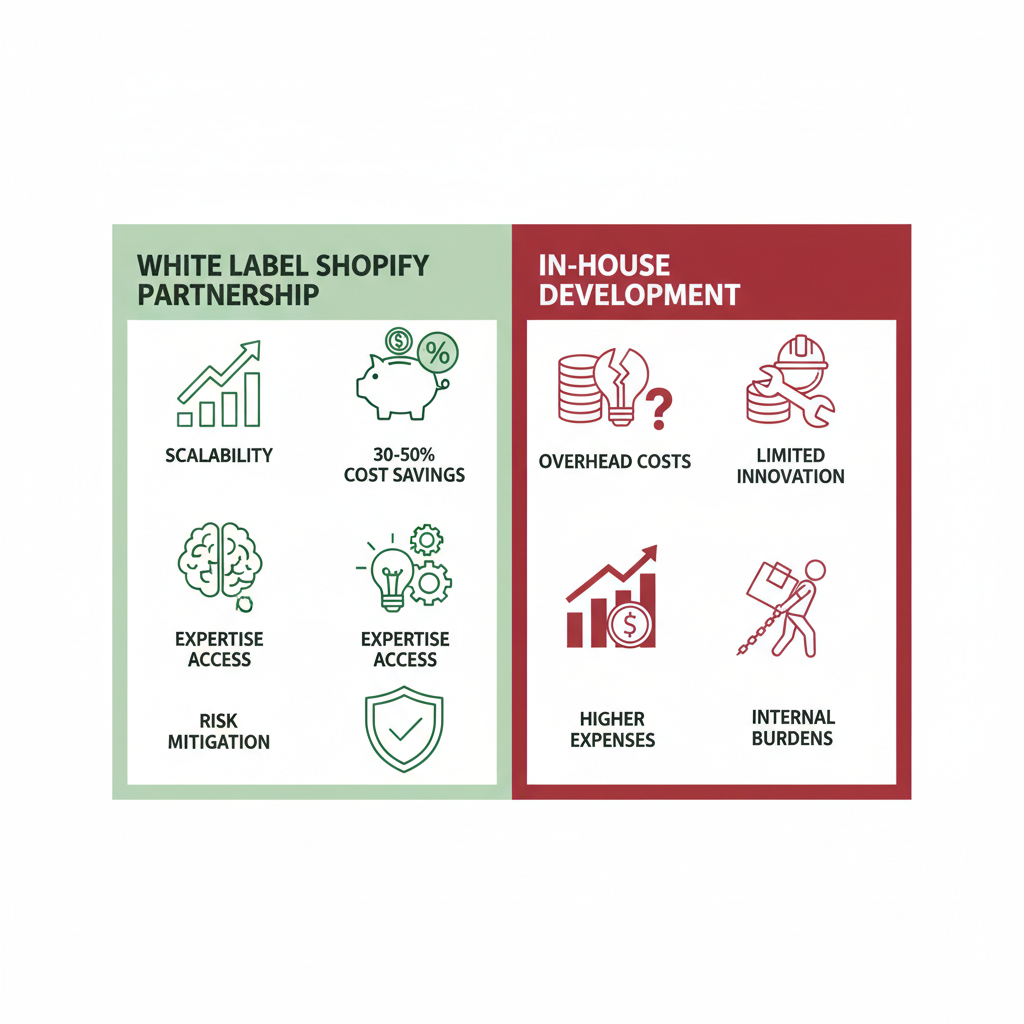
White label vs in-house Shopify development advantages comparison
This comparison underscores how white label models excel in scalability and cost efficiency, allowing agencies to achieve 30-50% savings on development expenses, as reported by industry sources like Ecorn. For instance, agencies using such partnerships often see 25% revenue growth by handling more projects efficiently.
Scalability and Cost Efficiency Gains
White label models empower agencies to scale operations effortlessly, handling multiple clients without the need for in-house hires. By leveraging a white label shopify development partner, agencies can ramp up resources on demand, avoiding the delays of recruitment. This approach delivers significant cost efficiencies; for example, variable project fees replace fixed salaries, reducing overhead by up to 40%. Bantech’s structure, with budgets ranging from under $500 to over $50,000, allows flexible scaling for startups to enterprises.
Consider a mid-sized agency like AgencyX, juggling five e-commerce projects quarterly. In-house development might require two additional developers at $80,000 annually each, plus training. Outsourcing through a whitelabel saas development partner shifts to project-based pricing, yielding ROI through 40% faster time-to-market, as seen in Bantech case studies. Quantifiable outcomes include 30% reduction in development time and no ongoing payroll burdens, enabling agencies to reallocate savings toward marketing or client acquisition. While initial integration may pose minor challenges, the long-term gains in agility far outweigh them, fostering sustainable growth.
Enhanced Expertise and Innovation Access
Partnering grants agencies immediate access to specialized Shopify skills, bypassing the curve of building internal proficiency. Through the shopify expert partner program, certified developers ensure high-quality implementations aligned with Shopify’s standards. Bantech’s team, with over a decade in e-commerce, offers expertise in apps, integrations, and emerging tech like AI personalization, accelerating innovation without R&D investments.
For agencies seeking advanced features, this means tapping into cloud-native architectures and post-launch support seamlessly. Discussing white label content management system development integrations, partners handle complex CMS setups for headless commerce, enhancing site performance and user engagement. An agency persona like TechFlow benefits by delivering AI-driven recommendations, boosting client conversions by 20-30%. This outsourced Shopify expertise not only elevates project outcomes but also positions agencies as innovative leaders, with partners sharing updates on trends like PWAs and blockchain for secure transactions. The result is faster feature rollouts, keeping clients competitive in dynamic markets.
Risk Mitigation and Compliance Assurance
White label partnerships significantly reduce risks in agency-client relationships by embedding security and compliance from the start. Bantech’s security-first approach, including ISO-style compliance and data protection protocols, safeguards against breaches common in e-commerce. Agencies avoid liability pitfalls, as vetted processes ensure reliable project delivery and adherence to regulations like GDPR.
In practice, this means shared responsibility for audits and updates, minimizing downtime that could cost clients thousands. For a global agency serving US and UK markets, India-based efficiency from partners like Bantech provides robust risk management without compromising quality. Case studies highlight 99% uptime guarantees and proactive vulnerability scans, fostering trust. While agencies must align on scopes initially, the benefits include streamlined operations and peace of mind, allowing focus on strategic growth rather than technical hurdles.
These advantages collectively transform how agencies operate, turning potential constraints into competitive edges through reliable white label collaboration.
Collaborative Process with Shopify Development Partners
Engaging a Shopify development agency for white label projects streamlines your operations through a structured Shopify Development for Agencies approach. This collaborative process ensures agencies maintain control over client relationships while leveraging expert technical execution. Partners like Bantech Solutions facilitate seamless integrations, from initial scoping to ongoing support, aligning with agency workflows for efficient project delivery. By focusing on transparency and customization, this Shopify partnership workflow minimizes risks and accelerates time to market.
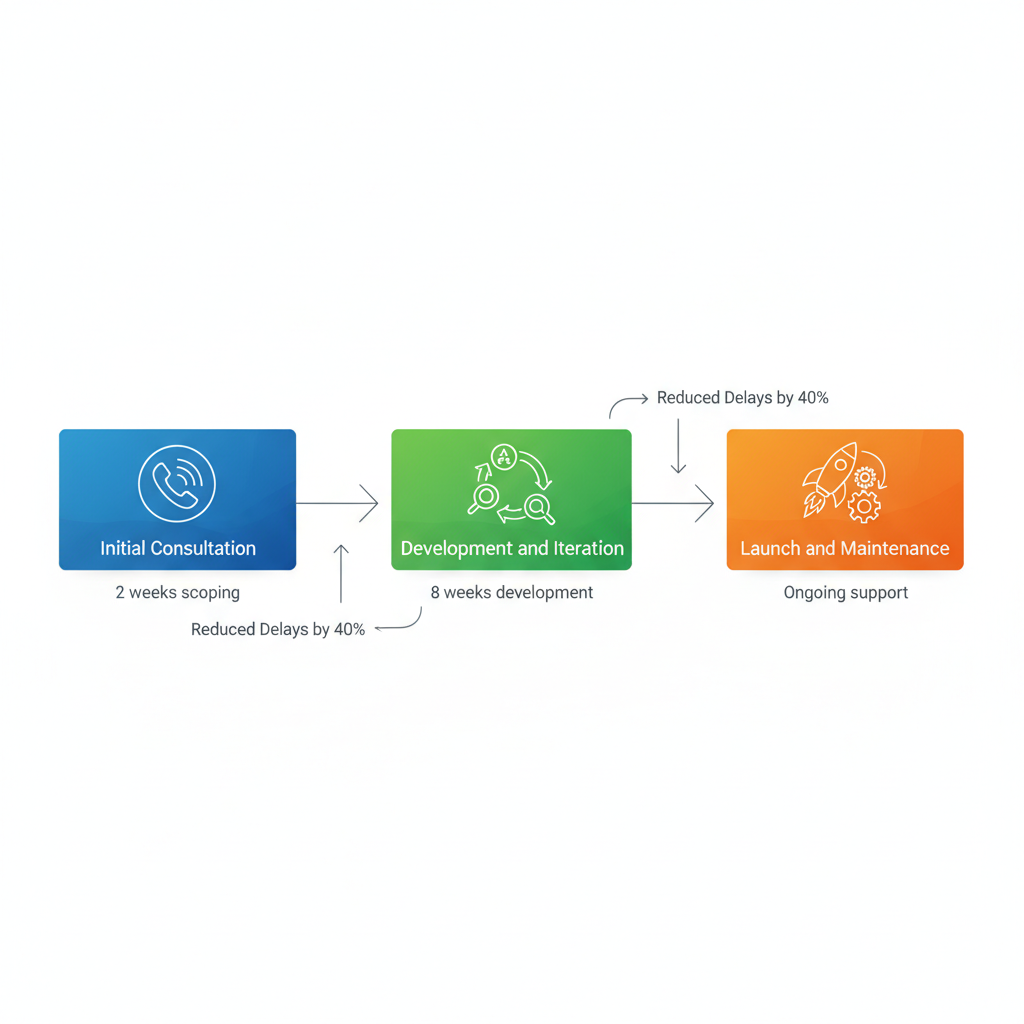
Three-phase collaborative process for Shopify development partnership
Initial Consultation and Project Scoping
The process begins with an initial consultation to align expectations and define project boundaries. Agencies submit requests for proposals (RFPs) outlining goals, such as custom theme development or app integrations. Bantech’s team schedules discovery calls within 48 hours, gathering detailed requirements through structured questionnaires. This includes assessing e-commerce needs, target audience, and budget constraints.
- Discovery Call: Discuss business objectives and technical specifications in a 1-hour virtual session via secure tools like Zoom.
- Requirement Gathering: Compile functional and non-functional needs, including scalability and SEO optimizations.
- Proposal Development: Deliver a comprehensive proposal within 1 week, including timelines, milestones, and costs.
Selecting a reliable Shopify Dev Outsourcing Partner is crucial; key questions to ask include experience with the shopify expert partner program and white label capabilities. Structured scoping, as recommended by industry best practices, reduces delays by 40%, ensuring realistic timelines like a 2-week scoping phase. Bantech’s US and UK communication lines support global agencies in building trust from the start.
Development and Iteration Phases
Once scoped, the project enters agile development, broken into iterative sprints for flexibility. Agile sprints are short development cycles, typically 2 weeks long, allowing for continuous progress and adjustments. Bantech employs tools like Jira for tracking, ensuring the agency development pipeline flows smoothly.
- Sprint Planning: Define tasks, such as building custom Shopify themes or integrating third-party APIs.
- Development Execution: Code custom features with a focus on security and performance; incorporate cms outsourcing for seamless content management.
- Feedback Loops and Testing: Conduct mid-sprint reviews with agency stakeholders, followed by QA testing to catch issues early.
This phase emphasizes white label Shopify development, where solutions are built generically for easy rebranding. Milestones include prototype delivery after sprint 2 and beta testing in sprint 4. Communication via Slack and weekly updates keeps agencies informed, fostering a collaborative environment that addresses potential challenges proactively.
Launch, Maintenance, and Scaling Support
The final phase transitions the project to launch, followed by sustained support. Deployment involves staging environment testing before going live, with Bantech handling migrations to minimize downtime.
- Pre-Launch QA and Training: Rigorous testing for functionality, speed, and mobile responsiveness; provide agency training sessions on platform management.
- Go-Live Deployment: Execute the launch with 24/7 monitoring, typically within 1 week of approval.
- Ongoing Maintenance: Offer retainer models for updates, security patches, and performance tuning.
For scaling, Bantech supports expansions like adding international stores or AI-driven personalization. As a white label shopify development partner, they ensure handoffs include full documentation for client rebranding. This comprehensive approach builds long-term partnerships, delivering scalable e-commerce solutions that drive growth.
Through this structured process, agencies achieve efficient, high-quality outcomes while retaining full ownership of client projects.
Strategies for Successful Shopify Agency Partnerships
Building on the workflow outlined earlier, applying targeted strategies elevates Shopify development partnerships into optimized agency partnerships. For agencies engaging in Shopify Development for Agencies, these Shopify collaboration strategies focus on clear communication, rigorous performance tracking, and scalable growth. By prioritizing these elements, agencies can achieve higher project success rates and foster long-term value with partners like Bantech, who offer robust white label solutions.
Effective Communication and Timeline Management
Effective communication forms the backbone of any successful Shopify project, preventing delays and misunderstandings. Start by setting clear expectations from day one through detailed project briefs that outline scopes, deliverables, and responsibilities. Use collaborative tools like Slack for daily updates and Zoom for weekly check-ins to keep all parties aligned.
- Do: Implement milestone-based timelines with automated reminders to track progress and flag potential delays early.
- Don’t: Rely solely on email; it often leads to fragmented conversations and overlooked details.
- Do: Schedule bi-weekly syncs to review achievements and adjust plans, incorporating client feedback loops.
In real-world scenarios, such as handling scope creep during a product launch, proactive check-ins can resolve issues swiftly. Agencies using milestone tracking, as noted by Magecomp, experience 35% fewer revisions, ensuring smoother deliveries and timely completions.
The following table presents a Best Practices Evaluation Framework for agency self-assessment in partnership success. It highlights key practices, their implementations, and anticipated outcomes to guide structured improvements.
| Practice | Implementation | Expected Outcome |
|---|---|---|
| Communication | Weekly stand-ups via Slack/Zoom | Reduced miscommunications and faster resolutions |
| Timeline Adherence | Milestone-based contracts | On-time project delivery and fewer overruns |
| Performance Review | Quarterly KPI audits | Continuous improvement and accountability |
| Risk Mitigation | Contingency planning | Minimized disruptions and proactive adjustments |
| Innovation Integration | Regular tech updates | Enhanced features and competitive edge |
| Scalability Planning | Modular project designs | Easy expansions without full redesigns |
| Compliance Checks | Ongoing security audits | Maintained data integrity and regulatory adherence |
| Feedback Loops | Client-agency-partner triads | Stronger relationships and iterative refinements |
| ROI Measurement | Pre/post metrics tracking | Quantifiable value and informed decision-making |
This framework underscores the importance of structured practices; for partners like Bantech, customize it to leverage their agile delivery model, achieving up to 90% success rates as per industry insights from Magecomp and Appwrk.
Evaluating Performance and ROI Metrics
To ensure partnerships deliver real value, agencies must establish clear KPIs for performance and ROI evaluation. Focus on metrics like project delivery timelines, client satisfaction scores via Net Promoter Score surveys, and cost efficiency ratios that compare budgeted versus actual spends.
- Do: Track KPIs monthly using dashboards in tools like Google Analytics or Asana to visualize progress and identify bottlenecks.
- Don’t: Ignore qualitative feedback; pair it with quantitative data for a holistic view.
- Do: Incorporate shopify expert program benchmarks, such as conversion rate improvements, to measure impact against industry standards.
For instance, in a recent e-commerce migration, monitoring ROI through pre- and post-launch traffic data revealed a 25% uplift, validating the partnership’s efficacy. Emphasize security audits as a core KPI to protect client assets, aligning with best practices for sustained trust.
Long-Term Collaboration and Scaling Tips
Scaling partnerships requires forward-thinking approaches to handle growth and platform evolutions. Opt for retainer agreements that provide ongoing support, allowing flexibility for expansions like adding new storefront features or integrations.
- Do: Include contract clauses for adaptability, such as provisions for Shopify updates, to future-proof projects.
- Don’t: Lock into rigid scopes; build in scalability from the outset.
- Do: Partner with a white label shopify development partner like Bantech, whose maintenance programs offer retainer and a la carte options for seamless scaling.
Adapting to Shopify’s frequent updates, such as new API enhancements, keeps projects innovative. Agencies can join the shopify expert program for certified resources, enabling expansions without internal hires. In practice, this approach helped one agency scale from single-site builds to multi-channel ecosystems, boosting revenue by 40%.
Integrating these strategies leads to enduring partnerships that drive business growth and innovation in the competitive e-commerce landscape.
Forging Lasting Shopify Development Alliances
In navigating the landscape of Shopify Development for Agencies, agencies have explored essential criteria for selecting partners, from technical expertise to seamless integration processes. Recapping key elements, reliable white label partnerships offer cost-effective scalability, enabling faster market entry without in-house burdens. As highlighted by industry guides like Ecorn’s Top Shopify Development Companies, top agencies deliver 50% faster launches through collaborative models, underscoring the transformative impact of aligning with a trusted white label shopify development partner. Bantech technology solutions exemplifies this with strengths in custom CMS development and robust security, ensuring scalable, secure e-commerce platforms that address reliability concerns head-on.
Key takeaways reinforce the shopify expert partner program as a benchmark for quality, providing access to certified innovations and agile delivery. Benefits extend to streamlined design integration via white label web design, empowering agencies to expand offerings while maintaining brand control. These practices not only resolve queries on hiring decisions but also pave the way for sustainable growth in competitive markets.
With these tools, agencies can confidently forge strategic Shopify alliances. To elevate your agency’s e-commerce offerings, connect with a proven partner today. Reach out via email at info@bantechsolutions.com or phone for a complimentary consultation, taking the immediate step toward lasting success.