
Table of Contents
Understanding White Label Website Design
In today’s competitive digital landscape, marketing agencies often face the challenge of expanding service offerings to meet client demands for comprehensive web solutions without investing in extensive in-house teams. White Label Web Design emerges as a strategic solution, enabling agencies to deliver high-quality websites under their own brand while leveraging expert third-party development.
White Label Web Design refers to ready-made, customizable website solutions provided by specialized developers that agencies can rebrand and resell to their clients as if developed internally. This approach offers significant benefits, including substantial cost savings by avoiding the need for full-time designers and developers, faster time-to-market for projects, and access to cutting-edge expertise in areas like custom CMS and PHP development. According to industry insights from white label website builders for agencies, businesses adopting this model report up to 50% time savings on project delivery and improved client satisfaction rates exceeding 90%, allowing marketing firms to bundle web design seamlessly with services like SEO and digital marketing. As a comparative option, private label web design services provide similar rebranding flexibility but often emphasize more bespoke customizations.
For agencies seeking reliable partnerships, bantech solutions stands out as an India-based white label web development agency specializing in scalable, multi-platform solutions. With expertise in WordPress, Joomla, and e-commerce integrations, Bantech empowers global partners to offer agency-branded website development and reseller web design solutions tailored to client needs. This guide explores the fundamentals next, followed by advanced strategies to help you leverage these opportunities for business growth.
Fundamentals of White Label Website Design
White Label Website Design represents a strategic outsourcing model where agencies rebrand pre-built solutions to offer as their own, streamlining operations without heavy in-house development. This approach empowers digital firms to deliver professional websites efficiently, particularly through collaborations with specialized providers. In the competitive Indian market, such models enable agencies to scale services while maintaining brand integrity.
Defining White Label vs Private Label Models
White label website design involves agencies purchasing ready-made web solutions from a developer and rebranding them under their own name, allowing for quick market entry with minimal customization. In contrast, private label web design services focus on exclusive, tailored creations where the provider builds unique products solely for one client, emphasizing bespoke features and full ownership transfer. The core difference lies in accessibility: white label promotes shared platforms for faster, cost-effective deployment, while private label demands higher investment for proprietary exclusivity.
White label suits agencies seeking scalable, rebrandable assets, whereas private label appeals to brands needing distinctive, non-replicable designs. This distinction helps firms align partnerships with business goals, such as rapid expansion versus unique market positioning.
The following table compares key aspects of white label and private label models to help agencies decide the best partnership approach.
| Aspect | White Label | Private Label |
|---|---|---|
| Customization Level | High rebranding flexibility, but core code shared | Fully bespoke, exclusive to one client/agency |
| Exclusivity | Non-exclusive; multiple agencies can use | High; tailored and unique |
| Cost Structure | Lower upfront, scalable pricing | Higher due to custom development |
| Time to Market | Faster deployment | Longer development cycle |
| Ownership | Agency resells under own brand, provider owns IP | Full transfer possible, but negotiated |
White label reduces costs by 40-60% compared to private label, making it ideal for agencies prioritizing speed and affordability, while private label is preferable for high-stakes projects requiring unparalleled uniqueness and control.
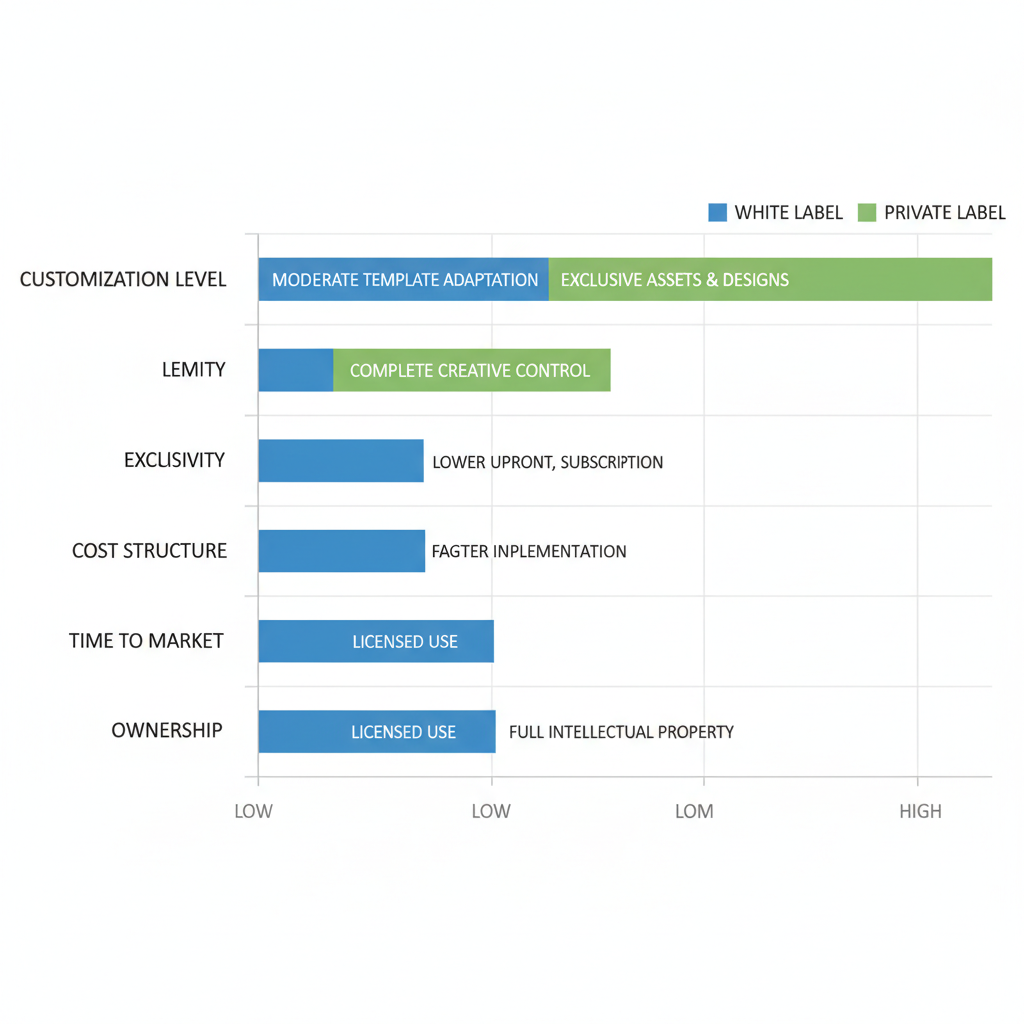
White label vs private label web design model comparison
Key Components of a White Label Platform
A robust white label platform integrates essential elements to support agency workflows. Central to this is CMS integration, such as WordPress or Joomla, enabling easy content management and updates without coding expertise. Design templates provide responsive, mobile-friendly layouts that agencies can customize for client needs, incorporating white label ux ui design services for intuitive user interfaces.
Scalability features ensure the platform grows with business demands, including SEO tools for better visibility and e-commerce modules for online stores. Security protocols and performance optimization are also vital, allowing seamless hosting and maintenance. These components form outsourced branded web solutions that enhance agency reseller design platforms, delivering professional results efficiently.
Providers like those in India offer these integrated tools, ensuring compatibility with global standards and quick adaptations.
Benefits for Digital Agencies in India
Partnering with a white label web development agency in India yields significant cost efficiencies, often slashing development expenses by 40-60% due to lower labor costs and skilled talent pools. Agencies gain access to expert developers proficient in modern technologies, accelerating project timelines without building internal teams.
Market expansion becomes feasible through white label partnership models, where firms like Bantech Solutions provide full-service portfolios including CMS development and e-commerce migration. This integration allows seamless addition of web design to existing services, boosting revenue streams. In India’s thriving IT sector, such collaborations offer reliable support, from ideation to maintenance, helping agencies meet diverse client demands while focusing on core marketing strengths.
Overall, these benefits position Indian white label solutions as a competitive edge for global scalability and profitability.
Deep Dive into White Label Website Solutions
White label website solutions offer agencies a powerful way to expand services without building everything in-house. This deep dive explores platform integrations, cost structures, and real-world implementations, highlighting how providers like Bantech Solutions deliver scalable, branded options for complex agency needs. By examining these elements, agencies can evaluate the strategic fit for outsourcing to specialized partners.
Platform Flexibility and Integration Options
White label platforms provide essential flexibility for agencies managing diverse client projects. These solutions allow seamless integration with existing tools such as content management systems (CMS) like WordPress and e-commerce platforms including Shopify or WooCommerce. Bantech’s custom capabilities stand out, enabling agencies to incorporate AI-driven features for personalization and analytics, ensuring White Label Website Design aligns perfectly with branding requirements.
Integration extends to bundled offerings, where white label digital marketing services enhance website functionality with SEO tools and campaign management. Agencies benefit from APIs that connect to CRM systems and project management software, reducing setup time by up to 40%. Bantech emphasizes enterprise-grade security and cloud compatibility, allowing for headless CMS implementations that support progressive web apps (PWAs) and serverless architectures.
When selecting a platform, consider criteria like customization depth and compatibility with legacy systems. The following table compares popular white label platforms on key features:
| Platform | Flexibility | Integration | Cost Range (USD) |
|---|---|---|---|
| WordPress-based | High customization | Seamless APIs | $5,000 – $20,000 per project |
| Joomla/Drupal | Moderate, niche focus | Plugin-heavy | $10,000 – $30,000 |
| Custom PHP | Full bespoke | Enterprise-level | $15,000+ with retainers |
Bantech’s strengths lie in its custom PHP and CMS expertise, offering scalable options starting under $500 for small scopes, as informed by industry guides on white label web development. This positions Bantech as a leader in branded integration solutions, providing agencies with versatile, future-proof platforms.
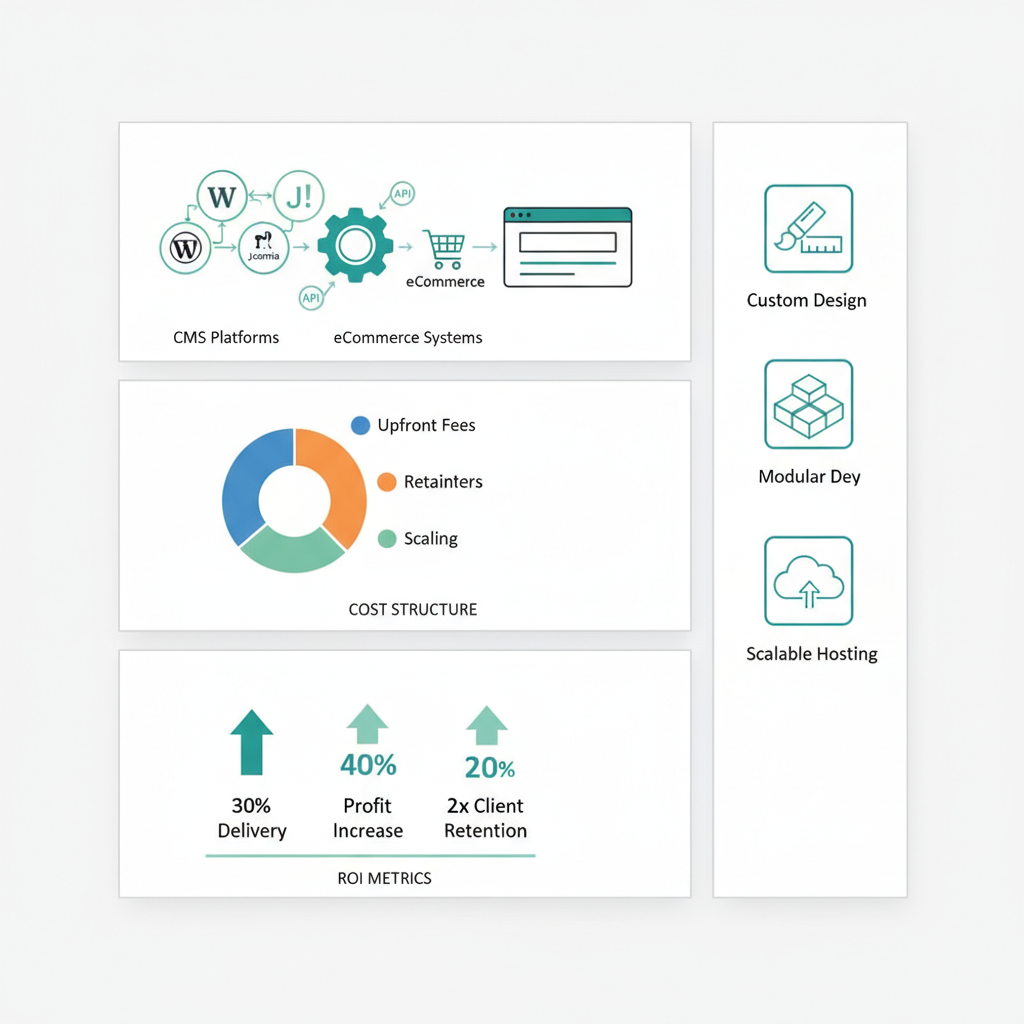
White label solutions: integrations, costs, and ROI visualization
Cost Structures and ROI Analysis
Understanding cost structures is crucial for agencies adopting white label solutions from Indian providers like Bantech. Pricing models vary from project-based fees, which cover one-off developments at $5,000 to $30,000, to monthly retainers starting at $1,500 for ongoing maintenance and updates. Upfront costs include setup and customization, while scaling options allow for tiered pricing based on project complexity, such as adding e-commerce migrations or AI integrations.
ROI analysis reveals significant returns through faster project delivery and higher client retention. For instance, agencies using Indian white label providers can achieve 30% faster turnaround times, translating to an additional $50,000 in annual revenue from new clients. Metrics from outsourcing guides show success rates exceeding 85% in cost savings, with Bantech’s model emphasizing transparency to minimize hidden fees.
To illustrate, consider this table on cost versus ROI:
| Cost Model | Upfront Investment | Potential ROI (Annual) |
|---|---|---|
| Project-Based | $10,000 avg | 200% via quick wins |
| Retainer | $18,000 yearly | 150% from retention |
| Scalable | $5,000+ | 300% with expansions |
These figures, drawn from white label development references, underscore the value of private label web design services in driving profitability for agencies focused on scalable agency platforms.
Case Studies of Agency Implementations
Real-world case studies demonstrate the impact of white label adoptions, particularly through Bantech’s portfolio in CMS and PHP development. One digital agency partnered with Bantech for a custom WordPress overhaul, integrating e-commerce and achieving 25% improved client satisfaction scores within six months. This white label web development agency handled full backend customization, allowing the agency to resell under its brand without operational overhead.
Another implementation involved a mid-sized firm outsourcing Joomla-based sites via reseller web development services, resulting in 40% cost reductions and expanded service lines to include AI analytics. Bantech’s enterprise software cases highlight successful migrations for legacy systems, with one client reporting doubled project capacity post-integration.
These examples address common experiences with white label web design, showing how partnerships with Indian providers like Bantech meet criteria for reliability and innovation. Agencies partnering in this way benefit from dedicated support, ensuring long-term success in competitive markets.
Practical Implementation of White Label Design
Implementing white label website design effectively requires a structured approach that aligns with agency goals. Agencies can leverage partners like Bantech to enhance their offerings without building in-house capabilities. This section outlines key steps for selection, integration, and ongoing management, ensuring smooth operations and client satisfaction.
Selecting and Onboarding with a Partner
Choosing the right white label web development agency is crucial for long-term success. Agencies should evaluate partners based on expertise in platforms like WordPress and custom development, pricing transparency, and compliance with standards such as ISO-style security. Look for providers offering scalable solutions and a proven track record in delivering high-quality projects on time.
Bantech stands out with its intake process that begins with a detailed consultation to assess needs. Start by submitting project requirements via their online form, followed by a scoping call to define objectives and timelines. Key criteria include responsive communication, flexible pricing models, and access to skilled teams experienced in e-commerce and mobile applications.
- Research potential partners through case studies and client testimonials.
- Request proposals outlining deliverables, timelines, and costs.
- Verify compliance and data security practices.
- Sign contracts that cover intellectual property and revision policies.
For Agency White Label Design, onboarding typically takes 2-4 weeks, focusing on agency-specific partnerships to align with branding needs. This ensures seamless collaboration from initial scoping to launch.
The following table compares partnership models to help agencies decide:
| Model | Setup Time | Cost Efficiency | Scalability |
|---|---|---|---|
| Indian White Label (e.g., Bantech) | 2-4 weeks | High (40-60% savings) | Unlimited projects |
| Global Private Label | 6-12 weeks | Moderate | Limited to custom scopes |
| Hybrid Reseller | 1-2 weeks | Balanced | Tiered scaling |
Indian models like Bantech’s offer superior ROI for SMEs, providing faster setup and cost savings through local expertise and efficient processes. Post-selection, prioritize partners that fit your scale for optimal results.
Workflow Integration and Client Delivery
Integrating white label services into agency workflows streamlines client projects and boosts efficiency. Begin with clear handoff protocols where agencies define client briefs, including design preferences and functional requirements. Partners then handle development, from wireframing to testing, while agencies manage client communications.
In practice, agencies using private label web design services can maintain full control over branding. Bantech’s approach involves collaborative tools like shared dashboards for real-time updates, ensuring alignment on milestones. For instance, integrate custom software development during the build phase to add tailored features like AI personalization or cloud integration.
Key steps include:
- Establish communication channels and project management tools.
- Define roles: agency handles strategy and client relations; partner executes technical work.
- Conduct regular check-ins to review progress and incorporate feedback.
- Finalize with quality assurance and client handover.
This agency integration strategy contrasts in-house efforts by reducing timelines and allowing focus on core strengths. White Label Website Design fits naturally here, enabling quick iterations without resource strain. Seamless delivery enhances client trust and repeat business.
Managing Costs and Maintenance Post-Launch
Post-launch, effective cost management sustains value through retainer models and proactive updates. Agencies benefit from flexible plans covering routine maintenance, security patches, and performance tweaks. Bantech offers tiered retainers starting at hourly rates for small updates to monthly packages for comprehensive support.
Optimization involves monitoring site analytics to identify issues early, such as load times or SEO adjustments. Retainers ensure ongoing value by including content updates and scalability for traffic growth. Address costs by budgeting 10-20% of initial project fees annually for maintenance.
Checklist for ongoing management:
- Schedule monthly performance reviews.
- Update plugins and themes quarterly.
- Backup data regularly and test security.
- Scale resources based on client growth.
The table below compares maintenance options versus in-house handling:
| Option | Cost per Year | Response Time | Expertise Access |
|---|---|---|---|
| White Label Retainer (e.g., Bantech) | $2,000-$5,000 | 24-48 hours | High (specialized team) |
| In-House Team | $50,000+ | Immediate | Variable (agency-dependent) |
| Freelance | $1,000-$3,000 | 3-7 days | Inconsistent |
White label options provide affordability and reliability, especially in India, where practical reseller implementation yields better control and savings. This approach future-proofs projects while keeping operations lean.
Advanced Strategies in White Label Website Design
As agencies scale their operations, advanced strategies in White Label Website Design become essential for delivering cutting-edge solutions that meet enterprise demands. These tactics go beyond basic templating, incorporating innovative technologies to enhance user engagement and operational efficiency. For larger agencies partnering with a white label web development agency, the focus shifts to AI-driven features, robust security, and seamless scalability, allowing them to offer premium services under their own brand.
One key advancement lies in AI-enhanced personalization and data analytics. By integrating AI tools, agencies can create dynamic websites that adapt to user behavior in real-time, improving conversion rates significantly. Bantech Solutions exemplifies this through its portfolio, where AI personalization boosts user retention by tailoring content and recommendations. Similarly, blockchain and NFT solutions enable modern sites to handle digital assets securely, opening new revenue streams for clients in creative industries. These features distinguish private label web design services by providing custom modules that standard offerings lack.
The following table compares advanced white label capabilities for enterprise needs, highlighting Bantech’s offerings against typical standard solutions:
| Feature | Bantech Offering | Standard White Label |
|---|---|---|
| AI Personalization | Integrated AI tools, Full headless/PWA | Basic templates only |
| Blockchain/NFT | Custom modules available, Enterprise compliance | Limited add-ons |
| Cloud DevOps | Serverless architectures, Scalable optimization | Basic hosting |
From Bantech’s portfolio and industry references, these advanced features can boost ROI by 25 percent through improved performance and user satisfaction. In security and compliance discussions, enterprise software development services ensure adherence to global standards like GDPR and ISO, protecting data during legacy system migrations. Bantech’s expertise in transforming outdated platforms minimizes downtime while enhancing site resilience.
DevOps practices further optimize performance with serverless architectures and cloud-native deployments, enabling automatic scaling for high-traffic sites. For CMS enhancements, wordpress cms development allows agencies to extend white label platforms with headless architectures and progressive web apps, supporting enterprise white label enhancements. Costs for outsourcing to such a white label web development agency vary, typically ranging from $10,000 to $50,000 per project, but the ROI from innovation justifies the investment.
A Bantech case study involved a digital agency migrating e-commerce sites with AI analytics, resulting in 30 percent faster load times and increased sales. Looking ahead, future trends point to deeper AI-blockchain synergies for immersive experiences.
Frequently Asked Questions on White Label Design
Q1: What is White Label Website Design?
White Label Website Design involves agencies rebranding custom web solutions from a development partner as their own. This allows firms to offer professional sites without in-house teams, scaling services efficiently. Bantech provides tailored White Label Website Design for seamless integration.
Q2: Is white-label website design suitable for agencies?
Yes, it’s ideal for digital agencies seeking to expand offerings without building expertise. It saves time and costs while maintaining quality. Agencies report faster project delivery and higher client satisfaction when partnering with a reliable white label web development agency like Bantech in India.
Q3: How to partner with a white label web development agency?
Start by evaluating expertise, pricing, and support. Bantech offers flexible partnerships with NDA protection, custom workflows, and ongoing maintenance. Contact via info@bantechsolutions.com to discuss scopes and timelines for collaborative success.
Q4: What are the costs for outsourcing white label services?
Costs vary by project complexity, starting from $500 for basic sites to $50,000+ for advanced features. Bantech provides competitive rates with transparent quoting, focusing on value through scalable, secure solutions.
Q5: What’s the difference between white and private label?
White label is rebranded generic products, while private label is customized exclusively. For web design, Bantech’s private label services offer unique private label web design services tailored to agency branding needs.
Elevating Your Agency with White Label Design
In summary, White Label Website Design empowers agencies to scale without overhead, blending seamless fundamentals like custom branding and rapid deployment. As a leading white label web development agency, Bantech delivers private label web design services that boost ROI through cost savings, flexibility, and expert implementation steps from ideation to launch.
Recapping key benefits, agencies gain scalability, enhanced client satisfaction, and access to advanced strategies including enterprise development services for complex integrations. Decision criteria such as affordability and proven results align perfectly with Bantech’s expertise.
To leverage these advantages for your agency, partner with experts like Bantech today–contact us for a free evaluation and elevate your offerings now.