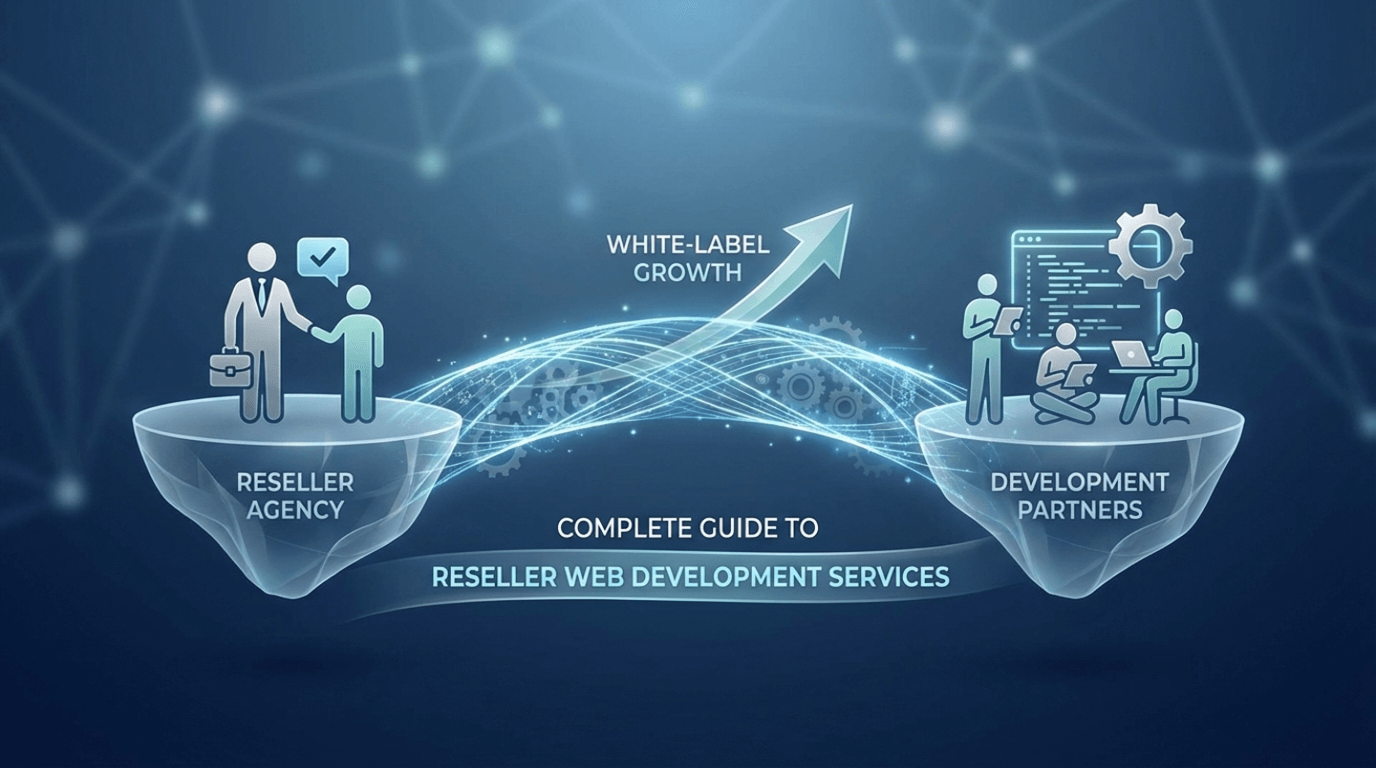
Introduction: The Growing Demand for Reseller Web Development Services
In today’s digital-first economy, web development has become the cornerstone of business success. Yet for digital agencies and startups across the USA, UK, Canada, Australia, and New Zealand, a critical challenge persists: how to meet surging client demand without the overhead of expanding internal development teams.
Enter reseller web development services – a strategic business model that enables agencies to offer comprehensive web development solutions under their own brand while partnering with specialized development firms for execution. This white label approach has evolved from a niche outsourcing strategy into a fundamental competitive advantage for agencies seeking sustainable growth.
According to industry research, the global web development market is projected to reach $89.12 billion by 2027, growing at a CAGR of 8.2%. Simultaneously, 73% of agencies report difficulty finding qualified in-house developers, with average hiring costs exceeding $15,000 per developer and time-to-hire stretching beyond 42 days. These market dynamics have made agency web dev reseller partnerships not just attractive, but essential for agencies aiming to remain competitive.
This comprehensive guide examines how reseller web development services work, why outsourcing to India through a hybrid partner like Bantech Solutions offers distinct advantages, and how Western agencies can leverage this model to achieve profitable, scalable growth.
What Are Reseller Web Development Services?
Reseller web development services – also known as white label web development or private label development – refer to a business arrangement where one company (the reseller/agency) sells web development services created by another company (the development partner) under the reseller’s own brand.
The Core Value Proposition
For digital agencies, marketing firms, and consultancies, this model offers several transformative benefits:
- Complete Brand Control: Your agency maintains full client relationships and brand visibility throughout the project lifecycle
- Pricing Flexibility: Set your own rates and markup structures, typically achieving 200-400% margins on development services
- Risk Mitigation: No hiring risks, no employee overhead, no infrastructure costs – your partner handles all technical execution
- Rapid Market Expansion: Offer comprehensive web development services immediately without months of recruitment and training
How White Label Reseller Web Dev Differs from Traditional Outsourcing
While traditional outsourcing involves project-by-project engagements, white label reseller web dev partnerships represent strategic, ongoing relationships characterized by:
- Invisible Partnership: Clients interact exclusively with your agency; the development partner remains completely behind the scenes
- Consistent Quality Standards: Established workflows, coding standards, and quality assurance processes ensure predictable outcomes
- Wholesale Pricing Models: Tiered pricing structures that improve as your partnership volume grows, with typical discounts of 30-50% off retail rates
- No Long-Term Contracts: Flexible, project-based engagements without lengthy commitments, though volume discounts incentivize ongoing partnerships
The Business Case: Why Agencies Choose Reseller Web Development
Financial Advantages That Transform Agency Economics

The financial benefits of reseller partnerships extend far beyond simple cost savings:
1. Dramatically Reduced Overhead
Consider the total cost of employing a senior web developer in major Western markets:
- Annual salary: $85,000 – $125,000 (USA/UK/Canada/Australia)
- Benefits and taxes: Additional 25-35%
- Recruitment costs: $15,000 – $25,000
- Equipment and software: $5,000 – $8,000 annually
- Office space and overhead: $12,000 – $20,000
- Total annual cost per developer: $120,000 – $175,000
With reseller web development services, agencies access equivalent expertise at 40-60% lower costs, paying only for actual project work rather than maintaining full-time staff during slow periods.
2. Improved Cash Flow and Profitability
White label partnerships transform fixed costs into variable expenses, dramatically improving cash flow management. Agencies report:
- Gross margins of 55-75% on web development services (compared to 35-45% with internal teams)
- Ability to take on 3-5x more projects without proportional overhead increases
- Faster project turnaround enabling quicker invoicing and payment collection
- Elimination of ‘bench time’ costs when developers lack active projects
Operational Benefits: Focus on Core Competencies
Beyond financial advantages, reseller partnerships enable agencies to concentrate resources on their highest-value activities:
- Client Acquisition: Redirect time and budget from managing developers to winning new business
- Strategic Consulting: Position your agency as a strategic partner rather than just an implementation vendor
- Relationship Management: Invest in deepening client relationships and identifying upsell opportunities
- Service Expansion: Easily add complementary services like SEO, digital marketing, and mobile development without building new capabilities
5 Critical Questions Agencies Must Answer About Reseller Web Development Services
Before partnering with a reseller web development provider, agencies should carefully evaluate these essential questions:
1. How Do I Maintain Quality Control with White Label Web Development?
Quality assurance represents the most common concern for agencies considering reseller partnerships. The solution lies in establishing robust quality frameworks:
- Pre-Development Standards: Detailed project briefs, wireframes, and technical specifications documented before development begins
- Milestone-Based Reviews: Structured checkpoints at 25%, 50%, 75%, and 100% completion with client feedback loops
- Automated Testing: Comprehensive testing protocols covering functionality, performance, security, and cross-browser compatibility
- Code Review Processes: Multiple layers of review including peer review, senior developer review, and final QA verification
Premium partners like Bantech Solutions maintain ISO-certified development processes and follow industry-standard methodologies including Agile and DevOps practices, ensuring consistent, high-quality outputs across all projects.
2. What Technologies and Platforms Should My Reseller Partner Support?
A comprehensive reseller partner should offer expertise across the full technology spectrum:
Core Development Platforms:
- WordPress: Custom themes, plugin development, WooCommerce integration
- PHP Frameworks: Laravel, Symfony, CodeIgniter for custom applications
- E-commerce: Shopify, Magento, BigCommerce, WooCommerce
- JavaScript Frameworks: React, Angular, Vue.js, Node.js
- CMS Platforms: Drupal, Joomla, custom CMS development
Advanced Capabilities:
- Progressive Web Apps (PWAs) and mobile-responsive development
- API integration and development (RESTful, GraphQL)
- Cloud deployment (AWS, Azure, Google Cloud)
- Database architecture (MySQL, PostgreSQL, MongoDB)
3. How Do Pricing Models Work for Agency Web Dev Reseller Partnerships?
Understanding pricing structures is critical for calculating margins and positioning your services. Most reseller partners offer tiered pricing:
Typical Pricing Tiers:
- Entry Level (1-5 projects/month): Standard wholesale rates, 30-40% below retail market pricing
- Growth Tier (6-15 projects/month): Additional 15-20% discount, dedicated account management
- Enterprise Tier (16+ projects/month): Maximum 40-50% discount, dedicated development team, priority support
Leading providers like Bantech Solutions offer transparent, no-setup-fee models with flexible month-to-month arrangements, allowing agencies to scale partnerships based on actual business needs rather than contractual obligations.
4. What Level of Communication and Project Management Should I Expect?
Effective communication distinguishes exceptional reseller partners from mediocre ones. Key communication elements include:
- Dedicated Project Managers: Single point of contact who understands your agency’s standards and client requirements
- Real-Time Collaboration Tools: Integration with Slack, Teams, or your preferred communication platform
- Time Zone Flexibility: Overlapping work hours or scheduled sync meetings during your business day
- Transparent Reporting: Weekly progress updates, time tracking, and milestone completion reports
- Emergency Response: 24/7 support for critical issues with guaranteed response times
5. How Do I Protect My Client Relationships and Ensure Complete White Label Service?
Client relationship protection forms the foundation of successful reseller partnerships. Essential protections include:
- Non-Disclosure Agreements (NDAs): Comprehensive agreements protecting client information, project details, and strategic insights
- Non-Compete Clauses: Contractual guarantees preventing the development partner from approaching your clients directly
- Branded Communications: All deliverables, code comments, and documentation carry your agency’s branding
- Anonymous Support: Development team operates entirely behind the scenes with no client-facing interaction unless explicitly requested
Code Ownership: Clear intellectual property agreements ensuring your agency (and ultimately your client) owns all code and assets
Why Outsourcing to India Offers Unmatched Competitive Advantages
While reseller web development services are available globally, partnering with Indian development firms – particularly hybrid companies like Bantech Solutions – provides distinct strategic and economic advantages for Western agencies.
The Indian Technology Ecosystem: A Global Leader
India has emerged as the world’s leading technology services hub, with compelling statistics:
- Technical Talent Pool: 5.2 million IT professionals, with 1.5 million engineering graduates entering the workforce annually
- Industry Experience: 50+ years of IT services excellence, serving 75% of Fortune 500 companies
- Quality Certifications: World’s highest concentration of ISO-certified, CMMI Level 5 development firms
- Innovation Leadership: Third-largest startup ecosystem globally, with cutting-edge expertise in AI, blockchain, and emerging technologies
- English Proficiency: Second-largest English-speaking nation, ensuring seamless communication with Western clients
Cost Advantages Without Quality Compromise

The cost differential between Western and Indian development remains substantial while quality standards have achieved parity:
Developer Rate Comparison (2026):
- USA/UK/Canada/Australia: $75-150/hour
- India (Premium Firms): $25-45/hour
- Cost Savings: 60-70%
Critically, this pricing advantage doesn’t correlate with reduced quality. Indian development firms serving global clients maintain rigorous quality standards, often exceeding those of domestic providers due to competitive market pressures and established process maturity.
Time Zone Benefits: The ‘Follow the Sun’ Development Model
India’s geographic position creates a unique ‘follow the sun’ advantage for agencies in Western markets:
- Continuous Productivity: Work continues 24/5 as your team sleeps – submit projects in your evening, receive progress by your morning
- Faster Project Completion: Typical projects complete 30-40% faster through round-the-clock development cycles
- Strategic Overlap Windows: 4-6 hour overlap with USA/Canada (early morning), 3-4 hours with UK/Europe (late afternoon), enabling real-time collaboration when needed
- Emergency Response: Critical issues during your after-hours receive immediate attention during Indian business hours
Scalability and Flexibility Advantages
India’s vast technical workforce enables unprecedented scalability:
- Rapid Team Scaling: Scale from 2 developers to 20+ within weeks rather than months
- Specialized Expertise: Access niche technical skills (blockchain, AI/ML, advanced security) without lengthy searches
- Project Surge Capacity: Handle sudden increases in project volume without turning away business
- Technology Diversification: Quickly pivot to new technologies and platforms as market demands evolve
Bantech Solutions: Your Strategic Hybrid Development Partner
While many development firms offer outsourcing services, Bantech Solutions distinguishes itself as a true strategic partner for Western agencies through its hybrid model combining Indian cost advantages with Western business practices and quality standards.
The Bantech Difference: Hybrid Excellence
Bantech Solutions operates at the intersection of Indian technical excellence and Western business culture, offering agencies the best of both worlds:
- Proven Track Record: 300+ solutions delivered, 20+ business domains mastered, 100+ legacy systems re-engineered
- End-to-End Capabilities: From enterprise software development to AI-driven solutions, blockchain, mobile development, and beyond
- Western-Aligned Processes: Business hours overlap, cultural compatibility, direct communication in fluent English
- Security and Compliance: GDPR, SOC 2, and industry-specific compliance built into every engagement
Comprehensive Service Portfolio for Agency Partners
Bantech offers the complete technology stack agencies need to serve diverse client requirements:
Core Development Services:
- Web Application Development: Custom PHP, Laravel, Node.js, React, and full-stack development
- WordPress & CMS Solutions: Enterprise-grade WordPress, Drupal, and custom CMS platforms
- E-commerce Development: Shopify, Magento, WooCommerce, and custom marketplace solutions
- Mobile Development: Native iOS/Android and cross-platform React Native/Flutter applications
- Maintenance & Support: Ongoing technical support, updates, and optimization services
Advanced Technology Services:
- AI Solutions: Machine learning, NLP, computer vision, and custom AI development
- Blockchain & NFT: Smart contracts, DeFi platforms, NFT marketplaces, and cryptocurrency solutions
- Cloud Architecture: AWS, Azure, Google Cloud infrastructure and migration
- DevOps Implementation: CI/CD pipelines, automation, and infrastructure as code
IT Strategy & Planning: Technology roadmaps, system architecture, and digital transformation consulting
Implementing a Successful Reseller Web Development Partnership
Transitioning to a reseller model requires strategic planning and process refinement. Follow this framework for optimal results:
Phase 1: Partner Selection and Vetting (Weeks 1-2)
- Evaluate Technical Capabilities: Review portfolio, technical stack, and case studies relevant to your target clients
- Assess Communication Standards: Schedule discovery calls to evaluate responsiveness, English proficiency, and cultural fit
- Verify Quality Processes: Request documentation on QA procedures, coding standards, and project management methodologies
- Review Legal Protections: Examine NDA templates, white-label agreements, and intellectual property terms
Phase 2: Pilot Project Execution (Weeks 3-6)
- Start Small: Begin with a single, non-critical project to evaluate partnership dynamics
- Establish Communication Protocols: Define meeting schedules, reporting requirements, and escalation procedures
- Test White Label Processes: Verify that all deliverables properly reflect your agency branding
- Measure Performance: Track delivery timeline, quality metrics, and communication effectiveness
Phase 3: Process Refinement (Weeks 7-10)
- Standardize Workflows: Create templates for project briefs, technical specifications, and deliverable checklists
- Optimize Pricing: Finalize markup structures and client-facing rate cards based on actual costs
- Train Internal Teams: Ensure account managers and client-facing staff understand the partnership model and capabilities
- Implement Quality Gates: Establish internal review checkpoints before client presentations
Phase 4: Scale and Optimize (Ongoing)
- Gradual Volume Increase: Incrementally increase project volume as confidence and processes mature
- Expand Service Offerings: Introduce additional services (SEO, mobile, AI) as partnership strengthens
- Negotiate Volume Discounts: Leverage increased volume for improved pricing tiers
- Continuous Improvement: Regular retrospectives to identify optimization opportunities
Key Terms and Concepts in Reseller Web Development
Understanding industry terminology ensures effective communication with partners and clients:
- White Label Web Development: Development services provided by one company but branded and sold by another under their own identity
- Private Label Development: Similar to white label, emphasizing exclusive branding rights for the reseller
- Wholesale Web Development: Development services offered at reduced rates specifically for agency resellers
- Development Outsourcing: Contracting external developers or firms for project execution
- Offshore Development Partner: Development firm located in a different country, typically offering cost advantages
- Hybrid Development Model: Combining offshore cost benefits with onshore business practices and cultural alignment
- Managed Development Services: Comprehensive development partnerships including project management and quality assurance
- Agency Development Partnership: Strategic alliance between agency and development firm for ongoing collaboration
- Turn-key Web Solutions: Complete, ready-to-deploy website solutions requiring minimal agency involvement
Full-Stack Development Services: Comprehensive development capabilities covering frontend, backend, database, and infrastructure
Conclusion: Transform Your Agency Through Strategic Reseller Partnerships
The digital agency landscape has evolved dramatically. Success no longer requires massive internal teams or prohibitive infrastructure investments. Instead, strategic reseller web development partnerships enable agencies of any size to compete effectively, scale profitably, and deliver exceptional client value.
Key takeaways for agencies considering reseller partnerships:
- Financial Transformation: Reduce overhead by 60-70% while improving gross margins from 35-45% to 55-75%
- Operational Excellence: Focus internal resources on high-value activities while expert partners handle technical execution
- Competitive Positioning: Offer comprehensive services instantly without lengthy capability building
- Risk Mitigation: Convert fixed costs to variable expenses while maintaining quality and client satisfaction
- India Advantage: Leverage world-class technical talent at 60-70% cost savings with 24/5 productivity cycles
For Western agencies targeting sustainable growth, partnering with established hybrid development firms like Bantech Solutions represents not just a tactical decision but a strategic imperative. With 300+ delivered solutions, expertise across 20+ business domains, and proven white-label capabilities, Bantech combines Indian technical excellence with Western business alignment.
Ready to Transform Your Agency?
Contact Bantech Solutions today to discuss how our reseller web development services can power your agency’s growth. Whether you need a single pilot project or a comprehensive development partnership, our team is ready to help you scale profitably while maintaining the quality and client relationships that define your brand.
Explore Our Services:
The future of agency growth lies not in doing everything internally, but in partnering strategically. Choose Bantech Solutions – where technology meets trust, innovation meets impact, and your vision becomes reality.
FAQs
A practical breakdown of how white label web development works, why it’s not the same as handing a project to a freelance shop, and how agencies use it to scale without hiring.
Key Takeaways
- White label web development is when a third-party partner builds a website while your agency delivers and brands it as your own work. The partner stays completely invisible to the client.
- The core difference from traditional outsourcing: white label partnerships guarantee no client-facing contact, no partner branding, and no direct line between the client and the developer.
- Agencies typically use white label reseller web development services to take on more projects, protect margins (often 55–75% gross margin vs. 35–45% with in-house teams), and avoid the cost of hiring full-time developers.
- It’s a standard, legal commercial arrangement, the same model used in private-label retail, just applied to code instead of products.
- Success depends on choosing a partner with strong NDAs, non-compete clauses, and documented quality processes, not just low hourly rates.
Agencies fielding more web development requests than they can staff for eventually run into the same fork in the road: hire developers you may not need in six months, or find a partner who can build under your brand without ever touching the client relationship. That second path is what white label web application development exists to solve, and it’s become one of the more common ways Western agencies scale without inflating headcount.
What Is White Label Web Development?
White label web development is an arrangement where a specialized development partner designs and builds a website on behalf of an agency, and the agency delivers the finished product to its end client under its own brand name. The client sees only your agency, never the company that actually wrote the code. This is sometimes also called private label development or reseller web development, and it’s functionally identical to how private-label products work in retail: one company manufactures, another company brands and sells.
The arrangement typically covers the full build, including design, front-end and back-end development, testing, and deployment, with the agency acting as the sole point of contact throughout. Your team scopes the project, manages the client relationship, and handles sign-off. Your partner handles the technical execution behind the scenes.
How Is White Label Development Different From Traditional Outsourcing?
The defining difference is invisibility: white label partnerships are structurally built so the client never knows a third party was involved, while traditional outsourcing carries no such guarantee. In a standard outsourcing engagement, it’s often obvious, or even expected, that work is being subcontracted. With white label development, invisibility is the product.
That distinction shows up in a few concrete ways:
| Factor | White Label Web Development | Traditional Outsourcing |
|---|
| Client awareness | Client never knows a partner is involved | Client may know or interact with the outsourced team directly |
| Branding on deliverables | 100% agency-branded, no partner logos, credits, or code comments | May carry the vendor’s branding or watermarks |
| Communication | Partner has no direct contact with the client | Vendor may join client calls or emails |
| Relationship structure | Ongoing, standardized partnership with repeatable process | Often one-off, project-by-project |
| Pricing model | Tiered wholesale rates that improve with volume | Typically flat project or hourly rates |
| Contractual protection | NDAs and non-compete clauses are standard | Not always included |
In short: outsourcing is about where the work gets done. White labeling is about who gets credit for it, and making sure that answer is always “your agency.”
How Does White Label Web Development Actually Work?
In practice, white label web development follows a repeatable handoff: the agency scopes and sells the project, the partner builds it under NDA, and the agency delivers and supports it as its own. A typical engagement moves through four stages:
- Sales and scoping: Your agency wins the client, gathers requirements, and defines the project brief.
- Handoff to the partner: The brief, wireframes, and technical specs are passed to the white label development team, who work entirely behind the scenes.
- Build and QA: The partner develops, tests, and refines the site against milestones (commonly checkpoints at 25%, 50%, 75%, and 100% completion).
- Branded delivery: Your agency reviews, approves, and delivers the finished site to the client, with your branding on every deliverable, from the codebase comments to the final invoice.
This structure is close to what our guide on outsourcing web development to an agency partner describes in more depth, particularly around how milestone reviews protect quality when you’re not writing the code yourself.
Why Agencies Choose White Label Over Hiring In-House
The financial case is usually the deciding factor: white label development lets agencies avoid the fixed cost of full-time developers while still capturing strong margins on every project. A senior web developer in the U.S. now earns an average of roughly $144,872 per year in base salary alone, according to Glassdoor’s 2026 pay data, before benefits, recruitment costs, or slow-period “bench time” are factored in. White label partnerships convert that fixed cost into a variable, project-based expense.
Beyond cost, agencies commonly cite:
- No hiring risk: no recruitment cycles, no bad hires, no layoffs during slow quarters
- Faster capacity scaling: take on 3-5x more projects without proportional headcount growth
- Protected margins: wholesale pricing tiers typically run 30-50% below retail rates, leaving healthy markup room
- Focus on core strengths: internal teams spend time on sales and client strategy instead of project management for code they didn’t write
This mirrors a broader pattern in the outsourcing market: Deloitte’s global outsourcing research found that a majority of organizations are now adopting outcome-based sourcing models specifically to gain strategic flexibility, not just to cut costs. For agencies, white label development is the web-development-specific version of that same shift.
Is White Label Web Development Legal and Legitimate?
Yes. White label web development is a standard, fully legal commercial practice, comparable to private-label manufacturing in retail. There’s nothing deceptive about it as long as the agency is transparently responsible for the final product, quality, and support the client receives. What matters legally and ethically is that your agency stands behind the work: the client’s contract, warranty, and support relationship are with you, not the invisible partner. Formal protections like NDAs, non-compete clauses, and clear IP/code-ownership terms are what keep the arrangement clean on both sides.
Choosing a White Label Web Development Partner: A Quick Checklist
Before signing with a reseller web development provider, confirm they can check these boxes:
- Signed NDA and non-compete clause preventing direct client contact
- Documented QA process with milestone-based reviews
- 100% white-labeled deliverables (no partner branding in code, comments, or files)
- Clear code and IP ownership terms in the contract
- Tiered or wholesale pricing with no long-term lock-in
- Overlapping working hours or a dedicated project manager for real-time communication
Related Questions
Is white label web development the same as white label web design?
Not quite. White label web design typically covers the visual/UI layer, while white label web development covers the coding, functionality, and back-end build. Many providers offer both as a bundled service.
How much does white label web development cost?
Wholesale rates generally run 30-50% below standard retail pricing, with further discounts at higher project volumes. Agencies typically mark up from there to set their own client-facing rates.
Will my clients ever find out about the white label partner?
Not if the partnership is structured correctly. NDAs, branded-only deliverables, and zero direct client contact are standard practice specifically to prevent this.
Can a small agency use white label web development?
Yes. It’s often more accessible for small or solo agencies than hiring, since there’s no minimum headcount and pricing scales with actual project volume.
What platforms do white label developers typically support?
Most partners cover WordPress, Shopify, Laravel, custom PHP, and JavaScript frameworks like React and Node.js, along with e-commerce platforms such as Magento and WooCommerce.
Ready to add white label development to your agency’s services?
Request a Quote from Bantech Solutions and see how our white label web development team can build under your brand, starting with a single pilot project.
A walkthrough of the actual workflow behind a white label web development project, from the first client call to final handoff, so you know exactly what to expect from a reseller partnership.
Key Takeaways
- White label web development follows a repeatable five-step workflow: scoping, handoff, design, build and QA, and branded delivery.
- Your agency stays the only point of contact throughout. The development partner works entirely behind the scenes and never speaks to the client.
- Milestone checkpoints (commonly at 25%, 50%, 75%, and 100% completion) are what keep quality predictable when you’re not writing the code yourself.
- Most projects run on a staging environment first, so your team can review and approve before anything reaches the client.
- A clear, documented process is what separates a dependable white label partner from a risky one, not just a low hourly rate.
Once an agency understands what white label web development is, the next question is almost always the same: what actually happens after you hand a project to a partner? The white label web development workflow is more structured than most agencies expect, and it’s worth understanding in detail before you build it into your own project management and implementation process. This same step-by-step logic applies whether you’re sourcing a single project or running an ongoing reseller web development services partnership across dozens of clients.
How White Label Web Development Works: The Short Answer
White label web development works through a five-stage process: your agency scopes and sells the project, hands off a documented brief to the partner, the partner designs and builds the site under NDA with milestone reviews, quality assurance runs before anything reaches you, and your agency delivers the finished, fully branded product to the client. No stage involves direct contact between the partner and your client. That structure is what makes the model reliable enough for agencies to build a business on.
Step 1: Sales, Discovery, and Scoping
Everything starts on your side. Your agency wins the client, runs discovery, and defines what the project actually needs to accomplish, including functionality, design direction, timeline, and budget. This is also where your agency sets its client-facing price, based on the wholesale rate your white label partner offers.
A detailed brief at this stage matters more than agencies often assume. Vague requirements are one of the most common reasons development projects go sideways later, regardless of who’s writing the code.
Step 2: Handoff to the Development Partner
Once the brief is finalized, it’s passed to your white label partner under a signed NDA and non-compete agreement. This is the point where the partnership becomes genuinely invisible: the development team receives the requirements, wireframes, and technical specs, but has no contact information for your client and no way to reach them directly.
A well-run partner will confirm scope and flag any gaps in the brief before development starts, rather than making assumptions and building the wrong thing.
Step 3: Design and Development
With the brief confirmed, the partner’s team moves into active design and build work. Depending on the project, this covers front-end and back-end development, CMS or e-commerce platform configuration, database architecture, and any custom functionality the brief called for.
This is typically the longest phase, and it’s where milestone structure matters most. Rather than disappearing for weeks and reappearing with a finished (or unfinished) product, established partners check in at defined completion points:
| Milestone | Typical Focus | What Your Agency Reviews |
|---|
| 25% complete | Core structure, wireframes translated into working layout | Site architecture, navigation, page structure |
| 50% complete | Primary functionality built | Key features, forms, integrations |
| 75% complete | Full site assembled, content populated | End-to-end user flow, content accuracy |
| 100% complete | Final build, pre-launch | Cross-browser and mobile testing, performance, final sign-off |
Step 4: Quality Assurance and Staging Review
Before anything reaches your agency for final approval, the build goes through quality assurance: functional testing, cross-browser and device checks, performance testing, and a security review. Most partners deploy the finished build to a staging environment first, giving your team a safe space to review the live site before it touches production.
This step matters more than it might seem. Research from the National Institute of Standards and Technology has found that inadequate software testing costs the U.S. economy tens of billions of dollars annually, largely because defects caught late in a project cost far more to fix than ones caught early. A milestone-based QA process is designed specifically to catch problems while they’re still cheap to fix, rather than after a client has already seen the site.
Step 5: Branded Delivery and Handoff
Once your agency signs off, the partner delivers the finished project back to you, fully stripped of any partner branding, in code comments, file metadata, documentation, or anywhere else. Your agency then delivers the site to the client under your own name, handles the client-facing walkthrough, and takes ownership of any post-launch support arrangement.
At no point in this process does the client interact with anyone outside your agency. That’s the entire point of the model.
Why the Milestone-Based Web Development Process Actually Matters
Skipping structured checkpoints is one of the fastest ways a white label partnership goes wrong. Research from the Project Management Institute has found that professionals who manage project complexity effectively, largely through structured, milestone-driven practices, are significantly more likely to deliver successful outcomes than those working without that structure. For a partnership where you’re not writing the code yourself, milestones are effectively your only real-time visibility into how the project is actually going.
This is also why vetting a partner’s process matters as much as vetting their rates. Our guide to choosing an offshore web development partner for agencies goes deeper into the specific questions worth asking before you sign a contract.
Checklist: What to Confirm Before Your First White Label Project
- A documented project brief is created and signed off before development begins
- NDA and non-compete terms are in place before any handoff happens
- Milestone checkpoints are scheduled in advance, not left informal
- A staging environment is used for review before anything reaches the client
- Final deliverables are confirmed to be fully white-labeled, with no partner branding anywhere in the files
Related Questions
How long does a typical white label web development project take?
Timelines vary by scope, but a standard business website usually runs four to eight weeks from brief to launch, while more complex builds (e-commerce, custom applications) can run several months.
Do I need to manage the development team directly?
No. A dedicated project manager on the partner’s side typically handles day-to-day coordination with the development team, while your agency manages the client relationship.
What happens if I’m not happy with a milestone deliverable?
Reputable partners build revision rounds into each milestone specifically so issues get caught and corrected before the project moves forward, not after final delivery.
Can I run multiple white label projects with the same partner at once?
Yes. This is one of the main reasons agencies adopt the model. Once the process is established, most partners can run several projects in parallel without your agency needing additional internal staff.
Does the process change for e-commerce or custom application builds?
The core five-step structure stays the same, though e-commerce and custom application projects typically involve more milestones and longer QA cycles given the added complexity of payment systems, integrations, and custom logic. Our white label eCommerce development guide covers what’s different about scoping and QA for online stores specifically.
Ready to see this process in action?
Request a Quote from Bantech Solutions and start your first white label project with a partner who documents every milestone from brief to launch.
A straight answer to the question agencies ask most often before signing their first white label contract: is this actually above board, or just a nicer way to describe hiding a vendor from a client?
Key Takeaways
- White label web development is fully legal and a standard commercial practice, comparable to private label manufacturing in retail.
- What makes it legitimate isn’t secrecy on its own. It’s that the reselling agency remains contractually responsible for the quality, warranty, and support the client receives.
- The main legal exposure isn’t the arrangement itself, it’s a vague or missing contract, particularly around IP ownership and confidentiality.
- U.S. copyright law addresses this directly: work isn’t automatically owned by the agency that commissions it unless a signed “work made for hire” agreement says so.
- A properly structured white label partnership protects both the agency and the client, since responsibility never gets lost between three parties.
Agencies considering their first white label partnership almost always ask some version of the same question before signing anything: is it actually legal to sell someone else’s work as your own? It’s a fair question, and the short answer is yes, but the details of why matter more than the yes/no.
Is White Label Web Development Legal?
Yes. White label web development is a standard, fully legal commercial practice, structurally identical to private label manufacturing in retail, where one company produces goods that another company brands and sells. Nothing about reselling development work under your own brand is inherently deceptive or unlawful. What makes the arrangement legitimate is that your agency remains the party legally and contractually responsible for the final product, its quality, and any support the client receives. The client’s relationship, including its warranties and remedies if something goes wrong, is with you, not with the invisible partner who built the code.
Why Does White Label Development Get Called “Sketchy”?
The discomfort usually comes from one specific worry: is it deceptive to let a client believe your agency built something that a third party actually built? In practice, this concern doesn’t hold up against how service businesses generally operate. Law firms staff cases with contract attorneys. Manufacturers private-label products made in someone else’s factory. Marketing agencies subcontract video production constantly. None of that requires disclosing every internal staffing decision to the end client, and the same logic applies to development work.
Legal explainers on the topic draw the same distinction. According to LegalClarity’s overview of white label business models, a well-drafted white label agreement simply needs to clearly allocate risk, define ownership, and set performance standards between the producing partner and the reselling agency, the same structure that governs private-label arrangements across other industries entirely. Nothing in that structure requires informing the end customer who actually did the work.
The line that actually matters legally isn’t disclosure of who typed the code. It’s whether your agency misrepresents its capabilities in a way that damages the client, or fails to deliver what was promised in the contract. As long as your agency stands behind the work, the arrangement is not fraudulent, and it’s not “sketchy,” it’s simply how a lot of professional services function. The discomfort tends to fade once agencies see how many industries, from consulting to retail to manufacturing, run on the exact same logic.
What Actually Creates Legal Risk in a White Label Partnership
The real legal exposure in white label web development rarely comes from the model itself. It comes from what’s missing in the paperwork. Three areas cause the most problems when they’re left vague:
| Risk Area | What Goes Wrong Without a Clear Contract | What Protects You |
|---|
| Code and IP ownership | Ambiguity over who owns the final code, leaving the developer free to reuse it elsewhere | Explicit work-for-hire or IP assignment clause, transferring ownership to your agency on payment |
| Client confidentiality | Sensitive client data or business details get exposed or shared beyond the project | Signed NDA covering source code, client data, and business information |
| Client poaching | The development partner contacts your client directly and cuts you out | Non-compete or non-solicitation clause preventing direct outreach |
On the IP point specifically, U.S. copyright law is worth understanding directly rather than assuming. Under the U.S. Copyright Office’s guidance on works made for hire, a commissioned work like a custom website is not automatically owned by the party who paid for it. Ownership only transfers cleanly when both parties sign a written agreement stating the work is made for hire, or when the contract includes a clear IP assignment clause. Skipping that step is one of the most common (and most avoidable) legal gaps in white label partnerships.
Want a partnership built on contracts that actually protect your agency?
Bantech Solutions’ white label partnership program includes signed NDAs, non-compete terms, and clear IP assignment on every project, so there’s no ambiguity about who owns what.
Request a Quote → Checklist: What Makes a White Label Web Development Agreement Legitimate
Before treating any partner’s offer as a safe one to sign, confirm the contract includes:
- A written work-for-hire or IP assignment clause naming your agency as the code owner
- A signed NDA covering client data, source code, and business information
- A non-compete or non-solicitation clause preventing direct contact with your client
- Clear language on who is responsible for warranties, bug fixes, and support after launch
- Defined payment terms tied to milestone completion, not vague “as needed” billing
Agencies extending this model into other service lines, such as white label SaaS development, run into the same contract questions, just with added complexity around ongoing hosting, updates, and multi-tenant IP ownership.
What Your Agency Is Actually Responsible For
Legitimacy in white label web development isn’t just about the contract with your partner. It’s also about what your agency owes its own client. That includes standing behind the quality of the deliverable, honoring the timeline and scope you agreed to, and providing support if something breaks after launch. None of this changes because a third party wrote the code.
If anything, agencies that treat white label partnerships as a shortcut around accountability, rather than a way to deliver accountably at scale, are the ones who create real reputational and legal risk. A client who was promised a working, secure, well-supported site has every right to hold your agency to that promise, regardless of who was on the keyboard. Vetting a partner’s own contractual protections, quality process, and support terms before you resell their work is how you make sure that promise is one your agency can actually keep.
Our guide to agency website white-labelling covers how to structure that accountability across an entire service line, not just a single project, including how to set client-facing warranty terms that match what your partner actually contractually guarantees you.
Related Questions
Do I need to tell my client I’m using a white label developer?
No, there’s generally no legal requirement to disclose this, as long as your contract with the client doesn’t promise in-house-only development and your agency remains responsible for the deliverable.
What happens if my white label partner reuses code they built for my client?
This is exactly what an IP assignment or work-for-hire clause prevents. Without one, the developer may retain rights to reuse components of the work elsewhere.
Can a white label partner legally contact my client directly?
Not if your contract includes a non-solicitation or non-compete clause, which is standard in any well-structured white label agreement.
Is white label web development the same thing as subcontracting?
They’re related but distinct. Subcontracting doesn’t guarantee the client stays unaware of the third party, while white label arrangements are specifically structured to keep that partner invisible.
Who is legally liable if a white label build has a security flaw?
Liability typically follows the contract chain: your partner is responsible to your agency, and your agency is responsible to the client, which is why clear warranty and support terms in both contracts matter.
Ready to work with a partner who gets the paperwork right?
Request a Quote from Bantech Solutions and start your first project with a contract that protects your agency from day one.
A practical breakdown of what white label web development actually costs at wholesale, how much agencies typically mark it up, and the pricing math you need to protect your margin.
Key Takeaways
- Wholesale white label web development rates typically run 30 to 50 percent below standard retail agency pricing, with deeper discounts at higher project volumes.
- Most agencies mark up wholesale rates by 100 to 300 percent, landing gross margins between 55 and 75 percent on resold projects.
- Markup and margin are not the same number. A 50 percent markup only produces a 33 percent margin, which matters when you’re setting client-facing prices.
- Pricing usually comes in tiers based on monthly project volume, not a single flat wholesale rate.
- The biggest pricing mistake agencies make isn’t undercharging clients. It’s confusing markup percentage with margin percentage when building their own price list.
Once an agency decides to add white label web application development services to its offering, pricing is usually the next thing to figure out: what does the wholesale rate actually look like, and what’s a reasonable amount to charge on top of it. Both questions have fairly concrete answers, and getting the math right from the start avoids underpricing your own services later.
How Much Does White Label Web Development Cost?
White label web development typically costs 30 to 50 percent less than standard retail agency pricing, with wholesale rates dropping further as monthly project volume increases. Retail web development pricing in the U.S. generally runs $100 to $149 per hour according to Clutch’s pricing data, with a typical full project averaging in the tens of thousands of dollars. Wholesale white label rates sit well below that band, which is what creates the margin room agencies rely on when reselling the work.
Most white label partners structure pricing in tiers rather than a single flat rate:
| Volume Tier | Typical Monthly Project Load | Typical Discount vs. Retail |
|---|
| Entry Level | 1-5 projects/month | 30-40% below retail |
| Growth Tier | 6-15 projects/month | 45-55% below retail (with dedicated account management) |
| Enterprise Tier | 16+ projects/month | 55-65% below retail (with a dedicated team) |
Our complete guide to reseller web development services breaks down how these tiers typically get structured in practice, including what triggers a move from one tier to the next.
How Much Can I Mark Up White Label Web Development?
Most agencies mark up white label web development by 100 to 300 percent over the wholesale rate, which typically produces gross margins between 55 and 75 percent on the resold project. Where you land in that range depends on your market positioning, the complexity of the build, and how much project management and client-facing value your agency adds on top of the development work itself.
A simple example: if your wholesale cost for a project is $8,000, a 100 percent markup puts your client-facing price at $16,000. A 300 percent markup puts it at $32,000. Both are common, and the right number depends more on what your local market and client relationships can support than on any fixed industry rule.
Want a partner with transparent wholesale pricing and no setup fees?
Bantech Solutions offers tiered pricing that scales with your project volume, with no long-term lock-in required.
Request a Quote → A Worked Example: Pricing a Typical Project
Numbers land better with a real example than with percentages alone. Say your white label partner quotes $10,000 at wholesale for a mid-sized custom website, based on your current volume tier.
- At a 60 percent target margin, the correct markup is roughly 150 percent, putting your client-facing price at $25,000
- At a 70 percent target margin, the correct markup climbs to roughly 233 percent, putting your client-facing price at around $33,300
- If you instead applied a flat 60 percent markup (a common but costly mistake), your price would only be $16,000, and your actual margin would be closer to 38 percent, not the 60 percent you thought you were pricing for
That gap, roughly $9,000 to $17,000 in lost revenue on a single project, is exactly why converting target margin into the correct markup percentage matters more than picking a markup number that “feels” high enough.
Why Markup and Margin Are Not the Same Number
This is the single most common pricing mistake agencies make when they start reselling development work. Markup and margin use different denominators, and confusing them leads to underpricing without realizing it.
As Corporate Finance Institute explains, markup is calculated as the difference between selling price and cost, divided by cost, while margin is calculated as the same difference divided by the selling price. That distinction changes the math more than most people expect:
| If You Apply This Markup | Your Actual Margin Is |
|---|
| 25% | 20% |
| 50% | 33% |
| 100% | 50% |
| 200% | 67% |
| 300% | 75% |
If you’re targeting a specific gross margin (say, 60 percent, which sits in the range most agencies report on resold web development), you need roughly a 150 percent markup to get there, not 60 percent. Setting client prices using the wrong formula is how agencies end up with thinner margins than they think they’re earning.
What Drives Wholesale Pricing Up or Down
Wholesale rates aren’t fixed. A few factors move them in either direction on a given project:
- Platform and complexity: A custom-coded application costs more at wholesale than a templated WordPress build
- Timeline compression: Rush timelines typically carry a premium over standard delivery windows
- Ongoing volume: Committing to a higher monthly project load unlocks the next pricing tier
- Post-launch support: Ongoing maintenance and support retainers are usually priced separately from the initial build
- Integration requirements: Custom API work, third-party integrations, and advanced e-commerce logic add to wholesale cost
Checklist: Setting Your Client-Facing Price
- Confirm your wholesale rate at your current (or next) volume tier
- Decide on a target margin, not a markup number, since that’s what actually shows up on your P&L
- Convert your target margin to the correct markup percentage before pricing the client
- Add project management and account management time into your price, since your partner’s wholesale rate typically doesn’t cover your own client-facing work
- Price ongoing support and maintenance as a separate line item from the initial build
Agencies weighing white label pricing against the cost of building an internal team often find the math tilts further in white label’s favor than expected. Our guide on what it costs to hire a web developer walks through the full-time hiring math for comparison.
Related Questions
Is it better to price white label projects hourly or as a fixed fee?
Fixed-fee pricing is more common for resold client work, since it’s easier for clients to budget against and easier for your agency to build a predictable markup into, though hourly billing still works for smaller or open-ended engagements.
Do white label partners charge setup fees?
Not always. Many partners, including transparent wholesale models, waive setup fees entirely and price purely on a per-project or tiered basis.
Should I mark up ongoing maintenance the same way as new development?
Not necessarily. Maintenance retainers are often marked up differently than net-new builds, since the ongoing relationship and lower delivery risk change the value equation.
How do I know if I’m charging enough?
Compare your client-facing price against retail market rates in your region. If you’re consistently priced far below the retail band for comparable work, you may be leaving margin on the table rather than winning business on value.
Does markup change based on project size?
Often yes. Smaller projects sometimes carry a higher percentage markup to cover fixed account management overhead, while larger projects may use a slightly lower percentage markup on a larger dollar base.
Ready to see your actual wholesale numbers?
Request a Quote from Bantech Solutions and get transparent, tiered pricing you can build your own markup on with confidence.
A practical vetting framework for agencies picking a white label web development partner, covering the criteria that actually predict a good partnership and the ones that don’t.
Key Takeaways
- The right white label web development partner is judged on process, contracts, and communication, not just price or a polished portfolio.
- Confirm NDA, non-compete, and IP assignment terms before anything else. These protect your agency more than any technical credential.
- ISO certification and a documented QA process are meaningful signals of reliability, since they require third-party audits rather than self-reported claims.
- Client reviews matter more than most agencies assume. Third-party reviews are one of the most commonly used vetting tools among B2B buyers.
- A short paid pilot project reveals more about a partner’s real quality and communication than any sales call or case study.
Agencies exploring white label web development services usually have no shortage of options. A quick search turns up dozens of providers claiming similar capabilities, similar pricing, and similar promises. The harder part is telling a genuinely reliable partner apart from one that looks good on a sales call but falls apart once real projects start moving, deadlines slip, or something goes wrong that needs a fast, accountable response. The criteria that actually separate the two are fairly consistent across agencies of very different sizes, and most of them have nothing to do with hourly rate.
What Should I Look for in a White Label Web Development Partner?
The right white label web development partner is defined by three things: a documented and repeatable process, contractual protections that cover IP ownership and confidentiality, and communication that holds up under real project pressure, not just during the sales pitch. Portfolio quality and technical skill matter too, but they’re easier to fake or misrepresent than the other three, which is why they shouldn’t be the only thing you’re evaluating.
Vetting Criteria That Actually Predict a Good Partnership
Not every evaluation criterion carries equal weight. Some are strong predictors of long-term reliability. Others are surface-level signals that tell you very little on their own.
| Criterion | Why It Matters | How to Check It |
|---|
| Documented milestone process | Predicts whether you’ll have real visibility into project status | Ask for a sample project timeline with defined checkpoints |
| NDA and IP assignment terms | Protects your agency legally if something goes wrong | Request the actual contract language, not a verbal assurance |
| ISO or similar quality certification | Signals third-party audited processes, not self-reported claims | Ask for the certificate and its current renewal status |
| Client reviews and references | Shows real-world performance beyond the sales pitch | Check third-party platforms, and ask to speak with a current client |
| Communication cadence | Predicts whether issues get caught early or late | Ask what a typical weekly update actually includes |
| Pricing transparency | Avoids surprise fees mid-project | Request a full breakdown of wholesale tiers, not just a headline rate |
Third-party validation matters more here than agencies often expect. According to Clutch, 65 percent of B2B buyers use third-party reviews to vet and hire service providers, rather than relying solely on a provider’s own claims or portfolio. Treat your white label partner search the same way your own clients likely research your agency.
Not sure where to start evaluating partners?
Bantech Solutions publishes its NDA terms, ISO-certified process, and wholesale pricing tiers upfront, so you can vet us the same way you’d vet any other partner.
Request a Quote → Why Certifications Like ISO Actually Matter Here
A quality certification is one of the few vetting signals that’s genuinely hard to fake, since it requires an external audit rather than a self-reported claim. The International Organization for Standardization maintains ISO/IEC/IEEE 90003 specifically to apply ISO 9001 quality management principles to software development and maintenance, covering documented processes across the entire development lifecycle. A partner holding this kind of certification has already been independently verified on the kind of process discipline that’s otherwise hard to assess from the outside.
That doesn’t mean certification alone is enough. It’s one data point in a larger evaluation, not a substitute for checking references or running a pilot project. Treat it the way you’d treat any other credential: a useful filter for narrowing your shortlist, not the deciding factor on its own.
Questions to Ask Before You Sign
Beyond the checklist above, a short conversation with a shortlisted partner should get you clear answers to:
- What happens if I’m not satisfied with a milestone deliverable? Is there a built-in revision process?
- Who owns the code once the project is delivered and paid for?
- What’s your average response time for urgent issues after launch?
- Can I speak directly with a current client reference, not just read a testimonial?
- What’s included in your wholesale rate, and what counts as a billable add-on?
A partner who answers these clearly and specifically is a stronger signal than one who redirects to a generic sales pitch. Agencies evaluating platform-specific partners, such as those offering WordPress-focused white label development, should ask the same questions with an added focus on plugin support, maintenance retainers, and theme customization practices specific to that platform.
Red Flags Worth Walking Away From
Some warning signs are worth treating as disqualifying rather than negotiable:
- Refusal to sign an NDA or non-compete before discussing project specifics
- Vague or evasive answers about who owns the final code
- No documented process for milestone reviews or QA
- Pricing that changes significantly once a contract is on the table
- No verifiable client references, or references that can’t be independently confirmed
Any one of these on its own might have a reasonable explanation. Two or more together are a strong reason to keep looking. Agencies deciding what scope of work to hand off in the first place should also review our guide on the range of services typically offered under a white label model, since a partner’s fit often depends on whether their specialization actually matches what you’re planning to resell.
Checklist: Before You Sign a White Label Contract
- NDA and non-compete terms reviewed and signed
- IP assignment clause confirmed in writing
- Quality certification (ISO or equivalent) verified directly, not just claimed
- At least one independent client reference contacted
- Wholesale pricing tiers and inclusions fully disclosed
- A small paid pilot project completed before committing to ongoing volume
Related Questions
Should I run a pilot project before committing to a partner long-term?
Yes. A small, paid pilot reveals far more about real communication, quality, and reliability than a sales conversation or a portfolio review ever will.
How many white label partners should I evaluate before choosing one?
Most agencies shortlist two to three finalists after an initial screening, since evaluating too many in depth becomes inefficient without meaningfully improving the outcome.
Is a lower wholesale rate always a red flag?
Not necessarily, but it’s worth understanding why the rate is low. A significantly below-market rate paired with vague answers about process is a much stronger warning sign than the price alone.
Do I need a lawyer to review a white label contract?
It’s not strictly required, but having legal review of the NDA, IP assignment, and liability terms is a reasonable safeguard, particularly for higher-volume or higher-value partnerships.
What’s the biggest mistake agencies make when choosing a partner?
Prioritizing the lowest wholesale rate over documented process and contractual protection, which is exactly the combination most likely to cause problems mid-project.
Ready to vet a partner who welcomes the scrutiny?
Request a Quote from Bantech Solutions and ask us every question on this checklist before your first project starts.
A breakdown of the checkpoints, reports, and contract terms that let agencies maintain real quality control over white label web development projects without writing a line of code themselves.
Key Takeaways
- Quality control in white label web development comes from structured checkpoints, not from watching the developer work in real time.
- Milestone reviews at 25%, 50%, 75%, and 100% completion give your agency regular, concrete points to catch problems early.
- QA reports covering functional, performance, security, and cross-browser testing should be a standard deliverable, not something you have to request.
- Gartner research has found that vendor governance, not vendor location, is the strongest predictor of outsourcing success.
- A staging environment and a defined revision process protect you from ever having to catch a quality issue in front of the client.
Once an agency commits to audit and compliance-grade quality standards for its own operations, the natural next question is how that same rigor applies to work it doesn’t produce in-house. It’s a fair concern, and often the single biggest hesitation agencies raise before signing their first white label contract. Quality control feels harder to guarantee when you’re not the one writing the code, sitting in on daily standups, or reviewing pull requests yourself. In practice, though, it comes down to structure, not proximity. The agencies that get burned aren’t the ones lacking technical oversight. They’re the ones lacking a documented process for catching problems early.
How Do You Maintain Quality Control Without Doing the Development?
Quality control in white label web development comes from structured checkpoints built into the process itself, not from direct oversight of the coding work. That means milestone-based reviews at defined completion points, standardized QA reports covering functionality, performance, and security, a staging environment for pre-launch review, and contract terms that guarantee revisions when something falls short. None of these require your agency to understand the underlying code. They require the process to be documented and followed consistently.
The Four Checkpoints That Actually Protect Quality
Rather than reviewing work only at the end, quality control works best when it’s spread across defined stages of the build:
| Checkpoint | What to Review | Why It Matters |
|---|
| 25% complete | Site architecture and wireframe-to-layout translation | Catching structural issues here avoids expensive rework later |
| 50% complete | Core functionality and key integrations | Confirms the build is solving the actual problem, not just looking right |
| 75% complete | Full site assembly with real content | Surfaces content, flow, and usability issues before final polish |
| 100% complete | Cross-browser, mobile, performance, and security testing | Final gate before anything reaches the client |
Skipping straight from a kickoff call to a finished product is the single most common way quality issues go unnoticed until a client finds them first.
What a Real QA Report Should Include
A partner serious about quality control doesn’t wait to be asked for proof of testing. A standard QA report at each milestone should cover:
- Functional testing: Does every feature and form work as specified in the brief?
- Cross-browser and device testing: Does the site render correctly across major browsers and screen sizes?
- Performance testing: Page load speed, image optimization, and server response times
- Security testing: Basic vulnerability scanning and secure handling of forms and data
- Code review: A second developer reviewing the work, not just the person who wrote it
If a partner can’t produce this kind of report without being pushed, that’s a meaningful signal about how seriously quality is actually being treated internally. Agencies that build this expectation into the contract upfront, rather than requesting it project by project, tend to catch far fewer surprises once a build is already underway.
Want QA reports built into every milestone by default?
Bantech Solutions includes functional, performance, and security testing documentation at every checkpoint, so you never have to ask for proof your project is on track.
Request a Quote → Why Governance Matters More Than Watching the Work
It’s tempting to think quality control requires visibility into the actual development process, but that’s not what the evidence shows. Gartner’s research on IT outsourcing governance has found that a robust governance framework, not proximity to the vendor or visibility into daily work, is what most reliably strengthens outsourcing outcomes. Applied to white label web development, that means the structure around the work (milestones, reports, contracts, and escalation paths) matters more than whether your agency could technically review the code line by line.
This is also why staffing your partner with testers who hold recognized credentials is a meaningful signal. According to the International Software Testing Qualifications Board, certified testing professionals give organizations independent validation that testing work meets a consistent, internationally recognized standard, rather than relying on informal or self-defined quality processes.
Contract Terms That Back Up Your Quality Control
Process alone isn’t enough if there’s no contractual teeth behind it. Before a project starts, confirm your agreement includes:
- A defined revision policy at each milestone, so issues get fixed before moving forward, not after final delivery
- A staging environment requirement, so nothing reaches the client without your agency reviewing it live first
- Response time commitments for post-launch bugs, spelled out in hours or days, not left vague
- A right to request QA documentation at any point during the project, not just at final delivery
Agencies extending white label partnerships into eCommerce specifically often need an added layer of scrutiny here. Our guide on what agencies should look for in a white label eCommerce development partner covers why QA reporting matters even more once payment processing and inventory logic are involved.
What Happens After Launch Matters Just as Much
Quality control doesn’t end at delivery. A site that passes every pre-launch check can still develop problems once real users, real traffic, and real content start hitting it. Confirm your partner’s post-launch maintenance and support structure includes ongoing monitoring, a clear bug-fix process, and a defined channel for your agency to report issues quickly, rather than treating support as an afterthought bolted onto the original build.
Checklist: Quality Control You Should Expect by Default
- Milestone reviews scheduled at 25%, 50%, 75%, and 100% completion
- A written QA report delivered at each milestone, not just requested informally
- A staging environment used before anything reaches the client
- A defined revision policy included in the contract
- Post-launch monitoring and a clear bug-fix response time commitment
Related Questions
What should I do if a milestone deliverable doesn’t meet quality standards?
A well-structured contract includes a revision process specifically for this, so flagged issues at any milestone should be addressed before the project moves to the next stage, not after final delivery.
Do I need technical knowledge to review a milestone deliverable?
Not necessarily. Reviewing against the original brief, checking that features work as described, and confirming the QA report matches what you’re seeing is usually enough without deep technical expertise.
How often should I expect updates from a white label partner?
Weekly updates are standard for active projects, with more frequent contact around each milestone checkpoint and immediately after any issue is flagged.
Should quality control look different for a small project versus a large one?
The core structure stays the same, though larger or more complex projects typically warrant more frequent checkpoints rather than skipping any of the standard stages.
What’s the biggest quality control mistake agencies make?
Reviewing work only once, at the very end, instead of at each milestone, which turns every issue into a late-stage fix instead of an early, cheap correction.
Ready to work with a partner who documents quality by default?
Request a Quote from Bantech Solutions and see a sample QA report before your first project even begins.
A clear explanation of the contractual and operational mechanisms, not just good intentions, that keep a white label web development partner invisible to your clients.
Key Takeaways
- No, clients will not find out about a properly structured white label partnership. Invisibility is enforced through contract terms, not just informal agreement.
- A signed NDA, a non-solicitation clause, and a strict no-direct-contact policy are the three mechanisms that actually make confidentiality work.
- The Defend Trade Secrets Act gives NDA-protected business information federal legal weight in the U.S., not just contractual weight.
- Weak spots that break confidentiality are almost always operational, like exposed code comments or file metadata, not the partnership model itself.
- Confirming these protections in writing before a project starts is far more reliable than trusting a partner’s verbal assurance.
Once an agency reviews a potential NDA-protected white label development partner, the confidentiality question almost always comes up directly: will the client ever find out someone else built this? It’s one of the most common hesitations agencies raise before their first white label project, right alongside pricing and quality control, and it has a concrete, contract-based answer rather than a vague one. The short version is that confidentiality isn’t something you have to hope holds up. It’s something you can verify in writing before a single line of code is written.
Will My Clients Find Out About the White Label Partner?
No, not if the partnership is structured correctly. Client confidentiality in white label web development is enforced through a signed NDA, a non-solicitation clause preventing direct contact, and operational practices that strip any trace of the partner’s identity from the final deliverable. This isn’t a matter of trust or good intentions. It’s a set of specific, contractually binding mechanisms that your agency should confirm in writing before any project begins, not assume are in place by default.
The Three Mechanisms That Actually Enforce Confidentiality
Confidentiality in a white label partnership isn’t one agreement doing all the work. It’s three separate protections working together:
| Mechanism | What It Prevents | Where It Should Live |
|---|
| Non-disclosure agreement (NDA) | Partner sharing client data, project details, or business information with anyone outside the agreement | A standalone signed document, referenced in the master service contract |
| Non-solicitation / non-compete clause | Partner contacting your client directly to pitch future work or cut your agency out | Written into the master service agreement, not left verbal |
| No-direct-contact operational policy | Partner ever appearing on client calls, emails, or project threads | Enforced through your agency’s project management process, not just the contract |
Each of these addresses a different failure point. An NDA alone doesn’t stop a partner from contacting your client after the project ends. A non-solicitation clause alone doesn’t stop sensitive data from leaking. You need all three in place, not just the one that feels most obvious, and you need them confirmed in the actual contract language rather than described to you verbally during a sales call.
Want confidentiality terms confirmed in writing before you commit?
Bantech Solutions provides signed NDAs and non-solicitation terms upfront, so your agency never has to take confidentiality on faith.
Request a Quote → Where NDAs Get Their Legal Weight
An NDA isn’t just a formality. In the U.S., it can carry real federal legal weight when the information involved qualifies as a trade secret. According to the U.S. Patent and Trademark Office, the Defend Trade Secrets Act of 2016 created a federal civil cause of action for the misappropriation of trade secrets, giving businesses a uniform way to pursue legal remedies if confidential information is improperly disclosed or used, on top of whatever state-level trade secret protections already apply.
That said, NDAs aren’t automatically airtight. Legal analysis from Gowling WLG has pointed out that some courts have found trade secret protection can lapse once an NDA’s stated confidentiality period expires, meaning the specific wording of the agreement matters as much as the fact that one exists. This is exactly why reviewing the actual contract language, rather than assuming “we have an NDA” is enough, matters before a project starts.
Where Confidentiality Actually Breaks Down in Practice
The partnership model itself is not usually where things go wrong. The failures tend to be operational, and mostly avoidable:
- Code comments or file metadata that reference the development partner’s name or branding
- Support ticket systems that accidentally CC the partner directly into client threads
- Portfolio pages where a partner showcases a project without your agency’s permission
- Invoicing or documentation that slips through with the partner’s letterhead instead of your agency’s
None of these require a bad-faith partner. They’re usually just gaps in an otherwise sound process, which is why confirming operational practices matters as much as confirming the contract itself. A partner with a mature, ISO-aligned delivery process typically has these checks built into a final pre-delivery review, rather than leaving them to chance on a project-by-project basis.
Agencies extending white label work into design specifically, through services like white label UX/UI design, should apply the same scrutiny to design files and prototypes, since tools like Figma can carry hidden authorship metadata just as easily as code can.
Questions to Confirm Before Trusting the Confidentiality Setup
- Is the NDA a standalone signed document, or just a clause buried in a broader contract?
- Does the non-solicitation clause cover the full duration of the relationship, plus a defined period after it ends?
- Who on the partner’s team has access to client-identifying information, and is that access limited by role?
- Are code comments, file metadata, and documentation checked for partner branding before delivery?
- What happens contractually if a confidentiality breach does occur?
A partner who answers all five clearly, without hesitation, is demonstrating exactly the kind of structural discipline that keeps a white label relationship invisible in practice, not just on paper. Our agency website white labeling checklist covers additional steps for auditing deliverables before they reach your client.
Checklist: Confidentiality Protections to Confirm in Writing
- Signed, standalone NDA covering client data, source code, and business information
- Non-solicitation clause with a defined post-project time window
- Written no-direct-contact policy for all project communication
- Pre-delivery audit process for code comments, metadata, and documentation
- Clear contractual remedy defined for any confidentiality breach
Related Questions
What happens if a white label partner accidentally reveals themselves to a client?
A well-drafted contract should specify remedies for this, ranging from corrective action to financial penalties, so it’s worth confirming this before an incident happens, not after.
Can a white label partner list my client’s project in their own portfolio?
Not without explicit permission, and a solid NDA should prohibit this by default rather than leaving it to informal courtesy.
Do I need a separate NDA for every project, or one master agreement?
A single master NDA covering the full scope of the relationship is standard and generally more practical than negotiating a new one for every individual project.
How long should a non-solicitation clause last after a project ends?
There’s no universal standard, but many agencies negotiate for coverage extending 12 to 24 months past the end of a relationship or project.
Is verbal assurance about confidentiality ever sufficient?
No. Confidentiality protections should always be documented in a signed agreement, since verbal assurances carry no enforceable weight if something goes wrong later.
Ready to see confidentiality terms in writing before you commit?
Request a Quote from Bantech Solutions and review our NDA and non-solicitation terms before your first project starts.
A clear breakdown of where white label web design ends and white label web development begins, and why most agencies eventually need to resell both together.
Key Takeaways
- White label web design covers the visual layer: layout, user experience, and the look and feel of a site.
- White label web development covers the functional layer: the actual coding, database work, and back-end logic that makes a site run.
- Nielsen Norman Group draws this same line at the industry level, distinguishing UX and UI (design) from the technical execution that brings them to life.
- Most client projects need both, which is why many white label partners bundle design and development into a single engagement.
- Confusing the two when scoping a project is one of the most common causes of budget and timeline surprises for agencies new to white label partnerships.
Agencies exploring white label web design services for the first time often assume design and development are two names for the same thing, especially since both terms get used loosely in sales conversations and marketing copy across the industry. They’re related, but they cover genuinely different parts of building a website, involve different skill sets and tools, and often carry different price tags. Mixing them up when scoping a project is a common source of confusion for agencies new to reselling this kind of work, and it’s usually the first thing worth clarifying before a brief goes anywhere near a partner.
What’s the Actual Difference Between White Label Web Design and White Label Web Development?
White label web design covers the visual and user experience layer of a project, including layout, wireframes, and interface elements, while white label web development covers the technical execution, including coding, database architecture, and back-end functionality that brings that design to life. In a bundled engagement, a designer typically produces the wireframes and visual system first, and a developer then builds the functioning site around that design. Many providers, including white label partners, offer both under a single contract, but they remain two distinct disciplines with different skill sets behind them.
Breaking Down What Each Discipline Actually Covers
| Aspect | White Label Web Design | White Label Web Development |
|---|
| Core focus | Visual layout, user experience, brand consistency | Functional code, database logic, integrations |
| Typical deliverables | Wireframes, mockups, style guides, prototypes | Working website, CMS setup, custom functionality |
| Tools commonly used | Figma, Adobe XD, Sketch | PHP, JavaScript frameworks, WordPress, custom code |
| Skill background | UX researchers, UI designers, visual designers | Front-end and back-end developers, engineers |
| What it solves | Does the site look right and feel intuitive to use? | Does the site actually work, load fast, and function securely? |
Industry researchers draw the same line. According to Nielsen Norman Group, user experience is a broader concept than the user interface alone, even though the interface is an important part of the overall design. That distinction between the experience layer and the interface layer maps closely onto how design work sits apart from the development work that turns it into a functioning product.
Need both design and development from one partner?
Bantech Solutions bundles white label design and development into a single engagement, so your agency doesn’t have to manage two separate vendors and two separate handoffs.
Request a Quote → Why the Development Side Carries Its Own Weight
It’s easy to underestimate development because a finished design file looks like most of the work is already done. In reality, the development layer determines how the site actually performs once it’s live, and the platform choices made during development have a real market footprint of their own. According to W3Techs, WordPress alone powers over 40 percent of all websites, which gives some sense of how much of the “invisible” development layer, CMS architecture, plugin integration, hosting configuration, sits behind sites that look visually simple on the surface.
Why the Distinction Matters When Scoping a Project
Confusing design and development scope is one of the most common ways agencies underquote or misprice a white label project. A client asking for a “new website” might mean a full visual overhaul, a rebuilt back end, or both, and each of those has a completely different cost and timeline attached.
Getting the scope right at the brief stage prevents two common problems:
- Underestimating the design phase: Treating wireframes and UI as a quick formality when a client actually needs deep UX research and iteration
- Underestimating the development phase: Assuming a finished design file means the site is nearly done, when the coding and integration work hasn’t started
Both mistakes tend to surface at the same point in a project: partway through, once the partner realizes the brief didn’t account for work that turns out to be substantial. Building a clear split between design and development line items into the original quote is the simplest way to avoid this.
Agencies handling the design side directly often outsource just the technical build. Our guide to white label UI design intake covers how that handoff typically works when design and development sit with two different teams rather than one bundled partner.
When Do You Need Both Services Together?
Most real client projects need design and development together, not one or the other in isolation. A few common scenarios make this clear:
- A brand-new site build: Needs a full design phase followed by development, since there’s no existing visual system to build from
- A CMS migration or platform switch: Often needs development-heavy work with lighter design touch-ups, since the visual system may already exist
- A full rebrand: Needs heavy design work first, followed by development to implement the new visual identity across the site
For CMS-specific projects in particular, white label CMS development illustrates how development work can dominate a project even when the visual design stays largely unchanged, since platform migrations and content architecture are development-heavy tasks in their own right.
Checklist: Scoping a Project Correctly
- Confirm whether the client needs new design work, new development work, or both
- Separate design and development into distinct line items when pricing, even in a bundled engagement
- Clarify which deliverables belong to design (wireframes, mockups) versus development (working code, CMS setup)
- Confirm your white label partner covers both disciplines, or if you’ll need two separate partners
- Build in a design-to-development handoff review before development work begins
Related Questions
Can I use one white label partner for both design and development?
Yes, many white label providers bundle both disciplines into a single engagement, which simplifies the handoff and avoids managing two separate vendor relationships with two separate invoices and timelines.
Which costs more, white label web design or white label web development?
It depends on project complexity, but development is often the larger cost driver on functionality-heavy projects, while design tends to dominate the budget on projects centered around a brand refresh.
Do I need a UX designer for a simple brochure website?
Often a lighter design process is sufficient for simple sites, though even brochure sites benefit from basic UX consideration around navigation and calls to action.
Is white label web design the same as white label graphic design?
No, web design specifically covers digital interfaces and user experience, while graphic design more broadly covers branding, print, and visual assets beyond a website.
What happens if the design and development teams aren’t aligned?
Misalignment between design and development is one of the most common sources of delays and rework, which is why a bundled partner or a clearly defined handoff process matters.
Ready to bundle design and development under one partner?
Request a Quote from Bantech Solutions and scope your next project with a team that handles both disciplines end to end.
A grounded look at whether white label web development actually makes sense for a small or growing agency, backed by real cost comparisons and growth data rather than assumptions.
Key Takeaways
- Yes, white label web development is often more accessible for small agencies than hiring, since there’s no minimum headcount and pricing scales with project volume.
- Small businesses that outsource at least one function grow revenue roughly 15 percent faster on average than those that keep everything in-house.
- The model removes the biggest barrier small agencies face: needing full technical capability before they can compete for larger projects.
- The main risk isn’t the model itself. It’s picking a partner without a documented process, which can undo the cost and speed advantages.
- Agencies that start small with white label development, often with a single pilot project, tend to scale the relationship successfully once trust is established.
Which agencies actually benefit from a white label model is a fair question, and the answer isn’t limited to large firms with big budgets and established teams. It’s a question worth asking honestly rather than assuming the answer either way, since the wrong assumption in either direction can cost a small agency real growth opportunity. Our guide on which agencies benefit most from white label web development covers this in more detail, but the short version is that small and growing agencies are frequently the ones with the most to gain, not the least.
Is White Label Web Development Worth It for a Small Agency?
Yes, white label web development is often a better fit for small and growing agencies than hiring in-house, since it requires no minimum headcount, no upfront salary commitment, and pricing that scales directly with the volume of work you actually have. The model solves the specific problem small agencies face most often: winning a project that needs technical capability you don’t have on staff yet, without taking on the fixed cost and hiring risk of building that capability internally before you know if the demand will last.
The Real Cost Comparison for Small Agencies
The math tends to favor white label development clearly once you compare it against the true cost of hiring, not just a developer’s salary:
| Cost Factor | In-House Hire | White Label Partnership |
|---|
| Upfront commitment | Salary, benefits, and onboarding before any revenue is generated | No fixed cost until a project is sold |
| Idle time between projects | Fully paid, regardless of workload | No cost when there’s no active project |
| Scaling up | Requires a new hire and a new ramp-up period | Instant, through existing partner capacity |
| Scaling down | Requires layoffs or difficult conversations | No obligation beyond the current project |
| Specialization | Limited to what your one hire knows | Access to a wider bench of specialized skills |
For a small agency with uneven project flow, the idle time column alone often makes the decision straightforward. A developer sitting on the bench between projects is a fixed cost regardless of whether there’s billable work to justify it.
Ready to test the model with a small first project?
Bantech Solutions works with agencies of every size, with no minimum project volume required to get started.
Request a Quote → What the Data Says About Small Businesses That Outsource
This isn’t just a theoretical argument. Small businesses that outsource at least one function grow revenue roughly 15 percent faster on average than comparable businesses keeping everything in-house, according to research compiled from SBA analysis. That growth gap tends to come from exactly the dynamic small agencies experience with white label web development: freeing up time and capital that would otherwise go toward hiring and management, and redirecting it toward winning and delivering client work instead.
That’s consistent with what SCORE has found more broadly among small businesses that outsource specific functions: doing so lets owners concentrate their limited time on core business operations rather than managing every function directly. For a small agency, that core function is almost always client relationships and business development, not internal engineering management.
When It Makes the Most Sense for a Small Agency
White label web development tends to make the clearest case for a small agency in a few specific situations:
- You’ve won a project that needs skills you don’t have on staff: Rather than turning down the work or scrambling to hire, a partner fills the gap immediately
- Your project volume is inconsistent: Wholesale, project-based pricing avoids paying for idle capacity between client wins
- You want to test a new service line before committing to it: A pilot project with a white label partner is a lower-risk way to validate demand for, say, e-commerce builds or custom applications
- You’re competing against larger agencies for bigger projects: White label capacity lets a small team credibly bid on work that would otherwise be out of reach
Agencies moving quickly on a new opportunity often ask how fast this can realistically happen. Our answer to how quickly you can start offering white label services breaks down the practical timeline, since speed to launch is often the deciding factor for a small team that just closed a deal.
Where the Risk Actually Lives
The model itself isn’t the risk. A poorly vetted partner is. Small agencies are sometimes more vulnerable here than larger ones, since a single bad project can do more relative damage to a small client roster and a newer reputation that hasn’t had time to absorb a setback. This is exactly why choosing a partner with a documented process, verifiable references, and clear contract terms matters more for a small agency than for one with the resources and reputation to absorb an occasional bad outcome. Our guide on white label eCommerce development for small and mid-sized agencies covers why this segment in particular tends to benefit the most, provided the vetting is done properly.
Checklist: Is Your Agency Ready to Try White Label Development?
- You’ve won or are actively pursuing a project that needs skills you don’t have in-house
- Your project volume is inconsistent enough that a full-time hire wouldn’t stay busy
- You’re comfortable starting with a small pilot project before committing to volume
- You’ve reviewed a potential partner’s NDA, IP assignment, and quality control process
- You have a plan for managing the client relationship while the partner handles execution
Related Questions
Is white label web development only worth it for larger agencies?
No, small and mid-sized agencies frequently benefit the most, since the model removes the fixed cost of hiring before demand is proven.
How do I start small with white label web development?
Most agencies begin with a single pilot project to test quality, communication, and process before expanding into a larger, ongoing partnership.
Does white label web development limit my agency’s growth long-term?
No, many agencies use it as a long-term growth structure rather than a temporary fix, scaling the relationship as project volume increases over time.
What if I only have one or two projects a month?
That volume level is exactly where white label pricing tends to make the most financial sense, since there’s no fixed cost to support during slower periods.
Can white label development help me win bigger clients?
Yes, having access to a wider range of technical capability can help a small agency credibly bid on projects that would otherwise be out of reach.
Ready to see if this fits your agency’s size and stage?
Request a Quote from Bantech Solutions and start with a project sized for where your agency is right now.
A practical rundown of the platforms and technology stacks white label web development partners commonly cover, and how to match the right one to a client’s actual needs.
Key Takeaways
- Most white label web development partners cover WordPress, Shopify, and custom code, along with a handful of other common CMS and e-commerce platforms.
- WordPress remains the dominant CMS globally, which is why most white label providers treat it as a baseline capability rather than a specialty.
- Shopify’s own developer platform is built around themes, apps, and headless storefronts, which requires a distinct skill set from general WordPress development.
- Custom code becomes necessary once a client’s requirements outgrow what a pre-built platform can reasonably support.
- The right platform choice depends on the client’s specific needs, not on which platform your white label partner happens to prefer.
Agencies weighing white label Shopify Plus and enterprise development against other platform options often start with a basic question: what does a typical white label partner actually cover, and how do you know which platform is right for a given client? It’s a reasonable thing to want clarity on before a brief goes anywhere, since picking the wrong platform early on tends to be far more expensive to fix later than getting it right from the start. The honest answer is that most reliable partners support a fairly standard set of platforms, and the right choice depends far more on the client’s requirements than on any platform being inherently better.
What Platforms Do White Label Web Development Providers Typically Support?
Most white label web development providers support WordPress, Shopify, and custom-coded solutions as their core offerings, often alongside WooCommerce, Webflow, and other common CMS and e-commerce platforms. WordPress tends to cover general-purpose business sites, blogs, and content-heavy builds. Shopify covers e-commerce specifically, from small stores through enterprise-grade Shopify Plus implementations. Custom code comes into play once a client’s requirements go beyond what a pre-built platform can reasonably support, whether that’s a complex web application, a unique integration, or performance requirements a templated platform can’t meet.
Platform Comparison: What Each One Is Actually Built For
| Platform | Best Suited For | Typical Use Case |
|---|
| WordPress | General business sites, blogs, content-heavy sites | Corporate websites, portfolios, content marketing sites |
| Shopify / Shopify Plus | E-commerce, from small stores to enterprise retail | Online stores, subscription commerce, multi-channel retail |
| WooCommerce | E-commerce for clients already invested in WordPress | Smaller stores that want commerce added to an existing WordPress site |
| Webflow | Design-heavy marketing sites with visual editing needs | Landing pages, marketing sites where the client wants some visual control |
| Custom code (PHP, JavaScript frameworks) | Complex applications, unique integrations, performance-critical builds | Web applications, custom dashboards, projects that outgrow templated platforms |
Because these platforms solve fundamentally different problems, a strong white label partner doesn’t push every client toward the same one. The platform should match the requirement, not the other way around.
Need a partner who covers WordPress, Shopify, and custom builds under one roof?
Bantech Solutions supports all three, so your agency doesn’t need separate partners for different platform requirements.
Request a Quote → Why WordPress Is Almost Always a Baseline Capability
WordPress isn’t just one option among many. It remains the dominant content management system globally, which is why nearly every white label provider treats it as table stakes rather than a specialty. According to W3Techs, WordPress continues to hold the largest share of the content management system market by a wide margin, ahead of every other platform tracked. For agencies, that scale matters practically: a huge share of existing client sites already run on WordPress, so a white label partner without solid WordPress capability would be turning away a large share of realistic project requests before a conversation even starts.
Why Shopify Requires a Distinct Skill Set
Shopify development isn’t just “WordPress for online stores.” It’s a genuinely different platform with its own architecture, and it requires developers familiar with that specific ecosystem. According to Shopify’s own developer documentation, the platform is built around themes using Liquid templating, apps that extend core functionality through Shopify’s APIs, and increasingly, headless storefronts for merchants who want a fully custom front end powered by Shopify’s commerce engine underneath. A partner without dedicated Shopify experience will often struggle with the platform-specific quirks that a general-purpose developer wouldn’t encounter on WordPress or a custom build.
When Custom Code Becomes Necessary
Pre-built platforms cover most client requirements, but not all of them. Custom code tends to become the right answer when:
- The functionality genuinely doesn’t exist in any plugin or app ecosystem for the client’s chosen platform
- Performance requirements are strict enough that platform overhead becomes a real constraint
- The project involves deep integrations with internal systems that off-the-shelf platforms weren’t built to handle
- Long-term ownership matters more than speed, since custom code avoids dependency on a third-party platform’s roadmap and pricing changes
Our custom software development services page covers what this looks like in practice, including the testing and deployment discipline that custom builds require compared to working within an established platform’s guardrails.
Matching the Platform to the Client, Not the Other Way Around
The most common mistake in this part of scoping isn’t picking the “wrong” platform outright. It’s letting a partner’s preference or existing expertise quietly steer the decision instead of the client’s actual requirements. A few signals worth checking before locking in a platform:
- Does the client need ongoing content publishing at volume, or a mostly static site?
- Is e-commerce a core requirement, or a secondary feature bolted onto a content site?
- Does the client’s internal team need to make edits themselves, and if so, how technical are they?
- Are there specific integrations (CRM, ERP, inventory systems) that only certain platforms handle well?
Agencies handling WordPress-specific projects at scale benefit from a partner with deep platform expertise rather than general familiarity. Our guide to white label WordPress development covers what that specialization actually looks like in practice, from theme customization to plugin architecture.
Checklist: Confirming Platform Coverage Before You Commit
- Confirm your partner has dedicated experience in the specific platform your client needs, not just general familiarity
- Ask for sample projects or references on that exact platform, not just their portfolio overall
- Clarify whether custom code is available in-house if a project’s requirements outgrow the initial platform choice
- Confirm ongoing support and updates are available for whichever platform is chosen
- Avoid letting a partner’s platform preference override what the client’s project actually requires
Related Questions
Can one white label partner handle both WordPress and Shopify projects?
Yes, many established partners maintain dedicated teams for each platform, so a single partner relationship can cover both without your agency needing separate vendors.
Is custom code always more expensive than using a platform like WordPress or Shopify?
Generally yes upfront, since custom code requires building functionality from scratch rather than leveraging existing plugins or apps, though it can be more cost-effective long-term for highly specific requirements.
Should I ask a client which platform they want, or recommend one?
Both matter. Understanding client preference is useful, but the final recommendation should be based on their actual functional requirements, not assumption or habit.
Does switching platforms later cause problems?
It can. Migrating from one platform to another (say, WordPress to Shopify) often requires significant rework, which is why getting the initial platform choice right matters more than it might seem.
Do white label partners support headless or API-first architectures?
Increasingly, yes. Many providers now offer headless builds on platforms like Shopify, which decouple the front end from the underlying commerce engine for more custom performance and design control.
Ready to scope your next project on the right platform?
Request a Quote from Bantech Solutions and let us help you match the platform to what your client actually needs.