
A fully agentic enterprise is one where AI agents, not just AI tools, plan, decide, and execute multi-step work across departments with minimal human handoffs. Instead of employees prompting a chatbot for answers, agents monitor systems, make judgment calls within set guardrails, and complete entire workflows such as processing claims, closing books, or resolving support tickets, while people supervise outcomes rather than perform every step.
If you have spent any time in a boardroom or a tech strategy meeting over the past year, you have probably heard the phrase “agentic enterprise” thrown around like it is a settled concept everyone already understands. It is not. Most companies are still figuring out the difference between an AI assistant that answers questions and an AI agent that actually does the work. That gap matters, because it is the line between a nice productivity bump and a genuine restructuring of how a business runs.
At Bantech, we work with organizations that are somewhere in the middle of that journey, some just starting to pilot their first agent, others already running dozens of them in production. What we have learned from that work is that a fully agentic enterprise does not look like a single flashy AI feature bolted onto existing software. It looks like a quiet, structural shift in how decisions get made and how work moves from one step to the next.
This article walks through what that shift actually looks like on the ground, department by department, and what has to be true underneath the surface for it to work safely
The Difference Between “Using AI” and Being Agentic
Plenty of companies today say they are “AI-powered.” Most of them mean their employees use a chatbot to draft emails or summarize documents. That is helpful, but it is not agentic. An agent is a system built on a foundation model that can plan a sequence of steps, choose which tools or systems to use, take action inside those systems, observe the result, and adjust its next move accordingly, all without a human clicking “approve” at every stage.
The distinction matters because the value shows up in completely different places. A copilot saves an employee a few minutes per task. An agent can remove the employee from the task entirely, or shrink their role down to reviewing exceptions. According to McKinsey’s research into the state of AI adoption, a meaningful share of organizations are already experimenting with AI agents, and the ones seeing real enterprise-level financial impact tend to be the ones that redesigned their workflows around agents rather than layering agents on top of old processes.
That last point is the one companies get wrong most often. Bolting an agent onto a broken workflow just makes the workflow break faster.
What “Fully Agentic” Actually Means in Practice
A fully agentic enterprise is not a company where every single task is automated. Nobody realistically expects a fully lights-out organization anytime soon, and frankly, most leaders do not want that either. What it does mean is that across the majority of repeatable, rules-bound, or data-heavy processes, agents own the execution, and humans own the judgment calls, exceptions, and strategic direction.
Picture a spectrum. On one end, you have a company using AI purely for drafting and summarizing. In the middle, you have task-specific agents handling narrow jobs like categorizing support tickets or reconciling invoices. On the far end, you have a fully agentic enterprise where networks of specialized agents hand work to each other, escalate to humans only when something falls outside their defined boundaries, and operate continuously rather than in response to a single prompt.
Gartner’s own forecast on enterprise applications predicts that a large share of enterprise software will carry embedded, task-specific agents within the next couple of years, with those agents eventually collaborating with one another to manage more complex, cross-functional work. That collaborative layer, agents working with other agents, not just with humans, is really the defining feature of a fully agentic organization.
What It Looks Like Department by Department
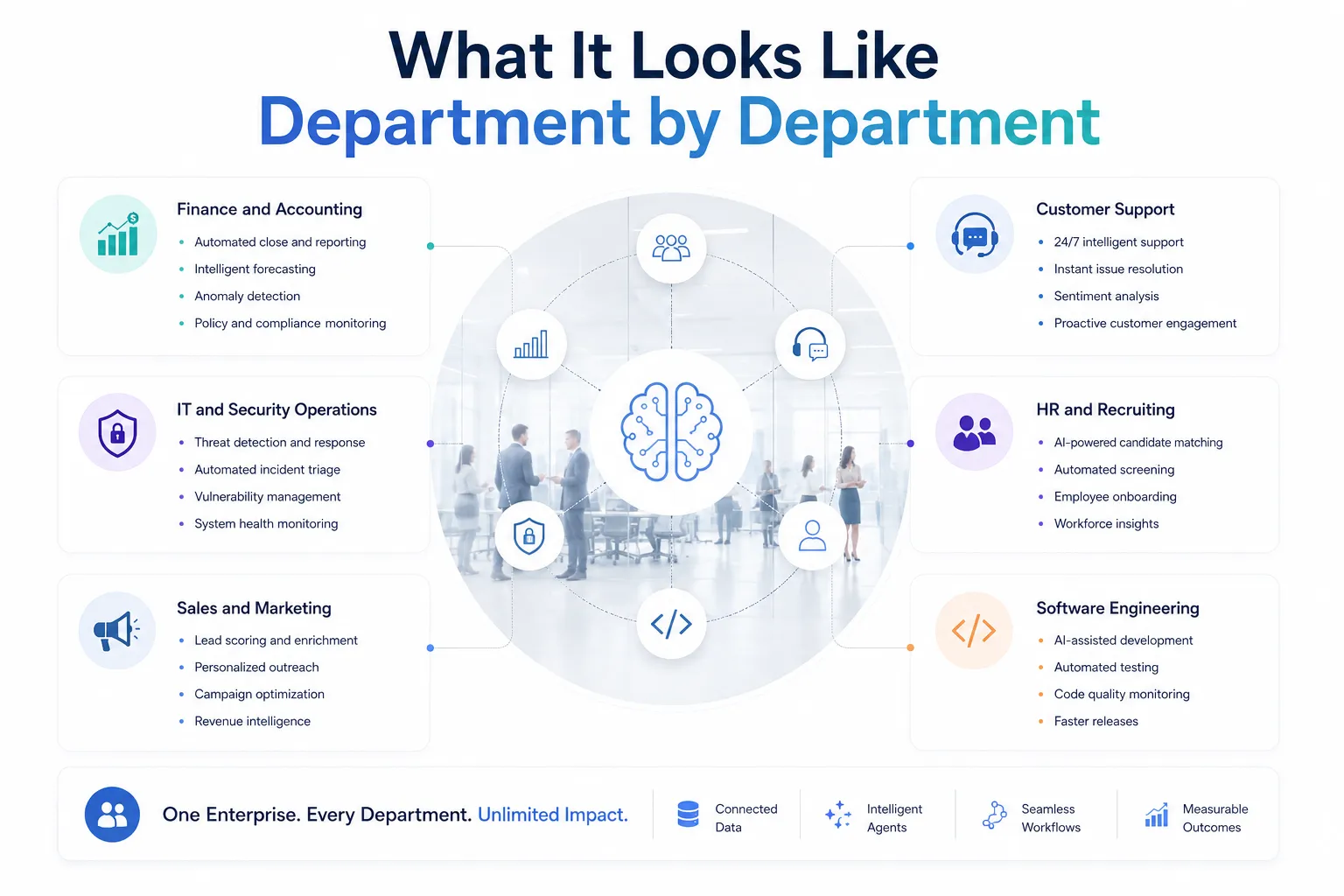
Abstract definitions only get you so far. Here is what agentic operations tend to look like once they mature inside real business functions.
Finance and Accounting
In a traditional finance team, closing the books involves someone pulling data from multiple systems, reconciling discrepancies by hand, and chasing down missing documentation through email. In an agentic setup, an agent continuously monitors transactions as they happen, flags anomalies in real time instead of at month-end, automatically matches invoices to purchase orders, and drafts the reconciliation report. A human finance lead reviews flagged exceptions and signs off on the final numbers, but the grunt work of chasing and matching disappears.
Customer Support
Instead of a chatbot that answers FAQs and then dumps anything complicated onto a human queue, an agentic support system can look up a customer’s order history, check inventory or shipping status across systems, issue a refund within a pre-approved policy limit, and follow up automatically if the customer does not respond. Humans step in only for edge cases, complaints that involve genuine ambiguity, or anything touching legal or safety concerns.
IT and Security Operations
A security agent can watch network traffic, correlate unusual login patterns, and isolate a compromised device before a human analyst even opens their laptop. That is not hypothetical. It is close to the example Gartner itself uses when describing task-specific agents already in deployment. The security team’s role shifts from constant monitoring to reviewing incident reports and refining the rules the agents operate under.
HR and Recruiting
Screening resumes, scheduling interviews, sending onboarding paperwork, and answering routine policy questions are exactly the kind of repetitive, document-heavy tasks agents handle well. A recruiting agent can shortlist candidates against a defined scorecard, coordinate calendars across multiple interviewers, and even draft personalized rejection or offer communications, leaving recruiters to focus on relationship-building and final decisions.
Sales and Marketing
Lead qualification, CRM data hygiene, follow-up sequencing, and even first-draft proposal generation can run largely on agents that watch buying signals and adjust outreach automatically. Sales reps end up spending their time on relationship-building and closing rather than administrative upkeep.
Software Engineering
This is often where agentic work is most mature already. Coding agents can write, test, and even deploy code changes for well-scoped tickets, with engineers reviewing pull requests rather than writing every line themselves. Several industry surveys point to software engineering as the function furthest along the agentic adoption curve, largely because the tasks are well-defined and the feedback loop (does the code pass tests?) is fast and objective.
The Infrastructure Underneath It All
None of the department-level examples above work without a specific set of technical and organizational foundations. This is the part that gets skipped in a lot of the hype cycle coverage, but it is where most agentic projects actually succeed or fail.
Clean, connected data. Agents are only as good as what they can see. If your CRM, ERP, and support ticketing system do not talk to each other, an agent cannot make a good decision because it is working with a partial picture. Data consolidation and access governance are unglamorous, but they are prerequisite work, not optional extras.
An orchestration layer. Somebody needs to manage how agents hand off work to each other, retry failed steps, and log what happened for auditing. This is often the missing piece between “we have a cool agent demo” and “we have agents running production workflows reliably.”
Guardrails and permissioning. A fully agentic enterprise still needs strict boundaries around what an agent can do without human sign-off. That might mean dollar thresholds on financial actions, mandatory human review for anything customer-facing that touches a complaint, or hard stops on actions affecting regulated data.
Human-in-the-loop checkpoints, by design, not by accident. The most mature organizations are not removing humans from the loop entirely. They are redesigning where humans sit in that loop, moving them from doing repetitive execution to supervising, auditing, and handling exceptions. This is consistently the differentiator between organizations that see real returns and those that stall out in pilot purgatory.
Continuous monitoring and evaluation. Agents drift, models get updated, edge cases emerge that were not part of the original design. Fully agentic organizations treat agent performance like a live product, with ongoing testing, not a one-time deployment.
If you are earlier in the process and trying to figure out which of these foundations you are missing, working with a partner that has built AI-driven solutions across multiple industries can shortcut a lot of the trial and error, particularly around data integration and the orchestration layer, which tend to be the two places internal teams get stuck.
Why Most Companies Are Not There Yet
It is worth being honest about where the industry actually stands, because the term “agentic enterprise” gets used loosely enough that it can sound like everyone else is already there and you are behind. That is not accurate.
Multiple surveys from major analyst firms describe a similar picture: broad experimentation, narrow scaling. Most organizations have agents running in one or two functions at most, not across the enterprise. The barriers are not really about the technology being immature, though there is some of that too. They are about organizational readiness: messy data, unclear ownership of processes, procurement and legal review cycles that were not designed with autonomous systems in mind, and a natural, reasonable hesitation about handing decision authority to a system that can make mistakes at machine speed.
That last point deserves attention. When a human employee makes an error, it is usually contained to one transaction, one email, one customer. When an agent has a flaw in its logic and acts on it repeatedly across hundreds of interactions before anyone notices, the damage compounds quickly. That is exactly why the guardrails and monitoring layer matters as much as the intelligence of the agent itself.
A Realistic Roadmap to Get There
If you are trying to move your organization toward a genuinely agentic operating model, the sequence matters more than the ambition.
Start with one high-volume, well-defined process. Pick something repetitive, rules-based, and measurable, invoice processing, ticket triage, candidate screening. Avoid starting with something that involves heavy judgment calls or legal exposure.
Fix the data pipes before you fix the workflow. An agent cannot orchestrate across systems that do not share data cleanly. This step is less exciting than deploying an agent, but it determines whether the agent actually works.
Define the boundaries explicitly before deployment. Decide, in writing, what the agent can decide on its own and what always requires human review. Do not leave this ambiguous and hope the agent figures it out.
Instrument everything. Track error rates, escalation frequency, time saved, and unexpected behaviors from day one. You cannot scale what you cannot measure.
Expand function by function, not all at once. Trying to make every department agentic simultaneously multiplies the risk surface and makes it much harder to trace where a problem originated.
Re-skill, do not just redeploy. Employees whose repetitive tasks get automated need a clear path to the higher-judgment work that remains. Skipping this step is a common source of internal resistance that slows adoption far more than any technical limitation does.
The Cultural Shift Nobody Talks About Enough
There is a version of this conversation that focuses entirely on architecture diagrams and ROI models, and that is useful, but it misses something important. Becoming a fully agentic enterprise changes what it feels like to work somewhere. Managers stop managing task completion and start managing exceptions and outcomes. Employees who used to measure their day by how many tickets they closed now measure it by how well they handled the two or three genuinely hard cases an agent could not resolve on its own.
That is a real adjustment, and it is one that gets underestimated constantly. Organizations that treat the cultural shift as an afterthought, something HR handles after the technical rollout, tend to see slower adoption and more quiet resistance than organizations that build change management into the project from the start.
What This Looks Like Five Years From Now
It is tempting to imagine a fully agentic enterprise as some kind of lights-out operation where software runs everything and people show up occasionally to check on things. That is probably not where this heads, at least not broadly. A more realistic picture is an organization where the ratio of people to process shrinks dramatically for repeatable work, while the number of people focused on strategy, relationships, exception handling, and judgment calls stays roughly steady or even grows, because those are the areas where human contribution remains hardest to replace and most valuable.
The companies that get there first will not necessarily be the ones with the flashiest individual AI feature. They will be the ones that did the unglamorous work of connecting their data, defining their guardrails clearly, and giving their people a real role to play once the repetitive tasks were gone. That is a harder problem than picking the right model or the right vendor, but it is the one that actually determines whether “agentic enterprise” becomes a real operating model or just another slide in a strategy deck.
How to Tell If You Are Actually Agentic, Not Just Automated
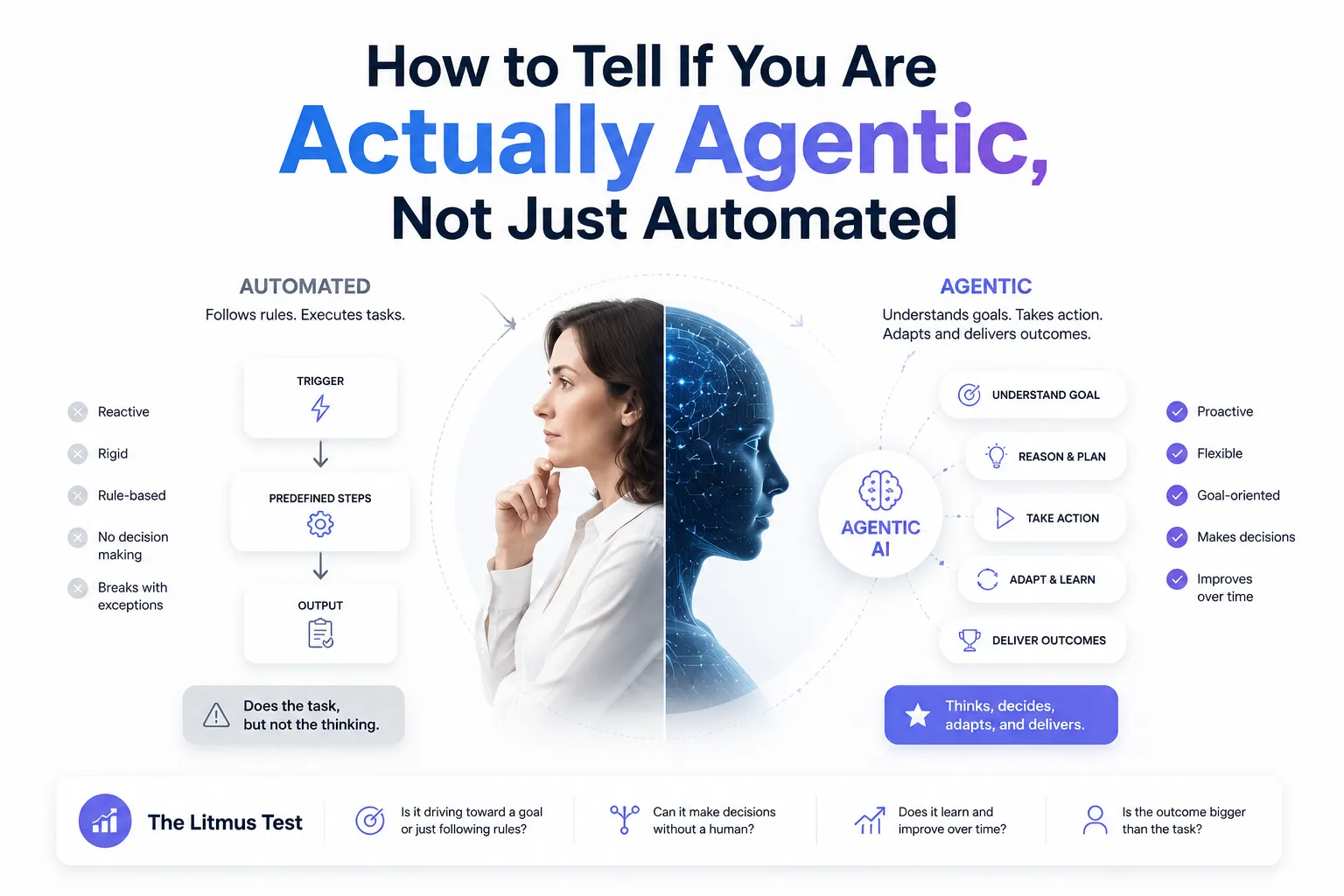
It is easy for a company to convince itself it has gone agentic when it has really just added a smarter layer of rules-based automation. The difference is worth being precise about, because it changes how you evaluate progress and where you invest next.
A genuinely agentic system can handle situations it was not explicitly scripted for, within the boundaries you set. If your support system can only follow a fixed decision tree and breaks the moment a customer’s question does not match a pre-built path, you are running automation with a chat interface, not an agent. A true agent reasons through unfamiliar combinations of information, checks multiple systems if needed, and produces a judgment call it can explain, even if that judgment call sometimes needs a human to override it.
Another signal is how the system behaves when something goes wrong upstream. Automation typically fails silently or throws an error that sits in a queue until a person notices it. An agentic system, properly built, recognizes that a step failed, tries an alternative path if one exists, and escalates clearly when it cannot resolve the issue on its own, rather than leaving a broken process invisible until someone stumbles across it.
A third test is whether the system’s scope expands naturally over time without a developer rewriting its rules from scratch. Automation tends to be brittle, every new scenario requires new code. An agent built on a foundation model can often generalize to adjacent tasks once its guardrails and available tools are defined, which is part of why the same underlying agent architecture can move from handling invoice matching to handling vendor onboarding with comparatively modest additional engineering.
None of this means automation is obsolete. Plenty of processes are genuinely simple enough that rigid, rules-based automation is the right, cheaper answer. The mistake is calling that automation “agentic” and expecting it to handle the messy, judgment-heavy work that only a reasoning system, paired with clear human oversight, can actually manage.
Continue reading the Complete Agentic AI Series
This post is a part of the Agentic AI Content Series — the complete 10 article series to understanding, implementing, and scaling Agentic AI in your organization.