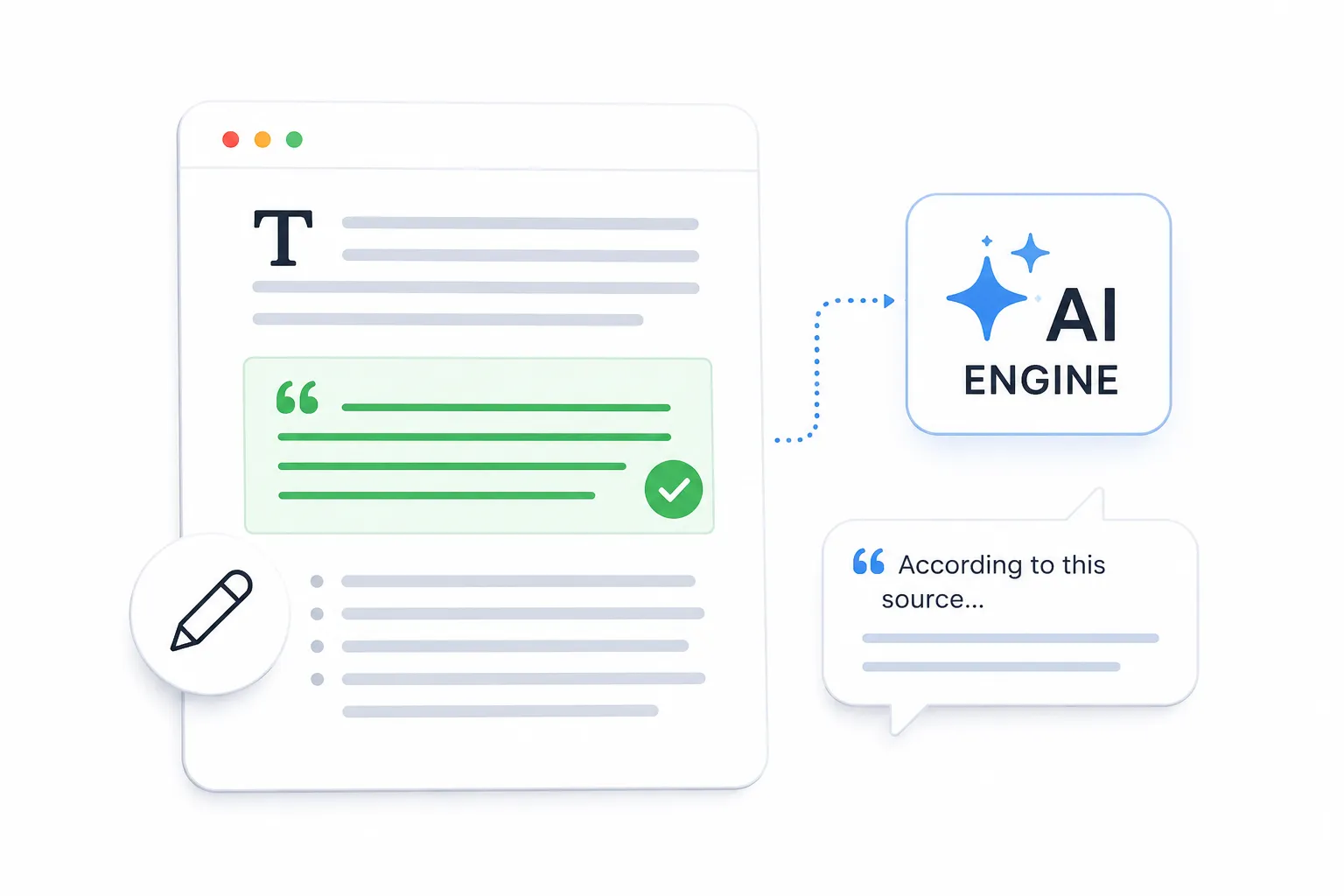

AI engines cite content that answers a question in the first sentence, names clear entities instead of vague pronouns, and shows verifiable experience through original data or real examples. Structuring a passage around a single question, using descriptive headers, and backing claims with credible sources gives large language models a clean, quotable unit to pull from.
Search behavior has quietly split in two. Half of the people looking things up are still typing into a search box and scrolling through blue links. The other half are asking ChatGPT, Perplexity, Gemini, or Google’s AI Overviews a question and reading a synthesized answer that pulls from a handful of sources, sometimes with a citation, sometimes without one. If you write for the web and your content never shows up in that second group of answers, you are losing visibility that no amount of traditional keyword stuffing will win back. Teams at Bantech Solutions have spent the last two years watching this shift play out across client sites, and the pattern is consistent: pages that get cited by AI systems are not necessarily the best written pages, they are the most extractable ones.
This distinction matters more than it sounds. A beautifully written 3,000-word essay with a clever narrative arc can be completely invisible to a language model trying to answer a direct question, while a plainer, more structured page with the same information gets quoted word for word. AI engines do not read the way people do. They chunk content into passages, score those passages for relevance and trust, and then either quote or paraphrase the ones that best answer the query in front of them. Writing for that process requires a slightly different discipline than writing for a human reader scrolling through Google’s ten blue links, even though the two overlap more than most people assume.
What It Actually Means for AI Engines to “Cite” Your Content
When people talk about getting cited by AI, they usually mean one of three things happening. First, a chatbot like ChatGPT or Claude directly quotes or paraphrases a sentence from your page and names your brand or domain as the source. Second, an AI Overview or a Perplexity answer includes a clickable link back to your URL alongside the synthesized response. Third, and more subtly, your content shapes the underlying answer even without an explicit citation, because the model was trained on or retrieved passages from your page during generation.
Retrieval-augmented systems, which is what most consumer AI search tools rely on today, work by running a query, pulling back a set of candidate documents, and then asking a language model to compose an answer using only (or mostly) the retrieved passages. That means your odds of being cited depend on two separate things: whether your page gets retrieved in the first place, and whether the retrieved passage is clean enough for the model to lift directly. A page can rank well in traditional search and still lose at this second stage if the actual answer is buried in a wall of text, split across three paragraphs, or wrapped in marketing language that the model has to strip away before it can use the fact underneath it.
Answer-First Structure: Give the Model Something to Grab
The single highest-leverage change most writers can make is moving the direct answer to the very top of the section, not the bottom. Traditional blog writing often builds up to a point: a hook, some context, a story, and then the payoff three paragraphs later. That structure works fine for a human reader who is willing to scroll, but it is a poor fit for how retrieval systems chunk and score content. If the answer to “how long does it take to build an AI model” is buried under four paragraphs of scene-setting, the model may retrieve the wrong chunk entirely, or retrieve a fragment that reads awkwardly out of context.
The fix is what some SEO practitioners call the inverted pyramid, borrowed straight from journalism. Put the conclusion first. Follow it with supporting detail, caveats, and nuance. This does two things. It gives search and AI crawlers a self-contained, quotable unit near the top of the page, and it respects the reader who wants the answer immediately and the detail only if they choose to keep reading.
A few practical habits that reinforce this:
- Open each major section with a one or two sentence direct answer to the question implied by the heading.
- Use question-phrased headers (“How much does AI development cost?”) rather than vague ones (“Pricing Considerations”), since this mirrors how people actually type queries into AI chat interfaces.
- Keep the first answer paragraph under 60 words where possible, since that is roughly the length that tends to get lifted whole into AI Overviews and voice-style answers.
- Avoid starting an answer with a pronoun or a reference to something mentioned earlier in the article. The passage needs to make sense on its own, because it will likely be extracted on its own.
This last point deserves its own section, because it is where most well-intentioned articles quietly fail.
Entity Clarity: Say the Name, Not the Pronoun
Language models retrieve and reason over passages, not entire articles. If your third paragraph says “it improved conversion rates by 40 percent” without restating what “it” refers to, a model pulling that paragraph in isolation has no way to reliably resolve the pronoun. The same problem shows up with vague company references like “the firm” or “this approach” when the specific entity was named two paragraphs earlier. Humans track context across a page effortlessly. Retrieval systems often do not, especially when passages are chunked into smaller windows for indexing.
Writing with entity clarity means being slightly more repetitive than instinct suggests is polite. Name the product, the company, the technology, or the person again, even if it was just mentioned. Instead of “it uses machine learning to predict demand,” write “the forecasting model uses machine learning to predict demand.” Instead of “this reduces onboarding time,” write “the automated onboarding workflow reduces onboarding time.” It reads slightly more formal in isolation, but it dramatically increases the odds that any single paragraph can stand on its own when a model extracts it.
This is also where structured data earns its keep. Schema markup such as Article, FAQPage, and Organization schema gives machines an explicit, unambiguous map of who is saying what about which entity, separate from the prose itself. Google’s own documentation notes that it can make broader use of properties like sameAs and other schema.org markup beyond what is formally documented on any single page, and that some of these elements may power future search features once they prove useful. That is a strong signal that entity markup is not just decoration for rich snippets today. It is infrastructure for how machines, including AI systems built on top of the same web graph, will understand your content tomorrow. Anyone serious about this should spend time with the Google Search Central documentation on structured data, which lays out exactly how machine-readable markup should be layered on top of visible page content, including which properties are required versus recommended for each content type and how those properties affect eligibility for enhanced display in search results.
Practical steps for entity clarity include:
- Naming the primary subject of a section in its opening sentence, even if it repeats a word from the heading.
- Using consistent naming for products, features, and companies throughout the piece rather than switching between a formal name and a nickname.
- Adding Organization, Person, and Article schema so machines have a structured backup source for who and what the content is about.
- Avoiding ambiguous demonstrative phrases like “this method” or “that solution” at the start of a paragraph without restating the referent.
E-E-A-T as a Trust Signal for AI Systems, Not Just Google Rankings
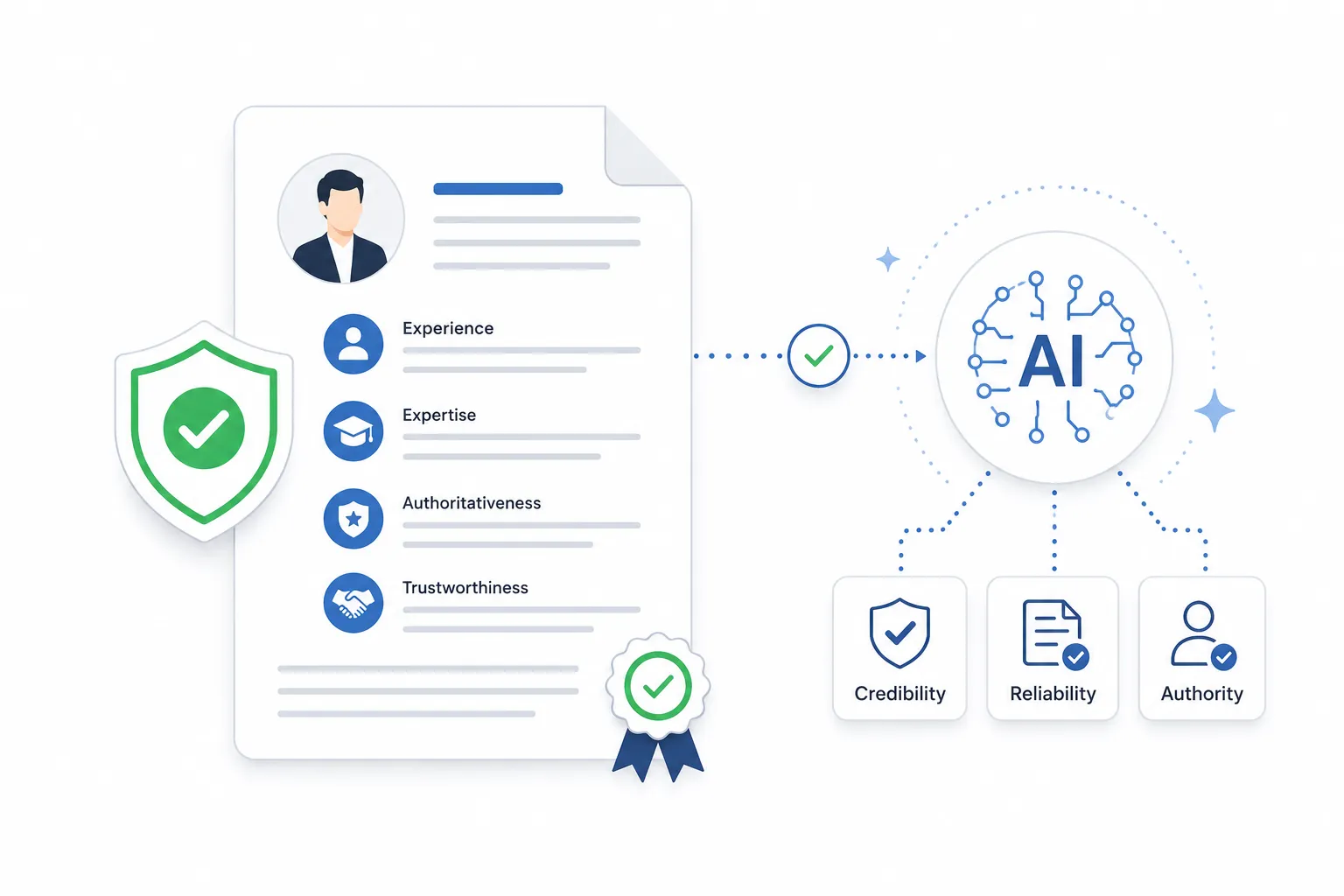
E-E-A-T, which stands for experience, expertise, authoritativeness, and trust, was originally framed as guidance for Google’s human quality raters rather than a literal ranking algorithm. But the underlying idea, that content backed by real experience and verifiable credentials should be trusted more than generic, interchangeable text, has become just as relevant to how AI systems weigh sources during retrieval and generation. A model choosing between two passages that make the same claim will lean toward the one that shows clearer signs of firsthand knowledge, cited data, or an identifiable author with relevant background.
Google’s own guidance describes this directly. Search quality raters are trained specifically to recognize whether content demonstrates strong E-E-A-T, and Google encourages site owners to read the published rater guidelines so they can self-assess their own content and align it with the broader signals its automated ranking systems are built to reward. While that framework was written with human raters in mind, the same logic applies to the retrieval layer underneath modern AI answers, because both systems are ultimately trying to solve the same problem: telling reliable information apart from confident-sounding filler. The full context is worth reading directly on Google’s page about creating helpful, reliable, people-first content, since it explains the “who, how, and why” framing that underlies the entire concept and offers a self-assessment checklist that translates cleanly into an editorial process for any content team.
In practice, showing experience and expertise for an AI-facing audience means a few concrete things. Cite original data instead of paraphrasing a competitor’s blog post. Include specific numbers, dates, and named sources rather than vague claims like “many experts agree.” Attribute the article to a real author with a bio that establishes relevant background, and link that author profile consistently across the site. Where possible, include a case study or a specific example drawn from direct work rather than a hypothetical scenario, since models appear to weight concrete, falsifiable claims more heavily than generic advice that could have been written about any topic.
Trust signals extend beyond the text itself. A page with a clear publication date, a visible author, a working contact page, and consistent information across the wider site sends the same signal to a retrieval system that it sends to a human reader: this is a real, accountable source, not a content farm assembled purely to rank. None of this is a shortcut. It is closer to old-fashioned journalistic rigor applied to a new distribution channel.
Formats AI Engines Tend to Favor
Beyond structure and trust signals, certain content formats seem to get pulled into AI answers more consistently than others, based on patterns observed across client sites and broader industry testing.
Direct question-and-answer blocks. A short FAQ section near the top or bottom of a page, phrased exactly as a user would type or speak the question, gives retrieval systems an almost pre-packaged answer unit. This is the same logic behind ranking for Google’s “People Also Ask” boxes, and it transfers directly to chat-based search.
Numbered steps for processes. When a query implies a sequence (“how do I set up a CI/CD pipeline”), numbered lists are easier for a model to extract cleanly and reproduce faithfully than the same steps described in flowing prose.
Comparison tables. Side-by-side comparisons of options, pricing tiers, or features give models structured data they can summarize accurately, rather than forcing them to infer relationships from paragraph text.
Definitions stated plainly. A single sentence that defines a term clearly, ideally right after the term is introduced, tends to get pulled directly into glossary-style AI answers.
Original statistics and firsthand examples. Content that contains a number nobody else has published, drawn from an actual project, survey, or dataset, has a much better chance of being cited than a summary of statistics everyone else is also citing, because it gives the model something unique to attribute.
None of these formats replace good writing. They sit inside it, giving the underlying prose clear landmarks that both human skimmers and machine retrievers can use to navigate the page quickly.
Common Mistakes That Get Good Content Skipped
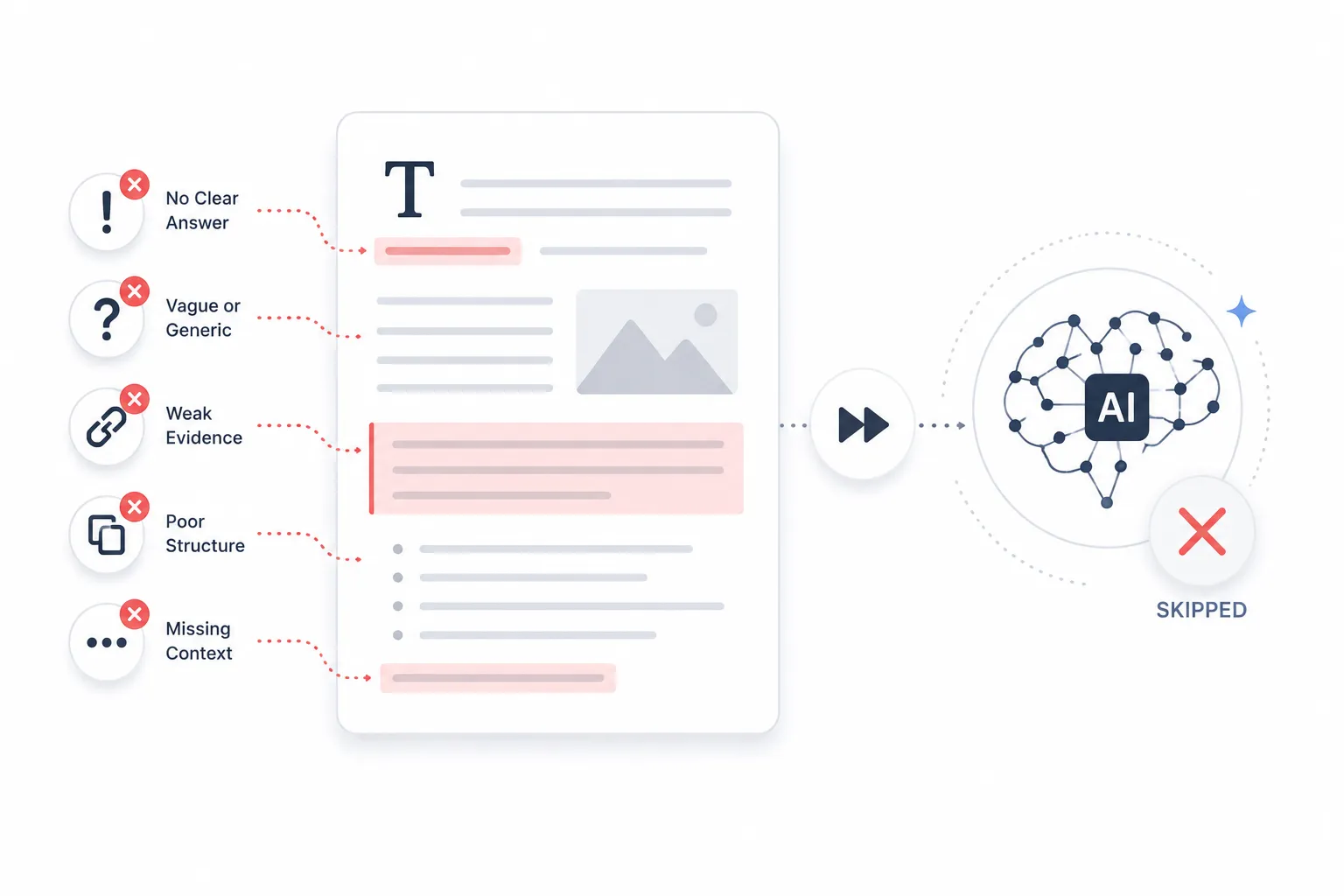
A surprising amount of high-quality content still gets passed over by AI systems, usually for a handful of avoidable reasons. The most common is answer-burying, where the actual response to the implied question sits three or four paragraphs deep, after a long introduction about industry trends or a personal anecdote. Another is over-reliance on transitional throat-clearing, sentences like “in today’s fast-paced digital world” or “it’s important to note that,” which add length without adding retrievable substance and often get stripped or skipped by summarization models anyway.
Keyword stuffing, ironically, tends to hurt more with AI systems than it ever did with traditional search, because unnatural repetition makes a passage harder to extract cleanly and signals lower quality to the language models scoring retrieved candidates. Similarly, content that reads as a rewrite of three other articles on the same topic, without a distinct angle, data point, or example, rarely gets chosen when a model has several nearly identical passages to pick from and needs a reason to prefer one over the others.
Technical issues matter too. Pages that load slowly, block crawlers inconsistently, or hide key content behind JavaScript that renders late can simply never make it into the retrieval index in the first place, regardless of how well the writing itself is structured. Getting the content right is necessary but not sufficient if the underlying technical foundation is not solid.
How to Audit Whether Your Content Is Citable
A practical audit process does not require expensive tools. Start by picking five to ten questions your target audience is likely to ask an AI assistant related to your topic, and run them directly through ChatGPT, Perplexity, and Google’s AI Overview where available. Note whether your domain appears, whether the language matches your actual phrasing or has been heavily reworded, and which competing sources are being cited instead.
Next, open your own page and imagine a model retrieving just the first two sentences of each major section in isolation. Do they make sense without the rest of the paragraph? Do they name the subject clearly, or lean on a pronoun? Would a stranger reading only that fragment understand the claim and who it applies to? If the answer is no, that section needs restructuring, regardless of how well it reads in full context.
Finally, check the supporting signals: is there a visible author with a real bio, a clear publish date, working internal and external links, and schema markup that matches the visible content. Combining strong on-page structure with the kind of technical and off-page groundwork covered under SEO and digital marketing strategy tends to produce the most durable results, since AI visibility and traditional organic visibility are increasingly built on the same underlying foundation of clarity, authority, and technical soundness rather than two separate playbooks.
Keeping Content Citable as AI Systems Evolve
The models and retrieval pipelines behind AI search are updated far more often than most traditional search algorithms ever were, which means a page that gets cited today can quietly drop out of rotation a few months later without any obvious warning. Treating this as a one-time editing pass rather than an ongoing habit is one of the more common mistakes teams make once they start seeing early wins. A page that earned a citation from an answer engine in January is worth revisiting in July, both to confirm it is still being pulled and to check whether a competitor has since published something more current, more specific, or better structured on the same question.
Refreshing a date, a statistic, or an example every few months does more than keep the page technically accurate. It signals to both human editors and machine retrievers that the content is actively maintained rather than a static artifact left to decay. Pages tied to fast-moving topics, pricing, tools, regulations, or anything version-dependent, benefit the most from this kind of light, regular maintenance, since stale specifics are one of the fastest ways a previously reliable source starts losing ground to a more recently updated competitor.
It also helps to track citations the same way a team might track keyword rankings. Running the same set of test queries against ChatGPT, Perplexity, and Google’s AI Overview on a monthly or quarterly cadence builds a simple before-and-after record of which pages are being pulled, which have dropped out, and which competitors have started appearing instead. That record turns an otherwise invisible process into something a content or marketing team can actually manage and improve deliberately, rather than guessing at what worked after the fact.
Bringing It Together
Writing content that AI engines actually cite is less about learning an entirely new discipline and more about tightening habits that good writers and good SEOs have used for years, applied with slightly more discipline. Answer the question immediately instead of building up to it. Name entities explicitly instead of leaning on pronouns and vague references. Back claims with real experience, original data, and identifiable authorship instead of generic filler. Use formats, like short FAQs, numbered steps, and comparison tables, that give both human skimmers and machine retrievers clear landmarks to navigate by.
None of this guarantees a citation in any specific AI answer, since retrieval systems weigh dozens of signals and change frequently. But content built this way consistently performs better across both traditional search rankings and AI-generated answers, because it is fundamentally easier to trust, easier to extract, and easier to verify, for a machine and for a person reading the same page. That overlap is exactly why this approach is worth the extra editing pass. It is not writing for algorithms instead of people. It is writing clearly enough that both can use what you wrote without losing what you meant.
Other Articles in the AI Search & GEO Series
This post is part of the AI Search & GEO Content Series — a practical guide to improving visibility across traditional search engines and AI-powered search experiences.