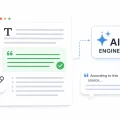

GEO vs. Traditional SEO: Where Should Your 2026 Budget Actually Go?
You should not choose one over the other. In 2026, a workable split for most mid-market companies is putting 60 to 75 percent of your search budget toward traditional SEO fundamentals that still drive rankings and AI citations alike, and 25 to 40 percent toward GEO-specific work like structured data, answer-first content, and AI platform monitoring. The right ratio depends on how much of your category’s search volume already flows through AI answers.
If you have been following this series, you already know the ground has shifted. We have walked through how to audit your site for AI search readiness, what changes for local “near me” queries once AI answers get involved, how to actually measure whether ChatGPT or Google’s AI Overviews are citing you, and how to write content that AI engines want to pull from. What we have not answered yet is the question every marketing leader eventually asks once the tactics start piling up: how much of the budget goes where. That is the gap teams at Bantech hear most often from clients trying to plan 2026 spend, and it is the one this final piece is built to answer directly.
This is not a theoretical exercise. Budgets are flat or shrinking at most companies, AI is eating an increasing share of both marketing spend and search behavior, and finance teams want a specific number, not a vibe. So let’s build the actual framework: what GEO and SEO cost, where they overlap, where they diverge, and how to split a real dollar figure between them based on your specific situation rather than a generic industry rule of thumb.
First, Get the Terms Straight
Before splitting a budget, it helps to be precise about what each discipline actually covers, because a lot of budget confusion comes from treating GEO as a total replacement for SEO rather than an adjacent, partially overlapping discipline.
Traditional SEO is the set of practices built around ranking in the classic ten blue links: keyword research tied to search volume and intent, technical crawlability and site speed, backlink acquisition, on-page optimization, and content built to satisfy a ranking algorithm that rewards relevance, authority, and user experience signals accumulated over months or years.
GEO, short for generative engine optimization, is the newer discipline focused on getting cited, mentioned, and recommended inside AI-generated answers across ChatGPT, Perplexity, Google’s AI Overviews and AI Mode, Copilot, and Gemini. It leans on structured, self-contained answers, schema markup, clear source attribution, and content formatted so a language model can lift a fact or a quote cleanly without needing to interpret ambiguous phrasing.
The overlap between the two disciplines runs at roughly 30 percent by most working estimates from teams actively tracking both. That overlap covers things like site structure, page speed, topical authority, and E-E-A-T signals, all of which help both a classic crawler and an AI retrieval system decide your content is trustworthy. The other 70 percent is where the real budget decision lives, and it is genuinely separate work with separate deliverables, separate KPIs, and in many organizations, a separate owner.
Why This Question Got Urgent in 2026

A year ago, GEO was mostly an experimental line item, something a forward-leaning content team tested on a handful of pages. That framing does not hold anymore, and the data backs up why.
Gartner’s 2026 CMO Spend Survey, conducted across 401 marketing leaders in North America, the UK, and Europe, found that CMOs are now allocating an average of 15.3 percent of their overall marketing budgets specifically to AI initiatives, even as total marketing budgets stay nearly flat at 7.8 percent of company revenue. The organizations Gartner classifies as AI-mature, meaning they have built the operational readiness to actually use those investments, allocate 21.3 percent to AI and report marketing budgets 1.1 percentage points higher as a share of revenue than the survey average. In other words, the companies pulling ahead are not spending marginally more on AI. They are restructuring how the whole budget gets prioritized around it, based on findings the firm shared through the Gartner 2026 CMO Spend Survey.
That reallocation pressure would matter less if SEO and GEO produced identical results from identical work. They do not. Research from EMARKETER, drawing on an analysis of citations pulled by ChatGPT, Gemini, and Copilot, found that fewer than 10 percent of the sources those AI engines cite also rank in the top ten Google organic results for the same query. That is a striking gap. It means a page that has spent two years climbing to position three on Google carries almost no guarantee of showing up as a cited source when someone asks an AI assistant the equivalent question, according to the firm’s Generative Engine Optimization in 2026 report. Budget spent purely chasing rank position is, increasingly, budget that does not automatically transfer to AI visibility. That is the crux of why this decision needs its own framework instead of an assumption that good SEO eventually becomes good GEO on its own.
What Each Discipline Actually Costs
Before assigning percentages, it helps to look at what a dollar buys in each category, because the cost structures are genuinely different.
Traditional SEO spend typically covers:
- Keyword research and competitive gap analysis
- Technical audits, site speed, crawl budget, and indexation fixes
- On-page optimization across existing and new pages
- Link building and digital PR
- Local SEO and Google Business Profile management
- Rank tracking and traditional analytics reporting
GEO spend typically covers:
- Structured data implementation (FAQPage, HowTo, Organization, and speakable schema)
- Content reformatted for direct, extractable answers, often restructuring existing pages rather than writing new ones from scratch
- AI crawler accessibility, meaning making sure bots like GPTBot, PerplexityBot, and Google-Extended can actually reach and parse your content
- Prompt library development and manual or automated AI visibility monitoring across platforms
- Digital PR and third-party mentions specifically aimed at earning citations on high-authority sites AI models trust, since brand-owned pages are cited less often than independent, authoritative sources
- Sentiment and share-of-voice tracking against named competitors
Notice that GEO is not simply “SEO plus AI.” It requires new tooling in some cases, new content formats in almost all cases, and a measurement approach that most existing analytics stacks were not built for. That is part of why folding GEO spend quietly into an existing SEO line item so often causes it to get starved. Whoever owns that combined budget is still measured on rankings and organic sessions, and GEO’s outputs, citation frequency and AI share of voice, do not show up cleanly in either of those numbers.
The Decision Framework: Four Questions That Set Your Split
Instead of applying a fixed industry ratio, run your specific situation through these four questions. Each one nudges your budget split in a direction.
1. How much of your category’s search volume is already flowing through AI answers?
This is the single biggest driver of your split, and it varies enormously by industry and query type. B2B software categories, health and wellness informational queries, and “how to” and comparison-style searches tend to show heavy AI answer involvement already. Highly transactional, local, or brand-name-driven queries, like “plumber near me” or “[your brand] login,” still route mostly through classic search and maps results.
Pull your own search query data from Google Search Console and look for a pattern: are your highest-volume informational queries increasingly showing an AI Overview above the organic results? If yes for most of your top 20 queries, tilt your split toward GEO. If your traffic is dominated by branded and highly local, transactional terms, traditional SEO still carries more of the weight.
2. Where does your competitive exposure sit?
Run five to ten of your most important buyer-journey prompts through ChatGPT, Perplexity, and Google’s AI Overviews. Are competitors showing up as cited sources or brand mentions where you are absent? A visible citation gap against named competitors is one of the clearest signals that GEO investment has an immediate, addressable target rather than a speculative one.
If you are already well cited relative to competitors, you can afford a lighter GEO allocation focused on maintenance and monitoring rather than aggressive content rebuilding.
3. How mature is your measurement function?
GEO’s return on investment is genuinely harder to prove than SEO’s, at least for now. Neither Google Search Console nor standard GA4 reporting cleanly isolates AI Overview clicks from regular organic clicks, and a meaningful share of AI search sessions end without any click at all. If your team does not yet have a working process for tracking citations, mentions, and share of voice, a large GEO budget risks becoming spend you cannot defend at the next budget review.
In that case, a smaller initial GEO allocation paired with dedicated investment in measurement tooling and process, so the case for scaling up next year is backed by real numbers rather than anecdotes, is the more defensible path.
4. What is your content team’s actual bandwidth and skill set?
GEO content work is not the same skill as traditional SEO copywriting. It rewards writers who can front-load a direct answer, cite sources precisely, and structure content so an individual paragraph stands on its own without depending on surrounding context. Some SEO content teams pick this up quickly. Others need training, a rewritten style guide, or outside support to make the shift. Underestimating this ramp-up time is one of the most common reasons GEO budgets underperform in year one.
Sample Splits by Company Stage
These are starting points, not prescriptions, built from the four questions above and adjusted for common organizational realities.
Early-stage or resource-constrained teams (limited combined search budget): Lean 80/20 toward traditional SEO. Foundational technical SEO and content still deliver the most reliable return when resources are thin, and much of that foundational work also strengthens AI visibility as a side effect, since the 30 percent overlap covers exactly this kind of work.
Established mid-market companies with steady organic traffic: A 65/35 or 70/30 split toward SEO, with the GEO portion concentrated on your highest-value, most AI-exposed query categories rather than spread thin across the entire site. This matches the informal benchmark several agencies report for first-year GEO allocations, generally in the 8 to 15 percent range of combined SEO and content budget, scaling as measurement matures.
Category leaders in AI-heavy verticals (B2B SaaS, health information, financial services comparison content): Closer to 50/50, sometimes tilting toward GEO if competitive citation gaps are wide and the cost of ceding AI visibility to a competitor is high. These are the categories where EMARKETER’s low citation-overlap findings bite hardest, since ranking well on Google buys you comparatively little insurance against AI invisibility.
Enterprise organizations already AI-mature per Gartner’s framework: These companies are not treating this as a binary split at all. They are restructuring the whole marketing budget around AI capability, per Gartner’s data showing AI-ready organizations commit 21.3 percent of total marketing spend to AI initiatives broadly, GEO included, and pair it with higher overall marketing investment as a share of revenue.
Common Mistakes When Splitting the Budget

Treating GEO as a bolt-on to the existing SEO retainer. When GEO work gets folded into an unchanged SEO scope with no additional budget or hours, it gets deprioritized every time a ranking fire drill comes up, because the team is still measured on rankings.
Assuming last year’s SEO content library transfers automatically. Given how low the citation overlap with top Google rankings actually runs, a content library optimized purely for classic ranking signals needs active rework, not just a schema markup pass, to earn AI citations.
Waiting for perfect measurement before starting. Measurement maturity is a reason to start smaller, not a reason to wait. AI citation behavior is moving fast enough that a team starting from zero in 2027 will be meaningfully behind competitors who spent 2026 building even an imperfect tracking habit.
Cutting traditional SEO too aggressively. GEO does not replace the need for a technically sound, well-linked, authoritative site. Several of the strongest AI citation performers are still winning largely because their underlying SEO fundamentals, crawlability, site structure, topical depth, are already strong. Starving that foundation to fund GEO experiments tends to hurt both disciplines at once.
Putting the Framework to Work
Here is how to actually run this exercise with your own numbers rather than treat it as an abstract model.
Start by pulling your last twelve months of organic search data and flagging which of your top-performing query categories show visible AI Overview or AI Mode involvement in the search results today. Next, run your priority buyer-journey prompts across ChatGPT, Perplexity, and Google to build a simple citation gap list against two or three named competitors. Cross-reference that against your team’s current measurement capability, and be honest about whether you can track citation frequency and share of voice reliably today or need to build that first. Finally, weigh your content team’s readiness to produce answer-first, source-verifiable content against their current SEO-only workflow.
Those four inputs will point you toward one of the sample splits above, or somewhere between them. What they will not do is hand you a single universal percentage, because none exists yet. The teams treating this as a fixed ratio applied blindly across every account are consistently the ones misallocating budget in one direction or the other.
Where This Leaves Your 2026 Planning
The honest answer to “GEO or traditional SEO” is that the question itself is a false choice dressed up as a strategic decision. The real work is diagnostic: understanding how much of your specific audience’s search behavior has already moved into AI answers, how exposed you are to competitors winning that visibility instead of you, and how ready your team and your measurement stack are to act on what you find. Get those three things right, and the budget split follows logically rather than needing to be guessed at from an industry benchmark that was likely built for a different company’s audience entirely.
This is also, deliberately, not a decision to make once a year and forget. AI citation behavior has shown swings of more than 30 percent within a five-week window on some tracked prompt sets, and the underlying platforms themselves, Google AI Mode chief among them, are still actively expanding and changing how they select and display sources. A budget split that made sense in January can look outdated by summer if nobody is watching the data in between.
If your team is still working from a rank tracker and a single SEO line item, that is a reasonable place to have started twelve months ago. It is not a reasonable place to still be sitting heading into 2026 planning season. The teams that treat this as an ongoing, data-informed allocation rather than a one-time budget line will be the ones with real numbers to defend at next year’s review, instead of a hunch about whether the AI spend “seemed worth it.”
If you want a second set of eyes on where your specific search and content data points, Bantech’s SEO team works through exactly this kind of diagnostic with clients before recommending a split, rather than starting from a generic percentage. That conversation tends to be a far more useful starting point for a 2026 budget than any industry rule of thumb, this one included.
Frequently Asked Questions
Should I completely replace my SEO budget with GEO spend?
No. The two disciplines overlap by roughly 30 percent and traditional SEO fundamentals, technical health, site authority, and content depth, still underpin most AI citation performance. Treat GEO as an addition with its own budget line, not a wholesale replacement.
How much should a small business budget for GEO in 2026?
Most agencies report first-year GEO allocations in the 8 to 15 percent range of a combined SEO and content budget for mid-market and smaller teams, scaling up once measurement shows clear return, rather than starting at parity with SEO spend.
Does investing in GEO hurt my traditional Google rankings?
Not inherently. Much of the foundational work, structured data, clear content organization, and authoritative sourcing, benefits both disciplines simultaneously. Problems only arise when GEO work is funded by cutting core SEO investment rather than by adding new budget.
Who should own the GEO budget inside a marketing team?
Most commonly the same team already responsible for organic content strategy, given the skill overlap, but with a dedicated budget line rather than folding GEO into the existing SEO scope, since teams measured only on rankings tend to deprioritize GEO work under deadline pressure.
How often should I revisit my GEO versus SEO budget split?
Quarterly, at minimum. AI citation behavior changes fast enough that a split set once a year at the start of budget season can be noticeably out of date by the middle of it.
Other Articles in the AI Search & GEO Series
This post is part of the AI Search & GEO Content Series — a practical guide to improving visibility across traditional search engines and AI-powered search experiences.