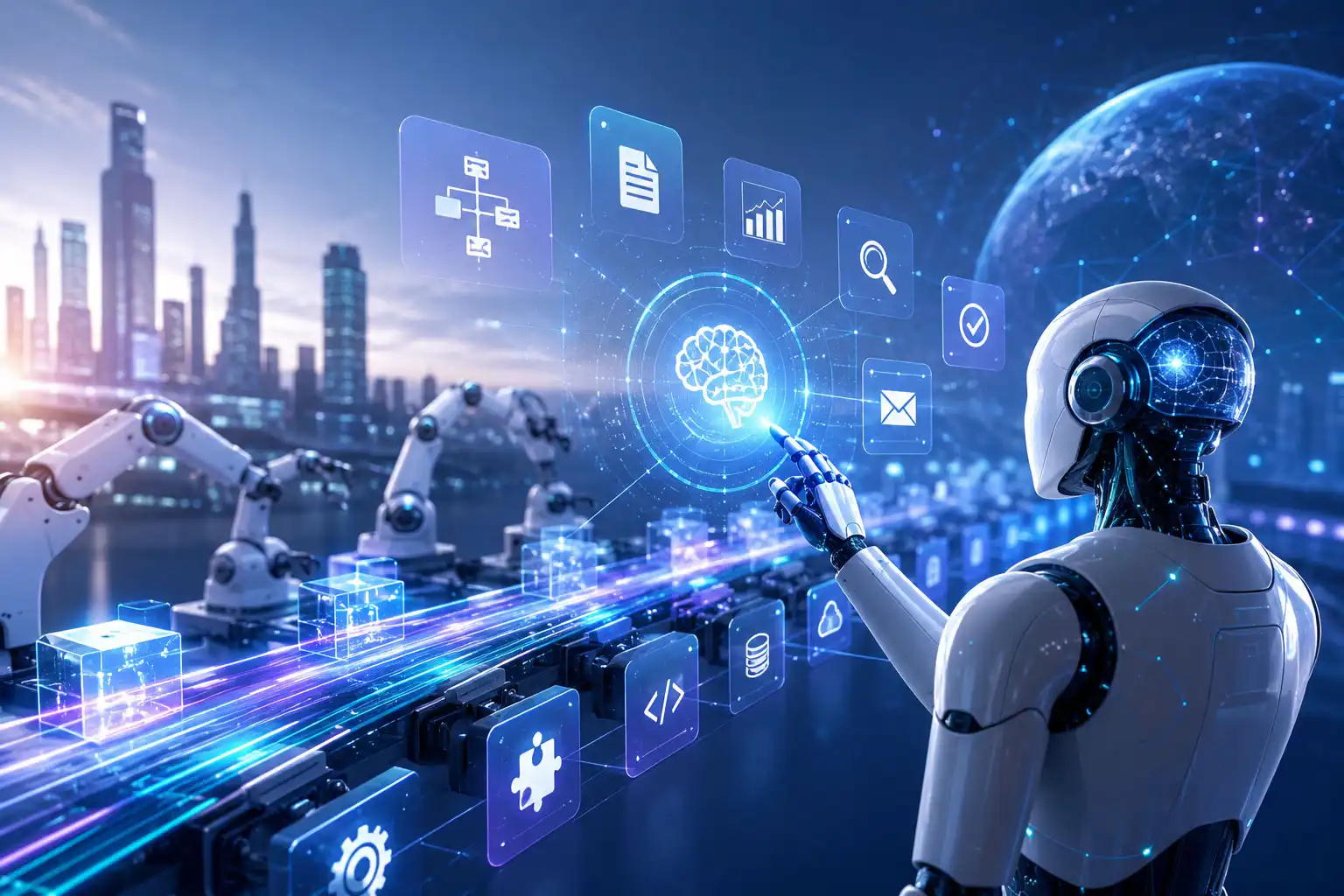
Every technology has a horizon — a point beyond which current thinking struggles to see clearly. For hyperautomation, that horizon is closer than most organizations realize, and what lies beyond it is not simply more of the same, only faster. It is a qualitatively different mode of operating: one in which the boundaries between human decision-making and machine execution become genuinely fluid, where organizations run digital replicas of themselves in real time, and where autonomous AI agents manage entire business functions with a level of sophistication that today’s RPA bots cannot approach.
The global hyperautomation market sat at USD 68.2 billion in 2026 and is on a trajectory toward USD 278 to 306 billion by 2035 — a near-fivefold expansion over a decade. But the more interesting story is not the market size. It is the nature of what that market will be selling by the time it reaches that scale. The automation of 2030 will bear about as much resemblance to today’s RPA-centered deployments as a modern jet engine bears to the Wright Brothers’ first propeller.
This article examines what is coming: the technologies emerging at the frontier of hyperautomation, the organizational transformations they will enable, the risks and responsibilities they introduce, and what it means — practically and strategically — for organizations that want to be on the right side of that shift.
Where Hyperautomation Stands Today: The Inflection Point
To understand where hyperautomation is going, it is useful to be precise about where it stands right now.
In 2026, the majority of enterprise hyperautomation deployments are what practitioners call “directed automation” — systems that follow human-designed workflows, execute human-defined rules, and escalate to human judgment when exceptions fall outside predefined parameters. The intelligence in these systems is real and valuable — machine learning models that classify documents, NLP systems that understand intent, process mining tools that surface inefficiencies — but the fundamental architecture is still one in which humans design the process and machines execute it.
The shift that is already underway, and that will accelerate dramatically through the remainder of this decade, is toward what analysts are calling “autonomous automation” — systems that do not merely execute human-designed workflows but can independently discover what needs to be done, design the optimal approach, execute it, monitor the results, and adjust their behavior based on what they learn.
This shift is being driven by agentic AI, and it represents the most significant evolution in automation technology since RPA was first deployed at enterprise scale.
Agentic AI: The Engine of the Next Automation Era

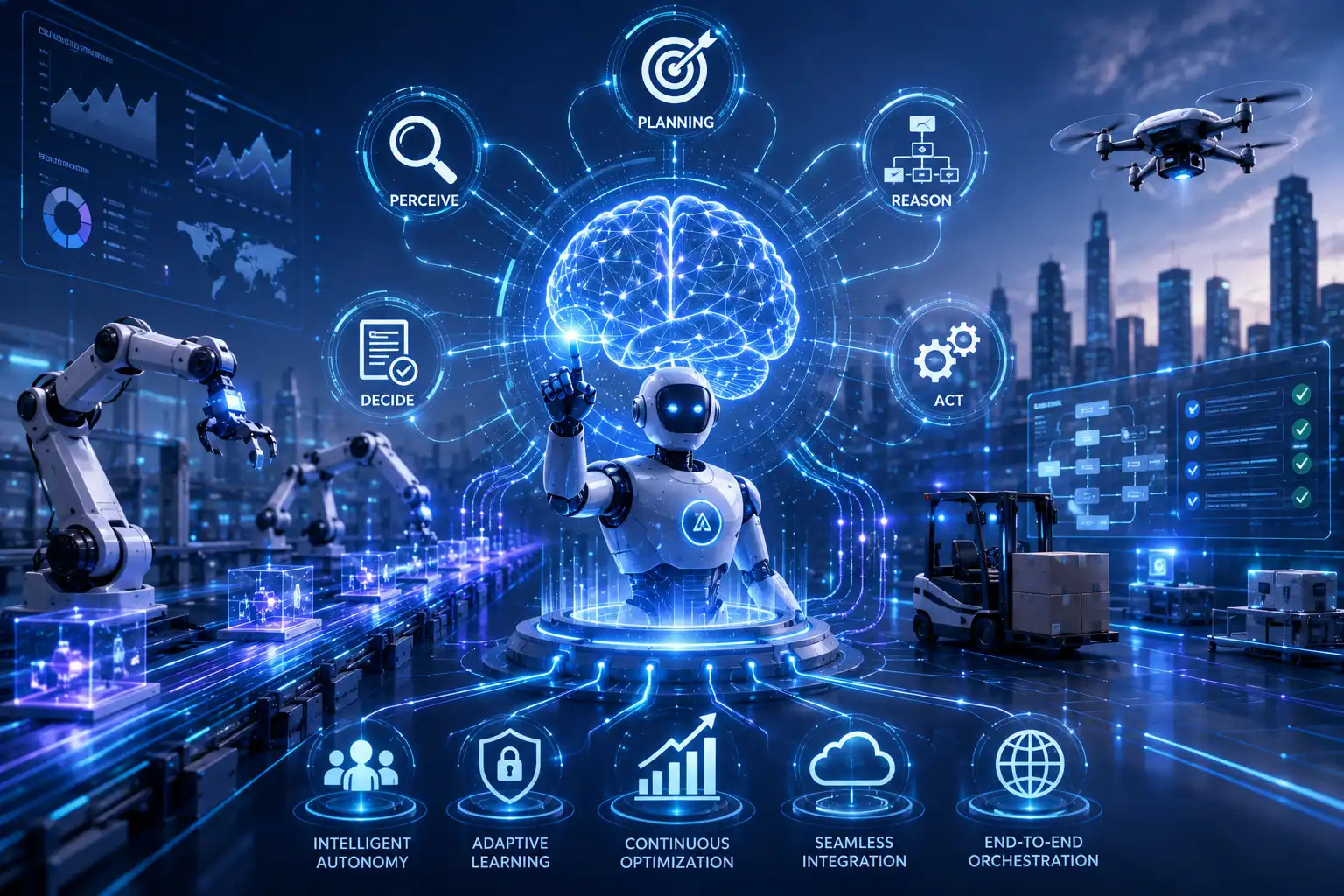
Agentic AI refers to artificial intelligence systems that can independently plan and execute multi-step tasks toward a defined goal, without requiring human direction at each step. Unlike a conventional AI model that responds to a prompt, an AI agent perceives its environment, sets sub-goals, selects tools to pursue them, takes actions, observes the results, and adjusts its approach — autonomously, continuously, and at machine speed.
The enterprise adoption numbers tell a compelling story. According to research from Deloitte, 50 percent of enterprises using generative AI will deploy autonomous AI agents by 2027, up from 25 percent in 2025. Gartner projects that 40 percent of enterprise applications will include task-specific AI agents by the end of 2026 — up from less than 5 percent in 2025. And 89 percent of surveyed CIOs already consider agent-based AI a strategic priority, according to the Futurum Group.
The enterprise agentic AI market is projected to reach USD 24.5 billion by 2030, growing at a compound annual rate of 46.2 percent — the fastest growth rate of any technology segment in enterprise software.
In the context of hyperautomation, agentic AI changes the game in three fundamental ways.
First, it extends automation into genuinely complex, judgment-intensive processes. Current hyperautomation can handle structured tasks and semi-structured decisions. Agentic AI can handle open-ended goals. Rather than “follow these steps to process this invoice,” an agent receives “manage our accounts payable function” and determines autonomously how to achieve that goal — routing invoices, negotiating payment terms, flagging anomalies, optimizing cash flow — with human oversight at the strategic rather than operational level.
Second, it enables true end-to-end process ownership. Today’s hyperautomation orchestrates workflows where humans have defined every step and every exception path in advance. Agentic AI can own workflows that evolve in real time — responding to conditions that were never explicitly anticipated, discovering more efficient approaches through experience, and coordinating with other agents to handle cross-functional dependencies without human choreography.
Third, it creates the possibility of compound automation value. In a multi-agent architecture, specialized AI agents handle specific domains — a procurement agent, a compliance agent, a customer service agent, a financial forecasting agent — while an orchestration layer coordinates their activities toward organizational objectives. The emergent capability of this network is greater than the sum of its parts, in the same way that the emergent capability of a well-functioning human organization exceeds the capabilities of any individual within it.
For a detailed analysis of the seven specific trends that will define agentic AI’s trajectory from 2027 to 2030, IceTea Software’s research guide on the future of agentic AI provides one of the most comprehensive publicly available breakdowns of what the leading analyst firms — Gartner, Deloitte, McKinsey, and IDC — are projecting.
Multi-Agent Systems: Automation That Collaborates
Agentic AI in isolation is powerful. Multi-agent systems — networks of specialized AI agents working in coordination — represent the next order of magnitude.
In a multi-agent hyperautomation architecture, individual agents specialize in specific domains or tasks and communicate with each other to accomplish goals that no single agent could achieve alone. A customer onboarding process, for example, might involve a document processing agent that verifies identity documents, a credit assessment agent that evaluates financial history, a compliance agent that checks regulatory requirements, and a communication agent that keeps the customer informed throughout — all coordinating autonomously, with the overall process orchestrated by a supervisory agent that monitors progress and resolves conflicts between their outputs.
This architecture mirrors how complex human organizations actually work: through division of labor, specialization, and coordination — but executing at machine speed, across unlimited volume, around the clock.
Emerging multi-agent frameworks from major technology providers are making this architecture increasingly accessible. Microsoft’s AutoGen, Anthropic’s multi-agent research, and platform-level orchestration capabilities from UiPath and Salesforce are all moving in this direction. By 2028, multi-agent coordination is expected to be a standard capability in enterprise hyperautomation platforms rather than a research-stage concept.
The organizational implications are profound. Entire business functions — not just individual processes — become candidates for AI-native operation, with human roles shifting from process execution to outcome definition, oversight, and strategic direction.
Digital Twins of Organizations: Simulating Before Deploying
One of the most underappreciated technologies in the future of hyperautomation is the Digital Twin of an Organization (DTO) — a real-time, data-driven virtual model of how an organization actually operates, updated continuously from production systems and used to simulate the impact of changes before they are deployed in the real world.
The concept is well-established in manufacturing, where digital twins of physical assets — machines, production lines, entire factories — enable predictive maintenance and performance optimization. The extension of this concept to entire organizations — their processes, workflows, decision points, capacity constraints, and interdependencies — is newer but gaining rapid momentum.
According to McKinsey, 75 percent of large enterprises are actively investing in digital twins to scale AI solutions. Gartner predicts that digital twin-based intelligent simulation will underpin more than 25 percent of strategic business decisions by 2032, and projects that by 2027 the first enterprise will be able to quantify USD 1 billion in operational savings from these capabilities.
In the context of hyperautomation, the DTO plays several critical roles. It enables organizations to identify automation opportunities with precision, not just through process mining of historical data but through real-time simulation of how proposed changes would affect the entire operational system. It allows automation initiatives to be tested and refined in a virtual environment before any production deployment, dramatically reducing implementation risk. And it provides the continuous monitoring capability that mature hyperautomation programs need — not just dashboards showing what is happening, but predictive models showing what will happen if current trends continue.
The digital twin market is projected to grow by approximately 60 percent to reach over USD 73.5 billion by 2027, with AI-driven twin deployments already demonstrating 85 percent improvement in downtime forecast accuracy and 50 percent reductions in unplanned outages in early manufacturing applications. As the technology matures and becomes more accessible, its role as the operating nervous system of hyperautomation programs will become increasingly central.
Generative AI: Rethinking What Can Be Automated
Generative AI — the technology behind large language models, image synthesis, and code generation tools — is already embedded in the most advanced hyperautomation deployments of 2026. Its impact on the future trajectory of automation is substantial and still unfolding.
In the near term, generative AI is expanding the category of tasks that automation can handle to include work that has traditionally been considered inherently human: drafting communications, synthesizing complex reports, generating code, interpreting ambiguous instructions, and engaging with customers in genuinely natural, contextually appropriate conversation.
In the medium term, generative AI will fundamentally change how automation is built. Rather than requiring skilled developers to hand-code automation workflows, organizations will describe processes in natural language and have AI generate the automation logic — dramatically lowering the cost and time of automation development and putting the capability to build sophisticated automations within reach of business users who have no technical training.
In the longer term, generative AI and agentic AI converge into systems that can not only execute processes but reason about them: identifying inefficiencies, proposing improvements, generating and testing alternative approaches, and continuously self-optimizing toward defined outcomes. This is the automation equivalent of hiring an engineer who never stops analyzing the system they are running — and the implications for operational efficiency are difficult to overstate.
Responsible Automation: Governance, Ethics, and the Human Role
The same capabilities that make the future of hyperautomation so compelling also introduce a new category of organizational responsibility. As AI systems become more autonomous, the stakes of getting governance wrong rise accordingly.
The EU AI Act, which became fully applicable in August 2026, establishes binding requirements for organizations deploying AI in high-risk contexts — including automated decision-making that affects access to financial products, employment outcomes, and healthcare services. These are precisely the domains where hyperautomation delivers its most significant value. Organizations that built their automation programs without governance frameworks capable of meeting these requirements now face the costly work of retrofitting compliance — a strong argument for building governance-first from the outset.
Beyond regulatory compliance, responsible automation raises fundamental questions about fairness, accountability, and the human role in automated decisions. When an AI agent denies a loan application, rejects a job candidate, or determines a patient’s treatment priority, the question of who is accountable for that decision — and how it can be challenged — becomes urgent. Explainability is not a technical nicety; it is an ethical requirement and increasingly a legal one.
Gartner’s stark warning — that more than 40 percent of agentic AI projects are expected to be discontinued by 2027 due to escalating costs and unclear ROI — contains an important subtext: the projects most likely to be discontinued are those that were deployed without adequate governance, explainability, or human oversight, and that consequently failed to earn the organizational trust needed to scale. Governance is not the enemy of speed in hyperautomation. It is what makes sustainable speed possible.
The organizational design question that flows from this is one every leader needs to address: as AI agents take on more operational responsibility, what is the human role? The answer emerging from organizations at the forefront of this transition is clear. Human roles are shifting from process execution to outcome ownership — defining the goals that agents pursue, setting the ethical boundaries within which they operate, monitoring the quality of their outputs, and making the judgment calls that genuinely require human values and contextual wisdom. This is not a diminishment of human work. It is, for most people, a significant upgrade.
The Hyperautomation Stack of 2030: What It Looks Like
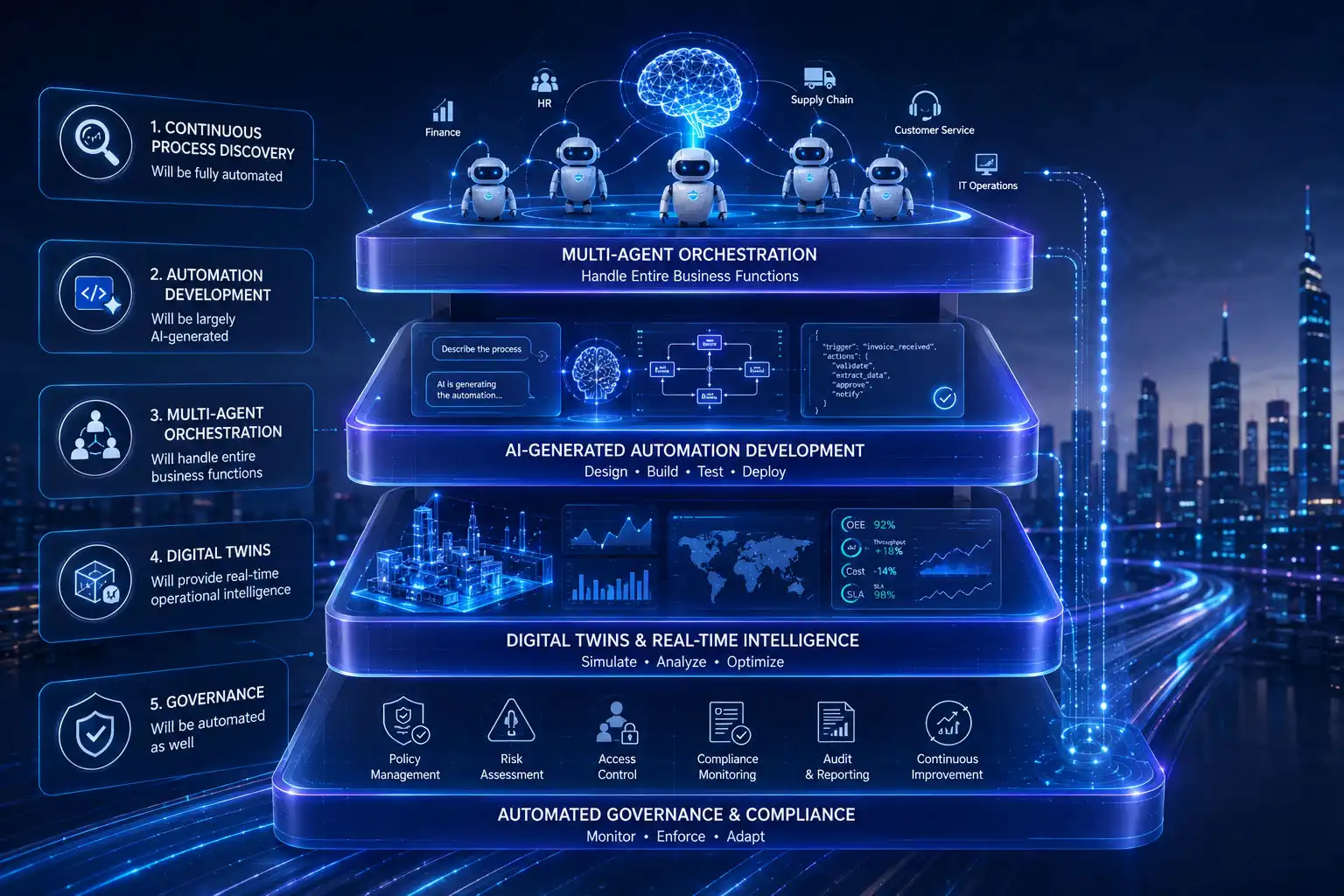
Projecting forward to 2030, the mature hyperautomation stack of the most advanced organizations will look fundamentally different from today’s deployments in several key respects.
Continuous process discovery will be fully automated. Rather than periodic process mining exercises, AI systems will continuously analyze production system data to identify new automation opportunities, estimate their value, and add them to a prioritized automation backlog — without requiring human analysts to run the discovery process.
Automation development will be largely AI-generated. Developers will define the outcome they want to achieve, and AI tools will generate, test, and deploy the automation logic — with human review focused on outcomes and edge cases rather than line-by-line code.
Multi-agent orchestration will handle entire business functions. Networks of specialized AI agents will own the operational management of major business processes end to end, with human managers focused on strategic direction, exception escalation, and performance oversight.
Digital twins will provide real-time operational intelligence. Every major hyperautomation deployment will be mirrored in a digital twin that simulates operational performance, predicts future states, and continuously surfaces optimization opportunities.
Governance will be automated as well. AI governance tools will continuously monitor automation deployments for bias, accuracy drift, compliance violations, and performance degradation — flagging issues for human review rather than relying on periodic manual audits.
For a comprehensive view of how these trends are projected to play out across different industries and timelines, StartUs Insights’ research guide on AI and the future of automation from 2026 to 2030 provides one of the most data-rich publicly available analyses of where enterprise automation is heading.
What This Means for Organizations Investing Today
The future trajectory of hyperautomation has clear strategic implications for organizations making automation investment decisions right now.
The foundations you build today determine your ceiling tomorrow. Organizations investing in data quality, integration infrastructure, governance frameworks, and automation talent in 2026 are building the platform on which agentic AI and multi-agent systems will run. Those foundations cannot be rushed or skipped — and the organizations that shortcut them today will face expensive remediation work when they try to scale to the next generation of automation capability.
Governance is a competitive advantage, not a compliance burden. The organizations that earn the organizational and regulatory trust needed to deploy truly autonomous AI systems at scale will be those that have already demonstrated responsible, explainable, and well-governed automation in simpler deployments. Trust is built incrementally, and it starts now.
The talent equation is shifting. The skills that automation programs will need in 2030 are different from those they need today. Prompt engineering, AI agent design, multi-agent orchestration, and AI ethics and governance are becoming as important as traditional RPA development skills. Organizations that are investing in building these capabilities now — through hiring, training, and partnerships with specialist firms — will have a meaningful head start.
Human-AI collaboration is the design challenge of the decade. The question of how to optimally combine human judgment with AI capability — which decisions should be fully automated, which should be AI-assisted, and which should remain entirely human — is not a technical problem. It is an organizational design and leadership problem. Organizations that think carefully about this question and make deliberate choices about where the human-AI boundary should sit will build more effective, more trusted, and more resilient automation programs than those that simply automate everything they can.
Conclusion
The future of hyperautomation is not a linear extension of where the technology stands today. It is a genuinely new operational paradigm — one in which organizations are run in partnership with intelligent, autonomous, continuously learning systems that do not merely execute instructions but pursue goals, adapt to circumstances, and compound their own capabilities over time.
Agentic AI will bring autonomous decision-making into domains that current automation cannot touch. Digital twins will give organizations unprecedented ability to understand, simulate, and optimize their own operations in real time. Multi-agent systems will coordinate specialist AI capabilities into organizational-level intelligence. And generative AI will make automation development itself dramatically faster, cheaper, and more accessible.
The organizations that will lead their industries in 2030 are those that understand this trajectory clearly and are making the investments today — in data infrastructure, governance frameworks, human capability, and strategic clarity about the role of automation in their operating model — that will position them to capture its full potential.
Hyperautomation is not a destination. It is a direction. The organizations moving fastest in that direction, with the clearest understanding of where they are going and the discipline to build the foundation properly, are the ones that will define what enterprise operations look like in the decade ahead.
The journey has already begun. The only question is how far and how fast you are willing to go.
Hyperautomation Content Series
Continue the Complete Hyperautomation Guide
This post is a part of the Hyperautomation Content Series — the complete 8 article guide to understanding, implementing, and scaling hyperautomation in your organization.
Agentic AI refers to artificial intelligence systems that independently plan, reason, select tools, execute multi-step actions, and adapt toward a defined goal with limited human direction at each step. Unlike reactive models that wait for prompts, these systems operate proactively in dynamic environments.
Key Takeaways
- Agentic AI systems pursue goals autonomously through perception, planning, action, and continuous learning loops.
- They differ from generative AI by focusing on action and outcomes rather than content creation alone.
- Enterprises use them to own end-to-end processes such as accounts payable, customer onboarding, and IT operations.
- Success requires clear goals, tool access, governance boundaries, and human oversight for high-stakes decisions.
- Adoption is accelerating, with major analyst firms projecting rapid growth in enterprise deployments through 2027.
Agentic AI represents the shift from AI that answers questions or generates content to AI that takes ownership of outcomes. Organizations building these capabilities often partner with specialized artificial intelligence development teams to design production-ready agents that integrate with existing systems and operate under proper controls.
How Agentic AI Works
Agentic AI operates through a continuous cycle that mirrors purposeful human work. The system begins by perceiving its environment through data sources, sensors, APIs, documents, or user inputs. It then interprets a high-level goal, breaks it into sub-goals, selects appropriate tools or actions, executes those actions, observes the results, and adjusts its plan based on new information.
This loop (perceive, reason, act, learn) allows the system to handle open-ended objectives. For example, instead of following a fixed script to process an invoice, an agent might receive the goal “optimize accounts payable cash flow this month.” It can then retrieve invoices, validate them against purchase orders, negotiate payment terms within approved limits, flag anomalies, and update financial systems while escalating only true exceptions.
Modern implementations typically combine large language models as the reasoning core with tool-calling capabilities, short-term and long-term memory, and orchestration layers that coordinate multiple specialized agents. The result is software that can manage multi-step workflows across systems without requiring a human to dictate every decision point.
Agentic AI vs Generative AI vs Traditional Automation
Understanding the distinctions helps organizations choose the right approach for each use case. The following comparison highlights the core differences:
| Aspect | Traditional Automation (RPA) | Generative AI | Agentic AI |
| Primary Focus | Rule-based task execution | Content creation | Goal-directed action and outcomes |
| Decision Style | Fixed scripts | Prompt-response | Autonomous planning and adaptation |
| Handling of Exceptions | Escalates or fails | Generates alternatives | Re-plans and recovers |
| Input Preference | Structured data | Natural language prompts | Goals + unstructured context |
| Human Role | Design and maintenance | Prompting and review | Oversight and goal setting |
| Best Suited For | High-volume repetitive tasks | Drafting, summarizing, coding | Complex, judgment-heavy processes |
Agentic AI builds on generative AI capabilities. The generative model supplies the reasoning and language understanding, while the agentic layer adds planning, tool use, and iterative execution. Traditional automation remains valuable for stable, high-volume structured work; agentic systems extend automation into areas that previously required human judgment.
For a deeper look at how these technologies combine inside modern automation programs, see the analysis in The Future of Hyperautomation: Agentic AI and Beyond.
Core Capabilities of Agentic AI Systems
Several capabilities define mature agentic systems in enterprise settings.
Autonomy with boundaries. Agents pursue goals independently yet operate inside predefined constraints such as approved tools, data access limits, financial thresholds, and escalation rules.
Multi-step planning and tool use. They decompose complex objectives, sequence actions, call APIs, query databases, trigger RPA bots, or interact with other agents.
Adaptability. When conditions change or an action fails, the agent revises its plan rather than stopping. This resilience is essential for real-world processes that rarely follow a perfect path.
Memory and context. Effective agents maintain short-term context for the current task and longer-term memory of organizational preferences, past outcomes, and policies.
Coordination in multi-agent architectures. Specialized agents (for example, a compliance agent, a document agent, and a communication agent) work together under a supervisory layer. This division of labor mirrors human organizational design while executing at machine speed.
These capabilities enable true end-to-end process ownership rather than isolated task automation.
Enterprise Applications and Business Value
Organizations deploy agentic AI where processes involve judgment, exceptions, unstructured inputs, or cross-system coordination. Common high-value areas include:
- Accounts payable and receivable management, including invoice processing, anomaly detection, and cash-flow optimization.
- Customer onboarding and support, where agents verify documents, assess risk, update systems, and communicate status.
- IT operations and incident response, with agents diagnosing issues, applying remediations, and escalating only unresolved cases.
- Procurement and supply-chain coordination, including supplier evaluation, order tracking, and exception handling.
- Compliance and risk monitoring, where agents continuously scan for policy deviations and generate audit-ready documentation.
The business case rests on speed, consistency, and scale. Agents handle volume that would require large teams while maintaining 24/7 availability and reducing error rates associated with manual handoffs. According to Deloitte research, 25 percent of companies using generative AI were expected to launch agentic AI pilots or proofs of concept in 2025, with that figure projected to reach 50 percent by 2027.
Early production deployments report meaningful reductions in cycle times for judgment-intensive processes and free skilled staff to focus on exception handling, strategy, and relationship work rather than routine coordination.
Implementation Considerations and Governance
Deploying agentic AI successfully requires more than model access. Organizations must define clear goals, map the tools and data the agent will use, establish action boundaries, and design human oversight mechanisms. High-stakes or irreversible decisions typically remain under human-in-the-loop review, while routine actions run under human-on-the-loop monitoring with sampling audits.
Data quality, integration readiness, and process documentation strongly influence outcomes. Agents perform best when they have reliable access to clean, well-structured information and well-understood workflows. Governance frameworks that log decisions, provide explainability, and support audit trails are essential for regulated industries and for building internal trust.
Many enterprises begin with narrow, high-ROI use cases that have clear success metrics and limited blast radius. Once the architecture, observability, and escalation patterns prove reliable, the same foundation can support broader multi-agent systems.
For practical guidance on building the broader automation foundation that supports agentic capabilities, review the complete hyperautomation guide.
Ready to explore agentic AI for your operations?
Many organizations accelerate progress by working with experienced partners who understand both the technology and the operational realities of production deployment. A focused discovery conversation can identify the highest-value starting points and the architectural choices that reduce risk.
Getting Started with Agentic AI
Begin by selecting a process that is currently bottlenecked by human coordination or exception handling. Document the desired outcome, available data sources, existing systems, and acceptable risk boundaries. Prototype with a single specialized agent before expanding to multi-agent coordination. Measure both efficiency gains and the quality of decisions against human baselines.
Agentic AI does not eliminate the need for human judgment. It elevates the human role from process execution to outcome definition, exception handling, and continuous improvement. Organizations that treat agents as collaborative digital workers rather than fully autonomous black boxes tend to achieve more sustainable results.
The technology is advancing rapidly, yet the principles of clear goals, strong governance, and measured expansion remain constant. Teams that invest in these foundations now will be positioned to capture the productivity and agility advantages as agentic capabilities mature across the enterprise software landscape.
Transform your automation strategy with production-ready agentic AI.
Contact the Bantech team to discuss how custom AI agents can own complex workflows in your environment. Request a consultation to map a practical pilot that delivers measurable value while maintaining the controls your organization requires.
Contact Us today!
Hyperautomation is a business-driven, disciplined approach that organizations use to rapidly identify, vet, and automate as many business and IT processes as possible by orchestrating multiple technologies including robotic process automation, artificial intelligence, process mining, low-code tools, and intelligent document processing. It moves beyond isolated task automation to end-to-end process ownership.
Key Takeaways
- Hyperautomation is a strategy, not a single product or tool.
- It combines RPA, AI/ML, process mining, low-code platforms, and integration technologies into a coordinated system.
- The goal is scalable, end-to-end automation of both structured and unstructured work across the enterprise.
- Success depends on process discovery, governance, clear ROI measurement, and the right technology mix.
- Organizations using it effectively report significant cost reductions, faster cycle times, and improved accuracy.
Hyperautomation emerged as organizations discovered that robotic process automation alone could not deliver enterprise-scale transformation. Teams that want to move from scattered bots to coordinated intelligent systems often begin by engaging partners experienced in enterprise software development services to map processes, select the right technology stack, and build the orchestration layer required for sustainable results.
The Origins and Definition of Hyperautomation
Gartner coined and popularized the term hyperautomation to describe a deliberate, organization-wide approach rather than the purchase of any single piece of software. Traditional automation focused on individual repetitive tasks. Hyperautomation treats the enterprise as a connected system and seeks to automate entire value streams from start to finish.
At its core, hyperautomation rests on three principles. First, identify every process that can be automated. Second, apply the most appropriate combination of technologies to each process rather than forcing one tool everywhere. Third, continuously discover new opportunities, measure outcomes, and refine the automation portfolio.
This approach addresses the limitations that appeared when companies deployed large numbers of standalone RPA bots. Bots excel at structured, rule-based work but struggle with unstructured data, exceptions, and processes that span multiple systems. Hyperautomation adds intelligence and orchestration so automation can handle real-world complexity.
Core Technologies That Power Hyperautomation
A mature hyperautomation program typically draws on several complementary technologies:
- Robotic Process Automation (RPA) provides the execution muscle for structured, repetitive digital tasks across desktop and web applications.
- Artificial Intelligence and Machine Learning handle classification, prediction, anomaly detection, and decision support.
- Natural Language Processing and Intelligent Document Processing extract meaning from emails, contracts, invoices, and other unstructured content.
- Process Mining and Task Mining analyze system logs and user activity to reveal actual process flows, bottlenecks, and automation opportunities.
- Low-code and no-code platforms enable business users and citizen developers to build and modify automations quickly.
- Integration and orchestration layers connect systems, manage workflows, and coordinate bots, AI models, and human participants.
When these capabilities work together, the result is far more powerful than any single technology operating in isolation. Process mining surfaces the highest-value targets. AI interprets unstructured inputs. RPA executes the structured steps. Orchestration keeps everything aligned with business rules and service levels.
For a detailed architectural view of how these layers fit together in 2026 environments, explore the guide on core technologies powering hyperautomation.
Hyperautomation vs Traditional Automation and RPA
Many organizations still confuse hyperautomation with simply deploying more RPA bots. The differences are fundamental:
| Aspect | Traditional Automation / RPA | Hyperautomation |
| Scope | Individual tasks or departmental scripts | End-to-end processes across the enterprise |
| Technology Mix | Primarily RPA | RPA + AI + process mining + low-code + integration |
| Handling of Unstructured Data | Limited or none | Native through AI, NLP, and intelligent document processing |
| Discovery Method | Manual process mapping | Continuous process and task mining |
| Adaptability | Breaks when processes or UIs change | Designed for continuous improvement and adjustment |
| Governance | Often ad-hoc | Centralized strategy, measurement, and oversight |
| Primary Goal | Task efficiency | Organizational process excellence and scalability |
RPA remains an essential component inside hyperautomation programs. It is simply no longer the entire strategy. Hyperautomation determines which processes deserve automation, which technologies should handle each part of the work, and how the resulting automations are governed and improved over time.
How Hyperautomation Works in Practice
A well-run hyperautomation initiative follows a repeatable cycle.
It begins with discovery. Process mining tools examine event logs from ERP, CRM, and other systems to show how work actually flows, where time is lost, and which steps create the most exceptions. Task mining can complement this by capturing desktop-level activity.
Next comes prioritization. Opportunities are scored on volume, complexity, error rates, regulatory risk, and expected return. High-volume, rule-heavy processes with clear data usually deliver the fastest payback.
Design and build follow. Teams select the right combination of tools for each process. Structured steps may use RPA. Document-heavy steps use intelligent document processing. Decision points leverage machine learning models. Low-code platforms allow rapid iteration by business analysts.
Deployment includes strong governance. Centralized control over bot credentials, access rights, change management, and monitoring prevents the shadow automation problems that plagued early RPA programs.
Finally, continuous improvement closes the loop. Dashboards track cycle time, exception rates, cost per transaction, and bot utilization. Process mining runs again to identify the next wave of opportunities and to detect process drift after automation goes live.
Real-world results appear across industries. Banks automate end-to-end KYC and AML workflows. Insurers accelerate claims intake and adjudication. Manufacturers improve order-to-cash and procure-to-pay cycles. Detailed industry examples are available in the collection of real-world hyperautomation examples by industry.
Business Benefits and Measurable Outcomes
Organizations that execute hyperautomation well consistently report several categories of value.
Cost reduction is the most visible. Manual processing costs for invoices, claims, or customer requests can drop 50 to 80 percent once intelligent automation is applied at scale. Cycle times shrink dramatically because work no longer waits in human queues overnight or over weekends.
Accuracy improves because bots and models follow rules consistently and flag anomalies that humans might miss under time pressure. Compliance and audit readiness strengthen when every step is logged and every decision is traceable.
Employee experience also benefits. Staff move away from repetitive data entry and exception chasing toward higher-value analysis, customer interaction, and process improvement. Capacity is unlocked without linear headcount growth.
The market itself reflects the strength of these benefits. Analyst estimates placed the global hyperautomation market at approximately USD 68.2 billion in 2026 with projections of multi-fold growth through the early 2030s as more enterprises move from pilot projects to enterprise-wide programs.
Common Challenges and How to Address Them
Hyperautomation is not without obstacles. Integration with legacy systems can be complex. Data quality issues surface quickly when automation begins consuming inputs that humans previously cleaned manually. Change management is frequently underestimated; employees need clarity on how their roles evolve.
Governance gaps create risk. Without clear ownership, exception handling rules, and monitoring, automation portfolios become difficult to maintain and hard to trust. Skill shortages in process mining, AI model management, and orchestration design slow progress for many internal teams.
Successful programs address these challenges by starting with a clear strategy, investing in process discovery before large-scale build, establishing a center of excellence or equivalent governance body, and measuring value rigorously from the first pilot. They also select technology platforms that support both citizen development and professional-grade control.
Building a Sustainable Hyperautomation Program
Long-term success requires treating hyperautomation as an ongoing operating capability rather than a one-time project. Organizations define a target operating model that includes process owners, automation developers, AI specialists, and business sponsors. They maintain a living pipeline of opportunities ranked by value and feasibility. They invest in skills and platforms that allow the program to scale without proportional increases in specialized headcount.
The most mature programs also prepare for the next evolution. Agentic AI and multi-agent systems are already extending hyperautomation into processes that require judgment and real-time adaptation. The foundation built through disciplined hyperautomation (clean process knowledge, reliable integrations, strong governance) becomes the launchpad for these more advanced capabilities.
Hyperautomation is ultimately about designing an organization that can improve its own operations continuously and at scale. The technologies matter, yet the strategy, discovery discipline, and governance determine whether the investment delivers lasting competitive advantage.
Ready to move from isolated automation projects to a coordinated hyperautomation strategy?
Bantech helps organizations assess their current state, prioritize high-value processes, select the right technology mix, and implement governed, measurable automation programs. Request a consultation to identify the fastest path to measurable results in your environment.
Contact Us today!
Agentic AI systems independently plan multi-step actions, select tools, execute tasks, and adapt toward a defined goal with limited human direction. Generative AI creates new content such as text, code, images, or summaries in response to prompts. The core difference is action and autonomy versus content generation.
Key Takeaways
- Generative AI focuses on producing outputs from prompts; agentic AI focuses on achieving outcomes through autonomous planning and execution.
- Agentic systems typically use generative models as their reasoning engine while adding planning, tool use, memory, and iterative action loops.
- Generative AI excels at drafting, summarizing, coding assistance, and creative work. Agentic AI excels at owning end-to-end processes that involve judgment and exceptions.
- Most enterprise deployments combine both: generative capabilities inside agentic workflows.
- Clear goal definition, tool access, and governance determine whether agentic systems deliver reliable value.
The distinction between these two approaches matters because organizations that treat them as interchangeable often choose the wrong tool for the job. Teams designing intelligent systems frequently start with a clear assessment of process needs and then engage specialists in cloud strategy and AI-ready infrastructure to ensure the underlying data and integration layers can support either generative or agentic workloads effectively.
Understanding Generative AI
Generative AI refers to models trained to produce new content that resembles the data they were trained on. Large language models generate text, code, and structured data. Image and video models create visual media. These systems respond to prompts and produce a single or multi-turn output.
In enterprise settings, generative AI powers features such as drafting emails, summarizing long documents, generating code snippets, creating reports, translating content, and answering questions based on retrieved knowledge. The human remains responsible for deciding what to ask, reviewing the output, and deciding what to do next.
Generative AI is powerful for accelerating knowledge work and creative tasks. It does not, by itself, decide on a sequence of actions across systems or pursue a multi-step business goal without continuous human guidance.
Understanding Agentic AI
Agentic AI builds on generative capabilities and adds the ability to act. An agentic system receives a high-level goal, decomposes it into sub-tasks, selects and calls tools or APIs, observes the results of each action, updates its plan, and continues until the goal is achieved or an escalation threshold is reached.
Typical components include a reasoning core (often a large language model), short-term and long-term memory, a set of available tools, and an orchestration or control layer that enforces boundaries. The system operates in a loop: perceive the current state, reason about the next best action, act, observe, and repeat.
This architecture enables agents to manage processes such as invoice processing, customer onboarding, IT incident response, or procurement coordination with far less step-by-step human direction than traditional automation or pure generative tools require.
Side-by-Side Comparison
The practical differences become clear when the two approaches are compared across key dimensions:
| Dimension | Generative AI | Agentic AI |
| Primary Purpose | Create content (text, code, images, summaries) | Achieve goals through planning and action |
| Interaction Style | Prompt and respond | Goal in, outcome out (with intermediate steps) |
| Autonomy Level | Low to moderate; human guides each major step | High; system plans and executes multi-step workflows |
| Tool Use | Optional and usually human-initiated | Core capability; agents select and call tools as needed |
| Handling of Change | Generates new content when re-prompted | Re-plans and adapts during execution |
| Typical Output | A document, answer, or artifact | Completed process steps, updated systems, resolved cases |
| Human Role | Prompting, reviewing, refining, deciding next steps | Setting goals, defining boundaries, handling exceptions |
| Best Fit | Content creation, analysis, coding assistance | Process ownership, exception-heavy workflows, coordination |
This comparison shows that agentic AI is not a replacement for generative AI. It is an extension that uses generative reasoning as one component inside a larger autonomous system.
How Agentic AI Builds on Generative AI
Most production agentic systems rely on generative models for language understanding, planning, and decision-making. The generative model serves as the “brain” that interprets goals, reasons about options, and generates the next action or tool call. The agentic framework supplies the structure that turns those outputs into reliable, observable, and governed behavior.
Without the generative foundation, agents would lack flexible reasoning. Without the agentic layer, generative models remain reactive tools that wait for the next prompt. The combination is what enables systems to move from answering questions to owning outcomes.
Organizations exploring platform choices for these combined capabilities often review detailed evaluations of leading solutions, such as those covered in the comparison of best hyperautomation platforms.
When to Use Generative AI vs Agentic AI
Choose generative AI when the primary need is content or insight:
- Drafting communications, reports, or documentation
- Summarizing large volumes of text or meetings
- Assisting developers with code generation and explanation
- Answering employee or customer questions from knowledge bases
- Creative or exploratory work where human review is expected at every stage
Choose agentic AI when the primary need is process completion or outcome ownership:
- End-to-end handling of invoices, claims, or service requests
- Multi-system workflows that require sequencing, validation, and updates
- Situations with frequent exceptions that still follow patterns
- Continuous monitoring and response tasks (IT operations, compliance checks)
- Processes where reducing human coordination overhead is a major goal
In practice, many high-value solutions use both. A generative model may draft a customer response while an agent decides whether the case can be closed, updates the CRM, and triggers a follow-up action. The agent provides the structure; the generative component provides the flexible language and reasoning.
Implementation and Governance Considerations
Moving from generative tools to agentic systems introduces new requirements. Goals must be specified clearly enough for the agent to act without constant clarification. Tool access must be carefully scoped. Observability becomes essential so teams can understand why an agent took a particular path. Human oversight models (human-in-the-loop for high-stakes decisions, human-on-the-loop for routine monitoring) need to be designed in advance.
Data readiness and integration quality matter more for agentic systems because the agent must reliably retrieve and write information across systems. Governance frameworks that log actions, support audit trails, and enforce policy boundaries reduce risk and build organizational trust.
Many enterprises find that a structured approach to strategy and prioritization accelerates progress. Guidance on building that foundation appears in resources focused on how to build a hyperautomation strategy.
Analyst projections underscore the momentum. Gartner has projected that 40 percent of enterprise applications will include task-specific AI agents by the end of 2026, up from less than 5 percent in 2025, reflecting the rapid shift from pure generative features toward more autonomous capabilities.
Practical Takeaway for Organizations
Generative AI multiplies the productivity of people who create and analyze information. Agentic AI multiplies the capacity of organizations to execute processes that previously required significant human coordination. The two are complementary rather than competitive.
Organizations that understand the difference avoid the common mistake of expecting a chatbot or content generator to run a multi-step business process, and equally avoid over-engineering simple content tasks with full agent architectures. Matching the technology to the nature of the work produces faster value and lower risk.
The most effective path forward usually begins with a clear inventory of high-volume or high-friction processes, an assessment of which ones benefit most from content assistance versus autonomous execution, and a deliberate plan for governance and measurement.
Ready to apply the right form of AI to your highest-value processes?
Bantech works with organizations to evaluate generative and agentic opportunities, design appropriate architectures, and implement solutions that deliver measurable outcomes under proper controls. Contact us to discuss a focused assessment tailored to your environment.
Contact Us today!
Agentic AI works through a continuous cycle of perceiving the current environment, reasoning about a high-level goal, selecting and executing actions or tools, observing the results, and adapting the plan until the goal is achieved or an escalation point is reached. This loop enables autonomous multi-step task completion with limited human intervention.
Key Takeaways
- Agentic AI operates in a perceive-reason-act-learn loop rather than a single prompt-response exchange.
- Core components include a reasoning engine, memory, tool access, planning logic, and governance boundaries.
- Specialized agents can coordinate in multi-agent systems under an orchestration layer.
- Reliable performance depends on clear goals, scoped tools, observability, and human oversight design.
- The architecture turns generative reasoning into goal-directed, adaptive execution.
Understanding the internal mechanics of agentic AI helps organizations design systems that deliver consistent results rather than impressive demos. Teams building production-grade agents frequently begin by clarifying process requirements and then work with specialists in software development consulting to define the architecture, tool interfaces, and control layers needed for reliable operation.
The Core Operating Loop
At the heart of every agentic system is a repeating cycle that replaces the traditional single-shot prompt model.
- Perceive
The agent gathers information about the current state. This can include reading data from databases or APIs, retrieving documents, checking system statuses, analyzing user input, or reviewing the results of previous actions. - Reason and Plan
Using a large language model or similar reasoning engine as its core, the agent interprets the high-level goal, evaluates the current state against that goal, and generates a plan or the next best action. It may break a complex objective into ordered sub-tasks. - Act
The agent selects and calls one or more tools. Tools can include API calls, database queries, RPA bots, email systems, CRM updates, or other agents. The action is executed in the real environment. - Observe and Learn
The agent receives the outcome of the action, updates its internal state or memory, and decides whether the goal is complete, whether the plan needs revision, or whether escalation to a human is required. The cycle then repeats.
This loop continues until the goal is satisfied or a predefined boundary (time, cost, risk, or confidence threshold) triggers human involvement. The iterative nature is what allows agentic systems to handle exceptions and changing conditions that would break rigid scripts.
Essential Architectural Components
Several building blocks make the loop reliable in enterprise settings.
Reasoning Engine
Usually a large language model that handles language understanding, planning, decision-making, and generation of tool calls. The quality of reasoning directly affects plan quality and adaptability.
Memory
Short-term memory maintains context for the current task. Longer-term memory stores organizational policies, past successful patterns, user preferences, or learned process knowledge so the agent does not start from zero on every run.
Tool Interface and Action Layer
A defined set of tools the agent is permitted to use, along with the protocols (function calling, APIs, MCP-style interfaces) that allow the reasoning engine to invoke them safely. Tool descriptions must be clear so the agent selects the right capability.
Planning and Orchestration Logic
Mechanisms that decompose goals, sequence steps, manage dependencies, and coordinate multiple specialized agents when needed. In multi-agent setups, a supervisory agent or orchestration layer assigns work and resolves conflicts.
Governance and Control Layer
Boundaries that limit what the agent can do, logging of every decision and action, confidence scoring, and escalation rules. This layer is essential for auditability, compliance, and organizational trust.
These components work together so the system can pursue outcomes rather than simply generate responses.
Single-Agent vs Multi-Agent Architectures
A single agent can handle relatively contained goals that fit within one domain of expertise and a manageable set of tools. For more complex processes that span functions, multi-agent systems become effective.
In a multi-agent design, specialized agents focus on distinct capabilities (document processing, compliance checking, customer communication, data validation). A coordinating agent or orchestration framework assigns sub-goals, monitors progress, and integrates results. This mirrors human division of labor while operating at machine speed and scale.
The coordination layer must handle communication protocols, shared memory or state, conflict resolution, and overall progress toward the parent goal. Platforms and frameworks continue to mature in this area, making multi-agent coordination increasingly practical for enterprise workflows.
How Agentic AI Differs from Traditional Automation Workflows
Traditional automation (including classic RPA) follows predefined paths designed in advance. Every branch and exception must be anticipated by a developer. Agentic systems invert this model: the high-level goal is defined, and the system determines the path dynamically.
Traditional workflows break when an unanticipated condition appears. Agentic systems attempt to re-plan. Traditional systems require human design of every step. Agentic systems require human design of goals, tools, and boundaries, then operate with greater independence inside those constraints.
This shift changes both the technical architecture and the skills required to build and maintain the systems. Insights on integrating these capabilities into broader automation programs appear in discussions of AI-powered software development.
Real-World Execution Example
Consider an agent tasked with managing a portion of accounts payable.
The goal is set: “Process all approved invoices due this week while optimizing early-payment discounts within policy limits.”
The agent perceives the current invoice queue and payment calendar. It reasons that several invoices qualify for discounts and that cash position allows selective early payment. It acts by validating each invoice against purchase orders and receipts, calculating discount opportunities, updating the ERP, scheduling payments, and notifying stakeholders. When an invoice lacks a matching receipt, the agent observes the gap, creates a follow-up task or escalates according to rules, and continues with the rest of the queue.
At each step the agent updates its working memory and adjusts the remaining plan. The human role centers on reviewing escalations, refining policies, and monitoring overall performance rather than executing every transaction.
Critical Success Factors for Reliable Operation
Several factors determine whether the theoretical loop delivers practical value.
Clear, measurable goals prevent ambiguous behavior. Well-described tools with accurate input and output schemas improve tool-selection accuracy. High-quality, accessible data reduces perception errors. Comprehensive logging and observability allow teams to diagnose why an agent chose a particular path. Thoughtful escalation design ensures humans remain in control of high-stakes or low-confidence decisions.
Measurement is equally important. Organizations track not only task completion rates but also exception rates, cycle times, cost per outcome, and the quality of decisions relative to human baselines. Resources focused on proving value provide useful frameworks for these metrics, including approaches outlined in guidance on hyperautomation ROI.
Analyst projections reflect growing confidence in the model. Research indicates that enterprise adoption of task-specific agents is expected to expand rapidly, with significant percentages of applications incorporating them in the near term.
From Concept to Production
Moving from a working prototype to a production agent requires attention to security (credential management, least-privilege tool access), scalability, monitoring, versioning of prompts and tools, and integration with existing enterprise systems. Many organizations begin with narrowly scoped agents that deliver clear ROI, prove the control and observability model, and then expand the scope or add coordinating agents.
The underlying principle remains consistent: give the system a clear goal, the right tools, appropriate memory, and firm boundaries, then let the perceive-reason-act-learn loop drive execution while humans focus on oversight and continuous improvement.
Agentic AI works by turning reasoning into structured, observable, goal-directed action. When the architecture, data, tools, and governance are designed with production realities in mind, the result is software that can own meaningful work rather than merely assist with it.
Ready to design agentic systems that operate reliably in your environment?
Bantech helps organizations define goals, select architectures, implement tool integrations, and establish the governance needed for production agentic AI. Contact us to explore a practical pilot tailored to one of your high-value processes.
Contact Us today!
Agentic AI systems independently plan multi-step actions, select tools, execute tasks, and adapt based on results to achieve a defined goal. RPA (robotic process automation) follows pre-defined rules and scripts to execute structured, repetitive digital tasks exactly as designed. The core difference is autonomous goal-directed reasoning versus rule-based task execution.
Key Takeaways
- RPA excels at high-volume, stable, rule-based tasks that follow predictable paths.
- Agentic AI handles judgment-heavy, exception-prone, or changing processes that require planning and adaptation.
- The two technologies are complementary: many organizations run RPA for structured steps and agentic AI for the decision and coordination layers.
- RPA breaks when processes or interfaces change; agentic systems attempt to re-plan.
- Choosing the right approach depends on process stability, data structure, exception volume, and the need for autonomy.
Organizations evaluating automation options benefit from a clear understanding of where each technology delivers the strongest return. Teams often begin by mapping process characteristics and then engage specialists in data analytics and business intelligence services to quantify volumes, exception rates, and potential value before selecting the appropriate mix of tools.
What RPA Does Well
Robotic process automation uses software bots to mimic human interactions with digital systems. Bots click, type, copy, paste, and navigate applications according to a fixed script. They work especially well when:
- The process is highly structured and stable
- Inputs are clean and predictable
- Rules are explicit and rarely change
- Volume is high and the work is repetitive
Classic examples include data entry between systems, report generation, invoice data extraction when formats are consistent, and system-to-system reconciliations. RPA delivers fast implementation for these use cases, clear audit trails, and reliable execution as long as the underlying applications and process steps remain unchanged.
The limitation appears when the process encounters variation. A new screen layout, an unexpected document format, or a decision that requires judgment typically causes the bot to fail or escalate. Maintenance effort rises as the number of bots and the frequency of process changes increase.
What Agentic AI Does Differently
Agentic AI starts from a goal rather than a script. The system perceives the current state, reasons about the best sequence of actions, selects and calls tools or systems, observes outcomes, and adjusts its plan. It can handle unstructured inputs, ambiguous situations, and multi-step workflows that were never fully mapped in advance.
Where RPA is told “follow these exact steps,” an agentic system is told “achieve this outcome within these boundaries.” It determines the steps itself. This makes it suitable for processes that involve classification of messy inputs, exception handling, cross-system coordination, and continuous adjustment.
Agentic systems typically use large language models for reasoning, maintain memory of the current task and relevant history, and operate through a perceive-reason-act-learn loop. They can call RPA bots as one of their tools when a structured, repetitive sub-task is required.
Direct Comparison
| Aspect | RPA | Agentic AI |
| Core Approach | Follow fixed, pre-built rules and scripts | Pursue a goal through planning and adaptation |
| Best Suited For | Structured, repetitive, stable tasks | Judgment-heavy, exception-prone, or evolving processes |
| Handling of Change | Breaks or requires re-development when UIs or rules change | Re-plans and adapts in real time |
| Input Handling | Prefers clean, structured data | Handles unstructured and ambiguous inputs natively |
| Decision Making | Rule-based only | Reasoning and contextual judgment |
| Exception Management | Escalates or fails | Attempts recovery and alternative paths |
| Human Role | Design scripts, handle exceptions, maintain bots | Define goals and boundaries, oversee outcomes, handle true exceptions |
| Implementation Focus | Process mapping and script development | Goal definition, tool access, governance, and observability |
| Typical Strength | Speed and consistency on high-volume routine work | Flexibility and end-to-end process ownership |
This table highlights why the two approaches solve different classes of problems. RPA provides deterministic reliability. Agentic AI provides adaptive capability.
How the Two Technologies Work Together
In practice, leading organizations do not treat the choice as binary. They use both inside a broader automation strategy.
RPA remains the efficient execution layer for stable, high-volume structured steps. Agentic AI sits above or alongside it as the decision and coordination layer. An agent can classify an incoming request, decide the correct handling path, call an RPA bot to perform a data update, evaluate the result, and continue or escalate as needed.
This hybrid model appears frequently in hyperautomation programs. Process mining identifies the opportunities. RPA handles the repetitive digital labor. Agentic capabilities manage the variable and judgment-intensive portions. Orchestration keeps the pieces aligned.
Lessons from production deployments of related AI systems, including those focused on voice agents, reinforce the importance of strong control layers and realistic expectations about exceptions. Detailed analysis of common failure patterns in AI agent deployments provides useful guidance for design. See the examination of why AI voice agents fail in production for parallel insights on architecture and governance.
When to Choose RPA, Agentic AI, or Both
Select RPA when:
- The process is stable and well-documented
- Volume is high and rules are clear
- Speed of implementation and low variability are priorities
- The primary goal is cost reduction on routine digital work
Select agentic AI when:
- The process involves frequent exceptions or unstructured inputs
- Steps cannot be fully predicted in advance
- Cross-system coordination and real-time adaptation add significant value
- The goal is end-to-end ownership rather than isolated task automation
Select both when:
- A process contains a mix of stable structured steps and variable decision points
- You want to preserve existing RPA investments while extending automation into more complex areas
- Scalability and resilience across changing conditions are required
The decision should be driven by process characteristics rather than technology preference. High exception rates, frequent process changes, or heavy reliance on unstructured data favor agentic capabilities. Stable, high-volume rule-based work continues to favor RPA.
Implementation and Governance Implications
RPA programs traditionally focus on process documentation, bot development standards, credential management, and centralized control rooms. Agentic programs add requirements around goal specification, tool scoping, memory management, observability of reasoning traces, confidence thresholds, and escalation design.
Both approaches need strong governance. Uncontrolled RPA creates fragile bot farms. Uncontrolled agentic systems create unpredictable behavior and compliance risk. Clear ownership, logging, access controls, and measurement frameworks are non-negotiable in either case.
Organizations that succeed with the combined model usually establish a center of excellence or equivalent structure that sets standards for both technologies, maintains a prioritized pipeline of opportunities, and tracks value realization consistently. Broader context on building intelligent systems that incorporate these capabilities appears in discussions of the rise of intelligent systems.
Analyst observations reinforce the complementary nature of the technologies. While agentic capabilities are expanding rapidly, most enterprises continue to run significant RPA estates for the workloads those bots handle best. The practical question is rarely “which one replaces the other” and almost always “which technology owns which part of the process.”
Practical Path Forward
Start with an honest assessment of process stability, data quality, exception volume, and desired outcomes. Use process mining or detailed process analysis where possible. Pilot agentic capabilities on a contained, high-value use case that has clear success metrics and manageable risk. Preserve and optimize existing RPA assets for the work they already perform well.
The organizations capturing the most value treat RPA and agentic AI as layers in a single automation stack rather than competing alternatives. RPA delivers efficient execution of the known and stable. Agentic AI delivers adaptive handling of the variable and complex. Together they extend the reach of automation further than either technology can achieve alone.
Ready to determine the right mix of RPA and agentic AI for your processes?
Bantech helps organizations assess process fit, design hybrid architectures, implement governed solutions, and measure results. Contact us to discuss a practical evaluation focused on your highest-potential workflows.
Contact Us today!
Hyperautomation is a business-driven strategy that combines multiple technologies (RPA, AI, process mining, low-code tools, and integration platforms) to identify and automate as many end-to-end processes as possible. RPA is a specific technology that uses software bots to execute structured, rule-based digital tasks by mimicking human interactions with applications.
Key Takeaways
- RPA is a tool focused on automating individual repetitive tasks through scripts.
- Hyperautomation is a broader strategy that uses RPA as one component among several technologies.
- RPA works best on stable, high-volume, rule-based work. Hyperautomation targets end-to-end processes that may include unstructured data and decisions.
- Most mature programs use RPA inside a hyperautomation framework rather than treating them as alternatives.
- Success with either requires process discovery, governance, and clear measurement of value.
Organizations that want to scale automation beyond isolated bots benefit from understanding this distinction clearly. Leadership teams often start by evaluating current process maturity and then partner with experts in IT strategy development and planning to design a coherent automation roadmap that places RPA in the right context.
What RPA Actually Is
Robotic process automation uses software robots to perform structured digital tasks. Bots interact with user interfaces or APIs according to predefined rules: logging into systems, copying data, filling forms, generating reports, and moving information between applications.
RPA delivers value quickly when processes are stable, rules are explicit, and volume is high. Common use cases include invoice data entry (when formats are consistent), employee onboarding data transfers, report compilation, and system reconciliations. Implementation can be relatively fast, and the bots provide consistent execution and detailed logs.
The constraints of RPA become visible as programs grow. Bots are brittle when user interfaces change or when inputs vary. Exception handling usually requires human intervention or additional scripting. Scaling often leads to a large portfolio of individual bots that need ongoing maintenance. RPA alone rarely transforms end-to-end business processes; it automates steps within them.
What Hyperautomation Actually Is
Hyperautomation is a strategic approach, not a single product. It aims to automate as many business and IT processes as possible, as quickly as possible, by orchestrating a combination of technologies. RPA is typically one of those technologies, but it is not the whole solution.
A hyperautomation program usually includes:
- Process mining and task mining to discover actual process flows and prioritization opportunities
- RPA for structured task execution
- Artificial intelligence and machine learning for classification, prediction, and decision support
- Intelligent document processing and natural language processing for unstructured content
- Low-code or no-code platforms for faster development and business-user participation
- Integration and orchestration layers to connect systems and manage end-to-end workflows
- Governance, measurement, and continuous improvement practices
The focus shifts from “automate this task” to “optimize and automate this process end-to-end.” Discovery is continuous. Technology choice is matched to the nature of each process step. Value is measured at the process and portfolio level rather than only at the bot level.
Side-by-Side Comparison
| Aspect | RPA | Hyperautomation |
| Nature | A technology / tool | A business strategy and operating approach |
| Primary Goal | Automate specific repetitive tasks | Automate and improve end-to-end processes at scale |
| Technology Scope | Primarily software bots | RPA + AI + process mining + low-code + integration |
| Process Coverage | Individual steps or narrow workflows | Full processes spanning systems and departments |
| Handling of Unstructured Data | Limited | Core capability through AI and intelligent document processing |
| Discovery Method | Manual process mapping | Continuous process and task mining |
| Adaptability | Low; scripts break when conditions change | Higher; designed for ongoing discovery and adjustment |
| Governance Focus | Bot development standards and control rooms | Portfolio strategy, prioritization, ROI, and risk |
| Typical Outcome | Faster execution of known tasks | Broader process transformation and scalable automation |
This comparison shows that RPA is often a building block inside hyperautomation rather than a competing alternative.
How RPA Fits Inside Hyperautomation
In effective programs, RPA continues to play an important role. It remains one of the fastest and most reliable ways to automate stable, structured digital labor. Hyperautomation provides the surrounding framework that decides which processes deserve automation, which technology should handle each part of the work, how exceptions are managed, and how value is tracked.
Process mining identifies the highest-potential opportunities and reveals where RPA alone is insufficient. AI components handle the unstructured or judgment-oriented portions. Orchestration ensures the RPA bots, AI models, and human participants work together coherently. Governance prevents the proliferation of unmanageable bot farms.
Many organizations that began with standalone RPA initiatives later adopt hyperautomation principles to gain control, improve ROI visibility, and extend automation into more complex processes. Guidance on measuring the value of these broader programs appears in resources focused on hyperautomation ROI.
When to Emphasize RPA vs Hyperautomation Thinking
Emphasize classic RPA when:
- You have a clear, stable, high-volume task with clean inputs
- Speed of implementation is the top priority
- The process is unlikely to change frequently
- The main objective is cost reduction on routine digital work
Adopt hyperautomation thinking when:
- You want to automate entire processes rather than isolated steps
- Processes involve unstructured data, exceptions, or cross-system coordination
- You need continuous discovery of new opportunities
- Scalability, governance, and measurable business outcomes at the process level are important
- You already have RPA bots and need a strategy to manage and extend them
Most enterprises eventually need both. RPA delivers efficient execution. Hyperautomation delivers the strategy, discovery, intelligence, and governance that turn individual automations into a durable operating capability.
Common Pitfalls to Avoid
A frequent mistake is treating RPA as the complete automation strategy. This leads to large numbers of bots with unclear ownership, rising maintenance costs, and limited visibility into overall process improvement. Another pitfall is launching hyperautomation initiatives without sufficient process discovery or prioritization, resulting in technology deployments that do not address the highest-value opportunities.
Successful programs invest early in process understanding, establish clear prioritization criteria, define governance from the start, and measure outcomes in business terms (cycle time, cost per transaction, error rates, capacity released) rather than only in bot counts or hours automated.
Insights from related intelligent automation efforts, including challenges observed in AI agent deployments, reinforce the need for strong architecture and realistic expectations about exceptions and change. Parallel lessons can be found in analyses of production AI systems.
Moving from RPA Projects to Hyperautomation Capability
Organizations that have already invested in RPA can transition productively by adding process mining to understand actual flows and bottlenecks, introducing AI components for unstructured work, establishing a centralized prioritization and governance model, and shifting metrics from bot-level activity to process-level outcomes.
The result is not the replacement of RPA but its elevation into a more powerful, strategic system. RPA remains the reliable executor of structured work. Hyperautomation ensures that work is the right work, connected end-to-end, continuously improved, and aligned with business priorities.
Hyperautomation and RPA are therefore not rivals. RPA is a powerful tool. Hyperautomation is the disciplined approach that decides when and how to use that tool, and many others, to transform how work gets done across the enterprise.
Ready to place RPA inside a stronger hyperautomation strategy?
Bantech helps organizations assess their current automation landscape, prioritize high-value processes, select the right technology mix, and implement governed programs that deliver measurable results. Contact us to discuss a practical next step tailored to your environment.
Contact Us today!
Hyperautomation delivers measurable reductions in operating costs, significantly faster process cycle times, higher accuracy and consistency, stronger compliance and audit readiness, and the ability to scale capacity without linear headcount growth. It transforms how work is executed by combining multiple technologies into coordinated, end-to-end process automation.
Key Takeaways
- Cost reduction of 20–40% or more is commonly reported on well-chosen processes.
- Cycle times often drop 40% or greater because work no longer waits in human queues.
- Accuracy improves through consistent rule execution and intelligent exception detection.
- Employees shift from repetitive tasks to higher-value analysis and customer work.
- Benefits compound when discovery, governance, and measurement are treated as ongoing disciplines.
Organizations that capture these advantages typically begin with a clear view of current process performance and then work with specialists in project management and implementation services to prioritize opportunities, sequence initiatives, and ensure disciplined delivery of the automation portfolio.
Cost Reduction and Efficiency Gains
One of the most immediate and quantifiable benefits is lower operating cost. Manual processing of high-volume work such as invoices, claims, customer requests, or data transfers carries a measurable cost per transaction. Hyperautomation reduces that cost by shifting the bulk of the work to software that operates continuously and consistently.
Typical results on suitable processes include 50–80% reductions in cost per transaction for document-heavy or data-entry workflows. Broader program-level savings of 20–40% in targeted process areas are frequently cited when automation is applied at scale across multiple related workflows. These savings come from reduced labor effort, fewer errors that require rework, and lower overtime or temporary staffing needs during peak periods.
Because the automation runs around the clock, organizations also avoid the capacity constraints of human-only teams. Work that previously queued overnight or over weekends is completed as it arrives.
Faster Cycle Times and Improved Responsiveness
Speed is another core benefit. Processes that once took days because of sequential handoffs, approvals, and manual reviews can often be completed in hours or minutes once the end-to-end flow is automated and intelligently orchestrated.
Faster cycle times improve customer experience (quicker onboarding, faster claims resolution, more responsive service) and internal agility (shorter order-to-cash, faster procure-to-pay, more timely reporting). In competitive markets, the ability to complete routine work faster becomes a tangible differentiator.
Process mining helps identify the delays and rework loops that automation can eliminate, ensuring that the speed gains are focused on the highest-impact bottlenecks.
Higher Accuracy and Consistency
Human performance varies with fatigue, volume pressure, and complexity. Software executing well-designed rules and validated models does not. Hyperautomation improves accuracy by enforcing consistent application of business rules, validating data against multiple sources, and flagging anomalies that might be missed in high-volume manual processing.
Error rates typically decline, which reduces downstream rework, customer complaints, and compliance exposures. Intelligent components can also improve decision quality by applying models trained on historical outcomes rather than relying solely on individual judgment under time pressure.
Stronger Compliance, Auditability, and Risk Management
Every automated step can be logged. Decisions can be traced. Policies can be embedded directly into the workflow. This creates a stronger audit trail than most manual processes provide and makes it easier to demonstrate compliance with regulatory requirements.
Hyperautomation also supports more proactive risk management. Continuous monitoring of process performance and exception patterns can surface emerging issues earlier. In regulated industries, the combination of consistent execution and comprehensive logging is particularly valuable.
Capacity Release and Better Use of Human Talent
When routine, repetitive work is automated, skilled employees gain capacity for higher-value activities: complex problem-solving, customer relationship work, process improvement, and exception handling that genuinely requires human judgment. This improves both productivity and job satisfaction.
Organizations often report that staff previously consumed by data entry or status chasing can be redeployed to roles that generate more revenue or improve service quality. The net effect is increased organizational capacity without a proportional increase in headcount.
Scalability Without Linear Cost Growth
Traditional process scaling usually requires more people. Hyperautomation allows volume to increase with far smaller increases in marginal cost. Once a process is automated and governed, additional volume is handled primarily by additional software capacity rather than additional full-time employees.
This characteristic is especially powerful for organizations experiencing growth, seasonal peaks, or expansion into new markets. The automation portfolio becomes a scalable operating asset.
Continuous Improvement and Process Insight
Hyperautomation programs that incorporate process mining generate ongoing visibility into how work actually flows. This insight supports continuous improvement even after initial automation is deployed. Teams can detect process drift, identify new bottlenecks, and prioritize the next wave of opportunities with data rather than anecdotes.
The combination of automation and insight creates a feedback loop that compounds benefits over time. Detailed approaches to capturing and proving these gains are outlined in guidance on hyperautomation ROI.
Strategic and Competitive Advantages
Beyond operational metrics, hyperautomation supports broader strategic goals. Organizations can respond faster to market changes, launch new products or services with more efficient back-office support, and free leadership attention from day-to-day process firefighting.
In many industries the ability to operate key processes at lower cost, higher speed, and higher reliability has become a competitive necessity rather than an optional efficiency play. Early movers often build a capability advantage that is difficult for slower competitors to close quickly.
Analyst observations and market growth projections reflect these drivers. The global hyperautomation market has expanded rapidly as more enterprises move from isolated automation projects to coordinated, enterprise-level programs.
Realizing the Benefits in Practice
The benefits listed above are not automatic. They depend on disciplined process discovery, careful prioritization, appropriate technology selection, strong governance, and consistent measurement. Programs that skip discovery or treat automation as a pure technology deployment frequently under-deliver.
Successful organizations treat hyperautomation as an operating capability. They maintain a prioritized pipeline of opportunities, apply the right mix of technologies to each process, measure outcomes in business terms, and continuously refine both the automations and the processes themselves.
Architectural foundations that support these outcomes, including the intelligent components that extend beyond classic RPA, are explored in resources covering core technologies powering hyperautomation.
When approached with this level of rigor, hyperautomation consistently delivers lower costs, faster cycles, higher quality, better compliance, released human capacity, and scalable operations. These advantages compound as the program matures and as more advanced capabilities such as agentic AI are layered onto the same foundation.
Ready to quantify and capture the benefits of hyperautomation in your organization?
Bantech helps teams identify high-value opportunities, design practical implementation roadmaps, and build the governance and measurement practices that turn automation investments into sustained business results. Contact us to discuss a focused assessment of your highest-potential processes.
Contact Us today!
Agentic AI systems independently plan multi-step actions, select tools, execute tasks, and adapt based on outcomes to achieve a defined goal with limited human direction. Traditional AI typically analyzes data or generates responses to specific inputs, while traditional automation executes pre-defined scripts or rules without autonomous planning or adaptation.
Key Takeaways
- Traditional automation follows fixed scripts; agentic AI determines the steps needed to reach a goal.
- Traditional AI (including most generative models) responds to prompts or data; agentic AI initiates and sequences actions.
- Agentic systems use a perceive-reason-act-learn loop that enables handling of exceptions and changing conditions.
- The technologies are complementary: traditional tools often serve as components inside agentic workflows.
- Clear goals, scoped tools, observability, and governance are essential for reliable agentic performance.
Organizations seeking to move beyond reactive tools and rigid scripts benefit from understanding these distinctions clearly. Teams evaluating the shift often begin by assessing process characteristics and then engage specialists in technology training and support services to build the internal capabilities needed to design, oversee, and improve agentic systems.
Understanding Traditional Automation
Traditional automation, most commonly implemented through robotic process automation (RPA) or workflow scripts, executes predetermined sequences of steps. A developer or business analyst maps the process, defines the rules, and builds a bot or script that follows those instructions exactly.
This approach works well for high-volume, stable, rule-based tasks with clean inputs. The system does not decide what to do next; it simply performs the steps it was given. When an unexpected condition appears, the automation typically fails or escalates to a human.
Traditional automation delivers consistency, speed, and cost reduction on predictable work. Its limitation is brittleness: changes in user interfaces, data formats, or process logic usually require redevelopment.
Understanding Traditional AI
Traditional AI covers a broad range of techniques, including rule-based expert systems, classical machine learning models for prediction and classification, and modern generative models that create text, code, or images from prompts.
In most enterprise deployments, traditional AI systems are reactive. A user or upstream process provides input; the model produces an output (a prediction, a classification, a generated document, or an answer). The human or calling system remains responsible for deciding what to do with that output and for initiating the next step.
Even advanced generative AI remains fundamentally prompt-driven. It does not independently maintain a goal across multiple steps, select tools on its own initiative, or revise a plan based on intermediate results unless an external orchestration layer is added.
How Agentic AI Changes the Model
Agentic AI inverts the control flow. Instead of receiving step-by-step instructions or individual prompts, the system receives a high-level goal and is given access to tools, data sources, and memory. It then:
- Perceives the current state of the environment
- Reasons about the gap between the current state and the goal
- Plans a sequence of actions or selects the next best action
- Executes actions by calling tools or systems
- Observes the results
- Updates its plan and repeats until the goal is reached or an escalation threshold is met
This perceive-reason-act-learn loop enables the system to handle variation, recover from partial failures, and operate across multiple systems without a human dictating every transition.
Agentic AI typically uses large language models as the reasoning core, but the defining characteristics are autonomy of planning, tool use, and iterative adaptation rather than the specific model architecture.
Direct Comparison
| Dimension | Traditional Automation | Traditional AI | Agentic AI |
| Primary Mode | Execute fixed scripts | Respond to inputs or prompts | Pursue goals through planning and action |
| Decision Authority | Pre-defined rules only | Model inference within scope | Dynamic planning and tool selection |
| Handling of Exceptions | Escalates or fails | Produces output; human decides next step | Re-plans and attempts recovery |
| Multi-Step Capability | Only if fully scripted | Limited without external orchestration | Native through iterative loop |
| Adaptation | Requires redevelopment | Retraining or new prompts | Real-time adjustment based on observed results |
| Human Role | Design scripts, handle exceptions | Provide inputs, interpret outputs | Define goals and boundaries, oversee outcomes |
| Best Fit | Stable, high-volume structured tasks | Prediction, classification, content generation | Complex, variable, or judgment-oriented processes |
This comparison shows that agentic AI is not simply a more powerful version of traditional AI or automation. It represents a different operating model focused on outcome ownership rather than task execution or content generation.
Complementary Nature of the Technologies
In practice, organizations rarely replace traditional automation or traditional AI entirely. Instead, they layer agentic capabilities on top of existing investments.
RPA bots become tools that an agent can call for reliable structured execution. Predictive models become inputs that inform an agent’s decisions. Generative models supply the flexible reasoning and language capabilities inside the agent loop. Orchestration and governance layers ensure the combined system remains observable, controllable, and aligned with policy.
This hybrid approach appears frequently in mature automation programs. Traditional tools handle the predictable portions of work; agentic systems manage coordination, exceptions, and adaptive decision-making. Broader context on the evolution of intelligent systems provides useful background for understanding how these layers fit together. See the discussion of the rise of intelligent systems.
Practical Implications for Design and Governance
Moving from traditional approaches to agentic systems changes several design requirements.
Goals must be specified clearly enough for the system to act without constant clarification. Tool access must be carefully scoped with least-privilege principles. Observability becomes critical so teams can understand the reasoning path and intervene when necessary. Escalation rules and human oversight models need to be designed in advance rather than added after problems appear.
Data quality and integration readiness matter more because the agent must reliably perceive state and write results across systems. Measurement shifts from task completion or model accuracy toward outcome metrics such as process cycle time, exception rates, and business value delivered.
Organizations that succeed treat agentic AI as a new class of digital worker that requires onboarding, boundaries, monitoring, and continuous improvement, rather than as a simple upgrade to existing scripts or models. Parallel lessons from production deployments of specialized AI agents reinforce the importance of architecture and control. Insights from analyses of AI voice agent failures in production highlight common gaps in observability and escalation design that also apply to broader agentic systems.
When Traditional Approaches Remain Preferable
Traditional automation remains the better choice for stable, high-volume, fully rule-based tasks where predictability and low maintenance are paramount. Traditional AI remains ideal for pure prediction, classification, or content generation tasks where a human or upstream process will handle the next action.
Agentic AI adds the most value when processes involve meaningful variation, unstructured inputs, cross-system coordination, or the need for adaptive sequencing that would be costly or impossible to script fully in advance.
The decision should be driven by the nature of the work rather than by technology trends. Matching the approach to the process characteristics produces faster value and lower risk.
Looking Ahead
Agentic AI does not make traditional AI or automation obsolete. It expands the boundary of what can be automated effectively and shifts the human role from step-by-step execution toward goal setting, exception handling, and system improvement. Organizations that understand the differences can build hybrid architectures that use each technology where it performs best.
The practical path forward usually begins with a clear inventory of processes, an assessment of stability versus variability, and a deliberate plan for governance and measurement. When these foundations are in place, agentic capabilities can be introduced on high-value use cases and expanded as confidence and infrastructure mature.
Ready to evaluate where agentic AI can extend your current automation and AI investments?
Bantech helps organizations assess process fit, design hybrid architectures that combine traditional and agentic capabilities, and implement the governance required for reliable production use. Contact us to discuss a practical assessment focused on your highest-potential workflows.
Contact Us today!
Multi-agent systems, also called multi-agent AI, are architectures in which multiple specialized AI agents collaborate, communicate, and coordinate their actions to achieve goals that would be difficult or impossible for a single agent to complete alone. Each agent typically owns a distinct role or capability while an orchestration layer manages overall progress and resolves conflicts.
Key Takeaways
- Multi-agent systems divide complex work across specialized agents that operate concurrently or in sequence.
- Coordination, communication protocols, and a supervisory or orchestration layer are essential.
- They enable end-to-end ownership of cross-functional processes at machine speed.
- Benefits include better scalability, modularity, and handling of complexity compared with single-agent designs.
- Governance, observability, and clear role boundaries determine production reliability.
Organizations exploring advanced automation architectures benefit from understanding how specialized agents can work together effectively. Teams designing these systems frequently start by clarifying process boundaries and then engage specialists in network infrastructure design and implementation to ensure the underlying connectivity, security, and data access layers can support reliable agent communication and tool use.
Core Concept of Multi-Agent Systems
A multi-agent system consists of two or more autonomous or semi-autonomous agents that interact within a shared environment to achieve individual or collective goals. In the context of modern AI, these agents are typically powered by large language models or other reasoning engines, equipped with memory, and given access to tools or APIs.
Unlike a single agent that attempts to handle an entire complex workflow, a multi-agent design assigns focused responsibilities. One agent might specialize in document understanding, another in compliance checking, another in customer communication, and another in data validation. A coordinating agent or orchestration framework assigns sub-tasks, monitors progress, manages handoffs, and intervenes when conflicts or failures occur.
This structure mirrors how human organizations operate through division of labor and coordination, while executing at machine speed and scale.
How Multi-Agent Systems Work
The typical operating pattern includes several elements.
Specialization
Each agent is designed or prompted for a specific domain or capability. Specialization improves performance because the agent can maintain focused context, tools, and evaluation criteria.
Communication
Agents exchange information through defined protocols. This may include structured messages, shared memory stores, or direct tool-based handoffs. Clear communication schemas reduce ambiguity and errors.
Orchestration
A supervisory layer or lead agent maintains the overall goal, decomposes work, assigns tasks, tracks status, and handles exceptions that individual agents cannot resolve. Orchestration can be centralized (one controller) or more distributed depending on the design.
Shared Context and Memory
Agents often access common state information so that decisions remain consistent. Short-term task memory and longer-term organizational knowledge help maintain coherence across the system.
Governance Boundaries
Each agent operates within scoped permissions, tool access, and escalation rules. The orchestration layer enforces global policies and risk thresholds.
When these elements function together, the system can manage multi-step, cross-functional processes that involve unstructured inputs, intermediate decisions, and adaptive sequencing.
Single-Agent vs Multi-Agent Architectures
| Aspect | Single-Agent System | Multi-Agent System |
| Scope of Responsibility | One agent handles the full goal | Specialized agents handle focused sub-goals |
| Complexity Handling | Limited by context window and tool set | Scales through division of labor and parallel work |
| Coordination Need | Minimal | High; requires orchestration and communication |
| Failure Isolation | Failure affects the entire process | Failures can often be contained to one agent |
| Development and Maintenance | Simpler initially | More modular but requires coordination design |
| Best Fit | Contained tasks with clear boundaries | Complex, cross-functional, or highly variable processes |
Single-agent designs are often sufficient for well-bounded tasks. Multi-agent designs become advantageous when the work spans multiple domains, requires concurrent activity, or exceeds the practical context and reliability limits of a single reasoning engine.
Enterprise Applications
Multi-agent systems are particularly effective for processes that naturally involve multiple roles or systems. Examples include:
- Customer onboarding that requires identity verification, risk assessment, compliance checks, account setup, and personalized communication.
- Accounts payable or receivable workflows that combine document processing, validation against purchase orders, anomaly detection, payment optimization, and stakeholder notification.
- IT operations and incident response in which specialized agents handle detection, diagnosis, remediation actions, and escalation.
- Procurement processes involving supplier evaluation, policy compliance, negotiation support, and order tracking.
- Complex customer service resolutions that draw on knowledge retrieval, policy application, system updates, and multi-channel communication.
In each case the multi-agent approach allows the overall process to progress with less continuous human coordination while preserving specialized expertise in each domain.
Benefits of Multi-Agent Designs
Scalability and Modularity
New capabilities can be added by introducing additional specialized agents without redesigning the entire system. Existing agents can be improved independently.
Improved Reliability Through Specialization
Focused agents often perform better on their narrow tasks than a generalist agent attempting to cover every aspect of a complex workflow.
Parallelism
Independent sub-tasks can proceed concurrently, reducing overall cycle time.
Better Handling of Complexity
Cross-functional processes that would overwhelm a single context window or tool set become manageable when decomposed.
Clearer Observability and Accountability
When roles are well defined, it is easier to monitor performance, diagnose issues, and attribute outcomes to specific components.
These advantages appear most clearly when the orchestration layer and communication protocols are designed with production requirements in mind.
Challenges and Design Considerations
Multi-agent systems introduce coordination overhead. Poorly designed communication can create bottlenecks or inconsistent decisions. Conflicting goals between agents require resolution mechanisms. Observability becomes more complex because reasoning and actions are distributed.
Successful implementations invest in:
- Clear role definitions and success criteria for each agent
- Robust message schemas and state management
- Comprehensive logging of inter-agent interactions
- Escalation paths for unresolved conflicts or low-confidence decisions
- Testing regimes that cover both individual agent behavior and system-level coordination
Governance remains essential. Permission boundaries, audit trails, and human oversight models must be established before scaling beyond controlled pilots.
Related discussions of advanced AI architectures and the evolution of intelligent systems provide additional context for these design choices. Insights from explorations of neuromorphic computing versus traditional AI and emerging human-machine interfaces such as those covered in brain-computer interfaces illustrate the broader trajectory of systems that combine specialized components into coordinated intelligent behavior.
Getting Started with Multi-Agent Systems
Organizations typically begin with a single high-value process that naturally decomposes into distinct roles. They implement a limited set of specialized agents plus a simple orchestrator, measure end-to-end outcomes, and refine communication and escalation patterns before expanding.
Platforms and frameworks that support multi-agent coordination continue to mature, lowering the barrier to experimentation. The foundational requirements remain consistent: well-defined goals, reliable tool access, strong observability, and deliberate governance.
Multi-agent systems represent a natural evolution beyond single-agent designs. By combining specialization with coordinated execution, they enable AI to own more complex, cross-functional work while maintaining modularity and control. When designed with production realities in mind, they extend the reach of automation into processes that previously required substantial ongoing human coordination.
Ready to explore multi-agent architectures for your complex processes?
Bantech helps organizations identify suitable use cases, design agent roles and orchestration patterns, implement reliable communication and governance, and measure business outcomes. Contact us to discuss a practical pilot focused on one of your high-value cross-functional workflows.
Contact Us today!
The future of hyperautomation is defined by the rise of agentic AI and multi-agent systems that move beyond scripted automation to autonomous, goal-directed process ownership. Organizations will increasingly operate digital replicas of themselves, deploy networks of specialized AI agents, and shift human roles toward oversight, exception handling, and strategic direction.
Key Takeaways
- Agentic AI will become a standard layer inside enterprise automation platforms by the late 2020s.
- Multi-agent systems will enable end-to-end ownership of complex, cross-functional processes.
- Digital twins of organizations will support simulation, testing, and continuous optimization of automation.
- Governance, explainability, and human oversight will determine which programs scale successfully.
- Early movers that build process knowledge, data foundations, and control frameworks now will hold a lasting advantage.
Organizations preparing for this shift benefit from a clear view of both the technological trajectory and the operating model changes required. Leadership teams frequently begin by assessing current automation maturity and then partner with specialists in technology training and support services to develop the skills and practices needed to design, govern, and improve agentic systems at scale.
From Directed Automation to Autonomous Automation
Today most enterprise hyperautomation deployments remain directed: humans design the workflows, define the rules, and handle exceptions that fall outside predetermined parameters. The intelligence layer (machine learning, NLP, process mining) improves classification and discovery, yet the fundamental architecture is still human-designed and machine-executed.
The coming decade will accelerate the transition to autonomous automation. Agentic systems will receive high-level goals, independently discover what needs to be done, design approaches, execute actions, monitor results, and adjust behavior based on learning. This shift represents the most significant evolution in automation since the mainstream adoption of RPA.
Analyst projections underscore the pace. Research indicates that a substantial share of enterprises using generative AI will deploy autonomous agents in the near term, and that task-specific AI agents will become embedded in a large percentage of enterprise applications within the next few years.
The Rise of Multi-Agent Systems
Single agents will handle contained goals effectively. The greater leap will come from multi-agent architectures in which specialized agents collaborate under orchestration layers.
A customer onboarding process, for example, may involve a document agent, a risk assessment agent, a compliance agent, and a communication agent, all coordinated by a supervisory agent that tracks progress and resolves conflicts. This structure mirrors human organizational design while operating continuously at machine speed.
By the later years of the decade, multi-agent coordination is expected to become a standard capability in mature hyperautomation platforms rather than a specialized research concept. The emergent capability of well-designed agent networks will exceed the sum of individual agents, much as effective human organizations exceed the capabilities of any single employee.
Digital Twins of Organizations as the Operating Nervous System
One of the most consequential supporting technologies will be the Digital Twin of an Organization (DTO). A DTO is a real-time, data-driven virtual model of how the enterprise actually operates, continuously updated from production systems.
In a hyperautomation context, digital twins will serve several critical roles. They will enable precise identification of automation opportunities through simulation rather than only historical process mining. Automation designs can be tested and refined in the virtual environment before production deployment, reducing implementation risk. Continuous monitoring will shift from descriptive dashboards to predictive models that show the likely impact of current trends or proposed changes.
As digital twin capabilities mature and become more accessible, they will function as the operating nervous system for advanced automation programs, providing the situational awareness that autonomous agents require to act effectively and safely.
Generative AI and the Democratization of Automation Development
Generative AI is already expanding the range of tasks that can be automated, including work previously considered inherently human: drafting communications, synthesizing reports, generating code, and engaging in natural conversation.
In the medium term, generative capabilities will change how automation itself is built. Business users will describe desired processes in natural language and receive generated automation logic, dramatically lowering the time and specialized skill required to create sophisticated workflows. This democratization will accelerate the volume of automation while increasing the importance of governance and quality controls.
In the longer term, generative and agentic capabilities will converge into systems that not only execute processes but reason about them: identifying inefficiencies, proposing improvements, generating and testing alternatives, and continuously self-optimizing toward defined outcomes.
Governance, Risk, and the Human Role
The same capabilities that make the future compelling also raise the stakes of governance. As systems become more autonomous, the consequences of inadequate controls grow. Regulatory frameworks, including those already in force in major jurisdictions, impose requirements around high-risk automated decision-making that affect financial access, employment, and other critical domains.
Explainability, auditability, and clear accountability will move from technical preferences to operational and legal necessities. Organizations that deploy agentic systems without robust oversight, escalation design, and human accountability mechanisms will face both performance failures and compliance exposure.
Gartner and other analysts have cautioned that a significant percentage of agentic AI projects may be discontinued due to escalating costs, unclear ROI, or inadequate risk controls. The programs most likely to succeed will treat governance as an enabler of sustainable speed rather than an obstacle to it.
Human roles will shift rather than disappear. People will focus on defining outcomes, setting boundaries, handling true exceptions, interpreting complex or novel situations, and continuously improving the overall system. The most effective operating models will combine human judgment with machine scale and consistency.
Strategic Implications for Organizations
The organizations that capture the greatest value will treat the transition as an enterprise transformation rather than a technology upgrade. They will invest in process knowledge, data quality, and integration foundations now so that agentic capabilities can be deployed on solid ground. They will build measurement systems that track business outcomes rather than only activity metrics. They will develop internal skills in goal specification, agent design, observability, and governance.
Competitive advantage will increasingly rest on the ability to operate key processes with higher speed, lower cost, greater consistency, and continuous adaptation. Enterprises that still rely primarily on directed automation and manual coordination will find it harder to match the responsiveness and efficiency of agentic peers.
Related explorations of advanced computing paradigms and human-machine collaboration illustrate the broader context in which these automation advances sit. Discussions of neuromorphic computing versus traditional AI and developments in brain-computer interfaces point toward even deeper integration of intelligent systems with human decision-making over the longer horizon.
Practical Steps to Prepare
Organizations do not need to wait for fully mature agentic platforms to begin preparing. Useful actions available today include:
- Strengthening process discovery and documentation so that future agents have clear models of how work actually flows.
- Improving data quality, accessibility, and integration so that agents can perceive state and act reliably.
- Establishing governance frameworks, escalation models, and measurement practices that can scale to higher autonomy.
- Running controlled pilots of agentic capabilities on well-bounded, high-value processes to build experience and confidence.
- Developing internal talent in the skills required to design, oversee, and improve autonomous systems.
The transition will be uneven across industries and processes. High-volume, rules-intensive domains with good data will move faster. Domains involving high-stakes judgment, sparse data, or heavy regulation will proceed more cautiously. In all cases, the foundations built now will determine readiness when more powerful capabilities become widely available.
The future of hyperautomation is not simply more bots or faster scripts. It is a shift toward organizations that can define outcomes, deploy networks of specialized intelligent agents to pursue those outcomes, simulate and optimize continuously through digital twins, and maintain meaningful human oversight and accountability. Enterprises that approach this future with clear strategy, strong foundations, and disciplined governance will be positioned to operate with levels of speed, scale, and adaptability that are difficult to achieve with today’s directed automation alone.
Ready to position your organization for the next era of hyperautomation and agentic AI?
Bantech works with leadership teams to assess readiness, identify high-value starting points, design practical roadmaps, and build the process, data, and governance foundations required for successful adoption. Contact us to discuss how to prepare your automation capability for the decade ahead.
Contact Us today!