
Table of Contents
Navigating Offshore Development Partnerships
In today’s competitive global market, enterprises increasingly seek an Offshore Development Partner in India to scale software solutions cost-effectively. With rising demands for custom software and digital engineering, partnering with a reliable offshore software development company India like Bantech Solutions, based in Kolkata, offers access to skilled talent while leveraging cost advantages and faster time-to-market.
Offshore development involves international software outsourcing to expert teams, enabling global dev collaboration without expanding in-house resources. Signs you’re ready include overwhelming project complexity, such as scaling a CMS project, budget constraints, or the need for accelerated delivery. These indicators signal the timing to evaluate partners, focusing on criteria like expertise and communication to ensure reliable outcomes, as highlighted in guides on choosing offshore development company. Bantech’s full-service portfolio covers enterprise software, WordPress, Joomla, Drupal CMS, e-commerce, mobile apps, AI solutions, and white label services, supporting medium to large businesses and agencies with international backing.
This foundation prepares you to explore understanding offshore models, their benefits, operational insights, and best practices for successful partnerships ahead. It also previews Bantech’s white label role as an Offshore Web Development Partner for Agencies.
Understanding Offshore Development Partnerships
Offshore development partnerships enable enterprises to leverage global talent for scalable software solutions, particularly through India-based providers like Bantech Solutions. These collaborations focus on custom software, CMS platforms, and emerging technologies such as AI and blockchain, offering cost-effective execution while ensuring security and compliance. By partnering with an Offshore Development Partner in India, businesses access dedicated teams that integrate seamlessly with internal operations, driving efficiency and innovation.
Key Components of an Offshore Partnership
Successful offshore partnerships hinge on well-defined team structures, communication protocols, and contractual frameworks. Team composition typically includes developers, project managers (PMs), and quality assurance (QA) specialists, tailored to project needs. For instance, agencies can outsource web development for agencies by assigning roles that support white-label delivery, ensuring seamless integration with client workflows. Communication tools like Slack and Jira facilitate real-time collaboration, mitigating timezone differences through structured daily stand-ups and asynchronous updates.
Contractual elements emphasize intellectual property (IP) protection via non-disclosure agreements (NDAs) and ISO-compliant processes, as practiced by Bantech in Drupal migrations. These components align with enterprise requirements by incorporating agile methodologies for scalability and cultural alignment training to foster trust. Quoting industry best practices, effective protocols reduce miscommunication risks by up to 40%, enabling smooth execution of complex projects like e-commerce platforms.
Differences Between Offshore and Full-Service Models
Offshore partners prioritize technical execution, delivering agile, cost-optimized solutions for software development, while full-service IT consulting firms provide holistic strategy alongside implementation. Offshore models excel in specialized tasks such as custom PHP or mobile apps, relying on client-defined strategies for focused delivery. In contrast, a full service IT consulting firm encompasses ideation, consulting, deployment, and ongoing transformation, ideal for enterprises needing comprehensive advisory.
For agencies, offshore setups often include white label web development to rebrand solutions without overhead, whereas full-service providers offer strategic outsourcing partnerships with broader innovation input. Use cases differ: offshore suits cost-sensitive scaling, like legacy system updates, while full-service fits digital overhauls requiring end-to-end guidance.
Understanding these distinctions is crucial for enterprise decisions, as they impact project control and ROI. The following table compares key aspects:
| Aspect | Offshore Development Partner | Full-Service IT Consulting Firm |
|---|---|---|
| Focus | Execution of technical projects with agile delivery, emphasizing cost savings and scalability. | Strategic input from ideation to optimization, guiding overall business transformation. |
| Service Scope | Custom software, CMS, mobile apps, specialized tech like AI and blockchain. | End-to-end solutions from consulting and strategy to deployment and maintenance. |
| Cost | Up to 60% savings through offshore labor and efficiency. | Higher premiums for integrated strategy and comprehensive services. |
| Support | Post-launch maintenance and scalability options. | Ongoing advisory, training, and transformation support with 80% success rates in digital initiatives. |
Offshore models shine in execution for budget-conscious projects, offering flexibility without sacrificing quality, while full-service firms provide the roadmap for complex transformations.
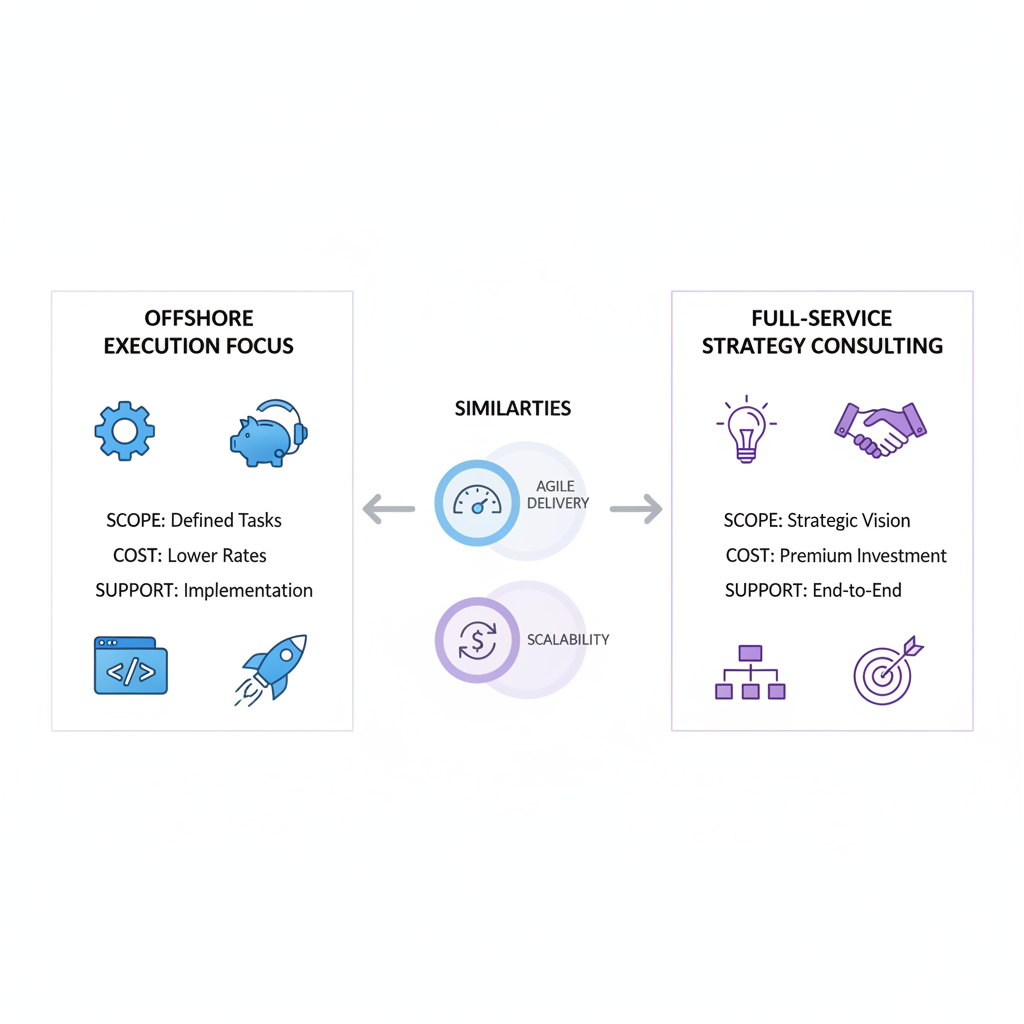
Visual comparison of offshore vs full-service IT development models
Evaluating Readiness and Initial Steps
Assessing enterprise readiness for offshore partnerships involves evaluating internal capabilities, such as project management maturity and technical requirements alignment. Key considerations include timezone management via overlapping hours, cultural alignment through team-building, and technical expertise in tools like Drupal or blockchain. Bantech’s ISO-compliant approaches ensure secure engagements, minimizing risks in global collaborations.
Initial steps start with a readiness audit using tools like SWOT analysis to identify gaps. Engage potential partners with targeted questions: 1) What is your experience with similar enterprise projects? 2) How do you handle scalability for growing teams? 3) What communication protocols mitigate timezone challenges? 4) Can you demonstrate IP protection measures? 5) What post-launch support options exist, including maintenance retainers? 6) How do you ensure cultural and quality alignment? 7) Provide case studies on cost savings and delivery timelines.
These queries, drawn from evaluation guides, help gauge reliability. Enterprises should pilot small projects to test integration, paving the way for full-scale partnerships that enhance efficiency and innovation in subsequent phases.
Key Benefits of Offshore Partnerships
Offshore partnerships, particularly with an offshore software development company India, offer enterprises significant advantages in cost savings, access to global talent, and flexible scaling. For businesses pursuing digital transformation, these collaborations with full-service IT consulting firms like Bantech Solutions enable faster innovation and higher ROI without compromising quality. By leveraging India’s robust IT ecosystem, companies can modernize legacy systems and accelerate e-commerce projects effectively.
Cost and Efficiency Advantages
Partnering with an Offshore Development Partner in India delivers substantial cost reductions, with hourly rates ranging from $20-50 USD compared to $100-200 USD domestically, yielding up to 70% savings. This eliminates overhead for infrastructure, allowing reinvestment in core operations. Bantech’s agile processes, for instance, streamline workflows through 24/7 operations across time zones, reducing time-to-market by 40% as per industry benchmarks. Clients benefit from faster iterations in custom software development, where offshore teams handle PHP, WordPress, and Drupal projects efficiently.
These efficiencies extend to productivity boosts, with no need for in-house hiring delays. An India-based outsourcing firm like Bantech ensures seamless integration, cutting project timelines while maintaining high standards. Quantifiable gains include a reported 60% cost reduction in software services, freeing budgets for strategic initiatives.
The following table illustrates key cost differences, highlighting why offshore options matter for commercial viability:
| Factor | India Offshore | Domestic US/UK | Savings/Advantage |
|---|---|---|---|
| Hourly Rate | $20-50 USD | $100-200 USD | Up to 70% reduction |
| Infrastructure Overhead | Minimal (cloud-based) | High (on-site setup) | 50% lower costs |
| Development Timeline | 20-30% faster | Standard | Accelerated delivery |
| Quality Assurance | ISO-compliant | Equivalent | Comparable with expertise |
| Scalability Costs | Flexible retainers | Fixed contracts | Cost-effective expansion |
Such savings empower enterprises to innovate, funding advanced features in e-commerce and mobile apps without financial strain.
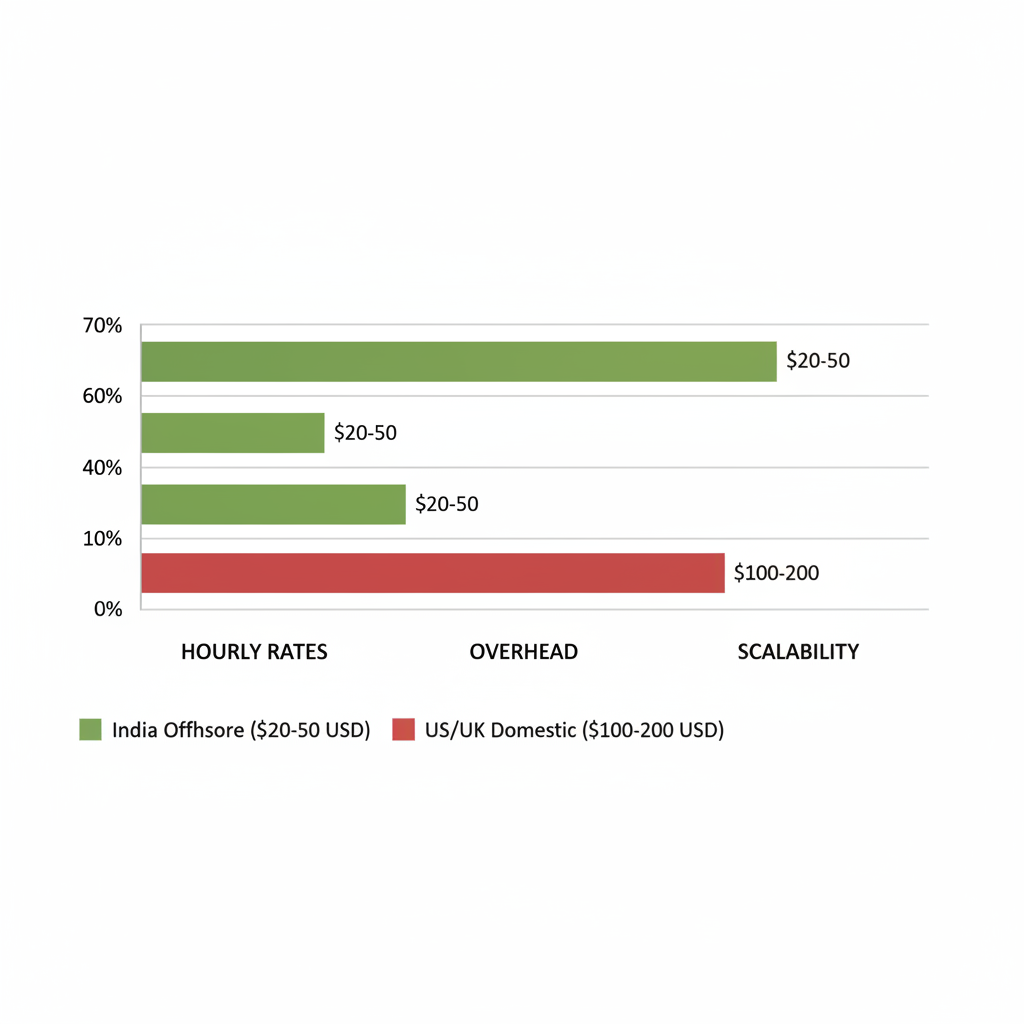
Cost comparison visualization for offshore software partnerships
Access to Specialized Expertise
India’s vast talent pool provides access to certified experts in custom software, CMS platforms like WordPress and Drupal, and emerging technologies. A cost-effective dev partner such as Bantech Solutions boasts a portfolio spanning AI-driven analytics, blockchain for secure transactions, and mobile app development for cross-platform solutions. This expertise supports enterprise software needs, from e-commerce migrations to cloud-native architectures.
Businesses gain from English-proficient teams ensuring clear communication and reliable delivery. Bantech’s full-service approach integrates these skills for digital transformation, offering white label solutions that agencies can rebrand. For instance, white label saas development enables medium-sized firms to launch scalable SaaS products quickly, leveraging AI personalization and DevOps for optimal performance.
- Custom PHP and CMS: Tailored solutions for robust web applications.
- AI and Blockchain: Enhancing data security and automation.
- Mobile Development: Native and hybrid apps for global reach.
This specialized access addresses queries on why India excels in IT outsourcing, positioning Bantech as a trusted ally for complex projects.
Scalability and Risk Mitigation
Offshore partnerships offer unparalleled scalability, allowing enterprises to adjust team sizes based on project demands without long-term commitments. Bantech’s retainer models and a la carte maintenance provide flexible support, mitigating risks through ISO-style compliance and security-first practices. This ensures data protection and seamless legacy modernization for digital transformation.
Risks like communication gaps are minimized by India’s reliable infrastructure and cultural alignment. Long-term partnerships include ongoing training and updates, supporting e-commerce scaling and blockchain integrations. White label options further reduce exposure by enabling agencies to outsource discreetly.
For agencies, partnering with a saas dev outsourcing agency like Bantech facilitates white label SaaS delivery, handling development while clients focus on branding. This model supports startups and large businesses alike, with examples including PWA-enabled CMS for enhanced user experiences.
- Flexible Scaling: Ramp up/down resources efficiently.
- Compliance Features: Adhering to global standards.
- Long-Term Support: Retainer-based maintenance programs.
Overall, these benefits pave the way for sustainable growth, transitioning smoothly into practical implementation strategies for offshore collaborations.
How Offshore Partnerships Operate
Offshore partnerships with an offshore software development company India like Bantech Solutions streamline software projects through structured processes, advanced tools, and cost-effective models. These collaborations enable seamless delivery of custom software, mobile apps, and CMS solutions, leveraging agile methodologies for efficiency and scalability.
Engagement and Project Lifecycle
Engaging an agency mobile app outsourcing partner begins with ideation, where Bantech’s collaborative intake process gathers requirements via initial consultations. As a reliable Offshore Development Partner in India, the lifecycle progresses through distinct phases: 1) Discovery, involving stakeholder interviews to define scope and objectives; 2) Planning, where agile sprints and timelines are outlined using tools like Trello; 3) Development, focusing on coding with cloud and DevOps integration for Bantech’s e-commerce migrations. Testing follows with rigorous QA to ensure compliance and security, then deployment via CI/CD pipelines. Maintenance provides ongoing support, addressing updates and optimizations. This agile workflow, as per The Ultimate Outsourcing Guide, incorporates iterative feedback to adapt quickly, reducing risks like scope creep. Bantech’s full-service approach integrates consulting early, ensuring alignment with business goals throughout the 6-12 month typical project duration.
Communication and Collaboration Tools
Daily interactions in India offshore operations rely on robust tech stacks to bridge time zones and foster global project execution. Bantech employs video calls on Zoom for weekly reviews and shared documents in Google Workspace for real-time updates, overseen by dedicated project managers. Tools like Jira track tasks and bugs, while Slack enables instant messaging for quick resolutions. The Ultimate Outsourcing Guide highlights that daily stand-ups reduce delays by 40%, a practice Bantech adopts to maintain momentum. For specialized areas, such as mobile app development technologies, teams use GitHub for version control and Figma for UI/UX collaboration, ensuring seamless integration of native or cross-platform solutions. This setup minimizes misunderstandings, with asynchronous updates accommodating the 9.5-hour time difference between India and the US, promoting transparency and accountability in every sprint.
Cost Structures and Payment Models
Transparent pricing defines offshore partnerships, with Bantech offering flexible models tailored to project needs. Fixed-price contracts suit well-defined scopes like CMS migrations, providing predictability at rates 40-60% lower than US firms due to India’s talent pool. Time-and-materials billing works for evolving projects, charging hourly rates of $25-50 for developers, ideal for agile iterations. Retainers ensure ongoing maintenance, starting at $2,000 monthly for post-deployment support including security audits and updates. Milestones trigger payments at phase completions, verified via demos to align with deliverables. As an offshore software development company India, Bantech emphasizes value through economies of scale, cloud efficiencies, and no hidden fees, as recommended in outsourcing best practices. This structure supports budgets from $5,000 to over $50,000, with detailed proposals outlining breakdowns for consulting, development, and DevOps services.
Success in these partnerships hinges on clear scoping, proactive communication, and selecting experienced providers like Bantech. By avoiding pitfalls such as vague requirements, businesses achieve accelerated time-to-market and sustained innovation through reliable offshore operations.
Best Practices for Offshore Selection
Selecting an offshore development partner requires careful evaluation to ensure alignment with business goals, cost efficiency, and quality outcomes. In India, a hub for skilled IT talent, focusing on vetting, reliability, and long-term strategies can mitigate risks and drive success. This guide outlines practical steps, exemplified by firms like Bantech Solutions, to help you choose wisely.
Vetting Criteria and Questions
Begin with a structured vetting process to identify a capable Offshore Development Partner in India. Review portfolios for relevant projects in custom software and CMS, check client testimonials for real-world performance, and conduct technical audits to assess code quality and innovation. Red flags include vague responses to queries or lack of verifiable references, as noted in industry guides on offshore selection–thorough checks boost successful partnerships by 75%.
Use these key questions to guide due diligence:
- What is your experience with our industry and tech stack, such as PHP, AI, or blockchain?
- Can you demonstrate scalable solutions from past projects?
- How do you handle intellectual property rights and data security?
- What are your service level agreements (SLAs) for timelines and deliverables?
- How do you ensure cultural fit for collaborative teams?
For Bantech Solutions, their case studies in e-commerce migration highlight strong portfolio depth, making them a prime example of thorough vetting payoff.
The following Partner Evaluation Checklist provides a framework for comparing offshore options against full-service partners. It emphasizes criteria, probing questions, and India’s advantages to streamline your decision-making.
| Criteria | Key Questions | India Offshore Advantages |
|---|---|---|
| Expertise | What tech stacks do you specialize in? | Cost-effective talent in PHP, CMS, AI at 60% lower rates |
| Cost Efficiency | How do you structure pricing models? | Access to vast skilled workforce reducing overhead by 50-70% |
| Scalability | Can you scale teams quickly for growth? | Agile talent pools for rapid expansion without delays |
| Compliance | What certifications do you hold? | Strong adherence to GDPR, ISO standards with robust legal frameworks |
| Support | How do you provide ongoing maintenance? | 24/7 availability and retainer options for seamless continuity |
| Cultural Fit | How do you bridge time zone differences? | English proficiency and collaborative mindset for effective partnerships |
Weight factors like expertise highest for technical needs, while cost suits budget-focused projects. This checklist, drawn from vetting best practices, helps prioritize partners offering enterprise-grade value.
Ensuring Reliability and Compliance
Reliability starts with verifying an offshore software development company India ‘s adherence to global standards. Prioritize ISO-certified processes and GDPR compliance to safeguard data, alongside robust security protocols. Bantech Solutions exemplifies this through their security-first approach in blockchain and DevOps projects, ensuring no vulnerabilities in deployments.
In the second phase, assess service scopes via demos or pilots. For instance, explore custom software services tailored to enterprise needs, including AI-driven analytics and cloud integration. Client testimonials often reveal post-deployment reliability–look for firms with proven track records in handling complex migrations without downtime.
Finally, evaluate support mechanisms. A reliable India dev firm should offer transparent communication channels and contingency plans. Bantech’s case studies, such as legacy system transformations for agencies, demonstrate how compliance-focused practices build trust and minimize risks in offshore engagements.
Building Long-Term Partnerships
Foster sustained collaboration by negotiating clear contracts that outline retainers, milestones, and exit clauses. Emphasize scalability through agile methodologies, allowing seamless team expansions for evolving projects. As a strategic offshore ally, Bantech supports white label options, enabling agencies to rebrand solutions without overhead.
Discuss IP ownership upfront and include scalability clauses for growth. A full service IT consulting firm like Bantech aids digital transformation by integrating consulting with development, as seen in their NFT and e-commerce case studies.
In maintenance discussions, prioritize ongoing support. Post deployment support compliance is crucial for regulatory adherence in India-based operations, ensuring security audits and updates. Stress cultural alignment–India’s time zone overlap with Europe and English proficiency enhances reliable India dev firm interactions.
Use templated checklists for quarterly reviews to maintain momentum.
Applying these practices positions you to select partners that deliver innovation and efficiency, transforming offshore selection into a competitive advantage for your business.
Choosing Your Ideal Offshore Partner
Selecting the right Offshore Development Partner in India requires careful evaluation of readiness signs, such as clear project scopes and scalable needs, alongside understanding model differences like dedicated teams versus project-based engagements. Cost benefits include up to 60% savings on development, while operational flows emphasize seamless communication through agile methodologies. Vetting best practices involve assessing technical expertise, compliance standards, and cultural alignment to ensure reliability. According to the Offshore Software Development Services Guide, offshore models yield 50% faster delivery, validating these partnerships for accelerated innovation.
Bantech Solutions stands out as a full service IT consulting firm offering unique value through scalable CMS platforms, e-commerce solutions, AI integrations, and retainer support for ongoing maintenance. Their expertise in white label web design enables agencies to deliver premium services without in-house expansion, fostering business-oriented growth in a rapidly evolving tech landscape.
With these insights, partnering with a trusted offshore collaborator like Bantech Solutions is straightforward–reach out today to discuss your project and unlock scalable solutions tailored to your enterprise. As an Offshore White Label Agency, they provide the integrated IT partnership needed for long-term success and digital transformation.