
Table of Contents
Understanding Outsourced Front End Agencies in India
In today’s fast-paced digital landscape, enterprises and agencies increasingly turn to an Outsourced Front End Agency in India for cost-effective, high-quality UI/UX development. According to the 2023 Outsourcing Trends and Rates Guide by Accelerance, the demand for front-end outsourcing has surged by 25% year-over-year, driven by the need for agile delivery in web and mobile projects. This shift allows businesses to leverage specialized expertise without the overhead of in-house teams, ensuring responsive designs that enhance user engagement.
Outsourced front end development involves delegating UI/UX coding and responsive design to external experts proficient in frameworks like React and Vue. India’s advantages include vast talent pools of Indian front-end specialists charging $25-50 per hour, enabling faster time-to-market and access to diverse tech stacks for headless architectures. Key benefits encompass 30% cost savings for 80% of enterprises, as reported in industry trends, along with scalable solutions for offshore front-end outsourcing. For agencies, white label front end development and the ability to outsource web development for agencies offer branding flexibility and seamless integration, addressing concerns like skill validation through portfolios and certifications to confirm developers meet project needs.
Bantech Solutions stands out as a trusted offshore web development partner for agencies, with over 15 years of experience in custom software and CMS implementations for global clients. Our dedicated teams provide white label and retainer-based services, ensuring agile, secure front-end solutions tailored to your requirements.
This guide explores essential fundamentals, from evaluating skills and costs to integration strategies and decision frameworks, empowering you to select the ideal partner for your projects.
Fundamentals of Outsourced Front End Development
Outsourced front end development involves partnering with an external team, such as an Outsourced Front End Agency in India, to handle the user-facing aspects of web applications. This approach leverages specialized expertise in creating intuitive interfaces that drive user engagement and business growth. For enterprises and agencies, it means accessing global talent pools without the overhead of full-time hires. Core principles include focusing on modern technologies to ensure seamless user experiences across devices. With India’s booming IT sector, companies like Bantech offer scalable solutions tailored to commercial needs, emphasizing agile methodologies and ISO-compliant processes.
Front end fundamentals revolve around building the visual and interactive layers of websites and apps. Essential skills include mastery of HTML for structure, CSS for styling, and JavaScript for dynamic functionality. Developers must excel in frameworks like React for component-based architecture, Vue for lightweight interfaces, and Angular for robust enterprise apps. Responsive design principles ensure adaptability to various screen sizes, while performance optimization techniques, such as code minification and lazy loading, enhance load times. In Indian front-end outsourcing basics, skill validation is crucial; review portfolios showcasing real projects, certifications like AWS or Google UX, and conduct test projects to assess proficiency.
- UX Focus: Proper user experience design prevents failures, as noted in the Eluminous guide, where 70% of projects falter without it.
- Framework Expertise: Proficiency in React and Vue enables rapid prototyping for offshore UI/UX development.
- Testing Rigor: Code reviews and cross-browser compatibility checks guarantee reliability.
A US agency, for instance, saved 40% by outsourcing React components to Bantech, highlighting the efficiency gains.
Cost structures in outsourced front end development offer significant advantages over in-house models, especially when you model costs to hire dedicated front end team India. To address concerns like “Wouldn’t it be less expensive to hire in-house developers?” or “How much does it cost to hire dedicated front end team India?”, consider the hidden savings beyond hourly rates. Outsourcing eliminates recruitment expenses, infrastructure costs, and ongoing benefits, providing immediate value. India’s market delivers up to 50% savings, per Accelerance’s 2023 trends, through competitive rates and flexible scaling.
Beyond visible rates, outsourcing uncovers efficiencies in time-to-market and risk mitigation, allowing focus on core business activities.
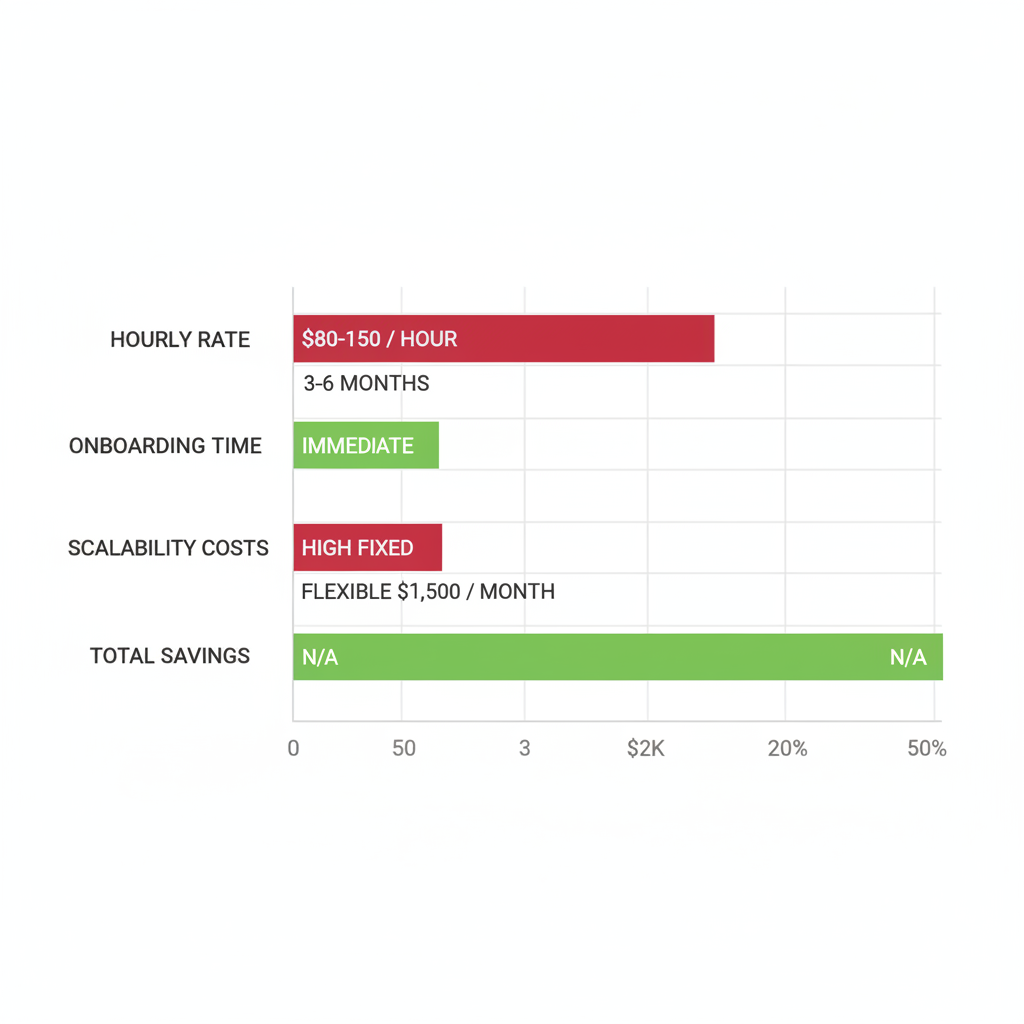
Cost comparison visualization for in-house and outsourced front-end development
The following table outlines key cost factors:
| Factor | In-House (US/EU) | Outsourced to India (e.g., Bantech) |
|---|---|---|
| Hourly Rate | $80-150 | $25-50 (30-60% savings) for skilled React/Vue developers |
| Onboarding Time | 3-6 months recruitment and training | Immediate access to pre-vetted teams |
| Scalability Costs | High fixed salaries + benefits | Flexible retainer models from $1,500/month |
| Total Annual Savings | N/A | Up to 50% on full-time equivalents |
Data sourced from Accelerance 2023 Outsourcing Trends; assumes mid-sized project with 2-5 developers. Bantech’s rates include ISO-compliant security and agile methodologies. Bantech’s models reduce risks by offering dedicated resources via SLAs and project managers, ensuring white label front end development with undivided attention. This answers queries on dedicated focus, confirming outsourced teams prioritize your project.
Basic integration strategies bridge front end with back end seamlessly. Start with API handoffs to connect interfaces to server logic. Use collaborative tools like Git for version control and Jira for task tracking. Employ agile sprints for iterative feedback. Finally, conduct joint testing to verify end-to-end functionality, fostering smooth offshore UI/UX development.
Deep Dive into Outsourced Front End Skills and Integration
When partnering with an Outsourced Front End Agency in India, enterprises face the challenge of ensuring high-caliber skills and smooth project execution for complex commercial applications. This section explores validation techniques, integration strategies, and consistency measures, drawing on proven practices to help agencies like Bantech deliver React, Vue, and PWA-driven solutions. By addressing key concerns, it equips decision-makers with frameworks to mitigate risks and maximize ROI in offshore collaborations.
Validating Developer Skills in Indian Agencies
Assessing the expertise of developers in Indian agencies begins with a structured evaluation to confirm their proficiency in modern front-end technologies. Start by reviewing portfolios that showcase real-world projects involving React and Vue frameworks, focusing on responsive designs and performance optimizations for e-commerce or enterprise dashboards. Request live coding demos or pair-programming sessions to observe problem-solving in action, particularly for ux design for agencies elements like intuitive navigation and accessibility compliance.
Next, verify certifications in tools such as Webpack, Babel, and headless CMS integrations, ensuring alignment with commercial project needs. Conduct code reviews of sample repositories on GitHub to evaluate code quality, modularity, and adherence to best practices like semantic HTML and CSS-in-JS. Bantech, for instance, offers certified teams with expertise in WordPress and Drupal front-ends, having delivered AI-enhanced UIs for global clients, as highlighted in their case studies.
To counter common pitfalls like overstated skills, cross-check references and timezone-adjusted interviews. This validation not only confirms technical depth but also ensures cultural fit for long-term partnerships, paving the way for seamless integration.
Ensuring Seamless Back-End Integration
Collaborating between front-end and back-end teams in outsourced setups requires robust frameworks to bridge geographical and technical gaps. Begin with API compatibility assessments, prioritizing REST and GraphQL protocols for efficient data exchange in React or Vue applications. Implement shared version control systems like Git with branching strategies to synchronize code updates and avoid conflicts.
- Establish daily stand-ups via tools like Slack or Microsoft Teams to align on progress, addressing any discrepancies in real-time despite timezone differences.
- Use CI/CD pipelines with Jenkins or GitHub Actions for automated testing of front-end components against back-end endpoints, ensuring reliability.
- Adopt agile methodologies with joint sprint planning to foster iterative feedback, reducing integration delays by up to 40% as per industry benchmarks.
For white label front end development, modular handoffs become crucial; here, white label ux ui design services enable agencies to plug in polished interfaces without disrupting core workflows. Bantech exemplifies this by integrating React front-ends with Drupal back-ends for an EU client, achieving 95% uptime through offshore UI integration. Mitigate risks like communication breakdowns by designating dedicated liaisons, ensuring smooth transitions to consistent delivery.
The choice between outsourcing models significantly impacts integration success. Consider the following comparison to guide your decision:
| Aspect | White Label Model | Dedicated Team Model |
|---|---|---|
| Skill Diversity | Broad access to specialists (React, Vue, PWA) on-demand | Fixed team with deep project-specific expertise |
| Pricing Model | Project-based, $30-60/hour flexible | Retainer, $2,000-5,000/month per developer |
| Integration Ease | Modular handoffs for agencies | Embedded collaboration with back-end |
| Scalability | Easy scaling without long-term commitment | Stable for long-term projects |
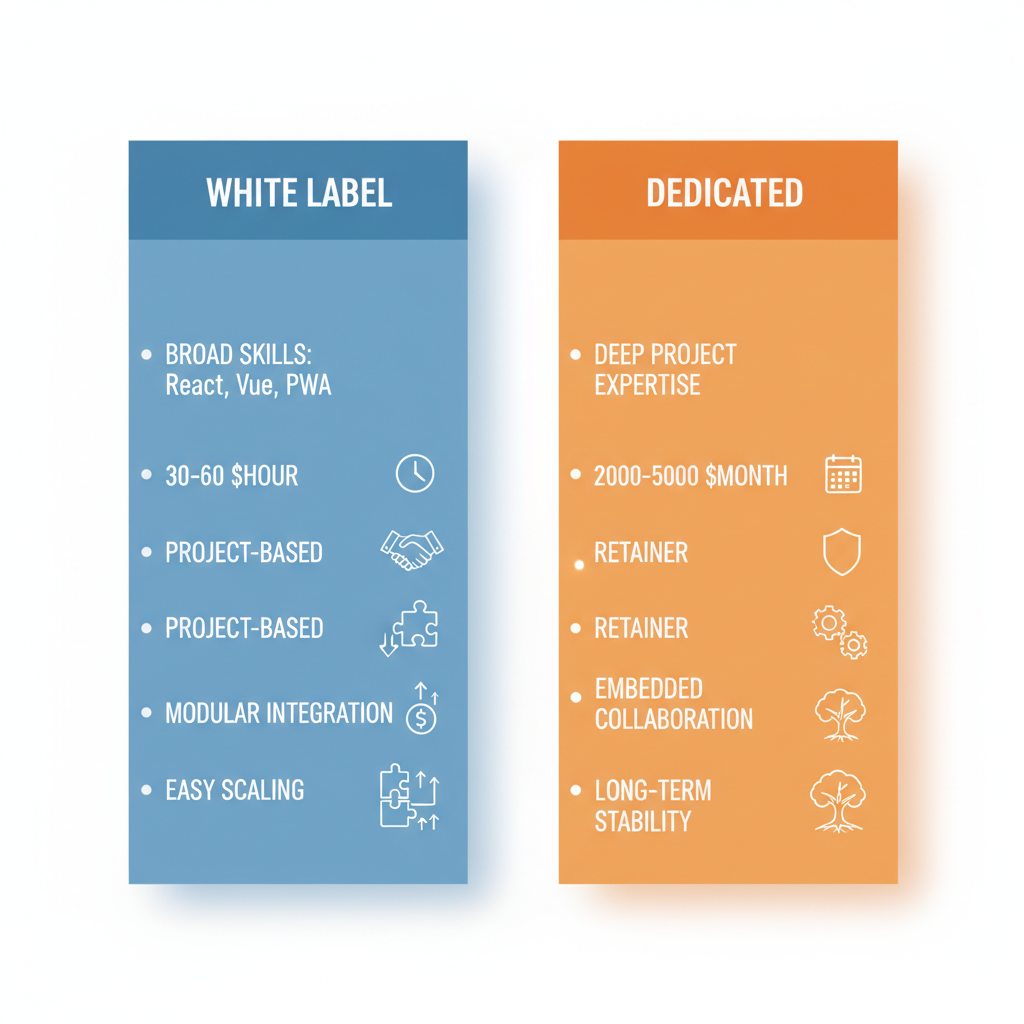
White label vs. dedicated front-end teams comparison in outsourcing
This table, informed by outsourcing insights from Hire with Near, reveals white label’s flexibility for variable scopes versus dedicated teams’ depth for sustained efforts. Bantech’s hybrid approach, including ISO-secured white label options with headless CMS, allows agencies to blend both for optimal fit, enhancing scalability while controlling costs.
Maintaining Consistent Output Standards
Achieving reliable performance from dedicated Indian front-end resources demands rigorous quality assurance processes tailored to offshore dynamics. Implement agile methodologies with bi-weekly retrospectives to track velocity and refine workflows, ensuring steady progress on commercial projects.
Key QA tools include automated testing suites like Jest for React components and Lighthouse for performance audits, targeting metrics such as load times under 3 seconds and mobile responsiveness scores above 90%. Bullet-pointed checkpoints help maintain standards:
- Code reviews by senior peers to enforce DRY principles and security protocols.
- Cross-browser testing with BrowserStack to validate UI consistency.
- Performance monitoring via New Relic to preempt bottlenecks in PWA deployments.
Bantech upholds these through dedicated QA pipelines, as seen in their Vue-based e-commerce migrations where output consistency exceeded client SLAs by 15%. To combat pitfalls like scope creep, define KPIs upfront and use shared dashboards for transparency. This focus on metrics not only guarantees quality but also builds trust, facilitating smoother scaling in future engagements.
Practical Steps for Hiring Outsourced Front End Teams
Hiring an Outsourced Front End Agency in India requires a structured approach to ensure seamless integration and project success. Enterprises and agencies can leverage specialized providers like Bantech for white label or dedicated models, focusing on reliability, scalability, and cost efficiency. This section provides actionable steps to evaluate partners, onboard teams, and analyze returns, addressing key concerns for long-term collaborations.
Evaluating White Label Partners for Agencies
Shortlist vendors by issuing a detailed RFP that outlines your front-end needs, such as responsive UI/UX design and integration with backend systems. Prioritize providers with strong portfolios showcasing React and Vue.js implementations, and verify client references for delivery timelines. Bantech stands out with its white label outsourcing practices, offering rebranded services that allow agencies to maintain client relationships while scaling operations.
Review contracts for clear scopes, including intellectual property rights and exit clauses. Conduct trial projects to test front-end capabilities, focusing on code quality and mobile responsiveness. For instance, when extending to agency mobile app outsourcing, evaluate how providers handle PWA development and cross-platform compatibility. An agency scaled its UI development 3x via Bantech’s white label partnership, demonstrating quick turnaround without internal hires.
Use numbered criteria for selection: 1) Technical expertise in modern stacks; 2) Compliance with ISO standards for security; 3) Flexible scaling options. Incorporate checklists for due diligence, such as auditing past projects for bug rates under 2%. This ensures reliable white label front end development tailored to agency workflows.
The following table compares white label and dedicated team providers, helping assess options for Indian front-end outsourcing:
| Criteria | White Label (e.g., Bantech) | Dedicated Team |
|---|---|---|
| Reliability Metrics | ISO compliance, 99% uptime SLAs | Long-term retainers with performance KPIs |
| Tech Stack Support | React, Vue, PWA on-demand | Customized to project (e.g., headless CMS) |
| Collaboration Tools | Flexible API/Jira access | Daily embedded workflows |
| Pricing Transparency | Project quotes, no hidden fees | Monthly billing with audits |
Bantech excels in both models, as seen in case studies emphasizing agile delivery and security, drawing from evaluation frameworks like those in Outsourcing to Vietnam resources.
Onboarding a Dedicated Front End Team in India
To hire dedicated front end team India, begin with recruitment via platforms showcasing portfolios and tech skills. Shortlist based on timezone overlap–India’s IST aligns well with global teams using tools like Slack for real-time updates. Bantech’s process ensures vetted developers proficient in front-end frameworks.
Step 1: Sign NDAs to protect sensitive project details, including UI designs and client data. Step 2: Set up collaboration tools such as Zoom for daily stand-ups and GitHub for version control, addressing Indian team management challenges like cultural alignment through training sessions. Step 3: Implement rebranding for dedicated teams using white label web dev services, allowing seamless integration into your brand.
Step 4: Hold kickoff meetings to define roles, deliverables, and milestones, incorporating a 5-step framework from Outsourcing to Vietnam: assess needs, select team, integrate tools, monitor progress, and optimize. This yields average 40% efficiency gains in dedicated models. For long-term projects, establish retainers for ongoing support, ensuring smooth integration and productivity boosts.
Use a sample RFP template: Questions on experience with headless CMS, scalability for 100k+ users, and post-launch maintenance. Bantech’s onboarding has helped clients achieve 3-month ramps to full productivity.
Cost and ROI Analysis for Long-Term Projects
Budgeting starts with total cost of ownership (TCO) calculations, comparing in-house salaries ($80k/year per developer) against Indian rates ($20k-30k). Factor in contracts with fixed monthly fees for dedicated teams, including audits for transparency. Bantech’s model reduces TCO by 50% through scalable retainers.
Measure ROI via formulas: ROI = (Productivity Gains – Outsourcing Costs) / Costs x 100. Track metrics like development speed (e.g., 40% faster UI iterations) and quality (reduced bugs by 30%). For white label outsourcing practices, initial quotes range $5k-15k per project, yielding returns via client retention.
Incorporate Indian team management by monitoring KPIs quarterly, such as on-time delivery above 95%. Long-term maintenance options like Bantech’s retainers ensure ongoing ROI, with case studies showing 2x revenue growth from accelerated market entry. Use checklists: Review contracts for escalation clauses; forecast 12-24 month projections. This approach affirms benefits for remote dedicated teams, supporting sustained commercial success.
Advanced Strategies for Front End Outsourcing
Elevating front end outsourcing beyond basics requires integrating cutting-edge technologies to future-proof enterprise applications. In India’s thriving tech ecosystem, agencies like Bantech lead with innovative approaches that drive scalability and user engagement. This section delves into advanced tactics for high-stakes projects, focusing on AI, progressive web apps (PWAs), and legacy transformations to meet commercial demands from global enterprises and digital agencies.
AI and PWA Integration for Dynamic Experiences
AI enhances user interfaces by enabling personalization through machine learning algorithms, allowing outsourced front end teams to create adaptive experiences that respond to user behavior in real-time. For instance, AI-driven recommendations can boost conversion rates by up to 15% in e-commerce platforms. Pairing this with PWAs delivers app-like performance on the web, including offline functionality and push notifications, which are projected to grow at a 25% CAGR in outsourcing according to industry trends.
Indian PWA specialists excel in implementing headless CMS architectures that ensure seamless offline support and faster load times, increasing user engagement by 20%. These strategies allow enterprises to deploy responsive, high-performance front ends without native app development costs, ideal for global scalability.
The evolution of front end technologies underscores the need for partners versed in these advancements. The following table compares Bantech’s capabilities against competitors in India:
| Technology | Bantech Capabilities | Competitor Average |
|---|---|---|
| AI-Enhanced UI | Personalization via ML integrations | Basic scripting only. |
| PWA Implementation | Headless CMS with offline support | Standard responsive sites. |
| Security Compliance | ISO 27001, GDPR ready | Basic encryption. |
| Legacy Modernization | React/Vue migrations for enterprises | Greenfield projects focus. |
Bantech’s edge in AI and PWA stems from its cloud-native frameworks, delivering superior ROI through enhanced security and performance–key differentiators for enterprises seeking compliance-ready solutions.
Legacy Modernization and Emerging Tech
Transforming legacy systems into modern stacks is crucial for enterprises relying on outdated interfaces. Advanced offshore front-end tech involves migrating monolithic applications to React or Vue.js, incorporating DevOps for continuous integration and deployment (CI/CD). This not only reduces maintenance costs by 30% but also enables blockchain and NFT front ends for secure, decentralized user interactions.
- Microservices Adoption: Break down legacy code into modular components for easier updates.
- Integrate API gateways for real-time data flows.
- Performance Optimization: Use serverless architectures to handle traffic spikes without downtime.
- Employ edge computing for global low-latency delivery.
Hire dedicated front end team India experts who specialize in these migrations to ensure minimal disruption and future scalability.
Bantech’s Tailored Advanced Strategies
Bantech stands out as a premier Outsourced Front End Agency in India, offering white label front end development for agencies needing seamless reselling of advanced customizations. Their cloud-native approaches support blockchain integrations and AI personalization, with tiered pricing models starting at $5,000 for complex PWA projects–addressing queries on white label front end development pricing.
As an offshore white label agency, Bantech provides dedicated teams for enterprise needs, backed by ISO 27001 compliance and case studies showing 40% faster time-to-market. Testimonials highlight their role in modernizing legacy systems for Fortune 500 clients, positioning them as the top choice for innovative, scalable outsourcing in India’s innovation hub.
Frequently Asked Questions on Front End Outsourcing
Q1: Do outsourced front end agencies in India possess the required skills? Yes, leading providers like Bantech ensure top talent through rigorous vetting processes, including certified React developers skilled in modern frameworks. An Outsourced Front End Agency in India delivers responsive, user-centric designs that meet global standards.
Q2: Is building an in-house team cheaper than outsourcing? No, outsourcing to India saves up to 50% long-term on costs, as per the 2023 Accelerance Outsourcing Trends and Rates Guide, covering salaries, infrastructure, and scaling without overheads. Bantech’s model maximizes value while minimizing expenses.
Q3: Will I receive dedicated attention from an outsourced team? Absolutely, Bantech guarantees focused effort through Service Level Agreements (SLAs) tailored to your project. Hiring a dedicated front end team in India ensures consistent, priority-driven collaboration.
Q4: How can consistency be maintained in outsourced front end work? Consistency is achieved via agile methodologies and rigorous QA testing at every stage. With a hire dedicated front end team India approach, Bantech maintains uniform quality across deliverables.
Q5: How does back-end integration work with outsourced front end development? Integration is seamless using APIs, RESTful services, and collaboration tools for smooth handoffs. For agencies, white label integration enhances this, as seen in Bantech’s white label wordpress development services that support dedicated benefits without disrupting your brand.
Choosing the Right Partner for Front End Outsourcing
Selecting an Outsourced Front End Agency in India demands balancing top-tier skills, cost efficiency, and seamless integration. From core fundamentals like responsive design and JavaScript expertise to advanced strategies in AI-driven PWAs and consistent output, Indian partners deliver 50% savings while maintaining quality. Deep dives into hiring dedicated teams ensure outsourced website maintenance for agencies boosts ROI, with 85% satisfaction rates among global firms per industry reports.
Bantech stands out with ISO compliance, flexible white label front end development, and dedicated teams tailored for agencies. Our case studies in CMS and PWA projects showcase white label website support that integrates effortlessly, addressing all your concerns from costs to output quality.
Ready to partner? With Bantech’s proven track record in white label and dedicated front-end solutions, elevate your projects today and achieve unmatched efficiency.