
Table of Contents
UX Design Essentials for Modern Agencies
In today’s competitive digital landscape, UX Design for Agencies stands as a cornerstone for delivering exceptional user-centered experiences. Agencies that prioritize intuitive interfaces not only boost client engagement but also streamline project outcomes, turning complex designs into seamless interactions. For instance, e-commerce redesigns that focus on user journeys can increase conversion rates by up to 30%, according to industry benchmarks.
Design agencies often grapple with tight deadlines, limited in-house resources, and the pressure to balance creativity with functionality. Without specialized UX support, projects risk misalignment between client visions and user needs, leading to costly revisions. Partnering with experts like Bantech Solutions addresses these hurdles through agency white label design, offering scalable white label UI UX services that integrate seamlessly into agency workflows. Drawing from the Complete UI Workflow Guide for Agencies 2025, which notes average UX project timelines stretching 12-16 weeks without optimization, such collaborations can shave off 40% of development time while maintaining high standards.
This guide equips agencies with foundational knowledge, starting from UX fundamentals and progressing to deep dives on methodologies. Explore practical applications, including product design and ideation, and advanced strategies like design thinking workshops for agencies. Subsequent sections cover outsourced UI/UX solutions, agency UX strategies, and real-world case studies to foster innovation and efficiency.
Outsourcing UX to a reliable partner like Bantech enhances scalability, with their security-first, ISO-compliant frameworks ensuring data protection and quality. Evaluate options based on cost, process transparency, and proven results to elevate your agency’s offerings and client satisfaction.
Core Principles of UX Design for Agencies
UX Design for Agencies forms the backbone of creating intuitive digital experiences that drive client success. At its core, this discipline emphasizes user-centered approaches to ensure seamless interactions across platforms. For agencies handling multiple projects, mastering these principles enables efficient outsourcing while maintaining high standards. Key principles include empathy for users, iterative refinement, and collaborative workflows that align with agency timelines.
- User-Centered Focus: Prioritizing end-user needs through empathy mapping and personas, crucial for agency projects like mobile app redesigns.
- Iterative Design: Building prototypes and refining based on feedback, reducing errors in fast-paced environments.
- Accessibility and Inclusivity: Ensuring designs work for diverse audiences, enhancing brand reputation.
- Design Thinking Workshops for Agencies: Facilitating structured ideation sessions to spark innovation in team settings.
These principles guide agencies in delivering impactful solutions, addressing common challenges like tight deadlines and client expectations.
The UX design process typically unfolds in stages, from research to testing, tailored for agency scalability. Traditional methods follow a linear path, while agile approaches integrate flexibility for white label UI UX services. Comparing these helps agencies evaluate providers for efficient partnerships. For instance, in a recent Bantech collaboration on an e-commerce redesign, agile methods accelerated delivery by incorporating real-time client input.
This table compares traditional vs. agile UX design processes for agencies, highlighting time, cost, and output differences to aid evaluation.
| Stage | Traditional Approach | Agile Approach | Key Benefits for Agencies |
|---|---|---|---|
| Research | Initial user interviews and surveys (4-6 weeks) | Ongoing user feedback loops (integrated throughout) | Faster iterations, reduced risk of scope creep |
| Wireframing | Static prototypes post-research (2-3 weeks) | Collaborative, iterative sketches (1-2 weeks per sprint) | Agency flexibility in client revisions |
| Testing | End-stage usability tests (2 weeks) | Continuous A/B testing (ongoing) | Higher client satisfaction, quicker market entry |
| Overall Cost | Fixed upfront (higher initial) | Incremental billing (scalable) | Budget alignment with agency projects |
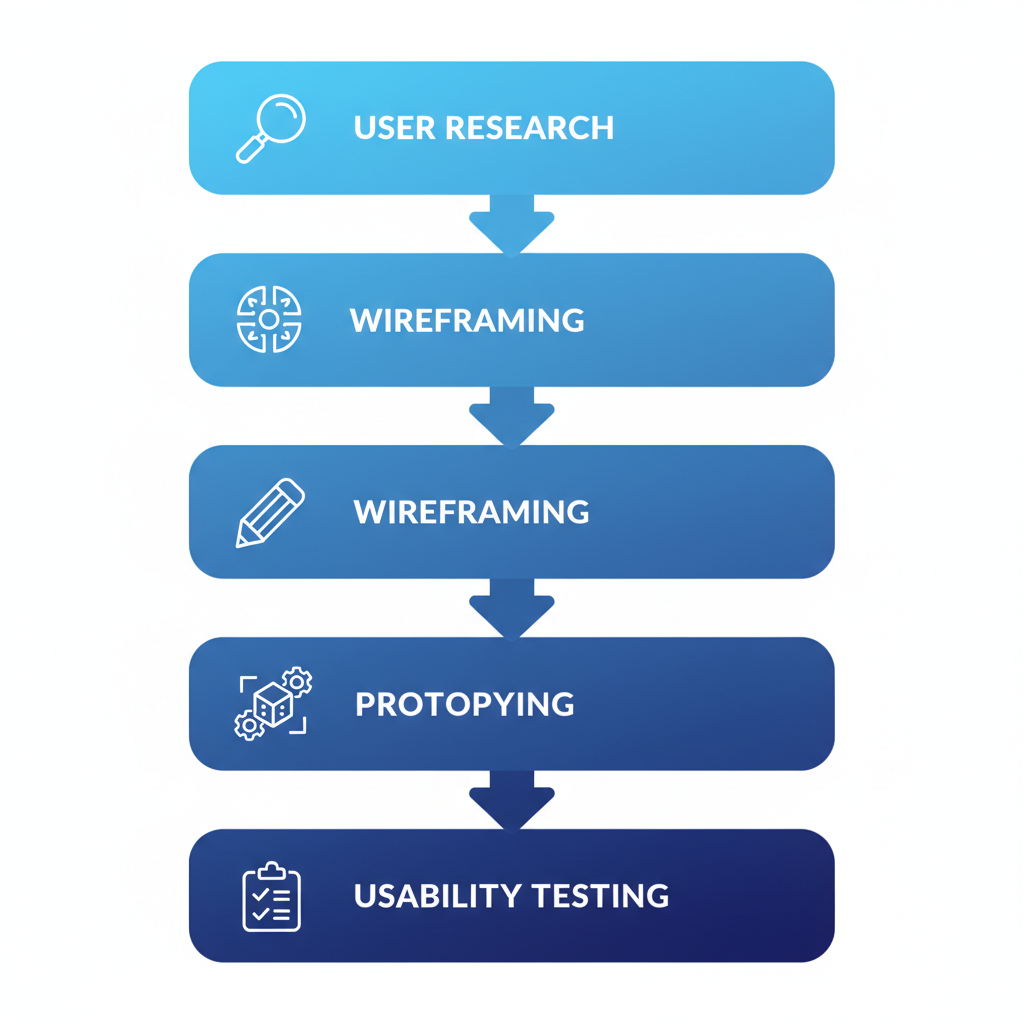
UX design process flow for agencies with four key stages
Agile’s advantages shine in white label partnerships, reducing time-to-launch by 30% per industry benchmarks. This suits agency needs for parallel client work, enabling scalable white label website design without quality dips. Bantech’s model ensures seamless integration, fostering long-term collaborations.
UI/UX designers in agency settings play pivotal roles, blending creativity with technical expertise. They conduct user research using methods like surveys and interviews to uncover pain points, essential for client deliverables. Daily responsibilities include crafting wireframes in tools like Figma, prototyping interactive elements, and facilitating collaborative design processes. In agency environments, designers collaborate with developers and stakeholders, ensuring designs align with business goals. For example, during a Bantech-supported project for a retail client, designers iterated prototypes based on usability insights, boosting conversion rates by 25%. Their contributions extend to usability testing, where they analyze feedback to refine interfaces, ultimately enhancing user satisfaction and project ROI.
Cost factors significantly influence UX projects for agencies, with budgets typically ranging from $5,000 to $20,000 depending on scope and complexity. Factors include research depth, iteration cycles, and team expertise. Understanding the cost of digital product design helps in budgeting for outsourced work, avoiding overruns while maximizing value.
Bantech integrates these principles through agile frameworks and ISO-compliant processes, supporting agency scalability with secure, efficient white label UI UX services. This alignment ensures timely, high-quality outputs for outsourced projects.
In-Depth UX Strategies and Tools for Agency Success
In the competitive landscape of UX Design for Agencies, adopting advanced strategies can significantly enhance project outcomes and client satisfaction. Agencies often seek efficient methodologies to deliver innovative solutions, particularly through partnerships that offer white label UI UX services. Bantech Solutions exemplifies this by providing AI-enhanced tools and PWA-capable implementations, ensuring scalable and modern UX deliverables. This section explores research techniques, prototyping practices, and design thinking integration to empower agencies with actionable insights.
Research and Ideation Techniques
Effective UX begins with robust research to align designs with user needs, a cornerstone of advanced UX toolkits. Agencies can employ user personas to create detailed profiles based on demographics, behaviors, and pain points, derived from surveys and interviews. Journey mapping visualizes user interactions across touchpoints, identifying friction areas in software interfaces. These methods, customized for tight agency timelines, incorporate design thinking to generate client-specific insights, such as empathy mapping to understand emotional responses.
For instance, in a Bantech project for an e-commerce client, persona development revealed key user segments, leading to personalized navigation improvements. This approach not only uncovers hidden opportunities but also fosters ideation sessions where teams brainstorm solutions collaboratively. Tips include starting with stakeholder interviews to refine scopes and using digital tools for remote mapping, ensuring inclusivity across global teams. By prioritizing these techniques, agencies can reduce redesign costs by up to 20%, based on industry benchmarks from 2025 UX trends.
The following table compares popular design thinking tools for agencies, aiding in selection for ideation and workshops:
| Tool | Key Features | Pricing | Agency Fit |
|---|---|---|---|
| Figma | Collaborative prototyping, real-time editing | Free for basics, $12/user/mo pro | Ideal for remote agency teams, integrates with white label workflows |
| Miro | Whiteboard for ideation, templates galore | Free tier, $8/user/mo | Great for design thinking workshops, scalable for agencies |
| Adobe XD | Advanced animations, voice prototyping | $9.99/mo starter | Suits creative agencies needing polished outputs |
| Overall | Cloud-based collaboration emphasis | Budget-friendly options available | Enhances Bantech’s white label services for modern needs |
This comparison highlights tools that support efficient research, with Figma and Miro standing out for their affordability and collaboration features. Agencies outsourcing to partners like Bantech can leverage these for seamless integration, optimizing workflows and reducing overhead.
Prototyping and Iteration Best Practices
Prototyping accelerates the transition from ideas to testable designs, essential for iterative agency design processes. High-fidelity tools enable detailed mockups that simulate user interactions, allowing early feedback to refine concepts. tools for product design process such as Figma or Adobe XD facilitate this by offering component libraries and auto-layout features, streamlining agency workflows.
Iteration involves structured feedback loops, where prototypes are shared with clients and users for usability testing. Agile methodologies in UX promote short sprints, enabling rapid adjustments based on metrics like task completion rates. White label partnerships amplify this efficiency; for example, Bantech’s outsource web development for agencies allows agencies to integrate custom iterations without internal resource strain, cutting development time by 25% through AI-driven personalization.
Cost implications include initial tool subscriptions but yield ROI via faster delivery–prototyping phases typically span 2-4 weeks per cycle. A Bantech case study on a mobile app redesign demonstrated how iterative loops improved user retention by 35%. Best practices: conduct A/B testing on prototypes and document changes in shared repositories for team alignment.
To illustrate methodology impacts, consider this comparison of agile versus waterfall in UX prototyping:
| Methodology | Key Features | Time Savings | Agency Fit |
|---|---|---|---|
| Agile | Iterative sprints, continuous feedback | 30% faster per 2025 trends | Suits dynamic agency projects with evolving requirements |
| Waterfall | Sequential phases, upfront planning | Standard timelines | Fits fixed-scope deliverables, less flexible for UX iterations |
| Overall | Flexibility vs. structure | Agile offers 25% efficiency boost via AI tools | Bantech white label enhances agile for cost-effective scaling |
Agile’s adaptability aligns with agency needs for quick pivots, supported by references indicating substantial time savings in collaborative environments.
Integration of Design Thinking Workshops
Design thinking workshops for agencies ignite creativity by structuring ideation around user-centered problem-solving. These sessions enhance project innovation, particularly for software developments, by breaking down complex challenges into empathetic, defined, ideated, prototyped, and tested phases. Tailored exercises encourage diverse inputs, fostering breakthroughs in UX design.
A typical workshop lasts 4-8 hours, depending on depth, and can improve agency projects by aligning teams on user insights, reducing miscommunications. Key exercises include:
- Empathy Building: Role-playing user scenarios to build personas, revealing unmet needs in software interfaces.
- Ideation Brainstorming: Rapid sketching sessions to generate 50+ ideas, prioritizing via dot voting for feasibility.
- Prototyping Challenges: Low-fi builds with paper or digital tools, followed by immediate critique rounds.
Bantech incorporates these in white label UI UX services, as seen in a recent enterprise portal project where workshops led to AI-personalized dashboards, boosting efficiency by 25% per 2025 agency guides. Pros include heightened team morale and innovative outputs; cons involve time investment, mitigated by virtual formats. When partnering with firms like Bantech, agencies gain access to facilitated sessions, ensuring scalable creativity without in-house expertise.
Applying UX Design in Agency Workflows
Agencies can enhance client deliverables by integrating UX design seamlessly into their operations. This section explores practical strategies for hiring UX partners, managing costs, and implementing projects through outsourcing, with a focus on white label solutions like those from Bantech. By addressing common challenges in UX Design for Agencies, teams achieve better efficiency and client satisfaction.
Hiring and Engagement Processes
Selecting the right UX partner is crucial for agency success. Start by evaluating potential providers with targeted questions to ensure alignment. A checklist drawn from industry best practices includes: 1) What UX methodologies do you employ, such as design sprints or user testing? 2) Can you demonstrate ISO-compliant processes for security and scalability? 3) How do you handle white label integration to maintain our branding? 4) What tools support collaborative workflows, like Figma or Adobe XD? 5) Provide examples of agency-specific projects with measurable ROI. These inquiries, inspired by expert guides on hiring design agencies, help identify partners adept at practical UX outsourcing.
Once vetted, engagement begins with clear contracts outlining scopes, deliverables, and timelines. Define milestones for wireframing, prototyping, and iterations to track progress. For seamless integration, opt for white label web dev services that allow agencies to present UX work as in-house. This setup minimizes disruptions, enabling agencies to focus on client relationships while outsourcing handles the technical heavy lifting. Post-engagement, establish communication channels via tools like Slack for real-time updates.
Outsourcing UX design offers agencies a strategic edge over building internal teams, especially in dynamic markets. The following table contrasts white label services with in-house efforts, highlighting key decision factors for cost, time, and scalability.
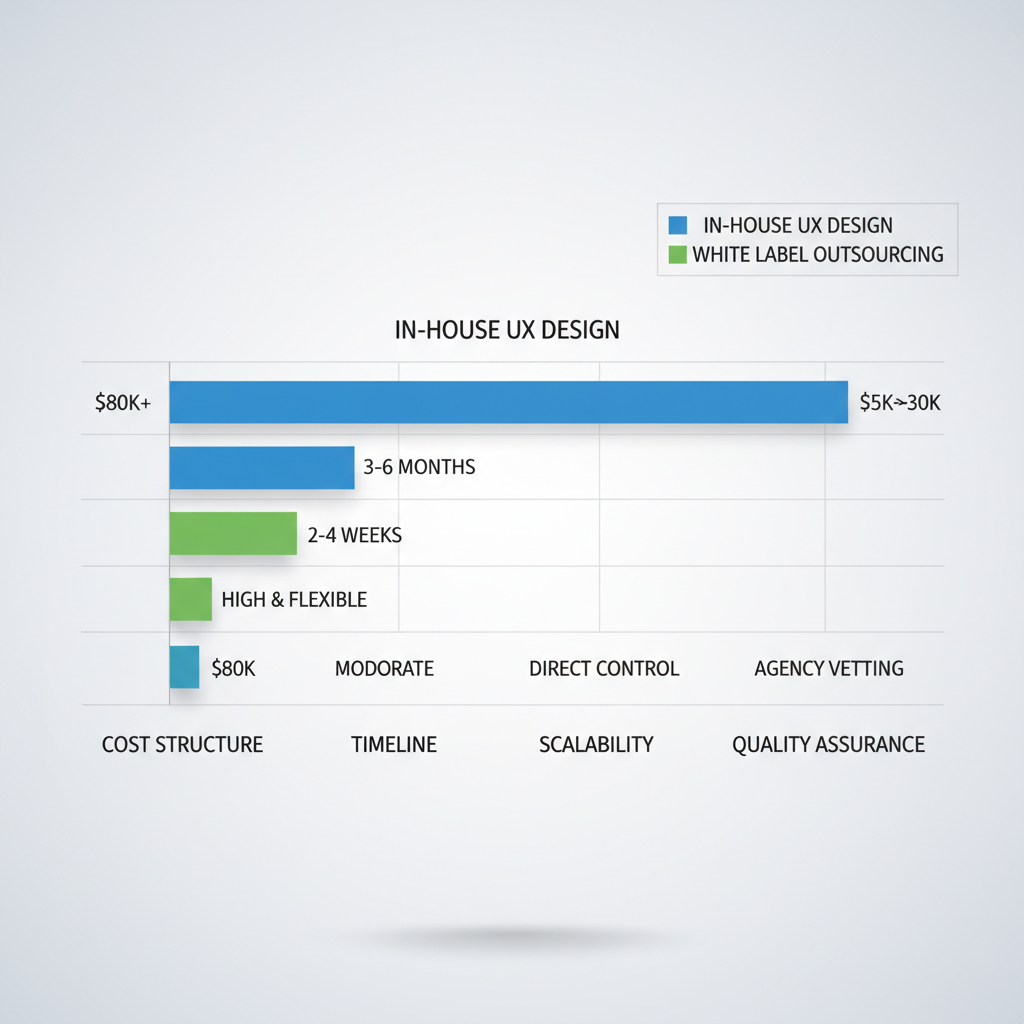
Bar chart of UX design in-house vs. outsourcing benefits for agencies
| Aspect | In-House UX | White Label Outsourcing (e.g., Bantech) | Agency Advantages |
|---|---|---|---|
| Cost Structure | High fixed salaries ($80k+/year per designer) | Project-based ($5k-$30k), scalable retainers | Predictable budgeting, no overhead |
| Timeline | 3-6 months for full team ramp-up | 2-4 weeks to launch, agile sprints | Faster project delivery for clients |
| Scalability | Limited by headcount, training needs | On-demand experts, ISO-compliant scaling | Handle multiple clients without expansion |
| Quality Assurance | Internal only, variable expertise | Security-first, AI-enhanced, certified teams | Consistent high standards, compliance |
Bantech’s white label model stands out for agencies, delivering 60% cost savings as reported in surveys while ensuring rapid deployment through cloud-native tools. This approach supports PWA implementations and fosters long-term partnerships, reducing risks and boosting scalability for growing firms.
Cost Management and Budgeting Strategies
Effective UX outsourcing requires understanding cost breakdowns to avoid surprises. Core components include research (10-15% of budget), wireframing and prototyping (30-40%), user testing (20%), and iterations (25%), with tools and revisions rounding out the rest. For agencies, white label White Label UX UI Design Services provide flexible pricing from $5,000 for basic audits to $30,000+ for full redesigns, emphasizing ROI through enhanced user engagement.
To optimize budgets, compare pricing models carefully. Fixed-price suits defined scopes like app interfaces, while retainers offer ongoing access for iterative work. Agencies benefit from hybrid models, allocating 20-30% to upfront design and the balance to maintenance. Tips include negotiating volume discounts for multiple projects and using milestone payments to align incentives.
The table below illustrates fixed versus retainer models, sourced from agency workflow guides, aiding in budget planning.
| Pricing Model | Description | Pros for Agencies | Typical Range |
|---|---|---|---|
| Fixed-Price | One-time fee for scoped deliverables | Predictable costs, clear scopes | $5k-$20k per project |
| Retainer | Monthly fee for ongoing support | Flexibility, priority access | $2k-$10k/month |
| Hybrid | Blend of fixed and hourly | Balanced risk, scalable adjustments | $10k initial + $1k/month |
| Hourly | Billed per expert hour | Customizable for variable needs | $50-$150/hour |
These strategies enable agency workflow optimization, ensuring UX investments yield high returns without straining resources.
Real-World Implementation Case Studies
Bantech’s white label projects demonstrate practical UX outsourcing in action. In one anonymized case for a marketing agency, a PWA redesign integrated design thinking workshops for agencies, completing in 4 weeks versus 4 months in-house. Outcomes included 40% faster load times and improved conversion rates, teaching agencies the value of agile sprints for quick wins.
Another example involved e-commerce migration for a digital firm, using white label UI UX services. The 6-week timeline delivered AI-enhanced personalization, boosting user retention by 25%. Lessons highlighted the importance of early milestone reviews to refine features, emphasizing compliance in data handling.
For a startup agency client, Bantech handled legacy system UX overhaul on retainer, spanning 3 months with bi-weekly iterations. Results showed scalable interfaces supporting 50% more traffic, underscoring retainers for sustained innovation. Overall, these cases affirm Bantech’s role in fostering secure, efficient partnerships that drive agency growth and client success.
Advanced UX Innovations for Agency Partnerships
In the evolving landscape of digital experiences, UX Design for Agencies demands forward-thinking strategies to stay competitive. Agencies partnering with innovative providers like Bantech can leverage cutting-edge advancements to future-proof client projects. These innovations not only enhance user engagement but also position agencies as leaders in delivering seamless, secure digital solutions. From predictive analytics to decentralized security, Bantech’s offerings transform standard UX paradigms into agency tech frontiers, enabling scalable growth and client satisfaction.
Advancements in artificial intelligence and blockchain are revolutionizing UX design. AI enables predictive personalization, where algorithms analyze user behavior to deliver dynamic content tailored in real-time. For instance, AI-driven interfaces anticipate needs, reducing bounce rates by up to 40% based on industry benchmarks. Blockchain integration ensures tamper-proof data flows, particularly valuable for agencies handling sensitive client information in sectors like finance or healthcare. Bantech incorporates blockchain for secure, transparent experiences, aligning with rising demands for privacy-focused designs. These technologies address key challenges in user trust and engagement, setting the stage for more intuitive interactions.
As agencies seek to elevate their offerings, comparing standard versus advanced UX features highlights the value of innovative partnerships. The following table outlines key differences, showcasing Bantech’s edge in delivering superior results.
| Feature | Standard UX | Advanced (Bantech-Enabled) | Impact on Agencies |
|---|---|---|---|
| Personalization | Basic user segments | AI-driven dynamic content, PWA adaptive | Increased client retention by 35% |
| Security | Standard compliance checks | ISO-style, blockchain-secured data flows | Builds agency trust in sensitive projects |
| Integration | Basic API connections | Headless CMS, serverless architectures | Seamless white label scalability |
| Innovation Speed | Traditional iterations (monthly) | Agile with DevOps (weekly sprints) | Faster time-to-market for agency clients |
This comparison, sourced from Bantech case studies and industry reports on AI UX gains, underscores the leap from conventional to transformative capabilities. Advanced features like those Bantech provides support budgets up to $50k+ for complex projects, fostering efficiency and innovation. Bantech’s ISO-compliant innovations empower agencies to tackle ambitious scopes, driving revenue growth through enhanced project delivery and client loyalty–essential for thriving in competitive markets.
Implementing these advancements involves headless architectures for flexible content management and progressive web apps (PWAs) for responsive, app-like experiences across devices. Bantech excels in agile methodologies in product design, streamlining workflows with weekly sprints that distinguish product ideation from service delivery. Agencies benefit from design thinking workshops for agencies, sparking collaborative ideation sessions tailored to client visions. For white label engagements, Bantech offers streamlined processes: initial consultations define scopes, followed by iterative prototyping and seamless handover under agency branding–ideal for white label UI UX services. Looking ahead, trends like NFT integrations and advanced data analytics will further amplify these innovations, ensuring agencies remain at the forefront of digital excellence.
Common UX Design Queries for Agencies
In the realm of UX Design for Agencies, agencies often seek clarity on outsourcing to streamline projects. Below are answers to common queries, tailored for efficient partnerships with firms like Bantech Solutions.
- How to choose the best UX design agency? Evaluate expertise in your niche, portfolio of successful cases, and communication style. Avoid common pitfalls like unclear scopes; Bantech offers tailored consultations to match your needs.
- How much does white label UI UX design cost? Costs range from $500 for basic audits to $50,000 for full projects, depending on scope. Bantech provides flexible white label UI UX services with transparent pricing.
- What is ideation in product design? Ideation in product design involves brainstorming innovative ideas to solve user problems, fostering creativity through workshops.
- What does product design vs service design mean? Product design vs service design differs in focus: product on tangible items like apps, service on experiences like customer journeys; both enhance user satisfaction.
- What exercises are used in design thinking for software? Key exercises include empathy mapping, prototyping, and user testing in design thinking workshops for agencies, building intuitive software.
- How long does a design thinking process take? Typically 4-12 weeks, scalable to your timeline; Bantech ensures agile iterations for quick results.
These insights empower informed decisions–contact Bantech for personalized UX support.
Optimizing Agency Growth with Expert UX Partnerships
In the realm of UX Design for Agencies, embracing strategic UX outsourcing transforms challenges into growth opportunities. Core principles like user-centered innovation and agile processes, combined with cost-effective models ranging from $50-$150/hour, enable agencies to deliver exceptional digital experiences without in-house overheads. Hiring criteria–portfolio strength, collaboration tools, and scalable teams–ensure seamless integration, while trends in AI personalization highlight forward-thinking partnerships.
Bantech stands out with its white label UI UX services, offering ISO-certified security, AI-driven innovations, and flexible retainers for sustained support. As White Label UI Designers, they provide process efficiency, substantial cost savings, and cutting-edge design thinking workshops for agencies, fostering reliable scalability.
Ready to elevate your agency’s capabilities? With Bantech’s proven framework, scale seamlessly–start your partnership today with a free consultation.