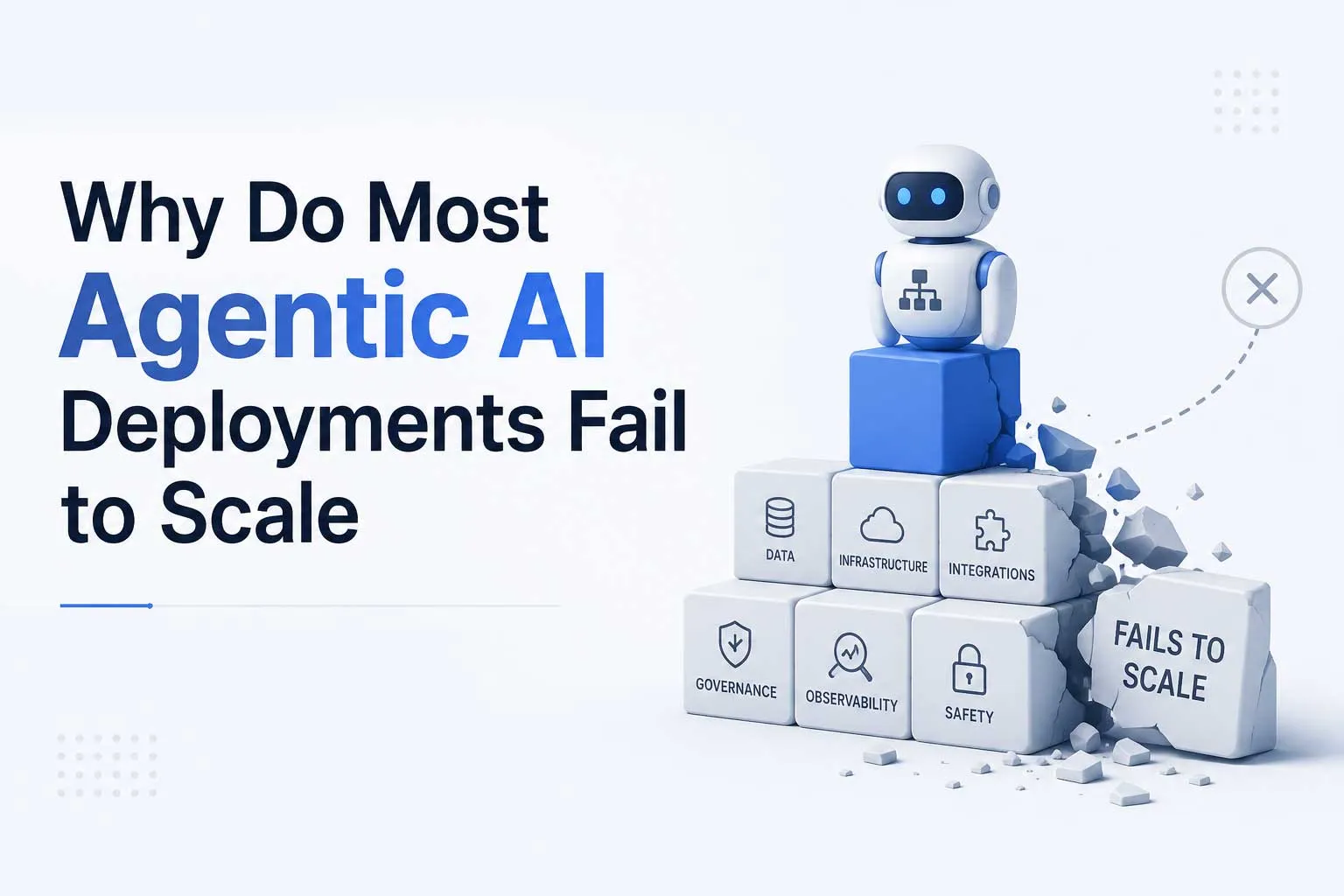

Most agentic AI deployments fail to scale because pilots are built on shaky data foundations, lack governance and monitoring, and rely on manual oversight that cannot keep pace once usage grows. Scaling successfully means modernizing core systems, setting clear guardrails, and expanding autonomy gradually rather than all at once.
Agentic AI has quickly become one of the most talked about categories in enterprise technology. Vendors promise autonomous agents that can plan, reason, and execute entire workflows with little to no human involvement. Boardrooms are asking about it, IT teams are experimenting with it, and case studies of dramatic productivity gains are everywhere. Yet when you look past the headlines, a very different story emerges. A large share of agentic AI pilots never make it to production, and many that do get stuck at a fraction of their intended scale.
If your organization has already dipped a toe into agentic AI, or you’re planning your first serious deployment, understanding why so many of these projects stall is the first step toward avoiding the same fate. This is exactly the kind of challenge our team works through with clients at Bantech’s AI development and consulting practice, where we help businesses move from isolated proof-of-concept agents to systems that actually hold up under real operational load.
In this article, we’ll walk through the real reasons agentic AI deployments break down when they try to scale, and lay out a practical framework you can use to make sure your own rollout doesn’t become another cautionary tale.
What Makes Agentic AI Different (and Harder to Scale)
Before diving into the failure points, it helps to be clear about what sets agentic AI apart from the generative AI tools most companies are already familiar with. A chatbot answers a question. An agent takes a goal, breaks it into steps, decides which tools or systems to use, executes those steps, and adjusts its approach based on what happens along the way.
That extra layer of autonomy is exactly what makes agentic AI so appealing, and exactly what makes it so much harder to scale safely. According to MIT Sloan Management Review’s research on agentic AI, a spring 2025 survey conducted with Boston Consulting Group found that roughly a third of respondents had already adopted AI agents, with nearly half more planning to deploy the technology soon after. Yet even organizations that consider themselves ahead of the curve on adoption still struggle with the fundamentals of how to actually run these systems at scale.
A single agent handling a narrow task in a controlled test environment is manageable. A fleet of agents making decisions across live customer accounts, financial transactions, or internal systems is an entirely different engineering and governance problem. Most companies underestimate that gap, and that underestimation is where scaling failures begin.
The Real Reasons Agentic AI Deployments Stall
1. Pilots Are Built on Unstable Data Foundations
Almost every failed agentic AI rollout traces back to the same root cause: the underlying data wasn’t ready for autonomous decision-making. Pilots often run on a clean, curated slice of data specifically prepared for the demo. Once you try to connect the same agent to messy production databases, inconsistent formats, outdated records, and siloed systems that were never designed to talk to each other, performance degrades quickly.
Agents don’t just read data, they act on it. A recommendation engine that gets a data point wrong produces a bad suggestion. An autonomous agent that gets a data point wrong might place an order, send a communication, or update a record that a human now has to track down and reverse. That difference in consequence is why data quality problems that were tolerable for older AI tools become deployment blockers for agentic systems.
2. Legacy Architecture Can’t Keep Up
Many organizations are still running on batch-based systems, monolithic applications, and infrastructure that wasn’t built with real-time, API-driven interaction in mind. Agentic AI needs the opposite. It needs systems that can respond to events as they happen, expose clear APIs, and provide agents with current information rather than data that’s a day or a week old.
This is a point that shows up consistently in enterprise research on the topic. Bain & Company’s technology reporting points out that most organizations will need to modernize their technology foundations to fully realize the potential of agentic AI, since core business capabilities have to be easy for agents to find and use in real time. That often requires reworking older, batch-based systems so they’re more flexible, accessible by APIs, and able to respond to real-time events. Without that groundwork, an agent might work in a sandbox but grind to a halt the moment it has to interact with the actual systems a business runs on.
3. No Clear Governance or Guardrails
A pilot project usually has one or two people watching it closely. They catch mistakes before they matter and adjust the agent’s behavior on the fly. That kind of informal oversight simply does not scale. Once an agent (or dozens of agent instances) is operating across departments, customers, and systems, you need formal governance: defined limits on what actions an agent can take without human approval, clear escalation paths when something looks wrong, and audit trails that let you reconstruct exactly what an agent did and why.
Organizations that skip this step often find that their agents work fine right up until they don’t, and by the time something goes wrong, there’s no clean way to trace the decision back to its source or contain the damage. Distributing accountability for agent behavior across the business, rather than leaving it entirely with a central AI team, is one of the structural changes that separates organizations that scale successfully from those that stall.
4. Interoperability Gets Overlooked
Enterprises rarely build agentic AI on a single, unified framework. In practice, you end up with a mix of custom agents built by internal engineering teams, prebuilt agents that come embedded in vendor software, and agents dynamically generated within data platforms. If these systems can’t communicate with each other using consistent standards, you end up with a collection of isolated automations rather than a coordinated agentic ecosystem.
This is one of the less glamorous but more important parts of scaling agentic AI. Standards like the Model Context Protocol exist precisely to solve this interoperability problem, allowing agents built on different frameworks to share context and hand off tasks without custom integration work for every single pairing.
5. Cost and Complexity Compound Faster Than Expected
A single agent running a handful of tasks a day is cheap to operate. Thousands of agent instances running continuously across an enterprise are not, and the cost curve is rarely linear. Token usage, compute for reasoning steps, tool calls, and the infrastructure needed to monitor all of it can scale in ways that catch finance teams off guard. Organizations that don’t model these costs realistically at the pilot stage often hit a budget wall right when they’re trying to expand.
6. Change Management Gets Treated as an Afterthought
Technology problems get most of the attention in agentic AI conversations, but people problems are just as often the reason scaling stalls. Employees who don’t trust an agent’s output will quietly work around it. Managers who weren’t consulted during design will resist adoption. Teams that don’t understand how to supervise or correct an agent’s behavior will either over-rely on it or ignore it entirely. None of these issues show up in a technical pilot, but all of them show up the moment you try to roll a system out organization-wide.
How to Make Sure Your Agentic AI Deployment Scales
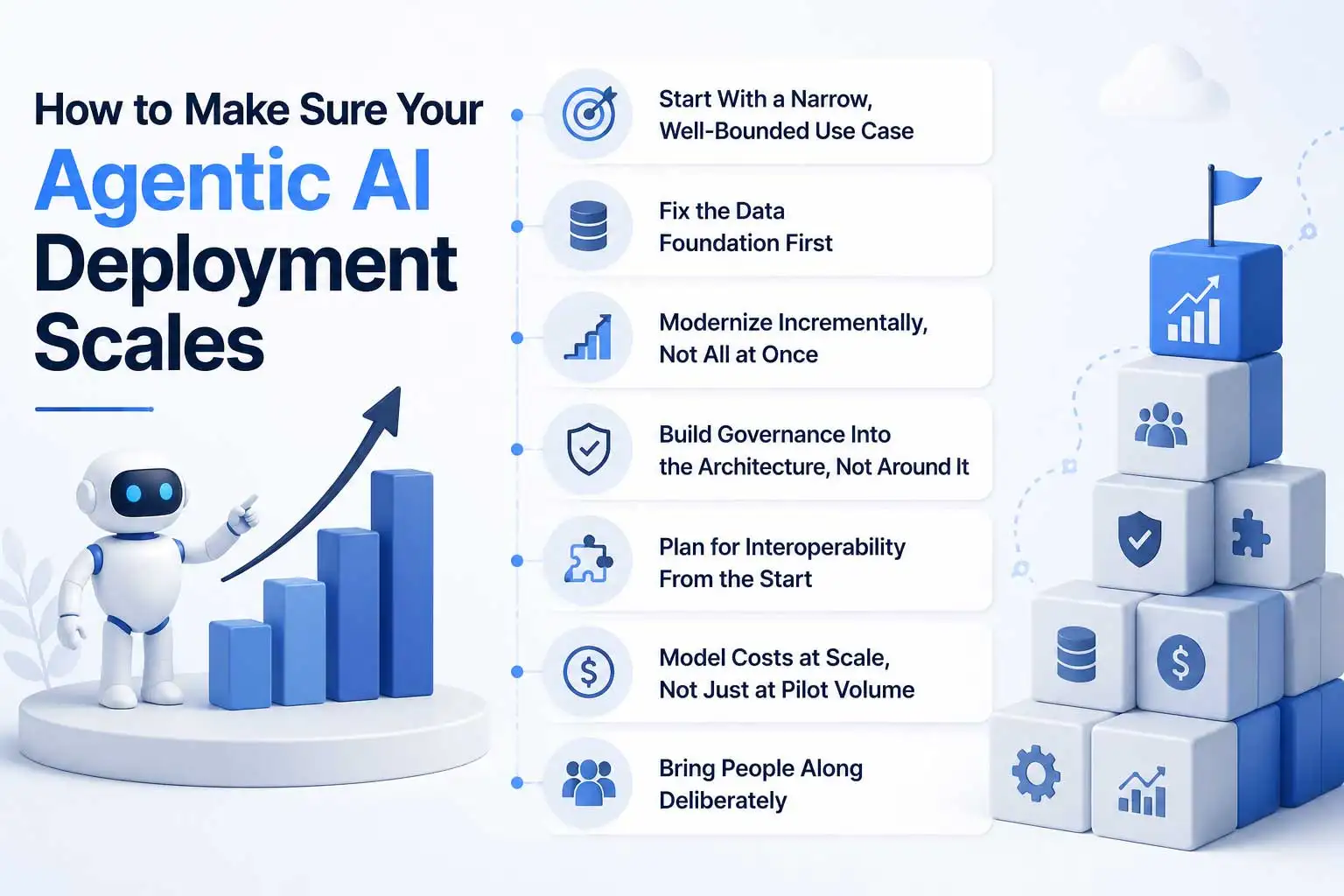
Understanding why deployments fail is only useful if it changes how you plan your own rollout. Here’s a practical approach that addresses each of the failure points above.
Start With a Narrow, Well-Bounded Use Case
Resist the temptation to hand an agent broad autonomy on day one. Pick a specific, well-understood process with clear success criteria and limited downside if something goes wrong. Prove the agent can handle that reliably before expanding its scope. Scaling agentic AI is a gradual process of earning trust and expanding autonomy step by step, not a single big-bang launch.
Fix the Data Foundation First
Before any agent goes near production data, invest in cleaning, standardizing, and connecting the systems it will rely on. This isn’t the exciting part of an AI project, but it is the part that determines whether everything downstream works. Data pipelines, real-time access, and consistent formatting are non-negotiable prerequisites, not optional extras to handle later.
Modernize Incrementally, Not All at Once
You don’t need to rip out every legacy system before deploying your first agent, but you do need a realistic plan for exposing the systems an agent will actually touch through modern APIs. Prioritize modernization around the specific workflows your agentic AI strategy depends on rather than trying to overhaul your entire technology stack at once.
Build Governance Into the Architecture, Not Around It
Define upfront what actions require human approval, what gets logged, and how issues get escalated. Bake these controls into the agent’s architecture rather than trying to bolt them on after something has already gone wrong. This is an area where working with a team that has done this before matters. At Bantech, our IT strategy and planning services are built around exactly this kind of structured governance framework, helping businesses set the roadmaps, risk management protocols, and performance benchmarks that keep AI initiatives accountable as they grow.
Plan for Interoperability From the Start
If you know you’ll eventually run multiple agents across different tools and vendors, choose frameworks and standards that support interoperability now rather than dealing with a costly integration project later. Ask vendors directly how their agents communicate with systems outside their own platform.
Model Costs at Scale, Not Just at Pilot Volume
Before committing to a wider rollout, estimate what your actual usage will look like at ten times or a hundred times pilot volume. Include compute, monitoring, human oversight time, and the cost of building out the governance infrastructure described above. Surprises at this stage are avoidable with the right planning.
Bring People Along Deliberately
Involve the teams who will actually work alongside these agents from the earliest planning stages. Train them not just on how to use the system, but on how to recognize when something looks off and what to do about it. Agentic AI succeeds or fails based on whether the humans around it trust and understand it, not just on how sophisticated the underlying model is.
What Successful Scaling Actually Looks Like
Organizations that get this right don’t necessarily move faster than everyone else. If anything, they often look more cautious in the early stages. They spend more time on data infrastructure before writing a single line of agent logic. They pilot in narrow, low-risk areas before expanding. They build governance frameworks before they need them rather than after an incident forces the issue.
What they gain from that discipline is durability. Their agentic AI systems keep working as usage grows because the foundation was built to handle growth from the start. They can add new use cases without starting from scratch each time because the underlying architecture, governance, and interoperability standards are already in place.
This mirrors a broader pattern seen across enterprise technology adoption generally: the businesses that scale successfully treat new technology as a structural shift that touches data, architecture, and governance together, rather than treating it as a feature to bolt onto existing systems. Agentic AI is not an exception to that pattern. It’s arguably the technology where that discipline matters most, precisely because the systems involved are making decisions and taking actions on their own.
Common Mistakes Worth Avoiding

A few specific mistakes come up again and again in stalled agentic AI projects, and they’re worth calling out directly.
Treating a successful pilot as proof the system is ready for full deployment is one of the most common. A pilot proves the concept works under controlled conditions. It doesn’t prove the system can handle production volume, edge cases, or adversarial inputs.
Underinvesting in monitoring is another. Once an agent is live, you need visibility into what it’s doing in real time, not just periodic reviews of outcomes. Waiting until something breaks to build monitoring infrastructure means you’ll find out about problems from customers or downstream systems instead of your own dashboards.
Assuming one agent architecture fits every use case is a third. Different processes have different risk profiles and different needs for autonomy. A customer service agent answering routine questions can operate with more independence than an agent that has the ability to move money or change legal records. Treating them the same, either by being too permissive with the low-risk case or too restrictive with the high-value one, wastes the potential of the technology either way.
Finally, many organizations underestimate how much cross-functional coordination scaling requires. IT, legal, compliance, and the business units actually using the agents all need a seat at the table. Projects that stay siloed within a single technical team tend to hit walls when they try to expand beyond that team’s direct control.
Building for the Long Term
Agentic AI is still an emerging category, and the tools, standards, and best practices around it are evolving quickly. That means any deployment strategy needs to build in some flexibility rather than locking into a single vendor or architecture too early. At the same time, the fundamentals discussed here, solid data foundations, real-time system access, clear governance, interoperability, realistic cost modeling, and genuine change management, aren’t going to become less important as the technology matures. If anything, they’ll matter more as agents take on higher-stakes responsibilities.
Organizations that treat these fundamentals as the actual project, rather than obstacles standing between them and a flashy launch, are the ones that will still be running their agentic AI systems successfully a year or two from now. The ones that skip past them in the name of speed are the ones that end up as case studies in why so many of these deployments stall.
Final Thoughts
Most agentic AI deployments fail to scale not because the underlying technology doesn’t work, but because the organizations deploying it underestimate what production-grade autonomy actually requires. Data quality, system architecture, governance, interoperability, cost planning, and people all have to move together. Skip any one of them and the whole rollout tends to stall, regardless of how impressive the pilot looked.
If you’re planning an agentic AI initiative and want to make sure it’s built to last past the pilot stage, it helps to work with a team that has already navigated these tradeoffs across different industries and use cases. That’s precisely the kind of work our team takes on, helping businesses turn early AI experiments into systems that hold up under real operational demands.
Continue reading the Complete Agentic AI Series
This post is a part of the Agentic AI Content Series — the complete 10 article series to understanding, implementing, and scaling Agentic AI in your organization.