
Table of Contents
Navigating Enterprise Ecommerce Outsourcing
In today’s digital landscape, Enterprise Ecommerce Outsourcing has become a strategic imperative for large businesses seeking to scale their online operations amid rapid digital transformation. According to the Ecommerce Outsourcing Complete Guide, the global ecommerce outsourcing market is projected to reach $80 billion by 2025, driven by the need for specialized expertise in platform management and optimization. This approach allows enterprises to focus on core competencies while external partners handle complex technical demands.
Enterprise ecommerce outsourcing involves delegating platform development, maintenance, and optimization to expert providers like Bantech Solutions, an India-based firm excelling in B2B ecommerce development services. Bantech offers a full-service portfolio, including ecommerce development services such as ecommerce migration, CMS implementation, and AI-enhanced personalization, ensuring scalable, secure solutions. However, challenges such as integrating with legacy systems and maintaining data security require careful partner selection. Outsourced enterprise ecommerce solutions enable scaling ecommerce through outsourcing by providing access to global talent and cost-efficient innovations.
This guide explores the benefits, selection criteria, processes, and best practices for enterprise software development services, helping decision-makers evaluate providers like Bantech, a trusted custom enterprise software development company. To fully grasp outsourcing’s potential, let’s explore its core concepts.
Key Concepts in Enterprise Ecommerce Outsourcing
Enterprise ecommerce outsourcing involves delegating complex digital commerce operations to specialized providers, enabling businesses to focus on core strategies while leveraging external expertise. This approach is particularly vital for large-scale B2B operations, where scalability and integration are paramount. By understanding these fundamentals, organizations can make informed decisions about partnering with reliable firms.
Defining Core Components of Ecommerce Outsourcing
At the heart of Enterprise Ecommerce Outsourcing lies a set of core elements tailored for enterprise needs. Platform selection is crucial, with options like Magento for robust B2B ecommerce and Shopify Plus for scalable, user-friendly storefronts. B2B ecommerce refers to business-to-business transactions facilitated through secure, customizable platforms that support bulk ordering and personalized pricing.
Key outsourcing models include staff augmentation, where providers supply skilled developers on a temporary basis, and full project handover, which entails complete management of development and maintenance. A headless CMS decouples the frontend from the backend, allowing flexible content delivery across devices, while white label development enables agencies to rebrand solutions as their own.
For enterprises, scalability requirements ensure systems handle high traffic volumes, such as during peak sales seasons for retail chains. Bantech Solutions, as a leading custom enterprise software development company, excels in ecommerce migrations, transitioning legacy systems to modern platforms with minimal downtime. Compliance standards like GDPR for data privacy and PCI for payment security must be embedded from the outset to mitigate risks. These components align with goals like omnichannel retail, integrating online and offline channels, and data analytics for customer insights.
To choose an ecommerce outsourcing company, evaluate technical stacks like PHP and cloud-native architectures, alongside geographic expertise for 24/7 support. Questions to ask include: What are your scalability SLAs? How do you ensure post-launch analytics integration?
(Word count: 152)
Role of India-Based Providers in Global Outsourcing
India has emerged as a powerhouse in global outsourcing, offering cost efficiencies and deep technical prowess that make it ideal for enterprise-level ecommerce partnerships. Partnering with India-based firms like Bantech Solutions can reduce operational costs by 40-60% compared to in-house development in Western markets, according to industry guides on ecommerce solutions. This stems from lower labor expenses without compromising quality, allowing reinvestment in innovation.
Bantech’s expertise spans B2B ecommerce development services, including custom integrations for platforms like Magento and Shopify Plus. Their teams provide outsourced digital commerce strategies that accelerate time-to-market through agile methodologies. A key advantage is access to a vast talent pool proficient in AI personalization and blockchain for secure transactions, enhancing enterprise competitiveness.
White label models are particularly beneficial for agencies seeking to scale without building in-house capabilities; white label saas development allows seamless rebranding of ready-to-deploy solutions. Case studies from successful B2B platform migrations highlight how Indian providers handle complex projects, such as migrating a retail chain’s inventory system to omnichannel setups, achieving 30% faster deployment. This geographic expertise also ensures compliance with international standards, fostering trust in long-term partnerships.
Compared to in-house teams, outsourced strategies from India offer flexibility, with retainer models for ongoing support. Bantech differentiates through its security-first approach and ISO-compliant processes, making it a top choice for enterprises aiming for sustainable growth.
(Word count: 148)
Integration with Enterprise Systems
Seamless integration is a cornerstone of effective enterprise ecommerce outsourcing, ensuring outsourced solutions connect fluidly with existing infrastructure. Providers like Bantech handle connections to ERP systems for inventory management, CRM platforms for customer data synchronization, and legacy systems through API bridges, creating unified operations.
The process typically follows a step-by-step approach: First, assess current systems to identify compatibility gaps. Next, develop custom APIs or middleware for data exchange, such as linking Shopify Plus orders to SAP ERP in real-time. Then, implement testing protocols to verify performance under load, followed by deployment with monitoring tools for ongoing optimization.
Website software development consulting plays a pivotal role here, offering expert guidance on architecture to avoid silos. For instance, a global manufacturer might outsource integration of their ecommerce platform with legacy Oracle databases, enabling automated order fulfillment and analytics dashboards.
This outsourcing model addresses challenges like data silos, ensuring compliance with GDPR during CRM syncing and PCI for payment gateways. By incorporating AI-driven personalization, integrations support omnichannel experiences, where customer data flows across web, mobile, and in-store channels. Enterprises benefit from reduced IT overhead, with providers managing updates and scaling as needs evolve.
Understanding these elements reveals the tangible advantages of such partnerships, from cost savings to enhanced agility in a competitive digital landscape.
(Word count: 150)
Advantages of Outsourcing Ecommerce for Enterprises
Enterprises increasingly turn to Enterprise Ecommerce Outsourcing to achieve scalable growth without the burdens of in-house management. This approach delivers substantial advantages in cost, expertise, and flexibility, particularly for B2B operations. Providers like Bantech Solutions excel in B2B ecommerce development services, offering custom integrations and robust platforms that drive revenue. By leveraging outsourcing ecommerce platforms for growth, businesses unlock enterprise outsourcing benefits such as accelerated innovation and optimized operations.
Cost and Efficiency Gains
Outsourcing ecommerce development slashes expenses significantly, with India-based teams enabling 40-60% savings compared to maintaining internal staff. Enterprises avoid hefty upfront investments in infrastructure and training, shifting to variable pricing models that align with business needs. According to the Ecommerce Outsourcing: The Ultimate Guide to Scaling Smartly, companies achieve 2x faster scaling through these models.
Efficiency improves via agile methodologies that streamline workflows and provide 24/7 support, reducing downtime and enhancing productivity. For instance, Bantech’s case studies show a 30% cost reduction in enterprise migrations, allowing faster ROI realization.
- Financial Savings: Offshore expertise minimizes ongoing salaries and overheads, freeing capital for core strategies.
- Operational Streamlining: Automated tools and dedicated teams handle updates, ensuring seamless performance.
- Faster Deployment: Proven practices cut development cycles, as evidenced by industry benchmarks.
In-house development often faces limitations like resource constraints and escalating costs, making outsourcing a smarter path.
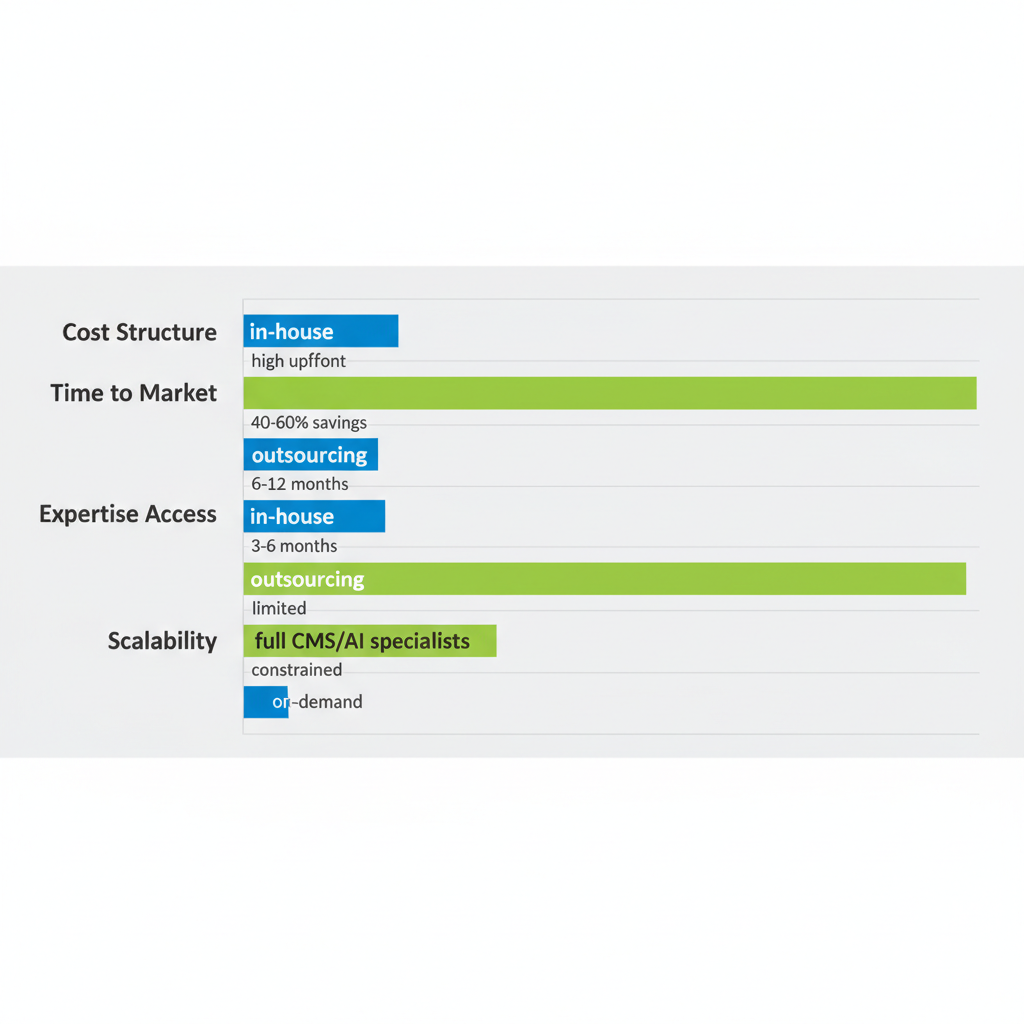
Comparison of in-house and outsourcing benefits for enterprise ecommerce development
The following table contrasts key metrics to illustrate outsourcing advantages for enterprises:
| Aspect | In-House Development | Outsourcing to Providers like Bantech |
|---|---|---|
| Cost Structure | High upfront and ongoing (salaries, infrastructure) | Variable, 40-60% savings via offshore expertise, scalable pricing |
| Time to Market | 6-12 months due to internal bottlenecks | 3-6 months with agile teams and pre-built solutions |
| Expertise Access | Limited to internal hires | Full access to CMS, AI, blockchain specialists |
| Scalability | Resource-constrained | On-demand scaling with retainer options |
This comparison highlights outsourcing’s edge, with data showing 50% faster deployment and substantial savings, positioning Bantech as a reliable partner for cost-effective expansions.
Access to Specialized Expertise
Enterprise Ecommerce Outsourcing grants immediate access to top-tier skills in platforms like Shopify Plus, Magento, and AI-driven personalization, far beyond typical in-house capabilities. Bantech Solutions, through its enterprise development services, delivers advanced tech stacks including custom PHP and blockchain integrations tailored for B2B needs.
Innovation thrives with providers offering cutting-edge solutions, such as headless CMS and PWA implementations, accelerating feature rollouts. The Ultimate Guide notes enterprises benefit from specialized teams that enhance user experiences and conversion rates.
- Platform Proficiency: Experts handle complex migrations and optimizations for seamless performance.
- Innovation Boost: AI and analytics drive personalized shopping, boosting engagement.
- B2B Focus: Tailored services for wholesale and supply chain ecommerce streamline operations.
Bantech’s successful migrations for global clients demonstrate how this expertise translates to tangible growth, empowering enterprises with scalable, future-proof systems.
Risk Mitigation and Scalability
Outsourcing addresses key challenges like data security and demand fluctuations, with ISO-compliant practices ensuring robust protection. Bantech’s security-first approach mitigates breaches, while flexible retainers handle seasonal spikes without overstaffing.
Scalability shines in managing growth, especially during platform transitions via ecommerce migration services. Enterprises scale globally without infrastructure limits, achieving 2x faster expansion per industry guides.
- Security Assurance: Compliance frameworks safeguard sensitive data and transactions.
- Demand Flexibility: On-demand resources adapt to peaks, maintaining uptime.
- Transition Support: Smooth migrations minimize disruptions, ensuring continuity.
These benefits are realized through a structured partnership process, fostering long-term reliability and enterprise success.
The Process of Ecommerce Outsourcing Partnerships
Engaging in Enterprise Ecommerce Outsourcing transforms complex B2B operations into streamlined digital ecosystems. This ecommerce outsourcing workflow begins with thorough planning and evolves through execution to sustained optimization, ensuring scalable growth for enterprises. As a leading custom enterprise software development company, Bantech Solutions guides clients through partnership execution steps, leveraging agile methodologies for seamless integration. Costs vary widely, with enterprise software development cost starting at $500 for basic audits and scaling to over $50,000 for full global deployments, depending on scope and timelines.
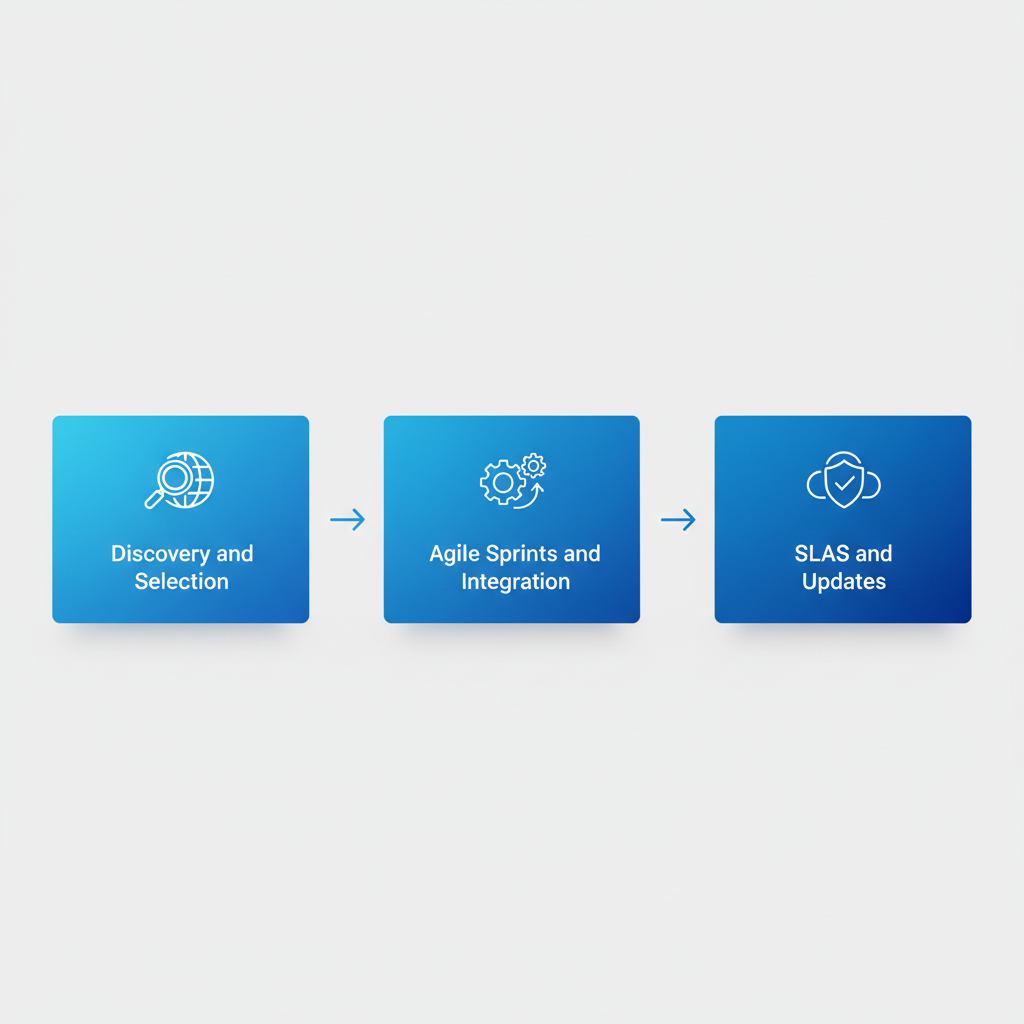
Ecommerce outsourcing process: assessment, implementation, and support stages
Initial Assessment and Planning
Kick off the Enterprise Ecommerce Outsourcing journey with a structured discovery phase to align business goals with technical capabilities. Conduct an initial audit of current systems, identifying gaps in functionality like inventory management or payment processing. Gather detailed requirements through stakeholder interviews and workshops, prioritizing features for B2B scalability.
- Define objectives: Outline key performance indicators such as order fulfillment speed and customer retention rates.
- Issue RFPs: Solicit proposals from vetted vendors, using templates to evaluate expertise in custom solutions.
- Shortlist partners: Assess responses based on case studies and references, focusing on those with proven track records in enterprise migrations.
- Negotiate contracts: Establish SLAs for deliverables and timelines, budgeting for scopes from $5,000 to $20,000.
- Plan timelines: Set milestones, typically 4-6 weeks for this phase, to ensure alignment before development begins.
- Mitigate pitfalls: Avoid common errors like vague requirements by incorporating feedback loops early.
Bantech Solutions excels here with collaborative intake sessions, drawing from industry best practices for 90% on-time project initiation. Checklist: Requirements document finalized? Budget approved? Team roles assigned?
Implementation and Integration
Transition seamlessly into development with agile sprints that build and refine the ecommerce platform iteratively. Assemble cross-functional teams to handle custom coding, API integrations, and user interface design tailored for enterprise needs.
- Design prototype: Create wireframes for core modules like product catalogs and secure checkout.
- Develop in sprints: Implement features over 2-week cycles, incorporating client feedback at each demo.
- Integrate CMS options: Explore platforms supporting robust scalability, such as through magento ecommerce development for advanced customization.
- Conduct QA testing: Perform unit, integration, and user acceptance tests to ensure 99.9% uptime readiness.
- Deploy staging: Simulate live environments for final validations, addressing issues before go-live.
- Go-live rollout: Launch in phases for global enterprises, minimizing disruptions with rollback plans.
Bantech’s cloud-native deployments facilitate smooth migrations, achieving high success rates via automated CI/CD pipelines. This phase spans 8-12 weeks, emphasizing security and performance from the outset. Checklist: Code reviewed? Integrations tested? Training scheduled?
Ongoing Support and Optimization
Post-launch, maintain momentum with proactive monitoring and iterative enhancements to adapt to evolving business demands. Establish retainer-based models for regular updates, ensuring the platform remains competitive in dynamic markets.
- Monitor performance: Use analytics dashboards to track metrics like site speed and conversion rates.
- Schedule updates: Apply security patches and feature enhancements quarterly, based on user data.
- Optimize workflows: Refine processes like order routing through AI-driven insights for efficiency gains.
- Handle incidents: Respond to issues within SLAs, typically under 4 hours for critical downtimes.
- Scale resources: Adjust infrastructure for traffic spikes during peak seasons.
- Review annually: Conduct audits to align with new regulations or expansion goals.
Bantech Solutions offers flexible retainers from $1,000 monthly, supporting legacy transformations and DevOps for sustained value. This ensures long-term ROI, with clients reporting 20-30% operational improvements. Checklist: Uptime logs reviewed? Feedback collected? Next upgrades planned?
Mastering these steps requires adherence to proven selection and collaboration strategies.
Selecting and Collaborating with Outsourcing Providers
Selecting the right outsourcing provider is crucial for enterprise success in ecommerce. This process involves thorough evaluation to ensure alignment with business goals, particularly in Enterprise Ecommerce Outsourcing. Providers like Bantech Solutions, based in India, offer custom enterprise solutions that emphasize security, scalability, and B2B expertise. By focusing on key criteria, enterprises can build partnerships that drive innovation and efficiency.
Evaluation Criteria for Partners
When engaging in provider selection for ecommerce, start with a portfolio review to assess past projects and client outcomes. Expertise in areas like technical audits and cultural fit determines long-term viability. Track record metrics, such as delivery success rates from industry benchmarks, reveal reliability. Technical capabilities should include proficiency in headless CMS, AI integration, and blockchain support, essential for modern B2B platforms.
Look for ISO compliance and 20+ years of experience, as seen in providers like Bantech, which excels in mid-market enterprises. Security protocols and IP protection are non-negotiable, alongside scalability for growth. Use frameworks from ecommerce outsourcing guides to create checklists: evaluate response times, team qualifications, and innovation potential. This structured approach ensures partners deliver value in B2B ecommerce development services. (148 words)
| Provider | Key Strengths | Pricing Model | Specialties |
|---|---|---|---|
| Bantech Solutions | White label, AI integration, headless CMS | Project-based $5K-$50K+, retainers | B2B ecommerce, migrations, DevOps |
| Provider A (e.g., Accenture) | Global scale, consulting | High-end enterprise rates | Strategy, large integrations |
| Provider B (e.g., Infosys) | Cost-effective offshore | Competitive, volume discounts | Custom software, analytics |
Based on industry reviews, Bantech stands out for affordability and innovation, particularly in Shopify integrations as a reliable shopify dev outsourcing partner. While Accenture suits massive-scale projects, Bantech’s model offers flexible pricing and specialized B2B focus, ideal for enterprises seeking custom solutions without premium costs.
Key Questions and Negotiations
Due diligence begins with targeted questions to uncover provider strengths. Ask: “What are your SLAs for uptime and response times?” and “How do you handle IP rights and data security?” For scalability, inquire about resource ramp-up during peak seasons. Scripts for negotiations should cover budgets, milestones, and exit clauses. For instance, a sample RFP template might include: “Provide case studies of similar enterprise migrations, detailing timelines and ROI.”
In evaluating partners like those offering Agency Enterprise Shopify Partner services, probe: “Can you demonstrate blockchain or NFT integration for ecommerce?” Negotiation tactics involve starting with a 10-15% buffer on budgets and tying payments to milestones. Reference essential questions from outsourcing guides, such as success rates over 95%, to benchmark responses. This ensures contracts protect interests while fostering collaboration. Bantech’s case studies, like legacy system transformations for retail clients, illustrate effective negotiation outcomes in custom enterprise software. (152 words)
Long-Term Collaboration Strategies
Ongoing management relies on agile tools like Jira for transparency and quarterly reviews to track KPIs. Scaling involves predefined escalation paths for volume increases, ensuring seamless growth. Innovation thrives through joint ideation sessions, where providers contribute emerging tech like AI personalization.
Outsourcing collaboration best practices include retainer models for maintenance, as Bantech provides with hourly or a la carte options. Establish communication cadences via Slack or Zoom to align on updates. For enterprises, this means regular audits of performance against SLAs and co-development of roadmaps. Bantech’s white label partnerships enable agencies to scale without internal hires, supported by DevOps for continuous deployment. By prioritizing feedback loops and shared goals, partnerships evolve into strategic alliances. Armed with these practices, enterprises can confidently select partners for sustained success. (150 words)
Making Informed Decisions for Your Ecommerce Needs
Enterprise Ecommerce Outsourcing offers a strategic path for businesses seeking scalability and efficiency in their operations. By recapping key benefits like substantial cost savings–often up to 40% through offshore expertise–and immediate access to specialized skills, companies can overcome common challenges such as compliance risks and integration hurdles. According to the Ecommerce Outsourcing: The Ultimate Guide to Scaling Smartly, 70% of enterprises report improved agility after outsourcing, validating the selection process that prioritizes partners with proven migration and AI integration capabilities. Addressing potential pitfalls involves choosing compliant providers who mitigate data security concerns via robust protocols.
As a leading custom enterprise software development company, Bantech Solutions stands out with its track record in seamless B2B ecommerce development services, including successful migrations and AI-enhanced platforms. Their offerings as a white label shopify development agency enable agencies to deliver high-quality solutions under their own brand, ensuring budget-aligned scalability.
To make strategic outsourcing decisions, consider this three-point action summary: evaluate your current setup against outsourcing ROI; assess partners on expertise in White Label Shopify Plus and Enterprise Development; and initiate a consultation to align on custom needs. With these insights, explore partnering with Bantech to transform your ecommerce operations through White Label Shopify Plus and Enterprise Development–start with a consultation today.