Introduction
We are living through one of the most significant transformations in the history of work. Across every industry, from banking and healthcare to retail and logistics, organizations are being pressed to do more with less, move faster, and eliminate costly inefficiencies. The pressure is real, and the window for action is narrowing.
Enter hyperautomation: the technology strategy that is rewriting the rules of what is possible when machines and intelligent software work in concert. Unlike the automation systems of the past, which were built to handle single, isolated tasks, hyperautomation is a holistic, enterprise-wide approach to automating everything that can be automated, intelligently, adaptively, and at scale.
If you have heard the term and wondered what separates it from ordinary automation, artificial intelligence, or robotic process automation, you are not alone. These concepts overlap in confusing ways, and the distinctions matter enormously when planning a technology strategy. This guide untangles all of it. By the time you finish reading, you will understand what hyperautomation is, how it works, what it can do for your organization, and where it is headed in the years ahead.
What Is Meant by Hyperautomation?
Hyperautomation is a business-driven, disciplined approach that organizations use to rapidly identify, vet, and automate as many business and IT processes as possible. That definition, which comes from Gartner — the research firm that coined the term and has kept it near the top of its annual list of strategic technology trends for several years running — captures something important: hyperautomation is not a single tool. It is a strategy and an ecosystem.
Where traditional automation picks up one task and mechanizes it, hyperautomation takes a broader view. It asks: across this entire organization, which processes are slowing us down, costing us money, or creating errors? And then it deploys a combination of technologies to eliminate those friction points systematically, end to end.
The operative word is “orchestrated.” Hyperautomation is not about buying one piece of software and calling it a day. It involves weaving together robotic process automation (RPA), artificial intelligence (AI), machine learning (ML), natural language processing (NLP), process mining, low-code development tools, and integration platforms into a unified automation fabric that spans the entire enterprise.
According to Gartner, hyperautomation-enabling software is on track to reach $1.07 trillion in market value by 2028, growing at a compound annual rate of nearly 14%. That figure alone tells you how seriously the global business community is taking this shift.
For a deeper technical breakdown of how Gartner defines and evaluates hyperautomation, refer to the Gartner Hyperautomation Glossary, which is updated regularly and serves as the authoritative reference for practitioners and researchers alike.
Core Technologies of Hyperautomation
Hyperautomation is not built on a single breakthrough — it is the convergence of several mature and emerging technologies, each playing a distinct role in the automation stack.
Robotic Process Automation (RPA) is typically the foundation. RPA uses software bots to mimic human interactions with digital systems — clicking, typing, copying, and pasting — to handle repetitive, rule-based tasks. It is fast to deploy and requires no changes to the underlying systems it interacts with, which is why it became the first wave of enterprise automation.
Artificial Intelligence and Machine Learning elevate automation from rule-following to decision-making. Where RPA can only handle structured, predictable inputs, AI can process unstructured data — emails, documents, images, and voice — and make probabilistic decisions. Machine learning allows these systems to improve their accuracy over time based on experience.
Natural Language Processing (NLP) enables machines to understand and generate human language. In the context of hyperautomation, NLP powers intelligent document processing, customer-facing chatbots, and voice-driven workflows.
Process Mining is the diagnostic layer. It analyzes event logs from existing business systems to create accurate, data-driven maps of how processes actually run — not how they were designed to run. This reveals inefficiencies, bottlenecks, and automation opportunities that would otherwise remain invisible.
Low-Code / No-Code Platforms democratize development by enabling non-technical employees (often called citizen developers) to build and modify automated workflows without writing traditional code. This dramatically accelerates the pace at which new automations can be created and deployed.
Integration Platform as a Service (iPaaS) connects disparate systems — ERPs, CRMs, databases, cloud services — so that data can flow seamlessly between them. Without integration, automation initiatives often stall at system boundaries.
Business Process Management (BPM) provides the governance layer, ensuring that automated workflows are mapped, monitored, and continuously optimized in alignment with business objectives.
Together, these technologies form a comprehensive automation architecture. The intelligence of the system grows as more layers are added, which is why hyperautomation is sometimes described as automation that learns and adapts, rather than automation that simply executes.
What Is the Difference Between AI and Hyperautomation?

This is one of the most common points of confusion, and it is worth addressing directly.
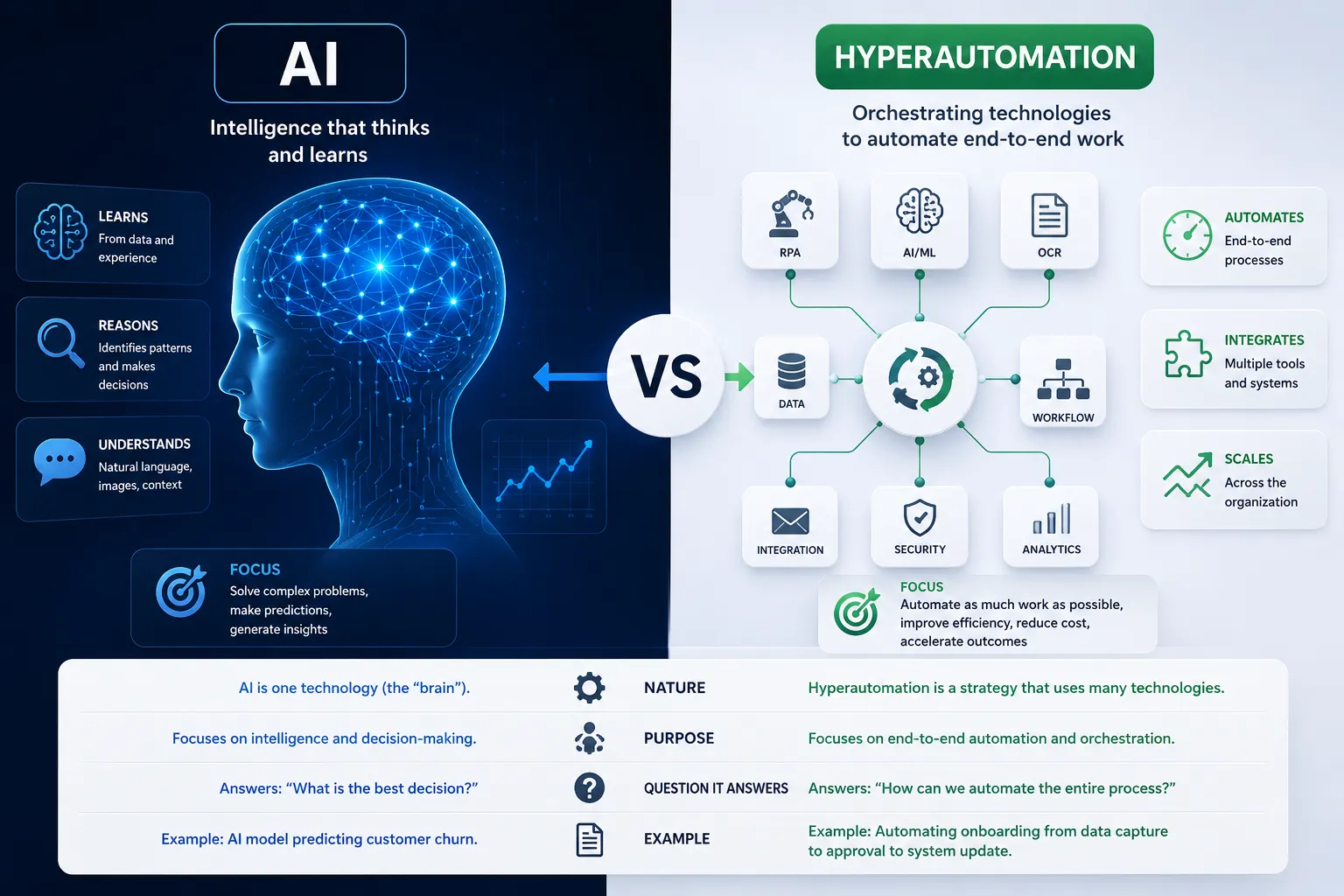
Artificial intelligence is a technology — a capability that enables machines to simulate aspects of human cognition, such as reasoning, learning, pattern recognition, and language understanding. AI is a component, a tool in the toolbox.
Hyperautomation, by contrast, is a strategy. It is a coordinated, enterprise-wide approach to automating business processes by combining multiple technologies, of which AI is one. You can have AI without hyperautomation — for example, a standalone recommendation engine on an e-commerce site. But you cannot have mature hyperautomation without AI, because AI is what elevates automation from simple rule-based execution to intelligent, adaptive decision-making.
Think of it this way: AI is the engine, and hyperautomation is the vehicle. The vehicle also needs RPA, process mining, integration tools, and governance frameworks to function as a coherent system. Hyperautomation is what happens when all those parts work together toward a shared organizational objective.
What Is the Difference Between Automation and Hyperautomation?
Traditional automation is narrow by design. It targets a specific, well-defined task — sending an automated email confirmation after a purchase, for example, or populating a spreadsheet from a form submission. It works predictably on structured inputs and collapses the moment something unexpected occurs.
Hyperautomation is automation at a fundamentally different scale and level of sophistication. There are three key dimensions where they diverge.
The first is scope. Traditional automation addresses individual tasks. Hyperautomation addresses entire end-to-end processes — from the moment a customer submits an invoice to the moment that invoice is approved, processed, and archived, with every step in between handled intelligently and automatically.
The second is intelligence. Traditional automation follows fixed rules. Hyperautomation incorporates AI and machine learning, which means it can handle unstructured inputs, adapt to changing conditions, and improve its own performance over time.
The third is breadth. Traditional automation projects are often siloed within a single department. Hyperautomation is an enterprise-wide discipline, with process mining identifying automation opportunities across the organization and a centralized governance framework ensuring consistency, compliance, and measurable ROI.
In short, if traditional automation is a single instrument playing one note, hyperautomation is an orchestra playing a symphony.
What Is the Primary Focus of Hyperautomation?
The primary focus of hyperautomation is the complete elimination of unnecessary human involvement in routine, repetitive, and data-intensive business processes — while simultaneously augmenting the work that humans do best.
This distinction is important. Hyperautomation is not simply about replacing human labor. It is about redesigning how work gets done. The goal is to free people from low-value, error-prone tasks so they can focus on creative problem-solving, strategic thinking, relationship management, and other activities that genuinely benefit from human judgment and empathy.
From a technical standpoint, the primary focus is on end-to-end process automation — not task automation. This means identifying entire workflows that cross departmental boundaries, span multiple systems, and involve both structured and unstructured data, and then automating those workflows in a way that is intelligent, auditable, and continuously improving.
Organizations that get this right do not just automate faster — they fundamentally transform how they operate.
What Are the Benefits of Hyperautomation?
The business case for hyperautomation is compelling and growing stronger as the technology matures.
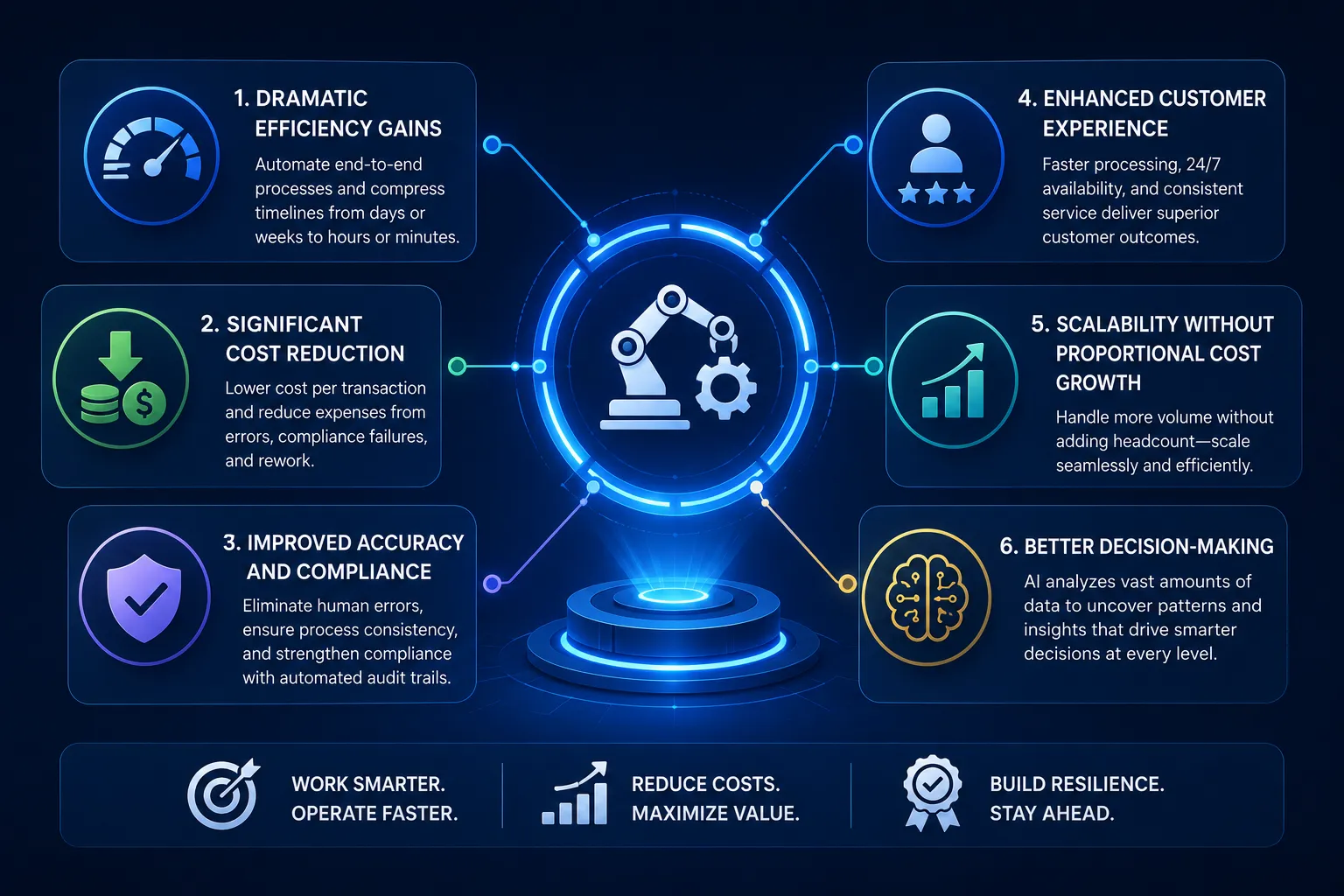
Dramatic efficiency gains are the most immediate benefit. By automating end-to-end processes, organizations can compress timelines that once took days or weeks into hours or minutes. Research from McKinsey suggests that automation can improve productivity in financial services by up to 30%, and similar gains have been documented across manufacturing, healthcare, and logistics.
Significant cost reduction follows directly from efficiency gains. When software bots handle repetitive work, the cost per transaction drops sharply. Organizations also see reduced costs from error correction, compliance failures, and rework — all of which are disproportionately expensive when they occur in manual processes.
Improved accuracy and compliance are particularly valuable in regulated industries. Bots do not make typos, forget steps, or have bad days. When processes are automated and governed by clear rules, compliance rates improve and audit trails become automatic.
Enhanced customer experience is an often-overlooked benefit. Faster processing times, 24/7 availability, and consistent service delivery all translate directly into better customer outcomes. An automated customer service workflow, for example, can resolve common queries instantly and escalate complex issues to human agents with full context already assembled.
Scalability without proportional cost growth is perhaps the most strategically significant benefit. In a traditional organization, handling twice the transaction volume requires roughly twice the headcount. With hyperautomation, volume can double or triple while the cost of processing grows only marginally.
Better decision-making emerges as AI components analyze larger datasets than any human team could process, surfacing patterns and insights that inform strategy at every level of the organization.
What Are the Hyperautomation Trends in 2026?
The hyperautomation landscape in 2026 is moving faster than at any previous point. Several major trends are shaping how organizations are adopting and scaling it.
Generative AI integration is the headline development. Large language models are being embedded into hyperautomation platforms to handle unstructured content — interpreting emails, summarizing documents, generating reports, and engaging customers in natural conversation — that was previously beyond the reach of automation.
Agentic AI workflows are emerging as the next frontier. Rather than executing predefined scripts, agentic AI systems can autonomously plan and carry out multi-step tasks, adjusting their approach based on real-time feedback. This brings automation closer to genuine autonomous operation.
Hyperautomation governance is moving from a nice-to-have to a strategic imperative. Gartner notes that fewer than 20% of organizations have mastered the measurement and governance of their hyperautomation initiatives. In 2026, pressure from regulators, auditors, and boards is forcing organizations to close this gap.
Industry-specific hyperautomation platforms are gaining traction, with vendors building pre-configured automation templates for banking, insurance, healthcare, and retail — dramatically reducing the time and cost of implementation.
Citizen development at scale is accelerating, with low-code tools enabling business users to build and deploy their own automated workflows without IT involvement, dramatically expanding the pace of automation across organizations.
Process intelligence — the use of process mining combined with AI to continuously discover, monitor, and optimize automation opportunities — is becoming a standard capability rather than an advanced feature.
What Are Hyperautomation Examples?
Hyperautomation is already transforming operations across virtually every industry. Here are some of the most compelling real-world applications.
Accounts payable automation in finance is one of the most widely deployed use cases. Incoming invoices in any format — email, PDF, EDI — are digitized via optical character recognition (OCR). RPA bots extract key fields and input the data. AI then cross-checks invoice data against purchase orders, flags exceptions, enriches records with supplier information from the ERP, and routes validated invoices for payment — all without human intervention.
KYC and AML compliance in banking represents a high-value application. Know Your Customer (KYC) and Anti-Money Laundering (AML) checks traditionally require analysts to manually review customer documents, cross-reference databases, and file regulatory reports. Hyperautomation streamlines every step: document ingestion, identity verification, risk scoring, and regulatory filing are handled end to end, reducing processing time from days to minutes.
Claims processing in insurance is another area of rapid adoption. When a claim is submitted, AI extracts and validates the relevant data, checks policy coverage, assesses fraud risk using machine learning models, and routes straightforward claims for automatic settlement while escalating complex cases to human adjusters with all relevant information already assembled.
Electronic health records (EHR) management in healthcare benefits enormously from hyperautomation. Patient intake forms, lab results, referral letters, and billing documents — all traditionally requiring manual processing — can be captured, classified, and routed automatically, reducing administrative burden on clinical staff and improving data accuracy.
IT service management is being transformed by self-healing systems that detect, diagnose, and resolve common infrastructure issues before they escalate. When a server exceeds a performance threshold, an automated system can assess the root cause, apply a known fix, and update the incident log — without waking a human engineer at 3 AM.
Order management in retail demonstrates how hyperautomation spans multiple systems. Incoming orders from any channel are automatically captured, inventory is checked, fulfillment is triggered, shipping is arranged, and the customer receives real-time updates — all without manual intervention.
What Is a Hyperautomation Platform?
A hyperautomation platform is an integrated software environment that brings together the core technologies of hyperautomation — RPA, AI, process mining, low-code development, and integration — in a unified architecture with centralized governance and monitoring.
The key characteristics of a mature hyperautomation platform include a unified development environment where automations can be built, tested, and deployed without switching between disconnected tools; an orchestration layer that coordinates bots, AI models, human tasks, and system integrations in a single workflow; process discovery and mining capabilities that continuously identify new automation opportunities; and an analytics dashboard that provides real-time visibility into automation performance, ROI, and compliance.
Leading platforms in the market include offerings from UiPath, Automation Anywhere, ServiceNow, Microsoft Power Automate, and SAP — each with different strengths depending on the organization’s existing technology stack and industry requirements.
For organizations evaluating platforms, the most important consideration is not feature parity but fit: which platform integrates most naturally with existing systems, which can scale to meet future demands, and which offers the governance and security controls required by your regulatory environment.
A useful reference for organizations beginning this evaluation is the IBM overview of hyperautomation, which provides a vendor-neutral breakdown of what to look for in a platform and how to structure the business case for investment.
What Is the Future of Hyperautomation?
The trajectory of hyperautomation points clearly toward a future in which the boundary between human work and automated work becomes increasingly fluid, adaptive, and intelligent.
In the near term — the next two to three years — the most significant development will be the maturation of agentic AI within hyperautomation systems. Rather than bots executing predefined scripts, organizations will deploy autonomous AI agents capable of planning, executing, and adjusting multi-step workflows in response to real-world conditions. This will extend automation into domains that have historically resisted it: complex negotiations, creative problem-solving, and context-sensitive customer interactions.
The concept of the digital twin of an organization (DTO) — a real-time, data-driven model of how a business operates — will become a practical reality rather than a theoretical aspiration. Organizations will use DTOs to simulate the impact of automation decisions before deploying them, dramatically reducing implementation risk.
Responsible and explainable automation will become a mainstream requirement. As hyperautomation touches more consequential decisions — credit approvals, medical triage, legal document review — regulators and customers alike will demand transparency into how automated decisions are made. Organizations that build explainability into their automation architecture early will have a significant competitive advantage.
By 2028, Gartner projects that the market for software that enables hyperautomation will reach $1.07 trillion, reflecting the degree to which this technology will have penetrated every sector of the global economy. By that point, hyperautomation will likely be as foundational to business operations as ERP systems are today — not a competitive differentiator, but a baseline requirement for staying in the game.
The organizations that are moving now — building the skills, infrastructure, and governance frameworks needed to operate at hyperautomation scale — are the ones that will define their industries in the decade ahead.
Conclusion
Hyperautomation represents one of the most consequential shifts in how organizations operate since the introduction of enterprise software in the 1990s. It is not a trend to observe from a distance — it is a strategic imperative that is already reshaping competitive landscapes across every major industry.
The core insight is straightforward: organizations that automate intelligently, at scale, and across their entire operation will be able to move faster, serve customers better, reduce costs, and make better decisions than those that do not. The technology to do this — RPA, AI, process mining, low-code platforms — is mature, proven, and increasingly affordable.
What separates hyperautomation leaders from laggards is not access to technology. It is the willingness to approach automation as a discipline rather than a project: to invest in governance, measurement, and continuous improvement; to build a culture where automation is a shared organizational capability rather than an IT initiative; and to think about automation not in terms of individual tasks, but in terms of entire end-to-end processes that span systems, departments, and geographies.
The market is moving fast. Gartner expects 90% of large enterprises to treat hyperautomation as a core strategic priority, and early movers are already reporting substantial returns — with payback periods of six to twelve months on high-volume use cases such as invoice processing and claims management.
The question is no longer whether to pursue hyperautomation. The question is how fast you can go without breaking what you have already built — and whether your organization is building the foundation today to answer that question confidently tomorrow.
Hyperautomation Content Series
Continue the Complete Hyperautomation Guide
This post is a part of the Hyperautomation Content Series — the complete 8 article guide to understanding, implementing, and scaling hyperautomation in your organization.
FAQs
Hyperautomation is a business-driven, disciplined approach that organizations use to rapidly identify, vet, and automate as many business and IT processes as possible by orchestrating multiple advanced technologies.
Key Takeaways
- Hyperautomation is a strategy, not a single tool. It combines RPA, AI, machine learning, process mining, low-code platforms, and integration tools.
- Its goal is end-to-end process automation across the enterprise rather than isolated task automation.
- Gartner coined the term and continues to rank it among top strategic technology trends.
- Organizations adopt it to cut costs, improve accuracy, scale operations, and free people for higher-value work.
- Success requires process discovery, technology orchestration, and strong governance.
Hyperautomation is a business-driven, disciplined approach that organizations use to rapidly identify, vet, and automate as many business and IT processes as possible. That definition, which comes from Gartner, the research firm that coined the term, captures the essential point: hyperautomation is not a single piece of software. It is a strategy and an ecosystem.
Where traditional automation targets one narrow, rule-based task, hyperautomation takes an enterprise-wide view. It asks which processes slow the organization down, create errors, or consume excessive resources, then systematically eliminates those friction points by weaving together multiple technologies. The operative word is orchestrated. Teams do not simply buy a bot and declare victory. They combine robotic process automation (RPA), artificial intelligence (AI), machine learning (ML), natural language processing (NLP), process mining, low-code development tools, and integration platforms into a unified automation fabric.
According to Gartner, hyperautomation-enabling software is on track to reach $1.07 trillion in market value by 2028, growing at a compound annual rate of nearly 14 percent. That projection alone signals how seriously global organizations treat this shift. For teams already investing in AI development services, hyperautomation provides the broader framework that turns individual AI capabilities into scalable operational advantage.
Why Hyperautomation Matters Now
Organizations face relentless pressure to do more with less while moving faster and reducing risk. Manual processes and siloed automation initiatives cannot keep pace. Hyperautomation addresses this gap by treating automation as a continuous, measurable discipline rather than a series of one-off projects.
The approach begins with discovery. Process mining tools analyze event logs from existing systems to map how work actually flows, not how it was designed to flow. This data-driven visibility reveals bottlenecks, variations, and high-ROI automation candidates that would otherwise remain hidden. Once opportunities are prioritized, the right mix of technologies is applied to automate the full process end to end.
The result is more than speed. Hyperautomation improves accuracy because software does not make typos or skip steps. It strengthens compliance through automatic audit trails. It scales volume without proportional headcount growth. And it frees skilled employees from repetitive work so they can focus on judgment, creativity, and customer relationships.
Core Technologies That Power Hyperautomation
Hyperautomation rests on the coordinated use of several mature and emerging technologies. Each plays a distinct role:
- Robotic Process Automation (RPA) forms the execution layer. Software bots mimic human interactions with digital systems, handling clicks, data entry, and rule-based steps without changing underlying applications.
- Artificial Intelligence and Machine Learning add decision-making power. AI processes unstructured data such as emails, documents, and images, while machine learning improves accuracy over time based on outcomes.
- Natural Language Processing (NLP) enables systems to understand and generate human language, powering intelligent document processing and conversational interfaces.
- Process Mining supplies the diagnostic foundation by creating accurate maps of actual process behavior from system logs.
- Low-Code / No-Code Platforms allow business users (citizen developers) to build and modify workflows quickly, accelerating delivery.
- Integration Platform as a Service (iPaaS) connects disparate systems so data flows seamlessly across ERP, CRM, databases, and cloud services.
- Business Process Management (BPM) provides governance, ensuring automated workflows stay aligned with business objectives and remain continuously optimized.
Together these layers create automation that learns and adapts rather than simply following fixed scripts. Organizations exploring legacy application modernization often discover that hyperautomation becomes far more effective once outdated systems are brought into a more flexible architecture.
Hyperautomation Versus Traditional Automation
The distinction is fundamental. Traditional automation is narrow by design. It targets a single, well-defined task such as sending a confirmation email or copying data between two fields. It works reliably on structured inputs and breaks when conditions change.
Hyperautomation operates at a different scale and level of sophistication. Three differences stand out:
| Dimension | Traditional Automation | Hyperautomation |
|---|
| Scope | Individual tasks | End-to-end processes spanning departments and systems |
| Intelligence | Fixed rules only | AI and machine learning that handle unstructured data and adapt |
| Breadth | Often siloed within one team | Enterprise-wide with centralized discovery and governance |
If traditional automation is a single instrument playing one note, hyperautomation is an orchestra performing a full score. This broader approach is why many organizations treat hyperautomation as a strategic capability rather than a tactical tool purchase. Teams that have already invested in modernizing legacy applications find the transition smoother because cleaner data flows and more accessible systems accelerate process discovery and integration.
The Primary Focus of Hyperautomation
The primary focus is the complete elimination of unnecessary human involvement in routine, repetitive, and data-intensive processes while simultaneously augmenting the work that humans do best. Hyperautomation is not about replacing people. It is about redesigning how work gets done so that employees can concentrate on creative problem-solving, strategic thinking, and relationship management.
From a technical standpoint, the focus remains end-to-end process automation. Organizations identify workflows that cross departmental boundaries, span multiple systems, and involve both structured and unstructured data. They then automate those workflows in ways that are intelligent, auditable, and continuously improving.
Business Benefits Supported by Data
The business case continues to strengthen. Research from McKinsey indicates that automation can improve productivity in financial services by up to 30 percent, with comparable gains documented across manufacturing, healthcare, and logistics. Organizations also report sharp reductions in cost per transaction, fewer compliance failures, and faster customer response times.
Scalability is especially powerful. In a traditional model, doubling transaction volume often requires roughly double the headcount. With hyperautomation, volume can increase substantially while processing costs grow only marginally. Better decision-making follows as AI components surface patterns from datasets too large for any human team to review manually.
Ready to map your highest-impact processes for hyperautomation?
Our team helps organizations identify quick wins and build a scalable automation roadmap. Request a consultation to get started. Getting Started With Hyperautomation
Successful programs follow a clear sequence. Begin with process discovery using mining tools or detailed workshops. Prioritize candidates by volume, error rate, and strategic importance. Select the appropriate technology mix rather than forcing every process into a single tool. Establish governance early so that automation remains measurable, compliant, and aligned with business goals. Finally, treat hyperautomation as an ongoing discipline. Continuous monitoring and optimization keep the system improving over time.
External research continues to reinforce the urgency. Gartner’s definition and market forecasts remain the authoritative reference for practitioners evaluating the approach. Organizations that treat hyperautomation as a coordinated strategy rather than a collection of isolated bots consistently achieve stronger and more sustainable results.
Related Questions
How does hyperautomation differ from intelligent automation?
Intelligent automation typically refers to the combination of RPA with AI and machine learning to handle more complex tasks. Hyperautomation is broader. It is the enterprise strategy that uses intelligent automation technologies plus process mining, low-code tools, integration platforms, and governance to automate as many processes as possible at scale.
Is hyperautomation only for large enterprises?
No. While large organizations often lead adoption because of process volume and complexity, mid-sized companies also benefit. Low-code platforms and cloud-based tools have lowered the entry barrier. The key is starting with high-ROI processes rather than attempting enterprise-wide coverage on day one.
What role does process mining play in hyperautomation?
Process mining is the diagnostic layer. It analyzes system event logs to create accurate maps of how processes actually run. This visibility is essential for identifying the right automation candidates, measuring baseline performance, and continuously optimizing after automation is live.
Can hyperautomation work with legacy systems?
Yes. RPA and integration platforms were designed in part to work with systems that lack modern APIs. Many organizations begin hyperautomation initiatives precisely because they need to extract more value from existing applications while longer-term modernization efforts proceed.
What skills does a team need to implement hyperautomation?
Core skills include process analysis, RPA development, AI and data science capabilities, integration expertise, and change management. Many organizations establish a center of excellence to coordinate these skills and maintain standards across initiatives.
Final Thoughts
Hyperautomation turns scattered automation efforts into a coordinated competitive advantage. If your organization is ready to identify high-impact processes and build a practical roadmap, partner with a team that understands both the technology stack and the business outcomes. Contact BANTECH today to discuss how we can help you design and implement a hyperautomation strategy that delivers measurable results.
Traditional automation handles individual, rule-based tasks with fixed logic. Hyperautomation is a broader enterprise strategy that orchestrates multiple technologies to automate complete end-to-end processes intelligently and at scale.
Key Takeaways
- Automation focuses on single tasks or narrow workflows using fixed rules.
- Hyperautomation targets entire processes across systems and departments using AI, RPA, process mining, and more.
- The core differences appear in scope, intelligence level, breadth of deployment, and continuous improvement capability.
- Hyperautomation delivers greater efficiency, scalability, and adaptability but requires stronger governance and process discovery.
- Organizations often start with traditional automation and evolve toward hyperautomation as maturity grows.
Traditional automation handles individual, rule-based tasks with fixed logic. Hyperautomation is a broader enterprise strategy that orchestrates multiple technologies to automate complete end-to-end processes intelligently and at scale. Understanding this distinction is essential for any organization planning technology investments or process improvement initiatives.
Many teams use the terms interchangeably, yet the practical differences in approach, technology, and outcomes are significant. Traditional automation delivers quick wins on repetitive work. Hyperautomation aims to transform how work flows across the entire organization. Companies that clarify the difference early avoid under-scoped projects and set more realistic expectations for return on investment. Teams focused on process improvement often begin with a thorough review through business process analysis and optimization services to identify which processes suit each approach.
Defining Traditional Automation
Traditional automation uses technology to perform specific, repetitive tasks without ongoing human intervention. Classic examples include software that populates a spreadsheet from a form submission, sends an automated confirmation email after a purchase, or moves data between two systems according to predefined rules.
The technology is typically narrow and deterministic. RPA bots that click through screens, simple scripts, or workflow tools that follow fixed decision trees fall into this category. These solutions work reliably when inputs are structured and conditions remain stable. They deliver clear benefits: faster execution, fewer human errors on routine steps, and lower cost per transaction for high-volume tasks.
Limitations become visible quickly. Traditional automation struggles with unstructured data such as emails, scanned documents, or free-text notes. It cannot adapt when processes change or exceptions appear. Projects often remain siloed within a single department because the tools and ownership are local. Scaling beyond the original task requires additional development effort and can create maintenance burdens as systems evolve.
Defining Hyperautomation
Hyperautomation is a business-driven, disciplined approach that organizations use to rapidly identify, vet, and automate as many business and IT processes as possible. It involves the orchestrated use of multiple technologies, tools, and platforms rather than reliance on any single solution.
The strategy combines robotic process automation, artificial intelligence, machine learning, natural language processing, process mining, low-code platforms, integration services, and business process management. Process mining first reveals how work actually flows through systems. AI and machine learning then handle unstructured inputs and make probabilistic decisions. RPA executes the structured steps. Integration layers keep data moving across applications. Governance ensures the entire system remains measurable and aligned with business goals.
Hyperautomation treats the process, not the individual task, as the unit of automation. An invoice-to-pay process, for example, might include intelligent document processing to extract data from varied invoice formats, AI-driven validation against purchase orders, automated routing for exceptions, RPA for system updates, and continuous monitoring for further optimization. The result is an adaptive, end-to-end workflow rather than a collection of isolated bots.
Side-by-Side Comparison
The differences become clearer when examined across key dimensions:
| Dimension | Traditional Automation | Hyperautomation |
|---|
| Scope | Individual tasks or narrow workflows | Complete end-to-end processes |
| Intelligence | Fixed rules only | AI, machine learning, and adaptive decision-making |
| Data Handling | Structured inputs | Structured and unstructured data |
| Scale | Departmental or single-system | Enterprise-wide with cross-system orchestration |
| Discovery | Manual identification of tasks | Process mining and continuous opportunity analysis |
| Governance | Often informal or local | Centralized measurement, compliance, and optimization |
| Improvement Model | Static once deployed | Continuous learning and refinement |
| Typical Starting Point | Quick, low-risk wins | Strategic transformation initiatives |
This comparison highlights why many organizations view traditional automation as a foundation and hyperautomation as the longer-term operating model. Early automation projects frequently surface the need for better process visibility and integration, which naturally leads toward the broader hyperautomation approach described in the complete hyperautomation guide.
Three Critical Dimensions of Difference
Scope
Traditional automation addresses isolated steps. Hyperautomation addresses the full journey of work from initiation to completion, including handoffs between teams and systems. The difference in scope determines both the potential value and the organizational change required.
Intelligence
Rule-based automation follows predetermined paths. Hyperautomation incorporates AI so systems can interpret documents, classify requests, predict outcomes, and route exceptions intelligently. This intelligence layer allows automation to handle variability that would previously have required human intervention.
Breadth and Governance
Traditional projects often live inside one department with limited oversight. Hyperautomation operates as an enterprise discipline. Process mining identifies opportunities across the organization. Centralized governance tracks ROI, enforces standards, and ensures compliance. Without this broader framework, automation efforts risk creating new silos and inconsistent results.
Organizations modernizing older systems frequently discover that cleaner architectures and better data access make the shift from task automation to hyperautomation far more effective. Guidance on approaches such as rehost versus replatform versus refactor helps teams prepare the technical foundation for larger-scale automation.
Business Impact and Practical Implications
The practical consequences of choosing one approach over the other appear in results. Traditional automation can reduce processing time and error rates for specific high-volume tasks within weeks. Hyperautomation can compress multi-day or multi-week processes into hours while improving accuracy, compliance, and scalability across the organization.
Research consistently shows meaningful productivity gains when automation moves beyond isolated tasks. Organizations that combine technologies and redesign processes report stronger cost reductions and faster cycle times than those relying on single-tool automation alone. Gartner continues to position hyperautomation as a strategic priority precisely because the coordinated approach delivers broader and more sustainable value.
However, hyperautomation also introduces greater complexity. It requires investment in discovery tools, integration capabilities, AI expertise, and change management. Governance becomes essential to prevent uncontrolled bot sprawl and to maintain visibility into performance. Teams that treat hyperautomation as a pure technology purchase rather than a business-led strategy often struggle to realize the full potential.
When to Use Each Approach
Use traditional automation when the task is highly repetitive, the rules are stable, the data is structured, and the goal is a fast, low-risk improvement. Invoice data entry into a single system, routine report generation, or simple system-to-system data transfers are classic candidates.
Move toward hyperautomation when processes span multiple systems, involve unstructured data or judgment steps, cross departmental boundaries, or represent high strategic value. Order-to-cash, claims processing, customer onboarding, and supply-chain exception handling typically benefit from the fuller approach.
Most mature programs use both. They deploy traditional automation for tactical wins while building the discovery, integration, and governance capabilities required for hyperautomation. The progression is natural once teams see the limits of isolated bots and begin asking how entire value streams can operate more intelligently.
Unsure whether your current processes are better suited to focused automation or a full hyperautomation strategy?
Our specialists help map opportunities and recommend the right path.
Start the conversation. Common Misconceptions
One frequent misconception is that hyperautomation simply means “more RPA.” In reality, RPA is only one component. Without AI, process mining, and integration, the effort remains traditional automation at larger scale.
Another misconception is that hyperautomation eliminates the need for people. The opposite is true. The strategy frees people from low-value work so they can apply judgment, creativity, and relationship skills where they create the most value.
A third misconception is that hyperautomation requires a complete technology overhaul before any progress is possible. Many organizations begin with process mining and targeted intelligent automation on high-impact processes, then expand the technology stack and governance model over time.
External analyses from firms such as Gartner reinforce that the organizations achieving the strongest results treat hyperautomation as a continuous discipline rather than a one-time project. The same principle appears in broader digital transformation research: coordinated, business-led initiatives outperform fragmented tool deployments.
Building the Transition Path
Organizations ready to move beyond traditional automation should start with visibility. Process mining or detailed process workshops reveal the true flow of work and the highest-value opportunities. Next comes prioritization based on volume, error cost, strategic importance, and technical feasibility. Technology selection follows the process needs rather than the reverse. Finally, governance structures, measurement frameworks, and change management ensure the program scales sustainably.
The difference between automation and hyperautomation is ultimately a difference in ambition and architecture. One optimizes individual steps. The other redesigns how work moves through the enterprise. Both have a place. The organizations that understand the distinction and apply each approach deliberately position themselves for stronger operational performance and greater agility.
Related Questions
Is hyperautomation just advanced RPA?
No. RPA remains an important execution layer, but hyperautomation also includes AI for decision-making, process mining for discovery, low-code tools for rapid development, integration platforms for connectivity, and governance for scale and compliance. Treating hyperautomation as “RPA plus a few extras” understates the strategic and architectural shift required.
Can small or mid-sized companies benefit from hyperautomation?
Yes. While large enterprises often lead in volume of processes, mid-sized organizations gain substantial value by focusing on a smaller number of high-impact end-to-end processes. Cloud-based tools and low-code platforms have reduced the cost and complexity of entry. The key is disciplined prioritization rather than attempting enterprise-wide coverage immediately.
How long does it take to move from traditional automation to hyperautomation?
Timelines vary with process complexity, data quality, and existing technology landscape. Many organizations achieve meaningful end-to-end automation on selected processes within six to twelve months once discovery and prioritization are complete. Full enterprise maturity typically unfolds over multiple years as capabilities and governance mature.
What role does process mining play in the difference?
Process mining is a defining capability of hyperautomation. Traditional automation usually relies on interviews and documentation to identify tasks. Process mining analyzes actual system event logs to create objective maps of how work flows, revealing variations, bottlenecks, and automation candidates that manual methods miss. This data-driven foundation supports the broader scope of hyperautomation.
Does hyperautomation replace the need for human workers?
No. Hyperautomation removes unnecessary human involvement from routine, repetitive, and data-intensive steps. It simultaneously elevates the work that benefits most from human judgment, creativity, empathy, and complex problem-solving. The goal is augmentation and better allocation of talent, not wholesale replacement.
Final Thoughts
Choosing the right balance between traditional automation and hyperautomation determines how quickly and sustainably your organization improves operational performance. If you need clarity on which processes suit each approach and how to build a practical roadmap, the BANTECH team is ready to help. Reach out today to discuss your current automation maturity and design the next steps that deliver measurable results.
Artificial intelligence is a technology that enables machines to simulate human cognition such as learning, reasoning, and pattern recognition. Hyperautomation is a broader business strategy that orchestrates AI together with RPA, process mining, and other tools to automate as many processes as possible at enterprise scale.
Key Takeaways
- AI is a capability or technology component.
- Hyperautomation is a coordinated enterprise strategy that uses AI as one of several essential technologies.
- You can deploy AI without hyperautomation, but mature hyperautomation cannot succeed without AI.
- The difference lies in purpose, scope, and integration rather than in the underlying algorithms.
- Organizations gain the most value when they treat AI as an engine inside a larger hyperautomation vehicle.
Artificial intelligence is a technology that enables machines to simulate human cognition such as learning, reasoning, and pattern recognition. Hyperautomation is a broader business strategy that orchestrates AI together with RPA, process mining, and other tools to automate as many processes as possible at enterprise scale. Confusing the two leads to misaligned investments and unrealistic expectations.
AI can exist independently as a standalone recommendation engine, a predictive model, or a generative content tool. Hyperautomation cannot reach maturity without AI because intelligence is what elevates automation from rigid rule-following to adaptive, decision-capable systems. Understanding this relationship helps leaders decide when to buy an AI solution and when to pursue a full hyperautomation program. Teams building advanced capabilities often begin by evaluating IT strategy and planning services to align technology choices with operational goals.
Understanding Artificial Intelligence
Artificial intelligence refers to systems that perform tasks normally requiring human intelligence. These tasks include recognizing patterns in data, understanding language, making predictions, generating content, and improving performance through experience.
Common forms include machine learning models that learn from historical data, natural language processing that interprets text and speech, computer vision that analyzes images, and generative models that create new text, images, or code. AI can be narrow, focused on a specific problem such as fraud detection, or more general in its ability to handle varied inputs.
In business settings AI appears as chatbots that answer customer questions, models that forecast demand, systems that extract data from documents, and engines that personalize recommendations. The technology is powerful because it handles unstructured data and probabilistic decisions that traditional rule-based systems cannot manage. However, AI by itself does not automatically redesign processes or connect systems. It provides the cognitive capability. Someone still needs to decide where and how that capability is applied across the organization.
Understanding Hyperautomation
Hyperautomation is a business-driven, disciplined approach that organizations use to rapidly identify, vet, and automate as many business and IT processes as possible. It is not a single product. It is an orchestrated combination of technologies and practices aimed at end-to-end process automation.
The technology stack typically includes robotic process automation for executing structured steps, AI and machine learning for intelligent decision-making, process mining for discovering actual workflows, low-code platforms for rapid development, integration tools for connecting systems, and business process management for governance. AI sits inside this stack as the layer that enables systems to interpret unstructured inputs, adapt to change, and improve over time.
The goal of hyperautomation is systematic elimination of unnecessary human involvement in routine and data-intensive work while improving the quality and speed of outcomes. Discovery comes first. Process mining reveals bottlenecks and opportunities. Prioritization follows based on volume, cost, risk, and strategic value. Then the appropriate technologies, including AI, are applied to automate the full process rather than isolated tasks.
Core Differences at a Glance
| Aspect | Artificial Intelligence | Hyperautomation |
|---|
| Nature | Technology / capability | Business strategy and ecosystem |
| Primary Purpose | Enable machines to learn, reason, and decide | Automate as many processes as possible end to end |
| Scope | Can be applied to a single model or use case | Enterprise-wide process orchestration |
| Relationship to Tools | Can operate standalone | Requires coordinated use of multiple tools including AI |
| Success Metric | Model accuracy, prediction quality, generation quality | Process cycle time, cost reduction, error rates, ROI across workflows |
| Dependency | Does not require hyperautomation | Mature implementations depend on AI for intelligence |
This comparison shows that AI is an essential engine while hyperautomation is the vehicle that puts the engine to work across the organization. Leaders who treat AI projects as isolated experiments often miss the larger process redesign opportunities that hyperautomation is designed to capture. Insights from broader digital initiatives, including those exploring AI search readiness, illustrate how specialized AI capabilities gain more impact when embedded in coordinated operational strategies.
Why the Distinction Matters in Practice
When organizations invest in AI without a hyperautomation mindset, they frequently create high-performing models that remain disconnected from day-to-day workflows. A strong predictive model may sit in a data science environment while the actual process still relies on manual handoffs and spreadsheets. Value stays limited.
When organizations pursue hyperautomation without sufficient AI, they automate only the structured, rule-based portions of processes. Exceptions, unstructured documents, and judgment steps continue to require human intervention, capping the potential gains.
The highest returns appear when AI is deliberately positioned inside a hyperautomation program. Process mining identifies where intelligence is needed. AI models handle document understanding, classification, anomaly detection, or decision support. RPA and integration tools execute the resulting actions across systems. Governance ensures the combined system remains measurable, compliant, and continuously improved.
External research underscores the scale of opportunity. According to analysis from leading firms, organizations that combine advanced technologies with process redesign achieve substantially higher productivity and cost improvements than those deploying isolated tools. One widely cited projection indicates that hyperautomation-enabling technologies are expected to reach market values in the trillion-dollar range within the decade, reflecting the shift from point solutions to coordinated strategies.
How AI Powers Hyperautomation Capabilities
AI contributes several specific capabilities that traditional automation lacks:
- Unstructured data processing: Natural language processing and computer vision extract meaning from emails, contracts, invoices, images, and voice interactions.
- Adaptive decision-making: Machine learning models improve accuracy over time and handle probabilistic outcomes rather than binary rules.
- Exception handling: AI can classify and route complex cases that would otherwise stop a rigid bot.
- Continuous optimization: Models surface patterns and improvement opportunities that process mining alone might miss.
- Generative support: Large language models assist with summarization, content creation, and conversational interfaces inside automated workflows.
Without these capabilities, hyperautomation remains closer to scaled RPA. With them, the system becomes intelligent and resilient. Organizations that have already invested in data foundations and analytics find the integration of AI into hyperautomation smoother. Guidance on related topics such as measuring AI search visibility demonstrates how specialized AI applications benefit from the same principles of measurement and continuous refinement that govern successful hyperautomation programs.
Common Points of Confusion
One frequent point of confusion is treating every AI project as hyperautomation. A chatbot that answers FAQs is AI. It only becomes part of hyperautomation when it is connected to backend systems, process workflows, exception routing, and governance that allow it to resolve complete customer journeys rather than isolated questions.
Another confusion is assuming hyperautomation is simply “AI plus RPA.” While those two technologies are central, the strategy also requires process discovery, integration, low-code acceleration, and enterprise governance. Omitting any of these layers reduces the initiative to a collection of tools rather than a coherent approach.
A third confusion involves ownership. AI projects are often led by data science or innovation teams. Hyperautomation initiatives typically require cross-functional leadership that includes operations, process owners, IT, and compliance. The difference in ownership reflects the difference in scope.
Practical Guidance for Decision Makers
If the objective is to solve a specific prediction, classification, or generation problem, start with a focused AI initiative. Define the use case, secure the data, select or train the model, and measure accuracy and business impact.
If the objective is to reduce cycle time, cost, and error rates across an end-to-end process that spans systems and teams, design a hyperautomation initiative. Begin with process discovery, prioritize candidates, determine where AI is required for intelligence, and orchestrate the full technology stack under clear governance.
Most organizations benefit from running both types of work in parallel. Targeted AI projects deliver quick intelligence gains. Hyperautomation programs convert those gains into sustained operational transformation. The key is clarity about which problem each investment is solving.
Trying to decide whether your next initiative should be a focused AI project or a broader hyperautomation program?
Our team helps map the right approach to your processes and goals.
Request a strategic discussion. Looking Ahead
The boundary between AI and hyperautomation continues to evolve as generative models and agentic systems become more capable. These advances expand what can be automated, yet they do not change the fundamental distinction. AI remains the intelligence layer. Hyperautomation remains the disciplined strategy for applying that intelligence, along with other technologies, to the maximum number of valuable processes.
Organizations that maintain this clarity invest more effectively, measure results more accurately, and scale successful patterns more quickly. Those that blur the terms risk scattering resources across disconnected experiments instead of building a coherent automation capability.
External perspectives from research firms consistently emphasize that the greatest value arises when advanced technologies are embedded in redesigned processes rather than layered onto existing ones. This principle applies equally to AI deployments and to hyperautomation programs.
Related Questions
Can an organization have AI without hyperautomation?
Yes. Many companies run successful AI models for forecasting, personalization, fraud detection, or content generation without pursuing enterprise-wide process automation. These are valuable technology deployments. They simply operate at a different scope and level of process integration than hyperautomation.
Can hyperautomation succeed without AI?
Limited forms of hyperautomation that rely primarily on RPA, rules, and integration can deliver value on highly structured processes. However, mature hyperautomation that handles unstructured data, exceptions, and continuous improvement depends on AI. Without it, the system remains closer to traditional automation at larger scale.
Where does intelligent automation fit between AI and hyperautomation?
Intelligent automation typically describes the combination of RPA with AI and machine learning to handle more complex tasks. It is often a capability used inside a hyperautomation strategy. Hyperautomation is the broader, business-led approach that includes discovery, prioritization, multiple technologies, and governance in addition to intelligent automation components.
How should leaders prioritize investments between AI projects and hyperautomation?
Prioritize based on the problem. Choose focused AI when the primary need is better prediction, classification, or generation. Choose hyperautomation when the primary need is end-to-end process performance across systems and teams. Many roadmaps include both, with AI models feeding into larger automated workflows.
Does generative AI change the difference between AI and hyperautomation?
Generative AI expands the range of tasks that can be automated, particularly those involving language and content. It strengthens the AI layer inside hyperautomation. It does not eliminate the distinction. Generative models remain a technology. Hyperautomation remains the strategy for orchestrating that technology with other tools to automate complete processes.
Final Thoughts
Clarity on the difference between AI and hyperautomation helps organizations invest with purpose and scale with confidence. Whether you need targeted intelligence or a full process automation strategy, the BANTECH team can help you design the right path. Contact us today to discuss your processes, data readiness, and automation goals so we can build a practical roadmap that delivers measurable results.
Hyperautomation delivers measurable gains in efficiency, cost reduction, accuracy, compliance, customer experience, scalability, and data-driven decision-making by automating end-to-end processes with intelligent technologies.
Key Takeaways
- Efficiency improves as multi-day processes compress into hours or minutes.
- Operating costs fall through lower transaction costs, reduced errors, and less rework.
- Accuracy and compliance rise because bots follow rules consistently and create automatic audit trails.
- Customer experience strengthens via faster response times and consistent service.
- Scalability becomes possible without proportional increases in headcount or cost.
- Decision-making improves as AI surfaces patterns from large datasets.
Hyperautomation delivers measurable gains in efficiency, cost reduction, accuracy, compliance, customer experience, scalability, and data-driven decision-making by automating end-to-end processes with intelligent technologies. Organizations that move beyond isolated task automation and adopt a coordinated strategy consistently report stronger operational and strategic outcomes.
The benefits compound because hyperautomation addresses complete workflows rather than single steps. Process mining reveals opportunities. AI handles unstructured data and decisions. RPA executes structured actions. Integration keeps systems connected. Governance ensures results remain visible and sustainable. When these elements work together, the impact extends across cost structure, service quality, employee focus, and competitive position. Teams seeking to quantify and expand these gains often leverage data analytics and business intelligence services to track performance before and after automation.
Dramatic Efficiency Gains
The most immediate benefit is speed. End-to-end processes that once required days of handoffs, manual reviews, and data re-entry can be reduced to hours or minutes. Invoice processing, customer onboarding, claims handling, and order fulfillment all show substantial cycle-time reductions once intelligent automation is applied across the full flow.
Research indicates that automation can improve productivity in financial services by up to 30 percent, with similar results documented in manufacturing, healthcare, and logistics. These gains come from eliminating waiting time between steps, removing redundant data entry, and allowing systems to operate continuously rather than only during business hours. Efficiency compounds when multiple related processes are automated under a single orchestration layer.
Significant Cost Reduction
Cost savings follow directly from higher efficiency. The cost per transaction drops when software performs work previously done by people. Error correction, compliance remediation, and rework costs also decline because automated processes produce fewer mistakes and create complete records automatically.
Organizations frequently report that volume can increase substantially while the cost of processing grows only marginally. This cost structure advantage becomes especially valuable during periods of growth or seasonal spikes. Rather than hiring and training additional staff for temporary demand, the automated system absorbs the extra load with limited incremental expense. Over time the cumulative savings free capital for innovation and customer-facing investments.
Improved Accuracy and Compliance
Human performance varies. Fatigue, distraction, and inconsistency introduce errors even in well-trained teams. Automated processes execute the same steps the same way every time. When rules and validations are correctly defined, accuracy rates rise and defect rates fall.
In regulated industries the compliance benefit is particularly strong. Automated workflows generate complete, time-stamped audit trails without extra effort. Policy changes can be implemented centrally and applied uniformly. Exceptions are logged and routed according to defined criteria rather than left to individual judgment. These characteristics reduce regulatory risk and simplify audits. External analyses from firms such as Gartner continue to highlight governance and measurement as critical success factors precisely because accurate, auditable processes underpin sustainable hyperautomation programs.
Enhanced Customer Experience
Customers notice speed, consistency, and availability. Faster processing of applications, orders, claims, and support requests improves satisfaction scores. Automated systems can operate around the clock, resolving routine inquiries immediately and escalating complex cases to human agents with full context already assembled.
Consistency also matters. Every customer receives the same high standard of handling rather than variable service that depends on which employee is available. When AI is layered in, interactions become more personalized while still remaining efficient. The combination of rapid resolution and reliable quality strengthens loyalty and reduces the volume of follow-up contacts that consume further resources.
Scalability Without Proportional Cost Growth
Traditional operations scale roughly linearly with volume. Doubling transactions often requires roughly double the staff. Hyperautomation changes the economics. Once the process is automated and governed, additional volume can be handled with far smaller increases in cost.
This scalability is strategic. Organizations can pursue growth, enter new markets, or absorb demand spikes without the usual constraints of hiring cycles and training lead times. The same infrastructure that processes current volume can typically accommodate significantly higher loads. Capacity becomes more elastic and more predictable.
Better Decision-Making Through Data and AI
Hyperautomation generates rich operational data as a byproduct of execution. Process mining and monitoring tools show where time is spent, where exceptions occur, and where further improvement is possible. AI components analyze larger datasets than any human team could review, surfacing patterns, anomalies, and predictive insights.
Leaders gain earlier visibility into performance trends and emerging risks. Front-line teams receive better recommendations and prioritization. Strategic planning benefits from more accurate forecasts and clearer understanding of process economics. The shift from lagging reports to near-real-time intelligence supports faster and more confident decisions. Organizations that already invest in measurement frameworks find the transition smoother, as illustrated by approaches used to write content that AI engines actually cite, where structured, high-quality signals improve downstream outcomes.
Additional Strategic Advantages
Beyond the core operational benefits, hyperautomation supports several broader outcomes:
- Employee experience: Removing repetitive work allows people to focus on higher-value activities that require judgment, creativity, and interpersonal skill. Engagement and retention often improve when routine burden declines.
- Agility: Automated processes can be modified more quickly than manual ones when market conditions or regulations change. Low-code tools further accelerate adaptation.
- Risk reduction: Consistent execution and automatic logging lower operational and compliance risk.
- Innovation capacity: Resources freed from routine work can be redirected toward product development, customer innovation, and process redesign.
These secondary benefits reinforce the primary gains and help sustain momentum for continuous improvement.
Quantifying the Impact
The magnitude of benefits varies by process volume, complexity, and starting baseline. High-volume, rules-heavy processes with frequent exceptions typically show the largest absolute returns. Organizations that begin with thorough discovery and clear prioritization realize value faster than those that automate without visibility into actual workflows.
A practical way to assess potential is to map current cycle time, cost per transaction, error rate, and customer impact for candidate processes. After automation, the same metrics provide clear before-and-after comparison. Many programs establish a center of excellence to standardize measurement and share successful patterns across the enterprise. Research from leading advisory firms consistently shows that companies combining technology deployment with process redesign outperform those that simply layer tools onto existing workflows.
Ready to quantify the benefits of hyperautomation for your highest-impact processes?
Our team helps identify opportunities, estimate returns, and design a practical roadmap. Schedule a discussion to get started. Realizing the Benefits in Practice
Benefits do not appear automatically. Success requires deliberate process selection, appropriate technology choices, clean data foundations, and ongoing governance. Organizations that treat hyperautomation as a one-time technology purchase often capture only a fraction of the available value. Those that treat it as a continuous business discipline compound gains over time.
Common success factors include executive sponsorship, cross-functional ownership, clear prioritization criteria, and transparent measurement. Starting with a focused set of high-ROI processes builds credibility and funding for broader rollout. Integrating AI thoughtfully expands the range of processes that can be automated intelligently rather than only the fully structured ones.
External perspectives reinforce these patterns. Analyses show that the largest productivity and cost improvements occur when automation is paired with redesigned workflows and strong change management. Technology alone is rarely sufficient. The combination of intelligent tools and improved process design produces the durable advantages described above. Insights from related digital transformation work, including readiness assessments for emerging technologies such as those explored in tokenization checklists, similarly emphasize preparation and measurement as prerequisites for realizing full value.
Looking Forward
As generative AI and agentic systems mature, the benefits of hyperautomation are expected to expand further. More complex knowledge work becomes eligible for intelligent automation. Decision support grows more sophisticated. The same foundational advantages of efficiency, cost control, accuracy, scalability, and insight remain relevant while the scope of what can be automated continues to grow.
Organizations that build strong hyperautomation capabilities now position themselves to adopt these advances more quickly and more effectively. The benefits are already substantial with current technology. They will increase as the intelligence layer becomes more powerful.
Related Questions
How quickly can organizations see benefits from hyperautomation?
Focused processes with clear rules and high volume often show measurable cycle-time and cost improvements within a few months of deployment. Broader enterprise programs typically deliver cumulative returns over one to three years as more processes are automated and governance matures. Early wins help fund subsequent phases.
Do the benefits justify the investment and complexity?
For high-volume or high-cost processes the returns frequently exceed the investment within the first one to two years. The key is disciplined prioritization. Automating low-value processes yields limited returns regardless of technology quality. Automating the right processes under proper governance produces strong and sustained value.
How does hyperautomation improve employee experience?
By removing repetitive, low-value tasks, hyperautomation allows employees to spend more time on work that uses their expertise and judgment. Many organizations report higher engagement and lower turnover once routine burden declines. Clear communication about the purpose of automation is essential so teams understand the goal is augmentation rather than replacement.
What metrics should be tracked to measure benefits?
Core metrics include process cycle time, cost per transaction or case, error or exception rates, first-time-right percentage, customer satisfaction or Net Promoter Score where relevant, and volume handled per full-time equivalent. Leading programs also track automation coverage, bot utilization, and continuous improvement opportunities identified through process intelligence.
Can smaller organizations achieve similar benefits?
Yes. Mid-sized organizations often realize strong returns by focusing on a smaller number of high-impact processes rather than attempting enterprise-wide coverage. Cloud platforms and low-code tools have lowered the cost and complexity of entry. The principles of discovery, prioritization, and governance remain the same regardless of size.
Final Thoughts
The benefits of hyperautomation are proven and substantial when the right processes are selected and the initiative is managed as a business discipline. If your organization is ready to move from isolated automation experiments to measurable, scalable results, the BANTECH team can help. Contact us today to map your highest-value opportunities and build a roadmap that turns potential benefits into realized performance gains.
Hyperautomation works by discovering actual process flows, prioritizing high-value opportunities, orchestrating multiple technologies including RPA and AI, executing end-to-end automation, and continuously monitoring and optimizing results under clear governance.
Key Takeaways
- Discovery via process mining reveals how work really happens.
- Prioritization focuses effort on processes with the highest impact and feasibility.
- Multiple technologies are orchestrated rather than used in isolation.
- Execution covers the full process from trigger to completion, including exceptions.
- Continuous monitoring and governance turn automation into an ongoing capability.
Hyperautomation works by discovering actual process flows, prioritizing high-value opportunities, orchestrating multiple technologies including RPA and AI, executing end-to-end automation, and continuously monitoring and optimizing results under clear governance. It is not a single product installation. It is a repeatable operating cycle that turns fragmented automation efforts into a coordinated enterprise capability.
The cycle begins with visibility, moves through design and deployment, and continues with measurement and refinement. Organizations that follow this sequence capture stronger and more sustainable results than those that simply deploy bots against known tasks. Teams that need specialized skills to implement or scale these capabilities frequently choose to hire a software development team with experience in process automation, integration, and intelligent systems.
Step 1: Process Discovery and Mapping
Everything starts with understanding how work actually flows. Traditional documentation often describes the ideal process. Reality includes variations, workarounds, and hidden bottlenecks. Process mining tools analyze event logs from ERP, CRM, and other systems to create objective maps of real behavior.
These maps show cycle times, waiting periods, rework loops, and the frequency of exceptions. Task mining can supplement the view by capturing desktop-level actions. The result is a data-driven inventory of automation candidates rather than a list based solely on interviews or assumptions.
Discovery also surfaces process variants. The same nominal process may run differently across regions, product lines, or customer segments. Identifying these variants prevents automation from encoding only the happy path and failing on common exceptions. This foundation is essential because automating a broken or poorly understood process simply accelerates inefficiency.
Step 2: Prioritization and Opportunity Assessment
Not every process should be automated immediately. Prioritization balances potential value against technical and organizational feasibility. Common criteria include transaction volume, cost of manual handling, error rates, compliance risk, customer impact, and data readiness.
High-volume, rules-heavy processes with structured data and clear ownership typically rank near the top. Processes that involve heavy unstructured content or complex judgment may still be candidates once AI capabilities are factored in. A simple scoring model helps teams agree on sequence and avoid spreading effort too thinly.
Business cases are developed for the highest-ranked opportunities. Expected reductions in cycle time, cost, and error rates are estimated alongside implementation effort and ongoing run costs. Clear prioritization keeps the program focused and makes it easier to demonstrate early returns that fund later phases.
Step 3: Technology Orchestration and Design
Hyperautomation succeeds when technologies are chosen and combined according to process needs rather than technology preferences. The typical stack includes several complementary layers:
| Layer | Role in the Process | Common Tools / Approaches |
|---|
| Discovery | Map actual flows and identify opportunities | Process mining, task mining |
| Intelligence | Handle unstructured data and adaptive decisions | AI, machine learning, NLP, computer vision |
| Execution | Perform structured, repetitive actions | RPA bots, scripts |
| Integration | Move data and trigger actions across systems | iPaaS, APIs, event-driven architecture |
| Development Speed | Enable rapid creation and change of workflows | Low-code / no-code platforms |
| Governance | Monitor, measure, control, and improve | BPM suites, CoE dashboards, audit tools |
Design workshops translate the process map into an automated workflow. Decision points are identified. Structured steps are assigned to RPA. Unstructured inputs are routed to AI models for extraction or classification. Exceptions are defined with clear escalation paths. Human-in-the-loop steps are retained only where judgment adds genuine value.
Integration design is critical. Data must flow cleanly between systems of record. Event triggers ensure the process advances without manual handoffs. Security, access controls, and audit requirements are built in from the start rather than added later.
Step 4: Build, Test, and Deploy
Implementation follows the design. RPA developers configure bots for the structured portions. Data scientists or AI engineers prepare models for document understanding, classification, or prediction. Integration specialists connect the systems. Low-code platforms often accelerate workflow assembly and allow business users to participate in configuration.
Testing covers the happy path, common variants, and exception scenarios. Performance under expected volume is validated. Security and compliance checks are completed. Change management prepares the people who will interact with the automated process or handle escalations.
Deployment is typically phased. A pilot volume or limited scope goes live first. Results are monitored closely. Adjustments are made before broader rollout. This controlled approach reduces risk and builds confidence among process owners and end users.
Step 5: Execution and Exception Handling
Once live, the automated process runs end to end. A trigger such as a new invoice, application, or support ticket initiates the flow. AI extracts and validates data from unstructured sources. Rules and models make routing and decision steps. RPA updates systems of record. Notifications and confirmations are generated automatically.
Exceptions are handled deliberately. Cases that fall outside confidence thresholds or predefined rules are escalated to human reviewers with full context. The system learns from resolved exceptions over time when machine learning feedback loops are in place. This combination of automation and targeted human involvement keeps the process both efficient and resilient.
Step 6: Monitoring, Measurement, and Continuous Optimization
Hyperautomation is not a one-time project. Live processes generate performance data. Dashboards track cycle time, throughput, exception rates, bot utilization, and cost per transaction. Process mining continues to run, revealing new variations or emerging bottlenecks.
A center of excellence or governance team reviews results regularly. Successful patterns are standardized and reused. Underperforming automations are refined or retired. New opportunities identified through ongoing discovery enter the prioritization pipeline. This closed loop turns hyperautomation into a continuous improvement engine rather than a collection of static bots.
External research confirms the importance of this ongoing discipline. Analyses from leading firms show that organizations with mature measurement and governance achieve higher returns and scale more effectively than those that deploy technology without sustained oversight. The same principle of continuous refinement appears in other digital transformation domains, including work on real-world asset tokenization, where preparation and ongoing management determine long-term success.
Governance as the Operating Backbone
Governance sits across every step. It defines standards for development, security, naming, documentation, and handover. It establishes ownership for each automated process. It sets rules for change control so that updates do not introduce instability. It ensures compliance requirements are met and audit trails remain complete.
Without governance, hyperautomation risks creating unmanaged bot sprawl, inconsistent quality, and hidden operational risk. With effective governance, the program remains aligned with business priorities and can scale confidently. Many organizations formalize this through a center of excellence that combines process, technology, and change-management expertise.
Practical Example of the Cycle in Action
Consider an accounts payable process. Process mining reveals that invoice handling involves multiple systems, frequent data re-entry, and high exception rates caused by varied document formats. The process is prioritized because of volume and cost. Design assigns intelligent document processing (AI) to extract data, validation rules to check against purchase orders, RPA to post approved invoices, and human review for low-confidence or mismatched cases. Integration connects the document repository, ERP, and approval system.
After deployment, cycle time drops from days to hours. Exception rates fall as the AI model improves. Monitoring dashboards show remaining bottlenecks in a specific vendor category. Further refinement targets that segment. The same discovery-to-optimization cycle is then applied to related processes such as expense management or vendor onboarding. Case studies of complex digital systems, such as those involving tamper-proof blockchain records, illustrate how layered technologies and disciplined process design produce reliable end-to-end outcomes.
Want to see how this cycle would apply to your highest-volume processes?
specialists map discovery opportunities and design practical automation blueprints.
Request a working session. Common Pitfalls and How to Avoid Them
Several patterns limit results. Automating without discovery encodes existing inefficiencies. Choosing technology before understanding process needs leads to forced fits. Neglecting exception design causes excessive manual escalations. Weak governance allows quality and security issues to accumulate. Insufficient change management creates resistance and workarounds.
Avoiding these pitfalls requires treating hyperautomation as a business-led program with strong process ownership, clear prioritization, appropriate technology matching, and sustained measurement. Technology is necessary but never sufficient on its own.
How the Pieces Fit Together
Hyperautomation works because each layer addresses a specific limitation of traditional approaches. Discovery replaces assumptions with data. Prioritization focuses resources. Intelligence handles variability. Execution delivers consistency and speed. Integration removes handoffs. Governance and monitoring ensure the system improves rather than degrades over time.
When these elements operate as a coordinated cycle, organizations move from isolated task automation to true process-level transformation. The result is faster cycle times, lower costs, higher accuracy, better scalability, and richer operational insight. The mechanism is repeatable and can be applied progressively across the enterprise as capabilities and confidence grow.
Related Questions
What is the first practical step to start hyperautomation?
Begin with process discovery using mining tools or structured workshops on one or two high-volume processes. Objective visibility into actual flows provides the foundation for prioritization and design. Avoid starting with technology selection.
How long does a typical hyperautomation cycle take for one process?
Discovery and prioritization can take weeks. Design, build, and pilot deployment for a moderately complex process often require two to four months. Full stabilization and optimization continue after go-live. Timelines shorten as the organization reuses patterns and platforms.
Does hyperautomation require a center of excellence?
A formal center of excellence is not mandatory for initial projects, but some form of coordinated governance becomes essential as the number of automated processes grows. Without it, standards, measurement, and knowledge sharing suffer.
How does AI specifically fit into the working model?
AI provides the intelligence layer. It extracts data from unstructured documents, classifies requests, predicts outcomes, and improves decision accuracy over time. It is applied where rules alone are insufficient and is orchestrated with RPA and integration tools rather than used in isolation.
Can existing RPA investments be incorporated?
Yes. Existing RPA bots often become the execution layer inside a broader hyperautomation design. The key is connecting them to discovery insights, AI capabilities, integration points, and governance so they contribute to end-to-end process performance rather than remaining isolated.
Final Thoughts
Understanding how hyperautomation works is the foundation for capturing its benefits at scale. If your organization is ready to move from isolated bots to a disciplined discovery-to-optimization cycle, the BANTECH team can help design and implement the approach. Contact us today to discuss your processes and build a practical roadmap that turns the mechanism into measurable results.
Hyperautomation relies on an orchestrated set of technologies that includes robotic process automation, artificial intelligence, machine learning, natural language processing, process mining, low-code platforms, integration platforms, and business process management tools.
Key Takeaways
- No single technology defines hyperautomation; success comes from coordinated use of several complementary layers.
- RPA handles structured execution while AI and machine learning provide intelligence for unstructured data and decisions.
- Process mining supplies objective discovery and continuous visibility.
- Low-code tools and integration platforms accelerate development and connect systems.
- Business process management and governance keep the entire stack measurable and aligned with business goals.
Hyperautomation relies on an orchestrated set of technologies that includes robotic process automation, artificial intelligence, machine learning, natural language processing, process mining, low-code platforms, integration platforms, and business process management tools. Each layer addresses a specific limitation of traditional automation so that organizations can move from isolated task bots to intelligent, end-to-end process automation.
The power of the approach lies in combination rather than in any individual tool. Process mining reveals opportunities. AI interprets unstructured inputs and makes adaptive decisions. RPA executes the structured steps. Integration platforms keep data and triggers flowing across systems. Low-code environments speed delivery. Governance tools ensure the system remains controlled and continuously improved. Organizations building the supporting infrastructure for these capabilities often begin with a clear cloud computing strategy and migration plan so that platforms and data can scale reliably.
Robotic Process Automation as the Execution Foundation
Robotic process automation forms the workhorse layer of most hyperautomation programs. Software bots interact with existing applications through the user interface or available APIs, performing clicks, data entry, copy-paste operations, and rule-based decisions exactly as a human would.
RPA is valued for speed of deployment and non-invasiveness. It requires no changes to underlying systems of record, which makes it practical for environments with legacy applications. Bots handle high-volume, repetitive, structured tasks with consistent accuracy and can operate around the clock.
Within hyperautomation, RPA rarely stands alone. It receives work from upstream AI components, executes the deterministic portions of a process, and hands exceptions or completed work to downstream systems via integration layers. This division of labor keeps bots focused on what they do best while intelligence and orchestration handle the rest.
Artificial Intelligence and Machine Learning for Intelligent Decisions
Artificial intelligence and machine learning supply the cognitive capabilities that elevate automation beyond fixed rules. Machine learning models learn patterns from historical data and improve predictions or classifications over time. AI systems interpret complex inputs, detect anomalies, and support decision points that would otherwise require human judgment.
In practice these technologies power document classification, risk scoring, demand forecasting, anomaly detection in transactions, and intelligent routing of cases. When combined with RPA, AI determines what should happen next and RPA carries out the required system actions. The combination allows processes that previously stalled on unstructured or variable inputs to continue automatically in a high percentage of cases.
External research consistently shows that organizations combining AI with process automation achieve stronger productivity and cost outcomes than those relying on rules alone. Analyses from firms such as those published by IBM on hyperautomation emphasize that AI is what enables automation to scale across more complex, knowledge-oriented work while remaining adaptable.
Natural Language Processing for Language Understanding
Natural language processing enables systems to understand, extract meaning from, and generate human language. In hyperautomation it powers intelligent document processing, email interpretation, chatbot interactions, and summarization of case notes or reports.
NLP models extract key fields from invoices, contracts, claims, or customer correspondence even when formats vary. They classify intent in incoming messages and route work accordingly. Generative capabilities can draft responses or summarize long documents for human reviewers. These functions remove one of the largest historical barriers to automation: dependence on structured, predictable inputs.
Process Mining for Discovery and Continuous Visibility
Process mining analyzes event logs from operational systems to reconstruct how processes actually run. The resulting maps show cycle times, bottlenecks, rework loops, and process variants with objective data rather than interviews or assumed documentation.
This technology serves two critical roles. First, it identifies the highest-value automation candidates during the discovery phase. Second, it continues to monitor live processes after automation is deployed, revealing new variations, performance drift, or additional opportunities. Without process mining, hyperautomation programs risk automating the wrong steps or losing visibility once bots are live.
Task mining can complement process mining by capturing desktop-level user actions, providing finer detail on how people interact with applications. Together they create a factual foundation for prioritization and ongoing optimization.
Low-Code and No-Code Platforms for Speed and Democratization
Low-code and no-code platforms allow both professional developers and trained business users (citizen developers) to build and modify automated workflows through visual interfaces rather than traditional coding. Drag-and-drop designers, pre-built connectors, and reusable components dramatically reduce the time required to create or adjust automations.
These platforms accelerate the overall pace of hyperautomation. Business teams closest to the process can contribute directly, reducing the backlog on central IT or automation teams. Governance features within mature platforms help maintain standards, version control, and security even as more people participate in development. The result is faster delivery of new automations and quicker response when processes change.
Integration Platform as a Service for Seamless Connectivity
Integration platform as a service connects disparate systems so that data and events flow without manual intervention or brittle point-to-point scripts. Modern iPaaS solutions offer pre-built connectors for common enterprise applications, support for APIs and events, data transformation capabilities, and monitoring of integration health.
In a hyperautomation architecture, integration is the connective tissue. An AI component extracts data from a document, an integration layer moves that data into the ERP, RPA performs follow-up updates in a secondary system, and notifications are triggered in a collaboration tool. Without reliable integration, automation initiatives frequently stall at system boundaries. Cloud-based iPaaS options also simplify scaling and reduce infrastructure management overhead.
Business Process Management for Governance and Orchestration
Business process management tools and intelligent BPM suites provide the governance and orchestration layer. They model processes, enforce business rules, manage long-running workflows that span multiple systems and human steps, and supply monitoring dashboards.
BPM ensures that automated workflows remain aligned with organizational objectives and compliance requirements. It supports audit trails, version control, and performance measurement. In mature hyperautomation programs a center of excellence often uses BPM capabilities together with process mining data to maintain standards and drive continuous improvement across the portfolio of automated processes.
How the Technologies Work Together
The technologies form a layered architecture rather than a collection of independent tools:
| Technology Layer | Primary Contribution | Typical Position in the Flow |
|---|
| Process Mining | Discovery and ongoing visibility | Before and after automation |
| AI / ML / NLP | Intelligence for unstructured data and decisions | Early in the process for interpretation |
| RPA | Reliable execution of structured steps | Core execution layer |
| iPaaS / Integration | Data movement and system connectivity | Throughout the process |
| Low-Code / No-Code | Rapid development and business participation | Build and change stages |
| BPM / Governance | Orchestration, control, and measurement | Across the entire lifecycle |
A typical end-to-end flow might begin with process mining identifying an invoice process as high priority. NLP and computer vision extract data from varied invoice formats. Machine learning validates and scores the extraction confidence. Integration moves clean data into the ERP. RPA posts the transaction and updates related systems. BPM tracks the overall case, routes low-confidence items to human review, and records metrics for later optimization.
This coordinated design is what distinguishes hyperautomation from simply deploying more RPA bots or standalone AI models. Gartner’s definition of hyperautomation as a business-driven approach that uses multiple technologies in an orchestrated manner remains the authoritative framing for practitioners evaluating technology choices.
Selecting and Sequencing the Stack
Organizations rarely implement every technology at once. A practical sequence often begins with process mining for visibility and RPA for quick structured wins. AI capabilities are added where unstructured data or decision complexity limits further progress. Integration and low-code platforms expand reach and speed. Governance tooling matures as the number of automated processes grows.
Technology selection should follow process requirements. A highly structured, high-volume process may need strong RPA and integration first. A document-heavy process prioritizes NLP and intelligent document processing. Cross-functional processes that span many systems place earlier emphasis on integration and BPM orchestration. Matching the stack to the work avoids both under-powered and over-engineered solutions.
Related digital initiatives, including those focused on visibility in evolving search environments such as GEO versus traditional SEO strategies, similarly demonstrate that coordinated technology choices outperform isolated tool deployments. The same principle applies inside hyperautomation programs.
Need help selecting and sequencing the right technology mix for your processes?
Our team designs practical hyperautomation architectures that balance impact, feasibility, and governance.
Start the discussion. Emerging Additions to the Stack
Generative AI and early agentic systems are expanding the intelligence layer. Large language models improve document understanding, summarization, and conversational interfaces. Agentic approaches aim to plan and execute multi-step work with greater autonomy while remaining within policy guardrails. These advances increase the range of processes that can be automated intelligently, yet they still operate most effectively when embedded in the broader discovery, integration, and governance framework of hyperautomation.
Organizations that already possess solid process mining, RPA, integration, and measurement foundations are better positioned to adopt these newer capabilities safely and productively. Insights from other technology transitions, such as those examined in local SEO adaptations for AI answers, reinforce that foundational readiness determines how quickly and successfully new layers can be added.
Practical Considerations for Implementation
Several factors influence technology success. Data quality and accessibility affect AI performance. System stability and interface consistency affect RPA reliability. Security, access control, and compliance requirements must be designed into every layer. Change management determines whether people trust and adopt the automated processes.
A center of excellence or equivalent governance body helps maintain standards across tools, share reusable components, and measure portfolio-level results. Vendor and platform choices should consider long-term interoperability rather than short-term feature lists. The goal is a coherent automation fabric, not a collection of disconnected point solutions.
External perspectives from established research organizations continue to underline that the orchestrated use of multiple technologies, rather than any single breakthrough, drives the sustained value of hyperautomation. Programs that treat the stack as an integrated system consistently outperform those that accumulate tools without overall architecture or measurement.
Related Questions
Is RPA still necessary if AI is available?
Yes. RPA remains highly effective for reliable, high-volume execution of structured steps across existing applications. AI handles interpretation and decisions; RPA carries out the resulting actions with consistency and speed. Most mature programs use both in combination.
Do organizations need every technology on day one?
No. Many programs begin with process mining and RPA, then add AI, stronger integration, and low-code capabilities as the portfolio expands and more complex processes are targeted. Sequencing according to process needs and organizational readiness produces better results than attempting a complete stack immediately.
How does process mining differ from traditional process mapping?
Traditional mapping relies on interviews and workshops that capture how people believe the process works. Process mining reconstructs actual behavior from system event logs, revealing variants, bottlenecks, and true cycle times with objective data. This factual baseline improves prioritization and design quality.
What role does low-code play for non-technical teams?
Low-code platforms enable trained business users to configure and adjust workflows under governance. This democratizes development, reduces backlog on specialist teams, and shortens the time from opportunity identification to working automation while still maintaining standards and security.
How should governance be applied across the technology stack?
Governance defines standards for development, security, naming, documentation, testing, and change control. It assigns ownership for each automated process, sets measurement expectations, and ensures compliance requirements are met. A center of excellence often coordinates these activities across RPA, AI, integration, and process tools.
Final Thoughts
Selecting and combining the right technologies determines how far and how fast hyperautomation can deliver results. If your organization needs clarity on the optimal stack for your processes and a practical roadmap for implementation, the BANTECH team is ready to help. Contact us today to evaluate your current capabilities and design a technology architecture that supports scalable, intelligent process automation.
RPA uses software bots to automate individual, rule-based, repetitive tasks by mimicking human interactions with applications. Hyperautomation is a broader enterprise strategy that orchestrates RPA together with AI, process mining, integration tools, and governance to automate complete end-to-end processes at scale.
Key Takeaways
- RPA is a technology focused on task-level automation.
- Hyperautomation is a business-driven strategy that uses RPA as one component among several.
- RPA excels at structured, stable, high-volume tasks; hyperautomation addresses full processes that include unstructured data and cross-system flows.
- The difference appears in scope, intelligence, discovery method, and governance.
- Most mature programs treat RPA as the execution layer inside a larger hyperautomation approach.
RPA uses software bots to automate individual, rule-based, repetitive tasks by mimicking human interactions with applications. Hyperautomation is a broader enterprise strategy that orchestrates RPA together with AI, process mining, integration tools, and governance to automate complete end-to-end processes at scale. Understanding this distinction prevents organizations from treating every bot deployment as strategic transformation and helps leaders set realistic expectations for results.
RPA delivers fast, tangible wins on well-defined tasks. Hyperautomation aims to redesign how work flows across the enterprise. The two are complementary rather than competing. Organizations that clarify the relationship early build stronger roadmaps and avoid both under-ambitious and over-scoped initiatives. Teams coordinating complex technology programs often rely on structured project management and implementation services to keep discovery, build, and governance aligned.
Understanding Robotic Process Automation
Robotic process automation deploys software robots that interact with digital systems the same way a person would. Bots log into applications, click buttons, copy data between fields, fill forms, and follow predetermined rules. They require no changes to the underlying systems, which makes them attractive for environments with legacy applications or limited API access.
RPA works best when tasks are repetitive, high-volume, rules-based, and stable. Classic use cases include data entry from one system into another, invoice field population when formats are consistent, report generation, and routine system updates. Deployment can be relatively rapid, and return on investment for the right tasks is often visible within weeks or months.
Limitations become apparent as ambitions grow. RPA struggles with unstructured data such as free-text emails, scanned documents with variable layouts, or images. It cannot adapt when process rules change frequently or when exceptions become common. Individual bots also tend to remain siloed. Without broader orchestration they create a collection of local efficiencies rather than enterprise-level process transformation. Maintenance can increase as application interfaces change and bots require updates.
Understanding Hyperautomation
Hyperautomation is a business-driven, disciplined approach that organizations use to rapidly identify, vet, and automate as many business and IT processes as possible. It involves the orchestrated use of multiple technologies, tools, and platforms. RPA is typically one of those technologies, but it is never the whole story.
The strategy begins with discovery, often using process mining to map how work actually flows. High-value opportunities are prioritized. A combination of technologies is then applied: AI and machine learning for unstructured data and decisions, RPA for structured execution, integration platforms for connectivity, low-code tools for speed, and business process management for governance and long-running orchestration. The goal is end-to-end process automation that is intelligent, measurable, and continuously improved.
Hyperautomation therefore treats the process, not the individual task, as the unit of work. An accounts-payable flow might use intelligent document processing to extract data from varied invoices, AI to validate and score confidence, RPA to post approved transactions, integration to update related systems, and governance dashboards to monitor performance and exceptions. RPA performs essential work inside that flow, yet the overall design and value exceed what RPA alone can deliver.
Side-by-Side Comparison
| Dimension | RPA | Hyperautomation |
|---|
| Nature | Technology / tool | Business strategy and ecosystem |
| Primary Focus | Individual tasks or narrow workflows | Complete end-to-end processes |
| Intelligence Level | Rule-based and deterministic | AI-enabled, adaptive, and learning |
| Data Handling | Structured inputs | Structured and unstructured data |
| Discovery Method | Usually manual identification of tasks | Process mining and continuous opportunity analysis |
| Scope | Often departmental or single-system | Enterprise-wide with cross-system orchestration |
| Governance | Frequently local or informal | Centralized standards, measurement, and control |
| Typical Outcome | Faster, more accurate task execution | Redesigned process performance and scalability |
This comparison shows why many organizations describe RPA as a foundational capability and hyperautomation as the operating model that puts that capability to work at greater scale and sophistication. Research from authoritative sources such as the Gartner glossary definition of hyperautomation frames it explicitly as the orchestrated use of multiple technologies rather than any single tool.
Scope: Task Versus Process
The most fundamental difference is scope. RPA targets discrete tasks. A bot may extract data from a spreadsheet and enter it into an ERP screen. The surrounding process of receiving the source file, validating business rules, handling exceptions, updating related systems, and notifying stakeholders often remains manual or only partially automated.
Hyperautomation expands the boundary to the full process. Discovery identifies every step, handoff, and variation. Design assigns the right technology to each portion. Structured steps go to RPA. Variable or knowledge-intensive steps go to AI. Connectivity is handled by integration layers. Human involvement is retained only where it adds unique value. The result is a coherent automated workflow rather than a collection of optimized fragments.
Intelligence: Rules Versus Adaptive Decision-Making
RPA follows fixed rules. If the conditions match the programmed logic, the bot proceeds. If an unexpected variation appears, the bot typically fails or escalates. This reliability is a strength for stable tasks and a constraint when processes contain ambiguity or change.
Hyperautomation incorporates AI so that systems can interpret unstructured inputs, classify cases, predict outcomes, and route work intelligently. Machine learning models improve with experience. Natural language processing extracts meaning from documents and messages. The intelligence layer allows a far higher percentage of process instances to complete without human intervention while still escalating genuine exceptions with full context. Analyses from established technology research organizations, including detailed examinations available through TechTarget’s definition and overview of hyperautomation, consistently note that AI and related capabilities are what enable automation to move beyond purely rule-based limitations.
Discovery and Prioritization
RPA projects traditionally begin with interviews, workshops, or known pain points. Teams identify repetitive tasks and build bots for them. This approach works for obvious candidates yet can miss higher-value opportunities hidden in process variations or cross-functional flows.
Hyperautomation places objective discovery first. Process mining reconstructs actual behavior from system event logs. The resulting data reveals volume, cycle times, bottlenecks, and variants. Prioritization then balances impact against feasibility. This data-driven foundation improves the quality of the automation portfolio and reduces the risk of encoding inefficient process designs.
Governance and Scalability
Individual RPA bots can be managed by local teams. As the number of bots grows, however, issues of standards, security, change control, and performance visibility multiply. Without broader governance, organizations encounter bot sprawl, inconsistent quality, and rising maintenance costs.
Hyperautomation treats governance as a core design element. Centers of excellence or equivalent structures define standards, own the technology roadmap, measure portfolio-level results, and ensure compliance. This institutional layer is what allows automation to scale across the enterprise while remaining controlled and aligned with business priorities. Related challenges of maintaining visibility and relevance in complex digital environments, such as those discussed in analyses of why ranking number one on Google no longer guarantees the same outcomes, similarly highlight the need for coordinated strategy beyond isolated tactics.
Practical Implications for Organizations
Organizations that already have successful RPA programs are well positioned to evolve toward hyperautomation. Existing bots can become the execution layer inside redesigned end-to-end processes. The additional investments required are primarily in process mining, AI capabilities for unstructured work, stronger integration, low-code acceleration, and formal governance.
Organizations that are just beginning can choose to start with focused RPA for quick wins while simultaneously building the discovery and prioritization discipline that hyperautomation requires. The key is clarity of intent. Task-level automation and process-level transformation serve different purposes and should be measured accordingly.
Common pitfalls include labeling every RPA deployment as hyperautomation, expecting RPA alone to handle unstructured or highly variable processes, and neglecting governance as the bot count rises. Avoiding these pitfalls keeps both RPA investments and broader hyperautomation programs on track.
Evaluating whether your current RPA work should expand into a full hyperautomation strategy?
Our team helps assess maturity, identify gaps, and design the next practical steps.
Request a consultation. How RPA Fits Inside Hyperautomation
In a mature hyperautomation architecture RPA retains a clear and valuable role. It remains the most efficient way to perform high-volume structured actions across existing applications. AI determines what should happen. Integration moves data and triggers. Process mining and monitoring keep the system visible. Governance maintains control. RPA executes the deterministic work with speed and consistency.
This division of labor plays to the strengths of each technology. Organizations that force RPA to handle tasks better suited to AI create brittle solutions. Organizations that ignore RPA and attempt to solve every step with AI or custom code often increase cost and complexity unnecessarily. The orchestrated combination produces the best balance of capability, speed, and maintainability. Insights from other technology transitions, including those explored in local search adaptations for AI-driven answers, reinforce that layered, purpose-fit approaches outperform single-tool strategies.
Building the Transition Path
A practical transition path often includes these elements:
- Inventory existing RPA bots and assess which processes they support.
- Introduce process mining on high-volume or high-cost workflows to create objective baselines.
- Identify process segments that fail or escalate frequently because of unstructured data or decision complexity.
- Add AI capabilities targeted at those segments.
- Strengthen integration so that bots and AI components operate inside coherent end-to-end flows.
- Establish or mature governance standards, measurement frameworks, and ownership models.
- Expand low-code participation so that process owners can contribute to configuration under control.
This sequence builds on existing RPA investments rather than discarding them. It converts a collection of task automations into a managed portfolio of process automations.
Related Questions
Is hyperautomation simply RPA with AI added?
No. Adding AI to RPA creates more capable automation for specific tasks or processes. Hyperautomation is the broader strategy that includes discovery through process mining, prioritization across the enterprise, integration, low-code acceleration, governance, and continuous optimization in addition to the RPA-plus-AI technology combination.
Can RPA projects be considered part of a hyperautomation program?
Yes. Existing or new RPA work becomes part of hyperautomation when it is selected through objective discovery, designed as a component of an end-to-end process, connected through integration layers, measured under shared governance, and improved over time. Isolated bots remain traditional RPA even if they are numerous.
When should an organization stay with pure RPA?
Pure RPA remains appropriate for stable, structured, high-volume tasks where rules are clear, data is consistent, and the surrounding process does not require significant redesign. Expanding into hyperautomation becomes valuable when processes span systems, involve unstructured inputs, generate frequent exceptions, or carry strategic importance that justifies broader investment.
Does hyperautomation make RPA obsolete?
No. RPA continues to provide efficient, reliable execution of structured work. Hyperautomation changes the context in which RPA operates, embedding it inside intelligent, governed, end-to-end processes rather than leaving it as a collection of standalone bots. The technology remains relevant; its role becomes more strategic.
What skills differ between RPA-focused and hyperautomation-focused teams?
RPA teams emphasize bot development, interface automation, and basic exception handling. Hyperautomation teams add process mining analysis, AI and data science capabilities, integration expertise, low-code facilitation, change management, and governance design. Cross-functional collaboration becomes more important as scope expands from tasks to processes.
Final Thoughts
Recognizing the difference between RPA and hyperautomation helps organizations invest with precision and scale with purpose. Whether you need to strengthen existing bot programs or design a full process automation strategy, the BANTECH team can help. Contact us today to assess your current automation maturity and build a practical roadmap that turns task-level wins into enterprise-level results.
Hyperautomation examples include end-to-end invoice processing, intelligent claims handling, customer onboarding, supply-chain exception management, and automated compliance workflows that combine RPA, AI, process mining, and integration across systems.
Key Takeaways
- Effective examples automate complete processes rather than isolated tasks.
- Common patterns appear in finance, healthcare, insurance, manufacturing, retail, and logistics.
- Each example typically layers process discovery, AI for unstructured data, RPA for execution, and governance for control.
- Results include faster cycle times, lower costs, higher accuracy, and improved customer or employee experience.
- The same principles scale from mid-sized operations to large enterprises.
Hyperautomation examples include end-to-end invoice processing, intelligent claims handling, customer onboarding, supply-chain exception management, and automated compliance workflows that combine RPA, AI, process mining, and integration across systems. These real-world applications demonstrate how organizations move beyond single-task bots to intelligent, measurable process transformation.
The strongest examples share a common pattern. Process mining or detailed analysis first reveals actual workflows and bottlenecks. AI handles documents, decisions, or predictions. RPA executes structured system updates. Integration keeps data moving. Governance tracks performance and exceptions. Organizations implementing or scaling such solutions often benefit from expert website and software development consulting to ensure the underlying systems and interfaces support reliable automation.
Finance and Accounting: Invoice-to-Pay and Order-to-Cash
One of the most widespread hyperautomation examples is intelligent invoice processing. Process mining identifies high volumes of invoices arriving in varied formats across email, portals, and paper scans. Natural language processing and computer vision extract header and line-item data. Machine learning validates the extraction against purchase orders and historical patterns, scoring confidence levels. High-confidence invoices flow automatically into the ERP via RPA or API integration. Low-confidence or mismatched cases escalate to human reviewers with the extracted data and source document already prepared.
The same pattern extends to order-to-cash. Orders received through multiple channels are classified and validated. Credit checks and inventory reservations run automatically. Fulfillment triggers and invoicing follow without manual handoffs. Exceptions such as credit holds or stock shortages are routed intelligently. Organizations report cycle-time reductions from days to hours and significant drops in processing cost per transaction.
Insurance: Claims Intake and Processing
Insurance claims provide a clear illustration of hyperautomation value. Incoming claims arrive as emails, portal submissions, photos, or scanned forms. AI classifies the claim type and extracts key details such as policy number, incident description, and supporting evidence. Rules and predictive models assess initial validity and potential fraud indicators. Straight-through processing handles routine, low-complexity claims end to end. More complex or high-value claims are enriched with the extracted data and routed to adjusters.
Process mining continuously monitors claim variants and cycle times, revealing opportunities for further automation or process redesign. Integration connects the claims system, policy administration, payment platforms, and customer communication tools. The result is faster settlements for customers, lower loss-adjustment expenses, and more consistent handling. External overviews from technology leaders, including detailed discussions available through SAP’s explanation of hyperautomation, frequently cite insurance and financial services as sectors realizing substantial gains from this coordinated approach.
Healthcare: Patient Onboarding and Revenue Cycle
Healthcare organizations apply hyperautomation to patient registration, eligibility verification, prior authorization, and revenue-cycle processes. Demographic and insurance information is captured from multiple sources. AI extracts data from referral documents or insurance cards. Eligibility checks run automatically against payer systems. Prior-authorization requests are assembled and submitted with supporting clinical documentation where rules allow.
On the revenue side, coding assistance, claim scrubbing, and denial management benefit from the same layered design. Process mining highlights leakage points and rework loops. Automated workflows reduce days in accounts receivable and improve clean-claim rates. Staff are freed from repetitive data entry so they can focus on patient care and complex exception resolution. These examples show how hyperautomation supports both operational efficiency and care quality when governance and compliance requirements are designed in from the start.
Manufacturing and Supply Chain: Exception Management and Order Fulfillment
Manufacturing and logistics operations use hyperautomation for order orchestration, inventory reconciliation, and exception handling. Process mining maps the actual flow from order receipt through production scheduling, warehousing, and shipment. AI predicts potential delays or quality issues from sensor and historical data. RPA updates ERP and warehouse systems when standard conditions are met. Integration layers connect planning tools, supplier portals, and transportation management systems.
When exceptions occur (shortage, quality hold, or carrier delay), the system classifies the issue, gathers relevant context, and either resolves it through predefined logic or escalates it to the right team with full visibility. The combination reduces manual firefighting, improves on-time performance, and provides earlier warning of disruptions. Continuous monitoring feeds further process improvements.
Retail and Customer Service: Returns and Personalized Support
Retailers apply hyperautomation to returns processing, order modifications, and customer service workflows. A return request triggers AI assessment of eligibility based on policy and purchase history. RPA updates inventory and financial systems. Refunds or exchanges are initiated automatically when rules are satisfied. Complex cases receive the full context for human agents.
In customer service, incoming inquiries across email, chat, and portals are classified by intent. Routine requests such as order status or password resets resolve automatically. More complex issues are enriched with customer and order data before reaching an agent. Process mining reveals high-volume inquiry types that become candidates for deeper automation. The outcome is faster resolution times, lower cost per contact, and more consistent customer experiences.
Banking: Customer Onboarding and Compliance Monitoring
Banks and financial institutions use hyperautomation for account opening, know-your-customer checks, and ongoing compliance monitoring. Documents uploaded by customers are processed with intelligent document understanding. Identity verification, sanctions screening, and risk scoring run through combined rules and AI models. Straight-through processing completes low-risk applications. Higher-risk or incomplete cases escalate with a prepared package for review.
Ongoing transaction monitoring similarly combines rules, anomaly detection models, and automated case creation. Process mining helps compliance teams understand true investigation cycle times and bottlenecks. Integration across core banking, CRM, and external data sources keeps the workflows coherent. These examples illustrate how hyperautomation supports both growth (faster onboarding) and risk management (consistent, auditable compliance processes). Authoritative technology research, such as the comprehensive treatment found in IBM’s overview of hyperautomation, regularly highlights financial services as a leading adopter of these multi-technology patterns.
Cross-Industry Pattern Summary
| Industry | Example Process | Key Technologies Applied | Typical Outcomes |
|---|
| Finance | Invoice-to-pay | Process mining, NLP/IDP, ML validation, RPA, iPaaS | Faster cycle times, lower cost per invoice |
| Insurance | Claims processing | AI classification, extraction, rules + RPA, BPM | Quicker settlements, reduced adjustment cost |
| Healthcare | Revenue cycle / prior auth | Document AI, eligibility APIs, RPA, monitoring | Higher clean-claim rates, lower A/R days |
| Manufacturing | Order & exception management | Process mining, predictive AI, RPA, integration | Improved on-time delivery, less firefighting |
| Retail | Returns & service | Intent AI, policy rules, RPA, system integration | Faster resolution, lower cost per contact |
| Banking | Onboarding & compliance | IDP, risk models, screening, RPA, audit trails | Faster account opening, stronger compliance |
These examples share the same architectural logic even though the industry content differs. Discovery informs design. Intelligence handles variability. Execution delivers consistency. Integration removes friction. Governance sustains performance.
Lessons from Successful Implementations
Successful hyperautomation examples begin with clear process ownership and measurable goals. They avoid automating every step on day one; instead they target the segments that deliver the largest impact while designing clean exception paths. They invest in data quality and system connectivity early. They treat change management as seriously as technology configuration so that employees understand the new workflows and trust the escalations they receive.
Many organizations start with one high-volume process, prove the model, then expand using reusable components and shared platforms. Centers of excellence help standardize approaches and accelerate later projects. Measurement remains continuous: cycle time, cost, accuracy, exception rates, and customer or employee feedback all inform the next iteration. Related work on building reliable digital systems, including approaches examined in analyses of why traditional ranking signals are evolving, similarly shows that coordinated, multi-layered strategies outperform isolated tactics.
Looking for hyperautomation examples tailored to your industry and processes?
Our team maps real opportunities and designs practical pilots that deliver measurable results.
Request a discovery conversation. Emerging Examples with Generative and Agentic Capabilities
Newer examples incorporate generative AI for summarization, correspondence drafting, and knowledge retrieval inside automated workflows. Early agentic approaches plan and execute multi-step sequences with greater autonomy while remaining within policy boundaries. These advances expand the range of processes that can be automated intelligently, particularly those involving heavy language or knowledge work. They still rely on the same foundational layers of discovery, integration, RPA execution, and governance. Organizations that already operate mature hyperautomation programs are best positioned to adopt these capabilities safely. Insights from other technology readiness discussions, such as those covering local search changes driven by AI answers, reinforce that strong foundations determine how quickly new layers create value.
Choosing the Right Starting Examples
Not every process is an equal candidate. The strongest early examples usually combine high volume, measurable cost or cycle-time pain, reasonable data accessibility, and clear ownership. Processes that are entirely unstructured or require constant novel judgment may need more preparation before full automation is realistic. Starting with a well-scoped, high-visibility process builds organizational confidence and funding for broader rollout.
Documentation of current performance before automation begins is essential. Baseline metrics make the impact of the hyperautomation example visible and credible. After go-live, the same metrics, enriched by process mining insights, guide continuous improvement and help identify the next candidate processes.
Related Questions
What makes a good first hyperautomation example?
A strong first example is high-volume, currently costly or slow, contains a mix of structured and unstructured steps, has accessible system logs or data, and possesses clear business ownership. Invoice processing, claims intake, and customer onboarding frequently meet these criteria.
Do examples always require AI?
Not every example needs advanced AI. Highly structured processes can achieve significant gains with process mining, RPA, integration, and strong governance. AI becomes essential when unstructured documents, variable formats, or decision complexity limit further progress with rules alone.
How long does it take to implement a typical example?
Focused processes with clean data and existing system access often move from discovery to pilot in two to four months. More complex, cross-system processes take longer. Phased deployment and reuse of platforms shorten subsequent examples.
Can mid-sized organizations achieve similar examples?
Yes. Mid-sized organizations often succeed by concentrating on one or two high-impact processes rather than attempting enterprise-wide coverage. Cloud platforms and low-code tools have reduced the cost and complexity of building credible examples.
How should success of an example be measured?
Measure cycle time, cost per transaction or case, error or exception rates, first-time-right percentage, volume handled without human intervention, and relevant customer or employee experience indicators. Process mining provides ongoing visibility into whether the automated process remains healthy.
Final Thoughts
Real-world hyperautomation examples prove that coordinated technology and process redesign deliver tangible results across industries. If your organization is ready to identify and implement high-impact examples of its own, the BANTECH team can help. Contact us today to explore your processes, prioritize opportunities, and design practical pilots that turn examples into sustained operational advantage.
Hyperautomation is important because it has shifted from an optional efficiency tool to a core capability for operational survival, resilience, and competitive advantage in a digital-first business environment.
Key Takeaways
- Gartner describes hyperautomation as moving from an option to a condition of survival.
- It enables organizations to scale operations without linear cost growth.
- It builds resilience against volume spikes, labor constraints, and process fragility.
- It converts fragmented automation efforts into measurable, enterprise-wide performance gains.
- Organizations that delay risk falling behind competitors who redesign work at process level.
Hyperautomation is important because it has shifted from an optional efficiency tool to a core capability for operational survival, resilience, and competitive advantage in a digital-first business environment. Isolated task automation no longer keeps pace with rising customer expectations, cost pressure, regulatory demands, and talent constraints. Organizations need a disciplined way to identify, automate, and continuously improve as many processes as possible.
The importance lies less in any single technology and more in the strategic posture it creates. Companies that treat automation as a series of local projects capture limited gains. Those that adopt hyperautomation as an enterprise discipline redesign how work flows, free capacity for higher-value activities, and build systems that adapt as conditions change. Teams preparing people and processes for this shift often invest in structured technology training and support services so that skills and adoption keep pace with the technology.
From Optional Efficiency to Operational Necessity
For years automation was viewed as a way to do existing work faster or cheaper. That framing is no longer sufficient. Volume growth, customer expectations for instant service, regulatory complexity, and persistent skills shortages mean that manual or lightly automated processes become liabilities.
Gartner has stated that hyperautomation is rapidly shifting from an option to a condition of survival. This assessment reflects the reality that organizations unable to systematically remove friction from their operations struggle to compete on cost, speed, or reliability. The same research notes that a large majority of enterprises plan to increase or sustain investment in hyperautomation, signaling broad recognition of its strategic weight.
When outdated processes remain the primary constraint on performance, incremental improvements deliver diminishing returns. Hyperautomation addresses the root issue by treating process redesign and intelligent automation as continuous disciplines rather than one-off projects.
Enabling Scale Without Linear Cost Growth
Traditional operations scale roughly in proportion to volume. More transactions usually require more people, more handoffs, and more coordination overhead. Hyperautomation changes the economics. Once an end-to-end process is intelligently automated and governed, additional volume can often be absorbed with only marginal increases in cost.
This scalability is strategically important. It allows organizations to pursue growth, enter new markets, or handle seasonal or unexpected demand spikes without the usual constraints of hiring cycles and training lead times. Capacity becomes more elastic. Cost structures become more predictable. Leaders gain freedom to focus investment on innovation and customer value rather than simply keeping pace with operational load.
Building Resilience into Daily Operations
Resilience has become a board-level concern. Disruptions in labor availability, supply chains, or sudden demand shifts expose the fragility of processes that depend heavily on manual effort or tribal knowledge. Hyperautomation reduces that fragility.
Automated processes continue to run when key individuals are unavailable. Exception handling is designed rather than improvised. Audit trails and performance data remain complete. Process mining provides ongoing visibility so that emerging bottlenecks can be addressed before they become crises. The organization becomes less dependent on heroic individual effort and more dependent on reliable systems.
This resilience extends to compliance and risk. Consistent execution and automatic documentation lower the chance of errors that create regulatory or reputational exposure. In regulated industries the ability to demonstrate controlled, auditable processes is itself a competitive and operational advantage.
Converting Fragmented Efforts into Coherent Performance
Many organizations already run dozens or hundreds of RPA bots, scripts, and point solutions. Without an overarching strategy these efforts remain fragmented. Gains stay local. Maintenance burdens grow. Visibility into overall process health is limited.
Hyperautomation provides the missing coherence. Process discovery identifies the highest-value opportunities across the enterprise. Prioritization focuses resources. Multiple technologies are orchestrated rather than deployed in isolation. Governance and measurement turn individual automations into a managed portfolio. The result is cumulative improvement rather than a collection of disconnected wins.
External research reinforces the scale of opportunity. Analyses show that organizations combining hyperautomation technologies with redesigned processes can achieve substantial reductions in operational costs. One widely referenced projection indicates potential cost reductions in the range of 30 percent when technology and process redesign advance together. These outcomes are difficult to reach through isolated task automation alone.
Freeing People for Higher-Value Work
Hyperautomation is frequently misunderstood as a headcount-reduction strategy. Its deeper importance lies in the reallocation of human effort. When routine, repetitive, and data-intensive work is handled by intelligent systems, people can focus on judgment, creativity, complex problem-solving, relationship management, and exception handling that truly benefits from human skills.
This shift improves both operational outcomes and employee experience. Staff spend less time on low-value tasks and more time on work that uses their expertise. Engagement and retention often improve when the burden of repetitive work declines. Organizations that communicate the purpose clearly and invest in reskilling capture these benefits more fully. Related challenges of maintaining relevance and visibility in evolving digital environments, such as those examined in discussions of how ranking signals and search behavior continue to change, similarly show that coordinated strategy outperforms isolated tactics.
Supporting Faster and Better Decision-Making
Hyperautomation generates rich operational data as a byproduct of execution. Process mining and monitoring tools reveal where time is spent, where exceptions occur, and where further improvement is possible. AI components surface patterns and predictions from datasets too large for manual review.
Leaders gain earlier and clearer insight into performance trends, emerging risks, and process economics. Front-line teams receive better prioritization and recommendations. Strategic planning benefits from more accurate forecasts. The move from lagging reports to near-real-time process intelligence strengthens decision quality across the organization.
Competitive Differentiation in a Digital-First World
Customers and partners increasingly expect speed, consistency, and transparency. Competitors that deliver these attributes through intelligent process automation set new baselines for what is acceptable. Organizations still reliant on slow, error-prone, or opaque manual processes find themselves at a disadvantage in win rates, customer satisfaction, and cost position.
Hyperautomation is therefore not only an internal efficiency agenda. It is a customer-facing and market-facing capability. Faster onboarding, quicker claims resolution, more reliable order fulfillment, and consistent service quality all translate into competitive differentiation. The organizations that industrialize these capabilities pull ahead; those that delay face a widening gap.
Authoritative technology research continues to underscore this dynamic. Perspectives from firms such as those detailed in IBM’s analysis of hyperautomation emphasize that the approach enables organizations to operate in a more streamlined manner, reduce costs, and strengthen competitive position precisely because it addresses outdated processes at scale.
The Cost of Inaction
Delaying hyperautomation carries its own risks. Manual processes continue to absorb capacity that could be redirected. Error rates and cycle times remain higher than necessary. Scaling becomes expensive and slow. Talent is underutilized on low-value work. Competitors who move earlier lock in cost and service advantages that become harder to match later.
The window for treating advanced process automation as optional continues to narrow. Market and customer expectations evolve faster than most internal change programs. Organizations that build the discovery, technology, governance, and cultural foundations now position themselves to adapt continuously. Those that wait often find themselves reacting under greater pressure and with fewer options.
Practical Implications for Leaders
Recognizing the importance of hyperautomation changes how leaders allocate attention and resources. It elevates process performance from an operational detail to a strategic priority. It justifies investment in process mining, AI capabilities, integration, low-code platforms, and formal governance. It encourages cross-functional ownership rather than purely IT-led or department-led initiatives.
It also changes measurement. Success is tracked not only by the number of bots deployed but by improvements in end-to-end cycle time, cost per outcome, error rates, scalability, and the percentage of process volume handled without manual intervention. Continuous discovery ensures the portfolio of automated processes keeps expanding in line with business priorities.
Insights from other technology transitions, including readiness considerations explored in tokenization and digital asset discussions, reinforce that early preparation and clear strategic framing determine how fully the benefits are realized.
Ready to assess how important hyperautomation is for your specific processes and competitive position?
Our team helps leaders evaluate maturity, quantify opportunity, and design practical next steps.
Request a strategic conversation. Looking Ahead
As generative AI and more autonomous agentic systems mature, the importance of a solid hyperautomation foundation only increases. New intelligence capabilities expand what can be automated, yet they deliver the greatest value when embedded in discovered, integrated, governed processes rather than applied as isolated experiments. Organizations that already operate a disciplined hyperautomation approach will adopt these advances more quickly and more safely.
The core reasons hyperautomation matters remain consistent: survival-level operational capability, scalable economics, resilience, coherent performance improvement, better use of human talent, stronger decisions, and competitive differentiation. Technology will continue to evolve. The strategic necessity of systematically automating and improving processes will not diminish.
Related Questions
Is hyperautomation only important for large enterprises?
No. While large organizations often have greater process volume and complexity, mid-sized companies also face cost pressure, customer expectations, and talent constraints. Focused hyperautomation on a smaller number of high-impact processes can deliver meaningful advantages without requiring enterprise-wide coverage from day one.
How does hyperautomation differ in importance from traditional automation?
Traditional automation improves individual tasks. Hyperautomation addresses the cumulative drag of many processes across the organization. Its importance is strategic rather than purely tactical because it changes cost structures, resilience, and competitive posture at scale.
What happens if an organization delays hyperautomation?
Delays allow competitors to lock in lower cost structures, faster cycle times, and higher consistency. Internal capacity remains tied up in low-value work. Scaling becomes more expensive. The organization has less flexibility when market or regulatory conditions change. Catching up later often requires greater investment under tighter time pressure.
Does hyperautomation importance vary by industry?
The underlying importance is consistent across industries, but the highest-value processes differ. Financial services, insurance, healthcare, manufacturing, logistics, and retail all show strong returns because they combine high volume with mixed structured and unstructured work. Regulated industries gain additional value from improved compliance consistency and auditability.
How should leaders communicate the importance of hyperautomation internally?
Frame it as a means to improve customer outcomes, reduce operational risk, free people for higher-value work, and strengthen competitive position. Avoid presenting it solely as a cost-cutting or headcount-reduction initiative. Clear linkage to business goals and transparent measurement builds broader support.
Final Thoughts
Hyperautomation has moved from helpful to essential for organizations that want to compete on speed, cost, resilience, and consistency. If your leadership team is ready to evaluate its importance for your operations and design a practical path forward, the BANTECH team can help. Contact us today to discuss your processes, quantify the opportunity, and build a roadmap that turns strategic necessity into measurable results.
The leading hyperautomation trends in 2026 center on generative AI integration, the rise of agentic AI workflows, intensified focus on governance and measurement, growth of industry-specific platforms, scaled citizen development, and the mainstreaming of process intelligence.
Key Takeaways
- Generative AI is being embedded to handle unstructured content and natural interactions at scale.
- Agentic AI systems are moving from pilots toward multi-step autonomous workflows with guardrails.
- Governance has become a strategic priority as fewer than 20% of organizations have mastered measurement.
- Industry-specific platforms and templates are reducing time-to-value.
- Citizen development and process intelligence are expanding the pace and precision of automation.
The leading hyperautomation trends in 2026 center on generative AI integration, the rise of agentic AI workflows, intensified focus on governance and measurement, growth of industry-specific platforms, scaled citizen development, and the mainstreaming of process intelligence. These developments are accelerating the shift from isolated task automation to intelligent, adaptive, enterprise-wide process orchestration.
Organizations that understand and act on these trends position themselves to capture greater efficiency, resilience, and competitive advantage. Those that treat hyperautomation as static risk falling behind as capabilities and expectations evolve. Teams strengthening the technical foundations that support these advances frequently prioritize robust network infrastructure design and implementation so that data, systems, and automation platforms can scale reliably.
Generative AI Integration into Hyperautomation Platforms
Generative AI has moved from experimental add-on to core capability within hyperautomation stacks. Large language models are now embedded to interpret emails, summarize documents, generate reports, draft correspondence, and support natural-language interactions inside automated workflows.
This integration expands the range of processes that can be automated. Previously, unstructured content and language-heavy steps required human handling. Generative models extract meaning, classify intent, and produce usable outputs that feed directly into RPA execution or decision layers. The result is higher straight-through processing rates and richer context for any remaining human review.
Adoption is pragmatic rather than purely experimental. Leading programs apply generative AI where it measurably reduces cycle time or exception volume, while maintaining human oversight for high-risk or low-confidence cases. The trend rewards organizations that already possess clean process maps and solid data foundations.
Emergence of Agentic AI Workflows
Agentic AI represents the next frontier. Unlike traditional automation that follows predefined scripts, agentic systems can plan multi-step tasks, adjust approaches based on real-time feedback, and pursue defined goals with greater autonomy.
In 2026 these capabilities are moving from isolated pilots into production workflows, particularly for processes that involve coordination across systems or require sequential decision-making. Early use cases appear in exception handling, research-and-response sequences, and orchestrated multi-system updates.
Success depends on clear boundaries. Organizations achieving reliable results define goals, constraints, escalation rules, and monitoring carefully. Unconstrained agents create risk; well-governed agentic workflows extend the reach of hyperautomation while preserving control. External research highlights both the opportunity and the caution required as these systems mature.
Hyperautomation Governance as a Strategic Imperative
Governance has shifted from optional best practice to board-level concern. Research indicates that fewer than 20% of organizations have mastered the measurement and governance of their hyperautomation initiatives. In 2026, pressure from regulators, auditors, risk teams, and executive leadership is closing this gap.
Mature programs establish clear ownership, standards for development and change control, security and access policies, performance dashboards, and continuous improvement processes. Centers of excellence or equivalent structures coordinate these activities across RPA, AI, integration, and process tools.
Without strong governance, organizations face bot sprawl, inconsistent quality, compliance exposure, and difficulty proving return on investment. With it, hyperautomation becomes a managed, scalable capability rather than a collection of projects. This trend elevates measurement and control to the same priority as technology deployment.
Growth of Industry-Specific Hyperautomation Platforms
Generic platforms are being supplemented by industry-specific solutions that ship with pre-configured process templates, data models, and compliance accelerators for banking, insurance, healthcare, manufacturing, and retail.
These vertical offerings reduce the time and cost of implementation. Common processes such as claims handling, invoice processing, patient onboarding, or order orchestration arrive partially designed and ready for configuration rather than built entirely from scratch. The trend accelerates time-to-value and lowers the expertise barrier for organizations that lack deep internal automation teams.
Vendors are competing on domain depth as well as technical breadth. Buyers increasingly evaluate platforms on how well they address industry-specific regulations, data structures, and process patterns in addition to core RPA, AI, and integration capabilities.
Citizen Development at Scale
Low-code and no-code tools continue to expand the pool of people who can build and modify automated workflows. In 2026 citizen development is moving beyond small experiments toward governed, scaled programs.
Business users closest to the process can create and adjust automations under central standards, reusable components, and security controls. This democratization dramatically increases the pace at which new opportunities are converted into working solutions. IT and automation centers of excellence shift toward enablement, platform management, and governance rather than serving as the sole builders.
Successful scaled citizen development requires training, clear guardrails, version control, and ongoing support. Organizations that invest in these enablers see faster coverage of long-tail processes that would otherwise remain manual.
Process Intelligence Becoming Standard
Process mining combined with AI is evolving into continuous process intelligence. Rather than one-time discovery projects, leading organizations run ongoing monitoring that detects new variants, emerging bottlenecks, performance drift, and fresh automation candidates in near real time.
This capability turns hyperautomation into a closed-loop system. Automation is deployed, results are measured, insights are generated, and further improvements are prioritized automatically. Process intelligence also supports better prioritization by quantifying impact and feasibility with current data rather than outdated assumptions.
The trend rewards organizations that treat process visibility as infrastructure rather than a periodic project. Insights from broader digital strategy work, including analyses of evolving search and visibility dynamics, similarly show that continuous measurement outperforms static approaches.
Summary of 2026 Trend Priorities
| Trend | Core Focus | Primary Business Impact | Maturity in 2026 |
|---|
| Generative AI Integration | Unstructured content and language handling | Higher automation coverage, richer context | Rapidly moving into production |
| Agentic AI Workflows | Multi-step autonomous planning and execution | Greater process autonomy with guardrails | Early production, strong pilots |
| Governance & Measurement | Control, standards, ROI visibility | Risk reduction, scalable and auditable programs | Rising from lagging to mandatory |
| Industry-Specific Platforms | Pre-built templates and domain accelerators | Faster time-to-value, lower customization cost | Expanding across major sectors |
| Scaled Citizen Development | Business-user participation under governance | Faster coverage of processes, reduced backlog | Moving from pilots to programs |
| Process Intelligence | Continuous discovery and optimization | Closed-loop improvement, better prioritization | Becoming expected capability |
These trends reinforce one another. Generative and agentic capabilities expand what can be automated. Governance and process intelligence keep the expansion controlled and valuable. Industry platforms and citizen development increase the speed and breadth of adoption.
Implications for Organizations
Leaders should assess current maturity against each trend. Gaps in generative AI readiness, agentic guardrails, governance structures, vertical accelerators, citizen enablement, or continuous process visibility indicate where investment will yield the highest returns.
Technology choices should favor platforms that support orchestration across these capabilities rather than point solutions that create new silos. Skills development must cover both technical depth and the process, change, and governance disciplines required for sustained success. External perspectives from research organizations continue to stress that coordinated adoption of multiple technologies, rather than isolated tool purchases, drives lasting value. Detailed examinations available through sources such as IBM’s ongoing coverage of hyperautomation reinforce the importance of treating these trends as an integrated agenda.
Related digital readiness discussions, including those on preparing for emerging technology transitions, illustrate that early foundation work determines how quickly organizations can absorb new capabilities.
Want to map these 2026 trends against your current hyperautomation maturity and identify the highest-impact next steps?
Our team provides practical assessments and roadmaps.
Schedule a working session. Preparing for the Next Wave
The trends of 2026 will continue to evolve. Generative models will become more domain-specialized. Agentic systems will handle longer and more complex sequences under tighter controls. Governance tooling will mature. Industry templates will deepen. Citizen development platforms will grow more sophisticated. Process intelligence will become more predictive.
Organizations that build flexible architectures, strong measurement practices, and cross-functional ownership now will absorb these advances more easily. Those that remain focused only on today’s tools risk repeated cycles of catch-up. The consistent theme across all trends is the move from static automation to adaptive, governed, intelligence-augmented process operations.
Related Questions
Which 2026 hyperautomation trend should organizations prioritize first?
Prioritization depends on current maturity. Organizations with weak visibility should begin with process intelligence. Those with many unmanaged bots should strengthen governance. Those ready for greater automation coverage should evaluate generative AI and industry platforms. A short maturity assessment usually clarifies the highest-leverage starting point.
How mature are agentic AI workflows in 2026?
Agentic capabilities are advancing rapidly from pilots into controlled production use cases. Most organizations still apply human oversight and clear constraints. Fully unconstrained multi-step agents remain limited; governed agentic workflows that operate within defined goals and escalation rules are the practical frontier.
Why is governance receiving so much attention?
Because the volume and complexity of automated processes have outpaced many organizations’ ability to measure, control, and prove value. Research consistently shows that only a minority of enterprises have mastered hyperautomation measurement. Regulatory, risk, and board pressure are forcing the issue in 2026.
Do industry-specific platforms replace general hyperautomation tools?
They complement rather than fully replace general platforms. Vertical solutions accelerate common processes within a domain. Broader orchestration, custom processes, and cross-industry capabilities still benefit from flexible, multi-technology platforms. Many organizations use both.
How does citizen development change the role of IT and automation teams?
It shifts specialist teams toward platform ownership, standards, enablement, security, and complex or high-risk automations. Business users handle a larger share of straightforward workflow configuration under governance. The overall pace of automation increases when this model is implemented well.
Final Thoughts
The hyperautomation trends of 2026 reward organizations that combine new intelligence capabilities with disciplined governance, continuous visibility, and scalable delivery models. If your team is ready to assess these trends against your current state and build a practical roadmap, the BANTECH team can help. Contact us today to turn emerging trends into concrete operational advantage.