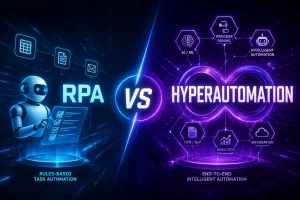
We are living through one of the most significant transformations in the history of institutional operations. Across every major sector, from global banking and complex healthcare networks to multi-tiered logistics and digital-first retail, enterprises are facing a relentless mandate: maximize operational velocity, eliminate deep-seated structural inefficiencies, and pivot from reactive execution to proactive adaptation. The luxury of linear, siloed technology adoption has vanished. In today’s economic climate, localized efficiency is no longer enough; survival requires end-to-end operational fluidity.
Enter hyperautomation: the overarching technology strategy that orchestrates multiple technological layers into a single, cohesive, and self-improving operational fabric. Coined by research firm Gartner, hyperautomation has evolved from a forward-looking trend into the definitive architectural blueprint for modern enterprise software. It is a business-driven, disciplined approach that organizations use to rapidly identify, vet, and automate as many business and IT processes as possible.
Crucially, hyperautomation is not an individual piece of software, nor is it a rebranded version of any single tool. Where traditional IT strategies focused on isolated tasks, hyperautomation takes an expansive, holistic view of the enterprise. It builds a connected ecosystem where tools don’t merely run parallel to each other; they communicate, share context, make decisions, and execute complex workflows across legacy mainframes, cloud applications, and modern databases.
According to global market forecasts, hyperautomation-enabling software and infrastructure are on track to surpass $1 trillion in market value before the end of the decade, expanding at a compound annual growth rate (CAGR) of nearly 14%. This explosive growth is driven by a fundamental realization among CIOs and enterprise architects: the single-point automation tools of the past have hit a hard ceiling. To unlock the next wave of productivity gains, organizations must shift their focus from task automation to complete process orchestration.
This comprehensive guide breaks down the core technologies powering hyperautomation in 2026. By examining how these distinct layers converge, this article provides technology leaders with the structural insights required to architect resilient, scalable, and intelligent automation ecosystems that drive measurable, long-term business value.
The Architectural Paradigm of Hyperautomation in 2026
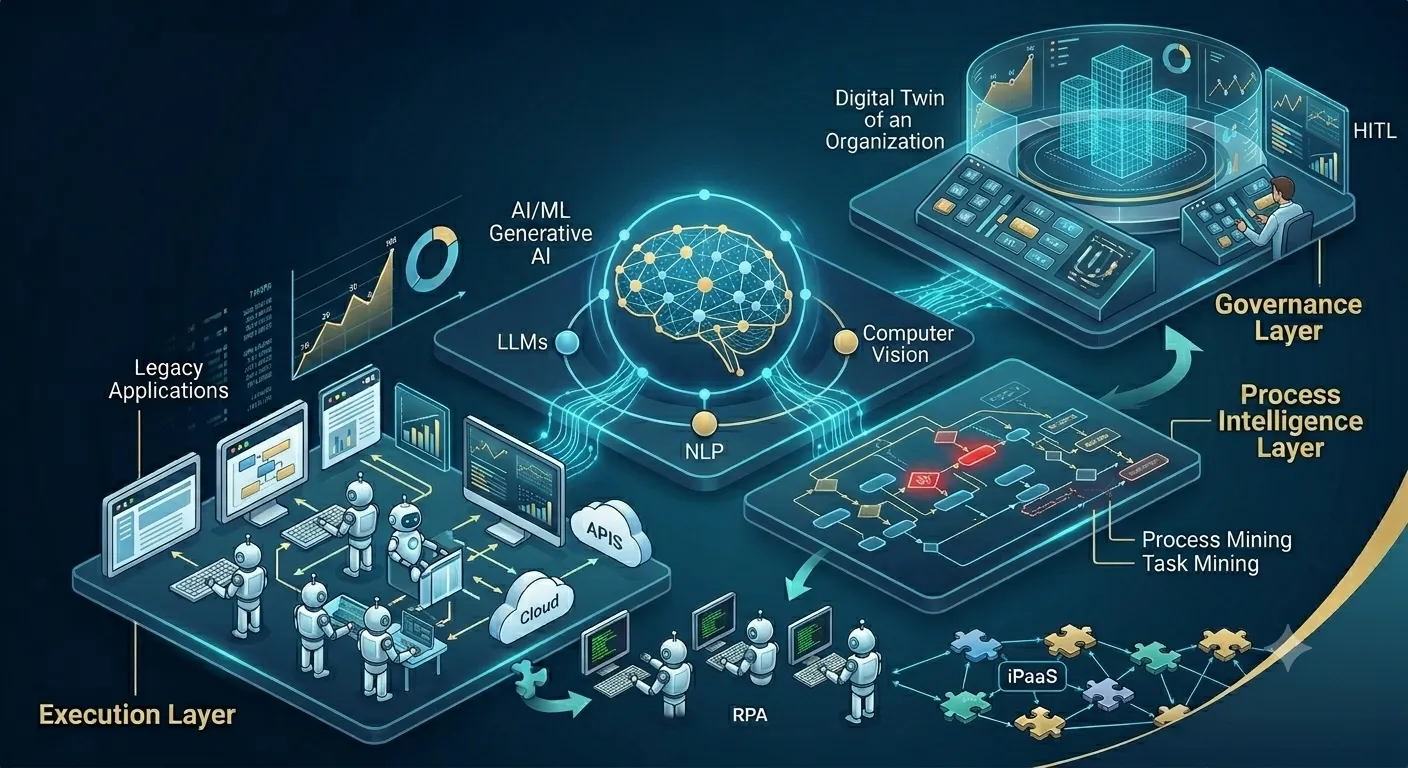
To understand the core technologies driving hyperautomation, one must first understand how they interact. Modern hyperautomation rejects the concept of isolated software deployments. Instead, it relies on a layered, multi-tier architectural framework often referred to as the
enterprise automation fabric.

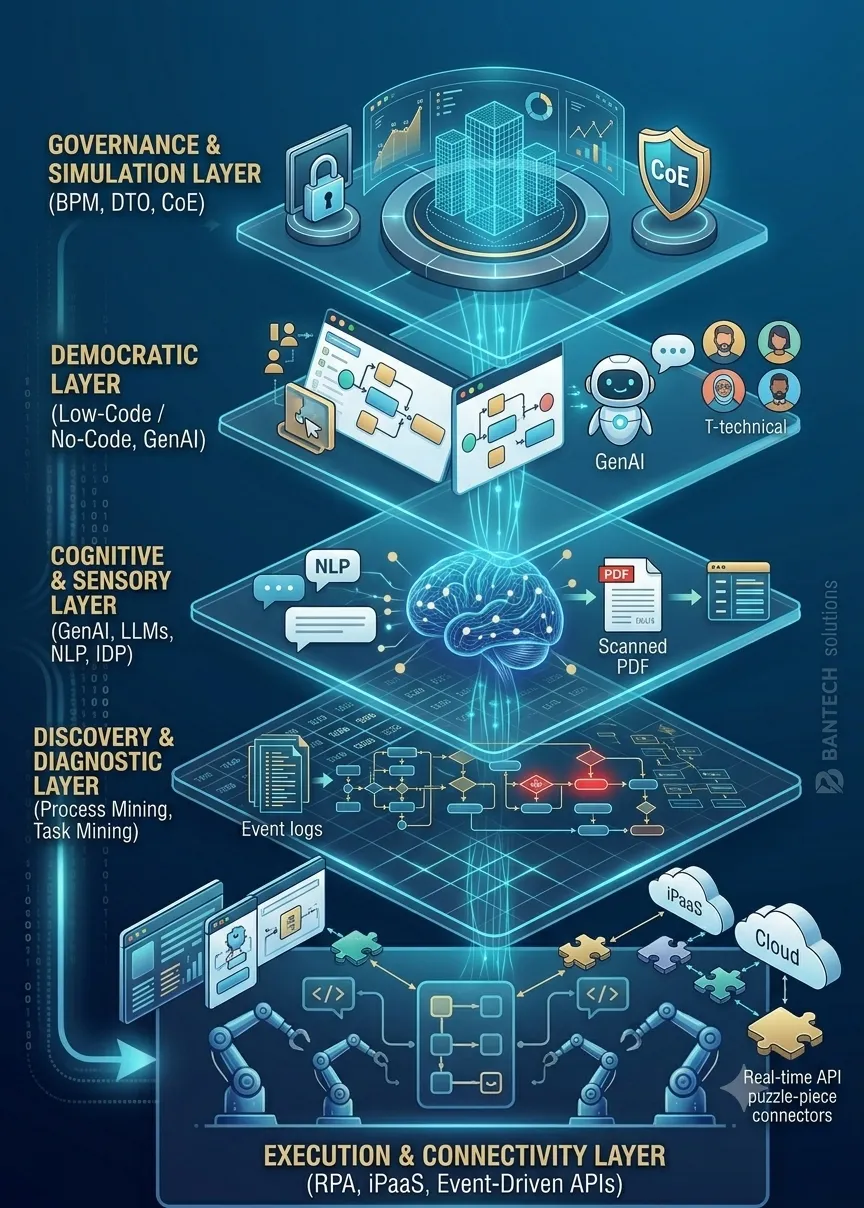
This fabric operates symmetrically across five distinct technical capabilities:
- The Execution & Connectivity Layer: The muscle that interacts with software interfaces, moves data, and bridges disparate applications.
- The Discovery & Diagnostic Layer: The continuous monitoring engine that uncovers inefficiencies, maps workflows, and identifies automation candidates based on real-world event logs.
- The Cognitive & Sensory Layer: The intelligent brain that processes unstructured information, interprets language, and makes complex, probabilistic decisions.
- The Democratic Layer: The tools that abstract technical complexity, allowing non-technical business experts to safely build and scale localized workflows.
- The Governance & Simulation Layer: The centralized command center that ensures compliance, models operational changes, and manages human-in-the-loop interventions.
When these layers function in harmony, the automation ecosystem ceases to be a rigid set of instructions. It becomes an adaptive system capable of learning from exceptions, self-correcting when underlying applications change, and optimizing its own performance over time.
1. Robotic Process Automation (RPA): The Operational Muscle
Robotic Process Automation (RPA) remains the foundational execution engine of the hyperautomation stack. RPA utilizes software bots to mimic human interactions with digital systems—such as clicking buttons, typing text, copying data between fields, filling out forms, and executing structured commands. Because it acts directly on the user interface (UI) layer, RPA allows organizations to automate tasks across legacy systems that lack modern application programming interfaces (APIs), bypassing the need for multi-million-dollar infrastructure overhauls.
However, the role of RPA has shifted dramatically over the past several years. In isolation, traditional RPA is inherently deterministic and rigid. It relies entirely on structured data and explicit, rule-based logic; if a screen layout changes by a few pixels or an input deviates from an expected format, the bot breaks. This fragility historically created a substantial maintenance burden for enterprise IT teams.
In 2026, the fundamental distinction between RPA vs hyperautomation lies in scope and cognitive capability. Rather than operating as a standalone strategy, RPA has been reframed as the “operational muscle” within a broader, multi-technology ecosystem. Modern RPA bots are rarely deployed in a vacuum; instead, they are tightly integrated with cognitive layers that guide their execution.
Furthermore, RPA itself has become significantly more intelligent through the integration of computer vision and machine learning-guided selectors. Instead of relying on rigid, absolute pixel coordinates or easily broken underlying HTML trees, contemporary RPA bots use advanced visual models to interpret screen layouts dynamically, much like a human eye. If a software vendor updates an ERP application’s user interface, the bot autonomously recognizes the new positions of the input fields, logs in successfully, and completes the task without human intervention. By acting as the ultimate bridge to legacy applications, RPA ensures that older systems can be seamlessly incorporated into end-to-end, hyperautomated workflows.
2. Generative AI and Large Language Models (LLMs): The Contextual Brain
If RPA represents the operational muscle of hyperautomation, Generative Artificial Intelligence (GenAI) and Large Language Models (LLMs) represent the contextual brain. Historically, automation initiatives stalled the moment they encountered unstructured data—such as unstructured customer emails, free-form legal contracts, medical charts, or audio recordings. Traditional machine learning models could classify data or extract highly specific fields, but they lacked the semantic understanding required to interpret context, tone, and nuanced human intent.
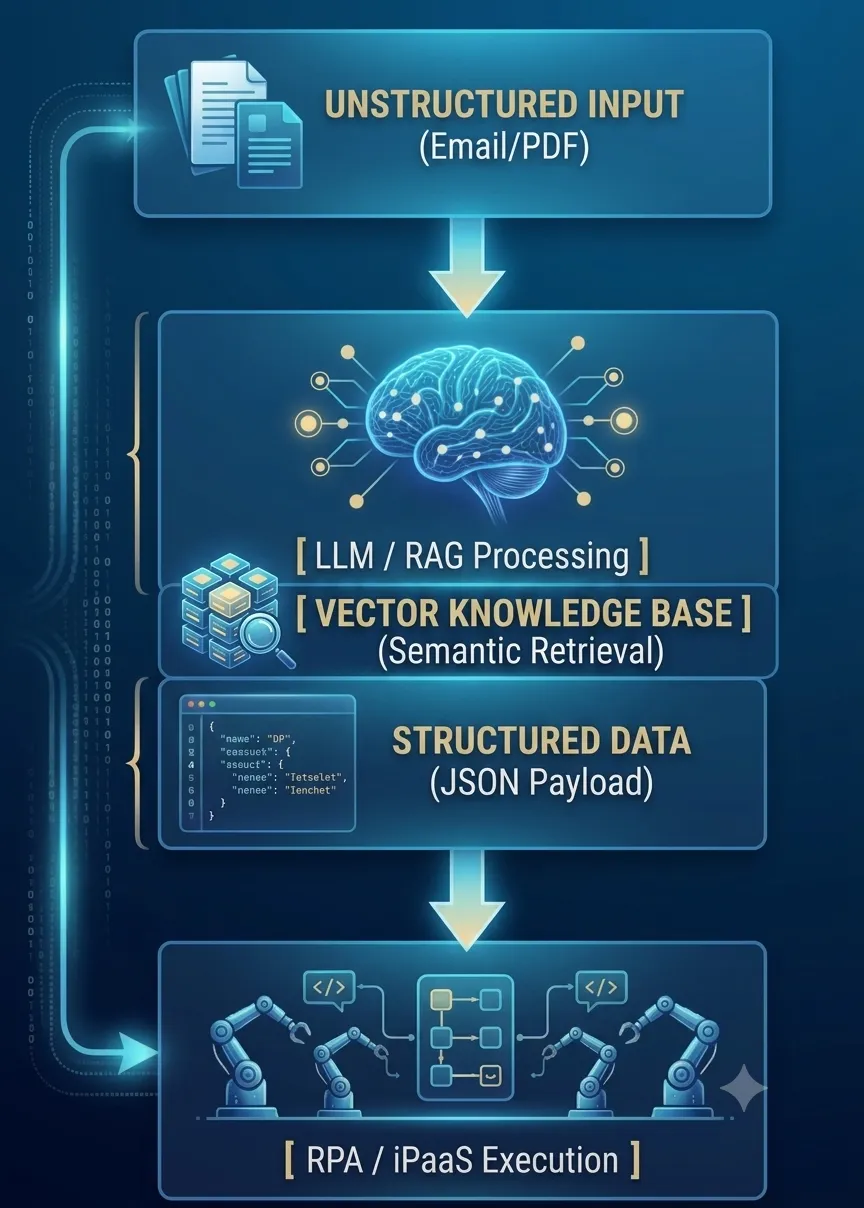
In 2026, enterprise-grade LLMs and Large Multimodal Models (LMMs) have revolutionized how automation systems interact with unstructured information. These advanced cognitive engines process massive volumes of multi-format data natively, translating ambiguous inputs into highly structured JSON payloads that downstream execution bots can immediately process.
Architecturally, this is achieved by embedding specialized, fine-tuned foundational models directly into automated workflows using Retrieval-Augmented Generation (RAG) and high-performance vector databases. Consider a complex customer service pipeline within an insurance firm:
When an unstructured claim email arrives, the RAG engine queries the secure vector database to retrieve the organization’s specific policy rules and compliance guidelines. The LLM evaluates the email against this context, determines whether the claim contains all necessary documentation, extracts relevant fields (such as policy numbers, loss dates, and damage descriptions), and passes this structured payload to an RPA bot or an API connection for immediate processing in the core CRM. By moving beyond rigid if-then rules to probabilistic, context-aware reasoning, Generative AI allows hyperautomation to scale into complex cognitive domains that were previously completely dependent on manual human labor.
3. Agentic AI and Autonomous Cognitive Agents: The Next Frontier
The integration of Generative AI has paved the way for the most significant evolution in modern enterprise software: Agentic AI. Traditional automation workflows are linear and deterministic; every path must be mapped out by a software engineer ahead of time. Agentic AI, by contrast, shifts the paradigm from predefined instruction tracking to autonomous, goal-directed behavior.
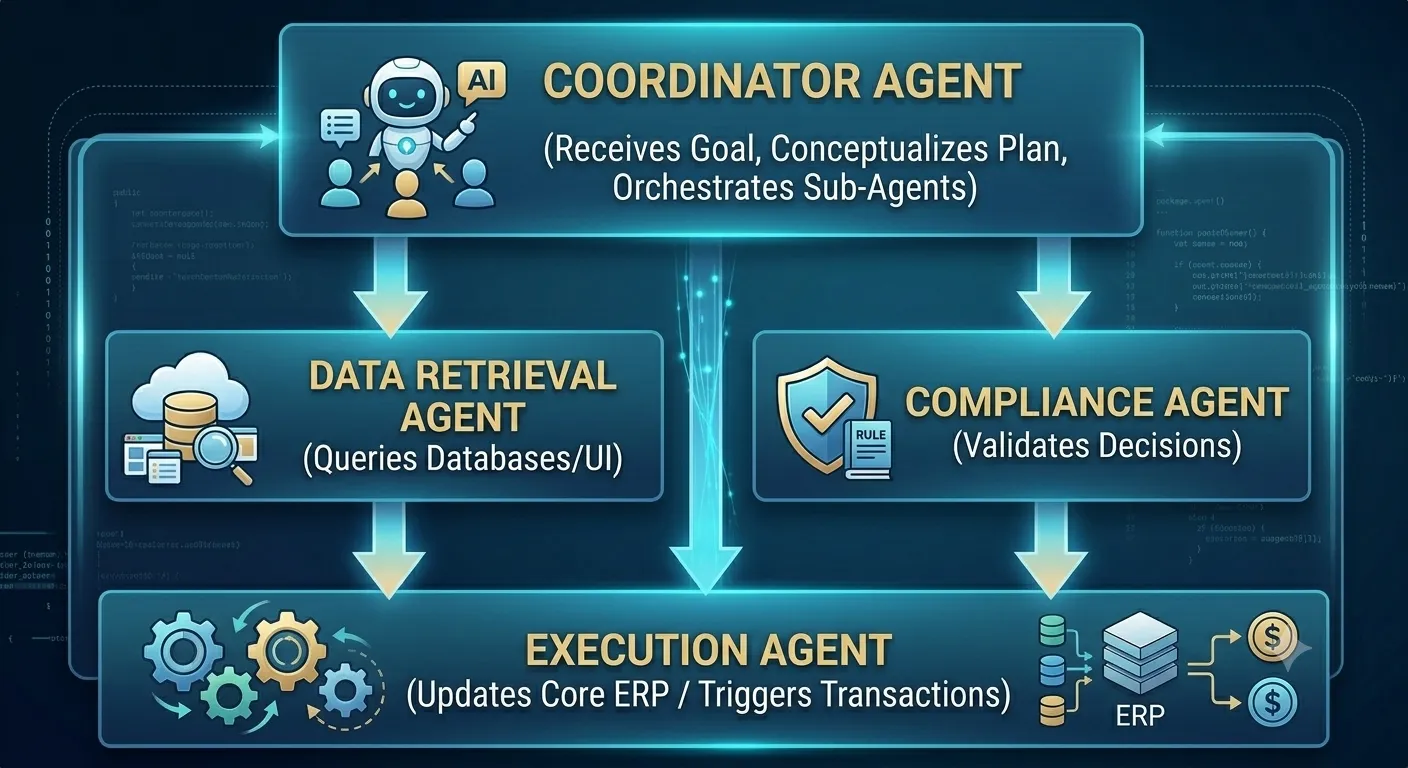
An autonomous cognitive agent is given a high-level objective, a defined set of boundaries, and access to an array of tools—such as corporate APIs, database access, document processing systems, and RPA bots. Rather than following a rigid script, the agent leverages its internal reasoning engine to formulate a multi-step execution plan, evaluate real-time feedback from its environment, and dynamically adjust its actions to achieve the specified goal.

In mature enterprise architectures, this capability is scaled through multi-agent collaboration frameworks. In these setups, specialized agents operate as a virtual department. For example, in an automated supply chain management workflow:
- A Monitoring Agent continuously analyzes shipping logs and weather data. Upon detecting a major port disruption, it flags the issue.
- It passes the context to a Sourcing Agent, which autonomously queries alternative supplier databases, reads available contracts via NLP, and calculates total landed costs including dynamic tariff updates.
- A Compliance Agent cross-checks the alternative suppliers against the organization’s environmental, social, and governance (ESG) rules and financial risk models.
- Finally, an Execution Agent uses an API or an RPA bot to draft a purchase order within the company’s ERP, routing it to a procurement manager’s dashboard with a complete, fully auditable summary of why this specific action was taken.
By delegating the planning and sub-task distribution to autonomous agents, enterprises can automate incredibly complex, non-linear workflows that cross dozens of internal and external systems.
4. Process Intelligence: Process Mining, Task Mining, and Business Activity Monitoring (BAM)
An enterprise cannot safely automate what it does not understand. Historically, the greatest bottleneck to scaling automation was process discovery. Organizations relied on manual consulting engagements, interviews, and time-and-motion studies to map out business processes—a practice that was slow, highly subjective, and out of date the moment it was completed.
Hyperautomation solves this visibility challenge through Process Intelligence, an advanced diagnostic layer that combines Process Mining, Task Mining, and real-time Business Activity Monitoring (BAM). As outlined in our complete guide to hyperautomation, continuous process discovery is what differentiates strategic automation from isolated IT experiments.
- Process Mining operates by ingesting the objective digital footprints left behind in enterprise event logs (found within systems like SAP, Oracle, Salesforce, or Workday). Each log entry contains a precise timestamp, a unique case ID, and a specific activity name. By aggregating millions of these rows, process mining algorithms reconstruct a highly accurate, interactive visual mathematical map of how the business actually runs. This instantly exposes hidden operational bottlenecks, unmapped process variations, and non-compliant paths that bleed revenue.
- Task Mining zooms into the micro-level, capturing the granular actions taken by human operators between system logs. Utilizing privacy-compliant desktop interaction recorders, task mining analyzes keystrokes, clicks, copy-paste sequences, and application switching. Machine learning algorithms analyze this interaction data to identify repetitive, low-value desktop tasks that are prime candidates for RPA deployment.
- Business Activity Monitoring (BAM) completes the loop by providing real-time, operational visibility into running automations. BAM dashboards don’t just track whether a bot is active; they measure process throughput, error rates, financial ROI, and service-level agreement (SLA) compliance.
Together, these technologies form an enterprise diagnostic engine. Instead of guessing where automation will deliver the highest return, process intelligence provides leaders with concrete, data-driven proofs, turning automation discovery into a continuous, quantifiable discipline.
5. Intelligent Document Processing (IDP) and Multimodal NLP: The Sensory Layer
The modern corporate landscape is flooded with documentation. Invoices, bills of lading, customs declarations, regulatory filings, and customer onboarding documents form the lifeblood of administrative workflows. Transforming these physical and digital documents into clean, actionable business data requires Intelligent Document Processing (IDP) and Multimodal Natural Language Processing (NLP).
Legacy Optical Character Recognition (OCR) tools were restricted to basic template mapping. They looked at a document as a static grid; if an invoice number moved from the top right corner to the center of the page, the extraction failed. Furthermore, legacy OCR struggled with poor-quality scans, skewed PDF formatting, and handwritten annotations.
Modern IDP platforms overcome these limitations by combining layout-aware deep learning transformer architectures with multimodal NLP. These models analyze a document through two lenses simultaneously: textual content and visual, spatial semantics. The system understands that a string of digits near the words “Total Amount Due” represents a specific financial variable,
| Feature / Capability | Legacy OCR | Modern IDP (2026) |
|---|
| Data Extraction Basis | Fixed coordinates / Template zones | Semantic layout & Contextual understanding |
| Handling of Variation | Breaks if format or template changes | Adapts natively to unseen, dynamic layouts |
| Data Input Types | Clean, structured digital PDFs only | Unstructured text, poor scans, handwriting, tables |
| Straight-Through Processing | Extremely low; requires high human review | High (>90% on standard financial/admin docs) |
This spatial-textual awareness allows IDP engines to process highly dense, multi-page documents—such as complex medical bills with nested tables, handwritten customs declarations, and variable-format corporate invoices—achieving high straight-through processing (STP) rates. Once the information is parsed and validated, it flows downstream into the enterprise fabric, removing manual data entry bottlenecks from high-volume operations.
6. Integration Platform as a Service (iPaaS) and API-First Orchestration: The Nervous System
While RPA excels at interacting with older applications via the user interface, modern cloud-native systems and enterprise software suites are built for direct, high-speed programmatic communication. Connecting these cloud applications, local databases, and external SaaS solutions requires Integration Platform as a Service (iPaaS) and an API-first orchestration architecture. This layer serves as the hyperautomation framework’s central nervous system.
An iPaaS platform abstracts away the underlying technical complexities of custom API development. It provides enterprise software architects with a visual middleware environment equipped with hundreds of pre-built, secure connectors for major enterprise applications (such as NetSuite, Snowflake, Microsoft Dynamics, and HubSpot). This allows data to flow instantly between systems without requiring developer teams to write and maintain brittle, bespoke integration code.
Crucially, modern hyperautomation relies heavily on Event-Driven Architecture (EDA) managed within the iPaaS layer. Traditional IT integrations ran on scheduled batch processing—for instance, syncing data once every night at midnight. In contrast, an event-driven framework reacts instantly to real-time micro-events across the enterprise infrastructure.
Using technologies like Apache Kafka, RabbitMQ, or AWS EventBridge, an event—such as a customer submitting a new support ticket, an inventory level dropping below a critical threshold, or an IoT sensor detecting an equipment anomaly—triggers an immediate webhook. This webhook instantly alerts the cognitive and execution layers of the hyperautomation fabric to process the event in real time. By replacing slow, batch-based workflows with dynamic, event-driven data streaming, iPaaS ensures that automated systems can respond to market demands and operational anomalies the microsecond they occur.
7. Low-Code/No-Code (LCNC) and Citizen Development Environments: The Democratic Accelerator
The demand for operational automation across the global enterprise landscape far outpaces the development capacity of central IT departments. If every automated workflow required a team of dedicated full-stack software engineers to architect, write, test, and deploy code, the pace of organizational transformation would grind to a halt. To scale hyperautomation across hundreds of distinct departments, enterprises leverage Low-Code/No-Code (LCNC) platforms and Citizen Development frameworks.
LCNC platforms democratize the creation of automated workflows by providing visual, drag-and-drop design interfaces. Business analysts, operations managers, HR specialists, and financial controllers—often referred to as citizen developers—can build, test, and modify localized automations without writing traditional code. They can visually map out a workflow, connect data sources via pre-cleared iPaaS components, and set processing rules through simple, intuitive graphical interfaces.
In 2026, this democratic acceleration has been supercharged by the integration of AI-powered co-pilots within low-code development environments. A business user can simply describe a desired workflow in natural language:
“Whenever a premium client uploads a signed contract to our SharePoint folder, verify their credit rating in Dun & Bradstreet, update our Salesforce account status, and notify the account executive via Microsoft Teams.”
The LCNC platform’s generative engine automatically synthesizes the underlying integration logic, maps the appropriate API fields, handles basic exception routing, and presents the user with a fully functional visual prototype.
However, scaling citizen development requires rigorous corporate governance to prevent the rise of chaotic “shadow automation.” Mature enterprise architectures employ centralized software sandboxes, automated security scanning of low-code scripts, and strict data-loss prevention (DLP) policy enforcement engines. This ensures that while non-technical staff can rapidly build and scale localized workflows, the central IT department maintains complete visibility, security control, and architectural oversight.
8. Business Process Management (BPM) and Digital Twins of the Organization (DTO): The Governance and Simulation Layer
At the highest level of the hyperautomation architecture sits the governance, orchestration, and simulation layer. As an enterprise scales its automation initiatives, it inevitably builds a complex, interlocking ecosystem of hundreds of distinct RPA bots, API integrations, and autonomous cognitive agents. Without a centralized orchestration framework, this complexity can devolve into operational fragmentation, where independent systems inadvertently create data conflicts or processing loops.
To maintain structural control, organizations deploy Business Process Management (BPM) platforms and Digital Process Automation (DPA) engines. The BPM layer acts as the supreme conductor of the enterprise fabric. It focuses on the macro-orchestration of end-to-end workflows, managing long-running processes that span days or weeks and involve both automated machine tasks and critical human interventions.
Hyperautomation is rarely 100% autonomous. High-risk, high-impact business decisions—such as approving corporate credit extensions above a certain financial threshold, flagging medical triage anomalies, or validating sensitive legal exceptions—require a Human-in-the-Loop (HITL) architecture. The BPM platform governs these handoffs seamlessly. When an autonomous agent or an IDP model encounters a complex case with low statistical confidence, the BPM engine pauses the automated flow, routes the case to a qualified human expert’s dashboard with full contextual documentation, and—once human judgment is applied—automatically resumes the automated downstream execution.
Enterprise Process Simulation (DTO)
- Models end-to-end workflows in a virtual, real-time replica.
- Conducts stress testing and “what-if” operational scenario analysis.
- Evaluates downstream impacts before live system deployment.
Macro-Orchestration & Governance (BPM)
- Manages long-running processes across diverse departments.
- Governs Human-in-the-Loop (HITL) manual intervention routing.
- Enforces strict regulatory compliance and granular audit logs.
Furthermore, advanced technology leaders utilize the concept of a Digital Twin of the Organization (DTO) to manage operational risk. A DTO is a dynamic, software-driven, real-time virtual simulation model of the enterprise’s operational processes, fed continuously by live event logs and process mining streams.
Before deploying a new suite of autonomous cognitive agents or restructuring a core financial workflow, enterprise architects run predictive “what-if” simulations within the DTO sandbox. The system models how the proposed automation will affect downstream capacity constraints, staffing requirements, and system response times. By stress-testing automated workflows in a risk-free virtual environment before pushing them into live production, companies can eliminate implementation risk, optimize resource allocation, and guarantee operational stability at scale.
Strategic Implementation Challenges & Governance in 2026
While the technical convergence of these core layers offers unparalleled opportunities for operational transformation, scaling a hyperautomation ecosystem introduces significant structural challenges that technology leaders must proactively manage.
Technical Debt and Bot Fragility
Despite advances in computer vision and layout-aware selectors, the maintenance overhead of enterprise automation portfolios remains a critical concern. As underlying legacy systems, third-party SaaS interfaces, and internal corporate databases undergo continuous updates, the automation integrations connecting them can experience friction. Furthermore, the inclusion of Generative AI introduces the challenge of semantic drift and prompt fragility, where minor variations in unstructured model outputs can cause unexpected formatting errors in downstream API payloads. Managing this requires strict version control, automated regression testing pipelines, and dedicated Automation Centers of Excellence (CoE) tasked with continuous monitor optimization.
Explainable AI (XAI) and Regulatory Compliance
As hyperautomation expands into highly consequential decision-making domains—such as credit evaluation, insurance underwriting, and medical documentation—enterprises must navigate increasingly stringent global regulatory frameworks, including the European Union AI Act and localized financial compliance mandates. Traditional deep learning architectures and LLMs frequently operate as “black boxes,” making it difficult to trace exactly how a specific probabilistic conclusion was reached. To mitigate legal and regulatory risks, enterprise architects must build Explainable AI (XAI) parameters into their cognitive layers. Automated workflows must generate comprehensive, human-readable audit trails detailing the exact data points, corporate policies, and semantic logic used by an autonomous agent to validate a given decision.
Data Security and Zero-Trust Privacy
Autonomous cognitive agents and intelligent document processing engines require deep access to sensitive corporate records, proprietary intellectual property, and protected personal identifiable information (PII). In an era of sophisticated cyber threats, integrating these tools requires a strict Zero-Trust Architecture. Enterprises must implement:
- Advanced data masking and anonymization protocols at the data ingestion boundary.
- Granular identity and access management (IAM) controls, ensuring software bots possess the absolute minimum system privileges required to complete their explicit task.
- Secure, localized deployment of open-source LLMs within isolated private clouds or corporate virtual networks, completely preventing sensitive enterprise data from leaking into public model training pools.
Conclusion
Hyperautomation represents a fundamental shift in how modern enterprises design, execute, and optimize their operational workflows. It has moved past the era of experimental IT projects to become a core strategic discipline required for sustained corporate agility and market competitiveness.
The core insight for technology leaders is clear: true operational transformation is not achieved by choosing between disparate applications, nor by purchasing a single, catch-all platform. Success lies in the strategic orchestration of the entire automation stack. By weaving together the operational execution of RPA, the cognitive reasoning of Generative AI, the goal-directed adaptability of Agentic workflows, the deep diagnostics of process intelligence, and the comprehensive oversight of BPM governance frameworks, organizations can build a unified, resilient, and human-centric enterprise automation fabric.
The technologies required to achieve this vision are mature, reliable, and accessible. The defining factor that will separate industry leaders from lagging organizations over the coming years is not access to the software itself, but the willingness to approach hyperautomation as a continuous operational discipline. The organizations that move decisively to build a cohesive, securely governed technology foundation today are the ones that will define operational efficiency, customer service excellence, and business model innovation in the decade ahead.
Hyperautomation Content Series
Continue the Complete Hyperautomation Guide
This post is a part of the Hyperautomation Content Series — the complete 8 article guide to understanding, implementing, and scaling hyperautomation in your organization.
FAQs
Hyperautomation is a business-driven strategy that combines multiple technologies to identify, automate, and continuously optimize as many business and IT processes as possible across an enterprise.
Key Takeaways
- Hyperautomation is a strategy, not a single product or tool.
- It orchestrates RPA, AI, process mining, intelligent document processing, and low-code platforms into one connected system.
- The goal is end-to-end process automation rather than isolated task bots.
- Organizations use it to increase speed, reduce errors, and free people for higher-value work.
- In 2026 it has moved from experimental projects to a core enterprise architecture priority.
Hyperautomation is a business-driven, disciplined approach that organizations use to rapidly identify, vet, and automate as many business and IT processes as possible. Unlike traditional automation that targets single repetitive tasks, hyperautomation takes an expansive view of the entire enterprise and builds a connected system in which tools communicate, share context, make decisions, and execute complex workflows across legacy and modern applications. Teams that need to design and implement this architecture often begin with specialized artificial intelligence development services so the cognitive layers are production-ready from the start.
Hyperautomation Definition and Origins
The term was popularized by Gartner and describes a deliberate strategy rather than a piece of software you can buy off the shelf. The formal definition centers on three ideas: business ownership of the initiative, rapid identification of automation candidates, and the coordinated use of multiple technologies instead of reliance on any single tool.
In practical terms this means an organization first maps how work actually flows, then selects the right combination of technologies for each part of the process, and finally governs the entire system so it remains compliant, measurable, and adaptable. The result is an automation fabric that can handle both structured and unstructured data, span multiple departments, and improve its own performance over time.
How Hyperautomation Differs from Traditional Automation
Traditional automation focuses on discrete, rule-based tasks. A bot might copy data from one system into another or send a confirmation email after a form submission. These solutions work well when inputs are predictable and the process never changes, yet they break the moment a screen layout shifts or an exception appears.
Hyperautomation operates at a different scale and level of intelligence. It targets complete end-to-end processes rather than isolated steps. It incorporates cognitive technologies that interpret unstructured information and make probabilistic decisions. It also includes continuous discovery so new automation opportunities are surfaced automatically instead of relying on periodic consulting workshops.
The practical difference shows up in three dimensions:
- Scope: Traditional automation addresses single tasks. Hyperautomation addresses entire workflows that cross systems and teams.
- Intelligence: Traditional automation follows fixed rules. Hyperautomation uses AI to handle variation and improve with experience.
- Governance: Traditional automation often lives in departmental silos. Hyperautomation requires centralized oversight, measurement, and continuous optimization.
For a deeper technical breakdown of the individual layers that make this possible, see the detailed examination of the core technologies powering hyperautomation in 2026.
The Core Technology Stack Behind Hyperautomation
Hyperautomation is the orchestrated combination of several mature and emerging technologies. No single component is sufficient on its own. The power comes from how they work together.
Robotic Process Automation (RPA) supplies the execution layer. Software bots interact with user interfaces and APIs to perform repetitive actions such as data entry, form completion, and system-to-system transfers. Modern RPA has become more resilient through computer vision and adaptive selectors, allowing bots to continue working even when application screens change.
Artificial Intelligence and Machine Learning provide the decision-making layer. These models classify documents, detect anomalies, forecast demand, and recommend actions. Generative AI and large language models extend the capability further by interpreting free-form text, summarizing complex documents, and generating structured outputs that downstream bots can act on.
Process Mining and Task Mining form the discovery layer. Process mining reconstructs actual workflows from system event logs, revealing bottlenecks and variations that process documentation rarely captures. Task mining records desktop-level actions to identify micro-tasks suitable for automation. Together they turn discovery into a continuous, data-driven discipline.
Intelligent Document Processing (IDP) handles the sensory layer. Combining computer vision, optical character recognition, and natural language processing, IDP extracts and validates data from invoices, contracts, claims, and other documents regardless of layout or quality. The structured data then feeds the rest of the automation stack.
Low-Code and No-Code Platforms democratize development. Business users can build and modify simpler workflows without writing traditional code, accelerating the pace at which new automations are created while professional teams focus on complex orchestration and security.
Integration Platforms and Orchestration connect the pieces. APIs, event buses, and workflow engines ensure data and control flow smoothly across systems so that each technology can hand work to the next without manual intervention.
| Technology Layer | Primary Function | Typical Tools or Capabilities | Outcome for the Enterprise |
|---|
| Execution | Perform actions across systems | RPA, APIs, computer vision | Reliable completion of structured tasks |
| Cognitive | Interpret and decide | Generative AI, ML models, agentic frameworks | Handling of unstructured data and exceptions |
| Discovery | Map real processes | Process mining, task mining | Accurate, continuously updated automation backlog |
| Sensory | Convert documents to data | Intelligent document processing, NLP | Structured inputs from any document type |
| Governance & Scale | Control and extend | Low-code platforms, simulation, audit trails | Compliant, measurable enterprise rollout |
How Hyperautomation Works in Practice
Implementation follows a repeatable cycle. First the organization uses process and task mining to understand how work actually occurs. High-impact candidates are prioritized by volume, error rate, and business value. Suitable technologies are then applied: RPA for structured steps, IDP for documents, generative AI for interpretation, and orchestration for end-to-end flow.
Once live, the system is monitored through business activity monitoring dashboards that track throughput, exceptions, and return on investment. Insights feed back into the discovery layer so the automation fabric improves continuously. Human-in-the-loop checkpoints remain available for exceptions that still require judgment, creating a hybrid model rather than a fully lights-out operation.
This approach is especially powerful in regulated industries such as banking, insurance, and healthcare, where accuracy, auditability, and compliance are non-negotiable. The same pattern also delivers results in manufacturing, logistics, and shared-service centers where process volume and complexity are high.
Business Benefits That Drive Adoption
Organizations adopt hyperautomation for concrete operational gains. Cycle times that once measured in days compress into hours or minutes. Error rates drop because bots and models do not suffer from fatigue or inconsistency. Compliance improves through automatic audit trails and rule enforcement. Scalability becomes possible without proportional headcount growth: transaction volume can increase while processing cost grows only marginally.
Perhaps the most strategic benefit is the shift of human effort. Employees move from repetitive data handling into roles that require judgment, creativity, and relationship management. The organization therefore gains both efficiency and higher-value capacity at the same time.
Market data reinforces the trajectory. Gartner has projected that hyperautomation-enabling software will reach more than one trillion dollars in market value before the end of the decade, expanding at a compound annual growth rate of nearly 14 percent. That level of investment reflects a broad consensus that single-point automation has reached its limits and that coordinated, intelligent process orchestration is now a competitive requirement.
Ready to move from isolated task automation to a full hyperautomation strategy?
Request a Quote and receive a practical assessment of your process landscape and technology readiness. Common Misconceptions
Several misunderstandings still circulate. One is that hyperautomation equals RPA. RPA is an important component, yet it is only the execution muscle. Without AI, process intelligence, and governance, the initiative remains limited.
Another misconception is that hyperautomation eliminates all human involvement. In reality the most successful programs keep people in the loop for exceptions, oversight, and continuous improvement. The goal is to remove unnecessary manual work, not to remove human judgment entirely.
A third misconception is that hyperautomation can be purchased as a single platform. While vendors offer increasingly integrated suites, the architecture still requires careful design, data quality work, and change management. Organizations that treat it as a pure technology purchase often underperform those that treat it as a business transformation program supported by technology.
For additional perspective on how artificial intelligence is reshaping software delivery itself, see the analysis of AI-powered software development in 2026.
Getting Started with a Hyperautomation Program
Successful programs begin with clear business ownership and a realistic scope. Select one or two high-volume processes that cross multiple systems and contain measurable pain. Use process mining to establish a factual baseline. Design the technology combination that fits those processes rather than forcing every process into the same tool set. Establish governance early so security, compliance, and measurement are built in rather than bolted on later.
Pilot results should be measured in hard metrics: cycle time, error rate, cost per transaction, and employee time reclaimed. Only after the pilot demonstrates value should the program expand. This disciplined, evidence-based approach avoids the common pattern of scattered bots that deliver limited enterprise impact.
Related Questions
What is the difference between automation and hyperautomation?
Automation typically targets individual repetitive tasks with rule-based tools. Hyperautomation orchestrates multiple technologies to automate and continuously optimize entire end-to-end business processes.
Is hyperautomation the same as intelligent automation?
Intelligent automation usually refers to RPA enhanced with AI for decision-making. Hyperautomation is broader: it includes process discovery, governance, low-code platforms, and enterprise-wide orchestration in addition to intelligent execution.
What technologies are required for hyperautomation?
The core set includes robotic process automation, artificial intelligence and machine learning, process mining, intelligent document processing, low-code platforms, and integration or orchestration tools.
How long does it take to see results from hyperautomation?
Well-scoped pilots focused on high-volume processes often show measurable reductions in cycle time and error rates within three to six months. Broader enterprise programs typically deliver compounding returns over twelve to twenty-four months.
Does hyperautomation replace human workers?
Hyperautomation removes repetitive, low-value work so people can focus on judgment, creativity, and customer relationships. Most mature programs operate as human-plus-machine systems rather than fully autonomous ones.
Turn the definition of hyperautomation into a working enterprise capability.
Request a Quote today for a tailored assessment of your processes and a practical roadmap to start. The core technologies of hyperautomation form a coordinated enterprise stack that includes robotic process automation, generative AI, agentic systems, process intelligence, and intelligent document processing working together as one adaptive system.
Key Takeaways
- Hyperautomation relies on five interlocking technology layers rather than any single tool.
- RPA provides reliable execution while generative AI and agentic systems supply cognitive decision-making.
- Process mining and task mining turn discovery into a continuous, data-driven activity.
- Intelligent document processing removes the unstructured-data barrier that limited earlier automation.
- Governance and low-code capabilities complete the stack so the system can scale safely across the organization.
The core technologies of hyperautomation are the set of complementary capabilities that let organizations move beyond isolated task bots and into end-to-end, continuously improving process orchestration. In 2026 these technologies function as a single architectural fabric. Enterprises that treat them as separate purchases still face brittle integrations and rising maintenance costs. Those that design the stack as an integrated system achieve measurable gains in speed, accuracy, and resilience. Organizations that need production-grade implementations frequently engage a custom software development team to ensure each layer is engineered for reliability and governance from the outset.
The Architectural Layers of the Hyperautomation Stack
Modern hyperautomation rejects isolated software deployments. It operates through a multi-tier framework often described as the enterprise automation fabric. This fabric spans five distinct technical capabilities that must function in concert.
- Execution and connectivity layer: the muscle that interacts with user interfaces, moves data, and bridges legacy and modern systems.
- Discovery and diagnostic layer: continuous monitoring that maps real workflows and surfaces high-value automation candidates.
- Cognitive and sensory layer: the intelligence that interprets unstructured information and makes probabilistic decisions.
- Democratic layer: tools that allow business experts to build and adjust workflows without deep coding expertise.
- Governance and simulation layer: the control plane that enforces compliance, models operational changes, and manages human-in-the-loop checkpoints.
When these layers operate together the automation ecosystem ceases to be a rigid collection of scripts. It becomes an adaptive system capable of learning from exceptions and self-correcting when underlying applications change.
1. Robotic Process Automation: The Execution Foundation
Robotic process automation remains the foundational execution engine of the hyperautomation stack. RPA bots mimic human interactions with digital systems by clicking buttons, typing text, copying data between fields, filling forms, and executing structured commands. Because they act directly on the user-interface layer, they can automate work across legacy systems that lack modern APIs, avoiding costly infrastructure replacement projects.
In 2026 the role of RPA has matured. Earlier generations were deterministic and fragile. A minor screen-layout change could break a bot and create ongoing maintenance burdens. Contemporary RPA incorporates computer vision and machine-learning-guided selectors. Bots now interpret screen layouts dynamically and continue operating even when an application vendor updates its interface. This resilience positions RPA as the reliable bridge that incorporates older systems into end-to-end hyperautomated workflows. For broader context on how RPA fits inside a larger strategy, see the practical overview in the complete hyperautomation guide.
2. Generative AI and Large Language Models: The Cognitive Layer
If RPA supplies the muscle, generative AI and large language models supply the contextual brain. Earlier automation initiatives stalled whenever they encountered unstructured data such as free-form emails, legal contracts, medical charts, or audio recordings. Enterprise-grade large language models and large multimodal models now process multi-format data natively and convert ambiguous inputs into structured payloads that downstream systems can act on immediately.
Architecturally this is achieved by embedding fine-tuned models into workflows through retrieval-augmented generation and vector databases. An unstructured claim email arrives. The retrieval engine pulls the organization’s policy rules and compliance guidelines. The language model evaluates completeness, extracts key fields, and passes a clean structured payload to an RPA bot or API connection. The shift from rigid rule sets to probabilistic, context-aware reasoning allows hyperautomation to scale into cognitive domains that previously required full-time human labor.
3. Agentic AI and Autonomous Cognitive Agents
Agentic AI marks the most significant evolution in the current stack. Traditional automation workflows are linear and pre-mapped. An autonomous cognitive agent receives a high-level objective, a defined set of boundaries, and access to tools such as corporate APIs, databases, document processors, and RPA bots. It then formulates a multi-step plan, evaluates real-time feedback from its environment, and dynamically adjusts its actions to reach the goal.
In mature enterprise architectures these agents collaborate as a virtual team. A monitoring agent detects a supply-chain disruption from shipping logs and weather data. It hands context to a sourcing agent that queries alternative suppliers, reads contracts, and calculates total landed cost. A compliance agent cross-checks the options against environmental, social, and governance rules. An execution agent then drafts the purchase order inside the ERP and routes a fully auditable summary to a human manager. Multi-agent frameworks enable automation of complex, non-linear processes that cross dozens of internal and external systems.
4. Process Intelligence: Mining, Task Mining, and Real-Time Monitoring
An enterprise cannot safely automate what it does not understand. Process intelligence solves the visibility problem by combining process mining, task mining, and business activity monitoring.
Process mining ingests objective event logs from systems such as ERP, CRM, and workforce platforms. Each log entry contains a timestamp, case identifier, and activity name. Aggregating millions of these rows reconstructs an accurate visual map of how the business actually operates, exposing bottlenecks, unmapped variations, and non-compliant paths. Task mining zooms to the desktop level, capturing keystrokes, clicks, copy-paste sequences, and application switching. Machine-learning algorithms identify repetitive micro-tasks that are strong candidates for RPA. Business activity monitoring closes the loop by tracking live automation performance, including throughput, error rates, financial return, and service-level compliance.
Together these capabilities convert automation discovery from subjective workshops into a continuous, quantifiable discipline. The same diagnostic engine also feeds the governance layer, creating a closed loop between discovery, execution, and optimization.
5. Intelligent Document Processing and Multimodal NLP
Corporate operations still depend heavily on documents: invoices, bills of lading, customs declarations, regulatory filings, and customer onboarding packs. Intelligent document processing combined with multimodal natural language processing turns those documents into clean, actionable data.
Legacy optical character recognition treated a page as a static grid and failed when layouts shifted or handwriting appeared. Modern intelligent document processing uses computer vision, layout-aware models, and domain-tuned language models to extract, classify, and validate information regardless of format quality. The resulting structured data becomes immediately available to RPA bots, agentic planners, or analytics engines. This removes the unstructured-data bottleneck that historically limited the scope of automation programs.
Comparison of the Core Technology Layers
| Layer | Primary Role | Key Technologies | Enterprise Outcome |
|---|
| Execution | Perform actions across systems | RPA, APIs, computer vision | Reliable task completion on both modern and legacy interfaces |
| Cognitive | Interpret and decide | Generative AI, large language models, agentic frameworks | Context-aware handling of unstructured inputs and exceptions |
| Discovery | Map and prioritize work | Process mining, task mining, business activity monitoring | Data-driven automation backlog and continuous optimization |
| Sensory | Convert documents to data | Intelligent document processing, multimodal NLP | Structured payloads from any document type or quality |
| Governance | Control and scale | Low-code platforms, simulation, audit trails | Compliant, measurable rollout across the enterprise |
Market Context and Supporting Evidence
The shift toward coordinated technology stacks is reflected in market projections. Gartner has indicated that hyperautomation-enabling software and infrastructure are on track to surpass one trillion dollars in market value before the end of the decade, expanding at a compound annual growth rate of nearly 14 percent. That growth is driven by the recognition that single-point automation has reached a practical ceiling and that the next productivity gains require the full, integrated set of technologies described above.
Ready to design a production-ready hyperautomation architecture?
Request a Quote and map the right technology layers to your highest-value processes. Practical Considerations for Building the Stack
Successful implementations follow a consistent sequence. Begin with process intelligence to identify the highest-return candidates. Deploy RPA for the structured execution steps. Layer generative AI and intelligent document processing for unstructured inputs. Introduce agentic orchestration only after foundational data flows are stable and reliable. Finally, wrap the entire fabric in governance and low-code capabilities so business teams can iterate safely while security and compliance remain intact.
Organizations that skip discovery or treat generative AI as a simple add-on frequently encounter rising exception rates and governance gaps. Those that treat the five layers as a single architectural system achieve the adaptive, self-improving automation fabric that defines mature hyperautomation in 2026. Additional perspective on how artificial intelligence is reshaping related software practices appears in the examination of AI voice agents in production environments.
Related Questions
What is the role of RPA in the hyperautomation stack?
RPA serves as the primary execution engine. It handles structured, rule-based interactions with applications and provides the reliable bridge to legacy systems that lack modern APIs.
How does generative AI improve hyperautomation?
Generative AI and large language models interpret unstructured data such as emails, contracts, and documents, converting them into structured payloads that RPA bots and other systems can process automatically.
Why is process mining considered essential?
Process mining reconstructs actual workflows from system event logs, revealing bottlenecks and automation opportunities that manual documentation and interviews typically miss.
What does agentic AI add that earlier automation lacked?
Agentic AI enables goal-directed, multi-step planning. Agents receive an objective and autonomously select tools and adjust their approach while remaining inside defined guardrails.
How does intelligent document processing fit into the architecture?
Intelligent document processing extracts and validates data from documents of varying quality and layout, supplying clean structured inputs to the rest of the automation stack.
Convert the core technologies of hyperautomation into a working enterprise architecture.
Request a Quote today for a tailored assessment of your process landscape and technology readiness. RPA automates individual rule-based tasks through software bots that interact with application interfaces, while hyperautomation is an enterprise strategy that orchestrates RPA together with AI, process mining, intelligent document processing, and governance to automate entire end-to-end processes.
Key Takeaways
- RPA is a tactical tool focused on structured, repetitive tasks.
- Hyperautomation is a strategic approach that combines multiple technologies for complete process orchestration.
- RPA works best on stable, rules-driven work; hyperautomation handles variation, unstructured data, and cross-system workflows.
- Most mature programs use RPA as one layer inside a broader hyperautomation architecture.
- The choice is rarely either-or: organizations typically start with RPA and expand into the full stack as complexity and scale increase.
RPA and hyperautomation are frequently discussed together, yet they operate at different levels of ambition and capability. Robotic process automation is a technology that uses software bots to mimic human actions on digital systems. Hyperautomation is a business-driven strategy that coordinates several technologies, including RPA, to identify and automate as many processes as possible across the enterprise. Organizations evaluating the shift often partner with providers of white-label software development services to design and deliver the integrated architecture without building every component from scratch.
Clear Definitions of Each Approach
Robotic process automation focuses on individual tasks. A bot logs into an application, reads data from a screen or file, enters information into another system, clicks through a sequence of menus, or moves records according to fixed rules. Because the bot works at the user-interface level, it can operate on legacy systems that lack modern APIs. The strength of RPA is speed of deployment and reliability on stable, high-volume, rules-based work such as data entry, invoice coding, or report generation.
Hyperautomation takes a wider view. It is the disciplined practice of discovering, automating, and continuously optimizing entire business and IT processes. It does not rely on any single tool. Instead it combines RPA for execution, artificial intelligence and machine learning for decision-making, process mining for discovery, intelligent document processing for unstructured inputs, low-code platforms for rapid development, and orchestration layers for end-to-end control. The goal is not simply to replace a human click but to redesign how work flows across systems and teams.
Side-by-Side Comparison
| Dimension | RPA | Hyperautomation |
|---|
| Primary focus | Individual repetitive tasks | End-to-end processes across departments and systems |
| Scope | Task-level automation | Enterprise-wide process orchestration |
| Data handled | Mostly structured, predictable inputs | Structured and unstructured data, including documents, email, and free text |
| Decision capability | Rule-based and deterministic | Rule-based plus probabilistic AI and agentic reasoning |
| Discovery method | Manual identification of candidate tasks | Continuous process mining and task mining |
| Adaptability | Breaks when screens or rules change significantly | Designed to adapt through AI, computer vision, and feedback loops |
| Governance | Often managed at team or departmental level | Centralized oversight, measurement, and compliance controls |
| Typical outcome | Faster execution of known tasks | Measurable improvement in cycle time, accuracy, and scalability of whole processes |
This comparison shows why the two concepts are complementary rather than competitive. RPA remains an essential execution layer. Hyperautomation supplies the surrounding intelligence, discovery, and governance that turn isolated bots into a coherent operational system.
Scope and Scale of Impact
The most fundamental difference lies in scope. An RPA project typically targets a single task or a short sequence of tasks inside one or two applications. Success is measured by the number of transactions processed or the hours of manual effort removed from that specific step.
A hyperautomation initiative examines an entire value stream. For example, instead of automating only the data-entry portion of invoice processing, the program maps the full journey from receipt of the document, through extraction and validation, exception handling, approval routing, payment execution, and archiving. Process mining reveals the actual variations and bottlenecks. Intelligent document processing extracts the data. Generative AI interprets exceptions. RPA or APIs execute the system updates. Governance tracks compliance and return on investment. The result is a measurable reduction in end-to-end cycle time rather than improvement in only one fragment of the work.
Intelligence and Handling of Variation
RPA is deterministic. It follows explicit rules. When an input falls outside the expected format or a screen element moves, the bot usually fails and requires human intervention or redevelopment. This rigidity is acceptable for stable, high-volume processes but becomes a maintenance burden when processes contain frequent exceptions or when underlying applications change often.
Hyperautomation incorporates cognitive technologies that handle variation. Large language models interpret free-form text and documents. Computer vision allows bots to locate screen elements by visual context rather than brittle selectors. Agentic systems can replan a sequence of steps when an unexpected condition appears. Machine learning models improve classification and decision accuracy over time. These capabilities allow the overall system to absorb change and continue operating where pure RPA would stop.
Technology Stack Differences
RPA can be implemented as a relatively self-contained solution. Many organizations begin with a single RPA platform and a small center of excellence.
Hyperautomation requires a broader technology set. In addition to RPA it typically includes process mining tools that analyze event logs, intelligent document processing engines that convert documents into structured data, generative AI and retrieval systems that supply context, low-code platforms that accelerate workflow construction, and orchestration or integration platforms that connect the components. Governance dashboards and simulation capabilities complete the stack so leaders can measure impact and model changes before they go live. Additional perspective on how artificial intelligence is applied in related operational systems appears in the examination of AI and machine learning in e-commerce applications.
When to Use RPA and When to Move Toward Hyperautomation
RPA remains the right starting point when the work is high-volume, rules-based, and relatively stable. Classic candidates include data transfer between systems, form completion, report generation, and simple reconciliation. These use cases deliver quick returns and build organizational confidence.
Hyperautomation becomes necessary when processes span multiple systems, contain significant unstructured data, involve frequent exceptions, or require continuous discovery of new opportunities. Organizations also move to the broader approach when they need centralized governance, auditability, and the ability to scale automation across many departments without creating a patchwork of disconnected bots.
In practice most enterprises follow a progression. They begin with focused RPA projects, then introduce process mining and intelligent document processing, and gradually add generative AI and orchestration. The result is an evolving hyperautomation capability rather than an abrupt replacement of one approach by the other.
Common Misconceptions
One frequent misconception is that hyperautomation makes RPA obsolete. In reality RPA remains the most efficient way to interact with many legacy interfaces and to execute structured steps at scale. Hyperautomation simply places RPA inside a larger, more intelligent architecture.
Another misconception is that hyperautomation is only for large enterprises. While the full stack is most powerful at scale, mid-sized organizations can adopt the same principles by starting with process intelligence and selective use of AI and RPA on their highest-impact processes.
A third misconception is that the transition is purely technical. Successful programs treat hyperautomation as a business transformation effort that includes process redesign, change management, and clear ownership of outcomes. Technology alone does not deliver the full value.
Practical Guidance for Decision Makers
Leaders evaluating the difference should ask three questions. First, is the current pain limited to a few well-defined tasks, or does it span an entire process with multiple hand-offs and data types? Second, how much unstructured content or exception handling is involved? Third, is the organization ready to invest in continuous discovery and governance, or does it need rapid tactical wins first?
Answering these questions clarifies whether a focused RPA deployment is sufficient or whether a broader hyperautomation architecture is required. Organizations that need deeper insight into alternative computing approaches for intelligent systems can also review the comparison of neuromorphic computing and traditional AI.
Market evidence supports the broader direction. Research firms project strong growth in the software and infrastructure that enable hyperautomation, reflecting the recognition that task-level automation has practical limits and that coordinated process orchestration is becoming a competitive requirement.
Ready to move from isolated RPA bots to a coordinated hyperautomation architecture?
Request a Quote and receive a practical assessment of your processes and technology options. Related Questions
Is RPA part of hyperautomation?
Yes. RPA typically serves as the primary execution layer inside a hyperautomation architecture. Hyperautomation adds discovery, cognitive, and governance capabilities around that execution layer.
Can an organization start with RPA and later expand into hyperautomation?
Yes. Most successful programs begin with focused RPA projects on high-volume structured tasks and then progressively add process mining, intelligent document processing, AI, and orchestration.
Does hyperautomation require replacing existing RPA tools?
No. Existing RPA platforms can usually continue as the execution engine. The additional technologies integrate with or sit alongside the current bots.
Which approach delivers faster ROI?
Focused RPA projects often show returns within a few months on well-chosen tasks. Hyperautomation programs typically require more upfront design yet deliver larger and more durable improvements in end-to-end process performance.
How does process mining change the picture?
Process mining replaces subjective process maps with objective analysis of system event logs. It reveals the real variations and bottlenecks that pure RPA initiatives often miss, making it a foundational capability for hyperautomation.
Clarify whether RPA or a full hyperautomation approach best fits your current processes.
Request a Quote today for a tailored evaluation and practical next steps. Hyperautomation works by continuously discovering process opportunities, applying a coordinated set of technologies to automate end-to-end workflows, and then monitoring and optimizing those workflows so the system improves over time.
Key Takeaways
- Hyperautomation operates as a closed-loop cycle of discovery, automation, execution, and continuous improvement.
- Process mining and task mining supply objective data on how work actually flows.
- Multiple technologies (RPA, AI, IDP, orchestration) are applied in combination rather than in isolation.
- Governance and measurement ensure the system remains compliant and delivers measurable value.
- Human oversight remains part of the model for exceptions and high-stakes decisions.
Hyperautomation works as a disciplined, repeatable cycle rather than a one-time technology deployment. Organizations first gain a factual understanding of how processes actually run, then select and combine the right technologies for each segment of the work, execute the automated flows, and continuously refine the system based on performance data. Enterprises that need to design and operationalize this cycle often begin with a partner that offers comprehensive enterprise software development and AI solutions so the architecture is built for scale and governance from the start.
The Closed-Loop Operating Model
At its core, hyperautomation follows a continuous loop with four primary stages: discover, design and automate, execute and orchestrate, and monitor and optimize. Each stage feeds the next, creating a self-improving system rather than a static set of bots.
1. Discover: Mapping Reality with Process Intelligence
The process begins with visibility. Traditional automation programs relied on interviews, workshops, and process documentation that quickly became outdated. Hyperautomation replaces that subjective approach with process mining and task mining.
Process mining analyzes event logs from enterprise systems such as ERP, CRM, and workflow platforms. Each log entry contains a timestamp, case identifier, and activity name. By aggregating large volumes of these records, the tools reconstruct an accurate, interactive map of how work actually flows, including variations, bottlenecks, rework loops, and non-compliant paths.
Task mining complements this by capturing desktop-level activity: keystrokes, clicks, copy-paste sequences, and application switching. Machine-learning models identify repetitive micro-tasks that are strong candidates for automation. The combined output is a prioritized backlog of opportunities ranked by volume, complexity, error rate, and potential business value.
This discovery stage is not a one-time project. It runs continuously so the organization always has an up-to-date view of where automation will deliver the highest return.
2. Design and Automate: Selecting and Combining Technologies
Once opportunities are identified, the appropriate technologies are applied to each part of the process. No single tool handles every requirement. The design phase matches capabilities to needs:
- Structured, rules-based steps are handled by robotic process automation.
- Unstructured documents are processed by intelligent document processing and multimodal language models.
- Decision points that require interpretation or prediction use generative AI, machine learning, or agentic systems.
- Cross-system data movement and control flow are managed by integration platforms and orchestration engines.
- Simpler workflows that business teams can own are built on low-code or no-code platforms.
The result is a coordinated workflow rather than a collection of independent bots. For a detailed view of how these technologies interact inside a single architecture, see the practical breakdown in the complete hyperautomation guide.
3. Execute and Orchestrate: Running End-to-End Flows
Execution is where the designed automation runs in production. Orchestration platforms coordinate the sequence of steps, route work between bots, AI models, APIs, and human reviewers, and maintain state across long-running processes.
In a typical invoice-processing flow, for example:
- An intelligent document processing engine extracts data from incoming invoices.
- A generative AI component validates the extraction against purchase orders and policy rules.
- An RPA bot or API updates the ERP system.
- Exceptions are routed to a human reviewer with full context already assembled.
- Once approved, payment is triggered and the case is archived with a complete audit trail.
Agentic systems can further improve this stage by receiving a high-level objective and dynamically selecting the next best action based on real-time conditions, rather than following a rigid pre-mapped path.
4. Monitor and Optimize: Closing the Loop
Live performance is tracked through business activity monitoring dashboards that measure throughput, error rates, cycle time, cost per transaction, and service-level compliance. These metrics feed back into the discovery layer.
When a new bottleneck appears or an exception rate rises, process mining highlights the change. The design team adjusts the automation, tests the modification, and deploys the update. Over time the system becomes more accurate and more resilient because it continuously learns from its own operational data.
How the Technologies Interact in Practice
The following table illustrates a simplified view of how the core technologies collaborate inside a single process cycle.
| Stage | Primary Technologies | What Happens | Output |
|---|
| Discover | Process mining, task mining | Reconstruct actual workflows and identify candidates | Prioritized automation backlog |
| Design | RPA, IDP, generative AI, low-code | Match tools to process segments and build the flow | Executable automation design |
| Execute | RPA bots, APIs, agentic systems, orchestration | Run the end-to-end process with human checkpoints where needed | Completed transactions and audit trails |
| Optimize | Business activity monitoring, analytics | Measure performance and surface new opportunities | Continuous improvement backlog |
This interaction is what distinguishes hyperautomation from earlier generations of automation. The technologies do not operate in parallel silos; they form a feedback-driven system.
Human Involvement and Governance
Hyperautomation does not eliminate human involvement. It changes the nature of that involvement. Routine, high-volume steps run without intervention. Exceptions, high-value decisions, and policy overrides are routed to people with full context already prepared. Governance frameworks define the boundaries: which actions agents may take autonomously, which require approval, and how compliance and security rules are enforced.
Centralized oversight also ensures that automation does not create new risks. Access controls, audit logs, simulation of process changes, and clear ownership of outcomes remain essential. Organizations that treat governance as an afterthought often experience rising exception volumes and compliance gaps.
Typical Implementation Sequence
Most enterprises follow a phased sequence rather than attempting a full enterprise rollout on day one.
- Select one or two high-volume processes that cross multiple systems and contain measurable pain.
- Run process and task mining to establish a factual baseline.
- Design and deploy a pilot that combines the necessary technologies.
- Measure results against clear metrics (cycle time, error rate, cost, employee time reclaimed).
- Expand successful patterns to adjacent processes while strengthening governance.
- Embed continuous discovery so the automation backlog remains current.
This evidence-based progression reduces risk and builds internal capability. Additional insight into how artificial intelligence is reshaping related software practices can be found in the analysis of AI-powered software development in 2026.
Common Challenges and How They Are Addressed
Several practical challenges appear repeatedly. Data quality issues can undermine process mining and AI accuracy; these are addressed by data-cleansing steps and feedback loops that improve source systems over time. Legacy system constraints are handled by RPA as a bridge while longer-term API modernization proceeds. Change management resistance is reduced by involving process owners early and demonstrating clear time savings for the teams that previously performed the manual work. Skill gaps are closed through a combination of low-code tools for business users and specialized engineering support for complex orchestration.
Market data continues to support the approach. Projections from leading research firms indicate sustained double-digit growth in the software and infrastructure that enable hyperautomation, reflecting the shift from isolated task automation to coordinated, intelligent process systems.
Ready to put the hyperautomation cycle into practice on your highest-value processes?
Request a Quote and receive a practical assessment of discovery readiness and technology options. Related Questions
What is the first step in making hyperautomation work?
The first step is objective process discovery using process mining and task mining to create an accurate map of how work currently flows and where automation will deliver the highest return.
How long does a typical hyperautomation pilot take?
Well-scoped pilots focused on one or two high-volume processes often move from discovery to measurable results within three to six months, depending on data availability and process complexity.
Does hyperautomation require replacing existing systems?
No. RPA and integration platforms allow automation to work with existing applications, including legacy systems, while longer-term modernization can proceed in parallel.
What role do humans play once hyperautomation is running?
Humans handle exceptions, high-stakes decisions, policy overrides, and continuous improvement. Routine steps run automatically, and people receive fully prepared context when their input is required.
How is success measured in a hyperautomation program?
Success is measured by end-to-end metrics such as cycle time reduction, error rate, cost per transaction, compliance adherence, and the amount of employee time redirected to higher-value work.
Turn the hyperautomation operating model into a working capability inside your organization.
Request a Quote today for a tailored roadmap that starts with discovery and delivers measurable process improvement. The technologies used in hyperautomation include robotic process automation, generative AI and machine learning, process mining, intelligent document processing, low-code platforms, and integration or orchestration tools working together as a coordinated enterprise system.
Key Takeaways
- Hyperautomation is never powered by a single technology.
- RPA handles structured execution while AI and intelligent document processing manage unstructured data and decisions.
- Process mining supplies continuous, data-driven discovery of opportunities.
- Low-code platforms and orchestration tools enable scale and governance.
- The real power comes from how these technologies interact inside one architecture.
The technologies used in hyperautomation form a multi-layered stack designed to discover, automate, and continuously improve end-to-end business processes. No individual tool is sufficient on its own. Organizations combine robotic process automation for reliable execution, artificial intelligence for interpretation and decision-making, process intelligence for visibility, document processing for unstructured inputs, and orchestration layers for control. Teams that need to assemble and operationalize this stack often work with specialists who deliver custom software development and AI integration so each component is engineered for production reliability and governance.
The Core Technology Categories
Hyperautomation draws on a set of complementary capabilities that can be grouped into five practical categories. Each category addresses a different requirement in the automation lifecycle.
1. Execution Technologies: Robotic Process Automation and APIs
Robotic process automation remains the primary execution engine. Software bots interact with application user interfaces and APIs to perform repetitive actions such as data entry, form completion, system navigation, and record updates. Because RPA works at the interface level, it can automate tasks on legacy systems that lack modern integration points.
Modern RPA has evolved beyond brittle, pixel-based scripts. Computer vision and machine-learning-guided selectors allow bots to locate screen elements by visual context, reducing breakage when applications change. API-based automation is preferred wherever possible for speed and stability, while RPA fills the gaps for systems that cannot be reached programmatically.
2. Cognitive Technologies: Generative AI, Machine Learning, and Agentic Systems
Artificial intelligence supplies the decision-making and interpretation layer. Machine learning models classify documents, detect anomalies, forecast demand, and recommend actions. Generative AI and large language models go further by understanding free-form text, summarizing complex content, extracting structured data from unstructured sources, and generating responses or reports.
Agentic AI represents the next step. Autonomous agents receive a high-level objective, access a set of tools (including RPA bots and APIs), and dynamically plan and adjust multi-step actions to achieve the goal. This moves automation beyond pre-scripted paths into goal-directed behavior while remaining inside defined guardrails.
3. Discovery Technologies: Process Mining and Task Mining
Process mining and task mining form the diagnostic foundation. Process mining analyzes event logs from enterprise systems to reconstruct accurate maps of how work actually flows, revealing bottlenecks, variations, and compliance gaps. Task mining captures granular desktop activity to identify repetitive micro-tasks suitable for automation.
These technologies turn discovery from a periodic consulting exercise into a continuous, data-driven discipline. The resulting insights feed both the prioritization of new automation candidates and the ongoing optimization of existing flows.
4. Sensory Technologies: Intelligent Document Processing and Multimodal NLP
Intelligent document processing combined with natural language processing converts documents, emails, images, and other unstructured inputs into clean, structured data. Traditional optical character recognition struggled with layout variation and handwriting. Modern IDP uses computer vision, layout-aware models, and language understanding to extract and validate information regardless of format quality.
The structured output then becomes available to RPA bots, AI decision engines, or analytics systems, removing a major historical barrier to full-process automation.
5. Scale and Governance Technologies: Low-Code Platforms and Orchestration
Low-code and no-code platforms allow business users to build and modify simpler workflows without traditional coding, accelerating the pace of automation while professional teams focus on complex integration and security. Orchestration and integration platforms (including iPaaS) connect the individual technologies so data and control flow smoothly across systems.
Governance tools provide centralized monitoring, audit trails, simulation of process changes, and policy enforcement. These capabilities ensure the automation fabric remains compliant, measurable, and under control as it scales.
How the Technologies Work Together
The following table summarizes the primary role of each major technology category inside a hyperautomation architecture.
| Technology Category | Primary Role | Typical Capabilities | Contribution to the Overall System |
|---|
| Execution (RPA + APIs) | Perform actions | UI interaction, data movement, system updates | Reliable completion of structured steps across legacy and modern systems |
| Cognitive (AI / ML / Agents) | Interpret and decide | Classification, extraction, prediction, goal-directed planning | Handling of unstructured data and dynamic decision-making |
| Discovery (Process + Task Mining) | Map and prioritize | Event-log analysis, desktop activity capture | Continuous, objective identification of automation opportunities |
| Sensory (IDP + NLP) | Convert documents to data | Extraction, validation, classification of documents and text | Structured inputs for the rest of the stack |
| Scale & Governance (Low-code + Orchestration) | Connect and control | Workflow building, integration, monitoring, audit | Enterprise-wide coordination, compliance, and continuous improvement |
This coordinated interaction is what distinguishes hyperautomation from earlier, single-technology automation efforts. Additional detail on how artificial intelligence behaves in live operational environments can be found in the examination of AI voice agents in production.
Supporting and Emerging Technologies
Several additional technologies frequently appear in mature hyperautomation programs. Integration platform as a service (iPaaS) provides pre-built connectors and visual mapping for rapid system integration. Business process management and decision management tools supply formal process models and business rules. Analytics and business activity monitoring dashboards track live performance and return on investment. Digital twins of processes allow simulation of changes before they are deployed in production.
Emerging capabilities such as multi-agent collaboration frameworks and retrieval-augmented generation further strengthen the cognitive layer, enabling more complex, context-aware automation.
Practical Selection Criteria
Not every organization needs the full set of technologies on day one. Selection should follow process requirements rather than technology fashion. High-volume structured tasks may begin with RPA alone. Processes heavy in documents require strong IDP capabilities. Complex, exception-rich workflows benefit from generative AI and agentic systems. Enterprise-wide programs need robust discovery and governance from the outset.
A common successful pattern is to start with process mining to establish a factual baseline, introduce RPA and IDP for quick wins, then layer cognitive and orchestration capabilities as the program matures. Organizations exploring related applications of machine learning in commercial systems can also review the discussion of AI and machine learning in e-commerce.
Market Context
The demand for these coordinated technologies continues to grow. Research firms project that the software and infrastructure enabling hyperautomation will expand at a strong compound annual rate through the remainder of the decade, reflecting the shift from isolated task automation toward integrated, intelligent process systems.
Ready to select and integrate the right technologies for your hyperautomation roadmap?
Request a Quote and receive a practical assessment of technology fit and implementation priorities. Common Implementation Considerations
Several practical factors influence success. Data quality affects both process mining accuracy and AI performance; early investment in data readiness pays dividends. Legacy system constraints are typically addressed with RPA as a bridge while API modernization proceeds. Skill development is required for both technical teams and business users who will work with low-code tools. Governance must be designed early so security, compliance, and measurement are built in rather than added later.
Organizations that treat the technology set as a shopping list rather than an architecture often end up with disconnected tools and limited enterprise impact. Those that design the interactions between the technologies from the beginning achieve more resilient and scalable results.
Related Questions
Is RPA required for hyperautomation?
RPA is the most common execution technology, especially when legacy systems are involved, but pure API-based automation can replace it in fully modern environments. Most programs use a combination of both.
What role does generative AI play among the technologies?
Generative AI interprets unstructured content, extracts structured data, summarizes information, and supports decision-making. It extends automation into domains that previously required human reading and judgment.
Why is process mining considered a core technology?
Process mining provides objective visibility into real process flows. Without it, organizations risk automating the wrong steps or missing high-value opportunities that only appear in system logs.
Do low-code platforms replace professional development?
Low-code accelerates simpler workflows and empowers business users. Complex orchestration, security, integration, and agentic systems still require professional engineering.
How do organizations decide which technologies to adopt first?
Start with process discovery to identify the highest-impact opportunities, then select the minimum set of technologies needed to automate those specific processes effectively. Expand the stack as the program matures.
Build a practical technology roadmap for hyperautomation that matches your processes and maturity level.
Request a Quote today for a tailored assessment of the technologies that will deliver the strongest results in your environment. Agentic AI in hyperautomation refers to autonomous software agents that receive high-level objectives, plan multi-step actions, select tools, and adapt in real time to complete complex processes while operating inside defined guardrails and governance controls.
Key Takeaways
- Agentic AI shifts automation from fixed scripts to goal-directed behavior.
- Agents can plan, use tools such as RPA bots and APIs, and adjust based on feedback.
- In hyperautomation they sit alongside RPA, process mining, and document processing rather than replacing them.
- Strong governance and human oversight remain essential for high-stakes or regulated actions.
- Mature programs use multi-agent collaboration for complex, cross-system workflows.
Agentic AI represents one of the most significant advances inside modern hyperautomation architectures. Traditional automation follows pre-defined paths. Agentic systems receive an objective, reason about the steps required, select available tools, and revise their plan when conditions change. This capability allows enterprises to automate non-linear, exception-rich processes that earlier generations of automation could not handle reliably. Organizations building these capabilities often engage teams that specialize in custom software development and AI systems to ensure agents are production-ready, secure, and properly governed.
Defining Agentic AI in the Context of Hyperautomation
An autonomous cognitive agent is given a clear goal, a set of operational boundaries, and access to tools such as corporate APIs, databases, document processors, and RPA bots. Instead of executing a rigid sequence of instructions, the agent uses an internal reasoning process to break the goal into steps, evaluate intermediate results, and choose the next action.
In a hyperautomation setting these agents do not operate in isolation. They form part of the broader technology fabric that already includes robotic process automation for structured execution, process mining for discovery, intelligent document processing for unstructured inputs, and orchestration layers for control. Agentic AI adds the planning and adaptation layer that was previously missing.
How Agentic AI Differs from Traditional Automation and Standard AI
Traditional RPA and rule-based automation are deterministic. Every path must be mapped in advance. When an unexpected condition appears, the bot typically fails or requires human intervention.
Standard machine learning models and generative AI improve classification, extraction, and content generation, yet they usually respond to a single prompt or input. They do not independently manage a multi-step process over time.
Agentic AI combines reasoning, tool use, and iterative planning. The agent maintains state across steps, decides which tool to call next, and revises its approach when feedback indicates the current path is not working. This moves automation closer to genuine autonomous operation while still respecting the boundaries set by the organization.
| Aspect | Traditional RPA / Rule-Based | Generative AI Alone | Agentic AI in Hyperautomation |
|---|
| Control flow | Pre-mapped scripts | Single response or short chain | Dynamic multi-step planning |
| Handling of exceptions | Usually fails or escalates | Limited to prompt context | Can replan and try alternatives |
| Tool use | Fixed sequence | Rarely multi-tool | Selects and sequences tools as needed |
| Goal orientation | Task completion | Content or classification | High-level objective achievement |
| Governance need | Moderate | Moderate | High (boundaries and oversight required) |
Multi-Agent Collaboration in Enterprise Workflows
In mature hyperautomation architectures, specialized agents collaborate as a virtual team. A common pattern appears in supply-chain or finance processes:
- A monitoring agent continuously reviews logs, weather data, or inventory signals and flags disruptions.
- A sourcing agent queries supplier databases, reads contracts via document processing, and calculates total cost including dynamic factors.
- A compliance agent checks the proposed options against environmental, social, governance, and risk rules.
- An execution agent uses an API or RPA bot to create the purchase order or system update and routes a complete audit summary to a human manager for final approval when required.
Each agent focuses on a defined domain. The orchestration layer manages hand-offs, shared context, and overall process state. This division of labor allows complex, cross-system work to be automated without forcing a single monolithic agent to handle every detail.
Integration with the Rest of the Hyperautomation Stack
Agentic AI does not replace the other core technologies. It depends on them.
Process mining and task mining still identify the highest-value opportunities and supply the process maps that inform agent design. Intelligent document processing converts incoming documents into structured data that agents can reason over. RPA and APIs remain the primary means of executing actions on both legacy and modern systems. Low-code platforms and orchestration engines provide the control plane that sequences agents, enforces policies, and maintains audit trails.
When these elements work together, the overall system becomes adaptive. Agents handle the variable portions of a process while deterministic bots and APIs handle the stable, high-volume steps. For a broader view of how the full stack fits together, see the practical overview in the complete hyperautomation guide.
Governance, Boundaries, and Human Oversight
The power of agentic systems also creates new requirements for control. Organizations define clear action boundaries: which tools an agent may use, which data it may access, which decisions it may make autonomously, and which actions require human approval.
Human-in-the-loop checkpoints remain common for high-value, irreversible, or regulated steps. Human-on-the-loop models allow agents to proceed while sampling and reviewing a percentage of outcomes. In both cases the agent prepares full context so the human can decide quickly and with complete information.
Audit logs, simulation of agent behavior before production deployment, and continuous monitoring of agent performance form essential parts of the governance layer. Programs that skip these controls often encounter compliance, security, or reliability issues.
Practical Benefits and Use Cases
Agentic AI extends the reach of hyperautomation into processes that previously resisted automation because of their variability or complexity. Common early use cases include:
- Exception handling in finance and claims processing, where agents gather missing information and propose resolutions.
- Supply-chain disruption response, where agents evaluate alternatives and prepare recommended actions.
- Customer service escalation paths that require multi-system investigation and coordinated responses.
- Internal knowledge work such as research synthesis, report preparation, and compliance checking.
In each case the agent reduces the manual effort required to coordinate information and actions across systems while leaving final accountability with human owners where appropriate.
Implementation Considerations
Successful introduction of agentic AI follows a measured path. Organizations typically begin with well-bounded use cases that have clear success metrics and limited downside risk. They invest in reliable tool interfaces so agents can call RPA bots, APIs, and document processors without friction. They establish governance frameworks before agents operate at scale. They also maintain feedback loops so agent performance improves over time and new failure modes are detected early.
Skill requirements expand beyond traditional RPA development. Teams need experience in prompt engineering or agent design, tool integration, evaluation of agent trajectories, and the design of effective human oversight. Additional perspective on production challenges that arise with advanced AI systems appears in the analysis of AI voice agents failing in production environments.
Market interest in agentic capabilities continues to grow. Leading research firms highlight multi-agent systems and autonomous process execution as priority areas for enterprise technology investment through 2026 and beyond, reflecting the recognition that goal-directed agents can address process complexity that earlier automation approaches could not.
Ready to explore agentic AI inside a governed hyperautomation architecture?
Request a Quote and receive a practical assessment of suitable use cases and readiness requirements. Related Questions
How is agentic AI different from generative AI?
Generative AI produces content or answers in response to a prompt. Agentic AI maintains state across multiple steps, selects tools, plans actions, and works toward a defined objective over time.
Does agentic AI replace RPA in hyperautomation?
No. RPA and APIs remain the primary execution mechanisms. Agentic AI decides which actions to take and in what order; RPA and APIs perform many of those actions.
What governance is required for agentic AI?
Organizations must define action boundaries, data access rules, approval requirements for high-stakes steps, audit logging, and continuous monitoring of agent behavior and outcomes.
Can agentic AI handle completely open-ended tasks?
Current enterprise deployments keep agents inside well-defined domains and guardrails. Fully open-ended autonomy remains limited by reliability, compliance, and risk considerations.
How do organizations start with agentic AI?
Begin with a narrow, high-value process that has clear success metrics and limited downside. Establish tool access, governance, and human oversight before expanding scope.
Incorporate agentic AI into your hyperautomation strategy with the right boundaries and architecture.
Request a Quote today for a tailored evaluation of use cases, technical requirements, and governance design. Process mining plays a foundational role in hyperautomation by analyzing system event logs to create accurate maps of real process flows, revealing bottlenecks, variations, and high-value automation opportunities that manual methods miss.
Key Takeaways
- Process mining replaces subjective process documentation with objective data from system event logs.
- It identifies the true paths, bottlenecks, and variations that exist in daily operations.
- In hyperautomation it supplies the continuous discovery layer that feeds automation design and optimization.
- Combined with task mining it provides both end-to-end and desktop-level visibility.
- Without process mining, organizations risk automating the wrong steps or missing the highest-return opportunities.
Process mining supplies the factual foundation that hyperautomation requires. Traditional automation programs often began with workshops, interviews, and static process maps that reflected how work was supposed to run rather than how it actually ran. Process mining changes that approach by reconstructing real workflows from the digital footprints left in enterprise systems. Organizations that want to build reliable discovery and automation capabilities frequently partner with teams experienced in custom software development and process intelligence solutions so the insights translate into production-ready automation.
How Process Mining Works
Enterprise systems such as ERP, CRM, workflow platforms, and case management tools generate event logs. Each log entry typically contains a case identifier, an activity name, a timestamp, and often additional attributes such as user, system, or status.
Process mining algorithms ingest these logs and reconstruct the sequence of activities for every case. The result is an interactive visual map that shows the most common paths, the frequency of each variation, the time spent at each step, and the points where work is reworked or delayed. Because the map is generated from actual system data, it reflects reality rather than idealized documentation.
Advanced process mining also supports conformance checking (comparing the real process against a designed model), performance analysis (identifying slow steps and bottlenecks), and root-cause analysis (linking delays or errors to specific attributes such as region, product type, or user group).
Why Process Mining Is Essential for Hyperautomation
Hyperautomation aims to automate as many processes as possible in a coordinated, intelligent way. That goal cannot be achieved effectively without accurate visibility into how work currently flows. Process mining provides three critical contributions.
First, it creates an objective automation backlog. Instead of relying on opinions about which processes are painful, leaders can rank opportunities by volume, cycle time, error rate, and potential return. This data-driven prioritization focuses resources on the highest-impact candidates.
Second, it reveals process variations and exceptions that pure RPA initiatives often miss. Many processes look simple on paper yet contain dozens of alternate paths in practice. Process mining surfaces those paths so automation designers can decide which variations to handle automatically, which to route to humans, and which to eliminate through process redesign.
Third, it enables continuous improvement. Once automations are live, process mining continues to run against the same systems. New bottlenecks, rising exception rates, or unexpected path changes become visible quickly, allowing the hyperautomation program to adapt rather than degrade over time.
Process Mining and Task Mining Together
Process mining focuses on the system-level view: the sequence of activities recorded in enterprise applications. Task mining complements it by capturing the detailed desktop activity that occurs between system events. Privacy-compliant recorders track keystrokes, mouse clicks, application switches, and copy-paste sequences. Machine-learning models then identify repetitive micro-tasks that are strong candidates for robotic process automation.
When used together, the two techniques provide both the end-to-end process map and the granular desktop behaviors that sit inside each step. This combination is especially valuable for processes that involve significant human interaction with multiple applications. For a broader view of how discovery fits inside the overall hyperautomation architecture, see the practical explanation in the complete hyperautomation guide.
Integration with the Rest of the Hyperautomation Stack
Process mining does not operate in isolation. Its outputs feed the other technology layers.
The discovered process maps and prioritized opportunities guide the design of RPA bots, intelligent document processing pipelines, and agentic workflows. Performance data from process mining informs the selection of which steps should remain deterministic and which can benefit from generative AI or agentic planning. Once automations are running, process mining continues to monitor the live process and surfaces new candidates or degradation signals that the governance and optimization layers can act on.
In this way process mining functions as both the starting point and the ongoing diagnostic engine of the hyperautomation system.
Practical Benefits Organizations Realize
Organizations that embed process mining into their hyperautomation programs typically see several concrete benefits.
Automation candidates are selected on the basis of data rather than internal advocacy, improving the return on investment of each project. Process variations that previously caused bot failures are identified and handled during design, reducing maintenance effort. Continuous monitoring detects process drift early so automations remain aligned with actual work. Leaders gain a shared, fact-based view of operational performance that supports better prioritization and resource allocation.
These benefits compound over time. Early projects improve specific processes. Later projects benefit from a richer understanding of interdependencies and a growing library of reusable automation components.
Implementation Considerations
Successful use of process mining requires attention to several practical factors. Data quality and completeness of event logs directly affect the accuracy of the reconstructed maps. Organizations often need to improve logging or connect additional systems before the full value appears. Privacy and security controls must be applied when task mining captures desktop activity. Change management is required so process owners trust the data and act on the insights rather than defending existing practices.
Skill development is also important. Analysts need the ability to interpret process maps, distinguish signal from noise, and translate findings into actionable automation designs. Technical teams need experience integrating process mining outputs with RPA, AI, and orchestration platforms. Additional perspective on how advanced AI systems behave in live environments can be found in the discussion of AI-powered software development practices.
Common Misconceptions
One misconception is that process mining is only useful at the beginning of an automation program. In reality its continuous nature makes it valuable throughout the lifecycle for monitoring and optimization.
Another misconception is that process mining replaces the need for process experts. Domain knowledge remains essential for interpreting the maps, deciding which variations to automate, and redesigning processes where automation alone is not the best answer.
A third misconception is that process mining requires perfect data. While higher-quality logs produce better maps, even partial data often reveals valuable insights that improve automation decisions.
Market Context
The importance of process intelligence continues to grow as enterprises move from isolated task automation toward coordinated hyperautomation. Research firms consistently highlight process mining and related discovery technologies as foundational capabilities that separate mature programs from those that struggle to scale.
Ready to add objective process discovery to your hyperautomation program?
Request a Quote and receive a practical assessment of process mining readiness and high-value opportunities. Related Questions
How is process mining different from traditional process mapping?
Traditional mapping relies on interviews and workshops that capture how work is supposed to run. Process mining reconstructs actual flows from system event logs, revealing the real paths, variations, and bottlenecks.
Does process mining require task mining as well?
Process mining provides the system-level view. Task mining adds desktop-level detail. Many programs use both for complete visibility, especially when significant human-computer interaction is involved.
Can process mining work with existing systems?
Yes. It analyzes the event logs that most modern enterprise systems already generate. In some cases additional logging or connectors are added to improve coverage.
How does process mining support continuous improvement?
After automations are live, process mining continues to monitor the process. It detects new bottlenecks, rising exception rates, or process drift so the hyperautomation program can adapt.
Is process mining only for large enterprises?
No. Mid-sized organizations also benefit, particularly when they want data-driven prioritization of automation opportunities and objective evidence of process performance.
Make process mining the foundation of a data-driven hyperautomation strategy.
Request a Quote today for a tailored evaluation of your process landscape and discovery capabilities. Intelligent document processing (IDP) in hyperautomation is the technology that uses computer vision, machine learning, and natural language processing to extract, classify, validate, and structure data from documents so it can be used by RPA bots, AI agents, and other automation systems.
Key Takeaways
- IDP converts unstructured and semi-structured documents into clean, actionable data.
- It goes far beyond traditional OCR by understanding layout, context, and variation.
- In hyperautomation it removes one of the largest historical barriers to end-to-end automation.
- Extracted data feeds directly into RPA, generative AI, and orchestration layers.
- Modern IDP handles invoices, contracts, forms, emails, and handwritten content with high accuracy.
Intelligent document processing supplies the sensory layer of hyperautomation. Most enterprise processes still begin with or depend on documents: invoices, purchase orders, claims, contracts, onboarding forms, customs declarations, and regulatory filings. Traditional automation struggled when these documents varied in layout or quality. IDP solves that problem by turning the content of documents into structured data that the rest of the automation stack can act on immediately. Organizations that need to integrate IDP into production workflows often work with specialists in artificial intelligence and custom software solutions to ensure accuracy, scalability, and governance.
How Intelligent Document Processing Works
IDP combines several technologies into a single pipeline.
Computer vision and optical character recognition first locate and read text, tables, checkboxes, and other elements on the page, even when the document is skewed, low-resolution, or contains handwriting. Layout-aware models then understand the structure of the document: which fields belong together, where headers and line items appear, and how multi-page documents are organized.
Natural language processing and machine learning classify the document type, extract specific fields, and validate the extracted information against business rules or external data sources. Confidence scores indicate how certain the system is about each extraction. Low-confidence items can be routed for human review while high-confidence items proceed automatically.
The final output is a structured payload (typically JSON or a similar format) that downstream systems can consume without further interpretation. This payload becomes the input for RPA bots, API calls, generative AI agents, or analytics engines.
Why IDP Is Critical for Hyperautomation
Earlier generations of automation were limited by their dependence on structured data. Processes that began with paper or PDF documents required human data entry before any automation could begin. This created a persistent bottleneck and left large portions of work outside the reach of bots.
IDP removes that bottleneck. Once documents are converted into structured data, the full power of the hyperautomation stack becomes available. RPA can update systems, generative AI can interpret exceptions or generate responses, process mining can track the end-to-end flow, and orchestration can manage the complete lifecycle of the case.
Without reliable IDP, many end-to-end process automations remain incomplete. With it, organizations can automate the entire journey from document arrival to final system update and archival.
IDP Compared with Traditional OCR
Traditional optical character recognition focused primarily on turning images of text into machine-readable characters. It performed poorly when layouts changed, when documents contained tables or multi-column formats, or when quality was low.
Intelligent document processing addresses these limitations through a combination of capabilities:
| Capability | Traditional OCR | Intelligent Document Processing |
|---|
| Layout understanding | Limited or template-based | Layout-aware models that adapt to variation |
| Document classification | Rarely available | Automatic classification of document type |
| Field extraction | Template or position-based | Context and semantic understanding |
| Handwriting and poor quality | Often fails | Improved recognition with modern models |
| Validation | Minimal | Business-rule and cross-system validation |
| Output | Raw text | Structured, validated data ready for automation |
| Continuous improvement | Static | Models improve with feedback and new examples |
This evolution is what allows IDP to function as a reliable component inside hyperautomation rather than a fragile pre-processing step.
Integration with the Hyperautomation Stack
IDP does not operate in isolation. Its structured outputs feed the other layers of the architecture.
In a typical invoice or claims process, an incoming document is first classified and extracted by IDP. The structured data is then validated against purchase orders or policy rules, often with assistance from generative AI. High-confidence cases proceed to RPA or API updates in the core system. Exceptions are routed to human reviewers with the extracted data and supporting context already prepared. Process mining tracks the full lifecycle, including the IDP step, so performance and bottlenecks remain visible.
Agentic systems can also call IDP as one of their available tools when they need to interpret a new document during a multi-step process. For a broader view of how these technologies fit together, see the practical architecture overview in the complete hyperautomation guide.
Common Document Types and Use Cases
IDP is applied across a wide range of document-centric processes. Frequent examples include:
- Accounts payable: invoices, credit notes, and supporting documents.
- Claims processing: medical forms, damage reports, and policy documents.
- Customer onboarding: identity documents, application forms, and supporting evidence.
- Supply chain and logistics: bills of lading, packing lists, and customs declarations.
- Contract management: extraction of key terms, dates, and obligations.
- Regulatory and compliance filings: structured extraction for reporting and audit.
In each case the goal is the same: convert the document into reliable data as early as possible so the rest of the process can run with minimal manual intervention.
Accuracy, Human Review, and Continuous Improvement
Modern IDP systems achieve high accuracy on common document types, yet perfect extraction is not always required or expected. Confidence scoring allows organizations to set thresholds. Items above the threshold proceed automatically. Items below the threshold are routed for human review. The human corrections then become training data that improve the models over time.
This human-in-the-loop pattern is a standard part of mature hyperautomation programs. It balances speed and scale with the need for accuracy and compliance, especially in regulated industries.
Implementation Considerations
Successful IDP deployments pay attention to several practical factors. Document volume and variety influence model selection and training effort. Integration with upstream capture systems (email, scanners, portals) and downstream automation tools must be reliable. Data privacy and security controls are essential when documents contain sensitive information. Change management is required so operations teams trust the extracted data and adjust their workflows accordingly.
Organizations also need clear ownership of the IDP models and the feedback loops that keep them accurate as document formats evolve. Additional insight into how AI systems are engineered for production reliability appears in the analysis of AI-powered software development in 2026.
Business Impact
When IDP is embedded effectively, organizations typically see reductions in manual data entry, faster process cycle times, lower error rates, and improved auditability. Employees spend less time on repetitive transcription and more time on exception handling and higher-value work. The structured data produced by IDP also becomes available for analytics and continuous process improvement.
Market trends continue to support investment in these capabilities. Research firms project sustained growth in the intelligent document processing and related automation software categories as enterprises expand hyperautomation beyond structured tasks into document-heavy processes.
Ready to add intelligent document processing to your hyperautomation architecture?
Request a Quote and receive a practical assessment of document volumes, accuracy requirements, and integration options. Related Questions
How is IDP different from traditional OCR?
Traditional OCR mainly converts images of text into characters. IDP adds document classification, layout understanding, field extraction, validation, and structured output ready for automation systems.
Does IDP replace the need for human document handling?
IDP automates the majority of straightforward extractions. Humans remain involved for low-confidence items, complex exceptions, and continuous model improvement.
Can IDP handle handwritten documents?
Modern IDP systems include handwriting recognition capabilities that are significantly stronger than earlier OCR, though accuracy still varies with writing quality and document condition.
How does IDP work with RPA and generative AI?
IDP produces structured data. RPA uses that data to update systems. Generative AI can further interpret the content, validate against rules, or generate responses based on the extracted information.
What types of documents benefit most from IDP?
High-volume, semi-structured documents such as invoices, forms, claims, and shipping documents typically deliver the fastest returns. Highly variable or free-form documents also benefit but may require more training and human review.
Incorporate intelligent document processing into a complete hyperautomation strategy.
Request a Quote today for a tailored evaluation of your document processes and technology readiness. Intelligent automation typically combines RPA with AI and machine learning to handle more complex tasks, while hyperautomation is a broader enterprise strategy that adds process mining, intelligent document processing, low-code platforms, orchestration, and continuous governance to automate and optimize entire end-to-end processes.
Key Takeaways
- Intelligent automation focuses on making individual processes smarter with AI-enhanced RPA.
- Hyperautomation expands the scope to enterprise-wide discovery, orchestration, and continuous improvement.
- Intelligent automation is often a capability layer; hyperautomation is a full operating model.
- Most organizations begin with intelligent automation and evolve toward hyperautomation as they scale.
- The two approaches are complementary rather than mutually exclusive.
Intelligent automation and hyperautomation are closely related yet distinct concepts that are frequently confused. Intelligent automation usually refers to the combination of robotic process automation with artificial intelligence and machine learning so that bots can handle variation, unstructured data, and basic decisions. Hyperautomation is the larger business-driven strategy that uses intelligent automation technologies together with process discovery, document processing, low-code development, and governance to automate as many processes as possible across the enterprise. Organizations evaluating the progression between these approaches often work with partners that provide custom software development and automation solutions to design the right architecture for their maturity level.
Defining Each Approach
Intelligent automation (sometimes called cognitive automation or intelligent process automation) enhances traditional RPA with AI capabilities. Bots can classify documents, extract data from semi-structured sources, make rule-plus-model decisions, and handle a wider range of exceptions than pure rules-based RPA. The focus remains on improving specific processes or tasks by adding intelligence to the execution layer.
Hyperautomation, by contrast, is defined as a disciplined, business-driven approach that organizations use to rapidly identify, vet, and automate as many business and IT processes as possible. It treats automation as an enterprise capability rather than a collection of individual projects. In addition to intelligent execution it includes continuous process discovery, end-to-end orchestration, low-code enablement for business users, and centralized governance and measurement.
Side-by-Side Comparison
| Dimension | Intelligent Automation | Hyperautomation |
|---|
| Primary focus | Smarter execution of processes and tasks | Enterprise-wide identification, automation, and optimization of processes |
| Core technologies | RPA + AI / ML / NLP / basic IDP | RPA + AI + process mining + full IDP + low-code + orchestration + governance |
| Scope | Process or task level | Cross-departmental and end-to-end value streams |
| Discovery method | Usually manual or limited analytics | Continuous process mining and task mining |
| Governance | Often project or center-of-excellence level | Centralized, enterprise-level oversight and measurement |
| Goal | Improve speed, accuracy, and resilience of specific work | Automate and continuously improve as many processes as possible |
| Typical starting point | Enhancing existing RPA with AI | Building a coordinated automation fabric |
This comparison shows that intelligent automation is frequently a foundational capability inside a hyperautomation program rather than a competing alternative.
Scope and Ambition
The most important practical difference is scope. An intelligent automation initiative typically targets a defined process or set of related tasks. Success is measured by improvements in cycle time, error rate, or effort for that specific work.
A hyperautomation program examines the broader operational landscape. Process mining identifies opportunities across multiple departments. Automation designs consider hand-offs between systems and teams. Governance ensures consistent standards, security, and return-on-investment tracking across the portfolio. The ambition is not simply to make one process smarter but to raise the overall automation maturity of the organization.
Technology Breadth
Intelligent automation centers on the execution and decision layers: RPA enhanced by machine learning, natural language processing, and document extraction. These capabilities allow bots to handle more variation and unstructured inputs than classic RPA.
Hyperautomation retains those capabilities and adds several others that are essential for scale. Process mining and task mining supply objective discovery. Full-featured intelligent document processing handles a wider range of document types with higher accuracy. Low-code platforms enable business users to contribute automations. Orchestration and integration platforms coordinate complex, multi-system flows. Governance and simulation tools keep the growing portfolio under control. For a detailed view of the complete technology set, see the architecture discussion in the complete hyperautomation guide.
Discovery and Continuous Improvement
Intelligent automation programs often rely on process experts and workshops to identify candidates for automation. Once a process is automated, ongoing improvement tends to be reactive.
Hyperautomation treats discovery as a continuous, data-driven activity. Process mining reconstructs actual workflows from system event logs and surfaces new opportunities and bottlenecks automatically. After automations are live, the same tools monitor performance and detect drift or new variation. This closed-loop approach is one of the defining characteristics that separates hyperautomation from earlier intelligent automation efforts.
Governance and Operating Model
Intelligent automation can be managed successfully by a center of excellence or by individual process teams. Standards, security, and measurement are important but can remain relatively localized.
Hyperautomation requires a more deliberate operating model. Centralized governance defines technology standards, security policies, approval workflows for high-risk automations, and consistent methods for measuring value. Low-code and citizen-development programs need clear guardrails. Agent-based and AI-driven components need defined boundaries and human-oversight models. Without this layer, the expansion of automation can create new operational and compliance risks.
How Organizations Typically Progress
Most enterprises do not jump directly to full hyperautomation. A common path begins with classic RPA, advances to intelligent automation by adding AI and document processing, and then evolves into hyperautomation by introducing process mining, broader orchestration, low-code capabilities, and enterprise governance.
At each stage the organization gains new capabilities and learns how to manage the increasing complexity. The transition is usually gradual and guided by demonstrated value rather than by a single large transformation program. Additional perspective on how artificial intelligence is applied in related software and operational contexts appears in the analysis of AI-powered software development in 2026.
When to Emphasize Each Approach
Intelligent automation is often the right focus when an organization already has RPA in place and wants to expand the range of processes it can automate without yet building a full enterprise discovery and governance framework. It delivers tangible improvements relatively quickly on well-chosen processes.
Hyperautomation becomes the appropriate next step when the organization needs consistent visibility across many processes, wants to scale automation beyond a limited set of projects, or requires stronger governance and measurement as the automation footprint grows. It is also the better frame when leadership treats automation as a strategic operational capability rather than a collection of tactical tools.
Common Misconceptions
One misconception is that the terms are interchangeable. While vendors sometimes use them loosely, the difference in scope and supporting capabilities is real and affects architecture, investment, and operating model.
Another misconception is that hyperautomation makes intelligent automation obsolete. In practice intelligent automation technologies remain the execution and decision core of most hyperautomation programs.
A third misconception is that hyperautomation requires a complete technology replacement. Existing RPA and AI investments can usually be retained and extended with process mining, orchestration, and governance layers.
Market Context
Research firms continue to track both concepts. Intelligent automation remains an important category for process-level improvement. Hyperautomation is increasingly discussed as the strategic framework that enterprises adopt when they want to move from scattered automation projects to a coordinated, continuously improving operational capability. Projections for the underlying software and infrastructure show sustained growth, reflecting the broader shift toward more comprehensive automation architectures.
Ready to clarify whether intelligent automation or full hyperautomation best fits your current maturity and goals?
Request a Quote and receive a practical assessment of scope, technology gaps, and recommended next steps. Related Questions
Is intelligent automation part of hyperautomation?
Yes. Intelligent automation technologies (RPA enhanced with AI and document processing) typically form the execution and decision core inside a hyperautomation architecture.
Can an organization practice intelligent automation without hyperautomation?
Yes. Many organizations successfully apply AI-enhanced RPA to specific processes without yet implementing enterprise-wide process mining, low-code programs, or centralized governance.
Which approach delivers faster results?
Intelligent automation projects focused on well-defined processes often show returns more quickly. Hyperautomation requires more foundational work yet delivers broader and more durable operational impact.
Does hyperautomation require process mining?
Process mining is one of the capabilities that most clearly distinguishes hyperautomation from earlier intelligent automation. Continuous, data-driven discovery is a core element of the hyperautomation approach.
How should leaders decide which term and approach to emphasize?
Evaluate current automation maturity, the need for cross-process visibility, governance requirements, and strategic ambition. Use intelligent automation language and methods when the focus is process-level improvement. Shift to hyperautomation when the goal is enterprise-scale capability.
Choose the right automation approach for your organization’s maturity and objectives.
Request a Quote today for a tailored comparison of intelligent automation and hyperautomation options and a practical roadmap forward. Successful hyperautomation implementation in the enterprise follows a structured sequence of process discovery, prioritized technology deployment, strong governance, measured pilots, and controlled scaling rather than a single large technology purchase.
Key Takeaways
- Begin with objective process discovery instead of jumping straight to tools.
- Select technologies based on process needs rather than vendor feature lists.
- Establish governance and measurement early to avoid uncontrolled growth of bots.
- Run focused pilots with clear success metrics before expanding.
- Treat hyperautomation as an operating model and capability, not a one-time project.
Implementing hyperautomation in the enterprise requires more than buying software. It is a coordinated program that combines process insight, technology architecture, governance, and change management. Organizations that treat it as a pure technology project often end up with disconnected automations and limited enterprise impact. Those that follow a deliberate sequence build a scalable, measurable capability. Teams that need experienced support frequently engage partners offering custom software development and automation architecture services to design and execute the program effectively.
Step 1: Establish Clear Business Ownership and Objectives
Hyperautomation succeeds when it is owned by the business, not only by IT. Identify executive sponsors who care about operational outcomes such as cycle time, cost, error rates, compliance, or customer experience. Define a small set of measurable objectives for the first phase. Avoid vague goals such as “increase automation.” Prefer concrete targets such as reducing invoice processing time by a defined percentage or cutting manual exception handling in a specific process.
Create a cross-functional steering group that includes process owners, IT, risk or compliance, and the automation team. This group sets priorities, resolves conflicts, and maintains alignment as the program grows.
Step 2: Build Objective Process Visibility
The foundation of any strong hyperautomation program is accurate understanding of how work actually flows. Deploy process mining on the systems that support the highest-volume or highest-pain processes. Supplement with task mining where significant desktop activity occurs between system steps.
The resulting process maps reveal real paths, variations, bottlenecks, and rework loops. Use this data to build a prioritized backlog of automation opportunities ranked by volume, complexity, potential value, and feasibility. This data-driven backlog replaces opinion-based selection and focuses effort where returns will be highest.
Do not skip this step even if the organization already has RPA in place. Many existing automations were built on incomplete process understanding and benefit from the same visibility.
Step 3: Design the Technology Architecture
Select technologies according to the needs revealed by discovery rather than by marketing claims. A typical enterprise architecture includes:
- Robotic process automation and APIs for execution
- Intelligent document processing for unstructured inputs
- Generative AI and machine learning for interpretation and decisions
- Process mining and task mining for continuous discovery
- Low-code platforms for business-led development
- Orchestration and integration layers for end-to-end control
- Governance, monitoring, and simulation tools
Start with the minimum set required for the first pilot processes. Expand the stack as the program matures. For a detailed view of how these components interact, see the architecture discussion in the complete hyperautomation guide.
Step 4: Establish Governance and Operating Model Early
Governance is not an afterthought. Define standards for technology selection, security, access control, naming conventions, documentation, and testing before the number of automations grows. Decide how automation opportunities will be prioritized and how value will be measured.
Clarify the operating model. Some organizations maintain a centralized center of excellence. Others adopt a federated model with a central platform team and distributed process automation teams. Hybrid approaches are common. Whatever model is chosen, ensure clear ownership of the platform, the process pipelines, and the outcomes.
Include human oversight rules for AI and agentic components. Define which actions may run autonomously and which require approval. Build audit trails and monitoring from the beginning.
Step 5: Run Focused, Measured Pilots
Select one or two high-volume processes that cross systems and contain measurable pain. Design the end-to-end automation using the appropriate combination of technologies. Include exception handling and human checkpoints where needed.
Define success metrics before the pilot begins: cycle time, error rate, cost per transaction, employee time reclaimed, and compliance adherence. Run the pilot long enough to gather reliable data and to surface operational issues.
Review results with the steering group. Capture lessons about data quality, integration challenges, change management, and user adoption. Only after a pilot demonstrates clear value should the pattern be expanded.
Step 6: Scale with Discipline
Scaling is where many programs falter. Expand by replicating successful patterns rather than by launching many unrelated projects. Reuse components, connectors, and design standards. Maintain the continuous discovery pipeline so the backlog remains current.
Invest in skills. Technical teams need depth in RPA, AI integration, process mining, and orchestration. Business users need training on low-code tools and on how to identify and document automation opportunities. Change management support helps process teams adopt new ways of working.
Monitor the growing portfolio. Track not only individual automation performance but also the overall health of the automation estate: number of active automations, exception rates, maintenance effort, and realized value.
Step 7: Embed Continuous Improvement
Hyperautomation is not a project with an end date. Once the initial processes are automated, process mining continues to monitor performance and surface new opportunities or degradation. Feedback from exceptions and human reviewers improves AI models and bot logic. Governance reviews ensure the portfolio remains aligned with business priorities and risk appetite.
Organizations that treat the program as a permanent operational capability rather than a temporary initiative capture compounding returns over time. Additional perspective on engineering reliable AI-enabled systems appears in the analysis of AI-powered software development in 2026.
Common Pitfalls and How to Avoid Them
Several patterns repeatedly limit success. Starting with tools instead of process discovery leads to automating low-value work. Neglecting governance produces a sprawl of brittle bots. Underestimating change management leaves process teams resistant or confused. Treating AI as a magic overlay without clean data and clear boundaries produces unreliable results. Attempting a big-bang enterprise rollout before proving value in focused pilots increases risk and delays learning.
Avoid these pitfalls by following the sequence above: ownership and objectives first, discovery second, architecture and governance next, then measured pilots and disciplined scaling.
Implementation Roadmap Summary
| Phase | Key Activities | Primary Outcomes |
|---|
| Foundation | Sponsorship, objectives, steering group | Clear ownership and success criteria |
| Discovery | Process and task mining, backlog prioritization | Data-driven opportunity list |
| Architecture & Governance | Technology selection, standards, operating model | Controlled, secure platform |
| Pilot | End-to-end automation of 1–2 processes, measurement | Proven value and lessons learned |
| Scale | Pattern replication, skills, continuous discovery | Growing, managed automation portfolio |
| Optimize | Ongoing monitoring, model improvement, portfolio review | Sustained performance and compounding returns |
Market Context and Realistic Expectations
Research firms project continued strong growth in the software and services that enable hyperautomation, reflecting the shift from isolated task automation to coordinated enterprise capability. However, the organizations that capture the most value are those that invest in the operating model and process foundation as much as in the technology itself.
Realistic timelines vary. Focused pilots can show measurable results in three to six months. Building a durable enterprise capability typically takes twelve to twenty-four months of sustained effort. The returns compound as more processes are brought under the same discovery, automation, and governance framework.
Ready to design a practical hyperautomation implementation roadmap for your enterprise?
Request a Quote and receive a tailored assessment of discovery readiness, technology gaps, and recommended first steps. Related Questions
How long does it take to implement hyperautomation?
Focused pilots on well-chosen processes often deliver measurable results within three to six months. Building a broad enterprise capability typically requires twelve to twenty-four months of sustained program effort.
Do we need to replace existing RPA tools?
No. Existing RPA platforms can usually serve as the execution layer. Hyperautomation adds discovery, AI, document processing, orchestration, and governance around them.
What is the biggest risk in hyperautomation implementation?
The biggest risk is treating it as a pure technology project without process discovery, governance, and change management. This leads to low-value automations and uncontrolled bot sprawl.
How important is process mining for implementation?
Process mining is foundational. Without objective visibility into real process flows, organizations frequently automate the wrong steps or miss the highest-return opportunities.
Should business users be involved in building automations?
Yes. Low-code platforms allow business users to contribute under clear guardrails. This accelerates delivery while the central team maintains standards and handles complex integrations.
Turn hyperautomation from concept into a working enterprise capability.
Request a Quote today for a practical implementation roadmap aligned with your processes, systems, and organizational maturity.