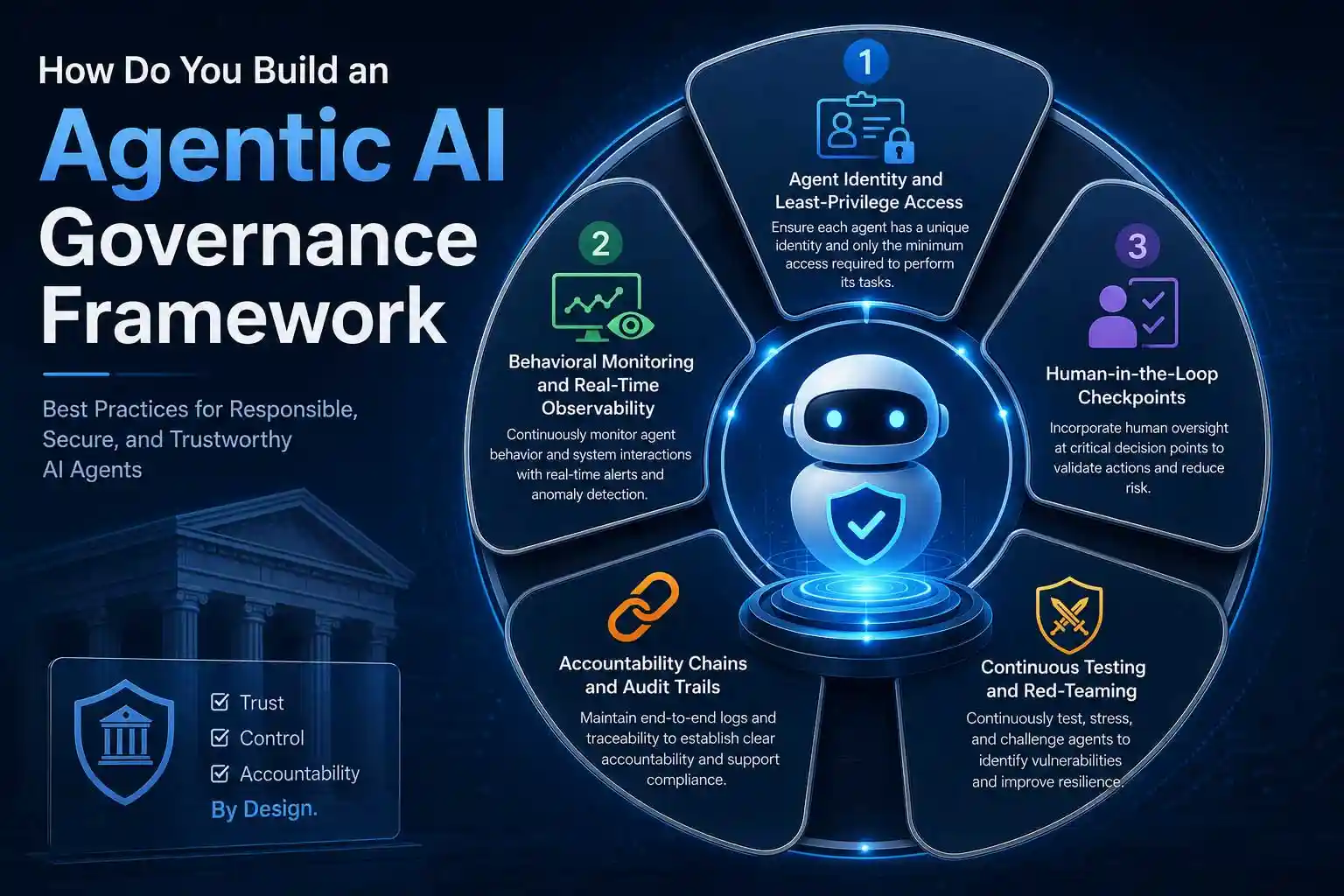

Building an agentic AI governance framework requires defining clear agent boundaries, enforcing least-privilege access, monitoring agent behavior in real time, and establishing human oversight checkpoints. Organizations must map every agent’s permissions, create accountability chains, and run continuous audits. The framework must be adaptive — not a one-time review — because autonomous AI systems act at machine speed.
How Do You Build an Agentic AI Governance Framework That Actually Works?
Autonomous AI is no longer a future concept. It is running inside enterprise systems right now, booking meetings, writing code, processing invoices, and managing customer service queues without pausing to ask for permission at each step. This is exciting, but it also creates a governance problem that most organizations are not fully prepared to handle. The shift from AI that advises to AI that acts is one of the most significant transitions in enterprise technology, and the controls required to manage it are fundamentally different from anything that came before. If you want to understand how building secure and scalable AI-driven solutions fits into this picture, the Bantech Solutions AI services page provides useful context on what responsible AI implementation looks like in practice. Getting governance right from the beginning is not optional. It is what determines whether your agentic AI investment creates lasting value or quietly accumulates risk.
Why Traditional AI Governance Falls Short
For the past several years, most enterprise AI governance programs focused on a relatively contained problem: making sure that predictive models were accurate, fair, and explainable. You trained a model, validated it, deployed it, and then monitored its outputs. There were review cycles, documentation requirements, and periodic audits. Human beings remained at the center of every consequential decision.
Agentic AI breaks that model entirely. These systems do not just generate recommendations. They plan, they call external APIs, they spawn sub-agents, they retrieve data from connected systems, and they execute actions that have real-world consequences. An agent helping with procurement might automatically generate a purchase order, submit it to a vendor portal, and log the transaction in an ERP system — all within seconds, and all without a human reviewing each step.
The governance frameworks designed for static, recommendation-generating AI simply cannot keep pace with this kind of behavior. They were built around the idea of reviewing outputs after the fact. Agentic systems require governance that operates in real time, at the level of individual actions, not aggregate model decisions.
This is not about replacing the governance work you have already done. It is about adding a new layer on top of it — one that shifts attention from validating answers to controlling actions.
The Five Pillars of an Effective Agentic AI Governance Framework
Building a governance framework for agentic AI is not a single project. It is an operating model — a continuous set of practices, controls, and accountability mechanisms that evolve as your agent deployments grow. There are five core pillars that every organization needs to get right.
1. Agent Identity and Least-Privilege Access
Every AI agent that operates in your environment must have a defined identity. This sounds straightforward, but in practice many organizations deploy agents using broad service accounts, shared credentials, or administrator-level access tokens that were originally created for a different purpose. This creates what security professionals call privilege drift, where an agent accumulates more access than it needs over time, creating a significant attack surface.
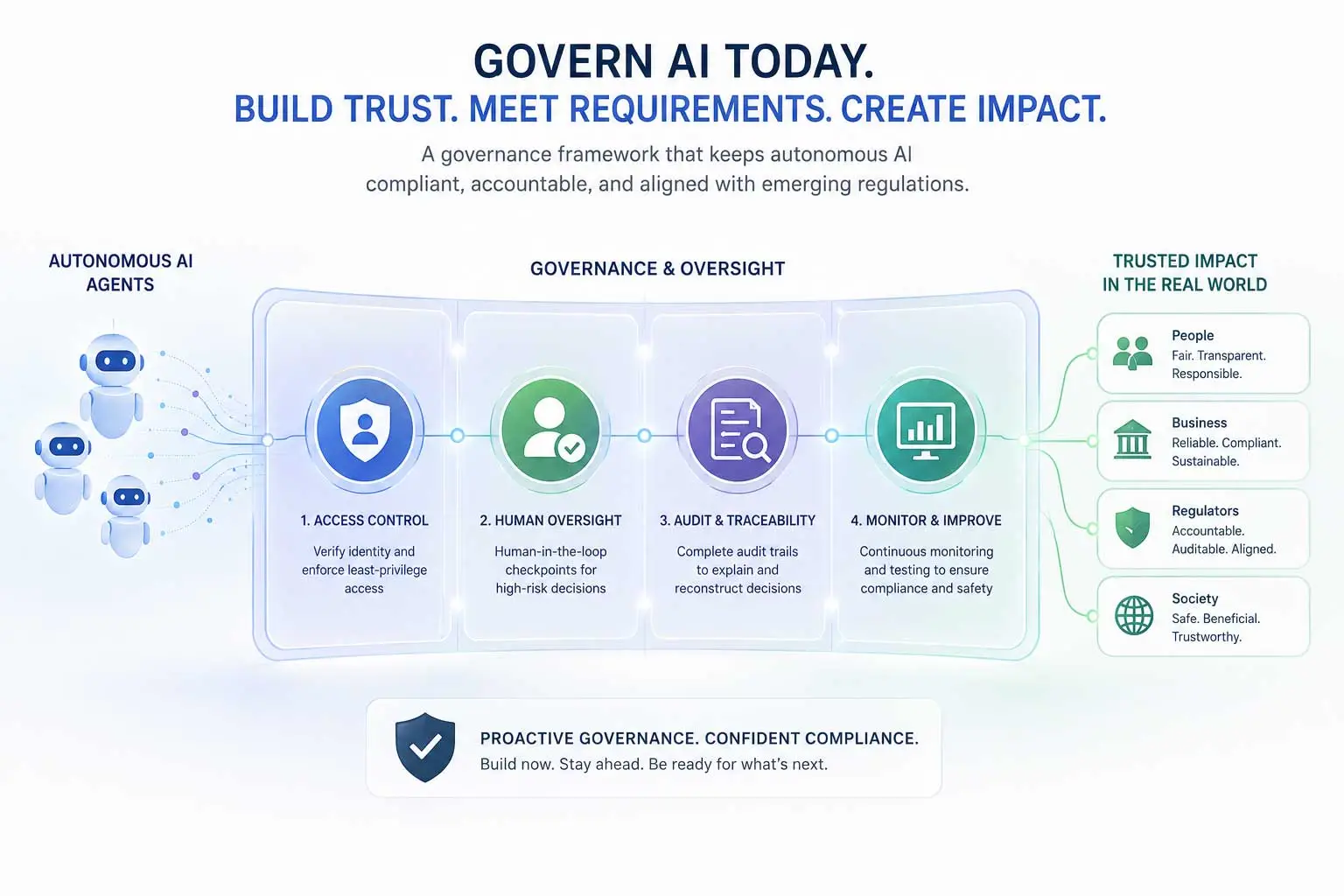
Effective governance starts by treating every agent like a distinct principal in your identity management system. Each agent should have its own unique identifier, its own scoped credentials, and a permissions profile that grants access to exactly what it needs to perform its specific function — nothing more. When an agent finishes a task, its tokens should expire. When its role changes, its permissions should be updated immediately.
This least-privilege approach is one of the most effective ways to prevent unauthorized actions. When an agent can only access the systems and data it legitimately needs, the potential blast radius of any failure or compromise is dramatically reduced.
2. Behavioral Monitoring and Real-Time Observability
One of the biggest challenges with agentic AI is that traditional infrastructure monitoring was not designed to capture what these systems actually do. Standard logs track things like HTTP responses, API call latency, and database queries. What they typically miss is the cognitive layer — the moment an agent revises its goal, chains together an unexpected sequence of tools, or retrieves memory that changes its downstream behavior in ways that could have governance implications.
Effective agentic AI governance requires a telemetry approach that captures both operational events and what researchers now call cognitive events. This includes tracking when an agent sets or revises its objectives, when it invokes external tools, when it spawns sub-agents, and when it escalates to a human operator. Without this level of visibility, your governance program is essentially blind to the processes that matter most.
The practical implication is that organizations need to instrument their agent deployments with purpose-built observability tooling, not just repurpose existing application performance monitoring tools. This investment pays for itself quickly because it is also the foundation of your audit trail, which becomes increasingly important as regulatory scrutiny of autonomous AI systems grows.
3. Human-in-the-Loop Checkpoints
One of the most common mistakes organizations make when deploying agentic AI is treating human oversight as a performance tax — something to minimize or eliminate in the name of efficiency. This is exactly backwards. Well-designed human oversight is not a bottleneck. It is what allows you to deploy agents with confidence, because you know that consequential decisions can be paused, reviewed, and corrected.
The key is designing oversight checkpoints strategically rather than applying them uniformly. Not every agent action needs human review. Routine, low-stakes actions — sending a meeting invitation, pulling a report from a database, formatting a document — can run autonomously without meaningful risk. But actions that are high-value, irreversible, or outside the normal operational envelope should trigger an escalation to a human.
What defines “high-value” and “irreversible” will be different for every organization and every use case. The governance framework should include a risk classification process that maps specific agent capabilities to oversight requirements. This gives developers and operations teams clear guidance, and it gives executives and compliance officers confidence that the organization is not relying entirely on the agent to police its own behavior.
4. Accountability Chains and Audit Trails
When an autonomous agent makes a decision that causes a problem — a vendor overpayment, a data access violation, a customer communication that went out at the wrong time — one of the first questions anyone asks is: who is responsible? In a traditional software environment, this question has a clear answer. In an agentic AI environment, the answer is often murky.
Effective governance requires establishing accountability chains before agents are deployed, not after something goes wrong. This means documenting who owns each agent, what that agent is authorized to do, how its behavior is logged, and what the escalation path looks like when something falls outside its defined scope. Every agent deployment should have a named human accountable for its behavior in the same way that a software system has an owner.
The audit trail requirements flow directly from this accountability structure. Every consequential agent action — particularly those that involve sensitive data, financial transactions, or communications with external parties — should be logged with enough detail to reconstruct exactly what happened and why. This is not just good practice from a risk management perspective. It is increasingly a legal and regulatory requirement. The European Union AI Act’s high-risk AI obligations took effect in 2026, and organizations operating in affected markets need audit-ready records of how their autonomous systems behave.
5. Continuous Testing and Red-Teaming
Static governance is not governance. An agentic AI system that passed your controls assessment six months ago may behave very differently today if the underlying model has been updated, if new tools have been connected to it, or if the business context in which it operates has changed. Governance frameworks for autonomous AI must include continuous testing practices that actively probe for failure modes, not just confirm that everything is working as expected.
This includes regular behavioral testing to confirm that agents stay within their defined scope, adversarial red-teaming exercises that attempt to manipulate agents into unauthorized actions, and automated policy compliance checks that run continuously in production. For organizations using third-party agent platforms, it also means reviewing the security and governance practices of vendors whose infrastructure your agents depend on.
Red-teaming for agentic AI is a relatively new practice, but it is rapidly becoming a baseline expectation. Frameworks like OWASP’s Top 10 for Agentic Applications identify specific attack vectors — including goal hijacking, tool misuse, and memory poisoning — that need to be tested against before deployment and on an ongoing basis thereafter.
Moving from Pilot to Production: What Changes at Scale
Most governance discussions focus on individual agent deployments. But the harder problem is what happens when you move from running three or four agents in a controlled environment to operating dozens or hundreds of agents across multiple business functions. At that scale, governance cannot be artisanal. It has to be systematic.
This is where the governance operating model becomes as important as the individual controls. Organizations that succeed at scaling agentic AI governance typically do a few things consistently well. They create a centralized agent registry — a catalog of every deployed agent, its identity, its permissions, its owner, and its risk classification. They establish a standard onboarding process that all new agent deployments must go through before they touch production systems. They build policy-as-code practices that allow governance rules to be enforced programmatically rather than through manual review. And they create escalation protocols that are actually used, rather than documented on paper and forgotten.
The organizational dimension matters just as much as the technical one. Governance programs that live only in the IT or security team tend to miss business context. Programs that live only in the business tend to miss technical risk. The most effective governance structures are cross-functional, bringing together IT, security, legal, compliance, and the business owners who actually understand what their agents are doing and why.
Common Mistakes That Undermine Governance Programs
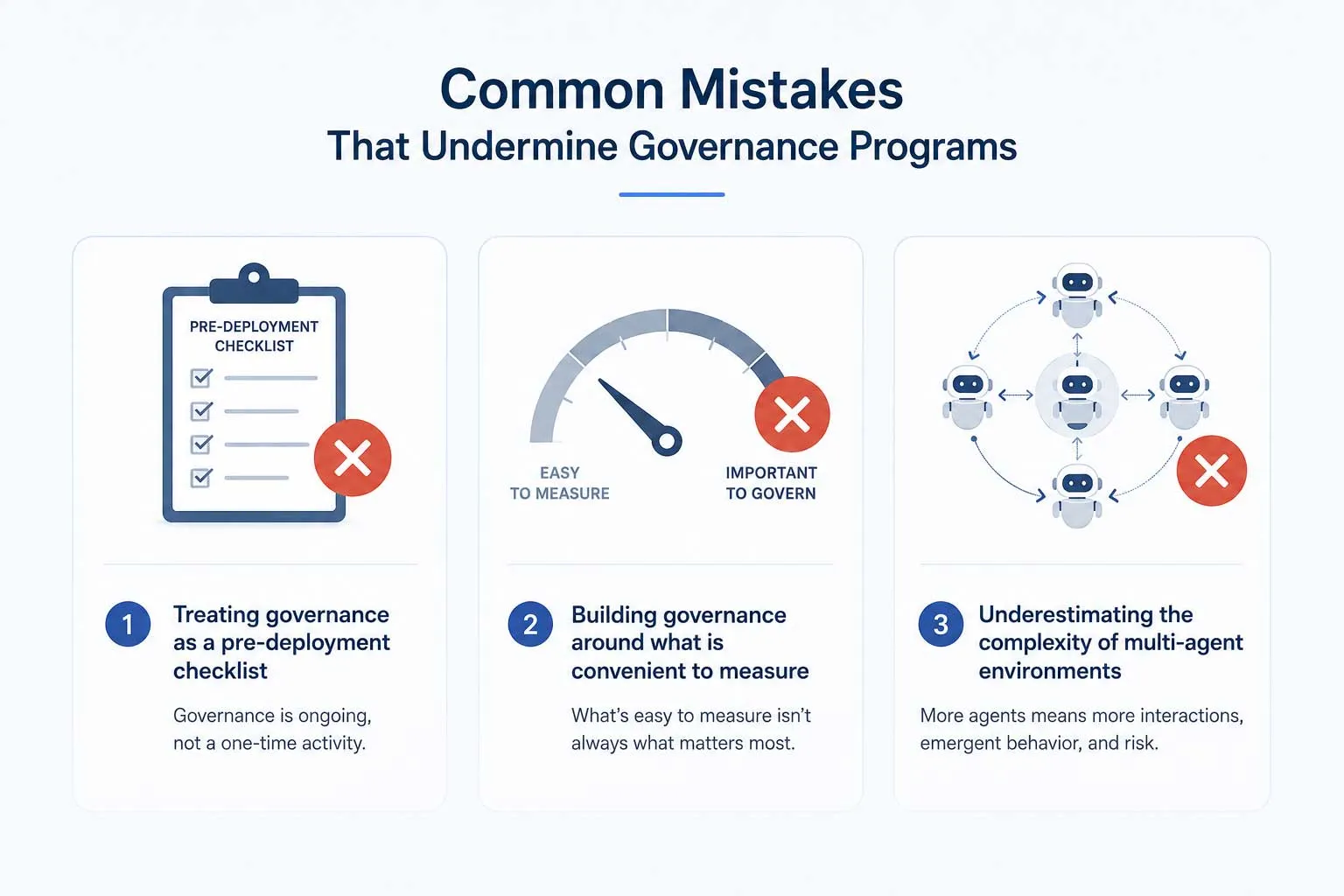
Even organizations that invest seriously in agentic AI governance often fall into a few recurring traps. Understanding these failure patterns can save considerable time and prevent significant risk exposure.
The first is treating governance as a pre-deployment checklist rather than an ongoing operating model. An agent that was properly governed at launch can become a governance liability over time if no one is actively monitoring its behavior, reviewing its permissions, or updating its oversight requirements when the business context changes.
The second is building governance around what is convenient to measure rather than what actually matters. It is easy to track API call volumes, error rates, and response times. It is harder — but much more important — to track whether an agent is behaving within its defined scope, whether its actions align with its stated purpose, and whether the humans nominally overseeing it are actually reviewing what it does.
The third is underestimating the complexity of multi-agent environments. When a single orchestrator agent coordinates five or more specialist sub-agents, each of which may have its own access permissions, tool connections, and behavioral tendencies, the governance surface area grows non-linearly. Organizations that govern each agent in isolation often discover too late that the interactions between agents create emergent behaviors that no individual governance review would have caught.
The fourth mistake is confusing model governance with agent governance. A model that has been extensively tested and evaluated for bias, accuracy, and safety is not the same as an agent built on that model. The model’s behavior in isolation may be well understood. Its behavior when given persistent memory, tool access, and a mandate to accomplish multi-step goals in a dynamic environment is a separate and more complex question.
Aligning with Emerging Regulatory Requirements
The regulatory landscape around autonomous AI is moving quickly, and organizations building agentic AI governance frameworks need to design with compliance in mind from the start. The EU AI Act’s requirements for high-risk AI systems are now in effect, with broad implications for any organization deploying autonomous systems that affect consequential decisions in areas like employment, credit, healthcare, or public services. The Colorado AI Act similarly imposes obligations on organizations using AI in high-risk decision-making contexts within the state.
Beyond specific regulations, the broader trajectory is clear: regulators expect organizations to be able to demonstrate that their autonomous AI systems operate within defined parameters, that human oversight is meaningful rather than nominal, and that audit trails are sufficient to reconstruct the basis for consequential decisions. Organizations that build governance programs now — before they are compelled to by a regulatory finding or an incident — will be significantly better positioned than those that wait.
The IAPP’s resource on AI governance in the agentic era offers a thorough look at the evolving regulatory landscape and the specific guardrails privacy professionals should be building into their governance programs.
Practical Steps to Get Started
If you are building or overhauling an agentic AI governance program, the starting point matters. Trying to build a comprehensive framework from scratch before deploying any agents tends to produce documentation that does not reflect operational reality. Deploying agents before any governance infrastructure is in place creates problems that are expensive to unwind.
The most practical path is iterative. Start by deploying a small number of agents in a well-contained use case, with rigorous monitoring, clearly defined ownership, and explicit human oversight at consequential decision points. Use that deployment to develop your governance practices empirically — learning what needs to be logged, where human oversight adds the most value, and what the actual risk profile of autonomous operations looks like in your specific environment.
From that foundation, build out your agent registry, your identity and access management practices, and your behavioral monitoring infrastructure as you expand deployments. Treat every governance artifact you produce — every policy document, every risk classification, every audit log structure — as a living document that needs to evolve as your understanding of agentic AI deepens.
Bantech’s analysis of AI-powered software development in 2026 makes a useful point that applies directly here: the value of AI comes not from replacing human judgment but from combining intelligent automation with human expertise. That principle is the foundation of effective agentic AI governance. The goal is not to constrain what your agents can do. It is to create the conditions under which they can do it safely, accountably, and at scale.
The organizations that get this right will have a genuine competitive advantage — not just because their agents are more capable, but because they can deploy them faster, expand their scope more confidently, and respond to problems more effectively when they arise. Governance is not what slows down agentic AI. Done well, it is what makes agentic AI actually work.
For a deeper look at how leading organizations are structuring their governance programs at scale, IBM’s detailed Agentic AI Governance Playbook walks through the operational model shifts required to move from experimentation to enterprise-wide deployment responsibly.
Continue reading the Complete Agentic AI Series
This post is a part of the Agentic AI Content Series — the complete 10 article series to understanding, implementing, and scaling Agentic AI in your organization.